Showing posts with label BB & Computing. Show all posts

Sunday, April 24, 2022

On the Differences between Artificial and Natural Minds: Another version of my intellectual biography

A couple weeks ago Tyler Cowen’s Emergent Ventures announced an interest in funding work in artificial intelligence (AI). I decided to apply. The application was relatively short and straightforward: Tell us about yourself and tell us what you want to do. So that’s what I did. I ended up recounting my intellectual career from “Kubla Khan” to attractor nets.

So, I’ve reproduced that narrative below, except for the final paragraph where I ask for money. It joins the many pieces I’ve written about my intellectual life. I list most of them, with links, after the narrative.

* * * * *

In a recent interview with Karen Hao, Geoffrey Hinton proclaimed, “I do believe deep learning is going to be able to do everything” (MIT Technology Review, 11.3.2020). His faith is rooted in the remarkable success of deep learning in the past decade. This notion of AI omnipotence has deep cultural roots (e.g. Prospero and his magic) and is the source of both wild techno-optimism and apocalyptic fears about future relations between AI and humanity. Momentum seems to be on Hinton’s side. I believe, however, that by establishing a robust and realistic view of the actual difference between artificial and natural intelligence, we can speed progress by tamping down both the hyperbolic claims and the fears.

In the 2010s I employed a network notation developed by Sydney Lamb (computational linguistics) to sketch out how salient features in the high-dimensional geometry of complex neurodynamics could map into a classical symbolic system. (Gary Marcus argues that Old School symbolic computing is necessary to handle common sense reasoning and complex thought processes.) My hypothesis is that the highest-level processes of human intelligence are best conceived in symbolic terms and that Lamb’s notation provides a coherent way of showing how symbols can impose high-level organization on those “big vectors of neural activity” that Hinton talks about.

Here is a quick account of how I arrived at that hypothesis.

For my Master’s Thesis at Johns Hopkins in 1972 I demonstrated that Coleridge’s “Kubla Khan” was a poetic map of the mind, structured like a pair of matryoshka dolls, each nested three deep. It “smelled” of an underlying computational process, nested loops perhaps. Over a decade later I published that analysis in Language and Style (1985) – at the time perhaps the premier journal about language and literature.

In 1973 I started studying for a PhD in English at SUNY Buffalo. The department was in the forefront of postmodern theory and known for its encouragement of interdisciplinary boldness, with Rene Girard, Leslie Fiedler, Norman Holland and several prominent postmodern writers on the faculty. There I met David Hays in the linguistics department. He had led the RAND Corporation’s team on machine translation in the 1950s and 1960s and later coined the term “computational linguistics.” I joined his research group and used computational semantics to analyze a Shakespeare sonnet, “The Expense of Spirit.” I published that analysis in 1976 in the special 100th anniversary issue of MLN (Modern Language Notes) – an intellectual first. Much of my 1978 dissertation, “Cognitive Science and Literary Theory,” consisted of semi-technical work in knowledge representation, including the first iteration of an account of cultural evolution that Hays and I would publish in a series of essays in the 1990s.

Prior to meeting Hays I had been attracted by a 1969 Scientific American article in which Karl Pribram, a Stanford neuroscientist, argued that vision and the brain more generally operated on mathematical principles similar to those underlying optical holography, principles also used in current convolutional neural networks. Neural holography played a central role in a pair of papers Hays and I published in the 1980s, “Metaphor, Recognition, and Neural Process” (American Journal of Semiotics, 1987), and “The Principles and Development of Natural Intelligence” (Journal of Social and Biological Structures, 1988). Drawing on a mathematical formulation by Miriam Yevick, both papers developed a distinction between holographic semantics and compositional semantics (symbols) and argued that language and higher cognitive processes required interaction between the two.

I spent the summer of 1981 working on a NASA project, Computer Science: Key to a Space Program Renaissance, leading the information systems group. I left the academic world in 1985 – I’d been on the faculty of the Rensselaer Polytechnic Institute – and collaborated with Richard Friedhoff on a coffee-table book about computer graphics and image processing, Visualization: The Second Computer Revolution (Abrams 1989). During this period Hays and I began publishing our articles on cultural evolution, beginning with “The Evolution of Cognition” (Journal of Social and Biological Structures, 1990). We argued that the development of a major new conceptual instrument, such as writing across the ancient world, enabled a new cognitive architecture, and that new architecture in turn supported new modes of thought and invention. When Europe had fully absorbed positional decimal arithmetic from the Arabs, the result was a new conceptual architecture which enabled the scientific and industrial revolutions and indirectly, the novel. The twentieth century saw the development of the computer, first conceptually, and then implemented in electronic technology at mid-century. Another new cognitive architecture emerged, but also modernism in the arts.

At the end of the 1990s I entered into extensive correspondence with Stanford’s Walter Freeman about complex neurodynamics. That work became central to the account of music I developed in Beethoven’s Anvil: Music in Mind and Culture (Basic Books, 2001). Meanwhile literary scholars were finally discovering cognitive science. I jumped back into the fray and published several articles, including a general theoretical and methodological piece, “Literary Morphology: Nine Propositions in a Naturalist Theory of Form” (PsyArt: An Online Journal for the Psychological Study of the Arts, 2006). I argued, among other things, that literary form could be expressed computationally in the way that, say, parentheses give form to LISP expressions. My early work on “Kubla Khan” and “The Expense of Spirit” exemplifies that notion of computational form, which I also discussed in “The Evolution of Narrative and the Self” (Journal of Social and Evolutionary Systems, 1993). Over the last two decades I have described and analyzed over 30 texts and films from this perspective, though most of that work is in informal working papers posted to Academia.edu where I rank in the 99.9 percentile of publications viewed.

I am now who knows how many miles into my 1000-mile journey. The full range of the work I’ve done over a half century, all of it with computation in mind – language, literature, music, cultural evolution ¬– remains open for further exploration. I am now ready to make significant progress on the problem that started my journey: the form and semantic structure of “Kubla Khan.” In so doing I intend to clarify the difference between natural and artificial intelligence.

“Kubla Khan” is one of the greatest English-language poems and has left its mark deep in popular culture. It has a rich formal structure and through that draws on the full range of human mental capacities. By explicating them I will propose a minimal, but explicit, set of capabilities for a truly general intelligence and show how they work together to produce a coherent object, a poem. I expect to show – though I can’t be sure of this – that some of those capacities are beyond the range of silicon.

I undertake to do so, not to save the human from the artificial, but to liberate the artificial from our narcissistic investment in it - the tendency to project our fears of the unknown and anxieties about the future onto our digital machines. Only when we have clarified the difference between natural and artificial intelligence will we be able to assess the potential dangers posed by powerful artificial mentalities. Artificial intelligence can blossom and flourish only if it follows a logic intrinsic and appropriate to it.

As futurist Roy Amara noted: We tend to overestimate the effect of a technology in the short run and underestimate the effect in the long run. So it is with AI. Fear of human-level AI is short-term while the transformative effects of other-than-human AI will be long term.

I don’t intend to craft code. I’m looking to define boundaries and mark trails. I have spent a career examining qualitative phenomena and characterizing them in terms making them more accessible to investigators with technical skills I lack. I seek to provide AI with ambitious and well-articulated goals that are richer rather than simply “bigger and still bigger.”

* * * * *

The break – How I ended up on Mars

Here’s one way I’ve come to think about my career: I set out to hitch rides from New York City to Los Angeles. I don’t get there. My hitch-hike adventure failed. But if I ended up on Mars, what kind of failure is that? Lost on Mars! Of course, it might not actually be Mars. It might be an abandoned set on a studio back lot. Ever since then I’ve been working my way back to earth.

This material is about how I ended up on Mars while on the way to LA. That is, it is about I set out to analyze “Kubla Khan” within existing frameworks but ended up outside those frameworks.

Touchstones • Strange Encounters • Strange Poems • the beginning of an intellectual life https://www.academia.edu/9814276/Touchstones_Strange_Encounters_Strange_Poems_the_beginning_of_an_intellectual_life

This is about my undergraduate years at Johns Hopkins and my years as a master’s student in the Humanities Center, where I wrote my thesis on “Kubla Khan.” This is how I became an independent thinker with my own intellectual agenda. Among other things, I talks about the role that some altered mental states – two having nothing to do with drugs, one about and LSD trip (that wasn't trippy in the standard sense) – in my early intellectual development. If you read only one of these pieces, this is the one.

Into Lévi-Strauss and Out Through “Kubla Khan”
https://new-savanna.blogspot.com/2013/08/into-levi-strauss-and-out-through-kubla.html

This is a story told in diagrams, about how I went from Lévi-Strauss style structuralism to the computationally inspired semantic networks of cognitive science. Read this second.
Monday, November 13, 2017

My 1985 Visualization Manifesto: The Visual Mind and the Macintosh [#DH #Visualization]

Sometime in 1984 my friend Rich sent me a letter he had written on someone’s Macintosh computer. I forget what it said, and that doesn’t matter. What matters is that it had graphics and text on the same page from the same machine. I was blown away.

I immediately forked out, I believe, $4400 for one of those original Macs, I may even have gotten one of the first 100,000. That 4K got me a Mac, an external floppy drive, a dot matrix printer, and a carrying case. I took me awhile to get used to the mouse, but I loved it. And I loved making images.

Meanwhile I’d been reading reviews that said, nice box, not enough oomph for the $$, MacPaint’s nice, but so what? Those blockheads obviously didn’t get it. So I wrote a longish letter to Byte Magazine, then perhaps the premier magazine for personal computing, in which I said those guys were wrong because, Visual Thinking.

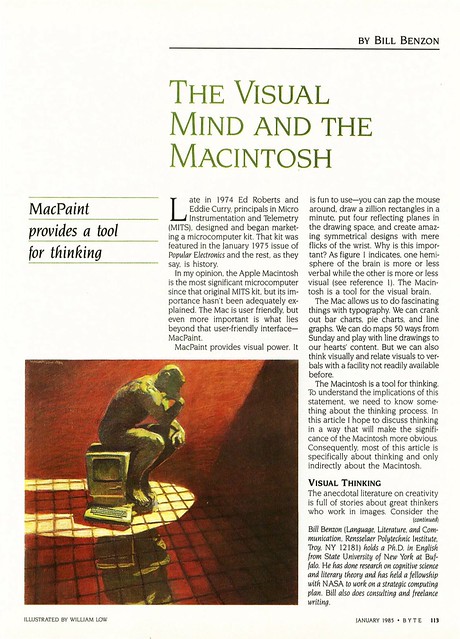
The good folks at Byte loved the letter, but said it was too long to print as a letter and not long enough for an article. I proposed to 1) edit it down to letter size and 2) to expand it to an article. They accepted my proposal. The article included a bunch of images I prepared on my Mac and was entitled “The Visual Mind and the Macintosh” and appeared in Vol. 10, No. 1, January 1985, pp. 113-130. Here’s the first page:

BYTE_VisMindMac FirstPage

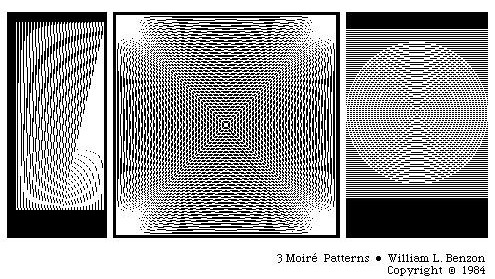
And here’s one of the images:
Moire Trio

Alas, the rest of the images are lost to me as a result of changes in the operating system. I don’t even know if I’ve got them kicking around somewhere on my hard drive. Of course, they originally lived on a 3 1/4 inch floppy disk, but I transferred most/all of those to my hard drive when I got one sometime in the 1990s. But then Apple switched to Intel chips and I lost access to a bunch of files.

Thursday, March 2, 2017

The physicality of computing

Intuitions are very important; they are the foundations of our thinking. But explaining or even merely “grasping” our intuitions is difficult. This is a story about my intuitions about computing. Lightly edited from a recent email:

My programming skills are minimal; and I’ve never done more the small example programs and that was long ago. These days I hand-code my posts, but that’s not programming.

But I’ve spent a lot of time thinking about computing. Back in the 1970s I studied computational semantics under David Hays, who was one of the first generation workers in machine translation. One of the things he impressed on me was the computation, real computation, is a physical process and thus subject to physical constraints. Too much talk about computation and information and the like treats them as immaterial substances, Cartesian res cogitans. Back in those days I bought a textbook on microprocessor design and read through several chapters. Of course what I got out of the exercise was not very deep, but it wasn’t trivial either.

Eventually I bought my first microcomputer, a North Star Horizon (this was before the days of the IBM PC). And I got a content-addressed memory board manufactured by a small (and now defunct) company started by Sidney Lamb (another first-generation MT researcher). One day the display on my computer went kerflooey (not exactly a technical term). Well, I knew that video-display boards had a synch-generator chip and it seemed to me that the problems I was having might have been caused by trouble with that chip. So I examined the circuit diagram for the video board and located the synch-generator. And then opened the box, removed the board, located the synch-generator, and reseated it. When I replaced the board and turned on the machine, the display was working fine. It’d guessed right.

That was years ago but I still remember it. Why? Because that gave me a tangible sense of the physicality of this information processing stuff. And I think all features of the story are important:
1) reading a text on microprocessor design,
2) somewhere reading about synch-generators,
3) having a problem with my machine and guessing about it’s nature,
4) consulting a circuit diagram of one board in my machine,
5) removing the board,
6) locating the chip on it,
7) reseating the chip,
8) reassembling the machine, and
9) testing it.
It’s all part of the same story. And that’s a story that informs my sense of the physicality of computing. I had to think about what I was doing at every step along the way.

That’s very different from simply believing that whatever happens in your computer is physical because, well, what else could it be? But I don’t know just how I’d characterize the knowledge I got from that experience. It’s not abstract. I hesitate to say that it’s deep or profound. But it’s very very real.

Sunday, November 22, 2015

Personal Observations on Entering an Age of Computing Machines

Another working paper, link, abstract, and introduction below.

Academia.edu: https://www.academia.edu/18791499/Personal_Observations_on_Entering_an_Age_of_Computing_Machines

* * * * *


Abstract: This recounts my history with personal computers, from a Z80 machine in 1981 through my Macintosh PowerBook Pro Retina today. I discuss the machines themselves, how I use them, the man-machine interface, and how computing has changed the way I work and afforded me new possibilities. Working as an independent scholar, the Internet has given me an intellectual life that would have otherwise been impossible. I have easy access to reference materials, to other scholars, and publishing opportunities that aren’t encumbered by old modes of thought or by the limitations of print publication.

CONTENTS

Computers and Me: What We Have and Haven’t Done 2
Academic Publishing, A Personal History 1: An Outside Move 6
Academic Publishing, A Personal History 2: To the Blogosphere and Beyond 12
I’m Lost in the Web & Digital Humanities is Sprouting All Over 21
The Diary of a Man and His Machines, Part 1: The 20th Century 24
The Diary of a Man and His Machines, Part 2: How’s this Stuff Organized on My Machines? 29
The Diary of a Man and His Machines, Part 3: The 21st Century 32
Have The Internets Rotted My Brain and Wrecked My Mind? 41
Finger Knowledge, A Note About Me and My Machines 50

My Computers and Me: What We Have and Haven’t Done

When I was born a few years after the end of World War II, “computer” likely referred to a person, that person was more likely than not a woman, and she performed calculations for a living. Yes, there were computing machines at the time – and I don’t mean mechanical calculators, but electronic computing machines ¬– but they were few and far between. They were also very large and expensive.

Electronic Brains

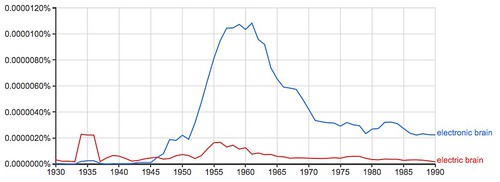
And they were sometimes called “electronic brains” a usage that, according to this Ngram chart, peaked around 1960:

electronic brain

By that time they were common enough that they would show up in the news in various ways. One of those ways was in news and propaganda about the Cold War. Who had the best computers, us or the Russians?

Thus I remember reading an article, either in Mechanix Illustrated or Popular Mechanics – I read both assiduously – about how Russian technology was inferior to American. It had a number of photographs, one of a Sperry Univac computer – or maybe it was just Univac, but it was one of those brands that no longer exists – and another, rather grainy on, of a Russian computer and taken from a Russian magazine. The Russian photo looked like a slightly doctored version of the Sperry Univac photo. That’s how it was back in the days of electronic brains.

When I went to college at Johns Hopkins in the later 1960s one of the minor curiosities in the freshman dorms was an image of a naked woman ticked out in “X”’s and “O”’s on computer print-out paper. People, me among them, actually went to some guy’s dorm room to see the image and to see the deck of punch cards that, when run through the computer, would cause that image to be printed out. Who’d have thought, a picture of a naked woman – well sorta’, that particular picture wasn’t very exciting, it was the idea of the thing – coming out of a computer. These days, of course, pictures of naked women, men too, circulate through computers around the world.

Two years after that, my junior year, I took a course in computer programming, one of the first in the nation. As things worked out, I never did much programming, though some of my best friends make their living at the craft. But I’ve been interested in computers and computing in one way or another for a bit over half a century and have invested a lot of time and energy in the idea that the human mind is computational in some fundamental sense.

Intellectual Appliances

But that’s not what this collection of posts is about. It’s about something a bit less exotic. The first two posts are about how I’ve used my personal computers, hooked to the Internet, as a vehicle for interacting with others and for publishing my ideas. Two more recent posts give a capsule history of the computers I’ve owned, from a NorthStar Horizon in the early 1980s to the MacBook Pro (with Retina screen) I’m using to write (and post) this introduction. In between these two pairs of posts is a somewhat shorter post about how using a computer has affected my style of working with words.

Tuesday, October 27, 2015

Finger Knowledge, A Note About Me and My Machines

A couple of months ago, before I got my new machine, two keys on my keyboard failed. First the left Shift key failed, and then the left Command key (on a Macintosh). Both are important frequently used keys. But, as there are two of each, I decided not to get a new keyboard – who knows, maybe they’d come back.

Continuing one, of course, meant that I had to change my keyboarding habits, which I figured I could do. The fact is, though I’m a semi-competent touch typist, I never really got competent secretary-class good. Though I do a lot of writing, I never go for long stretches of flat-out typing. So, while changing my keyboarding habits was a PITA, it was no more than that.

It was an inconvenience, not a disaster.

But it meant that I actually had to think about what my fingers were doing while typing. I couldn’t simply let them go on autopilot. And I had to think about just what workarounds I’d use for various situations. For example, you need the Left Shift key to type a capital “i” or to type left and right parentheses, each of which I use fairly often. Now what do I do?

What I did isn’t important. What I’m getting at is that, now that I’ve got a fully functioning keyboard, I’ve got to erase those workarounds. And that takes conscious thought and effort. I couldn’t just flip some mental switch – zhupp! – and go back to the old routines.

It seems that, in order to learn these new routines, I had to “erase” those old routines. So, now I’ve got to erase the new routines and consciously “relearn” the old routines. And I’m particularly aware of that as I type this note.

That”s what interests me. That’s what this post is about. That mental threshold between being able to switch back and forth between two ways of doing something and having to learn, unlearn, and relearn “low level” routines. I’m sure that has to do with how the nervous system works, but I don’t want to think very hard about that and the moment.

I’m pretty sure that I could be a piece of software that would remap my keyboard to the more physically efficient Dvorak mapping – for all I know, something like that might actually be an option somewhere in the Mac OS operating system. If I did that I would have to expend considerable effort to learn to use that mapping. Let’s imagine that I did so. Would I then be able to “turn it off” and will and return to the standard mapping. Or would I have to “relearn” the standard mapping, just as I am, to some extent, relearning the standard uses of Left Shift and Left Command keys?

I don’t know.

Orchestral trumpet players have to do something like that. When you learn to read trumpet music you learn a certain mapping between the written notes and the (right hand) finger action – which of the three valves do you depress? – you need to execute that note. But there are times when you might want to play every note consistently higher or lower than what’s written. To do this you need to learn a different mapping between the written notes and your finger actions.

Sure, you can “calculate” in your mind what you have to do. And if the music you are playing is simple enough, this will rework. But there are situations where that’s not fast enough. To cope with those situations you need to learn a new mapping. Orchestral and other “legit” trumpet players do it all the time.

I’ve never learned to do that, because I’ve never needed the skill. How do these trumpeters keep the different mappings separate in their minds? How do they keep from slipping into the wrong mapping? If they played while drunk, would they slip?

Interesting questions.

Monday, October 19, 2015

My Mind and the Machine @3QD

I decided to do something a bit different this time out on 3 Quarks Daily, I decided to indulge myself and write a personal essay – about me! It’s well over a decade that I’ve been reading articles about how the internets are rotting our kids minds: they’re distractible and flit endlessly from bitty little thing to little bitty thing, can’t go for the long-haul essay, New Yorker style, much less a book, oy vey! Well, I’m in the intertubes hours upon hours day after day, I go light on long-form essays – though if one really grabs me, I’ll read it – but I don’t read many books any more.

That’s my starting point. Don’t read books because the web has warped my mind. I don’t believe it of course, but a boy’s got to start somewhere, doesn’t he?

There’s another reason I chose that as my starting point, and I go into this in my essay. Back when I was in graduate school (reading two novels a week, plus secondary literature) – it was in the TV room and library at the house in Allentown – my father told me that he no longer enjoyed reading novels. I’m sure we must have had a little conversation about that, but I don’t remember what we said. My father had loved to read at one time, had a decent library (and an excellent collection of books about golf) and read literary classics to me at bedtime. I assume that he found this lack of interest a bit puzzling, which is why he mentioned it to me, his son who was in effect getting a graduate degree in reading (English literature).

Like father like son it would seem. That’s the premise of my current 3 Quarks Daily post: Have the Internets Rotted My Brain and Wrecked My Mind? Things happen to your mind on the far side of 60, though just what and why is a bit of a mystery.

Wednesday, October 14, 2015

The Diary of a Man and His Machines, Part 3: The 21st Century

As I’ve previously indicated, I finished out the previous century with a G3 MacIntosh in the tower configuration and having a (relatively small) LCD monitor – no more big hunks of glass and heavy electromagnets for me. That machine lasted until 2004 or 2005. It didn’t flat-out die on me, but it started getting cranky. I decided to replace it with a laptop, my first.

Laptops had been around and fairly common since the early 1990s. The nature of computing technology was such that laptops were somewhat more expensive than a desktop or tower model of equivalent power. But by the mid-2000s laptops had become cheap enough that even I could afford a nice one. I opted for a 15 inch Apple PowerBook G4. Given that I had two decades of work sunk into the Macintosh platform I had little choice but to continue down that line, though I’d used Windows machines, both laptops and desktops, in various consulting and professional gigs.

I had several reasons for going with the PowerBook G4. For one thing, I really had no love for a big machines and I was now doing some work where it could make use of a nice laptop for making presentations. Moreover, since it was only the processor that had gone bad on my G3 machine, I could keep the LCD monitor and hook it up to my PowerBook.

Two monitors! Whoo hoo! Two screens at once. What’s not to like?

* * * * *

Caveat: This is one of those posts that just grew and grew beyond my original expectations. It all seemed so simple in my mind. But I decided that I really needed to talk about learning to use a mouse and related matters, and that turned out to take a bit of doing.

My G4 Laptop and Two Screens

I ordered the G4 online and had it shipped to my friend Steve, who installed some software on it and then came to my place where he transferred my data files from the G3 to the new G4. This is the first time I’d hired an expert to make the transfer for me. And I’m glad I did.

There was nothing to transfer from my NorthStar to my first Mac. For each subsequent Mac transfer simply meant loading a bunch of floppies into the new machine. But the PowerBook didn’t support floppies. So I had to make sure I’d loaded all my floppies onto the G3’s hard drive. I’m sure I got most of them, but not all of them.

Steve ported this and that from the G3’s hard-drive and I was up and running on my new laptop, with two, count ‘em, two screens.

That made a tremendous difference in how I worked. By this time I was actively cruising the Internet and often had a browser open to several web pages. When writing I often had more than one document open: the document I was working on, one or more satellite documents containing notes and text, and I often had two windows open on the same document. I might have had a graphics program running as well.

Keeping track of three, four, five or more windows on one screen was a bitch. Two screen made things much easier – not ideal, mind you, but more manageable. The old LCD monitor only lasted a year or three before I had to replace it. I got a 20-inch Apple Cinema monitor, which was much larger than that old monitor (which was 13 or 15 inches, I forget which). I was a happy camper.

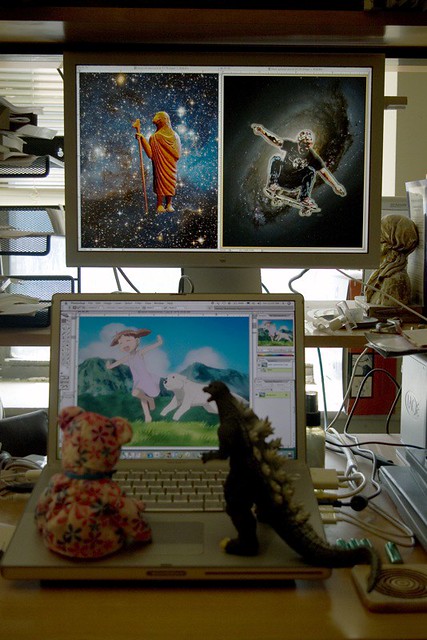
Here’s that setup:

scoping it out.jpg

You see the Cinema monitor up above and the PowerBook below. As for the two creatures on the PowerBook – that’s Sparkychan on the left and Gojochan on the right – there’s an interesting story there, but it would be something of a distraction for me to recount it here. Let’s just say that that photo was one of many I took in the process of telling a story to a couple of very young girls in Japan, daughters of one of my online friends (this post discusses that adventure in somewhat more detail: The Freedoniad: A Tale of Epic Adventure in which Two BFFs Travel the Universe and End up in Dunkirk, New York).

But that dual monitor setup, as useful as it proved to be, also raises a very important issue, one I haven’t yet touched upon in this series: How do you assimilate a computer to your body? The issue has fairly profound psychological and philosophical ramifications. Right now, though, I want to discuss the practical problem, which is:
How do I move my hands and eyes in order to get things done?

Sunday, October 11, 2015

The Diary of a Man and His Machines, Part 2: How’s this Stuff Organized?

As I indicated in the previous post in this series, I’m in the process of transferring my “stuff” to a new computer, my third for this century. So, I thought I’d talk a little about how I organize my stuff, not in detail, though. I’m more or less interested in the simple fact that, after all, you have to organize things some how.

Organization wasn’t an issue for my oldest machines, the NorthStar and the “toaster” Macs, because they didn’t have hard drives. There wasn't anything on them for ME to organize. I kept all my data (and programs for the Mac) on floppy drives. Of course, I generally had more than one document on a floppy, and I’d keep the same kind of stuff on a floppy. Organizing floppies is the same kind of problem as organizing books or files. You put books on shelves and keep similar books together on the shelves. Of course, a given book might be like several others. For example, John Bowlby’s Attachment is psychology, infant behavior, primatology, and psychoanalysis. Just where it goes on the shelves depends on whatever else I’m putting on shelves. Similarly, you put files in boxes, with similar files together, or perhaps alphabetically, but alphabetically by what?

Organizing lots of stuff isn’t easy. There’s a reason library science is called a science. Organizing a library is tricky.

Well, I’ve got 30 years of work accumulated on my various machines. That’s a library. And organizing it is a b*tch.

My Performa, mid-90s, had a hard-drive. So now I could do something other than put disks in boxes. But it was a small hard-drive by today’s standards and I don’t remember anything about it. But I still had lots of floppies hanging around. And I used them.

When I got the G3 Mac I’m pretty sure I moved everything off floppies I could. Now keeping track of my hard-drive became a problem. But there’s always search. And I used it. Still do.

The thing is, when you do as much work as I do, it’s hard to keep things in order. Heck, beyond a certain point it’s hard to even know what order is. And files have accumulated at a fierce clip in the last seven or eight years, spanning my two previous machines. For one thing, I started taking photos. I’ve uploaded almost 18,000 photos to Flickr since 2006. Given that those are just photos that I’ve processed from RAW files, and that I don’t process all my RAWs, that implies that I’ve got 60,000 or more photos floating around on my machine. I’d had to think what a full-time professional photographer has to deal with.

I started blogging at The Valve in December of 2005 and wrote I don’t know how many posts until I logged off in March of 2012, but 100s. I started New Savanna in April of 2010 and have published 3450 posts so far (not counting this one); but 1083 were mostly photos, though some of those would have had a bit commentary. That’s a lot of writing, on lots of topics – literature, cognitive science, neuroscience, film and animation, music jazz jamming, Jersey City, graffiti, my life here and there, and so forth. And I’ve got notes all over the place on all those topics, drafts of papers, and other documents.

And then there’s all the material I’ve downloaded, probably thousands of papers on all those topics and more. I’ve got at least half a dozen folders filled the miscellaneous collections of downloaded stuff and each of those folders has 30 to 100 items in it. And I’ve got a nice little pile of music files, but they’re mostly tucked away in iTunes, where they have some kind of quasi-order. And I’ve even put together a few modest videos, stitching together photos to go along with sound, or even shooting a dozen or so videos of me playing trumpet.

So one of the things I’m doing while moving to this new machine is cleaning up things a bit. But I could easily devote several days, if not a week or more, to doing nothing but looking around and re-organizing. Is it worth the effort?

Saturday, October 10, 2015

The Diary of a Man and His Machines, Part 1: The 20th Century

I’ve swiped the title from Dave Hays, my teacher and later friend and colleague, who wrote a weekly column entitled, “The Diary of a Man and His Machine”. This was back in the ancient days of the previous millennium when personal computers were new and hence novel. I forget just when he bought his machine, back in 1977 or 1978 I suppose. I forget the brand – Cromemco? – but it used a Z80 CPU chip and a S-100 bus, common specs back in those days. Hays bought his machine to go into some kind of consulting business and, for awhile, he mailed out a weekly newsletter which he wrote on his computer and printed out on a daisy-wheel printer of some sort. While the Internet existed in those days, it was not open to the public and the WWW was decades in the future.

Anyhow, his newsletter consisted of things and stuff – a favorite phrase of Bill Doyle, another of Hays’s students – and one of those things, or was it stuff? – was a column in which Hays talked about this new computer of his: what the machine and its software were like, what he was doing with it, and so forth. It was a fun column, and I’m sure the hundred or two hundred of so recipients of the newsletter got pleasure out of it. These machines, after all, were so new. A computer in my home? Who’d have thought!

A couple of years later, perhaps the spring of 1981, I embarked on my own adventure in computer ownership. I took out a small loan from my bank and bought an S-100/Z80 machine, a NorthStar Horizon (that's not my individual machine, but that's the model):

NorthStar Horizon.jpg
"NorthStar Horizon" by joho345 - Own work. Licensed under Public Domain via Commons.

It had little software, if any, beyond its operating system and a version of the Basic programming language. I got it with the peculiar idea that I’d teach myself to program and write myself some useful software, maybe even a word-processor.

Ha! Yes, I’d taken a programming course as at undergraduate at Johns Hopkins in the 1980s, and did well enough in it. But I had no real passion for programming, not like my friend Rich, who lived and breathed programming. I lent the Horizon to him for a couple of months so that he could have the fun of exploring a new machine and writing me a word-processing program.

It was a nice little program. The transition from writing on a typewriter to writing with that crude word-processor was more dramatic than any tech transition I’ve been involved with since then except MacPaint, and for the web, and that was a different kind of transition. I write a lot and computerized cut-and-paste was a revelation. It made roughing and revising documents so much easier.

And when I say “crude”, I mean it. Yes, the words appeared on the screen in roughly the same geometry as they got printed on the page. But there was no fancy font stuff, either on the screen or on the printed page (low resolution dot-matrix printer), no graphics at all. Just blocks of neon green text on a black background. No columns, no footnotes at the bottom of the page, no indexes or tables of contents, none of that. Cut and past, search, and a few other operations, and that was it.

As for the Horizon, it had 32K of RAM and two 5.25 inch floppy drives for storage. The floppy disk held all of 256K of data. Pretty soon I had a big pile of floppies.

Then, in 1984, lightening struck. My friend Rich had gotten access to a Macintosh and sent me a letter which had both text and graphics on the same page. As soon as I saw that I knew I had to get one of those machines. So I went out and bought one of those first 128K Macs. As the name indicates, it had 128K of RAM, thus way more than my Horizon, and an internal disk drive that took a 3.5-inch floppy with 400K capacity. I also got an external floppy drive.

Wednesday, November 28, 2012

Academic Publishing, A Personal History, Part 2: To the Blogosphere and Beyond

Rather than pick up the story of my involvement in academic publishing where I left off in the first post, in 2006 or so after having published several long articles in PsyArt, I want to go back to the 1990s and pick up some email action. That was quite important, both for the conversations, and the people I met through those conversations. It remains an important part of my digital mix, though not so important in the overall flow of things.

Listserves: Memetics and Evolutionary Psych

Judging from the email I’ve got stashed on my computer, I joined a memetics listserve in the middle of 1997. As you may know memetics is the study of memes. I don’t know who coined the term “memetics” but Richard Dawkins coined the term “meme” as the cultural analogy to the biological gene. As I was and remain very interested in cultural evolution it was natural that I join that listserve.

An email list is not, of course, a formal means of academic publication nor is it even informal publication comparable to blogging. It’s a conversation, or can be, but not like face-to-face or telephone. On a listserve you typically have many people who receive messages but do not themselves make comments. And that means that, when you do make a comment to the list, you have no idea what most of your audience is thinking—which, of course, is just like ordinary print publication or, for that matter, digital publication as well. But the overall dynamic is one of interaction, so you and your interlocutors are, in effect, putting on a show for an undisclosed population of lurkers. Listserve conversation are also notorious for degenerating into flame wars, but that’s neither here nor there for the purposes of this post. It’s just something that happens.

But you can also have useful conversations. The memetics list gave me a good sense of the state of play in the memetics world, which is a peculiar one. Though the idea was hatched by a card-carrying academic of high order, Richard Dawkins, and has a small following in the academy (e.g. Daniel Dennett among others), it hadn’t gained traction in the academy back then—the late 1990s—and still hasn’t. Perhaps it’s a superb idea that’s just too “out there” for hide-bound academics, or perhaps it’s not such a good idea. Myself, I’m somewhere between those two views.

Saturday, November 24, 2012

Academic Publishing, A Personal History, Part 1: An Outside Move

When I entered Johns Hopkins as a freshman in the Fall of 1965 academic publication was all hard copy; back then, that was the ONLY kind of copy there was. Computers were the size of gymnasiums and the internet didn’t exist. Academic publication consisted of articles, books and this that and the other, but all on paper.

And that’s still how most of it is, especially the prestige tier. If you want to get tenure and fame at schools that prize publication, you have to publish well in the hard copy literature, books if you’re a humanist, articles otherwise.

When I set out in academia I wanted a good permanent post, at a good school, and, yes, a bit of fame, enough to help the ideas along. Things didn’t work out that way. Instead, I’ve watched, and published from outside academia.

I figure that, by the time that the old ways have crumbled, perhaps some of the fugitives will be ready to listen to what I’ve been thinking over the past three decades or so. And I’ll have lots for them to read, some of it published in the traditional way, even well published; but some of it published in non-standard ways.

But this post, and a later one, isn’t about those ideas. It’s about how I’ve published my work and how that’s been changing. In this post I go from the beginning of my career though the microfiche experiment of the American Journal of Computational Linguistics and up to yesterday (well, five years or so ago), when I published four longish articles in a new online journal, PsyArt. In a second post I’ll discuss the blogosphere and beyond.

The Old Way

My first academic publication was a page and a half in an edited volume, a comment on Neville Dyson-Hudson’s essay in Macksey and Donato, The Languages of Criticism and the Sciences of Man. That came out in 1970, when I was a master’s student in the Humanities Seminar at Hopkins. My first article, “Cognitive Networks and Literary Semantics,” came out in 1976 in the Comparative Literature issue of MLN. When the issue came out I got a packet of off-prints, copies of my article that I could give to people.

In the months following publication I received a some postcards requesting copies of my article. The postcards were mostly preprinted forms with a blank line where the name of the article and journal would be printed or scrawled. That’s how it was in those days and, presumably, going back decades before. Photocopying existed but it wasn’t so cheap and ubiquitous that scholars could routinely make photocopies of articles rather than collecting off-prints.

The system didn’t work particularly well. Even then it was clear the most articles didn’t get read and that journals were routinely backlogged. But it was what we had.