Showing posts with label Duke_Ellington. Show all posts

Thursday, March 21, 2024

ChatGPT on a Remark Leonard Bernstein Made to Duke Ellington [intention, intuition, and tacit knowledge]

I have been arguing recently that meaning consists of intentionality and semanticity, where intentionality inheres in the relationship between the interlocutors (even if they are not face-to-face and synchronous) and semanticity inheres in the linguistic/cognitive system. Semanticity, in turn, consists of relationality and adhesion, where relationality is the relationships words have among themselves and adhesion inheres in the perceptual and motor linkages words have with the external world. In this view, meaning in LLMs is a matter of relationality.

I recently performed an experiment which bears on ChatGPT’s capacity to approximate intentional meaning in a conversation. In this case, a conversation between Duke Ellington and Leonard Bernstein. Back in 1966 the two had a conversation that was televised on station WTMJ-TV. Here’s the video clip:

I wrote a blog post where I included a clip of the conversation along with commentary and transcriptions of bits here and there. At about 05:53 Bernstein remarked to Ellington: “...you wrote symphonic jazz and I wrote jazz symphonies.” The two men then shook hands.

In my commentary I wrote that the actual assertion was not very meaningful, and that both men surely knew it, but that much was conveyed indirectly. That meaning derived from the fact that both men were, in effect, acting as representatives of two cultural traditions and so Bernstein’s remark, and Ellington’s acceptance, had the weight of a cultural negotiation.

I was curious about how much of that ChatGPT would be able to pick up. So I transcribed a bit of the conversation up to that point and asked the Chatster what was going on. Here’s that interaction. My prompts are in boldface while ChatGPT's responses are plain face (except for bolded topics on numbered lists).I’ve inserted some comments which I’ve aligned to the right-hand margin and highlighted thus. At the end of the interaction I have some general remarks about ChatGPT’s performance, including some remarks about ChatGPT’s lack of intuitive or tacit knowledge.

* * * * *

In 1966 Duke Ellington and Leonard Bernstein were interviewed on television. They were asked to talk about the state of music in America. I am going to give you part of that conversation, including the interviewer, and then I want to ask you about it.

Here’s the interview:

Leonard Bernstein: As a matter of fact there's tremendous diversity taking place. Diversification I should say because it's in the process of happening. But there has been a tremendous spread away from the metropolises to smaller cities to university campuses communities of various sorts and sizes.

I mean popularly referred to as the cultural explosion which is a word that occasions some dismay among the higher brow critics. But it's a thing that I am very proud of and happy to see happening because it's not a fake explosion. It's a real one and it's penetrating everywhere everywhere in the country.

Interviewer: Mr. Ellington how do you feel on the same point?

Duke Ellington: Well, I'm very happy to know that the american audience is maturing.

Inteviewer: And maturing you feel across the country.

Ellington: Oh yes.

Interviewer: What evidence do you find in your concerts of this?

Ellington: Well ours is a rather a separate one. It's in that, you know, everybody gets their own audience more or less. And because I was just spread over a long period you know. It's we find people who met when we were playing "Mood Indigo" at a prom, or the baby was born when "Caravan" came out or "Don't Get Around much Anymore," they were seeing husband after war, or something like. We cover a lot of different generations, you know, and so it's uh you just sort of automatically have an appraisal of the scene.

Bernstein: But wouldn't you say, Duke, that one of the great signs of this explosion I was talking about is that we really share the same audiences to a much greater extent than we used to. I mean, as you say, you have your own audience. Well that used to be true and I suppose our kind of music, if you could say such a thing, used to have its own audience. But now you can't tell them apart anymore. I mean the same kids and the same excited people who come to hear you, come to hear me and that's something new.

Ellington: What what I have been trying to, in the talking of, seeing and trying to de-categorize this American, it's American music I would say. Oh the stuff that we're in, anyway. And it's getting to the point now where the modern contemporary composer and the guy who's supposed to be a modern jazz composer, they all come out of the same conservatories.

Bernstein: Exactly.

Ellington: And it's very difficult to find a place to draw the line.

Bernstein: Well you were certainly one of the pioneers in that.

Ellington: Oh yeah, but i didn't come out of the conservatory.

Bernstein: No. but you one of the the first people who wrote so-called symphonic jazz.

Ellington: I had a conservatory in the capital theater.

Bernstein: That's right exactly. Sit there and listen to the symphony before the picture. Maybe that's really the difference between us. That you wrote symphonic jazz and I wrote jazz symphonies.

Ellington laughs. They shake hands.

This conversation between Duke Ellington and Leonard Bernstein offers valuable insights into the evolving landscape of American music during their time. Here's a breakdown of some key points:

1. Diversification and Cultural Explosion: Bernstein highlights the significant diversification happening in American music, particularly away from major cities and into smaller communities and campuses. This expansion, often termed a "cultural explosion," is viewed positively by both musicians.

2. Maturing Audience: Ellington expresses satisfaction with the maturation of the American audience, indicating a broadening appreciation for music across the country.

3. Shared Audiences: Bernstein observes that the lines between different genres of music are blurring, with audiences for jazz and classical music increasingly overlapping. This suggests a more unified appreciation for music regardless of genre distinctions.

4. De-categorization of American Music: Ellington emphasizes the emergence of a unified American musical identity, transcending traditional genre boundaries. He notes the difficulty in categorizing music into distinct genres, as contemporary composers and jazz musicians share similar backgrounds and influences.

5. Symphonic Jazz vs. Jazz Symphonies: Bernstein and Ellington playfully discuss their contributions to music, with Ellington credited as a pioneer of "symphonic jazz" and Bernstein likening his own compositions to "jazz symphonies." This exchange highlights the innovative approaches each artist brought to their respective styles.

Overall, the conversation reflects a period of significant change and artistic exploration in American music, with both Ellington and Bernstein contributing to its evolution in distinct yet interconnected ways.

That’s a decent summary of the things they talked about, but it completely misses the significance of Bernstein’s remark to Ellington. So I asked ChatGPT directly about that.
Saturday, March 16, 2024

Ellington's version of jazz history in 3 minutes & 45 seconds

Jazz scholar Lewis Porter has an interesting post featuring an all-but-forgotten composition in which Ellington runs down the history of jazz in three+ minutes. The only available recording is on a short film-clip, which Porter includes in his post.

Here's Porter's account of what happens:

A lot happens in this piece, which actually runs about 3 minutes and 45 seconds. First of all, it’s not a chronological history. It’s a kind of collage, with many short sections at different tempos that could, conceivably, be rearranged at will. It starts with a close-up of the clarinet going into a New Orleans piece—then it suddenly goes into a bebop line, followed by a tiny quote of Basie’s hit “One O’Clock Jump,” then a fast excerpt of that same number, followed by a little bit of stride piano by Duke. It’s from his own piece for Willie “The Lion” Smith, “The Second Portrait of the Lion.” At 1:50 all six saxophones play a ballad while the camera pans from left to right, as we saw above. Suddenly at 1:56 the whole band claps and sings “ah, ah, a-a-ah!” That marks the end of the first half.

The second half begins with Rouse playing, solo, a few phrases from the famous 1939 “Body and Soul” recording by Coleman Hawkins. Then the previously heard ballad continues, now featuring Glenn’s trombone. At 2:36 Duke plays some boogie-woogie, then goes into an abstract version of “Basin Street Blues” while Nance imitates Louis Armstrong with a handkerchief. But it’s a pantomime—he makes no sound! Then there’s a wild fast number, interrupted when we are suddenly taken back to the New Orleans piece that started it all—and finally, once again, “ah, ah, a-a-ah!”:

[FILM CLIP IS HERE]

What a journey! And what does it all mean? Today we might call this “post-modern” for the way it draws freely from such a range of styles, in a seemingly random, chopped-up fashion

This film also represents a step in Duke’s long-standing interest in creating a piece about jazz history. He credited Orson Welles for having gotten him thinking about this in the early 1940s, when Welles commissioned Duke to work on a history of jazz. Welles paid Duke in advance for that project, but it never happened. Soon afterward, in 1943, Ellington premiered his major suite, Black Brown and Beige. This was not a history of jazz—Duke’s subtitle was “A Tone Parallel to the History of the Negro in America"— but one could see these projects as related, since both involve creating musical works that offer a long historical view. He returned to jazz history in 1950 with the piece you just watched. The next year, 1951, he wrote his Controversial Suite with its two chronological sections, “Before My Time,” and “Later.” Then came A Drum is A Woman, recorded in 1956 and televised in 1957, which Ellington explicitly referred to as a history of jazz.

By all means, follow the link to watch the clip. It's marvelous.

Thursday, June 1, 2023

Duke Ellington on Rock and Roll

Friday, September 9, 2022

Duke Ellington wrote a suite for Queen Elizabeth II

0:00 Sunset and the Mocking Bird
3:51 Lightning Bugs and Frogs
6:45 Le Sucrier Velours
9:33 Northern Lights
13:11 The Single Petal of a Rose
17:19 Apes and a Peacock

Ted Gioia tells the story:

In a historic Duke-meets-Queen [in 1958] Ellington served up his famous charm for the monarch. When she asked him whether this was his first visit to Britain, Duke replied that his initial trip to London was in 1933, “way before you were born.” This was out-and-out flattery, because Queen Elizabeth had been born in 1926—but she played along with the game. “She gave me a real American look,” he later recalled, “very cool man, which I thought was too much.”

Give Duke credit for savviness. He understood that even a queen wants to hear how young she looks. Ellington followed up saying that Her Majesty “was so inspiring that something musical would come out of it.” She told him that she would be listening.

According to Ellington’s son Mercer, his father began working on the music to The Queen’s Suite as soon as he got back to his hotel room. He enlisted colleague and collaborator Billy Strayhorn. In addition to royal inspiration, the work also borrowed from the natural world: the opening movement draws on birdsong heard during a Florida visit, another section was a response to an unexpected encounter with “a million lightning bugs” serenaded by a frog. The best known part of the Suite, “The Single Petal of a Rose,” was spurred by a floral display on a piano at a friend’s home. [...]

By early 1959, the finished work was ready for performance. The Queen’s Suite was now a 20-minute work in six movements. The band recorded it over the course of three sessions in February and April 1959. A single golden disc was made, and sent to Buckingham Palace. In order to ensure that no other copies were released, Ellington reimbursed Columbia, his label, some $2,500 in production costs, and thus retained personal ownership of the master tapes.

There's more at the link.

Thursday, April 21, 2022

Tell me about the blues: Count Basie, Duke Ellington

Now that we’ve seen some very different kinds of blues in jazz idioms – more or less traditional and more modern – let’s look at blues in Swing Era big band music.

Now that I’ve laid out the basic 12-bar form in the two previous posts I’m not going to spend so much time on that.

As you probably know, a standard jazz big band consists of a rhythm section plus saxophone, trumpet, and trombone sections. The rhythm section almost always has bass, drums, and piano. It may also include a guitarist and, in some bands, a Latin percussionist or two. Some bands carried a vocalist or two as well. The saxophones frequently doubled on other instruments, such as flute and clarinet. Ellington always had a clarinetist who only played clarinet.

Though we tend to think of jazz as being organized around improvising soloists, that’s not how big band jazz worked. It was as much a vehicle for composers and arrangers as for soloists. Soloists are assigned to play specific choruses in an arrangement in a way that allows the arrangement to have a coherent and compelling shape, often/usually culminating in a “shout” chorus near the end.

Count Basie: One O’Clock Jump, Blues in Hoss Flat

Let’s look at Count Basie’s first recording of “One O’Clock Jump” from 1937. It was to become his theme song. The Wikipedia article lays out the basics:

The melody derived from band members’ riffs—Basie rarely wrote down musical ideas, so Eddie Durham and Buster Smith helped him crystallize his ideas. The original 1937 recording of the tune by Basie and his band is noted for the saxophone work of Herschel Evans and Lester Young, trumpet by Buck Clayton, Walter Page on bass, and Basie himself on piano. The song is typical of Basie’s early riff style. The instrumentation is based on “head arrangements” where each section makes up their part based on what the other sections are playing. Individuals take turns improvising over the top of the entire sound.

The stuff about riffs and head arrangements is important. They just made this stuff up and, over time, figured out what to do with all those instruments in one organization. In the process some musicians came to specialize in writing arrangements for bands.

The tune starts out with the rhythm section, bass, drums, and piano (Basie), on a short vamp. The tune, that is, the blues form, starts at roughly 0:11. Notice that the guitar also enters, playing on every beat. That’s Freddie Green, who played with Basie for years. The second chorus starts at 0:28 – for those keeping track. The change should be obvious even if you aren’t counting bars. That’s followed by a tenor sax solo, which sounds like Lester Young, with backing riff by the trumpets. Then we have a trombone solo, with saxophone backing riffs. Another sax solo, now trumpet – notice how the backing riffs change from chorus to chorus. By this point we have a moderately thick texture. It thins out at 1:53 for piano, bass, and drums for a chorus. Now we bring the band back on riffs. Finally, the saxes have the standard melody at 2:27. That’s followed by another riff chorus and we’re done. This arrangement doesn’t have a proper shout chorus.

Think about that. We are over two-thirds of the way through the tune before we get the melody. Maybe the melody isn’t the point. It's mostly a way of attaching an identity to the tune. What’s important is the play between the various voices, soloists, and sections of the band.

“Blues in Hoss Flat” is from a 1959 album, Chairman of the Board. It’s by Basie, and tenor saxophonist and arranger, Frank Foster (we heard him in the previous post).

This one starts with the full band, no sneaking up on things with just the rhythm section. We’ve left the riff style behind. This was arranged from top to bottom, start to finish, by Frank Foster.

The tune starts at 0:07. Do you need me to tell you what’s going on? No, I didn’t think so. You can hear the call-and-response easily enough – typical of the blues. Now a trumpet solo, enter a sax soli with trumpet responding, then a trombone solo in dialog with trumpet figures. Time to calm things down (1:29) and then start building. Now the trumpets take it, 2:11; we’re at the shout chorus (hear Basie comping in the background) – ‘cause that’s how Frank likes to do things. Whew! Let’s calm things down as we take it to the end. Joe Newman ends it with some plunger work on the trumpet.

By 1959 bebop had been in the ascendent for over a decade and a half, and we’re heading toward modal jazz – Miles Davis’s Kind of Blue came out in ’59 as well. But Basie is playing pretty much the same style he had in the 1930s, though the arrangements had become more complex. That’s what he knew and liked, his fans too. Good enough.

Duke Ellington: C Jam Blues, The Mooche, Blues for New Orleans

What could be simpler than the melody for Duke Ellington’s “C Jam Blues?” We have just two pitches. This was recorded in 1942:

We start with just the rhythm section. Wellman Alvin "Junior" Raglin is playing bass, Sonny Greer on drums, and Ellington on piano. He starts right on the melody. In the second chorus (0:13) Ellington passes that two-note melody to the sax and plays backing figures. We get Ray Nance on violin for the third chorus. That’s probably Rex Stewart on cornet for the next solo. Then Ben Webster gives us a tenor sax solo followed by “Tricky” Joe Nanton on trombone. listen to that vocal style; it’s why they called him Tricky. Nanton and Stewart are playing with mutes. Barney Bigard takes a four-bar break on clarinet (1:50), then the band starts coming in as Bigard continues. We’ve got the full band at 2:21, with Bigard continuing, to take it out.

“The Mooche” is not a 12-bar blues, but it oozes blues from every pore. Call it an extended blues. This recording is from 1928 and it exemplifies Ellington’s so-called “jungle” style. That style is uniquely Ellington’s; it’s what made him famous.

Just listen to the tonal colors, the shimmering clarinet on top, Bubber Miley on plunger-muted trumpet in the background, to open. Sounds like the drummer (Sonny Greer) is playing temple blocks. Now we change it up (0:46), with trumpets playing the top line. It goes to the clarinet (Barney Bigard), in the lower register (1:10), with Lonnie Johnson answering on guitar. Then Baby Cox does a nasty vocal (1:30) and Bubber Miley returns (1:54), with answers from Johnny Hodges on alto sax. We go back to the beginning (2:17) and start fading to the end at 2:51.

Thursday, March 10, 2022

Tuesday, June 29, 2021

South Korean Vinyl Nuggets: 70s & 80s Korean Jazz Selections

The range of music gathered together under the rubric of "jazz" is rather expansive and a bit strange, at least to someone raised in the USA and used to USA categories. Is this how Koreans think of jazz? The term seems to cover music that's not Western Classical, it's not traditional Korean music, it's not rock and roll, it's not really pop, it's not one or three other things, but it IS something called "jazz." There IS music in there that I'd call jazz, various styles including swing and modal, and a few flavors of lite jazz. There's also lounge music, bossa nova, and a bit of free jazz. And a bunch of other stuff.

From Mystic Moods.

South Korean Vinyl Nuggets: 70s & 80s Korean Jazz Selections (1/3)

Strong Gato Barbieri influence at about 35 minutes.

지숙 Bossanova Medley (1981)
정성조 - 지하실 (Late 1970s)
길옥윤 - 별들에게 물어봐 (1975)
김준 - 낙엽 (고엽) (1972)
류복성 봉고오케스트라 - 혼자 걷는 명동길 (Late 1970s)
Sang Hee Lim - This Girl In Love With You (1971)
최병걸 - 오후 (1975)
류복상 - 타향살이 (1987)
이판근과 코리안째즈퀸텟 - 아리랑 (1978)

South Korean Vinyl Nuggets: 70s & 80s Korean Jazz Selections (2/3)

The opening cut begins sounding like a Coltrane anthem. Then we get a vocal and big band over a funk beat. Very interesting use of Duke Ellington's "Come Sunday" to frame an arrangement, 38:00-43:03.

00:00 류복성 - 혼자 걷는 명동길 (1992)
04:27 정성조 - 깊고 푸른밤 Bossa Nova Theme (1985)
06:18 Sang Hee Kim - Little Green Apple (1971) [vocal in English]
09:34 맹원식고 그의 재즈밴드 - 성불사의 밤 (1973)
17:33 최병걸 - 사랑의 바람 (1978)
21:07 이판근과 코리안 째즈 퀸텟 - 가시리 (1978)
27:34 맹원식과 그의 째즈 오케스트라 - 낙엽 (1973)
30:25 유복성과 신호등 - 째즈의 혼이여 내게로 (1978)
35:25 최병걸 - 미소 (1977)
38:03 맹원식고 그의 재즈밴드 - 고향생각 (1973)

South Korean Vinyl Nuggets: 70s & 80s Korean Jazz Selections (3/3)

At 01:42 I hear some Cab Calloway style call and response. At 20:36 there's a strange little instrumental with twiddly sounds over a steady thumping beat with drum punctuations. Starting at 21:43 we hear McCoy Tyner style piano and a strange sounding soprano sax (maybe it's something else?) and then an Art Ensemble of Chicago funk beat at 22:43.

오성이 - 신농부가 (1976)
최병걸 - 건널수 없는강 (1978)
맹원식과 그 스윙밴드 - 아리랑 목동 (1973)
임희숙 - 그래도 설마하고 (1992)
최병걸 - 달려서가네 (1979)
맹원식과 그의 재즈밴드 - 동심초 (1973)
류복성 - 혼자 걷는 명동길 (1978)
정성조 - 달려서가네 (경음악)
류복성 - 마슬사의 여인
류복성 - 슈퍼맨
맹원식 - 야래향
정성조 - Road Work (뛰어라) (1980)
정성조 - 겨울여자 주제음악 (H) (1977)
정성조 - Title Back (1980)

Monday, April 5, 2021

Is music stagnating? and for how long? [What happened to progress?]

Last Saturday I posted a video of a conversation between Leonard Bernstein and Duke Ellington along with some commentary and transcription. I sent it to my friend, Bob Krull, whom I’ve know since my faculty days at RPI. We’ve been emailing back and forth about music, mostly technical “how-to” stuff, but other things as well. He asked some questions, and I gave some answers.

What follows below is an edited version of the longest of those answers. It takes off from a remark that Bernstein in the middle of the conversation. He noted that tonality had become and issue in classical music. A lot of music was being written that doesn’t have a tonal center, or a coherent progression of tonal centers. This music hasn’t found a very large audience. Is there a future for music without tonality? (Bernstein thinks not.)

The question then: What’s the future of music? It’s useful to remember that this conversation took place over a half century ago, in 1966.

* * * * *

A standard history of classical music depicts it as a (logical and coherent) progression of styles. We start back in ye olden days with Renaissance, then Baroque, then Classical [Haydn to, say, Brahms], Romantic, Impressionist, and…various things. There’s the 12-tone music of Schoenberg and friends, whatever the hell Stravinsky was up to, and so forth. The thing is, after about the Impressionists the audience begins to drop off. And with Schoenberg, tonality is pretty much gone. Stravinsky was sometimes tonal, sometimes not. Bartok and Shostakovich, call it extended tonality. But then you have experimentalists like Cage who toss out all the rules and it seems like anything goes. That’s where classical music is when Bernstein offers his remarks.

Jazz has a similar story. We start with so-called ‘traditional’ jazz in New Orleans and elsewhere. Obviously they didn’t call it traditional at the time; it was just “jazz” or “jass.” Then we have swing, which had established itself as THE popular music by the 30s and stayed there into the 40s. That’s where we find Ellington. He certainly did well financially, but he was black and didn’t do quite as well as, say, Benny Goodman or the Dorsey’s, or even Harry James (where Sinatra go his start). And a lot of swing was sweet and syrupy and didn’t really swing all that hard – ever hear Guy Lombardo (who Louis Armstrong admired a great deal)? Swing was big band music and, as such, was a composer’s and arranger’s game. There were vocalists and there were instrumental soloists; but they simply took the parts assigned to them in the overall arrangement. Some of the instrumental soloists found that rather confining and they, along some fellow travels, formed bebop. Bebop was mostly a small group music given over to soloists, though Dizzy Gillespie would put a big band together every now and then. Bebop gave way to cool and hard bop and modal and then so-called ‘free’ jazz. And that’s where things stood when Ellington and Bernstein had their conversation. Ornette Coleman had come east a couple of years ago and Coltrane had gone beyond modal to free (he’d die in ’67).

The point of these two just-so stories is that they follow a coherent progression of stylistic invention, with each style following out of the previous one in an intelligible way. Of course it’s not quite that simple, things never are, etc. But it’ll do.

What happened next? Well, various things. But as far as I can tell, WHAT ISN’T NEXT is a coherent evolution from what had gone immediately before. The story of stylistic succession has seemed to come to a halt and something else is going on. Progress seems to have stopped, run into an absorbing barrier of some kind.

In jazz, so-called “free” jazz kept on going. [For an account of what it's like to play free jazz, see my post, Free Jazz: A William Perker Workshop.] A couple years later we have jazz-rock fusion, which proved very fruitful. It’s still with us. It seems to me that Snarky Puppy, for example, is out of that, add in a little funk. And then in the late 70s and 80s you have Wynton Marsalis and the so-called Young Lions, who disavowed free jazz and fusion and went back to the older styles, mostly bebop and modal, but even older as well. That’s what became enshrined in Lincoln center and other places too; as I said, that’s the core of the academic jazz curriculum. Why do you think Barry Harris (teacher of bebop piano) is all over the place on YouTube? Now, you have someone like Adam Neely (contemporary bassist with a large YouTube following) who, when he isn’t posting pedagogical material, occasionally posts some of his own stuff. That seems to come out of fusion, with some odd meters thrown in, perhaps from some forms of rock but other musics as well (the Balkans, the Middle East, India). I really don’t have much of a sense of what’s going on across the contemporary scene, but I do think it’s bebop-modal plus other stuff.

Classical? There’s lots of outside stuff going on. There’s electronic. And there’s whatever Neil Rolnick (on the faculty back at RPI) and his buddies were up to. As I recall he spent a year in Paris at Pierre Boulez’s IRCAM (?); Boulez was an arch serialist. And then in the 70s and 80s so-called minimalist music emerged, Philip Glass, Steve Reich, and others. This is tonal music, but quite different from the 19th century.

And the instrumentalists are getting better and better.

You might want to hunt out a documentary on Netflix called “Quincy.” It’s about, guess who? Quincy Jones. He’s a prodigiously talented musician. He started out in jazz in the 1950s, making him a bebopper. Thus he put a big band together for Dizzy Gillespie that went on to tour Latin American for the State Department. A decade later he created arrangements for Sinatra to sing with Basie in Las Vegas. He toured with his own band for awhile and then became an executive in some music company and somewhere along the line wrote film scores. He’s best known, of course, for producing megabits for Michael Jackson. Very inventive guy and still active in nurturing and producing new talent.

* * * * *

But, as I say, there’s no obvious sense of stylistic progression either in jazz or classical. Both seem to be marking time, remixing and matching all over the place. Is musical progress over? Is this all we’re ever going to have until the end of time?

I think not, but I don’t really know. For a more considered account of classical music and jazz, one constructed in terms of cultural ranks theory, see:

William L. Benzon, Stages in the Evolution of Music, Journal of Social and Evolutionary Systems, 16(3): 273-296, 1993, https://www.academia.edu/8583092/Stages_in_the_Evolution_of_Music.

Saturday, April 3, 2021

Ellington Meets Bernstein, Part II: Cultural Negotiations at the Highest Level

I just had to write some commentary on the Ellington/Bernstein interview that I posted yesterday, it’s such a strange and interesting set of conversations. Here’s the whole thing, which took place in 1966:

The interview took place on July 2, 1966 in Milwaukee. As it opens we see Bernstein being helicoptered in to what looks like a country club or a large estate. He walks up to Ellington, who is already there on the ground. They shake hands and embrace (c. 1.11). What’s that? said I to myself, a little surprised. Do they know one another, or is it a performance by two public figures? Bernstein is wearing a white suit while Ellington is more casually dressed, wearing a polka-dot shirt. They chat a bit, smiling.

I don’t actually know this, but I’m guessing that this is the first time these two met. After all, they traveled in different circles. There is an element of negotiation in this whole conversation – negotiation between the two, negotiation with the broader public. Just what ARE we talking about, and how do we say it? Early in the conversation Ellington and Bernstein are negotiating, if you will, with one another, albeit in public. Later each will get long uninterrupted stretches where they direct their remarks mostly to their interrogator and, by implication, the broader audience.

2:30, Duke, wiping his eyes, looks like he’s waking himself up (while someone off screen is asking a question about whether or not music is confined to “cultural centers”). Bernstein runs a hand through his hair.

3:09 or so, Bernstein refers to “the cultural explosion,” of which he approves, contra “the higher brow critics.” Remember, this is the high 1960s & the Beatles, for example, had landed in the USA in 1964.

3:41, Ellington is happy to know that the American audience is maturing. He goes on to say that “everyone gets their own audience more or less and ours of course is spread over a long period...We cover a lot of different generations.”

Ellington is a generation older than Bernstein and had been broadcasting nationally from the Cotton Club in the 1920s. Big band swing was the popular music of the 30s and into the 40s. He continued to tour up to the end of his life, but I believe that at some point he was subsidizing the band from his royalties. By 1966 he was on the down slope of his career trajectory (he died in 1974). The previous year the Pulitzer jury had recommended him for a special prize, but the board rejected it. This made the news at the time.

Bernstein, in contrast, was in full flower. West Side Story had been a smash on Broadway in the late 1950s; the film version won 10 Oscars in 1961. In 1966 Bernstein was lording it over New York society as director of the New York Philharmonic, now ensconced in Lincoln Center, which had opened in 1962. (Jazz didn’t show up there until the late 1980s.)

4:41, Bernstein observes “that we really share the same audiences to a much greater extent than we used to...the same kids, the same excited people.” Refers to “our kind of music.” And so begins the dance of just how do we talk about this music, what terms do we use, Cotton Club vs. Lincoln Center [& the Cotton Club audience was white, though the performers exclusively black]. Both of these men had long been in the public eye and had well-crafted public personas, but those personas were not crafted to talk with one another [in public view]. It seems they’re negotiating the terms of a discussion on the fly.

5:05, Ellington, “...what I’ve been trying in talking...trying to de-categorize this, it’s American music.” Note that Ellington did not particularly like the term “jazz.” He goes on, “it’s getting to the point where the modern contemporary composer and the guy who’s supposed to be a modern jazz composer, they all come out of the same conservatories.” [Really? Maybe now, but back then?*] Bernstein remarks that Ellington was one of the pioneers; he replies that he didn’t come out of the conservatory [laughter]. Bernstein refers to Ellington’s “so-called symphonic jazz” & Ellington remarks that he “had a conservatory in the capital theater...sit there and listen to the symphony before the picture.”

5:53, Bernstein offers, “you wrote symphonic jazz and I wrote jazz symphonies.” They laugh, Ellington offers his hand, Bernstein accepts. As musical analysis that phrase is, if not exactly nonsense, nearly so. As a proposal in a cultural negotiation, which this is, it is very good. And the chiasmic formulation (“symphonic jazz,” “jazz symphonies”) is crucial to the proposal. By turning it into wordplay, something Ellington knew very well, that phrase makes it work as a proposal and elicits both the laughter and the handshake. The words are a proposal while the handshake is the mutual acceptance.

6:16 or so, The questioner uses the phrase “longhair music”, which used to refer to European classical music. I suppose the phrase still had some currency in that use in 1966 – I remember it – but was certainly on its last legs. Bernstein offers the obvious remark that things have certainly changed, clearly alluding to the long hair fashionable in rock and roll (“the plinking on a guitar”).

Bernstein goes on to talk about the subsidization of (classical) music, mentioning several levels of government and (c. 7:20) “foundations and great industrial complexes like Schlitz.” As he mentions Schlitz he makes a gesture indicating the present event, which establishes the auspices of this conversation. Schlitz Brewing was out of business by the end of the century.

He’s then asked about “rock and roll as an art form” and he says he doesn’t “know what the word art form means anymore and particularly in connection with rock and roll.” Here’s more cultural negotiation, though not particulary directed toward Ellington. Bernstein is now negotiating on his own behalf and on behalf of whatever social-cultural mesh he embodies. He offers that only 5% of “pop” music (he’s just rejected “rock and roll” as old hat) is any good, but then that’s true of “serious” music as well.

10:00, Ellington is asked about the relationship “between the spontaneity of improvisation, on the one hand, and composed jazz music on the other.” Ellington begins by noting that he’s been writing for the same guys since 1927, 28, 29, 32 [those dates will come back later with names attached] so he knows their capabilities and writes to and for them. This, he points is, is quite different from writing for whoever picks up the music and plays it. This leads to an interesting discussion about notation from both Ellington and Bernstein. Bernstein notes, however, that there is greater interpretive leeway in jazz. It’s an interesting little conversation, well worth attending to.

There’s a long stretch in which Bernstein talks about the current state in classical music and just what do we do about tonality?

17:27 or so, Ellington is asked about the influence of classical music on his own music. He remarks about how all the movie houses on Broadway used of have symphony orchestras in them [presumably he’s talking about the silent era; “talkies” didn't start until the late 1920s]. He tried to make his six piece band sound like a symphony, “no success, but a lot of fun.”

19:16 or so, Ellington is asked about the influence of “folk music and basic spontaneous American jazz itself.”

19:35 or so – a very interesting and important set of remarks, Ellington: “I think spontaneity has its limitations; it’s very much exaggerated. I think there is very little spontaneity. You must take in account the fact that a man plays a great solo and the audience likes it so well he does it again. Well I think the second time he does it it’s an orchestration.” He goes on to give the example of Coleman Hawkins’ famous recorded solo on “Body and Soul.” He had to play that same solo for the rest of his life, not necessarily because he wanted to, but because audiences wanted him to.

21:08 or so, “Spontaneity is this spontaneous, that if it’s worth listening it has to be anticipated. I’ve never heard anybody play anything that wasn’t anticipated.” He goes on with qualification and clarification. Ellington is countering the wide-spread idea that improvisation is complete invention out of nothing, a myth that makes improvisation as exotic and mysterious as, you know, “darkest Africa” and “natural rhythm.”

In response to another question Ellington will go on to talk about the importance of providing suitable settings for his (star) soloists. He rattles off their names along with the dates they joined the orchestra: Harry Carney, 1927; Johnny Hodges 1928; Cootie Williams, 1929; Lawrence Brown, 1932; Strayhorn, 1939 (not a soloist but an arranger and composer, Ellington’s alter ego); Jimmy Hamilton, 1943; Cat Anderson, 1944; Russel Procope, 1945; Paul Gonsalvez, 1950; Sam Woodyard, 1954. Think of the rhetorical force of the names and dates. He’s been around. And consider the fact that he reels off the names and dates so easily and casually.

Ellington ends (25:39): “Please tell all of your lovely listeners that we do love them madly.” That's the public Ellington in full  force.

* * * * *

*Wikipedia has a useful timeline of jazz education. North Texas started its jazz degree program in 1947. In 1972 only 15 U.S. institutions of higher learning offered jazz degree programs, though many more had jazz ensembles and offered some courses. New England Conservatory was the first conservatory to offer a jazz degree in 1969. Manhattan School of Music opened a jazz department in 1982. Julliard offered courses and ensembles in 2001 and a degree program in 2004. Thus in 1966 the idea of people studying jazz in “conservatories” was mostly figurative (like the school of hard knocks), and both Ellington and Bernstein would surely have known that.

* * * * *

Bonus: Bernstein rocks out.

* * * * *

Bernstein on the future of music in a rebirth of tonality (1973):

Friday, April 2, 2021

Duke Ellington and Leonard Bernstein chat about "the cultural explosion" [Dick Cavett bonus]

You can listen to the full interview (26 minutes) here. He has some interesting remarks on spontaneity and improvisation starting at about 19:30, including how Coleman Hawkins' recording of "Body and Soul" got him trapped in that solo for years. 

Here Ellington talks with Dick Cavett, starting with growl trumpet and moving to plunger mute and so on.

Friday, August 28, 2020

A Myth of Africa: Ritual Structure in Dusk of Dawn

The headnote aside, these notes date back to the 1990s. For those interested in formal matters, this is about ritual patterning in a piece of autobiographical non-fiction. [I'd originally posted this in 2010. I'm bumping it to the top of the queue because it's about time.]
Serendipity, fate, kismet, synchronicity, or just plain coincidence. Call it what you will.

I’d been planning to post these notes ever since I started my series on race in the symbolic universe. A couple of years ago Aaron Bady had a post at The Valve on the Western construction of Africa. And so this post of mine becomes something of an oblique counterpoint to that. While it too is about a Western construction of Africa, it is a specific construction, by a single individual, the great W. E. B. Du Bois. Du Bois was born in New England and died in Ghana. He was a Pan-Africanist whose need for a symbolic Africa was different from that which Bady describes in his post.

* * * * *

Du Bois, William Edward Burghardt. Dusk of Dawn. In W.E.B. Du Bois: Writings, ed. by Nathan Huggins, Library of American © 1986 by Literary Classics of the United States, Inc., New York, pp. 549 - 802. First published in 1940 by Harcourt Brace.

Ritual Structure

No autobiography is a simple chronological account of the facts. There is always a plot, an argument, some special pleading, a mythological/symbolic dimension. This is very obviously so with Dusk of Dawn -- Du Bois tells us as much several times, first in the opening "Apology."

I believe that Dusk of Dawn has an overall form corresponding to ritual structure as expounded by Van Gennep and Durkheim. The center section of the book, in which De Bois describes his trip to Africa, corresponds to the marginal phase of ritual where the celebrants have left the secular world for the sacred but have not yet returned. It is in the center of the book, chapter 5 out of 9, that we find the romantic evocation of Africa.

Here’s how I explained this standard ritual structure in my essay on Sir Gawain and the Green Knight:
In “Two Essays Concerning the Symbolic Representation of Time” Edmund Leach has described the ritual structure of Durkheim's “states of the moral person” (Leach 1965a). They are: 1) secular life, 2) separation from the secular world and transition to 3) the marginal state where the ‘moral person’ is in a world discontinuous from the ordinary world, often being regarded as being dead, and from which a return to the secular is made by a process of 4) aggregation or desacralization, often symbolized by rebirth. Arnold van Gennep talks of separation, transition, and incorporation in The Rites of Passage (Van Gennep 1960). The ritual sequence involves two realms of being, the secular and the sacred, and is designed to order the transition of initiates between these two realms. The ontological problem is isomorphic to that of hypnosis. Secular life corresponds to ordinary waking consciousness; separation corresponds to induction; margin or transition corresponds to trance; and aggregation or incorporation to release – which leaves the person back at the initial state, ordinary consciousness, or secular life. Hypnosis and ritual both involve ontological transition.
This is the pattern that Northrup Frye, in his Anatomy of Criticism, associated with New Comedy in ancient Greece, and which Frye C. L. Barber have used in analysing Shakespeare’s comedies. It is thus a pattern with a strong literary pedigree.

What’s surprising about finding it in Dusk of Dawn is that that work is not a work of fiction, it is an autobiography, a work of fact. Fictions can be patterned to suit the needs of the author. Lives are not so readily patterned, what happened is what happened.

But one need not tell what happened in the order in which it happened. One can change the order in the telling while remaining truthful about the dates so that the reader can supply the chronological order. And that is what Du Bois does. His displaces his first trip to Africa, which took place later in his life, to an earlier part of his narrative. It is that displacement that signals to the reader that something special is going on here.

Here’s the chronology. The first four chapters take us to 1910. Then, ruoghly 15 pages into Chapter 5, Du Bois tells of his trip to Africa, which began late in 1923. Thus he has skipped 13 years in his chronology. This chapter and the next two are discursive and expository in nature, not narrative. It isn’t until chapter 8 that Du Bois rejoins the narrative, which he does at the point where he left off in Chapter 4, 1910.

Here then is the overall scheme of the book, with the secular/sacred designations being mine:
SECULAR

1. The Plot
2. A New England Boy and Reconstruction
3. Education in the Last Decades of the Nineteenth Century
4. Science and Empire

SACRED

5. The Concept of Race
6. The White World
7. The Colored World Within

SECULAR

8. Propaganda and World War
9. Revolution
The rest of this post consists of my notes on those three central chapters. While I’ve touched them up a bit here and there, they’re still pretty much raw notes. As such they jump around a bit and, in particular, invoke Freud in a way that makes sense to me – after all, they are my notes – but may not make sense to anyone else. For that I apologize. Still, you should be able to get the drift.

Wednesday, July 15, 2020

I'd be wary of Ken Burns. His jazz documentary stretched the material to fit his myth of America.

Ken Burns produced a Vietnam documentary a couple years ago. Haven't seen it; don't intend to. I've only seen one Burns extravaganza, the one on jazz, and that one made me a Ken Burns skeptic. Why? Because I know the history better than Burns. I bought the 10-DVD boxed set to get the archival footage. Otherwise...Here's a note I sent to my old teacher, Bruce Jackson, while I was watching the series on TV.

* * * * *

Dear Bruce,

If you've been watching Ken Burns' Jazz, I'd be interested in your reactions.

Of course, this has come to us with lots of hype and counter hype as well, much of the latter centered on the aesthetically conservative scope and selection of material. I'm quite sympathetic to this line of criticism, but don't want to pursue it here, at least not directly. The following caveats would remain even if he hadn't bought the Marsalis/Crouch/Murray line pretty much wholesale.

I find it to be a somewhat mixed bag. The documentary material is often quite fine -- I'm particularly struck by the scenes of dancers, though I've seen that sort of stuff before. However, he often mixes images, especially stills, from distinctly different eras without really telling you that. If you know the faces well, and even the instruments (e.g. Armstrong played distinctly different horns at different periods) this is obvious. I'm not sure how obvious this would be to someone who's new to the material. I suppose this is a nit-picky issue, but in an overall scheme that's chronological, this tends to lift the major figures out of history and into the eternal ether, which is surely one of the things going on here.

Then there's the talking heads, the authoritative commentators. I'm not quite sure what role these folks and their words play/will play in the overall impact of this work. The images and sounds are quite powerful.

In any event, what I find interesting is that the words we hear, whether in voice-over or from a head we see, are a mixture of things, but, with one exception, not signaled as such. The exception is where, in voice-over, we get a fragment from a contemporary source (newspaper, magazine, biography, etc.). That is always identified, as such, but only after it has been read. The other commentary is of various kinds, including identification of materials, names and dates & other straight history, how-jazz-works (mostly from Marsalis so far), interpretation, exaggeration, and unverified lore. What bugs me is that all this commentary is presented on pretty much the same footing, on pretty much the same authority.

And it takes a pretty sophisticated person to recognize what's going on and to even begin to sort this out; more intellectually sophisticated and knowledgeable about jazz, I'd guess, than Ken Burns. I've never done any serious oral history or ethnography, but I've talked to many musicians and I've read lots of interviews and I know that you simply cannot take their words at face value. While it's possible that they may be deliberately playing you, that's really the least of your problems in dealing with what they say. They can only speak in the categories they know, and if those categories are poor -- and they certainly have been and still are for this music -- then the commentary will be poor as well. Beyond that, memory simply isn't reliable. Etc.

So that's an issue. And I'm not sure how you deal with it. I mean if you're going to interview 90-year-old Milt Hinton about what happened when he was twenty you pretty much have to present what he says. You can't give him a lawyerly grilling nor can you stick a little reliability meter there in the lower left hand corner. Now, if it is your explicit intention to do an oral history, then it's all talking heads and you frame it as an oral history and everyone knows it for what it is. But that's not what Burns is doing. He's presenting....well, just what is he presenting? that's the question. I think it's a nationalist myth, a rather attractive one, but still a myth.

Two examples. We get lots of grand statements about Louis Armstrong. Among those we have statements about his trumpet playing which lead you to think that all trumpet players before him were hacks. It's as though the cats Bach wrote for didn't exist, that they'd never played those ridiculously high parts with grace and delicacy on an instrument that, in some says, is more difficult than the modern one. Nor is there any sense of the virtuoso cornet tradition associated with brass bands, a tradition which was alive well into the previous century, a tradition Armstrong surely knew about, etc. But we have Stanley Crouch saying, with great authority, that the trumpet is the most difficult instrument to play. That's just meaningless. It serves no purpose but to pump up the legend. And when Wynton says how Armstrong's first notes on the horn must have been fine, I mean, he's getting dangerously close to natural rhythm, a bit of mythologizing he's taken pains to refute in other settings.

And then you have Wynton saying how Buddy Bolden is the first one to put his personality into his playing. He says that with great glee and energy. But how does he know that? We don't have any recordings of Bolden's playing nor did Bolden leave any diaries or interviews where he talks of his intentions and methods. All we've got is legend, and Wynton embroiders on that very nicely. Now, I know the history well enough to know that Marsalis is just making it up. But Jane Q. Public doesn't know that. As far as she's concerned, this man is the living spokesperson for jazz, and he's so cute too. [I notice that just about every talking head is framed so we see shoulders and chest. All shots of Wynton are closer, we rarely see below his tie knot or even out to the full width of his shoulders. He's become a disembodied head. You might as well put his head in a bell jar and give him little twitching antennae, cute ones, of course.]

Monday, October 7, 2019

Journey into Shakespeare, a tedious adventure – Will the real Hamlet stand up?

With ring-composition on my mind again – Heart of Darkness – I'm bumping this to the top of the queue.
* * * *  *

I’m inching my way toward a decision to take a serious look at Shakespeare’s Hamlet.

I’m thinking about doing a book on ring-composition and I need another canonical text to make the argument more enticing to ‘traditional’ literary scholars – by which I mean just about all literary scholars currently working regardless of their interpretive methodology. Hamlet is a good choice for several reasons. In the first place, it’s Shakespeare and, to the extent that the canon has a center, Shakespeare is it, and Hamlet is at the center of the Shakespeare oeuvre. Second, it’s already been identified as a ring-composition. Mark Rose did the basic descriptive work in Shakespearean Design (Harvard 1972), but didn’t use the term. In 1976 R. G. Person reviewed a wide range of diverse scholarship, “Critical Calculations: Measure and Symmetry in Literature” (PMLA, 91, 3, 1976, 367-375), and included Rose, asserting that he had in effect analyzed Hamlet as a ring-composition. Most recently, James E. Ryan has argued that all of Shakespeare’s plays are ring-compositions, Shakespeare’s Symmetries: The Mirrored Structure of Action in the Plays (McFarland 2016).

So, the basic work has already been done. I just have to check it. Except that, at first glace, Rose and Ryan don’t quite agree on the analysis. Uh oh! As I’ve not read the play in years I’m in no position to comment on this difference. Once I’ve (re)read the play for myself...

Which brings me to a third reason for looking at Hamlet. All of Shakespeare’s plays exist in two, or even three, early versions. The differences between the versions may be relatively minor – printer’s errors, different word choice scattered about, a few lines here and there – or not so minor. Hamlet exists in three versions and the differences between them are not minor; thus two texts are almost twice as long as the other and the two longer texts differ in some 300 lines out of almost 4000. Those are hardly trivial differences and there are many more local differences.

Now things begin to get interesting. If Hamlet is a ring-form composition, is that form preserved across all three texts? I don’t know. That’s what I want to find out. Hence both the adventure and the tedium. The process of reading the three texts and comparing them will surely be tedious, perhaps even tedious beyond belief. The prospect of finding out something at least interesting, but who knows, maybe even deep, is where the adventure comes in.

What qualifies as interesting? If all three of them turn out to be ring-compositions, and they have the same number of parts arranged in congruent ways, that would be interesting. If only one of them is a ring-composition, that too would be interesting, and become more so if the others diverge from ring-form – if that’s the way to put it – in intelligible ways. I don’t know what to expect. That’s adventure.

One text, one meaning

When you see a production of Hamlet, or a movie, you see one text, one play. If you purchase a text of the play, unless you are a scholar, you will purchase a single text; for that matter, most scholars work from single texts. That single text will have been prepared by an editor. A text that is acted will start with some existing edition and the director more likely than not will cut things here and there to produce a script that can be performed in a reasonable amount of time, say two hours plus or minus.

Just about the only people who work with the texts Shakespeare wrote are the editors who prepare the texts that the rest of us work from. Correction: Actually, no one works with the texts that Shakespeare wrote, at least not that we know of. Such things no longer exist.

We have no manuscripts and there is no documented relationship between any existing text and the man named William Shakespeare, son of a glover named John Shakespeare, actor, and partner in the Lord Chamberlain’s Men, a theatrical company. Two of the Hamlet texts were published during Shakespeare’s lifetime. Did Shakespeare have a hand in them? We don’t know. The third was published in 1623, seven years after Shakespeare died, 1616. It seems highly unlikely that Shakespeare had a hand in that edition.

What’s an editor to do? What’s at stake?

What Shakespeare editors in fact have done is to produce a single text. You correct printer’s errors as best you can, modernize the spelling, and examine the existing texts. Where they vary, pick the best variant. That last step, of course, leaves room for editorial discretion. But as long as the texts you start with do not differ in major ways, it is reasonable to think that the final result is a good approximation of the TRUE WORK.

For that’s what is behind this process, the idea of the true and original work of art by the true and original genius. That’s what we’re after.

In the case of Hamlet the existing texts differ from one another in such major ways that this process doesn’t work very well. As a practical matter, editors have mostly ignored the earliest text, which is also the shortest, and based their work on one of the two later texts. To be sure, they differ in significant ways, but still not so much that the search for the ONE TRUE TEXT can’t be patched up and pushed out on stage for another song and dance.

But things have changed over the last two decades or so. Postmodernism has given the search for the ONE TRUE MEANING the old heave-ho. And ONE TRUE MEANING strongly implies ONE TRUE TEXT, which can plausibly be edited from existing texts that ARE NOT SO DIFFERENT. Without the search for ONE TRUE MEANING driving critical practice, the need for the ONE TRUE TEXT all but disappears. And thus it is now possible to purchase a scholarly edition of Hamlet that includes all three texts.

What we’ve got, three texts

It didn’t happen all at once. It happened by stages, a story that is told in the introductory material for the Revised Edition (2016) of Hamlet in The Arden Shakespeare – one of several scholarly editions of Shakespeare’s plays. It is edited by Ann Thompson and Neil Taylor. Here’s what they say about their three texts (one of many things they say):
We are not assuming that William Shakespeare was necessarily the sole author of every word in those early seventeenth-century texts, nor that we know the degree to which any of them represent the author’s or authors’ intentions, nor how it was that they came to be in print. We do know, however, that they have a claim to be regarded as separate plays as well as separate versions of the same play. Our approach to editing them ultimately lacks intellectual purity, since ‘the dream of the original text’ inevitably informs every editor’s mind and, therefore, practice. But we nevertheless offer three Hamlets rather than one. (p. 95).

Tuesday, July 2, 2019

The Shakespeare collective?

From David Scott Kastan, Shakespeare Didn't Write Alone, The Atlantic, June 8, 2019:
So, early and late in his career, Shakespeare worked with other playwrights. In the middle, other playwrights seem to have worked with him, or at least worked on his scripts. The playwright Thomas Middleton had a hand in Macbeth, probably in Timon of Athens, and likely in both Measure for Measure and All’s Well That Ends Well.

No doubt there are other collaborations in the Shakespeare canon. That’s the way plays were composed. The plays of the Elizabethan theater were not written like Lord Byron’s poems or Virginia Woolf’s novels in a room of his or her own. They were more like our movie or TV scripts, which might combine several ideas from a writers’ room or get reworked by one or more “script doctors.” In the account book of the theater manager Philip Henslowe—the most important surviving document testifying to how plays were written in Shakespeare’s time—nearly two-thirds of the plays mentioned are in some sense collaborative. A team of playwrights might have completed a script by writing one act each, as was the case for a play Henslowe commissioned in 1602 from Anthony Munday, Michael Drayton, John Webster, Thomas Dekker, and Middleton. And old plays were regularly updated, as when Henslowe paid two playwrights, Samuel Bird and William Rowley, for “additions” to Marlowe’s Doctor Faustus.
By way of comparison I note that Duke Ellington wrote specifically for his band. The personel was relatively steady, with many musicians remaining with him for decades; his baritone saxophonist, Harry Carney spent a 45 year (I believe) career with him. Ellington tailored the parts specifically to the capabilities of his musicians. And, as well, he took ideas from them and turned some of them into full-fledged compositions and arrangements, often enough without sufficient acknowledgement (see Terry Teachout's excellent biography, Duke: A Life of Duke Ellington). During the last half of his career he worked extremely closely with Billy Strayhorn, who had composed the band's well-known theme song, "Take the A Train."

It's time we liberate creativity from the myth of the lone genius. Creativity is often collaborative, various, and even collective.

Monday, January 14, 2019

On the primacy of music

As chair of the National Endowment for the Arts (2003–2009), he created the largest programs in the endowment’s history, several of which, including the Big Read, Operation Homecoming, and Poetry Out Loud, continue as major presences in American cultural life. For many years, Gioia served on Image’s editorial advisory board, and he has been a guest lecturer for the Seattle Pacific University MFA program in creative writing. In 2010 he won the prestigious Laetare Medal from Notre Dame. Last year, he was appointed the Judge Widney Professor of Poetry and Public Culture at the University of Southern California—his first regular teaching post.
What he says about music:
Image: I once heard you say that if you could only have one art form, it would be music. Why?

Dana Gioia: I could give you reasons, but that would suggest that my response is rational. It isn’t. My choice of music is simply a deep emotional preference. I like the physicality of music. It is a strange art—not only profoundly beautiful, but also communal, portable, invisible, and repeatable. Its most common form is song, a universal human art that also includes poetry.

Image: As a young man, you intended to be a composer. What led to your discovery of poetry as your vocation?

DG: I started taking piano lessons at six, and I eventually also learned to play the clarinet and saxophone. During my teenage years, music was my ruling passion. At nineteen I went to Vienna to study music and German. But living abroad for the first time, I changed direction. I reluctantly realized that I lacked the passion to be a truly fine composer. I was also out of sympathy with the dull and academic twelve-tone aesthetic then still dominant. Meanwhile, I became fascinated with poetry. I found myself spending most of my time reading and writing. Poetry chose me. I couldn’t resist it.

Image: What does it mean to be a poet in a post-literate world? Or to be a librettist in an age where opera is a struggling art form?

DG: It doesn’t bother me much. I wasn’t drawn to poetry or opera because of their popularity. It was their beauty and excitement that drew me. Of course, I would like these arts to have larger audiences, but the value of an art isn’t in the size of its audience. It’s in the truth and splendor of its existence.

All that being said, let me observe that a post-print world is not a bad place for poetry. Poetry is an art that predates writing. It’s essentially an auditory art. A poet today has the potential to speak directly to an audience—through public readings, radio broadcasts, recordings, and the internet. Most people may not want to read poetry, but they do like to hear good poems recited well. I’ve always written mostly for the ear, and I find large and responsive audiences all over the country. The current cultural situation is tough on novelists and critics, but it isn’t all that bad for poets.

Image: Duke Ellington objected to his music being labeled jazz, since he just considered it music. This led me to wonder if you are bothered by the term “New Formalism” being applied to your poetry.

DG: I have never liked the term “New Formalism.” It was coined in the 1980s as a criticism of the new poetry being written by younger poets that employed rhyme, meter, and narrative. I understand the necessity of labels in a crowded and complex culture, but labels always entail an element of simplification, especially when the terms offer an easy dichotomy.

I have always written both in form and free verse. It seems self-evident to me that a poet should be free to use whatever techniques the poem demands. My work falls almost evenly into thirds—one third of it is written in free verse, one third in rhyme and meter, and one third in meter without rhyme. I do believe that all good art is in some sense formal. Every element in a work of art should contribute to its overall expressive effect. That is what form means. Whether the form is regular or irregular, symmetrical or asymmetrical is merely a means of achieving the necessary integrity of the work.
Do I go with music? Can't say, but obviously I'm sympathetic.

Wednesday, October 10, 2018

Walter Murch on Collective Creativity [TALENT SEARCH]

When I decided that this week would be Talent Search Week I was hoping to have a new article for today. But I've gotten broadsided by other matters and have spent most of the day  putting out fires.  So I've decided to bump this up to the top of the queue. Walter Murch has won three Oscars, one for sound on Apocalypse Now and two for The English Patient, sound and editing.
Two summers ago I was working on a series of posts about Apocalypse Now. One day I got an email from one Walter Murch, a man I did not know. But I knew the name.

Could it be him?

The Walter Murch I was thinking of had gone to Johns Hopkins a couple of years before I had and, like me, had associated himself with Professor Richard Macksey. When this Walter Murch left Hopkins he went West and ended up in the film business, where he’d worked on a number of important films, including Apocalypse Now, for which he won an Academy Award (aka an Oscar) for sound.

Was this that Walter Murch? Yes, it was, and he liked what I was saying about Apocalypse Now. Since then we’ve carried on a casual and sporadic email correspondence.

Most recently we’ve been talking about the collective nature of movie making. By convention overall creative responsibility for a film is credited to the director, and for sufficient reason. The problem is, however, that our basic cultural model of creativity is one of individual creativity, and that does not do justice to any number of activities, from scientific laboratories, through basketball teams and ballet companies, the founding team of a high-tech start-up and, yes, a motion-picture production ensemble.

Walter sent me a passage from a 1994 journal entry:
Reading Penrose - the fact that billiards, which is the game usually given as an example of mechanical physics in deterministic practice, is not immune to vanishingly small initial conditions for the outcome of complex sequences • A line of 20 balls may be arranged in a zigzag such that each will hit the next in sequence when tapped by the cue ball. But exactly where the last ball will wind up after it is hit is subject to something as small as an intake of breath in the neighboring town. If there are 26 balls, a molecular disturbance in some neighboring galaxy will influence the outcome • Reminds me of my 'magic light' hypothesis of film: that film is the sensitive receptacle of everything that happens during the filming - what the assistant electrician had for breakfast, etc. - caught somehow, invisibly, in the amber of celluloid. In the future, people will be able to see this complex of interactions directly by shining a special ‘light’ through the film. It will look like some 5-dimensional moiré pattern, endlessly shifting, endlessly fascinating.
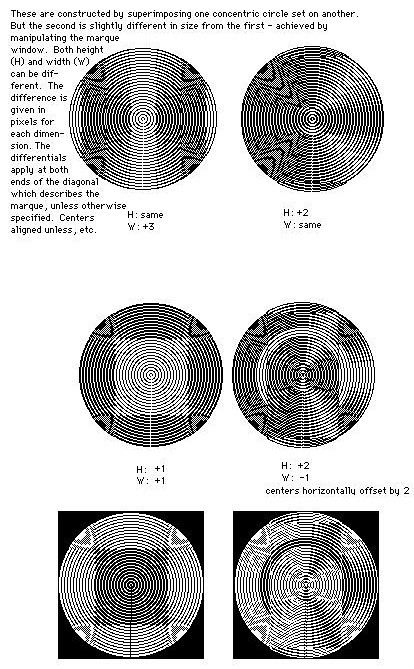
By Penrose I assume he meant Roger Penrose, a mathematician who had published a number of general interest books in the 1990s. You can find images of moiré patterns all over the place on the internet, or you can look below for some simple examples I ran up on my “classic” Mac back in 1985 or 86:

moire demo

Walter then went on to comment on his old journal entry:
What I meant by "Magic Light" is the discovery of some new force (Force 5) of nature, which has been with us all along but of which we are presently as ignorant as Newton was of electromagnetism. Using this new “force” as a beam, these hypothetical people of the future will transect our films and see - not the images which we see - but some fascinating interaction of all the people who worked on the film, in all its unexpected contingency, and this will be much more satisfying (to them) than the film itself. And it will be a wonder, to those future people, that we could accomplish this filmmaking without any knowledge of “Force 5”, which will be as crucial to them in their society as electromagnetism is to us today. As wondrous as is the construction of Gothic cathedrals to us today: we can hardly believe that our ancestors achieved these miracles with only human and (literal) horse power, and with no engineering textbooks.
And you could add: Duke Ellington and Shakespeare and the Egyptian Pyramids and many other things to this list.
Combining these two passages we get a sense of a film as a very compact “distillation“ of the diverse events surrounding and accompanying it. One might hazard the word “essence” but I fear it has too much of the wrong baggage associated with it. I’m a bit reminded of the JPEG compression for still images and the MPEG compression for video images. You “squeeze out” the redundancy and get a much more compact encapsulation of the information. Then, at playback, the redundancy is added back in and you see the full photograph or video image.

Walter goes on:
I think part of the mystery is that occasionally there is a balance of forces - what Koestler called the autonomy of the part and the wisdom of the whole - where the “part” (whatever it is) makes autonomous decisions that would be impossible for the theoretically guiding force (whatever that may be) to make. And that these decisions miraculously further the higher goal of the “organism” (Duke Ellington's sound, for instance: Duke did not have to tell each of his musicians exactly what to do at every moment) Similarly, if everything that is done on a film had to be expressed in “machine code” (e.g. “turn thirty degrees to the left and cock your right eyebrow”) the film would never get off the ground. People talk about this happening in sports, in battle, in every communal undertaking in fact. It is the human equivalent of the miraculous (to us) ability of fishes and birds to swim/fly in formation and all turn, repeatedly, at exactly the same moment, as if the school/flock were a single organism.
And when we've understood –mathematically, neurally–the nature of that coupling that makes of many ONE, then we will be on the threshold of a deeper understanding of  not only OUR nature, but perhaps of life itself.

Some time ago I read an interview with Jack Welch, then CEO of General Electric, who talked about how he and his colleagues in the executive suite could communicate in “code.” Through years of working together they could speak volumes in very terse ways because their shared experience gave them, well, a code that was meaningful among them but not necessarily to anyone else.

Yes, there are lone creative “geniuses” but I suspect there are fewer of those than we imagine. Creativity needs community and communities breed creativity, or can do so under the right circumstances. We have only just begun to understand such matters.

Tuesday, October 9, 2018

Five Extraordinarily Creative Communities, But Maybe Six [TALENT SEARCH]

I'm bumping this to the top for Talent Search Week. Here I look at some creative communities, for, often as not (more often?), genius thrives among genius. And genius can only spread among friends and allies. This is about to be added to, The Genius Chronicles: Going Boldly Where None Have Gone Before? to give us Version 7, which you may download here: 
https://www.academia.edu/7974651/The_Genius_Chronicles_Going_Boldly_Where_None_Have_Gone_Before.

* * * * *

Shakespeare, Ellington, Disney, Apocalypse Now, English at SUNY Buffalo, Mana Contemporary (?)

I was thinking about Apocalypse Now, an extraordinary film, as I often do. But not about the film itself, rather about how it was made, the production spread halfway across the Western Hemisphere (Hollywood to the Philippines), several years, a typhoon, a heart attack, and miles and miles of footage – well, not miles and miles, but you get the idea. Basically, Coppola was riding herd on a small town of talented people devoted to making this one film.

From there my mind drifted to the Department of English at SUNY Buffalo in its glory years, then to Duke Ellington, Shakespeare, and Disney – the glory years of the five early features, Snow White and the Seven Dwarfs, Pinocchio, Fantasia, Dumbo, and Bambi. Extraordinarily creative communities all, organized at different times and places and to different ends. Now there’s Mana Contemporary, right here in my own backyard, a unique for-profit non-profit art complex on the West Side of Jersey City. In this context it’s a question mark: Will it spawn an extraordinarily creative community??

Let’s start with Ellington and work our way through the list and back to Mana.

Duke Ellington

Duke Ellington was an American composer and bandleader whose career spanned the middle half of the 20th Century. During the latter part of that period he maintained his band at a financial loss. It was his instrument and he needed it as such; by that time his royalty income was sufficient to cover his costs.

First, Ellington did not write music in the abstract. He wrote specifically for the personnel in his band at the time. When the personnel changed, he changed the arrangements if needed. The band’s roster was unusually stable. Harry Carney, his baritone sax player, stayed with him for his entire career. Other key musicians had long tenures – Cootie Williams and Rex Stewart on trumpet; Juan Tizol and Sam Nanton on trombone; Sam Woodyard on drums; Paul Gonsalves, Johnny Hodges, Ben Webster, and Barney Bigard on woodwinds, and many others. And then there’s his alter ego, Billy Strayhorn, who contributed much of the band’s repertoire – including its theme song, “Take the A Train” – once he joined up in 1939.

Ellington was open to ideas from his men. Many of the lines and riffs, not to mention a tune or three, in his music came from them. So many, in fact, that when Lincoln Collier published his Ellington biography in 1987 he decided to cast doubt on Duke’s genius because of that. He was right to emphasize Ellington’s permeability to ideas from those very talented musicians he gathered specifically for that reason, but as for genius, who knows what THAT is, anyhow? Keeping those folks together and pointed in the same direction was no small task. Surely we must give Ellington credit for having the good taste needed to dream it up, and for having the wile and guile needed to pull it off.

The fact is we have been so besotted with the Romantic idea of the genius as a solitary creative figure pissing in the wind of stale bourgeois conformity that we have no effective way of talking about how people work together in groups. And that’s what Ellington’s band was, a very creative group, with Ellington as cat-herder in chief and front man.

William Shakespeare

And I’ll bet Shakespeare was much the same. Of course we don’t know much about the man, so little in fact that nominating others for the honor of having written those plays has been a minor academic sport for over a century. But, like Ellington, he didn’t write in a vacuum, he didn’t write for some distant audience. He wrote for a specific company, his company. He knew who would speak those lines, what resources of gait, gesture and posture, of facial expression and vocal nuance – a raise of the brow, the twitch of a lip, a stutter coughed up on the fly – they commanded. Did they suggest lines to him? I wouldn’t be surprised. Did he accept their suggestions? Sometimes yes, sometimes no. Did they get pissed-off at him for hogging the credit? I suppose, but they’re the ones who took the bows, no?

Just as we know little about the man, we know little about the process by which his plays came to be published in the form we have them – two different sets of texts, most plays in two different versions, some with significant differences between the two versions. Were they based strictly on Shakespeare’s original scripts or did they reflect improvisations and inspirations that happened in performance? We don’t know. But I rather suspect that Shakespeare’s working methods were more like Ellington’s than our prejudices in these matters can accommodate.

So, Ellington and Shakespeare, individual men who surrounded themselves with bands of brothers, channeling and shaping their creativity so they spoke with one voice.