Showing posts with label family. Show all posts

Saturday, September 6, 2025

Mom – The family sitcom has come a long way since the 50s and 60s [Media Notes 173]

Mom (2013-2021) showed up on my Netflix feed sometime within the last month. I saw Allison Janney on the clip, a plus, as I liked her as C.J. Craig in The West Wing. I saw it was a sitcom. I’m certainly in the mood for a sitcom. And that title proclaimed, “family wholesomeness,” and yes, that’s there. But it’s not the wholesomeness of the sitcoms I grew up with. 

From the Wikipedia entry:

Set in Napa, California, it follows dysfunctional mother/daughter duo Bonnie and Christy Plunkett, who, after having been estranged for years while both struggled with addiction, attempt to pull their lives together by trying to stay sober. [...] Mom received acclaim from critics and audiences for the writing and performances (particularly Janney's), as well as for addressing real-life issues such as: alcoholism, drug addiction, teen pregnancy, addictive gambling, homelessness, relapse, cancer, death, erectile dysfunction, domestic violence, overdose, palsy, rape, obesity, stroke, ADHD and miscarriage; and for maintaining a deft balance between the humorous and darker aspects of these issues.

Whoa!

I grew up with, for example, Father Knows Best:

The series, which began on radio in 1949, aired as a television show for six seasons and 203 episodes. Created by Ed James, Father Knows Best follows the lives of the Andersons, a middle-class family living in the town of Springfield. The state in which Springfield is located is never specified, but it is generally accepted to be located in the Midwestern United States. [...] As before, the character of Margaret was portrayed as a voice of reason, and Jim's character was that of a thoughtful father who offered sage advice in response to his children's problems. A responsible man, he loved his wife and children and would do whatever he could to give them a better life. Jim was a salesman and manager of the General Insurance Company in Springfield, while Margaret was a housewife. Their home was located at 607 Maple Avenue. One history of the series characterized the Andersons as "truly an idealized family, the sort that viewers could relate to and emulate." As the two eldest children aged from teenager to young adult, Betty (1956) and Bud (1959) graduated from high school and attended Springfield Junior College.

That’s a different world, very different.

I wonder how much daytime soaps changed over the same period?

BTW, I’ve now finished the first two seasons (of eight) of Mom, and will continue watching, though I don’t know whether or not I’ll go the distance. All that stuff that Wikipedia passage mentions, I’ve seen much/most of it in these two seasons. It’s light and enjoyable, which is what I was looking for. That is to say, it really is about family solidarity, even if the families involved are dysfunctional and centered on single moms. Every episode has one, two, or three scenes in an AA meeting. So we’ve got scenes of dysfunction in action, AA meetings (for a little distance), and reconciliation. For the most part, it works.

Thursday, September 4, 2025

How the Clark Family Creative learns a song in a day

YouTube:

Behind the Scenes: How We Learn a New Song in One Day

Hey guys! Tonight we have our most requested video! We explain how we learn a new song in one day. During the 2020 quarantine when we started, we were learning 4 or 5 songs a week but we modified the arrangements to their skill level at the time. The kids were done with homeschool and it was something fun that kept us sane during a very chaotic time. As the world started opening back up and the years went by we gradually decreased the new songs/videos to twice a week but with more difficult arrangements. The days that we film the songs start with a morning drive (and coffee) around a pretty neighborhood we all love. We listen to a playlist that we’ve all added songs to and come up with one that we all like for the day. Once we choose the song, we head back home. Cash and Beckett spend about 15 minutes on their own learning their parts. Colt and Cash will work together on guitar tones and getting the guitar sound perfect. Then Colt will work with Bellamy on her bass part. She can usually learn that in about 30 minutes. Next Colt will play with Beckett, working on the breaks and fills. The order that he works with them can be subject to change based on whether we have homeschool that day. Lastly we run the song all together around 3 or 4 times and film it right after. We hope you enjoy this little behind the scenes video of our process. Also, if you’re local to the Tampa Bay area, we’d love to see you at our show at Hutchinson Auditorium on Florida College’s campus on 9/20 at 7pm. I’ll leave the link below. Hope to see you there!

Thursday, August 28, 2025

Disney is abandoning the middle class, and the internet and AI are helping it do so

Daniel Currell, Disney Is the Happiest Place on Earth, if You Can Afford It, Aug. 28, 2025.

About Disney World:

For most of the park’s history, Disney was priced to welcome people across the income spectrum, embracing the motto “Everyone is a V.I.P.” In doing so, it created a shared American culture by providing the same experience to every guest. The family that pulled up in a new Cadillac stood in the same lines, ate the same food and rode the same rides as the family that arrived in a used Chevy. Back then, America’s large and thriving middle class was the focus of most companies’ efforts and firmly in the driver’s seat.

That middle class has so eroded in size and in purchasing power — and the wealth of our top earners has so exploded — that America’s most important market today is its affluent. As more companies tailor their offerings to the top, the experiences we once shared are increasingly differentiated by how much we have.

Data is part of what’s driving this shift. The rise of the internet, the algorithm, the smartphone and now artificial intelligence are giving corporations the tools to target the fast-growing masses of high-net-worth Americans with increasing ease. As a management consultant, I’ve worked with dozens of companies making this very transition. Many of our biggest private institutions are now focused on selling the privileged a markedly better experience, leaving everyone else to either give up — or fight to keep up.

Disney’s ethos began to change in the 1990s as it increased its luxury offerings, but only after the economic shock of the pandemic did the company seem to more fully abandon any pretense of being a middle-class institution. A Disney vacation today is “for the top 20 percent of American households — really, if I’m honest, maybe the top 10 percent or 5 percent,” said Len Testa, a computer scientist whose “Unofficial Guide” books and website Touring Plans offer advice on how to manage crowds and minimize waiting in line. “Disney positions itself as the all-American vacation. The irony is that most Americans can’t afford it.”

Back in the day (when I went to Disneyland on a family trip in the mid-1960s):

Disney was never cheap. A family day at the original Disneyland in California, including tickets, some rides and food for four people, was about a $30 affair when the park opened in 1955, which was a lot of money when the median family income was $4,400. But $30 — roughly the cost of a week’s groceries — was still an attainable number for much of America’s rapidly growing middle class.

In the early years, Disney ticket prices rose so slowly that at times they got cheaper after inflation. An employee handbook from the 1950s quotes Walt Disney as saying, “We roll out the red carpet for the Jones family from Joliet just as we would (with a few embellishments) for the Eisenhowers from Palm Springs.” Versions of Walt’s “Everyone is a V.I.P.” credo were in Disney’s new-employee training materials long after his death in 1966. Fortunately for him and his shareholders, embracing everybody made good business sense. That began to change in the 1990s.

Michael Eisner, Disney’s chief executive at the time, created a bevy of products for the affluent — including fancier hotels, a cruise line and white-tablecloth restaurants. But he rejected the idea of allowing customers to pay to skip lines at the parks, according to a Disney historian, Aaron Goldberg. When a rival, Universal Studios, introduced paid line-skipping in the early 2000s, Disney — perhaps fearing backlash from its large fan base — stood firm.

In the mid-2000s, however, the growing ranks of the affluent presented a profit source that could not be ignored. According to Datos Insights, in 1992 there were 88,000 households worth $20 million or more in 2022 dollars; by 2022, there were 644,000. Those who could pay almost anything for a vacation were becoming their own mass market.

Comes the smartphone and analytics:

At the same time, smartphone apps transformed how companies connected to their customers. In 2012, the My Disney Experience app gave guests an easy way to check wait times, show times, restaurant bookings and more. In return, Disney gained a trove of information on exactly where guests went, what they purchased and how much they spent in its complex. The app eventually became so integrated with a visit that much of a Disney park day can be dedicated to checking it; savvy guests bring an external battery.

More than ever before, Disney and companies like it have access to data showing them who is willing to spend what for which experiences. “Disney is an analytics company that happens to do movies and parks,” Mr. Testa said. [...]

The pandemic was the final blow. Covid shutdowns and the streaming wars delivered staggering financial losses. In October 2021, Disney killed its free FastPass system, upsetting many hard-core fans, and started offering ride reservations for $15 each at Disney World. Over the next three years, the line-skipping options multiplied in number and in price. Disney also offered perks for those staying in its properties — one of them being the ability to make ride reservations before those staying elsewhere.

Middle America at the middle of the 20th century:

America’s 20th century was a fortunate moment when we could rely on companies like Disney to deliver rich and unifying elements of our culture. Walt Disney hoped that his audience would have “no racial, national, political, religious or social differences” — he wanted to appeal to everyone, in no small part because appealing to everyone was profitable. It was a time when big institutions were trusted, and the culture they created was shared by nearly all Americans.

The article follows two very different families through Disney World, an affluent one and a one on the low-end of middle-class. 

There's much more at the link. 

Thursday, January 16, 2025

Oldest matrilocal tribe in European prehistory dates to Late Iron Age Celts

Cassidy, L.M., Russell, M., Smith, M. et al. Continental influx and pervasive matrilocality in Iron Age Britain. Nature (2025). https://doi.org/10.1038/s41586-024-08409-6

Abstract: Roman writers found the relative empowerment of Celtic women remarkable. In southern Britain, the Late Iron Age Durotriges tribe often buried women with substantial grave goods. Here we analyse 57 ancient genomes from Durotrigian burial sites and find an extended kin group centred around a single maternal lineage, with unrelated (presumably inward migrating) burials being predominantly male. Such a matrilocal pattern is undescribed in European prehistory, but when we compare mitochondrial haplotype variation among European archaeological sites spanning six millennia, British Iron Age cemeteries stand out as having marked reductions in diversity driven by the presence of dominant matrilines. Patterns of haplotype sharing reveal that British Iron Age populations form fine-grained geographical clusters with southern links extending across the channel to the continent. Indeed, whereas most of Britain shows majority genomic continuity from the Early Bronze Age to the Iron Age, this is markedly reduced in a southern coastal core region with persistent cross-channel cultural exchange. This southern core has evidence of population influx in the Middle Bronze Age but also during the Iron Age. This is asynchronous with the rest of the island and points towards a staged, geographically granular absorption of continental influence, possibly including the acquisition of Celtic languages.

The NYTimes has an article reporting the find: Becky Ferreira, Celtic Women Held Sway in ‘Matrilocal’ Societies, Jan. 15. 2025.

The liberties of Celtic women have been a hot topic for thousands of years. Roman writers were scandalized by reports of their sexual freedoms, which insocicluded taking multiple husbands. Cartimandua and Boudica, early female leaders in Britain, demonstrated that women could reach the highest levels of power, commanding armies and heading tribes.

Archaeological evidence also hints at flexible gender dynamics that varied widely depending on local traditions. For instance, Celtic women were sometimes buried with luxurious grave goods, like jewelry and mirrors, a marker of high status. Patrilocality, whereby women live near their in-laws, is still far more culturally common, but female-centric societies are not as unheard-of as they were even a decade ago.

“It’s a generational paradigm shift,” said Rachel Pope, an associate professor in European prehistory at the University of Liverpool with expertise in matrilocality who was not involved in the study. “It’s partly a trend in archaeology more generally, where we have returned to data and material evidence to lead narrative, rather than imposing narratives that confirm our own biases.”

In other words, scientists are working on big data projects, such as genome analysis, to pin down patterns in social structures with a level of accuracy that cannot be obtained from other sources like the accounts of classical writers with their own agendas and biases

Thursday, December 5, 2024

The Family Man & work-life balance [Media Notes 146]

I watched The Family Man the other night. Here’s what Claude (Anthropic’s chatbot) said about it when I asked it for five examples of films involving the conflict between career and family:

"The Family Man" (2000) tells the story of Jack Campbell, a wealthy investment banker who gets a glimpse of an alternate life where he chose family over career. Through this supernatural premise, the film explores how different life choices between career and family can lead to vastly different outcomes.

(See below for all five.)

When the movie opens Nicholas Cage and Téa Leoni are at the airport. He’s flying to London for an internship at Barclays. She: Don’t go. He: I gotta. And he does.

Zap!

We’re move ahead in time and he’s a rich banker about to close a BIG deal. Emergency meeting on Christmas coming up! Before it happens, MAGIK sends him into an alternate reality where he wakes up a husband and dad in suburban NJ selling tires for his wife’s father. He’s confused, but sorta’ likes the 10-year old girl who senses that he’s not really her dad. This and that happens, he gets used to suburbia. Not bad, not bad at all. Love my wife, the kids, can deal with tires. I like this!

And then – REVERSE MAGIK. Once again he’s a rich banker on the verge of the BIG deal. Confused. I’m not liking this. Guess who called? Téa! – that is, the character she plays in the movie. Gotta see her. She’s a rich lawyer, moving to Paris. Don’t go, pretty please, at least have a cup of coffee. They have coffee. The End.

Nice try, but I’m not convinced. Needed a couple helpings of Ground Hog Day, perhaps True Lies. Why not both?

Appendix: Ask Claude

My queries are set in bold, Claude’s replies are plainface.

* * * * *

The conflict between a man’s career on the one hand, and wife and family on the other is a theme in movies. Give me five examples.

Here are five notable films that explore the tension between professional ambition and family responsibilities:

"Kramer vs. Kramer" (1979) presents this conflict through Ted Kramer, a workaholic advertising executive who must reevaluate his priorities when his wife leaves and he becomes the primary caregiver for his young son. His journey shows how career ambitions must sometimes yield to parental responsibilities.

"The Pursuit of Happyness" (2006) depicts Chris Gardner's struggle to build a career as a stockbroker while caring for his young son as a single father. The film powerfully illustrates how professional aspirations and parental duties can create nearly impossible choices, especially when financial survival is at stake.

"Up in the Air" (2009) examines this theme through Ryan Bingham, a corporate downsizing expert who lives his life on the road. His dedication to his career has left him disconnected from family and meaningful relationships, forcing him to eventually confront the personal cost of his professional choices.

"The Family Man" (2000) tells the story of Jack Campbell, a wealthy investment banker who gets a glimpse of an alternate life where he chose family over career. Through this supernatural premise, the film explores how different life choices between career and family can lead to vastly different outcomes.

"Mrs. Doubtfire" (1993) portrays Daniel Hillard, an actor whose irregular work schedule and career pursuits contribute to his marriage's dissolution. The film shows his extraordinary efforts to maintain a connection with his children while trying to balance his professional aspirations with his role as a father.

Would you like me to elaborate on how any of these films specifically handle this thematic conflict?

Monday, July 1, 2024

The Presidential debate as entertainment

I've been watching Zeth's videos for over a year, maybe even two. When I first started watching them it was just Zeth and his daughter, Saylor. Then his with and son joined in, making them family videos. I'm putting this one up because they talk about the Presidential debate starting at 13:30. They don't see it as a serious political event. They see it as entertainment and mostly talk about Biden's poor condition.

Timestamps:

0:00 Visiting California
9:22 Zeth's Hair Problems
13:30 Presidential Debate
18:50 The New Pod
20:56 The Olympics
23:37 France
25:10 Florida Beaches
28:30 Atlas Joins

Thursday, March 14, 2024

First Knight [Media Notes 115]

Watched it over two sessions on the previous two days. First Knight (1995) is yet another retelling of the King Arthur story. Sean Connery is a middle-aged-growing-old Arthur of Camelot. Julia Ormond is a young-enough-to-be-his-daughter Guinevere of Lyonese. and Richard Gere is a handsome young Lancelot. In a departure from tradition, however, this Lancelot is not born an aristocratic knight. Instead, he’s a ronin warrior, one of the original free-lances, a hired gun (so to speak), of a murky background. Ben “Chariots of Fire” Cross is the evil Malagant, rogue fugitive from the Knights of the Round Table.

I’ll give you the whole Wikipedia plot summary because you need to know the whole sorry story and I don’t want to waste keystrokes making up my own summary:

King Arthur of Camelot, victorious from his wars, has dedicated his reign to promoting justice and peace and now wishes to marry. However, Malagant, a former Knight of the Round Table, desires the throne for himself.

Lancelot, a vagabond and skilled swordsman, duels in small villages for money. He attributes his skill to his lack of concern whether he lives or dies. Guinevere the young ruler of Lyonesse, decides to marry King Arthur out of admiration and for security against Malagant, who has been raiding local villages under the guise of "upholding the law."

While traveling, Lancelot chances by Guinevere's carriage on the way to Camelot, and spoils Malagant's ambush meant to kidnap her. He falls in love with her, but she refuses his advances. Though Lancelot urges Guinevere to follow her heart, she remains bound by duty. She is subsequently reunited with her escort. Later, Lancelot arrives in Camelot and successfully navigates an obstacle course on the prospect of a kiss from Guinevere, though he instead kisses her hand. He also wins an audience with her husband-to-be, Arthur. Impressed by his courage and struck by his recklessness and freewheeling, he shows him the Round Table, symbolizing a life of service and brotherhood, and warns him that a man "who fears nothing is a man who loves nothing".

That night, Malagant's henchmen arrive at Camelot and kidnap Guinevere. She is tied up and carried off to his headquarters, where she is held hostage. Lancelot follows, posing as a messenger from Camelot. He requests to see Guinevere alive before he delivers the message, then overpowers the guards and escapes with her. Once again, Lancelot tries to win her heart, but is unsuccessful. On the return journey, it is revealed that he was orphaned and rendered homeless after bandits attacked his village, and has been wandering ever since.

In gratitude, Arthur offers Lancelot a higher calling in life as a Knight of the Round Table. Amidst the protests of the other Knights (who are suspicious of his station) and of Guinevere (who struggles with her feelings for him) he accepts and takes Malagant's place at the Table, saying he has found something to care about.

Arthur and Guinevere subsequently wed. However, a messenger from Lyonesse arrives, with news that Malagant has invaded. Arthur leads his troops to Lyonesse and successfully defeats Malagant's forces. Lancelot wins the respect of the other Knights with his prowess in battle. He also learns to embrace Arthur's philosophy, moved by the plight of villagers.

Lancelot, guilty about his feelings for the queen and loyalty to Arthur, privately announces his departure to her. Not able to bear the thought of his leaving, she finally asks him for a kiss. It turns into a passionate embrace, just in time for the king to interrupt. Though Guinevere loves both Arthur and Lancelot – albeit in different ways – they are charged with treason. The open trial in the great square of Camelot is interrupted by a surprise invasion by Malagant, ready to burn Camelot and kill Arthur if he does not swear fealty.

Instead Arthur commands his subjects to fight, and Malagant's men shoot him with crossbows. A battle ensues, and Lancelot and Malagant face off. Disarmed, Lancelot seizes Arthur's fallen sword and kills Malagant, who falls dead on that same throne he so desired. The people of Camelot win the battle, but Arthur dies of his wounds.

On his deathbed, he names Lancelot his successor and asks him to "take care of her for me" – referring to both Camelot and Guinevere. The film closes with a funeral pyre raft carrying Arthur's body floating out to sea.

What the plot summary doesn’t say is that the punishment for treason is death. Lancelot does not deny the kiss, nor does Guinevere. Good fellow that he is, Lancelot pleads with Arthur to let him take the fall. Just then Malagant saves the day by invading Camelot. Arthur is saved from having to pass sentence on his wife [daughter] and valiant warrior [romantic rival] and Guinevere gets to wed her young stud while still treasuring the memory of her father [husband].

Of course, that’s not how the story frames Malagant’s arrival. It frames it as unambiguous evil, which it is, of course. But I’m talking about the underlying psychodynamics, which is about fathers and sons and fathers and daughters and husbands and wives and how those roles are so easily mixed-up, confused, and conflated. First Knight brings the whole mess to a head, then sweeps it away through this invasion in which Arthur gets killed. Problem solved. Arthur gets a grand send-off at sea and Guinevere and Lancelot hustle off to the bedroom at Camelot.

The Wikipedia entry notes: “The film is noteworthy within Arthurian cinema for its absence of magical elements [...] and the substantial age difference between Arthur and Guinevere.” A big YES to that last. As for the first, perhaps it’s that very lack of magical elements that makes Arthur’s speechifying about the ideals of Camelot seem like pious hokum. I liked Connery much better as Danny Dravot in The Man Who Would Be King. Heck, I liked him better as Bond, James Bond, where he didn't have to mouth any nonsense, just get the bad guys and bed the ladies.

On the whole, a most peculiar film.

Friday, January 5, 2024

Increasing living standards in the Early Modern Period may have contributed to the emergence of modern romantic culture

Mauricio de Jesus Dias Martins, Nicolas Baumard, Reproductive Strategies and Romantic Love in Early Modern Europe, Archives of Sexual Behavior, 22 November 2023, https://doi.org/10.1007/s10508-023-02759-4

Abstract: In Western Europe, the Early Modern Period is characterized by the rise of tenderness in romantic relationships and the emergence of companionate marriage. Despite a long research tradition, the origins of these social changes remain elusive. In this paper, we build on recent advances in behavioral sciences, showing that romantic emotional investment, which is more culturally variable than sexual attraction, enhances the cohesion of long-term relationships and increases investment in children. Importantly, this long-term strategy is considered especially advantageous when living standards are high. Here, we investigate the relationship between living standards, the emotional components of love expressed in fiction work, and behavioral outcomes related to pair bonding, such as nuptial and fertility rates. We developed natural language processing measures of “emotional investment” (tenderness) and “attraction” (passion) and computed romantic love in English plays (N = 847) as a ratio between the two. We found that living standards generally predicted and temporally preceded variations of romantic love in the Early Modern Period. Furthermore, romantic love preceded an increase in nuptial rates and a decrease in births per marriage. This suggests that increasing living standards in the Early Modern Period may have contributed to the emergence of modern romantic culture.

H/t Tyler Cowen.

Saturday, March 25, 2023

Robots and elder-care

Jason Horowitz, Who Will Take Care of Italy’s Older People? Robots, Maybe. NYTimes, Mar. 25. 2023.

CARPI, Italy — The older woman asked to hear a story.

“An excellent choice,” answered the small robot, reclined like a nonchalant professor atop the classroom’s desk, instructing her to listen closely. She leaned in, her wizened forehead almost touching the smooth plastic head.

“Once upon a time,” the robot began a brief tale, and when it finished asked her what job the protagonist had.

“Shepherd,” Bona Poli, 85, responded meekly. The robot didn’t hear so well. She rose out of her chair and raised her voice. “Shep-herd!” she shouted.

“Fantastic,” the robot said, gesticulating awkwardly. “You have a memory like a steel cage.”

The scene may have the dystopian “what could go wrong?” undertones of science fiction at a moment when both the promise and perils of artificial intelligence are coming into sharper focus. But for the exhausted caregivers at a recent meeting in Carpi, a handsome town in Italy’s most innovative region for elder care, it pointed to a welcome, not-too-distant future when humanoids might help shrinking families share the burden of keeping the Western world’s oldest population stimulated, active and healthy.

Italy's elders:

Robots are already interacting with the old in Japan and have been used in nursing homes in the United States. But in Italy, the prototype is the latest attempt to recreate an echo of the traditional family structure that kept aging Italians at home.

The Italy of popular imagination, where multigenerational families crowd around the table on Sunday and live happily under one roof, is being buffeted by major demographic headwinds.

Low birthrates and the flight of many young adults for economic opportunities abroad has depleted the ranks of potential caregivers. Those left burdened with the care are often women, taking them out of the work force, providing a drag on the economy and, experts say, further shrinking birthrates.

Yet home care remains central to the notion of aging in a country where nursing homes exist but Italians vastly prefer finding ways to keep their old with them.

For decades, Italy avoided a serious reform of its long-term care sector by filling the gap with cheap, and often off-the-books, live-in workers, many from post-Soviet Eastern Europe — and especially Ukraine.

“That’s the long-term care pillar of this country,” said Giovanni Lamura, the director of Italy’s leading socio-economic research center on aging. “Without that, the whole system would collapse.”

There's more at the link.

Tuesday, February 22, 2022

From Grandfather’s Diary: WWII, Ulysses, and Proust

I bumping this to the top of the queue as Putin marches on Ukrania.  This post contains some excerpts from my Grandfather's diary as he writes about news of the growing war in Europe and then reports the Japanese bombing of Pearl Harbor.
* * * * *
 
My paternal grandfather, Axel Benzon, was a Dane. He and his wife, Louise, immigrated to America early in the 20th Century. He was educated as an engineer and knew Greek sufficiently well that he wrote poetry in Greek. He ended his professional career as chief engineer, I believe, of the main US Post Office in Manhattan.

And he kept a diary, the pages of which are generically entitled: “Leaves from my diary.” It’s not a handwritten affair, kept in one of those blank books one can buy at a stationary store. It’s typed on ordinary 8.5 by 11 paper. I’ve got a photocopy of much or most of it, but, judging by his index, not all.

Here’s the opening paragraphs from the entry for 14 April 1940:
Sunday and cloudy with occasionally a little snow-a good day to remain indoors and listen to the war news from Europe. These news are coming in frequently but are most confusing and it is difficult from the british and german dispatches to a form a true picture about the situation in all parts of Norway.

The Danish goose is cooked – there the germans are in possession of all parts and are now fortifying points of vantage, especially the northernmost part of Jutland from where they can dominate a great port of Skagerak and Kartegat.

The invasion of Norway was a masterstroke, no matter how it turns out. It gave evidence of the usual german thoroughness and precision and coupled with the fact that the german navy is so much inferior to that of the English it has been most successful and must have taken the English by surprise.
As you can imagine, his reflections are much occupied by the war. But not entirely so. For example, he also talks of his fondness for the game of golf and playing it on public courses in New York City—he lived in Jackson Heights at the time. I rather imagine that THAT land has long since been given over to building of one sort or another. In fact, at one point he mentions exactly that.
 
But that’s not what I’m after here, nor his enumeration of Christmas gifts. Though as I did not mark those specific passages I have to do a bit of looking around in order to find them, which may take awhile. And, of course, in looking around, I spot things. For example, this paragraph from a letter to one of his daughters, Karen, on 20 April 1940:
You are affected by the insensate sacrifice to the voracious Moloch of the flower of youth driven to the slaughter by monsters whose greed can never be sated and by the senseless destruction of the fruits of toilers whose only earthly desire is to be permitted peacefully to toil as long as they can labor.

How are your aunts and cousins in Denmark, and how is aunt Kate in Oslo with her two boys? Pity for they have toiled and suffered for many years until lately they all felt reasonably secure to enjoy the fruits of their labor. Well-I often ask myself this question – and we cannot help, cannot even communicate with them.

But let these blows not deprive you of the desire to continue your own life as happily and peacefully as you are privileged to do. You are born in an age different from that in which your parents were born and in a country different from the little pastoral Denmark. The premature invasion into your time of an unbridled science which as a colt breathlessly has galloped over your era will in time be curbed and led into the field of anthropology where it will either destroy or make useful the parasitic growth that now is the cause of our folly and inhumanity.
I wonder what he would think of “shock and awe” or of drones?

From a letter of 19 May 1940, talking about one of is fellow expatriate Danes:
Some time ago when Bang from Baltimore visited us he lamented about the poor condition in which Denmark was situated with respect to defend herself against an aggressor. The Finnish war was on at that time and we were filled with reports about the bravery of the Finns. The Danes could do as well and it would be better to go down in glory than to give in without a fight.

Poor Bang, he still lives in a world of illusion. He did not see that the news we received from Finland were all highly colored and that Finland was doomed. And still, he wanted Denmark to defend herself from german invasion.
I wonder what he’d think about The New York Times reporting on Iraq, or Afghanistan. Would he think that Tom Friedman is as lost in illusion as his countryman Bang?

From 8 June 1940:
With all this misery in Europe things are quiet at the Post Office. Mail is not heavy and we can take our vacations knowing that there are hard times ahead of us so far as money is concerned. We must be glad is [sic] our salaries are not cut, for that in addition to increased taxation will be hard to bear.
He was waiting for the war to get worse. What are we waiting for? The war in Afghanistan to end? For climate chaos to get worse, and worse? I rather suspect that Grandfather would have been had little trouble accepting the data on climate change.

From 14 August 1940:
At the Post office we are preparing for registering the aliens. This gives me more work for we have to build a number for typewrite desks and other things that have to be used. We do much work in the Post Office other than handling mail.
2 December 1940:
Incidentally I listened to [H.G.] Wells the other day over the radio and was shocked to hear how feeble was his voice – hardly distinguishable – but the old radical spirit was there undaunted – he really sounded as were he speaking from one of the many and deep shell holes dug by the barbaric german bombers in the relics from the old Londinium.
There's that late 19th Century education for you, and he was educated as an engineer, not a preacher or a diplomat.

7 December 1941:
It is cold today on this Sunday but the wires or rather the air is hot with reports about the attack of the Japanese air forces upon Hawaii this morning when five civilians and apparently three hundred fifty soldiers were killed. It is also reported that a large battleship was set afire and two others sunk...

The Dutch East Indies and the republic of Costa Rica have declared war on Japan.

10 pm. Canada has declared war on Japan.
Ah, at last, one of the two passages I’ve been looking for. This entry is mostly personal and family stuff. 8 September 1941:
From Billy we finally got words today. They have moved and are now settled in the town. It was not all good news in his letter for Betty’s mother is bedridden with a bad heart and his former landlady presumably has cancer.

He has further more lost his nice golf clubs – they were mislaid by a caddie in a wrong automobile when he went in for a drink and now after ten days he has not gotten them yet. That is a serious loss and I sympathize with him for he had a very good set of clubs.
Billy is my father and Betty, his wife, my mother. Grandfather goes on to report on a book he’s been reading, The Managerial Revolution by Burnham (whoever he was), that offers “another alternative to capitalism than socialism namely the ruling of the country by a new class of managers.” He says a bit more about the book and then: “I agree with him in most of his points, but if that is not socialism as I understand it then I do not know what it is. Socialism as he defines it is the Utopia which, if we should try to establish it now would be anarchism and chaos.” I don’t think Grandfather had much objection to socialism, though I rather suspect he wouldn’t think too much of the financial managers who run the world these days.

At last, as he continues talking about his reading, he closes with this:
Also a book by Frank Buck, the animal dealer and a novel by Storm “Count Ten” which I should read at least twice in order to understand it properly. The style is somewhat like that of Ulysses and it deals with a man who does not know what he should do by tries his utmost to live a life of decenty wherein he can retain his selfrespect [sic].
Never heard of this Storm or his novel, though the Wikipedia has, but that’s not what caught my eye. You see, when I went off to college I thought of myself as a fairly literate young chap and so was taken aback a bit to hear these people raving on about some book called Ulysses that I’d never heard of. And here I am, leafing through my grandfather’s diary and I come upon a mention of that very book as though any well-read person would know it. By the time I got to college, well, that’s where you’d find Ulysses, in the literature curriculum. But Grandfather was well out of college by the time the book had been published. He must have read it because that’s what he did.

As for the mention of Proust, I’ve done a bit of searching and can’t find it. Grandfather was talking, not about his own reading, but about his wife’s. I forget just what she was reading, though I don’t think it was Proust. But it must have been something French, which gave him a reason to bring up Proust. Judging from his comment I don’t think he’d read him. What he said was that he’d been told the English translation was so much better than the original that a re-translation back into French would have been a considerable improvement.

Other than his wife, just who did this man talk too in his daily life? He doesn’t mention any New York friends who share his interests.

And then there’s the fuss over the appointment of Bertrand Russell to a position at City College.

And so on.

All during the run-up to World War II.

Addendum: The Proust passage, 22 November 1938:
Talking about books I think mama [his wife] is on the way to become literary. She was interested in Anatole France some time ago and read some of his books, and now she is buried in Marcel Proust. Whether she is enjoying their language or their outpourings of both I do no know for she does not say much about it. Anatole France’s language is of course concise, clear and classically French and is therefore enjoyable...

...As to Proust it is said that the translation into english is so much better than the french edition that if it were retranslated into french it would be a much better book. The french language is not adapted to the outpourings of the quickly decaying spirit departing disillusioned from the splendor that was nothing less than a stinking dungheap as was the fate of Proust. He longed for what he thought was the highest he could think of on this earth; he found it discovered is was rottenness. But just the same his description is more worth than Dos Passos’ description of the world as he found it in the twenties, to take an example.

Mama enjoys her reading more than she enjoys bringing up flowers or plants.

Wednesday, August 11, 2021

When did the English become indifferent to extended kin?

Tuesday, July 6, 2021

Interviews with my Uncle Rune, a sailer and model-builder from Sweden

This is a pair of conversations between my cousin, Erik Ronnberg, Jr., and his father, Erik Ronnberg, Sr. Uncle Rune, as we called him, had been a sailor in the Swedish merchant marine. He was aboard their training vessel, the Abraham Rydberg, which became stranded in Gloucester, Massachusetts, by the beginning of World War II. Consequently Rune met my aunt, Karen (my father's sister), married her, and settled in the United States.

He worked in a rigging loft in Gloucester. That's what these two interviews are about. He also became an expert building of model ships and other sailor's crafts. What you see in the photograph above is an example of scrimshaw, carved bone or ivory. In this case it is an image carved into the tooth of a sperm whale. The image was incised using dental tools and then the lines were filled with India ink. The whale, obviously, has to be Moby Dick.

Rune is being interviewed by his son, Erik, who eventually followed him in making museum-class ship models.

Collection of the Cape Ann Museum Library & Archives. Uploaded and shared with permission from Erik Ronnberg, Jr., 8/28/2020.
Image description: Erik A. R. Ronnberg Sr. and Jr. at the dining room table, c. 1950.

Collection of the Cape Ann Museum Library & Archives. Uploaded and shared with permission from Erik Ronnberg, Jr., 8/28/2020.
Image description: Erik A. R. Ronnberg Sr. and Jr. at the dining room table, c. 1950.

Thursday, October 1, 2020

Life in Sag Harbor [whose child are you?]

Sag harbor is a black enclave on Long Island. Sandra E. Garcia writes about it in the NYTimes. The whole piece is worthwhile, but I was struck by the second of the following two paragraphs (the first paragraph is for context:
Richard and Dorothy Granger, both dentists in Glen Cove, Long Island, came to Sag Harbor Hills in the early 1950s. Their daughter, Beverly Granger, 70, a retired dentist and ceramist who was born a year before her parents built their home, now lives in a renovated 2,500-square-foot, two-story house on the original plot of land with her 73-year-old husband, Aloysius Cuyjet, a retired physician who grew up in Sag Harbor. Granger renovated the home in 2003, after her mother died, puncturing the exterior with square windows and adding sliding glass doors that provide views of Sag Harbor Bay beyond her own private beach. Back in 1951, when the home was completed, it was modest, with sketchy wiring and inadequate heating. Back then, she remembers being able to skip across the properties and through the woods to meet her friends.

She also recalls a time when there was no way to tell where one house ended and another began. All the children in the subdivisions belonged to every adult that lived there. If a child scraped her knee in front of the Grangers’ house, she could walk in scuffed and walk out with a bandaged wound. If one mother cooked, all the kids nearby ate. If one mother was on the beach, all the children were looked after. “I felt loved there in a way that, now having lived in many other communities, I realize was unusual and incredibly empowering,” says Brooke Williams, 54, who grew up spending summers just outside Azurest and now owns her own small house in Sag Harbor, where she spends summers with her husband, Josh Liberson, 49, and their daughter, Ada. “Our pride of place — of the various achievements of our friends and family — and our cohesion and generosity toward each other came from a profound sense of love,” she says.

Wednesday, September 2, 2020

Comfort in Downton Abby: Utopia, Gemeinschaft and family [Media Notes 45]

Earlier this year I worked my way through Downtown Abby, all of it. It’s about comfort, comfort and family.

As I’m sure you know, the series is centered on a country estate, Downton Abbey, in the years straddling World War I. It is home to the Crawley family, which seems remarkably amiable, and their servants. The Crawleys are aristocrats, of course, while their servants are commoners. For the most part the servants respect the Crawleys, some are even fond of them, and, in turn – naturally – the Crawleys respect and are fond of their servants.

THAT’s the conceit of this series. There is an absolute class divide between two groups of people, and yet they get along well across that divide. That’s what makes this series so very comfortable: We’re all in this together, aristocrats and commoners alike.

The series is set in a period when the aristocracy is crumbling. It is becoming more and more difficult for the landed estates to remain solvent. An agricultural and rural way of life is being displaced by an industrial and urban way of life. Gemeinschaft by Gesselshaft, to wax sociological. During the course of the series two or three families loose their estates because of financial difficulties. And the Crawleys come close to it.

How do they adapt? One daughter goes into the publishing business while another marries the chauffeur, who turns out to be a good businessman, as does his wife. See there, the divide between aristocrats and commoners was bridged through that marriage. And all’s well in the world.

And we have complex goings-on among the servants as well. One of them is gay, which leads to complexities worked out over several seasons. One has done a hitch in prison, more complexities. And one marries, her husband dies, and she inherits the tenancy of his farm, which is on the Crawley grounds.

During the war the estate becomes used as a hospital and Lady Grantham (Crawley) turns out to be an able administrator. Score one for aristocratic women! And it is revealed that the Dowager Countess had once been involved in a Russian aristocrat, now displaced by the revolution. And there’s car racing, a trip to Ireland, and who knows what else. It’s all grand, complicated and, ultimately, convivial.

What keeps it all together? Why family, of course. What else? In fact, though, what was happening at the time is that the family, the aristocratic family, was losing the last of its force as social glue and being replaced by rationalized economic relationships, by the marketplace.

Downton Abby is a utopia. The word is based on the Greek: ou ‘not’ + topos ‘place’. Thus a utopia is no-place. Downton Abby is an utter fiction.

No matter. A good time was had by all.

The End.

Sunday, June 21, 2020

William Benzon, 1912-1998: He Went Out Swinging and Smooth Shaven [born on Jan 31, 1912]

Father & co 400 dpi jpg copy

My father, William Benzon, was born on Jan. 31, 1912 in Baltimore, MD, and died November 21, 1998 in Allentown PA. His parents were Danish immigrants. For about the first six years of his life he lived with his parents and two older sisters, Karen and Signe, on Curtis Bay in Baltimore in a house which had formerly been a yacht club. The family then moved to Longwood St. He attended Boy's Latin School and, according to his high school year book, was regarded as an intellectual and as the 2nd brightest in his class. He was on the boxing, fencing, and football teams and his favorite expression was "Well blow me down."

He did two years at the University of Virginia, where he managed to run up gambling debts that his father had to satisfy. He completed his college education at Johns Hopkins, graduating in 1934 with a degree in chemical engineering. He then went to work for Bethlehem Steel (initially at Sparrows Point) where he spent his entire career. He entered their "loop" program which was for hotshot college graduates they wanted to nurture. I don't know what his initial duties were or how he ended up in the mining division of the company (Bethlehem Mines Corp.). He spent most of his career there and rose to Superintendent of Coal Preparation, a position that was created for him. He stayed in that post until his retirement in 1974. He continued to consult on coal preparation after retirement.

Early in his career he moved to Johnstown Pa. where Bethlehem Mines had its headquarters. There he met my mother, Elizabeth Tredennick, and married her in 1940. I was born in 1947 and my sister in 1951.

What was he like?

He was a brilliant man, attaining an international reputation in his field, coal preparation. He was also a loving father, expressing his love in various ways, including making some very fine things for me and my sister. He made furniture for my sister’s dolls, a high chair, and a very elegant play pen with the letters of the alphabet cut into the slats. He made me a gorgeous Indian headdress – feathers of various kinds, ermine tails, abalone shell ornament, a beaded head band – and various swords and knives etc. as appropriate for various Halloween costumes. He encouraged my sister and me in whatever we wanted to do. When I went off to Hopkins and grew long hair, a beard and mustache, that was OK. And so was going to graduate school in something as impractical as English literature. When, as an adult I needed to borrow money from him because I was out of work, he loaned me money (even after he had retired and was obviously living on a fixed income). He never ever suggested that I "face reality" and move into the corporate world, etc. He knew my intellectual work was important and helped me pursue that, as he has helped my sister pursue her interest in poetry.

He was an intellectual and books were important to him; he had many of them, including many he inherited from his father. I remember a number of Christmas seasons where he read Dickens' A Christmas Carol to the family after dinner on a number of evenings. And he certainly read stories to me before bed as a child – I remember him reading me from Mark Twain, Rafael Sabatini, and others. I was particularly struck by his ability to read dialog so naturally, with expression, like people would actually have said it. He spent a great deal of time helping me and my sister with our homework. He never just told me answers or worked problems. He always asked questions designed to lead me to the answers myself.

My father had an excellent sense of humor, which he slyly attributed to his Danish heritage. He loved Mark Twain, Charles Dickens, Lewis Carroll, and one Jerome K. Jerome, and the Marx Brothers. He was also quite fond for Victor Borge. For one thing, Borge was from Denmark, where his parents were born and raised. Borge's humor was often of a linguistic nature, and my father was interested in language (he owned books by Otto Jesperson, the Danish scholar of the English language, and H. L. Mencken). Borge was a musician and much of his humor involved committing mayhem on various pieces of classical and not-so-classical music.

An Athlete - Golf

He was a good and dedicated athlete. Beyond his high-school sports he was also an excellent swimmer and loved the sea. As an adult he was a cyclist (mostly in his youth, in Baltimore and in his early days in Johnstown) and, above all, golf. 

He took up the sport as an adult and pursued it passionately. During his prime – say from 30 though 55 – he had a single digit handicap, even as low as two or three. He kept systematic notes about his game throughout his entire golfing career. One winter he painted golf balls in red nail polish and golfed in the snow. He experimented with putters he either built himself or modified from putters he'd bought. He also had ideas about custom golf shoes which he half-way finished (my sister and I found the half-completed shoes in the basement).

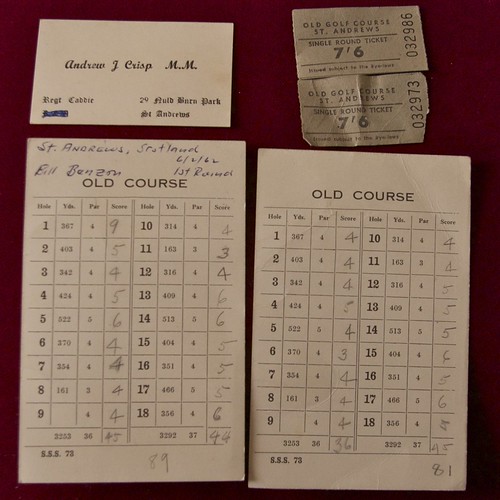
One of the highlights of his life was playing golf at St. Andrews in Scotland (he shot 81 on one round). He read a great deal about the sport, knew its history backwards and forwards, and had a good collection of golf books, including a classic written by a relative of Charles Darwin. It is absolutely clear to me that, as I use music to balance out my intellectuality, so my father used golf to achieve balance in his life.

IMGP5036
Caddie's card, tickets, and scorecards for two rounds at St. Andrews

Stamps

My father was an avid stamp collector, with particular interests in Canada, Liberia, Germany, and China. He loved the look of stamps, their design (line, color, shape, form, etc.), but also what they told about history and society. Stamps were his vehicle for encountering and organizing human history. Stamps commemorate individuals, events, ideas, and so forth, and thus tell the history of the nations that issue them. All of that was important to my father.

As was the craft of collecting itself. Used stamps are, of course, stuck on envelopes. They have to be separated from the envelope before they can be mounted in books. My father spent hours doing that. He had special chemicals, magnifying glasses, balances, tweezers, hinges etc. all relevant to the physical preparation of the stamps. He had books about stamps, and catalogues. He engaged in extensive correspondence with various stamp dealers, some he had come to know on an all but personal basis, even though he'd never met them. Over the years he'd developed relationships with them through the simple and cumulative acts of buying stamps.

Monday, January 6, 2020

Lost in Space and Anne – with an “E” [Media Notes 30]

I just finished watching the second season of Lost in Space and have re-watched the first season. I’ve also watched the second season of Anne with an “E” and most of the third season. They are worlds apart in many ways, but the difference that most interests me is the one Adam Roberts has raised in his post, Provincialism, which is about the ability of localist story-telling to convey large-scale social issues. It seems to me that Anne with an “E” broaches large scale issues – class, gender, sexual orientation, children and adults, race – while Lost in Space is basically about personal conflict in and around a family.

Anne doesn’t present itself as anything more than what it is, a narrative around and about a rural family in early century Canada. Lost, on the other hand, presents itself as a heroic space epic in the mode of the Star Wars franchise and other contemporary science fiction space operas. Lost centers on the Robinson family, who are colonists destined for Alpha Centauri. Earth is dying and the future of the human race depends on this colonization effort. But this is mere framing. All of the action and conflict is local to relations within the Robinsons and among those who interact with them. We have no politics worth talking about, nothing comparable to the reboot of Battlestar Galactica or even the dynastic politics of Star Wars. So we’ve got merely local action magnified to cosmic significance through special effects and an often bombastic soundtrack.

Whereas Anne...She’s an orphan and has to make her way with the middle-aged (bordering on elderly) brother-and-sister couple expecting a boy. She’s got an extravagant imagination which she’s somehow got to shoehorn into an highly conventional rural community. And then we have her friendship with a daughter of the local gentry, and with a boy who returns to the community (after a stint at sea) with a black friend, and an Indian girl who is sent to a boarding school (without her parents knowing who cruel that school would be), and now an upright scion of other gentry has spread malicious rumors about a friend...These all speak to issues that are real and current in North America and the world more generally. But Lost, well, there is human vs. machines/robots, but, I mean, in comparison, who cares? There’s little substance there. Just a lot of high-tech pizzazz surrounding questions of personal responsibility, friendship, and betrayal. Are those issues important? Sure. Are they cosmic? No.

Wednesday, December 18, 2019

Bleg: When Did Male Friendship [in America] Lose Its Warmth?

I'm moving this to the head of the queue because it's relevant to a post Tyler Cowen has just posted containing travel notes about Scandanavian culture. There's a remark in the notes about sleeping habits. Originally posted in September 2011.
Over at Arcade Gregory Jusdanis has a most interesting post: From Ishmael to Joey and Ross: Whither American Manhood. It’s about how, in the past, American men expressed affection for one another quite freely—no homo!—but do not do so anymore. 

He recounts an episode from Friends where Joey and Ross somehow become inadvertent snugglers. They like it, but the community disapproves. Ewww! He contrasts that with an incident from Moby Dick in which we see Ishmael and Queequeg sharing a bed, without sex, as though it were the most natural thing in the world. Which, apparently, it was:
Although most American men of the nineteenth century would not have described this occurrence as a marriage, they would have been used to sleeping with other men. Boys became accustomed to sharing beds with their brothers and then with their roommates in college, and with strangers when traveling. So did soldiers. Physical intimacy between men was economically enforced and privacy not available. And before central heating the male body lying next to you was a literal source of warmth. Men, in short, were familiar with the smell and touch of other men.
As we know, in the nineteenth and eighteenth centuries men (as well as women) formed romantic friendships, modes of relationship that allowed much emotional, if not, physical intimacy. The letters and diaries from the Civil War, for instance, reveal men talking to each and about each other with much sweetness and warmth. This was true in earlier decades. The language of affection used by men to write to one another during the American Revolution would put it today in the realm of gay discourse.
So, what happened, Jusdanis wants to know, between then and now? When did touch become forbidden as a means of expressing affection between men?

 He makes this observation:
Although a host of factors have come into play, two developments rise above all else: the idealization of romantic marriage as the center of men’s emotional lives and the association of male-male intimacy with homosexuality. So what seemed natural before has become unnatural.
Seems reasonable to me, though I don’t know quite what to make of these factors. 

On the second, once homosexuality was out of the closet to the point where one could see gay couples publicly holding hands, embracing, and kissing, THAT changes the PUBLIC valence of male-male touching. When homosexuality was hidden, male-male touch would be just that, male-male touch. But once gay men began touching one another in public, things changed. Now male-male touching might as easily mean GAY as meaning WE’RE FRIENDS, and we wouldn’t want that, would we? 

That story does have a certain logic. But do I believe it? How should I know? I just made it up. 

On the first development, the idealization of romantic marriage, that’s a funny one. Yes, it HAS happened—but when? But what effect has it had on how men interact with women, with the women they date and the women they marry? The tricky thing about sex is that, while it DOES require close physical touching, that touching need not be an expression of affection or tenderness. Is the modern man more comfortable with and more capable of showing simple affection toward women, whether on a casual date, during serious courtship, or in marriage? I’d guess not, but I’m not at all familiar with the relevant literature. 

What I’m suggesting is that this idealization of romantic marriage is just that, an idealization, akin to Dante’s idealization of his beloved Beatrice. It has little force in the physical interaction between men and women. Or perhaps it’s a substitute for physical affection. I don’t know. Again, I’m just making this up. 

And, while I’m making things up, let’s go for a real stretcher: Does this have anything to do with the changes that restricted cartoons to kids AFTER WWII and that gutted the comics industry with restrictive codes? (I told you it was a stretcher.) What also happened after WWII, in the 1950s, is the family-oriented sit-com, Ozzie and Harriet, Father Knows Best, Leave it to Beaver, etc. That idealized, not romantic marriage (which it presupposed), but the family-with-children. I can vaguely see how these two things fit together, the cartoon ghetto and the idealized kid-centric family, but what has that to do with male-male affection? In this idealized family, does daddy get physical affection from his children? 

I don’t know. I do not know. But what I’m wondering is whether or not the phenomenon that Jusdanis has put under scrutiny—male/male friendship—is an aspect of a society-wide readjustment and restructuring of personal relationships. His remarks about homosexuality and the idealized marriage suggest as much. 

But, as I say, I don’t know. I do know, however, that things are different elsewhere in the world, such as India, and that Jusdanis isn’t the only one who’s concerned about male-male friendship

But, still and all: When did this happen in America? There's a long stretch between Moby Dick and Friends. It's not the sort of thing that happens over night. It happens gradually, though perhaps there's a scalled tipping point when consolidation takes place. Was there a tipping point for this phenomenon? If so, when?

ADDENDUM: I just had a jivometric mind jolt (aka brainstorm). Don't know what it means, but take a look at this graph showing the shift in men's occupations during the 20th century.


I'm wondering if this shift in affection 'tracks' the precipitous decline in primary occupations (involving work with your hands and often intense physical labor) and the simultaneous steep rise of tertiary occupations (all mental labor). From the description accompanying the graph:
The long-term shift from digging, riveting, and hammering to filling out forms, negotiating agreements, and writing software continued unabated. Even in straightforward industrial production, computerization expanded the need for administrative activities while minimizing the demand for physical labor. Blue-collar workers were increasingly found at desks rather than workbenches.

Friday, November 8, 2019

Why the West is WEIRD – The nuclear family and the medieval Catholoic Church

WEIRD = W.E.I.R.D = Western, Educated, Industrialized, Rich, and Democratic – which, as you may know, has been a term of art in the human sciences since 2010. Drew Pendergrass in Harvard Magazine:
During the past 10 years, social scientists have wrestled with a powerful criticism of their research: their favorite subjects, American college students, are often outliers compared to the global population. Economists and psychologists run studies on their students, and then sometimes use those results to make broad claims about human tolerance for risk, moral reasoning, or even the way people perceive lines on a page. But they often are just describing a W.E.I.R.D. subgroup of humanity—Western, Educated, Industrialized, Rich, and Democratic—as an influential study calls them. That subgroup represents only 12 percent of the world’s population, but a whopping 96 percent of subjects in psychological studies.

Joseph Henrich, professor of human evolutionary biology (HEB), was lead author on a 2010 paper in Behavioral and Brain Sciences that proposed the WEIRD problem in social science. It has since received more than 5,000 citations, rocking the academic world. Henrich and his colleagues, all then at the University of British Columbia, describe in painstaking detail how WEIRD subjects differ from the global population, arguing for example that risk-averse behavior concerning money might be a recent development local to industrialized areas, rather than intrinsic to human nature. But he avoided any speculation as to why the West had such an unusual psychological makeup.

A paper published today in Science, coauthored by Henrich with Jonathan Schulz and Jonathan Beauchamp, both economists at George Mason University, and Duman Bahrami-Rad, a postdoctoral fellow in HEB’s culture, cognition, and coevolution lab, attempts to explain how Europeans came to be so atypical. In an argument fusing methods from anthropology, psychology, and history, the authors claim that the unusual levels of individualism seen in the West come in part from the emergence of the nuclear family—which is vanishingly rare outside of Europe.

Henrich had long been thinking about how families change the ways that people think. “I was influenced by my ongoing anthropological fieldwork at one of the outer islands of Fiji, where social life is still governed by strong norms of kinship, which endow everyone with a set of responsibilities, obligations, and privileges,” said Henrich in a news conference. “It seemed plausible that kinship systems, or what we call kin-based institutions, might have a big effect on people’s psychology.”

The authors’ argument goes like this. The emergence of agriculture 12,000 years ago favored societies that could work together on big projects, like growing crops. This kind of collaboration required people to be members of tightly bound social networks, strengthened by individuals who showed solidarity with one another. Families in farming societies fostered intense connection among people, because their survival depended on it: extended relatives lived under one roof, polygamy was often allowed, and people married within their own communities and families. Practices like ancestor worship and shared ownership further strengthened these bonds, both in Europe and in many farming societies around the agricultural world.

When the Catholic Church emerged, everything changed. The medieval church in western Europe promulgated unusually strict rules about families: newlyweds were often required to move to a new house, polygamy was weeded out, arranged marriages were discouraged, remarriage was banned, and legal adoption was stopped. Above all, the church harshly condemned incest. People were forbidden to marry their sixth cousins or anyone closer, as well as in-laws and “spiritual relatives” like godparents. Priests and elders would do background checks before the ceremony to uncover any hidden overlap in family trees. The motivations for these new rules are somewhat unclear, but church fathers like Ambrose and Augustine condemned incest in their writings, and various early councils saw it as an affront to God.
And so forth and so on.

Here's the research article, which appears to be open access: Jonathan F. Schulz, Duman Bahrami-Rad, Jonathan P. Beauchamp, Joseph Henrich, The Church, intensive kinship, and global psychological variation, Science 08 Nov 2019: Vol. 366, Issue 6466, eaau5141 DOI: 10.1126/science.aau5141
Abstract: Recent research not only confirms the existence of substantial psychological variation around the globe but also highlights the peculiarity of many Western populations. We propose that part of this variation can be traced back to the action and diffusion of the Western Church, the branch of Christianity that evolved into the Roman Catholic Church. Specifically, we propose that the Western Church’s transformation of European kinship, by promoting small, nuclear households, weak family ties, and residential mobility, fostered greater individualism, less conformity, and more impersonal prosociality. By combining data on 24 psychological outcomes with historical measures of both Church exposure and kinship, we find support for these ideas in a comprehensive array of analyses across countries, among European regions, and among individuals from different cultural backgrounds.

There's another aspect to this story which I addressed briefly in Beethoven's Anvil, 247-247, where I argue that plainsong (aka Gregorian chant) created a mental space. This is from an excerpt I've uploaded to New Savanna:
The various tribes, cities, and states of Medieval Europe were all, in some measure, under the sway of the Roman Catholic church, and thus of its plainsong-based ritual. Europe was dotted with communities of chanting religious, and congregations would hear chanting at church services. Plainsong thus has geopolitical implications. While Europe’s various cultures each had their own local musics, they all had plainsong as a common musical practice.

European tribes first began to distinguish themselves from the rest of the world as Christians. As such they deemed themselves superior to all infidels—such as the Arabs, who showed their inferiority by studying mathematics and drinking coffee rather than alcohol. It wasn’t until the 17th century, after the Western Church had been split by the Reformation, that the secular concept of Europe replaced the sacred concept of Christendom as a touchstone of identity.

Just as humankind originated through music-making somewhere in Africa, so Europe begins to unify through the sacred music-making of the chanting religious. As that body of music begins to differentiate and develop, it moves into secular contexts and mingles with vernacular musics.
* * * * *
Some pushback against Schulz et al.:

Reply to critics:

Monday, February 11, 2019

Home socialization and gender preferences in math

Gaia Dossi, David N. Figlio, Paola Giuliano, Paola Sapienza, Born in the Family: Preferences for Boys and the Gender Gap in Math, NBER Working Paper, No. 25535
Issued in February 2019:
Abstract: We study the correlation between parental gender attitudes and the performance in mathematics of girls using two different approaches and data. First, we identify families with a preference for boys by using fertility stopping rules in a population of households whose children attend public schools in Florida. Girls growing up in a boy-biased family score 3 percentage points lower on math tests when compared to girls raised in other families. Second, we find similar strong effects when we study the correlations between girls’ performance in mathematics and maternal gender role attitudes, using evidence from the National Longitudinal Survey of Youth. We conclude that socialization at home can explain a non-trivial part of the observed gender disparities in mathematics performance and document that maternal gender attitudes correlate with those of their children, supporting the hypothesis that preferences transmitted through the family impact children behavior.