Showing posts with label Michael_Bérubé. Show all posts

Monday, July 6, 2026

Once more into the breech: The problem with the humanities (not quite)

That’s a facebook post by Michael Bérubé. There’s a bunch of comments, which you’re welcome to read by scrolling over to Facebook. I’m putting my own comment right here:

I’m of two minds about this whole business, Michael, and by “whole business” I mean not only that report and your response – I’ve only glanced at both – but this whole “woe is the humanities” business. My trouble is that I am not a humanist. Oh, I’ve got a PhD in English from SUNY Buffalo, I’ve published in MLN, Semiotica, PMLA (but only a letter, about how boring deconstruction had become), I’ve even got a page and a half in the volume from that notorious 1966 structuralism conference, but I was kicked out of the club sometime in the late 1970s or early 1980s.

There was never an official  “drumming out” ceremony, no written reprimand, no detailing of reasons, but it happened nonetheless. And I know why it happened. I took Lévi-Strauss too seriously, deciding that there was more to him than binary oppositions. That led me to cognitive science and – the horror! the horror! – to computational linguistics. Back at Buffalo in the mid 1970s, yes, I was in the English Department, but I also strayed over into Linguistics and studied computational semantics with David Hays. Now at the time it looked like I was venturing into new territory, you know, going boldly etc. and I was. But by the 80s it was clear that I had been walking over a bridge too damn far. And so I left.

As for the current fracas, I understand that it concerns this “ideological monoculture.” Well I can see that, and I do think there is an issue here. I also don’t think it’s as bad as all that.

But the computer and computation, now that’s a deeper issue, and more complicated. There’s been a lot of interesting work in the so-called “digital humanities,” which has been marginalized within the humanities. And the issue is deeper than cultural analytics, a somewhat newer term. The issue is right there in the Centennial Issue of MLN, published as a special issue in 1976. Northrup Fry headlined the issue, but it also had articles by Edward Said, Eugenio Donato, Stanley Fish, Walter Benn Michaels, and others, and me. My article was “Cognitive Networks and Literary Semantics.” It was full of diagrams, those cognitive networks, which I used to analyze Shakespeare’s Sonnet 129. That’s why I was ultimately kicked out, and that’s indicative of the issue the humanities are not at all facing. Oddly enough, it’s not so very far from the issue Susan Sontag raised in perhaps her most famous essay, “Against Interpretation.”

Which is why I tend to think this current business is just a tempest in a teapot. Very important if you’re at the tea party. But if you’ve been kicked out, not so important.

Bérubé: You realize that the report is basically saying "the trans bullies have shut down debate in philosophy" (at a time of extraordinarily peril for trans and gender-nonconforming people) and you're replying with "I was kicked out of the tea party fifty years ago for a completely unrelated thing," right? (And digital humanities are marginalized? Not in this timeline. :))

Me: Yes, I realize that. It's a complicated world we live in. I don't know what's to be done about the culture warriors. Either it gets worse and worse, or it doesn't. Either way this completely unrelated thing remains an issue and the humanities are not doing a very good job of dealing with it. Not sure what future the humanities can have without dealing with this unrelated issue.

Indulge me with a little more, Michael. You're a decade and a half younger than I am. For most purposes and in most contexts that's irrelevant. Not not when it comes to sports, where you've got the advantage, and not in the context of English lit. Those 15 years mean you faced a very different discipline from the one I faced. For you the structuralist moment was a thing of the past, all settled and done. For me it was very different.

I saw an opening into a new way of thinking, whatever it was that Lévi-Strauss was doing with myth. And right around the corner we had Chomsky in linguistics and then the cognitive sciences (the term wasn't coined until 1972). That's what interested me. But the fact of the matter is that by the time I published that essay in MLN, the opening that I'd seen was closing rapidly. Jonathan Culler was touring around on his book, Structuralist Poetics, but that's as far as it got, which is not as far as I'd already gone. And as you know, Culler himself abandoned structuralism for deconstruction.

Well, the type of thinking that I was doing back in the 1970s, that could prove very fruitful in the current intellectual environment. But that has been so thoroughly closed off that, well, I'm wasting my time and yours for even bothering to comment, aren't I? Sorry about that.

Bérubé: No worries, Bill. I'm just saying ... perspective, my friend. Nobody is arguing that there have never been disciplinary orthodoxies in the various disciplines in the humanities, or that people didn't prefer certain lines of inquiry to others. All I'm saying is that the report's account of the Tuvel / Hypatia is wrong-- and a really indefensible way of implying that the trans folk and their allies have shut things down. But is it true that there are people in academe who can't abide the idea that other people think differently from themselves? Why, yes! And Paul Boghossian is apparently one of them.

Sunday, November 24, 2024

Romantic Love, Conversation, Biology, and Culture

[I'm bumping it yet again in 2024]
Once more I'm bumping this to the top of the queue. Why? It discusses a methodological problem that is of current interest to me.  [2021]
* * * * *
I'm bumping this to the top of the queue because it's one of my favorite posts. FWIW, this is the post that got me my monthly slot at 3 Quarks Daily.

Note: This post grew out of reflection on older earlier post on bundling.
When I was an undergraduate at Johns Hopkins I took a course in Medieval literature and was thoroughly gobsmacked when I learned that romantic love had been invented in 12th century France. Until then I’d believed it to be a human universal – one and only, forever and ever, that was just how it was, no? Well, not quite.

What arose in Medieval Europe is something called Courtly Love, a set of conventions used by high-born men in wooing their lovers. And these lovers were not their wives, nor wives to be. For aristocratic marriage had little to do with personal preference; it was politics. Powerful families would forge alliances by arranging marriages among their young.

In time, over the course of centuries, so the story went, romantic love was transformed from an aristocratic game into a set of conventions used to define the necessary, or at least the ideal, precondition for any marriage. This set of conventions was in place, at least among the middle class, by the time Jane Austen wrote her novels in the early 19th Century. Those conventions have remained more or less in place up to the present, though they’ve become a bit tattered in the last decade or three as a soaring divorce rate has made it abundantly clear that true love does not last forever. That, of course, is not exactly news – why, for example, did Flaubert write Madame Bovary? – but the myth is so attractive that it dies hard.

That was the state of things during my undergraduate years – which coincided with the emergence of feminist activism in the late 1960s. Whatever their personal experience, everyone gave lip service to one and only forever and ever and believed that it was human nature. In that context, then, the revelations of the learned scholars shook my world.

Counter-Revolution

Learned scholars, however, do not constitute a single tribe. Their tribes are many, and often contentious. Even as the literati were blissfully proclaiming the recent and Western origin of romantic love, other scholars set out to prove them wrong. In 1992, for example, W. R. Jankowiak and E. F. Fischer published “A cross-cultural perspective on romantic love” (Ethnology 31: 149-155). They defined romantic love as “any intense attraction that involves the idealization of the other, within an erotic context, with the expectation of enduring for some time into the future” and they contrasted this with “the companionship phase of love . . . which is characterized by the growth of a more peaceful, comfortable, and fulfilling relationship.” They examined ethnographic data on 166 societies from around the world and discovered romantic love in 88.5 percent of them, suggesting “that romantic love constitutes a human universal, or at the least a near-universal.”

More recently Jonathan Gottschall and Marcus Nordland published Romantic Love: A Literary Universal? (Philosophy and Literature 30: 450-470, 2006). They conducted a cross-cultural study of folktales from 79 cultures and found at least one reference to romantic love in 55 of those collections and multiple references in 39 collections. They assert that their study “offers staunch support to the existing evidence that romantic love is a statistical cultural universal. It would also seem to increase the probability that romantic love may be an absolute cultural universal offers staunch support to the existing evidence that romantic love is a statistical cultural universal.” “Statistical universal” is a term of art meaning that something is in a lot of places, but not everywhere, yet. It seems clear that if Gottschall and Nordland were to place a bet, they'd bet that further research would find that romantic love is a true cultural universal, present in every culture for which we have reliable records.

Still more recently, just yesterday in the time-scale of academic publishing, Brian Boyd has asserted, with the calm assurance of a senior scholar in command of wide learning, that “cross-cultural, neurological, and cross-species studies have demonstrated the workings of romantic love across societies and even species” (The Origin of Stories, Harvard 2009, p. 341). To this, Michael Bérubé has replied, with the calm assurance of a senior scholar in command of wide learning, but learning leavened with a dash of school-boy wit:
This just won’t wash. Other species might court and mate for life, but they do not engage in romantic love in the sense that humanists employ the term, save perhaps for the cartoon skunk Pepé Le Pew. “Romantic love” does not mean “mammals doing it like mammals”; it refers to the conventions of courtly love, which were indeed invented in the European middle ages and cannot be found in ancient literatures or cultures. Those conventions are culturally and historically specific variations on our underlying (and polymorphous) biological imperatives, just as the institution of the Bridezilla and the $25,000 wedding is specific to our own addled time and place.
What’s going on here? Who’s right?

Back to the Drawing Board: There's that pesky elephant

I don’t know. We don’t know. Not any more.

I’m inclined to invoke that hoary old story of the blind men who, upon examining a large beast, are unable to decided what beast it is, or even whether or not it is a beast at all. We, of course, know that they’re examining an elephant, but such different parts of the elephant – tusks, years, legs, tail – that they reach vastly different conclusions about the object under scrutiny.

In the case of romantic love, I believe we’re in much the same position as those blind men. But, in our case, there is no transcendent story-teller who actually knows what creature is under scrutiny. Rather, it is up to us to approximate that story-teller by making more and more sophisticated observations and examining them through richer concepts and models about human culture and behavior.

There is no point in continuing to argue using existing observations, methods, and theories. In light of the existing contretemps we would do well to consider such arguments to be ideological in nature and thus pointless, except, of course, to all-knowing ideologues. Meanwhile, let’s take a look around and see what else is there to be explained.

Companionship, Conversation, and the Novel

Let’s return to Jankowiak and Fischer, and their contrast between the romantic phase and the companionship phase of love, a distinction, I believe, that is common, and which I accept. This companionship, is it too universal?

Take those Medieval aristocrats who were playing courtship games on the side: Did they have a companionate relationship with their spouses? I’m guessing that in some cases, yes, and in other cases no. These marriages, after all, were arranged by parents for political ends. If companionship developed in the marriage, fine; if not, no big deal. For companionship was not the point, it was not part of the ideology.

And then we have my standard passage from John Milton's Doctrine and Discipline of Divorce, Preface to Book 1:
God in the first ordaining of marriage taught us to what end he did it, in words expressly implying the apt and cheerful conversation of man with woman, to comfort and refresh him against the evil of solitary life, not mentioning the purpose of generation till afterwards, as being but a secondary end in dignity, though not in necessity: yet now, if any two be but once handed in the church, and have tasted in any sort the nuptial bed, let them find themselves never so mistaken in their dispositions through any error, concealment, or misadventure, that through their different tempers, thoughts and constitutions, they can neither be to one another a remedy against loneliness nor live in any union or contentment all their days…
That strikes me as an assertion of the need for companionship between spouses – cheerful conversation – and a rather emphatic assertion at that. Would Milton have made such an assertion if it had, in fact, been the common understanding of the day? That seems unlikely to me, though I could be wrong, as I am not a scholar of 17th century English family practices.

But the late Lawrence Stone was, and in 1977 he published a ground-breaking study, The Family, Sex and Marriage in England 1500-1800 (Harper & Row) in which he argued that, over a period of three centuries, family organization underwent a transition that started with the Open Lineage Family – permeable by outside influences, with strong “loyalty to ancestors and to living kind” (p. 4). It was succeeded by the Restricted Patriarchal Nuclear Family P. 7):
which saw the decline of loyalties to lineage, kin, patron, and local community as they were increasingly replaced by more universalistic loyalties to the nation state and its head and to a particular sect or Church. As a result, ‘boundary awareness’ became more exclusively confined to the nuclear family, which consequently became more closed off from external influences, either or the kin or of the community.
Finally, during the last half of the 19th Century, the Closed Domesticated Nuclear Family emerges among “the upper bourgeoisie and squirarchy” (pp. 7-8):
This was the decisive shift, for this new type of family was the product of the rise of Affective Individualism. It was a family organized around the principle of personal autonomy, and bound together by strong affective ties. Husbands and wives personally selected each other rather than obeying parental wishes, and their prime motives were now long-term personal affection rather than economic or status advantage for the lineage as a whole … Patriarchical attitudes within the home markedly declined, and greater autonomy was granted not only to children, but also to wives.
This was a family in which companionship between husband and wife was important, for that companionship was now the foundation of family organization. And this is the family structure that is at the heart of the British novel in the late 18th century and into the 19th century. The novel and the family structure had a reciprocal relationship (dialectical?) in which the demands of this family structure created an audience for the novel and the novel, in turn articulated the inner-workings and hidden designs of the family.

Out of what biological equipment did the novel help people construct their familial relations? Let us speculate, and freely – for what else can we do? If we’re to search for evidence, we’ve got to make a guess about what we’re looking for before there’s any point to setting out. However, we do want our speculation to be biologically plausible. So, calling on chess as a metaphor, let’s select our pieces from biology while our speculation will be the game play.

Tuesday, January 23, 2024

GOAT Literary Critics: Part 3.1, René Girard prepares the way for the French invasion

I had originally intended this essay to cover three thinkers, René Girard, Jacques Derrida, and Claude Lévi-Strauss. As I began working on it the thinking grew knotty and the prose just grew and grew. So I’ve decided to break the essay into two parts. In this part I begin by negotiating a transition from the previous article in this series, which was about how the contemporary discipline of literary criticism emerged after World War Two. I then say a little about my years at Johns Hopkins by way of introducing our three thinkers. After that comes some empirical evidence about the mid-century transition in literary criticism. I then conclude with a look at René Girard. I’ll discuss Jacques Derrida, and Claude Lévi-Strauss in the next part and make some remarks about the aftermath of this mid-century Sturm und Drang.

Do we really have a discipline?

As the previous article ended, Michael Bérubé was informing us that that the disciplinary regime set in place by Northrup Frye would begin unraveling a decade later. That’s what this article is about. But I want to begin by reviewing where we’ve been.

Let us start with Cowen and his interest in the greatest economists. Cowen took the disciplinary existence of economics as a given: In the beginning there was Adam Smith, and the rest followed after. He had to do a bit of tap dancing to fit John Stuart Mill into his scheme, for we generally think of Mill as a philosopher, not an economist, but that is easily done. One might, I suppose, do the same for literary criticism. The deparments exist in colleges and universities; just go back as far as you can.

However, administrative continuity is one thing; intellectual continuity is another. The conceptual focus of academic literary criticism changed in the middle of the previous century. That’s what the previous article is about. Sure, the primary texts are still there, but what academics do with them has changed. There are continuities, to be sure, there always are. Think of astronomy – Lord! I hate what I’m about to do – and its Copernican revolution. The earth, moon, sun, and the other planets are the same things they were before and after the revolution, but our understanding of their relationships has changed. Something like that is what has happened to literary criticism, and the discipline almost knows it and is still thrashing about with the consequences.

Brooks & Warren, taken as a duo, are important because they focused the discipline’s attention on the texts themselves in the most concrete way possible, by gathering a bunch of them together for a reader intended for undergraduates. That in turn brought the teachers of those undergraduates to think about those texts in a new way, to search for the meaning held within each text. In his Anatomy of Criticism Northrup Frye both conducted an inductive survey of the literary field and, in his polemical introduction, explained how an interpretive focus on that field constituted a proper academic discipline. Then, a century and a half before them, Coleridge introduced concepts that brought the literary mind into conceptual focus. That’s a discipline.

It's the focus on meaning that became problematic. For one thing it turns out that critics kept coming up with different meanings for the same texts. How can we call ourselves an academic discipline if we can’t agree on the central objects of our discipline? The problem occasioned a lot of thinking about theory and method. What’s even more problematic, in time it became conceptually difficult to separate the roles of critics and writers in the literary system, if you will. It wasn’t at all obvious that that would happen, and it took a while for awareness of problem to come into view.

It’s in that context that we should consider the well-known symposium that took place at Johns Hopkins in the Fall of 1966: The Languages of Criticism and the Sciences of Man. Notice that phrase, “the Sciences of Man,” from the French “les Sciences de l’Homme.” The concept of the human sciences is European, not American, and covers a range of disciplines that would be divided between the humanities and society sciences in America.

In retrospect that event is recognized as a ‘tipping point’ in the course of American literary criticism. Such things do not tip in the course of four days (October 18-21). They are the culmination, in this case, of a decade of uncertainty about the conceptual nature of literary criticism. Before taking a look at that 1966 symposium, however, I want to step back and insert myself at the edges of the narrative.

A change in perspective

I wrote the previous posts in this series from the “view from nowhere” point-of-view that is the default stance for much intellectual writing. That stance really isn’t available to me for this post, which are about developments that happened early in my career, during my undergraduate years at Johns Hopkins and my graduate study in the English Department at the State University of New York at Buffalo. While I certainly did not play an active role in the events I will be describing, I was an interested, concerned, and involved bystander (see the appendix, "Skin in the game," in the next installment).

Though I never studied with René Girard, I heard him lecture in classes I took with Richard Macksey when I was an undergraduate at Johns Hopkins and I later met with him in connection with book collection that never came to fruition (it was to be a collection of structuralist essays on Shakespeare). The ideas of Jacques Derrida influenced me during my undergraduate years, especially “Structure, Sign, and Play in the Discourse of the Human Sciences,” the paper he delivered at the famous 1966 structuralism symposium. However, the influence of Claude Lévi-Strauss’s work on myth was to prove more intriguing, influential and enduring.

Those are the three thinkers at the center of this part of our story: René Girard, Jacques Derrida, and Claude Lévi-Strauss. All of them were French, through Girard spent most of his life in America. Jacques Derrida was frequently in residence at Yale and other schools and ended his career at the University of California at Irvine. The Nazi occupation of America caused Lévi-Strauss to leave France for in America between 1941, where he stayed until 1947 and then returned to France in 1948. None of them were primarily literary critics.

To be sure, Girard sojourned in literary studies from the late 1950s on into the 1970s. But he had trained as a historian and, by the time of that structuralism conference in the mid-1060s, he was moving through anthropology to become a grand social theorist. Derrida was a philosopher, though he often commented on literary texts. And Lévi-Strauss was an anthropologist, though he famously collaborated with Roman Jakobson, the great linguist, on an analysis of Baudelaire’s “Les Chats.”

What, then, are three non-literary critics doing in a series of posts ostensibly about the GOAT literary critics? They are influencing the course of literary criticism, that’s what. And that’s ultimately what this series of posts is about (for me). Why is literary study like it is? That the answer to that question depends critically on major thinkers outside of literary studies, that tells us something about the peculiar nature of a discipline focused on teasing out the meaning of literary texts.

Turning toward our three thinkers, Derrida arguably had more influence on literary criticism as a whole after 1970 than anyone trained as and writing primarily as a literary critic. It’s not clear to me that that is true of Lévi-Strauss, though he certainly had an influence and Derrida arguably made his bones with a famous essay about Lévi-Strauss. As for Girard, Tyler Cowen thinks he’ll go down in intellectual history as one of the major French thinkers of the last half century. Perhaps so. But that would be more in his person as a social theorist than as a literary critic. There his influence has been real, but limited. Thus he plays a somewhat different role in this story.

Note: In Appendix 1 I present some empirical evidence about the relative importance of these three thinkers.

Transition, the 1970s in literary criticism

Before discussing these three thinkers, however, I want to talk about what happened to academic literary criticism during this period in a general and empirical way. This is possible because of an important article that Andrew Goldstone and Ted Underwood published in 2014 in New Literary History: “The Quiet Transformations of Literary Studies: What Thirteen Thousand Scholars Could Tell Us”. Using topic modeling, a machine learning technique, Goldstone and Underwood analyzed complete runs of seven mainstream journals going back to the late nineteenth century.

This is not the place to explain how topic analysis is done – you’ll find an explanation in the article, or you may consult Appendix 2, where you’ll find what ChatGPT said about topic modeling. In this context “topic” is a term of art and refers to a group of words that tend to occur together in a collection of documents. It is up to the analyst to interpret the overall meaning of the topic.

This chart shows how Topic 16 evolved over time:

Here are the words most prevalent for that topic; criticism work critical theory art critics critic nature method view. The topic seems to be oriented toward method and theory and is most prevalent between roughly 1935 and 1985. The first half of that period likely reflects the rise of the so-called New Criticism while the second half reflects the developments I’ll be examining in this post, which came to a head at the time of that 1966 structuralism conference at Johns Hopkins. I should note as well that the study of poetry was prominent during the era of the New Criticism while disciplinary interested shifted toward the novel in the post-structuralist era. This is not covered by Goldstone and Underwood. I take it as a casual observation from personal correspondence with Franco Moretti.

Now look at Topic 20. Judging from its most prominent words, it seems weighted toward current critical usage: reading text reader read readers texts textual woolf essay Virginia.

That usage, reading as interpretation, becomes more obvious when we compare it with Topic 117, which seems to reflect a more prosaic usage, where reading is mostly just reading, not hermeneutics: text ms line reading mss other two lines first scribe. Note in particular the terms – ms line mss lines – which clearly reference a physical text.

This topic is most prominent prior to 1960 while Topic 20 rises to prominence after 1970. For what it’s worth – not much, but it’s what I can offer – that accords with my personal sense of things going back to my undergraduate years at Johns Hopkins in the later 1960s. I have vague memories of remarking (to myself) on how odd it seemed to refer to interpretative criticism as mere reading when, really, it wasn’t that at all.

Reading isn’t the only word whose meaning shifted during that period. Theory changed as well. Up into the 1960s and even the early 1970s “literary theory” was thinking about the nature of literature, as exemplified by the venerable Theory of Literature (1949), by René Wellek and Austin Warren. By the mid-1970s or so literary theory had come to refer to the use of some kind of theory about mind and/or society in the interpretation of literary texts. That is to say, it wasn’t theoretical discourse about literature. Rather it was a method for creating interpretations of texts, which are readings in the newer sense of the term. That’s where Derrida and Lévi-Strauss come in, as sources of interpretive tools, along with Marx, Freud, Adorno, Barthes, Deleuze, Foucault, and a cast of thousands. Well, I exaggerate the number, but you get the idea.

The rest of this essay, especially the second part coming up in a later post, is about those shifts.

Finally, and in view of recent events at Harvard and elsewhere, I must admit that I’ve ‘plagiarized’ from myself in what I’ve said about Topics 20 and 177. Those words come from a working paper that has a more complete discussion of this transitional period based in part on the work of Goldstone and Underwood. Here’s the paper:

Transition! The 1970s in Literary Criticism, Version 2, January 2017, https://www.academia.edu/31012802/Transition_The_1970s_in_Literary_Criticism

Rene Girard and Mimetic Desire

René Girard was the first professor I heard lecture when I entered Johns Hopkins in the fall of 1965. At one point during freshman orientation we were given a choice of attending one of five lectures. I attended Girard’s lecture on cultural relativism – I forget what the other four were. I remember only two things from that lecture: Girard spoke with an accent and it was the craziest damn thing I ever heard. Yes, that’s how I thought of it at the time, but this guy was a Hopkins professor, so there must be something to it.

In the spring of 1966 I took Richard Macksey’s course on the autobiographical novel. He invited Girard to lecture on mimetic desire, the central idea of his first book, published as Mensonge romantique et verité in 1961 and translated into English as Deceit, Desire, and the Novel in 1966. Here’s a brief account of the argument by John Pistelli:

He posits, therefore, a fundamental geometric relation governing the plots of great novels: the protagonist seems to desire something (wealth, status, a lover, etc.), but in fact really desires the object through a mediator whom the protagonist wishes to emulate or usurp. Desire, then, is mimetic—in the sense of mimicry—and triangular—because it doesn’t go from subject to object but from the subject through the mediator to the object. Girard’s first and clearest example is Don Quixote, who learns to want what a chivalric knight wants through reading about the hero Amadis of Gaul in medieval romances; his quest is less to possess the knight’s rewards than to become Amadis through this possession. Given Don Quixote’s reputation as the inaugural European novel, it’s no surprise to find that the pattern continues in later fiction: Girard’s main examples are the works of Stendhal, Flaubert, Dostoevsky, and Proust.

That book put Girard on the intellectual map, making him a force to be reckoned with.

And he used that force to organize the 1966 symposium at Johns Hopkins: The Languages of Criticism and the Sciences of Man. Girard provided the visibility and the international connections while Richard Macksey and Eugenio Donato did much of the actual organizing. Here’s a few observations Cynthia Haven offered about that symposium in the chapter, “The French Invasion,” in her biography of Girard, Evolution of Desire: A Life of René Girard (2018):

At that historical moment, “structuralism” was the height of intellectual chic in France, and widely considered to be existentialism’s successor. Structuralism had been born in New York City nearly three decades earlier, when French anthropologist Claude Lévi-Strauss, one of many European scholars fleeing Nazi persecution to the United States, met another refugee scholar, the linguist Roman Jakobson, at the New School for Social Research. The interplay of the two disciplines, anthropology and linguistics, sparked a new intellectual movement. Linguistics became fashionable, and many of the symposium papers were cloaked in its vocabulary.

Girard never saw himself as a structuralist. “He saw himself as his own person, not one of the under-lieutenants of structuralism,” said Macksey. Yet structuralism would have had a natural pull for Girard, who was already moving away from literary concerns and toward more anthropological ones by the time of the symposium. Indeed, in this as in other matters, he was indebted to the structuralists. His own metanarratives strove toward universal truths, akin to the movement that endeavored to discover the basic structural patterns in all human phenomena, from myths to monuments, from economics to fashion.

It's that drive toward “more anthropological” issues that interests me.

For it is through his readings in anthropology that Girard was able to enlarge mimetic theory to embrace society-wide dynamics of conflict and the resolution of conflict through the mechanism of sacrifice. Just how he was able to do that is not my concern here, any more than I was concerned about the validity of Northrup Frye’s archetypal criticism in the previous essay in this series. That led Girard to write his second book, Violence and the Sacred, which came out in English translation in 1977. And from there, apparently – for my own attention was elsewhere – he came up with what is somewhat derisively called a “theory of everything,” albeit one that was convincing enough that he was elected to the Académie Française in 2005. I prefer to think of him has a grand social theorist in the 19th century manner of, say, Karl Marx, Herbert Spencer, or somewhat later, Oswald Spengler. Whether history will remember him as such in 50 years, that’s another matter.

“But,” one might ask, “why did he do it?”
“Well,” might come the response, “there is curiosity.”
“But that’s not enough given the strictures of the modern academy.”
“But it wasn’t always thus, was it? Earlier thinkers had more latitude, no?”
“Yes, but...”

Saturday, December 16, 2023

GOAT Literary Critics: Part 2, A discipline is founded (sorta’): Brooks & Warren, Northrop Frye, and S. T. Coleridge

I sent the first post in this series – which, BTW, now has its own tag: GOATLiC (GOAT Literary Critic) – to Tyler Cowen, and he got back with a brief response: “Samuel Johnson?” That unsettled me. I hadn’t even thought of Johnson and neither had the Chatster. What’s worse, though I’ve certainly heard of Johnson, knew about his dictionary and his poetry and that he’d done other stuff, I’d read none of it. I thought about it, took a brief look at his Wikipedia entry, and replied to Tyler: “doesn’t compute.”

As things turned out, that first post became Part 1a in the context of GOAT Literary Critics: Part 1b, Lit Crit Compared to Economics; Aristotle, No. In that post I distinguished between literary culture as a whole and literary criticism as an intellectual discipline, suggesting that the discipline only became possible in the wake of conceptual advances that emerged in the 18th and 19th centuries and were brought into focus by Samuel Taylor Coleridge. People have been commenting on literature for as long as literature has existed, but only some of that commentary belongs in the intellectual discipline called literary criticism. Johnson – his poetry and criticism alike – belongs in that larger literary culture but not in the intellectual discipline.

My object in this post is to say a bit about how and why we have the modern institutional discipline of literary criticism. For that we must first turn to Brooks and Warren, Understanding Poetry (1939), which is not a book of criticism at all. It’s a collection of poems with annotations and exercises intended for use in undergraduate classes. A fourth edition came out in 1976, 37 years later. That cleared the ground for the modern discipline. Then we’re going to look at Northrop Fry’s Anatomy of Criticism (1957, same year as Syntactic Structures and Sputnik), which fenced the land in and tented it over. Then we move back in time to Samuel Taylor Coleridge, who established the literary mind as a worthy subject of the deepest kind of intellectual inquiry.

Brooks & Warren: The New Criticism

The study of vernacular literature came late to the academy. If you went to college or university in the 18th and 19th century you could study the Classics, in the original Greek and Latin, but not English language literature. Perhaps a bit here and there, but not until late in the 19th century; but more likely the 20th century. The story is complicated, but in order to make any headway at all I’m simply going to bracket those complications and set them aside. If you’re curious, I suggest that you start with excellent review-essay that Michael Bérubé wrote about Professing Criticism: Essays on the Organization of Literary Study (2022) by John Guillory.

The current academic discipline centers on the act of interpretation: What do these texts mean? That question is such an obvious one that it may be hard to imagine that it is only after World War II – at least in America, if not in England (another one of those pesky complications) – that interpretation became the sun around which the discipline orbited. Prior to that the academic discipline was mostly about philology and literary history. Those disciplines had their great figures, and they deserve consideration for a place in the More Inclusive GOATLiC Hall of Fame, but I’ll let someone else argue the cases for them.

Before considering Brooks & Warrant, the duo, Let’s take quick looks at them separately. Robert Penn Warren is one of the most decorated people in American letters, having won two Pulitzer’s for poetry and one for fiction, making him the only one to win both Pulitzers. Moreover, his prize-winning novel, All the King’s Men, was a best seller that has been twice made into a movie and once into an opera. He also wrote a variety of nonfiction, including critical essays and books. In 2005 U. S. Postal Service issued a commemorative stamp in his honor (16 years after his death in 1989). Cleanth Brooks is primarily an academic literary critic. The Well Wrought Urn is the best-known of his dozen or so books of criticism. He was one of most important expounders of close-reading. While Warren’s public honors over shadow Brooks’s, both men might be plausible individual candidates for the GOATLiC list. But I think the case for the duo is more interesting and perhaps even stronger as well.

The movement Brooks & Warren championed was known as the New Criticism, a term that’s with us even today. The means by which they advanced this movement was, first of all, a reader, Understanding Poetry, first published in 1939. That first edition is 680 pages long, including table of contents and index. Most of those pages are given over to the poems themselves. After a short list of acknowledgements the book opens with “Letter to the Teacher”:

This book has been conceived on the assumption that if poetry is worth teaching at all it is worth teaching as poetry. The temptation to make a substitute for the poem as the object of study is usually overpowering. The substitutes are various, but the most common ones are:

1. Paraphrase of logical and narrative content,
2. Study of biographical and historical material.
3. Inspirational and didactic interpretation.

Of course, paraphrase may be necessary as a preliminary step in the reading of a poem, and a study of the biographical and historical background may do much to clarify interpretation; but these things should be considered as means and not as ends.

That second point is aimed directly at the existing academic discipline, which was based on literary history and on philology. The justification was a doctrine called formalism, which held that, by virtue of their form, literary texts carried their meaning(s) within themselves, free of biographical and historical context. The paragraph continues:

And though one may consider a poem as an instance of historical or ethical documentation, the poem in itself, if literature is to be studied as literature, remains finally the object for study. Moreover, even if the interest us in the poem as a historical or ethical document, there is a prior consideration: one must grasp the poem as a literary construct before it can offer any real illumination of a document.

The innovation of Understanding Poetry was simply to present the texts to students so they could learn to grapple and conjure with them as just that, literary constructs. Nothing more, nothing less, the texts themselves. THAT’s the innovation. It’s so transparent that one hardly notices it as such. I assume that a significant portion of Brooks’ methodological and theoretical writing was a defense and elaboration of the idea of the text AS literary construct, an act of mind in and of itself. Much of the academic discipline of literary criticism has been puzzling over the issue ever since.

This doctrine and the attendant New Critical practice became particularly important after World War II, when college enrollments ballooned with soldiers going to college on the G.I. Bill and with a more general increase in enrollments. What are we going to teach these students, and how? A literary criticism based on history and philology required you to wade through a lot of secondary material before you arrive at the texts themselves. It’s one thing to ask that of professionals, not to mention graduate students, but it’s unreasonable to put freshmen and sophomores through all that. If, however, the meaning of literary texts resides within the texts themselves, then you don’t need the apparatus. You can go directly to the texts.

As a result, we now live in a world where anyone with a college education can talk about the meaning of texts, texts of all kinds including movies, TV, advertising and whatever else is floating about, as though it were the most natural thing in the world, which it has become. It is also a world in which meaning has become the focus of academic literary criticism, which it hadn‘t been beforehand. Now that ordinary readers can trade in meanings, some are prone to be disgruntled when they hear that the academics are trading in meanings they can’t understand. And so, among other things, we have the annual sport of the New York Times poking fun at the titles of papers offered at the annual convention of the Modern Language Association.

When one reads a book or a poem, one participates in literary culture. Reading book reviews in the daily newspaper or articles on literary topics in The New Yorker, that’s another way of participating in literary culture. But, for better or worse, those secondary activities are not intellectually comparable to engaging in the secondary activity academic literary criticism. [Secondary in relation to reading literary texts themselves.] Similarly, we all engage in economic activity of various kinds. We may also read news articles on economic topics in the daily newspaper, not to mention more sophisticated venues such as The Economist and The New Yorker (here I’m thinking, for example, of the work of Ken Auletta, who wrote Three Blind Mice, a book about the three major TV networks of the previous century). But engaging in economic activity is no more doing economics than engaging in literary activity is doing academic literary criticism.

Moreover, the fact that the economist Tyler Cowen can casually offer one-two-and-three-line “Straussian readings” of various texts by the handful at his blog may owe at least at much, if not more, to Brooks & Warren than to Leo Strauss himself (a philosopher, not an economist). That such readings – few of which seem tethered to the specific doctrines promulgated by Strauss – can be intelligibly offered on a blog read by thousands of people, few of whom are professional academics of any kind, piggybacks on the reading practice advocated and promulgated by Brooks and Warren. The reading practice they furthered through Understanding Poetry, and a later companion, Understanding Fiction, thus has echoes far beyond literary criticism.

Understanding Poetry rested on the assumption that interpretive reading requires little beyond will, curiosity, and a few modest pointers. No special learning required. If that is so, then is any special learning required of those who use Understanding Poetry as a vehicle for teaching inquiring young minds the craft of reading? One of the faculty, Bill Sylvester, at SUNY Buffalo where I got my degree, was fond of saying that “interpretations were invariant under transformations of sophistication.” What’s the source of that sophistication?

The profession has spent the last 75 years developing answer upon answer and still more answers to that question as schools of literary theory and method have dashed madly after one another like lemmings to the sea. Whatever the particular critical lens, it is always used to reveal a close reading. In the ideal case, when the reading is ever so close, it disappears, leaving only the text.

I digress.

Northrop Frye: How can we have literary criticism?

Northrop Frye was a Canadian literary critic who first gained notice through a book about Blake and who published on a wide range of topics in English literature, but also the Bible. But he is best-known for The Anatomy of Criticism: Four Essays. Despite the title, the Anatomy reads as much if not more like an anatomy of literature than of criticism. In that he had the audacity to see the study of literature as a (unified) whole. To be sure, the literature he surveyed is almost exclusively Western (though there is a mention of the Mahabharata and the Ramayana), but still, that’s quite a lot to take-in at one gulp. As far as I know, no one else has attempted it, save perhaps Harold Bloom.

Friday, February 3, 2023

Literary criticism is for just what exactly? On the occasion of his retirement, a boffin speaks.

Jennifer Schuessler, What Is Literary Criticism For?, NYTimes, Feb. 3, 2023. This is a consideration – not a review, exactly – of John Guillory's new book, Professing Criticism.

The humanities are in crisis, bla bla bla, including, perhaps most particularly, literary criticism, yada yada yada. [Actually, it's in the nature of the beast.] For the last half century, literary critics have acted like it's for changing the world. Guillory doesn't think so.

“Consider it a red alert, a cautionary tale, a fire bell in the night and an omen and admonition about how professionalization, specialization and bureaucratization can damage a field of study, even as it has benefited those with tenure,” Mintz wrote.

In an interview last month in a Brooklyn coffee shop, Guillory hardly seemed like an academic Paul Revere. Genial and slightly rumpled, he was also a far cry from stereotypical notions of the master critic, whether glowering in emo portraits à la Derrida or lobbing gleefully Zizekian outrage bombs.

Guillory’s style may be muted, but his message is blunt. He wants scholars to get real and acknowledge the field’s genuine strengths, which don’t necessarily lie in direct response to today’s political issues.

He got his degree at Yale in the mid-70s, when Yale was the home of deconstructive criticism. A thousand critical flowers bloomed throughout the land, "deconstruction, Marxism, psychoanalysis, feminism, semiotics and reader-response theory." His first book, Cultural Capital (1993), took on the infamous canon wars:

His argument questioned the premises shared by both sides. The canon, he argued, wasn’t an impregnable monument, but an imaginary construct that had always been contested. And the big question wasn’t which groups were excluded or included, but the university’s role in the unequal creation and transmission of “cultural capital.”

“It threw a really interesting wrench into the whole canon debate,” said Michael Bérubé, a professor of English at Penn State and a former president of the Modern Language Association. The book’s arguments and detached tone weren’t universally appreciated, he noted, including by those who saw Guillory as dismissive of marginalized groups’ desires to see themselves in the canon. But 30 years later, Bérubé said, “it looks like a much more foundational text.”

And now, "Guillory does not posit some lost golden age of literary criticism" in professing criticism. He notes:

In the long history of academic criticism, “professional reading defines itself over and against lay reading,” Guillory said. “I feel very strongly you have to have both things. But how do you make connections between the two?”

Indeed.

One of the crucial effects of higher education, according to Guillory, is the creation of “the professional profile” — the habits, attitudes, vocabulary and mores broadly shared by the professional-managerial class.

No matter what you study or where, he said, “you come out the other end and you belong to a college demographic, which is a real thing” — and an important component of the electorate.

Literary study “has a contribution to make” to that process, which happens “unintentionally and collectively in the university,” he said. But it can’t take most of the credit (or blame).

And?

But he also said the profession needs to face up to a broader reality: the declining cultural capital of literature in a wildly expanded media universe.

That's something the late J. Hillis Miller has noted – FWIW, he was on the faculty at Yale when Guillory was there.

Not that he sees only gloom and doom. He’s encouraged by the growing ranks of younger scholars who straddle the line between academia and journalism, via magazines like the The Point and The Drift.

Oh. 

He's now retired and has been reading Tristram Shandy:

“To be frank, I thought it was going to be boring,” he said of the novel, which consists almost entirely of digressions. “But it’s wonderful.”

That's nice. 

But, you know, it's not worth an article in The New York Freakin' Times.

Saturday, June 19, 2021

The changing terms of my Socratic bargain with the American Academy [and the larger search for truth]

In the course of writing a somewhat quixotic review of Permanent Crisis: The Humanities in a Disenchanted Age for 3 Quarks Daily I decided to conclude by discussing the importance of ancient books in my own life. Goethe’s Faust is one book I choose to write about, Plato’s The Crito is an other. But my discussion of The Crito grew and grew to the point it was threatening to consume the review. So I decided to make that a separate post here at New Savanna, leaving a much shorter account for the 3QD.

I’m denied tenure

In the mid-1980s I failed to get tenure at the Renssalaer Polytechnic Institute. I forget the reason given for denial, nor does it matter, though it is clear that, however valid the reasons given, RPI would have overlooked them if I had brought in grant money. I was unable to secure another academic post in the next two or three years. There is no doubt in my mind that, beyond the general stringency of the academic job market, the fact that my published work took me too deep into enemy territory, that is, into the science side of the humanities/science divide, certainly played a role in the failure of my job search. My degree was a humanities degree, in English Literature from SUNY Buffalo, so that’s where I had to search for jobs. Those good humanists were not having anyone with my interests in the cognitive sciences, though I did snag a job interview or three.

What was I to do? I had a bit of money saved up and, when Richard Friedhoff and I sold our proposal for Visualization: The Second Computer Revolution to Harry Abrams, I had a bit of advance money (low five figures if you must know). There was the prospect of more money when we completed the book and still more when it went on the market, but nothing I could count on to support me.

I supported myself with this and that while continuing my intellectual work. David Hays – my teacher and mentor in computational linguistics from SUNY Buffalo ¬– had left the academy to seek his fortune in New York City. It was easy enough to visit him from Troy, NY, and, of course, we could chat on the phone and, later, over email. We found a journal editor sympathetic to our work, Paul Levinson, and so we published, jointly and individually, a series of articles in The Journal of Social and Evolutionary Systems. Hays had also secured a small research grant from the Air Force and I got a piece of it. Thus I was able to continues functioning as a member of the academy, albeit as an independent scholar.

My Socratic bargain

Of course “the academy” is not a singular institution that makes formal bargains. It is an abstraction. And so is my bargain. It was a way of thinking about my situation.

The Socratic bargain, as I call it, is Plato’s dialog about Socrates’ final days, The Crito, which I had read in my freshman year (1965) at Johns Hopkins. Socrates had been condemned to death and was in prison. His friend Crito visits him there and explains that he has made arrangements for Socrates to escape. Socrates refuses, arguing that he lived his life within the Athenian state and that it is the laws of Athens that gave his actions meaning, even though he may have criticized the state. For him to run from the state even though it had condemned him unjustly would be to undermine the foundation of his life.

The academy, in the person of The Rensselaer Polytechnic Institute, had rejected me. But I decided nonetheless to remain loyal to it because its norms and values are what gave meaning to my intellectual work. Perhaps, I thought, if I continue to publish, times will change and I will be welcomed back into the fold.

I didn’t have to do that. In theory, I suppose, I could have given up my intellectual life. Equally theoretical, I could have cut off my left hand and then gotten it sewn back on. Not on your life. Or I could have continued to think and write but simply flat-out rejected the academic world as a fraud and a sham. Who knows, had I done that I might have gone on to fame and fortune with some fancy sounding intellectual bullshit, like L. Ron Hubbard’s Dianetics. Then again, after my left hand had been reattached I could have cut off my right.

The times they are a changing (but not enough)

But times did change. In the mid-1990s other literary scholars had discovered the cognitive sciences. To be sure, they hadn’t discovered the cognitive sciences I knew, which were defined by the use of computation as a model and metaphor for mental processes. They knew nothing of computation, indeed, they considered themselves beyond that, but perhaps I could interest them in what I had to so. I did my best to clothe my ideas in terms they could understand and I went off to several of their conferences. A number of them were kind to me but it became obvious to me that they had no interest in the ideas that had drawn me to the cognitive sciences. John Robert “Haj” Ross, the distinguished if quixotic linguist, was an exception, but one exception was not sufficient to restore me to the graces of the acadamy – besides, being at a former cow college, North Texas State at Denton, known primarily as a training ground for superb jazz musicians doesn’t count for much in the more august precincts of the academy.

Still, I held on to my Socratic bargain.

In 2001 I published Beethoven’s Anvil: Music in Mind and Culture (Basic Books), which gave me the opportunity to read widely in psychology, neuroscience, ethnomusicology, anthropology, and cultural history. It was well-reviewed in Science, peculiarly reviewed in Nature, and, in time, translated into Chinese and Japanese, but no European languages.

In the first decade of the new millennium I published four articles on literature in a new journal PsyArt: A Hyperlink Journal for the Psychological Study of the Arts, a new refereed journal. I chose PsyArt because 1) it was new, 2) it published online, and 3) it was edited by Norm Holland, a psychoanalytic critic I’d known casually at Buffalo who was friendly to my work. One problem I’ve always had is an affinity for pieces that are too long for journal publication but too short for monograph. The fact that PsyArt published online eliminated that problem. All four articles were long, 20,000 words or more, and contained diagrams (another headache for traditional hardcopy publication). In those articles I anticipated the profession’s emerging interest in description and in form while at the same time developing a distinct approach to the use of cognitive and neuropsychology.

The bargain reconsidered

However, as the internet began assuming a greater role in my life and in academic life more generally, I started thinking about revising my Socratic bargain. On the one hand it was easy for me to contact and interact with other thinkers despite the fact that I held no university post. The emergence of the blogosphere gave me a way of getting at least some of my ideas out in public. I joined an academic blog called The Valve in late 2006 and blogged there for a number of years. I created my own blog, New Savanna, in April 2010, and joined the Monday crew at 3 Quarks Daily at the end of 2013. And I joined three repositories for academic documents, SSRN, Academia.edu, and Research Gate. I deposited copies of my academic papers at those sites, but I also began posting working papers directly to those sites. I no longer needed traditional academic institutions in order participate in intellectual life.

Starting in the late 1990s and continuing until his death in 2014 I corresponded with Tim Perper, who had trained as a geneticist but had come to be an independent scholar working on human sexuality and romance, cultural evolution, anime and manga, a complexity. Since he lived in Philadelphia I visited him on holiday trips to visit my sister there. He got me interested in manga and anime, Japanese comics and animation, respectively. I ended up publishing three reviews in the early issues of Mechademia, a new academic journal, and two essays on Osamu Tezuka in edited collections.

During the late 1990s and into the early 2000s I had extensive correspondence with the late Walter Freeman, who had developed an international reputation for his work on the complex dynamics of mass action in the nervous system. I had some conversations with the distinguished historian, William Henry McNeil, in connection with my book on music, Beethoven’s Anvil (he was kind enough to blurb it). And I had extensive correspondence with Mary Douglas, the anthropologist, in the mid-2000s, and visited her at Yale when she was in residence giving the Terry Lectures in 2003. 

I remain committed to a communal enterprise, but I no longer regard the academy as a full and adequate host of that enterprise. 

All though this period I have had extensive interaction with Charlie Keil, who’s Urban Blues (1966), is a classic in the study of American musical culture in the 20th century. We corresponded, chatted on the phone, marched together in protests on the streets of Manhattan. More recently he has paid me modest sums as I worked on various projects of his, including editing two volumes in a series of books on peace, We Need a Department of Peace (2016) and Thomas Naylor’s Paths to Peace: Small is Necessary (2019); I’m currently working on a third volume, Playing for Peace: Reclaiming our Human Nature.

And I haven’t even discussed the Twittersphere, which I joined in 2011. To be sure, with limits of, at first 140 characters per tweet, now up to 280, you can’t work out complex arguments on Twitter. But you can link to papers and blog posts. And when a half dozen or more like-minded thinkers join in a conversational web spread out over a day or three, it can get quite interesting. No, you don’t have to be distracted by all the nonsense of Twitter. It can be a vehicle for serious intellectual interaction.

The fact of the matter is that, through the agency of the internet, I have been able to contact and intereact with a wide range of thinkers. All have substantial reputations within the academy, more than I do, some quite substantial indeed. Some relationships have been casual, but a few have been substantial, while others fall somewhere in between. The list includes: William H. McNeill (historian), Tim Morton (literary critic, philosopher), Keith Oatley (narrative studies), Haj Ross (linguist), Mark Moffett (biology, photographer), Howard Rheingold (futurist, journalist), David Bordwell (film studies), Steven Pinker (linguist, social scientist), Alan Liu (digital humanities), Bryan Alexander (futurist), Per Aage Brandt (cognitive semiotics), Margaret Freeman (literary critic), Rohan Maitzen (literary critic), Hollis Robbins (literary critic), Michael Bérubé (literary critic), John Wilkins (philosophy of biology), Adam Roberts (novelist, literary critic), Ted Underwood (computational criticism), Tyler Cowan (economist), Michael Barrier (animation historian), Franco Moretti (literary critic, computational criticism), John Lawler (linguistics), Sydney Lamb (linguistics), John McWhorter (linguistics, culture), Mark Changizi (mathematics, theoretical psychology), Dan Everett (linguist), Tim Perper (cultural evolution, anime/manga), Mary Douglas, (anthropologist), Walter Freeman (neuroscientist), and Charlie Keil (ethnomusicologist). There are others no doubt. In particular, there are some junior scholars whom I will not mention, thus saving them from the potential reputational harm of being associated with an old rebel like me.

What, then, do I need the Academy for? While I’m temped to respond, “Absolutely nothing”, that’s not quite true. Its function as a source of income aside, though, it doesn’t have the weight it had when I first struck my Socratic bargain back in the mid-1980s.

Sunday, July 12, 2020

The Great Show Trial of Two-Ought-Ought-Six

I'm feeling nostalgic, so I've bumped this 2011 post to the top of the queue.


In honor of all interweb traditions

The interwebs are hardly old enough for there to be any old geezers reminiscing about how things were in the old days. So this post will only be but a pale imitation of the real ‘back in the day’ thing. Alas. Here we go.

It was back in two ought ought six at Bérubé’s joint on Wednesday the fourth of October. Michael decided that it was high time he and his beloved Janet prepared a living will [this post seems to have disappeared from the web, hence no link, 7.12.20]:
There were a few comic moments in the attorney’s office when it sounded as if we were ordering from a sushi menu: we’ll have the maguro in the event of severe and permanent incapacitation, please, and two ebi with extra wasabi if terminally ill. Hold the intubation, and no blood products, thanks—we’re trying to cut down.
Michael continues on a similar vein until a Great Revelation comes to him, which he then passed on to us, the readers of his humble blog:
So it occurs to me that one of the more pleasant aspects of a giant nuclear fireball that consumes all life on earth is that it would render all these difficult decisions moot. I have therefore decided to abandon my commitments to procedural liberalism and political left-progressivism, and to begin working for the We Are All Giant Nuclear Fireball Now party. What’s in it for me, you ask? Peace of mind, mainly.

Just as long as we all perish by being vaporized in the bombs’ total destruction radius, and are not left to wheel shopping carts around the ashen, blasted post-apocalyptic landscape like something out of Cormac McCarthy’s latest. Because that would suck.
Thus was the WAAGNFN Party born in the sixth year of the reign of King “Bring’Em On” Bush.

st-berube3-872-labeled
Michael Bérubé, Founder of the We Are All Now Giant Nuclear Fireball Party
That left us with a problem: Just what exactly was the WAAGNFN Party (hereafter WAAGNFNP) to do? The party’s major objective – total annihilation of the world though nuclear conflagration – while spectacular, wasn’t exactly the sort of thing that got out the voters. And, in any event, it was a bit late in the season to run candidates for office, whether dogcatcher, assembly-person or governor.

Fortunately, Michael had a jivometric mind jolt. When Friday rolled around, as it always did, he announced yet another of his Arbitrary, but Fun (ABF), contests. These contests were known far and wide throughout the interwebs for their convivial good fun and just plain silliness. Michael dug deep into his well of pop cultural gambits and gambols and came up with one of the old-time good ones: complete the sentence. Here’s how it went:
To join the We Are All Giant Nuclear Fireball Now party, and achieve the serenity and peace of mind promised by our name and elaborated in our platform (which includes a plank of yummy irradiated Copper River salmon), simply follow the lovely and talented Oaktown Girl’s suggestion in comment 48 of this thread, and finish the sentence,
One of the more pleasant aspects of a giant nuclear fireball that consumes all life on earth is…
There’s only one proviso: you must use your captcha word in the completed sentence.
And so people began merrily completing the sentence. The completions kept rolling along and went into Saturday. And then Chris Clarke, environmentalist, poet, photographer, and blogger, admitted to some obscure sin against the WAAGNFNP. Seems that he had the keys to the skunkworks and “deleted a couple troll messages from that same guy without checking with [Michael] first” (see comment 88). To make amends for this violation of as yet unformulated, and thus all the more binding, Party policy, he offered himself “for a showtrial at your convenience.” The redoubtable and resourceful Oaktown Girl, who was about to appoint herself Ministress of Truth, Justice, and the WAAGNFNP Way, accepted on behalf of the Party, noting (comment 104):
A nice long showtrial could be just what is needed to boost the profile of our fledgling WAAGNFN Party. We need to prove we are perfectly capable of:

1. Bringing a “dangerous criminal” to justice through charges based on intelligence that is faulty, non-existant, deliberately misleading and cheery-picked, or just some shit we made up,

2. having “secret” evidence (by making more shit up or pretending we have some shit we made up),

3. rendering folks. (Let’s not render him too far, and let’s also skip the torture on this one. We still may need him around for skunk removal).

Mr. Clark, your sacrifice on behalf of the WAAGNFN Party will be long remembered.
So it was said, and so it was done.

Tuesday, October 2, 2018

The hermeneutic hairball: Intuition, tracking, and sniffing out patterns

This post serves three purposes: 1) It’s an elaboration on the middle section of a post from last month, Still, why do literary critics find it so difficult to focus on form? 2) It continues my reflections on intuition. 3) It’s push-back on the idea that the humanities are valuable as a means of teaching critical thinking.

On the last, gimme a break! What learning doesn’t require critical thinking skills? But you have to find something on which to ground your criticism, something to pull it from the sludge. That’s what this post is about.

What was so good about Derrida?

Let’s start with some observations J. Hillis Miller made almost a decade ago in an interview with Jeffrey Williams in the minnesota review [1]:
I learned a lot from myth criticism [referring to Northrup Frye], especially the way little details in a Shakespeare play can link up to indicate an “underthought” of reference to some myth or other. It was something I had learned in a different way from Burke. Burke came to Harvard when I was a graduate student and gave a lecture about indexing. What he was talking about was how you read. I had never heard anybody talk about this. He said what you do is notice things that recur in the text, though perhaps in some unostentatious way. If something appears four or five times in the same text, you think it's probably important. That leads you on a kind of hermeneutical circle: you ask questions, you come back to the text and get some answers, and you go around, and pretty soon you may have a reading.
That’s it, noticing patterns in texts, unostentatious patterns. That’s where the good stuff is.

Derrida was good at it as well. Referring to a passage in Remembrance of Things Past:
What Derrida did that I never would have thought of was to notice that the whole passage is based on words in pris: apprendre, comprendre, prendre. Those words are perfectly translatable, but lose their play on pris—I understood: j'ai compris. Derrida noticed these words and their recurrence in a way that helps you to understand the way the passage is put together and the meaning it has. Derrida was a genius in doing that sort of reading. That's why Derrida for me is even more important for his way of reading than for his invention of big concepts like différance.
There’s that notion again, “recurrence”. And why would Miller think Derrida’s ability to spot such patterns is more important that his ability to invent “big concepts”? Could it be that (at least some of) those big concepts are about what you uncover as you come to terms those unobtrusive patterns. If you’re out to deconstruct something, if that’s your critical game, those patterns tell you where to start pulling on the threads to unravel the cloth.

But how do you LEARN to do that, notice interesting things, diagnostic signs, in texts? Surely you learn it by doing it. A teacher works though it in lecture, and prods and nudges during class discussion. You read examples. You write your own examples, getting feedback from teachers and more experienced students. Getting good at it takes years. There are no shortcuts.

Markings and patterns

And that’s what I was doing, largely for myself, during those months and years working on “Kubla Khan” decades ago at Johns Hopkins. By that time I had had four years of undergraduate instruction in various subjects, including literature. I’d written, say, a dozen or more critical papers, and gotten them critiqued. I had the example of what Lévi-Strauss had done with myth, in The Raw and the Cooked, and in various essays, including one on some Winnebago myths. And there was some essays about poems as well, by Lévi-Strauss, Roman Jakobson, and Michael Riffaterre. But it was mostly Lévi-Strauss on myth.

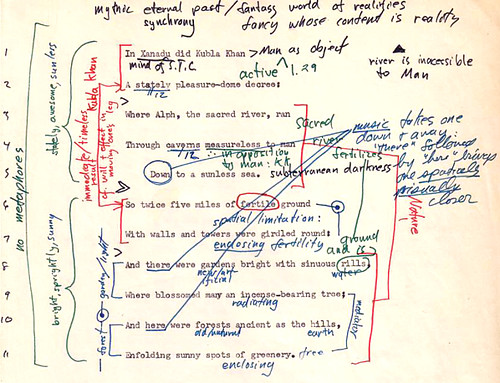
That got me started. But it wasn’t enough to bring me home. I made worksheets, worksheet after worksheet. I’d type out the text of “Kubla Khan” in double-space or triple-space and then mark it up. I must have done that half a dozen times or so. Here’s a fragment from one such sheet:

KK-working-text-old-2cr72.jpg

Notice that I’ve numbered the lines (down the left edge) and that I’ve made various kinds of notations in three, maybe four colors of in, black, blue, red, and I believe green (running vertically in the left margin). I’ve underlined and circles various words and phrases, used various lines and brackets to connect things across lines – in this I was inspired by an illustration in the notes to “Kubla Khan” in the edition I was working from, edited I believe by Kathleen Coburn. And I’ve written various kinds of comments all over the place. Some comments seem descriptive: “spatial limitation” (line 6), “enclosing fertility” (7), “water” (8), “radiating” (9), and “earth” (10). Others are more interpretive: “music takes one down & away” (to the right of ll. 3 & 4), “Nature” (on the rightmost red bracket), and “Man as object” (line 1). Notice, though, that the interpretation is rather “shallow”. I’m not trying to decode symbols. I’m classifying and organizing. I’m looking for patterns.

Friday, September 28, 2018

Michael Bérubé tells all

I was making my rounds the other day and followed a link to an interview with Michael Bérubé. But what really caught my attention was the name of the reviewer, Frederick Luis Aldama. What!@? My eyes blinked thrice and when I opened them it was still there: Intellectual relevance: an interview with Michael Bérubé.

I suppose you’re thinking, what’s so special about that? If you’re thinking that you may not know the interwebs like I know the interwebs. Back in October 2009 Bérubé had run up a post about one of Aldama’s books, a defense of the humanities. He called Aldama out for making a bunch of bone-headed mistakes, like, e.g., asserting that Leonardo da Vinci had been inspired by Isaac Newton’s account of gravity when, as we all know, Newton was born more than a century after Leonardo had died. (And how’d that one ever get past copy-editing?) And yet Aldama was able to get past it and give us a wonderful review.

Here’s some of my favorite passages.

After telling us that he’d originally intended to go into advertising rather than academia, Bérubé admits:
Let’s just say that if I were on an admissions committee, I wouldn’t have bet on me. But one thing that stays with me from being a musician is always wanting to be asked back. Even if you didn’t like the gig. From grad school onward, anytime someone has given me a break, I’ve been grateful – and I’ve tried to show them that they didn’t make a mistake. (The flip side of this is that you want the people who didn’t believe in you to go down in history like Dick Rowe, the A&R man from Decca who turned down the Beatles.) As a drummer, I also had to learn to overcome a paralyzing fear of failure. The first time I tried to play drums in public I couldn’t do it. I promised myself I’m not doing this again until I’m plausible. I felt the same way about graduate school – I was determined to make the most of it, wherever I got in.
Ah, yes, there’s nowhere to hide. One of these days I’ll tell you about the time I fracked the opening line to “You’re Still a Young Man” (here it is done right).

Concerning his most recent book:
With The Secret Life of Stories (2016) I return to narratology – some of those readings from my early years of graduate school: Wayne Booth, Peter Rabinowitz, Frank Kermode, and Paul Riceour. (Old white guys theorizing narrative! I used to be a serious Gérard Genette fan. No one knows this about me.) Narratology and my journey with my son Jamie (I wouldn’t have read Harry Potter without him) allowed me to analyze disability in fiction in terms of narrative strategies: motives, plot devices, for instance. In this way, I was able to show that disability in fiction doesn’t even require characters with identifiable disabilities; instead, it can involve ideas about disability, meditations on the social stigma associated with disability, narrative strategies that deploy ideas about disability that function in innumerable ways. The theorizing scaffold may be old school – hell, I rely heavily, at the end, on Viktor Shklovsky’s account of defamiliarization – but I knew I was opening up whole new territory for literary criticism in a way I’ve never done. Also, I have to admit, The Secret Life of Stories was more fun to write than anything I’ve written ever.
But, you know, Michael, the discipline would be better off these days if it hadn’t turned its back on narratology, poetics, and old school structuralism back in the mid-1970s. These days, for example, we have folks theorizing about doing “surface reading” and description without actually doing it. If more people had gone with narratology and the others, there’d be more practical descriptive work around to think about and emulate. Instead it seems to be easier to theorize about something we may do sometime in the future if only we knew how! You learn by doing, not by theorizing, which comes later.

Sorry about editorializing all over your interview, Michael. And – pro tip – I'd be more circumspect about admitting to having fun.

About the virtues of writing for non-academic audiences:
As an assistant professor at the University of Illinois at Urbana-Champaign, I was told in a friendly way that none of my writing for the Village Voice would count for tenure; it wouldn’t count against me, but it wouldn’t be a formal part of the tenure dossier, either. Still, I was encouraged to keep up the nonacademic writing as long as it was intellectually substantive. We both know that to get readers’ attention, non-academic writing actually has to be more rigorous in terms of theorizing and hailing its audiences. So, once I cleared that tenure hurdle, I knew I wanted to publish more of this kind of writing.
On working with the AAUP:
Yeah, sometimes you feel it’s like you have to build the house every day. So the first thing is really the question about institutionality and making sure that whatever you build stays around from year to year and it survives you. [...] resources. It’s why I chose to work for the American Association of University Professors (AAUP) – because that work has consequences for people’s working conditions and for policies and practices, especially with regard to academic freedom. I ran for Faculty Senate at Penn State so we could create a university-wide system for the review and promotion of fixed-term faculty. (And we did! [...]) I also wanted a conversion-to-tenure plan for long-term faculty with distinguished records but who don’t do research, along the lines Jennifer Ruth and I laid out in our book. (If they do research, great. But it shouldn’t be required for conversion to tenure. After all, these are teaching intensive jobs.) Jennifer and I argue that we can stabilize the profession of college teaching by moving as many people to tenure as possible. I couldn’t get that at Penn State, but we did create a system where fixed-term faculty can elect committees consisting entirely of fixed-term faculty to review fixed-term faculty the promotions that come with raises as well as changes of title to professorial titles. I also wanted promotions to be accompanied by multi-year contracts. We have that language now, and our administration has agreed to it, though I wish it were stronger. The upside is that our administration agrees with the Senate that we want to create a “culture of expectation” that promotions come with multi-year contracts, and we’ll keep working on that. So that’s what I’m going to spend my time doing. I want to work hand in hand with my fixed-term colleagues at Penn State to do something with what was once a random, arbitrary system, and reprofessionalize it.
Bérubé went on to point out that being President of the MLA (Modern Language Association) didn’t “really have the kind of institutional consequence I’m talking about [...] in terms of advocacy, the MLA can do a lot of things. In terms of implementation, not much.”

Finally:
I got into this business not just for the fun of reveling in ideas and doing different kinds of writing, but because the intellectual autonomy of the university is unparalleled in the American workplace. The university is a place where the people who dream of worlds that don’t exist can find a home. Those worlds don’t just exist in the theoretical sciences – they exist wherever the spark of human creativity bursts into flame. And those of us in the arts and humanities are the guardians of that flame.
I’ll close with my favorite Samuel Delaney line:
Science fiction isn’t just thinking about the world out there. It’s also thinking about how that world might be—a particularly important exercise for those who are oppressed, because if they’re going to change the world we live in, they—and all of us—have to be able to think about a world that works differently.