Showing posts with label party. Show all posts

Tuesday, May 20, 2025

On coping with Scarlet Begonias/Fire on the Mountain [Howard’s Birthday Jam 2025]

Several weeks ago I got an email from my friend, Howard, whom I’ve known since the beginning of this millennium, when we were both employees of a now-defunct software company started by a friend of mine. It was time for his annual birthday jam (session), a fine event I’ve attended let’s say a half-dozen times before. The idea is simple: 1) You tell your neighbors that this one time you’re going to be making music until the wee hours of the morning. 2) You set up a sound-system in the front parlor, along with a drum kit (while fitting out the rest of the first floor for a party). 3) Invite everyone you know to come to the party. Many of those people are musicians, and many are not. The musicians will generally bring their instruments. The others are welcome to listen (or not) and to pick up a cowbell, tambourine, or a shaker if they want to get in on the musical action, which some of them do.

Then you party.

How do you pick what music to play? While no one knows everyone else, not even Howard, as some people bring strangers to the event, we’ve played with one another at one time or other in one configuration or another. So there are a bunch of songs we more or less know and even if you don’t know a tune, you can often pick it up on the fly. People take turns playing guitar, bass, drums, keyboards, or singing. I’m the only trumpet player I’ve seen at these jams, but a saxophonist sometimes shows up, last night we had a fiddler and a flutist.

One song that has been a constant at these jams is in fact two songs, both by the Grateful Dead and often performed by them back-to-back: “Scarlet Begonias” followed by “Fire on the Mountain.” Those tunes are in the key of B. If you don’t know just what that means, don’t sweat it. Think of a key as a selection of notes and associated structures you can draw on in playing. The thing about the key of B is that it is convenient for guitar players, but hellish for trumpet players. We’re talking about how you manipulate your fingers to play the instrument. For guitar players it’s the fingers on the left hand that are used to depress strings against the fret board. For trumpeters it’s the right hand fingers used to depress the valves. For both instruments, some finger patterns are easier than others. Tunes that are easy for guitar are difficult for trumpet, and vice versa.

Thus, when I undertake to perform “Scarlet Begonias/Fire on the Mountain” I have to give up half my technique. Riffs that are easy in the key of B-flat are difficult in the key of B. I’ve got semi-virtuoso technique; I can play lots of fast, intricate, and even flashy patterns. But not in the key of B.

So what? Does that matter? Well, it depends. If you value flash, which I do occasionally, then that’s gone. Can you play without it? Yes. But still there are problems. Even when I slow down, I can’t be sure just what notes are going to come out when I manipulate my fingers. More often than not, they come out OK. But when they don’t, that doesn’t sound so good. All of a sudden I have to start actually thinking about what I’m doing. Thought may be fine enough in practice, but it’s not so good for performance. When performing you want to be able to do everything on autopilot. No thought. You’re sailing on pure intuition. That’s what you want. You don’t want to think.

Anyhow, I’ve played these tunes before, many times. I’ve always managed, somehow. I decided that this time I was going to do more than manage. I decided that I wanted to make some actual music. That meant that I had to practice.

So I started two weeks ahead of time. I’d get cue up one of the many versions of “Scarlet Begonias/Fire on the Mountain” that are on YouTube and start playing along. The minimum goal is to not play any wrong notes. At first even that was tricky. Beyond that you want to play notes that form meaningful musical patterns. More difficult.

When I’d hit a wrong note sometimes I’d just play through it and keep on moving ahead. Other times, though I’d start repeating the botched pattern, but with corrections. I’d repeat it until I got it right. Sometimes I’d do this while the music continued while other times I’d stop the music and turn the pattern into a technical exercise, an exercise that I’d repeat over and over until I felt smooth and comfortable under my fingers. I did a lot of that, make up little technical exercises. Gradually the glitches began disappearing and musical statements would replace them, meaningful statements.

After about a week of this I was getting more comfortable, more comfortable than I’d ever been with these tuns. Of course, I also picked up patterns from the performances, guitar riffs, fragments of the melody. I’d double the vocal, then play a harmony line, sometimes standard harmony (below the melody), and sometimes I’d go for high harmony. I worked on that long riff The Dead often used to connect the two tunes. Things were looking up.

Yet, something was missing. I needed something more. Just what, I didn’t know. Then it hit me on Thursday before the jam, Elmer Bernstein's soaring main theme from The Magnificent Seven.

I immediately tried it out. It worked. I could lay it in there nice and sweet and have an actual melody to work with. I was all set.

And it worked. Best I’d ever done on those tunes. I was happy.

I’d have been happier, though, if my chops had been stronger. I’d been off the horn for a long time. I just didn’t have the power and endurance I needed to really make that melody sing. But next year, though...Just you wait.
Thursday, January 16, 2025

Party like you own the world: Tech billionaires for 47

Theodore Schleifer and Kenneth P. Vogel, A Euphoric Tech Industry Is Ready to Celebrate Trump and Itself, NYTimes, Jan. 16, 2025.

A party at the Beaux-Arts mansion of the venture capitalist Peter Thiel. A blowout organized by hosts of the popular tech podcast “All-In” at a brand-new members-only club. A viewing ceremony hosted by an ascendant, Silicon Valley-inflected network of wealthy donors.

Some of the most coveted parties during President-elect Donald J. Trump’s inaugural weekend will be hosted by the Silicon Valley donors who are flush with power at the dawn of his second administration. The tech industry that has embraced Mr. Trump over the last year or so is set to revel in its clout over days of festivities that will make the tech donors the stars of the show.

Then comes a bunch of stuff about the usual corporate and GOP suspects. And then...

Few events have attracted more interest from politically ambitious executives than the Crypto Ball, a sold-out affair on Friday night being put on by the cryptocurrency industry to celebrate what the invitation calls “the first crypto president.” Snoop Dogg is set to perform at the party, which will also celebrate David Sacks, a venture capitalist and podcaster whom Mr. Trump named as his czar for artificial intelligence and crypto issues.

MAGA Inc., a pro-Trump super PAC, is hosting a “V.I.P. reception” at the Crypto Ball, with a $100,000-per-person entry fee. MAGA Inc. is raising significant money from these tech and crypto executives: On Wednesday evening, Mr. Vance was at Le Bilboquet, a French restaurant in Palm Beach, Fla., to headline a $250,000-a-head dinner for the group, according to a person with knowledge of the event. The 20 or so attendees included Mr. Sacks, Cameron and Tyler Winklevoss, the crypto billionaires made famous in “The Social Network,” and Omeed Malik, an investor at 1789 Capital.

And so it goes.

Other tech companies hosting events include Spotify, which is holding a brunch featuring Joe Rogan, Megyn Kelly and Ben Shapiro, and Uber and X, which is led by Elon Musk, one of Mr. Trump’s most vocal boosters and his No. 1 donor. People expected to be on the social scene from Silicon Valley include the Meta chief Mark Zuckerberg, who is hosting a post-ceremony event alongside the likes of the megadonor Miriam Adelson, and of course, Mr. Musk and several of his friends from California, Texas and Florida.

I wonder if we’ll finally see the much ballyhooed cage match between Elon and The Zuck? I hear they’ve already started dropping Jägerbombs. & Hollywood’s taken the sets for Tron out of mothballs so the billionaires usher in the MAGAverse in style.

It's gonna’ be wild!

Tuesday, August 29, 2023

The Death of Burning Man

Daniel Pinchbeck, How Burning Man Failed, Daniel Pinchbeck's Newsletter, Aug. 29, 2023.

I've known about Burning Man for a long time. When I read about it in Pinchbeck's first book, Breaking Open the Head, I wanted to go, but didn't. Now...?

Pinchbeck notes:

As some readers may recall, I love Burning Man and consider it a massive disappointment. When I first visited back in 2000, I was overcome with enthusiasm, inspiration — many people still feel this, today, when they go for the first time. I still recall that wonderfully intoxicating sense of arriving at a “free” or liberated cultural zone where, in theory, you can recreate yourself in any way you want, express yourself in any way, as long as it doesn’t cause harm to anyone else. [...]

Burning Man seemed to reveal how society, as a whole, could (and, I believed, eventually would) be reconstructed around the psychedelic anarchist vision. The festival showed me it was possible to deprogram people, en masse, from the economic shackles, blind ambitions, and incessant status-seeking of normative culture. In my naive excitement, I saw Burning Man as a porto-revolutionary model for the future— in How Soon Is Now, I joked that the festival was my version of the Paris Communes (1848), a short-lived worker-run experiment eventually crushed by Napoleon III, which inspired Karl Marx and Friedrich Engels.

But now, he goes on to say:

Over time it became clear — particularly after the death of Larry Harvey, its founder — that the dominant ethos underlying Burning Man was a kind of occult-tinged free market Libertarianism, influenced by transhumanism and the technological Singularity. Back in the early 2000s, Burning Man mocked itself vigorously. It had a hard, Terence McKenna / Robert Anton Wilson edge. We felt we were exploring Chapel Perilous, awaiting the Eschaton.

As Burning Man expanded and became more popular, it lost its self-parodying humor, its self-critical irony, and its encompassing social vision, to a great extent. It started to feel increasingly hollow, shallow, and narcissistic. Much of the art now seems designed to provide a fitting backdrop for Instagram selfies. The outfits and hats became copycats of each other. Burners no longer explore much originality of self-expression. They follow the pre-set script, the round-the-clock EDM schedule. [...]

There was always an innate beauty hierarchy at Burning Man; over time, wealth started to play a greater role in determining the festival’s focus. Wealthy Burners raised millions of dollars for their art cars, sculptures, and mega-domes.

Crank it up, rich tech bros! 

* * * * *

 This just in (73.23):

Referring to this:  Trapped in Mud, Burning Man Attendees Are Told to Conserve Food, NYTimes, Sept. 9, 2023:

Thousands of attendees at the Burning Man festival in a remote stretch of the Black Rock Desert in Nevada were told on Saturday to conserve food, water and fuel after heavy rainfall trapped them in thick mud.

The event, which takes place in Black Rock City and began on Sunday, was interrupted by heavy rains on Friday night, and organizers directed attendees to shelter in place as rain poured over the area.

The festival site received more than half an inch of rain overnight on Friday, organizers said. While it had stopped for much of Saturday, more was expected in the evening and into Sunday morning, with a slight chance of thunderstorms, they said.

Except for emergency services, vehicles have also been prohibited around Black Rock City.

Sunday, July 11, 2021

Peak happiness lies mostly in collective activity. [We need a Declaration of Interdependence.]

Adam Grant, There’s a Specific Kind of Joy We’ve Been Missing, NYTimes, July 10, 2021.

Most people view emotions as existing primarily or even exclusively in their heads. Happiness is considered a state of mind; melancholy is a potential warning sign of mental illness. But the reality is that emotions are inherently social: They’re woven through our interactions.

Research has found that people laugh five times as often when they’re with others as when they’re alone. Even exchanging pleasantries with a stranger on a train is enough to spark joy. That’s not to say you can’t find delight in watching a show on Netflix. The problem is that bingeing is an individual pastime. Peak happiness lies mostly in collective activity.

We find our greatest bliss in moments of collective effervescence. It’s a concept coined in the early 20th century by the pioneering sociologist Émile Durkheim to describe the sense of energy and harmony people feel when they come together in a group around a shared purpose. Collective effervescence is the synchrony you feel when you slide into rhythm with strangers on a dance floor, colleagues in a brainstorming session, cousins at a religious service or teammates on a soccer field. And during this pandemic, it’s been largely absent from our lives.

Peak happiness lies mostly in collective activity. 

Collective effervescence happens when joie de vivre spreads through a group. Before Covid, research showed that more than three-quarters of people found collective effervescence at least once a week and almost a third experienced it at least once a day. They felt it when they sang in choruses and ran in races, and in quieter moments of connection at coffee shops and in yoga classes.

But as lockdowns and social distancing became the norm, there were fewer and fewer of these moments. I started watching standup comedy specials, hoping to get a taste of collective effervescence while laughing along with the people in the room. It was fine, but it wasn’t the same.

Instead, many of us found ourselves drawn into a dark cloud. [...]

Emotional contagion can in part explain so-called Zoom fatigue, a phenomenon that has mostly been attributed to sitting still, staring at oversize virtual heads, feeling self-conscious at seeing your own reflection and juggling the cognitive load of reading glitchy facial expressions. The science of contagion suggests that the negative emotions we feel from video-call overuse could be partially driven by hours of communicating with people who are also sad, stressed, lonely or tired. (How to survive a Zoombie apocalypse: Avoid eye contact at all costs.) [...]

The Declaration of Independence promised Americans unalienable rights to life, liberty and the pursuit of happiness. If we want that pursuit to bring us bliss, it may be time to create a Declaration of Interdependence. You can feel depressed and anxious alone, but it’s rare to laugh alone or love alone. Joy shared is joy sustained.

There's more at the link.

Wednesday, June 30, 2021

Three Parties I Have Known

I'm boosting this once more, on general principal, but also with specific intent.

 * * * * *

I'm this time of the coronavirus I'm bumping this to the top of the queue just to remind everyone that fun is real!
If you’ve ever been to a really good party, or a happening nightclub scene, you know what I’m talking about. And I’m not even a party person. But I know a good time when one’s swirling about my legs and crawling up my spine.

Yes I do!

But writing about parties, as I’m about to do, is tricky business, especially if the parties you are writing about happened half a life-time ago and have left few memories which you can recount in appropriate detail. Without the detail, what is there, but the...feeling is not the word, nor ambience, perhaps residue, Benjamin’s aura? Somewhere in there.

I HAVE known some good parties. Some of the best are those where I’ve performed as a musician. But I was not a musician at these parties, though I helped organize the third. These are the parties that stick in my mind as (among) the best I have known.

1960s at Johns Hopkins

I was an undergraduate and then a graduate student (master’s program). I don’t recall whether this party happened during my undergraduate or graduate years. Not that it matters.

It was in the Hopkins gym on the north end of the Homewood campus. So the room was large and the ceiling high. The music was rock, with a bit of a psychedelic vibe. There was a light show, colored oils floating in water in shallow dish atop an overhead projector – do they still exist, overhead projects, or have they been completely replaced by digital projects of various kinds? The light show required a certain ambient darkness which it could then illuminate.

But I forget just where the light show was being projected. One wall, the ceiling, both? Don’t know.

Nor do I recall the music, not in the sense that I can bring it up in my mind’s ear. Though who knows what could come bubbling forth under hypnosis. The band was a trio, guitar, bass, and drums. And I have a vague sense that they were spread apart a bit on the floor rather than being tightly grouped.

It was the guitarist that caught my ear, his expertise with the wa wa. Sounded like Zappa. I told him so during a break and we had a nice chat. Zappa at Hopkins. What fun.

Somehow it was all magic. The world melted away and we all melted into the party.

1970s at UB

That’s the State University of New York at Buffalo, known as UB (it used to be a private school, the University of Buffalo). This party just happened. No one planned it. It just grew up out of the ground one afternoon.

At that time the English Department was housed in two long, low buildings that had been erected at the north end of the Main Street campus as temporary structures. Somehow they became all but permanent. The buildings ran parallel to one another about, say, 20 or 30 feet apart, with enclosed walkways between them and one or two points. This little complex was surrounded by grass of some useful extent.

It was Spring, of 1977 or 1978, and by then the grass had come back, the leaves were on the trees, and the temperature was comfortable. For some reason, somehow, the faculty decided to throw a party that afternoon, for the graduate students, for the undergraduate majors, for themselves, and, as a practical matter, for anyone who came by. They set up a temporary bar outside on the lawn and started serving drinks.

Where did the tables come from? I don’t know. And the booze? Don’t know that either. Someone had an idea and someone did this and that, and things happened. Word spread and a party was on.

We drank and talked and many of us got pleasantly tipsy, though some, I recall vaguely, drank to the point of nausea and throwing up.

Somehow it was all magic. Some people kissed people they’d hardly even talked to before, even me, though I forget the woman’s name. We had one date after the party, and that was that.

1980s at Grafton, NY

I was on the faculty at the Rensselaer Polytechnic Institute in Troy, New York. My friend Al and I rented a small house on the top of a hill in Grafton, about 15 miles outside of Troy. You could see into Massachusetts from our second floor.

We decided to throw a Halloween party. We sent out invitations – just how, I forget, but this was before email and I don’t recall stuffing a lot of envelopes. We hired some undergraduates to form a jazz band and set them up in a largish downstairs room. One of them wrapped himself in toilet paper so he became a mummy.

I forget what I did for a costume, but Al managed some kind of penguin costume.

A couple of hours before things began Al was cutting veggies for hors d’oeuvres when he managed to slice into the meat of his hand (I forget which one–all this forgetting) down to the bone. The party was set to begin in two hours and I had to drive Al to the emergency room–keep calm. Which I did, and left him there. Someone else would pick him up and bring him to the party.

I returned to Grafton, finished whatever needed to be finished. People began arriving and, by the time our little house was packed, Al had returned from the hospital and was in fine spirits. Some undergraduates had formed a small jazz combo. We hired them to play the party. Or did we just give them drinks. I don't remember. I do remember that one of them had wrapped himself in toilet paper so he could come as The Mummy. The joint was rockin’.

I remember one woman, a faculty wife, had costumed herself as an upside-down person: pants pulled on over her arms, some silly head hanging between her legs, which had shirt pulled over them so they could pretend to be arms as her hands pretended to be feet. Ridiculous. Fun. I mean, when talking to her, where do you direct your voice, to her pretend head (down there) or to her pretend crotch (in your face)?

Somehow it was all magic. The mundane world was gone and the cosmos filled our house.

Tuesday, October 21, 2014

Cataphiles: The Cave people of Paris

PARIS — On a recent evening, a 31-year-old street artist led a small group through a dark tunnel off a disused train track in the south of Paris. After crouching, crawling and sometimes wading through water, using headlamps to light their way, they finally arrived in a chamber with vaulted ceilings about 10 feet high.

The space was once used by a brewery to store bottles. It is now part of a sprawling network of abandoned galleries below this city, where a secretive community of street artists, history buffs and other Parisians regularly prowl. They are sometimes called cataphiles: lovers of the catacombs, as the subterranean network is commonly known.

Some seek peace and quiet from the bustling city, others an unusual canvas for their art, still others a place to party with friends at a lower cost and in a more jovial atmosphere than in the clubs and bars above. Many cherish the secrecy and, to some extent, exclusivity of their endeavors.

“My creations have a lot more value here, because they are intended for a limited audience that deserves to see them,” said the artist who led the group and declined to give his name, but went by Nobad. “They went through the trouble of coming here.”

Nobad stencils European paintings with a twist, like Gustave Courbet’s “Desperate Man” in glow-in-the-dark paint. But the walls are covered with art, including paintings in the style of Egyptian tomb murals, grimacing black and orange devil faces, a giant multicolored parrot, and an abundance of graffiti. In one room, the walls are encrusted with mirror shards, and a glittering disco ball hangs from the ceiling.
The egalitarian ethos is like that of Japanese aesthetic circles from the Tokugawa era, where people from different stations in life meet on an equal basis:
“You can’t be judged on your appearance because we are all dirty with mud and wearing boots,” said a 45-year-old pastel artist who gave her name only as Misti, on another outing. “So the banker and the punk, they party together.”
The 3 minute video with the Times article captures that ethos: "There is a lot of graffiti here and not enough classical masterpieces."

Saturday, June 26, 2010

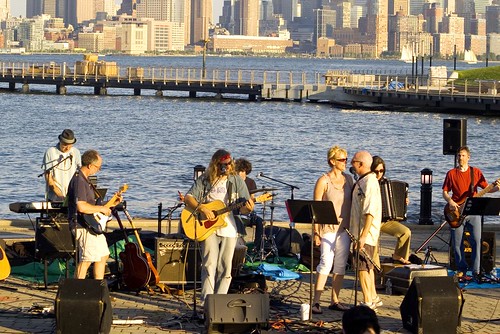
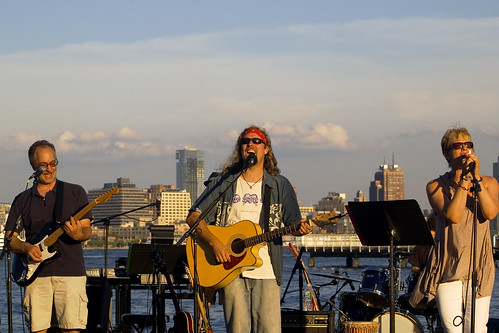
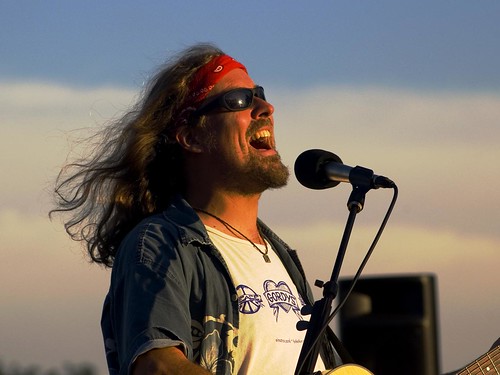
Gordys Concert 1

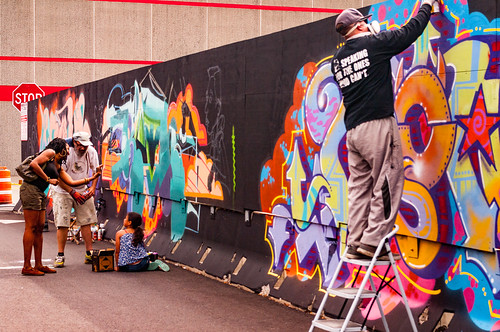
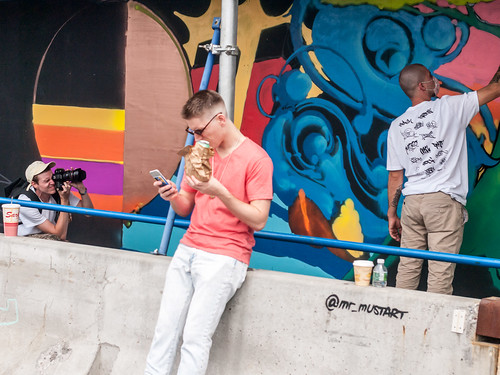
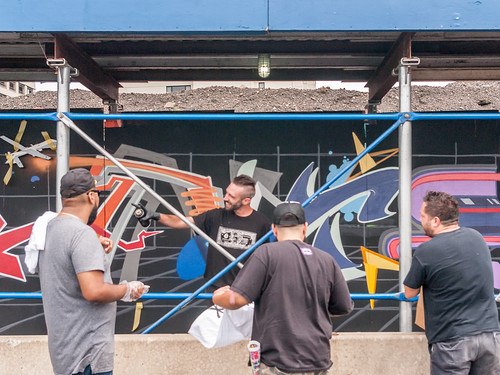
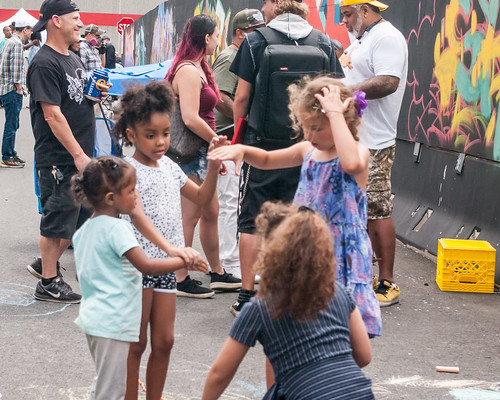
This is where I live, Hoboken, NJ. Some of these people are friends. All are neighbors.


Where's the line between the band and the audience?


Tuesday, April 20, 2010

AWESOME! Two iguanas, two people, and a cast of billions. Who could ask for anything more?

Last, night I went to a party by/with/for NYC’s Awesome Foundation. They gave a thousand bucks to a pair of iguanas. Well, not to the iguanas themselves, but their two handlers from the Brooklyn Zoo, who’ll use the money to build a new cage for the iguanas so the public can see them. Photo of iguanas here.

They do this every month, Awesome I mean, not the handlers. A thousand bucks to a worthy project. In a paper bag. But only if the idea is AWESOME! Details here.

The two people?

Steve Rosenbaum. I met him in Saratoga Springs in upstate New York. He was DJing at the Metro and I played trumpet in the Out of Control Rhythm and Blues Band, which gigged at the Metro. Steve then started OurTown, a video production company that did a cable TV magazine show. OurTown did a little piece on Out of Control. That was Steve’s first company. He’s now on his fourth, magnify.net. He’s also a trustee of the Awesome Foundation.

Reihan Salam. I’ve been quite impressed with his commentary on bloggingheads.tv, but I’ve not read any of his prose. He’s identified as a conservative and, who knows, he probably is. I’m not. But we both fear that the West is out of innovation. Will India emerge as the leading nation on the New Savanna?

The cast of billions? You figure it out. Remember, this party was held at hip (anyone use that word these days?) bar on NYC’s lower East Side, a few blocks away from the 2nd Ave. stop on the 7 train: d.b.a.