Showing posts with label Mary_Douglas. Show all posts

Sunday, April 6, 2025

A Letter to Mary Douglas about God, Religion, and Music

I’m in the process of thinking through my next column for 3 Quarks Daily. I’ve given it a provisional title: “My New-Found Patriotism: Vietnam, the Draft, Mennonites, Music, and Apollo.” I’ll probably include something from a letter I wrote to the late Mary Douglas some years ago. As you may know, she a well-known anthropologist best known for her book, Purity and Danger (1966). She’d been kind enough to blurb my book about music, Beethoven’s Anvil (2001). Once the book was out my editor, William Frucht, gave me her email address and we began corresponding.

While the book was reviewed in both Science and Nature, and other places as well, it was not the smash success I’d hoped it to be. But it did get me some speaking invitations, one of them at Goshen College, which is a Mennonite College in Indiana, Pennsylvania. The Mennonites are conservative Christians. How do I, an atheist, talk to devout Christians (about music)? Since Douglas was a devout Catholic, I asked her about it in a letter I wrote in October of 2002. I’ve appended my letter in full (though I’ve corrected a typo or two) along with her brief response.

* * * * *

Dear Mary,

I feel the need for a different kind of conversation. I’ve been asked to deliver an address at Goshen College in Indiana in the Spring of 2003 and I’ve accepted the invitation. Goshen College is a small school (c. 1000 students) affiliated with the Mennonite Church. Music is very important to the Mennonites, which is I why I’ve been asked to deliver an address. I can speak on any musical topic I wish but, given the nature of my book, on the one hand, and the importance of music to the Mennonites, on the other, the whole confused business of science and religion is going to be lurking in the background.

I don’t know much about the Mennonites, but I’ve been doing a bit of reading. As I said, music is important to them; they see it as a way to communicate to God. In particular, they have a long tradition of a capella four-part singing. This music is relatively austere. I note, however, that Charlie Keil has heard recordings of African Mennonites who sound like they’ve just invented four-part harmony. There are about 1,000,000 Mennonites world-wide, with c. 450,000 in North America and c. 350,000 in Africa.

Mennonite doctrine is fairly conservative. In particular, they believe in the “literal” truth of the Biblical account of creation. They are pacifists and also believe in a strict separation of church and state, so, for example, they refuse jury duty. They look at the world rather differently than I do. But the professor who made the invitation observed: “While I simply accept your scientific arguments on faith, I am entirely convinced that you and I 'hear' music the same way.”

When I say, in the first chapter of B’s Anvil, that I’m firmly anchored in the Western scientific view of the world, I am, of course, quite serious. When I said that, however, I was quite aware that I spend a great deal of time in the book discussing experiences that have little “purchase” within that worldview. I think that’s a real problem and that not only do such experiences need to be discussed, but that we need to reconsider how we think about cultures and groups. To the extent that that book is “science” (not something I fret over) science is seeming stranger and stranger to me.

When I started writing the book I wasn’t looking for the attractor stuff that I eventually put into it. That came late in the process, and something as a surprise. But it does mean that things like “group minds” are no mere metaphors; they are entities as real as quarks and dark matter, and equally strange. I can almost see my way to saying that, when Leonard Bernstein “becomes” Mozart, Mozart’s soul is, in fact, taking up residence in Bernstein’s body. If I admit of that, then it’s but a step to say that the same pretty much happens when anyone performs Mozart well, or listens to such a performance. As the same line of reasoning pretty much suggests that nothing remains of Mozart’s wife, not even her soul, I doubt that it would bring much comfort or satisfaction to a standard sort of religious. 

“If we are his creation, we should be this complicated and exciting, especially the brain.” 

But nonetheless I find it a rather striking and remarkable argument to make. In part what makes it so remarkable is that it follows directly from my insisting on treating the brain as a physical phenomenon, albeit an astonishingly complex one. Those musical attractors are beings most strange, remarkable in that once they come into existence, they can be passed down from person to person, group to group, generation to generation, yet they are, by nature, fluctuating and evanescent in the extreme. How can we comprehend that, when first a group of apes began to dance, they changed the world forever and began the trek to us?

And I find myself feeling a bit of sympathy with those fundamentalists who’ve been battling for years to have their view of human history presented in the schools, alongside Darwin’s view. It seems to me that one thing that’s going on is that they look out on the world in a commonsense way and see that man is quite different from animals. When they look at science, they see science telling them that, no, man is an animal, no more and no less. They cannot reconcile these views and so they reject science. I think that the science they are rejecting is wrong on that point and so I’m sympathetic with their rejection, even if I’m not sympathetic to creationist biology. And, given the time and energy this particular conflict has taken in America over the last century I’d be seriously inclined to allow creationism into the public schools, along side modern biology, just so we can stop wasting time with this particular squabble.

As you know, there is a well-established body of thinking on the vexed relationship between religion and science. I’ve read a little of this, and dip into it every now and then. But don’t mind much there to engage me. But those musical attractors, they are strange things to form in groups of human brains. As strange as spirits and gods.

I have no idea what I will tell the Mennonites about music. But whatever it is, I’ll be most interested in what they have to tell me in return.

Regards,

Bill B

* * * * *

Good luck with the Mennonites.

I don't really see the problems that loom in your mind about science and God. If we are his creation, we should be this complicated and exciting, especially the brain.

Have you come across the poetry of Fred Turner? especially a book of essays on Beauty. I find it inspirational about your kind of work.

Thanks for writing,

Mary

Wednesday, June 23, 2021

The failure of structuralism and linguistics: Why did academic literary criticism turn its back on intellectual opportunity in the mid-1970s? [and why did I ignore the profession?]

6.25.21: Revised and updated with new material.

I’ve been through this before, I know, but I keep coming back to it. Maybe this time I can get it right, or at least inch beyond were I got the last time. However, I’m not going to take the time to link to specific posts or working papers that are relevant. I’m just going to talk this one straight through.

However, I did update a post where I’ve been keeping track of my thinking on this issue. Here it is:

The profession of literary criticism as I have observed it over the course of 50 years [& related matters], https://new-savanna.blogspot.com/2017/01/the-profession-of-literary-criticism-as.html

I will say this, after having drafted this essay, I think I’ve got it right, more or less. This satisfies my curiosity about this matter, though no doubt there are details to be nailed down, etc.

Two Perspectives

We have two perspectives, two aspects to examine: 1) the profession in general, and 2) my history in particular. Let us assume that by my senior year in college, 1968-69 at Johns Hopkins, I had internalized some version of a standard academic approach to literary criticism. The object of criticism was to interpret the text. There was some question as to whether or not interpretations were unique, whether or not they could be objective, at least in principle. This was quite problematic and extensively debated. But there was no doubt that interpretation was the name of the game.

That’s the period when structuralism, not post-structuralism or deconstruction, was getting attention, what with its codes, little diagrams, and formulae. Perhaps, some thought, structuralism will clear up some of the debates about the nature of the text, meaning, and interpretation and, at the same time, open avenues of collaboration with neighboring disciplines. I grabbed ahold of that and had worked my way to computational semantics by early 1974. But the profession tossed structuralism over in favor of Derrida and friends. Why the divergence? And why did it take me so long – roughly two decades, into the mid-1990s – to realize that it had been form that had my attention all along that, in effect?

Lévi-Strauss and the logic of myths

I suppose it was in my sophomore year that I first encountered the work of Claude Lévi-Strauss. It would have been in a class I took with Richard Macksey. He’d assigned the following text as optional reading:

Claude Lévi-Strauss, The Structural Study of Myth, The Journal of American Folklore, Vol. 68 No. 270, Oct-Dec 1955, pp. 428-444.

I read it and was fascinated. I did a paper on Oedipus at Colonus – so it must have been his Idea of the Theatre course – in which I drew a table modeled more or less after something I’d seen in that article. It’s important that I’d internalized the article to the point where I did draw a table.

I forget what kind of table it was. I may still have the paper – I’ve kept some of my undergraduate work (just as Jerry Seinfeld has all his notes back to the first bit he ever performed) – but it would be in storage along with the rest of my library. It might have looked something like this, from the article:

That’s about the logic underlying the Oedipus stories. I sometimes talk of ‘myth logic.’

Then there’s this intriguing diagram:

It looks a bit like a slice through some kind of machine, a myth machine, no? Notice that we’ve got “life” at the upper left and “death” at the lower right. In between we’ve got some linkage between “animal food” and “life destroyed.” What’s going on?

Lévi-Strauss was working out a theory/model whatchamacallit that myths work by resolving binary oppositions. The big one, of course, is life-death. You then substitute mediating terms for each side of the opposition until you reach a point where you’ve got a common term, or something like that. That’s what that horizontal slot is about.

He argued that in myth after myth after myth for several years, until he adopted a somewhat different and more elaborate whatchamacallit in Mythologies, the first volume of which was The Raw and the Cooked, which are mediating terms for nature and culture, respectively.

That’s what caught the attention of the folks who organized and attended the (in)famous structuralism conference at Hopkins in the fall of 1966. Though I was on campus at the time, I didn’t attend any of the sessions, nor would it have done me any good as they we all in French, one of many languages of which I know little to nothing. But I was in Dick Macksey’s orbit, and that was enough. I read that essay, wrote that paper, and was hooked on Lévi-Strauss for the next few years.

But why?

The word illusion and the problem of meaning

When I talk of the word illusion I’m alluding to the fact that when we see words on the page – or for that matter, hear them, but mostly we see them on the page in our work – we think we’re seeing the whole word in the way that we see the whole cat when we look at it. In the case of the cat, of course, we may be looking at it from, say, its left side, but it has a right side that is invisible to us, not to mention the belly and back, as well as its interior organs. But that’s not quite what I have in mind.

We see a word on the page and we know how to spell it, how to pronounce it, how to conjugate it (if it is a verb) and so on. And we know its meaning, or perhaps meanings. We feel that we grasp of that when we see it there on the page. The word.

But the word, the whole word in full, isn’t on the page at all. All that’s on the page is the word form. We hold all the rest of that in our heads. That all the rest of it is somehow inherent in those marks on the page, that’s a perceptual-cognitive illusion. The word illusion. If meaning inhered in the marks, then you could look at a text in a foreign language and grasp the meaning immediately, from the marks. Obviously language doesn’t work like that.

Well, linguists have quite a bit to say about word forms, and about phonology, morphology, and syntax. And the structuralist movement latched on to this domain primarily through the structuralist linguistics Ferdinand de Saussure. He talked of the sign as consisting of a signifier (the word form) and signified (meaning), where the signified was explicitly understood as being different from the referent, the thing (out there) in the world to which the word referred.

It’s easy enough to say all that, and even to believe it. But how do we work with, think about, those signifiers? We can’t get at them directly. They’re not physically present in the speech stream or inscribed on the page with written symbols. They’re in the mind, or brain, but we can’t observe them directly.

We have to get at them indirectly. Obviously they form some kind of system. Perhaps it’s a differential system, like the phonemes, which have binary features. We can work with phonemes directly. Perhaps we can detect the workings of a differential system of meanings in texts. That’s what Lévi-Strauss was doing in his work on myth. He was examining myths, how they unfold through some system of categories, how those categories reflect off one another, and deducing the likely terms in the underlying system of meaning. Those diagrams, those little formulas, they’re all representations of a system of signifiers in the mind, your mind, my mind, every mind. Those representations make the hidden and invisible world of signifiers real and tractable.

That’s what made structuralism so appealing to a generation of scholars who, having entered into the business of interpreting texts, were beginning to fear it to be a somewhat dodgy business.

Well, members of the profession gave it a try from the mid-1960s and into the 1970s. Robert Scholes produced a little book on structuralism. Jonathan Culler produced a somewhat bigger book, Structuralist Poetics, and lectured it across the country in ‘75 or ‘76. But, in a review of Mythologiques in Diacritics at that time, Eugenio Donato said we can set aside the analyst of ethnographic materials; it’s Lévi-Strauss the enigmatic philosopher who interests us, the Lévi-Strauss who believes his analysis of a myth is but another variant of the myth, and so forth. [I had little interest Lévi-Strauss the philosopher.] In the title essay of The Fate of Reading (1975), Geoffrey Hartman pronounced an interdiction on semiotics, linguistics and “technical structuralism” in literary criticism. And behind it all was Derrida’s deconstruction of Lévi-Strauss in “Structure, Sign, and Play in the Discourse of the Human Sciences,” the paper he delivered at the 1966 structuralism symposium at Hopkins.

Derrida had won. Structuralism and linguistics lost. But I went with losers. I went beyond them. It was clear to me from my careful study of The Raw and the Cooked, that if there was that much structure there, there must be more. I was going to look for it.

Trees in “Kubla Khan”

But it wasn’t at all obvious in 1968-69 that structuralism and linguistics had lost. What’s when I took a two-semester course in Romantic Literature, taught by Earl Wasserman. He praised my Wordsworth paper as exhibiting a “mature approach” to whatever poem I’d analyzed, I forget which. I’d also done a paper on “Kubla Khan,” and that poem would come to dominate the earliest phase of my career. I was told that that paper prompted Wasserman to ask a question in my name (they did that back in those days, do they still do it?) at some presentation where I wasn’t present. I believe that I’d proposed that the poem achieves completeness by asserting its own completeness and he asked about that.

Sunday, October 4, 2020

Heart of Darkness 6: Some Informal Notes about the Nexus

Another surprise. This post has just over 3800 views, and it's mostly descriptive. No theory at all. It's relatively old, having been originally published on 7.17.17.
 My previous post in this series (see links at the end of this post) was about the longest paragraph in Heart of Darkness, one that is structurally central to the text. For that reason I’ve called it the nexus.

In this post I offer comments on the entire paragraph, along with comments on several preceding paragraphs and one following paragraph. My object is to demonstrate, in some detail, the range of material Conrad covers in this structurally central paragraph. What’s lacking in these comments is an overview. To invoke an old metaphor, I’m commenting on trees by ones, twos, threes and stands, but the shape of the overall forest is obscure.

Perhaps there’s no overview to be had. But I doubt that. I just don’t know the terms in which an overview can be constructed. I'd appreciate suggestions.

* * * * *

At this point in the story Marlow and the others are close to the Inner Station, where they expect to find Kurtz and, of course, his ivory. The boat is attacked from the shore. The helmsman is transfixed with a spear and dies, bleeding all over the floor. Marlow notices that his shoes are drenched in blood. He transfers the wheel to one of the pilgrims who’d been sent by the manager, and tosses one shoe overboard, thinking about how Kurtz must be dead and how he’d lost the opportunity to talk to him.
I have interpolated comments in italics, thus. The comments do not strive for depth. They note or ask about the obvious. Where I break a paragraph into segments to comment on the segments individually, I number the segments A, B, C, etc. I also give the total word count for the entire paragraph, but only list that total in the first segment of a multi-segment paragraph.
Before the Nexus

[99. 117 words]"The other shoe went flying unto the devil-god of that river. I thought, 'By Jove! it's all over. We are too late; he has vanished—the gift has vanished, by means of some spear, arrow, or club. I will never hear that chap speak after all,'—and my sorrow had a startling extravagance of emotion, even such as I had noticed in the howling sorrow of these savages in the bush. I couldn't have felt more of lonely desolation somehow, had I been robbed of a belief or had missed my destiny in life. . . . Why do you sigh in this beastly way, somebody? Absurd? Well, absurd. Good Lord! mustn't a man ever—Here, give me some tobacco." . . .
(1) Notice the sorrow and desolation he experiences while thinking of the meeting he’ll never have. (2) And then he turns his attention to his present listeners, one of whom apparently has sighed. Where does the “absurd?” come from? What’s Marlow thinking the other has judged to be absurd? (3) And then the concrete need of tobacco for his pipe, which gets lit in the next paragraph, which focuses our attention on the here and present of the frame tale.
[100. 61 words] There was a pause of profound stillness, then a match flared, and Marlow's lean face appeared, worn, hollow, with downward folds and dropped eyelids, with an aspect of concentrated attention; and as he took vigorous draws at his pipe, it seemed to retreat and advance out of the night in the regular flicker of the tiny flame. The match went out.

[101A. 210 words] "Absurd!" he cried. "This is the worst of trying to tell. . . . Here you all are, each moored with two good addresses, like a hulk with two anchors, a butcher round one corner, a policeman round another, excellent appetites, and temperature normal—you hear—normal from year's end to year's end.
Notice this figure — “each moored with two good addresses”. It will return again at 103G. Marlow then returns to commenting on his actions back then, the loss of his shoes, of Kurtz’s discourse. But, to the present Marlow’s shame, he did not shed a tear back then.
[101B.] And you say, Absurd! Absurd be—exploded! Absurd! My dear boys, what can you expect from a man who out of sheer nervousness had just flung overboard a pair of new shoes. Now I think of it, it is amazing I did not shed tears. I am, upon the whole, proud of my fortitude. I was cut to the quick at the idea of having lost the inestimable privilege of listening to the gifted Kurtz. Of course I was wrong. The privilege was waiting for me. Oh yes, I heard more than enough. And I was right, too. A voice. He was very little more than a voice. And I heard—him—it—this voice—other voices—all of them were so little more than voices—and the memory of that time itself lingers around me, impalpable, like a dying vibration of one immense jabber, silly, atrocious, sordid, savage, or simply mean, without any kind of sense. Voices, voices—even the girl herself—now—"
(1) Marlow now assures us that, yes, he did get to hear “the gifted Kurtz.” (2) What girl? The Intended, which he’ll mention shortly, or perhaps that native woman who’ll be mentioned somewhat later and who appears to have been Kurtz’s mistress? (3) And why does Marlow go silent? To compose himself before going on?
[102. 7 words] He was silent for a long time.

The Nexus Proper

[103A. 1502 words] "I laid the ghost of his gifts at last with a lie," he began suddenly. "Girl! What? Did I mention a girl? Oh, she is out of it—completely. They—the women, I mean—are out of it—should be out of it. We must help them to stay in that beautiful world of their own, lest ours gets worse. Oh, she had to be out of it. You should have heard the disinterred body of Mr. Kurtz saying, 'My Intended.' You would have perceived directly then how completely she was out of it.
(1) Marlow starts with a reference to the Intended, and to his conversation with her in which he lied about Kurtz’s last words, which were “the horror, the horror.” He told the Intended that Kurtz died with her name on his lips.

(2) The women are to kept out of this world. Whatever THIS world is – Africa? the sea? – it’s men only.

(3) The Intended is first mentioned in paragraph 58, though not by the phrase. Marlow is conversing with a young agent, an aristocrat who collected artifacts and was supposed to be making bricks. Marlow had been talking with him and noticed “a small sketch in oils, on a panel, representing a woman, draped and blindfolded, carrying a lighted torch. The background was somber—almost black. The movement of the woman was stately, and the effect of the torchlight on the face was sinister.” It had been painted by Kurtz and was, we subsequently infer, the Intended, whom we meet at the very end of the story.

(4) This is the first use of that phrase, “the Intended”.
[103B.] And the lofty frontal bone of Mr. Kurtz! They say the hair goes on growing sometimes, but this—ah specimen, was impressively bald. The wilderness had patted him on the head, and, behold, it was like a ball—an ivory ball; it had caressed him, and—lo!—he had withered; it had taken him, loved him, embraced him, got into his veins, consumed his flesh, and sealed his soul to its own by the inconceivable ceremonies of some devilish initiation. He was its spoiled and pampered favorite.
The frontal bone, perhaps alluding to the brain behind it. That it keeps on growing, presumably alluding to hair growth after death. He’s thinking of Kurtz being dead, which, of course, happens later in the story. From bald head Marlow associates to ball, and from there to ivory, the object of this whole business.

Follow the ontology in that sequence: from (part of) a living being, to an inanimate object, to a substance sans form. We’re heading toward “ivory” as a mass noun, as a substance. We’ve gone from high in the Great Chain of Being to low.
[103C.] Ivory? I should think so. Heaps of it, stacks of it. The old mud shanty was bursting with it. You would think there was not a single tusk left either above or below the ground in the whole country.
And elephants had to be killed to obtain those tusks. This is the economic core of the venture, the Company’s, and Marlow’s boat trip.
[103D.] 'Mostly fossil,' the manager had remarked disparagingly. It was no more fossil than I am; but they call it fossil when it is dug up. It appears these niggers do bury the tusks sometimes—but evidently they couldn't bury this parcel deep enough to save the gifted Mr. Kurtz from his fate.
(1) Not sure what’s going on here. Still, the term “fossil” tends to have a paleontological reference and that lines up with various references to prehistory. But how would burying the ivory deep have saved Kurtz? It’s as though the ivory tempted him, but couldn’t do so if he couldn’t find it. (2) Note the word “niggers.”
[103D.] We filled the steamboat with it, and had to pile a lot on the deck. Thus he could see and enjoy as long as he could see, because the appreciation of this favor had remained with him to the last. You should have heard him say, 'My ivory.' Oh yes, I heard him. 'My Intended, my ivory, my station, my river, my—' everything belonged to him.
Here we get the critical phrase, the one where Kurtz shows his boundless greed and boundless need, the phrase I’ve called the Litany: 'My Intended, my ivory, my station, my river, my—' As I’ve indicated in an earlier post — Ontology at the Heart of Darkness — it limns an ontology.
[103E.] It made me hold my breath in expectation of hearing the wilderness burst into a prodigious peal of laughter that would shake the fixed stars in their places. Everything belonged to him—but that was a trifle. The thing was to know what he belonged to, how many powers of darkness claimed him for their own. That was the reflection that made you creepy all over.
Kurtz had become a man possessed. He’s no longer an autonomous agent. He was in thrall to powers of. . . the place? Cf. the voiceover line in Apocalypse Now where Willard remarks that Kurtz had been receiving orders from the jungle.

Tuesday, July 17, 2018

A spearmaster's way of death

Mary Douglas, Purity and Danger (1966) 178-179:
Another example of death being softened by welcome, if we can put it that way, is the ritual murder by which the Dinka put to death their aged spearmasters. This is the central rite in Dinka religion. All their other rites and bloodily expressive sacrifices pale in significance besides this one which is not a sacrifice. The spearmasters are a hereditary clan of priests. Their divinity, Flesh, is a symbol of life, light and truth. Spearmasters may be possessed by the divinity; the sacrifices they perform and blessings they give are more efficacious than other men’s. They mediate between their tribe and divinity. The doctrine underlying the ritual of their death is that the spearmaster’s life should not be allowed to escape with his last breath from his dying body. By keeping his life in his body his life is preserved; and the spirit of the spearmaster is thus transmitted to his successor for the good of the community. The community can live on as a rational order because of the unafraid self-sacrifice of its priest.

By reputation among foreign travelers this rite was a brutal suffocation of a helpless old man. An intimate study of Dinka religious ideas reveals the central theme to be the old man’s voluntary choosing of the time, manner and place of his death. The old man himself asks for the death to be prepared for him, he asks for it from his people and on their behalf. He is reverently carried to his grave, and lying in it says his last words to his grieving sons before his natural death is anticipated. By his free, deliberate decision he robs death of the uncertainty of its time and place of coming. His own willing death, ritually framed by the grave itself, is a communal victory for all his people (Lienhardt). By confronting death and grasping it firmly he has said something to his people about the nature of life. [...]

The old spearmaster giving the sign for his own slaying makes a stiffly ritual act. It has none of the exuberance of St. Francis of Assisi rolling naked in the filth and welcoming his Sister Death. But his act touches the same mystery. If anyone held the idea that death and suffering are not an integral part of nature, the delusion is corrected. If there was a temptation to treat ritual as a magic lamp to be rubbed for gaining unlimited riches and power, ritual shows its other side. If the hierarchy of values was crudely material, it is dramatically undermined by paradox and contradiction. In painting such dark themes, pollution symbols are as necessary as the use of black in any depiction whatsoever. Therefore we find corruption enshrined in sacred places and times.

Thursday, October 5, 2017

Taboo, abstraction, and living with animals

The late Mary Douglas had been kind enough to blurb my book on music, Beethoven's Anvil: Music in Mind and Culture. After it's publication in 2001 my editor, Bill Frucht, put my directly in touch with Douglas and we began corresponding on a variety of things. Here's a long note I sent her on June 22, 2001.

* * * * * 

Dear Mary,

I've been reading a bit about the Nuer and their cattle (Evans-Pritchard 1940) and the Huaulu and their taboos (Valeri 2000) and find myself wondering what it would take to argue that abstract thinking emerged in our ancestors as a means of organizing their minds under the pressure of living among animals. Why the need to differentiate ourselves from them?

As long as you think of the mind as the Cartesian instrument of rational thought, the question is unintelligible. The differences between us and them are quite obvious. From that point of view, primitive thought is hopelessly confused.

But, of course, that point of view is wrong. The differentiation required is social and emotional, not perceptual and logical.

Cousin Sue 

First, however, let me tell a story. It is about my cousin Sue. She was born in the city and raised in the suburbs. But in her mid-30s or so she moved to the country and married a veterinarian. She began to raise sheep, not as pets, but as a source of wool to be spun into thread which she would then weave into cloth. When the sheep reached a certain age, she would take them to the butcher and, a day later, she and her husband would stock their freezer with mutton.

Despite the fact that these sheep are not pets, taking them to be butchered was not easy. Nor was their first meal comprised of mutton from sheep they'd raised. I'm told that when Sue and Larry sat down to that meal they were rather glum and sat there in silence, eating nothing. Then Sue said "baaa" in imitation of a sheep, they laughed, and began eating.

It seems to me that that complex of attitudes and behavior is what taboo is about. In making a sheep's call my cousin was both acknowledging an identity with the animal she'd raised and signaling their difference. Once that had been done it became possible to eat the meat.

Wolves to Dogs

So I now find myself wondering just when in our evolutionary history we first found ourselves faced with the problem of living among animals. It's a problem both of how we interact with animals and of the capacity of our neural machinery at the time. At the moment I'm thinking about the domestication of wolves into dogs, which seems to have happened on the order of 130 kya to 150 kya. By that time we were fairly large-brained. Up until then we knew animals as predators and prey. To domesticate wolves we must, in effect, come to know them as children and as subordinate companions and workers. That is, we must take them into our social system.

As Valeri has noted in his remarks on the Huaulu and their dogs (2000, p. 229), from a dog's point of view, the human master is just Top Dog. That is, dogs assimilate humans to their own social system. My point is that the identification goes in the other direction as well. Thus John Morgan (1999, p. 205) notes that "domestication was greatly facilitated because humans and wolves shared similar cooperative hunting behaviors and extended family social structure. Thus wolves and humans were pre-adapted to fit into each other's ecologies and families. Tame wolves and their descendants would have provided an enormous competitive advantage for the human groups that domesticated them.... From the dog's point of view, humans were pack members who brought food to the pups. Human support enabled dogs to have two litters of pups per year instead of the single little in wolves."

Wednesday, October 4, 2017

Comparative Rings: To the grocer’s, King Kong, Heart of Darkness

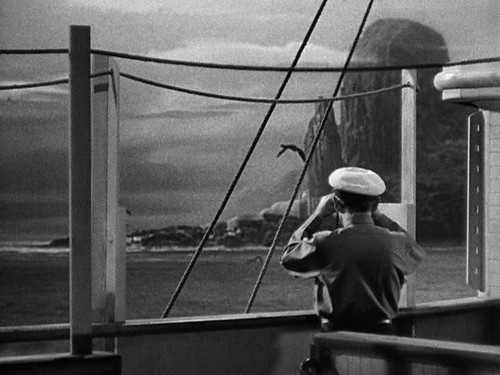
KING_KONG_1933-00.26.33
Skull Island ahead.

While I’d originally learned about ring composition in the mid-1970s, I didn’t start thinking about it seriously until I had entered into email discussions with Mary Douglas, the anthropologist, some time in the middle of 2001. She’d been studying ring composition for awhile, mostly in the Old Testament, and was wondering whether or not there could be a neural basis, that is, something more specific than the trivial fact that everything we do has some kind of neural basis. The best I could do was navigation, something I’d looked into in connection with my book on music, Beethoven’s Anvil. Why would researching music have me looking into navigation? Because music is about time, and so is dead reckoning – but that’s a digression in this context.

Note: This continues the discussion I began in Beauty and the Beast: King Kong as ring composition, plus myth logic, New Savanna, October 2, 2017: https://new-savanna.blogspot.com/2017/10/beauty-and-beast-king-kong-as-ring.html

To the grocer’s and back

All animals have to navigate their way around the world, way-finding it’s often called. The neural structures for it thus must be ancient. And they are, the hippocampus among them.

So, imagine you take a walk to the corner grocer’s to get a quart of milk and you return home by the same route:

1. Walk out the front door and turn left on Oak St.
2. Walk three blocks west and turn right on Princeton Dr.
3. Go two blocks north. Big Al’s Little Grocer is on your left.
X. Enter and purchase A quart of Aunt Emma’s Dairy Fresh Milk.
3’. Exit Big Al’s and walk two blocks south on Princeton.
2’. Turn left onto Oak and go three blocks east.
1’. Turn right and enter your home at No. 223.

What I like about this is that the path is a ring-form, certainly not geographically (you don’t travel in a circle), but in the sense meant in ring composition. You start at one location (home), take a trip where you accomplish some goal (purchase milk) and then return to your starting location (home). You traverse the same path on the return trip as you did setting out, but in the opposition direction. The two paths are thus symmetric with respect to landmarks passed over time.

But you didn’t set out to execute a ring-form trip. You set out to get a quart of milk. The ring-form was a side effect of the interaction between your conscious intention and the lay of the land.

And that’s what I want for ring composition, a way to ‘generate’ it naturally without conscious deliberation. Journey’s are common enough in literature – Odyssey, Sir Gawain and the Green Knight, Moby Dick, King Solomon’s Mines, and The Adventures of Huckleberry Finn come to mind. But do we have any ring-form texts where we have journeys of the requisite kind (same path to and fro)? Yes we do, King Kong and Heart of Darkness.

Journey to Skull Island

The movie doesn’t specify the route in detail, but the general idea is clear enough:

1. New York
2. Ocean Voyage
3. Skull Island: Native Territory
X. Skull Island: Kong’s Territory
3’. Skull Island: Native Territory
2’. Ocean Voyage
1’. New York

I’ve crossed out the ocean voyage on the return leg because that isn’t depicted in the film. We cut directly from Kong unconscious on the beach of Skull Island to New York City the day Kong goes on exhibit.

But of course it’s not the mere trip that’s important. That’s just a vehicle, if you will, for the story. What happens during each leg of the trip? Here’s a sketch:

1. New York: Denham recruits Darrow.
2. Ocean Voyage: Darrow and Driscoll fall in love.
3. Skull Island: Native Territory: Natives substitute Darrow for native woman as an offering to Kong.
4. Kong takes Darrow inland to his lair; Denham, Driscoll and others follow.
5. Driscoll wounds Kong in finger.
X. Kong defeats T-Rex in front of Darrow.
5’. Driscoll rescues Darrow.
4’. Return with Darrow through village; Kong goes on a rampage.
3’. Skull Island: Capture Kong.
2’. Ocean Voyage.
1’. New York: Kong put on display, escapes and captures Darrow; Kong killed.

Note that I’ve elaborated the central sequence, treating Driscoll’s rescue of Darrow as the ‘answer’ to his wounding of Kong. I’ll justify that in a later post where I look at the underlying myth logic.

That last step strikes me as being a bit busy; too many events for only one segment. Here’s what I’m going to do: What happens is what’s important, as opposed simply to where it happens. Hence I’m going to drop the ocean voyage from the return left and redistribute the events of that last segment. That gives us this:

1. New York: Denham recruits Darrow.
2. Ocean Voyage: Darrow and Driscoll fall in love.
3. Skull Island: Native Territory: Natives substitute Darrow for native woman as an offering to Kong.
4. Kong takes Darrow inland to his lair; Denham, Driscoll and others follow.
5. Driscoll wounds Kong in finger.
X. Kong defeats T-Rex in front of Darrow.
5’. Driscoll rescues Darrow.
4’. Return with Darrow through village; Kong goes on a rampage.
3’. Skull Island: Capture Kong.
2’. New York: Kong put on display, escapes and captures Darrow.
1’. New York: Kong ascends Empire State Building with Darrow; Kong killed.

In this version Kong’s escape and capture of Darrow in New York (2’) ‘answers’ Driscoll and Darrow falling in love (2). Intuitively, that makes sense in terms of myth-logic – yes, I know, I’ve got some explaining to do...later.

Do I like it? Yes.

But do I believe it? Not yet. I’m just making it up. I need to think it through.

Thursday, July 6, 2017

Two Problems for the Human Sciences, and Two Metaphors

For as long as I can remember such things – back to my undergraduate years in the 1960s – humanists have been defending themselves and their work against all comers: politicians, scientists of all kinds, and disgruntled letter writers. And always the defense comes down to this: we provide a holistic and integrated view of what it is to be human in a world that is, well, just what IS the world like anyhow?

It’s a mugs game and I refuse to play it. I was trained in the human sciences: hermeneutics AND cognitive science, history AND social science, and I’ve played jazz and rhythm and blues in seedy nightclubs, ritzy weddings, and outdoors before thousands. It’s all good. It’s all come into play as I’ve investigated the human mind through music and literature.

In this essay I look at literature. First I consider literary form as displayed in ring form texts. Then I review the historical problem posed by Shakespeare and the rise of the European novel. My general point is that we need all our conceptual resources to deal with these problems. But let’s begin with an analogy: how do we understand, say, a cathedral?

The Cathedral Problem

Cathedrals are made of stone blocks, mortar, pieces of stained glass, lead strips, metal fittings, wooden beams and boards, and so forth. You can go through a cathedral and count and label every block and locate them on a (3D) map. You can do the same for the doors and cabinets, the plumbing, heating fixtures, and wiring, and so forth. You will now, in some sense, have described the cathedral. But you won't have captured its design. That’s difficult and those how focus on it often use vague language, not because they like vagueness, but because, at the moment, that’s all that’s available.

And so it goes with literature and newer psychologies: cognitive science, evolutionary psychology, and neuroscience. My humanist colleagues keep hearing that they should get on board with the cognitive revolution and the decade of the brain. But it all sounds like trying to explain a cathedral by counting the building blocks, measuring the pitch of the roof, and analyzing the refractive properties of pieces of colored glass.

The advice may be well meant, but it isn’t terribly useful. It takes our attention away from the problem – how the whole shebang works – and asks us to settle for a pile of things we already know. Almost.

Ring Forms in Literature

I first learned of ring form in an article published in PMLA – the oldest literary journal published in the United States – back in 1976: “Measure and Symmetry in Literature” by R. G. Peterson. The idea is a simple one, that some texts, or parts of texts, are symmetrically arranged about a center point: 

A, B … X … B’, A’

He produced many examples, from Iliad through Shakespeare’s Hamlet to the “Author’s Prologue” to Dylan Thomas, Collected Poems. But my interests, like those of most literary critics, were elsewhere and so I merely noted the article and went on about my business.

I was reminded of this work some years ago when I entered into correspondence with the late Mary Douglas, a British anthropologist who rose to academic stardom – such as it was back in ancient times – after the 1966 publication of Purity and Danger: An Analysis of Concepts of Pollution and Taboo. She spent the last decade of her career immersed in the arcana of classical and Biblical studies, publishing monographs on the Book of Leviticus and the Book of Numbers and, in 2007, Thinking in Circles: An Essay on Ring Composition, based on a series of lectures she had delivered at Yale. Among other things, she argues that such forms aren’t special to the ancient world, that they continue in modern times – she offers Sterne’s Tristram Shandy as an example.

She opens her 10th chapter by referring to Roman Jakobson, one of the pioneering linguistics of the 20th Century, who believed, on the basis of extensive study, that such patterns reflect “a faculty inherent in the relation among language, grammar, and brain.” But why are such patterns so very difficult to recognize if they are so natural to us?

Tuesday, February 14, 2017

Preview: Meaning in Conrad's Heart of Darkness

Here's another draft fragment from my open-letter in progress. This fragment centers on Joseph Conrad's Heart of Darkness.

* * * * *

Now I want to look at a particular example, Joseph Conrad’s Heart of Darkness, which is one of the texts most frequently taught in undergraduate courses. Why? Well, it’s relatively short, 40,000 words, which is a consideration, albeit a minor one. Surely it’s the subject matter – roughly, European imperialism in Africa – and, secondarily, Conrad’s impressionist style. Still, why, why do those things matter?

Let’s look at a short statement by J. Hillis Miller, a senior and very respected literary critic. He is old enough to have gotten his degree at Harvard at a time when, in his view, when few in the English Department there were much good at interpreting texts and his is one in the first generation of deconstructive critics. Shortly after the turn of the millennium the Association of Departments of English honored him for his fifty years in the profession. Of his early days as a faculty member at Johns Hopkins, the 1950s and 1960s, Miller tells us:
English literature was taken for granted as the primary repository of the ethos and the values of United States citizens, even though it was the literature of a foreign country we had defeated almost two hundred years earlier in a war of independence. That little oddness did not seem to occur to anyone. As the primary repository of our national values, English literature from Beowulf on was a good thing to teach. [3]
Which is to say, literature is taught as a vehicle for cultural indoctrination. Of course you know that; you don’t need Hillis Miller to tell you that. But I just wanted to get the idea explicitly on the record along with that little irony about English literature in the United States (Miller had earlier pointed out that, at the time, American literature was marginal in the academy, at least at Hopkins).

Just a bit more about Heart of Darkness, which is a relatively simple story. A pilot, Charles Marlow, needs a gig. He calls on an aunt who gets in an interview with a continental firm, which hires him to pilot a steamer up the Congo River to a trading station that has gone incommunicado. Marlow’s job is make contact with the agent of the Inner Station, named Kurtz, and recover the ivory that Kurtz has, presumably, been accumulating. Marlow is our narrator. Actually, he tells the story to an unnamed third party, who then tells it to us, but we can skip that detail for awhile. That third party presents the bulk of the story to us as Marlow’s own words. Marlow’s steamer is crewed by native Africans and, in addition to personnel from the trading company, there are pilgrims on board.

Marlow is presented as a brilliant and talented man who went to Africa to earn enough money to make him worthy of his Intended; we don’t learn this detail until late in the story, nor are we ever told her name. We’re also led to believe that he has gone mad, setting himself up as a demi-god to the natives and taking a native mistress. As for those natives, it is clear that they have been badly treated by the Europeans.

Whatever else is going on, Heart of Darkness is an indictment of European imperialism in Africa. And yet in 1975 Chinua Achibe, the Nigerian novelist, set off bombshells when he delivered a lecture, “An Image of Africa: Racism in Conrad's Heart of Darkness” [4]. How could Heart of Darkness be racist, people objected, when the text obviously condemns imperialism? Easy, goes the rejoinder, for Conrad deprives Africans of agency, depicts them only as victims, and never has even one of them speak. Now, NOW, we’ve got something to think and talk about. Heart of Darkness may be over a century old, but the issues it embodies are very much alive in this, the 21st century.

Wednesday, September 7, 2016

The Psychology of Ring-Composition

Actually, there are two psychologies: that of the reader (or listener) and that of the writer (or speaker). They are different, but note that the writer is necessarily a reader.

The difference, of course, is that the reader (who is only a reader) faces a completed text. Whatever’s there, that’s what the reader reads. It’s like a roller coaster; you get in the car and go for a ride. The structure of the ride is determined by the structure of the roller coaster. The reader of the ring-form text doesn’t have to know that it’s a ring-composition. The reader doesn’t have to notice that events later in the text ‘answer’ events earlier, and that the ‘questions’ and ‘answers’ are symmetrically arranged about the mid-point.

That is to say, it is my position that, in general, the ring-form doesn’t require readerly recognition in order to work. There are critics who do seem to believe that, if the reader doesn’t consciously notice something, it doesn’t exist. That’s an assumption and it is, at best, questionable.

The situation of the writer is different. The writer faces a stack of blank pages. How can the writer create a large-scale symmetrical structure if the writer isn’t doing so consciously and deliberately? That question deserves an answer. That’s one of the reasons ring-composition interests me. Coming up with an answer will tell us something about how the mind works.

Note, however, that Mary Douglas (in Thinking in Circles) believes that such large-scale rings are done consciously. Presumably she finds it hard to imagine how they could be done otherwise. It was with this in mind that I created a just-so story about someone leaving home for some purpose and then returning by the same route. For example, Mary goes to the grocer to buy a bottle of milk:
1) Mary leaves home.
2) She walks past the oak tree.
3) She walks past the post box.
4) She arrives at the grocery store.
5) She opens the door and enters.
6) She nods to the cashier.
7) She gets a bottle of milk from the cooler.
6’) She pays the cashier for the milk.
5’) She exits through the door.
4’) She walks away from the grocery store.
3’) She walks past the post box.
2’) She walks past the oak tree.
1’) Mary arrives home.
That’s a canonical ring form, with the departure from and arrival back home being the first and last elements in the ring and the purchase of the bottle of milk being the mid-point. The events in the tale are arrayed symmetrically about the mid-point.

Now, I haven’t been able to make this kind of thing work for any of the ring-form texts I’ve investigated. But it does illustrate my point. Here’s a case where someone ‘traces’ a ring-form path without consciously setting out to do so. Mary does have a conscious intention, to buy a bottle of milk, and the world happens to be laid out in such a way that, as she pursues that goal, she traces a ring-form.

THAT’s what I’m after in the study of ring-composition. Whether I get there or not, that’s another matter. My immediate aim is simply to describe ring-form texts and see what we’ve got. I note, moreover, that I have no reason to think that all ring-compositions have to be constructed on the same underlying model. Maybe there are a half-dozen different ways to skin this cat.

Nor do I think that only one mechanism is involved in each text. I suspect that having a strong central section is a device that’s separable from the symmetrical arrangement of events before and after. The use of a frame tale is like that. Frame tales are common. When a frame tale frames a ring, it will be the first and last elements in the ring. But framing devices can be used for other tales. So, we’ve got three elements:
1) frame tale
2) center loading
3) symmetrical ordering of episodes
Maybe we’ve got one mechanism for each.

Finally, I note that writers live in a world full of poems and narratives. If some of those are ring-compositions, and a given writer particularly likes those, they’ll be motivated to imitate them. But they don’t necessarily have to consciously realize the ring-form structure. All they have to do is make a text that ‘feels like’ the ones they particularly admire.

To recap: readers and writers are different. Ring-composition poses no problem for the reader. The problem exists only for the writer. And there we will probably have to find several different quasi-independent mechanisms.

Saturday, March 29, 2014

Ring Composition in Alan Liu’s Essay, “The Meaning of the Digital Humanities”

I would like to conclude Alan Liu week at New Savanna by returning to the point where I began, his essay, “The Meaning of the Digital Humanities” (PMLA 128, 2013, 409-423). As I was writing my original post I was struck by a paragraph-opening sentence near the end: “It is not accidental, I can now reveal, that at the beginning of this essay I alluded to Lévi-Strauss and structural anthropology.” The sentence clearly states that Liu did something at the beginning of the essay so as to set us up for something coming at the end. There’s nothing unusual in that; skillful, and even not so skillful, writers do that sort of thing all the time.

But Liu’s telling us about his rhetorical slight of hand? Why? I don’t know and, to be honest, that particular question only just now occurred to me as I’m writing this post.

What struck me a week ago when I pasted that sentence into my post and then reread it was the possibility that Liu’s article was an example of ring-composition – which, you may know, is one of my interests. While I first learned about ring forms in a 1976 article by R. G. Peterson, Critical Calculations: Measure and Symmetry in Literature (PMLA 91, 3: 367-375) it was the late Mary Douglas who got me to think seriously about ring-forms; she devoted her final book to them, Thinking in Rings: An Essay in Ring Composition (Yale 2007).

But that was about literary texts of one sort or another. Douglas was particularly interested in Old Testament texts, but had also worked on Tristram Shandy; others were interested in the Homeric texts; I’ve been most interested in films, most recently Gojira (Godzilla), a 1954 Japanese film. But Liu’s essay is not a literary text, nor a religious one. No one to my knowledge has investigated ring composition in expository prose.

So, why would such a question arise in the case of Liu’s essay? Well, consider what is generally meant by ring-form. Such texts generally a form like this: A, B, … X … B’, A’. So, let us substitute “Levi-Strauss” for A in that structural pattern:

Lévi-Strauss, B, … X … B’, Lévi-Strauss’

If Liu’s essay follows that pattern then I need to find something that’s structurally central and at least one pair of elements that are closely related to one another where one comes before and the other after the structural center.

Tuesday, December 10, 2013

Center Point Construction and the Computational Mind

Edit (12.12.13): Jim Hoagland pointed out that my discussion of the basic symbol sets of arithmetic and natural language was wrong. I've corrected the problem (I think).
I was looking at Mary Douglas’s checklist for ring forms and realized that each item on it had a plausible interpretation in the domain of computation. So that’s where I’m going in this post. But that’s not where I start. First I want to talk a little about computation, then another look at Tezuka’s Metropolis, and then the Douglas checklist.

What is Computation, Anyhow?

If, when you think about computers and computation, you mostly think about numbers and arithmetic, then you’re likely to be puzzled, if not horrified, at the idea that literature is somehow computational. Literature, after all, is not about numbers – though the pages and chapters of books may be numbered.

But then, computation isn’t necessarily about numbers either. It depends on how you think of it.

“625” and “six-hundred and twenty-five” are strings of characters and each represents the same number. The first string is of the sort used in arithmetic calculation while the second is not, though not for any inherent problem. It’s a simple matter of convenience; the string of numerals is more compact, and hence more convenient, than the string of words. Note, however, that when “625” is read aloud it might sound the same as “six-hundred and twenty-five”, though it might also be abbreviated to “six-twenty-five”.

When you learn arithmetic you learn the tables for addition, subtraction, multiplication, and division. These tables consist of basic propositions about numbers and how they behave under those four operations. You also learn a handful of simple rules to be used in applying those operations to multi-digit numbers. What you are learning – and practicing, hour upon hour – is symbol manipulation, but symbol manipulation of a very restricted kind.

Ordinary language use, after all, is also symbol manipulation. And, while there are restrictions, and lots of them, the proper manipulation of the symbols of ordinary language is open ended in a way the arithmetic calculation is not. Perhaps the most fundamental difference has to do with the set of symbols used to spell the names of the entities.

For both arithmetic and natural language is finite and quite small. For arithmetic the set consists of ten numerals (0 1 2 3 4 5 6 7 8 9), four operators (+ - * /), and an equals sign (=). The symbol set for any natural language is complicated by the fact that, for written languages, there may not be a one-to-one relationship between the symbol set for the written and spoken versions. There we would have to have separate discussions for alphabetic and non-alphabetic writing systems. And in either case, the spoken language has prosodic features that are not well represented in the written language.

Consider written English. We have the 24 letters of the alphabet and a handful of punctuation marks. That’s finite and small. However, letter combinations are used to form words, but the way they are combined to do so is completely arbitrary with respect to what the words mean and how they are used. That gives rise to what linguists call duality of patterning; the fact that language is patterned with respect to sound (phonetics and phonology) and with respect to meaning (semantics and syntax).

That isn’t the case with arithmetic. There is a systematic relationship between how a number is spelled and the value of the number designated by its name. Thus the spellings tell us that, of “478”, “829”, and “321”, 829 is the largest and 321 is the smallest. But the spellings of “dog”, “dot”, and “elephant” do not tell us which, if any, are living creatures. In particular, of the two that have similar spellings, one is living, the other is not. The third (“elephant”) is also a living creature though its spelling shares no letters with “dog”.

Ring Form Opportunity: King Kong – and some notes on how to do it

David Bordwell just sent me the following note:
Long ago I remember the French critic Thierry Kuntzel giving a talk (which he never published, I think) on KING KONG arguing that it had such a construction, which he compared to an opened book, and the discovery of Kong as the 'gutter' (we'd say) between two pages, before and after. I've never checked to confirm this, but maybe it would fit too.
Are there any takers? I have seen the original, as well as the more recent remake, but this is not something you can do from memory. You need to watch the film and take notes. Judging from my experience, it should take at least half-a-day to do this.

And you start with a leg-up. In the first place, you have a reason to think the film might be a ring form, so you're looking for something specific–remember Mary Douglas's check list? Further, you've got a candidate for the central episode; that makes things much simpler.

Now you're trying to verify whether or not that episode is the center of a ring. Without that start you might have to test several episodes for centrality. And – obviously – when you're looking for ring form, the first thing to look for IS that central episode. In the cases of both Tezuka's Metropolis and Heart of Darkness, I started with a suspicion about what the central episode was.

Monday, December 9, 2013

Myth: From Lévi-Strauss and Douglas to Conrad and Coppola: A Working Paper

I've uploaded another working paper to my SSRN page. It is edited from two blog posts, From Heart of Darkness to Apocalypse Now and Lévi-Strauss and Contemporary Myth: Heart of Apocalypse. I have removed some redundant material and shifted emphasis here and there.

Here's the link to the full working paper. The abstract and introduction are below.

* * * * *
Abstract: Heart of Darkness (HoD) and Apocalypse Now (AN) both exhibit center point construction. Each narrative is constructed about a central incident that is, in effect, a précis of the whole. In HoD that incident is the death of the helmsman, into which Conrad inserted a long paragraph giving Kurtz’s history. In AN that incident is the (needless) massacre of the crew of a sampan. The two narratives, however, are thematically different. HoD is about European imperialism while AN is about the American state. These differences are reflected in differences in the ways the two narratives utilize center point construction.
* * * * *

I have had two anthropologists standing over me as I’ve worked on these two texts, Heart of Darkness and Apocalypse Now. I was influenced by both of them, Claude Lévi-Strauss and Mary Douglas, early in my career. It is Lévi-Strauss who inspired my overall approach to (literary) texts and it is Douglas who gave me the structural clue I’ve followed in these two texts. Let me think about Douglas in this introduction. I’ll turn to Lévi-Strauss later on.

Given my interest in form, it was easy for her to enlist me in her inquiry into ring forms, which I have since broadened into an inquiry into what I have been calling center point construction. But we differed on one issue. She believed that the writers of ring form texts knew what they were doing whereas I was and am skeptical. Certainly, they worked with skill and deliberation. But it is by no means obvious to me that they deliberately set out to craft such forms. I find it plausible that such tales are the emergent result of other factors.

Let Me Tell You about the Journey I Took

Consider a simple story. Louise Crimson travels from her home in Townsville to visit her Grandma in Centerville and then she returns by the same route, thus:
A. Louise Crimson travels to Townsville to visit Grandma.
B. Louise arrives in Little Glenn.
C. Arrives in Corner Cove.
D. Arrives at Grandma’s in Centerville. Grandma bakes her a peace cobbler
C’. Louise travels back to Corner Cove.
B’. And then on to Little Glenn. After a little rest she departs…
A’. …and arrives home in Townsville in time to share the last bit of peach cobbler with her best friend Ruth.
He route is symmetrical and any story she told about that journey would most naturally take the form of a canonical ring. Yet, in telling her story, Louise did not set out to produce a ring-form. Rather, it came about as a consequence of the route she travelled, on the one hand, and of the normal mode of story telling–list the incidents in chronological order–on the other.

Sunday, December 8, 2013

Center Point Construction: Description and Objectivity


No scholar should find humiliating the task of description. This is, on the contrary, the highest and rarest achievement.

—Bruno Latour

...we are not to attempt to hack off parts like a clumsy butcher...
– Plato

This post follows upon my earlier post, Center Point Construction: Coleridge, Tezuka, Conrad, and Coppola, and presupposed knowledge of it. I want to discuss the method I employed in making that argument and, in particular, I want to argue that it is possible for the profession to obtain objective knowledge of such matters.

I am aware, of course, that objectivity has taken a beating in the past few decades. Nonetheless I persist. I do not think that objectivity is a matter of unmediated access to the world. That doesn’t exist. Nor do I think that a pure heart and a clean mind are adequate to the job.

Rather objectivity is a matter of proper method, of construction or, to use a word from Latour, of composition. Our picture of the objective world is one we compose. And I offer ring form as one of those conceptual objects that we can compose in an objective manner.

The simplest form of objectivity is simple intersubjective agreement. It was when critics discovered that they could not attain intersubjective agreement on matters of interpretation, of meaning, that we began to question our activity, to theorize the discipline. My suggestion is that we bracket meaning and concentrate on describing form. There is where we can attain intersubjective agreement.

That is what I did in arguing about center point construction in “Kubla Khan”, Tezuka’s Metropolis, Heart of Darkness, and Apocalypse Now. I note that in talking of description I am not asserting that description, unlike interpretation, is in some mysterious way, unmediated. Description requires its terminology, such as ring form or center point construction, such as center loading, and so forth. But that terminology is about form, not meaning. These statements are descriptive, not because they are unmediated, but, in effect, because that is all that they do: describe. One would, of course, like to know how it is that the mind constructs such things, and why the mind takes pleasure in them. Description will not provide answers to those questions. But I see little hope of constructing answers if we do not start with good descriptions.

Objectivity

Before getting down to it, though, I want to show that I really mean it when I say that I am not presupposing that description is equivalent to having unmediated access to our object texts. Let’s sharpen our knives on Stanley fish.

Friday, December 6, 2013

Center Point Construction: Coleridge, Tezuka, Conrad, and Coppola

This one's going to take awhile; it's got 5800 words, plus several tables. You might want to have some snacks ready and make sure the cell phone's been silenced.
Yesterday I declared the psychological “revolution” in literary studies to be stillborn. Neither the cognitive poetics born of the so-called cognitive revolution nor the Darwinian literary criticism born of evolutionary psychology has yet delivered a new criticism. Nor, for reasons I explained in the post, do I expect them to deliver a robust and insightful new criticism any time soon. As currently constituted, those psychologies can tell us something about the bricks and mortar of our texts, but they can say nothing about the designs.

This post is about design, one particular design that I call center point construction. I describe it – and that’s all I do, describe it – as I’ve found it in four texts, four texts of very different kinds: 1) “Kubla Khan”, a lyric poem, 2) Metropolis, a Japanese manga narrative, 3) Heart of Darkness, a novella, and 4) Apocalypse Now, a motion picture. That the last two should share the same formal armature, to borrow a term from Lévi-Strauss, is perhaps not surprising. But the form I’ve found in both of them has not, so far as I know, before been described in either of them. That the same form can be found in two other texts that differ as much from one another as either in turn differs from Heart of Darkness or Apocalypse Now, that seems worthy of our attention.

A psychological model that could account for the same form in those very different realizations would thereby be one of considerable interest. For it would have to deal with radically differences in temporal scale and presentation medium. I am willing to leave the creation of such a model to the psychologists: evolutionary, cognitive, and neuroscientific. While they’re working on that I plan to be describing more texts, some having center point construction, but others based on different organizing principles.

After some preliminary throat clearing I go through the texts in order: “Kubla Khan”, Metropolis, Heart of Darkness, and Apocalypse Now. I’ve collected references to more detailed work on these texts at the end of the post.

Beyond “Kubla Khan”

As I’ve written in several posts, it was my early work on “Kubla Khan” that sent me down the path I’ve been traveling for the last four decades. However, I’ve always had a problem “selling” that work to others. “Kubla Khan” seems to be a one-off poem; there’s no other poem quite like it. Thus, however interesting its structure, it’s difficult to generalize from that work.

So, the poem’s got an interesting structure, what of it? It’s only one poem fer chrissakes!

Things began to open up a few years ago. The late Mary Douglas got me interested in ring form, where texts are organized like so: A, B, C…X…C’, B’, A’. The last episode mirrors the first, the next to last mirrors and second, and so forth around a central episode. While the two movements of “Kubla Khan” are symmetrical about a mid-point, they don’t appear to have other features of ring form and the poem as a whole doesn’t have a ring form.

Then I discovered that Osamu Tezuka’s manga, Metropolis, has a ring form. And, though it is a narrative not a lyric poem, it shares an important feature with “Kubla Khan.” It has an emblematic ending. Just at the first movement of “Kubla Khan” ends with a line that is an emblem for the whole poem – “A sunny pleasure-dome with caves of ice!” – so Metropolis ends with an image that can stand as an emblem for the entire narrative – the central character, Michi, in effect becomes transformed into a statue.

What if I analytically decomposed the form of “Kubla Khan” into different elements such that each element is a formal device that can perform certain functions? Maybe those different devices can be found in other texts.

Thursday, November 7, 2013

The Ring Form Challenge

The challenge is simple: for any given text – poem, drama, novel, film, what have you – is it a ring or not? That is, does it have the form:
A, B, … X … B’, A’

OR

A, B, … X, X’, … B’, A’
The question seems fairly straightforward, and, yes, the QUESTION is. But answering it may not be. I speak from experience.

Note that the question is about form, not meaning, and that answering the question requires that you describe the text, not that you figure out what it means. You will, however, have to pay attention to meaning to determine, say, whether or not two elements function in parallel. But comparing the meanings of elements within a text is quite different from translating meanings into some theoretical discourse.

I think we need to know, for any text we wish to study, whether or not it has a ring form. And if not a ring, then what? Why should we know this? Because form is important, it guides our apprehension of the text.

What I REALLY think is that if enough people set out in search of ring forms, by the time, say, that a 100 new ring form texts have been identified, a new mode of literary study will be emerging, one that can be commensurate with the new psychologies, but which is not subordinate to any other discipline or body of knowledge.

Mary Douglas on Rings

The study of ring forms is not new. I first learned about ring forms in a 1976 article in PMLA: R. G. Peterson, Critical Calculations: Measure and Symmetry in Literature (PMLA 91, 3: 367-375). He was reporting on a literature that was two decades old by that time, though it was mostly about classical and biblical texts. Beyond verifying the chiasmus in Dylan Thomas’ “Author’s Prologue”, however, I did nothing with the article. I simply filed the topic away in my mind.

I didn’t begin to think about rings until Mary Douglas brought them to my attention earlier in the decade. She had been kind enough to blurb my book – Beethoven’s Anvil: Music in Mind and Culture – and my editor put me in touch with her after the book came out. She’d been working on the topic for some time and had published books on two Old Testment texts: Leviticus As Literature (Oxford 1999), In the Wilderness: The Doctrine of Defilement in the Book of Numbers (Oxford 2001). She believed that rings are fundamental to human thought.

Thursday, August 2, 2012

Animals, Humans, Taboo

Valerio Valeri. The Forest of Taboos. The University of Wisconsin Press, 2000.
The late Mary Douglas gave this book a stellar review in either Nature or Science, I forget which. So I bought it and I’ve read most, though not all, of it. Yes, it’s stellar.

I just pulled if off the shelf on the hunch that it would speak to my current interest in Walt Disney’s Dumbo. Why would I think that? Because Dumbo is a story about animals, animals and humans, that’s why. And taboo is very much about animals and humans, but also plants and humans. And, if it is the best treatment we’ve got of taboo—which is pretty much what Douglas said of it—then it just has to be relevant.

It is, and also to object-oriented ontology and animals studies.

But this isn’t going to be a review or summary or anything like it. I just want to quote a few passages from Chapter 4, “Zoology and Meatology”.

p. 179-180:
Precisely because animals are our next of kin, because they offer a ready mirror for human attributes, for virtues and vices, taken together they raise a problem of self-definition for us: to establish where the difference between animal and human lies is to define what it is to be human...We ourselves come from a tradition where animals and humans have been radically opposed on ontological grounds—that is, on the grounds of the soul/body distinction. One way or another, we are all heirs to Descartes on this. He has left us with some outmoded furniture, which we have put in a dark corner but still occasionally use to support our plates when we enjoy our steak or roast.
That is, when we eat animal flesh we do so secure in the belief that animals really are radically different from us and that, therefore, we are not being cannibalistic in eating them. Valeri continues (p. 180):
Descartes believes that granting a soul to animals is an error second only to denying God. Animals are for him pure machines, and as such devoid of any signification beyond their utility. This cleavage is logically related to another one, that of soul and body in humans. Together, they run counter to any possible problematic of taboo, for eating is reduced to the confrontation of two machines, the human-body machine and the animal-body machine, under the detached gaze of a disembodied, self-determining subject—the cogito. Such a subject cannot be undermined by eating; the horrors and the dangers, but also the pleasures, of the transmutation of nonself into self are unknown to it. Food concerns the body, not the soul; res cogitans is radically separated from res extensa, so that the kinship between soulless animal and the soulful human can be severed at the root.
See, animals and machines, the equation of the two. That’s all over the place in cartoons, in Dumbo. But also the identification of animals and humans. But surely identity is transitive, no? So, if ‘animals=machines’ and ‘humans=animals’ then it follows that ‘humans=machines’.

Whoops!

Reset!

A bit later, p. 180:
If we are to understand why eating, and especially the eating of animals, is inseparable from the idea of taboo in Huaulu, we must forget Descartes or his residual effects on our ideas and practices. We must accept the Huaulu premise that no radical ontological difference between the human eater and the nonhuman eaten exists. [Graham Harman and Tim Morton, did you see THAT?] At the same time, we must not remain Cartesian in the very reversal of the Cartesian ontology. That the Huaulu do not postulate an inseparable ontological barrier between animal and human does not mean that they are not preoccupied with differentiating them. On the contrary, the lack of any guaranteed, a priori difference means that the difference has to be created constantly through various cultural practices which demonstrate it. The main practice of it is precisely that of taboo.
And it’s not as though we Moderns have somehow miraculously broken free of such problems. Not at all. We’ve got them all over the place. Hence the proliferation of Funny Animal cartoons and comics in mid-20th-century America. That, of course, takes some explaining, which is more than I’m up to in this little post.

I note only that on the next page (181) Valeri points out that the Huaulu have no word that corresponds to our word “animal”. He goes on to imply that they don’t have any word corresponding to “plant” either, though he does not say this outright. This is common enough in preliterate societies. In fact, it seems to be the norm (Brent Berlin, Ethnobiological Classification, 1992). This does not, however, mean that they lack the concepts, either or animal or plant. Valeri makes it quite clear that the Huaulu have such concepts.

So, how does a culture deal with concepts from which it lacks names? For that, I suspect, is what’s going on in funny animal cartoons and comics.

More later.