Showing posts with label Industrial_Revolution. Show all posts

Friday, July 10, 2026

Joel Mokyr on China, India, and Europe; clans vs. corporations; the idea of progress.

A Conversation with Tyler: Joel Mokyr on Clans, Corporations, and a Culture of Growth (Ep. 282)

Joel Mokyr co-won the 2025 economics Nobel for exploring the question that traces back to the beginning of economics: how did sustained economic growth suddenly become normal? For nearly all of human history, cleverness didn’t compound. What changed, according to Mokyr, was twofold: first, you need to know why something works, so that one advance can seed the next; second, you need a culture willing to tolerate the disruption. His new book contrasts Europe with China, showing how Europeans learned to cooperate with people they weren’t related to, in guilds, monasteries, cities, and universities, while China organized itself around the extended clan. One path led to internal stability and peace; the other, more restless and outward-looking, was the one that decided the world could always be made better.

Tyler and Joel discuss European corporations vs. Chinese clans, why the Catholic Church became obsessed with cousin-marriage, how persistent cultural trends really are, why Chinese cities became so populous relative to Europe, why it took so long for European living standards to surpass China’s, why sinified invaders kept getting swallowed by the dynasties they conquered, how geography kept Europe fragmented and China unified, where India fits into the story, why the Romans never made spectacles, why British soldiers stood two inches taller than the French, what powered the sudden rise of 19th-century German science, how disruptive winning a Nobel is, and much more.

Clans vs. Corporations

COWEN: Start by telling us, in the book, your thesis about European corporations versus Chinese clans and the importance of that difference. How would you explain it?

MOKYR: Well, the difference is, basically, the kind of organizations that produce what we call local public goods, so things like food relief and education, religious services, things like that, I would think that if you look at the world, say, around 800, at the time of Charlemagne, the difference between Europe and China isn’t very large. At some point, during the Middle Ages, you can see this divergence getting started. What’s happening is that, in Europe, there is more and more of a decline in the extended family or the extended kinship group, we call it clan, and instead, people get together and cooperate with other people to whom they are not related and with whom they do not share an ancestor.

Whereas in China, it moves exactly in the other direction. In China, you get more and more people getting organized by their extended family. The reasons for that are fairly complex. In Europe, it’s particularly the Catholic Church that played a major role here. This was argued quite a while ago by a guy, an anthropologist called Jack Goody, but your own colleague Jonathan Schulz wrote, what I think is one of the best papers on the subject, who pointed this out in great length and actually provided a fair amount of systematic evidence for this.

In China, there is no Catholic Church. The imperial bureaucracy is more and more in cahoots with local clans to whom they actually outsource a fair amount of the things that they were supposed to do. As you move on out of this period of the Song dynasty into later dynasties, you see this thing growing. The problem in Europe is that the nuclear family, which became the fundamental building block of society, is too small to provide local public goods. You need to cooperate with others. What emerges in Europe, and quite spontaneously, is a bunch of things that provide these local public goods that you just don’t see in China.

For instance, we have something called universities. We have monasteries. We have autonomous cities. All of those things are what we call corporations. What it is, is people who are not related, but what they share is not an ancestor but an objective. Guilds have one kind of objective, universities have another one, and so on and so forth. That divergence in social organization turns out, in our view, to be one of the key components of the divergence between Europe and China.

COWEN: Do you take that change in policy from the Catholic Church as exogenous or that it is rooted in earlier features of Western society such as the ideology of Christianity itself or maybe earlier Roman times? What is causing what? What’s the most fundamental driver here in the West?

MOKYR: Well, there’s some debate about that. They don’t, of course, tell you. There are, I think, two components about this, and I would not know how to weight them. There are two things happening here. The first is that the Catholic Church really becomes quite obsessive about certain sins that they consider to be particularly egregious. One of those sins is incest. Every society in the world prohibits marriage between siblings, but other more remote relatives is more ambiguous. The Church becomes quite obsessive about this. At the end, there are places where they actually prohibit the marriage of fifth-degree cousins. Now, how anybody in the Middle Ages would know who is fifth-degree cousin is, is unclear. I don’t know who my fifth-degree cousins are. Maybe you do.

The other thing, which is also sort of Goody’s argument, and I think there’s a great deal of truth to that, is that the Church wants to weaken any kind of organizations that compete with it for power and control in the local communities. They also have figured out that if you organize society by nuclear families, then a certain proportion of people die without heirs. If they die interstate without heirs, that in many cases, the property that these people own reverted to the Church. Pure naked greed by the Church, which was not unknown in the Middle Ages, I think, was a driver here. Goody convinced me that that actually is a substantial factor.

There are other arguments that have been made in this context, but I think these are the two that are most striking. The other question is, why is it that the clan in China is so convenient for the imperial bureaucracy to rely on? Both of those things happen in parallel. I would think, maybe, if I may allow one observation, in both cases, this is history as historical outcomes, as the unintended and unanticipated consequence of very different actions. There’s no question that the Church never, I think, foresaw the emergence of corporations in Europe, nor do I think that the Chinese imperial service ever seriously considered the possibility how this would change life in China. That’s what happens. You try to follow one objective and then something very different emerges over time. That’s what history is all about.

European Growth

COWEN: Why does it take so long for the wealthiest parts of Western Europe to surpass Chinese living standards? Say that’s happened by 1700 or 1720, that’s many centuries after this medieval divergence. If it takes so many centuries, is the medieval divergence really the relevant factor? Why is it such a slow process?

MOKYR: Yes, I think it is. I think it’s a main factor. I think the idea of looking at standard of living, one thing, I’m very skeptical about how standards of living are actually measured. I know that this is what Pomeranz and other people have, and Jack Goldstone and other people have argued that the living standards in China were comparable to the West as late as 1750. I’m not 100 percent sure that that is true. Certainly, for my money, what really defines the divergence is that, technologically, the gap between the two countries starts to become visible at the time of the Renaissance, in terms of a whole bunch of things that you see growing in Europe and stagnant in China.

Now, keep in mind, of course, that part of the European growth is due to the fact that they borrowed ideas from China. Then the Industrial Revolution consists, to some extent, of imports institution by Europeans trying to mimic the goods that they were importing from China—not just from China, from India as well. Pottery is a good example. One of the things they really wanted from China was Chinaware. That’s why it’s called Chinaware. It took them a while to be able to match the Chinese capability in the ceramic industry, but they do so eventually. Then they stop importing this stuff from China. The same is true for, say, cotton and other products that we’re getting from the East.

European living standards, I think, should be measured, in part, by the fact that when the Europeans start their voyages across the globe in the late 15th and early 16th century, they are able to bring in a whole bunch of new crops and new techniques from other areas which they merely adopt. You’ll see Europeans very soon growing tobacco and potatoes and corn and other things like that. They are the agents of global change. Not only that they change their own diets, they change the Chinese diets because the Europeans bring from the New World things like peanuts and sweet potatoes and things like that. They change the Chinese diets, but the Chinese themselves are not agents here.

They are accepting the stuff that the Europeans did to some extent, and they’re rejecting others, but it’s the Europeans who are the agents of change here. They are the entrepreneurs. They are the people who bring about the changes, Tyler. My sense is that typifies the difference between Europeans and the Chinese. Europeans are more aggressive. They are more outward-looking. In the end, what you see by the 1830s and 1840s, you see that the technological gap is huge, in some ways much larger than the living standards gap. Even in the 19th century, in terms of food, the Chinese were capable of producing enough food. The number of famines in China is probably not a lot worse than in Europe.

When you see what happens during the First Opium War, one English ship is blowing all of this sort of mighty empire to pieces, and the Chinese have to accept this terribly humiliating peace, you can sort of see how the technological gap has grown between the two. For me, that is much more telling than the living standards. The other thing that I should like to point out is that, when you look at Europe in the 16th and 17th century, you can see that the capability of expanding the set of useful knowledge, including science, is just growing very rapidly. Whether there is a scientific revolution or not is a debate that I want to get into.

Certainly, by 1700, Europe is on the verge of really changing our understanding of how creation works. That’s not just Newton and Galileo. There’s a whole body of work that is emerging. There’s really nothing parallel like that in China. China is a very sophisticated society in many ways. The literacy rates are high. They have a well-funded and well-organized system of education, but they don’t really continue their earlier forays into science and into new technology.

Somebody actually went out and looked at Joseph Needham’s many volumes on Chinese technology and science, or Science and Civilisation [in China], as he called it, and he discovered something—which I guess we all knew, but they put numbers on it—almost nothing that Needham pointed out as an innovation happens after 1400. There’s complete stagnation setting in and some of the things that they knew how to make in earlier times, like the sophisticated clocks that they built in the 11th century, they disappear. For me, that’s more telling than how many calories of carbohydrates were consumed on average, if we could ever calculate that correctly.

Friday, February 28, 2025

The groove before the machine @3QD

I’ve got a new article at 3 Quarks Daily: One thought for living in a high-tech world: The groove before the machine. It’s a strange one, for me, more aphoristic, metaphorical, and polemical, than actually argued. Not sure how I’d argue it. Not even sure what IT is.

Not what I started to write

I started to write an article explaining these three maxims:

1. The groove before the machine.

2. To drive a car, get in the driver’s seat.

3. The machine is useful in proportion to the user’s skill, knowledge, and experience.

As I started writing, my account of the first maxim took on a life of its own and I didn’t see how I could work the other two in. So, I took the article in a different direction:

We’re living in a mismatched world

This is where (I think) I was going:

Our basic institutions and norms are grounded in late Industrial Revolution social and political technology. That’s radically different from the technology that's been barreling in on us since the internet became the world-wide web. AI is just going to magnify that. What we’re now seeing in Silicon Valley and in Washington, DC., that’s what happens when 21st century high tech meets 19th century Gilded Age institutions. Not pretty.

Those mega-corporations now burning through billions investing in machine learning and preparing to dump 100s of billions into electrical infrastructure: 19th century. The school system, the institutional sector I know best: 19th century. The lock-step grade system in the primary schools was designed to send young adults into factories, standardized factories. The yawning gulf between the sciences and humanities in higher ed, that’s out of 19th century Germany. Chatbots make a hash out of that.

This mismatch is a disaster in the making.

I didn’t get there. Truth be told, I don’t quite know how. Instead a told a story about the hassle involved in trying to get a customized cover for a book I’d recently bought, Reid Hoffman’s Superagency: What Could Possibly Right with Our AI Future. They wanted me to upload a photo of myself but wouldn’t accept any of the photos I offered. It was frustrating, especially because I didn’t care all that much about the photo, so why should they make such a fuss about it? This reminded me of the hassle Facebook gave me and a bunch of other people about changing their interface, something I’ve blogged about under the heading, “Facebook or Freedom.”

Anyhow, getting back to Reid Hoffman’s customized book cover – the very idea of a customixed book is born out of 19th century standardizing culture. Who knows what will replace it.

And that, more or less, is where I left things. Kinda’ hanging, no?

Next time.

Saturday, February 8, 2025

Why didn’t Rome have an industrial revolution? No, no, no, not the printing press. They lacked a conceptual system capable of conceiving a clockwork universe.

Back in August (2024) Tyler Cowen had a link to a paper, Romae Industriae, in which the author, Maxwell Tabarrok, posed the question in the title of this post. While was unable to propose an answer, he did have this paragraph near the end:

The printing press alone may have been sufficient to start a Roman industrial revolution because its effects on culture are upstream of the invention processes that might invent all the other required tech. There was more than enough scale in the economy of Rome to support capital intensive productivity improvements in their major industries. So the major constraint must have been idea generation. Rome punches below their weight in population on this metric because of an aristocratic, slave based culture that ridicules the mechanical arts. If copies of Vitruvius or Archimedes became cheap enough that even the workers close to the vulgar arts of farming and manufacturing could read them, it would surely have an effect on the cultural attitudes that stultified Roman invention.

I believe he was right to suggest that “the major constraint must have been idea generation,” but he was wrong to finger the lack of the printing press as the cause of that constraint.

The problem is much deeper. The problem is that the Roman system of thought was incapable of conceiving of the clockwork universe, an idea that didn’t become prevalent in Europe until the Enlightenment (17th and 18th centuries), though a similar idea – the universe as the machina mundi – had been suggested as early as the 13th century. While I considered making a comment to that effect, I decided not to. There was simply no way to make that idea credible in a blog comment.

But the question kept bugging me until I finally decided to address it. I uploaded Tabarrok’s article to Claude 3.5, along with the article David Hays and I wrote, The Evolution of Cognition (1990), and went at it. First I asked Claude to summarize the two articles, then I had it consider the two hypotheses. We ended the discussion with the question: Can computers think?

My prompts are set in bold face type while Claude’s responses are plain face. I’ve added subtitles to make the conversation easier to follow.

Two summaries

I’ve uploaded a document about cognitive evolution. Could you summarize it for me?

I'll provide a summary of the key points from the paper "The Evolution of Cognition" by William L. Benzon and David G. Hays.

The authors propose that cultural evolution occurs through distinct cognitive ranks, with each new rank introducing new processes of thought and mechanisms for handling abstractions. They identify four cognitive ranks:

Rank 1: (Preliterate societies)

• Primary mechanism: Metaphor
• Medium: Speech
• Abstract knowledge carried through myths and proverbs
• Limited categorical thinking
• Found in most indigenous cultures worldwide

Rank 2: (Ancient civilizations)

• Primary mechanism: Metalingual definition
• Medium: Writing
• Enabled systematic philosophical thought
• Development of explicit ontological categories
• Examples: Ancient Greece, Rome, China

Rank 3: (Post-Renaissance)

• Primary mechanism: Algorithm
• Medium: Calculation
• Enabled scientific thinking and mechanistic worldview
• Clear subject-object distinction
• Originated in Western Europe

Rank 4: (Modern/Emerging)

• Primary mechanism: Control structure
• Medium: Computation
• Still developing
• Characterized by model-building and systems thinking
• Not yet fully formed in most areas of culture

Key concepts:

• Each rank builds on previous ones rather than replacing them
• New ranks emerge through new ways of manipulating abstractions
• A culture's rank is determined by its highest widely available cognitive process
• Evolution between ranks requires new conceptual technologies ("media")
• Changes in cognitive processes don't require biological evolution
• Each rank allows for new types of abstract thinking previously impossible

The authors argue that these cognitive ranks explain major transitions in cultural history and that we are currently in the midst of transitioning to Rank 4 thinking, though this transition is not complete. They suggest that widespread early exposure to computing may be necessary for Rank 4 cognition to fully develop.

The theory offers a framework for understanding cultural evolution without implying biological differences between populations, focusing instead on the development of cognitive tools and processes.

Good. I’ve also uploaded a document that wonders why Rome didn’t have an industrial revolution. Could you summarize that document?

Yes, I'll summarize Maxwell Tabarrok's "Romae Industriae" article which explores why the Roman Empire didn't achieve an industrial revolution.

Key Arguments Considered:

1. Coal and Cotton Theory (Bret Devereaux's View):

• Argues Rome lacked Britain's specific preconditions (coal, textile industry, etc.)
• Tabarrok counters this by noting Rome had:

• Access to coal deposits (including in Britain itself)
• Complex water-powered machinery
• Large-scale industrial demands (pottery, grain mills)
• Manufacturing needs for rotational power

2. Technology Gap Theory (Jason Crawford's View):

• Romans lacked key technologies like:

• Spinning wheel
• Windmill
• Horse collar
• Cast iron
• Printing press
• Mechanical clock

Tabarrok notes this explanation just pushes the question back: why didn't Romans develop these technologies?

3. Slave Labor Theory:

• Traditional view: cheap slave labor discouraged mechanization
• Tabarrok disagrees, noting:

• Labor was still the main production cost
• Southern US states with slaves still adopted labor-saving technology like the cotton gin

4. Cultural Explanation (which Tabarrok finds most convincing):

• Slavery created a culture that looked down on mechanical arts
• Successful merchants preferred to become landowners rather than innovate
• Lack of widespread literacy limited knowledge sharing
• No culture of invention and tinkering developed

Tabarrok's Conclusion:

• The printing press may have been the crucial missing element
• Its absence prevented the cultural changes needed for innovation
• Rome had the scale and resources for industrialization
• The failure to industrialize represents a tragic missed opportunity for human progress
• This has implications for identifying and pursuing transformative opportunities in our own time

The article suggests that Rome's failure to industrialize wasn't due to lack of resources or economic scale, but primarily due to cultural factors that could have been transformed by the widespread adoption of printing technology.

Why did Rome fail to have an industrial revolution? – two hypotheses.

Note that the cognitive evolution paper doesn’t adopt the conventional view of the importance of the printing press. Rather, it argues that it was the adoption of decimal arithmetic that catalyzed the intellectual and cultural developments of the Renaissance and, by implication, the Industrial Evolution.

With that in mind, let’s apply the cognitive evolution paper to Tabarrok’s argument. My guess would be that Rome didn’t have an industrial evolution because they didn’t have a Rank 3 ontology, as characterized by the cognitive evolution by me (I’m William Benzon) and David Hays. More specifically, a Rank 3 ontology would support the idea of the clockwork universe. You need that kind of ontology if you are to have a revolution based on mechanical devices, particularly devices which have their own power supply, which came later in the Industrial Revolution.

That hypothesis is different from Tabarrok’s. How do we decided between the two hypotheses? What kind of evidence do we need?

Ah, thank you for the clarification and for identifying yourself! This is a fascinating intersection of the two papers. Let me think through how we might evaluate these competing hypotheses.

Your hypothesis suggests that Rome couldn't achieve an industrial revolution because it lacked the cognitive framework (Rank 3) necessary to conceptualize mechanical systems as autonomous entities governed by universal laws - the "clockwork universe" ontology. This is deeper than just missing specific technologies; it's about the inability to think about technology and natural phenomena in a particular way.

Tabarrok's hypothesis focuses on the printing press as a catalyst for cultural change that would have encouraged mechanical innovation and knowledge sharing.

To decide between these hypotheses, we might look for evidence like:

1. Roman Conceptual Framework:

• How did Romans describe and think about mechanical devices in their writing?
• Did they conceptualize cause-and-effect relationships mechanistically?
• How did they explain natural phenomena?
• Can we find evidence in their philosophical texts of attempts to think algorithmically?

2. Knowledge Transfer Without Printing:

• Were there other societies that achieved significant technological advancement without printing?
• How effectively did Rome transmit complex technical knowledge through existing means?
• Can we find evidence of systematic (algorithmic) thinking in Roman engineering documents?

3. Comparative Analysis:

• How did Islamic civilization handle complex mathematical and mechanical concepts with limited printing?
• Did China, with both printing and sophisticated mechanical devices, show signs of developing a Rank 3 ontology?

4. Testing the Mechanisms:

• Can we find cases where printing existed without leading to industrial development?
• Can we find cases where algorithmic thinking emerged without printing?

One specific type of evidence might be examining Roman technical treatises (like Vitruvius) to see if they show any signs of algorithmic or systematic thinking about mechanisms, or if they remain at what your paper would characterize as Rank 2 rationalization.

What do you think would be the most decisive evidence to look for?

Friday, May 31, 2024

Why don't we dream of building perfect societies anymore?

Rohit Krishnan asks that question at Strange Loop Canon. He starts with a story:

Robert Owen was a Welsh industrialist. Born in Newtown, Owen moved to Manchester when he was quite young, and quickly rose to prominence as a manager in the cotton industry.

He was self-educated, reading everything that he could get his hands on. He was particularly impressed by the enlightenment thinkers, from Locke’s theories on human development and the importance of education to Rousseau’s ideas on natural human goodness and the corrupting influence of society. They resonated with Owen’s belief in the perfectibility of human beings through environmental improvements.

His success at New Lanark Mills in Scotland, where he implemented progressive labor practices such as fair wages, reasonable working hours, and comprehensive education for workers' children, demonstrated his commitment to improving social conditions through rational management.

After he had his economic success he wanted to put his grand theories into play and create a true utopian society.

So he created New Harmony, in Indiana, aimed at demonstrating the feasibility of social reform through cooperative living and education. He brought about the smartest people he could find, artists and scientists and intellectuals, to make New Harmony incredible.

It worked for a while too, even though its story ends in decline. New Harmony faced economic difficulties, internal disagreements, and lack of enough practical skills among its members.

There are at least a couple interesting things here. One is the fact that New Harmony seemed to have a strong undercurrent around things we consider highly modern, around equality and collective living and education.

The second, which is arguably more interesting, is that they clearly believed in the perfectibility of man. Some combination of the christian belief with the American belief with the Enlightenment belief combined to say “we can be so much better”. They truly believed that with individual effort we could create a better society. And what's more, they felt they could demonstrate it, and did just that by gathering up followers and heading to the middle of America to show the world.

Krishnan tells a few more such stories along with this and that. I urge you to read the whole thing. He published three charts which I find useful. I'll put them here without comment (click on them to enlarge):

Here's his final paragraph:

The spirit of pioneering ambition is perhaps our best features as a species. We only seem to get it in glimpses as you glance through history, seemingly at random as if a capricious muse bestows it on us, outside our control. But this isn’t preordained, nor is it true. If audacious optimism and a focus on utopian outcomes is achievable, then not doing so is a fault of the spirit. It is worth asking why this form of optimism is no longer around.

I made a long comment, which I append below the asterisks.

* * * * *

First, thanks for the charts, Rohit, they're most useful.

Beyond that, yes, no, not really, we can't get there from here.

Let's look at your last paragraph. Your last sentence: "It is worth asking why this form of optimism is no longer around." YES. But I've got doubts about the first sentence of that paragraph: "The spirit of pioneering ambition is perhaps our best features as a species." I know what the words mean, and I have half-a-hunch what you mean by the sentence, and I'm not buying it.

I live in an intellectual world where evolutionary psychology is important. I don't buy it, but I take it seriously. In THAT world your sentence is most easily read as an assertion about our biological nature. I don't think that pioneering ambition is somehow in our genes. But, for example, I'm willing to believe that an exploratory urge is in our genes, and not only ours, but in many animal species. And I'm quite willing to believe that that urge enters into the construction of pioneering ambition.

What do I mean by that, construction? As a crude analogy, think of chess. On the one hand we have the rules of the game, the 8 by 8 board, the different pieces, and the legal moves. You have to know that in order to play the game at all. Think of that as analogous to our biological nature. In order to play even a halfway decent game of chess you need to learn some tactics and strategy; those things are defined over the basic rules, but cannot be reduced to them. That's cultural evolution.

And that's where we get pioneering ambition. That takes us to your next sentence: "We only seem to get it in glimpses as you glance through history, seemingly at random as if a capricious muse bestows it on us, outside our control." But it seems to crop up most strongly in the late 18th and early 19th centuries. I once asked my humanist colleagues about that: When did we start thinking about the future as a time and place when things would be different from what they are now, when they would be better, and made so by effort we can undertake now? That's what they told me, late 18th century. The American Revolution started in 1776, the French Revolution a decade later. Note that the American Constitution contained a procedure for making amendments because the framers believed that the future would be different in consequential ways.

Why then? You mention the Enlightenment. Yes, but it didn't come out of nowhere. There's a history there, a lot of cultural evolution. The same with the Industrial Revolution. How are the cognitive underpinnings of those developments constructed out of the "raw stuff" of biological human nature? Hardly anyone is even asking the question. But it's the sort of thing David Hays and I gave careful thought to in elaborating our theory of cultural ranks. That's just the barest beginning but it does provide a way of thinking about how something like pioneering ambition might be constructed.

Beyond that, well, it's complicated. Walt Disney was optimistic about the future and perhaps did more to promote the idea of a technology-fueled quasi-utopian future than any other single person. You can see his vision in a short promotional film he made in 1966, a few months before he died. In that film he lays out his vision for Experimental Prototype Community Of Tomorrow (EPCOT). What actually got built as EPCOT is far less interesting. After Walt died the world that had nurtured that vision fell apart, though not because Disney died. For all sorts of reasons, some of which you mention.

We can't go back. We need to figure out a new vision (or visions) for the future. One way I have of thinking about that is something I call Kisangani 2150. Why that name? It's derived from New York 2140, Kim Stanley Robinson's novel about the world in 2140. It's neither utopian or dystopian. But it's believable. My idea is to take the world, more or less, run it forward 10 years and center the story in Kisangani. Why Kisangani? Because it's deep in the Congo Basin, which is a very different part of the world from New York. Also, there's literary resonance. Kisangani is the location of the Inner Station in Joseph Conrad's Heart of Darkness. That, as you may recall, is where Kurtz went mad. And there's music, which I explain in the post where I first entertained the idea: Kisangani 2150, or Reconstructing Civilization on a New Model.

Basically, we have to rethink EVERYTHING. No time to waste.

Thursday, April 25, 2024

The Industrial Revolution started earlier than conventional wisdom would have us believe

Fred Lewsey, ‘Nation of makers’: Britain industrialised over a century earlier than history books claim, University of Cambridge, 5 April, 2024.

Britain was well on its way to an industrialised economy under the reign of the Stuarts in the 17th century – over 100 years before textbooks mark the start of the Industrial Revolution – according to the most detailed occupational history of a nation ever created.

Built from more than 160 million records and spanning over three centuries, the University of Cambridge’s Economies Past website uses census data, parish registers, probate records and more to track changes to the British labour force from the Elizabethan era to the eve of World War One.

The research shows that 17th century Britain saw a steep decline in agricultural peasantry, and a surge in people who manufactured goods: from local artisans like blacksmiths, shoemakers and wheelwrights, to an explosion in networks of home-based weavers producing cloth for wholesale.

Historians say the data suggests that Britain was emerging as the world’s first industrial powerhouse several generations before the mills and steam engines of the late 18th century – long credited as the birth of global industry and economic growth.

Distributed manufacture:

Yet in the England of 1700, half of all manufacturing employment was in the countryside. “In addition to village artisans, there were networks of weavers in rural areas who would work for merchants that supplied wool and sold the finished articles,” said Shaw-Taylor.

Industries of textiles, or metalworkers making nails and scythes, were shaped like “factories without machines spread out over hundreds of households” according to Shaw-Taylor – and increasingly produced goods for international markets.

In Gloucestershire, for example, expansions in textiles, footwear and metals saw the share of the male workforce in industry grew from a third (33%) to almost half (48%) over the 17th century.comm

While in Lancashire, the share of men in manufacturing work grew from 42% in 1660 to 61% in 1750, driven by a doubling of textile workers (from 15% to 30%). This all occurred prior to the Industrial Revolution.

Some networks evolved into workshops, and eventually the mills of Blake’s visions as industries migrated to the North of England, where coal was abundant and crops were harder to grow.

This meant that by the mid-18th century – considered the start of the Industrial Revolution – much of England’s South and East had actually lost its long-established industries, and even returned to farm labour, according to the research.

There's more at the link.

H/t Tyler Cowen.

Monday, January 29, 2024

Arithmetic in Early Modern England

Jay Hancock reviews Jessica Marie Otis, By the Numbers: Numeracy, Religion, and the Quantitative Transformation of Early Modern England (Oxford UP 2024) (H/t Tyler Cowen). The opening paragraphs of the review:

Steam engine entrepreneur James Watt, as responsible as anybody for upgrading the world from poor to rich, left a notebook of his work. Squiggly symbols such as “5” and “2” mark the pages. Without these little glyphs, borrowed by Europeans from medieval Arabs, Watt would not have been able to determine cylinder volumes, pressure forces, and heat-transfer rates. Isaac Newton would’ve struggled to find that gravity is inversely proportional to the square of a planet’s distance from the sun. Calculations for Antoine Lavoisier’s chemistry, Abraham de Moivre’s probability tables, and the Bank of England’s bookkeeping would have been difficult or impossible.

But before Hindu-Arabic numerals could fuel the Enlightenment and the Industrial Revolution, society had to start to think quantitatively. Jessica Marie Otis’ By the Numbers is about scribes starting to write 7 instead of VII, parish clerks counting plague deaths rather than guessing, and gamblers calculating instead of hoping and praying.

Why did some countries become wealthy after 1800? Historians argue about the relative influences of religion, climate, geography, slavery, colonialism, legal systems, and natural resources. But the key, famously shown by economist Robert Solow, who died in December, is technological innovation enabling more and more goods and services to be produced per worker and unit of capital. Innovation needs research, development, and engineering. All those require numbers and numeracy.

This is consistent with the argument that David Hays and I made in The Evolution of Cognition (1990):

The role which speech plays in Rank 1 thought, and writing plays in Rank 2 thought, is taken by calculation in Rank 3 thought (cf. Havelock 1982: 341 ff.). Writing appears in Rank 1 cultures and proves to be a medium for Rank 2 thinking. Calculation in a strict sense appears in Rank 2 and proves to be a medium for Rank 3 thinking. Rank 2 thinkers developed a perspicuous notation and algorithms. It remained for Rank 3 thinkers to exploit calculational algorithms effectively. An algorithm is a procedure for computation which is explicit in the sense that all of its steps are specified and effective in the sense that the procedure will produce the correct answer. The procedures of arithmetic calculation which we teach in elementary school are algorithms.

The algorithms of arithmetic were collected by Abu Ja'far Mohammed ibn Musa al-Khowarizm around 825 AD in his treatise Kitab al jabr w'al-muqabala (Penrose 1989). They received an effective European exposition in Leonardo Fibonacci's 1202 work, Algebra et almuchabala (Ball 1908). It is easy enough to see that algorithms were important in the eventual emergence of science, with all the calculations so required. But they are important on another score. For algorithms are the first purely informatic procedures which had been fully codified. Writing focused attention on language, but it never fully revealed the processes of language (we’re still working on that). A thinker contemplating an algorithm can see the complete computational process, fully revealed.

To be clear, what Hays and I argued goes against a widely held view of the matter, perhaps the standard view, which credits the invention of the printing press with the catalytic role. While the printing press was enormously important, its importance was in facilitating the spread of ideas. As instruments of thought, mechanically printed books offered no affordances that hand-copied books didn't have. But arithmetic, that's a cognitive technology and, as such, can have a direct influence on thought.

Hays and I then go on to discuss the effect of "crossing" algorithmic calculation with the development of mechanisms:

The world of classical antiquity was altogether static. The glories of Greece were Platonic ideals and Euclidean geometry, Phidias's sculptures and marble temples. Although Mediterranean antiquity knew the wheel, it did not know mechanism. Water mills were tried, but not much used. Hero of Alexandria invented toys large and small with moving parts, but nothing practical came of them. Historians generally assert that the ancients did not need mechanism because they had surplus labor, but it seems to us more credible to say that they did not exploit mechanisms because their culture did not tolerate the idea. With the little Renaissance, the first machine with two co-ordinated motions, a sawmill that both pushed the log and turned the saw blade, turned up (White 1978: 80). Was it something in Germanic culture, or the effect of bringing together the cultures of Greece and Rome, of Islam and the East, that brought a sense of mechanism? We hope to learn more about this question, but for the moment we have to leave it unanswered.

What we can see is that generalizations of the idea of mechanism would be fruitful for technology (and they were), but that it would take an abstraction to produce a new view of nature. The algorithm can be understood in just this way. If its originators in India disregarded mechanism, and the north European developers of mechanism lacked the abstraction, it would only be the accidental propinquity of the two that generated a result. Put the abstract version together in one culture with a host of concrete examples, and by metaphor lay out the idea of the universe as a great machine. What is characteristic of machines is their temporality; a static machine is not a machine at all. And, with that, further add the co-ordination of motions as in the sawmill. Galileo discovered that force alters acceleration, not velocity (a discovery about temporality) and during the next few centuries mechanical clocks were made successfully. The notion of a clockwork universe spread across Europe (note that the Chinese had clockworks in the 11th Century, but never developed the notion of a clockwork universe, cf. Needham 1981). For any machine, it is possible to make functional diagrams and describe the relative motions of the parts; and the theories of classical science can be understood as functional diagrams of nature, with descriptions of the relative motions of the parts.

Tuesday, January 23, 2024

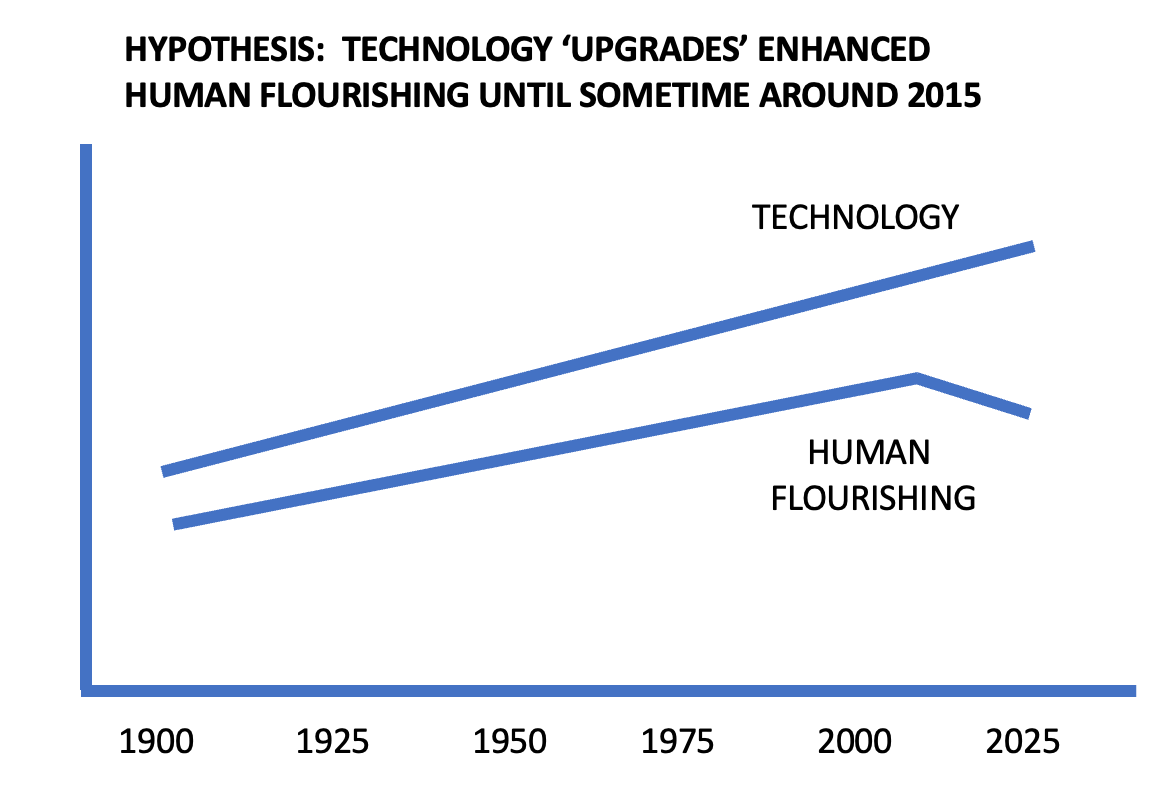
Ted Gioia believes that progress stopped in 2015 and that technocrats don't know diddly squat about human flourishing

Ted Gioia has just published an interesting polemic: I Ask Seven Heretical Questions About Progress. I'll leave you to read his seven heretical questions for yourself. But I'm quoting in full the final section of his most interesting post, with which I am deeply sympathetic. I am afraid that much current public discourse about progress is being driven by people whose minds are stuck in the 19th century world of the industrial revolution. The coupling of that mindset with current technology, particularly artificial intelligence, is a recipe of human disaster.

* * * * *

But let me move on to my radical hypotheses. (I’m running out of space, so these are much shorter.)

But each of these is a huge issue—and my views get more heterodox as you work your way down the list.

So I will need to write about this more in the future.

  1. Progress should be about improving the quality of life and human flourishing. We make a grave error when we assume this is the same as new tech and economic cost-squeezing.

  2. There was a period when new tech improved the quality of life, but that time has now ended. In the last decade, we’ve seen new tech harming the people who use it the most—hence most so-called innovations are now anti-progress by any honest definition.

  3. There was a time when lowering costs improved quality of life—raising millions of people out of poverty all over the world. But in the last decade, cost-squeezing has led to very different results, and is increasingly linked to a collapse in the quality of products and services. Some people get richer from these cost efficiencies, and a larger group move into more intensely consumerist lifestyles—but none of these results (crappy products, super-rich elites, mass consumerist lifestyles, etc.) deserve to be called progress.

    This illustrative chart suggests that technology upgrades stopped improving human life around 2015
  1. The discourse on progress is controlled by technocrats, politicians and economists. But in the current moment, they are the wrong people to decide which metrics drive quality of life and human flourishing.

  2. Real wisdom on human flourishing is now more likely to come from the humanities, philosophy, and the spiritual realms than technocrats and politicians. By destroying these disciplines, we actually reduce our chances at genuine advancement.

  3. Things like music, books, art, family, friends, the inner life, etc. will increasingly play a larger role in quality of life (and hence progress) than gadgets and devices.

  4. Over the next decade, the epicenter for meaningful progress will be the private lives of individuals and small communities. It will be driven by their wisdom, their core values, and the courage of their convictions—none of which will be supplied via virtual reality headsets or apps on their smartphones.

I still have more to say on this. But that’s plenty to chew on for the time being.

Thursday, June 2, 2022

The Fourth Arena: What’s Up in the world these days? We’re moving to a new, a new what?

About ten years of so ago I discovered object-oriented ontology (OOO) and Bruno Latour. That plunged me into a philosophy period during which I ended up taking a really Big Look at things. I ended up sketching a cosmology/ontology, Living with Abundance in a Pluralist Cosmos: Some Metaphysical Sketches. I ended up arguing that, to date, the universe has seen the emergence of three arenas of abundance. I’ve taken the term “abundance” from Paul Feryerabend: the universe is abundant, it just keeps generating lots and lots of stuff.

I’ve identified these three realms on this nice chart which I round in Wikipedia’s entry on Universe. Roughly speaking, the universe began 14 billion years ago, giving rise to the arena of Matter. Four billion years ago Life emerged. While animals do have culture – the higher primates, certainly, do beaver dams count as culture? I don’t know – it’s human culture that ushered in a new arena, that of Culture. Wikipedia dates Oldowan tools to about 2.6 million years ago. That’s when we can locate the origins of human culture. Whether it’s a million years later or earlier hardly matters on this time scale.

Just as the other areas exhibit internal differentiation, so does Culture. Over the years David Hays and I had developed an account of cultural evolution based on fundamental cognitive architecture which we cultural ranks. We’ve identified four cultural ranks. Rank 1 is based on speech and emerged we don’t really know how long ago. Let’s put it between 100,000 and a million years ago; I doubt that it’s younger and it may well be older. Rank 2 is based on writing and is 5000 to 7000 years old or so. Rank 3 began to emerge after Asian methods of calculation reached Europe by way of the Arabs. It is thus based on calculation and showed its face, say, 700 or so years ago. It gave us the scientific and industrial revolutions, but also the novel, coherent geometric perspective in drawing and painting, and harmony in music. We traced Rank 4 back to statistical mechanics and Darwinian evolution in the 19th century and flourished in the wake of Alan Turing’s conceptualization of computing and then, at mid-20th century, with the development and deployment of digital computers. At this point a large percentage of the earth’s peoples individually own one or more digital computers, whether in their phone or a laptop device, or some other device or devices.

Look at the time scales involved. Speech emerged millions of years ago. Writing only 1000s of years ago, 10,000 at the outside. Calculation is 100s of years, 1000 at the outside. And computation? Darwin published On the Origin of Species in 1859; Clausius formulated the idea of entropy in 1865. But the digital computer is a mere 70 years old or so. Cultural evolution is accelerating.

And what if we measure those intervals in generations, where a generation is 30 years? Let’s simplify things:

Speech = 1M years ago = 33,333 generations ago
Writing = 10K years ago = 333 generations ago
Computation = 1kya = 33 generations ago
Computing = 100 years ago = 3 generations ago

A mere three generations to remake the cognitive matrix from top to bottom; that’s compressing things quite a bit. Remember, culture is passed on through imitation and education between generations. But you can see where that evolution seems to be heading. It takes an individual 15 to 20 years to internalize the basic ideas and norms of their culture. Barring unforeseen advances in genetic engineering and pedagogy, that process cannot be compressed any more.

What’s happening now? Perhaps it is only the consolidation of Rank 4. Maybe it’s that, but also the emergence of a new rank. Hays and I talked about a fifth rank in private, but never published about it. Conceptualizing Rank 4 was difficult enough.

Still, the question must be asked: Are we witnessing the emergence of Rank 5 culture? And behind that lurks an even more radical question: Are we seeing the emergence of a new Arena of Abundance, the Fourth Arena?

We argued that Rank 4 was grounded in and driven by computing. At the moment it appears that machine learning, deep learning, artificial neural nets, all of them, are doing amazing things, things that are prompting apocalyptic fever in some quarters. Is AGI (artificial general intelligence) just around the corner? Will that yield a world of super-intelligence computers? What then?

I’m sure some of that is just hype and projection, tech-bros and others getting too far out over the edges of their skis. Here we have Holden Karnofsky breathlessly proclaiming we’re living in “the most important century” humankind has ever had. He’s projecting that, over the next 1.4 billion years humans and our intelligent machines are going to people the whole freakin’ galaxy. Really?

Karnofsky’s vision strikes me as something like Olaf Stapledon plus computers. It’s science fiction that’s escaped from the realm of imagination and into the real, not as actual, but as potential, as future. He senses that something Big is afoot and seeks to rationalize it.

Is that so very different from what I’m doing? I can’t help but wonder whether or not something of cosmic magnitude is in fact going on. However skeptical I am about all this AGI-is-coming hype, I am in fact deep into the process of drafting a paper arguing that machine minds are possible and that sketches out the broad requirements for them. Who knows?

More later.

Saturday, January 22, 2022

The "two-sleep" system (two periods of sleep at night, separated by wakefulness)

Zaria Gorvett, The forgotten medieval habit of 'two sleeps', BBC Future, Jan 9, 2022. Much of the article is apparently based on, Roger Ekrich, At Day's Close: A History of Nighttime.

In the 17th Century, a night of sleep went something like this.

From as early as 21:00 to 23:00, those fortunate enough to afford them would begin flopping onto mattresses stuffed with straw or rags – alternatively it might have contained feathers, if they were wealthy – ready to sleep for a couple of hours. (At the bottom of the social ladder, people would have to make do with nestling down on a scattering of heather or, worse, a bare earth floor – possibly even without a blanket.)

At the time, most people slept communally, and often found themselves snuggled up with a cosy assortment of bedbugs, fleas, lice, family members, friends, servants and – if they were travelling – total strangers.

To minimise any awkwardness, sleep involved a number of strict social conventions, such as avoiding physical contact or too much fidgeting, and there were designated sleeping positions. For example, female children would typically lie at one side of the bed, with the oldest nearest the wall, followed by the mother and father, then male children – again arranged by age – then non-family members.

A couple of hours later, people would begin rousing from this initial slumber. The night-time wakefulness usually lasted from around 23:00 to about 01:00, depending on what time they went to bed. It was not generally caused by noise or other disturbances in the night – and neither was it initiated by any kind of alarm (these were only invented in 1787, by an American man who – somewhat ironically – needed to wake up on time to sell clocks). Instead, the waking happened entirely naturally, just as it does in the morning.

The period of wakefulness that followed was known as "the watch" – and it was a surprisingly useful window in which to get things done. "[The records] describe how people did just about anything and everything after they awakened from their first sleep," says Ekirch.

Under the weak glow of the Moon, stars, and oil lamps or "rush lights" – a kind of candle for ordinary households, made from the waxed stems of rushes – people would tend to ordinary tasks, such as adding wood to the fire, taking remedies, or going to urinate (often into the fire itself).

For peasants, waking up meant getting back down to more serious work – whether this involved venturing out to check on farm animals or carrying out household chores, such as patching cloth, combing wool or peeling the rushes to be burned. One servant Ekirch came across even brewed a batch of beer for her Westmorland employer one night, between midnight and 02:00. Naturally, criminals took the opportunity to skulk around and make trouble – like the murderer in Yorkshire.

But the watch was also a time for religion.

For Christians, there were elaborate prayers to be completed, with specific ones prescribed for this exact parcel of time. One father called it the most "profitable" hour, when – after digesting your dinner and casting off the labours of the world – "no one will look for you except for God”.

Those of a philosophical disposition, meanwhile, might use the watch as a peaceful moment to ruminate on life and ponder new ideas. In the late 18th Century, a London tradesman even invented a special device for remembering all your most searing nightly insights – a "nocturnal remembrancer", which consisted of an enclosed pad of parchment with a horizontal opening that could be used as a writing guide.

But most of all, the watch was useful for socialising – and for sex.

As Ekirch explains in his book, At Day's Close: A History of Nighttime, people would often just stay in bed and chat. And during those strange twilight hours, bedfellows could share a level of informality and casual conversation that was hard to achieve during the day.

For husbands and wives who managed to navigate the logistics of sharing a bed with others, it was also a convenient interval for physical intimacy – if they'd had a long day of manual labour, the first sleep took the edge off their exhaustion and the period afterwards was thought to be an excellent time to conceive copious numbers of children.

Once people had been awake for a couple of hours, they'd usually head back to bed. This next step was considered a "morning" sleep and might last until dawn, or later. Just as today, when people finally woke up for good depended on what time they went to bed.

Ekirch also references bi-phasic sleep in the classical era.

Biphasic sleep is common among among animals as well.

"There are broad swaths of variability among primates, in terms of how they distribute their activity throughout the 24-hour period," says David Samson, director of the sleep and human evolution laboratory at the University of Toronto Mississauga, Canada. And if double-sleeping is natural for some lemurs, he wondered: might it be the way we evolved to sleep too?

The move away from biphasic sleep happened during the Industrial Revolution:

"Artificial illumination became more prevalent, and more powerful – first there was gas [lighting], which was introduced for the first time ever in London," says Ekirch, "and then, of course, electric lighting toward the end of the century. And in addition to altering people's circadian rhythms. artificial illumination also naturally allowed people to stay up later."

However, though people weren't going to bed at 21:00 anymore, they still had to wake up at the same time in the morning – so their rest was truncated. Ekirch believes that this made their sleep deeper, because it was compressed.

As well as altering the population's circadian rhythms, the artificial lighting lengthened the first sleep, and shortened the second. "And I was able to trace [this], almost decade by decade, over the course of the 19th Century," says Ekirch.

I mention multiphasic sleep in other posts, such as:

Friday, August 6, 2021

Thriving, Jiving, and Jamming Among Friends and Family

I am in the process of preparing the third volume in the peace series that Charlie Keil and I have been publishing: Playing for Peace: Reclaiming our Human Nature. The purpose of this introduction is to place this volume in the context of the series as it exists so far. However, it is a more or less complete statement in itself and so can stand as an independent essay. For that reason I am publishing it here on New Savanna without any edits.

* * * * *

This is the third volume in our series, Local Paths to Peace Today. The series is based on the premise that the tremendous growth that accompanied the Industrial Revolution, starting in the Eighteenth Century, going into the Nineteenth, and continuing up to the present day in a somewhat different (high technology) mode, that growth spurt has taken us as far as we can morally allow, and it is time for us to adopt a new way of being in the world. We acknowledge that, yes, that growth has lifted hundreds of millions of people out of poverty, produced cures for many diseases, and made an unprecedented range of material goods available to many. But it has also ruined large swaths of the Earth’s landmass, polluted the oceans, and is inducing global warming that threatens the lives of many species, not just humans. Lastly, it has produced populations of ‘civilized’ peoples who are rapidly losing the capacity for joyous play with one another.

In our first volume, We Need a Department of Peace: Everybody's Business, Nobody's Job, we addressed the problem of war, which kills and maims millions of people, consumes untold resources, and harnesses millions of people to the war machine, either directly through participation in the military, or indirectly through the manufacture of war materials and support of wars. Setting aside the Korean War, the United States as arguably been the most aggressive nation in the world, fighting destructive and wasteful wars in Vietnam, Iraq, Afghanistan and other places. We argued that the government should create a Department of Peace whose mission is to propose and plan peaceful solutions to international conflict.

Our second volume focused on the work of economist Thomas Naylor: Thomas Naylor’s Paths to Peace: Small is Necessary. Naylor argued that too many organizations in the world, private corporations, but particularly nations, are too large. Largeness breeds inflexibility, where a flaw in one part of a tightly coupled system can threaten the entire system, as happened in the 2008 collapse of the global financial system. Moreover largeness in nations threatens cultural diversity. Thus there are over 200 secessionist movements driven by a desire for cultural autonomy. The former Soviet Union devolved into smaller nations three decades ago. Should the United States do the same? (Naylor suggests that 20 would be about right.)

Now we turn our attention to our fundamental human nature, which is grounded in music and dance: Playing for Peace: Reclaiming our Human Nature. I want to set the problem with a classic essay by the economist, John Maynard Keynes, in which he predicted that by now we would have a 15 hour work week. What happened to that? Then I want to look at music and dance as the fundamental basis of human nature. We can move toward and ending by considering the concept of a moralnet, which cross-cultural anthropologist Raoul Narroll argued was the fundamental building block of human society. We then conclude where we began, with Keynes.

What Happened to the 15-hour Work Week?

Ezra Klein recently interviewed anthropologist James Suzman in The New York Times [1]. Suzman has done fieldwork among hunter-gatherers and had just published a book, Work, A Deep History from the Stone Age to the Age of Robots. Klein begins by mentioning a famous essay John Maynard Keynes published in 1930, “Economic Possibilities for Our Grandchildren [2].” Keynes predicted, among other things, that by 2030 advanced technology would have solved the problem of scarcity so effectively that people would only have to work 15 hours a week. While Keynes wildly underestimated how wealthy people would become in the future (that is to say, now). But, not only are we not working a 15-hour week, but

in an inversion of past history, the more money you make now, the more hours you generally work. It used to be the point of being rich was to not work. And now we’ve built a social value system. So the reward for making a lot of money at work is, you get to do even more work.

How did that happen?

Here’s what Klein says:

And the overarching argument is that the way we work today isn’t driven by what we need. It’s driven by what we want. It’s also driven by how, socially, we regulate or encourage wants, which is part of where [Suzman’s] research on hunter-gatherers and how they approach this comes in. [...] as we’ve gotten richer and built more technology, we’ve developed a machine not for ending our wants, not for fulfilling them, but for generating new ones, new needs, new desires, new forms of status competition.

Klein of course is talking about our ‘keep up with the Jones’s’ consumerist society.

Moreover, as Suzman argues, our society is relentlessly oriented toward the future in a way that robs us of our ability to experience satisfaction in the present. He points out, in the first place, that hunter gatherer’s are fiercely egalitarian. Goods are shared relentlessly among one’s fellows so that no one ever has a material advantage over another and so cannot use that to exercise power.

Paradoxically, it is the very fragile nature of the hunter-gatherer existences that allows them to feel that they live in a generous world. As long as the needs of the day are met, they are satisfied. They see little need to accumulate goods for the future. In contrast, the life of a farmer is very different:

Now the transition to farming was very, very different. Where hunter-gatherers viewed their environments as inherently provident, as almost generous, as something which gave them, farming, you have to view your environment as only potentially provident. For it to be provident, you have to invest your labor into it.

But investing your labor into land in order for it to provide you with something to eat involves a time scale. If we use, for example, the early wheats that were grown in the first populations to embrace agriculture in the Levant, you have a seasonal cycle. You plant the seeds in the spring. You then have to nurture and look after the crop and water it and so on and so forth, nurture it over several months, then process it, and eventually, maybe by New Year’s Eve, you might have a loaf of bread out of it. Everything is focused on future rewards.

Workers of the Industrial Revolution, whether on the factory floor or in the executive suite, have inherited that future orientation. Nor should we forget that it wasn’t until relatively late in the Industrial Revolution that most workers were agricultural workers. It is only in the late nineteenth and early twentieth centuries that masses of people left the country-side to work in cities.

That is the world we live in today, even as automation and robotics take over more and more jobs and will continue to do so for the foreseeable future. We live in a society that has been designed to keep us working so that we can satisfy and unending series of culturally-induced needs. How do we live among plenty? By working ourselves to death? Is that the plan?

We need to get off the treadmill. In the large, we’re killing the earth with this endless panoply of over elaborate and inane goods and services we’re producing and consuming. We’ve got to get off our war economy, in part by creating a Department of Peace, and, following the wise advice of Thomas Naylor, we need to downsize everything. For ourselves, we’ve got to follow the birds and cultivate the “common glad impulse” that William Henry Hudson extoled (see The Common Glad Impulse). We have to remake ourselves into more joyous and generous souls.

Jump for Joy

Musicking, that is to say, music and dance, that is the best way for us to jump for joy. And that, jumping for joy, is how a bunch of clever apes became human beings. At least that’s the argument I advanced in Beethoven’s Anvil: Music in Mind and Culture (2001). The argument is hardly original with me. Darwin believed something like that, and so did Jean-Jacques Rousseau.

At the time I wrote the book it was believed that humans were the only creatures that synchronized their movements in that way. Since then we’ve discovered otherwise. For one thing, videos started showing up on YouTube, which didn’t exist when I was writing the book, where cockatiels could be seen synchronizing to background music. Annirudah Patel took it into the lab and verified that, yes, cockatiels could synchronize to the beat the same way humans did [3]. Score one for William Henry Hudson’s common glad impulse.

A lot depends, of course, on just what we mean by synchronize. Flocks of birds and schools of fish are certainly tightly synchronized when they move almost as one as they the swerve, turn, and swirl. While the neural mechanism is probably not the same as that involved in human drumming and dancing, or cockatiel grooving for that matter, that, in the larger picture, is a secondary matter. The Big Picture is simple: We are creatures of time, all of us. We’ve all got our own grooves and rhythms.

Why, then, you ask, did I bother to argue that grooving is what transformed apes into humans? Because the Big Picture isn’t the only picture. There are many smaller pictures, and they’re all different. Birds may do it, fish may do it, but monkeys and apes do not, not until we came along. Why did we do it? Because we’re smart. And when you’re smart you’re aware. And when you’re aware you sense danger all around you, even when it’s not there. You make up things, your super-smart ever-aware mind makes things up, and likely as not it makes up spooky scaring things. They’re uncomfortable, they make us feel anxious. That’s not good.

Friday, July 16, 2021

Where do we get our visions of the future? An informal thinking-out-loud note. [Beyond progress and low-orbit joy rides]

Let's leave "we" somewhat indefinite. And by visions of the future, I mean the kind of thing Walt Disney was pushing back on his TV program in the 1950s and 1960s, in programs about space travel, the wonders of atomic energy, and, most specifically, in a promo video he did for the Experimental Prototype Community of Tomorrow (EPCOT) in 1966 (I've embedded it below for those who haven't seen it). What was actually built as EPCOT is not at all what Uncle Walt had in mind.

Breathing Uncle Walt's fumes

What I'm coming to believe is that the kind of technotopian visions of the future coming out of Silicon Valley and elsewhere are built on the fumes of 1950s tech-infused visions of the future. They're updated with newer tech, especially computer tech and mind uploads and all that, and we now have billionaires going to low-orbit joy rides, but the underlying energy and assumptions are the same.

Dystopian science fiction

I also think that dystopian science fiction is the other side, the dark side, of that, in the way that the Monster from the Id was the dark side of Morbius's desire for superintelligence in Forbidden Planet. Thus I regard, e.g. Terminator as the spiritual heir of Forbidden Planet, with Skylab in place of the Monster from the Id and the whole earth the object of its destruction instead of Morbius safely isolated way out in space.

Meanwhile, we plan

Meanwhile, people make their plans for the future. Save money, buy a car, take a vacation, put the kids through college, whatever. Corporations have their plans. A venture capital friend of mine says there are three time horizons, 3 months, 12 months, and three years. Universities and other organizations may make their 5 year or more plans; not so much concrete actionable plans as guide points for the construction of actionable plans.

And scientists create and revise predictions about climate change. Kim Stanley Robinson writes novels which are his best guess/hope for how the future will unfold in view of climate change.

Reset, it's the 21st century

But is anyone trying to do, in and of the 21st century, what Walt Disney was doing in the middle of the previous century, where he's essentially building on 19th century assumptions about human life, the good life, and his tech vision is really the highest of the 2nd Industrial Revolution? He's taking human nature and life for granted and amplifying the good stuff with technology. What I have in mind is rethinking human nature and human life, a lot of which has been going on in the last century, and starting from some other place.

What is that other place? Maybe that's what we have to figure out. But we have to get beyond this techno-utopianism. Yes, we need to think about technology. But we need to think about and rethink so much more.

Beyond work and flying cars

Back in 1930 John Maynard Keynes imagined we'd have a 15 hour work week. Whatever happened to that? Why is it easier and more fun to think about flying cars than about a 15-hour work week?

What happened, I suspect, is that we, with our assumptions about human nature and life, have a hard time imagining what we'd do with our time if we only had to work 15 hours a week. So, if your income is high enough, when you retire, you hire a retirement coach to help you figure out what to do with the your time now that you're not working. Why do people with the ability to have earned enough that they can afford a retirement coach, why do they HAVE to hire a retirement coach? Do we have to redefine adulthood?

How about a future where people don't have to hire a retirement coach? My friend Charlie Keil wants every child to be competent in dancing and drumming by the age of five. If that were true everywhere, not just in videos of cute African kids, what kind of world would we have? Let's build our tech visions around those kinds of people. And forget all this nonsense about superintelligent machines and uploading, etc. That's projective fantasy.

EPCOT promo

This is hot hot hot in Silicon Valley. I like it too, but recognize that it is an artifact of an earlier time.

You can skip the first 5 minutes, which is about Disneyland. The future starts at 5:03, and especially 9:15, when Walt delivers his vision for the future.

Sunday, June 13, 2021

Ramble, June 13, 2021: Progress, AI [rolling thunder | Media Notes 60]

Progress Studies

At the moment progress studies has two aspects:

1) Education: Making people aware that humankind has indeed made progress over the years, perhaps since the beginning of the Industrial Revolution, perhaps since the emergence of humankind on the African savannas.
2) Insight: Understanding the current stagnation – which may, however, be abating (we’ll see).

The first aspect seems to be coming along nicely; the second not so well.

The people who are attracted to the progress studies banner seem to believe that ideas are out there scattered about, just waiting for us to pick them up and use them. They don’t actually say that, but they act as though that were their underlying assumption. Thus they tend to believe that we can fix the problem by changing organizational structures, providing better incentives, getting rid of sclerotic procedures and bureaucracy.

They’re just tinkering around the edges. Such measures may produce marginal improvements, but will not address the core issue, which is that old systems of thought are ‘bottoming out’ and new ones have yet to emerge in strength. See my working papers:

I’ve been rethinking AI (artificial intelligence)

I don’t know exactly when I first began thinking about artificial intelligence (AI), but I was certainly thinking about it in my second year of graduate school at SUNY Buffalo. By that time I’d found my way to David Hays, in the Linguistics Department, and joined his research group in computational linguistics. Hays did not think very highly of AI as an intellectual endeavor; he thought it was more concerned with computer tricks and hacks than with anything one might call a scientific understanding of the human mind and/or intelligence. I was happy to follow him in this belief, which was and is by no means uncommon.

But recent developments have brought me to rethink things a bit. Sure, there’s plenty of hype and hackery to go around, but I think some serious issues are beginning to be address. In particular, a potentially very fruitful dialog is developing between neuroscientists and AI researchers. I think we’re going somewhere.

See two recent blog posts and a working paper from last year:

Bob Dylan’s Rolling Thunder

I just watched Rolling Thunder Revue: A Bob Dylan Story by Martin Scorsese, which is, according to the Wikipedia article, a somewhat fictionalized documentary about Dylan’s Rolling Thunder Revue, which toured New England and Canada in 1975-76. Until I looked it up, which I always do with anything I intend to write about, I thought it was all the gospel truth, or at least as true as documentary footage can be.

For me it was a trip down that much clichéd memory lane. No, I was never a Dylan fan, but always aware of him. And, no, I didn’t attend any of the signature concerts of the counter-cultural era, not Woodstock or Altamont, nor, come to think of it, did I attend concerts by any of the fabled rock or folk acts of the era. But I had records – that’s what we had back in those days, vinyl discs – and watched the news, read the news, and was generally aware of what was going on. In fact, the time of the Rolling Thunder Review I was studying computational linguistics with David Hays (see above), but also jazz improvisation with Frank Foster.

It reminded me that, yes, the 60s (which extended will into the 1970s) were real. No, they didn’t bring about an Aquarian Age, but the hopes and intentions were real, if naïve and misguided. I don’t see anything like that around today. Without it I’m afraid Progress Studies will come to naught. We need a new mythology and I’m afraid that silicon visions of virtual thrills and digital dominance don’t fill the bill.

So what was in the revue? Dylan of course, but also Joan Baez, and Joan Baez in Dylan drag. Dylan often wore white face make-up (I never knew that) inspired, by of all things, Kiss. Allen Ginsburg was on the tour, but the audiences weren’t digging his poetry. They wanted music. We saw Dylan visiting Rubin "Hurricane" Carter, and writing a song about him. And much more.

If you really want to change the world, watch this, and figure out how we’re going to come up with a new mythology as potent at that one.