Showing posts with label human nature. Show all posts

Wednesday, March 26, 2025

Homo economicus sucks! Homo Ludens rocks!

Here's what Wikipedia says about Homo economicus:

The term Homo economicus, or economic man, is the portrayal of humans as agents who are consistently rational and narrowly self-interested, and who pursue their subjectively defined ends optimally. It is a wordplay on Homo sapiens, used in some economic theories and in pedagogy.[1]

In game theory, Homo economicus is often (but not necessarily) modelled through the assumption of perfect rationality. It assumes that agents always act in a way that maximize utility as a consumer and profit as a producer,[2] and are capable of arbitrarily complex deductions towards that end. They will always be capable of thinking through all possible outcomes and choosing that course of action which will result in the best possible result.

The rationality implied in Homo economicus does not restrict what sort of preferences are admissible. Only naive applications of the Homo economicus model assume that agents know what is best for their long-term physical and mental health. For example, an agent's utility function could be linked to the perceived utility of other agents (such as one's husband or children), making Homo economicus compatible with other models such as Homo reciprocans, which emphasizes human cooperation.

As far as I can tell, Homo economicus dominates the ideological formations behind the major institutional structures of Western society. More specifically, it dominates the world of AI, both as a model of the mind, and as a way of thinking about the social consequences of AI, but good and bad. I say it functions as an ideological formation because it is simply assumed to be how the world is.

One can, however, reject that assumption in favor of something else. I'm am rejecting it in favor of a view promulgated in Homo Ludens, published in 1938 by Dutch historian and cultural theorist Johan Huizinga. From Wikipedia:

It discusses the importance of the play element of culture and society.[4] Huizinga suggests that play is primary to and a necessary (though not sufficient) condition of the generation of culture. The Latin word ludens is the present active participle of the verb ludere, which itself is cognate with the noun ludus. Ludus has no direct equivalent in English, as it simultaneously refers to sport, play, school, and practice.

Thus:

Huizinga begins by making it clear that animals played before humans. One of the most significant (human and cultural) aspects of play is that it is fun.

Huizinga identifies 5 characteristics that play must have:

  1. Play is free, is in fact freedom.
  2. Play is not "ordinary" or "real" life.
  3. Play is distinct from "ordinary" life both as to locality and duration.
  4. Play creates order, is order. Play demands order absolute and supreme.
  5. Play is connected with no material interest, and no profit can be gained from it.

Huizinga shows that in ritual dances a person 'becomes' a kangaroo. There is a difference in how western thought expresses this concept and how "primitive" religions view this. Scholars of religion use western terminology to describe non western concepts.

In the rest of this post I list a conversation I had with Claude 3.7 that starts with some passages from Yuval Noah Harari’s Homo Deus: A Brief History of Tomorrow (2017), which sets the current AI revolution in the context of all of human history. He accepts Homo economicus without question. I then propose Homo Ludens as an alternative.

My standard conventions apply. My prompts are in bold face. Claude's responses are in plain face.

Homo Economicus 

I’m reading Harari’s Homo Deus. In Chapter 9, The Great Decoupling, he says things like:  

In the twenty-first century liberalism will have a much harder time selling itself. As the masses lose their economic importance, will the moral argument alone be enough to protect human rights and liberties? Will elites and governments go on valuing every human being even when it pays no economic dividends?  

And: 

 The technological bonanza will probably make it feasible to feed and support the useless masses even without any effort on their side. But what will keep them occupied and content? People must do something, or they will go crazy. What will they do all day? One solution might be offered by drugs and computer games. Unnecessary people might spend increasing amounts of time within 3D virtual-reality worlds, which would provide them with far more excitement and emotional engagement than the drab reality outside. Yet such a development would deal a mortal blow to the liberal belief in the sacredness of human life and of human experiences. What’s so sacred in useless bums who pass their days devouring artificial experiences in La La Land?  

He's clearly assuming that humans get their value from their ability to make economic contributions. Where does he get that assumption? He attributes it to liberalism. Is that valid? Why happens to his argument if one rejects that view? Instead, one can affirm that human life is intrinsically valuable, that the sacredness of human life is intrinsic and not dependent on economic contributions.

You've pinpointed a crucial assumption in Harari's argument. His view that human value in liberal societies is fundamentally tied to economic utility is certainly debatable.

Harari is drawing on a particular interpretation of liberalism that emphasizes its economic aspects over its broader humanistic foundations. While economic productivity has certainly been valued in liberal societies, the philosophical underpinnings of liberalism - from Locke to Kant to Rawls - have often emphasized human dignity, autonomy, and inherent worth that exists prior to and independent of economic contribution.

If we reject his economic-centric assumption, his argument changes significantly. The "Great Decoupling" becomes less threatening if we maintain that human worth is intrinsic rather than instrumental. The questions become:

1. Can liberal societies maintain a commitment to human dignity without the pragmatic reinforcement of economic necessity?
2. How might social and political systems evolve to recognize human value beyond productivity?
3. What alternative sources of meaning and purpose might emerge beyond economic contribution?

Many religious and philosophical traditions have long held that human value is intrinsic and not dependent on utility. Even within secular humanism, there are strong arguments for inherent human worth based on our capacity for consciousness, relationships, moral reasoning, and subjective experience.

Harari's dystopian vision assumes that elites will abandon their commitment to universal human value once it's no longer economically expedient. But this presupposes that such commitments were only ever pragmatic rather than principled - a highly contestable claim about human moral psychology and political philosophy.

By questioning this fundamental assumption, you've identified a potential way to challenge Harari's more pessimistic conclusions while still engaging with the technological transformations he describes.

It seems to me that he makes unwarranted assumptions about AI. For example, he seems to accept Bostrom’s idea that super-intelligence is inevitable, though it is by no means clear just what “super-intelligence” might be. I notice that Harari was enthusiastic about the medical applications of IBM’s Watson. But five or six years have Harari published the book (2017) IBM sold-off it’s medical unit, presumably because it wasn’t performing well enough. Of course, Harari could point out that things will surely change in the future, as they surely will. Still, an awful lot depends on assumptions he’s making about the course of AI. He seems to assume that we have no choice about how we build and deploy the technology.

You're making an excellent point about Harari's technological determinism. He does seem to treat certain technological developments as inevitable rather than contingent on human choices and values.
Sunday, November 24, 2024

Romantic Love, Conversation, Biology, and Culture

[I'm bumping it yet again in 2024]
Once more I'm bumping this to the top of the queue. Why? It discusses a methodological problem that is of current interest to me.  [2021]
* * * * *
I'm bumping this to the top of the queue because it's one of my favorite posts. FWIW, this is the post that got me my monthly slot at 3 Quarks Daily.

Note: This post grew out of reflection on older earlier post on bundling.
When I was an undergraduate at Johns Hopkins I took a course in Medieval literature and was thoroughly gobsmacked when I learned that romantic love had been invented in 12th century France. Until then I’d believed it to be a human universal – one and only, forever and ever, that was just how it was, no? Well, not quite.

What arose in Medieval Europe is something called Courtly Love, a set of conventions used by high-born men in wooing their lovers. And these lovers were not their wives, nor wives to be. For aristocratic marriage had little to do with personal preference; it was politics. Powerful families would forge alliances by arranging marriages among their young.

In time, over the course of centuries, so the story went, romantic love was transformed from an aristocratic game into a set of conventions used to define the necessary, or at least the ideal, precondition for any marriage. This set of conventions was in place, at least among the middle class, by the time Jane Austen wrote her novels in the early 19th Century. Those conventions have remained more or less in place up to the present, though they’ve become a bit tattered in the last decade or three as a soaring divorce rate has made it abundantly clear that true love does not last forever. That, of course, is not exactly news – why, for example, did Flaubert write Madame Bovary? – but the myth is so attractive that it dies hard.

That was the state of things during my undergraduate years – which coincided with the emergence of feminist activism in the late 1960s. Whatever their personal experience, everyone gave lip service to one and only forever and ever and believed that it was human nature. In that context, then, the revelations of the learned scholars shook my world.

Counter-Revolution

Learned scholars, however, do not constitute a single tribe. Their tribes are many, and often contentious. Even as the literati were blissfully proclaiming the recent and Western origin of romantic love, other scholars set out to prove them wrong. In 1992, for example, W. R. Jankowiak and E. F. Fischer published “A cross-cultural perspective on romantic love” (Ethnology 31: 149-155). They defined romantic love as “any intense attraction that involves the idealization of the other, within an erotic context, with the expectation of enduring for some time into the future” and they contrasted this with “the companionship phase of love . . . which is characterized by the growth of a more peaceful, comfortable, and fulfilling relationship.” They examined ethnographic data on 166 societies from around the world and discovered romantic love in 88.5 percent of them, suggesting “that romantic love constitutes a human universal, or at the least a near-universal.”

More recently Jonathan Gottschall and Marcus Nordland published Romantic Love: A Literary Universal? (Philosophy and Literature 30: 450-470, 2006). They conducted a cross-cultural study of folktales from 79 cultures and found at least one reference to romantic love in 55 of those collections and multiple references in 39 collections. They assert that their study “offers staunch support to the existing evidence that romantic love is a statistical cultural universal. It would also seem to increase the probability that romantic love may be an absolute cultural universal offers staunch support to the existing evidence that romantic love is a statistical cultural universal.” “Statistical universal” is a term of art meaning that something is in a lot of places, but not everywhere, yet. It seems clear that if Gottschall and Nordland were to place a bet, they'd bet that further research would find that romantic love is a true cultural universal, present in every culture for which we have reliable records.

Still more recently, just yesterday in the time-scale of academic publishing, Brian Boyd has asserted, with the calm assurance of a senior scholar in command of wide learning, that “cross-cultural, neurological, and cross-species studies have demonstrated the workings of romantic love across societies and even species” (The Origin of Stories, Harvard 2009, p. 341). To this, Michael Bérubé has replied, with the calm assurance of a senior scholar in command of wide learning, but learning leavened with a dash of school-boy wit:
This just won’t wash. Other species might court and mate for life, but they do not engage in romantic love in the sense that humanists employ the term, save perhaps for the cartoon skunk Pepé Le Pew. “Romantic love” does not mean “mammals doing it like mammals”; it refers to the conventions of courtly love, which were indeed invented in the European middle ages and cannot be found in ancient literatures or cultures. Those conventions are culturally and historically specific variations on our underlying (and polymorphous) biological imperatives, just as the institution of the Bridezilla and the $25,000 wedding is specific to our own addled time and place.
What’s going on here? Who’s right?

Back to the Drawing Board: There's that pesky elephant

I don’t know. We don’t know. Not any more.

I’m inclined to invoke that hoary old story of the blind men who, upon examining a large beast, are unable to decided what beast it is, or even whether or not it is a beast at all. We, of course, know that they’re examining an elephant, but such different parts of the elephant – tusks, years, legs, tail – that they reach vastly different conclusions about the object under scrutiny.

In the case of romantic love, I believe we’re in much the same position as those blind men. But, in our case, there is no transcendent story-teller who actually knows what creature is under scrutiny. Rather, it is up to us to approximate that story-teller by making more and more sophisticated observations and examining them through richer concepts and models about human culture and behavior.

There is no point in continuing to argue using existing observations, methods, and theories. In light of the existing contretemps we would do well to consider such arguments to be ideological in nature and thus pointless, except, of course, to all-knowing ideologues. Meanwhile, let’s take a look around and see what else is there to be explained.

Companionship, Conversation, and the Novel

Let’s return to Jankowiak and Fischer, and their contrast between the romantic phase and the companionship phase of love, a distinction, I believe, that is common, and which I accept. This companionship, is it too universal?

Take those Medieval aristocrats who were playing courtship games on the side: Did they have a companionate relationship with their spouses? I’m guessing that in some cases, yes, and in other cases no. These marriages, after all, were arranged by parents for political ends. If companionship developed in the marriage, fine; if not, no big deal. For companionship was not the point, it was not part of the ideology.

And then we have my standard passage from John Milton's Doctrine and Discipline of Divorce, Preface to Book 1:
God in the first ordaining of marriage taught us to what end he did it, in words expressly implying the apt and cheerful conversation of man with woman, to comfort and refresh him against the evil of solitary life, not mentioning the purpose of generation till afterwards, as being but a secondary end in dignity, though not in necessity: yet now, if any two be but once handed in the church, and have tasted in any sort the nuptial bed, let them find themselves never so mistaken in their dispositions through any error, concealment, or misadventure, that through their different tempers, thoughts and constitutions, they can neither be to one another a remedy against loneliness nor live in any union or contentment all their days…
That strikes me as an assertion of the need for companionship between spouses – cheerful conversation – and a rather emphatic assertion at that. Would Milton have made such an assertion if it had, in fact, been the common understanding of the day? That seems unlikely to me, though I could be wrong, as I am not a scholar of 17th century English family practices.

But the late Lawrence Stone was, and in 1977 he published a ground-breaking study, The Family, Sex and Marriage in England 1500-1800 (Harper & Row) in which he argued that, over a period of three centuries, family organization underwent a transition that started with the Open Lineage Family – permeable by outside influences, with strong “loyalty to ancestors and to living kind” (p. 4). It was succeeded by the Restricted Patriarchal Nuclear Family P. 7):
which saw the decline of loyalties to lineage, kin, patron, and local community as they were increasingly replaced by more universalistic loyalties to the nation state and its head and to a particular sect or Church. As a result, ‘boundary awareness’ became more exclusively confined to the nuclear family, which consequently became more closed off from external influences, either or the kin or of the community.
Finally, during the last half of the 19th Century, the Closed Domesticated Nuclear Family emerges among “the upper bourgeoisie and squirarchy” (pp. 7-8):
This was the decisive shift, for this new type of family was the product of the rise of Affective Individualism. It was a family organized around the principle of personal autonomy, and bound together by strong affective ties. Husbands and wives personally selected each other rather than obeying parental wishes, and their prime motives were now long-term personal affection rather than economic or status advantage for the lineage as a whole … Patriarchical attitudes within the home markedly declined, and greater autonomy was granted not only to children, but also to wives.
This was a family in which companionship between husband and wife was important, for that companionship was now the foundation of family organization. And this is the family structure that is at the heart of the British novel in the late 18th century and into the 19th century. The novel and the family structure had a reciprocal relationship (dialectical?) in which the demands of this family structure created an audience for the novel and the novel, in turn articulated the inner-workings and hidden designs of the family.

Out of what biological equipment did the novel help people construct their familial relations? Let us speculate, and freely – for what else can we do? If we’re to search for evidence, we’ve got to make a guess about what we’re looking for before there’s any point to setting out. However, we do want our speculation to be biologically plausible. So, calling on chess as a metaphor, let’s select our pieces from biology while our speculation will be the game play.

Friday, October 13, 2023

Census of primate brain cells [good thing I don't subscribe and so can't download the articles]

Thursday, September 23, 2021

Beyond Human Nature

Amia Srinivasan, in a wide-ranging conversation with Tyler Cowen:

I also think one error that is consistently made in this discourse, in this kind of conversation about what’s innate or what’s natural, is to think about what’s natural in terms of what’s necessary. This is a point that Shulamith Firestone made a very long time ago, but that very few people register, which is that — and it was actually made again to me recently by a philosopher of biology, which is, “Look what’s natural isn’t what’s necessary.”

It’s extraordinary. It’s not even like what’s natural offers a good equilibrium point. Think about how much time you and I spend sitting around. Completely unnatural for humans to sit around, yet we’re in this equilibrium point where vast majority of humans just sit around all day.

So, I think there’s a separate question about what humans — as essentially social, cultured, acculturating creatures — what our world should look like. And that’s distinct from the question of what natural predispositions we might have. It’s not unrelated, but I don’t think any of us think we should just be forming societies that simply allow us to express our most “natural orientations.”

There's much more at the link.

Thursday, July 29, 2021

When did the future become a site for human habitation like, say, crossing the ocean to colonize the New World?

We’ve always thought about the future: Where’s the next meal coming from? How do we prepare for the festival? Will the harvest be good this year? What’ll I leave the grand kids? I have something different in mind. When did we start thinking about the future as a time and place when things would be different from they are now, when they would be better, and made so by effort we can undertake now? When did the future become that (kind of) place?

So I put the question to the Twitterverse:

That’s interesting. Very.

I’ve been pushing the Disney line for awhile now, maybe two years. He had boundless enthusiasm for the capacity of technology and industry to create a new an better world. But as far as I can tell he’d pretty much decided that the human world was fixed in its arrangements. Of course, when I talk of Walt Disney I don’t mean merely or only Walt Disney. I’m using him as a proxy for mid-20th century America. That’s the world he spoke to and spoke for.

And that world had begun falling apart by the time Disney died in 1966: the Civil Rights movement, the anti-war movement, feminism, the counter culture (“turn on, tune in, and drop out”), the OPEC oil embargo, it just gets worse and worse. And the future, what’s that? The future is “when are we going to get out of Iraq and Afghanistan, what’s Elon up to, more wild fires?”

I note that while a lot of science fiction is set in the future, not all of it is. Star Trek is, Star Wars is not. Sometimes science fiction is set in a world that’s just another fantasy space, like Narnia or Hogwarts, but sometimes it’s set in a world that’s (supposed to be) continuous with our world, like Kim Stanley Robinson’s New York 2150, or The Ministry of the Future. Take H. G. Wells. Is War of the Worlds set in another fantasy space, that happens to look a lot like the contemporary world, or is it in a world that’s continuous with, a potential extension of, the contemporary world? And The Time Machine? I’m not sure how to answer those questions.

I do know, however, that the Progress Studies movement seems to be much more interested in the question of “What happened to flying cars?” than in “What happened to the 15-hour workweek?” Why? I suppose the movement for Basic Universal Income is a bit like a push for the 15-hour workweek, but the emphasis is different.

And then there is Godwinian “perfectibility,” which Ted Underwood mentioned in a tweet. From Wikipedia:

Believing in the perfectibility of the race, that there are no innate principles, and therefore no original propensity to evil, he considered that “our virtues and our vices may be traced to the incidents which make the history of our lives, and if these incidents could be divested of every improper tendency, vice would be extirpated from the world.” All control of man by man was more or less intolerable, and the day would come when each man, doing what seems right in his own eyes, would also be doing what is in fact best for the community, because all will be guided by principles of pure reason.

Such optimism was combined with a strong empiricism to support Godwin’s belief that the evil actions of men are solely reliant on the corrupting influence of social conditions, and that changing these conditions could remove the evil in man. This is similar to the ideas of his wife, Mary Wollstonecraft, concerning the shortcomings of women as due to discouragement during their upbringing.

I don’t think the Progress Studies folks have a clue about that sort of thing. The tech-way to human perfection is obviously through technology: the Internet, virtual reality, augmented reality, something called the Metaverse, and above all, artificial intelligence. We’re to become one with our machines, if they’ll let us. Otherwise, they'll replace us. The horror! The horror!

But does anyone else have a vision of human perfectibility?

* * * * *

Let’s look at some passages from Keynes’s famous “Economic Possibilities for our Grandchildren” (1930).

Yet there is no country and no people, I think, who can look forward to the age of leisure and of abundance without a dread. For we have been trained too long to strive and not to enjoy. It is a fearful problem for the ordinary person, with no special talents, to occupy himself, especially if he no longer has roots in the soil or in custom or in the beloved conventions of a traditional society. To judge from the behaviour and the achievements of the wealthy classes today in any quarter of the world, the outlook is very depressing! For these are, so to speak, our advance guard-those who are spying out the promised land for the rest of us and pitching their camp there. For they have most of them failed disastrously, so it seems to me-those who have an independent income but no associations or duties or ties-to solve the problem which has been set them.

I feel sure that with a little more experience we shall use the new-found bounty of nature quite differently from the way in which the rich use it today, and will map out for ourselves a plan of life quite otherwise than theirs.

Is anyone proposing to “map out for ourselves a plan of life quite otherwise than theirs”? I don’t think so. Whenever I think about that my thoughts immediately lock on to the 60s & 70s counter-culture with its vague dreams of a coming Age of Aquarius (“let the sunshine in”). What happened to that? Gweneth Paltrow and Goop, that’s what happened, and of course Oprah Winfrey.

Keynes goes on:

There are changes in other spheres too which we must expect to come. When the accumulation of wealth is no longer of high social importance, there will be great changes in the code of morals. We shall be able to rid ourselves of many of the pseudo-moral principles which have hag-ridden us for two hundred years, by which we have exalted some of the most distasteful of human qualities into the position of the highest virtues. We shall be able to afford to dare to assess the money-motive at its true value. The love of money as a possession – as distinguished from the love of money as a means to the enjoyments and realities of life – will be recognised for what it is, a somewhat disgusting morbidity, one of those semicriminal, semi-pathological propensities which one hands over with a shudder to the specialists in mental disease. All kinds of social customs and economic practices, affecting the distribution of wealth and of economic rewards and penalties, which we now maintain at all costs, however distasteful and unjust they may be in themselves, because they are tremendously useful in promoting the accumulation of capital, we shall then be free, at last, to discard.

Where are we now? Billionaires in space, that’s where. “Lifestyles of the Rich and Famous,” that’s where.

But who knows, maybe there’s hope of progress lurking beneath the surface. For inequality is an issue that’s been festering in the civic sphere ever since Occupy Wall Street went live in September of 2011, proclaiming “We are the 99%.” Meanwhile, who’s going to help us figure out how to “use the new-found bounty of nature” that will come our way when we finally come to our senses? Who’s thinking about that? For without that there can be no progress.

More later.

Sunday, June 21, 2020

William Benzon, 1912-1998: He Went Out Swinging and Smooth Shaven [born on Jan 31, 1912]

Father & co 400 dpi jpg copy

My father, William Benzon, was born on Jan. 31, 1912 in Baltimore, MD, and died November 21, 1998 in Allentown PA. His parents were Danish immigrants. For about the first six years of his life he lived with his parents and two older sisters, Karen and Signe, on Curtis Bay in Baltimore in a house which had formerly been a yacht club. The family then moved to Longwood St. He attended Boy's Latin School and, according to his high school year book, was regarded as an intellectual and as the 2nd brightest in his class. He was on the boxing, fencing, and football teams and his favorite expression was "Well blow me down."

He did two years at the University of Virginia, where he managed to run up gambling debts that his father had to satisfy. He completed his college education at Johns Hopkins, graduating in 1934 with a degree in chemical engineering. He then went to work for Bethlehem Steel (initially at Sparrows Point) where he spent his entire career. He entered their "loop" program which was for hotshot college graduates they wanted to nurture. I don't know what his initial duties were or how he ended up in the mining division of the company (Bethlehem Mines Corp.). He spent most of his career there and rose to Superintendent of Coal Preparation, a position that was created for him. He stayed in that post until his retirement in 1974. He continued to consult on coal preparation after retirement.

Early in his career he moved to Johnstown Pa. where Bethlehem Mines had its headquarters. There he met my mother, Elizabeth Tredennick, and married her in 1940. I was born in 1947 and my sister in 1951.

What was he like?

He was a brilliant man, attaining an international reputation in his field, coal preparation. He was also a loving father, expressing his love in various ways, including making some very fine things for me and my sister. He made furniture for my sister’s dolls, a high chair, and a very elegant play pen with the letters of the alphabet cut into the slats. He made me a gorgeous Indian headdress – feathers of various kinds, ermine tails, abalone shell ornament, a beaded head band – and various swords and knives etc. as appropriate for various Halloween costumes. He encouraged my sister and me in whatever we wanted to do. When I went off to Hopkins and grew long hair, a beard and mustache, that was OK. And so was going to graduate school in something as impractical as English literature. When, as an adult I needed to borrow money from him because I was out of work, he loaned me money (even after he had retired and was obviously living on a fixed income). He never ever suggested that I "face reality" and move into the corporate world, etc. He knew my intellectual work was important and helped me pursue that, as he has helped my sister pursue her interest in poetry.

He was an intellectual and books were important to him; he had many of them, including many he inherited from his father. I remember a number of Christmas seasons where he read Dickens' A Christmas Carol to the family after dinner on a number of evenings. And he certainly read stories to me before bed as a child – I remember him reading me from Mark Twain, Rafael Sabatini, and others. I was particularly struck by his ability to read dialog so naturally, with expression, like people would actually have said it. He spent a great deal of time helping me and my sister with our homework. He never just told me answers or worked problems. He always asked questions designed to lead me to the answers myself.

My father had an excellent sense of humor, which he slyly attributed to his Danish heritage. He loved Mark Twain, Charles Dickens, Lewis Carroll, and one Jerome K. Jerome, and the Marx Brothers. He was also quite fond for Victor Borge. For one thing, Borge was from Denmark, where his parents were born and raised. Borge's humor was often of a linguistic nature, and my father was interested in language (he owned books by Otto Jesperson, the Danish scholar of the English language, and H. L. Mencken). Borge was a musician and much of his humor involved committing mayhem on various pieces of classical and not-so-classical music.

An Athlete - Golf

He was a good and dedicated athlete. Beyond his high-school sports he was also an excellent swimmer and loved the sea. As an adult he was a cyclist (mostly in his youth, in Baltimore and in his early days in Johnstown) and, above all, golf. 

He took up the sport as an adult and pursued it passionately. During his prime – say from 30 though 55 – he had a single digit handicap, even as low as two or three. He kept systematic notes about his game throughout his entire golfing career. One winter he painted golf balls in red nail polish and golfed in the snow. He experimented with putters he either built himself or modified from putters he'd bought. He also had ideas about custom golf shoes which he half-way finished (my sister and I found the half-completed shoes in the basement).

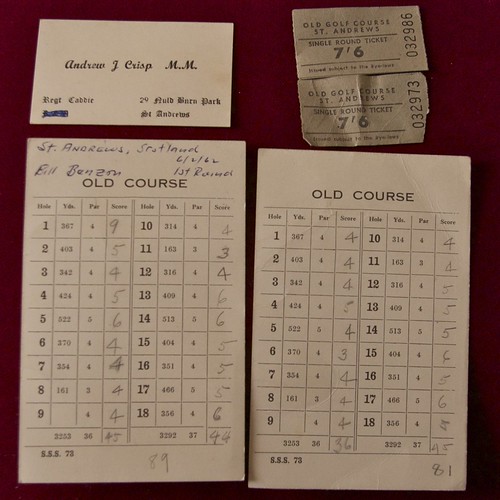
One of the highlights of his life was playing golf at St. Andrews in Scotland (he shot 81 on one round). He read a great deal about the sport, knew its history backwards and forwards, and had a good collection of golf books, including a classic written by a relative of Charles Darwin. It is absolutely clear to me that, as I use music to balance out my intellectuality, so my father used golf to achieve balance in his life.

IMGP5036
Caddie's card, tickets, and scorecards for two rounds at St. Andrews

Stamps

My father was an avid stamp collector, with particular interests in Canada, Liberia, Germany, and China. He loved the look of stamps, their design (line, color, shape, form, etc.), but also what they told about history and society. Stamps were his vehicle for encountering and organizing human history. Stamps commemorate individuals, events, ideas, and so forth, and thus tell the history of the nations that issue them. All of that was important to my father.

As was the craft of collecting itself. Used stamps are, of course, stuck on envelopes. They have to be separated from the envelope before they can be mounted in books. My father spent hours doing that. He had special chemicals, magnifying glasses, balances, tweezers, hinges etc. all relevant to the physical preparation of the stamps. He had books about stamps, and catalogues. He engaged in extensive correspondence with various stamp dealers, some he had come to know on an all but personal basis, even though he'd never met them. Over the years he'd developed relationships with them through the simple and cumulative acts of buying stamps.

Thursday, August 1, 2019

The representational nature of the earliest human engravings


Mellet E, Salagnon M, Majkic ́ A, Cremona S, Joliot M, Jobard G, Mazoyer B, Tzourio Mazoyer N, d’Errico F. 2019 Neuroimaging supports the representational nature of the earliest human engravings. R. Soc. open sci. 6: 190086. http://dx.doi.org/10.1098/rsos.190086.
Abstract:The earliest human graphic productions, consisting of abstract patterns engraved on a variety of media, date to the Lower and Middle Palaeolithic. They are associated with anatomically modern and archaic hominins. The nature and significance of these engravings are still under question. To address this issue, we used functional magnetic resonance imaging to compare brain activations triggered by the perception of engraved patterns dating between 540 000 and 30 000 years before the present with those elicited by the perception of scenes, objects, symbol-like characters and written words. The perception of the engravings bilaterally activated regions along the ventral route in a pattern similar to that activated by the perception of objects, suggesting that these graphic productions are processed as organized visual representations in the brain. Moreover, the perception of the engravings led to a leftward activation of the visual word form area. These results support the hypothesis that these engravings have the visual properties of meaningful representations in present-day humans, and could have served such purpose in early modern humans and archaic hominins.

Friday, September 8, 2017

The wealthy are (sometimes) ambivalent about their wealth (pssst...they're only human)

Rachel Sherman in the NYTimes:
We often imagine that the wealthy are unconflicted about their advantages and in fact eager to display them. Since Thorstein Veblen coined the term “conspicuous consumption” more than a century ago, the rich have typically been represented as competing for status by showing off their wealth. Our current president is the conspicuous consumer in chief, the epitome of the rich person who displays his wealth in the glitziest way possible.

Yet we believe that wealthy people seek visibility because those we see are, by definition, visible. In contrast, the people I spoke with expressed a deep ambivalence about identifying as affluent. Rather than brag about their money or show it off, they kept quiet about their advantages. They described themselves as “normal” people who worked hard and spent prudently, distancing themselves from common stereotypes of the wealthy as ostentatious, selfish, snobby and entitled. Ultimately, their accounts illuminate a moral stigma of privilege. [...]

Keeping silent about social class, a norm that goes far beyond the affluent, can make Americans feel that class doesn’t, or shouldn’t, matter. And judging wealthy people on the basis of their individual behaviors — do they work hard enough, do they consume reasonably enough, do they give back enough — distracts us from other kinds of questions about the morality of vastly unequal distributions of wealth.

To hide the price tags is not to hide the privilege; the nanny is no doubt aware of the class gap whether or not she knows the price of her employer’s bread. Instead, such moves help wealthy people manage their discomfort with inequality, which in turn makes that inequality impossible to talk honestly about — or to change.
Thus:
My interviewees never talked about themselves as “rich” or “upper class,” often preferring terms like “comfortable” or “fortunate.” Some even identified as “middle class” or “in the middle,” typically comparing themselves with the super-wealthy, who are especially prominent in New York City, rather than to those with less.

When I used the word “affluent” in an email to a stay-at-home mom with a $2.5 million household income, a house in the Hamptons and a child in private school, she almost canceled the interview, she told me later. Real affluence, she said, belonged to her friends who traveled on a private plane.
And:
The people I talked with never bragged about the price of something because it was high; instead, they enthusiastically recounted snagging bargains on baby strollers, buying clothes at Target and driving old cars. They critiqued other wealthy people’s expenditures, especially ostentatious ones such as giant McMansions or pricey resort vacations where workers, in one man’s sarcastic words, “massage your toes.”

They worried about how to raise children who would themselves be “good people” rather than entitled brats. The context of New York City, especially its private schools, heightened their fear that their kids would never encounter the “real world,” or have “fluency outside the bubble,” in the words of one inheritor. Another woman told me about a child she knew of whose father had taken the family on a $10,000 vacation; afterward the child had said, “It was great, but next time we fly private like everyone else.”
And so, "Nonetheless, their ambivalence about recognizing privilege suggests a deep tension at the heart of the idea of American dream." Might I suggest a name for that tension: human nature. See these posts:

Wednesday, June 28, 2017

Humans as pattern-seekers

Last week I’d posted a video in which Jeremy Lent sketches out a transformation in which humankind manages to escape climate catastrophe. He’s recently published The Patterning Instinct: A Cultural History of Humanity’s Search for Meaning. While I’m leery of the term “instinct” in this context, I certainly believe that we are pattern seeking creatures, and that we seek meaning (unity of being?).

What I’m wondering is if we can deriving this pattern seeking from the fact that each individual neuron is, of course, a living agent, seeking to increase its inputs (nutrients) through its actions (its outputs) – see my old post on The Busy Bee Brain. Of course that’s true of every kind of brain, not just human brains. What is it that sets the human brain free to seek patterns of every kind everywhere? Conversely, what is it that keeps the brains of butterflies, octopi, iguanas, rabbits, parrots, and so forth from such untethered pattern seeking?

I think it’s the (special) nature of human society, our ability to walk about in one another’s minds though language and the arts and sciences, that’s what does it. Alas, I don’t know how to turn that into an explicit argument. How is it that seeking and finding patterns energizes individual neurons, for the seeking and finding of patterns requires the coordinated efforts of millions and billions of neurons distributed across many brains. How can we formulate that in a coherent way?

Thursday, May 25, 2017

Sapolsky on good and evil (sorta’)

Robert Sapolsky is a Stanford biologist who’s just published an 800-page book, Behave: The Biology of Humans at Our Best and Worst. Sean Illing interviews him in Vox.

On violence:
Sean Illing: You write that “our species has problems with violence.” Can you explain this complicated relationship? 
Robert Sapolsky: The easiest answer is that we're really violent. The much more important one, the much more challenging one, is that we don't hate violence as such — we hate the wrong kind of violence, and when it's the right kind of violence, we absolutely do cartwheels to reinforce it and reward it and hand out medals and mate with such people because of it. And that’s part of the reason why the worst kinds of violence are so viscerally awful to experience, to bear witness to. But the right kinds of violence are just as visceral, only in the opposite direction. 
The truth is that this is the hardest realm of human behavior to understand, but it’s also the most important one to try to.
Sean Illing: What is the wrong kind of violence? What is the right kind of violence?

Robert Sapolsky: Of course that tends to be in the eye of the beholder. Far too often, the right kind is one that fosters the fortunes of people just like us in group favoritism, and the worst kinds are the ones that do the opposite.

Sean Illing: Violence is a fact of nature — all species engage in it one way or other. Are humans the only species that ritualizes it, that makes a sport of it?

Robert Sapolsky: That does seem pretty much the case. Certainly you see the hints of it in chimps, for example, where you see order patrols by male chimps in one group, where if they encounter a male from another group, they will kill him. They have now been shown in a number of circumstances to have systematically killed all the males in the neighboring group, which certainly fits a rough definition of genocide, which is to say killing an individual not because of what they did but simply because of what group they belong to.

What's striking with the chimps is that you can tell beforehand that this is where they are heading. They do something vaguely ritualistic, which is they do a whole bunch of emotional contagion stuff. One male gets very agitated, very aroused, manages to get others like that, and then off they go to look for somebody to attack. So in that regard, there is a ritualistic feel to it, but that's easily framed along the conventional lines of nonhuman animal violence. By that, I mean when male chimps do this, when they eradicate all of the other males in a neighboring territory, they expand their own; it increases their reproductive success.

I believe it is really only humans that do violence for purely ritualistic purposes.
And the future?
Sean Illing: Has civilization made us better?

Robert Sapolsky: Absolutely. The big question is which of the following two scenarios are more correct: a) Civilization has made us the most peaceful, cooperative, emphatic we've ever been as a species, versus b) civilization is finally inching us back to the level of all those good things that characterized most of hominin hunter-gatherer history, preceding the invention of agriculture. Amid mostly being an academic outsider to the huge debates over this one, I find the latter view much more convincing.

Sean Illing: You say you incline to pessimism but that this book gave you reasons to be optimistic. Why?

Robert Sapolsky: Because there's very little about our behaviors that are inevitable, including our worst behaviors. And we’re learning more and more about the biological underpinnings of our behavior, and that can help us produce better outcomes. As long as you have a ridiculously long view of things, things are getting better.

It’s much nicer to be alive today than it was 100 or 200 years ago, and that’s because we’ve progressed. But nothing is certain, and we have to continue moving forward if we want to preserve what progress we’ve made.

Sunday, March 9, 2014

In conversation with… Steven Pinker

I've been following Steve Pinker since the late 1990s, when I read How the Mind Works as background for my book on music, Beethoven's Anvil. While I disagree with him on many things, I find his work interesting and challenging. The following interview, conducted by Oliver Burkeman on human nature, violence, feminism and religion, originally appeared in Mosaic: The Science of Life.


* * * * *

In the week that I interview the cognitive psychologist and bestselling author Steven Pinker in his office at Harvard, police release the agonising recordings of emergency calls made during the Sandy Hook school shootings. In Yemen, a suicide attack on the defence ministry kills more than 50 people. An American teacher is shot dead as he goes jogging in Libya. Several people are killed in riots between political factions in Thailand, and peacekeepers have to be dispatched to the Central African Republic.

In short, it’s not hard to find anecdotes that seem to contradict a guiding principle behind much of Pinker’s work – which is that science and human reason are, slowly but unmistakably, making the world a better place.

Repeatedly during our conversation, I seek to puncture the silver-haired professor’s quietly relentless optimism. If the ongoing tolls of war and violence can’t do it, what about the prevalence in America of unscientific beliefs about the origins of life? Or the devastating potential impacts of climate change, paired with the news – also released in the week we meet – that 23 per cent of Americans don’t believe it’s happening, up seven percentage points in just eight months? I try. But it proves far from easy.

At first glance Pinker’s implacable optimism, though in keeping with his sunny demeanour and stereotypically Canadian friendliness, presents a puzzle. His stellar career – which includes two Pulitzer Prize nominations for his books How the Mind Works (1997) and The Blank Slate: The modern denial of human nature (2002) – has been defined, above all, by support for the fraught notion of human nature: the contention that genetic predispositions account in hugely significant ways for how we think, feel and act, why we behave towards others as we do, and why we excel in certain areas rather than others.

This has frequently drawn Pinker into controversy – as in 2005, when he offered a defence of Larry Summers, then Harvard’s President, who had suggested that the under-representation of women in science and maths careers might be down to innate sex differences.

“The possibility that men and women might differ for reasons other than socialisation, expectations, hidden biases and barriers is very close to an absolute taboo,” Pinker tells me. He faults books such as Lean In, by Facebook’s chief operating officer, Sheryl Sandberg, for not entertaining the notion that men and women might not have “identical life desires”. But he also insists that taking the possibility of such differences seriously need not lend any justification to policies or prejudices that exclude women from positions of expertise or power.

“Even if there are sex differences, they’re differences in the means of two overlapping populations, so for any [stereotypically female] trait you care to name, there’ll be many men who are more extreme than most women, and vice versa. So as a matter of both efficiency and of fairness, you should treat every individual as an individual, and not prejudge them.”

Thursday, June 27, 2013

The overhand throw is 1.8 million years old

Or at least it could be, based on anatomy. The NYTimes reports:
“You’re storing energy in your shoulder,” Dr. Roach said, speaking from Africa, where he was heading to Lake Turkana to look at fossil footprints of human ancestors about a million and a half years old. The storage occurs in the cocking motion, when a thrower brings hand and ball back, preparing to throw. “It works just like a slingshot would. You’re actually stretching the ligaments.”

Several developments in anatomy allowed humans to throw this way, he said, including a waist that allows twisting and a relatively open shoulder, compared with those of other primates like chimpanzees.

Looking at the fossil record, Dr. Roach and colleagues put the moment at which these changes came together in one body at about 1.8 million years ago, when Homo erectus first appeared. “It’s possible that Homo erectus could throw as fast as we do,” Dr. Roach said.
That's roughly when well-formed hand axes show up in the fossil record, though many of them are too large to be thrown. Crudely-formed stone tools are somewhat older (2.8 May).

Friday, December 7, 2012

Paradise Lost: The Faith of Evolutionary Psychology

This is another re-post from The Valve, July 2009. In it I argue that the adaptive account of literature given by Joseph Carroll, and based on an idea of E.O. Wilson, has the same abstract form as a trope in Christian apologetics and so is, in effect, a religious idea in naturalist camouflage.
Recent proponents of the biocultural study of literature and the arts have devoted a fair amount of intellectual energy to explaining why literature is biologically adaptive: How does literature originally contribute to species survival? No one has been more vigorous in this effort than Joseph Carroll, perhaps the central figure in what he calls literary Darwinism. A few weeks ago Carroll posted “The Adaptive Function of Literature and the Other Arts” at the blog for On the Human, a website sponsored by the National Humanities Center, and a number of people showed up to discuss it, including several prominent Darwinians, Ellen Dissanayake, Robert Story, and Brian Boyd. I was there as well. The resulting discussion went on for 40 comments, some of them quite long.

Since then I have continued to think about Carroll’s position and have concluded that his argument is too vague to support meaningful truth claims. Beyond that, I have begun to suspect that this argument may be better understood as a pseudo-biological rationalization of Christian tropes, original sin and the expulsion from Paradise. The purpose of this post is outline that argument. First I quote Carroll’s argument; then I explain why its biology is rather thin; finally, I point out the underlying Christian tropes.

Carroll’s Hypothesis

Carroll’s hypothesis is derived from one that E. O. Wilson made in Consilience, which I have not read. In the following selection from Carroll’s blog post I have underlined some passages and inserted identifying numerals (0) to facilitate discussion:
The distinguished sociobiologist Edward O. Wilson offers a very different vision of human cognitive evolution. In Consilience: The Unity of Knowledge (1998), Wilson poses the same question posed by Pinker:
If the arts are steered by inborn rules of mental development, they are end products not just of conventional history but also of genetic evolution. The question remains: Were the genetic guides mere byproducts—epiphenomena—of that evolution, or were they adaptations that directly improved survival and reproduction? And if adaptations, what exactly were the advantages conferred? (224)
(1) Wilson’s answer to this question draws a decisive line between the mental powers of humans and other animals. Other animals are “instinct-driven” (225). Humans are not. “The most distinctive qualities of the human species are extremely high intelligence, language, culture, and reliance on long-term contracts” (224). The adaptive value of high intelligence is that it provides the means for behavioral flexibility—for generating plans based on mental representations of complex relationships, engaging in collective enterprises requiring shared mental representations, and thus producing novel solutions to adaptive problems. Behavioral flexibility has made of the human species the most successful alpha predator of all time, but achieving dominance in this way has come with a cost. (2) Wilson speaks of the “psychological exile” of the species (224-25). To the modern human mind, alone among all minds in the animal kingdom, the world does not present itself as a series of rigidly defined stimuli releasing a narrow repertory of stereotyped behaviors. It presents itself as a vast and potentially perplexing array of percepts, inferences, causal relations, contingent possibilities, analogies, contrasts, and hierarchical conceptual structures. The human mind is free to organize the elements of cognition in an infinitely diverse array of combinatorial possibilities. (3) And most of those potential forms of organization, like most major mutations, would be fatal. Freedom is the key to human success, and it is also an invitation to disaster. This is the insight that governs Wilson’s explanation for the adaptive function of the arts. “There was not enough time for human heredity to cope with the vastness of new contingent possibilities revealed by high intelligence. . . . The arts filled the gap” (1998, p. 225). (4) If instincts are defined as stereotyped programs of behavior released automatically by environmental stimuli, we can say that in humans the arts partially take the place of instinct. Along with religion, ideology, and other emotionally charged belief systems, the arts form an imaginative interface between complex mental structures, (5) genetically transmitted behavioral dispositions, and behavior.
The argument can be summarized thus: Animals are behaviorally coupled to the world through instincts (1). Humans lack instincts (1, 4) and so need the arts to establish a behavioral connection to the world. Note that Carroll says nothing about why or how humans lost instinctive behavior, though perhaps Wilson covered that in his exposition. For the moment, let’s take the argument at face value.

Sunday, June 10, 2012

We ARE Animals

Barbara Natterson-Horowitz and Kathryn Bowers have written a fascinating opinion piece about similarities between animal and human disease for theNew York Times:
Do animals get breast cancer? Stress-induced heart attacks? Brain tumors? How about shingles and gout? Fainting spells? Night after night, condition after condition, the answer kept coming back “yes.” My research yielded a series of fascinating commonalities.

Melanoma has been diagnosed in the bodies of animals from penguins to buffalo. Koalas in Australia are in the middle of a rampant epidemic of chlamydia. Yes, that kind — sexually transmitted. I wondered about obesity and diabetes — two of the most pressing health concerns of our time. Do wild animals get medically obese? Do they overeat or binge eat? I learned that yes, they do.
We all grieve and we like to get high:
Perhaps a human patient compulsively burning himself with cigarettes could improve if his therapist consulted a bird specialist experienced in the treatment of parrots with feather-picking disorder. Significantly for substance abusers and addicts, species from birds to elephants are known to seek out psychotropic berries and plants that change their sensory states — that is, get them high.
There was a time when practitioners treated all species:
A century or two ago, in some rural communities, animals and humans were cared for by the same practitioner. And physicians and veterinarians both claim the same 19th-century doctor, William Osler, as a father of their fields. However, animal and human medicine began a decisive split in the late 1800s. Increasing urbanization meant that fewer people relied on animals to make a living. Motorized vehicles began pushing work animals out of daily life.
And then there's the taboo on anthropomorphising:

Sunday, July 31, 2011

HD11: Marlow’s Calculation

Or, the Incommensurability of Competence and Affection

I want to take a last look at the Nexus, where Marlow poses something very like a calculation, or a weighing. He’s talking of Kurtz:
He won't be forgotten. Whatever he was, he was not common. He had the power to charm or frighten rudimentary souls into an aggravated witch-dance in his honor; he could also fill the small souls of the pilgrims with bitter misgivings: he had one devoted friend at least, and he had conquered one soul in the world that was neither rudimentary nor tainted with self-seeking. No; I can't forget him, though I am not prepared to affirm the fellow was exactly worth the life we lost in getting to him.
It’s that last phrase I’m thinking about: “I am not prepared to affirm the fellow was exactly worth the life we lost in getting to him.” How does one do that, weigh one man against another? Though we rarely have cause to weigh individuals in their totality, as Marlow apparently is doing here, we do evaluate others constantly. The most subtle evaluations are about personal relationships and social interactions.

Indeed, that is one of the themes of evolutionary psychology, that our large brain is fundamentally a social brain, that we evolved the brain as a means of conducting a rich social life. As far as I know, no one has proposed explicit mechanisms by which we evaluate or calculate about interpersonal relationships, though Alan Fiske, for example, has interesting things to say on the subject. Nor do I intend to propose mechanisms here. I wish simply to make the point that such mechanisms must exist, and that we are, in effect, observing the traces of their operations as we examine such passages.

So, let us consider that problem Marlow has posed to himself, and by implication, to us: how weigh the life of the helmsman against that of Kurtz? It is, of course, a different problem for (the imaginary) Marlow than it is for (the real) us. He is telling us of something that happened to him long ago and far away. Whatever knowledge and experience went into calculating the balance between the two, Marlow has long since do so, and on the basis of far wider information than that available to us.

So, when he implies that the helmsman is neck-and-neck with or even ahead of Kurtz—who was “not exactly worth” the helmsman’s like, notice that exactly—he’s doing so with fuller knowledge of both the helmsman and of Kurtz than we have. But, do we have enough information at this point to make Marlow’s valuation credible? What do we know about Kurtz? Until the beginning of the paragraph we knew almost nothing about him. He was a name, attached to a position, Chief of the Inner Station, and associated with incredible talent and murky events. That’s pretty much it. But now, thanks to what Marlow has told us in this paragraph (though I assume that the paragraphing was supplied by the unnamed narrator of the frame tale) we know a great deal about him, though the nature of his transgressions is still somewhat murky. So we have at least something to put in the balance as we consider Marlow’s calculation.

What do we know of the helmsman? First of all, we do not even know his name. We know only his position in the boat’s crew. We have statements that Marlow has made about the crew in general, including their apparent propensity for cannibalism (see paragraph 88 where there’s talk of eating one of the attackers), but we also know how the helmsman specifically behaved when the boat came under attack: not terribly well.

Sunday, May 22, 2011

Living with Living Creatures: Will We Become the Apocalypse?

O! the one Life within us and abroad,
Which meets all motion and becomes its soul.


S. T. Coleridge, “The Eolian Harp”
Chet Wickwire was one of the most remarkable men I’ve known. He was Chaplain of The Johns Hopkins University in the third quarter of the last century. It’s in that capacity that I came to know him. He was central to both the Civil Rights and Anti-War movements of the 1960s and 1970s; he established a tutorial program that worked with inner city children, and he organized a wide variety of programs that benefited Johns Hopkins students and the local community. I worked for him as a program assistant for two or three years in the early 1970s.

One day during a meeting in his office – it may have been the weekly staff meeting – someone pointed out a possibly injured bee on the floor. My impulse – this is what I thought – was simply to kill it and throw the body into the trash. Chet’s was different. He gently picked the bee up and set it on the window sill. It then flew away.

That simple act of kindness, to a mere insect, impressed me deeply. Every time I think to kill an insect, I think of Chet and the bee. Sometimes I refrain and do what little I can to help the insect along, though often enough I kill the insect. But not without a twinge of guilt and angst, which is distinct from any disgust over contact with squishy insect guts.

But why was Chet unwilling to kill the bee? It is, after all, only an animal, and a rather lowly one at that? The only reasonable answer to that question is that he respected the bee as a living being. And if you ask: Why that? Well, is that not a reasonable why for an adult human being to act?

Just how are we to conduct our relations with other living beings? What degree of respect do we accord to their life? The answers to those questions, of course, vary from one culture to another. One concern here – it’s lurking in the background – is that the answer of the industrialized West, the agribusiness factory farming West is: None. None at all. No respect for other life forms. Is that answer anything less than a suicide pact?

Let me retell a story about my cousin Sue. She was born in the city and raised in the suburbs. But in her mid-30s or so she moved to the country and married a veterinarian. She began to raise sheep, not as pets, but as a source of wool to be spun into thread which she would then weave into cloth. When the sheep reached a certain age, she would take them to the butcher and, a day later, she and her husband would stock their freezer with mutton.

Despite the fact that these sheep are not pets, taking them to be butchered was not easy. Nor was their first meal comprised of mutton from sheep they'd raised. I'm told that when Sue and her husband sat down to that meal they were rather glum and sat there in silence, eating nothing. Then Sue said “baaa” in imitation of a sheep, they laughed, and began eating.

Friday, August 20, 2010

What’s Human? Why do we do what we do?

No sooner do I argue that even human sexuality has transcended the biological than a bunch of status-seeking EPers have to take a swipe at old Abe. By Abe I mean Abraham Maslow, in particular, his hierarchy of needs, an idea dating back to the 1940s. Maslow argued that our needs could be arranged in a hierarchy with physiological needs at the bottom, then safety, love, esteem and, at the top, self-actualization.

I can't say that I ever thought of Maslow's hierarchy as anything other than a useful metaphor. And the New Agers and the Oprah-squad have been been busy eliding the difference between self-actualization and narcisstic self-absorption. But surely THE most important use of the pyramid was to assert that something beyond biology is driving us humans.

This current revision is just standard-issue evpsych reductionism. Here, apparently, is the rationale:
The new pyramid is based on the premise that our strongest and most fundamental impulse, which shapes our day-to-day desires on an unconscious level, is to survive long enough to pass our genes to the next generation. According to this school of thought, backed by considerable — though not irrefutable — evidence, all our achievements are linked in one way or another to the urge to reproduce.

In other words, aside from our powerful brains, we’re pretty much like every other living creature. . . .

“There is such a thing as self-actualization, developing your inner potential, a self-need to become brilliant at whatever you’re doing,” says Kenrick, who studied classical guitar before devoting his professional life to academic research. “I just don’t think it’s divorced from biology.

“The reason our brains work this way — the reason we’re always so curious, we’re trying to solve problems, we’re trying to perfect the product of our creativity — it’s because when our ancestors used their big cerebral cortexes in those ways, the result was an increase in reproductive success.”
Um, err, well . . . sure. But, I’m afraid, but not terribly interesting. It doesn’t explain important facets of our behavior, such as the sexual metaphysics I described yesterday. The problem is that we humans engage in a lot of activities that are intrinsically rewarding. They are pleasurable in and of themselves. We may also be rewarded for these activities in one way or another – including money, prestige, and, yes, access to hot babes and hunky guys – but the fact is devote a great deal of energy these things that is not proportionate to those external rewards. Why? Because the activity itself pleases us.

In the large and over time, yes, groups tend to reproduce themselves. And one reason they do that is, yes, to ensure the survival of their ideas and ideals. And when those ideas and ideals clash with reality – perhaps the reality of more powerful folks over there, with better weapons, or the wells are running dry, all of them – some groups prefer their ideas and ideals over the life prospects of their grandchildren. Crazy, I know, but that’s how we are.

Reproduction is just the outer envelope of biological possibility. The range of things we can do within that envelope is so large and various, however, that the envelope itself tells us very little about the specific choices we make. If we want to explain how individuals make those choices we’re going to have to look elsewhere. Self-actualization has become rather shopworn. So let’s replace it with something else even as we also revise the rather static metaphor of the pyramid.

* * * * *

Meanwhile Elaine Howard Ecklund at Rice University has published a study showing that male scientists are more likely to regret not having more children than female scientists:
When asked about "denied parenthood" -- having fewer children than they would have wanted, many more women (45 percent) than men (24 percent) said they had fewer because they chose to pursue a scientific career. However, Ecklund said, "Men are harder hit by this than women. Not having as many children as they wanted has a more negative impact on their life satisfaction than it does for women."
I suppose the EPers might leap on this an exclaim: “Aha! See, we told you. Reproduction trumps self-actualization.”

Not so fast. The scientists did, after all, choose career over more kids. As for the regrets, we have to make trade-offs, all the time. We can’t have it all. Why? Because it is easy for us to want more than we can have, very easy. And so we have to make choices and deny ourselves things that would bring us satisfaction.

Whatever ‘self-actualization’ is, having it all isn’t in the picture.

Monday, May 31, 2010

Moffett on Ants 2: Photography as thinking and Conceptual calibration

Another in my series of notes on Mark Moffett’s Adventures Among Ants.
In the first note, written before I began reading the book, I set up an analogy between a swarm of bees and the human brain. In my second note, I continued with the brain analogy, specifically the reticular formation, and considered Marks thoughts about the emergence of coordinated collective behavior in the ant colony. Now I want to go “meta,” first with a note on photography, and then with some thoughts about conceptual calibration.

Photography as thinking

On page 41 Moffett has this nice little paragraph:
Such thoughts reflect how caught up I was in the drama of the moment, pressing the button of my camera each time a surprising event happened. I saw that the minor workers were able to stretch the legs of the termite soldier until she was spread-eagled (click). By this time the raid front had advanced beyond the victim, who was now deep within the swarm. Here the media and major workers roamed in numbers (click). The large ants were as plucky as the minors, and they had the size and mandibular power to be worthy of the designation “soldier”: but by dint of their location, most of them joined the fray at the termite only after the prey was felled (click).
Taking photographs, of course, is a way of documenting what you see. But, as this paragraph makes clear, it’s not necessarily the case that one first sees, then one goes out and searches for the appropriate shot to illustrate what one has seen. Rather, the act of taking photographs is deeply embedded in the basic process of observing and thinking.

Remember, ants are small and cameras have lenses that magnify small things. Looking through the camera is one of the ways Moffett sees what’s going on. He observes through the camera and must, perforce, think about what it is that he is seeing. What’s going on now? Do I need a photo? And I rather suspect that clicking the shutter does two things: 1) it causes the photograph to be taken and 2) it helps register the scene in Moffett’s mind.

Conceptual Calibration

What do I mean by conceptual calibration? There was a time when we believed that only humans made and used tools. And then someone observed chimps stripping twigs of leaves and poking the twigs into termite nests to fish out the termites. Tool use, no longer exclusively human. Well, there’s language, right? Then chimps learned to sign in American sign language. Language, no longer exclusively human. But, culture, there’s culture, no? Then a band of macaques learned to wash potatoes and the adults taught the young how to do this. Whoops, now monkeys have culture. We have elephants making paintings. And birdsong is learned, not genetic. Culture, no longer exclusively human.

Sunday, May 2, 2010

The Wall Street Potlatch

I want to play around with the idea that the orgy of bonus-giving that is a way of life among Wall Street investment banks (and related institutions) is a perverse form of the potlatch, the ceremony among Northwest Coast Indians in which leaders (Big Men) give away enormous quantities of food and goods to another tribal group. When I say “play around,” I mean that. I’m making this up as I go along. I’m not giving you a quick tour of a sophisticated piece of intellectual analysis that I or someone else has already done. Rather, I’m attempting to find out whether there is a sophisticated piece of analysis to be done and, of so, where one might begin.

Let me start with two confessions: I do not command the literature of potlatch ceremonies, nor to I have any direct experience with the inner workings of those large investment banks that have managed to bring our economy to its knees. With that out of the way, let’s proceed.

Potlatches have entered the public imagination as extravagant and often wasteful ceremonies in which enormous quantities of goods were often destroyed; though, according to Lewis Hyde, (The Gift, pp. 36 ff.) this represents a late and decadent form of the practice. At heart the practice was one of redistribution. A group leader and his followers would gather food and goods and give it all away in a big party for another group where all who attended were entitled to food and goods. The other group would then reciprocate at a later date, trying to outdo the first group in extravagant generosity. The long-term effect was to keep goods in circulation among the large group and to foster solidarity across that larger group.

At first glance, this seems to involve interaction between three of the four basic forms of social interaction Alan Fiske has found in all societies: Communal Sharing, authority ranking, and equality matching. That is to say, this is an aspect of the basic biological stuff out of which human communities are built. The relationship between a leader and the members of the group is one of authority ranking; the leader uses his authority to organize the work required to throw a potlatch – work that may take as much as a year. Communal Sharing takes place during the ceremony, in which all guests get something though they did nothing to produce the wealth being distributed. And, lastly, equality matching demands the potlatches be reciprocated. In effect, leaders (and their communities) are keeping score of who’s given a potlatch for whom.

Now let’s consider the Wall Street potlatch. At the top of each investment firm there is a small committee of top executives that determines how much of the firm’s profits are to go into the bonus pool and how that bonus pool is to be distributed. The members of this committee, in their day-to-day operating executive capacity, exercise authority over all other members of the firm (authority ranking). They are the tribal Big Men throwing the potlatch. The distribution of the bonus money is, in effect, the potlatch itself. That bonus distribution is communal sharing; everyone gets (a carefully graded) piece of the profit pie. While, as a practical matter, employees at such firms consider the bonus to be a proper part of their compensation package, the term itself, “bonus,” indicates that it is discretionary on the part of management. It is a gift, but one in which all share in communal fashion. It is this sharing that motivates them to work hard, not simply to please the executives, but to contribute to their work-place community. It is the sharing that, in some deep sense, makes the workplace into a community.