Showing posts with label text. Show all posts

Tuesday, May 18, 2021

The Word Illusion in Literary Criticism

We all know that each word has a spelling, a pronunciation, and one or more meanings. Different words may have the same meaning. Spellings and pronunciations are physical things, but meanings are not. Meanings are elusive.

When I refer to the word illusion I mean to indicate difficulties that some specialized disciplines encounter when dealing with word meanings.The illusory quality results from the mistaken idea/intuition that, because you know what words mean, what this that or the other word means, you are in a position, in effect, to think about the semantic underpinnings of meaning. This post is about problems that literary criticism has as a consequence of the word illusion.

On learning the distinction between form and content

It is one thing to be told, and to believe, that words have form, spelling and/or pronunciation, and meaning. That is simple. But how you think about language and texts depends on the conceptual equipment you have for dealing with meaning.

I don’t recall whether or not the distinction between form and content was even mentioned in literature courses I took in my freshman year at college. But in my sophomore year I read Roland Barthes’ Elements of Semiology. There I learned that the sign consisted of a signifier (form) and signified (content). I found the difference between (external) thing, or referent, and (internal) signified difficult to grasp.

Here is how Barthes talked of the signified:

II.2.1. Nature of the signified: In linguistics, the nature of the signified has given rise to discussions which have centred chiefly on its degree of ‘reality’; all agree, however, on emphasising the fact that the signified is not ‘a thing’ but a mental representation of the ‘thing’. We have seen that in the definition of the sign by Wallon, this representative character was a relevant feature of the sign and the symbol (as opposed to the index and the signal). Saussure himself has clearly marked the mental nature of the signified by calling it a concept: the signified of the word ox is not the animal ox, but its mental image (this will prove important in the subsequent discussion on the nature of the sign). These discussions, however, still bear the stamp of psychologism, so the analysis of the Stoics will perhaps be thought preferable. They carefully distinguished the phantasia logiki (the mental representation), the tinganon (the real thing) and the lekton (the utterable). The signified is neither the phantasia nor the tinganon but rather the lekton; being neither an act of consciousness, nor a real thing, it can be defined only within the signifying process, in a quasi-tautological way: it is this 'something' which is meant by the person who uses the sign. In this way we are back again to a purely functional definition: the signified is one of the two relata of the sign; the only difference which opposes it to the signified is that the latter is a mediator.

Notice that Barthes begins by noting that the nature of this signified, whatever it is, is problematic. It is at least clear that the signified is to be distinguished from the thing, the referent. Beyond that, alas, I find it opaque. I have no idea what I would have made of it back then.

I am quite sure, however, that I had a rather clear sense of the distinction between signifier and thing, or reference, six years later in my second year of graduate school, when I’d undertaken the study of computational semantics with David Hays. Hays had worked out a complete linguistic system, which he’d sketched out in an unpublished book entitled Mechanisms of Language, from phonetics and phonology, though morphology and syntax, to semantics and discourse. He used diagrams, network diagrams, to indicate this system. In those diagrams semantic objects where clearly distinct from syntactic and morphological ones. There could be no doubt that signifiers (morphological objects) are distinctly different from signifieds (semantic objects), and that all those linguistic objects are distinct from the various things, referents, language can be used to talk about. Those diagrams made these matters very clear.

I have no recollection of what I made of the distinction between signifier and thing between my sophomore year and graduate school. In the second half of that period, however, I did read about semantics in the nascent cognitive sciences and that must have given me some way of dealing with that distinction. But the discipline of literary criticism never made it beyond that obscure paragraph by Barthes, that and others like it. Yes, literary critics certainly understand that there is a distinction between, say, the concept of an apple, which is in one’s head, and a physical apple out there in the world. But that understanding doesn’t give you much to work with when dealing with more complicated cases, and every literary text is a more complicated case.

The critics and the text

In the late 1930s and on into the 1950s a group of critics known as the New Critics argued that literary texts were autonomous. By that they meant that you need not, indeed you should not, refer either to socio-historical context or to the author’s life in interpreting a literary work. What made texts autonomous? Their form. How did form do that? I do not at this point know what the New Critics thought about that, but I’m sure they had reasons and those reasons no doubt became more sophisticated as literary criticism grew in philosophical sophistication after World War II.

Beyond the general idea of interpretation the New Critics had little intellectual equipment for dealing with meaning, the world of signifiers, of verbal content. That meant that in practice critics could wander far and wide as long as they avoided attempting to ground their interpretations in the author’s life and/or historical context. They were interpreting ‘universal’ meanings.

One was free to track down influences in earlier texts that the author might have read. Even if an author hadn’t read them, there were there floating around in the tradition. These influences ranged all the way back to the ancient Greeks and Hebrews. Biblical and classical references and symbols gave one leeway to traipse far and wide in discovering meanings somehow IN the text, in the text in the sense that they aren’t in the biographical and historical details of the author’s life and times. Beyond that, Freud and Jung afforded the critic other means of interpretation. Such ‘depth’ criticism certainly wasn’t authorized by the New Critics, but it did afford ways of interpreting texts that avoided context and biography, and so of finding meanings IN the texts.

It was fascinating stuff. I do remember, if only vaguely, that, as I read such criticism, I was puzzled about just how and in what sense these meanings were actually there in the text. I certainly didn’t think of them when I read the text. In what sense does one have to know such things in order properly to have read the text?

What is reading and where’s the text?

One consequence of this methodology is was to elide the distinction between reading, as the word is ordinarily used, and reading, as critics offer and explicit written interpretation of the text. Reading is reading. They are the same thing, reading. I recall being puzzled about that elision as it happened. A study of topics in seven mainstream literary journals suggests that the elision happened in the 1960s and 1970s (see my post Meaning, Theory, and the Disciplines of Criticism).

Another consequence is that the concept of the text became deeply problematic. That a text is a string of signifiers, of word forms, is obvious, and trivial. This is an idea/observation of little use to a literary critic. The critic wants to know, what is this thing I am interpreting? It’s not those dumb symbols. It’s something they represent, evoke, constitute, but what?

In a well-known article, for example,  Roland Barthes’ tells us (“From Work to Text, in The Rustle of Language, 1986):

1. The text must not be understood as a computable object. It would be futile to attempt a material separation of works from texts. In particular, we must not permit ourselves to say: the work is classical, the text is avant-garde; there is no question of establishing a trophy in modernity's name and declaring certain literary productions in and out by reason of their chronological situation: there can be “Text” in a very old work, and many products of contemporary literature are not texts at all. The difference is as follows: the work is a fragment of substance, it occupies a portion of the spaces of books (for example, in a library). The Text is a methodological field. The opposition may recall (though not reproduce term for term) a distinction proposed by Lacan: “reality” is shown [se montre], the “real” is proved [se démontre]; in the same way, the work is seen (in bookstores, in card catalogues, on examination syllabuses), the text is demonstrated, is spoken according to certain rules (or against certain rules); the work is held in the hand, the text is held in language: it exists only when caught up in a discourse (or rather it is Text for the very reason that it knows itself to be so); the Text is not the decomposition of the work, it is the work which is the Text's imaginary tail. Or again: the Text is experienced only in an activity, in a production. It follows that the Text cannot stop (for example, at a library shelf); its constitutive moment is traversal (notably, it can traverse the work, several works).

Just what does that mean?

Note, however, that in the world I explored with David Hays the text really is a computable object, a concept which does not, however, diminish it. In that world, the text considered as a computable object, is a very rich a complex object. It is rich and complex because that world contains tools for constructing a rich and complex account of semantics.

Correlatively, the notion of form is as problematic as that of the text. Why? Because the New Critics and their heirs were never very interested in literary form as itself an object of analysis and description – though they did comment on such matters in poetry, where they are unavoidable. The idea of form provided philosophical cover for their declaration of textual autonomy. They were focused on meaning and so looked right through, as it were, the text’s formal features.

Thus the word illusion led literary critics to mystify the nature of the text, of form, and to conflate the acts of reading and interpretation. But – and this is important – without an explicit and tractable account of the world of signifieds, of meaning, it is not clear that critics could have done anything else, not if they wanted to study the meanings of literary texts. The current intellectual situation is quite different, but that’s well beyond the scope of a blog post.

Moving forward

Indeed, much of what I’ve written in New Savanna in the last decade about those current possibilities. Two somewhat different arenas have opened up.

At the level of the individual text, one can analyze and describe formal elements [1]. I suppose this possibility has always been there, but the existence of sophisticated approaches to computational semantics lends them a plausibility that they hadn’t had before. Not, mind you, that one can apply these semantic models to whole texts. I tried that and got as far as a Shakespeare sonnet, 129 [2]. But the existence of these models allows for the clear separation of signifier, linguistic content, from referent, ‘thing’ in the world and that separation “liberates” the text itself from the its interpretive subordination to the search for meaning.

At the level of a corpus of texts, we have a great and growing variety of work in computational criticism. The nature of these methods necessarily means that they are focused on the signifieds, the word forms, as that is all that is accessible to the computational techniques employed. It turns out that a sophisticated analysis of patterns of signifiers can be interpreted into the domain of meaning [3].

There is every hope that a revivified study of literary criticism can emerge from the shadow cast by the word illusion.

References

[1] For an explicit methodological justification of a computational approach to literary form, see my Literary Morphology: Nine Propositions in a Naturalist Theory of Form, PsyArt: An Online Journal for the Psychological Study of the Arts, August 2006, Article 060608, https://www.academia.edu/235110/Literary_Morphology_Nine_Propositions_in_a_Naturalist_Theory_of_Form

In recent years I have chosen to focus on ring-forms as a specific kind of formal design. In particular, see my working paper, Ring Composition: Some Notes on a Particular Literary Morphology, September 11, 2017, 71 pp. https://www.academia.edu/8529105/Ring_Composition_Some_Notes_on_a_Particular_Literary_Morphology

[2] William Benzon, Cognitive Networks and Literary Semantics, MLN 91: 1976, 952-982, https://www.academia.edu/235111/Cognitive_Networks_and_Literary_Semantics

William Benzon, Lust in Action: An Abstraction, Language and Style 14, 1981, 251-270, https://www.academia.edu/7931834/Lust_in_Action_An_Abstraction

 [3] Perhaps my best systematic statement on this is From Canon/Archive to a REAL REVOLUTION in literary studies, Working Paper, December 21, 2017, 26 pp., https://www.academia.edu/35486902/From_Canon_Archive_to_a_REAL_REVOLUTION_in_literary_studies.
Wednesday, August 12, 2020

The problematics of text and form and the transmutation zone between symbol and thought [once more into the methodological breach]

On the one hand we have those simple diagrams Mark Rose drew back in 1972, the ones he apologized for. Why?

Because they’re over the line, ever so slightly. But over, definitely over.

On the other hand, we have these recurring discussions: What is the text? What is the form? They go nowhere, that is, there is no effort to reach consensus on what those things are. On the contrary, these occasions serve to keep the questions alive: Ah, we don’t agree, but that’s OK. Maybe someday they will. Someday.

Someday my ass. The latent purpose of these challenge sessions, if you will, is to make sure that that day never comes. As long as the discipline can continue asking these questions, it can remain blind to its founding shortcomings, the blindness that allows it to pursue interpretation with single-minded vigor.

But what’s that have to do with those poor diagrams of Mark Rose? They blow the whistle on the whole thing. They follow from a simple conception of the text – as a string of words – and a simple conception of form – as the arrangement of items in that string. The profession can’t let such heresy spread!

Let’s take a closer look.

Mark Rose apologizes for simple diagrams

Mark Rose’s slender volume, Shakespearean Design [1], has been on my mind recently off and on for several years as it speaks to two hobby horses of mine, 1) literary form and 2) its description. Rose is interested in Shakespeare’s plays, not interpreting them, telling us what they mean,

This is about an incidental remark in the Preface, something of an apology (p. viii):
A critic attempting to talk concretely about Shakespearean structure has two choices. He can create an artificial language of his own, which has the advantage of precision; or he can make do with whatever words seem most useful at each stage in the argument, which has the advantage of comprehensibility. In general, I have chosen the latter course.

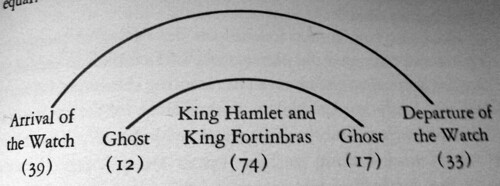
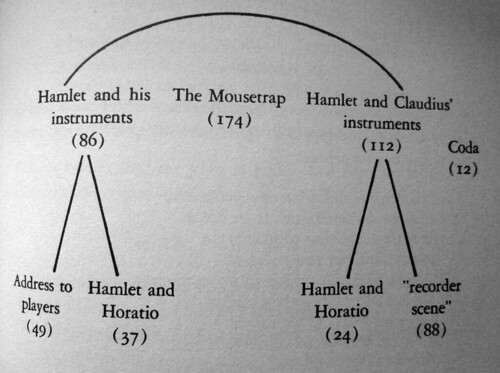
The little charts and diagrams may initially give a false impression. I included these charts only reluctantly, deciding that, inelegant as they are, they provide an economical way of making certain matters clear. The numbers, usually line totals, sprinkled throughout may also give a false impression of exactness. I indicate line totals only to give a rough idea of the general proportions of a particular scene or segment.
Here’s two of those offending diagrams, from the Hamlet chapter, pages 97 and 103 respectively; you can see the line counts in parentheses:

Rose 97

Rose 113

What’s the fuss about? And there aren’t many of them. These are simple diagrams and, yes, without them, Rose’s accounts would be more difficult to understand. Indeed, without them, a reader would be tempted to sketch their own diagrams on convenient scraps of paper.

I figure Rose’s misgivings about the numbers are about humanistic ideology, we don’t do numbers, though his use of numbers is, as he says, slight. His willies about the diagrams may be that as well, but I think there’s something more there. The diagrams themselves are problematic simply because they ARE diagrams. They intrude too deeply into the inner workings of the humanistic mind. It’s like throwing a spanner into a machine; it gums-up the works.

It’s one thing to have pictures in an illustrated edition of, say, Hamlet, pictures depicting a scene in the play. That’s fine, for it’s consistent with the narrative flow. And it’s fine to have illustrations in, say, an article about the Elizabethan theatre, where you need to depict the stage layout or the relationship between the stage and the seating. Such illustrations are consistent with the ongoing flow of thought.

Those diagrams are different. It’s not that they’re inconsistent with the flow of thought. They’re not. They’re essential to it. But they indicate that this kind of thinking is not quite kosher. Why not? How do these simple diagrams intrude on the humanistic mind, while more elaborate images of the type mentioned in the previous paragraph, while those images are fine?

The problematics of text and form

The concepts of text and form are central to literary criticism. Texts are the things we study and form is what somehow makes them special. And yet we have no consensus views of either concept. In a sense, we don’t know what we’re talking about, though we talk about it incessantly.

The following statement is typical. It is by Frances Ferguson and John Brenkwood introducing papers from the 2013 English Institute on form [2]:
A second irony is that the recently renewed interest in questions of literary form has proved quite amorphous. Perhaps, though, that has been the predicament and vitality of the topic all along. Georg Lukács inaugurated modern literary theory with a collection of essays called Soul and Form, a title that would be impossible today unless it were for a critical reflection on jazz. Among theorists preoccupied with form, there is a recurrent conflict between nonformalist and formalist conceptions of form: Bahktin as against Shklovsky; Jameson as against Frye; or the Barthes of S/Z over against the Barthes of “Introduction to the Structural Analysis of Narrative.” There is also a conflict, cutting across these competing methods, between form as a feature of literary works and form as constitutive of literary works. The New critics are often the benchmark of formalism in American discussions, but they did very little to illuminate literary forms compared to the Russian Formalists or, say, Lévi-Strauss and Jakobson’s classic essay on Baudelaire’s “Les chats.” And yet even the surest markers of literary forms fail to define form when it comes to actual works. The form of the sonnet, for example, is readily defined by the number of lines and the stanza organization, but does that account for a particular sonnet’s form any more than a rectangle accounts for a painting’s form? Vertical for portraits, horizontal for landscapes! And, finally, is formalism itself based on the idea that literary works are purely form, or on the idea that the vocation of literary criticism lies in formalization, that is, in its capacity to create categories at a level of abstraction applicable to the widest variety of literary phenomena?
They end with this:
The polarity between Clark’s appeal to human-sensuous activity and Macpherson’s call for a conception of form that holds good even on the assumption of human extinction suggests the philosophical extremities to which the question of form gives rise. So, too, the polarity between the richly historical texture of formal analysis in Jones, Martin, and Butterfield and the radically formalist analysis of Jarvis exemplifies how critical practice, not definition, is where the question of form is most fruitfully fought out.
So, this discipline for which the concept of form is central is still fighting over the concept after how many years? Fifty, a hundred?

Friday, July 31, 2020

On the nature of academic literary criticism as an intellectual discipline: text, form, and meaning [where we are now]

Since the late 1950s and early 1960s the discipline has made interpretation its central focus. The discipline’s job is to determine or at least comment on and explicate the meaning of texts. At the same time the discipline has failed to define just what the text is and has arrived at no consensus about form, though formalism is a central conception. This makes sense. Form is a property of texts. If the discipline doesn’t know what a text is, then it can’t know what form is either.

Correlatively, the distinction between reading, in the ordinary sense of the word, and reading, as explicit interpretation, has become elided so that reading can mean either or both depending on the context. This too makes sense, though we need to think about it and come at it from another angle.

That other angle starts with a straight-forward definition of the text as a string of symbols. Form then becomes a matter of how words and syllables are arranged on the string. That’s my starting point; that’s the starting point for the naturalist study of literary morphology [1]. With that as your starting point, how do you get to meaning?

There are two ways.

The way of the critic

Here’s the standard way, the way of the critic: You can simply read the text, in the ordinary sense of read. This makes you a reader, obviously. To act as a literary critic, using this as your starting point, you go on to interpret the text. That is, you read it, in the sense the word has come to have among critics.

This process renders the text, as a string of symbols, all but invisible, and so obscures form – the arrangement of symbols in the string – as well. There are, of course, exceptions. In poetry rhyme and meter are obvious and so attract comment. But they are obvious that makes it easy to subordinate that comment to interpretive exegeses. In prose we have the distinction by story and plot, which is so prominent in Tristram Shandy. This too is so obvious that it doesn’t threaten the hegemony of interpretive meaning.

The way of the modeler [speculative engineer]

That’s one way. There is another. That’s what I pursued, staring with Lévi-Strauss on myth and, to a lesser extent, Jakobson on poetics. That led me first to “Kubla Khan”, where I ran up against a very elaborate formal structure [2], form in the sense of the arrangement of words and syllables on the string. Despite all the attention that had been given to this poem that formal structure had been missed.

That formal structure seemed computational to me and so I went off to graduate school in search of the computational underpinnings of literary texts. I produced a partial computational model of a single text, Shakespeare’s Sonnet 129 [3]. Take that model, flesh it out in various ways, and then embody in an appropriate computer program and then, yes, the computational engine reads the text. You could then, at least in principle, open the engine and see what it did in the course of reading the text. In a paper I co-authored with David Hays in 1976 we imagined such an engine and I fully anticipated that I would one day be working with it, as would others [4]. That didn’t happen, nor do I expect it to any time in the near future, if ever.

This path leads you to models, but also to the description of form [5]. But you do not end up with interpretations. Those you must forswear.

Which way?

There is a trade off. If you seek meaning, then you take the way of the critic, but subordinate the text and form. If you seek form, then you must subordinate meaning and pursue the say of the modeler. There is no reason, of course, why one individual can’t pursue both paths, sometimes in different investigations, sometimes at different points in the same investigation. I have investigated this trade-off in an open letter I wrote to Daniel Everett, who was an academic dean at the time [6].

I see no reason why academic literary criticism should give up the way of the critic. But it will whither and die if it does not attend more deeply to the way of the modeler.

Note on terms and citations

This short post makes many assertions about literary criticism. I believe that I have discussed all of them in various posts and working papers. But I have decided not to cite those many pieces in this post, which would have turned it into a bit of a slog to write. It’s Friday morning, I’m exhausted from thinking and writing about GPT-3. Enough. If you have a mind to do so you can hunt those pieces down through the links I attach to the post.

I don’t particularly like the term “modeler”, but I can’t offer another at the moment. In the past I’ve talked of “naturalist criticism” and so of the “naturalist critic.” That suffers from the use of “critic”. I’ve taken the term “speculative engineer” from the preface to my book on music, Beethoven’s Anvil (2001), where I describe my method as speculative engineering. I do like that, but I can’t see it being used as a term of art.

That being said, this is pretty much how I see things at the moment. If I changed the tone a bit I could turn it into a manifesto.

References

[1] William Benzon, Literary Morphology: Nine Propositions in a Naturalist Theory of Form, PsyArt: An Online Journal for the Psychological Study of the Arts, August 2006, Article 060608, https://www.academia.edu/235110/Literary_Morphology_Nine_Propositions_in_a_Naturalist_Theory_of_Form.

[2] William Benzon, Articulate Vision: A Structuralist Reading of "Kubla Khan", Language and Style, Vol. 8: 3-29, 1985, https://www.academia.edu/8155602/Articulate_Vision_A_Structuralist_Reading_of_Kubla_Khan_.

[3] William Benzon, Cognitive Networks and Literary Semantics, MLN 91: 1976, 952-982, https://www.academia.edu/235111/Cognitive_Networks_and_Literary_Semantics.

[4] William Benzon and David Hays, “Computational Linguistics and the Humanist”, Computers and the Humanities, Vol. 10. 1976, pp. 265-274, https://www.academia.edu/1334653/Computational_Linguistics_and_the_Humanist.

[5] William Benzon, Description as Intellectual Craft in the Study of Literature, Working Paper, September 2017, 35 pp., https://www.academia.edu/4262467/Description_as_Intellectual_Craft_in_the_Study_of_Literature.

[6] William Benzon, An Open Letter to Dan Everett about Literary Criticism, June 2017, 24 pp., https://www.academia.edu/33589497/An_Open_Letter_to_Dan_Everett_about_Literary_Criticism.

Sunday, December 15, 2019

Some informal remarks on Jockers’ 3300 node graph: Part 3, Signs and mechanisms

I want to start at the point where I ended my previous post in this series, Some informal remarks on Jockers’ 3300 node graph: Part 2, structure and computational process. I was arguing that the issue of scale was misconceived. The fundamental issue is NOT a corpus of texts versus one or a handful of texts. That’s trivial. The issue has to do with the terms of analysis. So-called close reading exists within a conceptual and methodological discourse which is quite different from that of so-called distant reading.

The difference is one of conceptual ontology, as that term has come to be understood in computer science and the cognitive sciences. In that context the issue is not the ultimately real, a philosophical question, but the kind of concepts we are we using. I start with a simple example, salt versus sodium chloride and then build out from there to words versus signifiers and then on to texts and meaning.

Conceptual ontology

Consider for a moment, salt on the one hand and NaCl (sodium Chloride) on the other. Physically they are (almost) the same substance, but conceptually they are quite different. Salt is defined and understood in terms of its physical appearance and, above all else, its taste. We can taste salt even when we cannot see it, and so can animals. NaCl, however, is defined in terms of an atomic theory of matter that didn’t exist until early in the 19th century. Moreover, NaCl is a pure substance, consisting of nothing by sodium and chlorine atoms; salt on the other hand will always have some impurities. Thus, strictly speaking, salt and NaCl are not physically the same, close, but not exactly the same.

Salt and sodium chloride, then, are used in different intellectual contexts, each of which has its own vocabulary. Salt belongs with sugar, pepper, cinnamon, flour, and so forth all substances having to do with food, food preparation, and eating all related concepts. Sodium chloride is related to potassium chloride, sodium hydroxide, and so forth, electrolysis, ion-exchange, and so forth, for a long list. Thus we have two different conceptual worlds, each coupled to characteristic actions and processes, but both ultimately grounded in the same physical reality. Someone whose occupation has them working in the sodium chloride world has no trouble with table salt at mealtime. The transition from one world to the other is seamless, or nearly so (there may be a change of clothes involved).

The worlds of “distant reading” and “close reading” differ from one another in the same way. The physical texts and the symbols imprinted on them are the same in both worlds, but the concepts and methods of description and analysis are different. It’s that (kind of) different that Geoffrey Hartman had in mind almost a half century ago when he observed: “modern ‘rithmatics’—semiotics, linguistics, and technical structuralism—are not the solution. They widen, if anything, the rift between reading and writing” (The Fate of Reading, Chicago 1973, p. 272). He expresses himself using the standard trope of distance, but he’s certainly not talking about distance in any physical sense – no one is.

These days we might want to gloss distance in terms of explicit mediating steps. In close-reading you read a primary text and then does some thinking, perhaps some secondary reading and research, and then you write about that primary text. Just how you break that down is somewhat arbitrary, but it’s nothing like what happens in distant-reading, which starts when a collection of primary texts is digitized. The digitized texts are then cleaned up, tagged with metadata, organized in a database or databases, and then subject to analysis, which might be a straightforward matter of word counts, or the somewhat more strenuous process of topic modeling, or perhaps we’re going to make use of vector semantics, or any of a number of things. This more complicated process is likely to involve two, three, or more people at various stages along with way. At some point the analytic process will produce some set of visualizations and they, in turn, will be interpreted in terms appropriate to the primary texts (and their contexts).

As I said, that’s how we might gloss the close vs. distant distinction these days. The distance isn’t one of physical steps, but operational steps. However, it’s doubtful that Hartman had anything like this in mind. To be sure, stylometrics existed in 1973, and Stanley Fish was doing his best to skewer it, but I doubt that Hartman was thinking about stylometrics when he made that remark. However, he might well have been thinking about the kinds of tables and diagrams that Lévi-Strauss used, or that showed in linguistics article, those diagrammatic signs that interrupted the linguistic flow. They are indices of a different mode of thought, a different conceptual ontology.

Words and signifiers

We can begin to appreciate that difference by noting the difference between words, which are signs in Saussure’s sense, and signifiers, which are components of signs. Literary critics generally talk of words, and occasionally of signifiers. The concept of word is transparent enough in ordinary casual discourse. As ordinarily understood, the concept of words encompasses pronunciation, spelling, grammatical usage, and meaning, often several meanings. Words in this sense are the things listed in dictionaries. And for the most part, literary critics deal in words, even those who’ve read a bit of Saussure.

Saussure distinguished between the signifier and the signified. The signifier is a physical entity, either sonic or visual. The signfied is a mental entity; it is the bearer of meaning. Signifiers are public; they can be transmitted between people. Meanings are, well, they’re not exactly private – Wittgenstein established that in a famous section in his Investigations – but as mental objects they exist in people’s heads and we do not have direct access to one another’s heads. Thus, as William Croft has argued in chapter 4 of Explaining Language Change [1], word meanings are negotiated in conversational interaction with one another.

Computational critics, in contrast, may talk of words, but what they are actually working with are signifiers, signifiers rendered in digital form. That is to say, that’s what’s in the databases at the heart of computational work, mere signifiers. The computer has no access to word meanings, to signifieds; it only knows the written signifier. Consider the following passage from the well-known 1949 memo on machine translation written by Warren Weaver, who headed the Natural Sciences Division of the Rockefeller Foundation:
First, let us think of a way in which the problem of multiple meaning can, in principle at least, be solved. If one examines the words in a book, one at a time as through an opaque mask with a hole in it one word wide, then it is obviously impossible to determine, one at a time, the meaning of the words. "Fast" may mean "rapid"; or it may mean "motionless"; and there is no way of telling which.

But if one lengthens the slit in the opaque mask, until one can see not only the central word in question, but also say N words on either side, then if N is large enough one can unambiguously decide the meaning of the central word. The formal truth of this statement becomes clear when one mentions that the middle word of a whole article or a whole book is unambiguous if one has read the whole article or book, providing of course that the article or book is sufficiently well written to communicate at all.

The practical question is, what minimum value of N will, at least in a tolerable fraction of cases, lead to the correct choice of meaning for the central word?
While that memo catalyzed early work on machine translation, the approach suggested in those paragraphs played no role in that work. The necessary computing power wasn’t available. That changed in the 1980s and especially 1990s.

The topic analysis technique that Jockers used follows from the insight expressed in those paragraphs, as does the work on vector semantics. The idea is simple. Words that appear together frequently must somehow have related meanings. Race, horse, saddle, jockey, and track, all mean different things, but they belong to the same discourse and so will appear in close proximity when that discourse is spoken, or written. And so it is with human, race, IQ, identity, American, black, and white, these too belong to a discourse and so will co-occur in texts using that discourse. Notice that race is common to those two very different discourses. Considered alone, without context, the meaning of race is ambiguous, we don’t know what it means. But if we see race in close proximity to horse, we’ll locate it in one discourse while if we see it in proximity to IQ we’ll locate it in that other discourse.

Signifiers in themselves have no meaning. But in actual usage signifiers are always bound to a meaning and that meaning connects them to related signifiers. Given a large enough body of texts, computers can determine which signifiers occur together. It is up to the investigator to make a judgment about why those signifiers are occurring together. The investigator will, of course, make that judgment on the basis of their knowledge of the language.

The conventional literary critic finds such judgments utterly trivial and has no way, no intellectual context, for understanding how remarkable it is that mere computation can discover such relationships. And since that critic is only interested in a handful of texts they have no reason to reconsider that judgment and consider the possibility that there is something to be learned in examining such patterns in collections of texts, such as the collection of 3346 Anglophone novels Jockers has been working with.

Text and meaning

But what is a text? For the linguist, or for the computational critic, and answer is simple: a text is a string of characters.

Things are not so simple for the literary critic. Yes, sure, a text is a physical object, a scroll or a codex, and it is a bunch of signifiers inscribed on such. That’s trivial and, for the most part, uninteresting except in very well defined contexts, such as physical preservation or, more interestingly, the preparation of an edition. And the preparation of critical editions has been very important in the development of digital humanities broadly conceived, but still, we can bracket that.

What I am interested in here is the text as an object of interpretation. THAT text is an enigma [2]. The following passage is from the introduction Rita Copeland and Frances Ferguson prepared for five essays from the 2012 English Institute devoted to the text:
Yet with the conceptual breadth that has come to characterize notions of text and textuality, literary criticism has found itself at a confluence of disciplines, including linguistics, anthropology, history, politics, and law. Thus, for example, notions of cultural text and social text have placed literary study in productive dialogue with fields in the social sciences. Moreover, text has come to stand for different and often contradictory things: linguistic data for philology; the unfolding “real time” of interaction for sociolinguistics; the problems of copy-text and markup in editorial theory; the objectified written work (“verbal icon”) for New Criticism; in some versions of poststructuralism the horizons of language that overcome the closure of the work; in theater studies the other of performance, ambiguously artifact and event. “Text” has been the subject of venerable traditions of scholarship centered on the establishment and critique of scriptural authority as well as the classical heritage. In the modern world it figures anew in the regulation of intellectual property. Has text become, or was it always, an ideal, immaterial object, a conceptual site for the investigation of knowledge, ownership and propriety, or authority? If so, what then is, or ever was, a “material” text? What institutions, linguistic procedures, commentary forms, and interpretive protocols stabilize text as an object of study?
What? “Linguistic data” sounds like it might be mere signifiers, and perhaps “copy-text” as well. But the rest of them, those various sites “for the investigation of knowledge, ownership and propriety, or authority”, those texts clearly consist of words, in the ordinary sense, complete with their multiple and often ambiguous and contradictory meanings.

That is the text that is conceptualized in vague spatial metaphors. Do we talk of meaning as being IN the text or as being somehow outside the text, in the CONTEXT? I think it would be a mistake to interpret that as a vague assertion about mechanism, though I am sorely tempted to do so. Rather, it’s a statement about critical methodology. If you think of meaning as IN the text, then you do not invoke anything but the text itself in the process of interpreting it. That’s what was originally meant by close reading. But if you mean that meaning is located in the context, well then you must bring other evidence to bear in your close reading. Depending on your particular methodology you may call on historical materials of various kinds – newspapers and other contemporary periodicals, correspondence, legal documents, and so forth – or you may want to mount a psychological argument in terms of this or that theory, diaries, and what have you. And of course the text itself.

And then we have the idea of “hidden” meaning. That’s clearly a spatial metaphor. But a metaphor for what? Not the text itself; it’s not as though anyone is imagining a secret text bound into the spine or sandwiched into the front or back boards. The idea seems to be something like a large and elaborate old house with hidden rooms and passages. Expressed in that way it seems just a bit foolish, but then no one ever expresses it in that way, do they? Again, we’re dealing with a covert methodological injunction. Words have many meanings and are linked to other meanings through various figures, such as the master figures of metaphor and metonymy – need I invoke, for example, Roman Jakobson’s work on the subject [4]? And so, as a methodological precept, one must explore those possibilities.

The fact of the matter is that, by contemporary standards, those of the so-called cognitive revolution and after, literary criticism lacks an account of language mechanism, whether in the reader, the author, or the critic. It is non-mechanistic or pre-mechanistic and certainly non-computational – an issue I’ll take up in the next and last post in this series. For now I want to end on the assertion that meaning, as the object of critical investigation, is inherently and irreducibly subjective. That doesn’t mean that critics cannot agree on the meaning of texts, for subjectivity necessarily implies intersubjectivity. It means only that meaning resides in subjects, in readers, writers, and critics and is not subject to objective determination. It is thus like color, which is also subjective in that sense. Sensations of color may be closely related to wavelengths of light, but cannot simply be reduced to them. Color arises within subjects, though psychologists have made a great deal of progress in figuring out how color perception functions in humans and animals.

The objective study of meaning, that is, of semantic mechanisms, has not yet been so successful. It was the search for semantic mechanisms that lead me to David Hays and computational linguistics, which I discussed in the previous post in this series, Some informal remarks on Jockers’ 3300 node graph: Part 2, structure and computational process.

References

[1] Croft, William (2000). Explaining Language Change: An Evolutionary Approach. Longman.

[2] I’ve written a number of posts at New Savanna about the concept of the text. They’re at this link: http://new-savanna.blogspot.com/search/label/text.

[3] Rita Copeland and Frances Ferguson, “Introduction”, ELH, Volume 81, Number 2, Summer 2014, p. 417.

[4] For example, Roman Jakobson and Morris Halle, Two Aspects of Language and Two Types of Aphasic Disturbances in Fundamentals of Language, The Hague & Paris: Mouton, 1956.

[5] I’ve got a good many posts on color, https://new-savanna.blogspot.com/search/label/color. They are of various kinds. Some are simply sets photographs where I was interested in colors and color contrasts. But others are about color perception in the mind and in photography. If you are interested in this topic you might what to search the web on “color perception”.

Monday, December 9, 2019

Can you learn anything worthwhile about a text if you treat it, not as a TEXT, but as a string of marks on pages? [#DH]

With Matt Jockers' 3300 node graph on my mind, this post deserves a bump to the otp of the queue.
The Chronicle of Higher Education just published a drive-by take-down of the digital humanities. It was by one Timothy Brennan, who didn’t know what he was talking about, didn’t know that he didn’t known, and more likely than not, didn’t care.
Timothy Brennan, The Digital-Humanities Bust, The Chronicle of Higher Education, October 15, 2017, http://www.chronicle.com/article/The-Digital-Humanities-Bust/241424
Subsequently there was a relatively brief tweet storm in the DH twittersphere in which one Michael Gavin observed that Brennan seemed genuinely confused:


“Lexical patterns”, what are they? The purpose of this post is to explicate my response to Gavin.

The Text is not the (physical) text

While literary critics sometimes use “the text” to refer to a physical book, or to alphanumeric markings on the pages in such a book, they generally have something vaguer and more expansive in mind. Here is a passage from a well-known, I won’t say “text”, article by Roland Barthes [1]:
1. The text must not be understood as a computable object. It would be futile to attempt a material separation of works from texts. In particular, we must not permit ourselves to say: the work is classical, the text is avant-garde; there is no question of establishing a trophy in modernity's name and declaring certain literary productions in and out by reason of their chronological situation: there can be “Text” in a very old work, and many products of contemporary literature are not texts at all. The difference is as follows: the work is a fragment of substance, it occupies a portion of the spaces of books (for example, in a library). The Text is a methodological field. The opposition may recall (though not reproduce term for term) a distinction proposed by Lacan: “reality” is shown [se montre], the “real” is proved [se démontre]; in the same way, the work is seen (in bookstores, in card catalogues, on examination syllabuses), the text is demonstrated, is spoken according to certain rules (or against certain rules); the work is held in the hand, the text is held in language: it exists only when caught up in a discourse (or rather it is Text for the very reason that it knows itself to be so); the Text is not the decomposition of the work, it is the work which is the Text's imaginary tail. Or again: the Text is experienced only in an activity, in a production. It follows that the Text cannot stop (for example, at a library shelf); its constitutive moment is traversal (notably, it can traverse the work, several works).  
And that is just the first of seven propositions in that well known text article, which has attained, shall we say, the status of a classic.

I have no intention of offering extended commentary on this passage. I will note, however, that Barthes obviously knows that there’s an important difference between the physical object and what he’s calling the text. Every critic knows that. We are not dumb, but we do have work to do.

Secondly, perhaps the central concept is in that italicized assertion: “the Text is experienced only in an activity, in a production.”

Finally, I note that that first sentence has also been translated as: “The Text must not be thought of as a defined object” [2]. Not being a reader of French, much less a French speaker, I don’t know which translation is truer to the original. It is quite possible that they are equally true and false at the same time. But “computable object” has more resonance in this particular context.

Now, just to flesh things out a bit, let us consider a more recent passage, one that is more didactic. This is from the introduction Rita Copeland and Frances Ferguson prepared for five essays from the 2012 English Institute devoted to the text [3]:
Yet with the conceptual breadth that has come to characterize notions of text and textuality, literary criticism has found itself at a confluence of disciplines, including linguistics, anthropology, history, politics, and law. Thus, for example, notions of cultural text and social text have placed literary study in productive dialogue with fields in the social sciences. Moreover, text has come to stand for different and often contradictory things: linguistic data for philology; the unfolding “real time” of interaction for sociolinguistics; the problems of copy-text and markup in editorial theory; the objectified written work (“verbal icon”) for New Criticism; in some versions of poststructuralism the horizons of language that overcome the closure of the work; in theater studies the other of performance, ambiguously artifact and event. “Text” has been the subject of venerable traditions of scholarship centered on the establishment and critique of scriptural authority as well as the classical heritage. In the modern world it figures anew in the regulation of intellectual property. Has text become, or was it always, an ideal, immaterial object, a conceptual site for the investigation of knowledge, ownership and propriety, or authority? If so, what then is, or ever was, a “material” text? What institutions, linguistic procedures, commentary forms, and interpretive protocols stabilize text as an object of study? [p. 417]
“Linguistic data” and “copy-text”, they sound like the physical text itself, the rest of them, not so much.

If literary critics were to confine themselves to discussing the physical text, what would we say? Those engaged in book studies and editorial projects would have more to say than most, but even they would find such rigor to be intolerably confining. The physical signs on the page, or the vibrations in the air, exist and come alive in a vast a complicated network of ... well, just exactly what? Relationships among people to be sure, but also relationships between sights and sounds and ideas and movements and feelings and a whole bunch of stuff mediated by the nervous systems of all those people interacting with one another.

It’s that vast network of people and neuro-mental stuff that we’re trying to understand when we explicate literary and cultural Texts. As we lack really good accounts of all that stuff, literary critics have felt that we had little choice but to adopt this more capacious conception, albeit at the expense of definition and precision. Anyhow, aren’t the people trying to figure out those systems, aren’t they scientists? And aren’t we, as humanists, skeptical about science?

And then along came the computer.

An ontological gulf

The thing about computational criticism is that computers don’t have all that other stuff – a complex fluctuating network of interactions among people both containing and embedded in a vast and turbulent meshwork of flashing neurons (one of Tim Morton’s hyperobjects?) – available to them. The computer deals only with those dumb marks on the page, or rather, with digital representations of them. There is only the physical text, that dull thing that other literary critics pass over in favor of The Text.

Thus there is an ontological gulf between computational criticism and the many varieties of – I hate to say it ­– conventional literary criticism. Here I mean ontological in the sense it has come to have in the cognitive sciences, a sense where a more conventional humanist might talk of different discourses (Foucault) or paradigms (Kuhn). In this sense an ontology is an inventory of concepts. Salt, as ordinarily understood, and sodium chloride, exist in different ontologies in this sense [4]. Humans have known about salt since forever, and apprehend it through its taste, texture and color; even animals know about it. Sodium chloride is quite different conceptually, though physically, yes, it is salt. Conceptually it is defined in terms of bonds between atoms which themselves consist of electrons, protons, and neutrons, a set of concepts developed in Western science in the 18th and 19th centuries.

When it comes to the concept of text, the conventional critic and the computational critic operate in different conceptual worlds, with different ontologies. Yet there are subtleties.

Text and context


Thursday, May 9, 2019

Notes toward a theory of the corpus, Part 1: History [#DH]

The recent discussion of Nan. Z. Da,  The Computational Case against Computational Literary Studies, has me thinking about Matt Jockers' Macroanalysis, in particular, about his high-dimensional graph of his 19th century corpus. Da dissmisses with with two paragraphs (pp. 610-611). Interestingly enough, though, when Critical Inquiry hosted a discussion forum on the article, it used tan image of that graph to head the forum. That, I assume, is because it is visually compelling.

Visually compelling, but nontheless trivial? I think not. I'm bumping this post to the top of the cue. It represents my thinking about the implications of that diagram as of late September of 2018. I've thought a bit more about that diagram in the past month, going over and over and over. I've got a few more thoughts.
That graph, of course, is constructed in a space of roughly 600 dimensions. We can think of that space as, shall we say, a design space, where each point represents a possible novel. Like most such spaces, most of it is empty. What's interesting about his space is that it emerged over time and we can more or less track that emergence. That follows from the fact that the texts in that space are ordered in time, more or less, from left to right. As novels were written in the course of the century, they enlarged the space, rather than moving about in the already existing space. That's what's interesting, new texts enlarged the space. What does that tell us about the history of the novel, and about cultural evolution?
A corpus

By corpus I mean a collection of texts. The texts can be of any kind, but I am interested in literature, so I’m interested in literary texts. What can we infer from a corpus of literary texts? In particular, what can we infer about history?

Well, to some extent, it depends on the corpus, no? I’m interested in an answer which is fairly general in some ways, in other ways not. The best thing to do is to pick an example and go from there.

The example I have in mind is the 3300 or so 19th century Anglophone novels that Matthew Jockers examined in Macroanalysis (2013 – so long ago, but it almost seems like yesterday). Of course, Jockers has already made plenty of inferences from that corpus. Let’s just accept them all more or less at face value. I’m after something different.

I’m thinking about the nature of historical process. Jockers' final study, the one about influence, tells us something about that process, more than Jockers seems to realize. I think it tells us that cultural evolution is a force in human history, but I don’t intend to make that argument here. Rather, my purpose is to argue that Jockers has created evidence that can be brought to bear on that kind of assertion. The purpose of this post is to indicate why I believe that.

A direction in a 600 dimension space

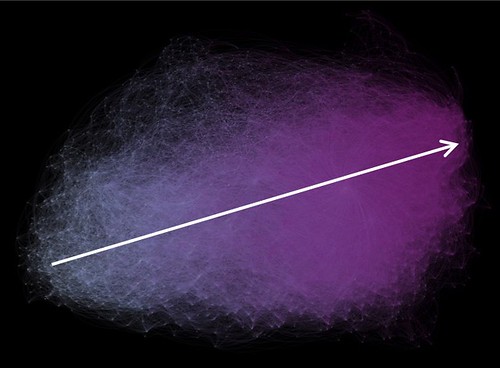
In his final study Jockers produced the following figure (I’ve superimposed the arrow):

direction of 19C lit history


Each node in that graph represents a single novel. The image is a 2D projection of a roughly 600 dimensional space, one dimension for each of the 600 features Jockers has identified for each novel. The length of each edge is proportional to the distance between the two nodes. Jockers has eliminated all edges above a certain relatively small value (as I recall he doesn’t tell us the cut off point). Thus two nodes are connected only if they are relatively close to one another, where Jockers takes closeness to indicate that the author of the more recent novel was influenced by the author of more distant one.

You may or may not find that to be a reasonable assumption, but let’s set it aside. What interests me is the fact that the novels in this graph are in rough temporal order, from 1800 at the left (gray) to 1900 at the right (purple). Where did that order come from? There were no dates in 600D description of each novel, so the software was not reading dates and ordering the nodes according to those dates. By process of elimination, that ordering must be a product of whatever historical process that produced the texts represented in the graph. What else is there? That process must therefore have a temporal direction.

I’ve spent a fair amount of effort explicitly arguing that point [1], but don’t want to reprise that argument here. I note, however, that the argument is a geometrical one. For the purposes of this piece, assume that that argument is at least a reasonable one to make.

What is that direction? I don’t have a name for it, but that’s what the arrow in the image indicates. One might call it Progress, especially with Hegel looking over your shoulder. And I admit to a bias in favor of progress, though I have no use for the notion of some ultimate telos toward which history tends. But saying that direction is progress is a gesture without substantial intellectual content because it doesn’t engage with the terms in which that 600D space is constructed. What are those terms? Some of them are topics of the sort identified in topic analysis, e.g. American slavery, beauty and affection, dreams and thoughts, Greek and Egyptian gods, knaves rogues and asses, life history, machines and industry, misery and despair, scenes of natural beauty, and so on [3]. Others are stylistic features, such as the frequency of specific words, e.g. the, heart, would, me, lady, which are the first five words in a list Jockers has in the “Style” chapter of Macroanalysis (p. 94).

The arrow I’ve imposed on Jockers’ graph is a diagonal in the 600D space whose dimensions are defined by those features and so its direction must specified in terms that are commensurate with such features. Would I like to have an intelligible interpretation of that direction? Sure. But let’s leave that aside. We’ve got an abstract space in which we can represent the characteristics of novels (Daniel Dennett might call this a design space) and we’ve got a vector in that space, a direction.

What’s that direction about? What is it about texts that is changing as we move along that vector? I don’t know. Can I speculate? Sure. But not here and now. What’s important now is that that vector exists. We can think about it without having to know exactly what it is.

A snapshot of Spirit of the 19th century

In a post back in 2014 I suggested that Jockers’ image depicts the Geist of 19th century Anglo-American literary culture [2]. That’s what interests me, the possibility that we’re looking at a 21st century operationalization of an idea from 19th century German idealism. Here’s what the Stanford Encyclopedia of Philosophy has to say about Hegel’s conception of history [4]:
In a sense Hegel’s phenomenology is a study of phenomena (although this is not a realm he would contrast with that of noumena) and Hegel’s Phenomenology of Spirit is likewise to be regarded as a type of propaedeutic to philosophy rather than an exercise in or work of philosophy. It is meant to function as an induction or education of the reader to the standpoint of purely conceptual thought from which philosophy can be done. As such, its structure has been compared to that of a Bildungsroman (educational novel), having an abstractly conceived protagonist—the bearer of an evolving series of so-called shapes of consciousness or the inhabitant of a series of successive phenomenal worlds—whose progress and set-backs the reader follows and learns from. Or at least this is how the work sets out: in the later sections the earlier series of shapes of consciousness becomes replaced with what seem more like configurations of human social life, and the work comes to look more like an account of interlinked forms of social existence and thought within which participants in such forms of social life conceive of themselves and the world. Hegel constructs a series of such shapes that maps onto the history of western European civilization from the Greeks to his own time.
Now, I am not proposing that Jockers’ has operationalized that conception, those “so-called shapes of consciousness”, in any way that could be used to buttress or refute Hegel’s philosophy of history – which, after all, posited a final end to history. But I am suggesting that can we reasonably interpret that image as depicting a (single) historical phenomenon, perhaps even something like an animating ‘force’, albeit one requiring a thoroughly material account. Whatever it is, it is as abstract as the Hegelian Geist.

How could that be?

Wednesday, September 6, 2017

The Paradox of the Text and Computational Criticism

I've been thinking about the text, especially the standard spatial metaphors literary critics use in talking about them, so I'm bumping this to the top of the queue. I'm working on another post on the topic.
Computational criticism, in Franco Moretti’s well-known terminology, is said to be “distant” reading. And there is an obvious sense in which it consistently deals with the text while so-called “close” reading often elides the text. It all depends on what we mean by “the text.”

There are situations where we mean the physical signs on the page, or even the pages themselves. But these situations are generally circumscribed. First of all there is old school textual criticism, concerned with the editing and preparation of texts. Then there are theoretical discussions about signs. More recently we have the history of the book. Practical criticism may deal directly with the signs on the page, or with the sounds of words (as in working out the rhyme scheme of a poem), but more often than not “looks through” the signs to their (various and possible) meanings.

Most importantly, in discussions of meaning and interpretation, the text is in fact a ghostly object – not the signifiers on the page, much less the pages themselves – which we apprehend through vague spatial schematization. In this schematization the text has an inside, an outside, and a surface. A major discussion has taken place around the question of whether or not the “meaning” of the text is determined only by items inside the text or items outside the text (such as authors and social context). Moreover the interior of the text is often presumed to have some kind of structure such that some meanings can be hidden within it. In contrast, other meanings are said to be on the surface of the text.

The general nature of the space that is articulated through these terms – inside, outside, surface, hidden – is unspecified. It is thus not clear where one must be in this space, or even how one can be in it, to render a so-called close reading. That a reading is close is generally indicated by extensive quotation of the text. Not only is such quotation lacking in so-called distant reading, but individual texts may not even be distinguished from one another.

And yet where the process of distant reading is mediated by digital computation, it is the text itself, the text understood as a collection of signifiers, that enters into the process. That is what I mean by the paradox of the text: computational criticism takes the text into account much more directly than does so-called close reading. The spatial schematization that guides our thinking about close reading is replaced by computational processes that operate directly with and on digital representations of physical signs (and the process by which those digital representations are created is a transparent one).

The critic, of course, supervises this digital processing. And the critic must select and interpret the visualizations of that processing. But that’s quite different from interpreting quoted passages. And the process of creating those visualizations is open to examination in a way that the selection of passages to quote is not. In “close” reading the process by which we get from the signs to meanings is opaque. By contrast, in “distant” reading that process is, at least in some respect, explicit and open to examination.

I note, finally, that this post is subject to deconstructive critique, but that critique will not erase the point that signs play a different role in computational criticism than they place in the many varieties of close and not-so-close reading.

* * * * *

Also see this older post, Commensurability, Meaning, and Digital Criticism.

Tuesday, August 29, 2017

Reply to a traditional critic about computational criticism: Or, It’s time to escape the prison-house of critical language [#DH]

A couple of weeks ago I posted “In search of a small world net: Computing an emblem in Heart of Darkness” [1], which was about a computational procedure for establishing that a phrase we can call the Emblem is ‘central’ to Conrad’s text. Here is the phrase, in one of two slightly different versions: My Intended, my ivory, my station, my river, my—. A colleague asked me, in the person of more traditional critic: If this were true, why would we need computation to prove it? That is, since I’ve already made an argument in more or less traditional terms, what’s the point of the computational exercise?

To a critic for whom such questions are real, I have no response.

But I am not such a critic.

To be sure, my degree is in English literature, from the State University of New York at Buffalo in ancient days of 1978. But my dissertation was, in a large degree, an exercise in knowledge representation of the sort then current in the cognitive sciences. By the time I had completed my degree I ‘spoke’ both literary criticism and cognitive science with native competence. As a literary critic I can read Heart of Darkness, spot Kurtz’s Emblem, note its ‘centrality’, and make a fairly standard kind of case for it. But for my cognitive science side, what does that mean, ‘central’ to the text? The standard critical argument doesn’t satisfy my curiosity. Thus I’ve suggested the small-world-net exercise to satisfy the cognitive scientist in me.

But that’s not a reason for a literary critic to pay attention to that kind of argument. From my point of view, such a critic suffers from a limited imagination, an imagination confined to the prison-house of discursive criticism [2].

The standard argumentation I’ve offered about the centrality of the Emblem ultimately rest on intuitions about texts and language. What does it mean to talk of the semantic center of Heart of Darkness, or any other text for that matter? What do we mean by center, anyhow? Certainly not the physical center of the book itself. We mean the center of, well, you know, the ‘meaning space’ of the text. And what is that?

The fact is for years critics have been using loose spatial imagery in talking about texts. Texts have insides and outsides, so that some things are in a text while others are not. The text is capable of hiding meaning. It also has a surface, and that surface can be read. Such a so-called surface reading is of course different from a close reading, which is certainly different from distant reading. Do texts also have semantic edges as well? What about a top and a bottom?

We’re so used to this imagery that we don’t notice that it’s pretty much built on nothing. These vague spatial terms constitute our rock-bottom understanding of texts, not as physical objects, but as mental objects. We’ve agreed on these terms and have arrived at ways of using them but, really, what are we saying? There’s very little there.

It may see strange to think of such language as the bars and walls of a conceptual prison, but that’s what it is. It limits how we allow ourselves to think about our craft. We defend this language, not because it’s perspicuous, but because it’s comfortable – and we’ve grown lazy and complacent.

I've you've of a mind, better pour yourself a drink. This is going take awhile.

Beyond the transcendental homunculus: What’s next for literary criticism?

What kind of a future does this standard spatialized literary criticism have? Forget about current institutional pressures for the moment. In purely intellectual terms, what’s the future of literary criticism? Where is there to go?

For years I’ve been reading that there’s been no substantial new development since Barbara Butler and queer theory. I’m not entirely sure that’s true. Does animal studies count? What about eco criticism? Is Tim Morton a major figure? He’s given the Wellek Lectures (2014); he’s touring the world giving speeches these days; Bjork has endorsed his work and I believe he’s completing a general audience book for Penguin. Sounds pretty major to me. And I think he’s brilliant. But – the future of literary criticism?

What tools does discursive criticism have for thinking about the mind? I submit that the most important tools are the texts themselves – a theme to which I’ll return – along with the critics’ ability to spot interesting patterns in the texts. But when it comes to explaining those patterns, what tools?

As far as I can tell, those tools various kinds of mental faculties operated by invisible homunculi. That’s what psychoanalytic psychology (in its various forms) is like–and, by the way, I actually like psychoanalytic ideas and use them in my work [3]. As far as I can tell that’s the most explicit ‘model’ on offer. Ideology? What’s that but a hegemonic mental faculty operated by an authoritarian homunculus, and a transcendental homunculus at that, though we try hard to pretend that these guys (they’re always guys) are immanent. I’m exaggerating of course, but in comparison with the work that’s been done in the cognitive a neurosciences over the past half-century, the psychologies of literary criticism are pretty ghostly.

No, I believe that what we (in my person as a literary critic) have to offer is the texts themselves, and the patterns we spot and describe in them. Consider these remarks by Tony Jackson [4, p. 202]:
That is, a literary interpretation, if we are allowed to distinguish it as a distinct kind of interpretation, joins in with the literariness of the text. Literary interpretation is a peculiar and, I would say, unique conjunction of argument and literature, analytic approach and art form being analyzed.
That’s obvious enough, isn’t it? An interpretation is coupled to the text, and draws its substance from the text. Certainly it draws its claim to authority from the canonical text, not from the critic, who is merely an academic.

Taken by alone, the conceptual apparatus we use in interpretation is thin. Perhaps that’s one of the problems of critique, the ratio of interpreting theory to object text has tipped too far toward theory, resulting in an intellectually thin and unsatisfying discourse. Is it any coincidence that this era of High Theory has also given rise to the star critic who is granted the authority of that same Theory?

Can academic literary criticism thrive and prosper under a regime where theory works hard to pry itself free of literary texts, rendering them mere examples for displays of critical brilliance?

Monday, July 17, 2017

Where is the never ending (medieval) text? [#DH]

I checked in at Academia.edu today and found another article by medievalist Stephen Nichols. I've not finished it, but wanted to blog a passage or two anyhow.
Stephen G. Nichols, Dynamic Reading of Medieval Manuscripts, Florilegium, vol. 32 (2015): 19-57 DOI: 10.3138/ or.32.002 download at Academia.edu. https://www.academia.edu/33907842/Nichols_Dynamic_Reading_flor_32_002
Here's the abstract:
Abstract: Digital manuscript and text representation provides such a wealth of information that it is now possible to see the incessant versioning of works like the Roman de la Rose. Using Rose manuscripts of the Bibliothèque municipale de Lyon MS 763 and BM de Dijon MS 525 as examples and drawing on Aristotelian concepts such as energeia, dynamis, and entelecheia, the copiously illustrated article demonstrates how pluripotent circulation allows for “dynamic reading” of such manuscript texts, which takes into consideration the interplay between image, text, and the context of other texts transmitted in the same manuscript.
What caught my attention was his statement about the unexpected impact of digital technology. It made it possible, for the first time, to examine a number of different codices of the same title and to compare them. And THAT led to a sea-change in understanding of what a text is. The normative concept of the Urtext as the author's original version is in trouble. What happens to the so-called critical edition? Thus (p. 22):
that the critical edition represents a construct based on selected evidence is neither exceptional nor particularly shocking. More problematic is the fact that expediency decrees that manuscript mass be accorded short shrift. Not all manuscripts are equal in this scenario. Indeed, the purpose of manuscript selection—the choice by the editor of a small number of manuscripts deemed reliable — lay precisely in minimizing the number of manuscripts. The more versions an editor could eliminate as defective or uninteresting, the greater the probability that one had located the few copies closest to an original or early version of a work. The select copies could then be closely scrutinized for variant readings. And ‘variant’ meant precisely that: readings of lines or passages differing from what the editor determined to be the normative text. It was in reaction to such a restrictive treatment of manuscript variation that New Philology emerged. Initially, we argued that manuscript copies bore witness to a dialectical process of transmission where individual versions might have the same historical authority as that represented by the critical edition.
And so (pp. 24-25):
Perhaps the most startling question posed by the specular confrontation of manuscripts concerns the status of textuality itself. With unerring perspicuity, Jacqueline Cerquiglini-Toulet pinpoints the issue by asking the simple, but trenchant question: “what, exactly, is ‘a text’ in the Middle Ages, and how do we locate it in a manuscript culture where each codex is unique? [. . .] More radically still,” she continues, “we might legitimately ask just where we’re supposed to nd the text in the manuscript. How does it come to instantiate itself materially as object? And how is its literary identity realized?”

If such questions seem disorienting, it is because they underline how much print editions of medieval works have shaped our expectations. We have grown accustomed to finding the ‘text’ of a medieval work before our eyes whenever we open an edition. In the critical edition, the text is a given; that is why the work is called ‘textual scholarship.’ The editor works hard to establish a text on the basis of painstaking study of the manuscripts that he or she determines to be authoritative. The point, of course, is to circumscribe or close the text to from continuing to generate additions or variants. As we know, that is a modern practice grounded in concepts of scientific text editing.

But as Jacqueline Cerquiglini-Toulet observes, the very concept of a definitive text, a text incapable of generating new versions, is an illusion propagated by its own methodology. Authentic medieval texts, she observes, are never closed, nor, I would add, would their mode of transmission allow them to remain static. And, as a corollary, she observes: “Where are the boundaries?” How do we “identify the borders of a text”? She means that the manuscript folio has a very different ecology from the page of a printed edition. Textual space on a folio is not exclusive, but shared with other systems of representation, or — why not? — other kinds of ‘texts.’ These include rubrics, miniature paintings, decorated or historiated initials, bas-de-page images, marginal glosses, decorative programmes, and so on. In other words, the medieval manuscript page is not simply complex but, above all, an inter-artistic space navigated by visual cues.
We are far from the world of "distant reading" a large corpus of texts and thereby beginning to see patterns in literary history that had been but dimly envisioned before. But the change is equally profound. For example (26-27):
To understand the astonishing virtuosity and variety we find in manuscript versions of the ‘same’ work — such as the Roman de la Rose, for example, for which we have some 250 extant manuscripts produced between the end of the thirteenth and the beginning of the sixteenth century — we need to identify imminent factors responsible for generating multiple versions of a given work throughout the period. Here again, digital manuscript study offers reasons to move beyond conventional explanations.

Whereas increased manuscript production might intuitively be explained by such external causes as rising literacy among the merchant and artisan classes and the growth in the number of booksellers, the great variation we see in manuscripts, even those contemporaneous with one another, suggests the possibility of inherent forces of variation at work. Put another way, whereas the increase in literacy and leisure certainly contributed to the growing market for manuscripts to which Parisian booksellers responded, the efficient cause generating multiple manuscripts of a given work lay in the nature of the manuscript matrix itself.

It is not by chance that versions of a given work vary. Literary prestige derived in part from a work’s ability to renew itself from generation to generation by a dynamic process of differential repetition.
And so it goes. And we bring in Artistotle (p. 30): "But whereas we might think of striving for perfection as linear and directed, Aristotle sees it as continuous and open-ended." Is Nichols going to be arguing, then, that the production of version after version is a "striving for perfection" the extends through a population of scribes and readers? I suppose that's what I'll find out as I continue reading.

Thus, p. 32: "In other words, manuscripts are, by their very nature as eidos, ergon, and energeia, predisposed towards actualizing the works they convey not as invariant but as versions in an ever-evolving process of representation.  Against those who would see manuscript copies as regressions from an authoritative original to ever fainter avatars of that primal moment, we must recall Aristotle’s notion of form as atemporal actuality. "

* * * * *

Here's an earlier post about Nichols: Mutable stability in the transmission of medieval texts. And here's a post about the three texts of Hamlet that's relevant: Journey into Shakespeare, a tedious adventure – Will the real Hamlet stand up?