Showing posts with label greatest siam. Show all posts

Saturday, February 18, 2017

The Greatest Man in Siam


This is one of my favorite cartoons. I've blogged about it quite a bit, and have packaged those posts into a working paper. About 3/4 of the way though there is a dance sequence that is one of the most joyous bits of film I've ever seen. The animation is superb, and so is the music. Given the date, 1944, the music is big band music, and this band plays like it's playing for live dancers. And the trumpet soloist, he plays like it's the third set of a good night.

And yes, sure, the cartoon is Orientalist, sexist, patriarchal, racist and a few other things as well. After you've gotten over that, look at the eyes and ask yourself, Why does the trumpet player get the girl? The cartoon's premise is that men are competing for the king's daughter. Why do the first three lose and thaelast one win? As I said, look at the eyes. What's that about? What values?

Tuesday, February 24, 2015

The Hottest Man in Siam

Another working paper on a classic Walter Lantz cartoon from the 1940s. Download from:
Abstract and Introduction below:
Abstract: The Greatest Man in Siam is a Walter Lantz cartoon from 1943. It has a pseudo-Oriental setting and depicts a contest to win the hand of a young princess. The losers present themselves as intelligent, rich, and athletic, respectively, while the winner is a good musician and dancer. He’s also the only one who plays attention to the princess and doesn’t insult the king. The cartoon ends with everyone dancing, thus affirming communal values over individual accomplishment. Just before the end there is a virtuoso dance sequence between the couple; it was superbly animated by Pat Matthews.

Contents:

Introduction: What Fun! Learning to See 1
The Hottest Man in Siam 4
The Greatest Social Contract in Siam 18
Why Siam? The Contest Motif 32
The Phallus in the Palace 34
Eyes, Electricity, and a Contest 38
In Praise of Cartoons: Lantz Does Conceptual Integration 45
The Siam Paradox 54
Shamus Culhane of the Avant-Garde 55

Introduction: What Fun! Learning to See

siam 1 cityscape

This cartoon gave me a great deal of pleasure. Above all, there is the dance sequence, which is flat-out joyous wonderful. Then there is the anonymous solo trumpeter on the sound track, who just kills it! I’ve rarely heard such heart-felt and enthusiastic playing on the sound track of any film. As I’m a trumpet player myself, I suppose I get more of a kick out of the trumpeting that most would, but the player’s passion is evident.

Then there is the chase, the intellectual chase. I didn’t start out to write a series of posts on The Greatest Man in Siam. At this point I don’t really remember just what I set out to do – though now that I’ve looked, I notice I’ve got some remarks about that in my initial post. About all I can remember is that, when I first decided to blog about it, I didn’t intend to write so very much about that dance sequence. But once I actually started planning the post, that was when I figured that I really needed to devote a whole post to nothing more than the dance sequence. I figured I could take care of the rest of the cartoon in another post.

It didn’t quite work out that way. Once I started digging I had to dig for more. It took me awhile to figure out what was going on in this cartoon. And then, when I was pretty much done The New York Times published an article about the cartoon’s director, Shamus Cullhane, pointing out that he consciously and deliberately slathered this cartoon in phallic symbolism.

What fun!

Monday, May 30, 2011

Implicit Analysis in Two Texts, a Cartoon and a Romance

It’s been a commonplace for two or three decades that narrative is a mode of thought. It is my impression — though I could be wrong — that this literature takes narrative at face value. Narrative situates things and events in relation to one another in time and space and that’s what narrative thinking is about.

I think narrative is used in a more subtle way. That more subtle mode of thought is the object of this post. Just how this more subtle thinking works, the fundamental mechanisms, that is not at all obvious. That something interesting is going on, though, that is relatively easy to spot.

I want to begin by presenting a more or less contemporary example, the Walter Lantz cartoon The Greatest Man in Siam. After that I’ll offer a suggestion or two about what might be going on. Then it’s on to a second example, Sir Gawain and the Green Knight. I conclude by suggesting that we’re dealing with a computational form that realizes the poetic function as defined by Roman Jakobson.

Why the Greatest?

In The Greatest Man in Siam a king holds a contest to choose a mate for his daughter. Four men appear for the contest. The first three are dismissed and the last one wins. It’s in these four contests that this mode of thought, which I’ll call implicit analysis, takes place.

The first man presents himself as the smartest man in Siam, the second as the richest, the third as the fastest, and the fourth as the hottest – “hot” in the sense of hot jazz and what that implies. We’re given no particular reason why the last man wins. The king doesn’t say something like, “I declare thee the winner because X.” The first three are each dismissed for reasons related to their proclaimed strengths; the fourth is not. He makes his pitch, does his dance, and gets the girl, all without explanation.

Why’d the fourth man win? Because he was a trumpeter? Well, what’s so special about trumpeters? We can go at it the other way: What did the other three have in common that disqualified them? How were they like one another, but different from the trumpet player? If they’d all been clarinet players, then we might conclude that the folks who made the cartoon like trumpeters, but not clarinetists. But they weren’t clarinetists, nor drummers, nor masons, nor bakers, nor merchants. Each was something different, but all were losers.
Monday, April 11, 2011

Shamus Culhane of the Avant-Garde

An article in The New York Times reports the work of Tom Klein, of Loyola Marymount University:
In the March issue of Animation: An Interdisciplinary Journal, Mr. Klein relates an intriguing theory. He says that Mr. Culhane broke the boundaries of his craft when he worked on the Woody Woodpecker cartoons in the 1940s, going well beyond the kind of commonplace puckishness that supposedly led later animators to stitch frames of a panty-less diva into “Who Framed Roger Rabbit.” Mr. Culhane’s stunts, Mr. Klein posits, were of a higher order. He worked ultra-brief experimental art films into a handful of Woody Woodpecker cartoons.
What I find especially interesting is that we now know that all those phallic symbols in The Greatest Man in Siam, which Culhane directed, got there through conscious deliberation:
“We were just trying to put one over on them,” Mr. Culhane years later told Mr. Klein, who had asked him about the bawdy imagery in the course of a visit and correspondence shortly before Mr. Culhane died.

Sunday, April 3, 2011

The Siam Paradox

Though perhaps it’s not quite a paradox. And it certainly has nothing to do with Siam, but then neither does The Greatest Man in Siam. But I’m calling it the Siam Paradox because it occurred to me while thinking about that cartoon.

As I argued in my first post about that cartoon, the dramatic climax is a 20 second segment where the trumpeter and the king’s daughter do a wild and joyous Lindy. They dance to swing music on the soundtrack, and that music features a trumpet solo. A really good trumpet solo. Astonishingly good trumpet solo. It took the trumpeter 20 seconds to play that solo. It took Pat Matthews, the animator, hours upon hours to make the 200+ drawings required to animate the scene.

That disparity is what this ‘not quite a paradox’ is about. I’m just blown away that these two streams of activity – the 20 seconds of music, the hours upon hours of drawing – lined up so well. The animator, of course, knew what he was doing. He compared his drawings, frame by frame, as he executed them. I supposed he was constantly riffling the stack to see how the flow went. And he probably filmed tests of preliminary drawings. So, there were procedures to be followed.

But I’m still astounded. The trumpeter was deep in his lizard brain. He had to be to play hot music like he did. What about Matthews’ lizard brain? When did it get to jump and jive? Sure, it was the human-level monkey brain that executed the drawings. But it was the lizard brain that did the ultimate match between the drawings and the music. Why do I think that? Because it’s the lizard that’s most sensitive to and cares most deeply about the match.

How’d Matthews train his monkey brain to draw to the tune called by his lizard brain?

Saturday, April 2, 2011

In Praise of Cartoons: Lantz Does Conceptual Integration

This is the sixth in a series of posts on the Walter Lantz cartoon, The Greatest Man in Siam. I've listed the other posts at the end of this one. YouTube has the cartoon.
Over the past two months or se, even as I’ve been viewing, reviewing, and writing about the The Greatest Man in Siam and Porky in Wackyland, I’ve been thinking about the more general question: Why cartoons? Why do we watch them? Why do they give us so much pleasure? There are, I suppose, many factors to consider in approaching those questions. I’ve got one particular factor in mind: conceptual integration.

The notion of conceptual integration, or conceptual blending, has been pioneered by Mark Turner and Giles Fauconnier and a host of others in the cognitive sciences over the past two decades or so. The basic idea is simple: one of our principle ways of grasping the world is to combine concepts from different domains into a new concept. We do it so often and effortlessly that we rarely notice it. Yet it is ubiquitous and fundamental.

In this post I’m going to take an informal look at conceptual integration in The Greatest Man in Siam, and then conclude with some more general remarks on conceptual integration in cartoons. Those who’ve been following my series on that cartoon will be familiar with that material; those who haven’t may wish to look over some of the earlier posts.

Orientalist Fantasy & America

In the large, we can think of The Greatest Man in Siam as being staged in a blend of two conceptual spaces: 1) a generic pop-cultural Orientalist fantasy of the Arab Middle East (though Siam, of course, is not in the Middle East), and 2) mid-20th Century America. The Orientalist fantasy provides the physical setting and costumes and is the ‘cover’ for the central conceit of the cartoon: a king declaring a competition for his daughter’s hand in marriage. Mid-20th century America then obtrudes in this setting in various ways; in particular, we have references to the ongoing state of war (the cartoon appeared in 1943).

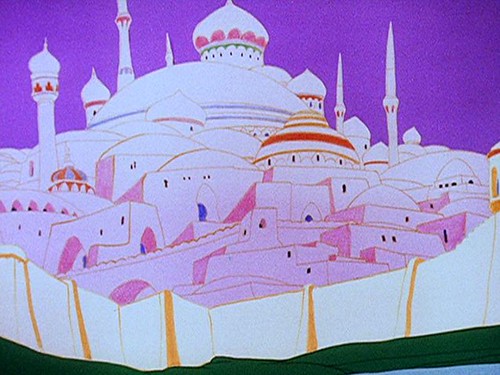
Here’s the opening shot of the film:

siam 1 cityscape

This is pure Orientalist fantasy. A bit later we see this car pull up:

Siam S

This could, of course, be the car of a rich Arab and so be a proper part of the Orientalist fantasy. But it could also be a mid-20th century American car. It’s thus ambiguous between the two spaces. When the car door opens, a rotund man in Arab dress emerges and nails a proclamation to the wall. Here’s the last part of that proclamation:

siam 3 announce

Thursday, March 31, 2011

Siamese Eyes, Electricity, and a Contest

This is the fifth in a series of posts on the Walter Lantz cartoon, The Greatest Man in Siam. I've listed the other posts at the end of this one. YouTube has the cartoon.
I’ve mentioned eyes several times in our on-going examination of The Greatest Man in Siam. People have eyes and so any depiction of people must necessarily show us those eyes. But this cartoon deals calls our attention to eyes in specific ways, ways that lead to deep issues.

I See You

Eyes first come into prominence when the princess is presented to us for our viewing pleasure. We see an unidentified group of men, located who knows where against a green background, ogling her:

siam 3F howlone

The first contestant, The Smartest, turns out to be cross-eyed:

siam 6 smartest

If you follow the king’s reaction closely, you’ll see that he has trouble establishing visual contact with the contestant. His eyes blink fidget around.

There’s nothing wrong with the eyes of The Richest, the second contestant. But his jewels are so bright that the light glinting off them hurts the king’s eyes.

Siam S7

Siam S8

The situation’s the same with The Fastest, the third contestant. There’s nothing odd about his eyes – though most of the time he’s moving so fast we can’t see them – but the king uses binoculars to follow him in after he’s first entered the palace. And when he’s completed his archery shot, he tosses a bowl of applesauce that lands on the king’s head and flows over the his face, forcing him to wipe his eyes clear:

Wednesday, March 30, 2011

The Phallus in the Palace

Spotting phallic symbols in art has long been a minor sport among college sophomores. At least, it once was – I don’t know what the wise kids are up to these days. Spotting phallic symbols is so easy that one must be suspicious of them. As The Master is said to have remarked, “There are times, gentlemen, when a cigar is just a cigar.”

Indeed.

The trouble is, it is not always the case that phallic symbology is merely the figment of sophomoric sophistication. It is often real. In any given situation, how do you tell whether you’ve got a token of sophomoric will or a real phallic symbol?

Beats me.

In a previous post on The Greatest Man in Siam, I’ve already suggested that the grandfather clock on King Size’s lap is a phallus:

siam 5 without delay big clock

I mean, one can’t ignore where the base of that thing is, its general shape, and angle of incidence – not to mention the swinging pendulum. To that we add that Size is the king, thus making that phallus a symbol of his kingly authority.

There’s more.

Monday, March 28, 2011

Why Siam?

The Greatest Man in Siam is nominally set in a place called “Siam.” “Siam” is an older name for Thailand, which is in Southeast Asia, of course, not the Middle East. But this cartoon is not about Thailand, or anyplace in the Middle East for that matter, in any substantial sense.

We can, and I suppose we should, critique the cartoon for its standard-issue cultural misappropriation and Orientalism. At the moment, that acknowledgment is all I’m going to do. But, as these tropes aren’t being used to comment about some other culture, just why are they being used? Why the exoticism?

siam 50 wedding

Most likely because it provides a plausible ‘cover’ for the central motif of the cartoon, the contest for the bride. That’s not the sort of thing that’s done in America, is it? So we’ve got to locate the story is some place where this sort of thing is the norm. A mythical Siam is as good a locus as any.

What we really need to know, of course, is what this bride contest is doing in the cartoon. It’s a device, for what purpose? But let’s set that aside for a minute and ask another question: Where’d this device come from?

Sunday, March 27, 2011

The Greatest Social Contract in Siam

Now that we’ve had a chance to examine the critical dance sequence in the Walter Lantz cartoon, The Greatest Man in Siam, let’s take a look at the whole thing. As I remarked earlier, the cartoon seems to be a simple one in which everything is obvious. Nothing to puzzle over.

But it’s simple and obvious only because the moves and memes are familiar, because it’s built on tropes that have been circulating for a long time. As I explained previously, the story is simple: King Size is giving away his daughter’s hand in marriage. Four men compete. One wins. End with a party. It’s that simple.

* * * * *

When I set out to analyze the cartoon I was curious about one thing: Why’d the trumpet player win? What is it that he did right that the others did wrong?

Let’s not go there just yet. Let’s start at the beginning. Roughly the first two minutes or so are devoted to establishing this exotic world, one based on standard clichés about the Middle East. The opening shot tells us where we are – notice the domes, the minarets, and the color scheme:

siam 1 cityscape

Now we move around and see some gags, such as:

siam 2 marketplace

Saturday, March 26, 2011

The Hottest Man in Siam

Michael Barrier’s recent post about life at the Walter Lantz studio prompted me to review what is (currently) my favorite Lantz cartoon, one of the Swing Symphonies: The Greatest Man in Siam. It’s got slammin’ music on the soundtrack, composed and directed by Darrell Calker, and featuring some ferocious playing by an uncredited trumpet player. It was directed by James Culhane and animated by Pat Matthews and Emery Hawkins.

The cartoon’s story is simple. King Size of Siam decides it’s time for his daughter to wed. So he has a competition for her hand. Four men compete in succession and the last one wins. The cartoons ends with lots of dancing.

I figured I’d take a dozen or twenty screen shots and write up a post. There’s nothing tricky or complicated about this cartoon, nothing like the brilliant oddities of Porky in Wackeyland. “It’ll be easy,” I told myself. “Snap the screenshots, say something about the brilliant trumpet playing and the dance animation, and you’re done.”

Wrong. It’s not that it turned out to be tricky in an unanticipated way. It’s just that once I started stepping through the dance sequence it got more and more interesting. I decided it just wouldn’t do to take two or three of four screen shots of it and let it go at that. No, that animation merits a closer look.

So that’s what I’m going to do in this post, take a close look at the dance sequence. Though not close enough, for you really need to step through it frame by frame to appreciate it and to watch it several times over. But at least I can point out some things to pay attention to. I’ll look at the rest of the cartoon in a later post.

Dance, Dance, Dance

The dance sequence starts a bit over five minutes into the cartoon. The smartest, richest, and fastest men in Siam have all failed in their quest for the king’s daughter. Just after the fastest failed, King Size turns to his daughter and remarks, with a chuckle, that “he burned himself out.”

siam 11 burned himself out

Then we hear a hot lick on unaccompanied trumpet. King Size and his daughter are startled, and look one another in the eye:

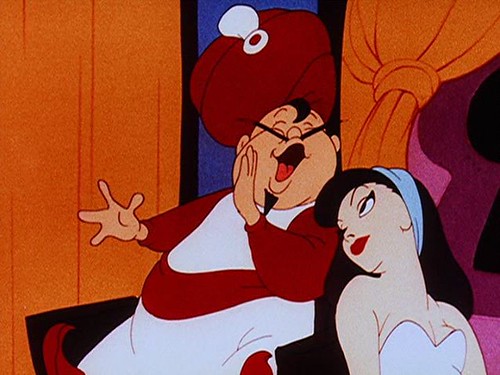
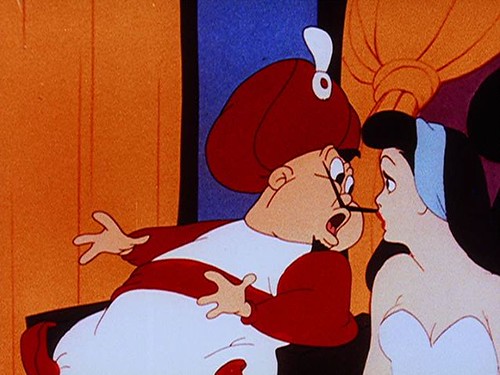
siam 12 the look

They look up and see a trumpeter on high:

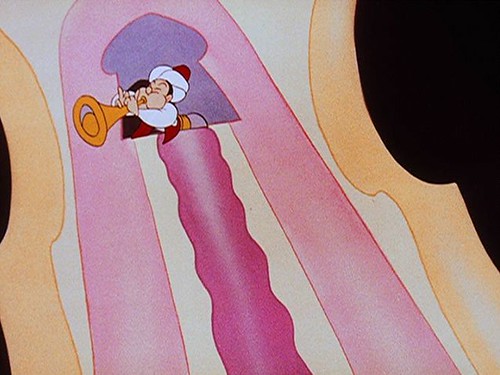
siam 13 the trumpeter

He finishes blowing his lick and floats down to the floor where Size and daughter are located. As the trumpeter floats down he begins singing about how he’s the hottest man in Siam. When he lands he continues singing even as he does a sensuous dance directed at the daughter and observed by the king: