Showing posts with label my intellectual life. Show all posts

Saturday, July 4, 2026

My action at Academia.edu over the last 6 months

Has been pretty interesting. Look at these charts, for January 2026 through June, in order from top to bottom:

January is pretty even, with a peak just below 50 near the end of the month. February shows a steady rise through the month, topping out just over 60 at the end of the month. March tops out just over 70 at the beginning of the month then takes a wild ride though the middle finally evening out a bit at the end of the month, with two peaks just above 60 and on just below. April has its ups and downs but on the whole seems pretty steady, with values between just above 20 to just above 60; 40 seems to be the middle value. May shows a definite downward trend, with a high of about 55 about a week in and then dropping through the end. And then we have June, which starts out low rises to 60 in four days, hangs in there a bit and then starts dropping down until the last day (June 30) it has a steep rise until well above 90. Then an apparent steep drop to July 1, though that’s an illusion. I took that last screen shot very early in the day.

I have no idea what that steep rise is about. My guess is someone somewhere put out notice about me – email, social media, website, who knows? – others picked up on it and came by. The question is: what’s next. It’s now early in the morning on July 4 (7:30) and here’s what we’ve got:

We’ve dropped way down, down to the region where things were for the middle through June 29. Note though, that we’re well above 15, which is pretty high for this time of day. Still, I don’t expect a steep rise through July. Beyond that, who knows?

Friday, February 23, 2024

Keeping Score of my online action

It’s a lazy Friday afternoon, but then recently all Friday afternoons have seemed lazy. I’ve spent much the day doing this and that and taking stock, getting ready for the been weekend push on my next piece for 3 Quarks Daily. It’s currently titled, “Why We Need Philosophy, Now, More Than Ever [AI].” Perhaps it will have that title by the time I publish it. We’ll see.

Anyhow, I thought I’d report my latest states on Academic and here at the Savanna.

Academia

I’ve got 90,841 total views, which puts me in the top 0.5%. I’ve been there for months. At one point in the last year, Mar. 22, I was in the top 0.1%. That’s pretty good. I need to be in the top 0.001%.

The chart below shows my paper action over the last 60 days. The upper green line is paper views and the lower black line is downloads. Notice that all the data points except the rightmost one indicate totals for the day. I took the screenshot at 4PM; I won’t hazard a guess where thing will be at the end of the day.

Here's the most popular papers over the last 60 days (click on chart to embiggen):

Notice that the top paper, on the tech Singularity, is way behind the second paper, on Kawajiri’s Ninja Scroll, in total views (to the right), but ahead of it in downloads. The singularity paper is from 2014; the Ninja Scroll paper is from 2015. The corresponding Ninja Scroll post at New Savanna is the most popular post there. I’m particularly pleased with the performance of the Heart of Darkness paper, which is hard-core literary criticism, with quite a bit of close-reading and “distant” reading as well; it’s from 2019. The Visual Thinking paper is an encyclopedia article I published in 1990.

New Savanna

Here’s the views on New Savanna over the past three months. Very spiky.

Here’s the last year; notice the overall spikiness and the heavy action in August and September.

This is how things look over the whole life of the blog:

I have no idea what caused all that action in 2017, nor what’s the source of the recent, but highly variable, increase since August, 2023.

Here’s the most popular posts for the last three months (click on chart to embiggen):

Note particularly the most popular one: GOAT Literary Critics: Part 1.1, What do you mean, literary critic? That’s from December 4, 2023, and is the first post in my ongoing series on literary criticism. That series is a response to Tyler Cowen’s recently published book, GOAT: Who is the Greatest Economist of all Time and Why Does it Matter? Cowen published a link to my post at his blog, Marginal Revolution, on December 6 and that drove a lot of traffic to New Savanna that day.

The second post on the list is my post on Ninja Scroll; as I indicated above, it’s the most popular one at New Savanna and dates from September, 2010, the first year of the blog. In third place we have one the posts in my series about Miyazaki’s The Wind Rises. That is now the third most popular post on the blog and dates from late 2015.

Who’s the GOAT of Economics? Tyler Cowen on His New AI Book & More! [Bonus: from double-entry bookkeeping to supply and demand] – that’s in fourth place and has some comments on a podcast in which Cowen discussed his GOAT economists book. During the conversation he mentioned that he couldn’t understand why 17th century thinkers had such trouble conceptualizing the phenomenon of supply-and-demand, which he could easily explain to a reasonably intelligent teenager. I did some thinking about it and made a variety of comments about it, giving special attention to a speculation that the conceptualization probably piggy-backed on the practice of double-entry book-keeping. Cowen apparently liked that and gave me another link.

More later.

Thursday, February 22, 2024

My use of ChatGPT in my intellectual work

 I recently posted this note to an online community, Brainstorms, hosted by Howard Rheingold (whom I address in the final paragraph):

I've spent a LOT of time using ChatGPT since it went online at the end of Nov. 2022. Most of the time I've been investigating its behavior and have written a number of posts about it. But more recently I've been using it a bit in for my own research purposes, where it's a tool for me, not the object of my inquiry. Thus, back in October the economist Tyler Cowen announced that he'd written a book about the greatest economists of all time. You can download the PDF, but he's also made AI versions that you can query like an AI engine. I've only used the AI once or three times. It seemed OK, but not great.

However, I decided, why the hell not? I'll write so posts about great literary critics. I've now got over a half dozen posts in the series, and I've used ChatGPT in the process. But always in a background role. If you look at any of those posts and see something set in Courier, that's from ChatGPT. I'm not using it to do any of the writing. not even drafts for me to edit into (more or less) finished prose. If I'm going to stick its text into my work, I want the reader to know that it did it, not me.

Now, I'm trained as a literary critic. I've published in professional journals. Though I've mostly been doing other things for the last three or four decades, I still follow some things here and there. From 2007 to 2010 or so I was a member of a (now-defunct) group blog (The Valve) of mostly professional literary scholars and a philosopher or two. In the last decade I've followed work in digital humanities, often on Twitter. So I'm pretty confident of using ChatGPT in that arena. If it produces some nonsense, there's a good chance I'll detect it.

Of course, I'd really like to be able to use it in areas where I know little or nothing. There I'm more likely to be fooled. However, I've looked into and published about a lot of things over the years. I'm very sophisticated about these things. And I know how to check things. If I get some stuff from ChatGPT in an area I don't know, but I like what it's given me. I'll check it.

I've got a lifetime's worth of crap-detection behind me. Now how you distil that down, you've thought a lot more about that than I have, Howard. It seems to me, though, that the tricky part is that you learn best if you're really interested and the work means something to you. Then you'll automatically take care and, I assumem, would be open to specific instruction on crap-detection. But if you're just doing it to get a grade in something that otherwise doesn't interest you, or to rack up education points at a boring job, then I'd think you're more vulnerable.

Wednesday, February 7, 2024

10 Influential Books [Updated, once again]

I've just been watching this conversation between Howard Gardner and Steven Pinker and was reminded of Erik Erikson. His book, Childhood and Society was very important for me. It made Freudian ideas more intelligible than Freud himself had done. Anyhow, that's why I'm once again bumping this post to the top of the queue.
* * * * *

The "10 Influential Books" meme seems to be making the rounds again. I originally published this back in March of 2010. Here it is again, without revisions.
Urged on by a reader, Tyler Cowen seems to have started a books meme: What 10 books have influenced you the most? This sort of thing is something of a crap-shoot, yadda yadda, but why not? I’ve limited my list to non-fiction.

My Teacher

David Hays, Cognitive Structures (HRAF Press 1981). Hays was my teacher, and most of what I learned from him I learned directly from him. His aim in this book was to integrate the analog and servomechanical model of William Powers (see below) with the propositional and digital style of his own earlier work in computational linguistics. It is embodied cognition before the term was coined and gained currency. I believe this is the most profound such attempt to date (Hays wrote the book in the Spring of 1976), but, of course, I am biased. It is also, alas, rather obscure in points, no bias.

Some Others

Claude Lévi-Strauss, The Raw and the Cooked. I’ve read a good deal of Lévi-Strauss, and this wasn’t the first. But it has had the most lasting effect on my thinking, which I’ve already discussed. Lévi-Strauss sees that there is a rigorous, but hidden, logic to a body of South American myths. He evokes this hidden logic by careful comparisons between myths, while discussing them in their larger socio-cultural context.

John Bowlby, Attachment. I read this in typescript under the tutelage of the late Mary Ainsworth when I was an undergraduate at Johns Hopkins. Bowlby set out to reconstruct psychoanalytic object relations theory using systems models (TOTE from Miller, Gallanter, and Pribram, Plans and the Structure of Behavior) and evidence from ethology, especially of primates. This became my model of biologically-based psychology.

Jean Piaget, Play, Dreams and Imitation in Childhood. I’ve read a good deal of Piaget, and this wasn’t the first (most likely that was The Origins of Intelligence in Children.) Though now somewhat eclipsed, his concept of developmental stages was enormously useful and, I believe, still holds water. But be careful. (Given its subjects, this book connects nicely with an interest in literature.)

Lev Vygotsky, Language and Thought. Vygotsky argued that children acquire language by completely internalizing that started as interaction with another. First the parent uses language to direct the child’s attention and behavior. Over time the child becomes able, first to use his own speech for those tasks, and then becomes able to dispense with external speech entirely.

Karl Pribram, Languages of the Brain. Pribram was a champion of the notion that the brain processes and stores information holographically. You’ll find that idea here, plus much more besides. Pribram was, and remains, one of our most comprehensive thinkers about the brain and its mind. But this book’s a tough read.
 
Philippe Ariès, Centuries of Childhood. Medievals and Early Moderns didn’t think about children as we do, which Ariès argued from paintings, diaries, and other sources. The basic idea is that people way back when didn’t think and act about something very basic in the way we do. Children are children, no? Well, biologically, yes. Culturally, no.

William Powers, Behavior: The Control of Perception. Powers has two ideas, both from control theory (& one of them is more or less given in his title), and both quite elegant. This is how to go about theorizing, be as clear as you can and use elegant examples. FWIW, Powers was an engineer and very much concerned with building real things.

Philosophers

Except for the Powers, all of the above books came to me within a minute or two. Then I drew a blank for a couple of minutes. “But you know,” says I to myself, “I was quite influenced by some philosophers early on, even if I no longer read philosophy. Oo why not mention them.” So I will. That I had to kick Merleau-Ponty into the omissions pile, rather than one of these, is somewhat arbitrary.

Ludwig Wittgenstein, Tractatus Logico-Philosophicus. Two things got me, the rigorous order of the whole affair, each proposition numbered in outline form. And the mysticism.

Friedrich Nietzsche, The Birth of Tragedy. Read a lot of Nietzsche too. But his account of the birth of tragedy linked up with other things in a powerful (including two of the books in the omissions pile.) And, of course, the Apollonian and Dionysian.

Omissions

Since the exercise limited us to ten I didn’t list The Structure of Scientific Revolutions (Thomas Kuhn) The Phenomenology of Perception (Maurice Merleau-Ponty), The Four Ages of Music (Walter Wiora, Has anyone else ever heard of this one, much less read it?) or Art and Illusion (Ernst Gombrich). The more I think about this, the longer this list will get.

EDIT: Jeeze, how did Freud not make the list? I only thought of him when I read someone else’s list just minutes ago (and 2 hours after I first posted this). & Gregory Bateson, Bertrand Russell. Well, I know why Russell didn’t make the list. I read a lot of his stuff in my mid-teens, but not after. I hadn’t started “serious” thinking when I left off reading him. And then there's Charlie Keil's Urban Blues (1966).

* * * * *

These are comments I made to responses back at The Valve (now defunct):
I find it interesting that you list a number of books from high school & earlier, Luther. I didn't list any from my high school years, which is when I read most of the Bertrand Russell, his popular stuff, not the technical philosophy and logic. Love your comment about Norman Brown. & perhaps I should have listed Suzanne Langer among my philosophers; Feeling and Form was a key work for me. I used both her and Nietzsche in my music book (Beethoven's Anvil, 2001).

Interesting, Rohan, what we take "influence" to mean. Without so much as a thought otherwise I took it to mean "influential in my research." If I'd construed the term more broadly, as you did, I'd have a somewhat different list. That list might have included, for example, Peter Pan (the Golden Books version via Disney), Oliver La Farge, Laughing Boy, and Holling Clancy Holling, Lucille Webster Holling, Pagoo (just look at those illustrations).

Thursday, January 4, 2024

Update: My mood over the long term [intellectual productivity]

As you may know, I use my posting pattern as a gauge of my overall long-term mood. The better my mood, the more I post in a month. I’ve written about this a number of times, most recently in mid-September of this year, New Savanna Moods: I was down, but I’ve started back up. The trend I reported in that post has continued through the end of the year, with a total of 112 posts in September, 120 in October, 132 in November, and 111 for December. Here’s how things look for the last three years:

And here’s how things look over the life of New Savanna, starting back in June 2010:

The overall trend is up. Last year (2023) is my highest annual total: 1004. Then we have 2019 (912) followed by 2018 (871).

I should note, however, that prior to September of 2018 I had not been posting tweets to New Savanna, though I joined Twitter in October of 2011. In terms of psychic energy, tweet posts are cheap posts, so I tend to think that some of the increase since has to be discounted in the sense that the increase doesn’t reflect my mood, rather it reflects ease of posting.

See also, A Mind Over the Long Haul: My Posting Patterns For that matter, take a look at this while you're at it, What is depression? [an umbrella term]..

Thursday, December 7, 2023

UPDATE AT 76: Reflections on entering my eighth decade and why it portends to be the most productive one of my life

I posted this six years ago, a few days after my 70th birthday. It’s still a reasonable overview of things I’ve accomplished, though the future looks a bit different. GPT-3 and then ChatGPT came along unexpectedly. I’ve devoted a great deal of time on ChatGPT over the last year, over 100 blog posts and 11 working papers. I’d hoped to finish a 12th paper by today, but other things intervened so I’ve still got a day’s or so worth of work on it. Then I’ve got to look over that work, arrive at some conclusions, and set directions for future work. That’ll take several more days.

One of those working papers, Xanadu, GPT, and Beyond: An adventure of the mind, outlines the connections between this strand of current work and my earlier work going back to “Kubla Khan” and even a bit before. Back in 2022 I posted Relational Nets Over Attractors, A Primer: Part 1, Design for a Mind, which knits together the work I did with David Hays, first on cognitive networks in the 1970s, and then our two papers on the brain in 1988, Principles and Development of Natural Intelligence and Metaphor, Recognition, and Neural Process. That was unexpected.

It also appears that I’ve undertaken yet another overview of literary criticism, GOAT Literary Critics. I’ve posted two pieces already and have tentative plans for five more. I don’t know just when I’ll do them as the ChatGPT wrap-up has higher priority.

Finally, back in 2017 I wrote about how I made Jersey City my home: through photographs. Now Hoboken has become my home and, once more, it’s been through photographs. I post photos to a Facebook group for Hoboken photos and am planning a small exhibit of some of my photos. I’m working with one of my Jersey City friends, Greg Edgell, on that (& Greg’s gotten married and moved to the house near Morristown where he grew up).

Things are moving along. Like my friend Al used to say, “These are the good old days. The best days are yet to come.” 

* * * * *

Reflections on entering my eighth decade and why it portends to be the most productive one of my life


KK in Arches 70
In destinies sad or merry, true men can but try.
– Sir Gawain and the Green Knight 
In scientific prognostication we have a condition analogous to a fact of archery—the farther back you draw your longbow, the farther ahead you can shoot.
– Buckminster Fuller
Birthdays are generally just that, even “major” birthdays, like my most recent one, my 70th. They are an occasion for a celebration, perhaps a modest one, perhaps not quite so modest – our house was crowded with dinner guests for my father’s 50th birthday – perhaps even extravagant. I’ve never been to an extravagant birthday party. Birthdays may also be a time for reflection, but by no means necessarily so.

But in my experience birthdays rarely correspond to major life events. What’s a major life event? Getting married, whether at a small civil ceremony before a judge or an elaborate wedding with 100s of guests into the church and out to the reception where a great band – like me and my colleagues in The Out of Control Rhythm and Blues Band – performs for hours of dancing, that’s a major life event. Climbing a mountain you’ve trained for over a period of years, that’s a different kind of major life event. Graduating from school, or completing basic training in the military, passing the bar exam, all major.

Years ago, in my early 20s, I was in a rock band called “St. Matthew Passion.” It was our last gig, the sax player and I were jamming a whacked out intro to “She’s Not There” and suddenly it all disappeared, me, the musicians, the room, the world, all into a brilliant, but soft, white light. Only the light and the music. It lasted what, half a second, a second, two seconds? Whatever. Those few moments challenged me for years, changing my sense of myself and the world.

Major life events come in all forms and durations, but they rarely coincide with a birthday. Birthdays simply mark the passage of time.

And so it set out to be on Thursday, December 7, 2017, when I turned 70. I woke up, cruised the web, made four posts to New Savanna, had breakfast and then, and then I decided to go out and take some photos, including some of that green platform pump I’ve been having so much fun photographing.

20171207-_IGP1519

That was a bit unusual because I generally write in the morning, and perhaps I was motivated by my birthday to do something a bit different. But that’s all it was, a change in routine. It’s no big deal; I do it all the time.

But then I realized, sometime in the afternoon, that this birthday IS a big deal, and that I really can make it a big deal. How? By finishing my working paper, Calculating meaning in “Kubla Khan” – a rough cut. Why is that important, major milestone important? Because I’ve been working on it almost 50 years, all my adult life.

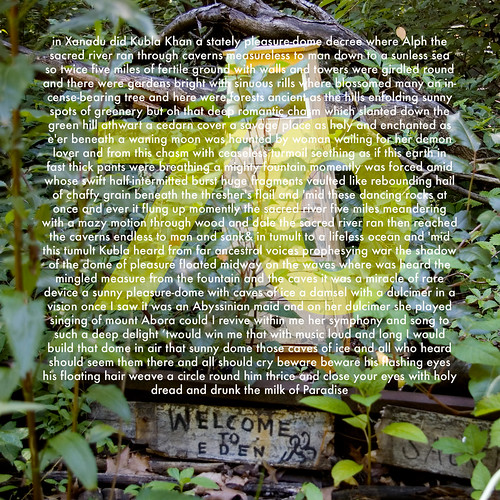
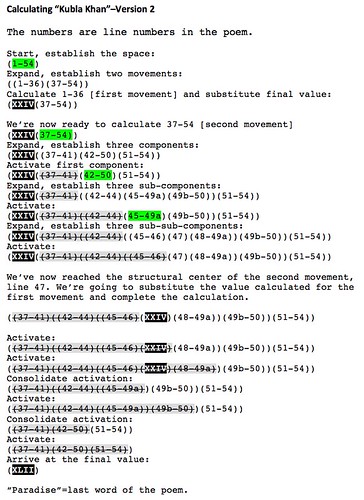
Calculating Kubla Khan 3
Teaser: Calculating meaning in “Kubla Khan”, 2017
This image likely makes little sense. Don’t worry about it. There are two more images that won’t make much sense. Don’t worry about them either. Just look at them as you would displays in a museum or gallery and move on.
Not that paper, no, not that. It’s the poem, “Kubla Khan”, by Samuel Taylor Coleridge, that I’ve been tracking all my adult life. I’ve been working on it since the spring of 1969 when I read it in Earl Wasserman’s class in my senior year at The Johns Hopkins University in Baltimore – where my father had gone to school. To have completed a project that framed one’s adult life, that is indeed a major event. Not completed, not in the sense that it’s all over and done with – for it isn’t, but in some deep and fundamental sense, things have changed. I’ve got a new understanding, and new obligations to go with it.

The first five lines:
In Xanadu did Kubla Khan
A stately pleasure-dome decree:
Where Alph, the sacred river, ran
Through caverns measureless to man
          Down to a sunless sea.
There are 49 more.

Let me explain. Perhaps then you will understand why I expect the next decade to be the most productive one of my life. And not just my intellectual life. There is the Bergen Arches Project as well. And who knows what else? I wonder if Rita Moreno is available for salsa lessons?

Saturday, September 16, 2023

New Savanna Moods: I was down, but I’ve started back up.

I have, at various times, written about how my general mood is subject to long-term swings, apparently seasonal. I go down in the fall or winter and come back up in spring: A Mind Over the Long Haul: My Posting Patterns.

This has been going on, it seems like, my entire adult life, starting in young adulthood (my freshman year in college). At one time a friend suggested that I had seasonal affective disorder (SAD). I never really checked that out, though earlier this year I thought about getting those bright lights that are supposed to stave it off.

Anyhow, things changed this year. Look at this chart, which depicts my monthly blogging frequency since 2021:

We see the standard pattern in 2021. There’s a big drop from August to October, to a low in November. I start back up in December, but don’t come back until April.

In 2022 again, have a big drop between August and September, a low in November, but then I shoot up in December up through April and then, whoops! back down for May. What happened?

At the end of November 2022 Open AI released ChatGPT to the web. I started playing with it, a lot, and got back to blogging, a lot. I kept that going through the end of April, when I lost intellectual and creative steam. But then, late in August, things started back up (I wrote over half of the August posts in the last week of the month). My thinking has come back.

Why? Interesting question. I don’t really know. Let’s just leave it for now and move on.

If my winter slumps were due to SAD, then that shouldn’t have happened. Sure, there’s ChatGPT, so what? Why should that make a difference if my mood is controlled by biochemical events that are cued by seasonal variations in illumination? But what if my moods are not cued by the weather? What if something else is going on and, whatever that is, it just happened to more or less coincide with seasonal variations in light?

NOTE: The bar for September of this year, at the far right of the chart, is a guess. I set the number at 90 so the chart would show what I think is going on. The month isn’t over yet. It’s the 16th. When this post goes up I’ll have 50 for the month. I’m over half way to 90 and I still have half a month left.

Wednesday, August 30, 2023

Why I hang out at LessWrong and why you should check-in there every now and then

The first two sections are a background, first a bit on cultural change to set the general context. Then some general information about LessWrong. Now we’re reading for my personal impressions of the place, concluding with a suggestion that you take a look if you haven’t already.

Cultural change over the long haul: Christians and professors

Back in the ancient days Christianity as just another mystery cult on the periphery of the Roman Empire. Then in 380 AD Emperor Theodosius I issued the Edict of Thessalonica and it became the state religion of the Roman Empire. In time it spread out among the many tribes of Europe and those Christian tribespeople began thinking of an entity called Christendom, and that, in time, became Europe and “the West.”

Back in the days when Europe was still Christendom the Catholic Church was the center of intellectual life. That changed during the Sixteenth Century with the advent of the Scientific Revolution and the Reformation. The Catholic remained powerful, of course, but universities supplanted it as the institutional center of intellectual life.

My point is simple and obvious: things change. Cults can become mainstream and new institutions can displace old ones. With that in mind, let’s think about LessWrong.

LessWrong

To be sure do not want to imply that LessWrong, a large and sophisticated online community, and the currents that swirl there (the rationalist movement, effective altruism (EA), dystopian fears of rogue AI) is comparable to Christianity, but it appears cultlike to outsiders, and to some insiders as well. It hosts a great deal of high-wattage intellectual activity on artificial intelligence and AI existential risk, effective altruism, and, more generally, how to live a life. I suspect that for some who post there, it is the intellectual center of their intellectual life.

It was founded in 2009 by Eliezer Yudkowsky, an autodidact with strong interests in AI and, in particular, the destructive potential of advanced AI. That is what he’s best known for and, while I suspect that Nick Bostrom is more widely known on that subject – his 2014 book, Superintelligence, was a best-seller, and he has an academic post at Oxford – Yudkowsky has likely been more influential within the tech community centered on Silicon Valley, where he lives. As an indicator of that influence, consider this pair of recent posts at X, the site formerly known as Twitter, by the president and co-founder of OpenAI, Sam Altman:

Color me skeptical about the Peace Prize. But that’s beside that point, which is that Yudkowsky has been and is very influential in Silicon Valley. People who work in those companies post and comment at LessWrong.

Why I’m there

Because it is an interesting place, if a bit strange and off-putting, and because I have so far had some interesting conversation there. Not a lot, but certainly enough to make it worthwhile.

I don’t know when I first took a look at LessWrong, but let’s say it was more than five years ago and perhaps even as long as ten years ago. But I didn’t spend much time there. That began changing, say, two or so years ago, sometime after GPT-3 began rocking the world. I made my first post in June of 2022, and have made a total of 40 posts and 137 comments there so far (now 40 posts as I've cross-posted this there). I generally check in there every day just to see what’s going on. I may take a quick look at a new post or five, look at comments on posts I’m following, and then go on about my business. On a particularly good day I’ll read some comments on one of my own posts and reply.

The thing is, I’m a ronin intellectual, and have been for years. If you’ve ever seen the anime series, Samurai Champloo, I’m the intellectual equivalent of Jin. Yes, I’ve got a PhD – there are a few of those at LessWrong – and once held a faculty post at the Rensselaer Polytechnic Institute. But I left that a long time ago and have been without an intellectual home ever since. I’ve published a bunch of articles in the academic literature on various topics scattered over literary criticism, cognitive science, and cultural evolution, and two books in the trade press with good publishers, one on music (Beethoven’s Anvil, Basic 2001) and one on computer graphics (Visualization, Harry Abrams 1989). For what it’s worth, and it’s worth a great deal to me, the idea count is higher than the page count would seem to indicate, but my work never really caught on. So I understand what it’s like to be a mammal in a world dominated by dinosaurs.

Sunday, August 27, 2023

Xanadu, GPT, and Beyond: An adventure of the mind

I've posted a new working paper. Title above; links, abstract, table of contents, and introductory material below.

Download at: 

Academia: https://www.academia.edu/106001453/Xanadu_GPT_and_Beyond_An_adventure_of_the_mind
SSRN: https://ssrn.com/abstract=4553351
ResearchGate: https://www.researchgate.net/publication/373433939_Xanadu_GPT_and_Beyond_An_adventure_of_the_mind

Abstract: This article recounts an intellectual journey that began in curiosity about the structure of Coleridge’s “Kubla Khan” in the late 1960s and has led to an interest in large language models at the present time. A close analysis of the poem revealed its two parts each to have a nested structure (think of a matryoshka doll) that suggested the operation of an underlying computational process (nested loops). That led to the study of computational linguistics (semantic networks), followed by neuroscience (Karl Pribram’s neural holography), and cultural evolution. In the 2010s I began following work digital humans had been doing with machine learning. When GPT-3 was released in 2020 I was ready, though it took me awhile to establish a link, however tentative, between that conceptual universe and that of “Kubla Khan.”

Encountering Coleridge’s “Kubla Khan” 3
Romantic states of consciousness 3
Matryoshka dolls and the escape from Xanadu 5
Semantic networks and a Shakespeare sonnet 8
Karl Pribram, neural holography, and the brain 10
The wandering years 11
Through GPT to the future 13
Mind and world in text 15
The Text of “Kubla Khan,” including Coleridge’s prefatory note 17
A note about the cover image 19

Encountering Coleridge’s “Kubla Khan”

I became hooked on Coleridge’s “Kubla Khan” in the Spring of 1969, my last semester as an undergraduate at Johns Hopkins. Three years later “Kubla Khan” had become the standard against which I measured my understanding of the human mind. That is why I am telling a story about how my interest in the mind has evolved through “Kubla Khan” to include, most recently, ChatGPT. Strange as it may seem, that poem is the vehicle through which I am coming to terms with this new technology and arriving at a sense of its potential.

There is a sense in which the story of that great poem can be traced back to the 11th century invasion of Britain by the Norman French, for that culture-crossing is what gave rise to the English language. A century or so later that story encountered a tale born of an encounter between an Italian merchant, Marco Polo, and a Mongolian warlord, Kubla Khan, which, when enlivened by the East India Company’s trade in opium, set fire to the mind of Samuel Taylor Coleridge in the late 18th and early 19th centuries. We need not trace that trajectory in any detail. I mention it only to give a sense of the scope of this 36-line poem, which is one of the best-known poems in the English language, and is perhaps unique in the annals of Western literature. It has made its mark on popular culture, from Orson Welles’s Citizen Kane, where it names Kane’s estate, Xanadu, thereby establishing the matrix for the whole film, to a hit song and film by Olivia Newton-John, Xanadu, subsequently made into a Broadway musical. It even provided that most vulgar of real-estate barons, Donald Trump, with the name for the nightclub, Xanadu, in his now defunct Atlantic City casino.

Romantic states of consciousness

I may well have read the poem prior to taking Romantic Literature with Professor Earl Wasserman in 1968-1969. But I have no memory of that. Though we didn’t study Coleridge until the second semester, it is probably best if I start my story with the first semester.

The course started with Keats. I decided to write my paper about a minor poem, “To–[Fanny Brawne],” and had delayed writing until the night before it was due. I was tired and my mind snapped. All of a sudden, I was typing a passage from one of Keats’ letters to Fanny, but I experienced the act of typing as though the words were my own. When I finished that passage, my mind was astir and found its way to the second stanza of “Ode on a Grecian Urn” – you know “Heard melodies are sweet, but those unheard Are sweeter...” I read those words as though they were my own.

I finished the paper, turned it in, got a grade, and...

I had a problem: What was that!? I didn’t know. But this was the 1960s and altered states of consciousness were all the rage, drug induced, but also meditation, and now it seems, the influence of late-night poetry on a tired mind.

Next up: Percy Bysshe Shelley, he who had declared poets to be “the unacknowledged Legislators of the world.” Again, I delayed writing my paper until the last minute. I was tired. The damned paper wrote itself, through me. But I didn’t experience anything of Shelley’s as though I had written it. It was different from the experience I had writing about Keats. The words just lined themselves up, one after the other and flowed down my arms, through my fingers, from the typewriter and onto the page. It was easy. No sweat. It was a good paper too.

Wordsworth was up in the Spring semester. That was the best paper I’d written as an undergraduate. Wasserman remarked that it “was a mature contemplation of the poem” – though I forget just what poem it was. There were no mental hijinks. I wrote it with the standard task-assemblage of a sentence or three here, a paragraph there, pace the room a bit, make a note or three, look up something, back to the typewriter, rinse, repeat, and so forth....it’s done.

And so it went with my “Kubla Khan” paper. The poem itself presents a number of problems. The first is: What is it about? There is no narrative. It has often been dismissed as word music. Word music it is, but that is no ground for dismissal.

Then we have Coleridge’s preface. He said the poem was incomplete. He had become lost in an opium reverie when two or three hundred lines came to him – “all the images rose up ... as things, with a parallel production of the correspondent expressions, without any sensation or consciousness of effort” – which was dashed when he was interrupted by a man from Porlock. When the Porlockian had gone, so had those two or three hundred lines. All that was left were the 54 lines of this, one of the most extraordinary poems in the world. In fact, nothing is obviously missing. If it weren’t for that preface, no one would even suspect that the poem was incomplete.

Critics have had various ways of dealing with the disparity between the poem itself and Coleridge’s claim. I invented another solution to the problem. It is easy and natural to interpret the second part of the poem as asserting that the poem is incomplete (I’ve appended a complete text to the end of this essay). The speaker says “Could I revive within me” (l. 42), clearly implying that he can’t, but if he could he would “build that dome in air” (p. 46). The dome is assumed to be Kubla’s pleasure-dome from the first part and is here being used as figure for the poem itself. That’s a perfectly respectable reading of those lines.

I pushed it a step further. I asserted that the poem paradoxically completes itself by asserting that it is incomplete. That kind of reading has it all. The wealthy English of Coleridge’s time were fond of placing newly built but incomplete or dilapidated structures in their gardens – “follies” they were called. An exquisitely dilapidated poem fit right in with that aesthetic. Moreover, such paradoxical readings fit right in with the rising tide of structuralist, post-structuralist and deconstructionist readings in American literary criticism. Despite all that that, Wasserman, who was more traditional in his conceptual leanings, Wasserman loved it.

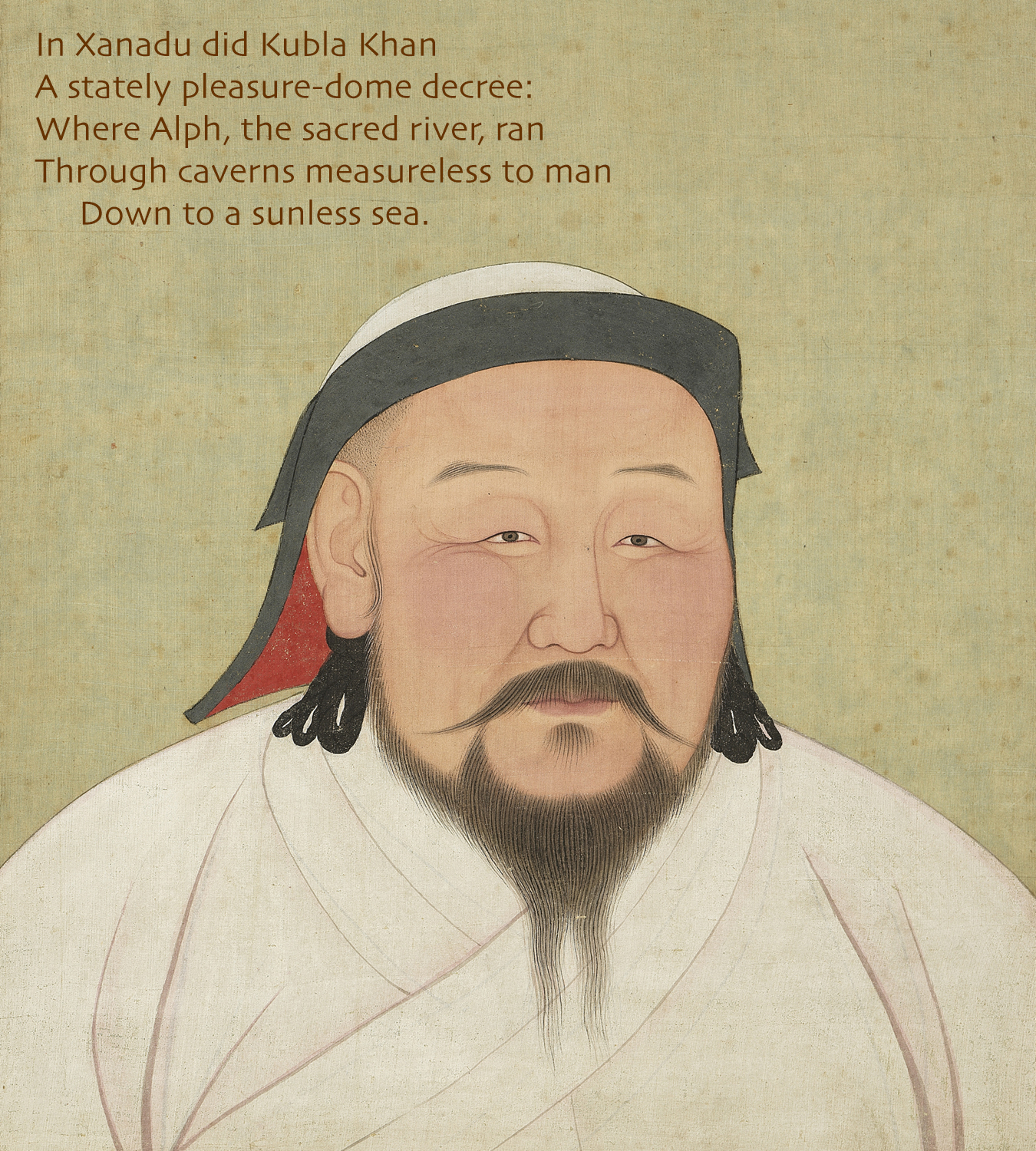
A note about the image

The portrait of “Kubla Khan” was made by Araniko, a Nepalese artist, shortly after Kubla’s death in 1294. The image is from Wikimedia Commons and is in the public domain.

Araniko: https://en.wikipedia.org/wiki/Araniko.
Image: https://commons.wikimedia.org/w/index.php?curid=4126240.

I have overlaid it with an image I made in MacPaint on a Classic Macintosh in 1985.

Tuesday, March 28, 2023

Inching “Kubla Khan” and GPT into the same intellectual framework @ 3 Quarks Daily

That framework is my intellectual history:

From “Kubla Khan” through GPT and beyond
https://3quarksdaily.com/3quarksdaily/2023/03/from-kubla-khan-through-gpt-and-beyond.html

I think I should have said a bit more, but it runs over 4000 words as it is.

What did I miss?

I should probably have mentioned Karl Pribram’s 1969 article in Scientific American about neural holography. I would have read that in during the same period as I took the course on Romantic literature which opens the essay. In the first place, the article grabbed me because I saw a (rough) analogy between what Pribram was proposing for the brain and what Lévi-Strauss had described in a conceptual structure he called the totemic operator, something I describe in this piece, Border Patrol: Arguments against the idea that the Mind is (somehow) computational in nature, which I oppose in the essay. That connection in turn piqued my interest in the brain.

Pribram became a central thinker for me. I devoured his Languages of the Brain when it came out in 1971. That’s where I learned about Ross Quillian’s work in computational semantics and that, in turn, led me more generally to semantic networks. This was during my initial work on “Kubla Khan” and my search for concepts and methods once I’d discovered the matryoshka doll embedding structures structures. This in turn links to the work Hays and I did in the mid-1980s on metaphor and on natural intelligence, both of which I do mention in the article.

The point, then, is that while I was trained in symbolic computing, I’ve always been aware of a fundamentally different approach to understanding mind-in-brain. Which is to say, I’ve NEVER seen an opposition between symbolic computing (GOFAI) and statistical techniques. Yes, they are different, and serve different purposes.

In that context I should also have mentioned Miriam Yevick’s work on holographic logic, which I found through Pribram. Hays and I give it a prominent place in our evolving understanding of the mind. Holography is based on convolution, and convolution became central to machine learning in the second decade of this century. But, as far as I have been able to tell, no one has read Yevick’s work. Why not? That it is from 1975 is not a good reason, any more than the 1958 publication date is a reason not to read John von Neumann’s The Computer and the Brain. Does the AI community have the collective curiosity and intellectual imagination that will be necessary to build on the extraordinary work of the last decade?

That’s one line of thought.

I should probably have laid more emphasis on thinking about the whole brain. On the one hand, great literary and artistic works, like “Kubla Khan” call on a wide range of mental, and hence neural, capabilities. If we want to understand how the mind works, we need to understand how those objects work in the mind. That’s major reason I’ve thought about “Kubla Khan” over the years. It forces me to think about the whole mind, not just language, but it also provides me a vehicle for organizing that effort. I suppose I could have a said a bit more about that, that risks getting caught up in a lot of detail that, in this context, would have been distracting.

Finally, an issue: Should I have explicitly said that the article was implicitly a critique of current work in AI? In the case of GPTs we're dealing with technology that pumps out language by the bucket full but is designed and constructed by people who know relatively little about linguistics, psycho-linguistics, or cognition. Lacking such knowledge, how can they possibly offer serious judgments about whether or not these engines are approaching thought? It's preposterous.

I lay some of the blame on Turing and his philosophical successors. It was one thing to propose the imitation game, as Turing called it, in a context where no one had access to a machine capable of playing it in a half-way interesting way. Once such machines existed, though, it quickly became obvious that people are willing to project humanity on the flimsiest of clues, thus trivializing the so-called Turing test. So now we’re witness to dozens of papers reporting the scores of AI engines on various tests. I suppose they have some value, but that value is not as indices of human thought.

Show me a device that is adequate to “Kubla Khan” and we’ll have something to talk about. Just what THAT adequacy means, just how it is to be DEMONSTRATED, those are serious issues. But if you think we’re going to get THERE without dealing with the range of ideas and considerations I’ve laid out in that essay, From “Kubla Khan” through GPT and beyond, then you seriously underestimate the richness of thought and subtlety of fabrication required for a deep adventure into artificial intelligence.

Monday, January 2, 2023

Half-way through my eighth decade: What next?

At the end of 2017 I wrote a post in which I reflected back on my intellectual life, Reflections on entering my eighth decade and why it portends to be the most productive one of my life. That remains a decent overview of what I’ve been up to in the last 50+ years, though it is hardly complete. It gives little sense of my interest in literature beyond “Kubla Khan,” my work on ring-composition, my thinking about form and computation, my commentary on digital humanities. Nor does it say much about my work on cognitive science, the brain, or cultural evolution. And then there’s all the descriptive work I’ve done on films. And music!

So, yeah, I guess it’s not such a good overview. I have no intention to fill in those gaps in this post. But it does give a sense that I’ve been doing other things than thinking and writing, about my involvement in my local community. In that sense, it’s good.

As for what’s next, let’s set that aside for a moment. Every so often I’ve written about my posting habits, how they vary wildly during the course of the year. My most recent such post was in November of 2018, A Mind Over the Long Haul: My Posting Patterns. Let’s see where that stands. The chart below shows my posting habits from the beginning of 2017 through the end of 2022. Each column indicates the number of posts for a single month.

The up and down cycling of my posting productivity is clearly visible. Notice that the slump came in the late Winter and early Spring in 2017, a bit earlier for 2018, and about the same in 2019. Notice that there’s a steep drop at the beginning of 2020, then a rise in summer and into the Fall, with a slump coming in November and continuing through March of 2021, when things move back up, only to drop back down in October and continuing through March of 2022.

So, in 2020, we have slump in November. In 2021 the slump moves to October. Guess when it hits in 2022? That’s right, September. That’s not good. But then we have a major – and unexpected rebound – in December. I know what that’s about; that’s when I started playing with and blogging about ChatGPT. I expect that to continue in this year.

What happened in the Summer of 2020 that brought me back to life? That’s when GPT-3 hit, in June or perhaps July I believe. On August 5, 2020 I issued my working paper, GPT-3: Waterloo or Rubicon? Here be Dragons, which I have since revised several times. I don’t recall off-hand what got me revved up in April of 2021, perhaps nothing in particular. But I know what got me revved in 2022. Jerry Seinfeld, Analyze This! AI meets Jerry Seinfeld, and then Grace Lindsey published Models of the Mind, which I read and wrote about, To Model the Mind: Speculative Engineering as Philosophy. Then came a dialog on “Kubla Khan” in May, Symbols and Nets: Calculating Meaning in “Kubla Khan.” That kept things moving on “Kubla Khan,” which as you my recall, is where all this started back at Johns Hopkins in the late 1960s and early 1970s.

And then the big one came in later in May, Relational Nets Over Attractors, A Primer: Part 1, Design for a Mind, which I have subsequently revised. That brought together the work on cognitive networks I had done with David Hays in the 1970s, the work we did on the brain in the 1980s, my conversations about neurodynamics with Walter Freeman in the late 1990s and early 2000s, and my reading of Peter Gärdenfors on the geometry of meaning. It’s all there in one wonderful crazy paper, a major synthesis, albeit a very speculative one. July saw the discussion of Yann LeCun’s position paper, A Path Towards Autonomous Machine Intelligence, which I found interesting and discussed over the next couple of weeks.

But, for reasons I don’t understand, the excitement had worn off by September. Come to think of it, I do see why things went downhill. I saw new possibilities of linking my work with what others were doing, but was unable to actualize any of them. I remained in a slump until ChatGPT came out at the very end of November. I signed up for an account and started playing with it.

That’s taken a considerable amount of my time over the last month. I’ve written many blog posts, most with long transcripts of my interaction with ChatGPT. I’ve been working on a paper for the last week and a half – current title, Discursive Competence in ChatGPT, Part 1: Talking with Dragons – and expect to issue it within a week.

Once again I see the possibility of linking my work to the work of others. I do think there is an audience within the technical community for the work I’m doing with ChatGPT. I think I can build on it. But I don’t want to say anything about that here and now. I suppose I don’t want to jinx things by talking in public. Bit mostly I want to finish with this post and get on with the work.

‘Till later.

Saturday, August 7, 2021

The road to Xanadu led to Mars: Why structuralism sent me there but the profession went elsewhere

I've issued a new working paper. Title above, download, abstract, contexts, and introduction below:

Download at:

Academica.edu: https://www.academia.edu/50780325/The_road_to_Xanadu_led_to_Mars_Why_structuralism_sent_me_there_but_the_profession_went_elsewhere
SSRN: http://ssrn.com/abstract=3901083
ResearchGate: https://www.researchgate.net/publication/353755798_The_road_to_Xanadu_led_to_Mars_Why_structuralism_sent_me_there_but_the_profession_went_elsewhere

Abstract: Academic literary criticism has become centered on the interpretation of meaning in literary texts. As a consequence, the profession has no consensus account of what texts are or what form is. By following tentative interest in structuralism, semiotics, and linguistics to the analysis of “Kubla Khan” I moved deep into the cognitive sciences with an analysis of Shakespeare’s Sonnet 129. That effectively removed me from the profession, which continued to pursue a wide variety of interpretive approaches. A 21st century discipline would retain interpretation as ethical criticism while incorporating other approaches as description, naturalistic, and computational criticism.
DOI: 10.13140/RG.2.2.17288.75521

Contents

If this is a paradigm shift, how can it be understood? 2
The problematics of text, form, and diagrams 5
Dictionaries, encyclopedias, and the word illusion 10
The word illusion in literary criticism 12
The failure of structuralism and linguistics: Why did academic literary criticism turn its back on intellectual opportunity in the mid-1970s? [and why did I ignore the profession?] 17
Jakobson’s poetic function and textual closure 30
Literary studies for the Twenty-First Century 34
Appendix 1: A short chronology of career events 39
Appendix 2: Cognitive science and literary theory, 1948-1999 40

If this is a paradigm shift, how can it be understood?

I have characterized my career in the following fanciful way:

In the early 1970s I discovered that “Kubla Khan” had a rich, marvelous, and fantastically symmetrical structure. I'd found myself intellectually. I knew what I was doing. I had a specific intellectual mission: to find the mechanisms behind “Kubla Khan.” As defined, that mission failed, and still has not been achieved some 40 odd years later. It's like this: If you set out to hitch rides from New York City to, say, Los Angeles, and don't make it, well then your hitch-hike adventure is a failure. But if you end up on Mars instead, just what kind of failure is that? Yeah, you’re lost. Really lost. But you’re lost on Mars! How cool is that!

Of course, it might not actually be Mars. It might just be an abandoned set on a studio back lot.

I have all but concluded that I have indeed landed on Mars, rather then being lost in an abandoned movie studio. But I would like to know how it happened: There we were back in the 1960s and 1970s, all set to explore the lands that structuralism laid before us, and I end up in a strange and different place while the others more or less abandoned structuralism and ended up where they had started, but facing the other way, any other way, and spinning elegantly in circles.

I two reasons for having chosen this rather fanciful way of characterizing my career. Fanciful though it is, it does give a reasonable sense of how I see things. And the fancy blunts the embarrassing fact that I have to talk about myself so much. I can’t help it. I don’t approach the study of literature the way other literary critics do. I want to know why. The only way to figure that out is to look at what I do and what they do.

The times they are a changing

If I talk of a paradigm shift, I do so because “paradigm” seems to be the word we use to characterize the difference between how I think about literary texts and phenomena and how most members of the profession do. The difference between us is paradigmatic.

Of course, as Thomas Kuhn used the word in The Structure of Scientific Revolutions, paradigms are communal conceptual objects. An intellectual discipline or some substantial group of thinkers within the discipline has a paradigm, a way of construing the world so as to interrogate the world and establish answers. In this case the discipline in question is academic literary criticism. And literary criticism perhaps best thought of as a family of closely related paradigms, if indeed the term is at all appropriate, as Kuhn was talking about science, not intellectual life in the large, though others have generalized from his use of the term. But that’s a quibble.

Given that use, it’s rather, grand, shall we say, for me to talk about my paradigm. One adherent does not a paradigm make. As I said, this is a bit embarrassing. But I do approach the study of literature a bit differently than other critics. I want to understand how and why that difference came about.

Back in the early 1970s, when I was still a graduate student, I was more or less aligned with many of my fellow critics in the pursuit of textual meaning. In the processing of thinking about why interpretations for a given text seemed to proliferate rather than converge the profession entered a period of methodological reflection that included an interest in structuralism, semiotics, and linguistics. I followed that interest and went beyond it, deep into the cognitive sciences. For the most part, however, those others who had been interested in structuralism had abandoned it by the early 1980s in favor of post-structuralism, deconstruction, or something else. To be sure some critics pursued narratology, which has affinities with structuralism, but those are a small minority within the profession.

How did that happen? Why? I suppose I could assert that I am brilliant and creative while the profession is populated by hide-bound clerks. But, aside from the fact that that is not true, it wouldn’t explain anything. What did I see that others did not, or, if you will, why did I pursue it further than others did? Correlatively what interested them that was not so compelling to me? Those questions require fairly specific answers, answers that allow everyone to come out of this story with a some measure of dignity.

On the one hand there is the fact that I have written papers that are quite unlike others offered within the discipline; I mention some of them in the text and in the footnotes of the section, “The failure of structuralism and linguistics.” All of the ones I mention in that section, save working papers on ring-composition (and on Heart of Darkness) have been published in the formal literature. Publication does not mean acceptance as gospel truth, it means only that the work is judged worthy of consideration by other professionals. But I have yet to convince other professionals to take up some of the methods I use in those papers. More importantly, as far as I know, others have not arrived independently at them. Why not?

What’s in the rest of this document?

I make my major argument in the longest section of this working paper: “The failure of structuralism and linguistics: Why did academic literary criticism turn its back on intellectual opportunity in the mid-1970s? [and why did I ignore the profession?].” Since all of the sections in this paper were originally written as independent blog posts, you may choose to read that without reading any of the others.

But I have included them for various reasons. Actually, come to think of it, I have included them for one reason: They are about the problematic nature of the concepts of both text and form within what I am calling standard literary criticism. Neither concept is problematic for me. But then I don’t use them to mean quite the same thing.

Let’s take them up in order:

The problematics of text, form, and diagrams: I look at an apology that Mark Rose offered for including simple diagrams in a discussion of Shakespeare plays. I take the fact of that apology as evidence of the profession’s (informal) norms about proper intellectual method. But why would such simple diagrams raise suspicions?

Dictionaries, encyclopedias, and the word illusion: This one and the next one are about something I have come to call the word illusion, a term I use to refer to the fact that what we see on the page (or hear in the air) is only a word form, not the word-in-full, complete with meaning and syntactic affordances. That turns out to be the key concept in this paper. I this post I talk about the role dictionaries and encyclopedias play in fostering and supporting the word illusion.

The word illusion in literary criticism: The word illusions opens the way to problematic conceptions of both the text and literary form. Though such conceptions are central to the discipline, it has no consensus accounts of either.

The failure of structuralism and linguistics: Why did academic literary criticism turn its back on intellectual opportunity in the mid-1970s? [and why did I ignore the profession?]: I suspect that text and form only became problematic after the structuralist collapse, that is, after literary criticism had to rationalize its willingness to countenance the world illusion, as I call it. All the elaborate theoretical language serves the purpose of saying that we are not fooled by words. The professions made tentative gestures toward structuralism, semiotics, and linguistics in the late 1960s and early 1970s. This is an account of why, in following those gestures I abandoned standard interpretive methodologies in favor of the nascent cognitive sciences while the profession felt it was necessary to truncate those gestures in favor of the interpretive approaches that came to be known as Theory.

Jakobson’s poetic function and textual closure: I re-interpret Jakobson’s poetic function in terms of computation as the governing process in reading a text.

Literary studies for the Twenty-First Century: Would consist of five interlinked fields of activity: infrastructure (preparation of texts, corpora, etc.), ethical criticism, description, naturalist criticism, and computational criticism.

Appendix 1: A short chronology of career events: From 1972 (my master’s thesis at Hopkins) through the present; this chronology can be used as a means of linking events described in “The failure of structuralism and linguistics” with events in a related working paper, Crisis Among HUMANITIES DISCIPLINES in the Twenty-First Century.

Appendix 2: Cognitive science and literary theory, 1948-1999: A parallel list of significant texts in the two intellectual domains.

Wednesday, July 28, 2021

Things change, but sometimes they don’t: On the difference between learning about and living through [revising your priors and the way of the world]

This is a year old (first published in July 26 of last year). I'm bumping it to the top of the queue because I'm thinking about these things once again.
It has long been obvious to me that there is an epistemic difference between knowing history and living through history. I now have half a notion of how to think about this. That’s what this post is about.

I begin by talking about the effect the fall of the Soviet Union had on me. That’s my paradigm example of the phenomenon I’m talking about. Call it a RUPTURE in my sense of the world. Then I consider my intellectual career as a series of ruptures where I had to reconsider my priors, if you will, and so rethink my intellectual foundations. Finally I move to a graphics revolution that could have happened, SHOULD have happened, as a result to digital technology. I saw it coming, but it never really got started. What was I missing? I conclude with some reflections on the current situation.
 
I list five such ruptures in all. Three INSIDE my primary intellectual trajectory, my intellectual career, while two are OUTSIDE that trajectory, but nonetheless affected me.

World history and the fall of the Soviet Union

It’s about having to revise your priors – I’m talking Bayes, as least informally, your prior commitments. Living through events forces that on you, or at any rate, gives you the opportunity to revise those priors. Merely learning about the past doesn’t do that. Changing how you think is deeper than learning about change.

My paradigmatic example is the fall of the Soviet Union. I grew up in the 1950s and ‘60s, when the Cold War was going strong. I remember reading about how to construct bomb shelters, and thinking about where the family shelter should be. I remember talk of the missile gap; I remember the Cuban missile crisis. I fully expected to be living the Cold War when I died.

And then the Berlin Wall came down in 1989 and the Cold War was all but over. Though some had anticipated this – I’m thinking particularly of U.S. Senator Daniel Patrick Moynihan – I certainly did not. It took me by surprise.

What did I learn from that? Simple, that The World can change. Sure, I knew world history, I knew that things changed deeply and fundamentally, time and time again. But I hadn’t seen it for myself. I suppose I might have taken that simple lesson from the Civil Rights movement, but perhaps the persistence of racism blunted that achievement. The end of the Vietnam War? No, and I’d marched against that one and been a conscientious objector.

It was the fall of the Soviet Union that reached me, that forced me to abandon a set of simple, but fundamental – I was about to type “epistemic”, “epistemic commitments”, but no, it’s deeper – ontological commitments. For me the Cold War had ontological force. It was simply the way of the world. I learned about it in childhood and lived it through a quarter century of adulthood.

And then the world changed.

Let’s call that an OUTSIDE RUPTURE in my sense of the world, outside because it was outside my primary sphere of action and commitment.

My intellectual life

My intellectual life has had a number of “ruptures”, if you will. In the late 1960s I learned to interpret literary texts as an undergraduate at Johns Hopkins. I was trained in so-called “close reading”, but was interested in structuralist analysis as well. In the spring of my senior year I became interested in “Kubla Khan.” I decided to undertake a structuralist analysis of the poem for a master’s thesis.

Worksheet, first 36 lines of "Kubla Khan"

As things worked out that project fell apart in 1970 or ‘71. “Kubla Khan” refused to submit to the methods I applied to it. My commitment to the poem won out and I was forced to abandon those methods. I tell the story in considerable autobiographical detail in “Touchstones” [1] and supply the intellectual detail in a working paper on Lévi-Strauss [2].

FIRST INSIDE RUPTURE, inside because it is dead center in my primary sphere of action and commitment. I could no longer believe that existing methods of literary criticism were adequate to the task of understanding how literary texts work. New methods, incidentally, that required visual thinking. Standard literary criticism has been and remains committed to expository prose as its fundamental intellectual medium.

In 1973 I went off to get a Ph. D. in the English Department at SUNY at Buffalo and ended up spending considerable time studying computational semantics with David Hays in the Linguistics Department. My dissertation ended up as a quasi-technical exercise in cognitive semantics as applied to literature, one where, for large sections, I drew the diagrams first and then wrote prose to explain them. In 1976 Hays and I published a humanities-oriented review of computational linguistics in which we proposed the development of symbolic systems capable of “reading” a Shakespeare play in an intellectually interesting way [3]. I fully expected to be working with such a system later in my career. That hasn’t happened, nor do I expect it to.

Part of a semantic network for Shakespeare's Sonnet 129

SECOND INSIDE RUPTURE. Symbolic computational systems are not adequate for understanding the mind.

But this was not so drastic as that first inside rupture. For one thing, Hays and I didn’t really believe that symbolic systems were adequate to the task. We’d been exploring how to ground them in analog systems and in distributed neural computation [4]. The failure, rather, was one of degree rather than kind. I had overestimated the power of symbolic systems. I would later pick up my interest in neural systems in conversations I had with the late Walter Freeman and I incorporated into the early chapters of my book on music, Beethoven’s Anvil (2001) [5].

I suppose there was a THIRD INSIDE RUPTURE, or quasi-rupture, as well. In 1995 I discovered that a bunch of literary scholars was interested in “the cognitive revolution” – you know, the ideas I’d begun investigating in graduate school. That was in the Stanford Humanities Review. My work was forgotten but, and more importantly, computation was nowhere to be seen in this newer. Their version of cognitive science was thus very different from mine. It was in working through that difference that I figured out that I had been chasing form all along.