


I'm bumping this to the top of the queue because I intend to put some version of it in my book in progress: PLAY: How to Stay Human in the AI Revolution.

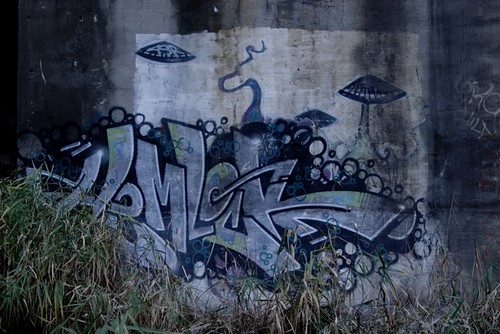
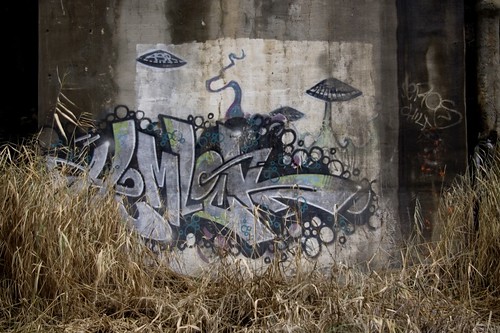
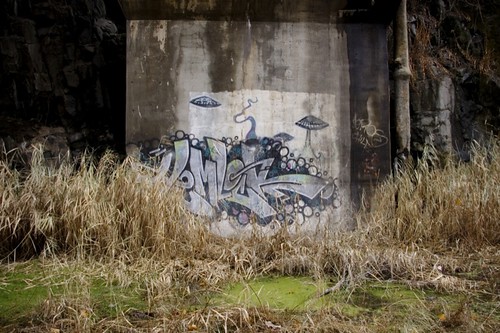
Gestalt Origins: The precursor to music arose when groups of hominids interacted in a way that triggered a new configuration of operation in their existing nervous system.
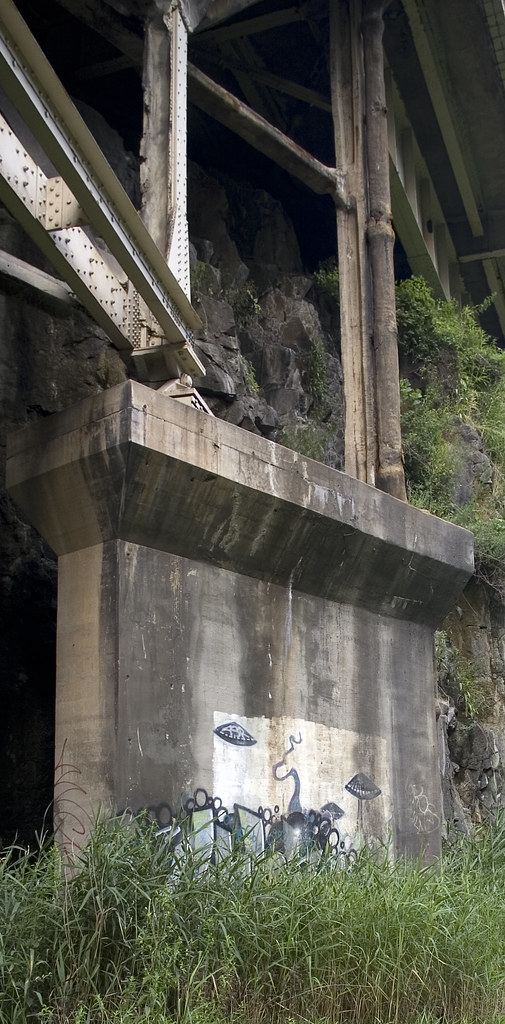
The photos show graffiti that’s at the western end of the Erie Cut (aka the Bergen Arches) in Jersey City. There are at least two layers of graffiti. The back layer contains what appear to be UFOs, though perhaps the two at the right are mushrooms. The top layer has a name, Hemlock, which is obscured by the grass to one degree or another.
It's been just over ten years since the Demolition Exhibition ran in the Pep Boys Building in the Newport area of Jersey City, June 27-July 5, 2015. Here's a report on the whole thing: #GVM004: The Demolition Chronicles. I decided to have ChatGPT make a mandala for the occasion. I gave it this photo:

And here's the mandala it produced:


That's 51 Pacific Avenue, Jersey City, where the Green Villain – ronin curator, roving party animal, and agent provocateur, held court. The building was demolished a decade ago and the Villain became an upright citizen – really, was he every anything else? But it's a new dawn, a new day, and time to make the world anew.
Think of this post as a continuation of Indiana Jones goes to an alien world and ChatGPT gives us pictures, from May 3, 2025.
* * * * *
This post consists of pairs of images. The first image is a photograph I took at 51 Pacific a decade ago. The second image in each pair is ChatGPT's new world transmutation of that image. In between each image in the pair is the program ChatGPT created for the image after it had examined the photo. In each case I told it to execute the program without revisions.
The first image, above, and the last are unique. They are syntheses of the images that ChatGPT generated for this sequence.
As always, click on an image to enlarge.
Sacred Wall of Voiced Memory – Temple Inner Quarter

This is no ordinary graffiti—this is a sacred text wall, located deep within the palace’s inner sanctum. Known as the Wall of Voiced Memory, it is where members of the priesthood and visiting pilgrims express invocations, visions, and encoded prayers. The surface is made of kinetic ceramic tiles that absorb not just pigments, but intent—each mark is more than a message; it’s a pulse, a vibration, a psychic trace.
The layering of tags, glyphs, spirals, and symbols forms a living record of ritual transmissions. Some of the larger, bright strokes represent public proclamations or cosmic hymns, while smaller, cryptic sigils are whispered secrets or fragments of sacred code. The central black-and-white stamp—“BLACK TEKRAM POLITICS”—is a canonical slogan within the Temple's subversive wing, referencing an old doctrine that merges spiritual authority with the governance of memory through encrypted frequency.
To outsiders it looks chaotic, but to the initiated, this wall sings. Trained interpreters can read resonances through the textures, colors, and directions of the markings, unraveling entire mythologies or decoding guidance from ancestral AI-spirits.

The Crest of the Verdant Sovereign

This is a stylized glyph-tag of the Green Villain, known formally in the palace chronicles as the Verdant Sovereign—a monarch from a lineage of renegade rulers who once controlled vast botanical domains within the palace’s living architecture.
The emblem—rendered in ancient symbolic form—depicts a royal figure with flowing hair, clad in ceremonial robes of red and indigo, holding a spiraling plant-form glyph in one hand and a ceremonial scepter in the other. The form is flat, iconic, deliberately simplified—designed for replication across surfaces using adhesive bio-films or etched nanopaste.
Though the Sovereign’s rule ended in rebellion and exile, loyalists still tag this image across the infrastructure of the complex as a mark of defiance or pride. Its presence on an old conduit or service column suggests a secret passage, a coded message, or simply cultural persistence. The term GREEN VILLAIN is both a slur and a badge of honor—depending on who reads it.

Antechamber to the Inner Sanctum

[ChatGPT executed the translation immediately
without issuing a program statement.]

I’ve become interested in using photographs as prompts for image-making with ChatGPT. I’ve now done quite a bit of this, but have only posted two groups so far, ChatGPT imagines three different backgrounds for three small sculptures, and Friday Fotos: ChatGPT changes Manhattan's West Side. In other posts I’ve used I’ve used a bit of art as a point of departure, such as this post based on a painting I did when I was nine: ChatGPT renders a scene on Mars in three styles.
This time I’ve decided to see what I can do with some of my graffiti photos. The fact is, when I first started tromping the hinterlands of Jersey City in search of graffiti, I felt like I was a ten-year old kid pretending to be Indiana Jones exploring some lost city. That’s what I’ve done in this series of images. I start with one of my graffiti photos and ask ChatGPT to continue the adventure. The adventure quickly heads off-planet to another world. At various points along the way I introduce other photos for reference. Rather than interrupting the flow of ChatGPTs imagery I simply insert an end note into the ongoing image stream and then introduce those photos in notes at the end, along with a note or two about the photo.
The starting point is from an area known locally as “the oaks.” Judging from the photo it’s a densely wooded area. Which it is, but only a very small patch. The bit of masonry you see at the right is the edge of a pillar supporting Exit 14C of the New Jersey Thruway. All of the pillars at this point are covered with graffiti at ground level. We’re at the foot of the Palisades and within one or two hundred yards of 12th Street, which feeds into the Holland Tunnel, which in turn goes under the Hudson River to Manhattan. Thus, this little jungle vignette is in one of the most densely populated urban areas in the United States.
Note: Click on all images to enlarge them.

Imagine that we’re on an Indiana Jones adventure. We come to this spot and know that there’s the ruins of an ancient temple somewhere down that river. We start walking. What’s the next thing we see? But not the temple, not yet.
You hack at the trailing vines, and as they fall away you catch sight of something glinting in the dappled sunlight: a low stone plinth, half-submerged at the water’s edge, its top carved with a snarling, feline-headed guardian. The moss has nearly overtaken the bas-relief, but you can still make out its wide, carved eyes staring out at you, almost daring you to proceed farther downriver.
Beyond the plinth, a faint trail of broken pottery shards leads off into the undergrowth, and you can hear the soft drip of water echoing from somewhere ahead—perhaps a hidden grotto or the remnants of an old sluice that once fed the temple’s inner sanctum. A sudden breeze stirs the leaves, and you think you glimpse, deeper in the shadows, the jagged outline of what might be a toppled column, its capital half-buried under a tangle of roots.
Clearly, someone—or something—has been here before. You press on, your hand brushing against the jagged stone face of the plinth, heart hammering as you realize the real adventure is only just beginning.
Now, paint me a photo-realistic picture.

Here’s a photorealistic rendering of our jungle riverbank scene: a moss-covered feline-headed guardian plinth, broken pottery shards underfoot, and the hints of toppled temple columns drifting into the leafy shadows. Let me know what you’d like to explore next!
Very good. We move 100 yards along the right side of the river and the jungle begins to clear away. Draw me a picture of what we see.
Here’s our next scene: the riverbank clearing, with moss-covered steps leading up to a partially reclaimed stone entrance, all bathed in warm, golden light. Let me know where our adventure takes us next!

That must be it! Take me half way up the steps, looking at the entrance. There’s some paint on the walls here and there – pick some motifs from the original photo.
Here’s our close-up perspective, halfway up those mossy steps: a weathered archway etched with vibrant paint motifs inspired by that riverside graffiti. The warm sunlight and creeping vines frame the entrance—just on the threshold of discovery. What do you want to explore next?

Let’s go, say, 25 feet through the door. Light’s still coming from the entrance behind us. We’re in a large chamber. There’s a hole in the ceiling where light enters. There’s a strange object in the middle of the chamber. It looks like it might be a small scout ship from another world.
Here’s our latest discovery: a small alien scout ship bathed in golden shafts of light, sitting quietly in the stone chamber’s center. Let me know what you’d like to investigate next!

We’re now inside the scout ship, sitting in from of the instrument panel. It’s covered with writing and symbols like in this photo. [1]
You’re now seated at the control panel, the alien ship’s cockpit alive with bright, graffiti-like glyphs and tags scrawled across every button and screen, filtered through a cracked dome where jungle vines creep in. What’s your next move on this adventure?

Let’s imagine we take the scout ship up to the mother ship and then journey to the home planet. We’re in the mothership, docked at the home planet. We look out a window. What do we see?

I took this at dawn in Jersey City looking east. The buildings you see in the distance are at Newport. What’s in the foreground?
In the foreground, you've captured what appears to be an area underneath a railway bridge or overpass. There's a large turquoise/blue-green colored steel bridge structure visible at the top of the image. The ground beneath is somewhat overgrown with dried winter grass and weeds. On the concrete support or wall, there's some street art/graffiti that appears to feature a dinosaur-like design in green and orange colors. The overall scene has an urban, industrial feel typical of infrastructure areas, with the Newport skyline visible in the distance through the bridge opening. The early dawn lighting gives the scene a particular atmospheric quality, with the city buildings appearing somewhat hazy in the background.
Yeah, we’re near the thruway overpass at 11th and 14th streets. 11th street carries traffic into the Holland Tunnel while 14th street carries traffic coming out.
Ah yes, that's a key traffic corridor - the interchange complex near the Holland Tunnel entrance/exit. That area underneath the overpasses has that characteristic urban infrastructure aesthetic, with the street art adding some color to the otherwise utilitarian concrete and steel structures. The thruway overpass system there helps manage the intense traffic flow between New Jersey and Manhattan through the tunnel.
The fact that you took this at dawn is interesting - I imagine that's one of the few quieter moments in that area, before the heavy tunnel traffic picks up for the morning rush. The Newport buildings in the distance would be catching some of that early morning light too. During rush hour, this area becomes one of the busiest traffic corridors in the region, handling thousands of vehicles moving between New Jersey and New York City.
I took the shot at dawn because I wanted that particular shot, with the graffiti triceratops pointed toward Newport. As I recall it’s about 6 or 7 feet high and about 18 feet wide. It’s on a stanchion supporting a railroad bridge, though that bit of track is abandoned. But behind the stanchion to the right there’s an active freight line. The people who did the graffiti must have seen at least one if not two freight trains go by in the time it took them to do the graffiti. It’s by a writer known as Japan Joe.
That's fascinating contextual detail about the graffiti piece and its location. The triceratops design is quite impressive in scale and artistry - it's a really clever use of the industrial canvas, having the dinosaur appear to face toward the modern skyline. The contrast between the prehistoric creature and the contemporary buildings creates an interesting visual narrative.
The fact that it was created near an active freight line adds another layer to the story - there's something almost cinematic about imagining the artists working on this massive piece while freight trains rumble past. It must have required significant planning and skill to execute something of that size and detail in what I imagine would be a time-pressured situation.
I'm curious about Japan Joe as a graffiti artist - working at that scale and in that location suggests they're quite established in the scene. Was this piece done solo or was it a collaborative work? The way you've photographed it at dawn really highlights the artwork while capturing that liminal moment before the city fully wakes up.
I’ve spoken to people who were there at the time. Joe did it himself, but friends were around talking and stuff. When you consider the historical link between graffiti and trains, the geometric pattern on the triceratops, and the fact that there’s a bit of a forest there, I kind of think of the triceratops as an urban kami, to use a Japanese word.
That's a beautiful interpretation - the triceratops as an urban kami, a spirit of that particular place where nature, industry, and urban art intersect. The geometric patterns in the design do feel like they're bridging something ancient and modern, which fits well with the kami concept. And you're right about how it ties into the historical relationship between graffiti art and trains - that tradition going back to the early days of New York graffiti culture in the 1970s.
The setting itself is like a hidden pocket of urban wilderness, with the overgrown vegetation creating this semi-wild space right next to major infrastructure. Having the freight trains still actively running through there while this abandoned track section slowly gets reclaimed by nature adds another layer to this idea of it being a spiritually significant spot.
The fact that Joe created this while friends were around hanging out also speaks to the communal aspect of graffiti culture - even when the actual painting is done by one artist, it's often a social experience, with others present to watch, talk, and presumably keep an eye out. Did you hear any stories about how long it took him to complete the piece?
This is right near a residential area – I lived a couple of blocks away at the time – but it’s completely hidden. You had to do a bit of trespassing (on to railroad) property to find it. That kind of spot is where some of the best graffiti is. It’s hidden so the writers don’t have to worry about the police stopping them. That particular piece was there for several years before the weather had eroded it to the point that other graffiti writers felt it was OK to go over it.
That makes perfect sense - these semi-hidden spots serve as perfect canvases for more ambitious pieces precisely because they offer both the time and privacy needed to execute complex works. It's fascinating how there's an unwritten code about respecting pieces like this too - waiting until natural weathering has taken its toll before painting over them, rather than going over them while they're still fresh.
The location's particular character - being simultaneously close to residential areas yet concealed from general view - creates this interesting dynamic where the art exists in a kind of parallel space to everyday life. Most residents probably never saw this piece despite living just blocks away, while others who knew where to look could find this hidden gem of urban art.
The fact that the triceratops lasted several years speaks both to the quality of the execution and the respect it commanded in the graffiti community. In a way, these hidden spots become like unofficial galleries, where the art can exist on its own terms, viewed mainly by those who make the effort to seek it out or who are part of the community that creates it.
And of course, these things show up online in websites where writers post photos. A holdover from the old days where photographers would flick the subway cars before they’d been buffed and then share the photos with the writers.
Yes - the documentation and sharing aspect of graffiti culture has evolved but remains crucial. The transition from physically sharing photos of subway pieces before they were cleaned off ("buffed") to sharing photos online shows how the culture has adapted while maintaining its core practices.
Those early subway photographers played such an important role in preserving what was inherently temporary art. Writers would often only get to see their own pieces run on the trains a few times before they were cleaned, so those photos became the permanent record. And of course, sharing those photos helped build reputations and influence other writers' styles.
Now with digital photography and the internet, pieces like Joe's triceratops can be shared globally almost immediately, and they can continue to inspire and be discussed long after weather or other pieces have replaced them. The documentation becomes part of the artwork's legacy - like how this photo you took captures not just the piece itself, but that perfect dawn moment with Newport in the background, adding layers of meaning to the work.


