Showing posts with label MacPaint. Show all posts

Wednesday, August 13, 2025

Kama Carnatica in context(s)

So, I was playing around, having ChatGPT place Kama Carnatica (a new Hindu superhero) on magazine covers. First, obviously, as person of the year on Time. That went well. Then the cover of the swimsuit issue of Sports Illustrated. No problem. How about the cover of Vogue? That seemed like a natural. But I wan’t a proper “high fashion” background. So I uploaded this photo and asked ChatGPT to use it as the background:

This is what I got:

That’s fine. (Sundari Nova is one of Kama Carnatica’s various incarnations.)

Then I dropped the magazine cover trope and just asked ChatGPT to place Kama Carnatica in this photo, which is a food cart in Manhattan near Herald Square:

This is what I got:

Yikes! There’s the food cart, though the signage is a bit strange and the menu items are odd. But the New York City background is even stranger. Where’d that come from? I’m pretty sure it came from this set of futuristic transformations of scenes from Hoboken, which is set in the year 2225 – notice that number just to the left of her head, along with “Hoboken BNJ.” What’s that?

I didn’t ask for any of that? Why’d ChatGPT “get its wires crossed” in that way. Who knows.

Saturday, October 29, 2022

The Andy Warhol Diaries [Media Notes 80]

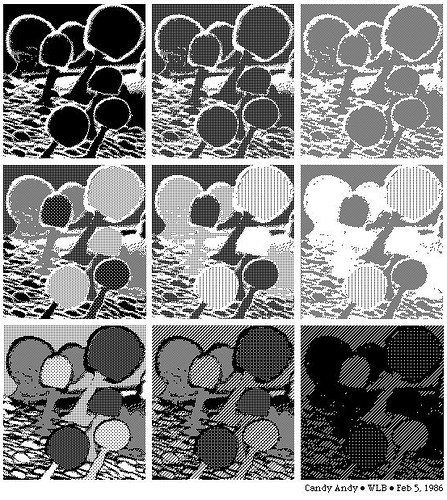
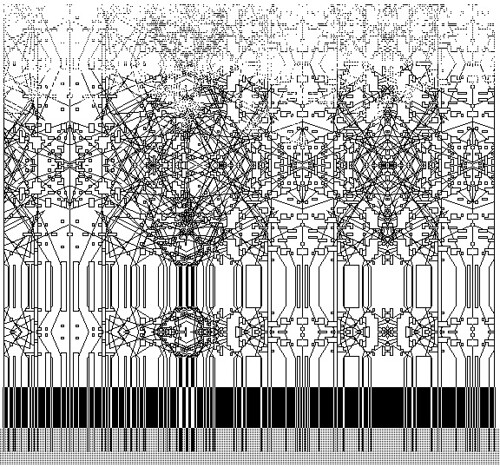
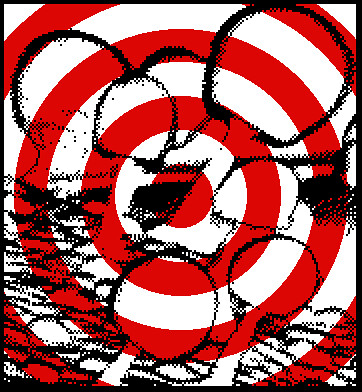
I was certainly away of Any Warhol, the soup cans, the Factory, being shot, Interview magazine, Studio 54, and so forth. I particularly remember a short article about him in a magazine targeted at users of the Amiga personal computer. Warhol had been given an Amiga to play around with its graphics capabilities. FWIW, I wasn’t impressed with the examples of what he did with it. I Here’s an image I did on my classic Macintosh computer; I call it “Candy Andy”:

It’s based on a photomicrograph of something or other. thought he was an important artist.

I’ve now watched two episodes of the six in the Netflix documentary, The Andy Warhol Diaries (2022). They’re bleak. Not sure I’ll finish the series.

Bruce Jackson, one of my teachers from SUNY Buffalo decades ago, has some remarks about them in First of the Month:

In March 2022, Netflix aired a six-part series, The Andy Warhol Diaries, based upon Pat Hackett’s 1989 book of the same title. Each episode was a hodge-podge of archival footage and photographs, current comments from people who were close to Warhol or who knew someone who was, recreated scenes, repeated current shots of places mentioned (such as Warhol’s house), and, throughout, an AI-generated version of Warhol’s voice, saying lines that almost never went beyond banal and trivial. Many also seemed familiar. I remembered that I’d read Hackett’s book when it came out and then had reviewed it for the Buffalo News (July 2, 1989). It was one of those pieces I did and promptly forgot, in part because the News arts editor mangled it, especially the ending, which he cut off after the first sentence of the final paragraph, so the piece just stopped rather than ended. I found the manuscript, which restores what I actually wrote.

The opening paragraph from Jackson’s 1989 review (which is reprinted in First of the Month):

The vampire has no mirror image; the Andy Warhol of The Andy Warhol Diaries (ed. Pat Hackett, New York: Warner Books, 1989) has no other. His primary interest is in being and having been seen; his life is defined and preserved in other people’s eyes. His triumphs are requests from strangers for autographs, and invitations to parties and any form of social recognition by the currently-famous or fabulously wealthy. Small wonder that even his diary was written by someone else.

Somewhere in the middle:

He was innocent of politics, literature, music, and he seems to have cared little for art—but he was vitally interested in how much the other guys were getting for their paintings. He was rich, but money was a constant obsession. “Some blacks recognized me a few times this weekend, and I’m trying to figure out what they recognize so I can somehow sell it to them, whatever it is” (3 July 1977). He voted once, but couldn’t figure out how to work the machine so he pulled the wrong lever; he never voted again because he didn’t want to be called for jury duty (16 July 1980). He considered himself a Democrat.

The final paragraph:

Things go sour about 1982, the year AIDS begins doing horrible things to many of Warhol’s beautiful people. He begins noting the “gay cancer” on 6 February 1982; the acronym “AIDS” first appears nearly a year later, on 28 January 1983. The other characters are as wealthy as ever, but they seem duller and meaner. Warhol still grinds out portraits and portfolios, but there’s a flatness to his life. He walks a street and no one asks for an autograph, he leaves a party and no photographer follows him outside, he learns of important parties days after they’ve taken place. We don’t know if the pretty world Warhol loved in the 1970s has disappeared or if it has just moved elsewhere, leaving him behind. But even without the fact of Warhol’s absurd death, there’s a feeling that something was over anyway.

For all that, he was, I believe, a significant artist.

Saturday, August 7, 2021

Rahsaan Roland Kirk, born August 7, 1935


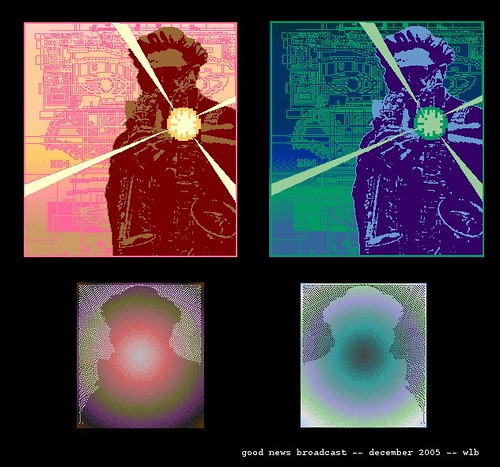
Bright Moments! Rahsaanovision, December 2005

* * * * *


See these posts:

Wednesday, October 10, 2018

Walter Murch on Collective Creativity [TALENT SEARCH]

When I decided that this week would be Talent Search Week I was hoping to have a new article for today. But I've gotten broadsided by other matters and have spent most of the day  putting out fires.  So I've decided to bump this up to the top of the queue. Walter Murch has won three Oscars, one for sound on Apocalypse Now and two for The English Patient, sound and editing.
Two summers ago I was working on a series of posts about Apocalypse Now. One day I got an email from one Walter Murch, a man I did not know. But I knew the name.

Could it be him?

The Walter Murch I was thinking of had gone to Johns Hopkins a couple of years before I had and, like me, had associated himself with Professor Richard Macksey. When this Walter Murch left Hopkins he went West and ended up in the film business, where he’d worked on a number of important films, including Apocalypse Now, for which he won an Academy Award (aka an Oscar) for sound.

Was this that Walter Murch? Yes, it was, and he liked what I was saying about Apocalypse Now. Since then we’ve carried on a casual and sporadic email correspondence.

Most recently we’ve been talking about the collective nature of movie making. By convention overall creative responsibility for a film is credited to the director, and for sufficient reason. The problem is, however, that our basic cultural model of creativity is one of individual creativity, and that does not do justice to any number of activities, from scientific laboratories, through basketball teams and ballet companies, the founding team of a high-tech start-up and, yes, a motion-picture production ensemble.

Walter sent me a passage from a 1994 journal entry:
Reading Penrose - the fact that billiards, which is the game usually given as an example of mechanical physics in deterministic practice, is not immune to vanishingly small initial conditions for the outcome of complex sequences • A line of 20 balls may be arranged in a zigzag such that each will hit the next in sequence when tapped by the cue ball. But exactly where the last ball will wind up after it is hit is subject to something as small as an intake of breath in the neighboring town. If there are 26 balls, a molecular disturbance in some neighboring galaxy will influence the outcome • Reminds me of my 'magic light' hypothesis of film: that film is the sensitive receptacle of everything that happens during the filming - what the assistant electrician had for breakfast, etc. - caught somehow, invisibly, in the amber of celluloid. In the future, people will be able to see this complex of interactions directly by shining a special ‘light’ through the film. It will look like some 5-dimensional moiré pattern, endlessly shifting, endlessly fascinating.
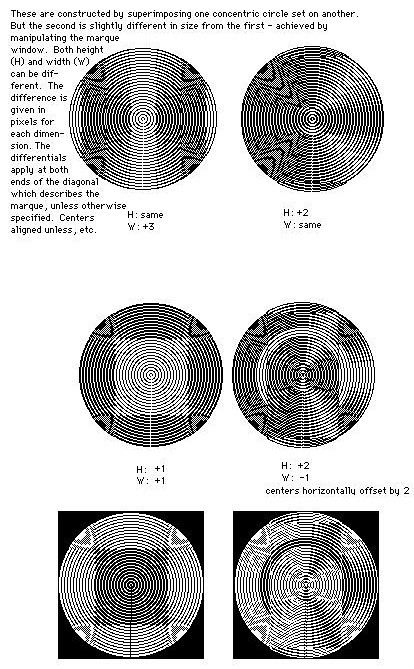
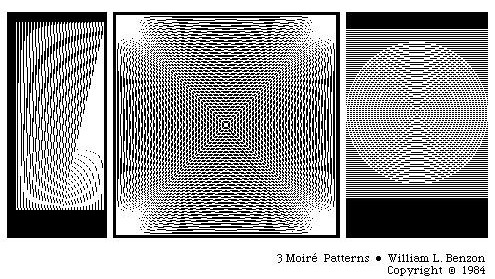
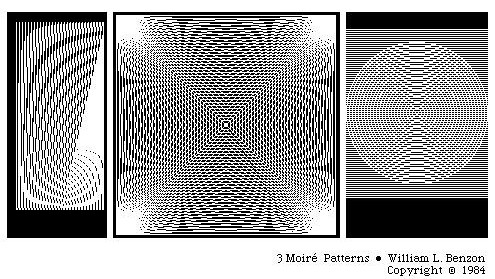
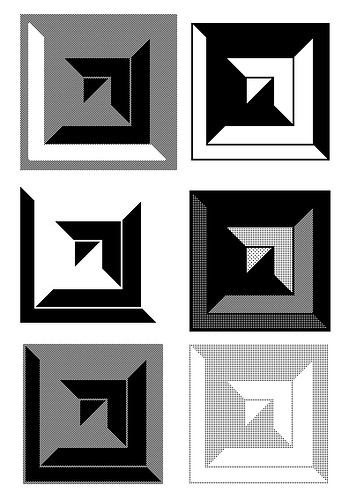
By Penrose I assume he meant Roger Penrose, a mathematician who had published a number of general interest books in the 1990s. You can find images of moiré patterns all over the place on the internet, or you can look below for some simple examples I ran up on my “classic” Mac back in 1985 or 86:

moire demo

Walter then went on to comment on his old journal entry:
What I meant by "Magic Light" is the discovery of some new force (Force 5) of nature, which has been with us all along but of which we are presently as ignorant as Newton was of electromagnetism. Using this new “force” as a beam, these hypothetical people of the future will transect our films and see - not the images which we see - but some fascinating interaction of all the people who worked on the film, in all its unexpected contingency, and this will be much more satisfying (to them) than the film itself. And it will be a wonder, to those future people, that we could accomplish this filmmaking without any knowledge of “Force 5”, which will be as crucial to them in their society as electromagnetism is to us today. As wondrous as is the construction of Gothic cathedrals to us today: we can hardly believe that our ancestors achieved these miracles with only human and (literal) horse power, and with no engineering textbooks.
And you could add: Duke Ellington and Shakespeare and the Egyptian Pyramids and many other things to this list.
Combining these two passages we get a sense of a film as a very compact “distillation“ of the diverse events surrounding and accompanying it. One might hazard the word “essence” but I fear it has too much of the wrong baggage associated with it. I’m a bit reminded of the JPEG compression for still images and the MPEG compression for video images. You “squeeze out” the redundancy and get a much more compact encapsulation of the information. Then, at playback, the redundancy is added back in and you see the full photograph or video image.

Walter goes on:
I think part of the mystery is that occasionally there is a balance of forces - what Koestler called the autonomy of the part and the wisdom of the whole - where the “part” (whatever it is) makes autonomous decisions that would be impossible for the theoretically guiding force (whatever that may be) to make. And that these decisions miraculously further the higher goal of the “organism” (Duke Ellington's sound, for instance: Duke did not have to tell each of his musicians exactly what to do at every moment) Similarly, if everything that is done on a film had to be expressed in “machine code” (e.g. “turn thirty degrees to the left and cock your right eyebrow”) the film would never get off the ground. People talk about this happening in sports, in battle, in every communal undertaking in fact. It is the human equivalent of the miraculous (to us) ability of fishes and birds to swim/fly in formation and all turn, repeatedly, at exactly the same moment, as if the school/flock were a single organism.
And when we've understood –mathematically, neurally–the nature of that coupling that makes of many ONE, then we will be on the threshold of a deeper understanding of  not only OUR nature, but perhaps of life itself.

Some time ago I read an interview with Jack Welch, then CEO of General Electric, who talked about how he and his colleagues in the executive suite could communicate in “code.” Through years of working together they could speak volumes in very terse ways because their shared experience gave them, well, a code that was meaningful among them but not necessarily to anyone else.

Yes, there are lone creative “geniuses” but I suspect there are fewer of those than we imagine. Creativity needs community and communities breed creativity, or can do so under the right circumstances. We have only just begun to understand such matters.

Monday, September 10, 2018

Generative art (i.e. made via computer)

candy_andy.jpg
Jason Baily, Why Love generative Art? Artnome, August 26, 2018. Go there and look at the pictures.
Over the last 50 years, our world has turned digital at breakneck speed. No art form has captured this transitional time period - our time period - better than generative art. Generative art takes full advantage of everything that computing has to offer, producing elegant and compelling artworks that extend the same principles and goals artists have pursued from the inception of modern art.

Geometry, abstraction, and chance are important themes not just for generative art, but for all art of 20th Century. As an art historian and an amateur generative artist, I see a clear line of influence on generative art starting from Cézanne and shooting straight through to the:
  • Fracturing of geometry in Analytical Cubism
  • Emphasis on technology, machine aesthetic, and mechanized production from Futurism, Constructivism, and the Bauhaus
  • Introduction of autonomy and chance in Dada, Surrealism, Abstract Expressionism
  • Anti-figurative aesthetic, bold geometry, and intense color of Neoplasticism, Suprematism, Hard-edged Abstraction, and OpArt
  • Use of algorithms by Sol Lewitt and others
Two myths:
Myth One: The artist has complete control and the code is always executed exactly as written. Therefore, generative art lacks the elements of chance, accident, discovery, and spontaneity that often makes art great, if not at least human and approachable.

Myth Two: The artist has zero control and the autonomous machine is randomly generating the designs. The computer is making the art and the human deserves no credit, as it is not really art.

The truth is that generative artists skillfully control both the magnitude and the locations of randomness introduced into the artwork.
Etc etc etc etc etc etc etc...
    Etc etc etc etc etc etc etc...
        Etc etc etc etc etc etc etc...
            Etc etc etc etc etc etc etc...
                .............................
In summary, let’s take a look back at what we have learned:
  • Generative art is an extension of central themes from 20th Century art
  • The artists play a major role in the outcome of the work
  • The process is very similar to traditional artmaking
  • Generative art has its own rich history going back to 1960
  • Women have played and continue to play major roles in this genre
  • MIT has been an incubator for brilliant generative artists
  • In the last two decades the genre has exploded as a result of the open source movement, improved tools like Processing, and a supportive community
  • AI art using GANs, Pix to Pix, and DensePose is a subgenre of generative art
  • As with all generative art, AI art is largely driven by human guidance
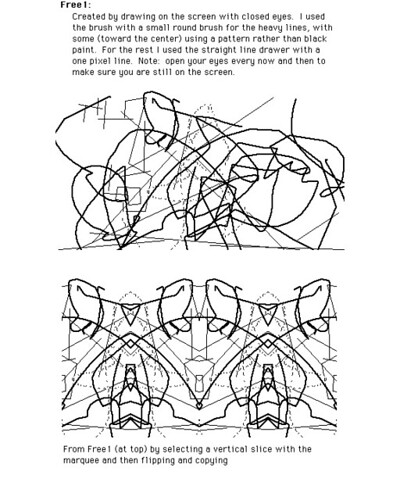
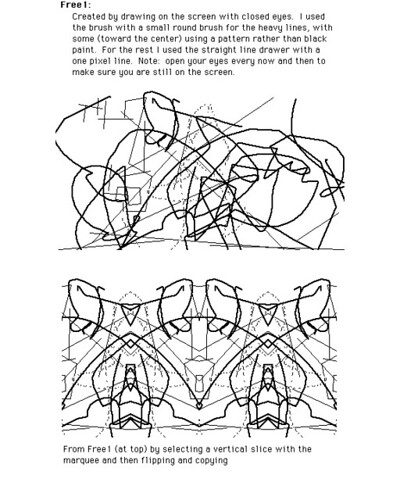
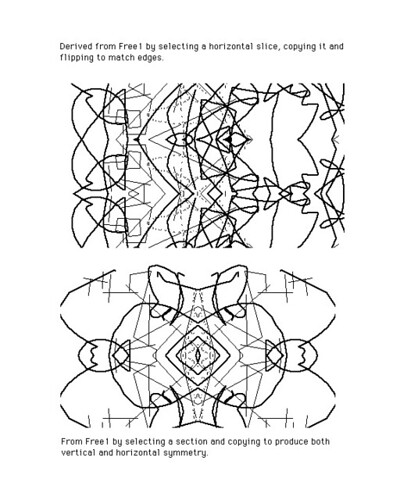
Free - Vertical Slice

Tuesday, November 21, 2017

Intersection of the Worlds Realized in Two Media

I've been digging out old MacPaint images over in Twitter, so I thought I'd bump this to the top of the queue.
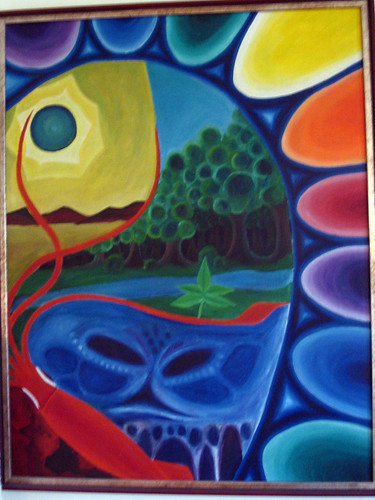
This is a slightly off-angle photograph of a painting I did in the summer of 1981:

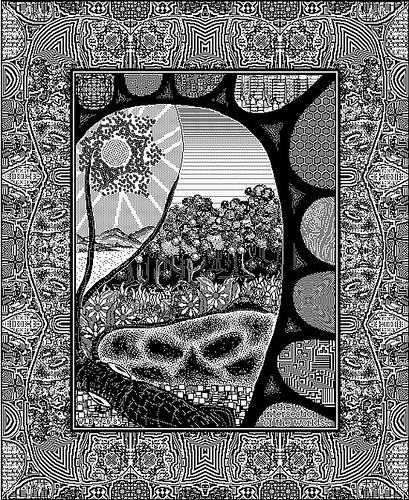
3worlds_oil

When I started it I had a simple formal problem in mind, to do a painting that used a full range of colors. Id been doing paintings that leaned toward blues and reds and paintings that leaned toward blues and greens, but none that had all three in prominent use. That was the problem I started with in that painting. I approached it right off the bat by painting that rainbow arc of color patches across the top and right side. I then filled in the rest with appropriate imagery. Note the three worlds separated by the squid's tentacles: the yellow sky with the bluish sun, the forest with blue sky and stream, and the underwater scene with the strange ET-like face.

A couple years later I got a Macintosh and decided to realize that same image in the very limited medium of MacPaint, which gave me only white dots and black dots, no grays, much less color. Here's the final image:

3W7 framed

Monday, November 13, 2017

My 1985 Visualization Manifesto: The Visual Mind and the Macintosh [#DH #Visualization]

Sometime in 1984 my friend Rich sent me a letter he had written on someone’s Macintosh computer. I forget what it said, and that doesn’t matter. What matters is that it had graphics and text on the same page from the same machine. I was blown away.

I immediately forked out, I believe, $4400 for one of those original Macs, I may even have gotten one of the first 100,000. That 4K got me a Mac, an external floppy drive, a dot matrix printer, and a carrying case. I took me awhile to get used to the mouse, but I loved it. And I loved making images.

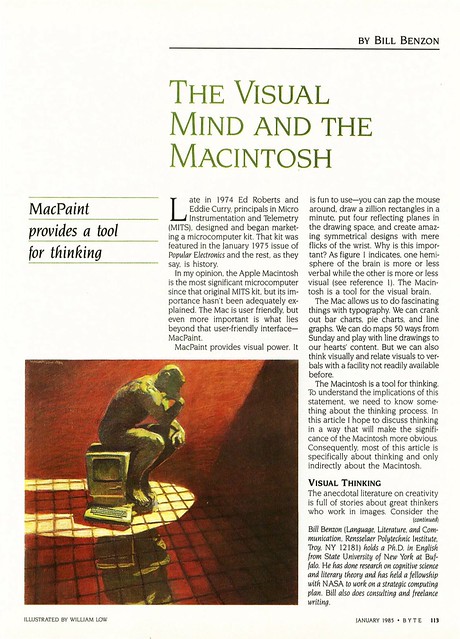
Meanwhile I’d been reading reviews that said, nice box, not enough oomph for the $$, MacPaint’s nice, but so what? Those blockheads obviously didn’t get it. So I wrote a longish letter to Byte Magazine, then perhaps the premier magazine for personal computing, in which I said those guys were wrong because, Visual Thinking.

The good folks at Byte loved the letter, but said it was too long to print as a letter and not long enough for an article. I proposed to 1) edit it down to letter size and 2) to expand it to an article. They accepted my proposal. The article included a bunch of images I prepared on my Mac and was entitled “The Visual Mind and the Macintosh” and appeared in Vol. 10, No. 1, January 1985, pp. 113-130. Here’s the first page:

BYTE_VisMindMac FirstPage

And here’s one of the images:
Moire Trio

Alas, the rest of the images are lost to me as a result of changes in the operating system. I don’t even know if I’ve got them kicking around somewhere on my hard drive. Of course, they originally lived on a 3 1/4 inch floppy disk, but I transferred most/all of those to my hard drive when I got one sometime in the 1990s. But then Apple switched to Intel chips and I lost access to a bunch of files.

Monday, June 26, 2017

Mathematics, Computing, and the Literary Mind

As some of you know, Willard McCarty has been hosting an informal online seminar on the digital humanities since 1987. One topic that comes and goes is the question of whether or not computing has more to offer the humanist than a set of practical tools. Could computing offer us a way of thinking about how the objects and processes of humanistic inquiry actually function? This topic has reappeared once again and I've decided to offer my two cents. Here's the note I posted to the seminar.

Moire Trio

Dear Willard et al.,

This business – mathematics & computing and what they offer humanists other than tools – is something I've been thinking about, off and on, since the late 1960s. Back then I wasn't interested in practical tools (for making a concordance, or stylometrics, or whatever), I was interested in thinking about how the mind worked. Of course lots of thinkers have pursued that line over the years, and while it's produced its share of nonsense, I don't think that should discredit the whole line of investigation, which is hardly unified and is still very much open-ended.

As far as I know the nature of computation is itself still very much under investigation. And I figure that literary studies (my particular corner of the humanities) may well have contributions to make. That is, understanding the computational properties of the literary mind is NOT (going to be) a matter of taking some existing ensemble of computational processes and fitting them to one text after another. Rather, we – someone – is going to have to create appropriate computational procedures.

Just how we – someone – get there from here, that's way beyond the scope of an email note, nor would I be able to chart a course given whatever scope I please. But I think we have to start with literary form and we must learn how to describe it.

I've got some general notes on this in a working paper, Description 3: The Primacy of Visualization: https://www.academia.edu/16835585/Description_3_The_Primacy_of_Visualization

Here's a somewhat more polished account (though unpublished): Sharing Experience: Computation, Form, and Meaning in the Work of Literature: https://www.academia.edu/28764246/Sharing_Experience_Computation_Form_and_Meaning_in_the_Work_of_Literature

Some years ago I engaged in extensive correspondence with Mary Douglas, the anthropologist, and she got me interested in ring-composition. Texts with the form:

A, B, C...X, C', B', A

Why ring-composition? 1) Because it "smells" like something that requires a computational account. 2) It's something definite one can look for in a text. 3) Identifying and describing ring-composition in texts doesn't require any esoteric knowledge. But it does require the sort of feel for the phenomenon that comes only from paying close attention to texts.

Douglas has published short book on the subject (her last), based on a series of lectures she delivered at Yale: Thinking in Circles: An Essay on Ring Composition (Yale 2007). There's a chapter where she lists a set of identifying features of ring-composition.

I've produced a handful of working papers in which I describe ring-composition in a variety of texts. You can find those listed here: https://independent.academia.edu/BillBenzon/Ring-Composition

If you're interested in reading around in that material, you might start with, Ring Composition: Some Notes on a Particular Literary Morphology: https://www.academia.edu/8529105/Ring_Composition_Some_Notes_on_a_Particular_Literary_Morphology

One of the things I do in that working paper is gloss Douglas's diagnostic features as being aspects of a computational process.

Finally, it's worth remembering that ordinary arithmetic (which is fairly important in the theory of computation) is, after all, a linguistic process. The symbol set is highly restricted, as is the set of rules for its use (both sets are finite); but it is a creature of language.

Best,

Bill Benzon

Friday, December 20, 2013

Warhol Variations 2

There's an obvious similarity between these images and the earlier Warhol Variations I'd posted. They are derived from the same source material.

self-similar, 3 layers

I don't recall the order in which I did what, but the general idea is to build an image in layers using differen sized versions of the same source in each layer. The above image has three layers, so the source material is used at three different scales. This image only has two layers:

Friday, December 13, 2013

Portrait of the Mind as an Artificial Enigma

imagine_that.jpg
Imagine That – MacPaint digital image, 1985

reality engine subassembly 764 BSQT 77.jpg
Inside a MacIntosh Computer – Inhanced Digital Photograph, 2006

walkway along the hudson RGB 2nd mix.jpg
Along the Waterfront –Enhanced Digital Photograph, 2007

Monday, December 9, 2013

Warhol Variations & the evolution of Macintosh graphics over 20 years

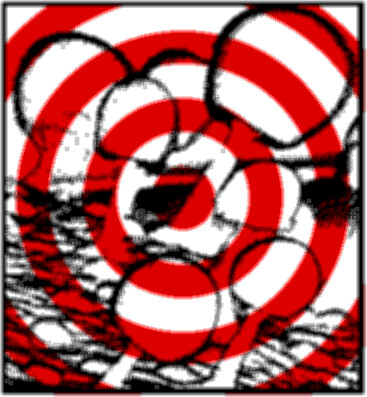
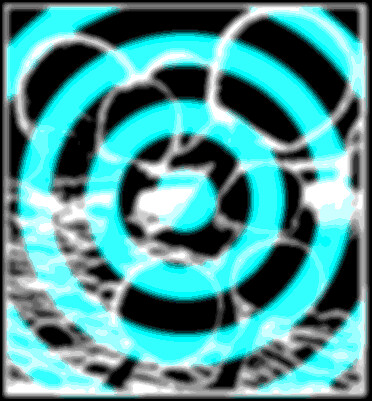
The Warhol, of course, is Andy Warhol. And the influence should be obvious, even if the tools are not. He used silkscreen printing to produce various versions, often brightly colored, of the same source image, often a famous person, such as Marilyn Monroe or Mao Tse-Tung. My source, which I'll reveal shortly, was somewhat different, as should be apparent in the image itself.

candy_andy.jpg

And I didn't have color available to me. I did that in MacPaint back in 1986. All I had to work with was a rather coarse bitmap that gave me either white, or black, but nothing in between. So I had to substitute texture for color in order to produce the requisite variations.