Showing posts with label cog poetics. Show all posts

Monday, February 27, 2023

Faculty psychology and the will [cognitive science meets history of ideas]

This is a section from my article, Cognitive Networks and Literary Semantics. It's a bit crippled without the context provided by that article. It refers to "nodes" and "on-blocks" and "sensorimotor schema" and other things, all of which are explained in previous sections of the article. But still, you should be able to get the general idea.

The article refers here and there to the following figure: Commonsense Think. Click on the image to embigen.

* * * * *

The notion that man consists of three souls (or a single soul which is tripartite) and a body is deeply embedded in our own intellectual tradition. In Primitive Man the Philosopher (New York: Dover, 1957), Paul Radin has shown that the Oglala Sioux, the Masai, and the Batak of Sumatra also believe that man consists of three souls and a body (pp. 257-74). He goes on to suggest that such a belief may well be a cultural universal. It may or it may not be, but the fact that similar theories appear on four continents (North America, Europe, Africa, Asia) suggests that the task those theories perform, an account of human nature, is highly constrained.

I am presently entertaining the hypothesis that such a theory is an attempt by the cognitive network to explain the relationship between the SELF node and the rest of the nervous system. If one believes (and that is all it is, a matter of what one believes) the soul to be tripartite, then the SELF has two components, a body and a soul which is tripartite, with rational, sensitive, and vegetative sub- divisions. If one prefers to believe that one has three souls, then the SELF has three soul components and one body component, four components in sum.

The peripheral nervous system has two divisions, the somatic and the autonomic. The somatic system mediates voluntary control of the skeletal muscles and the activities of vision, hearing, touch, etc. The autonomic system regulates breathing, heart beat, digestion, the control of temperature, etc. Any episode which represents a transaction between the cognitive network and a sensorimotor schema whose intensities (first order input functions) are of somatic (perhaps just somatic motor) origin is cognized as being done by the body. The vegetative soul is cognized as the agent responsible for transactions between the network and sensorimotor schemas whose intensities are of autonomic origin. Episodes (which, you will recall, are conscious) in which one runs, jumps, spears hunks of meat, etc. are executed by the body. Episodes in which one feels hunger, lust, cold, thirst, etc. are cognized as being felt by the vegetative soul.

Responsibility for episodes of on-blocks is assigned to the sensitive soul. An on-block in which the condition is autonomic and the act to be executed is somatic (such as Figure 4) is a motivational on-block. Lust is the motivation behind seeking out another person, hunger is the motivation behind seeking out food. If the condition is somatic and the act is autonomic and perhaps somatic as well, then the on-block is emotive. One sees a bear (autonomic) and adrenaline is pumped into the bloodstream (autonomic) and one runs away (somatic).

Episodes of (commonsense) thinking are attributed to the rational soul. Since the actual process of thinking (the commonsense notion) is carried out by the abstraction system (Figure 5), the rational soul is simply a first order copy of the second order network's regulation of the interaction between the semantic and the syntactic networks.

The entire activity of the network is thinking, where "thought" is a technical term in a theory about the functioning of the brain. Since the souls are defined over the channel structure of cognitive episodes (autonomic, somatic, semantic, and syntactic are the channels), it follows that any cognitive use of these concepts is thinking about thought (technical sense). In The Growth of Logical Thinking (Basic Books, 1958) Bärbel Inhelder and Jean Piaget assert that the child isn't able to think about thinking until adolescence. Consequently the child can't really acquire the structures of those souls until adolescence. In fact, since all abstract concepts involve thinking about thought (pattern matching over episodes), it follows that abstractions aren't really learned until adolescence.

It turns out that the system is capable of constructing accounts of abstract concepts which can be represented entirely within the first order network. Courage, an abstract concept, might be handled like this: Courage is when someone does something which is dangerous to himself and which is important when he could easily avoid doing it at all. The child could learn such a rationalization without the aid of a fully developed abstraction system, but his understanding of the concept would be rather shallow and inflexible. Since the nodes in the abstraction system cannot be provided with names, it follows that we can only communicate directly about rationalizations. The processing of a rationalization into a real abstract definition, involving the operation of the abstraction system on episodes, is internalization, just as the processing of episodes into systemic concepts is (see above). The intuitive part of any intellectual enterprise is likely to reflect the operation of the abstraction system in using its abstract schemas. The difficult work of giving verbal form to those intuitions by constructing first order accounts of the abstract concepts is rationalization. Faculty psychology is a rationalization of the activity of the nervous system.

In the Elizabethan rationalization of the nervous system spirit was introduced as a tertium quid between the material body and the immaterial soul(s). The rational soul exerted control over the body through the intellectual spirit or spirits; the sensitive soul worked through the animal spirit; and the vegetative soul worked through the vital spirit. Madness could be rationalized as the loss of intellectual spirit which causes a situation in which the rational soul can no longer control the body. The body is consequently under control by man's lower nature, the sensitive and vegetative souls. Such a rationalization is perfectly respectable and, in its own limited way, not inaccurate. But it hardly constitutes a scientific theory of madness. A scientific theory of madness would have to be constructed in terms of conflict and contradiction within the control system; it might well be that, within such a theory, the SELF system (three souls, body and SELF node) is responsible for much of the conflict.

Getting back to the Elizabethan rationalization, the loss of control by the intellectual soul cripples the Will, one of the faculties lodged in the rational soul. A complex concept node can he aroused when a lexeme which names it has been detected in a speech signal or when the abstract schema which defines it has been aroused by some episode which is an instance of the concept. When excitation travels from the SELF node, along a component (CMP) arc to one of the souls or to the body and hence to an episode which the system proceeds to execute, that episode has been willed by the SELF. When excitation travels in the opposite direction, from episode to the body node or to one of the soul nodes and then up a CMP arc to the SELF node, the SELF is being done unto, it is not willing the episode currently in consciousness. An episode of hunger appears, the abstraction systems arouses the vegetative soul node and excitation travels from there to the SELF node, SELF is hungry, SELF is subject to hunger-for the SELF has not willed the excitation of the hunger episode. On hunger, one must find food. Excitation travels from the SELF node to the sensitive soul node and the body node and hence to an episode structure which contains a plan in which the sensitive soul controls the body in a search for food. That search is willed, for the excitation which resulted in the execution of a search episode started with the SELF node.

Notice that think, the process carried out by the rational soul, is defined in such a way that any thought (commonsense) about hunger or searching for food is registered as an episode in the rational soul. That is as it should be; for we can see, with the aid of cognitive network theory, that the souls of faculty psychology are all abstract concepts constructed in the cognitive network by the abstraction system. The concepts of the body, the vegetative soul, the sensitive soul, and the rational soul are all constructed of the same stuff-nodes and arcs realized in neural tissue. The system which operates in terms of those concepts sees them as very different things, for they have different definitions. But that system of thought was not sophisticated enough to construct rationalizations asserting that all the faculties are abstract concepts in a cognitive network. Cognitive network theory makes it possible to construct accounts of the souls in such a way that we can begin to examine the way in which the system's rationalized account of the interaction between the SELF node and the rest of the nervous system affects and effects the integrated activity of that entire nervous system.

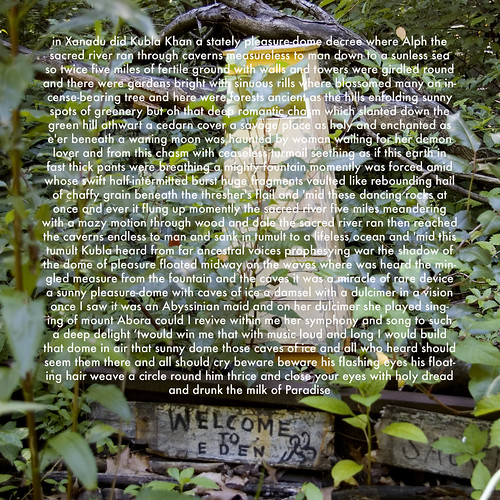
Saturday, January 21, 2023

Let’s give ChatGPT another crack at “Kubla Khan.”

One of the first things I did when I started playing with ChatGPT is have it parody “Kubla Khan.” I’ve reported some of that session here. I also asked it about the poem’s imprint on pop culture, including Orson Welles and Olivia Newton-John, Ted Nelson’s Project Xanadu, and even the historical site of the original Xanadu, all of which it knew about. But that’s not what this post is about.

It's about ChatGPT’s ability as a parodist.

Write a new poem based on “Kubla Khan” where “Kubla Khan” is changed to “Johnnie’s Mom.”

In Johnnie's Mom's stately pleasure dome
Decreed by her will, with walls and towers girt round,
Where Alph, the sacred river, ran
Through caverns measureless to man,
Down to a sunless sea.

So twice five miles of fertile ground
With walls and towers were girt round:
And there were gardens bright with sinuous rills,
Where blossomed many an incense-bearing tree;
And here were forests ancient as the hills, Enfolding sunny spots of greenery.

But oh! that deep romantic chasm which slanted
Down the green hill athwart a cedarn cover!
A savage place! as holy and enchanted
As e'er beneath a waning moon was haunted
By woman wailing for her demon-lover!

At that point I stopped it from generating any more. The opening two lines are a mess and the rest is a word-for-word repeat of the original. I decided I’d give it another chance.

Write a new poem based on “Kubla Khan” with the following first line: “In Timbuktu did a prince named John.” Make any other changes you think are necessary.

In Timbuktu did a prince named John
A palace build of gold and stone
With gardens bright and rivers run
And in its halls, a throne

He called to all the world to see
This marvel of his hand
And travelers came from far and wide
To witness the grand

But in the night, the prince did dream
Of a greater palace still
With walls of pearl, and turrets high
On a verdant hill

And in his dream, he heard the sound
Of a distant, mystic sea
And when he woke, he knew with haste
He must that palace be

And so he set out on a quest
To find that fabled land
And though he searched for many years
He never found its strand

But still the memory of that dream
Remained with him, alway
And in his heart, the palace stood
In Timbuktu, to this day.

That’s much better. Notice how I changed the prompt. I gave it a whole first line, to prevent the previous debacle, and I gave it permission to make any other changes it wished to make. I suppose I should go back and see what would happen if it gave it two different prompts, each with only one of those changes. You see why I want to do that no?

Like this:

Write a new poem based on “Kubla Khan” with the following first line: “In Timbuktu did a prince named John.”

Or this:

Write a new poem based on “Kubla Khan” where “Xanadu” becomes “Timbuktu” and “Kubla Khan” becomes “a prince named John.” Make any other changes you think are necessary.

I’m guessing the second prompt would produce better results than the first, but I don’t actually know.

Later.

Thursday, September 8, 2022

Some Thoughts on the Discipline [Literary Criticism]

I'm bumping this to the top of the queue on general principle – and – to remind myself that, to the extent that I have a home discipline, it is the study of literature. I originally published this in October of 2015. I've written considerably more about literary study since then.
* * * * *
 
It appears that I’ll be publishing a working paper on the profession of academic literary criticism sometime in the next week or three, depending on what other projects I’m working on. This is a topic I’ve written quite a bit on, so much that it seemed to me that there should be a section in that working paper that serves as a guide to much, if not quite all, of that work.

This is a trial run on that section. As such it is a lightly annotated bibliography, where the annotations mostly consist of the abstracts I prepared for each working paper. I’ve divided them into four sections: Bridges, Description, Psychology, and Computational Criticism.

Bridges


How you get from here to there. The first one is how you get (how I got) from Lévi-Strauss’s practical work on myth to cognitive science. The second one seeks to justify the ways of literature and of humanists to Steven Pinker. The third places my conception of (the potentialities of) literary criticism in the context of Bruno Latour’s actor networks and his modes of being.

* *

Beyond Lévi-Strauss on Myth: Objectification, Computation, and Cognition (2015) 30 pp.

Abstract: This is a series of informal notes on the structuralist method Lévi-Strauss used in Mythologiques. What’s essential to the method is to treat narratives in comparison with one another rather than in isolation. By analyzing and describing ensembles of narratives, Lévi-Strauss was able to indicate mental “deep structures.” In this comparing Lévi-Strauss was able to see more than he could explain. I extend the method to Robert Greene’s Pandosto, Shakespeare’s The Winter’s Tale, and Brontë’s Wuthering Heights. I discuss how Lévi-Strauss was looking for a way to objectify mental structures, but failed; and I suggest that the notion of computation will be central to any effort that goes beyond what Lévi-Strauss did. I conclude by showing how work on Coleridge’s “Kubla Khan” finally led me beyond the limitations of structuralism and into cognitive science.

* *

An Open Letter to Steven Pinker: The Importance of Stories and the Nature of Literary Criticism (2015) 20 pp.

Abstract: People in oral cultures tell stories as a source of mutual knowledge in the game theory sense (think: “The Emperor Has No Clothes”) on matters they cannot talk about either because they resist explicit expository formulation or because they are embarrassing and anxiety provoking. The communal story is thus a source of shared value and mutual affirmation. And the academic profession of literary criticism came to see itself as a repository of that shared value. Accordingly, in the middle of the 20th century it turned toward interpretation as its central activity. But critics could not agree on interpretations and that precipitated a crisis that led to Theory. The crisis has quited down, but is not resolved.

* *

Literary Criticism 21: Academic Literary Study in a Pluralist World, Revised September 2014 (2014) 42 pp.

Abstract: At the most abstract philosophical level the cosmos is best conceptualized as containing various Realms of Being interacting with one another. Each Realm contains a broad class of objects sharing the same general body of processes and laws. In such a conception the human world consists of many different Realms of Being, with more emerging as human cultures become more sophisticated and internally differentiated. Common Sense knowledge forms one Realm while Literary experience is another. Being immersed in a literary work is not at all the same as going about one's daily life. Formal Literary Criticism is yet another Realm, distinct from both Common Sense and Literary Experience. Literary Criticism is in the process of differentiating into two different Realms, that of Ethical Criticism, concerned with matters of value, and that of Naturalist Criticism, concerned with the objective study of psychological, social, and historical processes.

Description


The description of literary form is the foundation of a revivified literary criticism. But description as I’ve come to understand it, both from doing and from theorizing about it, is more subtle and difficult that traditional criticism warrants. It is also more important, far more important. Without four centuries of painstaking naturalistic description available to him, Darwin would have had no empirical basis for his work. That’s where literary criticism is now: Lacking careful and detailed descriptions of the texts we’re entrusted with, we lack the basis for objective accounts of textual phenomena. Producing these descriptions should be a prime intellectual priority.

* *

Description as Intellectual Craft in the Study of Literature (2013) 33 pp. https://www.academia.edu/4262467/Description_as_Intellectual_Craft_in_the_Study_of_Literature

Abstract: This is a series of notes in which I argue that better descriptive methods are a necessary precondition for more sophisticated and objective literary criticism. Description, though it does not give unmediated access to texts, requires methods for objectifying texts, methods which must be discovered in the doing. By way of comparison I discuss the role of description in biology and I discuss the use of images and diagrams as descriptive devices. Lévi-Strauss on myth and Franco Moretti on distant reading, though quite different, are up to the same thing: objectification.

* *

Description 2: The Primacy of the Text (2013) 41 pp. https://www.academia.edu/4866743/Description_2_The_Primacy_of_the_Text

Abstract: These notes consist of five posts discussing the description of literary texts and films and five appendices containing tables used in describing to manga texts (Lost World, Metropolis) and two films (Sita Sings the Blues, Ghost in the Shell 2: Innocence). The posts make the point that the point of description is to let the texts speak for themselves. Further, it is through descriptions that the texts enter intellectual discourse.

* *

Description 3: The Primacy of Visualization (2015) 48 pp. https://www.academia.edu/16835585/Description_3_The_Primacy_of_Visualization

Abstract: Describing literary texts requires a mode of thought distinct from the discursive interpretation of them. It is a mode of thought in which various visual devices are central. These devices include: tables, trees and mental spaces, directed graphs and “sketchpads”. Visualization facilitates the objectification of literary form and objectification is necessary for objectivity. With objectivity comes the possibility of cumulative knowledge.

Wednesday, May 11, 2022

Symbols and Nets: Calculating Meaning in “Kubla Khan”

A new working paper. Title above, abstract, table of contents, and introduction below. Download at: Academia.edu: https://www.academia.edu/78967114/Symbols_and_Nets_Calculating_Meaning_in_Kubla_Khan_
SSRN: http://ssrn.com/abstract=4106687
ResearchGate: https://www.researchgate.net/publication/360525548_Symbols_and_Nets_Calculating_Meaning_in_Kubla_Khan 

* * * * * 

Abstract: This is a dialog between a Naturalist Literary Critic and a Sympathetic Techno-Wizard about the interaction of symbols and neural nets in understanding “Kubla Khan,” which has an extraordinary structure. Each of two parts is like a matryoshka doll nested three deep, with the last line of the first part being repeated in the middle of the second. They start talking about traditional symbol processing, with addressable memory, and nested loops, and end up talking about a pair of interlinked neural nets where one (language forms) is used to index the other (meaning). 

In search of “Kubla Khan” 2
Fee fi fo fum, I smell computation 4
Calculating over symbols 8
Calculating over a neural net 10
Two linked networks in the mesh 14
Speculative Engineering: A postscript on method 17
Appendix 1: The text of “Kubla Khan” 18
Appendix 2: Rhyme and sense in the first part of “Kubla Khan” 20
Appendix 3: My Work on Coleridge 21 

 * * * * *   

Symbols and Nets  

...At this moment he was unfortunately called out by a person on business from Porlock, and detained by him above an hour, and on his return to his room, found, to his no small surprise and mortification, that though he still retained some vague and dim recollection of the general purport of the vision, yet, with the exception of some eight or ten scattered lines and images, all the rest had passed away like the images on the surface of a stream into which a stone has been cast, but, alas! without the after restoration of the latter!
– Samuel Taylor Coleridge, Preface to “Kubla Khan” 

 In search of “Kubla Khan”

This dialog marks progress in my third attempt to comprehend the structure of Coleridge’s “Kubla Khan.” My 1972 Master’s Thesis marks my first attempt: “THE ARTICULATED VISION: Coleridge's ‘Kubla Khan’”. I read everything I could find about the poem in the Johns Hopkins library. Two essays held my attention. The one by Humphrey House, from his Clarke Lectures, pointed out that no one would ever have thought the poem incomplete without Coleridge’s preface. In the other one, “’Kubla Khan,’ Proto-Surrealist Poem,” Kenneth Burke argued that the poem so defied Coleridge's aesthetic theories that he did not know what to make of it, arguing that it was a ”poetized psychology.”

I updated my thesis work with a 1988 essay I published in Language and Style, “Articulate Vision: A Structuralist Reading of ‘Kubla Khan’.” I tossed out some of the philosophical language and updated it with some cognitive network diagrams, but it was fundamentally the same work. It was an analysis of the poem’s utterly remarkable structure, a structure which no one had seen despit all the attention that had been given to the poem.

Though I hadn’t realized it at the time, that thesis marked my break from what I now think of as standard literary criticism, which centers on interpreting a text’s meaning. I focused on the text’s form and used meaning as a way to examine form. Whereas the profession had moved beyond structuralism to various post-structuralisms, I had moved beyond it to the cognitive sciences. But I branded my essay “structuralist” both to signal its intellectual roots and as a touchstone literary critics could recognize.

Decades passed until, early in the new millenium, I took another pass at “Kubla Khan.” I published “’Kubla Khan’ and the Embodied Mind,” PsyArt: A Hyperlink Journal for the Psychological Study of the Arts (2003). This was considerably longer than my 1988 article, more prose and many more diagrams, and a section where I speculated on the neural underpinnings of the poem. But I remained focused on the structure I had identified in my 1972 thesis, and which my interlocutors examine in the first section of their dialogue below, “I smell computation.”

I paired that with a later essay, “Talking with Nature in ‘This Lime-Tree Bower My Prison,’” PsyArt, November (2004). That poem has a motif, gazing upon the sun, which is closely related to the “sunny dome” of “Kubla Khan” and a glimpse into a “still roaring dell” that resonates with the “deep romantic chasm” of “Kubla Khan.” A decade later I discussed these conjunctions in an unpublished working paper, “STC, Poetic Form, and a Glimpse of the Mind” (2013) – where “unpublished” means not published in the formal academic literature; but I posted it online, as I have this dialog.

At that time I thought perhaps I had gone as far as I could with Coleridge. There was certainly more to be done, but I couldn’t see how to do it. And the I began reading about machine learning and artificial neural nets, which set me to thinking. In December, 2017, I issued a working paper, “Calculating meaning in ‘Kubla Khan, – a rough cut,” Version 2. Here’s how I characterize calcuation (pp. 2-3):

Roughly speaking then, to calculate the meaning of a text is to construct a coherent pattern of signifieds as prompted by the that text. [...] I assume this process involves both composition and convolution. Composition is the primary process and for many texts it may be the only process. I sometimes think of composition as “the freight train” model of meaning, where meanings are discrete entities, each of which is packed into a freight car, and the cars assembled into a train. In fact, nothing in a relational network functions like this, but it will serve as a crude metaphor to underpin the following discussion.

Here is how I characterize convolution (p. 5):

Still, what do I mean by convolve? I’m going to tap-dance through this one. Some years ago David Hays and I published a paper on metaphor, “Metaphor, Recognition, and Neural Process” [7], in which we argued that ‘robust’ metaphor (as opposed to ‘dead’ metaphor) works by convolving the tenor and the vehicle. At the time we were influenced by Karl Pribram’s notion of neural holography, which we explain (somewhat) in the paper. Note that neural tissue is active tissue. Individual neurons are always active, but more so at some times than others. Convolution is thus a process involving the interaction of meshworks of neurons, perhaps arranged in a specific architecture.

Convolution is a very important operation in the world of artificial neural nets, used mostly for processing images. But then, “Kubla Khan” conjures up rich visual imagery.

Thus began my third attempt to understand the mechanisms behind “Kubla Khan.” This dialog continues that attempt. I have created two interlocutors, a Naturalist Literary Critic (NLC) and a Sympathetic Techno-Wizard (STW). I conceive of this Naturalist Literary Critic as one who examines literary works in the way that a naturalist examines life forms. I first explained my conception in a long post at The Valve in 2010, which is now defunct. It’s now on New Savanna, “’NATURALIST’ criticism, NOT ‘cognitive’ NOT ‘Darwinian’ – A Quasi-Manifesto”. Nor, I might add, is it formalist, Marxist, deconstructionist, feminist, or any other form of interpretive criticism. It is, if you will, post-interpretive.

As for the Sympathetic Techno-Wizard, they’re expert in various forms of natural language processing, machine learning, and artificial intelligence, which I am not, except for my early-career adventure into Old School computational semantics. Nonetheless, as I alone am writing this dialog, I have to play the role of STW, which implies that they say what I want/need them to say. One of my major intellectual goals is to take a topic that has resisted technical development and transmute it into a form where it is accessible to investigators who have technical skills that I lack. That has been one motive driving my work on “Kubla Khan” from the very beginning. I offer this dialog in the hope that some real techno-wizards will read it and take me up on it.

Sunday, October 4, 2020

Jakobson’s Poetic Function and Textual Closure

I'm bumping this to the top of the queue, 1) on general principle, and 2) because, with almost 2900 reads, it seems to be unusually popular for a quasi-technical post on literary form. It was originally published on 12.25.2017.
Roman Jakobson’s poetic function [1] is one of the best-known and most obscure ideas in modern poetics. I believe that it extends beyond the kinds of examples Jakobson himself gave, to include, for example, ring-form narratives. It may as well be considered a computational principle applying to texts considered as strings of word forms.

Literary Form

Two years ago Sandra MacPherson wrote [2] that she's looking for “for a genuinely formalist critical practice, a little formalism that would turn one away from history without shame or apology” (p. 385). What does she mean by form? She means “nothing more—and nothing less—than the shape matter (whether a poem or a tree) takes” (p. 390).

The basic shape that literary matter takes is simple, a string. When spoken the string is an acoustic wave. When written the string is a collection of written symbols that generally take rectangular form on the page but that are read as though they were one long string – which they are. The rectangular arrangement is but a convenient way of fitting the string onto sheets of paper.

Music takes the form of a string. That’s one example for us, and poetry is often likened to music. Beads on a wire is another example – a metaphor sometimes used to characterize DNA. I suggest that Roman Jakobson’s poetic function is an abstract statement of a formal principle for things strung together in linear order, such as words.

Jakobson’s formulation of this principle is one of the most enigmatic statements in the critical literature (p. 358):
The poetic function projects the principle of equivalence from the axis of selection into the axis of combination. Equivalence is promoted to the constitutive device of the sequence.
What does that mean? The sequence, of course, is our string. A bit later he says (p. 358):
Measure of sequences is a device that, outside of the poetic function, finds no application in language. Only in poetry with its regular reiteration of equivalent units is the time of the speech flow experienced, as it is — to cite another semiotic pattern — with musical time.
Almost all of his examples are from poetry. Take rhyme. Line endings occur at regular measured intervals. When similar syllables occur at specific fixed intervals, that is projection from the axis of selection (one syllable or another, one word or another) to the axis of combination. That is rhyme. Rhyme is a simple and obvious example of the poetic function. Jakobson goes on to give other, more sophisticated, examples.

But I want to move out of the domain entirely. Let me suggest that ring-composition also exemplifies the poetic function. You may recall that ring-composition involves linear arrangements of this form:
A, B, C...X...C’, B, A’.
The letters indicate ‘slots’ in the sequence while the identity of the letters indicates the pattern of symmetrical matching that is characteristic of ring composition. Matching pairs are equivalent in some semantic sense and the form requires that they be deployed in a certain sequence.

That, I realize is a highly abstract paragraph. As I intend this as only a short note, I have no intention of filling that out [3]. My object is simply to point out that ring-composition can be seen as exemplifying Jakobson’s poetic function, thereby extending its applicable range beyond the kinds of examples Jakobson himself gave and that others typically give. The poetic function isn’t specifically about poetry. It operates in non-poetic narrative forms as well.

I have no reason to believe that the poetic function will account for all aspects of literary form. Just how many aspects it accounts for, I wouldn’t hazard a guess. That will require more work.

The poetic function as a computational principle

Not only can Jakobson’s poetic function be extended beyond the examples he gave, which came from poetry, to other formal features, such as ring composition. I now want to suggest that it is a computational principle as well. What do I mean by computation [4]? That’s always a question in these discussions, isn’t it?

When Alan Turing formalized the idea of computation he did so with the notion of a so-called Turing Machine: “The machine operates on an infinite memory tape divided into discrete cells. The machine positions its head over a cell and ‘reads’ (scans) the symbol there.”[5] There’s more to it than that, but that’s all we need here. It’s that tape that interests me, the one with discrete cells, each containing a symbol. Turing defined computation as an operation on the contents of those cells. Just what kind of symbols we’re dealing with is irrelevant as long as the basic rules governing their use are well-specified. The symbols might be numerals and mathematical operators, but they might also be the words and punctuation marks of a written language.

Linguists frequently refer to strings; an utterance is a string of phonemes, or morphemes, or words, depending on what you’re interested in. Of course it doesn’t have to be an utterance; the string can consist of a written text. What’s important is that it’s a string.

Well, Jakobson’s poetic function places restrictions on the arrangement of words on the string, restrictions independent of those made by ordinary syntax. Let us recall his definition:
The poetic function projects the principle of equivalence from the axis of selection into the axis of combination. Equivalence is promoted to the constitutive device of the sequence.
The sequence, of course, is our string. As for the rest of it, that’s a bit obscure. But it’s easy to see how things like meter and rhyme impose restrictions on the composition of strings. And we have just seen, if only briefly, that ring composition may be seen as restrictions of the composition of a string. In a working paper on ring composition, I have already pointed out how the seven rules Mary Douglas gave for characterizing ring composition [6] can be given a computational interpretation (pp. 39-42).

Textual closure and literary form

I propose these as central to a computational account of literary form:
1. The process whereby word forms, whether spoken, written, or gestured (signed), are linked to meaning/semantics is irreducibly computational.
2. A complete text is well-formed if and only if its meaning is resolved once the last word form has been taken up.
3. It is in this context that Roman Jakobson’s poetic function may be considered a principle of literary form.
1 and 2 are about language in general.

It is not clear to me whether 1 is a matter of definition or a statement empirical fact subject to investigation. If it is to be construed as fact, what would the investigation be like? What counts as evidence? If it is a matter of definition, what is the more general definition of computation of which this would be a particular instance? Would Alan Turing’s definition, via the Turing Machine, be sufficient?

On 2, I rather imagine there is relevant literature, though I don’t know. Obviously there is a huge literature about computational completion, and 2 would fall within the scope of that literature. Whether or not a computation will complete is one thing. This is much more specific. It says that we are
1. computing the value of a string by
2. moving through the string from left to right (though I suppose we can allow some back-tracking and some looking ahead) and that
3. the value of the string will have been completed shortly after the rightmost character has been read.
“Shortly after” means, say, less than 1/1000 to 1/100 of the time it takes to read the string from beginning to end–something like that; it needs to be adjusted to allow for both haiku and triple-decker Victorian novels.

On 3, I note that Obama’s eulogy for Clementa Pinckney takes the form of a sermon, but it exhibits ring-composition and thus falls within the scope of Jakobson’s poetic function [7]. I note as well that Alan Liu’s essay, “The Meaning of the Digital Humanities”, exhibits ring-composition, but is expository and argumentative prose [8]. It is possible, but by no means obvious, that all literary texts are governed by the poetic function (whatever “govern” means), but that non-literary texts exhibit it as well. It is also possible that some literary texts exhibit it and some do not. Finally, we might ask whether or not, and if so, in what way, the use of the poetic function in a text contributes to its closure, as defined in 2.

References

[1] Roman Jakobson, “Linguistics and Poetics,” in Thomas Sebeok, ed., Style in Language (Cambridge, Ma.: MIT Press,1960), 350-77.

[2] Sandra Macpherson, A Little Formalism, ELH, Volume 82, Number 2, Summer 2015, pp. 385-405.

[3] For that, see, e.g., Mary Douglas, Thinking in Circles: An Essay on Ring Composition, Yale University Press, 2007. I have numerous posts on ring form at New Savanna, https://new-savanna.blogspot.com/search/label/ring-form
and a number of working papers at Academic.edu: https://independent.academia.edu/BillBenzon

[4] I have argued at some length that literary form is computational: Literary Morphology: Nine Propositions in a Naturalist Theory of Form. PsyArt: An Online Journal for the Psychological Study of the Arts, August 2006, Article 060608. https://www.academia.edu/235110/Literary_Morphology_Nine_Propositions_in_a_Naturalist_Theory_of_Form

[5] Turing machine, Wikipedia, accessed Sept. 19, 2017: https://en.wikipedia.org/wiki/Turing_machine

[6] Ring Composition: Some Notes on a Particular Literary Morphology, Working Paper, September 28, 2014, 70 pp.
https://www.academia.edu/8529105/Ring_Composition_Some_Notes_on_a_Particular_Literary_Morphology

[7] Obama’s Eulogy for Clementa Pinckney: Technics of Power and Grace, Working Paper, July 2015, 37 pp., https://www.academia.edu/14487024/Obama_s_Eulogy_for_Clementa_Pinckney_Technics_of_Power_and_Grace

Friday, December 8, 2017

Calculating meaning in “Kubla Khan” – a rough cut

KK in Arches

In the spring of 1969 I became interested in Coleridge's "Kubla Khan". In the fall of 1970 I began drafting a master's thesis on the poem, hoping to create the kind of theory necessary to make sense out of its underlying logic. The theory didn't happen, but I discovered that the poem had an elaborate structure, one that (extensive) prior criticism had utterly failed to notice. In the fall of 1973 I went off to graduate school, hoping to create the theory I had been unable to create for my master's thesis. While the work I did with David Hays in linguistics was deeply satisfying, it wasn't the theory "Kubla Khan" required.

But that time the poem had become the touchstone of my intellectual life. I returned to it from time to time, thinking about it often and publishing on it in the the late 1980s and then again in the early 2000s. That last article was an advance over the previous one, but still not what the poem required.

I now believe I know what the poem requires and have posted a sketch under the title of this post. Here's the abstract:
Abstract: "Kubla Khan" and "This Lime-Tree Bower My Prison" are constructed on utterly different schemes, though they share some of the same underlying components. "Kubla Khan" is ontological and impersonal in character and makes extensive use of convolution in calculating meanings. It reveals the structure of Being. "Lime-Tree Bower" is narrative and personal and makes little or no use of convolution. It reveals the unfolding of subjectivity in Time. The two poems also differ in their versification, a differences which is related to their different strategies of meaning.

If you're interested in discussing it, you can do so here: https://www.academia.edu/s/431cfa649a/calculating-meaning-in-kubla-khan-a-rough-cut

When I say, I know what the poem requires, what does that mean? It means that, as far as I can tell, the conceptual space we need for understanding that poem is now "closed". The article outlines the nature of that closure. It will require a book to do significantly better, a book that integrates the ideas in this article with my previous work. The task of actually constructing a deep and satisfying account of the poem within that conceptual space will require the work of investigators having intellectual skills that I lack.

Friday, November 17, 2017

Metaphoric and Metonymic Invariance: Two Examples from Coleridge

I've added another article to my online stash. Title above. Download from:

Academia.edu: https://www.academia.edu/35168392/Metaphoric_and_Metonymic_Invariance_Two_Examples_from_Coleridge
SSRN: http://ssrn.com/abstract=3072879
ResearchGate: https://www.researchgate.net/publication/275688816_Metaphoric_and_Metonymic_Invariance_Two_Examples_from_Coleridge

Citation: William Benzon. Metaphoric and Metonymic Invariance:  Two Examples from Coleridge.  MLN 96:  1097 - 1105, 1981. DOI: 10.2307/2906237

Abstract: “Kubla Khan and “This Lime-Tree Bower My Prison” are two very different poems by the same poet. But they share the same two-part structure, and they share imagery as well. The roaring dell of “Lime-Tree” corresponds to the savage chasm of “Kubla Khan.” The concern with sight and sound manifest in “Kubla Khan” shows up in “Lime-Tree Bower” in the image of the creeking rook flying across the sun. And the way in which both Charles and the poet have access to that sight gives it a role similar to the sunny dome and caves of ice in “Kubla Khan,” where both the poet and his audience are linked through the image. These two poems share the same world. But they take radically different paths through it. One path is regulated by metonymy and unfolds though two consciousness moving through different parts of the same landscape. The other path is regulated by metaphor and so unfolds in two different worlds linked by a common image; the path it takes through these worlds is, however, the same.

I. Forms of Invariance – 1097
II. Metonymic Invariance – 1099
III. Metaphoric Invariance – 1001
IV. Toward Poetic Grammar – 1103
NOTES – 1105

Thursday, September 7, 2017

Jakobson’s Poetic Function and Literary Form

Two years ago Sandra MacPherson wrote [1] that she's looking for “for a genuinely formalist critical practice, a little formalism that would turn one away from history without shame or apology” (p. 385). What does she mean by form? She means “nothing more—and nothing less—than the shape matter (whether a poem or a tree) takes” (p. 390).

The basic shape that literary matter takes is simple, a string. When spoken the string is an acoustic wave. When written the string is a collection of written symbols that generally take rectangular form on the page but that are read as though they were one long string – which they are. The rectangular arrangement is but a convenient way of fitting the string onto sheets of paper.

Music takes the form of a string. That’s one example for us, and poetry is often likened to music. Beads on a wire is another example – a metaphor sometimes used to characterize DNA. I suggest that Roman Jakobson’s poetic function is an abstract statement of a formal principle for things strung together in linear order, such as words.

Jakobson’s formulation of this principle is one of the most enigmatic statements in the critical literature (p. 358):
The poetic function projects the principle of equivalence from the axis of selection into the axis of combination. Equivalence is promoted to the constitutive device of the sequence.
What does that mean? The sequence, of course, is our string. A bit later he says (p. 358):
Measure of sequences is a device that, outside of the poetic function, finds no application in language. Only in poetry with its regular reiteration of equivalent units is the time of the speech flow experienced, as it is — to cite another semiotic pattern — with musical time.
Almost all of his examples are from poetry. Take rhyme. Line endings occur at regular measured intervals. When similar syllables occur at specific fixed intervals, that is projection from the axis of selection (one syllable or another, one word or another) to the axis of combination. That is rhyme. Rhyme is a simple and obvious example of the poetic function. Jakobson goes on to give other, more sophisticated, examples.

But I want to move out of the domain entirely. Let me suggest that – you guessed it – ring-composition also exemplifies the poetic function. You may recall that ring-composition involves linear arrangements of this form:

A, B, C...X...C’, B, A’.

The letters indicate ‘slots’ in the sequence while the identity of the letters indicates the pattern of symmetrical matching that is characteristic of ring composition. Matching pairs are equivalent in some semantic sense and the form requires that they be deployed in a certain sequence.

That, I realize is a highly abstract paragraph. As I intend this post to be only a short note, I have no intention of filling that out [3]. My object is simply to point out that ring-composition can be seen as exemplifying Jakobson’s poetic function, thereby extending its applicable range beyond the kinds of examples Jakobson himself gave and that others typically give.

I have no reason to believe that the poetic function will account for all aspects of literary form. Just how many aspects it accounts for, I wouldn’t hazard a guess. That will require more work.

References

[1] Sandra Macpherson, A Little Formalism, ELH, Volume 82, Number 2, Summer 2015, pp. 385-405.

[2] Roman Jakobson, “Linguistics and Poetics,” in Thomas Sebeok, ed., Style in Language (Cambridge, Ma.: MIT Press,1960), 350-77.

[3] See, for example, Mary Douglas, Thinking in Circles: An Essay on Ring Composition, Yale University Press, 2007. I have numerous posts on ring form, and a number of working papers: https://independent.academia.edu/BillBenzon

Tuesday, August 15, 2017

In search of a small world net: Computing an emblem in Heart of Darkness [#DH]

This post is about aesthetics, one bit of Conrad’s craft. What’s the semantic ‘center’ of Heart of Darkness? I think Conrad has indicated that quite clearly and I’m wondering if it can be investigated computationally.

I have called paragraph 103 of Heart of Darkness the Nexus because in encapsulates the story of Kurtz, the central enigma of the story and one of two central characters–the other being Marlow, a boat captain and the main narrator. Some 300 words from the paragraph’s beginning we have the following sentence: “'My Intended, my ivory, my station, my river, my—' everything belonged to him.” [I've appended the opening to the end of this post.] That opening phrase is repeated later, in a slightly different form, in paragraph 148, while the steamer is on its return trip with Kurtz on board: “My Intended, my station, my career, my ideas—these were the subjects for the occasional utterances of elevated sentiments.” So, we have the two versions:
1) My Intended, my ivory, my station, my river, my—
2) My Intended, my station, my career, my ideas
We can consolidate the different terms into a single phrase:
3) My Intended, ivory, station, river, career, ideas
Let’s think of those terms in the context of Kurtz’s life. Briefly:
My Intended: the women he wishes to marry, but her relatives didn’t think him worthy of her because he was too poor.
ivory: The potential source of Kurtz’s wealth, produced by elephants in Africa.
station: Kurtz’s place of business, but also where he took an African mistress.
river: The Congo, connecting the station to the Atlantic Ocean and thereby to Europe.
career: Kurtz went into the ivory trade to make enough money to become worthy of his Intended.
ideas: His schemes for the betterment of the Congo, written up in a 17-page document ending with the phrase, alas, ‘Exterminate all the brutes!’
Now consider them as words, without any context. They cover a wide range of things:
My Intended: fiancé, not merely a woman, but a woman in a specific social relationship.
ivory: physical substance in solid form
station: geographic locus
river: geographical feature, liquid substance
career: from the dictionary, “an occupation undertaken for a significant period of a person's life”
ideas: immaterial, mental
My hunch is that Conrad’s phrase linking those words together is emblematic of Kurtz’s life and hence of the book. I want to make computational sense of that centrality, that emblematicity (if you will). Selecting those words and then linking them together into a single phrase, that is a product of Conrad’s craft, as is placing the first occurrence of that phrase at the structural center of the text and the second occurrence somewhat later.

Wednesday, June 21, 2017

An Open Letter to Dan Everett about Literary Criticism (PDF at Academia.edu)

I’ve finally PDF’ed my Open Letter to Dan Everett and uploaded it to Academia,edu:

https://www.academia.edu/33589497/An_Open_Letter_to_Dan_Everett_about_Literary_Criticism

An Open Letter to Dan Everett about Literary Criticism

Abstract: Literary critics are interested in meaning (interpretation) but when linguistics, such as Haj Ross, look at literature, they’re interested in structure and mechanism (poetics). Shakespeare presents a particular problem because his plays exist in several versions, with Hamlet as an extreme case (3 somewhat different versions). The critic doesn’t know where to look for the “true” meaning. Where linguists to concern themselves with such things (which they mostly don’t), they’d be happy to deal with each of version separately. Undergraduate instruction in literature is properly concerned with meaning. Conrad’s Heart of Darkness has become a staple because of its focus on race and colonialism, which was critiqued by Chinua Achebe in 1975 and the ensuing controversy and illustrates the problematic nature of meaning. And yet, when examined at arm’s length, the text exhibits symmetrical patterning (ring composition) and fractal patterning. Such duality, if you will, calls for two complementary critical approaches. Ethical criticism addresses meaning (interpretation) and naturalist criticism addresses structure and mechanism (poetics).

Dan Everett & Me . . . 1
Haj’s Problem: Interpretation and Poetics . . . 1
Will the Real Shakespeare Stand Up . . . 4
Meaning in Conrad’s Heart of Darkness . . . 8
Pattern in Conrad’s Heart of Darkness . . . 13
Contexts of Understanding: Naturalist Criticism and Ethical Criticism . . . 21

Monday, June 19, 2017

Extra! Computational Criticism Breaks with Tradition! Sky Remains Overhead

Andrew Goldstone has decided that perhaps so-called distant reading is not reading at all. The document is relatively short, “The Doxa of Reading” (PDF), and will appear in PMLA for May 2017. Goldstone takes “doxa” from Pierre Bourdieu (whom I’ve not read) who regards it “as what participants in the literary field take for granted.” What critics take for granted is “the assumption that the primary activity of academic literary study is textual interpretation.” Though Goldstone doesn’t say so, this wasn’t always the case, though it has been the case for the last five or six decades.

Bourdieu also allows for orthodoxy and heterodoxy, which stand in opposition to rupture. In Goldstone’s analysis–I refuse to call it a reading–the term “distant reading” functions as a heterodox form of reading and does so, in effect, to ward off the realization that it is not a form of reading at all but a rupture from reading. Goldstone’s analysis is both subtle and complex, just enough so that I’m not sure where he stands. But his penultimate sentence seems clear enough: “If we cease to regard the different versions of distant reading as a singular project [...] we gain a wider sense of the possibilities for scholarship.” I take that to mean in some version distant reading computational criticism really does point beyond “reading” and so to new modes of literary investigation.

In the course of his argument Goldstone considers the visual objects that have become a signal feature of so much work in computational criticism:
Looking back on the work of the Literary Lab in a recent pamphlet, Moretti asserts:
Images come first, in our pamphlets, because–by visualizing empirical findings–they constitute the specific object of study of computational criticism; they are our “text”; the counterpart to what a well-defined excerpt is to close reading. (“Literature, Measured” 3)
As an account of a quantitative methodology, this is a strange statement: visualizations are powerful exploratory tools, but they should be considered provisional summaries of the data of literary history, not primary objects. As a description of argumentative rhetoric, however, Moretti’s analogy between visualization and excerpt is illuminating. It positions the “computational critic” as an expert interpreter of visual texts, a heterodox version of the close reader.
He is correct. Those visual objects are not the “primary objects” of investigation. Yes, they are “exploratory tools”.

It seems to me that they have the character of observations (of the primary object of investigation). Think of the images created in radio astronomy; they make look rather like optical photographs, but they aren’t. The process through which they are constructed is different. The visual objects of computational criticism don’t look like photographs; they look like the charts and graphs that are ubiquitous in so many quantitative disciplines. But they have the same status in the intellectual process as those images of radio astronomy, that of observations.

It is through observations that a phenomenon of interest enters the investigative field. Observations as well have something of a descriptive character. Wouldn’t you know, description has recently become of interest in discussions of critical method and practice, along with “surface reading”.

And with that I want to turn to the aborted structuralist moment in the history of literary criticism. Jonathan Culler published Structuralist Poetics in 1975. In his preface he observed (xiv-xv):
The type of literary study which structuralism helps one to envisage would not be primarily interpretive; it would not offer a method which, when applied to literary works, produced new and hitherto unexpected meanings. Rather than a criticism which discovers or assigns meanings, it would be a poetics which strives to define the conditions of meaning.
Culler himself never followed up on the poetics he proposed, nor did others take him up on it. To be sure, we have narratology, a poetics of the narrative. But it is hardly central to the discipline as it has been practiced over the past half-century or so.

A turn to poetics would have been a rupture from emerging interpretive practices (aka reading). But then those practices themselves constituted a rupture from the practice of a discipline rooted in philology and (traditional) literary history. While interpretive criticism has its roots before World War II, it isn’t until after the war that it became the center of critical activity. As that happened interpretive practice became the focus of scrutiny, scrutiny that led, among other things, to the (in)famous structuralism conference that took place at Johns Hopkins in 1966. But the rupture that actually happened, was not a turn to poetics, but a turn to deconstruction. And if deconstruction was noisy and obstreperous at the time, in retrospect it is clear that it was not a rupture at all, but just a further variation on interpretive reading.

It remains to be seen whether or not computational criticism will flourish as a genuine rupture from interpretative reading, though not so much as a replacement as a supplement. If so, will it find common cause with a new poetics, one based on surface “reading”, description, and perhaps even the newer psychologies (cognitive, neuro-, and evolutionary)? Can we move beyond reading, not only in the analysis of large corpora, but in the analysis of single texts? And can we move beyond a meta language centered on notions of reading and space (close, distant, hidden, surface) to one based on the intellectual operations involved (among others, description, analysis, interpretation, explanation)?

* * * * *

Of course I've addressed these issues endlessly here and in my working papers. For a start, see this post from 3 Quarks Daily, “The Only Game in Town: Digital Criticism Comes of Age”, and in numerous blog entries and working papers (e.g. these working papers on description).

Sunday, June 18, 2017

Does "distant reading" presage a return to poetics?

By all means, read the piece Goldstone links to in the first tweet,"The Doxa of Reading" (accepted for publication in PMLA).

See this piece from 3 Quarks Daily (5 may 2014), The Only Game in Town: Digital Criticism Comes of Age.

Tuesday, September 13, 2016

Interlude: Dylan Thomas constructs a WONDERFUL chiasmus

On the one hand this is one of the more popular posts at New Savanna. Not in the very top rank, but well over a thousand hits. That's one reason to bump it to the head of the queue. The fact that I'm currently thinking about chiasmus, in the extended form known as ring-composition, is a better one.
* * * * *


Some years ago, before I got a computer, I read. R. G. Peterson, Critical Calculations: Measure and Symmetry in Literature (PMLA 91, 3, May 1976: 367-375). It opens:
That such a superb example of Renaissance elegance and grace as Spenser’s Epithalamion is literally informed by a complicated numerical system and a highly symmetrical structure was announced in 1960 by A. Kent Hiatt. The numbers–365 days, twenth-four hourse, the proportions of day and night at the summer solstice at a given latitude in Ireland, the long and short lines of the poems, the groups of stanzas–coincide with transitional points in the content; the structure depends upon correspondences and parallels between the two halves.
Peterson goes on to report that similar methods “have been used to reveal everywhere in literature hitherto hidden symmetries, correspondences, patterns, and systems of number symbolism.” He goes on to review quite a bit of this work while raising the inevitable question: did the authors actually intend these patterns? And that question bleeds into this one: Are they real?

The questions are real, and serious. But I’m not prepared to address them in full. I’m interested in a single case. Peterson devotes some attention to Cedric H. Whitman’s study, Homer and the Heroic Tradition (1958) and tells us that had also remarked that Dylan Thomas’ “Author’s Prologue” formed a “huge chiasmus” – that is, the first line rhymed with the last, the second with the next to last, the third with the next to the next to last, and so forth. I decided to check it out.

Rhyming the Circle

“Author’s Prologue” is the first poem in Thomas’ Collected Poems. It is 102 lines long. Here’s the first ten lines:
This day winding down now
At God speeded summer's end
In the torrent salmon sun,
In my seashaken house
On a breakneck of rocks
Tangled with chirrup and fruit,
Froth, flute, fin, and quill
At a wood's dancing hoof,
By scummed, starfish sands
With their fishwife cross
Gulls, pipers, cockles, and snails,
There’s no rhyme scheme apparent there, but that’s not the issue. What we’re interested in is the relationship between the first ten lines and the last ten. Before we look at that, however, let’s look at the middle ten lines:
Out of the fountainhead
Of fear, rage read, manalive,
Molten and mountainous to stream
Over the wound asleep
Sheep white hollow farms
To Wales in my arms.

Hoo, there, in castle keep,
You king singsong owls, who moonbeam
The flickering runs and dive
The dingle furred deer dead!