Showing posts with label justice. Show all posts

Thursday, May 15, 2025

Trump is going after the big law firms so he can derail their efforts on behalf of social justice

Scott Cummings, There’s a Darker Reason Trump Is Going After Those Law Firms, NYTimes, May 15, 2025.

Every year, The American Lawyer publishes a scorecard ranking big law firms by the amount of pro bono service they provide. In 2024 the top firms on the list were Jenner & Block, Covington & Burling and WilmerHale, whose lawyers collectively donated over 400,000 hours to cases advancing the rights of L.G.B.T.Q. people, helping immigrants gain asylum and fighting voter disenfranchisement, among other causes.

These firms now top a different list: law firms targeted by the Trump administration’s executive orders. This is no accident. These orders use the pretense of punishing Mr. Trump’s perceived enemies to pursue the far more comprehensive goal of controlling pro bono work, the lifeblood of legal aid and public-interest law organizations, which depend on pro bono support to promote access to justice and defend the values of liberal democracy. This targeting replaces the ideal of pro bono publico, literally “for the public good,” with pro bono Trump.

I’ve studied pro bono work around the world, and the American model — in which prominent firms devote enormous amounts of lawyer time, which would otherwise be billed at rates surpassing $1,000 per hour, to litigate cases against the government — is unique. It’s also powerful. That model is behind some of the most consequential Supreme Court cases of the past quarter-century.

Perkins Coie worked pro bono for Salim Ahmed Hamdan, Osama bin Laden’s driver, helping win a 2006 ruling that military commissions at Guantánamo Bay violated federal and international law. WilmerHale and Covington & Burling contributed tens of thousands of hours to petitioners in Boumediene v. Bush, holding that Guantánamo detainees were entitled to habeas corpus. The 2015 case Obergefell v. Hodges, which established the right of same-sex couples to marry, was argued by a lawyer at Ropes & Gray and was supported by an amicus brief filed by Munger, Tolles & Olson. During President Trump’s first term, prestigious firms helped immigrants targeted by the Muslim travel ban and filed amicus briefs in the Supreme Court case challenging it.

And this is only the tip of the iceberg. Overall, American lawyers contribute over 35 million hours of free counsel annually to clients in need, representing them in cases involving domestic violence, illegal evictions, family separation and more. These efforts are led by lawyers in the nation’s largest firms, with members of the top American Lawyer firms donating over five million hours last year.

The Trump administration is making deals with these big firms to donate services “...to causes that the President” and the firm ‘both support.’”

Precisely what this free work will look like is an open question. Firm leaders have claimed ultimate authority to, as W. Neil Eggleston of Kirkland put it, “determine which matters we take on — both pro bono and otherwise.” Mr. Trump has asserted a contrary view, declaring that the agreements effectively create a pro bono war chest to conduct government business, such as negotiating trade deals and supporting the so-called Department of Government Efficiency. The recent executive order called Strengthening and Unleashing America’s Law Enforcement pointed to another potential repository of pro-Trump work by instructing the attorney general to promote “the use of private-sector pro bono assistance” for police officers accused of violating civil rights.

These proposals turn the meaning of pro bono on its head by mobilizing free lawyers on behalf of government officials accused of engaging in abuse, rather than vulnerable members of the community who suffer at the government’s hand. [...] Already, many firms are declining to take on cases that challenge the administration’s policies. That’s not a side effect of the crackdown. It was the purpose all along.

There's more at the link.
Tuesday, December 3, 2024

Are the Justices of the Supreme Court above justice?

Jodi Kantor and Abbie VanSickle, Inside the Supreme Court Ethics Debate: Who Judges the Justices? NYTimes, Dec. 3, 2024.

President Biden and Democratic lawmakers have called for a code with teeth. Justices Elena Kagan and Ketanji Brown Jackson have publicly pledged support for an enforcement mechanism. Outside legal experts have circulated proposals that would enlist the guidance of other federal judges. The conservative pushback has been strong and sometimes furious.

Now the election of former President Donald J. Trump, and a new era of unified Republican government, are raising the stakes for a branch supposed to serve as an independent guardrail. The court, which has a conservative supermajority, is already perceived as partisan by many Americans. And the justices largely appear to be split along the same lines on how far to go to ensure that its rules are followed.

Outside the court, critics say they are trying to bolster trust in the institution by holding the justices to similar standards as lower-court judges. Because no outsiders are involved in enforcing the new code, it lacks “any way to give the justices a chance to look in the mirror,” said Jeremy Fogel, a retired federal judge appointed by President Bill Clinton and a judicial ethics expert who recently proposed an enforcement plan.

Many conservatives, however, suspect liberals of trying to make ideologically driven incursions on the court. “I’m distrustful of calls for reform or change, because they’re so motivated by antipathy to the current court’s decisions,” said Thomas Griffith, a retired federal judge appointed by President George W. Bush. He and others argued that more stringent oversight could weaken the court’s integrity, because it could be used as a weapon, or give rise to constant warfare about which justices would hear each case.

There's much more at the link.

Putting this in terms of the cognitive ranks account that David Hays and I have developed about cultural evolution, I'd say this is Rank 2 (conservatives) vs. Rank 3 (liberals) thinking about social matters. I don't have time to explain now, but if you're curious, take a look at Politics, Cognition, and Personality (David Hays) and The Evolution of Cognition (Benzon and Hays).

Biden pardons Hunter: Whether you call it nepotism or old boys or even white privilege, it's not right.

Shaila Dewan, After Biden Pardons His Son, Prison Inmates Hope They’re Next, NYTimes, Dec. 2, 2024:

Andrea James, who runs an organization that helps incarcerated women, said she did not begrudge Hunter Biden his pardon, but said she was hopeful that it would “move President Biden to consider other families who’ve endured what they have gone through for much longer periods of time.”

Critics have complained that Mr. Biden has approved a smaller fraction of the requests for clemency that he has received than any other modern president. Of course, he still has time, and presidents have made a habit of waiting until the 11th hour to announce their clemency decisions.

“This pardon of Hunter Biden better be the first of a huge flurry of commutations,” wrote Rachel Barkow, a law professor at New York University, in a social media post. “There are so many cases even more deserving than this one that the Pardon Attorney has recommended granting, and they’re just waiting for Biden’s signature.” [...]

The Office of the Pardon Attorney, part of the Justice Department, has received nearly 12,000 requests for clemency during Mr. Biden’s term. The president has so far issued 157 clemency grants — 25 pardons and 132 commutations — according to a tally kept by the pardon attorney.

That is fewer than the 238 — 144 pardons and 94 commutations — that Mr. Trump issued during his first administration.

What about prisoners of Covid-19?

Others argue that Mr. Biden should grant blanket clemency to the thousands of people who were placed on house arrest during the Covid-19 pandemic to lower their chances of illness. They could still be returned to prison at the discretion of the Bureau of Prisons. A report by the agency found that those people had a lower rate of recidivism than similar prisoners.

There's much more at the link.

Wake up, Joe! Do the right thing!

Thursday, April 20, 2023

"The Fox settlement reeks of justice without accountability"

David French, Did Fox News Just Pay for the Privilege of Continued Corruption? NYTimes, April 20 2023.

The legal system can achieve justice when an aggrieved party is made whole. And make no mistake, Dominion received justice. It was more than made whole for Fox’s lies, and its quest for even more justice continues. Its lawsuits against OAN, Newsmax, Sidney Powell, Rudy Giuliani and Mike Lindell are still pending.

But accountability is different. Accountability occurs when the people responsible for misconduct — and not merely their corporate bank accounts — experience proportionate consequences for their actions. One of the #MeToo movement’s greatest achievements was exposing to the world the degree to which corporations essentially paid for the privilege of continued corruption. They’d write checks to the survivors of abuse (granting them justice) without taking action against the abusers (enabling them to avoid accountability).

This is not a critique of the plaintiffs at all. They need justice, and they don’t have the power to impose accountability. They can’t mandate that corporations apologize or terminate employees without the agreement of the corporation. The system itself can generally only give them money. Do we want to ask people who’ve been harmed by misconduct to delay or risk their own quest for justice for the sake of using the settlement process to mandate apologies or terminations that the courts don’t have the power to compel?

the cost of doing business:

The end result is that Fox has paid an immense price for its lies, but it recognizes that its true vulnerability isn’t in its bank account but in its audience. It can absorb huge financial losses so long as those losses are fleeting. It cannot prosper if it loses its audience. Shielding its audience from the truth is easily worth almost $800 million to a company that made $1.2 billion in net income last year and is sitting on $4 billion in cash reserves.

In the meantime, many of the viewers who keep the company so very profitable won’t know anything meaningful about the Dominion settlement or Fox’s lies — because Fox won’t tell them. I can think of any number of friends, relatives and neighbors who regularly consume conservative media and know nothing about the case. They know nothing about Fox’s falsehoods. Their ignorance is of incalculable worth to Fox.

Saturday, February 4, 2023

Philosopher Martha Nussbaum - Justice for Animals

Cows dying in a barn fire, chimpanzees struggling to survive in a shrinking jungle, and whales stranding with kilos of plastic in their stomachs. Animals are in trouble all over the world. And we, humans, are causing their suffering. Our species dominates the lives of other animals everywhere on the planet. According to world renowned philosopher Martha Nussbaum, animals should be able to live a flourishing, natural life. And as the earth’s dominating inhabitants, we have a responsibility to secure this freedom of other species. Come and learn from Spinozalens laureate 2022, who will plead – via Zoom – how we can treat both domestic as well as wild animals ethically.

Justice for Animals | Lecture via Zoom by philosopher Martha Nussbaum | Tuesday 8 November 2022| De Lindenberg, Nijmegen

H/t 3 Quarks Daily.

Monday, December 26, 2022

Should animals bear criminal responsibility? Do they have rights as well?

It’s not animals that interest me so much as robots and AIs. But let’s set that aside while we look at this article:

Ed Simon, If animals are persons, should they bear criminal responsibility? Psyche/Aeon.

From the essay:

Dismissing animal trials as just another backwards practice of a primitive time is to our intellectual detriment, not only because it imposes a pernicious presentism on the past, but also because it’s worth considering whether or not the broader implications of such a ritual don’t have something to tell us about different ways of understanding nonhuman consciousness, and the rights that our fellow creatures deserve. From our metaphysics, then, can come our ethics, and from our ethics can derive politics and law. There need not be a return of animals to the stand as defendants, but they’ve already had legal representation as plaintiffs. The Nonhuman Rights Project, led by the US attorney Steven Wise, has filed briefs on behalf of creatures such as the four captive chimpanzees Tommy, Kiko, Hercules and Leo in New York in 2013, and more recently Happy the elephant, a solitary pachyderm at the Bronx Zoo.

Later:

The possibility that an animal could be found either innocent or guilty evidences a formidable respect for nonhuman consciousness, a sense that, despite their profound otherness, they are still invested with the powers of thought and intentionality. Contrasting modernity’s largely instrumental understanding of animal-hood, whereby their only functions are as pets, beasts of burden or food, Evans argues that in ‘ancient and medieval times domestic animals were regarded as members of the household and entitled to the same legal protection as human vassals,’ concluding that, before the Enlightenment, animals were ‘invested with human rights and inferentially endowed with human responsibilities’. None of this is to pretend that scholastic theologians were somehow nascent PETA ideologues; meat may have been expensive and rare on peasant tables, but there were precious few vegans during the Middle Ages. Rather, it is to claim that culturally and theologically there was an understanding of animals – their individual uniqueness and independence, as well as their relationship to humanity – that was arguably more sophisticated than the dominate schema that came to prevail.

Now things get interesting:

To claim that an animal is a type of intricate robot – a demonstrable falsehood for anyone who has ever had a dog or cat – is both a less true and a more pernicious myth than the one that puts a pig on trial. It would be both overly reductionist and unfair to blame René Descartes’s Discourse on Method (1637) for the widespread instrumental view of animal worth. More accurate to say that Descartes either anticipated or took part in a burgeoning shift of modernity that increasingly separated humanity from the animal kingdom of which we are a part, and which did so by rendering our fellow animals as without voice, without mind, without worth beyond what they can do for us.

But we are now living in an age where we must ask: What about intricate robots? Do they have moral standing? Do they have rights, a question that has been addressed in various ways here at New Savanna?

What about Lake Erie, is it a juridical person? We’re living in a topsy-turvy world which poses such questions to us.

There is more at the link.

H/t 3QD.

Friday, June 12, 2020

Agnes Callard on truth and jusice

COWEN: If I look at at least some parts of the American legal system, there’s a kind of adversarial method. I’m not sure that works well.

If I look at many parts of the American private sector, in business meetings, people aren’t focused on refuting each other. They work together in small teams, and they try to improve each other’s arguments. The private sector, to me, on average seems to work better than the legal system.

So why don’t we do more philosophy like this? Someone presents a paper. You then have seven or eight people stand up. It’s kind of assumed most arguments are wrong or insufficient. Those seven or eight people try to improve on what the person said. They can only say positive things, only build up the argument in various ways.

Then at the end, everyone goes away. It’s like, “is this project worthwhile?” Almost like venture capitalists, most of the time it’s “no.” But sometimes, the initial talk and those improvements will be so good, people will say, “Oh, if most ideas are wrong to begin with, and this is rationally known, why spend all this time on refutations?”

CALLARD: We all think that our ideas are right, at least at the time that we’re proposing them.

COWEN: But that can’t be rational, right?

CALLARD: It’s actually rationally required in the sense that to believe . . . Say I say, I believe there’s snow on the ground outside. That’s a belief of mine. Then I also believe that’s true. Then I can also say, “There’s snow on the ground outside.” Those are just three ways of saying the same thing. In order to have any beliefs at all, you have to think that those beliefs are true.

COWEN: Some beliefs, the snow beliefs. But the “Is there free will?” beliefs, you figure whatever you think, it’s probably wrong.

CALLARD: If you go to a philosophy talk about free will, they’re not going to say that there’s free will or there isn’t.

COWEN: Exactly. Complicated.

CALLARD: They’re going to say something much, much smaller and much more complicated, something that they feel they can say. We say what we feel we can say, right?

At the very least, we believe it at the time. And that’s quite important. When you say most arguments are bad arguments or wrong, in a way, that’s right. It’s really hard to be Socrates’s interlocutor. It’s much harder to be the interlocutor than to be Socrates, and I think Socrates very much appreciates that. He’s very grateful to his interlocutors, and he praises them constantly.

To put something forward is an act of courage, and especially when you know people are going to tear it down. But I think tearing it down is the right response. So let me defend that, as opposed to the helping.

About the justice system versus the private sector: generally speaking, they have different goals. Generally speaking, most of the private sector is not aiming at justice, and it’s not aiming at the particular form of justice.

COWEN: But it’s aiming at truth, right? Getting something done by blending synthetic knowledge.

CALLARD: I don’t know whether it’s aiming at truth either. What I would mean by aiming at truth is aiming at knowledge. I would think that, most of the time, the knowledge would be, at most, a kind of proximate goal but not an ultimate goal.

The reason why we have adversarial systems for pursuing certain goals is that there’s actually a tension inside the goal itself. The goal threatens to pull itself apart. In the case of justice, we have the goal that we want to convict the guilty, and we want to acquit the innocent. And those are not the same goal.

They pull apart a little bit because if you’re really, really, really committed to acquitting the innocent, you’ll be like, “Look, if there’s any doubt, if there’s any possible doubt of any kind, we should acquit.” Then you’re not going to get to the other goal. It’s that tension inside of the goal itself of justice that’s generating need for the adversarial system.

There’s a similar tension inside the goal of philosophical knowledge. It’s one that I think was best articulated by William James in his famous article, “The Will to Believe.”

There’s the goal of having truths. You want to have some truths. You don’t just want to be a skeptic. You want to have some beliefs. You need beliefs for living your life and everything like that. On the other hand, you don’t want to believe anything false.

James thought that the science and epistemology of his time was too obsessed with that second goal: “Well, if there’s any doubt at all, just don’t believe it.” He was pointing out that we had this other goal too.

I don’t agree with James about how we solve the problem, but he’s right that there’s a real problem there, that the goal threatens to pull itself apart. And it’s in those contexts that the adversarial division of labor makes sense.
There's much more in the conversation, which is heavy with Plato.

Sunday, November 10, 2019

The (mis)use of social media as a means of social control

Aviram, Hadar, Progressive Punitivism: Notes on the Use of Punitive Social Control to Advance Social Justice Ends (June 14, 2019). Buffalo Law Review, Forthcoming; UC Hastings Research Paper No. 364. Available at SSRN: https://ssrn.com/abstract=3404276 or http://dx.doi.org/10.2139/ssrn.3404276.
Abstract: This essay examines the emergence of an academic and popular discourse that advocates turning the cannons of the punitive machine against the powerful. I identify this discourse as “progressive punitivism”: a logic that wields the classic weapons of punitive law — shaming, stigmatization, harsh punishment, and denial of rehabilitation — in the service of promoting social equality. This logic has permeated much of the political conversation on the progressive left in the United States, and while it has gained some hold in academic discourse, particularly in the legal field, its core lies in the leftist social media arena, where it has enjoyed considerable popular appeal in the last few years. Progressive ire before, and especially after, the election of Donald Trump to the presidency, has flared around issues such as police accountability for use of excessive force, especially against people of color; the proliferation of sexual harassment, assault, and abuse, by the powerful, with too little accountability; and the too-lenient legal response to expressions of racism, xenophobia, corporate/political malfeasance, and other forms of discrimination, social hatred and exclusion.

Progressive punitivism operates within the criminal justice system, in the context of a call to hold people perceived as belonging to powerful groups accountable for their actions. However, it also operates throughout the realm of social media and public opinion, often compensating for the perceived lack of formal consequences against the powerful with intense bursts of informal social control, such as online shaming and excoriation. These two realms — formal and informal social control — frequently cross paths in progressive punitivism in complex ways, often yielding informal, democratized punitive power to those perceived as powerless within the formal apparatus.

In this paper I attempt to sketch the main features, origins, and consequences, of the progressive punitive perspective. I start with an overview of the main characteristics of progressive punitivism: turning the existing punitive machine on the powerful, focusing on identity and group politics as an epistemological resource for identifying perpetrators, the concept of “ratcheting up” punishment, the preoccupation with victim voices, and the idea of punishment as a catalyst for social change. I then review the three key areas in which ideas of progressive punitivism have gained visible popularity in recent times: police abuse of force, sexual assault (carceral feminism and the #metoo movement) and hate crimes. I also engage in a brief discussion of the interplay between the call for formal consequences for lawbreaking and the engagement in intense punitive expressions of informal social control, particularly via shaming campaigns on social media. I then expand the theoretical framework by interrogating the intellectual and cultural sources of progressive punitivism, examining radical and critical criminology, second-wave feminism, and Communist China as a surprising intellectual parallel. I conclude that the most plausible source of progressive punitivism is conservative punitivism; Americans of all political stripes, I explain, have been steeped for decades in a framework that sees criminal justice as the quintessential solution for moral problems and victims of crime as the premier moral interlocutors. American criminal justice in the late 20th and early 21st centuries has had a deep impact on the national psyche, and progressive punitivism is, upon reflection, an application of this mentality, rather than a deviation or revolutionary reinterpretation of it. The essay ends with a discussion of the discontents of progressive punitivism and the dangers of cottoning to it as a viable strategy for social justice reform.

Monday, December 10, 2018

Jubilee! Bronze Age economics (perhaps we should give it a go, no?)

... the Bronze Age and early Western civilization was shaped so differently from what we think of as logical and normal, that one almost has to rewire one’s brain to see how differently the archaic view of economic survival and enterprise was.

Credit economies existed long before money and coinage. These economies were agricultural. Grain was the main means of payment – but it was only paid once a year, at harvest time. You can imagine how awkward it would be to carry around grain in your pocket and measure it out every time you had a beer.

We know how Sumerians and Babylonians paid for their beer (which they drank through straws, and which was cleaner than the local water). The ale-woman marked it up on the tab she kept. The tab had to be paid at harvest time, on the threshing floor, when the grain was nice and fresh. The ale-woman then paid the palace or temple for its advance of wholesale beer for her to retail during the year.

If the crops failed, or if there was a flood or drought, or a military battle, the cultivators couldn’t pay. So what was the ruler to do? If he said, “You owe the tax collector, and can’t pay. Now you have to become his slave and let him foreclose on your land.”

Suddenly, you would have had a slave society. The cultivators couldn’t serve in the army, and couldn’t perform their corvée duties to build local infrastructure.

To avoid this, the ruler simply cancelled the debts (most of which were owed ultimately to the palace and its collectors). The cultivators didn’t have to pay the ale-women. And the ale women didn’t have to pay the palace. [...]

This concept is very hard for Westerners to understand. Yet it was at the center of the Old and New Testaments, in the form of the Jubilee Year – taken out of the hands of kings and placed at the center of Judaic religion.
A contemporary analogy:
A bad international loan to a government is one that the government cannot pay except by imposing austerity on the economy to a degree that output falls, labor is obliged to emigrate to find employment, capital investment declines, and governments are forced to pay creditors by privatizing and selling off the public domain to monopolists.

The analogy in Bronze Age Babylonia was a flight of debtors from the land. Today from Greece to Ukraine, it is a flight of skilled labor and young labor to find work abroad.

No debtor – whether a class of debtors such as students or victims of predatory junk mortgages, or an entire government and national economy – should be obliged to go on the road to and economic suicide and self-destruction in order to pay creditors. The definition of statehood – and hence, international law – should be to put one’s national solvency and self-determination above foreign financial attacks. Ceding financial control should be viewed as a form of warfare, which countries have a legal right to resist as “odious debt” under moral international law.

The basic moral financial principal should be that creditors should bear the hazard for making bad loans that the debtor couldn’t pay — like the IMF loans to Argentina and Greece. The moral hazard is their putting creditor demands over the economy’s survival.

Monday, October 1, 2018

Tyler Cowen on Kavanaugh: asymmetry between male and female perceptions

There is an asymmetry between male and female perceptions.

Most men are not abusers, yet very large numbers of women have been abused. So if a man is an abuser, there is a good chance he has abused a fair number of women.

That means many well-meaning men experience sexual abuse as a relatively rare phenomenon. They haven’t done it, and most of their male friends haven’t either. At the same time, most women have abuse, rape or #MeToo stories, and they experience these phenomena as relatively common and often life-altering. Probably they also have heard multiple such stories from their female friends. This structural asymmetry of perspectives is crucial to understanding the discourse and the often fundamental differences in opinion.

Our criminal justice system isn’t very good.

Whether you think Kavanaugh is innocent or guilty, we can all agree there are large numbers of intelligent people on both sides of the debate, and even after a week of intense national scrutiny there is no resolution. The reality is that ordinary accused people, who are basically presumed guilty by the criminal justice system, don’t receive very fair judgments. And if Kavanaugh is innocent, might we hope that this experience will make him more sympathetic to the plight of the unjustly imprisoned and accused?
The passage above is posted at Marginal Revolution (where there is also discussion). Complete column at Bloomberg (also has discussion, but not as much as at MR).

Sunday, August 2, 2015

Felix Culpa: The Judeo-Christian Underpinnings of Coates’ Reparations Argument

Yes, I understand that Coates is an avowed atheist. But he was born and raised in a culture that has been formed by Christian thought and ritual practice. It is easy enough to disavow both Christian scripture and ritual practice. But there is no way to escape patterns of mind that have seeped into the culture through centuries of practice.

The particular pattern that Coates is enacting in The Case for Reparations is the Fortunate Fall, felix culpa in Latin. The idea is (not so) simple: When Adam and Eve exercised their free will and ate of the tree of knowledge, they fell into sin. By taking physical form as Jesus Christ, God gave humankind the opportunity to transcend original sin and thereby to reach a higher level of existence than that enjoyed by prelapsarian Adam and Eve.

What’s Going On?

Coates’ article is a long one and unfolds in ten chapters. Near the end of the third chapter, “We Inherit Our Ample Patrimony”, he mentions a bill, HR 40, that has been repeatedly introduced into Congress over the last quarter century. It calls for a study of the reparations issue:
That HR 40 has never—under either Democrats or Republicans—made it to the House floor suggests our concerns are rooted not in the impracticality of reparations but in something more existential. If we conclude that the conditions in North Lawndale and black America are not inexplicable but are instead precisely what you’d expect of a community that for centuries has lived in America’s crosshairs, then what are we to make of the world’s oldest democracy?

One cannot escape the question by hand-waving at the past, disavowing the acts of one’s ancestors, nor by citing a recent date of ancestral immigration. The last slaveholder has been dead for a very long time. The last soldier to endure Valley Forge has been dead much longer. To proudly claim the veteran and disown the slaveholder is patriotism à la carte. A nation outlives its generations. We were not there when Washington crossed the Delaware, but Emanuel Gottlieb Leutze’s rendering has meaning to us. We were not there when Woodrow Wilson took us into World War I, but we are still paying out the pensions. If Thomas Jefferson’s genius matters, then so does his taking of Sally Hemings’s body. If George Washington crossing the Delaware matters, so must his ruthless pursuit of the runagate Oney Judge.
Observe two things about this passage: 1) it begins in Congress with HR 40 and 2) it ends with the founding fathers, in this case, two of them who are explicitly implicated as slave-holders.

Near the end of very last chapter, “There Will Be No ‘Reparations’ From Germany” there is another passage that is framed the same way:
A crime that implicates the entire American people deserves its hearing in the legislative body that represents them.

John Conyers’s HR 40 is the vehicle for that hearing. No one can know what would come out of such a debate. Perhaps no number can fully capture the multi-century plunder of black people in America. Perhaps the number is so large that it can’t be imagined, let alone calculated and dispensed. But I believe that wrestling publicly with these questions matters as much as—if not more than—the specific answers that might be produced. An America that asks what it owes its most vulnerable citizens is improved and humane. An America that looks away is ignoring not just the sins of the past but the sins of the present and the certain sins of the future. More important than any single check cut to any African American, the payment of reparations would represent America’s maturation out of the childhood myth of its innocence into a wisdom worthy of its founders.
This time the founders are mentioned as a group and there is no recognition that they had permitted slavery in the new nation, had permitted the Three-Fifths Compromise in the Constitution, much less that some of them were slave owners. What happened? Why the inconsistency?

Sunday, February 8, 2015

We don't know why the US prison population is so large

Slate interviews John Pfaff, a professor at Fordham Law School who's analyzed the statistics. It's not really because of drug busts or long sentences. We've got two periods to consider:
You need to break the question into two periods. Because there’s a time between 1975 and 1991 when you see this dramatic rise in crime, and the prison population went up as well. And then there’s a more interesting period, between 1991 and 2010, when crime steadily declined, yet prison populations kept going up. So, between ’75 and ’91, it’s almost certain that the increase in crime had to play at least some significant role in increasing the prison population....What appears to happen during this time—the years I look at are 1994 to 2008, just based on the data that’s available—is that the probability that a district attorneys file a felony charge against an arrestee goes from about 1 in 3, to 2 in 3. So over the course of the ’90s and 2000s, district attorneys just got much more aggressive in how they filed charges. Defendants who they would not have filed felony charges against before, they now are charging with felonies. I can’t tell you why they’re doing that. No one’s really got an answer to that yet. But it does seem that the number of felony cases filed shoots up very strongly, even as the number of arrests goes down.
My pet theory, of course, is that when the Cold War shut down in the early 1990s the country had to do something to take up the slack in anxiety relief. We could no longer get angry as the Soviets. So, we decided to direct our anger at our own citizens and jack up the prison population.

That's MY explanation. I like it and it's consistent with Pfaff's story. That is, he has no story. We just have local DAs filing more felony indictments, but we don't really know why they're doing that.

I note, though, that mere consistency with lack of knowledge is not exactly strong empirical validation.

H/t 3QD.

Monday, December 1, 2014

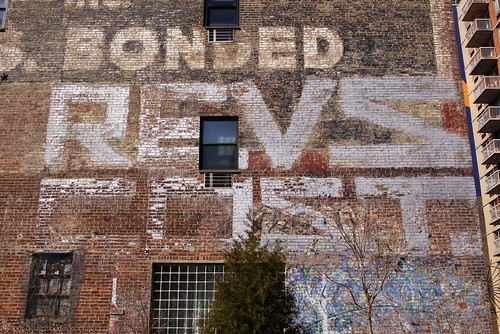
Who owns and controls public space? Increasingly, it's the .01%

IMGP5806rd Revs-Cost on the High Line

First came REVS COST, then the High Line followed.

Media mogul Barry Diller has just pledged a bucket load of cash to build a new public park in the Hudson River off shore in Chelsea, where he's got his office in a building designed by Frank Gehry. That's a good thing, no? Well, maybe. Noting that this park will be near the High Line, also financed by private money, David Callahan has an op-ed in The New York Times pointing out that:
  1. the creation of privately funded public amenities has been going on since the 1980s,
  2. this is happening because public money for such purposes has been drying up,
  3. many of these facilities are of benefit to a relatively small and well-off segment of the American population.
Whatever happened to democracy? It's been bought out, that's what. Callahan:
The design, placement and maintenance of parks were once a function of democratic processes. Now, as a citizen, you feel like a spectator to largely privatized decision making. A declining public sector, burdened by budget cuts, creates a vacuum for imaginative civic leadership that is being filled by a new class of Medicis. Things are going to get a lot worse, too....

More than 100 billionaires worldwide have pledged to give away at least half their wealth, further supersizing philanthropy even as the fiscal screws on government turn tighter as the boomer generation retires. Their beneficence is admirable, but it also poses a threat to the ability of everyday Americans to have an equal voice in civic life.

This power shift is part of a larger story about rising inequality and shrinking democracy. One reason the wealthy are flush with cash is that they’ve paid historically low taxes in recent decades, which helps explain why government can’t afford to do big things. A small step toward rebalancing things would be to tax capital gains — the source of much of the wealth of the superrich — at the same rate as regular income, and then dedicate most of that money to rebuilding our eroding infrastructure.
I note, in passing, that just as the rich have been funding public amenities since the 1980s, so the International Academy of Graffiti Writers, Street Artists, and Jivometric Rabblerousers (IAGWSAJR), has been spray painting, stenciling, and wheat pasting public spaces in an effort to restore a semblance of balance to public space.

Saturday, September 13, 2014

Symposium on Universal Basic Income (UBI)

Appearing in the Boston Review, discussion took place back in 2000. Philippe Van Parijs makes the opening statement and then replies to comments on it. Here's the first few paragraphs of that statement:
Entering the new millennium, I submit for discussion a proposal for the improvement of the human condition: namely, that everyone should be paid a universal basic income (UBI), at a level sufficient for subsistence.

In a world in which a child under five dies of malnutrition every two seconds, and close to a third of the planet’s population lives in a state of "extreme poverty" that often proves fatal, the global enactment of such a basic income proposal may seem wildly utopian. Readers may suspect it to be impossible even in the wealthiest of OECD nations.

Yet, in those nations, productivity, wealth, and national incomes have advanced sufficiently far to support an adequate UBI. And if enacted, a basic income would serve as a powerful instrument of social justice: it would promote real freedom for all by providing the material resources that people need to pursue their aims. At the same time, it would help to solve the policy dilemmas of poverty and unemployment, and serve ideals associated with both the feminist and green movements. So I will argue.

I am convinced, along with many others in Europe, that–far from being utopian–a UBI makes common sense in the current context of the European Union.
Responses by: Herbert A. Simon, Emma Rothschild, Brian Barry, Anne L. Alstott, Fred Block, Katherine McFate, Gar Alperovitz, William A. Galston, Wade Rathke, Edmund S. Phelps, Elizabeth Anderson, Ronald Dore, Robert E. Goodin, Peter Edelman, Claus Offe.

Wednesday, December 4, 2013

A Meditation on Golf: What Would Dad Think about Liberty National?


Thinking about golf and trying to master it takes one’s mind away from other troubles.
– William Benzon


I think a lot about golf as a metaphor for life. The harder you swing, the less far it goes.
– Paul Fireman


IMGP4652

That’s the clubhouse for Liberty National Golf Course, on the banks of the Hudson River – or is it the upper end of New York Bay at that point? – at the south end of Jersey City, NJ. When you go up the steps, which are chained off midway, you go onto the club grounds which are, of course, private. When you go down, you come to the club’s private pier. You can see the Statue of Liberty at the left edge of the photo, hence the club’s name:

IMGP4654

The pier is for a motor launch that ferries club members back and forth to Manhattan. Club members with helicopters can land on the club’s helipad.

* * * * *

The man left of center in the photo below is my father:

Father & co 400 dpi jpg copy

I don’t know exactly what meeting this was, or when it took place. But it would have had to do with coal preparation in some way and it probably took place in the 1960s – the date on his badge appears to be 1966. He worked with Bethlehem Mines, the mining subsidiary of Bethlehem Steel (now defunct), and was Superintendent of Coal Preparation. He was in charge of removing impurities from coal so it could be used in smelting iron ore into iron. He has a few patents to his name and was quite distinguished in that field.

Tuesday, October 1, 2013

Work the Bottom Before You Work the Top

My father was an engineer who spent his life working for Bethlehem Mines, the mining subsidiary of Bethlehem Steel. He was a chemical engineer who was in charge of process design for coal cleaning plants, the plants that separated impurities from raw coal so that the clean coal could be used to make coke for heating blast furnaces.

In a word, he was a “suit.” Though he generally wore dress slacks and a sport coat to work rather than a suite. And he often wore a bow tie rather than a long one. A real bow tie, one of those where you had to tie the knot yourself.

Still, his job required that he go down into coal mines on a regular basis. I’m not sure just why this was, that is, I don’t know why he had to see where and how the coal was mined in order to clean it. But he did.

And that means he knew, first hand, that working in a coal mine was nasty, dirty work, and dangerous. On many occasions he told me that a man shouldn’t be given managerial responsibility for coal mines unless that man had had experience working in a coal mine.

That seems like a good principle to me. It’s not so much that working on the coalface down in a mine gives you knowledge you need in order to turn a profit but that working the coalface was necessary to secure empathy for the men who put their lives at risking working that kind of job year after year, and decade after decade.

Managers should be stewards, not simply of profits, but of the workers under their control.

An exercise to the reader: generalize the principle beyond coal mining.

Monday, February 13, 2012

The Parable of the Unforgiving Servant

And Its Application to the Current Mortgage Disaster

I’ve been reading David Graeber’s recent book, Debt: The First 5,000 Years. In the chapter, “Cruelty and Redemption,” he recounts the Parable of the Unforgiving Servant (Matthew 18:21-35). As an exercise you might want to read the story as one about the recent mortgage mess in the United States. In this version the king is the Federal Government and the first servant, the unforgiving one, corresponds to the investment bankers who sold those bought, packaged, and sold risky mortgages as fancy derivative instruments. The second servant, then, would be all those homeowners to took out those risky mortgages and are now losing their homes. In this reading, there's lots more work to be done to fill out the Biblical model.

Here’s the parable as it’s quoted from the World English Bible in the Wikipedia, which also has some useful interpretive remarks:
Then Peter came and said to him, "Lord, how often shall my brother sin against me, and I forgive him? Until seven times?"

Jesus said to him, "I don't tell you until seven times, but, until seventy times seven. Therefore the Kingdom of Heaven is like a certain king, who wanted to reconcile accounts with his servants. When he had begun to reconcile, one was brought to him who owed him ten thousand talents. But because he couldn't pay, his lord commanded him to be sold, with his wife, his children, and all that he had, and payment to be made. The servant therefore fell down and knelt before him, saying, 'Lord, have patience with me, and I will repay you all!' The lord of that servant, being moved with compassion, released him, and forgave him the debt.

"But that servant went out, and found one of his fellow servants, who owed him one hundred denarii, and he grabbed him, and took him by the throat, saying, 'Pay me what you owe!'

"So his fellow servant fell down at his feet and begged him, saying, 'Have patience with me, and I will repay you!' He would not, but went and cast him into prison, until he should pay back that which was due. So when his fellow servants saw what was done, they were exceedingly sorry, and came and told to their lord all that was done. Then his lord called him in, and said to him, 'You wicked servant! I forgave you all that debt, because you begged me. Shouldn't you also have had mercy on your fellow servant, even as I had mercy on you?' His lord was angry, and delivered him to the tormentors, until he should pay all that was due to him. So my heavenly Father will also do to you, if you don't each forgive your brother from your hearts for his misdeeds."