Showing posts with label Morton. Show all posts

Saturday, August 28, 2021

Reading Spacecraft 7: Muppet Star Wars

This is a documentary about creating digital characters where there had been puppets in Star Wars. Naturally, they spend a fair amount of time on Yoda. At about 43:22 Lucas is talking with a couple of the animators about digital Yoda. Observing that Yoda is a frog-like creature, Lucas wants to combine the movement styles of Kermit and Miss Piggy in Yoda for the big light saber battle – “the illegitimate child of Kermit the frog and Miss Piggy.” Lucas continues (c. 33:49): “We’ve never discussed this before, and don’t let it get out because if that hits the National Enquirer we’re all dead.”

That pretty much confirms Morton’s intuitions about the deep continuity between the Muppets’ universe and the Star Wars universe.

* * * * *

Other posts in this series about Tim Morton’s Spacecraft.

Tuesday, August 24, 2021

Reading Spacecraft 6: The child is father to the man

Morton begins Spacecraft by talking about his childhood as an eleven year old boy coming from a family of limited means and walking to school in the morning, going “toward the ... alienating land of a very posh private school” (p. 1). In that context he took comfort in “making up spacecraft. I would inhabit them in the cockpit of my mind, describing their specifications to myself, under my breath.” When I first read those words I merely read them on the way to what came next, which was about seeing Star Wars and, a bit later, Close Encounters of the Third Kind – both came out in 1977, when he was nine – about his collections of models, and books.

Yet, as I read Morton’s account of his childhood engagement with space flight, I thought of my own, which was a bit different as I am a generation older. For me the movie was Forbidden Planet, which came out in the same year as Godzilla King of the Monsters, 1956. I spent hours drawing pictures of flying saucers and robots. But the definitive event came early in October of 1957 when the Soviet Union launched Sputnik into space, thereby launching the so-called “space race” into overdrive. That’s when my personal imaginary met world history. I didn’t think in those terms at the time, that formulation came to me only in retrospect.

I’m wondering whether or not Morton’s childhood encounter with space-themed science fiction had a similar valence for him. And not only for him, but for many other children as well. Thus, after recounting that aspect of his childhood, Morton observes (p. 2):

I was using space craft as protection and escape vehicle in my head. And so, to this day, I’ve wanted to explore what that was all about. In particular that’s because I’m sure I’m not the only one.

No, he’s not. How many of us are there? Morton continues in the next paragraph:

This doesn’t mean that I’m not interested in Apollo or the Space Shuttle, or Soyuz, or Sputnik. Far from it. The whole point about those vehicles is that they also originated in some dream of a human being. The Space Shuttle bears a vivid resemblance to the shuttle as imagined by Stanley Kubrick in the film 2001: A Space Odyssey (1968). And to design real spacecraft you need a big imagination.

When I was young science fiction was a relatively minor genre, both in film and on television (not to mention prose fiction). The Western was much more important. I’d guess that the Western wouldn’t have been so important in Britain, especially on TV, but I have no idea what the British equivalent would have been. My point, though, is that however much I loved Westerns, and I did love them, and how much time me and my friends played at “cowboys and Indians” – not to mention that I wanted to be an Indian when I grew up – they were set in the past. There was almost no way I could forge an adulthood around one of the typical characters from a Western. I wasn’t going to be a cowboy, much less an Indian.

But an astronaut, that’s different. That had possibilities. I thought about that. But gave it up in favor of being a scientist or an engineer. But for whatever reason, I declared a psychology major when I went off to college; graduated with a degree in philosophy; and then went off to get a doctorate in English Literature. Still, about a decade after getting the degree I did manage to spend a summer working with NASA on a project involving artificial intelligence.

I digress. In pursuing Morton’s childhood (and mine), I’m not attempting to shoehorn Spacecraft into old-fashioned biographical criticism whereby one seeks to explain a text by finding its secrets in the author’s autobiography. There’s nothing secret of hidden about Morton’s childhood introduction to spacecraft. He tells us about it the very first thing. It’s part of the story he’s telling. And that, he later tells us, is a story common to many children whose imagination has been fired with visions of space travel. It’s a story born of a specific cultural imaginary common among children of the last decades of the previous century.

Such children couldn’t have existed prior to the second half of the twentieth century. Why not? Because the culture didn’t provide the materials on which such an imagination could feed itself. Sure, science fiction novels existed before then, as did magazines build on science fiction stories, and some science fiction stories did show up in the movies, But they weren’t so pervasive and readily available to children as they became in the 1950s. Nor did they exist in the context of an international competition, the Cold War, that made the conquest (a word I chose deliberately) of space a matter of national and international importance.

That competition reached an inflection point in the late 1960s, at about the time Morton was born (in 1968). Stanley Kubrick redefined science fiction when he released 2001: A Space Odyssey in 1968. The special effects were a quantum level superior to those in any prior science fiction films and, by starting the film in the ancient past, when there were no humans on earth, Kubrick situated the mythos of spaceflight in the history of life on earth. Thus, with the help of Arthur C. Clarke, who collaborated on the script, Kubrick situated space flight in the mythos and imaginary of the human, thereby freeing it from the trapping of the late industrial revolution.

A year after that NASA landed Apollo 11 on the moon. What Kubrick had depicted in fiction, in imagination, in one of the most important science fiction films ever made, NASA had made real. Space travel was no longer something that happened only in the cultural imaginary. It had entered the realm of the Real, of what Morton called the “future future. Futurality is the possibility that things could be different” (p. 73). Space travel is more than rockets and phasers, super-smart computers, aliens, and the possibility of faster-than-light travel. It is the possibility of radical transformation. As Morton says at the beginning of his last paragraph (pp. 110): “The millennium (as in falcon) is hyperspace, that post-apocalyptic moment at which a more just world is established.” NASA may have been funded out of a desire to score points against the nation Ronald Reagan would come to call an evil empire (1983), but it was never captive to, subsumed by, that intention. It played on a much larger stage.

But I want to go back to childhood. The late-60s conjunction of Kublick and NASA also saw the original Star Trek on television (1965-1969). A decade later The Muppet Show ran on British and American television between 1976 and 1981. It had a running segment entitled “Pigs in Space,” which was a parody on 1960s and 1970s space operas. That is to say, by that time space travel was established well enough that it could evoke and support parodies in a television show aimed at children (the kind of children’s show that appealed to adults as well). Morton watched it “all the time” he tells me (I asked him in the Twitterverse). And though I didn’t ask him whether or not he watched Doctor Who, I assume that he did so, because 1) it started in 1963 (and has been on television ever since), 2) he mentions it fairly often in the book.

That brings us to our Wordsworthian subtitle: “The child is father to the man.” Just what we’re supposed to do with it, I’m not sure. Contemplate it? Re-read the post?

I know what I want. Hegel had a word for it: Aufhebung. Uttering the word is easy enough. Performing the act, allowing it to perform you. That is not so easy.

‘Till next time.

* * * * *
 

Monday, August 23, 2021

Reading Spacecraft 5: The Millenium Falcon is a mirror ball in your front room

Here, I believe, is my first public remark about Spacecraft:

I still believe it, more or less. While Morton makes many and various assertions about spacecraft, and closely related matters (e.g. hyperspace), they don’t take the form of an argument. They delineate a world, the world of spacecraft. How Morton goes about that is as important as what he says, if not more so.

Here and there Morton makes explicit philosophical statements – references to philosophers, Husserl for example, and uses philosophical terms of art, phenomenology, circlude, and so forth. They serve two purposes, to indicate intellectual sources, and to motivate certain assertions. I wonder whether or not he needs them? Could those assertions stand on their own simply by affordances of his language? Perhaps not. Still, it would be interesting to see whether or not the marionette can dance without any one manipulating the strings.

* * * * *

When the fourth and last chapter, “Anyone,” is well under way, Morton brings back a conceit he used in the introduction, a comparison between the Muppets and Star Wars. As you may recall, The Muppet Show, had a running segment featuring Miss Piggy, “Pigs in Space.” That’s one source of motivation for the conceit. Another comes from the fact that, as actors, Muppets are hybrid creatures (electromechanical devices with human operators) like R2D2, and many of the aliens, including Jabba the Hutt, and can serve as weird mediators between fictional objects and real objects – in a domain, of course, where all objects are equally real so that the distinction between fiction and real is a secondary one. And then we have Frank Oz, operator and voice of Muppets and of Yoda. All of that AND... the conceit serves Morton’s sense of whimsy.

Anyhow, he’s brought it back in the final chapter, worked with it a bit and then says (p. 108): “I will cease this line of thought because, really it’s way too far out, even for me. But it’s an interesting game, isn’t it? Can you match characters in Star Wars with Muppets?” He continues on doing so. But that’s beside the point, what’s interesting is Morton’s assertion that this “interesting game” has gone “way to far out, even for me.”

Is that his mode through the whole book, game mode? Start with the Millennium Falcon and see where it leads, by association, generalization, abstraction, conflation and whatever else. With the Falcon at the center of the web, how far can you extend it through spacecraft to matters of social and political organization and action, of work and play. Is the game a meditation on the Millennium Falcon?

* * * * *

Is THAT what Spacecraft is about? Is the Millennium Falcon the mirror ball that transforms a room into a disco?  Is ecological tuning the way one enters hyperspace? 
 
Enquiring minds want to know.
 
* * * * *
 

Thursday, August 19, 2021

Reading Spacecraft 4: The future

I wonder if he’ll say something about the future? I thought when I asked Tim for a review copy of Spacecraft. The future sort of goes along with science fiction, no? But Tim is also very much interested in climate change and the Anthropocene, and they entail the future too.

And in a special way. For climate change is what Morton calls a hyperobject, an object so extended in time and space that we cannot grasp it (easily if at all). If we think of climate change as one single thing a hyperobject, why then an undetermined fraction of it hasn’t even happened yet, most likely a larger fraction than we’ve so far experienced. Yet if it is all one (hyper)object, one thing, then there is a sense in which THAT future is now. Is the future but a dimension along which objects (can) withdraw?

If Tim’s going to talk about spacecraft he just has to talk about the future. And he does (p. 73):

The future is everywhere, you can reach it any time–the real future or as I like to say sometimes, the future future. Futurality is the possibility that things could be different. [...] The hyperspace of Star Wars is the closest a regular cinema-goer gets to realizing that film isn’t just about the visible, but about the invisible, and in particular, the feel of motion, all the liquid celluloid spooling through the projector [...]. It’s a lovely gift that George Lucas gave to ordinary people–something utopian to keep them going.

Yes.

Tomorrow, next week, three months from now, 13 years from now those times have not happened yet. But that by itself does not situate them in the future. Futurality implies a certain kind of relationship to the present. [Does this mean the Nietzsche’s idea of the eternal recurrence is a denial of futurality?]

I put the issue to some of my humanist friends on Twitter and they replied that the future, “as something that can and will be significantly changed by human effort” (my formulation) is the product of the late 18th century. The future is a kind of place that exists at some time other than the present, some time after the present. Maybe it’s some kind of fold in hyperspace.

Now consider this passage from Morton’s last chapter (“Anyone” p. 101):

Stealing the Falcon and playing it like an instrument is a nonverbal image of revolution, like those in Sergei Eisenstein’s film about the Russian Revolution, October.

But unlike in the Russian Revolution, it’s not about some artist-like hero seizing the moment (Lenin). It’s about people from the criminal class whom Marx sometimes calls the enemy! And they’re seizing an instrument and playing it, listening to it, not imposing their will. America is a country that isn’t really one because of slavery. America is (from) the future. If it’s something from the past, it can only be a hotbed of fascism. If America is a weird, junky model of future worlds in which there is planet-scale human collective awareness and action, then ... well the Falcon is the utopian quality of America itself.

It’s this sentence that caught my eye: “America is (from) the future.” Read it both ways, with and without from, at one and the same time. Without it’s saying the future is going to be like America is now. With it’s saying America will be birthed at some date (way) ahead of the present and is heading for us (at warp 9).

But what is America? It’s probably another one of those hyperobjects. So who knows what or where or how it is. But somehow it’s become entangled with the Millennium Falcon.

A final thought: The original Star Wars opens “A long time ago in a galaxy far, far away...” When and where is that? What happened to the future? Is it lost?

Other posts in this series: https://new-savanna.blogspot.com/search/label/Morton-Spacecraft.

Tuesday, August 17, 2021

Reading Spacecraft 3: Ships, craft, and the imagination

Let’s begin at the beginning: “Introduction: Ships and craft,” pp. 1-27, Tim Morton, Spacecraft (2021). Morton tells us that he saw Star Wars upon its initial release in December of 1977 (p. 2), when he was nine (p. 10). We will learn quickly enough that the Millennium Falcon is his prototypical spacecraft – mine was the flying saucer from Forbidden Planet, which I saw on its initial release in 1956, but then, for some reason, flying saucers fell out of fashion in the movies. He goes on to inform us that he “can’t count the number of models of spacecraft, real and fictional, that I owned.” Nor can I count the number I owned, not to mention the countless drawings I made, and a painting or two. I quote the sentence, not on account of the uncountability of his collection, but because he introduces the distinction between fiction and real. He’ll go on to say “this book is about the space vessels of our imaginations.”

However (p. 10):

This doesn’t mean that I’m not interested in Apollo or the Space Shuttle, or Soyuz, or Sputnik. Far from it. The whole point about those vehicles is that they also originated in some dream of a human being. The Space Shuttle bears a vivid resemblance to the shuttle as imagined by Stanley Kubrick in the film 2001: A Space Odyssey (1968). And to design real spacecraft you need a big imagination.

Morton points out that “Imaginary ‘objects’ are also objects” (p. 3), and we’re off to the philosophical races for the next few pages as he flies through Husserl, Heidegger, Derrida, philosophy, psychology, phenomenology, scientism, subjective and objective on his way to hyperspace, which he locates in African philosophy and the TARDIS and so forth and so on until the philosophical scaffolding falls away – you know what I’m imagining, don’t you? the moment during a satellite launch where the gantry falls away... – and we’re left with his core distinction, between a spacecraft and a spaceship.

One distinction is that spaceships are generally larger than spacecraft; think, for example, of the hulking vessels of the Empire or, for that matter, of the Starship Enterprise. But size isn’t the only thing. The Millennium Falcon is a spacecraft but it’s roughly the same size as the Altair IV, the saucer from Forbidden Planet. The Altair is clearly a spaceship, however. Why? Because it is run by a crew with a hierarchal structure headed by a captain and with a cook somewhere near the bottom of the staff. Craft aren’t crewed in that way. The crew is small and more or less equal. Yeah, the Falcon is Solo’s vessel, but he’s not Chewbacca’s boss. They’re buddies.

That distinction alone throws an interesting light on the long-standing discussion of the relative merits and demerits of the Star Wars and Star Trek franchises. I believe Morton mentions it once or twice but doesn’t, so far as I remember, discuss it much. In this discussion Trek is generally seen as the more ‘progressive’ and democratic of the two. But Trek always takes place on a military vessel, except for DS9, which centers on a space station. There may be a democracy somewhere in the wings of the Trek universe, but what we see episode after episode, film after film, is a military hierarchy. (Yeah, I know, it’s about exploration. But those exploration vessels are equipped for battle.)

Getting back to ship vs. craft, we’ve also got “craft” as skill, and “craft” as in crafty (p. 13). These things matter in Morton’s thinking, but also in his style. And so he plays around with implications and connotations until we get a feel for the flow and then he offers a partial typology of space vehicles (p. 21):

The ark
The juggernaut
The frigate
The fighter
The explorer
The yacht
The machine cum dea
The coracle

First of all, I’m not going to attempt to explain what all those vessels are. You’ll have to read the book for that, as Morton gives examples of each.

He does note, however, that “none of them are exactly the Millennium Falcon” and that “the Falcon can become any of these types of vessel. Moreover, “each of these vessels can become other ones.” What? This is all seeming a bit arbitrary, yes? no? To cap it off (21-22): “But none of them can be the Falcon. That’s because the Falcon stands for the irreducible uniqueness of how things are.”

And again, what? Does it stand so in general and for everyone or is that standing limited to the scope of Spacecraft?

I’m reminded of Claude Lévi-Strauss’s The Raw and the Cooked which, as you may recall, is the first of four volumes in which he examines myths of South American peoples, with excursions elsewhere as well. He starts with one myth, which he calls the key myth. He describes and analyzes it, and then adds a second, comparing it to the first, and then a third and so on. Somewhere he tells us that there is nothing special about this key myth, it doesn’t hold a key to anything, its just where we start. And we have to start somewhere. It’s key but not special. It plays a certain function in the course of his analysis.

And so it is with the Millennium Falcon. Morton has given us reasons why it’s special, and will give us more. But it’s also the vessel Morton fell in love with as a child. That’s fine too. It’s where he started, his space-faring imagination that is. You may be in love with the Falcon. You may not. I’m certainly not. For that matter, I’m not particularly attached to the Altair IV, though I certainly covered pages and pages with drawings of it when I was young.

You don’t have to buy Morton’s attachments to buy his argument. But then “argument” isn’t quite the right word. For Morton isn’t building an argument in the ordinary, the philosophical, the academic meaning of the term. What he’s doing is more like world-building, as a novelist or a film-maker does it. He’s using the ideas of spacecraft, hyperspace, and the future as devices from which to craft a world, a world of and in expository prose rather than a fictional world in which one tells stories of Wookiees, tumbling phone booths, and of shoes and ships and sealing wax. A home for the imagination.

Do I believe this? How do I know, I just wrote it. See you next time.

Earlier in this series:

Reading Spacecraft 2: Hyperspace, a lounge at the center of the world [& the Disney version] 
Reading Spacecraft 1: In what way is Morton’s prose like Shakespeare’s verse? [and why?]

Monday, August 16, 2021

Ramble – Spacecraft, social nature of truth, Green Villain, the architecture of mind

Once again, I’m feeling a need to ramble around in my mind, see what’s going on.

Spacecraft

I’m still thinking about Tim Morton’s Spacecraft. I figure I’ve got two, perhaps three, more posts on it and then perhaps a formal review. One post will look at how he talks of spacecraft, and his basic distinction between spacecraft and spaceship. Even before that, though, I think I need to talk about the distinction between real spacecraft and fictional ones. By real spacecraft I mean the 100s if not 1000s of satellites we’ve launched since Sputnik back in 1957, the various probes and landers, manned orbital craft and, of course, the Apollo missions, etc. There’s been a lot of them.

But while Morton mentions one or three of them here and there, they aren’t of much interest to him. He’s only interested in fictional space craft, with the Millennium Falcon being his primary example. And I pretty much assumed that’s what he’d be talking about when I asked him to have a copy of the book sent to me. It’s a bit as though someone had chosen two write a book about unicorns or dragons and did so in much the same way as one would write a book about sheep or crows. Of course Morton knows these various spacecraft are fictional, as is hyperspace, which I’ve already written about. But he sees no need to remark on that fact, much less to examine it.

That in itself is interesting.

Then I want to write one about the future. For that’s what was on my mind when I asked Tim for a copy: I wonder if he’ll say something about the future? And he does, page 73. Not sure whether I can get a whole post out of that, we’ll see. But the future sort of goes along with science fiction, no? Nor, come to think of it, does he talk much, if any, about science fiction as a kind of fiction, but that’s what he’s writing about, no? That too is interesting, especially since he’s trained as a literary critic.

That is to say, what’s most interesting about Spacecraft is the framing that’s not there.

The social construction of truth

I was going to write a 3QD column about the social construction of truth, but bailed on it. It would have been an expansion and refinement of a recent blog post, What’s the difference between a conspiracy theory and a far-out, but reasonable, idea? When does signaling go haywire? (July 21). I’m not quite sure why I bailed on it. Though I will note that, for one thing, it’s been shifting beneath my feet.

Perhaps I’m still figuring out an approach to truth. One thing that’s clear in a general sort of way, lots of people in what I will call my society believe lots of different things and this collectivity of beliefs is by no means coherent, mutually consistent, and stable. Do I need an approach to that multiplicity, a way to move it into the foreground instead of keeping it in the background? I’m inclined to think of that as the nature of belief in society and truth is something we carve out of it.

OK, this is going somewhere. The deep problem with asserting the social nature of truth is the implied split between nature and culture (and this goes back to Morton and his OOO). Given that split, society (that is to say, us) is viewed as a source of distortion and error. Truth is something outside us, it’s stable. What is in fact going on, however, is that, once we reach substantial agreement, we project that agreement into nature and fool ourselves into thinking it has nothing to do with us.

And in a sense it doesn’t, because it is about the world. But that agreement is something we’ve created. Science, in this view, is a collection of techniques for framing propositions about the world such that observations can be made that compel agreement from a given scientific community. Which brings us to the case of fundamental physics, where we’ve had half a century of theorizing without observational confirmation. Where’s that going?

What if scientists in other fields decided that they didn’t need to worry about observational confirmation either. That would surely make things easier for psychologists with their replication crisis. Just toss out observation all together. The crisis disappears.

Do these physicists know that their recalcitrance is threatening the very nature of science?

So, what’s at state in my other examples: 1) GOP Trumpism and conspiracy theories (e.g. QAnon), 2) memetics, and 3) the tech singularity? The first is mostly about socio-political reality where current truth is determined by journalistic means. The second was a proposal about science that just fizzled out. And the third is about things that will happen in the future.

I’m thinking that doing all that much stretch the limits of a 3QD column. It’s the framework implied in the previous paragraph that’s tricky. That is, almost all thinking about epistemology takes place within a Cartesian framework, where mind and body are split and truth is a problematic negotiation between a mind and the world. Drop that framework and truth becomes something different, a matter of reading agreement.

Green Villain

Instead of writing about the social construction of truth I choose to do a photo essay about the Green Villain loft space 51 Pacific. That was fun, and didn’t require much thought, just arranging the photos and providing a bit of introductory prose. The trick was to choose the photos, as I’ve got 100s to choose from. The idea was to sample the space.

Here’s another one, of Serringe in process:

In going through the photos, it occurred to me that if this space existed today (the building was demolished in 2015) it would be possible to charge people, say, $5 to enter and tour the building. That wouldn’t have been possible when the space was alive and kicking, back in the early 2010s. Things have changed.

The architecture of mind

And then there’s this recent post: Attractor nets, from basic vertebrates to humans, August 13. That belongs to my general attractor nets project, where the goal is to produce a primer on attractor nets. Does it make sense to think in terms of an explicit construction for each of the five principles listed in the brain paper (Principles and Development of Natural Intelligence)? The basic goal of the attractor net project is to work out constructions for the fifth principle (indexing). That earlier post mentioned the first principle (feeling, on-blocks). What about the other three? I’m thinking I need to leave them alone for awhile.

Seinfeld working paper

Yes, I need to get one of those done, one based on my explication of various bits.

Thursday, August 12, 2021

Reading Spacecraft 2: Hyperspace, a lounge at the center of the world [& the Disney version]

“Hyperspace” is the third chapter in Tim Morton’s Spacecraft, a book with four chapters plus an introduction. Let’s start with a passage near the end of the chapter. I’ve not chosen it at random, say by tossing divination sticks in the manner of John Cage I-Chinging his way toward a composition. Nor have I spent a great deal of time choosing just the right passage for this (illustrative) purpose. Because, really, any of various passages would serve.

Here we go (p. 85-86):

To the outside world you disappear when you enter hyperspace. But for you, it’s as if you’ve stepped out of the street into the lounge. Star Wars sensualizes hyperspace in this way too – hyperspace is not a place of cosmic speed and massive realizations, but rather a quiet lounge. There’s an achieved privacy. It’s soft and comfy. You can play chess. You can flirt. You can talk about boyfriends. Suddenly you arrive at your destination and your spacecraft floats a little. It’s as if you’ve been in a traveling lounge that can relocate anywhere. Then you have to get to work and do stuff like fighting or landing.

What do you think as you read that? After all, you’ve not read Spacecraft so you’re not accustomed to Morton’s way of talking. Stepped out of the street into the lounge? What street, and what lounge? What’s this have to do with Star Wars?

Morton opens the chapter in the lounge area at the center of the Millennium Falcon where Chewbacca’s paying holographic chess (p. 53). So the chapter starts in a lounge. A bit later Morton will offer a brief disquisition on lounges in which he informs you, trickster that he is, that the Falcon is itself a lounge that contains a lounge much larger than it is – in the same way that the Tardis, from another science fiction franchise, contains within it much more than could possibly be fit inside a phone booth – and that this much larger lounge is hyperspace (p. 55). How do you get to hyperspace? By hitching a ride on the Falcon. Or you can watch the Tardis tumble thought hyperspace at the beginning of a each episode of Doctor Who.

Honestly, it’s as though all those roads that lead to Rome? When you turn around and look at them all squinty-eyed, it turns out they can to hyperspace as well. Though you might have to click the heels of your red shoes to get the full effect.

Later (p. 56-57): “...hyperspace is definitely not an empty box. [...] hyperspace has a feel. Hyperspace is ‘space-feel’ just like potato chips have ‘mouthfeel’ in the PR business. [...] Hyperspace is a place.

You are perhaps confused? From hyperspace to mouthfeel to place, that’s just how it goes. How about Claude Monet’s water lilies, Einstein’s spacetime, stream of consciousness (Woolf and Joyce), “Space...has contours...is creamy...a kind of roaring blue and white curdled ocean” – I’m not making this up. I’m just collecting things as I leaf through the book. Then: Hyperspace is the ecological niche of spacecraft – their habitat.” Finally we land, with Morton telling us that the term hyperspace was coined in 1967 (p. 61). Then right back out, we’re off into Gauss and non-Euclidean geometry and “reference mollusks” (Einstein) and then Wham! Han Solo tells us: “Traveling in hyperspace ain’t like dusting crops boy” (p. 62). It sure didn’t feel that way, zipping all over the map in Morton’s OOO-charged prose.

* * * * *

It’s time to slow down and get serious. What strikes me about this chapter ¬– and it’s why I want to get to Walt Disney – is Morton’s discussion of the way hyperspace is visually presented in Doctor Who (the Tardis tumbling though a tunnel), Kubrick’s 2001: A Space Odyssey (a psychedelic light show), the Star Wars saga, more psychedelia, and the relationship between those tunnels and the ones in near death experiences, the Tibetan Book of the Dead, and DMT trips. In some cases the hyperspace tunnel is a way of getting from here to there while in other cases it’s a place where you are (for awhile). Morton discusses the kinesthetic and haptic feel of these tunnels, whether one is penetrating into the tunnel or enveloped by the tunnel (those are gender typed), and so forth. He manages to bring Plato’s cave into play, for it is a tunnel too, no? and therefor implies light, which blinds one upon leaving the tunnel.

And so (pp. 83-4, just three pages short of the passage where we began):

When we enter or “make” hyperspace, it’s also like having an orgasm. The fourth wall collapse I discussed a moment ago is a kind of orgasm of the film stock, a sudden shudder or “petit mort” as the French say about coming: la mort, l’amour. There is a sudden spring or ripple that demonstrates how not in control of our bodies we really are. We move from extreme pleasure into bliss. In the esoteric “tantric” parts of Hinduism and Buddhism bliss is a pathway beyond the ego – into the hyperspace of enlightenment.

Like Han said, it ain’t like dusting crops.

* * * * *

But it might be like the closing sequence of the “Toccata and Fugue in D Minor” episode of Disney’s Fantasia (1941). It is the first episode, of eight (plus in interlude in the middle), in the film.

During the opening toccata we see the orchestra in images like this:

We recognize the images, but we never see them fully rounded. There’s always an element of flattening.

When we move into the fugue we see quasi abstract imagery:

Tuesday, August 10, 2021

Reading Spacecraft 1: In what way is Morton’s prose like Shakespeare’s verse? [and why?]

Timothy Morton, Spacecraft, Bloomsbury Academic, 2021.

I posted a tweet about Morton’s new book, Spacecraft (not yet out), earlier today. Here’s the tweet along with Morton’s response:

Let’s begin at the end. In what way is Morton’s writing like Shakespeare’s? As you might imagine, I hesitated for a few seconds before actually releasing that tweet into the Twitterverse. Morton & Shakespeare? You’ve got to be kidding. No, I’m not. But you might not realize quite what I’ve got in mind. It’s not obvious, though I said it plain: “just beyond the edge.”

The thing is, Shakespeare is not a real person. No, I don’t mean that old “who is Shakespeare” nonsense. I mean that Shakespeare has long since ceased to be a mortal human being. He’s become a mythological creature.

The Bard. The Greatest Poet of the English language. The Greatest Writer that ever lived.

Are you kidding me? Those are titles, honorifics, laudatory epithets. They indicate, not the individual, who(m)ever they are, who wrote those plays. They designate a certain position in the cultural firmament of a large and miscellaneous group of mostly, but not entirely, Europeans and other Westerners. The North Star, that’s what this symbolic Shakespeare is.The North Star isn’t any better than any other star, nor any worse. But it happens to be in a convenient location for certain beings (us) to use it for certain purposes (getting around). So it is with Shakespeare.

Of course, getting back on track, that symbolic Shakespeare is a perfectly fine object, just like that real individual, and just like Tim Morton. Proper objects all. It’s their language that interests me.

Is Morton’s language as good is Shakespeare’s (pick whichever Shakespeare you will)? Likely not, though that’s beside the point – speaking of which, Morton has some interesting remarks on how he uses the ideas of prose and poetry in teaching (pp. 58-59). The point is that Shakespeare’s English is not quite our English. It’s just beyond the edge of our English. It’s a little strange, strange words whose meanings we cannot readily ken, so we read the footnotes (if we’re diligent, if not...).

And so Morton’s language is a little strange as well. Not so obviously strange as Shakespeare’s, none of those odd Shakespeare words you don’t recognize. But really, if you attend to it, strange. He talks OOO, object-oriented ontology. OOO is a kind of philosophy with which Morton is associated. I’ve blogged about it a bit, mostly several years ago (2012-2015, but referencing it here and there up to the present). In OOO everything is an object, that apple you just ate, the sun, the tsunami that wrecked Fukushima, the idea of the future, of atoms, of Mohammed, any and all ideas, Der Hölle Rache kocht in meinem Herzen, the odor of myhrr, Denali (the mountain), and so on. You get the idea. So Morton spells that out with examples. Names some implications, e.g. withdrawal, with examples, and so on. That’s all quasi-technical philosopher’s speak. There are other books where he does more of that. But, in my experience, his writing is never so dense with philosopherspeak as that of, for example, Graham Harman. Which is not to criticize Harman, nor to praise Morton either. They are different. That’s all.

Just different.

Just.

Different.

Morton’s written a lot, and I’ve not read much of it, though I did read Hyperobjects quite carefully back in 2014. I don’t know how he’s been writing since then, but I have the impression in Spacecraft that he wants to minimize philosophyspeak, even eliminate it – not so he can address himself to a general audience, though he wishes to do that (and why not?), in favor of simply seeing and talking about the world in that OOO way.

That’s the sense in which Spacecraft is an operator’s manual for spaceship earth. I know, “operator’s manual” conjures up a book of instructions, perhaps several books, a thin one to get your started, and a thick one to bore you out of your mind once you’ve gotten going. Given that Morton has a long-standing interest in global climate catastrophe, you might think an operator’s manual for earth would say something about how to avoid it. Nope, nothing like that, at least not so far (I’m on page 68 of 112). He mentions global warming and the Anthropocene – how could he not? – but his focus is firmly on spacecraft.

And the Millennium Falcon is his primary example. There are various reasons for that, including the fact that he first saw it in a theater when he was nine (when I was nine I saw a light in the sky I interpreted as Sputnik). The thing about the Millennium Falcon is that it has no operator’s manual. Maybe it did when it first rolled out of the assembly building in that galaxy long ago and far away. But that event is not part of Star Wars canon, at least not yet. As far as we know, as far as we have seen, anyone who has managed to sit their ass down in the pilot’s seat of the Millennium Falcon also knows how to fly it, intuitively, either that or they can figure it out in real time.

That’s what Morton is up to in his style. A real-time reconfiguration of how we see and talk. A new language in which to pilot spaceship earth. Which is also and one and the same time a craft. And a craft is not a ship.

But that will have to wait for next time.

Thursday, June 10, 2021

OOO! – So That’s What You Mean [Morton and graffiti]

I'm bumping this post from April 2011 to the top of the queue in joint recognition (conjunction) of Jersey City's mural festival and the recent New Yorker article about Tim Morton.
 
* * * * *

Objects withhold themselves

This is about connections. It started – well, who knows just when it really started, but, in the immediate past, it started yesterday when I listened to a talk Tim Morton just gave at Temple. In the subsequent Q & A Tim made a remark about how he loves to return to London, his hometown, because he’s always discovering “strange pathways” affording him uncanny glimpses into his home turf. That reminded me of my early experiences photographing graffiti, and that, in turn, reminded me of a passage from J. J. Gibson, the ecological psychologist.

So I made a comment to that effect at Tim’s blog, and that was that. Except that it wasn’t. It never is, is it? I realized that Tim’s comments & the Gibson connection have given me a clue about what OOOists (object oriented ontologists) mean when they say that objects are ‘withdrawn,’ or they ‘withhold themselves.”

I slept on it, and more connections formed themselves in the meshwork that is my mind. And From Gibson I connected with one of my current hobbyhorses, and then to another, and ended up at graffiti, via ecology.

So that’s what this post is about. First I recap the comment I made at Ecology without Nature. And I jump to graffiti.

Strange Ways

On Thursday 7 April Tim Morton keynoted a symposium held at Temple University: GRID + Flow: Philadelphia and Beyond, Mapping and Reimagining Urban Ecologies through the Arts and Humanities. His topic: Ecology and Philosophy in the Time of Hyperobjects. In the subsequent question and answer session someone posed a question about non-locality. After acknowledging that Philadelphia was real, yes, really real, Tim’s answer moved to the Airporter, an airport shuttle service. What he said was that the trip from his (familiar) home to the (by now familiar) airport inevitably went by way of unfamiliar routes, giving him a strange and uncanny view of his home turf. The capacity for reliable navigation is deeply embedded within animal nervous systems and that, in particular, this entails the capacity to move to and from one’s home base (nest, den, hive, as the species may be). The shuttle picked up Tim from his home base and then immediately set out on a strange route, thus causing some discomfort to millions of years of evolutionary work enmeshed deep in his brain.

From there Tim talked about coming back to London (1:03:40) and finding all sorts of strange little places that he hadn't seen before, “strange ways of going from A to B.” That’s when it hit me: Wham!

For I’d felt that very strongly when I first began photographing graffiti in my neighborhood. The graffiti itself aside – marks of paths taken by others through my 'hood – I walk obscure and hidden pathways through my familiar neighborhood. I'd walk for, say, a mile or so behind abandoned buildings and along a railroad track and take and turn and then another and suddenly, Bingo! There I am in this place I've been through time and again. But never by the route I just took. That place had become, all of a sudden, strange and a bit uncanny. 

Here's a passage from the ecological psychologist J. J. Gibson that's relevant (The Ecological Approach to Visual Perception. Boston: Houghton Mifflin, 1979, pp. 256-257). He was addressing the question of how you tell a veridical perception from an illusion (say, projected into your mind by a malignant being;):
A surface is seen with more or less definition as the accommodation of the lens changes; an image is not. A surface becomes clearer when fixated; an image does not. A surface can be scanned; an image cannot. When the eyes converge on an object in the world, the sensation of crossed diplopia disappears, and when the eyes diverge, the “double image” reappears; this does not happen for an image in the space of the mind. . . . No image can be scrutinized -- not an afterimage, not a so-called eidetic image, not the image in a dream, and not even a hallucination. An imaginary object can undergo an imaginary scrutiny, no doubt, but you are not going to discover a new and surprising feature of the object this way.
David Hays and I have glossed Gibson's passage:
Gibson presupposes an organism which is actively examining its environment for useful information. It can lift, touch, turn, taste, tear and otherwise manipulate the object so that its parts and qualities are exposed to many sensory channels. Under such treatment reality continually shows new faces. Dream, on the other hand, simply collapses. Dream objects are not indefinitely rich. They may change bafflingly into other objects, but in themselves they are finite.
The real, then, is that which holds open the potential for the new. We can never fully know what’s real. The more we look, the more we see. Endlessly. It’s turtles all the way down, but not quite the same turtles. They keep morphing. And become doves.

All the way down.

And, that, I believe, is what object oriented ontologists are driving at when they make these strange assertions about how objects are withdrawn, how they withhold themselves – not merely from us (for it’s not about us at all, this is not us-oriented ontology, after all) – but from one another. There’s always more object there. Our nervous system can never fully assimilate an object, a real object, to its familiar patterns – which is, incidentally, what nervous systems are ‘designed’ to do, more or less, but not always, not in emergencies.

Objects are withdrawn. They withhold themselves. There’s always something more.

And so the uncanny, the disequilibrium of the new and strange, that becomes the mark of the real. There is this modernist notion – still in this post-modern age, post-post-modern? – that the purpose of art is to ‘make it new,’ to ‘defamiliarize’ the world – though do give a thought to traditional societies where they sing the same songs and weave the same patterns and paint the same pots generation after generation.

Graffiti as Environmental Art

I don’t mean graffiti in the general sense of the term, as writing and markings on walls. I mean it in the specific sense that it acquired in the early 1970s, where it came to designate the markings – initially ‘tags,’ then ‘throw-ups‘ or ‘throwies,’ then ‘pieces,’ ‘burners,’ and ‘productions’ – that appeared in urban environments starting in Philadelphia and New York City and, in relatively short order (a decade or two) around the world. The term “graffiti” was not used by the artists themselves. Their markings were names, based on letter-forms and elaborations on them, and they called themselves writers. What they did was write on walls.

I don’t know just when or how the term ‘graffiti’ was first applied to these markings. But a book by Norman Mailer and Jon Naar, The Faith of Graffiti, fixed the term in people’s minds. It stuck. That’s what it’s now called, graffiti.

To the non-graffiti world it said, unmistakably, that other people exist and live in the same space they lived in, people who didn’t figure in their life ways in any significant way. To the non-graffiti world, graffiti was vandalism. And that’s still very much, though not exclusively so, the case. The non-graffiti world found it distancing, uncanny, estranging. But, one might argue that even as graffiti took their world away, it also returned that world to them by forcing them to think about that world they otherwise took for granted.

Whatever.

What I really want to get to is the way in this graffiti stuff now exists. It’s ephemeral; it’s transitory. And the writers know that and even cherish it. They will spend hours upon hours putting pieces on walls knowing that they will be written over by others. Knowing that the only people who see their work are other graffiti writers. They are more outside the art world than the most avant of the avant-garde.

What I want to suggest is that graffiti’s basic mode of existence makes it, in this the start of a new millennium, a new kind of artistic expression. We could talk about the marks themselves, the tags and throwies and pieces, but that’s not what I have in mind. For this work is being done in the wake of and under the nose of an aesthetic culture that thinks of art as something that’s ‘over there’ and that’s ‘eternal.’ Graffiti is not over there, it’s right here and in your face (except when it’s hidden around a corner where you may never go). And it’s not created for eternity. It’s created with the certain knowledge that it will perish.

It is of and in the environment where it is created. It is environmental art in the deepest and most profound sense. At one and the same time it pervades the web. Writers post photos of their graffiti on the web, as do followers (of which I am one). The electronic web is simply part of the environment that connects the world-wide meshwork of graffiti, that slowly changing and reforming connection of consciousness around the world. Graffiti is the markings on the stone cave walls of 21st century cyberspace.

It is us.

Note: If you google ‘graffiti’ you’ll get tons of stuff. I’ve written a great deal about it. Here’s an annotated list of posts I made at The Valve and here’s a link to my graffiti posts and photos at New Savanna.

Tuesday, June 8, 2021

Tim Morton talks with a scientist, and then a spirituality of care [COVID-19 as hyperobject]

Morgan Meis, Timothy Morton's Hyper-Pandemic, The New Yorker, June 8, 2021.

* * * * *

The next morning, I was eating a leisurely breakfast at my B. and B. when a young woman sat down at the same large wooden table. I assumed that she was in Houston to do something artsy in this part of the city. “Are you visiting the Menil Collection?” I asked her.

“No,” she said. She was a scientist in Houston for business; she worked for one of the largest petrochemical companies in the world.

“Are you here for the Menil Collection?” she asked, in return.

“No,” I said. “I’m here to meet Timothy Morton.”

I told her about Morton and hyperobjects. She nodded along indulgently, then told me more about her work, which revolved around the difficult task of improving plastic. She pointed to the corner of the breakfast room. “It’s a completely different matter to get plastic to be brittle and hard like that trash can over there, versus making it get supple and strong and stretchy like the bag inside the can,” she said. I asked her if she felt bad about working for a giant petrochemical company. Her brow furrowed. “I wouldn’t say that,” she said. “I just think maybe it’s worth something to make plastic better, more efficient, less wasteful.” She seemed to be gauging my reaction, staring at me intently over the lip of her coffee cup.

I was suddenly curious about what a conversation between a plastics scientist and an eco-philosopher might sound like. “Will you come to Galveston with me and Simon and Tim?” I blurted.

“Absolutely,” she said, jumping up from the table. “Just give me a couple of minutes to get ready.”

In Morton’s Mazda, we zipped along the massive highway linking Houston and Galveston, which is in the area that the Spanish explorer Álvar Núñez Cabeza de Vaca called “the Isle of Bad Fate.” There, we saw a giant yellow phosphorescent pile of sulfur; a building complex containing three massive glass pyramids; Halliburton, or at least a sign pointing to Halliburton; and a Second World War submarine credited with having sunk one of the Japanese aircraft carriers that attacked Pearl Harbor.

We stopped for lunch at the Black Pearl Oyster Bar, a seafood restaurant that evoked a hypothetical diner inside the film “Pirates of the Caribbean.” The place was full of customers, their plates piled high with critters pulled from the Gulf of Mexico and tossed immediately into a deep fryer. Morton ordered oysters. “I love the objectivity of science,” they said, turning to the plastics scientist. “I love the rigorous way that you can ask questions and then get answers.”

She nodded. “But polymers are tricky,” she said. “Polyurethanes behave in downright magical ways.” She picked at a salad layered with tentacles.

“But there’s a method,” Morton insisted, beginning to progress through a dozen oysters.

“Sometimes it seems more art than science,” she cautioned. “I have deep emotional commitments to plastic.”

Listening to their discussion—about art and science, logic and emotion—I understood an argument to which Morton often returns. We are not getting rid of the hyperobject Plastic anytime soon, or of any of the other hyperobjects that are the result of our industrial practices. We are deeply involved with all of them now. We might as well admit our commitment, physically, practically, and emotionally.

In “Dark Ecology,” Morton writes that we must cultivate a “spirituality of care” toward the objects of the world—not just the likable parts but the frightening ones. Morton suggests that, instead of burying nuclear waste, we might store it aboveground, in a visible place, where we can learn to take more responsibility for it—perhaps even building an aesthetically interesting enclosure. The kind of care Morton envisions is as interested in piles of sulfur as in trees; it is concerned with both polar bears and circuit boards. Morton wants us to care for plutonium. At a minimum, Morton thinks that this kind of caring could cure us of the idea that we are in control; it might show us that we are part of a vast network of interpenetrating entities that come to know one another without dispelling their mystery. At a maximum, Morton seems to feel that this omnidirectional, uncanny form of care could help save the world. [...]

Nearly a year after my trip to Houston, I called Morton on the phone. It was April, 2020. COVID-19 was tearing through the U.S.

“Is COVID-19 a hyperobject?” I asked them.

“It’s the ultimate hyperobject,” Morton said. “The hyperobject of our age. It’s literally inside us.” We talked for a bit about fear of the virus—Morton has asthma, and suffers from sleep apnea. “I feel bad for subtitling the hyperobjects book ‘Philosophy and Ecology After the End of the World,’ ” Morton said. “That idea scares people. I don’t mean ‘end of the world’ the way they think I mean it. But why do that to people? Why scare them?”

What Morton means by “the end of the world” is that a world view is passing away. The passing of this world view means that there is no “world” anymore. There’s just an infinite expanse of objects, which have as much power to determine us as we have to determine them. Part of the work of confronting strange strangeness is therefore grappling with fear, sadness, powerlessness, grief, despair. “Somewhere, a bird is singing and clouds pass overhead,” Morton writes, in “Being Ecological,” from 2018. “You stop reading this book and look around you.

Tuesday, January 9, 2018

Tim Morton in a paragraph, and some tomato sauce

Ted Hamilton reviews Tim Morton's Humankind in the Los Angeles Review of Books. Here's Morton's recent career in a paragraph:
Humankind is the latest in a barrage of brief volumes that has transformed Morton from a literary critic with an interest in food and Romantic poetry to a globe-trotting public intellectual elaborating a new ontology for the Anthropocene. Ecology without Nature (2007) and The Ecological Thought (2010) developed the argument that Nature with a capital “N” inhibits true ecological awareness. Hyperobjects (2013) introduced the titular concept of massively extended, empirically elusive objects, such as “global warming,” that demand new ways of thinking about human action and subjectivity. In Dark Ecology, released last year, Morton expanded these claims into a deep-time story of how everything went wrong with the invention of agriculture. In a stylistic analogue of the syncretic spirit of these works, Morton’s writing has become increasingly breezy in its references to object-oriented ontology, Buddhism, and My Bloody Valentine, often in the same sentence. Humankind picks up right where Dark Ecology left off, arguing — among many other things, and through a bewildering array of asides — that our best chance for solidarity with nonhuman beings is fixing the “bug” of anthropocentrism in Marx.
Followed by this:
Don’t be put off by, or expect too much from, the Marx. While Humankind is broadly Marxist in orientation, and while Morton ultimately locates the proper place for Anthropocene politics in an interspecies — nay, interbeing — communism, the book is hardly Marxian in tone or method. Morton spends more time with quantum theory than he does with class-consciousness. This is because, for him, our ecological crisis, signified most clearly by the hyperobject of global warming, begins not with James Watt’s steam engine or the logic of surplus value, but with the separation between humans and nonhumans that occurred with the Neolithic Revolution.
So, what's Morton up to?
Now he’s staging an intervention against our addiction to a whole way of thinking and feeling: the logic of explosive holism born of the Severing, or what he calls “agrilogistics.” Agrilogistics is a bad program that we’ve left running so long that it’s produced the Sixth Mass Extinction Event. It’s what’s behind patriarchy, racism, and dead polar bears. It’s the basis of anthropocentrism and — as Morton argues in complicated but compelling fashion — Kantian correlationism, another enemy. The analogy to code [“agrilogistics”?] isn’t just a cute way of flattening the ontology of humans and computer viruses: just like the anthropocentric “bug” in Marxism, ideas are real, material forces, and if we don’t learn to think correctly, we’ll never come to act correctly. In fact, rigidly distinguishing thought from action is another part of the problem.
And so it goes.
Why read Morton, then? Surely not in search of a roadmap for revolution. Like most theory, whether of the capital-T or lower-case variety (and this is decidedly lower-case), Humankind is meant to prompt political projects, not to guide them. There are some fair contributions in this direction, a bit more concrete than what Morton has offered before: embrace a politics of pleasure, don’t buy into the obsession with scarcity and efficiency (a legacy of agrilogistics), and double down on moments of cross-species kinship like the Cecil the lion controversy. Of course, this still leaves us wondering what kind of solidarity we should be aiming for, and what politics for nonhumans means. Are we going to stand at the barricades with other objects? And will the barricades be part of our rebel army, too?

The best image of Morton is not a rabble-rouser on the streets but a lecturer with a flair for showmanship and arrogance, capable of synthesizing disparate sources into an argument for why we must think differently or perish.
I'll buy that. And that leads to a bit of waggishness:
The upshot of Morton’s capaciousness is that this invitation is open to philosophers, eco-critics, activists, artists, psychologists, and historians, and perhaps even to the tomato sauce that I spilled on my copy of the book, temporarily occluding some of the verbal content while illuminating the previously withdrawn capacity of the pages to absorb liquid. I hadn’t physically related to a book in that way in a long time. It reminded me of the Ziploc bag with which I preserved my copy of The Neverending Story in third grade.
And that as well. 

Sunday, January 7, 2018

Kim Stanley Robinson's been reading object oriented ontology

I've been reading Kin Stanley Robinson's New York 2140. Big book, 613 pages. I'm on 399. 

The title tells you what the book's about. There's been two major "pulses"–he calls them–between now and then, with the result that the sea level's been raised 50 feet. Lower Manhattan is now a network of canals threaded among tall buildings. Finances rule. National governments seem much pared away.

All well and good.

But it seems that Robinson's been reading OOO. Concerning the gray-world financial system (319): “It grew in the dark, it’s a stack, a hyperobject, an accidental megastructure.” Has he read Tim Morton, or just someone who's read Morton? And of course Morton is all about anthropogenic climate change which, obviously, is central to the book, though in the past.

A bit later (399): “Have you ever noticed that our building is a kind of actor network that can do things? We got the cloud star, the lawyer, the building expert, the building itself, the police detective, the money man...add the getaway driver and it’s a fucking heist movie!” “Actor network”, that’s Latour, and Robinson certainly does treat that particular building as a Latourian actor. 

It goes: Met Life tower in lower Manhattan, where all the central characters live; New York City; the world.

More later.

Monday, November 27, 2017

In this brave new world (the Twitterverse)...

... a mathematician, a philosopher, and a science fiction writer went into a bar...

Well, not exactly. As the title says, it was cyberspace. And they didn't go into it. They just reached out and touched it, and were there. The mathematician is Mark Changizi, Tim Morton is the philosopher, and Adam Roberts: science fiction writer. I've met and know each of them in cyberspace, at different times and places. I've actually met Tim in real geophysical space as well.

Anyhow, I was hanging out in the Twitter Saloon and these three entered. That is to say, just a few moments ago I sent them the following string of tweets:
I'm wondering, Mark, if hanging out in 'cyberspace' will change people's 'natural' intuitions about space? Our basic intuitions about space derive from the physical world. But that space, what IS that space, anyhow? /1

As a mathematician and psychologist you know that those are not simple questions. However, in middle school we learn Euclidean geometry in 2 dimensions and pick up a third later. We tend to think of that as "real" space. /2

Then, depending on this and that, many of us will pick up a smattering of other geometries. Add a 4th dimension, drop the parallel postulate, etc. We may even pick up a smattering of topology. /3

Thus '6 degrees of separation' has been in circulation for so long and so widely that it has a fairly secure place in pop intellectual culture. And that's topology. That's social media. When we make & break friends.. /4

..in this space, send messages to 1,3, many, all, etc. we're moving about and manipulating this space. We do so 'naturally', 'intuitively'. Think of those intuitions as the ground on which to construct formal mathematical knowledge. /5

The physical symbols and gestures we use to do this via the 'man-machine interface' form the concrete trace of those intuitions. Relatively young children are doing this. Are their minds being readied for new things? /6

And now, leaping over several tall buildings, we have Tim Morton over there writing about 'hyperobjects' of which climate change is his paradigm example. What do you get when you cross climate change with topology? Hyperobjects. /7

A science fiction writer (Adam Roberts), a philosopher (Tim Morton), a mathematician (Mark Changizi). The new "A Jug of Wine, a Loaf of Bread—and Thou"? /8
I have no idea whether or not any of those will lead to a discussion. As the Indian (played by Chief Dan George) said in that movie (Little Big Man), "Sometimes the magic works, sometimes it doesn't".


If you're interested, you can pick up the conversation here:


* * * * *

Changizi's reply:

Friday, September 15, 2017

Tim Morton’s Maxims

Shortly after Hurricane Harvey had moved through Houston, Tim Morton, who lives there, was interviewed for a Cultures of Energy podcast. During the interview he offered four maxims for living in the Anthropocene:
1. You're not guilty. 2. If you can understand it, you're responsible for it. 3. Try increasing pleasures. 4. We're all roughly the same.
That may seem a bit terse, but, yes, I do rather like them in that form, the way they rub up against one another and intermingle. But he did get some pushback about lack of context:

So, read the book (Humankind: Solidarity with Non-Human People) if you will, Tim’s a good writer, and witty.

But I’d like to think about the maxims in their naked decontextualized form.

What caught my eye, as you might imagine (& my heart), is #3 “Try increasing pleasures” (my toes too). If I were to give it a close close reading I’d note a mild ambiguity: we need more and more pleasure, but also, we need individual pleasures that build and build. Such is language.

It’s just the delicious irony of it, in America, home of earnest Puritan virtue, to hear of pleasure. From the mouth of a hurricane though, since the hurricane was moving away at the time, maybe it was from the other end. I gather Tim is one of Emma Goldman’s dancing r/evolutionaries.

YES!

#1: You’re not guilty. Guilty of what? Everything, life. I sometimes think that guilt is sometimes something we agree to assume in order that we may either do something we shouldn’t, not fail to do something we should. We may feel the guilt after the event, or non-event, but we allow and plan for it in advance. Guilt is a bargain we make so we can be naughty and self-righteous at the same time.

Guilt gets in the way, of pleasure certainly. But also, it clouds understanding & hence responsibility (#2) and is isolating, thus diminishing fellow-feeling (#4).

Changing direction a bit, we were born into this mess (the Anthropocene), we didn’t start it. (Seems very Christian. Adam & Eve.) The Anthropocene was launched during the Industrial Revolution, and they didn’t understand (#2) what they were doing. They couldn’t see. And neither could we until science & satellites & computers allowed us to look at the earth and the climate and see that, YIKES!, it’s getting warmer.

So, guilt gets in the way. They didn’t intend it and we didn’t deserve it – throw off the guilt! – but here it is. And now that we understand...

(#2: If you can understand it, you're responsible for it.)

... we’re responsible. Without guilt, we are FREE to be responsible. We can do something. Yes, we CAN. And by “we” we mean (“we” means Tim and you and me and everybody else) every body, which by OOO logic implies everything.

#4: We're all roughly the same. I suppose “roughly” as in “more or less, approximately”. Yet, as we’re all bodies, it might also be “smoothly”. So we’re smoothly the same, rolling around together here on earth, increasing pleasure.

Wednesday, August 30, 2017

Keeping track of myself – Lit Crit, #DH, Prospero, Metagramming, Cultural Evolution [Ramble 7]

I’ve completed to of the items that entered my to-do list last week:
And that means I’ve now got a new working paper on my to-do list. The working title is: Virtual Reading: The Prospero Project Redux. It will include the two previous posts, plus the one on a small-world net in Heart of Darkness. I’ll need to write an introduction, one that will be based on the old hypothetical Prospero Project which Dave Hays and I introduced in our 1976 paper, Computational Linguistics and the Humanist.

NEW item: I need to do a post on the text as conceived by cognitive science, which would pick up on the drubbing I gave to the spatial metaphorics of the text (inside, outside, surface, hidden, etc.) in my reply. Depending on just when I do this post, it may also be a part of the VR working paper.

OLD item: How do humanists understand computational criticism (aka ‘distant reading’): But I’m working toward it. This may also be part of the VR working paper.

NEW item: I’d like to do a shortish (I hope!) post explicating Tim Morton’s ethical quartet: 1. You're not guilty. 2. If you can understand it, you're responsible for it. 3. Try increasing pleasures. 4. We're all roughly the same.

* * * * *

I got a nice surprise. I forget just what I was up to, but I decided to do a search for an old tech report that Dave Hays and I did under a small Air Force contract in 1979-80 or so. I found it, posted it to my Academia.edu page, and wrote up a post: Metagram Software - A New Perspective on the Art of Computation.

* * * * *

Old items that are ticking along:
  • Description and Form in Literary Analysis: The Case of Heart of Darkness: This is a major task and will be ongoing until it’s done.
  • Lit Crit, Identity, & the Curriculum in the 21st Century: Perhaps one or two posts here.
  • Open letter to John Lawler about Cultural Evolution: This is my next big push, even before the VR working paper. Hope to knock it out over the Labor Day weekend.
* * * * *

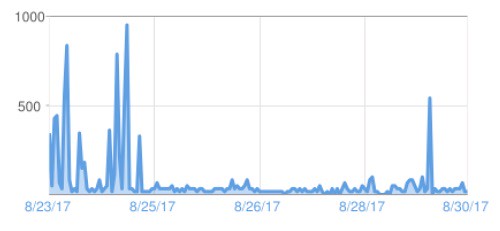
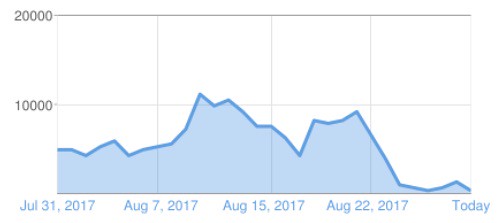
The hit count at New Savanna has plummeted over the weekend, dropping to 996 last Thursday and to a low of 478 on Saturday. Here’s the last week:

Aug-30 week 10-30AM

And the last month:

Aug-30 month 10-20AM

I’m guessing this is an end-of summer slump that may well last through Labor Day as most of my traffic is from the USA. When it comes back up, where will it go, to 4000 hits a day, plus or minus, or, say 8000? Who knows?