Showing posts with label magic. Show all posts

Thursday, December 2, 2021

It Shook Me, the Light

Bump! This post is from 2010, but it's been on my mind lately. So I'm bumping it to the head of the queue.
 
During the early 1970s I'd played for two years with a rock band called St. Matthew Passion. Modeled on Blood, Sweat, and Tears and on Chicago, the band consisted of 4-piece rhythm section plus three horns: sax, trumpet (me), and trombone. On “She's Not There” the three horns would start with a chaotic improvised freak-out and then, on cue from the keyboard player, the entire band would come in on the first bar of the written arrangement.

On our last gig it was just me and the sax player; the trombonist couldn't make it. The sax and I started our improv. The music got more and more intense until Wham! I felt myself dissolve into white light and pure music. It felt good.

And I tensed up.

It was over.

After the gig the sax player and I made a few remarks about it — “that was nice” — enough to confirm that something had happened to him too. One guy from the audience came up to us and remarked on how fine that section had been. Did he know what had happened? Or, if not ‘know’ exactly, did he sense a special magic in the performance? I ask because performers and audience often have a very different ‘sense’ of the same performance. Perhaps the guy was just complimenting us on our ‘freak-out’ chops, not on any magic in the music.

That's the only time I've ever experienced that kind of ego loss in music. For a few years I was very ambivalent about that experience, wanting it again, but also fearing it. A child of the 60s, a very geekish child of the 60s, I’d read quite a bit about altered states of consciousness, as they were called in the scientific literature. I read around in the secondary and tertiary literature on mystical experiences, and even a bit of the primary literature – though just exactly what’s the point of reading a mystic’s account an ineffable encounter with . . . . well, with what, exactly?

I knew such things happened. And now, in little more than a couple of heartbeats, now I too knew. But what is it that I knew?

Other than the experience itself, I knew that what all those people had been writing about was real. It’s not that I doubted it. Still it’s one thing to read about walking on the moon, even to see video footage and photographs of space-suited men walking about. It’s another thing to be there oneself.

But how can one experience be so powerful, so polarizing, that it haunts your thoughts and echoes through your soul for years afterward? What is the human nervous system that THAT can happen? In attributing the experience to the nervous system – as opposed, say, to an encounter with the divine, I do not thereby mean to dismiss it – oh, that? that was just a burp of the nervous system. We cannot dismiss it. The nervous system is us.

Now the memory's faded & the ambivalence too. But I'm playing better music now than ever I did back then. I’m talking not so much about technique – that comes and goes – but about expressive power, about ‘authenticity.’ Is that authenticity and echo of that experience?

Who knows?


* * * * *


Such experiences are common enough among musicians. Over the years I’ve collected accounts from books and articles. Here are some from Jenny Boyd, with Holly George-Warren. Musicians In Tune. New York: Simon and Schuster, 1992.
 
Patty Smyth (p. 161):
When I have had those experiences, I'm singing by myself. I've had those moments when I do feel the voice coming through me, and I know it's coming from out there. It's a certain tone in that voice that makes me feel that way. It chokes me up.
Cece Bullard (pp. 161-162):
It's like you leave your body. It's like you're dizzy and lightheaded and yet right there. My hands just seem to throb, like a pulse almost. It's the best feeling in the world, bar none. It took me a lot of singing lessons before I finally connected with that feeling. The first time it clicked and I connected, I nearly fell down, and I started crying.
Sinéad O'Conner (p. 164):
A lot of times I shake uncontrollably. I can't control the shaking, and it's not because I'm nervous, it's because I'm singing. It's because it's coming out and it's making me shake. It feels like being drunk, it's like an out-of-body experience. There are times when I've done gigs — and it doesn't happen every time you do a show or every time you write something — but they've told me stuff I've done onstage that I'm not aware I've done.
Branford Marsalis (p. 173):
High, you feel high. It's easy to do it physically, but it's hard to do it mentally. I feel that musicians who say it happens every time they play are full of shit. The sublime cannot be routine. Three times, and you never forget them. It's with a combination of musicians, it's never just me.
Ringo Starr (p. 176):
It feels great; its just a knowing. It's magic actually; it is pure magic. Everyone who is playing at that time knows where everybody's going. We all feel like one; wherever you go, everyone feels that's where we should go. I would know if Paul was going to do something, or if George was going to raise it up a bit, or John would double, or we'd bring it down. I usually play with my eyes closed, so you would know when things like that were happening . . . you've got to trust each other.
Huey Lewis (p. 179):
I find it more of a group experience for me. You look around and all of a sudden the song is playing and singing itself. It’s just like a wave that you ride. It’s tremendously exhilarating; it doesn’t take any energy and you look around and say, ‘Yep, this is it!’ It happens quite often but not for long periods of time. Almost at every gig that will happen somewhere for a fleeting moment. Some gigs it happens more often than others, and those are the good gigs.
Eric Clapton (p. 185):
It's a massive rush of adrenaline which comes at a certain point. Usually it's a sharing experience; it's not something I could experience on my own. . . . other musicians . . . an audience . . . Everyone in that building or place seems to unify at one point. It's not necessarily me that's doing it, it may be another musician. But it's when you get that completely harmonic experience, where everyone is hearing exactly the same thing without any interpretation whatsoever or any kind of angle. They're all transported toward the same place. That's not very common, but it always seems to happen at least once a show.
I don’t for a moment think these musicians are all describing the same thing. But just how many different things they’re describing, that I don’t know. Branford Marsalis says, “I feel that musicians who say it happens every time they play are full of shit.” Eric Clapton says that “it always seems to happen at least once a show.” Are they talking about the same thing? How could you tell?

Whatever it is, this family of musical experiences, it visits us in this devastating performance of Leonard Bernstein’s “One hand, one heart” by Jose Carreras and Kiri Te Kanawa.
Tuesday, February 26, 2019

Musician's Journal: The Magic of the Bell

This experience has had a profound effect on how I think about music. I used a reworked version to open the second chapter of Beethoven's Anvil: Music in Mind and Culture. One of my all time favorites.

Introduction: Together on the One


Interpersonal synchrony, moving, precisely, to the same beat as your fellows, is the core of social experience. The thrusts and jerks of an infant’s limbs, the timing of glances and twists of the body, will follow the speech rhythms of someone talking to the infant. Couples casually strolling in the park walk in step. People at a ball game make a “wave” in support of their team. All societies have rituals where people gather together and synchronize their movements, and thereby their hearts and minds, in affirmation of the central values of their culture.

I want to consider an example which is immediately familiar to me. This happened when I was living in upstate New York, which is as familiar to me as Africa was to the original African-Americans. It involves bell playing based on traditional African techniques.


The Craft


However, before getting to the magic, you need to understand a little about the craft. Few physical tasks are easier than getting a sound from a bell by hitting it with a stick. But that doesn’t mean that you can play your bell in a mood of casual somnambulance. No, you must be sensitive to small details, for nuance matters.

Generally you hold the bell in your left hand and the stick in your right—if you are right-handed. When you hit the bell with a stick the stick will bounce back. You need to learn to work with the rebound, not against it. If you hold the stick too firmly your grip will damp out the rebound and you will thereby waste the energy the bell has imparted to the stick. Rather, you want to hold the stick lightly and learn simply to redirect the stick’s energy back to the bell. You want to “cooperate” with the stick and the bell rather than “dominate” them.

Further, you need to attend to just where you hit the bell. The sound of a bell is complex and varies depending on just where you hit it. Thus, by hitting a bell in different places you can get several distinctly different sounds from a single bell. The different sounds you get from the bell will blend with other bell sounds in different ways. You have to be conscious of these blending possibilities when playing your bell.

By hitting the bell with sensitivity to the elastic properties of stick and bell you become one with the bell. By hitting the bell with sensitivity to the way your bell tones blend with other bell tones you become one with the group. While thus “becoming one with” has a mystical aura about it, you need to understand that this mystical aura is grounded in the subtleties of physical technique.

Sunday, February 25, 2018

Free Jazz: A William Parker Workshop


On Wednesday 13 February 2002 I attended a workshop conducted by William Parker. It was held in downtown Manhattan at 228 W. Broadway. The participants included two guitarists (electric), a vocalist, a trumpeter (me) and, of course, Parker himself, playing tuba for this occasion (he’s best known for his work on stand-up bass). Not your standard jazz ensemble.

Free jazz was the idiom. Of course “free jazz” is a big territory, but it doesn’t much matter just where in that territory we were located.

Parker made some general statements about this and that, and had variously wry, witty, and informative comments about the working methods of many of the folks he’s played with – Cecil Taylor, Ornette Coleman, Don Cherry, Muhal Abrams, and so forth. But mostly we made music. And it really was music that we made. And pretty good music at that. The kind of music where, when it’s over, you don’t want to talk. You just remain silent for a moment, collecting yourself, deploying your parachute so as to slow down your descent into lower Manhattan.

We started with something Parker called “Number 14” — which he concocted on the spot. As he said, it starts with four fours. “What’s that?” you ask. You play four notes at a rapid clip, and do that four times in a row. “What four notes?” you ask. “He didn’t tell us, and none of us asked.” We all picked the notes we wanted when it came time to play the piece. But there’s more to “Number 14” than four fours. After four fours there’s a pause, that’s so, just like that, long. After the pause everyone picks a high note and does a long descending gliss(ando) to some low note. “What high note to what low note?” you ask. “Do you really think there’s a specific answer to that question?” says I. And then we play a long trill. “On notes of your choice,” you remark. “Yes, that’s it.” After that, guitar one plays a simple one two figure and repeats it four times. Then the ensemble does another high to low gliss to trill. That’s the “head” to “Number 14.” After the head, it was up to us and the music to negotiate the flow.

So we went through the head a couple of times and then played it down. It must have gone for twenty or thirty minutes. It started out pretty raggedy, but then things started to settle in—though “settle “ is not a particularly good word to use here. There’s no easy way to describe the music that evolved. Sometimes there was a pulse, sometimes there wasn’t. Even when there was a pulse, there where times when some people didn’t follow it. Sometimes everyone was playing, sometimes only one or two were. Sometimes loud, sometimes soft, sometimes fast, sometimes slow, always shifting. Sometimes full-tilt bozo, sometimes approaching serene.

You need to understand that this is different from, say, your standard mainstream jazz quintet (there were five of us) in various ways. For one thing, the head wasn’t particularly definite; and there were no set chord changes or modes, no set back-up figures or ensemble passages. But, major though that may seem, those differences from the mainstream are, in fact, secondary. More profoundly, the traditional instrumental roles were gone. Traditionally there’s a rhythm section (piano and/or guitar, drums, and bass) and a front line (horns, vocal, guitar). The front line players do the head and then they play solos; meanwhile the rhythm section provides support (and gets a bit of solo action as well, depending on the format). Within the rhythm section, the drums, bass, and piano each has a role to play.

Well, in our music, all that disappeared. There’s no distinction between front line and rhythm section, and no fixed division of rhythm section responsibilities. It’s all up in the air, to be negotiated and reconfigured moment by moment. What this implies is that the old head-solos-head format disappears as well. There are no solos as such. This is collective improvisation, a conversation among equals, true democracy (to put a Ken Burns twist on the proceedings). Now, at this or that moment, one player might be more out front — either because she stepped out there or the others stepped back — but this is not dictated by any plan. It just happens. So we’ve got a floating mélange of quasi-solos, duos, trios and quartets all within the framework of the overall quintet.

How do you cope with a situation like that? I can’t answer the question in general, but I can say a little about how I approached it: With my ears. I’m always aware of what’s going on. Now sometimes I’m focused on what I’m doing and not so much on anyone or everything else. But I’m aware of it nonetheless. And when I’m focused on my own playing I might be doing complex stuff, or I might be repeating a simple three-note riff, or even a long tone. But I also make it a practice to spend some time explicitly focusing on what each other player is doing and to orient myself to those sounds in some way. Perhaps I’ll imitate them, or play an answer to them, or support them, or create a counter line. There are lots of ways to orient yourself to what other people are doing and it’s very important that you do so with each player, one at a time. It’s part of your responsibility as a citizen in this improvisatory democracy.

To return to traditional ways of thinking, what this means for me is that some of the time I’m thinking and playing like a soloist — my instrument’s traditional role in mainstream jazz — but that I spend more time thinking and playing like a bass player (though the trumpet is a soprano instrument, but that’s no reason I can’t provide an anchoring ostinato) or pianist (playing arpeggios) or even like a drummer (playing staccato hits). And when the vocalist would sing long tones, I might support her by playing long tones (more or less) with her.

It’s like going into a theatrical costume shop and trying on all the different costumes. Everyone else is doing the same thing. You meet in various configurations and improvise a little skit that’s consistent with your costumes. Then you change costumes and do it again, and again.

Until it’s over. And that’s the interesting thing. How do you know it’s over? Since there’s no set plan, no check list of things to accomplish (as in the head-solos-head format), you need some other way to end it. You might think that, since William Parker was leading this workshop, that he ‘d end it. But he didn’t. We all ended it, and at the same time.

That was the first time through “Number 14.” We did it a second time. Then we worked on some conceptions from other workshoppers. And then it was over. We didn’t have time for “Number 15.”

A most satisfying experience.

Addendum: Check out this interview with Steve Swell, a  trombonist who knows the drill.

Monday, April 6, 2015

Bell Magic and Spirits at 3 Quarks Daily

IMGP4137rd

My intellectual life has tended to revolve around various specific examples that I examine closely and revisit from time to time. Coleridge’s “Kubla Khan” is perhaps the most important literary example but of course there are others, most recently Conrad’s Heart of Darkness.

My thinking about music has been strongly influenced by a particular incident that occurred in rehearsal sometime in the 1980s. I was playing bells with three others and “magic” happened: the appearance of high twittering sounds that no one was playing. I used that incident to open the second chapter of Beethoven’s Anvil; I’ve blogged about it; and elaborated it into a 10,000 word working paper: The Magic of the Bell: How Networks of Social Actors Create Cultural Beings (see below).

I’ve now taken part of the working paper and revised it into my most recent post for 3 Quarks Daily: The Magic of the Bell and a Glimpse of Spirits. I’ve listed the working paper below along with its abstract and table of contents.

* * * * *

The Magic of the Bell: How Networks of Social Actors Create Cultural Beings


Abstract: It is well known that music can engender altered states of consciousness that are difficult to interpret scientifically except as odd malfunctions in the nervous system. In this paper I report a phenomenon known among some musicians as “the magic of the bell”: the emergence of high-pitched twittering sounds when a group is playing interlocking rhythms on different bells. These sounds cannot be attributed to any of the musicians and they emerge only when the group is a group is playing bells with passion and precision. I argue that those sounds arise through interpersonal coupling among the musicians and that the ‘naïve’ temptation to attribute them to a ‘spirit’ or ‘spirits’ can be reconciled with a close description that does not presuppose non-physical entities. Those spirits should be conceived as the embodiment of non-mysterious and physically coherent group process. This argument has ramifications for how we think of time and how we think of longer cycles of group life.

Introduction: Composing Strange Objects
Instrument Matter in the Musician’s Mind
Time and Again, the Curse of Linear Time
How to Compose a Spirit
Explain or Explain Away? Composition and Cultural Beings
Bibliographical References

Tuesday, March 31, 2015

Time after Time: Music and Memory in the Group

Or, messing around in one another’s mind space for fun and funk
This is about a simple, but profound, matter: that we cannot always and reliably access the contents of our own minds. In some circumstances we need external prompts. For reasons that I'll have to explain in a later post, this absolutely sinks the superficial notions of "information transfer" from one mind to another that seem to be the norm in discussions of cultural evolution. Certain activities seem to be irreducibly GROUP activities. And THAT's why I'm bumping this post from 2011 to the top of the stack.
John Miller Chernoff has an interesting observation in his book, African Rhythm and African Sensibility. It’s about playing one’s part in a percussion choir. Each of three, four, five, etc. players has a specific, simple, repetitive pattern to play. These individually simple patterns interlock to create a rich sonic wall of rhythm.

Chernoff notes that even highly skilled percussionists often have a difficult time playing a specific part without also hearing the other accustomed parts. This suggests that what the percussionist has learned is not just a motor pattern, but an auditory-motor gestalt that includes the whole rhythmic soundscape and not just one specific part of it. In such a gestalt the motor and auditory components would so intertwined that one cannot simple ‘extract’ the sound of one’s own phrase, along with the motor pattern, in order to execute in isolation. Rather, proper execution requires the entire gestalt and that includes the sounds executed by other players, the group sound, not the individual sounds.

It is thus not just that individual parts only sound correct in the context of other parts, but that the motor schema for executing one part is interwoven with the auditory schema for hearing the entire complex of parts. The drummer needs to hear the sound that the others are playing in order properly to activate his own motor schemas. The performance is thus inextricably a collective one.

In order to be as explicit as possible I want to suggest a very strained analogy. I am imagining a scene in a certain kind of action movie where it is time to launch the nuclear missiles. The process requires that two people insert keys into locks and turn them simultaneously. In the case of our African drummer, his auditory-motor schema for a rhythm is analogous to the launch of the nuclear missles. The drummer has the key to one lock, but that isn’t sufficient. Think of the auditory gestalt of the entire pattern as being the other key. Both keys are necessary. The drummer cannot access motor patterns in his own brain and body without help from others. Again: The drummer cannot access motor patterns in his own brain and body without help from others. Both keys must be inserted into their respective locks and then turned in order for the drummer to play his component of the rhythm. Without the full sound the drummer can certainly play something, but it will not be just exactly the appropriate part.

What is so very peculiar about my argument is that it contravenes a deep an unquestioned assumption of almost all of our thinking about the human mind. That assumption is that we are masters of our own mind and body. To be sure, there is, for example, the Freudian unconscious, which I do not here deny. But that does not seem germane in this situation. Our drummer’s inability to drum alone is not a matter of neurotic repression. It is quite different.

Monday, September 1, 2014

When Penn Met Teller

Running along with the musical numbers in an Othmar Schoeck concert were various “bits of business”— often, Chrisemer cheerfully admits, based on jokes that were not immediately comprehensible to most of those in the audience. In the final year of the concerts, when Chrisemer had graduated and was working in a stereo store in nearby Greenfield, Massachusetts, the bits included an extremely tall teenager riding across the stage on a unicycle as part of Chrisemer’s interpretation of “The Battle Hymn of the Republic.” The unicyclist was someone Chrisemer had met at the stereo store —a recent graduate of Greenfield High School named Penn Jillette, who had completed his higher education at the Ringling Bros. and Barnum  Bailey Clown College. Jillette also participated in the playing of “The Star-Spangled Banner” by juggling some balls above a large bass drum and letting one drop onto the drum on the appropriate beat: “Oh, say can you see [BOOM] by the dawn’s early light [BOOM] . . .”

One of the people who had helped with the staging of that concert was a close Amherst friend of Chrisemer’s who was by then teaching high-school Latin in New Jersey. Even as a college magician doing a silent and rather arty act at fraternity parties, he had taken to using only his last name—Teller. (The act was silent partly as a means of deflecting hecklers and partly as a means of increasing its artiness.) In the lobby at intermission, the silent Teller, outfitted with a cane and dark glasses, sold Othmar Schoeck pencils.

Thursday, March 21, 2013

Liquid Tone: Lena Horne on Music

Over the years I’ve been collecting anecdotes about the inner workings of music, especially about feelings and about moments of transcendence. Here are some remarks that late Lena Horne made to David Craig for On Performing (McGraw-Hill, 1987), his book about how musicians work their magic (p. 134):
And then when they killed [Robert] Kennedy and Martin Luther King, it seemed like a floodgate had opened. There had been a lot of deaths in my own family. . . . and when I say, I was different. I began to "listen" to what I was doing and thinking. I listened to the audience. Even to the quiet. I had never listened to it before. . . . I was different because I was letting something in. The tone was developing differently. I could do what I wanted with it. I could soften it. I wasn't afraid to show the emotion. I went straight for what I thought the songwriter had felt at a particular moment because he must have felt what I'd been feeling or else I couldn't have read that lyric, I couldn't have understood what he was saying. And I used my regretfulness and my cynicism. But even my cynicism had become not so much that as . . . logic. Yes, life is shit. Yes, people listen in different ways. some nights they're unhappy at something that has happened to them. OK. I can feel that knot of resistance. OK. That's where I'm going to work to. . . . And the second "eight" would be different than the first because the first was feeling it out and the second would change because I could come in "to my mood." . . . It developed out of this relaxation . . . a tone that was softer, more liquid.

Friday, October 7, 2011

Dandelions by Surprise

IMGP3465rd

When I took this photo I was thinking about aligning the trunk of the small tree with the edge of the building in the far back ground—but not so far back as the sun, of course. The dandelions didn't show up until I realized the photo.

Saturday, May 14, 2011

Flowers / Irises


IMGP9570rd

Flowers are much on my mind these days. Particularly irises.

I’ve been photographing flowers since late May of last year; irises in particular since May 1st of this.

In the past month or so Georgia O’Keefe and Robert Maplethorpe have been on mind. Obviously so. O’Keefe is known for painting large pictures of flowers seen close-up. And Maplethorpe too is known for his images of flowers, these photographic. In both cases, the images are said to be sexualized.

And I believe it. I can see it. That’s why their names have been circulating in my mind.

IMGP9595rd

And what I think is, no, it’s not that, it’s more than that, perhaps less as well. But that’s not right, not now in the early 20th century.

It may have taken an act of imaginative daring to see female genitals in O’Keefe’s flowers; even in Maplethrope’s flowers decades later. But no more. That connection, I note furthermore, is old as the hills. Now it’s banal. All those flowers I’ve been photographing, close-up, at a distance, en masse, they’re all. just. flowers.

The thing is, the blossoms really are reproductive organs, the reproductive organs of plants. And to call some of those plants “flowers” is to reduce those plants to their reproductive organs. They have stems, leaves, and roots as well. And the blossoms, the sex organs, they’re both male and female. So the O’Keefe/Maplethorpe resonance, while scoring on the geometry, gets the biology wrong.

Tuesday, March 29, 2011

The Woodpecker Works

Michael Sporn’s joined the Lantz-fest with a post that touches on the role of The Woody Woodpecker Show in stoking his desire to be an animator, meeting Lantz in NYC, and commentary on various Lantzers, with screen shots from Ace in the Hole.

I too have fond memories of The Woody Woodpecker Show. It was part of my routine. I watched it religiously, often with friends. I was particularly fond on the ‘behind the scenes segments,’ where Lantz would show how cartoons were made. Hot Stuff! I certainly tried out some of the drawing tips he gave out, though I never aspired to be an animator.

But – think about it – how often did a TV show take you behind the scenes? Not often. TV shows & movies were just out there. Like ‘em or leave ‘em, you had to take them at face value, ‘cause that’s all you got to see. But Walter Lantz showed you how cartoons were made (as did Walt Disney). Even as you laughed yourself silly over Woody Woodpecker and Andy Panda and the others, you also knew something about how the magic was done. Making it just a little bit more your magic.

What I’m wondering is if this early sense of the strings, levers and pulleys in the puppets and behind the curtain is the roots of my adult interest in how art works. Not what it means, no! not that! How it works.

Monday, March 28, 2011

Why Siam?

The Greatest Man in Siam is nominally set in a place called “Siam.” “Siam” is an older name for Thailand, which is in Southeast Asia, of course, not the Middle East. But this cartoon is not about Thailand, or anyplace in the Middle East for that matter, in any substantial sense.

We can, and I suppose we should, critique the cartoon for its standard-issue cultural misappropriation and Orientalism. At the moment, that acknowledgment is all I’m going to do. But, as these tropes aren’t being used to comment about some other culture, just why are they being used? Why the exoticism?

siam 50 wedding

Most likely because it provides a plausible ‘cover’ for the central motif of the cartoon, the contest for the bride. That’s not the sort of thing that’s done in America, is it? So we’ve got to locate the story is some place where this sort of thing is the norm. A mythical Siam is as good a locus as any.

What we really need to know, of course, is what this bride contest is doing in the cartoon. It’s a device, for what purpose? But let’s set that aside for a minute and ask another question: Where’d this device come from?

Tuesday, August 17, 2010

Ole! Elizabeth Gilbert

It turns out I’ve known about Elizabeth Gilbert for some months now, well before the movie of Eat, Pray, Love came out. She’d give a talk at TED back in early 2009 and I watched it online sometime early this year or late last year. Her talk was about creativity, natch, and about how the notion of the lone genius is just getting old, has always been destructive, and can’t we just get rid of it?

Yes, by all means, let’s do so.

Her general idea is to go back to an older sense of ‘genius,’ its original Roman sense, where it mean “this, sort of magical divine entity, who was believed to literally live in the walls of an artist’s studio, kind of like Dobby the house elf, and who would come out and sort of invisibly assist the artist with their work and would shape the outcome of that work.” That is, it’s not YOU, you creatin’ fool, its some other thing working through, or at least with, you.

OK, well, I’m not exactly sure that’s a step forward, but at least it’s no longer the lone genius individual dredging it up from the bowels of his – and, traditionally, it’s mostly been HIS – soul: the pain! the agony! the ecstasy! And so she goes on, first talking how the poet Ruth Stone would chase a  poem in her youth, grab it by the tail and “pull it backwards into her body as she was transcribing on the page. And in these instances, the poem would come up on the page perfect and intact but backwards, from the last word to the first.”

Strange are the ways of creativity. And then there was a story about Tom Waits, and how a song once came to him at an inconvenient time, while he was driving his car. So he told to the song to back off, either visit him at a more convenient time or “go bother somebody else today. Go bother Leonard Cohen.”

I like that: Go bother Leonard Cohen.

So she goes on a bit more, talks about how she gave a similar admonition to the house elf who was not cooperating on Eat, Pray, Love and then she reaches the climax of her talk.
Centuries ago in the deserts of North Africa, people used to gather for these moonlight dances of sacred dance and music that would go on for hours and hours, until dawn. And they were always magnificent, because the dancers were professionals and they were terrific, right? But every once in a while, very rarely, something would happen, and one of these performers would actually become transcendent. . . . It was like time would stop, and the dancer would sort of step through some kind of portal and he wasn’t doing anything different than he had ever done, 1,000 nights before, but everything would align. And all of a sudden, he would no longer appear to be merely human. He would be lit from within, and lit from below and all lit up on fire with divinity.

And when this happened, back then, people knew it for what it was, you know, they called it by it’s name. They would put their hands together and they would start to chant, “Allah, Allah, Allah, God, God, God.”
In time, in Moorish Spain, “Allah” became “Ole.” The tricky thing, says our Liz, is the day after, when the dancer “wakes up and discovers that it’s Tuesday at 11 a.m., and he’s no longer a glimpse of God . . . and maybe he’s never going to ascend to that height again.”

Ain’t that the truth, Ruth.

Her point, then, is that maybe that’s not so bad “if you just believed that [the powers to transcend] were on loan to you from some unimaginable source for some exquisite portion of your life to be passed along when you’re finished.”

And so I do think there’s more to Elizabeth Gilbert than made it into that movie, Eat Pray Love.

Monday, August 9, 2010

Musician's Journal: On Learning to Play the Cowbell

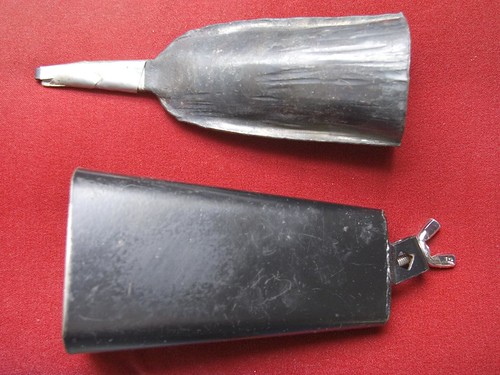
Yes, a cowbell, a standard Latin Percussion timbale cowbell. It’s 8” long, and the mouth measures 4 1/2” by 2 3/8”. It’s painted matte black and has a mounting bracket for attaching it to a drum kit. But I don’t have a drum kit. I hold it in my left hand and beat it with a drum stick.

I’ve been learning to play this bell for, say, 25 years. With any luck I’ll still be learning the day I die. Why so long to learn to play the bell? That’s probably not quite the right question.

Let me explain. In the first place, when I set out to learn a musical instrument five decades ago, the cowbell wasn’t what I set out to play. I set out to play trumpet. The musical role I cherished as a trumpet-player was that of improvising soloist. In time I became quite good in that role, good enough to open for BB King in one band, and for Dizzy Gillespie in another.

The soloist role is very up-front. It’s a role that allows for, and often calls for, a lot of flash and dash. You’re the center of attention, and you have to deliver.

The cowbell isn’t like that. Oh, I suppose it can be, if you’ve got more technical skill than I’ve got. But percussionists with the skill to solo generally don’t do so on cowbells. They’re more likely to use a jazz-type drum kit, or timbales, congas, bongos, djembe, or some other drum. Cowbell solos are rare.

The cowbell is an anchor instrument, a foundation instrument. It’s responsible to the basic rhythmic framework, whether a simple regular beat in rock and jazz or the more subtle 3/2 clave in Latin and African musics. The foundation has to be rock solid, unwavering, there.

And that, the role, is what I’ve been learning above all else. The foundational role is entirely different from the solo role. The soloist is a peacock, spreading his tail and strutting for the peahens. The bell is the ground on which the peacock and the peahens walk. The soloist needs good time, but that time can flex and change quite a bit – ever listen to Louis Armstrong? The cowbell’s time cannot flex and change, for it is the background against which, the framework within which, any flexing and changing is done.

By the time I’d started to play cowbell I’d been flexing and changing for 25 years. Learning NOT to do that, learning to be rock steady, that’s a process.

A tricky process. For you see, the time of a group is not mechanically perfect. It’s a steadiness built on a shifting framework of micro-, no nano-, flexing. There are little perturbations that give life to the time. Those perturbations exist in relation to the time of everyone playing. You’ve got to absorb all those time streams and drive your own time down the middle.