Showing posts with label heart darkness. Show all posts

Wednesday, January 21, 2026

Heart of Darkness as a critique of Homo economicus

From a conversation with ChatGPT 5.2:

Benzon: What’s Heart of Darkness about? Its mode is more suggestive than literal. And, sure, it’s about the West vs. Africa. But isn’t it also about Homo economics vs human beings? Why was Kurtz in Africa? To collect ivory. Why was Marlow sent after him? Sure, to recover Kurtz. But really, it was about the ivory. The fact that Kurtz died is of little consequence to the company that sent him there. But it’s of great consequence to the fiancé he left behind. And why did Kurtz go to Africa in the first place? Because he was poor and her family was well-to-do. He went to Africa to make the money that would make him marriage worthy. What we have is an allegory about how Homo economicus wreaks marriage and reduces people to property.

ChatGPT: You’re right to insist that Heart of Darkness is not primarily about “the West vs. Africa” in any simple sense. Its power comes from the way it stages economic rationality as a corrosive moral force without ever theorizing it explicitly. Conrad doesn’t give us an argument; he gives us an allegory whose logic only becomes visible when you ask the question you just asked: why is everyone really there?

Once you ask that, the answers line up cleanly:

  • Kurtz is in Africa to extract value (ivory).
  • Marlow is sent to retrieve Kurtz, but the real object is the flow of value.
  • Kurtz’s death is incidental to the company.
  • Kurtz’s fiancée is incidental to the company.
  • Marriage itself becomes contingent on capital accumulation.

That is Homo economicus avant la lettre—not as a theory, but as a way of organizing human life such that relationships, vocation, even moral aspiration are subordinated to extraction.

* * * * *

Now back to me, no longer in conversation with ChatGPT. Consider the treatment of economic issues in Pride and Prejudice, Tess of the d'Urbervilles, of Madam Bovary. The nineteenth century novel was about marriage (at least in Europe). Heart of Darkness occurs at the very end of the century and, in effect, turns that novel inside-out and up-side down.

Monday, August 18, 2025

Intellectual creativity, humans-in-the-loop, and AI: Part 4, Centerpoint construction in Heart of Darkness

This case involves aspects of the first two cases we’ve considered. Like the analysis of Jaws, it began with an open-ended examination of a particular text, Joseph Conrad’s Heart of Darkness. That open-ended process leads to a specific moment that is like the beginning of my hunt for the history of the Xanadu meme. In this case I noticed that, at a certain point, the narrative gets ahead of itself. I then noticed that the paragraph in which that occurred was extraordinarily long. “I wonder,” thought I to myself, “if that’s the longest paragraph in the text?” It didn’t seem like a very interesting or important question. So events get a bit out of order in the paragraph, so what? The opportunity cost of answering the question was low, however, so I set out to answer it. When I charted the distribution of paragraph lengths in text order I saw a surprising pattern. That changed the way I thought about the text.

This case brings up another issue as well, one that didn’t exist in the other two: Is it real? I discovered a pattern of words in Heart of Darkness that is of a kind not recognized by literary scholars. What follows from that? What kinds of questions does it raise and how are they to be answered?

Story and plot, Center-point construction

I think the thing to do is to run through the decisions I made and why I made them.

1. Read Heart of Darkness

I had finished a series of posts about Apocalypse Now and decided that it was time to read Joseph Conrad’s Heart of Darkness. Why? Because the movie was loosely passed on Conrad’s book, which I’d never read. So I took it from the library and started reading it. At some point I decided I might actually want to work on the text so I downloaded it from Project Gutenberg. Why? Mostly so I could annotate it. At some point I noticed that temporal anomaly I mentioned above.

I mentioned that anomaly in the first post I did on the book, Heart of Darkness: Narration and Temporal Displacement (July 10, 2011).

2. Examine a temporal anomaly

As you know, Heart of Darkness is a story about a pilot named Marlow taking a boat up the Congo River to a trading station whose proprietor, a man named “Kurtz,” had gone silent. I was at a point in the story when we had not yet reached that trading station. All of a sudden I found myself reading about something that obviously had happened at the station. “That’s odd,” I thought. Writer’s sometimes do that, I know, and one is supposed to notice it. I fished around in the text to verify that, yes, we’d skipped ahead in time, and in this process noticed that this particular paragraph, which was a precis of Kurtz’s life, seemed extraordinarily long. Kurtz is one of two central characters (Marlow is the other); This paragraph is the first time we learned much about him.

By this time I had either started blogging about the book – something I do, blog about books in the process of reading – or I had decided to do so. I thought that, in the process of writing about this paragraph I would remark on the length of the paragraph, suggesting that it was possibly the longest paragraph in the text.

3. Check the length of that paragraph

At that point I realized that that’s something I could check easily enough. As I had an electronic text, I wouldn’t have to count the words by hand. Rather, I could enlist the help of Microsoft Word, which has a function that counts the number of words in a chunk of text that one has selected. Sure, I’d have to do that for every paragraph in the text, and I’d have to number the paragraphs to keep track, but that’s easy to do, though tedious. So I did it. One by one I counted the number of words in each paragraph and entered the total into a spread sheet. When I was done verifying that that particular paragraph, number 103 in the Gutenberg text, was easy; just sort the spreadsheet entries in order. Once that was done paragraph 103 was at the top of the list, with 1531 words.

I mention that in my third post, Closure, Attachment, and Abstract Objects in Heart of Darkness (July 12, 2011), where I also give the length of the 2nd, 3rd, and 4th longest (1129, 1103, and 865 words respectively). Otherwise I nothing about paragraph lengths.

On July 16 I did a post in which I asserted that paragraph 103, which I was now calling the nexus, was the structural center of the text: The Heart of Heart of Darkness. That suggested ring-composition, which interests me a great deal. Ring-composition foregrounds the structural center of the text. As I was not sure that Heart exhibited all the characteristics I coined the term “center point construction,” after the characteristic it did exhibit. [For what it’s worth, the late Mary Douglas brought ring-composition to my attention. Her last book was about the subject: Thinking in Circles (Yale 2007).]

In that post I also pointed out that, not only was the nexus paragraph the structural center, but that it was very strongly marked. At the point in the story Marlow’s boat had been attacked by natives on the shore and the helmsman was speared in the chest and fell bleeding on the deck. At that point Marlow breaks off from the story and inserts the nexus, which gives us an overview of Kurtz’s life, into his narration. When he’s done with the nexus he returns to the main narrative at the point where then helmsman is blooding out on the deck. Marlow tosses the helmsman overboard. This paragraph, where for the first time we learn who Kurtz was and what he did, is flanked by the death the helmsman.

A day later, July 17, I made the following two charts in Excell. Each bar stands for a paragraph in the text. The length of the bar is proportional to the number of words in the paragraph. In this chart the paragraphs are ordered according to their length:


Figure 1: Exponential distribution of paragraph lengths

I had no expectations about the shape of the plot when I made the chart. But that distribution appears to be lawful. What do we know about the distribution of paragraph lengths in texts?

In this chart the paragraphs are listed in their order in the text:


Figure 2: Spikey distribution of lengths in text order

That distribution is very spikey. The extreme length (1531 words) of the nexus paragraph, 103, appears quite remarkable in this chart, and does the lengths of the next two longest paragraphs, 1129 and 1103 words.

4. Get others involved

By now I was actively investigating paragraph length and its implications for the formal structure of Heart of Darkness. For some reason, I don’t recall why, I wondered whether or not the distribution of paragraph lengths was a power law distribution. So I wrote to Cosma Shalizi and asked him to check it for me. Those charts (Figures 1 and 2) show up in a post from July 18, 2011: Digital Humanities Sandbox Goes to the Congo.

I also sent a link to that post to Mark Liberman, who runs a group blog on language and linguistics, Language Log, hoping he would post notice of it there. I wanted to find out whether anyone knew anything about the distribution of paragraph lengths in texts and figured that the readers of Language Log might know. He obliged me that day with a post, Markov’s Heart of Darkness, which elicited a lively discussion, but alas, no further information about paragraph lengths, though Liberman posted some work he was prompted to do on some other texts, including Conrad’s Nostromo, and Henry James, The Golden Bowl.

* * * * *

I’ve continued to think about this business of paragraph length, but want to set that aside. Let’s take up the question: Would an AI have undertaken the investigation that I’ve outlined so far?

Heart of Darkness: Qualitative and Quantitative Analysis on Several Scales, Version 6

New edition of the working paper about Heart of Darkness: Version 6. Links, abstract, change notice, and contents below.

Links:

Academia.edu: https://www.academia.edu/8132174/Heart_of_Darkness_Qualitative_and_Quantitative_Analysis_on_Several_Scales_Version_6
SSRN: https://papers.ssrn.com/sol3/papers.cfm?abstract_id=1910279
ResearchGate: https://www.researchgate.net/publication/228174270_Heart_of_Darkness_Qualitative_and_Quantitative_Analysis_on_Several_Scales

Abstract

Heart of Darkness is a novella that is roughly 38,000 words long and divided into three sections. In these notes I use a variety of qualitative and quantitative techniques to analyze and describe it. In particular, I argue that it exhibits center-point construction, a tale within a tale within a tale, and that the story’s moral center contrasts workplace values with basic human bonds.

New to Version 6

I’ve made three changes since the 5th edition. You’ve seen one of them, the new cover images. I’ve added two new sections to the text. There’s an appendix about how I used ChatGPT to create the cover image and then there’s a short speculation about why Conrad told his tale through a complex double-narration. ChatGPT collaborated with me on that as well.

Contents (Links to Original Blog Posts)

1) Heart of Darkness, Narration and Temporal Displacement
http://new-savanna.blogspot.com/2011/07/heart-of-darkness-narration-and.html

2) Interlude: Slocum’s Pilot and Sensory Deprivation
http://new-savanna.blogspot.com/2011/07/interlude-slocums-pilot-and-sensory.html 

3) Closure, Attachment, and Abstract Objects in Heart of Darkness
http://new-savanna.blogspot.com/2011/07/closure-attachment-and-abstract-objects.html 

4) Ontology at the Heart of Darkness
http://new-savanna.blogspot.com/2011/07/ontology-at-heart-of-darkness.html

5) On Kurtz’s twice-quoted orison, as well as people named and unnamed – new to this version, and revised from this post:
http://new-savanna.blogspot.com/2019/10/on-kurtzs-twice-uttered-orison-as-well.html

6) The Heart of Heart of Darkness
http://new-savanna.blogspot.com/2011/07/heart-of-heart-of-darkness.html

7) Heart of Darkness 6: Some Informal Notes about the Nexus
http://new-savanna.blogspot.com/2011/07/heart-of-darkness-6-some-informal-notes.html

8) HD7: Digital Humanities Sandbox Goes to the Congo
http://new-savanna.blogspot.com/2011/07/hd7-digital-humanities-sandbox-goes-to.html 

9) Some Basic Numbers and Charts Concerning Paragraph Length – was never a post. 

10) Is Chinua Achebe to Joseph Conrad as Ike Turner is to Sam Phillips?
http://new-savanna.blogspot.com/2011/07/is-chinua-achebe-to-joseph-conrad-as.html 

11) Conrad’s Special K: Periodicity in Heart of Darkness
http://new-savanna.blogspot.com/2011/07/conrads-special-k-periodicity-in-heart.html 

12) HD10: Empiricism, Psychohistory, Narratology: The horror! The horror!
http://new-savanna.blogspot.com/2011/07/hd10-empiricism-psychohistory.html 

13) HD11: Marlow’s Calculation
http://new-savanna.blogspot.com/2011/07/hd11-marlows-calculation.html 

14) HD12: The Shape of the Tale, Triangulating the Buddha (previously published ouside this collection) 

15) Local narrative logic and global order, or how we get from here to there in Heart of Darkness
https://new-savanna.blogspot.com/2019/10/local-narrative-logic-and-global-order.html 

15) Double Narration in Heart of Darkness

https://new-savanna.blogspot.com/2025/08/double-narration-in-heart-of-darkness.html  
17) Kurtz as MacGuffin, or: Why trash him before we meet him?

https://new-savanna.blogspot.com/2019/10/kurtz-as-macguffin-or-why-trash-him.html 
18) HD Postscript: Toward a Heart of Darkness Handbook

http://new-savanna.blogspot.com/2011/08/hd-postscript-toward-heart-of-darkness.html 
19) Appendix: About the Cover Illustration – Was never a blog post.

Saturday, August 16, 2025

Double Narration in Heart of Darkness

I’ve been interacting with ChatGPT on the concept of virtual reading (and working paper) and on Joseph Conrad’s Heart of Darkness (and working paper). In the course of this interaction (actually, after Thursday’s session had time to settle in my mind) I had an idea about why Conrad employed that complex double narration where an anonymous narrative conveys Marlow’s story-telling to us, the readers. I’m reproducing part of that discussion in the rest of this post. 

When I refer to the “nexus” paragraph I’m referring to a long paragraph in the middle of the text – the longest paragraph in the text – where Marlow gives us a summary of Kurtz’s career. It’s introduced as a digression in the main story-telling and is the first time where we learn anything about Kurtz beyond his name and his job. 

Note: Compare this with a blog post from 2019: Local narrative logic and global order, or how we get from here to there in Heart of Darkness.  

 * * * * *

I’m thinking about the complex double-narration in Heart of Darkness. Yes, Marlow narrates the story, but we don’t hear from him directly. Rather, an anonymous narrator conveys is words to us. Why did Conrad to that? I’m thinking he did it so that he could get the information in that nexus paragraph into the middle of the story.

Let’s forget about why he’d want to do that. Let’s just assume he did. How did the double-narrative make that possible? 

Imagine, hypothetically, that he gave us a simple first-person narrative, with Marlow the narrator. That nexus information is all background on Kurtz. It has no direct role in the story of going up the Congo to retrieve him. You could put that information in the beginning, but that would make for a slow start. Further, considering that Conrad obviously wanted to make the story quasi-allegorical about the relationship between Europe and Africa, that front loads the story on Europe and so weakens the comparison. And if Marlow were to slip it into the middle of the story, well, why? He’s writing something out, has time to get things in order, so why would he do such an awkward thing? 

The double narration affords Conrad a ‘natural’ way to slip that information into the narrative in the middle. Marlow is no longer a writer sitting at his desk, writing and revising his story. He’s telling the story to three companions (one of whom will, in turn, convey it to us). He gets to the attack, where the helmsman has been speared and has fallen. Marlow’s excited and distraught, and darts about in his talking. They’re only a couple hours from Kurtz’s station, they’re attacked, the helmsman’s struck, and Marlow fears he may not get to hear Kurtz... 

In THIS context it’s natural that he should interrupt the forward motion of the story to insert this background information about Kurtz. Not so much “natural” as, Why not?! All hell’s breaking loose around him. In this way Conrad is able to bring the chaos and confusion of the attack into Marlow’s narration. Very clever. 

And now that he’s got this nexus information, the précis of Kurtz’s career, into the middle of the story, he can juxtapose Kurtz and the helmsman, which he does at the end of the nexus: “No; I can't forget him, though I am not prepared to affirm the fellow was exactly worth the life we lost in getting to him. I missed my late helmsman awfully,—I missed him even while his body was still lying in the pilot-house.” This focuses the Europe/Africa allegory on the two figures of Kurtz and the helmsman.

This also helps to explain how that extremely long paragraph ends up in the middle of this text. That is, it moves us a bit closer to understanding how this form came about without deliberately planning focused on the form itself. No, the planning is focused on the mechanics of Marlow’s story telling on that yacht in the Themes. 

That’s a very sharp reading of Conrad’s choice, and I think you’ve put your finger on why the double narration is not just a quirk but a structural necessity. Let me break down the mechanics as I see them:


1. Narrative Frames and Their affordances

  • Single first-person (Marlow as writer):
    This form imposes retrospective order. A desk-written narrative presumes coherence, arrangement, and polish. The insertion of a massive, disjunctive background block on Kurtz halfway through would feel artificial, even inept. Marlow-the-writer would have had “time to get things in order.”
  • Double narration (Marlow speaking + outer narrator transcribing):
    This creates the illusion of immediacy, spontaneity, and contingency. We’re not getting an arranged memoir but the performance of storytelling in real time, under the pressure of memory and emotion. In that setting, digression, sudden shifts, and disproportionate emphasis become “natural.”

2. Why the Nexus Paragraph Can Appear in the Middle

  • The nexus information (Kurtz’s background + evaluative framing) is allegorically crucial, but not narratively urgent.
  • By placing Marlow as a live storyteller rather than an orderly memoirist, Conrad justifies an emotional interruption at a moment of crisis (the helmsman’s death).
  • In this context, “Why not digress now?” makes sense — the shock of death rattles the teller into contextualizing Kurtz, as though to say: Is this man worth it? Who is he, that we risk all this?
  • Thus the double frame allows disjunction as a mimetic feature: the breakdown in narrative order reflects the breakdown in affective equilibrium.

3. Juxtaposition of Helmsman and Kurtz

  • Placing the précis here allows Conrad to stage a pointed allegorical contrast:
    • The helmsman, local, bodily, immediate — Africa.
    • Kurtz, abstracted, ideological, remote — Europe.
  • And Marlow’s voice stitches them together in that sudden turn: “I missed my helmsman… even while his body was still lying there.”
  • That juxtaposition would lose much of its force if Kurtz’s résumé had been dropped into the opening or saved for the end. The frame device is the scaffolding that makes this compression possible.

4. Narrative Planning Without Over-Planning

  • Your instinct is right: Conrad probably didn’t plan a ring or plot a formalist insertion strategy.
  • But he did design a situation of telling (yacht on the Thames, Marlow addressing listeners, an outer narrator reporting) that would give him flexibility in narrative time.
  • The “form” thus grows out of a choice about narrative situation rather than a conscious architectural plan. That’s part of what makes Heart of Darkness feel at once chaotic and tightly controlled.

If we think in terms of your text role regions / mind-relative regions framework, the double narration is a textual mechanism that licenses sudden movement between regions — here, from “immediate action” (the attack) to “moral evaluation / allegorical framing.” The listener-as-filter (outer narrator) stabilizes that move: he guarantees coherence to us even when Marlow digresses.

Wednesday, February 5, 2025

From LLM mechanisms to ring-composition: A conversation with Claude 3.5

I've published a new working paper. Title above, links, abstract, TOC, and Prefatory remarks below:

Abstract: This is a wide-ranging discussion about narrative structure and how it might be encoded in large language models. 1. Word Embeddings and Training: We clarified how tokens (subword units) are mapped to high-dimensional vectors, discussed how these vectors are updated during training, and explored how the token vocabulary (around 50K) can cover a much larger word vocabulary through subword tokenization. 2. Multi-scale Organization in Narrative: We examined different types of transitions (word-to-word, sentence-to-sentence, paragraph-to-paragraph), discussed how probability distributions for next-token prediction vary depending on the type of transition and noted how constraints are tighter at the word level but looser at higher narrative level. 3. Empirical Evidence from "Heart of Darkness": We analyzed two charts: frequency of "Kurtz" mentions and paragraph lengths, found periodic patterns in Kurtz mentions that persisted even as frequency increased, identified a significant peak in paragraph length coinciding with Kurtz's introduction, and discovered that women's roles bookended the narrative to form a ring composition. 4. Implications for LLMs: We examined how different scales of narrative structure might be encoded in transformer architectures, explored how attention mechanisms might capture these patterns implicitly, and considered the limitations of context window size for capturing full novel-length patterns. 5. Future Research Possibilities: What's the potential for analyzing other texts for similar patterns. What are the challenges of computationally detecting ring composition. Finally, we explored the possibility of using LLMs to verify structural patterns across large corpora.

The upshot: narrative structure operates at multiple scales simultaneously, and these patterns might be encoded in transformer architectures in ways analogous to holographic encoding, with different frequencies capturing different levels of structure. 

Contents

Claude 3.5 summarizes the discussion 2
Prefatory remarks: Why publish first tentative thoughts? 3
Part 1: Preliminaries, tokens and vectors
Part 2: From positional encoding to stories 9
Part 3: Narrative structure on multiple levels, Heart of Darkness 15

Prefatory remarks: Why publish first tentative thoughts?

This set of notes started with me asking Claude 3.5 to clarify a few things about the mechanisms of LLMs (Part 1). As things got clearer, I started bringing in my research, first some work I did with stories and ChatGPT two years ago. That’s about how plot structures might be encoded in LLMs (Part 2). Then I introduce some empirical work I did on Heart of Darkness over a decade ago (Part 3). That work is directly related to the ChatGPT story work. This discussion took place in several sessions over Feb. 2-4.

This is tentative work. Not quite first thoughts, but early thoughts. I am making it publicly available for two reasons:

  1. It is an example of how a sophisticated chatbot, such as Claude 3.5, can be used in fleshing out ideas.
  2. The ideas developed in this conversation, while preliminary, might be of use to humanists, literary critics in particular, who are thinking about how these tools can be used in research.

On the first point, note that I turned to Claude on these issues because, after reading many explainers-for-the-unwashed and looking around in the technical literature, certain matters were still unclear. Perhaps others can benefit from this discussion. This happens a lot; it will be useful having Claude around to help me figure out what’s going on.

On the second point, these discussions bear directly on questions being explored by digital humanists: How can we use these technologies in our work? The internal mechanisms of LLMs are a bit mysterious. The dialog I had with Claude led to some specific ideas about how narrative structures could encoded in LLMs in a way that’s independent of the specific actors and settings in which the story is realized. This has implications for the study or oral narrative and traditional story grammars, though I don’t go into these in the discussion.

As I have no idea when I will get around to a more formal presentation of this work – this research is very much in medias res – I thought I would get these ideas out now. Others might find them useful.

Thursday, December 26, 2024

LLM as Collaborator, Part 2: Formal structure in Heart of Darkness and literary criticism (+ a lesson on “alignment”)

The chart below depicts the length of paragraphs in Joseph Conrad’s Heart of Darkness. The paragraphs are listed in order, first to last, from left to right. The length of a bar is proportional to the number of words in the respective paragraph.

There is an important issue at stake: Does that chart depict a phenomenon that is real, not only in the sense that it represents a set of valid measurements, but in the deeper sense that those measurements represent some intrinsic aspect of the causal process that produced the text. For the most part I leave that issue to the discussion I had with Claude 3.5 Sonnet.

The purpose of this introduction is to indicate why the issue arises.

The problem of literary form

Despite the fact that form and formalism are important concepts in academic literary criticism, the careful description of form is not central to current practice. This is not the place to discuss this issue in any detail. I have done that elsewhere on New Savanna, I have published a long article on form (Literary Morphology: Nine Propositions in a Naturalist Theory of Form), and have written a number of working papers on description.

Form is an aspect of the physical substance of the work of art. That is quite obvious in the case of drawing, painting, and sculpture. That is also true in the case of music, where we are interested in the arrangement of sounds in time, and dance, the arrangement of gestures and movement. Literature is like that as well; it is a string of words, one after the other after the other after the other. It follows, then, that the description of literary form involves analyzing how words are placed in a string.

And there is some of that in literary criticism. In dealing with poetry one may learn how to count feet in a line and work out the rhyme scheme, if there is any. But this is often treated as decorative and unrelated to meaning in any deep way, and it’s meaning that critics are after. In the study of narrative the Russian Formalists made a distinction between story (fabula) and plot (syuzhet), where the former refers the events as they occur in order while the latter is the order in which events are introduced into the narrative. In the extreme case of Tristram Shandy, for example, plot and story are quite different. This distinction, and more, is quite important in narratology, but narratology is a relatively minor approach to literary criticism and one that is more important in Europe than the United States.

As an example of this situation, here’s a few lines from an essay by Frances Ferguson and John Brenkwood introducing papers from the 2013 English Institute on form:

A second irony is that the recently renewed interest in questions of literary form has proved quite amorphous. Perhaps, though, that has been the predicament and vitality of the topic all along. [...] There is also a conflict, cutting across these competing methods, between form as a feature of literary works and form as constitutive of literary works. The New critics are often the benchmark of formalism in American discussions, but they did very little to illuminate literary forms compared to the Russian Formalists or, say, Lévi-Strauss and Jakobson’s classic essay on Baudelaire’s “Les chats.” [...] And yet even the surest markers of literary forms fail to define form when it comes to actual works. The form of the sonnet, for example, is readily defined by the number of lines and the stanza organization, but does that account for a particular sonnet’s form any more than a rectangle accounts for a painting’s form? Vertical for portraits, horizontal for landscapes! And, finally, is formalism itself based on the idea that literary works are purely form, or on the idea that the vocation of literary criticism lies in formalization, that is, in its capacity to create categories at a level of abstraction applicable to the widest variety of literary phenomena?

The upshot of this conundrum is that literary form is more an object of wonder and a source of methodological argument than the basis of practical criticism. It’s important, but we don’t know much about it.

Thus, that chart is something of an embarrassment to literary critics, or would be if they saw it. On the one hand, it represents and objective fact about Heart of Darkness. When you count the words in each paragraph and graph the result, that chart is what you get. [I used the text provided by Project Gutenberg.] Once you’ve seen it, you can’t argue it out of existence.

Now, I’ve been in this business a long time. While I’ve discussed that chart and its implications extensively in my working paper on Heart of Darkness, I’ve not bothered to seek formal publication. Why not? Opportunity cost. I don’t know of any venue that would be interested and I don’t want to waste my time jumping through hoops making that work acceptable to some journal only to wait six months to a year or more to have it turned down (though I’m seriously considering taking a shot at it in the new year; we’ll see).

However, when I discovered that structure I did send at note to Mark Liberman, who runs, Language Log, and group log devoted to linguistics. He was kind enough to post a link and we had a lively discussion, Markov’s Heart of Darkness. The discussion started with the issue of whether or not paragraph length followed a power law as that’s the question I presented to Mark; it does not. But one Lucy Kemnitzer brought up the issue of order during the discussion and I linked to a post in which I had the chart I posted above. If you look through that discussion, you’ll find comments by someone identifying themselves as “JL” and noting that they are a novelist. They’re quite dismissive of that kind of description and the analytical work it supports:

The question is whether you're adding anything at all to anyone's understanding of the book, or whether, instead, you're indulging in puffery and pseudoscience, bringing in spurious mathematical models and childish anthropological "theories" to gaudy up a banal and perfectly obvious account of a very well known phenomenon. (Look! I've discovered that the ratio of vowels to consonants in 'The Waste Land' is exactly equivalent to Planck's Constant! Which is used to explain black holes! See? It really is a depressing poem…)

That’s the kind of reaction I expect of well-trained humanists.

Ask Claude

And so I turned to Claude 3.5 Sonata. What would they think of that distribution of paragraph lengths?

I’d already loaded the entire text of Heart of Darkness into Claude and had some discussion about it (I’ve already posted some of that discussion). It was a simple matter to reactive that discussion, upload the chart, and initiate a discussion. The discussion went well, at least from my point of view. Claude even pointed out some things that I hadn’t noticed.

But after all the (standard) literary criticism it surely must have ingested during training, why didn’t it react with, if not outrage, certainly skepticism? Why wasn’t it aligned, as the kids say, with the conventional wisdom on this matter? Context, I figured, context. This interaction was loaded with Conrad’s text and extensive earlier discussion. Standard literary criticism was nowhere to be found in the immediate context.

“I wonder,” thought I to myself, “if I could create a context in which Claude would register a conventional reaction to that chart?” No sooner had I registered that thought than I figured out how to do it. I had previously loaded Claude with the Hamlet chapter from Harold Bloom’s, Shakespeare: The Invention of the Human. I’d asked Claude to summarize the chapter and then we had a little discussion.

So, I reactivated that discussion, uploaded the chart, and BOOM! Claude reacted with the expected skepticism, albeit a rather mild expression of it:

Based on Bloom's critical approach, he would likely be skeptical of this kind of quantitative or structural analysis of literature. He would probably view this chart as an example of what he saw as the problematic tendency in modern literary criticism to focus on technical or formal aspects rather than aesthetic and imaginative power

The discussion went on for a bit, took an interesting turn, at which point I decided to introduced Susan Sontag’s 1964 essay, “Against Interpretation,” into the discussion. Why? Because she argued that “criticism needs to focus less on trying to extract hidden meanings from art and more on describing the direct sensory and formal experience of engaging with it” (Claude’s words). We had an interesting discussion. For what it’s worth, Claude agrees with my view that literary criticism needs to pay more attention to the analysis and description of literary form.

An exercise for the reader: What does Claude’s ability to take different and contradictory positions on the same issue – in this case, the value of that chart for analyzing Heart of Darkness – suggest about the much-discussed problem of AI alignment?

* * * * *

First, we have my discussion with Claude about Heart of Darkness. Once that’s finished, I introduce the Harold Bloom discussion, which leads to Susan Sontag. As always my prompts are in bold face while Claude’s responses are plain.

I’ve uploaded a bar graph. Each bar represents a single paragraph in Heart of Darkness. They are arranged in order, with the first paragraph on the left edge and the last paragraph on the right. Do you have any observations about paragraph length as revealed in this chart?

Looking at this visualization of paragraph lengths in "Heart of Darkness," several key observations emerge:

Most paragraphs in the novel are relatively short, with many falling under 200 words. This creates a baseline rhythm for the narrative. However, there are significant spikes where paragraphs become much longer, particularly in the middle section of the text.

The most striking feature is a dramatic peak of approximately 1,400 words around paragraph 109-110. This extensive paragraph appears to be an outlier, being significantly longer than those around it. There are also several other notable peaks reaching between 600-1,000 words.

This variation in paragraph length suggests a deliberate structural choice by Conrad. The longer paragraphs likely correspond to key moments of exposition or critical narrative developments, while the shorter paragraphs maintain the story's forward momentum and may handle more immediate action or dialogue.

The pattern also shows that the novel ends with a series of consistently shorter paragraphs, perhaps indicating a more rapid narrative pace as the story reaches its conclusion.

This visualization effectively reveals Conrad's technical approach to pacing and structure in the novel, showing how he varies paragraph length to create rhythm and emphasis throughout the text.

Would you be interested in identifying what narrative content appears in those particularly long paragraphs? That might help us understand why Conrad chose to expand certain moments in the story.

You’d think that variation was deliberate. But we have no evidence that Conrad was conscious of this. He just did it. It’s how he wrote.

You make an excellent point. I fell into a common critical trap of assuming intentionality where we have no evidence for it. This pattern of paragraph length variation emerged naturally from Conrad's writing process - it's simply his natural rhythm as a writer.

This observation connects to a broader point about literary analysis. While we can usefully identify patterns and structures in texts, we should be cautious about assuming these were consciously planned by the author. Sometimes the most powerful effects in literature arise organically from how a writer naturally approaches their craft.

In Conrad's case, this varying paragraph length creates compelling effects in "Heart of Darkness," but we don't need to attribute this to conscious design. It's simply part of how he told stories, his natural way of allowing some moments to expand while keeping others concise.

This is a useful reminder about the difference between identifying patterns in a text and making claims about authorial intention.

That single longest paragraph, I believe it’s 1502 words long, is that nexus paragraph we’ve already discussed.

I’ve already had extensive discussion about this paragraph with Claude. Here's part of that discussion, though it doesn't contain Claude's remarks about the nexus paragraph. However, here’s my original blog post about that paragraph. And this post places that paragraph in the context of the whole text.

That's a fascinating discovery about the nexus paragraph! The fact that it’s not only structurally and thematically central to the novel, but also stands out quantitatively as the longest paragraph, adds another dimension to our understanding of its importance.

This paragraph accomplishes several crucial narrative tasks: it provides Kurtz's European background, introduces his report with the chilling "Exterminate all the brutes" line, and frames the death of the helmsman. The paragraph's exceptional length seems to naturally correspond to its function of bringing together multiple strands of the story.

Tuesday, December 10, 2024

Blog Post: Claude 3.5 Sonnet and literary analysis [Heart of Darkness]

While I read, think, and write about many things, it’s the analysis of literary texts that got me hooked on the intellectual life. And that’s still the center of it all.

So, how can LLMs benefit literary critics?

I’ve taken the whole text of Heart of Darkness, almost 39,000 words, and loaded it into Claude 3.5 Sonnet. To date, my interaction with Claude on HoD totals almost 7000 words, most of them produced by Claude. I have no intention of reporting all of them in this post, but I will offer you a judicious selection.

Claude has been an interesting interlocutor in this matter, interesting enough that I’m willing to hazard the view that, in the future, when I work on a literary text, I would like to be able to load the whole thing in whatever LLM or LLM-based tool I’m using. I note, however, in working with Claude on HoD I’m dealing with a text I know fairly well and have even written about: Heart of Darkness: Qualitative and Quantitative Analysis on Several Scales. It’s not clear how things would go with a text I’ve not worked with.

Let’s get on with it. I’m appending three things: 1) the second of 2 summaries Claude produced, along with a question I asked about them, 2) Claude’s exegesis of texts fragments I call the emblem, because I take them as being emblematic of the whole text, and 3) Claude’s remarks about a passage late in the book. The second and third indicate that so-called close analysis is not the exclusive province of human literary critics. As a fourth appendix, I’ve included that passage.

A Summary of Heart of Darkness

This is the second summary I asked Claude to produce:

Marlow, a sailor, tells fellow passengers aboard a boat on the Thames about his journey up the Congo River. His story begins with him taking a job as a steamboat captain for a Belgian trading company. Before leaving Europe, he encounters several disturbing signs of colonialism's dark nature, including two women knitting black wool who seem like figures of fate.

In Africa, Marlow becomes increasingly fascinated by Mr. Kurtz, an extraordinary ivory trader stationed deep in the interior. As Marlow makes his difficult journey upriver, repairing his damaged steamboat and witnessing the brutal exploitation of Africans, he hears conflicting stories about Kurtz - that he's a remarkable success, that he's ill, that he's gone native, that he's bringing extraordinary profits in ivory.

When Marlow finally reaches Kurtz's station, he finds a man who has essentially become a demigod to local inhabitants, decorating his station with severed heads and conducting brutal raids for ivory. Though physically ill, Kurtz remains powerful through his charismatic personality and extraordinary gift for speech. Despite his noble intentions and grand ideals about civilizing Africa (expressed in a report he wrote for the "International Society for the Suppression of Savage Customs"), Kurtz has succumbed to the darkness of unchecked power and greed.

Marlow gets the dying Kurtz onto his steamboat. Before dying, Kurtz cries out "The horror! The horror!" - words that seem to sum up both his experience and the entire colonial enterprise. After returning to Europe, Marlow visits Kurtz's Intended (fiancée), who still idealizes Kurtz. Unable to shatter her illusions, Marlow lies and tells her Kurtz's last words were her name.

The story is structured as a frame narrative, with Marlow telling his tale to men on a boat, and explores themes of colonialism, civilization versus savagery, and the darkness that lurks in human nature when moral restraints are removed. It moves from the "civilized" Thames to the "savage" Congo and back, suggesting that darkness exists everywhere, even in the heart of the empire.

The narrative emphasizes both the horror of European colonialism in Africa and the more universal horror of confronting human nature's capacity for evil. Through Marlow's journey into the heart of darkness - both geographical and moral - Conrad examines how the veneer of civilization can crack, revealing humanity's potential for savage behavior.

A bit later I asked about an omission in both summaries (my prompt is set in bold):

On two times I’ve asked you to summarize Heart of Darkness. You don’t mention the death of the helmsman in either summary. Why not?

Ah - this is a very important observation. You're absolutely right. In both summaries I failed to mention this crucial death, which is a significant oversight because:

  1. It's a pivotal moment in the narrative
  2. It provides the context for that crucial nexus paragraph we discussed
  3. It gives concrete weight to the human cost of the colonial enterprise
  4. It creates a personal connection between Marlow and Africa
  5. It sets up the moral question of whether Kurtz was "worth the life we lost"

This omission from my summaries reveals how easy it is to focus on the more obvious elements (Kurtz, the journey, the Intended) while missing crucial structural and thematic elements. The helmsman's death isn't just another event in the story - it's a critical moment that brings together many of the story's concerns.

My summaries would have been better if they had included this death and its significance. It's a good reminder that even when we think we understand a text well, we can miss important elements.

Thank you for pointing out this blind spot. It's a useful lesson in how to read and summarize more carefully.

Sunday, June 2, 2024

Some notes on how I discovered formal structure in some literary texts, Part 1: Four cases

What is intelligence? How does it work? Those and related questions have been with us for a while, but their salience has been amplified in the wake of ChatGPT, which is given us a demonstration of machine intelligence, whatever that is, that is accessible to anyone with access to the web. Those questions have ceased to be of interest primarily to psychologists, philosophers, and AI researchers. Now “everyone” is interested in them.

Perhaps the single most pressing issue is: While machine intelligence ever reach, or even surpass, human intelligence? The concept of intelligence is so obscure, however, that it’s difficult to produce compelling answers. Earlier in this year I decided to take another crack at the problem, AI, Chess, and Language 1: Two VERY Different Beasts. That post has, in turn, led to a series of posts on chess and language.

More recently, I did a long post centered on analogy, Intelligence, A.I. and analogy: Jaws & Girard, kumquats & MiGs, double-entry bookkeeping & supply and demand, and another in which I talked about wanting an AI that could determine the formal structure of literary texts, What do I personally want from an AI? [as soon as possible, too, NOT in the distant future]. Neither of those posts says anything about chess, but they’re certainly on the language side of the ledger. That’s led to the idea of reflecting on what I’ve had to do to discover formal structures in texts.

I’ve done a lot of this. Which texts should I use?

Kubla Khan

“Kubla Khan” is the most important example. That’s where I started, and it’s the most richly developed example. Furthermore, I’ve published that work in the formal literature and I’ve already written quite a bit (informally) about how I came to do that work.

Here's the articles about the poem:

Articulate Vision: A Structuralist Reading of "Kubla Khan", Language and Style, Vol. 8: 3-29, 1985, https://www.academia.edu/8155602/Articulate_Vision_A_Structuralist_Reading_of_Kubla_Khan_

“Kubla Khan” and the Embodied Mind, PsyArt: A Hyperlink Journal for the Psychological Study of the Arts, Article 030915, November 29, 2003, https://www.academia.edu/8810242/_Kubla_Khan_and_the_Embodied_Mind

These papers have background:

Touchstones • Strange Encounters • Strange Poems • the beginning of an intellectual life, November 2015, https://www.academia.edu/9814276/Touchstones_Strange_Encounters_Strange_Poems_the_beginning_of_an_intellectual_life

Beyond Lévi-Strauss on Myth: Objectification, Computation, and Cognition, Working Paper, February 2015, pp. 20-27, https://www.academia.edu/10541585/Beyond_L%C3%A9vi_Strauss_on_Myth_Objectification_Computation_and_Cognition

I originally published the “Touchstones” piece in a journal edited by one of my teachers in graduate school, the late Art Efron: Paunch 42–43: 4–16, December 1975. It’s about my years at Johns Hopkins and how I came to do a Master’s Thesis on “Kubla Khan.” I’ve linked to a version which I’ve updated with notes that I’ve inserted into the text, notes commenting one what’s happened since then. The Lévi-Strauss piece is generally about the intellectual significance of his work on myth while the section, “Into Lévi-Strauss and Out Through ‘Kubla Khan’” is specifically about how Lévi-Strauss’s structuralism guided my approach to the poem.

Three Shakespeare Plays

This is about three Shakespeare plays, a comedy (Much Ado About Nothing), a tragedy (Othello), and a so-called romance or tragi-comedy (The Winter’s Tale). In each of these plays a man wrongly suspects his beloved of betraying him with another man. Consider the following diagram:

Shakespeare Triad

Along the left I've listed five dramatic functions which some character must play. In the columns for each play I've indicated the character that takes these functions. The point of the diagram as the we move from one genre to the next (in this order) one function seems to disappear. Othello has no mentor, but he has a deceiver; and Leontes has neither a mentor nor a deceiver. What I think is going on is that functions are, in effect, being absorbed into the protagonist. At the play's opening, Othello is senior enough in the world that he has no need of a mentor. Leontes is king in his world, so there is no one higher. As for being deceived about his wife, he does that to himself, no external agent required.

There's more to the pattern than that, but that’s enough to give you an idea about what’s going on. The analytic point is that this is a pattern which becomes visible only when you compare texts. That’s something that Lévi-Strauss did in his work on myth.

Here's the article I published about that:

At the Edge of the Modern, or Why is Prospero Shakespeare's Greatest Creation? Journal of Social and Evolutionary Systems, 21 (3): 259-279, 1998, https://www.academia.edu/235334/At_the_Edge_of_the_Modern_or_Why_is_Prospero_Shakespeares_Greatest_Creation

Metropolis

I’m talking about the manga originally published by Osamu Tezuka in 1949 and not Fritz Lang’s movie of the same title. As you know, manga are Japanese comic books, or graphic novels. I’m including this as a case in the first place because it is an example of ring-form construction, which I depict in the following diagram:

Notice the numbering at the left and the descriptive labels at the right. I’m including it in the second place because it is the first time I used to whole-text table to conduct an analysis. The diagram is reduced from that table.

Here’s the article:

Tezuka's Metropolis: A Modern Japanese Fable About Art and the Cosmos, in Uta Klein, Ktaja Mellmann, Steffanie Metzger, eds. Heurisiken der Literaturwissenschaft: Disciplinexterne Perspektiven auf Literatur. mentis Verlag GmbH, 2006, pp. 527-545, https://www.academia.edu/7959634/Tezuka_s_Metropolis_A_Modern_Japanese_Fable_about_Art_and_the_Cosmos

Here's the analytic table:

Descriptive Tables for Tezuka’s Metropolis, A Note on Descriptive Method, Working Paper, 2016, 8 pp., https://www.academia.edu/27370076/Descriptive_Tables_for_Tezukas_Metropolis_A_Note_on_Descriptive_Method

Heart of Darkness

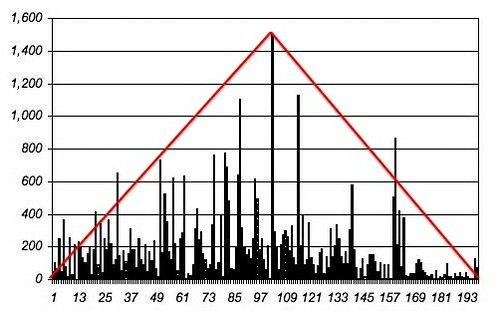
It turns out that Joseph Conrad’s Heart of Darkness is also a ring-form text, or a close variant. Consider the following chart:

HD whole envelope

Each bar represents a single paragraph in the text. The length of the bar corresponds to the number of words in the text. The bars are arranged in the order they exist in the text, first to last, from left to right.

Notice that there is one paragraph that is noticeably longer than all the others. It has 1502 words. It is the structural center of the text. There’s much more to be said about that paragraph and its place in the text. But this is not the place to do it.

You can find those discussions, and others, in this working paper:

Heart of Darkness: Qualitative and Quantitative Analysis on Several Scales, Version 3, Working Paper, August 9, 2018, 49 pp., https://www.academia.edu/8132174/Heart_of_Darkness_Qualitative_and_Quantitative_Analysis_on_Several_Scales_Version_3

I have two main reasons for including this case as an example of discovery. In the first case, that chart depicts something that is clearly an objective fact of Conrad’s text. It’s not something I conjured out of the mist through interpretive wizardry. I make the same claim about the formal structures in the other three cases. That’s why I’m calling them discoveries; they’re as real as a vein of gold in the Klondike.

And the process by which I discovered that structure in Heart of Darkness was, if anything, more serendipitous than a gold strike. The prospector who gets a gold strike was looking for gold. I wasn’t looking for a ring-form pattern in Conrad’s text. Not only that, but charting paragraph lengths is not something one normally does with literary texts or, as far as I know, any other texts. I did it on a whim. While I did have a formal reason for looking at that particular paragraph, it didn’t have anything to do with ring-composition. While examining that paragraph I noticed that it seemed unusually long. Perhaps it was even the longest one in the text. So I decided to take a look. Out of mere curiosity.

But I’ve said enough about that so far. I’ll say more later. Here’s the point at issue: How do you construct at AI to discover something of a kind that it didn’t know exists? That’s what I did in this case and in “Kubla Khan” as well. The pattern I discovered across those three Shakespeare plays is arguably related to the sort of thing I’d seen in Lévi-Strauss’s work on myth, though quite different in the details. As for the ring-composition in Metropolis, ring-composition is well-enough known, though not much studied by literary critics. I was alerted to it by the late Mary Douglas. 

The importance of visualization

I don't see how I could have done any of that work without visualization. I could have spotted that something was going on in the Shakespeare case, and maybe, just maybe, I could have made an argument without that simple diagram. But the fact is that that's not how I did it. More precisely, I might have imagined the argument I ended up making without drawing that table. But I can't imagine trying to write it up without making the table. The table allows you to see the structural phenomenon at a glance.

In the other three cases diagrams were an essential part in seeing the phenomenon at all. Since I didn't include any diagram from the "Kubla Khan" work in this post, I will here explicitly state that diagramming was essential to my "Kubla Khan" work from the beginning.

All of which is to say that in each case, two distinctly different methods of thought were important. What does that imply about the possibilities of artificial intelligence?

Thursday, January 12, 2023

The horror! The horror! ChatGPT gets lost while summarizing Heart of Darkness

I have already reported that ChatGPT failed in an attempt to summarize Sir Gawain and the Green Knight. Heart of Darkness is a very different text, but similar in length (roughly 40K words). I note that while we do not think of summarizing a text as something requiring creativity, it is difficult to do well.

Note that I have blogged extensively about Heart of Darkness and have gathered many of those posts into a working paper: Heart of Darkness: Qualitative and Quantitative Analysis on Several Scales, https://www.academia.edu/8132174/Heart_of_Darkness_Qualitative_and_Quantitative_Analysis_on_Several_Scales_Version_3.

Could you summarize Heart of Darkness.

Heart of Darkness is a novella by Joseph Conrad that tells the story of a man named Charles Marlow, who is sent on a journey up the Congo River to find and bring back a rogue trader named Kurtz. Along the way, Marlow encounters the brutal realities of colonial exploitation and the darkness of the human soul. The novella is considered a classic of literature and is widely studied for its themes of imperialism, madness, and the search for meaning.

That’s a bit short. The final sentence tells us almost nothing about what happens. Let’s dig in for more information:

How does the story begin?

The story begins with the narrator, Charles Marlow, telling his story to a group of men on a boat anchored on the Thames River in London. He begins by describing how he got the job as a riverboat captain in the Congo Free State, a colony controlled by a private company. He sets off on a journey up the Congo River to meet Kurtz, an enigmatic figure who has become a god-like figure to the local people and has a reputation as a brilliant and gifted man. However, as Marlow travels deeper into the jungle, he begins to uncover the brutal realities of colonial exploitation and the darkness that lies within the human soul. He also hears stories about Kurtz and his descent into madness. The story starts with Marlow's journey and his reflections on the journey and the people he meets.

How does he get his job?

Marlow gets his job as a riverboat captain in the Congo Free State through an acquaintance of his aunt. The company that controlled the colony was in need of a captain for one of their steamboats, and Marlow's aunt's acquaintance, who was a Director of the company, recommends him for the job. Marlow is not particularly qualified for the position, but he is eager to take on the challenge and sees it as an opportunity to satisfy his curiosity about the Congo and the mysterious Kurtz. He is also drawn to the idea of traveling to the "blank spaces" on the map, the unknown and unexplored areas of the world.

What happens on his trip upriver?

On his trip up the Congo River, Marlow encounters a number of obstacles and challenges. He first has to deal with the treacherous and unpredictable nature of the river itself, which is full of rapids and obstacles. He also has to deal with the heat and the dense jungle, which make the journey physically demanding.

As he travels deeper into the jungle, Marlow also encounters the brutal realities of colonialism. He sees firsthand the exploitation and oppression of the native people by the European colonizers, and the greed and corruption that drive the colonial enterprise. He also witnesses the dehumanizing effects of this system on both the colonizers and the colonized.

Marlow also meets a number of people on his journey, including a group of European traders and adventurers, who are all in search of ivory and other resources. These men are portrayed as being morally bankrupt and unfeeling, driven only by their greed.

As Marlow gets closer to his destination, he begins to hear more and more about Kurtz and his descent into madness. Marlow becomes increasingly obsessed with meeting Kurtz and understanding the truth about him. In the end, Marlow finally meets Kurtz and is shocked by what he finds. Kurtz, who was once a brilliant and idealistic man, has become a tyrant, using the native people for his own gain and imposing his will through fear and violence. The meeting with Kurtz is the climax of the story, which also marks the end of Marlow's journey.

That last sentence is dead wrong. In the rest of this interaction ChatGPT keeps making errors and I keep guiding it back on track. Finally, I just give up.

Really? I thought his journey ended when he returned from the Congo and talked with someone? Who did he talk with?

You are correct that Marlow's journey to the Congo ends when he returns and his story is being told to a group of men on a boat anchored on the Thames River in London. The men listening to Marlow's story are not identified, but they are described as being "ordinary types" and Marlow seems to be talking to them because he wants to share his experiences and what he has learned from his journey. The story is framed as Marlow telling his story to these men, and it is through his storytelling that the reader is able to understand and interpret the events of the novel.

Didn't he talk with those men long after he'd returned?

Yes, you are correct. Marlow tells his story to the group of men on the Thames River long after he has returned from his journey to the Congo. It is not specified in the book how much time has passed between Marlow's return from Congo and the moment he is telling the story, but it's implied that it's some time after. The story is presented as a recollection of Marlow's experiences and thoughts, rather than a contemporaneous account of them.

Did he ever talk with Marlow's fiance?

It is not specified in the story whether Marlow ever speaks with his fiancée about his journey to the Congo or his experiences there. The fiancée is not a character in the story, and there is no mention of her being informed or involved in any way with Marlow's journey. The focus of the story is on Marlow's inner journey and his reflections on the events he witnesses, rather than on his personal relationships.

Didn't Marlow talk with Kurtz's fiancée to tell her about Kurtz's death?

You are correct, towards the end of the novella, Marlow does meet Kurtz's Intended, his fiancée. Marlow feels a sense of obligation to inform her of the truth about Kurtz, who has been described as a god-like figure by the Company and the people in the colony. When he meets her, he does not give her a straight answer about Kurtz's condition when he died, instead he presents him as a man of great talents and virtues, he even lies to her saying that Kurtz's last words were her name. Marlow does this because he believes that the truth about Kurtz's descent into madness and tyranny would be too difficult for her to bear and it would be better for her to remember him as the man she loved.

Wednesday, August 24, 2022

Patterns as Epistemological Objects [2495]

Pattern-matching is much discussed these days in connection with deep learning in AI.  Here's a post from July, 2014, where I discuss patterns more generally. [I was also counting down to my 2500th post. I'm now over 8600.]

* * * * *

When I posted From Quantification to Patterns in Digital Criticism I was thinking out loud. I’ve been thinking about patterns for years, and about pattern-matching as a computational process. I had this shoot-from-the-hip notion that patterns, as general as the concept is, deserve some kind of special standing in methodological thinking about so-called digital humanities – likely other things as well, but certainly digital humanities. And then I discovered that Rens Bod was thinking about patterns as well. And his thinking is independent of mine, as is Stephen Ramsay’s.

So now we have three independent lines of thought converging on the idea of patterns. Perhaps there’s something there.

But what? It’s not as though there’s anything new in the idea of patterns. It’s a perfectly ordinary idea. THAT’s not a disqualification, but I think we need something more if we want to use the idea of pattern as a fundamental epistemological concept

From Niche to Pattern

In my previous patterns post, “Pattern” as a Term of Art, I argued that the biological niche is a pattern in the sense we need. It’s a pattern that arises between a species and its sustaining environment. Organisms define niches. While biologists sometimes talk of niches pre-existing the organisms that come to occupy them, that is just a rhetorical convenience.

That example is important because it puts patterns “out there” in the world rather than them being something that humans (only) perceive in the world. But now it’s the human case that interests me, patterns that humans do see in the world. But we don’t necessarily regard all the patterns we see as being “real”, that is, as existing independently of our perception.

When we look at a cloud and see an elephant we don’t conclude that an elephant is up there in the sky, or that the cloud decided to take on an elephant-like form. We know that the cloud has its own dynamics, whatever they might be, and we realize that the elephant form is something we are projecting onto the world.

But that is something we learn. It’s not given in the perception itself. And that learning is guided by cultural conventions.

We see all kinds of things in the world. Not only does the mind perceive patterns, it seeks them out. What happens when we start to interact with the phenomena we perceive? That’s when we learn whether or not the elephant we saw is real or a projection.
 
With this in mind, consider this provisional formulation:
An observer defines a pattern over objects.
The parallel formulation for ecological niche would be:
A species defines a niche over the environment.
The pattern, the niche, exists in the relationship between a supporting matrix (the environment, an array of objects) and the organizing vehicle (the species, the observer). Just as there’s no way of identifying an ecological niche independently of specifying an organism occupying the niche, so there’s no way of specifying a (perceptual or cognitive) pattern independently of specifying a mind the charts the pattern.

As a practical matter, of course, we often talk of patterns simply as being there, in the world, in the data. And our ability to understand how the mind captures patterns is still somewhat limited. But if we want to understand how patterns function as epistemological primitives, then we must somehow take the perceiving mind into account.

The point of this formulation is to finesse the question of just what characteristic of some collection of objects makes them a suitable candidate for bearing a pattern. We can understand how patterns function as epistemological primitives without having to specify, as part of our inquiry, what characteristics an ensemble must have to warrant treatment as a pattern. We as epistemologists are not in the business of making that determination. That’s the job of a perceptual-cognitive system.

Our job is to understand how such systems come to accept some patterns as real while rejecting others. How does that happen? Through interaction, and the nature of that interaction is specific to the patterns involved.

Two Simple Examples: Animals and Stars

Let us consider some simple examples. Consider the patterns a hunter must use to track an animal, footprints, disturbed vegetation, sounds of animal movement, and so forth. The causal relationship between the animal and the signs in the pattern is obvious enough; the signs are produced by animal motion. The hunter knows that the pattern is real when the animal is spotted. Of course, the animal may not always be spotted, yet the pattern is real. In the case of failure the hunter must make a judgment about whether the pattern was real, but the animal simply got away, or whether the perceived pattern was simply mistaken.

Constellations of stars in the sky are a somewhat more complex example. That a certain group of stars is seen as Ursa Major, or the Big Dipper, is certainly a projection of the human mind onto the sky. The set of stars in a given constellation do not form a group organized by internal causal forces in the way that a planetary system does. The planets in such a system are held there by mutual gravitational attraction. The gravitational force of the central star would be the largest component in the field, with the planets exerting lesser force in the system.

But the stars in the Big Dipper are not held in that pattern by their mutual gravitational forces. Whatever that pattern is, it is not evidence of a local gravitational system among the constituents of the pattern. Rather, that pattern depends on the relationship between the observer and those objects. An observer at a different place in the universe, near one of the stars, for example, wouldn’t be able to perceive that pattern. And yet the stars have the same positions relative to one another and to the rest of the (nearby) universe.

Our knowledge of constellations is quite different from the hunter’s knowledge of tracking lore. One cannot interact with constellations in the way one interacts with animals. While one can pursue and capture or kill animals, one can’t do anything to constellations. They are beyond our reach. But we can observe them and note their positions in the sky. And we can use them to orient ourselves in the world and thus discover that they serve as reliable indicators of our position in space.

These two patterns attain reality in a different way. The forces that make the animal’s trail a real pattern are local ones having to do with the interaction between the animal and its immediate surrounding. The forces “behind” the constellations are those of the large-scale dynamics of the universe as “projected” onto the point from which the pattern is viewed.

A Case from the Humanities

Now let’s consider an example that’s closer to the digital humanities. Look at the following figure:

HD whole envelope

The red triangle is the pattern and I am defining it over the vertical bars. That is, I examined the bars and decided that they’re approximating a triangle, which I then superimposed on those bars. The bars preexisted the triangle.

I also created those bars, but through a process that is different and separate from that from the informal and intuitive process through which I created the triangular pattern. Each bar represents a paragraph in Joseph Conrad’s Heart of Darkness; the length of the bar is proportional to the number of words in the paragraph. The leftmost bar represents the first paragraph in the text while the rightmost bar represents that last paragraph in the text. The other bars represent the other paragraphs, in textual order from left to right.

The bars vary quite a bit in length. The shortest paragraph in the text is only two words long while the longest is, I believe, 1502 words long. In any given run of, say, twenty paragraphs, paragraph lengths vary considerably, though there isn’t a single paragraph over 200 words long in the final 30 paragraphs or so.

But why, when the distribution of paragraph lengths is so irregular, am I asserting the overall distribution has the form of a triangle? What I’m asserting is that that is the envelope of the distribution. There are a few paragraphs outside the envelope, but great majority are inside it.

The significant point, though, is that there is one longest paragraph and it is more or less in the middle. That paragraph is considerably longer (by over 300 words) than the next longest paragraphs, which are relatively close to it. The paragraphs toward the beginning and the end, the end especially, tend to be short.

What we’d like to know, though, is whether this distribution is an accident, and so of little interest, or whether it is an indicator of a real process. In the first place I observe that, in my experience, paragraphs over 500 words long are relatively rare – this is the kind of thing that can be easily checked with the large text databases we now have. Single paragraphs of over 1000 words must be very rare indeed.

And that longest pattern is quite special. It is very strongly marked. If you know Conrad’s story, then you know it centers on two men, Kurtz, a trader in the Congo, and Marlow, the captain of a boat sent to retrieve him. Marlow narrates the story, but it isn’t until we’re well into the story that Kurtz is even mentioned. And then we don’t learn much about him, just that he’s a trader deep in the interior and he hasn’t been heard from in a long time.

That longest paragraph is the first time we learn much about Kurtz. It’s a précis of his story. The circumstances in which Marlow gives us this précis are extraordinary.

His narrative technique is simple; he tells events in the order in which they happened – his need for a job, how he got that particular job, his arrival at the mouth of the Congo River, and so forth. With that longest paragraph, however, Marlow deviates from chronological order.

He introduces this information about Kurtz as a digression from the story of his journey up the Congo River to Kurtz’s trading station. Some of what he tells us about Kurtz happened long before Marlow set sail; and some of what we learned happened after the point in Marlow’s journey where he introduces this paragraph as a digression.

What brought on this digression? Well, Marlow’s boat was about a day’s journey from Kurtz’s camp when they were attacked from the shore. The helmsman was speared through the chest and fell bleeding to the deck. It’s at THAT point that Marlow interrupts his narrative to tell us about Kurtz – whom he had yet to meet. Once he finishes this most important digression he returns to his bleeding helmsman and throws him overboard, dead. Just before he does so he tells us that he doesn’t think Kurtz’s life was worth that of the helmsman who died trying to retrieve him.

That paragraph – its length, content, and position in the text – is no accident. That statement, of course, is a judgement, only based only on my experience and knowledge as a critic, which have been shaped by the discipline of academic literary criticism. But it’s not an unreasonable judgement; it is of a piece with the thousands of such judgements woven into the fabric of our discipline.

Conrad may not have consciously planned to convey that information in the longest paragraph in the text, and to position that paragraph in the middle of his text, but whatever unconscious cognitive and affective considerations were driving his craft, they put that information in that place in the text and at that length. The apex of that triangle is real, not merely in the sense that the paragraph is that long, but in the deeper sense that it is a clue about the psychodynamic forces shaping the text.

Just what are those psychodynamic forces? I don’t know. The hunter can tell us in great detail about how the animal left traces of its movement over the land. Astronomers and astrophysicists can tell us about constellations in great detail. But the pattern of paragraph lengths in Heart of Darkness is a mystery.

* * * * *

Why do I consider this example at such length? For one thing, I’m interested in texts. Patterns in text are thus what most interest me.

Secondly, that example makes the point that description is one thing, explanation another. I’ve described the pattern, but I’ve not explained it. Nor do I have any clear idea of how to go about explaining it.

There’s a lot of that going around in the digital humanities. Patterns have been found, but we don’t know how to explain them. We may not even know whether or not the pattern reflects something “real” about the world or is simply an artifact of data processing.

Third, whereas much of the work in digital humanities involves data mining procedures that are difficult to understand, this is not like that. Counting the number of words in a paragraph is simple and straightforward, if tedious (even with some crude computational help). And yet the result is strange and a bit mysterious. Who’d have thought?

Note that I distinguish between the bar chart that displays the word counts and the pattern I, as analyst, impose on it. When I say that the envelope of paragraph length distribution is triangular, I’m making a judgement. That judgement didn’t come out of the word count itself. And when I say that that pattern is real, I’m also making a judgement, one that I’ve justified – if only partially – by discussing what happens in that longest paragraph and that paragraph's position in the text as a whole.

My sense of these matters is that, going forward, we’re going to have to get comfortable with identifying patterns we don’t know how to explain. We need to start thinking about, theorizing if you will, what patterns are and how to identify them.

* * * * *

I’ve written a good many posts on Heart of Darkness. I discuss paragraph length HERE and HERE. I’ve called that central sentence the nexus and discuss it HERE. Here’s a downloadable working paper that covers these and other aspects of the text.

* * * * *
I’m on a countdown to my 2500th post. This is number 2495.