Sabine doubts those amazing findings of huge structures supposedly beneath the pyramids.
Showing posts with label Egypt. Show all posts
Showing posts with label Egypt. Show all posts
Saturday, March 29, 2025
Thursday, March 27, 2025
Archaeologists Find Huge Tomb of Unknown Pharaoh
Alan Yuhas, Archaeologists Find Huge Tomb of Unknown Pharaoh in Egypt, NYTimes, March 27, 2025.
Archaeologists have unearthed the huge tomb of an unknown pharaoh at an Egyptian necropolis, a team of researchers said on Thursday, in the second discovery of a king’s tomb this year.
The team of Egyptian and American archaeologists found the tomb, which the researchers estimate is 3,600 years old, nearly 23 feet underground at Abydos, one of the oldest cities of ancient Egypt. The city, about 300 miles south of Cairo, was a burial place for early pharaohs, and a necropolis developed at Anubis Mountain to the city’s south.
Researchers uncovered the tomb at the mountain, at the base of a high desert cliff where strong winds carry gusts of sand. In some places around the necropolis, sand has buried structures more than 16 or 19 feet deep.
The burial chamber features a decorated entryway, several rooms and soaring 16-foot vaults made of mud bricks. It dwarfs a tomb unearthed at Abydos over a decade ago, which was hailed at the time as the first material proof of a “lost” dynasty of kings there.
There's more at the link.
* * * * *
Meanwhile, there's an essay at Snopes about those pyramid discoveries that have been making the rounds and that I reported here and here. It's not looking good:
Claims that researchers discovered previously unknown structures beneath the Pyramid of Khafre — the pyramid situated in the center of the Great Pyramids of Giza — using radar technology circulated online in March 2025.
The purported discovery was that of "five identical structures near the Khafre Pyramid's base, linked by pathways, and eight deep vertical wells descending 648 meters underground." [...]
Despite the popularity of the claim, there is no evidence to support it. In addition, no credible news outlets or scientific publications have reported on this rumor.
Rather, this appears to be a spin on already questionable research conducted in 2022 that was subsequently embellished by a variety of right-wing content creators like conspiracy website Infowars contributor Greg Reese, who publishes The Reese Report, listed as a source for many of the claims pertaining to this topic.
Whoops!
Wednesday, March 26, 2025
Daily life in a New Kingdom fortress town in Nubia
I recently posted about some potentially spectacular, but currently controversial, results about the great pyramids. This referred paper reports more modest results about a different tomb complex that has the potential to change our understanding of just what these tomb complexes are.
Sarah Schrader, Michele Buzon, Emma Maggart, Anna Jenkins, Stuart Tyson Smith, Daily life in a New Kingdom fortress town in Nubia: A reexamination of physical activity at Tombos, Journal of Anthropological Archaeology, Volume 78, 2025, 101668, ISSN 0278-4165, https://doi.org/10.1016/j.jaa.2025.101668.
Highlights
- A multi-method approach to better understanding physical activity and socioeconomic status in a colonial Egyptonubian space.
- Novel quantitative and qualitative assessment of points of muscle and ligament attachment.
- Bioarchaeological methods are bolstered by archaeological excavations, isotope analysis, and comparative Egyptian/Nubian contexts.
- Pyramid complexes, once thought to be the burials for the elite, were actually resting places for a socioeconomic cross section of this community.
- Illustrates the importance of reanalyzing data.
Abstract
Previous analysis of skeletal indicators of physical activity suggested that the population at Tombos, an Egyptian colonial town in Nubia, may have benefited from an imperial framework through occupations that were not physically demanding. With more than ten years of continued excavations, coupled with further biomolecular testing, we reanalyze entheseal changes at Tombos. We compare entheseal changes between the three areas of cemetery, which house drastically different tomb types. Additionally, we also assess burial position (Egyptian, Nubian) and we incorporate the results of previous strontium isotope analysis to better understand the mortuary, socioeconomic, and occupational landscapes of this colonial space.
Our findings suggest that pyramid tombs, once thought to be the final resting place of the most elite, may have also included low-status high-labor staff. We support this argument with comparative data from Egypt and Nubia. Other cemetery areas seem to include individuals whose activity levels were more moderate. Nubian-style burials have relatively low entheseal scores, suggesting that they may have had low-labor occupations during the Egyptian colonial period, despite possibly identifying as Nubian. Lastly, locals and non-locals appear to have similar levels of physical activity, suggesting that migration status was also neither an advantage nor disadvantage in such a multicultural community. This study speaks to the importance of reanalyzing data; with continued excavations, dating, and biomolecular analysis, interpretations of lived experience in the past can be completely altered.
Tuesday, March 25, 2025
More about those pyramids
Yesterday I published excerpts from an article in The Jerusalem Post about recent discoveries that may upend what we know about the pyramids at Giza. That article has now been amended with extensive pushback. For example:
Egyptian archaeologist Dr. Zahi Hawass vehemently denied the existence of columns beneath the tomb of King Khafre, calling such claims "baseless" and lacking any scientific evidence.
"The rumors that have spread about the Egyptian pyramids that there are columns under King Khafre's pyramid have no basis in truth, and there is no scientific evidence to support this claim, and there are no missions working in King Khafre's pyramid now," Hawass stated on his official Facebook page, according to Sabq. He emphasized that the Supreme Council of Antiquities has not granted any permits for work inside King Khafre's pyramid.
"No radar devices or modern technologies have been used to detect alleged structures beneath the Khafre Pyramid," pointed out Hawass, the former Minister of Antiquities, as reported by Asharq Al-Awsat. He described the claims as "an attempt to undermine ancient Egyptian civilization," adding that "these are failed attempts, and these rumors will go to the dustbin of history," according to Al Arabiya.
The claims made by Malanga and Biondi “fall within the realm of exaggeration and deception," said Dr. Hussein Abdel-Basir, Director of the Antiquities Museum at the Bibliotheca Alexandrina, according to Asharq Al-Awsat. He stressed that "any real scientific discovery in the field of archaeology must be published first in a reliable scientific journal after careful review by independent experts."
And:
In the days following the announcement, the debate gained further attention as Florida Congresswoman Anna Paulina Luna shared a post about the findings on her X page, amplifying the claims on social media, according to the Daily Mail.
Scrutiny has been directed at Professor Malanga’s background, with critics highlighting his reputation as a UFOlogist known for appearing on programs discussing extraterrestrial life and promoting fringe theories about the pyramids.
I note that there is some doubt that SAR (synthetic aperture radar) is capable of detecting structures deep beneath the surface. I do know that a somewhat different kind of imaging technology (light-based remote sensing technology, LIDAR) has discovered “lost cities” in the Amazon. I assume, more or less on general principle, that there’s lots still waiting to be discovered.
I note as well that at the very end of the article we have this statement: "The article was written with the assistance of a news analysis system." Unless otherwise informed, I assume that means AI of some kind. Note that I make extensive use of AI myself, so that's neither here nor there. I do, however, identify when the words are about ChatGPT or Claude.
This article in The New York Post has some renderings of what might be under the surface: There’s a ‘vast underground city’ below Egypt’s Giza pyramids, scientists’ wild theory claims — but experts debunk it as ‘fake news’.
Monday, March 24, 2025
What's up, umm, err, down with the pyramids? [“a vast underground city”?]
The Egyptian pyramids have been a scientific, historical, and mythological (if you will) puzzle since whenever. What are the for and how were they built? On the first, they are tombs for pharoahs. More or less. The second question has been the subject of endless inquiry and speculation, but as far as I know, we don’t yet have a definitive answer.
And now, the mysteries may have just gotten deeper and deeper. On March 23 The Jerusalem Post published this: Scientists using new radar technology find ‘vast city’ beneath pyramids:
Italian and Scottish researchers claim they found a major discovery beneath the Pyramids of Giza, potentially rewriting the history of ancient Egypt. Using radar technology, the team led by Corrado Malanga from Italy’s University of Pisa and Filippo Biondi from the University of Strathclyde in Scotland announced the findings of what they describe as a vast underground city stretching more than 6,500 feet directly beneath the pyramids.
“This groundbreaking study has redefined the boundaries of satellite data analysis and archaeological exploration,” said the project’s spokesperson, Nicole Ciccolo, according to The Sun. She elaborated that the discovery “could redefine our understanding of the sacred topography of ancient Egypt, providing spatial coordinates for previously unknown and unexplored subterranean structures.”
The researchers used a new radar technology known as Synthetic Aperture Radar (SAR), which combines satellite radar data with tiny vibrations from naturally occurring seismic movements. This method creates 3D images of what lies beneath the Earth’s surface without the need for physical excavation. Their study, still awaiting peer review, suggests that the complex is ten times larger than the pyramids themselves.
Whoah!
There is skepticism, as well there should be:
Several experts have expressed skepticism regarding these claims. Independent experts, including Professor Lawrence Conyers, have raised serious concerns about the study. “I could not tell if the technology used actually picked up hidden structures below the pyramid,” Conyers told Daily Mail, calling the claims of a vast city underneath the pyramids “a huge exaggeration.”
He acknowledged that while small structures such as shafts and chambers might exist beneath the pyramids, the idea of a vast underground city is questionable.
Well, OK, sure, why not? But I’m inclined to think that if there’s anything at all down there, anything at all, it’s important. There’s so very much we don’t know. Surely the universe is jam-packed with surprises. Why not have some of them under our noses?
“The megastructure they just found underneath the Giza Pyramids is probably the most important discovery to ever be made in our lifetimes,” one user posted, according to Marca. Others have shared similar sentiments, blending hard science with speculative theories.
Tuesday, December 31, 2024
Abu Simbel: Two Modes of Thought (an analogy)
This post was created in June of 2011. As you can see by the note immediately below, I bumped to the top back on July 29, 2013, because it was germane to my life situation at the time. It is once again germane, so I'm bumping it again.
* * * * *
These days I've got two things on my mind: 1) my current series of posts on cultural evolution, memes, and the thought of Dan Dennett, and 2) murals, Mana Contemporary, and current events in Jersey City, where I live. These are both big sprawling messes and meshes of ideas, very difficult to get a hold of. It is in THAT context that I re-post this note from 2011 on conceptual styles, particularistic and holistic. How do you combine them, because that's what I'm now wrestling with, the need to combine these two styles into a single synthetic act–actually, two synthetic acts, one about cultural evolution and the other about civic life in Jersey City.
Once upon a time the two temples of Abu Simbel sat on the western bank of the Nile River in Nubia, that is, southern Egypt. Then it was decided to dam the Nile at Aswan, creating a large lake. And that lake, it was realized, would, in time, submerge those temples.
What to do? The temples must be saved.
A number of plans were devised, and sometime during the process National Geographic did an article on the problem, and the proposed solutions. I read that article in my youth – I was, maybe, 12, 13, somewhere in there – and was quite impressed. Not so much with the temples, but with the proposed solutions. And not so much with them directly, but because two of them seemed to embody different ways of thinking about problems and working toward solutions.
12.31.24: Now that I think about it, a third method was proposed: Simply build a large wall around the temple so it is protected from the rising water.
One proposal was to cut the temple in cubes roughly two meters on a side. The cubes would then be moved, one by one, to higher ground, where they would be reassembled. This is what was done.
Another proposal was to cut the temple free from its matrix in one huge block. Then you place thousands of hydraulic jacks under that block and jack it up, fractions of a millimeter at a time. As I recall, it was estimated that it would take a year or more to raise the temple at the rate of, say, an inch a day.
This is the proposal that grabbed my imagination. It seemed so impossible and fantastic at the same time. How do you make that first cut? How do you slip the jacks under the bottom surface? How do you coordinate the jacks? How do you . . . ?
I suspect, though, that it mostly it grabbed my imagination because it seemed to me that’s how I thought about complex problems, and, as such, it contrasted with a different way of thinking about complex problems, a way represented by the cut-it-into-chunks approach. Though I couldn’t do so then, now I could assign labels to these two modes of thinking. Heck, I could probably supply several different pairs of labels.
But I won’t. Because that would reduce this story to those labels. And that’s not how the story exists in my mind, and that’s not how I use it as an object to think with. To this day.
Saturday, March 16, 2024
Tight Like This: A Tale of High Adventure in Ancient Nubia [the fourth arena]
Yet another bump, and less than two years after the previous bump, In August of 2022. This time I'm preparing for the 3QD piece that's due of Mar. 24, for posting on the 25th.
I'm bumping this to the top of the queue. Why? Because I can, that's why. Because the world's got to change and it's got to change NOW. You know, now's the time! We've been mugged by the future and don't realize it. We're still waiting for jet packs when the time for jet packs has done come and gone. There isn't going to be any AGI (artificial general intelligence) coming down the pike, not in time to make a difference and maybe not ever. Get real and figure out how we're doing to deal with a network of self-driving cars that can learn. Anyhow, this is going to require major changes in how we think, and that's going to require a new mythology. I figure maybe old Golfotep and the Mystic Jewels have something to say about that.
I published this on The Valve some years ago and, as the introductory note says, I'd published it on Meanderings, now defunct, before that. No doubt I will republish it somewhere else sometime in the future. Or maybe someone will make it into a movie. Who knows.
Oh, and be sure to check out Tight Like This (this is Wynton Freakin' Marsalis, Armstrong link in text below). High drama & low-down hoochie coochie.
Jivometrics
Back in the mid 1990s, about the time Mosaic was being unleashed on the internet, I met a fellow in the African-American Forum at AOL Online. Called himself Cuda Brown. We hit it off and began emailing privately. Before you know it we were collaborating on a website called Meanderings - which later became Gravity. Cuda did most of the work, including all of the HTML coding and the back-end database coding. I helped editorially, wrote some pieces, and did some art.
One day I sent Cuda an email containing a spur-of-the moment paragraph satirizing Afrocentrism, something much discussed at Meanderings. While Cuda and I were sympathetic, we were doubtful about the more inventive flavors of the brew. Thus I had improvised something about golf being invented by one Pharoah Golfotep: the primo white-shoe Anglo country club plus-fours game was invented in ancient Egypt. What could be sillier? Over the next two weeks, however, this little bit of satire jes grew and grew, like Topsy, and became something else.
So, we posted it in Meanderings, which may have become Gravity by that time, I forget. And people read it. In time, however, Gravity died. Since then I've been looking for a place to revive “Fore Play.” Well, here it is. Let's call it a cultural studies primer for the new millennium.
Some of it is a bit dated. Who remembers Dennis Rodman, much less his experimental tonsorial stylings? Back then Tiger Woods was more potential than achievement – but what potential! – while boom boxes have now bifurcated into iPods and beat boxes. "Muggles" hadn't become a Potteresque term of art for – well, just what exactly, non-magicals? (I've never read any of the books.) Back then I used it as the name of a Louis Armstrong blues and I'm sticking to it. It's also old New Orleans slang for something Bill Clinton didn't inhale.
Otherwise, it's pretty much now as it was then. Only back then the turn of the millennium was in the future. Now it's in the past.
A Lesson in Jivometric Drummology
Jefferson Ribonucleic Parker IV
aka
Mr. Ribs
Tiger Woods is only the most recent in a long line of fine black golfers. In saying that I refer to players other than the moderns such as Charles Sifford, Jim Thorpe, Jim Dent, Lee Elder, Calvin Peete, and Renee Powell. Truth be told, the tradition of sepia swing masters started in ancient Egypt, where the game was invented. In that company Woods would be no more than a middling player.
By today's standards Tiger is ferociously talented and filled with promise for the future. Perhaps he'll become the best in post-modern times, the primo putter of the 21st Century, the first master to break par on the New Savanna. But those African drivers of ancient Egypt were giants the like of which haven't been seen in thousands of years.
Their stories, like so many stories, have been suppressed by the Europeans. Fortunately many of those stories have been collected by The Order of Mystic Jewels for the Propagation of Grace, Right Living, and Saturday Night through Historic Intervention by Any Means Necessary. The Jewels are dedicated to preserving the ancient stories and to intervening in history in ways variously clever and indirect. They are the chief source of that version of Afrocentric thinking known as Jivometric Drummology. In her classic study, Klactoveededstene: Riffing the Noumena, Ella Birks Roach defined the basic concept thus:
Jivometric Drummology: A philosophical system grounded in African and African-American musical practice. “Drummology” indicates that the governing logos is that of the drum, of rhythm, of hands and sticks coaxing sound from skin, of people joining together, each playing a simple rhythm, with the many simple rhythms melting into a single stream of infinite diversity. “Jivometric” is here because of the way it rolls off the tongue and tickles the ear; its meaning is secondary to its sound. Jivometrics is thus a principle of grace. When jivometrics is in play outer sonic auras join in the creation of tones played by no one, but heard by all. A treatise may have drummological ideas, but if the language lacks grace, then the treatise is not jivometric -- jiveturkey is all too often the appropriate term. In the most profound works of this school jivometrics and drummology are joined through agape
The Mystic Jewels, however, are not mere signifiers. They signify with a stern purpose. For example, Harriet Beecher Stowe was invented by the Mystic Jewels. They knew the abolitionists would never get beyond a lot of grand indignant talking so they figured a novel that stirred the imagination would be just the thing. A light-skinned sister named Eleanor Gough McKay changed her name to Harriet Beecher, married Calvin Stowe, and wrote Uncle Tom's Cabin. That book, as President Abraham Lincoln acknowledged, is what gave the North the guts to wage the Civil War.
Anyhow, my mother's father, Cassius Photon Gaillard, aka Slim, was a Mystic Jewel and took a special interest in the history of golf. The following story is based on information from his papers.
• • • • • • •
Golf was invented by the ancient Egyptians – well, that's what we call them now, but they were really Nubians, and proud of it, too. Most of the details have been lost, but the general shape and thrust of the story has been preserved.
It began in the reign of Pharaoh Ramses Golfotep LVII of the 'N Baa Dynasty. One day Rams was hanging out with some of his friends in the Lark Meadow gazebo at his summer palace. As usual, they were playing bid whist and sipping Mount Gay and Coke, with a twist of lemon. As so often happens, they got to talkin' trash about their wives and girl friends. Ramses talked about how he particularly liked going into a special glade with his wife Cleopatra and a boom box loaded with some righteous jams. The best time was early evening when things were cooling down and the sun lit the sky with orange fire. They'd meander down this long narrow opening among the palms and get to a secluded spot ringed with patches of sand. The ground was firm and the grass kept closely cropped so they could dance freely. Inevitably the dancing would lead to a little fooling around, and that little fooling around generally led to more and before you know it Cleo was baking Ramses' sweet potato in her oven. That was some fine sweet potato pie they'd cook up. Yes indeed.
Saturday, March 2, 2024
The invention of the West
Steven Poole reviews, Josephine Quinn, How the World Made the West (2024), in The Guardian. The opening paragraph:
Like the railway and the telegraph, western civilisation was invented in the 19th century. It had located its noble roots in classical Athens and Rome, and from then, so the story went, white Europeans embarked on a smooth progression of gradual sophistication and enlightenment that culminated, not coincidentally, in the glories of the British empire.
That’s not quite how it all got started, argues ancient history professor Josephine Quinn in this fascinating account of the cultural and martial doings around the Mediterranean in the two millennia BC, and thence up to the middle ages. For her, “civilisational thinking” itself is the enemy, not only in historiography but in modern geopolitics. [...]
But “western civilisation” would not exist without its Islamic, African, Indian and Chinese influences.
I agree. A bit later:
With such relentless trade and travel comes, naturally, cultural commingling. “Overseas exchange meant that Cretans could pick and choose from different cultural options, and they did,” Quinn remarks. Cultural appropriation was not yet an affront; indeed, it could be a strength, as we learn later from Polybius’s remark about the upstart Romans: “They are unusually willing to substitute their own customs for better practice from elsewhere.”
The book is rich in marvellous detail, and succeeds in making the pre-classical world come to life. There is something of the modern wheedling teenager in the complaining minor royal who ends a letter to the king of Egypt with the line “Send me much gold”.
Still later, after this and that:
Meanwhile, it didn’t take until the 19th century for the idea of “the west” to arrive, as Quinn notes. The “earliest known version of a binary polarity setting Europe against Asia”, she observes, is found already in Herodotus’s tales of the Persian wars; and Frankish Christians began thinking of themselves as “European” in the wake of the Arab conquest.
Doubtless, though, those fusty 19th-century gentlemen historians were blinkered, in the same way that we shall appear blinkered to historians a century hence. Quinn makes this point beautifully when discussing the “stories of warrior women in the Steppe” in the first millennium BC, which were long dismissed as fantasy by scholars. “There was no room in civilisational thinking for cultures run aggressively and successfully by women,” she observes. “In recent decades, however, more than one hundred women’s graves containing axes, swords and occasionally armour have come to light in Russia and Ukraine.”
I've been making a similar argument for a long time. Although it has long been convention to trace "the West" back to ancient Greece and to Israel, and those genealogical connections are real, the idea that there this cultural entity, "the West," extends back into ancient times is more on the order of a founding myth than a summary history. It should be obvious on the face of it that if any contemporary citizen of a Western country were transported back in time to the ancient world, anywhere, they'd find themselves in a very strange culture that they do not at all recognize. For that matter, the England of Shakespeare and Queen Elizabeth I would be barely recognizable as English by contemporary speakers of the language. The language would be difficult to understand and to speak, and the customs strange.
In "The Evolution of Cognition" David Hays and I point out that contemporary Western culture would have been impossible without arithmetic imported from the Arab world. In "Culture, Plurality, and Identity in the 21st Century" I point out that the idea of a Western cultural identity is relatively recent and was preceded and facilitated by the idea of Christendom that emerged in Europe in the 16th century.
Tuesday, October 31, 2023
Israel/Palestine and conflict at the Core of the World: "When you get into this cycle of finding faults, one side's memories clash with the other's."
This is a tremendous read.
— Rupert Read 🌍 (@GreenRupertRead) October 29, 2023
De Villepin may have been the best President France never had. He is always truly running rings around any media interlocutor. In an intellectually respectable way, not a cheap way.#Gaza https://t.co/g8SXt1y9iZ
Here is the translation of the interview:
Absolutely masterful interview on Gaza of Dominique De Villepin, former Prime Minister of France, who famously led France's opposition to the Iraq war and who, IMHO is the best diplomat the West has produced in decades.
This is so important, so incredibly well argued, that I decided to translate it in full:
"Hamas has set a trap for us, and this trap is one of maximum horror, of maximum cruelty. And so there's a risk of an escalation in militarism, of more military interventions, as if we could with armies solve a problem as serious as the Palestinian question.
There's also a second major trap, which is that of Occidentalism. We find ourselves trapped, with Israel, in this western bloc which today is being challenged by most of the international community.
[Presenter: What is Occidentalism?]
Occidentalism is the idea that the West, which for 5 centuries managed the world's affairs, will be able to quietly continue to do so. And we can clearly see, even in the debates of the French political class, that there is the idea that, faced with what is currently happening in the Middle East, we must continue the fight even more, towards what might resemble a religious or a civilizational war. That is to say, to isolate ourselves even more on the international stage.
This is not the way, especially since there's a third trap, which is that of moralism. And here we have in a way the proof, through what is happening in Ukraine and what is happening in the Middle East, of this double standard that is denounced everywhere in the world, including in recent weeks when I travel to Africa, the Middle East, or Latin America. The criticism is always the same: look at how civilian populations are treated in Gaza, you denounce what happened in Ukraine, and you are very timid in the face of the tragedy unfolding in Gaza.
Consider international law, the second criticism that is made by the global south. We sanction Russia when it aggresses Ukraine, we sanction Russia when it doesn't respect the resolutions of the United Nations, and it's been 70 years that the resolutions of the United Nations have been voted in vain and that Israel doesn't respect them.
[Presenter: Do you believe that the Westerners are currently guilty of hubris?]
Westerners must open their eyes to the extent of the historical drama unfolding before us to find the right answers.
[Presenter: What is the historical drama? I mean, we're talking about the tragedy of October 7th first and foremost, right?]
Of course, there are these horrors happening, but the way to respond to them is crucial. Are we going to kill the future by finding the wrong answers...
[Presenter: Kill the future?]
Kill the future, yes! Why?
[Presenter: But who is killing whom?]
You are in a game of causes and effects. Faced with the tragedy of history, one cannot take this 'chain of causality' analytical grid, simply because if you do you can't escape from it. Once we understand that there is a trap, once we realize that behind this trap there has also been a change in the Middle East regarding the Palestinian issue... The situation today is profoundly different [from what it was in the past]. The Palestinian cause was a political and secular cause. Today we are faced with an Islamist cause, led by Hamas. Obviously, this kind of cause is absolute and allows no form of negotiation. On the Israeli side, there has also been a development. Zionism was secular and political, championed by Theodor Herzl in the late 19th century. It has largely become messianic, biblical today. This means that they too do not want to compromise, and everything that the far-right Israeli government does, continuing to encourage colonization, obviously makes things worse, including since October 7th. So in this context, understand that we are already in this region facing a problem that seems profoundly insoluble.
Added to this is the hardening of states. Diplomatically, look at the statements of the King of Jordan, they are not the same as six months ago. Look at the statements of Erdogan in Turkey.
[Presenter: Precisely, these are extremely harsh statements...]
Extremely worrying. Why? Because if the Palestinian cause, the Palestinian issue, hasn't been brought to the forefront, hasn't been put on stage [for a while], and if most of the youth today in Europe have often never even heard of it, it remains for the Arab peoples the mother of all battles. All the progress made towards an attempt to stabilize the Middle East, where one could believe...
[Presenter: Yes, but whose fault is it? I have a hard time following you, is it Hamas's fault?]
But Ms. Malherbe, I am trained as a diplomat. The question of fault will be addressed by historians and philosophers.
[Presenter: But you can't remain neutral, it's difficult, it's complicated, isn't it?]
I am not neutral, I am in action. I am simply telling you that every day that passes, we can ensure that this horrific cycle stops... that's why I speak of a trap and that's why it's so important to know what response we are going to give. We stand alone before history today. And we do not treat this new world the way we currently do, knowing that today we are no longer in a position of strength, we are not able to manage on our own, as the world's policemen.
[Presenter: So what do we do?]
Exactly, what should we do? This is where it is essential not to cut off anyone on the international stage.
[Presenter: Including the Russians?]
Everyone.
[Presenter: Everyone? Should we ask the Russians for help?]
I'm not saying we should ask the Russians for help. I'm saying: if the Russians can contribute by calming some factions in this region, then it will be a step in the right direction.
[Presenter: How can we proportionally respond to barbarism? It's no longer army against army.]
But listen, Appolline de Malherbe, the civilian populations that are dying in Gaza, don't they exist? So because horror was committed on one side, horror must be committed on the other?
[Presenter: Do we indeed need to equate the two?]
No, it's you who are doing that. I'm not saying I equate the faults. I try to take into account what a large part of humanity thinks. There is certainly a realistic objective to pursue, which is to eradicate the Hamas leaders who committed this horror. And not to confuse the Palestinians with Hamas, that's a realistic goal.
The second thing is a targeted response. Let's define realistic political objectives. And the third thing is a combined response. Because there is no effective use of force without a political strategy. We are not in 1973 or in 1967. There are things no army in the world knows how to do, which is to win in an asymmetrical battle against terrorists. The war on terror has never been won anywhere. And it instead triggers extremely dramatic misdeeds, cycles, and escalations. If America lost in Afghanistan, if America lost in Iraq, if we lost in the Sahel, it's because it's a battle that can't be won simply, it's not like you have a hammer that strikes a nail and the problem is solved. So we need to mobilize the international community, get out of this Western entrapment in which we are.
[Presenter: But when Emmanuel Macron talks about an international coalition…]
Yes, and what was the response?
[Presenter: None.]
Exactly. We need a political perspective, and this is challenging because the two-state solution has been removed from the Israeli political and diplomatic program. Israel needs to understand that for a country with a territory of 20,000 square kilometers, a population of 9 million inhabitants, facing 1.5 billion people... Peoples have never forgotten that the Palestinian cause and the injustice done to the Palestinians was a significant source of mobilization. We must consider this situation, and I believe it is essential to help Israel, to guide... some say impose, but I think it's better to convince, to move in this direction. The challenge is that there is no interlocutor today, neither on the Israeli side nor the Palestinian side. We need to bring out interlocutors.
[Presenter: It's not for us to choose who will be the leaders of Palestine.]
The Israeli policy over recent years did not necessarily want to cultivate a Palestinian leadership... Many are in prison, and Israel's interest - because I repeat: it was not in their program or in Israel's interest at the time, or so they thought - was instead to divide the Palestinians and ensure that the Palestinian question fades. This Palestinian question will not fade. And so we must address it and find an answer. This is where we need courage. The use of force is a dead end. The moral condemnation of what Hamas did - and there's no "but" in my words regarding the moral condemnation of this horror - must not prevent us from moving forward politically and diplomatically in an enlightened manner. The law of retaliation is a never-ending cycle.
[Presenter: The "eye for an eye, tooth for tooth".]
Yes. That's why the political response must be defended by us. Israel has a right to self-defense, but this right cannot be indiscriminate vengeance. And there cannot be collective responsibility of the Palestinian people for the actions of a terrorist minority from Hamas.
When you get into this cycle of finding faults, one side's memories clash with the other's. Some will juxtapose Israel's memories with the memories of the Nakba, the 1948 catastrophe, which is a disaster that the Palestinians still experience every day. So you can't break these cycles. We must have the strength, of course, to understand and denounce what happened, and from this standpoint, there's no doubt about our position. But we must also have the courage, and that's what diplomacy is... diplomacy is about being able to believe that there is light at the end of the tunnel. And that's the cunning of history; when you're at the bottom, something can happen that gives hope. After the 1973 war, who would have thought that before the end of the decade, Egypt would sign a peace treaty with Israel?
The debate shouldn't be about rhetoric or word choice. The debate today is about action; we must act. And when you think about action, there are two options. Either it's war, war, war. Or it's about trying to move towards peace, and I'll say it again, it's in Israel's interest. It's in Israel's interest!"
* * * * *
Here is the interview. Set the auto-generated subtitles to whatever language you wish.
Thursday, January 26, 2023
Louis Armstrong and the Snake-Charmin’ Hoochie-Coochie Meme
Another bump to the top, this time (Jan. 26, 2023) to acknowledge the examples appended to the end.
* * * * *
Another "old time good one", as Pops used to say. This is about a little tune I learned as a kid, but which might well be hundreds of year old, if not even older. And I'm now (August 2016) bumping this to the top of the queue because I'm about write about my early education in jazz,
Some years ago I was looking for a way to open the final chapter of a book I was writing about music, Beethoven’s Anvil: Music in Mind and Culture. The chapter was to be a quick tour of black music in 20th Century America, starting with jazz and blues and ending with hip-hop. So, I thought and thought and, finally, an idea crept up on me.
I had this book of Louis Armstrong trumpet solos that I’d been practicing ever since my early teens. The solos had been transcribed from recordings Armstrong had made in the late 1920s and had been circulating ever since, all under copyright, naturally. These were classic Armstrong: “Cornet Chop Suey,” “Struttin’ with some Barbecue,” “Gully Low Blues,” “Muggles” (nothing to do with Harry Potter, muggles was Armstrong’s favorite inhalent, the one that President Bill Clinton never took into his lungs) and a few others. One of those others was called “Tight Like This” – an open-ended title that asked you to use your imagination. During his improvisation in “Tight Like This” Armstrong quoted a certain riff, not once, but twice.
How did I know it was a quotation? Because I was familiar with the riff from other contexts. For one thing, it showed up in cartoons, often to accompany a snake charmer, but also as general all-purpose Oriental mystery music. For another, I knew it as a children’s song that me and by buddies used to sing, with lyrics to the effect that the girls in France didn’t wear underpants – hotcha! But how did Armstrong know this tune? He recorded “Tight Like This” in 1928, the same year that Walt Disney produced “Steamboat Willie,” generally regarded as the first cartoon with a fully synchronized soundtrack. So Armstrong’s recording predated the tune’s use in cartoon soundtracks. Did he learn it as a kid growing up on the streets of New Orleans?
I made a few phone calls, sent some emails to friends, queried a trumpeter’s listserve (sponsered by TPIN, Trumpet Players’ International Network), and information began trickling in. In the first place, other people remember this tune from their childhoods. One Eric Johnson. from the TPIN list, told me that his daughters remember these lyrics:
All the girls in France do the hokey pokey dance,
And the way they shake is enough to kill a snake.
Karen Stober, also from TPIN, tells me the tune was sung by two children facing one another and clapping hands to the lyrics:
On the planet Mars all the women smoke cigars.
Every puff they take is enough to kill a snake.
When the snake is dead they put flowers on its head.
When the flowers die they say 1969! [whatever year it is].
We’ve moved from France to Mars, but there’s that snake again, and now we’ve got cigars – a regular Freudian wonderland of sub-rosa implication. What fun. I found a somewhat fuller version on the web where the dance was characterized as a “hookie-kookie dance.”
I then followed a lead from my friend, David Bloom, who suggested I check out the 1893 Chicago World’s Columbian Exposition. It was a major event in American cultural life. It was the first large-scale use of AC electricity, and the first Ferris wheel. The exposition hosted delegations from all over the world, including Japan, the first chance Americans had to experience that nation and its people – who were here, of course, to learn about us as well. This is when and where hamburgers became all-American fast food; Pabst Blue-Ribbon Beer flowed freely on the midway; Kellogs Cornflakes debuted here as well. And, wouldn’t you know it? Elias Disney, Walt’s father, was a carpenter on the construction job. But all this is beside the point.
The point is about the entertainment on the midway. Yes, we had Wild Bill Cody, and we had John Philip Sousa. But we also had a lithe young woman who danced as “Little Egypt.” The exposition’s press agent, Sol Bloom, claimed that he had written our little tune just so Little Egypt could dance to it. The tune was a hit and was subsequently copyrighted under various names, including Dance of the Midway, Coochi-Coochi Polka, Danse de Ventre, and The Streets of Cairo. Just how it was copyrighted several times is a bit of a mystery, but the fact that several folks claimed it as their own testifies to the tune’s popularity. One of those folks, W. J. Voges, included it as the Koochie-Koochie Dance in the second edition of Pasquila Medley published in New Orleans in 1895. We’ve now got the tune in New Orleans at a date prior to Armstrong’s birth.
Wednesday, April 21, 2021
Satchmo in Giza
During the Cold War, the United States made the case for the American way of life by sending its best ambassadors abroad — jazz musicians.
— Alysha Eff (@alyshner) April 21, 2021
Louis Armstrong went to Egypt in 1961 where he played trumpet for his wife, Lucille, in Giza.
https://t.co/H0KvgYef7Z via @openculture pic.twitter.com/i1Y7TUgo2d
Monday, August 31, 2020
Henry Rawlinson and reorganizing our understanding of historical time
Ali Minai, Henry Rawlinson and the Transformation of History, 3 Quarks Daily, August 31, 2020.
Rawlinson was a British civil servant who served in the Middle East in the 19th century, Iran in particular, and played a major role in deciphering ancient texts, thereby opening up a new world of archaeological and historical investigation which changed Europe's understand of the history.
Darwin’s ideas on evolution are often – correctly – seen as a critical factor in the transition to modern, secular thinking in the West, but the great archaeological discoveries which were happening in the same period (mid-19th century) surely played a significant role as well. They changed the whole horizon of our understanding of history. Indeed, the two things – the theory of evolution and the archaeology of ancient civilizations – can be seen as part of the same process: A process that suddenly extended the Western (and, ultimately, universal modern) view of time from a short period in the past that then disappeared into the mythical haze of Genesis or cosmic cycles to one where time stretches in a scientifically understandable way to billions of years, and where living things, peoples, civilization, and cultures emerge from physical – and, therefore, understandable – processes rather than by the handiwork of a deity or supernatural forces. The time-scales are different, but Darwin and the archaeologists eventually turned out to be fellow travelers in the journey towards a modern, scientific, materialistic view of the world that has ultimately enabled all the scientific and technological progress we see around us. Both changed history by changing history.
But it is also possible to turn this question around and ask: Why did it take so long for a scientific discipline of archaeology to arise? Why did the systematic rediscovery of ancient history in Mesopotamia, Egypt, Iran, India, and Central Asia have to wait until the colonial period? Great civilizations with erudite scholars and intrepid explorers ranged over these regions for millennia, surrounded by remarkable ruins, monuments, and inscriptions. True, some of these had been buried by sand and debris, but enough remained visible to have excited curiosity. Why did no one think to dig into mounds or decipher forgotten scripts?
There is anecdotal evidence of sporadic interest in ancient artifacts and ruins going as far back as ancient Egypt and Mesopotamia, but no systematic science of archaeology is apparent until the mid-18th century. Rulers did pay attention to the monuments of their predecessors – even those from long ago – with a view to emulating or outdoing them, but not with any desire for knowledge. Clearly, the civilizations of regions from India to Egypt did value knowledge: They made great contributions in astronomy, mathematics, chemistry, medicine, geography, and other disciplines. They did systematic studies of language, culture, recent history, and even the very processes of history. But, for some reason, the artifacts of the past did not interest them in the same way. [...]
The question is: Why? What was it in a diverse range of cultures that they remained content in their ignorance when history lay all around them? Was it disinterest in the past – an attitude that knowing more beyond what scripture and tradition said would be a waste of time, or that there was nothing to learn from vanished alien cultures except sic transit gloria mundi? Or was it something deeper – a different relationship with the world, and especially with time? Perhaps for some, it was a view of history as the work of God rather that the business of Man; for others, an inability to distinguish between history and legend. One may also speculate that the emergence of archaeology as a science required a transition from an eschatological view of history to a secular, material, and humanistic one – a view that was made possible by the same changes that made European colonialism possible, and that underlie the qualitative change in material progress since the Renaissance.
Whatever it was, something awoke in 16th century Europe that ignited a passionate interest in digging up and studying the past. Initially, it was an interest in “antiquities” unearthed all over Europe. Soon, pioneers like John Aubrey extended this to a larger scale study of megalithic sites such as Stonehenge and Avebury. The earliest European colonizers – the Spanish, Portuguese, and Dutch – showed little interest in history even as they marauded their way through lands rich in lost civilizations. It was with the arrival of Napoleon in Egypt that this changed, and the great age of European archaeology began. In the 150 years between Napoleon’s invasion of Egypt and the British departure from India and the Middle East, the great monuments of Egypt had been revealed In full; storied ancient cities like Babylon, Nineveh and Ur had been excavated; the Indus Valley Civilization had been discovered; Egyptian hieroglyphics and several cuneiform scripts had been deciphered and their languages understood; the initial family tree of the Indo-European languages had been drafted; and the understanding of history had been revolutionized utterly. What had been neglected for thousands of years was laid bare in little more than a century.
It is obvious that the scientific, rational revolution that swept Europe after the Renaissance transformed human understanding of the universe and Man’s place in it. One of the most profound transformations in this regard was a re-organization of time – ultimately at three levels: Human, geological, and cosmic. Before that, it was quite typical for an educated European to believe that the Universe, including the Earth, was created a few thousand years ago by an act of God and then populated with beasts and men. [...] There was little notion of a long human history, let alone a much longer prehistory. Distant times, like distant lands, were populated by fantasies akin to “here be dragons.” [...] And then, as mentioned earlier, came Darwin’s theory of evolution that not only stretched the age of the Earth by orders of magnitude but also linked humanity into the extremely ancient chain of life. [...] And here we are today, living with at least an abstract apprehension of billions of years in cosmic and geological time, and hundreds of thousands of years in human time.
Friday, July 24, 2020
Immigrant uprising in ancient Egypt
‘Invasion’ of ancient Egypt may have actually been immigrant uprising | Science | AAAS https://t.co/lo0TRaJeAF— Robert Baker (@RobertB41188300) July 24, 2020
Thursday, August 2, 2018
Seder-Masochism: Nina Paley began at the end and ended at the beginning
Nina Paley has now finished her second feature film, Seder-Masochism–her first, of course, is the marvelous Sita Sings the Blues. Seder-Masochism is now playing at festivals but the full movie is not yet generally available; it seems that some of the festivals won’t show a film that has an “online platform”. So we’re going to have to wait awhile to see it whole, from beginning to end.
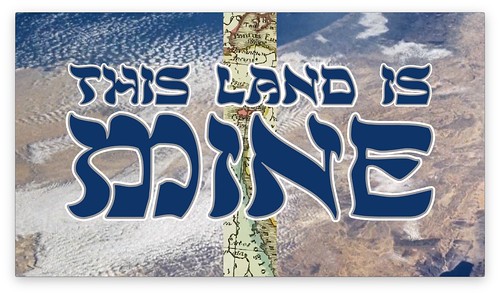
But Nina’s been releasing segments since 2012 and I’ve seen most, perhaps all of them. I want to offer some brief comments about two of them. This Land is Mine is the first segment she released, but it will be the last one in the film. God-Mother is one of the last she released–I don’t know whether or not it is THE last–but will be the first one in the film, even before the credits. Jordan Peterson has interviewed her and, in that interview, Nina said that the process of making the making turned about to be a journey of discovery in which she, in effect, discovered God-Mother.
The End: This Land is Mine
This Land is Mine is in the style she used for the music clips of Sita Sings the Blues:
The song is the theme song from Exodus, a contemporary epic about the founding of the modern state of Israel that came out made in 1960. The movie was a hit and so was it’s theme song. Originally an instrumental, “This Land is Mine” was given lyrics by Pat Boone and was a major hit, both in instrumental and vocal versions. Paley’s clip is based on a vocal version sung by Andy Williams.
The clip’s opening is very ‘stagy’:

The virtual camera then zooms in on a generic Early Man who starts singing the song:
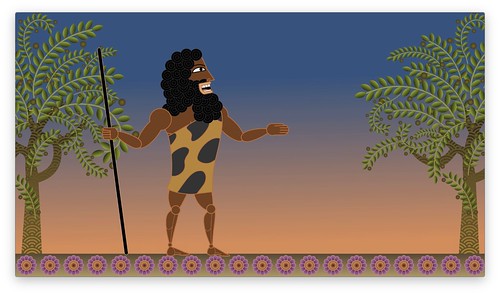
The camera then stays focused on that space through the clip to the very end.
Soon another figure, a Canaanite, enters from the right, in different dress, kills our Early Man, and continues singing. An Egyptian enters from the left, shoots this character with an arrow, and continues the serenade. You can pretty much guess what happens next. Someone enters from the right, kills our Egyptian, and continues singing. Sorta’. Enter from the right, yes. Kills the Egyptian, yes. Continues sing, you bet. But he passes across the screen, in silhouette, exits at the left, and then re-enters from the left, and comes up behind the Egyptian. Then he kills him. And the slaughter continues, left, right, left, right, etc. until the very end, when we’re all dead:
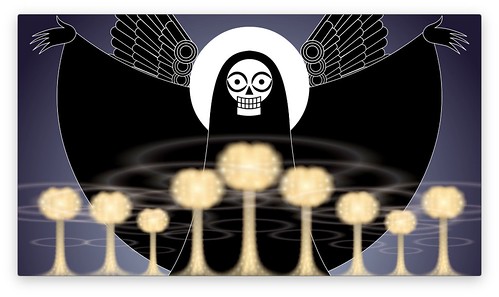
The atomic Angel of Death takes us all.
This is a very grim segment. Cruel. But also witty, and even beautiful, as Jordan Peterson notes in one of his remarks to Nina.
Paley keeps our interest by changing the costumes of the killers (Paley identifies them all in this blog post) and by varying the timing and method of slaughter. For example, if you know the song at all, then you know at one point we have this line: “So take my hand...” When you hear some poor soul start singing that, you know what’s going to happen, don’t you?
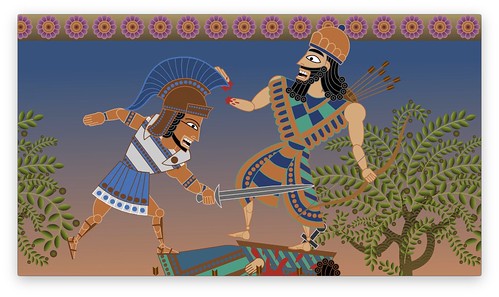
And so it goes, line after line of this preposterous anthem, people get slaughtered right and left, left and right, until the Angel of Death takes them all. And then Paley runs the end credits, but over distinctly different music, a gently singing version of the theme by Quincy Jones. Does she keep this for the full-length version? It’s not as though the credits change much: “written, directed, designed, animated, etc. by Nina Paley.” Well, I guess she’d got to give credits for all the musical selections.
Wednesday, November 9, 2016
Evolution of Language – Will we crack it in 30 years?
When I was young, they was relatively little work on the evolution of human language. Back in the 19th century the Société Linguistique de Paris banned the topic and that ban seemed in effect. By the 1990s, however, things had changed. The evolution of language was now not only a respectable topic for research, but a popular one.
These days any number of people would like to be recognized as the one who discovered how language came about. But discovering the origin of language is rather different from, for example, discovering the tomb of an Egyptian pharaoh. Tombs are physical things with definite locations. To a first approximation, you either know it exists and where, or you don’t. If you start digging in a deserted area and find a tomb, then you discovered it. Simple enough.
But language, how does one discover its origins? The big problem, of course, is that we have no direct observations. If we had a time machine then we could gather such observations. We’d know when and where language originated, and perhaps even how.
Of would we? There is the problem of definition. These communication phenomena we’ve observed, language or not? But that’s likely a matter of mere semantics. It doesn’t really matter just which of them we’re going to certify as ‘real’ language. What needs to be explained, explained, is the entire evolutionary run from a point where there is no language to one where, yes, that’s definitely language. And, while having direct observations of that run would certainly help, it won’t tell us everything. It will tell us about the relationship between spoken language and associated behavior and that will be useful. But it won’t tell us what’s happening in the brain.
Still, I’m beginning to think that we may arrive at a consensus account within 20 or 30 years. I’ve given considerably thought to a related question, the origins of music, which I discussed in Beethoven’s Anvil a decade and a half ago. I extended those ideas at bit and had some remarks on language in Synch, Song, and Society, an essay-review of Steven Mithen’s The Singing Neanderthals. I have no intention of summarizing those arguments here, but I need to mention that I joined the ancient and venerable parade of those who believe that music, or something like it, not only preceded the emergence of language, but is a necessary precursor.
All of this is a prelude to Dan Everett’s new book, Dark Matter of the Mind: The Culturally Articulated Unconscious, which I’m currently reading. As the title indicates, it’s not about the origins of language, but the subject does come up, particularly in his discussion of work on the relationship between gesture and language. I find that discussion very encouraging. That, along with what I already know, is what has me thinking that we may arrive at a consensus account in 20 or 30 years.
If so, the account will stretch over many specific disciplines scattered across linguistics, psychology, anthropology, neuroscience, biology, and who knows what else. The trick is to pull all that together. That’s something our academic institutions are not suited for. If anything, they work against it.
We’ll see.
Monday, October 20, 2014
Death of the Firstborn Egyptians: Nina Paley takes it up a notch
Here's a kick-ass scene from Nina Paley's work-in-progress, Seder-Masochism:
I think her artistry's gone up a notch with this piece. The coloring is more subtle, and the overall rhythm and movement seems to be heading out to parts unknown.
From Nina's blog:
Based on Exodus 12:
21 Then Moses called for all the elders of Israel, and said unto them, Draw out and take you a lamb according to your families, and kill the passover.
22 And ye shall take a bunch of hyssop, and dip it in the blood that is in the bason, and strike the lintel and the two side posts with the blood that is in the bason; and none of you shall go out at the door of his house until the morning.
23 For the Lord will pass through to smite the Egyptians; and when he seeth the blood upon the lintel, and on the two side posts, the Lord will pass over the door, and will not suffer the destroyer to come in unto your houses to smite you.
24 And ye shall observe this thing for an ordinance to thee and to thy sons for ever.
25 And it shall come to pass, when ye be come to the land which the Lord will give you, according as he hath promised, that ye shall keep this service.
26 And it shall come to pass, when your children shall say unto you, What mean ye by this service?
27 That ye shall say, It is the sacrifice of the Lord’s passover, who passed over the houses of the children of Israel in Egypt, when he smote the Egyptians, and delivered our houses. And the people bowed the head and worshipped.
28 And the children of Israel went away, and did as the Lord had commanded Moses and Aaron, so did they.
29 And it came to pass, that at midnight the Lord smote all the firstborn in the land of Egypt, from the firstborn of Pharaoh that sat on his throne unto the firstborn of the captive that was in the dungeon; and all the firstborn of cattle.
30 And Pharaoh rose up in the night, he, and all his servants, and all the Egyptians; and there was a great cry in Egypt; for there was not a house where there was not one dead.
For those who are new to New Savanna, I've got a ton of stuff about Nina's previous feature, Sita Sings the Blues (the SSTB page); this link takes you to the individual SSTB posts.
Sunday, May 12, 2013
Culture Evolving: Egyptian Mahraganat Music Flowers in the Arab Spring
In just a few years, these and other young musicians have created a new genre of youth-driven, socially conscious music and forced it on the Egyptian soundscape.
Their music predated the political revolution that ousted President Hosni Mubarak in February 2011, and most of the musicians did not join the uprising in Tahrir Square. But the turmoil since has left Egypt’s huge youth population searching for voices that address issues they care about.
Half of Egypt’s 85 million people are under 25, and many found what they were looking for in the raucous, defiant new music known as “mahraganat,” Arabic for “festivals.” The songs’ addictive beats helped, too.
“We made music that would make people dance but would also talk about their worries,” said Alaa al-Din Abdel-Rahman, 23, better known as Alaa 50 Cent. “That way everyone would listen and hear what was on their minds.”
The music is a rowdy blend of traditional Egyptian wedding music, American hip-hop and whatever else its creators can download for free online.
The Egyptian revolution, such as it is, created a new cultural landscape in which an already existing form of music called “mahraganat” could thrive and animate a much larger audience.
The music’s swift rise from the alleys of neglected Cairo neighborhoods to car stereos and high-class weddings and even television commercials reflects the profound shifts in Egyptian society since the revolution. More people are looking for open discussion of social issues and willing to reach across class lines to find it. Like the revolution, the music came from young people who looked at their lives and did not see much to look forward to. So they made noise, spread their ideas through social media and were surprised by the results. ... Arab popular music has long been dominated by beautiful stars who croon about love and heartbreak and market themselves with music videos shot in luxurious settings that many Egyptians will never visit. Mina Girgis, an Egyptian ethnomusicologist, said that left a wide opening after the revolution for music more in touch with its audience.
By way of comparison, I note that manga existed in Japan before World War II, but it grew tremendously after the war, as though Japan's defeat changed the cultural landscape is a way that allowed this heretofore minor form of popular culture to grow and diversify to the point where it now constitutes 30% to 40% of Japan's annual print output.
Will these new grooves change Egyptian society as profoundly as African-American grooves have changed American society?
Will these new grooves change Egyptian society as profoundly as African-American grooves have changed American society?
Friday, December 21, 2012
Political Graffiti: Truth on Arab Walls
Nancy Demerdash, "Concuming Revolution: Ethics, Art, and Ambivalence in the Arab Spring, New Middle Eastern Studies, December 3, 2012.
First paragraph of the section, Graffiti, Memory and the "Political Street': The Production and Reclamation of Public Space:
Artists across the region are also taking their craft to the street, the very locus of resistance. Of course, there is a long and sustained tradition of graffiti and mural arts in the Middle East, mainly in Palestine and the Occupied Territories.[16] But since the revolutions, these public art forms have exploded in Tunisia, Egypt, Libya and to a far lesser degree in Syria.[17] Recognizing the Lefebvreian social and political production of urban space and its constant reconfigurations,[18] artists identify with the urban marginals who continually negotiate their integration with and contestations to the disintegrating systems of state and bureaucratic power.[19] Meaning, for these urban artists and everyday locals alike, is constituted from lived experiences within the spaces of revolution. Street artists have come to inscribe on public walls past memories and memorials to those struggles and lives lost in the revolutions. But for the general public, the spaces on these walls have acquired profound collective and personal meaning. Murals and graffiti panels embody concrete memories for passersby and neighborhood locals; people gather around the walls, engaging in discussions of what should be represented and how a particular piece moves them or invokes a certain memory.[20] These art forms have transformed public spaces and streets into what Asef Bayat terms the “political street,” signifying “the collective sensibilities, shared feelings, and public judgment of ordinary people in their day-to-day utterances and practices… The Arab Street… should be seen in terms of such expression of collective sentiments in the Arab public sphere.”[21]
Check out the images. They're superb. H/t Alexander Key.
Thursday, February 10, 2011
Egyptian Revolution, Current Status
As of noon, Thursday 10 Feb, Eastern time, the Egyptian revolution appears to have reached this status:

Mubarak is on the way out, but it's not clear what happens next or what the protesters will do. They're still shrouded in dust and the nature of the interim regime, or even IF it's only interim, is not clear.
From the NY Times:
From the NY Times:
The character of the military’s intervention and the shape of a new Egyptian government remained uncertain. A flurry of reports on state media on Thursday indicated a degree of confusion — or competing claims — about what kind of shift was underway, raising the possibility that a competing forces did not necessarily see the power transfer the same way. ...
For weeks, the protesters have hoped the military would intervene on their side, though it remained unclear whether the military would support democratic reforms that would threaten its status as the most powerful single institution in the country.
Sunday, February 6, 2011
Uh Oh! Hosni Mubarak and Wile E. Coyote
I’ve been so busy doing one thing and another that I haven’t had time to make any substantial posts, not one doing a wrap-up on Porky in Wackyland, nor one on anything else.
And that includes the situation in Egypt. But I saw an Al-Jeezera clip that suggested a way to combine Looney Tunes and the Egyptian revolution into a single post. The clip involves a discussion between Tariq Ramadan, a Muslim scholar, and Slavoj Žižek, philosophical provocateur. Žižek suggested that Mubarak is facing a situation covered by one of the best-known laws of cartoon physics: A character who is suspended in space will remain in suspension only until he realizes that fact. Once he realizes that he’s standing on nothing, gravity kicks in.
Žižek’s comment starts a bit after 20:30 in this clip:
Here’s an elaborated example from a Warner Brothers Road Runner cartoon, Zoom and Bored. In this shot Wile Coyote’s situation (not to mention Road Runner's) is obscured by a dust cloud:

Of course, we don’t know what’s going on. For all we know, Wile and Road Runner are standing on solid ground – the default assumption. Now Wile senses that something’s wrong:

Subscribe to:
Posts (Atom)