Showing posts with label Sowa. Show all posts

Wednesday, March 6, 2024

John Sowa on meaning in language and LLMs

 
An exercise for the reader: 
Background: I have argued that meaning involves intention, relationality, and adhesion, where intention inheres in the relationship between the parties to a linguistic act and relationality and adhesion together make up semanticity, which inheres in the language system itself. Relationality exists in the relationships of words among themselves and is the basis of inferential semantics, as it's called in the literature. Adhesion exists in the relationship between a word and the situation in the world designated by the word.

The exercise: Sowa gives a number of examples between 02:29 and 13:10. Examine those various examples and assess the roles of intention, relationality, and adhesion in each.

Tuesday, February 27, 2024

The Adventures of Task-Force Tim: An Allegory About the Current Effort to Regulate AI

John Sowa is an Old School AI researcher who spent his career at IBM until retired. Since then he’s pursued various projects in AI (see this video, Evaluating and Reasoning with and about GPT). He’s got an extensive website that includes some materials from the old days, including some remarks about a project that IBM started in 1971. It didn’t work out. In the process, one member of Sowa’s department, Bob Bacon, did a comic illustrating the problems that inevitably came up.

Sowa has those on his website where anyone can see them. So I assume he has no problem with me putting them in this post. I’m thinking of them as an allegory on current efforts to regulate research in artificial intelligence and machine learning. [Click on images to enlarge them.]

Monday, May 2, 2022

What is a conceptual ontology?

From Wikipedia:

In computer science and information science, an ontology encompasses a representation, formal naming, and definition of the categories, properties, and relations between the concepts, data, and entities that substantiate one, many, or all domains of discourse. More simply, an ontology is a way of showing the properties of a subject area and how they are related, by defining a set of concepts and categories that represent the subject.

Every academic discipline or field creates ontologies to limit complexity and organize data into information and knowledge. Each uses ontological assumptions to frame explicit theories, research and applications. New ontologies may improve problem solving within that domain. Translating research papers within every field is a problem made easier when experts from different countries maintain a controlled vocabulary of jargon between each of their languages.

This differs from what philosophers have generally meant when they talk of ontology. They are concerned with what’s really real about the world, not how people think about the world. The study of conceptual ontology is about what people think, regardless of whether or not it is true?

But, you might be thinking, aren’t philosophers, even the best of them, only human beings and so their thoughts about ontologies are only thoughts? Ah...

Think of a set of building blocks, Lego pieces, Erector set components, or, for that matter, the various components that go into the construction of, say, actual buildings, whatever. There is a finite set of distinct different types of objects in these various collections. That set of types is your ontology. This set of types places constraints on what you can build. But what you can actually build depends on your imagination and determination, plus, of course, having enough tokens of each type to complete the job.

John Sowa’s top-level set of categories based on the work of Charles Sanders Pierce and Alfred North Whitehead. From his book, Knowledge Representation (2000):

He argues that that is the conceptual ontology fundamental to all human thought.

I’ve got my doubts about that, but don’t want to argue it here and now. There may well be some elements that are universal among humans, but I will say that each culture has its own underlying conceptual ontology. And ontologies change over the long duration, thus, for example, the ontology of 19th century chemistry is different from that of alchemy. More generally, when Thomas Kuhn talks about revolutionary science vs. normal science, he’s talking about regimes where the underlying ontology changes, revolutionary science, versus those where it remains unchanged.

My set of conceptual Lego pieces was complete by the time I completed my master’s thesis on “Kubla Khan” in 1972. It was rich enough that I was able to learn Hays’s computational semantics and, on that basis, imagine Prospero, the system that could “read” Shakespeare. When the possibility of actually constructing Prospero disappeared, the set of conceptual Lego pieces – my conceptual ontology – remained unchanged. But my sense of what one can build with those pieces changed.

When I began (email) conversations with Walter Freeman about the complex dynamics of the nervous system, I was able to do so with that set of conceptual Lego pieces (ontology) – though, keep in mind, I don’t command the underlying mathematics and so have to work analogy and metaphor. That same conceptual ontology has allowed me to conceive of attractor nets, networks of logical operators over attractors in various attractor landscapes, where each landscape corresponds to a neurofunctional area in the brain. When I began thinking seriously about deep learning and artificial neural nets, I did so in terms those ontological primitives. They allowed me to see, both that GPT-3 represents a conceptual advance, and that such technology is not sufficient in itself.

Remember, finally, that that conceptual ontology took shape through investigating the form and meaning of “Kubla Khan.” That ontology was ‘designed,’ if you will, to encompass a rich example of verbal artistry. It ranges over neurons, logical operators, poems, and more.

What has happened over the course of my career is the my sense of what can be built within this ontology has changed. Yes, I have had to drop Prospero and things ‘like’ it from the list, but I have added things to the list as well, such as the origins of human thought and attractor nets. On the whole, my sense is that the space of possible constructs has grown larger and more various.

For a more detailed look, see:

Ontology in Cognition, The Assignment Relation in the Great Chain of Being, Working Paper, November 12, 2012, https://www.academia.edu/37754574/Ontology_in_Cognition_The_Assignment_Relation_and_the_Great_Chain_of_Being

Ontology of Common Sense, in Hans Burkhardt and Barry Smith, eds. Handbook of Metaphysics and Ontology, Muenchen: Philosophia Verlag GmbH, 1991, pp. 159-161, https://www.academia.edu/28723042/Ontology_of_Common_Sense

Ontology in Knowledge Representation, Working Paper, 1987, https://www.academia.edu/238610/Ontology_in_Knowledge_Representation

Ontological Cognition, Working Paper, November 12, 2012, https://www.academia.edu/7931749/Ontological_Cognition

Wednesday, October 23, 2019

What’s in a Name? – “Digital Humanities” [#DH] and “Computational Linguistics”

It's been a bit over three years since I originally posted this and, in the context of a discussion that has come up in the Humanist Discussion Group, I think it's worth bumping to the top of the queue.  If you read far enough you'll see me point out that many of the tools currently used in computational criticism have their origins in machine translation, yet the effort to understand language computationally has all but been ignored in computational criticism and DH more generally. Since the field as chosen "digital humanities" as its name, however fitfully, it seems to me this calls for a bit of deconstructive questioning: Why ignore (some of) the deepest lines of investigation implied by the term you've adopted for your inquiry? Is being au courant so important that you're willing to toss the baby overboard so that you can splash about in the bath more freely? I leave such analysis to the reader.
In thinking about the recent LARB critique of digital humanities and of responses to it I couldn’t help but think, once again, about the term itself: “digital humanities.” One criticism is simply that Allington, Brouillette, and Golumbia (ABG) had a circumscribed conception of DH that left too much out of account. But then the term has such a diverse range of reference that discussing DH in a way that is both coherent and compact is all but impossible. Moreover, that diffuseness has led some people in the field to distance themselves from the term.

And so I found my way to some articles that Matthew Kirschenbaum has written more or less about the term itself. But I also found myself thinking about another term, one considerably older: “computational linguistics.” While it has not been problematic in the way DH is proving to be, it was coined under the pressure of practical circumstances and the discipline it names has changed out from under it. Both terms, of course, must grapple with the complex intrusion of computing machines into our life ways.

Digital Humanities

Let’s begin with Kirschenbaum’s “Digital Humanities as/Is a Tactical Term” from Debates in the Digital Humanities (2011):
To assert that digital humanities is a “tactical” coinage is not simply to indulge in neopragmatic relativism. Rather, it is to insist on the reality of circumstances in which it is unabashedly deployed to get things done—“things” that might include getting a faculty line or funding a staff position, establishing a curriculum, revamping a lab, or launching a center. At a moment when the academy in general and the humanities in particular are the objects of massive and wrenching changes, digital humanities emerges as a rare vector for jujitsu, simultaneously serving to position the humanities at the very forefront of certain value-laden agendas—entrepreneurship, openness and public engagement, future-oriented thinking, collaboration, interdisciplinarity, big data, industry tie-ins, and distance or distributed education—while at the same time allowing for various forms of intrainstitutional mobility as new courses are approved, new colleagues are hired, new resources are allotted, and old resources are reallocated.
Just so, the way of the world.

Kirschenbaum then goes into the weeds of discussions that took place at the University of Virginia while a bunch of scholars where trying to form a discipline. So:
A tactically aware reading of the foregoing would note that tension had clearly centered on the gerund “computing” and its service connotations (and we might note that a verb functioning as a noun occupies a service posture even as a part of speech). “Media,” as a proper noun, enters the deliberations of the group already backed by the disciplinary machinery of “media studies” (also the name of the then new program at Virginia in which the curriculum would eventually be housed) and thus seems to offer a safer landing place. In addition, there is the implicit shift in emphasis from computing as numeric calculation to media and the representational spaces they inhabit—a move also compatible with the introduction of “knowledge representation” into the terms under discussion.

How we then get from “digital media” to “digital humanities” is an open question. There is no discussion of the lexical shift in the materials available online for the 2001–2 seminar, which is simply titled, ex cathedra, “Digital Humanities Curriculum Seminar.” The key substitution—“humanities” for “media”—seems straightforward enough, on the one hand serving to topically define the scope of the endeavor while also producing a novel construction to rescue it from the flats of the generic phrase “digital media.” And it preserves, by chiasmus, one half of the former appellation, though “humanities” is now simply a noun modified by an adjective.
And there we have it.

A decade later, however, the term was being used to different effect by critics of DH. As Kirschenbaum noted at the end of “What Is Digital Humanities and What’s It Doing in English Departments?” (ADE Bulletin #150, 2010):
Digital humanities, which began as a term of consensus among a relatively small group of researchers, is now backed on a growing number of campuses by a level of funding, infrastructure, and administrative commitments that would have been unthinkable even a decade ago. Even more recently, I would argue, the network effects of blogs and Twitter at a moment when the academy itself is facing massive and often wrenching changes linked both to new technologies and the changing political and economic landscape has led to the construction of “digital humanities” as a free-floating signifier, one that increasingly serves to focus the anxiety and even outrage of individual scholars over their own lack of agency amid the turmoil in their institutions and profession. This is manifested in the intensity of debates around open-access publishing, where faculty members increasingly demand the right to retain ownership of their own scholarship—meaning, their own labor—and disseminate it freely to an audience apart from or parallel with more traditional structures of academic publishing, which in turn are perceived as outgrowths of dysfunctional and outmoded practices surrounding peer review, tenure, and promotion […].
And that, more or less, is where we are today. The recent ABG critique can be read, at least in part, as yet another use of “digital humanities” as a “free-floating signifier [that] serves to focus the anxiety and even outrage of individual scholars over their own lack of agency amid the turmoil in their institutions and profession.”

Of course, the use of computers in humanities research is much older than these debates. The standard history leads back to Roberto Busa and the Index Thomisticus in the early 1950s. At roughly the same time another enterprise got started, one that could plausibly be grandfathered into the history of DH.

Computational Linguistics

That enterprise is translation from one language to another. As that is certainly an activity undertaken by humanists, one could reasonably regard attempts to do so by digital computers as an activity within the scope of DH though, as far as I know, DHers generally do not do so. Nor was the early work in machine translation (MT), as it was and is called, undertaken toward humanistic ends. It was undertaken for practical purposes and was undertaken in the United States through funding from the federal government. The object was to translate technical texts from Russian into English.

Monday, August 24, 2015

On the Poverty of Literary Cognitivism 2: What I Learned When I Walked off the Cliff of Cognitivism

In the first post in this series I took a look at an essay-review Alan Richardson wrote about two recent books in literary cognitivism and asserted, in effect, that you can’t get there from here [1]. By “there” I mean a reciprocal relationship between literary study and “the mind and brain sciences” in which “methods, finds, or evidence from a literary field” (Richardson, p. 368) is important. And by “here” I meant cognitive literary criticism as it has developed over the last two decades or so. It’s not that I don’t think that such literary finds or evidence exist but that current literary methods enable scholars to find them and present them in a convincing way.

The problem, I asserted, is that the cognitive revolution was driven by the idea of computation and that neither the literary cognitivists, nor their twin, the literary Darwinists, have faced up to computation in a deep way. Until they do so, their efforts will be still born. No matter how widely they read in the newer psychologies, no matter how many findings, ideas, and models they incorporate into their theorizing, they won’t produce results that are compelling to thinkers in the mind and brain sciences.

The purpose of this post is to explain how I arrived at my belief computation must be dealt with. But the argument will be a strange one because it will tell the story of how my own journey computation semantics led to a satisfying failure and thereby forced me to reconceptualize what it means for a literary scholar to come to terms with computation. But I’ll save that reconceptualization for a later post.

From “Kubla Khan” to Computation

I was an undergraduate at Johns Hopkins when the French landed back in the Jurassic era of academic literary criticism. Though I didn’t attend the sessions of the famous 1966 structuralism conference, I fell into the orbit of one of its organizers, Dick Macksey. But I also studied with Earl Wasserman, Don Howard, and Don Cameron Allen, all of whom were more traditionally minded, each in his own way, and with J. Hillis Miller, who was a fellow traveler and who, as you know, went on to become one of our premier deconstructive critics. I was thus versed in New Criticism on the way to phenomenology, phenomenology giving way to structuralism and semiotics, and deconstruction bubbling up underneath it all. During my senior year I became interested in “Kubla Khan” and stuck around to do a master’s thesis on it. I read everything the Hopkins library had on the poem, threw all my critical tools into the fray and found myself walking in circles, getting nowhere.

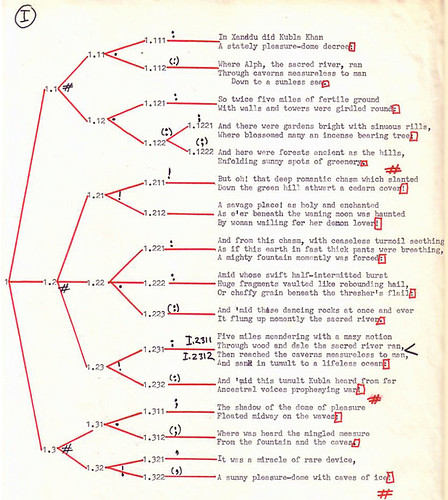
And then, on a hunch, I decided to break the poem into pieces using the obvious markers, stanza divisions and line-end punctuation. Here’s one of my work sheets for the first part of the poem, 36 lines.

KK-triple-72.jpg

The tree structure to the left visualizes the result. Notice that we’ve got three sections at the topmost level; the middle of those is in turn divided into three; and the middle of that is again divided into three. All other divisions are binary.

It turns out that the poem’s second part, only 18 lines, has a similar structure. And now it gets really interesting. For the last line of the poem’s first part – “A sunny pleasure-done with caves of ice!” – is the middle, of the middle, of the middle of the poem’s second part – “That sunny dome! Those caves of ice” And that’s just a fragment of the elaborate patterning that exists in “Kubla Khan,” all there on the “surface” just waiting to be seen, analyzed, and described. But where did those patterns come from, what were they doing? [2]

And yet the literature I’d reviewed about “Kubla Khan,” one of the best-known and most-examined poems in English, knew nothing of this. And the body of literary and critical theory I’d absorbed, from New Criticism through structuralism and (a bit) beyond, had little to say about this kind of phenomenon. If I was going to figure out what that patterning was about, I was going to have to find the tools elsewhere or somehow create them myself.

Wednesday, November 6, 2013

The Jasmine Papers: Notes on the Study of Poetry in the Age of Cognitive Science

I have now collected my posts on "To a Solitary Disciple" and associated discussions into a single working paper having the above title. You may download it from my SSRN page.

The abstract is immediately below, followed by the introduction and then the table of contents.
Abstract: In More Than Cool Reason Lakoff and Turner offer a global reading of “To a Solitary Disciple” (by William Carlos Williams) in terms of conceptual metaphor theory (CMT). The reading itself is independent of CMT; any competent literary critic could have done it. Their attempt to explain the relationship between that reading and the poem using CMT is at best problematic and does not seem to be metaphoric as specified by the terms of CMT. Rather, their reading takes the form of little narrative that has the same form as one they attribute to the poem. Beyond the critique of Lakoff and Turner, this paper makes some observations about the poem and suggests that it has a ring form: A, B, C, D, C’, B’, A’. Two sentences by Hemingway and a poem by Dylan Thomas are discussed in counterpoint with “To a Solitary Disciple.” Two appendices discuss ontological cognition in relation to Williams’ Paterson, Book V and Burton’s Anatomy of Melancholy.
Introduction: The Poverty of Cognitivism for Literary Criticism

This working paper consists of things and stuff. I drafted some drafted over a decade ago and wrote others on the day or on the day before I posted them.

Several things are going on, but the central thread is an examination of the third chapter of George Lakoff and Mark Turner, More Than Cool Reason, which is an analysis of “To a Solitary Disciple” by William Carlos Williams. That book is certainly one of the founding texts of cognitive poetics, which is a major school of thought within a broader engagement between literary criticism and cognitive science. As such, that Lakoff and Turner on Williams is a paradigmatic example in this engagement: If you want to use cognitive metaphor theory in the analysis of literary texts, this is how you do it.

It may very well be a good example of the application of cognitive metaphor theory, but it’s an inadequate example of literary analysis. While I have quite a bit to say about their analysis – in A Leak in Cool Reason, Beyond Metaphor: Pattern Matching, and What’s a Global Reading for Anyhow? – my major argument on this point – that it’s inadequate as literary analysis – is presented in The Disciple Revisited and Revived. There I comment on the poem in some detail, but without bringing any particular body of theoretical material to bear on the text, not their theory, not mine, not anyone else’s. To this I would add my discussions of two sentences from Hemingway’s Death in the Afternoon and of the chiasmus governing Dylan Thomas’ “Author’s Prologue”.

Alas, I do not know how to explain what I found in “To a Solitary Disciple”. Nor do I know of any body of theory that can do so. That is to say, I am unaware of any set of principles of mental functioning that explain why poems are LIKE THAT. They just are. Some of them. This one appears to have ring-form – A, B, C, D, C’, B’, A’. No one knows how to explain them. Maybe one day cognitive science will be up to that task. But it isn’t now.

I have come to believe that what a good critic sees in texts is mostly a function of wide experience. That experience may well begin with tutelage by master critics – I learned from Richard Macksey, Donald Howard, Don Cameron Allen, J. Hillis Miller, Earl Wasserman and, in a sense, Lévi-Strauss, though I never studied or even corresponded with him – but it is a craft that must be developed through use. The more you study texts, the more you learn to see in them. Really see in them, not just project your own fancies.