Or, Center Point construction in a tale within a tale within a tale
For Mary Douglas
It’s a long way through this post. First, I look at the structural center of Heart of Darkness, which is that long paragraph I’ve called the nexus. I then argue that Heart and Osamu Tezuka’s Metropolis deploy different techniques for achieving what I’m calling center point construction, which is close kin to the ring forms that held Mary Douglas’s attention at the end of her career. Finally, I attach an appendix that contains the complete text of the nexus.
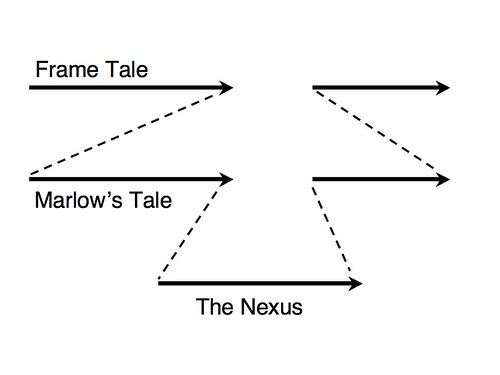
Consider the following diagram. It represents, albeit crudely, the narrative structure of Conrad’s Heart of Darkness:
While the tale is told mostly by Marlow, Marlow does not speak directly to us, the readers. Rather, his tale is told to a group of four men aboard a boat in the Thames. One of those tells it to us. That tale is the frame tale. It begins Conrad’s novella, running for roughly 1300 words before giving way to Marlow, and it concludes the novella, with the last 70 words or so. It also shows up here and there during Marlow’s tale, though never for long. The diagram doesn’t show those . . . what shall we call them, intrusions, reminders, touchstones relief points?
This much is well-recognized in the literature on the book, which I’ve been examining in the two case books I’ve just acquired, the Norton Critical Edition (2006) edited by Paul Armstrong, and Ross C. Murfin’s Joseph Conrad, Heart of Darkness (Bedford/St. Martin’s, 2011). But there’s a third ‘level’, which I’m calling the nexus. It is not, in what I’ve read so far, singled out as a tale within the tale within the tale, as my diagram has it.
But it is certainly mentioned. For example, in Albert Guerard’s, “The Journey Within” (from his 1958 book, Conrad the Novelist), which is reprinted in the Norton, pp. 326-336. He says, “We think we are about to meet Kurtz at last,” referring to a passage in paragraph 101 (see endnote on paragraph numbering) where Marlow tells us that he did get to meet Kurtz. And then Guerard observes: “But instead Marlow leaps ahead to his meeting with the “Intended”; comments on Kurtz’s megalomania and assumption of his place among the devils of the land; reports on his seventeen-page pamphlet ...” In those three clauses Guerard has characterized the paragraph that I’m calling the nexus.
The Nexus
The segment I’m calling the nexus is part of Marlow’s tale, but I believe that it deserves to be treated as a separate narrative entity. For one thing, and this is what originally brought it to my attention, it contains material that is told out of temporal order. At the point where Marlow launches into the nexus – which, by the way, is one of the places where the frame tale reaches in to Marlow’s tale, reminding us that Marlow is not talking to us, but that he’s talking to someone else, and it is this anonymous someone else who writes to us – they have not yet gotten to the Inner Station, where Marlow is located. And yet it is during the nexus that Marlow tells us, not simply of all the ivory they found and recovered at the station, but that they loaded it aboard the ship: “We filled the steamboat with it, and had to pile a lot on the deck.” That ivory is not mentioned later at the time when they actually do load it into the boat. In paragraph 140 it’s the middle of the night and Marlow has followed Kurtz ashore and then in paragraph 141 we’ve left at noon and nothing is said about carting 1000s of pounds of ivory onto the ship.
What’s going on in the story at the point where the nexus emerges is that the boat is a few hours away from the Inner Station and is under attack. The helmsman has just been killed and Marlow, who was captaining the boat, was standing in the man’s blood. He, Marlow, tossed a blood-drenched shoe overboard and had told himself that, alas, he would never hear Marlow speak:
I made the strange discovery that I had never imagined him as doing, you know, but as discoursing. I didn't say to myself, 'Now I will never see him,' or 'Now I will never shake him by the hand,' but, 'Now I will never hear him.' The man presented himself as a voice. Not of course that I did not connect him with some sort of action.
Then the other shoe
went flying unto the devil-god of that river. I thought, 'By Jove! it's all over. We are too late; he has vanished—the gift has vanished, by means of some spear, arrow, or club. I will never hear that chap speak after all,'—and my sorrow had a startling extravagance of emotion, even such as I had noticed in the howling sorrow of these savages in the bush.
At which point the teller of the frame tale takes over for a bit, describing Marlow lighting and taking a draw on his pipe, and, after some preparatory chatter from Marlow (paragraph 101) and a long silence – what was going on in Marlow’s mind during that silence? – then, and only then, do we get the nexus.
Think about it: Conrad didn’t toss both shoes overboard at once. He tossed one, then threw out a significant thought, and then tossed the other. That’s a very careful, very particular bit of writing. Why make such a big deal out of Marlow’s bloody shoes? Because it’s in our shoes that we trod the earth, because Oedipus means swollen-footed? I don’t know, but Conrad did make a deal out of it. At this critical point in the story where a man, an African, died.
But I digress. The nexus. So, Marlow tosses his shoes overboard, then relieves himself of the nexus, 1500 words in a story of 38,000 words, for 4% of the total. And then he returns his telling to the story’s present and drags the lifeless body over the edge:
The current snatched him as though he had been a wisp of grass, and I saw the body roll over twice before I lost sight of it for ever. All the pilgrims and the manager were then congregated on the awning-deck about the pilot-house, chattering at each other like a flock of excited magpies, and there was a scandalized murmur at my heartless promptitude. What they wanted to keep that body hanging about for I can't guess. Embalm it, maybe.
Other than Kurtz, this is the only other person who dies in the story. That Conrad should tuck the novella’s longest paragraph into the moments between shoes overboard and corpse overboard is no accident, nor is it an accident that this paragraph contains out-of-sequence information.
Those three things – out of sequence information, the helmsman’s death, and the length of the paragraph – all suggest to me that this paragraph is special, that it deserves to be treated as a separate ‘level’ of narration. Technically, no, it’s not a tale within a tale. Effectively, it is, giving us the structure I’ve diagrammed above.
What’s it About?
So what’s in this paragraph that I call it the nexus? [Note that I’ve copied the whole paragraph into an appendix to this post.] It begins by asserting that this world, the world of the tale, is men only:
Girl! What? Did I mention a girl? Oh, she is out of it--completely. They--the women, I mean--are out of it--should be out of it. We must help them to stay in that beautiful world of their own, lest ours gets worse. Oh, she had to be out of it. You should have heard the disinterred body of Mr. Kurtz saying, 'My Intended.' You would have perceived directly then how completely she was out of it.
Yes, women are out of it but specifically, the Intended. This is the first time she’s mentioned as such, the first time we know that Kurtz intended to get married. But we don’t actually see her until the very end of the story.
From there Marlow works his way quickly to the ivory by way of Kurtz’s bald head, “like a ball—an ivory ball.” Then there’s talk of the moral comforts and pressure of home, which are gone in the jungle, Kurtz’s pan-European background, his education, his beautifully-written report to the International Society for the Suppression of Savage Customs, the unspeakable practices Kurtz allowed himself, and, of course, the report’s postscript: “Exterminate all the brutes!” And by the by Marlow arrives at something of an abbreviated eulogy for his helmsman:
I missed my late helmsman awfully,--I missed him even while his body was still lying in the pilot-house. Perhaps you will think it passing strange this regret for a savage who was no more account than a grain of sand in a black Sahara. Well, don't you see, he had done something, he had steered; for months I had him at my back--a help--an instrument. It was a kind of partnership. He steered for me--I had to look after him, I worried about his deficiencies, and thus a subtle bond had been created, of which I only became aware when it was suddenly broken. And the intimate profundity of that look he gave me when he received his hurt remains to this day in my memory--like a claim of distant kinship affirmed in a supreme moment.
That ends it, the nexus.
And it call it that because, whatever this story’s about, it’s all there, compressed into those 1500 words. It’s a part that is also the image of the whole. And within that part we have the Litany — 'My Intended, my ivory, my station, my river, my—' which, in its way, is a highly compressed image of the whole. We thus have THE WHOLE STORY compressed into THE NEXUS compressed into THE LITANY.
Note, finally, that the nexus begins by mentioning the Intended, and then pushing her aside, and ends with Marlow’s eulogy for his helmsman. If there’s any heart in this story, that’s it, Marlow’s feeling for his lost helmsman – is it an accident that Conrad made this man a helmsman, the one who steered the boat? I’m reminded of that other great 19th Century river yarn, The Adventures of Huckleberry Finn. A very different yarn, to be sure, but one built on the bond between a white man, in the person of Huck Finn, abused son of an alcoholic, and a black man, Jim, runaway slave. The bond between Huck and Jim was real, but far from simple. In particular, it did not prevent Huck from allowing Tom Sawyer to stage an elaborate play with Jim in the center, a play that had more to do with Tom’s theatricality than Jim’s desire for freedom. Similarly, I do not think we have to believe that Marlow (and Conrad) regarded the helmsman’s humanity as being equal to his own in order to credit his feeling for the man, a man who is nameless, like everyone else in this tale except Kurtz.
Center Point Construction
And THAT is my best guess as to why Conrad stuck the nexus, with its out-of-sequence material, at this point in the narrative. For reasons having to do with a psychology we don’t understand, the nexus had to be toward the center of the book. Whatever effect Conrad was after, it required that the nexus be in more or less this place. Too early and we wouldn’t know enough, or not know enough, to appreciate it; too late and, well, it would be too late. It had to go toward the middle. Given that the ivory is at the material center of this greedy activity, the nexus had to assure us that, yes, the ivory was safely in hand, even though we hadn’t gotten to that point in the story.
For it isn’t in the center. Heart of Darkness was broken into three installments for serial publication. The nexus is in the second half of the middle installment. The whole text is something over 38,000 words long. The nexus starts at about 23,000 words in and there are roughly 13,500 words after it. So it’s well beyond the center, but not quite in the last third.