Showing posts with label Andrew_Piper. Show all posts

Wednesday, June 19, 2024

The Lives of Literary Characters [digital humanities #DH]

From the project site:

The goal of this project is to generate knowledge about the behaviour of literary characters at large scale and make this data openly available to the public. Characters are the scaffolding of great storytelling. This Zooniverse project will allow us to crowdsource data to train AI models to better understand who characters are and what they do within diverse narrative worlds to help answer one very big question: why do human beings tell stories?

In the nineteenth-century heyday of the novel, there were over 1.5 million literary characters invented just in English alone. Today, with the continued growth of literary markets around the world and the explosion of creative writing on the internet through fan communities, that number is orders of magnitude higher.

How on earth can we possibly understand all of this creativity?

This is where you, the reader, come in. We need your help to build better, more transparent AI models to understand human storytelling. To be clear: our goal is not to build AI to generate stories or create smarter chatbots. Our aim is fundamentally academic: we want to develop models to help us understand stories and thus learn more about this essential human activity. Most AI development is happening inside of black boxes behind closed doors. Our models will be open to the public as will all of the annotations made by readers like you. You are a key participant in how we will understand the future of stories.

There's much more HERE.

Friday, May 6, 2022

Virtual Reading, Phase 2: Cultural Analytics and the Brain [1 billion parameters here we come!]

I’ve said a bit about virtual reading here on the New Savanna. By that I mean that the ‘reading’ is being done by a computer system that is tracing the path of a text through a semantic space of high dimensionality. I’ve recently come across a very interesting paper that opens up the possibility of a different kind of virtual reading. In this case a real reader is doing the reading. But they’re doing it while in listening to a text read to them while they’re in an fMRI machine. That means that we can follow this real reading as it activates a reader’s brain. But, and here we go virtual, we can follow that reading as it traces a path through a neuro-semantic space of high dimensionality, 100s of millions if not a billion dimensions. 

First I take a quick look at the paper that gave me the idea, then I review Andrew Piper’s work on Augustine’s Confessions. I conclude the suggesting what we could do by applying that technology to the Confessions.  

Mapping the semantic space of the brain

Here’s the paper:

Huth, Alexander G.; de Heer, Wendy A.; Griffiths, Thomas L.; Theunissen, Frédéric E.; Gallant, Jack L. (2016). Natural speech reveals the semantic maps that tile human cerebral cortex. Nature, 532(7600), 453–458. doi:10.1038/nature17637

As I’ve already indicated, the basic idea is that they had people listen to stories while inside an fMRI scanner, which is sensitive to blood flow. This gives them a picture of brain activation during reading. The more active an individual voxel (3D sample of brain tissue), the more blood flows in it. Some voxels will be more active than others at any given moment, and the activity of any given voxel will vary from moment to moment. What we’re getting from the scanner is a 3D movie of blood flow in the brain.

Then they ‘translated’ that blood flow information into semantic information. How did they do that? It’s complicated, too complicated to go into here, and besides, that would just delay the time it takes to arrive at the good stuff. The investigators are able to do this because they know what stories each subject listened to, and they know where each subject was in the story at any given time-slice of the scan. They used standard NLP tools to process the texts and arrived at set of roughly 1000 words they traced through the scan. From that they calculated each voxel’s sensitivity to each word.

Consider the following image:

At the lower left you see a key that identifies broad areas of meaning. Those colors are used to color the image we see of the brain, center. The axes are centered on an individual voxel. The word cloud to the right indicates the words to which that voxel is most sensitive.

The following image presents the same information, but this time the cortical surface has been flattened.

You can play around with the neuro-semantic atlas here: gallantlab.org/huth2016/

Andrew Piper’s work on Augustine’s Confessions

Note: I’m just swiping this from an old post.

Over the past year of so I’ve been thinking about computing virtual readings of texts where the reading is in effect a path through a high-dimensional sematic space. I’ve even written a working paper about it, Virtual Reading: The Prospero Project Redux. I’ve just now discovered that Andrew Piper has taken steps in that direction, though not in those terms. The paper is:
Andrew Piper, Novel Devotions: Conversional Reading, Computational Modeling, and the Modern Novel, New Literary History, Volume 46, Number 1, Winter 2015, pp. 63-98. DOI: https://doi.org/10.1353/nlh.2015.0008
Piper is interested in conversion stories in autobiographies and novels. He’s also interested in making a methodological point about an exploratory style of investigation that moves back and forth between qualitative and quantitative forms of reasoning. That’s an interesting and important point, very important, but let’s set it aside. I’m interested in those conversion stories.

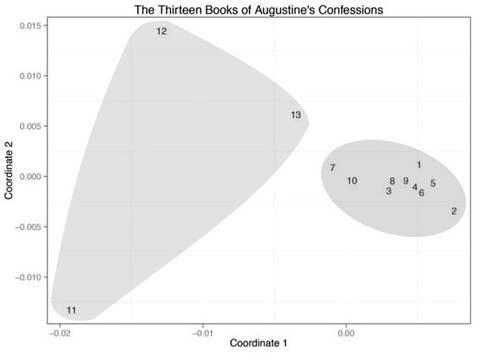
He takes Augustine’s Confessions as his starting point. Augustine puts the story of his conversion near the end of Book 8, of thirteen. Do the chapters prior to the conversion take place in a different region of semantic space from those after the conversion? With chapters (Augustine calls them books) as analytic unit, Piper uses multidimensional scaling (MDS) to find out. I’ve taken his Figure 2 and added the shading (p. 71):

Augustine 1

We can see that books 1-10 occupy a position in semantic space that’s distinctly different from books 11-13 and, further more, that “The later books are not just further away from the earlier books, they are further away from each other” (p. 72). Now, though Piper himself doesn’t quite do so, it is easy enough to imagine each book as a point in a path, and track that path through the space.

Thursday, May 5, 2022

You're looking for theory? I'll give you theory. [What cultural analytics can tell us about the brain.]

Overheard near the water cooler on the Web Tubes:

Deep in the library, among the spiders and potions: 

Later, over lunch:

May I offer a suggestion?

Sunday, December 22, 2019

A quick note on the future of literary studies [hot off the press!]

I’ve been participating some interesting discussions on Twitter, yesterday about computational criticism, today about fan fiction.


Are we heading toward a Copernican transformation in literary studies, to borrow a phrase from one of the last essays written by Edward Said[1]?

For the sake of discussion, let’s assume that that is what the discipline is undergoing. Just what is the earth around which the whole system is thought to revolve? I would say it is interpretation. What then would correspond to the sun around which the system should be reconfigured? Is it computational criticism? No. Fan fiction? No.

Again, for the sake of argument, let us assume a simple story about the centrality of interpretation. It mostly happened after World War Two with the so-called New Criticism in the driver’s seat. The New Critics posited an autonomous text and practiced a criticism unadorned with any specialized critical apparatus. In time many, perhaps most, critics dropped the assumption of autonomy and summoned various specialized bodies of knowledge – philosophy, rhetoric, psychology, anthropology, social theory – to use in constructing interpretations. Collectively they came to be known as Theory.

That’s the sun in this metaphor, sorta’. It isn’t really theory about literature, but rather it is theory about various other things – signs, the mind, society, history – being put to use as ways of interpreting the (various kinds of) events depicted in literary texts. I want to relieve those various theories of their interpretive burden and put actual theory of literature into the center position of a Copernican realignment.

Theoretical work would thus take literature and literary process itself as its object of study rather than interpreting our way through literature to something else. In this context the study of fan fiction is allowed to be what it is, the study a certain kind of text and its function in the society-wide literary process. It is no longer a poor second cousin to the interpretation of canonical texts. And computational techniques are free to be what they are, tools for conducting various kinds of investigations of texts, canonical and non-canonical, without prejudice either way. They need no longer justify the fact that they aren’t primarily in the business of cranking out readings of canonical texts.

I realize that, in this short note, it is easy to see this Copernican suggestion is a mere rhetorical maneuver without any intellectual substance. Whether or not that is the case depends on what happens with literary studies in the future. I note only that I have produced a reasonable body of work that fits my prescription – using psychology, mostly, but other disciplines as well, to make literature itself the object of study – and others have as well. I see no reason – other than organizational inertia, which, alas, IS a heavy drag – why more such work cannot be done in the future [2].

References

[1] Edward Said, Globalizing Literary Study, PMLA, Vol. 116, No. 1, 2001, pp. 64-68.

[2] A significant chunk of New Savanna is devoted to literary study. See, for example, work gathered under these labels, method and literary criticism, search on “the profession” and look at these two short posts: Critical Method: the Four-Fold Way, from Then to Now (September 2015), The Key to the Treasure IS the Treasure (December 30, 2012).

Monday, December 31, 2018

Toward a Theory of the Corpus [#DH]

I've just posted a new working paper. Title above, abstract, table of contents, introduction and section introductions are below. Download from:

Academia.edu: https://www.academia.edu/38066424/Toward_a_Theory_of_the_Corpus_Toward_a_Theory_of_the_Corpus_-by.
SSRN: https://ssrn.com/abstract=3308601.

Abstract: Recent corpus techniques ask literary analysts to bracket the interpretation of meaning so that we may trace the motions of mind. These techniques allow us to think of the mind as being, in some aspect, a high-dimensional space of verbal meanings. Texts then become paths through such a space. The overarching argument is that by thinking of texts as just ordered collections of physical symbols that are meaningless in themselves we can examine those collections in ways that allow us to recover the motions of mind as it constructs meanings for itself. When we examine a corpus over historical time we can see the evolution of mind. The corpus thus becomes an arena in which we investigate the movements of mind at various scales.

Contents

Meaning, text, and mind: Notes toward a theory of the corpus 2
PART 1: MAPPING A NEW ONTOLOGY OF THE TEXT 4
1. Can you learn anything worthwhile about a text if you treat it, not as a TEXT, but as a string of marks on pages? 6
2. Computational linguistics & NLP: What’s in a corpus? – MT vs. topic analysis 13
3. Why computational critics need to know about constitutive computational semantics 18
PART 2: VIRTUAL READING: PATHS THROUGH THE MIND AND THE MIND OVER HISTORICAL TIME 21
4. Augustine’s Path, A note on virtual reading 23
5. Mapping the pathways of the mind 29
6. Inferring the direction of the historical process underlying a corpus 39

Meaning, text, and mind: Notes toward a theory of the corpus

The set of observations I’ve collected in this working paper has two sources; it was spun out to scratch two conceptual itches. One is my long-standing interest in literary form. The other is the opposition or tension between meaning and, well, computation that has been dogging computational criticism for, I don’t know, a decade. Even computational critics who otherwise refuse to take that opposition as a criticism nonetheless tend to treat their mathematical models as scaffolding to support, or as gadgets for detecting, what really interests them. In the end I spent more time scratching that second itch than the first.

Computational critics have an opportunity to map the human mind that is qualitatively different from what interpretive critics accomplish by uncovering meanings ‘hidden’ in literary texts. But to avail themselves of this opportunity computational critics must understand the broad disciplinary framework in which “meaning” is opposed to “distant reading”. It is not simply that these are two different phenomena, or that “distant reading” is not intended to replace or supplant the explication of “meaning”, but that yoking them together in that opposition makes no more sense than opposing “salt” to “NaCl”.

The first three sections – Part 1: Mapping a new ontology of the text – deal with that kind conceptual difference. The last three sections – Part 2: Virtual reading: Paths through the mind and the mind over historical time – are about those new conceptual possibilities. I’ve provided some introductory material for both parts that is intended to help stitch these various arguments together. The overarching argument is that by thinking of texts as just ordered collections of physical symbols that are meaningless in themselves we can examine those collections in ways that allow us to recover the motions of mind as it constructs meanings for itself. We bracket the interpretation of meaning so that we may trace the motions of mind.

* * * * *

Part 1: Mapping a new ontology of the text – My overall objective here is to outline a way of thinking about language and texts that is centered on form and mechanism (linguistics) rather than meaning (literary criticism).

1. Can you learn anything worthwhile about a text if you treat it, not as a TEXT, but as a string of marks on pages? – Conventional literary criticism talks a lot about the text, but has no coherent conception of it. That is because it is focused on meaning and meaning doesn’t exist in the marks on pages, the physical text. Corpus techniques, topic modeling for example, have nothing but those marks and yet manage to reconstitute something that looks like meaning (but really isn’t, not quite). How is that possible? Moreover, by focusing on certain kinds of patterns in those marks, we can uncover formal structure in texts, structure that is otherwise invisible to conventional criticism, which also talks a lot about form without offering a coherent account of it.

2. Computational linguistics & NLP: What’s in a corpus? – MT vs. topic analysis – Corpora play very different roles in topic modeling and in machine translation. In topic modeling a corpus is the object of investigation while in machine translation a corpus is used to build a tool which then, in turn, does the translation. In MT the corpus allows us to create that Martin Kay calls an “ignorance model”. We would really like to be able to us a robust account of natural language semantics in MT; alas, we don’t have such a model (ignorance), so we use corpus techniques to construct a very crude approximation of semantics.

3. Why computational critics need to know about constitutive computational semantics – Simple, you need to know the lay of the land. That can be expressed in four contrasts: 1) close reading vs. distant reading, 2) meaning vs. semantics, 3) statistical semantics vs. computational semantics, and 4) corpus as tool vs. corpus as object. More often than not, corpus as tool is a substitute for constitutive computational semantics.

Part 2: Virtual reading: Paths through the mind and the mind over historical time – Assuming that we can think of the mind as, in some aspect, a high-dimensional network of verbal meanings, we can use statistical techniques to reveal the paths different texts trace through the mind and, beyond that, follow the mind as it evolves over historical time.

4. Augustine’s Path, A note on virtual reading – If we think of the mind as a high-dimensional space that can be approximated by statistical techniques, including those in analyzing texts, then we can see Andrew Piper’s statistical analysis of conversion texts, chiefly Augustine’s Confessions, as an analysis of mental structure. The statistical structure uncovered in the location of the 13 books of the Confessions can thus be reinterpreted as a pathway in the mind, of Augustine, but also of his readers. What are these different mental regions that are traversed in just this way?

5. Mapping the pathways of the mind – Michael Gavin uses vector semantics to examine a passage from Paradise Lost. After arguing that a word-space model is, after all, a model of the mind, I suggest that vector semantics could be used to map paths through the mind. I illustrate this conjecture by drawing a path for the Milton passage by picking words that had been brought to my attention by Gavin’s analysis. There’s no reason why such a path couldn’t be traced computationally.

6. Inferring the direction of the historical process underlying a corpus – Mathew Jockers’ final study in Macroanalysis (2013) attempted to investigate influence in a corpus of 3300 19th century novels. I argue that what he in fact discovered is that the socio-cultural process that created those novels is inherently directional. Without intending to do so, Jockers had in effect operationalized the 19th century idealist notion of Spirit and provided a way of thinking about “an autonomous aesthetic realm” (in a phrase from Edward Said).

Thursday, October 18, 2018

Notes on the mind as neural weather: Augustine’s Confessions, psychoanalytic thought

While I was working on my book on music, Beethoven’s Anvil (Basic 2001) my friend Tim Perper put me on to the work of Walter Freeman, a neuroscientist who has pioneered the use of complex dynamics as a vehicle for modeling and understanding the nervous system. In consequence I adopted neurodynamics as my basic framework and settled on the weather as a metaphor for the mind: The mind is neural weather.

I have recently uploaded to short working papers that exploit this metaphor in somewhat different ways. I’ve placed links and abstracts immediately below. After that I have the passage from Beethoven’s Anvil where I introduce the weather metaphor.

Two New Working Papers, really just notes

AUGUSTINE’S PATH: A note on virtual reading & an example of the hermeneutics of screwing around, Working Paper, Working Paper, October 18, 2018, 7 pp., https://www.academia.edu/37605244/AUGUSTINES_PATH_A_note_on_virtual_reading_and_an_example_of_the_hermeneutics_of_screwing_around
Abstract: Andrew Piper analyzed the large-scale narrative structure of Augustine’s Confessions using a vector space semantic model. The 13 books fell into two distinct cluster, one having 3 books, the other having 10. By treating his analysis as specifying a macro-scale (low resolution) path through that space, one can see that it consists of three loops of increasing size: 1-6, 6-10, 10-13. The last is by far the largest, and ‘points’ back toward the beginning point. I argue that we may interpret this as a path in the mind, where the mind is conceived as the high-dimensional state space of the brain.
NEURAL WEATHER, An Informal Defense of Psychoanalytic Ideas, Working Paper, August 25, 2013, 6 pp., https://www.academia.edu/37605450/NEURAL_WEATHER_An_Informal_Defense_of_Psychoanalytic_Ideas
Abstract: Psychoanalytic theory is a theory about the mind. I suggest we think of the mind as the brain’s neural state space where the brain is conceived as a complex dynamical system. The large scale dynamics of the mind are governed by a modal system, as defined by Warren McCulloch. Psychoanalysis is the best conceptual tool we have for charting the motions of these large-scale dynamics in films and literary texts.

Neural Weather: The Musical Mind

The following paragraphs are from my Beethoven’s Anvil: Music in Mind and Culture (Basic Books 2001), pp. 71-74.

Thus far we have considered the states of the brain, intentionality, coupling and timing, all while examining the nervous system as a physical system. We can no longer avoid the mind/body problem. I want to approach to this problem in the manner of Gilbert Ryle’s The Concept of Mind. Rather than wonder how the mysterious and ineffable mind can connect with the mysterious but concrete brain, I propose a definition:
Mind: The dynamics of the entire brain, perhaps even the entire nervous system, including the peripheral nervous system, constitutes the mind.
The thrust of this definition is to locate mind, not in any particular neural structure or set of structures, but in the joint product of all current neural activity. As such the mind is, as Ryle argued, a bodily process; in the words of Stephen Kosslyn and Olivier Koenig, “the mind is what the brain does.” Whether a neuron is firing at its maximum rate or idling along and generating only an occasional spike, it is participating in the mind. In asserting this I do not mean, of course, to imply that there is no localization of function in the brain. There surely is. But the mind and the brain are not the same thing, though they certainly are intimately related, as are the dancer and the dance. The fact that the dancer is segmented into head, neck, trunk, and limbs does not mean that the dance can be segmented in the same way. Similarly, we should not think of the functional specialization of brain regions as implying a similar specialization of the mind. It is not at all clear that the mind has “parts” in any meaningful sense.

If the functional proclivities of a patch of neural tissue are not relevant for a current activity, those neurons will not be firing very often, but they will still generate some output. The only neuron that does not generate any output is a dead one. Neurons that are firing at low intensity one moment may well be recruited to more intense activity the next. As Freeman has said, a low level of activity is still a means of participating in the evolving mental state.
The mind, in this view, is thus like the weather. The same environment can have very different kinds of weather. And while we find it natural to talk of weather systems as configurations of geography, temperature, humidity, air pressure etc., no overall mechanism regulates the weather. The weather is the result of many processes operating on different temporal and spatial scales.

At the global level and on a scale of millennia we have the long-term patterns governing the ebb and flow of glaciers which, in one commonly accepted theory, is a function of wobble and tilt in the earth’s spin axis and the shape of the earth’s orbit. At the global level and operating annually we have the succession of seasons, which is caused by the orientation of the earth with respect to the sun as it moves through the year. We can continue on, considering smaller and smaller scales until we are considering the wind whipping between the twin towers of the World Trade Center or the breeze coming in through your open window and blowing the papers off your desk.

Weather is regular enough that one can predict general patterns at scales of hours, days, and months, but not so regular that making such predictions is easy and routinely reliable. Above all, there is no central mechanism governing the weather. It just happens.

The flow of information on the internet is much the same. Individual computer users can choose to send messages, send or download files, “surf” the web, and so forth. These decisions send packets of bits flowing through the internet. The specific paths taken by these packets, however, are determined by routers and gateways that are widely distributed. There is no command center regulating overall message traffic on the internet. The global state of internet traffic at any given time is the net effect of independent decisions by many thousands of human and electronic agents.

So it is with the brain. The overall state is not explicitly controlled, at least not at a high degree of precision. Rather, that overall state reflects activities at various levels within the whole system. At the smallest level we have the individual neurons. Neurons are living cells and, as such, act to maintain their existence. Individual neurons, in turn, are grouped into functional units at several levels, with many neurons connected to others at distances ranging from fractions of a millimeter to several centimeters or more. Many of these functional units are coupled together into systems that explicitly control something else—whether it be another system within the nervous system, or something external to it, either elsewhere in the body (the muscles or the viscera) or in the external world. But there is no component of the brain that regulates all of this activity in detail. The overall activity just happens. That overall activity is what I am calling the mind.

Some of the activity may be conscious, some unconscious. Some activity may, in principle, always be outside the reach of consciousness. And the “contents” of consciousness certainly vary from moment to moment. No matter, it all contributes to the global state of the nervous system, to the mind. Nor should we think of this division between conscious and unconscious activity as two “parts” of the mind. It simply denotes two different kinds of activity. Just where these are located in the brain is likely to shift from moment to moment.

As a practical matter, many microscopically different states of mind are macroscopically the same. This is true of weather as well. The weather near my apartment while I type this varies from one fraction of a second to the next. The positions, velocities, and directions of air molecules are constantly changing. Each individual change, no matter how small, constitutes a change in the microscopic state of the system. However, for almost all practical purposes, the macroscopic state of the weather is the same from minute to minute, if not hour to hour. Thus the current temperature is about 52 degrees Fahrenheit, it is sunny, there are no clouds in the sky and the wind is calm. The number of microscopic states that fit that macroscopic description is quite large, but we can consider them the same.

So it is with states of mind. For some purposes ordinary wakefulness and dream sleep are perfectly good characterizations of states of mind. Later on we will examine work by J. Allen Hobson aimed at explaining such states. Bette Midler’s heartfelt song and Leonard Bernstein’s ego loss are also macroscopic states of mind. Each is like a macroscopic state of weather, cool and sunny, hot with thunderstorms, etc. Each of these macroscopic states encompasses untold different microscopic ones. The range of things flitting through one’s mind in ordinary wakefulness is, well, mind-boggling. But no less so than what can happen during dreams. Similarly Bernstein can be as lost in a Mozart symphony as in a Stravinsky ballet. Macroscopically the states are the same; microscopically they are not.

But whereas macroscopic states of wakefulness and dreaming recur regularly through the day and seem to be largely under the influence of a particular set of brain mechanisms deep in the core of the brain (concentrated in the reticular formation), we have no reason to believe that Bernstein’s ego loss or Midler’s song is under the strong influence of any particular neural mechanism. It just happens.

Friday, August 10, 2018

A new humanities for the 21st century, really? – Heart of Darkness across multiple media, Or: The times they are a changin’

From the other day, “the new humanities”:

I replied with this:
A New Humanities implies not only new methods, but new objects of inquiry. What is the current status of, e.g. The Sopranos, The Wire, Mad Men, Deadwood, Breaking Bad, etc. as objects of humanistic inquiry?
And then, after a bit of discussion, we got around to this:

I picked Heart of Darkness, of course, because I’ve done quite a bit of work on it, Apocalypse Now as well. As for the range of associated texts–a major Hollywood film, a Japanese manga, and whatever-the-hell Bourdain's show is–that allows you to address culture in a more complex and interesting way than you could using just the High Culture literary text. And that's important for understanding how culture works, no?

I cite some of that work on both Heart of Darkness and Apocalypse Now in an open letter I wrote to Dan Everett, who was then Dean of Arts and Sciences at Bentley University (he’s now back to be just a regular faculty member):

An Open Letter to Dan Everett about Literary Criticism
https://www.academia.edu/33589497/An_Open_Letter_to_Dan_Everett_about_Literary_Criticism

In one section of the letter I talk of teaching Heart of Darkness at the undergraduate level, including those other texts. I’ve reproduced that section below. That’s followed by another discussion of the text, one more oriented toward research, perhaps a graduate level course, one concerned with patterns in the text, including a remarkable pattern that one finds by looking at how long the paragraphs are. You’ll have to read the open letter for that discussion.

Teaching Conrad’s Heart of Darkness

Joseph Conrad’s Heart of Darkness is one of the texts most frequently taught in undergraduate courses. Why is it so popular? Well, it’s relatively short, 40,000 words, which is a consideration, albeit a minor one. Surely it’s popular for its subject matter – roughly, European imperialism in Africa – and, secondarily, Conrad’s impressionist style. Still, why, why do those things matter?

Let’s look at a short statement by J. Hillis Miller, a senior and very respected literary critic. He is old enough to have gotten his degree at Harvard at a time when, in his view, few in the English Department there were much good at interpreting texts. Moreover he is one in the first generation of deconstructive critics. Shortly after the turn of the millennium the Association of Departments of English honored him for his fifty years in the profession. Of his early days as a faculty member at Johns Hopkins, the 1950s and 1960s, Miller tells us:
English literature was taken for granted as the primary repository of the ethos and the values of United States citizens, even though it was the literature of a foreign country we had defeated almost two hundred years earlier in a war of independence. That little oddness did not seem to occur to anyone. As the primary repository of our national values, English literature from Beowulf on was a good thing to teach. [1]
Which is to say, literature is taught as a vehicle for cultural indoctrination. Of course you know that; you don’t need Hillis Miller to tell you that. But I just wanted to get the idea explicitly on the record along with that little (emic) irony about English literature in the United States – Miller had earlier pointed out that, at the time, American literature was marginal in the academy, at least at Hopkins. And what I’m wondering is if the original impetus behind interpretive criticism wasn’t cultural anxiety: Just who are we and what are our values? Let’s set that aside for the moment, though I’ll return to it at the end of this section.

Just a bit more about Heart of Darkness, which is a relatively straight-forward story. A pilot, Charles Marlow, needs a gig. He calls on an aunt who gets him an interview with a continental firm which hires him to pilot a steamer up the Congo River to a trading station that has gone incommunicado. Marlow’s job is to make contact with the station agent, who is regarded as a real up-and-comer. Marlow is to recover the ivory that Kurtz has, presumably, been accumulating. Marlow is our narrator. Actually, he tells the story to an unnamed third party, who then tells it to us, but we can skip that detail. That third party presents the bulk of the story to us as Marlow’s own words. Marlow’s steamer is crewed by native Africans and, in addition to personnel from the trading company, there are pilgrims on board.

Marlow is presented as a brilliant and talented man who went to Africa to earn enough money to make him worthy of his Intended; we don’t learn this last detail until late in the story, nor are we ever told her name. We’re also led to believe that Kurtz has gone mad, setting himself up as a demi-god to the natives and taking a native mistress. As for those natives, it is clear that they have been very badly treated by the Europeans.

Whatever else is going on, Heart of Darkness is an indictment of European imperialism in Africa. And yet in 1975 Chinua Achibe, the Nigerian novelist, set off bombshells when he delivered a lecture, “An Image of Africa: Racism in Conrad's Heart of Darkness” [2]. How could Heart of Darkness be racist, people objected, when the text obviously condemns imperialism? Easy, goes the rejoinder, for Conrad deprives Africans of agency, depicts them only as victims, and never has even one of them speak. Now, NOW, we’ve got something to think and talk about. Heart of Darkness may be over a century old, but the issues it embodies are very much alive in this, the 21st century.

Sunday, July 29, 2018

Virtual Reading as a path through a high-dimensional semantic space [#DH]

Over the past year of so I’ve been thinking about computing virtual readings of texts where the reading is in effect a path through a high-dimensional sematic space. I’ve even written a working paper about it, Virtual Reading: The Prospero Project Redux. I’ve just now discovered that Andrew Piper has taken steps in that direction, though not in those terms. The paper is:
Andrew Piper, Novel Devotions: Conversional Reading, Computational Modeling, and the Modern Novel, New Literary History, Volume 46, Number 1, Winter 2015, pp. 63-98. DOI: https://doi.org/10.1353/nlh.2015.0008
Piper is interested in conversion stories in autobiographies and novels. He’s also interested in making a methodological point about an exploratory style of investigation that moves back and forth between qualitative and quantitative forms of reasoning. That’s an interesting and important point, very important, but let’s set it aside. I’m interested in those conversion stories.

He takes Augustine’s Confessions as his starting point. Augustine puts the story of his conversion near the end of Book 8, of thirteen. Do the chapters prior to the conversion take place in a different region of semantic space from those after the conversion? With chapters (Augustine calls them books) as analytic unit, Piper uses multidimensional scaling (MDS) to find out. I’ve taken his Figure 2 and added the shading (p. 71):

Augustine 1

We can see that books 1-10 occupy a position in semantic space that’s distinctly different from books 11-13 and, further more, that “The later books are not just further away from the earlier books, they are further away from each other” (p. 72). Now, though Piper himself doesn’t quite do so, it is easy enough to imagine each book as a point in a path, and track that path through the space.

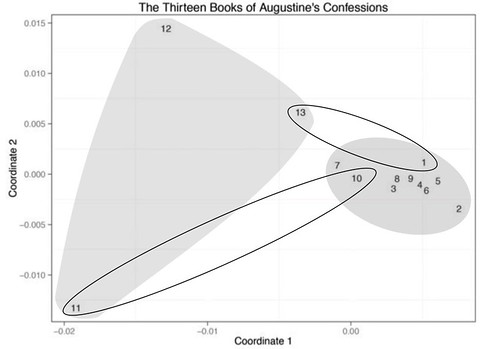
But Piper does note that “Book 13 appears to return back to the original ten books in more circular fashion” (p. 71) and that, by a standard statistical measure, Book 13 belongs with 1-10. In the following figure I’ve highlighted both the relationship between Books 1 and 13 and the long leap between 10 and 11:

Augustine 2

From there Piper goes on to develop a pair of numerical measures that allows him to test a body of texts (450 of them) for this kind of semantic structure. Which is all well and good.

But I want to dwell on the mere fact that Piper has, in effect, shown that Augustine’s course through the Confessions moves through distinct regions of semantic space and that we have statistical tools we can use to trace such paths. Now, Piper used the chapter as his unit of analysis. That’s a rather large unit, yielding a rather crude approximation of the reader’s path. Hey, Jake. How do you drive from New York to LA? Well, I generally go to Pittsburgh, then St. Louis, Denver and then LA. Well, yeah, sure. That’s the general idea. But as driving instructions, it’s not very useful.

What if Piper had used 1000-word chunks, or paragraphs, perhaps even sentences, as a unit of analysis? I surely don’t know. It’s quite possible that, for his purposes, the added detail would have little or no value. But it might be that a more find-grained analysis would show that there are places in 1-10 territory where the path stray over there into 11-13 territory. And if so, what then? Who knows? We won’t know until we take a look.

I note finally that this is a kind of formal analysis. When Piper looks for similar texts, he's look for geometrical congruence that is independent of the specific semantic values of the underlying space.

For more thoughts in this, check out my working paper, Virtual Reading: The Prospero Project Redux, where I discuss Heart of Darkness and Shakespeare.