Are LLMs really more important than fire or electricity?
— Gary Marcus (@GaryMarcus) April 24, 2026
“Honestly, a ton of what we’ve developed in my lifetime amounts to scaling up the delivery of information and entertainment and the frictionlessness of certain financial transactions. These are real improvements! ... But…
Showing posts with label progress. Show all posts
Showing posts with label progress. Show all posts
Saturday, April 25, 2026
Remarkable though they are, LLMs aren't all that, and probably never will be. But they capture part of the formula.
Sunday, May 4, 2025
Tyler Cowen travels for the vibes; he may thus have unique insight into the conditions of cultural flourishing
You can’t follow Tyler Cowen at Marginal Revolution for long before you realize that this guy likes to travel, a lot. As far as I can tell it’s mostly long weekends, but it’s all over the world, well over a hundred countries on all continents. “Why?” I wondered, “Why does he spend so much time and energy on all that travel?” He doesn’t have to do it. He’s not jet-setting around the world to deliver papers at conferences and hold meetings with important people. Oh, sure, there’s some of that. But for the most part he goes to hang out, find the good local food, and get a feel for the place.
Becoming a vibe-master
Back in December of 2018 he wrote about this, Deconstructing cultural codes. Here’s what he says:
I’ve long been convinced that “matters of culture” are central for understanding economic growth, but I’m also painfully aware these theories tend to lack rigor and even trying to define culture can waste people’s time for hours, with no satisfactory resolution.
So I thought I would tackle this problem sideways. I figured the best way to understand culture was to try to understand or “crack” as many cultural codes as possible. As many styles of art. As many kinds of music. As many complex novels, and complex classic books, and of course as many economic models as well. Religions, and religious books. Anthropological understandings. I also learned two languages in my adult years, German and Spanish (the former better than the latter). A bit later I realized that figuring out how an economic sector works — if only partially — was really not so different from cracking these other cultural codes. For instance, once I spent three days on a boat (as keynote speaker), exclusively with people from a particular segment of the shipping trade. It was like entering a whole new world and every moment of it was fascinating.
Interesting. I believe him; I’ve no reason to believe otherwise. But I didn’t find this at all convincing.
My problem is with his intention to “crack” cultural codes. That’s not a technical term. Just what it means is vague. But then he mentions “anthropological understandings.” That’s vague as well. But anthropologists typically spend months and even years doing fieldwork among a single group of people. In the extreme, Dan Everett (a linguist) spent roughly three decades among the Pirahã learning their language and culture. Speaking for myself, I’m trained as a literary critic and have spent hours and hours over five decades writing detailed commentary on literary texts and movies, not to mention the work I’ve done analyzing my practice as a musician. As far as I’ve seen, Cowen hasn’t done anything comparable. Whatever he means by cracking cultural codes, it's not deep analytical understanding of cultural phenomena.
No, “cracking cultural codes” is not what Cowen has been doing, not for any substantial sense of “cracking.” But we now have a word for what Cowen is up to with all that travel: vibe. Oh, sure, we’ve had that word for a long time. But it’s only recently that it’s been used in a way that makes it apt for this context.
A vibe is NOT analytical understanding based on detailed descriptions. It’s a gestalt, a mood, a sense, an encompassing multi-modal image. THAT you can certainly pick up over the course of an extended weekend, especially one where you hunt out the local food. What could be more central to a culture than its food? The late Anthony Bourdain made a career of using food as a vehicle for cross-cultural understanding, for transmitting the vibes of many cultures to his audience. Cowen is a cultural vibe-master.
Cultural flourishing amid poverty
And this brings us to how I first found out about Cowen. It was back in 2006, after Katrina had wrecked New Orleans. Cowen visited the city and wrote about it for Slate: An Economist Visits New Orleans. He wrote:
Since so many homes were destroyed, the natural inclination is to build safer or perhaps impregnable structures. But that is the wrong response. No one should or will rebuild or insure expensive homes on vulnerable ground, such as the devastated Ninth Ward. And it is impossible to make homes perfectly safe against every conceivable act of nature.
Instead – I’m now cribbing from an old blog post of mine – the city should help create cheap housing by reducing legal restrictions on building quality, building safety, and required insurance. This means the Ninth Ward need not remain empty. Once the current ruined structures are razed, governmental authorities should make it possible for entrepreneurs to put up less-expensive buildings. Many of these will be serviceable, but not all will be pretty. We could call them structures with expected lives of less than 50 years. Or we could call them shacks.
I haven't given the matter much thought but, on the face of it, the suggestion seems worth considering. Cowan made the curious mistake, however, of concluding that piece with this fairytale:
To be sure, the shantytowns could bring socioeconomic costs. Yet crime, lack of safety, and racial tension were all features of New Orleans ex ante. The city has long thrived as more dangerous than average, more multicultural than average, and more precarious than average for the United States. And people who decide the cheap housing isn't safe enough will be free to look elsewhere-or remain in Utah with their insurance checks.
Shantytowns might well be more creative than a dead city core. Some of the best Brazilian music came from the favelas of Salvador and Rio. The slums of Kingston, Jamaica, bred reggae. New Orleans experienced its greatest cultural blossoming in the early 20th century, when it was full of shanties. Low rents make it possible to live on a shoestring, while the population density blends cultural influences. Cheap real estate could make the city a desirable place for struggling artists to live. The cultural heyday of New Orleans lies in the past. Katrina rebuilding gives the city a chance to become an innovator once again.
While it is true that remarkable creative activity has managed to survive in unfortunate physical circumstances, I would think the proper view of this relationship is that creativity thus survived in spite of those circumstances, not because of them.
Cowan's disingenuous praise of creativity among the poor is an example of the kind of thinking that Walter Benn Michaels eviscerates in The Trouble with Diversity: How We Learned to Love Identity and Ignore Inequality. The cultural creativity that sometimes manages to flourish amid poverty is, in Cowan's view, somehow supposed to compensate for that poverty or to demonstrate somehow that poverty really isn't such a bad thing. In Michaels's view such thinking is self-serving rationalization. He is right to critique it.
Even then, though – I’m no longer cribbing from that old post – I thought I was being a bit harsh on Cowen. Cultural creativity amid material poverty is a real phenomenon and needs to be understood. But it is a mistake to think that poverty plays an essential causal role in that creativity. Nor do I believe Cowen said that. But what he did say made it easy for a so-minded critic (like me) to read that between his lines.
Understanding the causes of human flourishing
Where am I going with this? I’m thinking of that recent study involving 200,000 people on six continents that found:
Across the whole sample of 22 countries, the overall national composite flourishing actually decreased slightly as G.D.P. per capita rose. The only high-income countries that ranked in the top half of composite flourishing were Israel and Poland. Most of the developed countries in the study reported less meaning, fewer and less satisfying relationships and communities, and fewer positive emotions than did their poorer counterparts. Most of the countries that reported high overall composite flourishing may not have been rich in economic terms, but they tended to be rich in friendships, marriages and community involvement — especially involvement in religious communities.
From which I conclude that cultural creativity amid material poverty is most likely the product of a rich network of connections (many connections, densely packed) between people through friendships, marriages, community involvement, and religious institutions. Such networks seem to weaken and fray with the social arrangements that accompany material prosperity. Why is that the case? More basically, has that actually been the case? If so, why?
It will take a generation of investigators to develop the rich descriptions we need as the basis for quantitative models, models, for example, that like those now being developed by researchers in the digital humanities, of these phenomena. We need those models to develop an analytic understanding of cultures-in-communities. And we need that analytic understanding to guide policy.
It seems to me that Cowen may be in a unique position to begin sorting through this problem. On the one hand he is trained as a social scientist, an economist. But he may well have a knowledge of cultural vibes that is unique in its variety. With his vibe-mastery, Cowen might well be able to play an important role in guiding that research.
Thursday, May 1, 2025
Where are people happiest and how do we know? For that matter, what's happiness? [#HumanProgress]
Byron Johnson, Tyler J. VanderWeele and Brendan Case, The Happiest Country in the World Isn’t What You Think, NYTimes, April 30, 2025.
The three of us conceive of happiness — or flourishing — more broadly: as a state of affairs in which all aspects of your life are relatively good, including the social environments in which you live. If we were to examine not just life evaluation but also relationships with family members and friends, community and political participation, health, prevailing emotions, a sense of life’s purpose, feelings of financial security and so on, we could better understand what it means to live a good life and how governments and international institutions can help make people happier.
On Wednesday, we are publishing a substantial body of research — dozens of academic papers, including a high-level overview of the results in the journal Nature Mental Health — based on the first year of data from our Global Flourishing Study, a five-year project that poses more than 100 questions to more than 200,000 people across 22 countries on six continents. Combining answers to questions regarding several domains of well-being — health, happiness, meaning, character, social relationships and material prosperity — we calculated a composite flourishing score for each country.
Our findings present a different picture of global well-being. As expected, Sweden, for example, had high scores for life evaluation, behind only Israel, another typical standout in the World Happiness Report. When we widened the aperture, however, the picture changed: Sweden had only the 13th-highest composite flourishing score, essentially tied with the United States, and considerably lower than Indonesia, the Philippines and even Nigeria, whose 2023 gross domestic product per capita was just under 2 percent of America’s.
Across the whole sample of 22 countries, the overall national composite flourishing actually decreased slightly as G.D.P. per capita rose. The only high-income countries that ranked in the top half of composite flourishing were Israel and Poland. Most of the developed countries in the study reported less meaning, fewer and less satisfying relationships and communities, and fewer positive emotions than did their poorer counterparts. Most of the countries that reported high overall composite flourishing may not have been rich in economic terms, but they tended to be rich in friendships, marriages and community involvement — especially involvement in religious communities.
And, frankly, that's the kind of world I want to live in. If you want to talk about human progress, moving toward that kind of world – "rich in friendships, marriages and community involvement" – THAT's progress. We need two things from AI: 1) economic prosperity for all, and 2) flourishing all around. How are we going to pull that off? I suppose that's what my book, Kisangani 2150: Homo Ludens Rising, is going to be about.
Back to the article:
Japan, where only 3 percent of the participants reported attending religious services at least weekly, had the lowest reported composite flourishing as well as the lowest scores in many individual facets of flourishing, such as a sense of life’s meaning and social relationships. Indonesia, by contrast, where 75 percent of the participants reported attending religious services at least weekly, had the highest scores both for composite flourishing and for many individual facets of flourishing.
Indonesia is often contrasted unfavorably with Japan in discussions of international development, cited as an example of the so-called middle-income trap, in which economic growth stalls before reaching high-income levels. This is true, so far as it goes, but our study suggests that the focus on economic growth tells only part of the story.
To be clear: Being poor is not desirable, and we should strive to improve material conditions. But our research, though in its early stages, should prompt people to wonder whether prioritizing economic growth and material prosperity above all else has imposed costs on developed nations — and whether doing so is likely to impose these costs on the developing economies that follow the path of Europe and its colonial offshoots.
Here's the abstract for their flourishing study:
Tyler J. VanderWeele, Byron R. Johnson, and Piotr T. Bialowolski et al., The Global Flourishing Study: Study Profile and Initial Results on Flourishing, Nature Mental Health, April 30, 2025, https://doi.org/10.1038/s44220-025-00423-5.
Abstract: The Global Flourishing Study is a longitudinal panel study of over 200,000 participants in 22 geographically and culturally diverse countries, spanning all six populated continents, with nationally representative sampling and intended annual survey data collection for 5 years to assess numerous aspects of flourishing and its possible determinants. The study is intended to expand our knowledge of the distribution and determinants of flourishing around the world. Relations between a composite flourishing index and numerous demographic characteristics are reported. Participants were also surveyed about their childhood experiences, which were analyzed to determine their associations with subsequent adult flourishing. Analyses are presented both across and within countries, and discussion is given as to how the demographic and childhood relationships vary by country and which patterns appear to be universal versus culturally specific. Brief comment is also given on the results of a whole series of papers in the Global Flourishing Study Special Collection, employing similar analyses, but with more-specific aspects of well-being. The Global Flourishing Study expands our knowledge of the distribution and determinants of well-being and provides foundational knowledge for the promotion of societal flourishing.
Monday, March 31, 2025
On the role of play in cultural evolution, a conversation with Claude 3.7
I’ve got two posts on the subject where I use passages from David Hays’s book on the history of technology: The Evolution of Technology Through Four Cognitive Ranks. Both posts date from 2019, though I’ve since bumped them up in the queue so they now display a more recent date. Here’s one of those posts: Personality, understanding, and anxiety as the driver of cultural evolution [Tech Evol]. “Anxiety” is the operative word here, for anxiety is something intrinsic to the operations of the brain, something I discuss in Beethoven’s Anvil (2001, pp. 85-90). Here’s the other post: Cultural Evolution: Expressive culture before practical culture [Progress]. Expressive culture, in turn, can been seen as an aspect of Homo Ludens, which brings up my recent conversation with Claude: Homo economicus sucks! Homo Ludens rocks!
This post follows up those previous posts with another conversation with Claude 3.7. This starts with a passage from Chapter 5, “Politics, Cognition, and Personality” in Hays’s book on the evolution of technology. As always in these conversations, my remarks are in bold face while Claude’s responses are in plain face.
Progress is driven by the need to control anxiety
I’m appending a passage from a book by David Hays. Does it make sense to you? Can you come up with other examples of the phenomenon?
In reading to prepare to write this book, I have learned that the wheel was used for ritual over many years before it was put to use in war and, still later, work. The motivation for improvement of astronomical instruments in the late Middle Ages was to obtain measurements accurate enough for astrology. Critics wrote that even if the dubious doctrines of astrology were valid, the measurements were not close enough for their predictions to be meaningful. So they set out to make their instruments better, and all kinds of instrumentation followed from this beginning. (That from White, Medieval Religion and Technology). Metals were used for ornaments very early – before any practical use?
In its original manifestation the compass was a divination, or future-predicting, instrument made of lodestone, which is naturally magnetic." (George Basalla, p. 172; in The Evolution of Technology)
I suspect that we could get many further examples, up into the growth curve from rank 2 to rank 3.
In fact, someone in the future may look back on psychoanalysis and remark that its origin was in parapsychology–dreams were interpreted first for divination, second for diagnosis of pathology.
Here is my first point: The driving force behind progress in social organization, government, technology, science, and art is the need to control anxiety, to satisfy the brain's striving for understanding.
The passage from David Hays makes perfect sense, and I find it fascinating. He's highlighting a counterintuitive pattern in technology development: many innovations that we now consider practical tools were first developed for ritual, religious, or mystical purposes.
This phenomenon demonstrates how human curiosity and spiritual needs often drive innovation before practical applications are discovered. It suggests that addressing existential concerns and "controlling anxiety" (as Hays puts it) can be more powerful motivators for technological development than immediate practical utility. Here are some additional examples of this phenomenon:
- Dario Amodei mentions in his essay that "mathematicians, computer scientists, and physicists who have applied their skills to biology over the last 30 years have been quite successful." This relates to Hays' point about how tools developed in one field (often for theoretical rather than practical reasons) end up having practical applications elsewhere.
- Chemistry originated from alchemy, which was primarily concerned with transmutation of elements and the search for the philosopher's stone - mystical pursuits that eventually led to practical scientific understanding.
- Early computing machines were often developed to calculate astronomical positions for navigation, which had both religious calendrical significance and practical applications.
- Cave paintings and early art appear to have had ritual/spiritual significance before developing into practical communication tools.
- Mathematics was often developed for religious astronomical calculations (predicting eclipses, solstices, etc.) before its widespread practical applications.
- Early glass making was largely for decorative and ritual objects before becoming practical for windows and vessels.
- The first organs and mechanical musical instruments were developed for churches and religious ceremonies before secular use.
- Early writing systems were primarily used for religious texts and royal/divine record-keeping before becoming tools for everyday communication.
- Many early drugs and medicines were first used in shamanic rituals before their medicinal properties were understood in a practical context.
This pattern seems to reflect something fundamental about human nature - we're motivated not just by practical needs but by deeper questions about meaning, the future, and our place in the universe. The anxiety about the unknown that Hays mentions may indeed be a powerful driver of innovation, as humans develop tools to help make sense of the world, first through ritual and religion, and later through practical applications.
As far as I can tell, the governing ideologies in the West are strongly influenced by the idea of Homo economicus, which has it that human motivation is economic in origin, that reason is rational (in the special game-theory sense of the word), and that growth is the primary aim of society. That would seem to be at odds with the phenomena we’ve just looked at.
You're making an astute connection. The "Homo economicus" model does indeed contrast sharply with the pattern we observed, where innovations often emerge from spiritual, ritual, or existential concerns rather than rational economic calculation.
The economic view of human motivation assumes that people primarily:
- Act as rational utility maximizers
- Make decisions based on self-interest
- Respond primarily to material incentives
- Value efficiency and practical outcomes above all
Yet the historical pattern Hays identified suggests that humans are often driven by:
- The desire to understand and control our anxiety about the unknown
- Spiritual and existential concerns
- Ritual and social/cultural meaning
- Curiosity that isn't immediately practical
This disconnect is important because our economic and social policies are frequently built on the "Homo economicus" model. If we misunderstand human motivation at a fundamental level, we may create systems that don't actually align with how humans naturally innovate and find meaning.
Dario Amodei touches on related themes in his essay when discussing work and meaning in a world with advanced AI. He notes that "I think meaning comes mostly from human relationships and connection, not from economic labor," and suggests that "It is easy to argue that children shouldn't die of disease if we can prevent it" - pointing to moral and compassionate motives rather than purely economic ones.
The examples we discussed (ritual wheels preceding practical ones, astrological instruments leading to scientific ones, etc.) suggest that humans often create their most important innovations when addressing deeper needs than economic efficiency. This has significant implications for how we might want to structure society, education, and research funding if we want to encourage genuine innovation.
What do you think are the implications of this mismatch between our governing ideology and the historical pattern of how innovation actually occurs?
From innovation to Huizinga
I think it means that we don’t have a deep understanding of innovation, and our policies are likely to miss the mark. But getting back to Amodei, his observations about work and meaning in a world of advanced AI seem almost like after thoughts. He’s mostly interested in convincing us that all sorts of marvelous things are just around the corner. That may be so, but, if our thinking and institutions are dominated by the idea of Homo economicus, then we’re not ready. If we don’t think explicitly and differently about human motivation, we’re going to keep getting blindsided by unfolding events.
You've hit upon something crucial. The relegation of "work and meaning" to almost an afterthought in Amodei's essay reflects a broader pattern in how we approach technological development.
Amodei's essay focuses extensively on the technological marvels AI might bring - curing diseases, extending lifespans, solving complex problems - but spends comparatively little time on how humans will find meaning in this new world. This imbalance mirrors our societal approach: we excel at advancing technology but often treat human psychological and spiritual needs as secondary considerations to be figured out later.
Friday, March 28, 2025
My father’s most important lesson: fundamental change is difficult
Perhaps the most important lesson my father gave to me explicitly is that people resist change. I forget this exact wording – for I’m thinking about a specific conversation, dimly remembered – but it was something like this: given a choice between learning how to swim, and drowning, most people would drown. Rather dramatic, no?
But that kind of rock-bottom resistance to change has certainly dogged me my professional life (Rejected! @ New Literary History, with observations about the discipline). And I’m pretty sure that observation can out of his professional life. He was a chemical engineer and spent most of his career with the Bethlehem Mines Corporation where he was in charge of coal preparation, which involved removing impurities (mostly rock) from coal before it was used in smelting iron.
I assume that the change he was talking about – for I don’t recall him mentioning it in that conversation – was introducing European technology into North America. I’ve appended a conversation I had with Claude 3.5 about that, since I don’t personally recall the dates. He went on to other innovations at the end of his career, innovations which were, unfortunately, still born. Oh, he got some patents, but Bethlehem Mines was unable to put them to good use. Not so long after that the bottom fell out of the American steel industry, and that changed everything, whether or not people liked it.
* * * * *
My conversation with Claude 3.5 about change in cleaning coal. My prompts are in boldface while Claude’s replies are plain.
I’m interested in a specific development in the history of coal preparation. As background, my father, William Benzon, was Superintendent of Coal Preparation for Bethlehem Mines Corp. from, say, 1960 until his retirement in the mid-1970s. I remember that he was involved in introducing heavy medium cyclones (magnetite) into the US from, I believe, Dutch State Mines in the Netherlands. Do you know anything about that process and its history?
Heavy medium cyclones using magnetite suspension were indeed a significant innovation in coal preparation, introduced to the US coal industry in the 1950s-60s after being developed at Dutch State Mines (DSM). The technology improved the efficiency of separating coal from impurities by using a dense magnetite suspension in a cyclone to separate materials based on density differences.
Given your father's role at Bethlehem Mines during this key period of adoption, he would have been directly involved in implementing this important technology transfer from Europe to the US coal industry. The timing aligns with when US coal companies were actively seeking more efficient separation methods.
I should note that while I'm confident about the general history of heavy medium cyclones and their introduction from DSM to the US, I may not be able to verify specific details about your father's individual role since this represents fairly specialized historical information.
Would you be interested in sharing more about what you remember about your father's specific involvement in this technology transfer?
Thank you. You've given me enough. I just wanted to confirm the timing of that technology. Beyond that, I really don't know much. I know that my father traveled to the Netherlands. And Dutch engineers came to the states. Some stayed with at our hours on several occasions. But I don't really know the dates, the early-mid 1960s seems right, nor do I remember names.
Indeed, the timing fits the historical record. The collaboration between Dutch State Mines and US coal companies in implementing heavy medium cyclone technology was an important development in coal preparation during that period. Your memory of Dutch engineers visiting and your father traveling to the Netherlands provides valuable first-hand confirmation of how this technology transfer occurred.
What I do remember, and this is why I asked the question, is that at some time my father told me that the hardest thing in the world to do is to get people to accept new ideas. I’ve remembered that for my whole life. I suspect that what he had in mind was this business of heavy medium cyclones. That would have been about the time we had that conversation. Much earlier and I would have been too young to understand. Much later, well, much later and I would have been in college. But I just don’t remember him specifically mentioning heavy-medium cyclone technology in that particular conversation. All I have to go on is the timing.
There’s a company known as, I believe, Robertson and Shafer. Did they have anything to do with this technology?
Your father's observation about the difficulty of getting people to accept new ideas is particularly poignant given the context. The introduction of heavy medium cyclones would have represented a significant change in coal preparation practices, likely facing resistance despite its technical advantages.
Regarding Roberts & Schaefer (which I believe is the company you're thinking of) - yes, they were involved in coal preparation plant design and construction during this period. However, I should note that while I'm confident they were active in the coal preparation industry, I can't say with certainty their specific role in heavy medium cyclone implementation without risking making incorrect claims.
Yeah, that's the name of the company. Thanks.
Your father's insight about resistance to new ideas, combined with the timing and context of heavy medium cyclone implementation, suggests that observation likely did stem from his experience with this technology transfer. Coming from his position as Superintendent of Coal Preparation during this key transition period, it's a particularly meaningful observation about technological change and human nature.
Wednesday, March 19, 2025
Dan Davies: cybernetic abundance and its limits
From then end of the article:
The problem of abundanceism, restated in this form, is simply that the liberal regulatory state isn’t adequate to the task.
Specifically, the problem is that, for the reasons noted above, as things grow and become more complex, a greater proportion of their energy and resources have to be devoted to purely internal and administrative matters. The regulatory model needs, ideally, to grow alongside the system that it’s modelling, so that it’s still capable of representing the complexity of the system.
If it doesn’t, then the people who still have the job of stopping things getting in the way of each other will reorganise, in order to try to continue to do their job with an inadequate model. One of the most effective organisational techniques to do this is to replace, as much as possible, “how and why” questions with “yes or no” questions. The “planning system” gradually stops being one in which the word “planning” has something close to its ordinary meaning, and moves toward becoming a “permissioning authority”.
As the resource imbalance gets bigger, another organisational/cognitive technique which helps reduce the load even more is to adopt something like the Hippocratic principle. It’s much easier to turn a “no” into a “yes” than vice versa, and part of the cost of building something is that it constrains what can be built in the future. So, the greater your uncertainty about the future (perhaps because you don’t have the capacity to think about it any more), the more likely you are to be worried about closing off options.
Where I think I end up with this is in a view that the battle between “builders” and “blockers” is mischaracterised. These are two wrong answers to a problem which is fundamentally caused by the imbalance between the complexity of the system and the capacity to manage it. Neither builders, nor blockers, but planners.
This suggests that AI systems than can really do planning, as opposed to the pseudo-planning of LLMs and their extensions, will be enormously valuable. Thus it’s almost tragic that Silicon Valley is unlikely to produce such systems. Why? Because they appear to have bought the sunk-costs fallacy hook, line, and sinker and so are committed to the current repertoire of techniques.
Friday, March 7, 2025
Claude and I discuss the idea of progress in the arts, from Hazlitt to Bloom on Shakespeare, and concluding with Arthur Danto and Ernst Gombrich
This is from an ongoing discussion I have been having with Claude. For this discussion I had uploaded the paper that David Hays and I wrote on cognitive evolution, which is our basic paper of cultural ranks, and Max Tabarrok’s post, Romae Industriae, which poses the question of why Rome didn’t have an industrial revolution. I have posted earlier segments of this conversation: 1) Why didn’t Rome have an industrial evolution? and 2) where I argued that the printing press did not play the role in cultural history that is usually assigned to it.
The general idea of cultural ranks came out of my undergraduate years at Johns Hopkins. I took a course on the Scientific Revolution, where we read Thomas Kuhn’s famous book, The Structure of Scientific Revolutions. In another course I learned that the novel emerged as a literary form in roughly the same time frame. In yet another course I read Centuries of Childhood, by Philippe Aries. He argued that the conception of childhood that is familiar to us, a distinct phase in human development, was not a “natural” concept, but rather emerged, yes, again within roughly the same time period. In a course on the theatre, taught by Dick Macksey, I read Nietzsche’s The Birth of Tragedy, which concocted a story about the historical emergence of tragedy in ancient Greece which made it seem as though the Athenians had “swallowed” an older society and put it on the stage. Ritual celebrants in the older social formation became the principle characters in tragedies while the general popular of that formation became the chorus.
During my sophomore year I’d taken a course in developmental psychology where I was introduced to the work of Jean Piaget. Piaget theorized that children’s mental development progressed through a series of more or less distinct stages, where each stage is characterized by specific cognitive capabilities, with later stages building on earlier ones. He also applied this concept to the history of ideas, e.g. in Genetic Epistmology, which read while working on an MA thesis. That’s also when I read Walter Wiora’s The Four Ages of Music. It was a slim volume in which Wiora argued that the first age emphasized rhythm, the second added an intense development of melody, then came harmony (emerging in Europe) and the contemporary phase, which involved exploration of new forms and methods. I read that and posed a question: Isn’t everything like that, four stages?
I took that question with me to SUNY Buffalo, where I enrolled for a PhD in the English Department, but also spent a great deal of time discussing computational linguistics, cognitive science, and cultural evolution with David Hays in Linguistics. That’s where we developed the idea of cultural ranks. I included an account of narrative development in my 1978 dissertation, “Cognitive Science and Literary Theory.”
I note, then, that while the scientific revolution certainly played an important role in my thinking about cultural evolution, the arts played perhaps an even more important role in developing the idea. However, the ranks idea only accounts for the overall shape of development. What about development within a given rank? I have some preliminary notes about that in a recent post, Confabulation, Dylan’s epistemic stance, and progress in the arts: “I’ll let you be in my dreams of I can be in yours.”
The rest of this post consists of a conversation I had with Claude 3.7 on March 3, 2025. As always, my comments are set in bold type while Claude’s are plain.
* * * * *
Hazlitt on progress in the arts
While it is common to say that there is progress in the sciences and technology, it’s less common to think of progress in the arts. William Hazlitt published a well-known essay in 1814, Why The Arts Are Not Progressive, and that’s remained the standard view. He observed:
“What is mechanical, reducible to rule, or capable of demonstration, is progressive, and admits of gradual improvement: what is not mechanical or definite, but depends on genius, taste, and feeling, very soon becomes stationary or retrograde, and loses more than it gains by transfusion. [...] The greatest poets, the ablest orators, the best painters, and the finest sculptors that the world ever saw, appeared soon after the birth barbarous. Those arts, which depend on individual genius and incommunicable power, of these arts, and lived in a state of society which was, in other respects, comparatively have always leaped at once from infancy to manhood, from the first rude dawn of invention to their meridian height and dazzling lustre, and have in general declined ever after.”
I see you're interested in exploring the contrast between progress in sciences/technology versus the arts. This is a fascinating philosophical question that bridges cultural evolution, aesthetics, and the nature of human creativity.
Hazlitt's essay presents the classic view that the arts, unlike sciences, don't experience linear progress. His central argument distinguishes between domains that are "mechanical, reducible to rule" (sciences) versus those dependent on "genius, taste, and feeling" (arts). He suggests artistic achievements often peak early in civilizations and then stagnate or decline.
The two documents you've shared offer interesting frameworks to consider this question: From "Cognitive Evolution," Benzon and Hays propose a four-rank model of cognitive development across cultures:
1. Rank 1: Abstraction through metaphor (preliterate societies)
2. Rank 2: Rationalization through metalingual definition (literate societies)
3. Rank 3: Theory through algorithm (Renaissance onward)
4. Rank 4: Model building through control (20th century)
They argue these cognitive advances shape all cultural domains, not just science. While they don't specifically refute Hazlitt's view on art, their model suggests that artistic expression would also evolve with new cognitive tools.
The "Romae Industriae" document examines why Rome didn't achieve an industrial revolution despite its technological sophistication. The author concludes cultural factors, particularly the lack of a printing press and the disdain for mechanical arts in slave-based societies, were key constraints rather than just technological limitations.
What's interesting is how these perspectives might inform a response to Hazlitt. Could we argue that while individual artistic genius may appear at any time, the evolution of artistic forms and movements does show a pattern of development tied to cognitive and cultural evolution? For example, the Renaissance's perspective techniques in painting required Rank 3 thinking about algorithmic representation of space.
Would you like to explore this tension between Hazlitt's view and the cognitive evolution framework more deeply, or focus on another aspect of these materials?
Bloom, Shakespeare, the novel
Ah, yes, this ranks business. Benzon has published on both the evolution of narrative and the evolution of music using ranks theory and Hays has published on expressive culture in general. Perhaps one day I’ll upload those papers for you to examine. I note, though, that they don’t address the issue of progressive change within individual ranks. For example, I suspect that there is expressive change in the novel, from the 18th century up through the end of the 19th century, but that’s entirely within Rank 3 culture, and I’d think the progress continues in the 20th century. [...] And then we have Harold Bloom’s assertion that Shakespeare, in some sense, “invented” the human, but which I think he means that Shakespeare was the first writer to give voice to certain aspects of human behavior and mental life. But I don’t think Bloom ever systematically developed that idea, not even in is book on the Western canon or in his Shakespeare book.
[...] You raise an excellent point about progressive change within individual ranks that wasn't fully addressed in the paper. The progression of the novel within Rank 3 culture is a perfect example of this phenomenon. From Defoe and Richardson through Austen, the Brontës, Dickens, Eliot, and on to James and Conrad, we see remarkable development in narrative technique, psychological depth, and formal complexity—all while remaining within the algorithmic thinking characteristic of Rank 3.
This intra-rank progression continues into the 20th century with modernist innovations by Joyce, Woolf, and Faulkner, who pushed the boundaries of what the novel could express while still operating within Rank 3 cognitive structures. Then perhaps writers like Pynchon and DeLillo begin to engage with Rank 4 model-building approaches to fiction.
Regarding Bloom's assertion about Shakespeare "inventing the human," this does seem to suggest a kind of progressive leap in artistic representation. Bloom never fully systematized this idea, but it appears to indicate that Shakespeare's achievement wasn't just artistic excellence but a cognitive breakthrough in representing human interiority. In ranks terminology, one might say Shakespeare was pushing against the upper limits of Rank 2 representation toward something like early Rank 3 thinking about human psychology, even before the scientific revolution had fully taken hold.
Tuesday, March 4, 2025
Why the printing press didn’t drive either the Scientific or the Industrial Revolution [McLuhan was wrong • Implications for progress studies]
Soon after ChatGPT hit the web both the progress punditocracy and the high-tech evangelists were busy chattering away about how this is the greatest thing since the printing press. They’re wrong. Was the printing press important? Sure, it was very important. But it was important as a vehicle for disseminating existing ideas, not for catalyzing new ones. Printed books have the same cognitive affordances – to borrow a term from James J, Gibson – as hand-lettered books, discrete letters in a rectangular array on a flat surface. That’s it. Mechanizing the process of impressing the letters on the page does not change the cognitive affordances of the printed page.
Back when David Hays and I began thinking about publishing on cultural evolution he brough his attention to a collection of essays by Eric Havelock, The Literate Revolution in Greece and Its Cultural Consequences (Princeton 1982), in which Havelock pointed out that was the adoption of decimal arithmetic was the essential step. Hays and I thought that was correct, and adopted it in the article we eventually published, The Evolution of Cognition (1990):
The role which speech plays in Rank 1 thought, and writing plays in Rank 2 thought, is taken by calculation in Rank 3 thought (cf. Havelock 1982: 341 ff.). Writing appears in Rank 1 cultures and proves to be a medium for Rank 2 thinking. Calculation in a strict sense appears in Rank 2 and proves to be a medium for Rank 3 thinking. Rank 2 thinkers developed a perspicuous notation and algorithms. It remained for Rank 3 thinkers to exploit calculational algorithms effectively. An algorithm is a procedure for computation which is explicit in the sense that all of its steps are specified and effective in the sense that the procedure will produce the correct answer. The procedures of arithmetic calculation which we teach in elementary school are algorithms.
A bit later we remark:
The amazing thing about algorithmic calculation is that it always works. If two, or three, or four, people make the calculation, they all come up with the same answer. This is not true of non-algorithmic calculation, where procedures were developed on a case-by-case basis with no statements of general principles. In this situation some arithmeticians are going to get right answers more often than others, but no one can be sure of hitting on the right answer every time.
This ad hoc intellectual style, moreover, would make it almost impossible to sense the underlying integrity of the arithmetic system, to display its workings independently of the ingenious efforts of the arithmetician. The ancients were as interested in magical properties of numbers as in separating the odd from the even (Marrou 179-181). By interposing explicit procedures between the arithmetician and his numbers, algorithmic systems contribute to the intuition of a firm subject-object distinction. The world of algorithmic calculations is the same for all arithmeticians and is therefore essentially distinct from them. It is a self-contained universe of objects (numbers) and processes (the algorithms). The stage is now set for experimental science. Science presents us with a mechanistic world and adopts the experimental test as its way of maintaining objectivity. A theory is true if its conceptual mechanism (its "algorithm") suggests observations which are subsequently confirmed by different observers. Just as the results of calculation can be checked, so can theories.
Given that, I take the wide-spread belief in the catalytic efficacy of the printing press as an indicator that the intellectual classes are not prepared for the revolution made possible through artificial intelligence. Just as generals are said always to fight the last war, so intellectuals are always proclaiming the last intellectual revolution. Our intellectuals are not prepared to think about thinking, about the processes of the mind, in a deep way.
* * * * *
Early in February I had a post on why Rome didn’t have an industrial revolution. The bulk of that post was a discussion I had with Claude 3.5 Sonata. As the lack of the printing press was one of the hypotheses on offer – in an article by Maxwell Tabarrok – Claude and I had a great deal of discussion about that. Once we’d conclude our discussion of Rome I decided to push on about the printing press. I suspected that Marshall McLuhan was responsible for that mistaken idea and asked Claude about.
Here's that conversation. As always, my remarks are set in bold face while Claude’s responses are plain.
McLuhan and the printing press view
The idea that the printing press was the main driver of intellectual change during the Renaissance, I believe that idea is widely held. Marshall McLuhan argued that in The Gutenberg Galaxy, and he was quite influential in the 1960s and 1970s and remains so today. Hays and I got clued-in to decimal arithmetic by Eric Havelock. But, as far as I know, that view has not been very influential. In discussions about the impact of AI I’ve heard many people compare it to the printing press. That seems to be what people think of in this kind of context, the printing press. Am I missing something about the range of views?
Your assessment seems accurate. The printing press as a primary driver of Renaissance intellectual change is indeed the dominant narrative in both academic and popular discourse. This can be seen even in the article you've shared - Tabarrok immediately gravitates to the printing press explanation without seriously considering alternatives.
This dominance might stem from several factors:
1. The printing press's effects are more immediately visible and concrete than those of decimal arithmetic. You can literally see books spreading knowledge.
2. The printing press story fits into a broader narrative about democratization of knowledge that appeals to modern sensibilities.
3. McLuhan's influence, as you note, helped cement this view, particularly through his compelling analysis of how media shapes cognition.
In contrast, the decimal arithmetic hypothesis requires a more complex understanding of how mathematical procedures can reshape cognitive frameworks. Havelock's view hasn't gained the same traction, perhaps because:
1. It's more difficult to trace the direct impacts of mathematical procedures on thought 2. It requires understanding both mathematical and cognitive concepts 3. It lacks the immediate intuitive appeal of the printing press narrative
Your papers with Hays present a strong case for decimal arithmetic's role, but I'm struggling to find other major works that focus on this as the key driver of Renaissance cognitive change. Even discussions of mathematical history tend to focus more on specific discoveries rather than how new mathematical procedures reshape thinking.
In current AI discussions, do you think the frequent printing press comparisons might be missing important aspects of how AI could reshape cognition, similar to how the printing press narrative misses the cognitive impact of decimal arithmetic?
Progress studies
Well, sorta’, yes. But that’s not quite the point. I take this belief in the printing press as an index of a general inadequacy in thinking about these kinds of issues.
As you know, there’s been a push for progress studies in the last few years. When it first emerged, I was interested and excited since the ideas that Hays and I have developed are certainly relevant to any study of progress. But I had no luck getting people interested. So it’s not so much the failure to understand how AI could reshape cognition as it is a more general failure to understand the role of cognition in the cultural process. There’s no concept of a general cognitive architecture underlying a whole family of ideas. Rather, the emphasis is more local, on this idea and that idea and the other ones over there and so forth.
For that matter, I don’t think Piaget’s ideas about genetic epistemology have really caught on either, or the closely associated idea of reflective abstraction.
This points to a deeper issue in how we think about intellectual and cultural progress. Instead of seeing ideas as emerging from and transforming underlying cognitive architectures, the tendency is to treat them as isolated units that simply accumulate or spread. This "local" view of ideas misses the systemic nature of cognitive development and cultural evolution that you and Hays describe.
The progress studies movement, while valuable in drawing attention to the importance of progress, seems to share this limitation. It tends to focus on:
- Individual innovations and discoveries
- Institutional structures and incentives
- Knowledge transmission mechanisms
- Economic and technological factors
But it gives less attention to how these elements relate to fundamental changes in how people think and process information - the kind of changes that Piaget described in individual development and that you and Hays describe at the cultural level.
This may explain why decimal arithmetic's role gets overlooked - it's harder to see its importance if you're not thinking about how it transformed the underlying cognitive architecture that makes certain kinds of ideas possible in the first place.
Friday, December 6, 2024
Progress ain’t what it used to be
Virginia Postrel, The world of tomorrow, Works in Progress, Issue 17, Dec. 5, 2024.
My favorite line: “Today’s techno-optimism is infused with nostalgia for the retro future.” Exactly! It seems like a throwback to an earlier time. In fact, it seems like a throwback to Walt Disney’s view of the world. While I admire Disney, his vision of the future was born in the first half of the 20th century. That's done and gone. It's a new world and we need new visions for the future.
Here's Claude's summary of Postrel’s article:
This article explores how the concept of progress lost its glamorous appeal in American culture, particularly during the mid-20th century, and examines what this shift means for modern techno-optimism.
The author begins by explaining how progress was viewed as inherently glamorous for much of the 20th century, particularly from the 1920s to 1960s. This was exemplified by events like the 1939 New York World’s Fair and Disneyland’s Tomorrowland, which presented optimistic visions of the future characterized by technological advancement and material abundance.
The article identifies three distinct audiences who found progress glamorous during this period: modernists who sought order and efficiency, intellectuals who yearned for discovery and achievement, and ordinary people who desired comfort and security. The latter group was particularly significant in making progress glamour a cultural norm, as they witnessed technological improvements materially benefiting their daily lives through innovations like refrigerators and automobiles.
However, this glamorous vision of progress began to fade in the late 1960s for several reasons. First, as futuristic conveniences became everyday realities, they lost their mystique and revealed their limitations. Second, the modernist approach to progress, which often involved top-down planning and urban renewal projects, faced growing resistance from communities affected by these changes. This resistance was exemplified by Jane Jacobs’ influential critique of urban planning and the rise of the counterculture movement.
The article then examines contemporary attitudes toward progress, noting that today’s longings differ significantly from those of the mid-20th century. Modern individuals often seek escape from the attention economy, desire authentic connections, and value mastery of practical skills. The author suggests that any new vision of progress must accommodate diverse preferences and lifestyles rather than pursuing a single ideal future.
The piece concludes by arguing that future progress must embrace pluralism and avoid the modernist fallacy of “one best way.” Using examples from Neal Stephenson’s novel The Diamond Age, it suggests that material abundance should serve as a foundation for various ways of living rather than forcing conformity to a single vision of the future. The author emphasizes that progress can only regain its appeal if it allows for multiple versions of the good life while maintaining social cohesion.
The central insight is that progress lost its glamour not simply because of environmental concerns or anti-technology sentiment, but because the modernist vision of progress failed to acknowledge human diversity and the importance of organic social development. Any attempt to restore faith in progress must learn from these historical lessons while addressing contemporary desires and anxieties.
Saturday, June 8, 2024
What about degrowth? Color me both sympathetic and skeptical. I'm thinking.
Jennifer Szalai, Shrink the Economy, Save the World? NYTimes, June 8, 2024. The article opens:
A rising tide and a bigger pie: Economic growth has long been considered such an obvious boon that it’s pursued by governments across the world as a matter of course. But in 2016, when a London professor warned an audience in Newcastle that Brexit would lead to a precipitous drop in Britain’s gross domestic product, that well-worn measure of economic activity, one woman’s heckling caught him by surprise. “That’s your bloody G.D.P.,” she shouted, “not ours!”
The eruption tapped into a suspicion supported by reality: Gains in economic growth have too often buoyed the fortunes of the richest instead of lifting all boats. Prosperity even in the most prosperous countries hasn’t been shared. But all the attention to inequality is just a crack in the edifice of economic orthodoxy. Now a much more radical proposition has emerged, looming like a wrecking ball: Is economic growth desirable at all? [...]
In 1972, the French theorist André Gorz coined the word décroissance to ask whether “no-growth — or even degrowth” in material production was necessary for “the earth’s balance,” even if it ran counter to “the survival of the capitalist system.”
While the idea of "earth's balance" is (at least superficially) attractive, I'm not sure what it means. It does seem to presuppose some line between "the natural" and "the human" such that the human has been messing up the natural. That strikes me as being too much like a repackaging of the idea of original sin. OTOH I've long been suspicious of an economic regime, like capitalism, that positively requires growth in order to function at all. Perhaps that suspicion is a repackaging of medieval Christian objects to usury? But it is also a recognition that we live in a finite world.
Continuing on:
For advocates of degrowth, it’s a core tenet that in high-income countries the constant expansion demanded by capitalism isn’t required to improve people’s lives; instead, the ensuing inequality and environmental havoc have frequently undermined them.
Take Hickel, an anthropologist who teaches in London and Barcelona and is one of the movement’s most spirited exponents. Like other contemporary critics of unfettered growth, he emphasizes the climate crisis. His book begins with scenes of ecological devastation: dying earthworms, declining crop yields, collapsing fish stocks. He points to the connection between growing G.D.P. and energy use, identifying an ideology of “growthism” that he equates with “a kind of madness.” He says that he is not promoting a deliberate reduction in G.D.P. But if G.D.P. stagnates or declines because we conserve energy instead of consuming it, so be it. [...]
Of course, such a sweeping pronouncement is far from uncontested. Economists like Paul Krugman and data scientists like Hannah Ritchie have maintained that technological advances mean that economic prosperity doesn’t have to lead to ecological degradation. But for all the debates over carbon pricing and parts per million and degrees of warming, the distinctive argument that Hickel and other degrowthers make is ultimately a moral one: “We have ceded our political agency to the lazy calculus of growth.”
What a piece of rhetoric: “... the lazy calculus of growth.” Color me sympathetic. Moving on:
As the economist Daniel Susskind notes in his new book, “Growth: A History and a Reckoning,” big questions that were pushed to the margins — about clashing notions of freedom, equality and justice — have roared back with a vengeance. Still, he sees this as cause for ambivalence, not despair. After all, growth has also emancipated much of the world from “an unforgiving struggle for subsistence,” Susskind points out. “Growth has an irresistible promise and an unacceptable price; it is miraculous and devastating; we need a lot more and vastly less.”
Although he denounces the blithe optimism of the economic establishment, Susskind is also highly critical of degrowthers, who are too dismissive of capitalism for his liking.
The article goes on to discuss the ideas of a Japanese Marxist philosopher, whose book, Slow Down: The Degrowth Manifesto, has sold half a million copies.
Saito admits that there is “some truth” to the argument that capitalism produces material wealth, and so he champions degrowth communism only for rich countries, not for poor ones. “Those in the Global North enjoy rich lifestyles enabled by the sacrifices of those in the Global South,” he writes. Degrowth would halt this injustice and offer a form of “reparations”: Reducing the resources and energy used by the Global North would allow the Global South to pursue its own economic growth instead.
Imagination, imagination, who's got imagination?
Even degrowth’s skeptics may find that Saito’s examples of grass-roots organizing sound agreeably democratic and improvisational. But the prospect of global apocalypse that degrowthers keep emphasizing also has the perverse effect of making local measures sound acutely inadequate. Still, Saito says that such experiments do offer something crucial: an enlarged sense of what’s possible. Degrowth’s critics, he writes, suffer from “a poverty of imagination that simply accepts the status quo as unchangeable.”
As it happens, Susskind says precisely the same thing but in the reverse: that it’s degrowth’s advocates who suffer from a “lack of imagination.” The mirrored accusations are striking. Maybe it isn’t a matter so much of imagination scarcity as of where that imagination is directed. Techno-optimists place their faith in innovation; degrowthers place theirs in social movements. Both sides lay claim to being the genuine realists. Each insists that we simply don’t have enough time to do what the other side wants.
Hey! I've got an idea. Let's create a super-intelligent AI and then let it solve the problem.
Thursday, May 9, 2024
Why is scientific progress slowing down? Science is making fewer and fewer breakthrough discoveries.[Hossenfelder]
What's going on?
- Nothing at all. Things are just fine. Most scientists prefer this.
- There's nothing left to discover.
- Current arrangements award productivity over usefulness.
Friday, April 12, 2024
Progress visualized by R. Crumb to Joni Mitchell's "The Big Yellow Taxi"
“They paved paradise to put up a parking lot!”
Tuesday, January 23, 2024
Ted Gioia believes that progress stopped in 2015 and that technocrats don't know diddly squat about human flourishing
Ted Gioia has just published an interesting polemic: I Ask Seven Heretical Questions About Progress. I'll leave you to read his seven heretical questions for yourself. But I'm quoting in full the final section of his most interesting post, with which I am deeply sympathetic. I am afraid that much current public discourse about progress is being driven by people whose minds are stuck in the 19th century world of the industrial revolution. The coupling of that mindset with current technology, particularly artificial intelligence, is a recipe of human disaster.
* * * * *
But let me move on to my radical hypotheses. (I’m running out of space, so these are much shorter.)
But each of these is a huge issue—and my views get more heterodox as you work your way down the list.
So I will need to write about this more in the future.
Progress should be about improving the quality of life and human flourishing. We make a grave error when we assume this is the same as new tech and economic cost-squeezing.
There was a period when new tech improved the quality of life, but that time has now ended. In the last decade, we’ve seen new tech harming the people who use it the most—hence most so-called innovations are now anti-progress by any honest definition.
There was a time when lowering costs improved quality of life—raising millions of people out of poverty all over the world. But in the last decade, cost-squeezing has led to very different results, and is increasingly linked to a collapse in the quality of products and services. Some people get richer from these cost efficiencies, and a larger group move into more intensely consumerist lifestyles—but none of these results (crappy products, super-rich elites, mass consumerist lifestyles, etc.) deserve to be called progress.
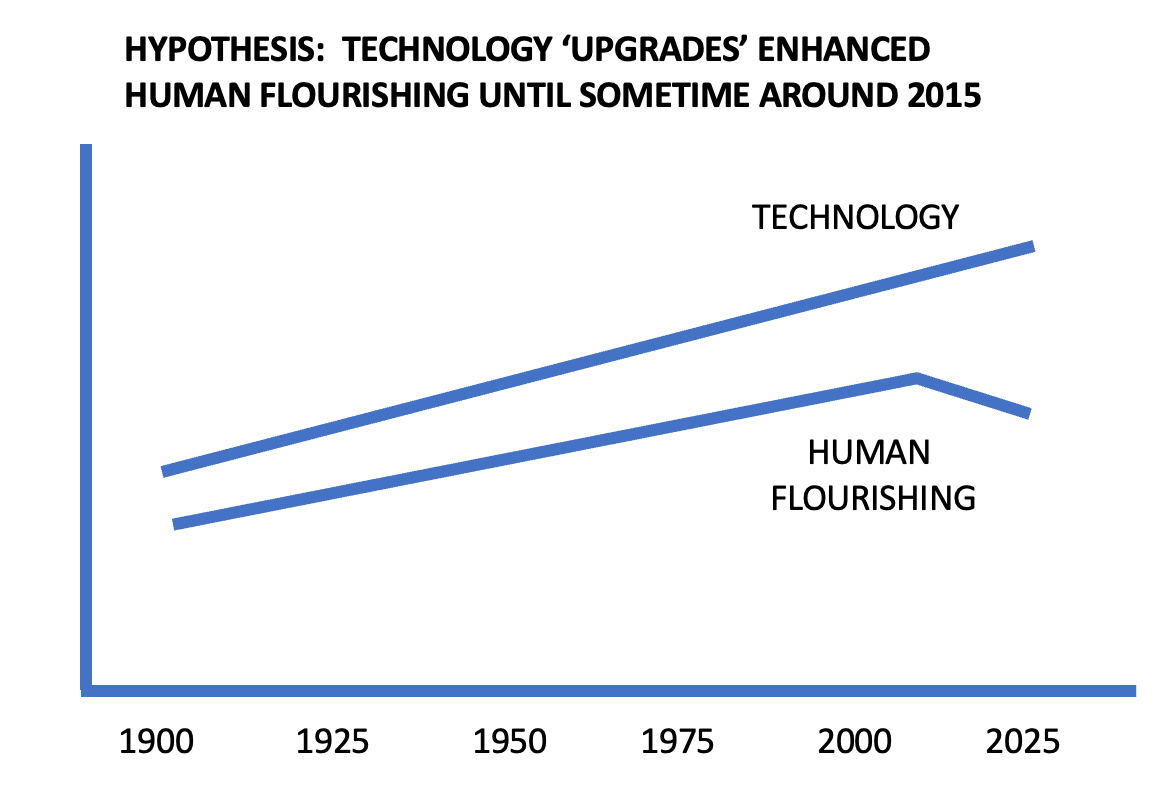
The discourse on progress is controlled by technocrats, politicians and economists. But in the current moment, they are the wrong people to decide which metrics drive quality of life and human flourishing.
Real wisdom on human flourishing is now more likely to come from the humanities, philosophy, and the spiritual realms than technocrats and politicians. By destroying these disciplines, we actually reduce our chances at genuine advancement.
Things like music, books, art, family, friends, the inner life, etc. will increasingly play a larger role in quality of life (and hence progress) than gadgets and devices.
Over the next decade, the epicenter for meaningful progress will be the private lives of individuals and small communities. It will be driven by their wisdom, their core values, and the courage of their convictions—none of which will be supplied via virtual reality headsets or apps on their smartphones.
I still have more to say on this. But that’s plenty to chew on for the time being.
Monday, October 23, 2023
Tech Utopians and AI Doomers are two sides of the same coin
Matt Yglesias pushes back against Andreesen’s Techno-Optimism, The techno-optimist's fallacy. He sets it up:
Earlier this year, I kept writing draft versions of an article denouncing something I wanted to call “the Techno-Optimist’s Fallacy.”
What is the fallacy? It starts with the accurate observation that technological progress has, on net, been an incredible source of human betterment, almost certainly the major force of human betterment over the history of our species, and then tries to infer that therefore all individual instances of technological progress are good. This is not true. Indeed, it seems so obviously untrue that I couldn’t quite convince myself that anyone could believe it, which is why I kept abandoning drafts of the article. Because while I had a sense that this was an influential cognitive error, I kept thinking that I was maybe torching a straw man. Was anyone really saying this?
Then along came Marc Andreesen, the influential venture capitalist, with an essay that is not only dedicated to advancing this fallacy, it is even literally titled “The Techno-Optimist Manifesto.”
So now I can say for sure that, yes, this is a real fallacy that people are actually engaged with.
I won’t go into the substance of his argument; you can read it for yourself. I want to look around the edge. Early on he observes, “It seems to me that, in practice, almost everyone in the techno-optimist camp lives in the Bay Area...” Toward the end:
I’m focusing on these somewhat outlandish edge cases because the point of Andreesen’s article is to try to salt the conversation around the risks associated with the rapid development of artificial intelligence. He is unalterably opposed to any kind of regulation and massively dismissive of concerns about existential risk, algorithmic bias, and everything else.
And he doesn’t want to argue any of the specifics, he just wants to mobilize general pro-technology, pro-progress, pro-growth sentiment in favor of the specific idea that we should be rushing headlong to try to create an artificial super-intelligence.
My point is simple, the tech-optimists and the AI Doomers are two sides of the same coin, which may be why they’re concentrated in Silicon Valley. One is Kirk, the other is Anti-Kirk, Spock and Anti-Spock, Yin and Yang, more generically, good twin and bad twin, or in a lingo from the belly of this particular beast, Luigi and Waluigi (LessWrong). You can line up the positives and negatives however you please.
All of them are insular, tech-obsessed, intelligence too, and self-regarding, at least on the surface. Who knows what lurks in the hearts of men. Moreover, some of them are very rich, which just magnifies everything else.
I suppose I got this idea from Ted Chiang, for example:
I used to find it odd that these hypothetical AIs were supposed to be smart enough to solve problems that no human could, yet they were incapable of doing something most every adult has done: taking a step back and asking whether their current course of action is really a good idea. Then I realized that we are already surrounded by machines that demonstrate a complete lack of insight, we just call them corporations. Corporations don’t operate autonomously, of course, and the humans in charge of them are presumably capable of insight, but capitalism doesn’t reward them for using it. On the contrary, capitalism actively erodes this capacity in people by demanding that they replace their own judgment of what “good” means with “whatever the market decides.” [...]
The fears of superintelligent AI are probably genuine on the part of the doomsayers. That doesn’t mean they reflect a real threat; what they reflect is the inability of technologists to conceive of moderation as a virtue. Billionaires like Bill Gates and Elon Musk assume that a superintelligent AI will stop at nothing to achieve its goals because that’s the attitude they adopted.
Johann Wolfgang von Goethe as Techno-Optimist of the Future
Well, I’m not proposing that we reanimate him, much less (attempt to) fetch him with a time machine. I suppose what I have in mind is that the ideal techno-optimist should be modeled on or inspired by Goethe. I got the idea from ChatGPT.
Let me explain.
At this moment the sector of the web I hang out in is getting a lot of commentary on Marc Andreesen’s The Techno-Optimist Manifesto, much of it critical. I’ve even taken a crack at it myself. But I didn’t attempt a direct critique. I pretty much ignored the content, judging it “to be an artless collection of tech-progress tropes spun-forth on autopilot.” I then went on to talk about Jack Kennedy’s 1962 “to the moon” speech, suggesting that such a speech would be impossible today because the country’s too deeply fractured. There’s no common ground adequate to serve as the foundation of such a speech.
That’s not, some might say, the most useful critique, and others are responding more directly to Andreesen. OK. But still, I stand by what I wrote.
“Perhaps, though,” I thought yesterday evening, “I can take a cue from the autopilot remark and see what a real autopilot would say.” I decided to put the question to ChatGPT. So, at 6:15 PM on October 22th I fired up the old computer. Here’s the prompt I gave it:
Imagine that you are a wealthy and successful venture capitalist with a particular interest high tech and AI. You’re dismayed at the mood of the country; it’s too negative and seems like it’s given up on the future. You decide to write a piece that will cheer people up and point the way to a better future. You call it “The Techno-Optimist Manifesto.” Now write it.
Here's the Chatster’s response:
The Techno-Optimist Manifesto: Embracing the Future with Hope and High-Tech Innovation
Dear fellow citizens,
In a world that sometimes feels mired in negativity and uncertainty, it's easy to lose sight of the incredible progress and potential that technology and artificial intelligence (AI) have to offer. As a venture capitalist deeply committed to advancing high-tech solutions and a firm believer in the power of human ingenuity, I am compelled to share with you "The Techno-Optimist Manifesto." This manifesto aims to inspire hope, rekindle enthusiasm for the future, and guide us towards a better world.
1. The Power of Technology as a Force for Good
First and foremost, we must recognize that technology, when harnessed for the greater good, has the potential to solve some of the most pressing global challenges we face. It has the power to transform healthcare, education, energy, and countless other sectors. The innovations that lie ahead will offer solutions we can hardly fathom today.2. Embrace AI as Augmentation, Not Replacement
There is fear that AI will replace human jobs, but we must shift our perspective. AI can enhance our capabilities, not replace them. We can use AI to perform mundane tasks, allowing us to focus on what truly makes us human—creativity, empathy, and ingenuity. Think of AI as a powerful ally in our quest for a brighter future.3. Abundance, Not Scarcity
The pessimistic view of a future with dwindling resources and overpopulation is a self-fulfilling prophecy. Innovations in agriculture, renewable energy, and sustainable practices are making it possible to create a world of abundance for all. Technology can and will help us tackle these challenges.4. Global Collaboration for Global Solutions
Our world is more interconnected than ever before. The problems we face, from climate change to pandemics, are global in nature. We must work together, harnessing the collective power of our global community and sharing knowledge to find innovative solutions.5. Lifelong Learning and Adaptation
As technology evolves, so must we. The key to thriving in this high-tech future is to embrace a culture of lifelong learning and adaptation. The future belongs to those who can continuously acquire new skills and stay agile in the face of change.6. Ethical Tech and Inclusivity
We must ensure that technology is developed and deployed with ethics and inclusivity in mind. Technology should serve all of humanity, not just a select few. Let us build a future where the benefits of innovation are shared equitably, and where our values guide our technological advancements.7. Protecting Privacy and Security
As we navigate the digital frontier, we must be vigilant in protecting our privacy and security. Technological advancement should not come at the expense of our personal freedoms. We can strike a balance that empowers individuals while maintaining a secure digital environment.8. Innovation as a Source of Inspiration
Innovation should inspire and ignite our collective imagination. It should drive us to explore new horizons, dream big, and create a world where the possibilities are limitless.9. Tech for Sustainability
Our planet is precious, and technology can help us protect it. From renewable energy solutions to sustainable transportation and conservation efforts, technology can pave the way for a more environmentally friendly future.10. Never Stop Dreaming
Above all, we must never stop dreaming of a better future. It is our dreams and aspirations that fuel progress. Let's imagine a world where technology serves as a beacon of hope, lighting the way toward a brighter, more promising tomorrow.In conclusion, "The Techno-Optimist Manifesto" is a call to action, a plea to recognize the incredible potential of technology and artificial intelligence in shaping a brighter future for all of humanity. Let us, as a society, embrace the power of innovation, and together, we can create a world that is more equitable, sustainable, and filled with boundless opportunities.
The future is not something to fear; it's something to look forward to with hope and excitement. Let us stand as techno-optimists, ready to build a world that reflects the very best of our human spirit and ingenuity.
With optimism and determination,
[Your Name] A Techno-Optimist Venture Capitalist
“Not bad,” I thought, “not bad at all.” But not wonderful either, neither was Andreesen’s. But it was certainly longer.
I asked Chatster to elaborate on the second point, which is one Stanford’s Michael Jordan has been elaborating. Chatster did so, and I’ve appended that reply to the end of this post. Since Andreesen had inserted a longish list of important thinkers into his manifesto, I then prompted ChatGPT to offer a list. It named ten people, with characterizations of each. Ray Kurzweil was at the head of the list. I suppose that was to be expected when you consider how long he's been pushing the Singularity. Elon Musk was there too. And others. I was pleasantly surprised to see Vint Cerf there. Marie Curie was a surprise as well:
While not a contemporary thinker, Marie Curie's pioneering work in radioactivity and her relentless pursuit of scientific discovery embody the spirit of innovation and optimism that drives technological progress.
OK. How about Grace Hopper, one of the first ever to program a computer and the inventor of COBOL, one of the most popular programming languages ever, if it bit long in the tooth?
I also asked it for a list of more “classical” thinkers, since Andreesen had some of those on his list as well. I was pleasantly surprised to see Johan Wolfgang von Goethe at the head of the list, and Plato at the end. I prompted CG for more about Goethe and Faust, and he was happy to oblige. And that in turn prompted me to another prompt:
He seems a little like Plato’s ideal of the Philosopher King.
Indeed, there are certain parallels between Johann Wolfgang von Goethe and Plato's ideal of the Philosopher King. Both Goethe and the Philosopher King embody qualities that transcend traditional roles and exhibit a commitment to wisdom, practicality, and the betterment of society:
1. Wisdom and Knowledge: Both the Philosopher King and Goethe are characterized by their pursuit of wisdom and knowledge. The Philosopher King, according to Plato, is well-versed in philosophy and seeks the highest truths. Similarly, Goethe's works and his life as a scientist and scholar reflect a deep quest for knowledge.
2. Interdisciplinary Excellence: Both Goethe and the Philosopher King demonstrate an interdisciplinary approach. Goethe's expertise ranged from literature to science, and the Philosopher King in Plato's ideal is well-versed in various fields, capable of ruling with a holistic understanding of society.
3. Service to the Betterment of Society: The Philosopher King, as conceived by Plato, is driven by a sense of duty to serve the best interests of the state and its citizens. Similarly, Goethe's practical affairs as a statesman, including his efforts to reclaim land from the sea, highlight his commitment to the betterment of society through his contributions.
4. Optimism and Enlightenment: Both Goethe and the Philosopher King reflect an optimism and belief in the potential for human progress and enlightenment. They are guided by a sense of responsibility and an unwavering commitment to improving the world.
While Plato’s Philosopher King is a conceptual ideal for governance, Goethe, in his multifaceted life and work, embodies a similar spirit of wisdom and practical action. Both figures emphasize the value of knowledge, ethical leadership, and the pursuit of a better future. In this sense, they serve as inspirations for those who aim to integrate wisdom and practicality, just as “The Techno-Optimist Manifesto” encourages the integration of technology and human values for the betterment of society.
So, where are we going to find a contemporary Goethe? Not, I warrant, in Silicon Valley, which seems to be too insular and self-satisfied.
I’ve appended the parts of the dialog that I skipped over. I pick up the conversation just after ChatGPT's initial response to my prompt, which I’ve quoted in full above, and conclude just before the Philosopher King prompt.
Subscribe to:
Posts (Atom)