Showing posts with label graffiti site. Show all posts

Friday, January 18, 2019

Shrine of the Triceratops: A Graffiti Primer

Or: Indiana Jones and the Green Dinosaur, a Tale of Exploration, Deduction, and Interpretation in the Wilds of Jersey City


This is the first post I made about graffiti. It went up on The Valve on November 1, 2006, over 12 years ago. When I posted this I really didn't know what I was looking at. I didn't even know that this was a name...
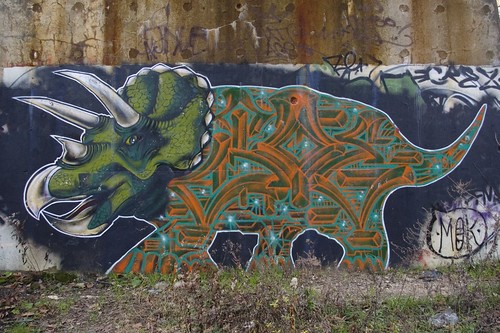
IMGP1338rd.jpg

...much less that the name was Joe. In time I figured out that it was by Japan Joe, not Jersey Joe, and I found someone who was present when Joe did it. All I knew was that, like Alice, I'd tumbled to something wonderful, something I had to investigate. Note also that I framed the piece by a quote from Sir Gawain and the Green Knight, a great medieval poem. That still seems right.

* * * * *

“Now, indeed,” said Gawain, “here is a wizardy waste,

And this an ugly oratory, still overgrown with weeds;

Well it befits that wight, warped and wraped in green,
To hold his dark devotions here in the Devil's service!
Now, sure in my five wits I fear it is the foul fiend
Who here has led me far astray, the better to destroy me.

–Sir Gawain and the Green Knight

Though ignorance is not, as the saying implies, a stop on the highway to bliss, it has its uses. In my case, all-but-ignorance of the world of graffiti and hip-hop has allowed me to explore my immediate surroundings as though I were a child discovering neat things in the woods, like the abandoned electrical substation where Steve and I found the raccoon skeleton in one corner of a room, or the strange markings on Timmy's lawn that looked like landing tracks from a flying saucer.

If I had been well-informed about the current state of graffiti I would not have regarded the images I recently blundered into as objects of wonder. I would have known what and perhaps even why they were and thought nothing more of them. Thus I would have been unable to see that I had found a shrine to the spirit of the triceratops. To me it would have just been a large and interesting painting (actually, a “piece”) in a strange location, strange because it is out-doors and thus unprotected, and hidden from public view as well. What sort of artist deliberately does good work in a place where no one will see it?

Tags, Throw-ups, and Pieces

The adventure started about a week ago [remember, I wrote this in November of 2006] when I decided to take some pictures of my neighborhood, Hamilton Park, roughly a third of mile (as measured on Google Earth) from the Holland Tunnel in downtown Jersey City. It's mostly a residential neighborhood consisting of one, two, and three-family attached housing and small apartment buildings. But there are large warehouses nearby, a small abandoned rail yard, a small office building for the Port Authority of New York and New Jersey, and various signs and remnants of more substantial industrial use not so long ago. It's a gentrifying neighborhood where homeless people push their grocery carts on streets where Mazdas and Range Rovers are parked.

While walking the streets taking pictures of this and that I noticed “tags” (see Figure 1) on signs, sidewalks, walls, fire hydrants, dumpsters and other surfaces.
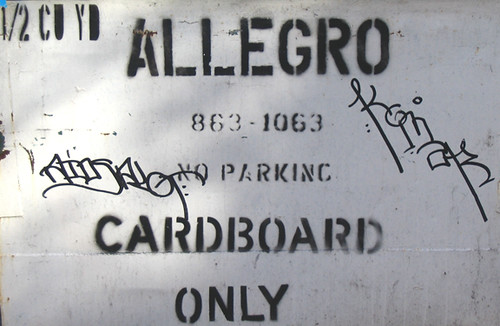
dumpster_872
Figure 1: Two tags on the dumpster behind my apartment building.
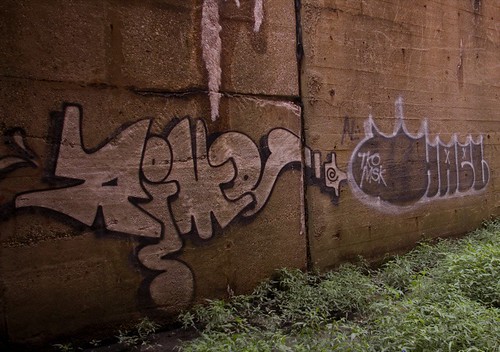
Rime Hael
Figure 2: Two “throw-ups” on the side of a building, Rime and Hael

I also saw some more elaborate graffiti of the kind known as “throw-ups” (see Figure 2) - though I didn't know the term when I started this adventure. They're generally, though not necessarily, larger than tags and have filled letters, with the outline and body in contrasting colors. They take more time to make than tags, but can still be thrown up rather quickly, necessary to avoid detection by the authorities.

I uploaded the first batch of photos into my computer and began examining and editing them in Photoshop. The more I looked at them, the more fascinated I became. I decided to roam the neighborhood looking for tags and other graffiti. I didn't know what I would find, but I had every reason to think there might be something interesting out there.

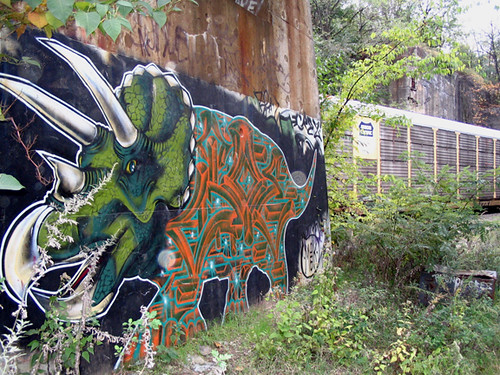
After all, this “piece” (Figure 3) - as they are called, from “masterpiece” - is on an embankment about 100 yards from my apartment building. Notice the lettering to the left and right and the strange long-nosed green creature in the center. Perhaps I would find one or two other pieces like it. I now know that such pieces are common enough, and have been so for years.
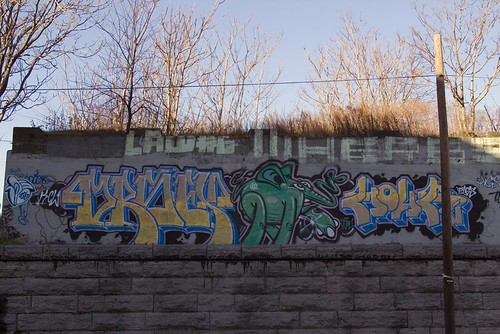
jj-elephunt.jpg
Figure 3: A piece on Jersey Avenue between 10th and 11th streets. It faces east toward the Holland Tunnel, the Hudson River, and Manhattan.

For that matter I had seen elaborately painted subway cars back in the 1970s. But I was only a visitor to New York at the time, such graffiti were not a part of my world. I had read about elaborate graffiti, about competitions between “writers” (the term of art for those who make graffiti) and their “crews,” about graffiti in the high art world of Andy Warhol, about Keith Haring and Jean-Michel Basquiat. But I did not live with the work. I only visited it.
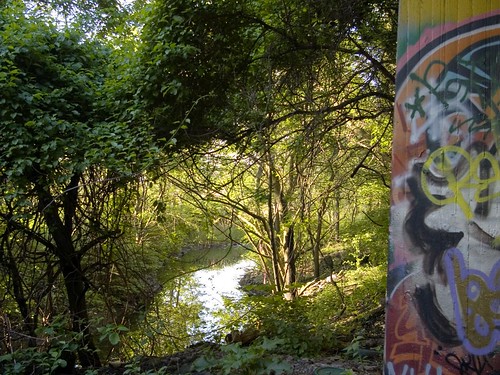
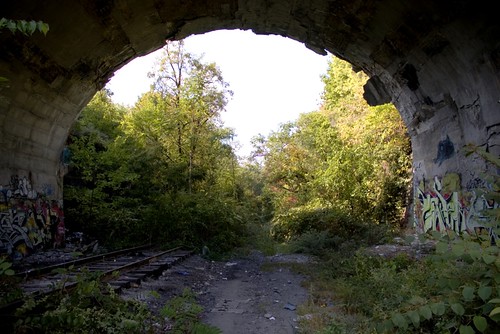
Friday, May 5, 2017

Sacred Things

From six years ago....
IMGP0005rd

… that still roaring dell, of which I told;
The roaring dell, o'erwooded, narrow, deep,
And only speckled by the mid-day sun;
Where its slim trunk the ash from rock to rock
Flings arching like a bridge;--that branchless ash,
Unsunn'd and damp, whose few poor yellow leaves
Ne'er tremble in the gale, yet tremble still,
Fann'd by the water-fall! and there my friends
Behold the dark green file of long lank weeds,
That all at once (a most fantastic sight!)
Still nod and drip beneath the dripping edge
Of the blue clay-stone.

-- Coleridge, This Lime-Tree Bower My Prison
This post began, I suppose, when, upon reading Charles Cameron’s post, Sacred space and the imagination, the “graffiti!” light went off in my brain. Not just any graffiti light, but this one:

westward ho.jpg

Well, not that exact one, but it was a photograph of that same arch, a different photograph. This one shows the graffiti a little more clearly, but it’s not the same graffiti, as graffiti often changes over time, in some places more rapidly than others.

If you look back over Cameron’s images, you’ll see that it’s of a piece with them. And I’ve got dozens of photos of that arch: different times of the day, different seasons, different years, different graffiti, different angles. And that’s not all.

Graffiti and the sacred is a natural, one that hadn’t quite hit me full-on until I’d read Cameron’s post. You see, my first post about graffiti (the images, alas, are gone) was about this piece, which I called the Shrine of the Triceratops:

dino_train_872

It’s not that I believe, mind you, that there’s a triceratops cult in Jersey City and that this is where they meet. Nothing like that. Rather, that that image seemed to embody of the spirit of the place, the Japanese word is kami. (That triceratops is now gone. First, eroded by the weather, then other writers went over it.)

I could go on and on about graffiti, but I won’t, because this post isn’t just about graffiti. But I’ll leave you with one last graffiti thought. Graffiti is often likened to cave art. Well, cave art, some of it, perhaps all of it, is sacred art. Not mere pictures, but spirits bodied forth on walls.

Monday, April 10, 2017

5Pointz Writers Sue Building Owner

It was a crushing blow to nearly two dozen established graffiti artists when in 2013 the owner of the Queens building complex known as 5Pointz ordered a surprise nighttime whitewashing of their colorful murals, leaving them with little chance to document or save the spray-painted artwork that had attracted worldwide attention.

But now they will have their chance at payback in a place that many graffiti artists try to avoid: a courtroom.

This is no vandalism case in a criminal courthouse, but rather a federal lawsuit filed in 2013 by the 23 artists who painted regularly at 5Pointz, against its owner, Jerry Wolkoff, who ordered the artwork destroyed.

The artists scored an incremental legal victory on March 31 when Judge Frederic Block of Federal District Court in Brooklyn ruled that their case could have a jury trial.
Ephemeral or not?
The judge’s ruling offers the artists a chance to confront Mr. Wolkoff in court and to seek redress for painting over their work, said Jonathan Cohen, an artist who had curated the murals and helped organize the artists at 5Pointz since 2002.

Mr. Cohen said he was hopeful that the suit might become a landmark case to establish street art as legitimate contributions worthy of protection.

Mr. Cohen, known by his artist name Meres1, said he had hoped to photograph the art on the building’s walls and to remove much of it, because many of the murals were painted on siding panels or otherwise removable and “could have filled a museum somewhere.”

In an interview, Mr. Wolkoff called the judge’s decision “mind boggling” because the art was never intended for anything but short-term display.

The 5Pointz artists followed a street graffiti tradition of creating murals knowing full well that they would soon be painted over by other artists, he added.
A legal angle:
In the suit, Mr. Baum contends that the art, created by recognized artists who had secured permission from the building owner, falls under the Visual Artists Rights Act of 1990, which has been used to protect established artists who have created public art that is of “recognized stature” on someone else’s property.

“We will make the jury aware,” he said, “that this was not graffiti, not vandalism, but rather work done with the permission of the owner, by artists of recognized stature, and protected by law.”

Monday, March 13, 2017

Journey to 3Tops: Indiana SLuGS and the Land that Time Forgot

Here's a piece from several years ago. Now that I'm involved in The Bergen Arches Project I've decided to bump it to the top of the queue. The graffiti 'landscape" has changed since then, and I've made some notations about that. "WAAGNFNP" is, of course, the We Are All Nuclear Fireball Now Party, which I've written about a bit earlier, and 3Tops is the Party's enforcer.
About two weeks ago (I'm writing this on 23 July 2007) I was checking my Flickr account to see if anyone had commented on any of my photos. I hit pay dirt. One PLASMA SLuGS (red ribbon for WAR} had made the following comment on one of my graffiti photographs: “please if u dont mind tell me where n how to get here.” Bingo!

As some of you party loyalists may know, I've been photographing local graffiti since last fall. The visage of our fine and noble 3Tops is, in fact, one of the pieces I'd found, not to mention other WAAGNFNP notables, such as Toothy. Graffiti, however, is generally illegal, and the people who do it don't leave contact information on the walls. Thus, while I now have hundreds, thousands even, of photographs of graffiti within a mile or so of my apartment, I don't know who painted them. And, since I have no roots in the area, I've got no social network through which I can track them down.

That's one of the reason I'd started posting my photos to Flickr. I figured that some of the writers (a term of art) would see them and perhaps, one day, one of them would contact me about them. SLuGS is the first.

Of course, I told him where the picture was taken - in Jersey City, about a mile in from the Holland Tunnel near the old Long Dock Tunnel. I also offered to take him on a tour of the local graffiti. He took me up on my offer and showed up that Sunday afternoon with a woman he introduced as his wife, a backpack full of spray paint, and a Canon single-lens reflex camera. I revved up Google Earth and showed them where we were, where the graffiti is, and off we went, with the intention of going into the Erie Cut.

On the way there SLuGS did a little painting, with both his wife and I snapping pictures:

laylabill07.jpg
Still there, though faded a bit.
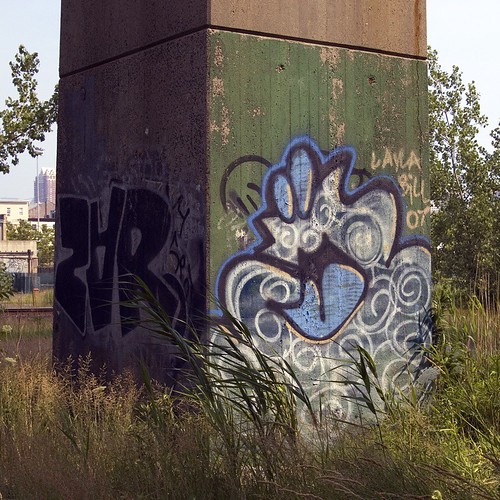
That's the SLuG, his identifying mark that he uses instead of the name that most writers use. It's painted on the base of one of the columns supporting I78 as it comes down off the Jersey Heights (or the Jersey Palisades) and feeds into the Holland Tunnel. He's done thousands of these here and there, mostly I'd guess in the New York City area, but other places as well. He's been to Amsterdam and he's made cooperative arrangements to get the PLASMA SLuG up all over.

Monday, July 13, 2015

#GVM004: The Demolition Chronicles

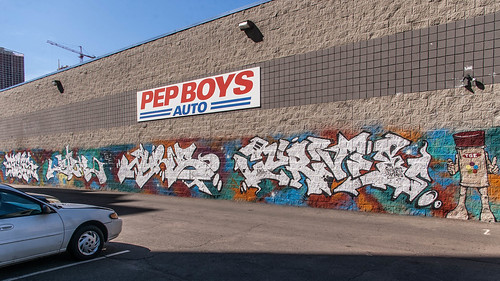
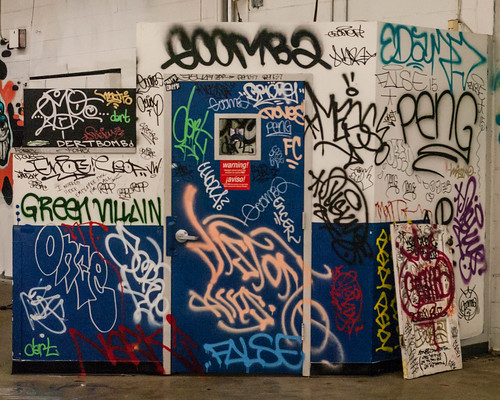
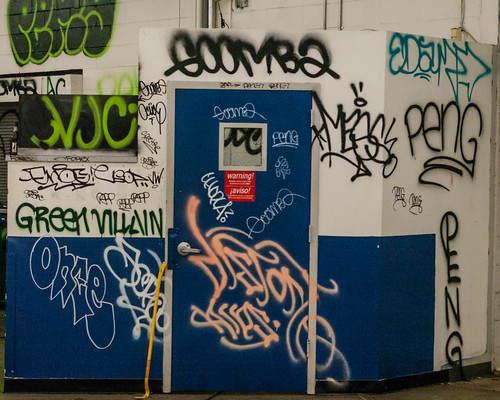
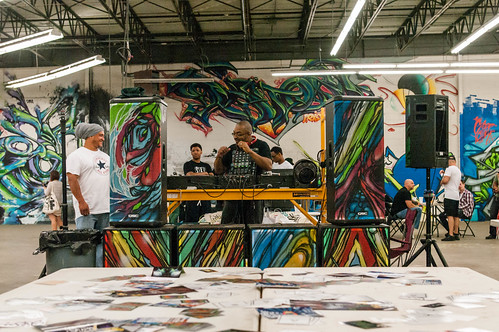
Here's another working paper, a major statement about contemporary graffiti and its (potential) role in transforming our cities. It's a collection of posts about Green Villian's Demolotion Exhibition at the now empty and about to be demolished Pep Boys store in the Newport are of Jersey City, NJ. URL's, abstract, contents, and introduction below:
Abstract: This document describes a major graffiti exhibition involving 100 artists producing 28,000 square feet of graffiti on the interior and exterior walls of a Pep Boys store in Jersey City. The building has been sold to developers, who will demolish it in mid-summer 2015. Topics include: history of the project, stylistic and thematic analysis of the art, and social context of the exhibition.

C O N T E N T S

Introduction: GVM004 Rises, Falls, Resonates – 2
OK to Destroy: Jersey City’s Graffiti Jam of April 2015 – 13
SP One, What’s he thinking?–  24
Graffiti: From Art Crimes to Family Day – 26
Green Villain Karma: Urban Buddhism in Jersey City – 29
Good Grief! War Boys in the Promised Land – 31
Study in Pink and Silver: Why Not Call It an Installation? – 35
Demolition Exhibition @ #GVM004: Graffiti at the Transition from Industrial to Informatic Culture – 38
Some Styles at the Demolition Exhibition – 40
Sacred Animal Beyond Category: Super-Dope in Layers – 46
Even Heather Mac Donald’s Welcome to Tag-Up at the Demolition Exhibition – 48
Appendix 1: Time Line – 60
Appendix 2: Is it Art? – 60
Appendix 3: Graffing the Future: Is the next phase of human cultural evolution being inscribed on walls by graffiti writers and street artists? – 62
Appendix 4: Sharks in Formaldehyde: New York’s Met and the People Who Made It – 65

Introduction: GVM004 Rises, Falls, Resonates

20150704-_IGP4769

Let’s begin at the beginning. I am a thinker, writer, musician, and photographer. For the past few years I’ve been functioning as senior advisor to Green Villain, LLC. I have no business card with such a title on it and likely never will. Nor, for that matter, does Green Villain have an org chart, official or unofficial. Not yet. Green Villain is the business of Greg Edgell and assorted associates, as the project requires. Greg is an event producer, DJ, has a record label, and wrangles graffiti writers and street artists on projects large and small.

The Demolition Exhibition has been our largest project so far. This paper is preliminary and partial documentation of it. The bulk of it consists of blog posts that I wrote while the project was unfolding. This introduction is new.
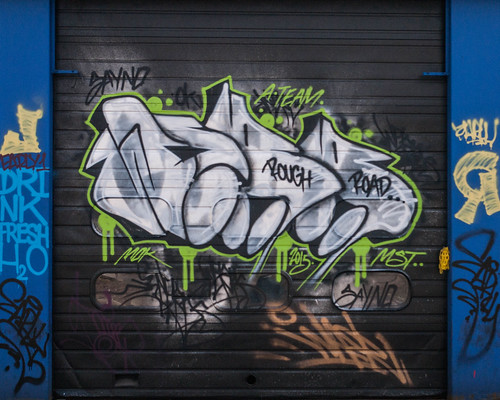
First I run through the history of the project. Then list media coverage, Green Villain’s online documentation, say a word about each of the posts in the rest of the document, list the artists involved, and conclude with a note about the title.

How It Happened

The demolition exhibition just happened. No, it didn’t grow up out of the ground all by itself, but it didn’t arise through the execution of a specific plan of action – at least no plan more specific than “use graffiti for the public good”. Rather, each step of the way we just took advantage of opportunities that appeared before us, with Greg (aka Green Villain) doing the heavy lifting and me providing advice and encouragement at every step.

On the public good, several years ago I’d written a report, Jersey City: From a Skatepark to the World, and shown it to a number of people, including Greg. More immediately, last Spring (2014) Greg decided to install murals wherever he could wrangle walls in Jersey City, New York City, and elsewhere. He’d drive around looking for likely walls and, when he spotted one, he’d find out who owned the property. Then he’d cut deals. The Pep Boys in the Newport area of Jersey City was the 4th deal he landed, hence the designation “GVM004”–Green Villain Mural number 4.

That store’s rear wall, which faces the Hudson-Bergen Light Rail, has three layers of graffiti on it.. Starting in mid-August, Jurne, Curve, Twigs, and Esteam of the TGE crew laid down the first layer:

20140923-IMGP0716

At the beginning of October Loser, Distort, Acro and Ntel of the AIDS – Alone in Deep Space – crew went to work on the second layer:

Thursday, July 2, 2015

Sacred Animal Beyond Category: Super-Dope in Layers [#GVM004]

20150702-_IGP4457

Three layers: 1) The Animal is the top layer and is outlined in black (the artist, Fathima [& Instagram], is from Dubai). It's painted on 2) the wall of a small semi-enclosed office (look at the way the wall meets the floor). The surface of that wall is the middle layer. Everything else is the 3) bottom layer: the floor and the wall behind the office wall.

I took that photo today: July 3, 2015. Here's how that wall looked on June 5, 2015:

20150605-_IGP3950

May 27, 2015:

20150527-_IGP3910

Sunday, June 7, 2015

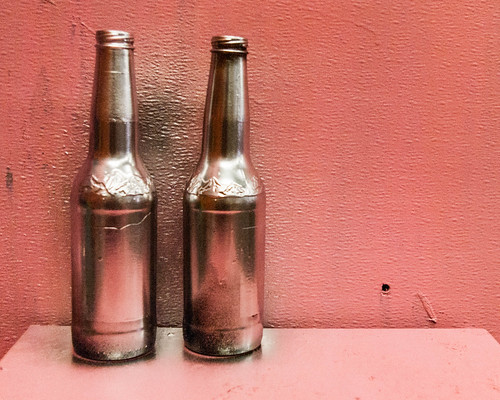
Study in Pink and Silver: Why Not Call It an Installation? [#GVM004]

What, pray tell, is this?

20150605-_IGP3982

It’s two bottles on a shelf or something.

Well, yeah, that’s obvious. But what kind of bottles...

look like beer bottles, maybe

but beer bottles aren’t silver

neither are they. that’s paint

not applied very carefully either, looks like it was sprayed

and the spray caught the wall too.

Saturday, June 6, 2015

Good Grief! War Boys in the Promised Land [#GVM004]

One could, of course, dismiss it because it’s comic strip imagery, and therefore Not Serious. One could also dismiss it as graffiti, and therefore Not Serious.

But I can’t do that, not while I’m being a Martian Anthropologist. In that role I have no choice but to take what the natives do as being quite serious. That is, serious in the sense that it indicates what’s going on in their society.

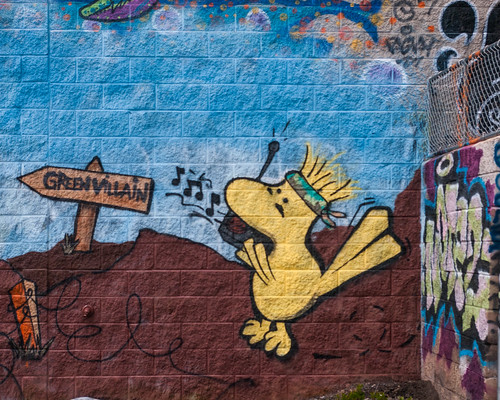
Here’s Woodstock, a character from the comic strip, Peanuts, which is surely smack dab in the center of post-war (WWII) American culture and which has shown up in graffiti culture since the mid-1970s–that is to say, from the beginning:

20150605-_IGP3920

The headband establishes Woodstock’s hippie cred and the music-blaring transistor radio dates him.

The “Greenvillain” sign is a shout-out to Greg Edgell, who runs Green Villain, the production company that’s organizing the graffiti on the soon-to-be-demolished Pep Boys building in the Newport area of Jersey City. This is painted on the southwest corner of the building.

But why the brown? Is it supposed to represent bare dirt? What about the black loops? Since I’ve seen the whole mural I’ll tell you what it is, it’s barbed wire. Woodstock is strolling around on a battlefield. Vietnam perhaps? After all, the war there was going hot and heavy when the flower children gathered in the mud at Woodstock, New York, and listened to Jimi Hendrix transform “The Star-Spangled Banner” into a war protest anthem.

Thursday, May 7, 2015

Green Villain Karma: Urban Buddhism in Jersey City #GVM004

The painting continues on the Pep Boys site, as you can see in these flicks, taken 5 May 2015. Notice the incomplete Goomba head (upper left):

20150505-_IGP3363

And the front façade is almost completely redone:

20150505-_IGP3383

But that’s not what’s on my mind. What’s on my mind is impermanence, one of the eternal themes of philosophy. Tibetan Buddhists celebrate this theme with sand mandalas. Here’s a short Wikipedia paragraph:
The Sand Mandala … is a Tibetan Buddhist tradition involving the creation and destruction of mandalas made from colored sand. A sand mandala is ritualistically dismantled once it has been completed and its accompanying ceremonies and viewing are finished to symbolize the Buddhist doctrinal belief in the transitory nature of material life.

Monday, May 4, 2015

JC Pep Boys Graffiti Jam 2015: Lingering Commentary #GVM004 [@3QD]

I’ve got another post at 3 Quarks Daily: OK to Destroy: Jersey City’s Graffiti Jam of April 2015.

The building will be coming down not too long from now. Meanwhile there’s commentary and touch-up going on. Look at this photo, taken on the day of the jam, April 25:

20150425-_IGP3239

If you look closely just below the center you’ll see the outline of a door which has the “Y” of Yoder’s piece looping across it.
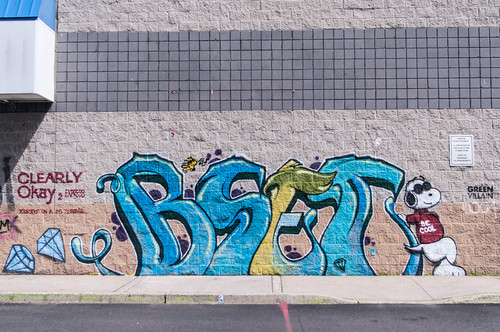
This is a photo of that door taken a couple of days later, on April 28:

20150428-_IGP3274

There’s a bunch of tags on the door. Now look at this photo, taken April 30:

20150430-_IGP3309

The repair is far from perfect. The point simply is that it’s there, and it’s there even though everyone knows the building will be coming down in the very near future.
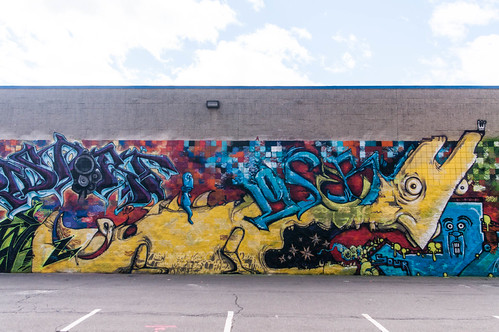
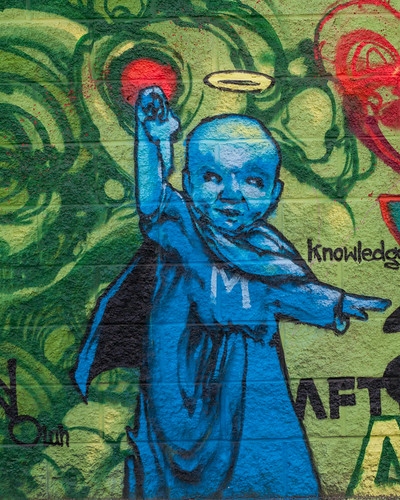
Thursday, April 30, 2015

"OK to Destroy" #GVM004

20150430-_IGP3294

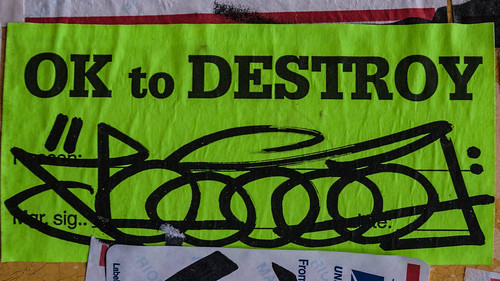
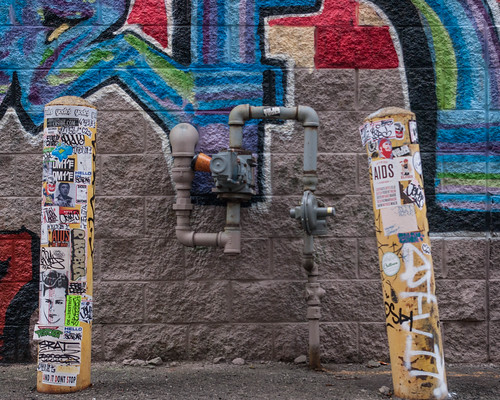
Been thinking about what to call the Green Villain First Annual Jersey City Invitational Graffiti Jam besides the GVFAJCIGJ. "OK to Destroy" seems metaphysically appropriate. The name comes from one of the stickers on a pipe at the rear of the building. There's two of them and they're there to protect a meter. You can see the sticker at the lower left:

20150430-_IGP3292

You might that "OK to Destroy" is a bit nihilistic. You might think that, but I urge you to reconsider. Compare it with, say, "Rage to Destroy". Very different, no? No, I think it's just right.

Tuesday, April 28, 2015

SP One, What’s he thinking? #GVM004

Look at this flick, taken at 1:17 PM, Saturday 25 April 2015, at the Pep Boys Memorial Graffiti Jam in Jersey City:

20150425-_IGP3139

SP One’s working on a piece, standing in front of a letter form at the left. But what’s immediately to the left of that letter form?

Now look at this shot, taken at 1:48 PM:

20150425-_IGP3160

No one’s standing in front of it, so we can see it clearly. Knowing this is by SP One it’s easy to see that letter form at the left as a combination of “S” and “P”. The “One” to the right is obvious enough. Given the way I framed the shot we can’t see much at the far left, but what’s there seems to be pretty much what was there in the previous shot.

Now look at this shot, which I took much later in the day (early evening, 6:49 PM, hence the different light):

20150425-_IGP3210

There’s a very obvious “S” over there at the left, on top of what appeared to be just background in the previous two shots. Was it part of the original design, of did it insert itself in process?

Sunday, April 26, 2015

The basics of graffiti culture #GVM004

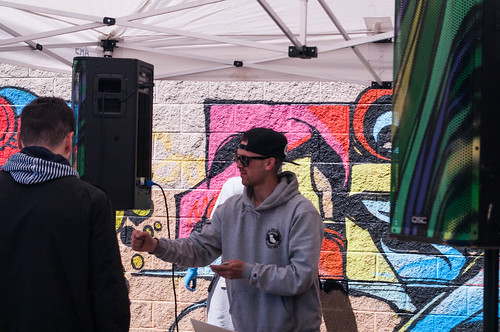
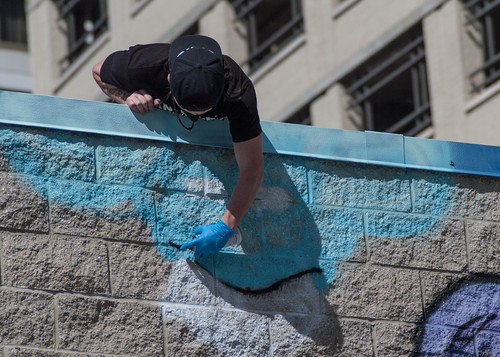
These photos were taken on Saturday, 25 April, 2015, at the Green Villain Pep Boys Invitational Greffiti Jam and Building Farewall.

The Writer

20150425-_IGP3198

The Photographer

20150425-_IGP3183

The Image

20150425-_IGP3211

Friday, April 24, 2015

Friday Fotos: Pep Boys, Newport, Jersey City: #GVM004

The Pep Boys in Newport in Jersey City has closed and the building's been sold. Next month it will be demolished to make way for new construction. My amigo, the Green Villain, has secured permission to paint the whole thing before it goes. That's happening tomorrow. Earlier today I went by to get a few shots before the fun begins. Well, actually, it's already begun. But tomorrow it's party time.

20150424-_IGP3117

20150424-_IGP3118

20150424-_IGP3116

20150424-_IGP3103

20150424-_IGP3123

20150424-_IGP3092

Tuesday, December 9, 2014

It’s Complicated 2: Graffiti and Public Space

20141207-_IGP1027

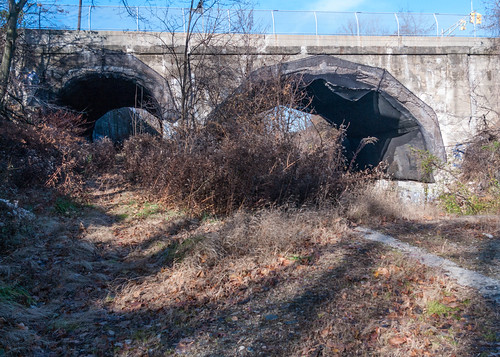
You are looking at two of the handful of arches known in Jersey City collectively as the Bergen Arches. In my experience, while many people have heard of “the Arches”, few people have a clear idea of what and where they are and even fewer have been there, though many pass beside them as they drive on Rt. 139. The arch to the left is over the remaining roadbed of a trolley line, which is where we’re standing. The one on the right goes over the Erie Cut, a man-made geological formation geographical feature that used to accommodate four railroad tracks. Three of them have been ripped out; the  fourth is broken and busted. The Erie Cut is almost a mile long and goes under four or five more arches, though three of them are better characterized as short tunnels.

Unless otherwise indicated, all the photographs in this post are of the Bergen Arches and were taken on December 7, 2014.

I’ve written about the Arches before, extensively. I’m going through the exercise again because, 1) they fascinate me, and 2) I want to discuss them in the terms that danah boyd has established for teen cyberspace hangouts in It’s Complicated: The Social Lives of Networked Teens (Yale UP 2014).

There are major differences, of course. The Bergen Arches is a real location in physical space whereas the spaces boyd has investigated are virtual. Functionally, network spaces exist online; physically, though, the servers that support them have real locations around the globe. However, copies of my photographs of the Arches exist on my Flickr page and so can be accessed by anyone who has Internet access to Flickr. And I am by no means the only one who photographs the graffiti down there. Just how many of us do that, I don’t know. I’d say 10s to 100s.

20141207-_IGP1030

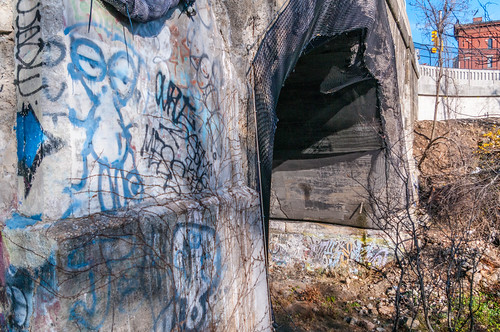
We’re standing right in front of the upper arch, looking down at the lower arch. Notice the somewhat scuffed and faded graffiti at the base of the arch. I’ve got photos of that wall going back to 2007 and those show four or five paint layers below the one currently visible. The strange big-eyed character at the left, however, is unchanged, perhaps because the location is not particularly desirable; it’s small and peripheral. I’ve got photos of that character in at least two other locations. The dark black lettering in the middle, however, is relatively new. You can make out the letters “MESS.” MESS or MES writes with the PFE crew. He gets up all over the place, though I’ve only got photos from three other locations that I can think of off hand. Finally, notice the black netting in the lower arch. That was installed a year or two ago to catch the crumbling masonry.

One of the themes boyd develops is that of privacy in public. The Internet functions as a public utility and most of the places teens hang out are public spaces; anyone can go there. Some have privacy settings, like Facebook, but using them is somewhere between tricky and a pain in the ass, so most teens simply ignore them. The fact that they don’t mess with those privacy settings doesn’t mean that they’re addressing their remarks to the public large. They’re not; they’re only addressing their friends. And, for the most part, the public at large could care less about what they say – the various snooping agencies and advertisers are not the public at large, nor is it obvious that they have any very clear idea of what they’re doing; they just do a lot of it.

However, steps are taken (p. 65):
Children love to experiment with encoding messages. From pig latin to invisible ink pens, children explore hidden messages when they’re imagining themselves as spies and messengers. As children grow up, they look for more sophisticated means of passing messages that elude the watchful eyes of adults. In watching teens navigate networked publics, I became enamored of how they were regularly encoding hidden meaning in publicly available messages. They were engaged in a practice that Alice Marwick and I called “social steganography,” or hiding messages in plain sight by leveraging shared knowledge and cues embedded in particular social contexts.
front row seat in the Theater of the New Reality.jpg

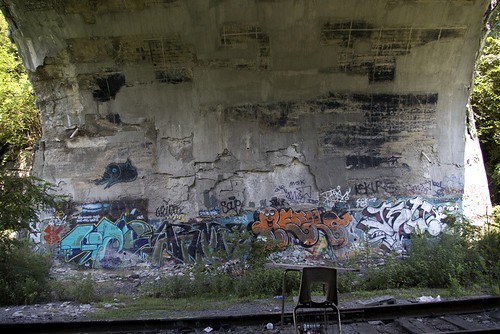
That photo dates from July 6 of 2007 and is the oldest photo I have of that wall, which is the wall whose lower edge we saw in the previous photo. There’s a lot of stuff on that wall, and things seem to have been piled atop one another chaotically. There is, however, an informal ethics to that. Unless the existing imagery has been badly degraded by the weather, or by “toys” (novice writers who have more chutzpah than skill), you have to do something better than what you’re going over.