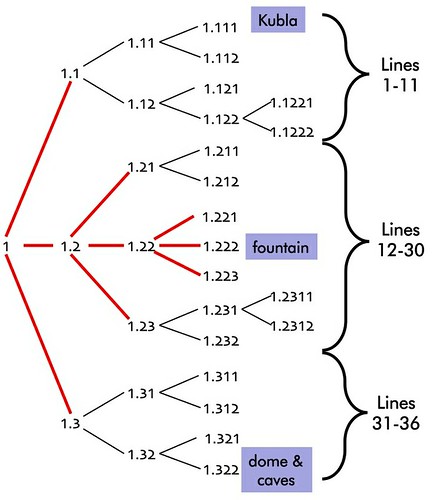
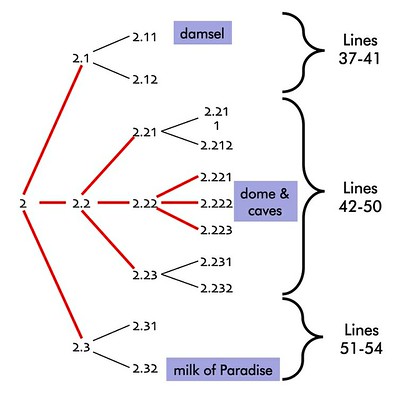
For me, those questions began when I was faced with the structure of “Kubla Khan”:
That’s just the first 36 lines, but the last 18 look the same:
That looked like the trace of some nested loops. If so, what then?
Let’s put that aside. After all, I’ve been working on that for a LONG time and still haven’t figure it out.
The problem I’m trying to figure out is this: How do we draw a principled line between those brain processes that are computational and those that are not?
Some (most, all?) computer scientists ‘seem to define a computer as “a physical mechanism that can theoretically calculate any computable function”.’ If I go with that notion, then it’s all computation and I have no reason to single out those tree structures in “Kubla Khan” for special attention, or any other linguistic tree structures for that matter. That’s not very helpful.
What if I think of the brain as a structured physical system? When Saty Chary advanced his Structured Physical System Hypothesis (SPSH) he was explicitly playing against the Physical System Hypothesis Hypothesis (PSSH) of Newell and Simon (1976). They advanced the PSSH as the central tenet of cognitive science and AI, and it echoes back to the 1943 paper in which McCulloch and Pitts argued that basic neuronal circuits are logic gates. It turns out that, no, they’re not. They’re quite a bit more complicated.
I like the SPSH. The question for me, then, is: Are their processes taking place in the brain that are NOT dominated by the internal physical activity of the nervous system? I should think so. The process of perception involves interaction with the external world, which necessarily implies that there are things happening in the brain that a driven, though not completely determined by, external physical circumstances. That, I believe, puts us in the world of William Powers, Behavior: The Control of Perception (1973). Language is among those circumstances; for humans it is one of the most important.
That, I think, will allow me to answer my question, though a proper answer will require more construction than I’m willing to undertake here. The relationship between the physical signifier and the signified is arbitrary. In particular, it is arbitrary with respect to the physical processes involved in both. It’s that arbitrary connection implies that language processes are not dominated by the internal physical dynamics of the brain. The basic language process is that of indexing, as Hays and I called it in Principles and Structure of Natural Intelligence. Newell and Simon called it designation.
Now, how can I formulate this idea so that it applies to large language models (in a useful way)? It seems to me that processes in LLMs are dominated by the statistics of the corpus that is modeled. That’s the nub of truth that’s captured by the otherwise reductive phrases, “stochastic parrots,” and “autocomplete on steroids.” The ideas that we require systems that both have access to the external world and that have robust symbolic capabilities, to a first approximation, those amount to freeing the system from being dominated by the statistics of some training corpus. Think about that, carefully.
Kotseruba, I., Tsotsos, J.K. 40 years of cognitive architectures: core cognitive abilities and practical applications. Artif Intell Rev 53, 17–94 (2020). https://doi.org/10.1007/s10462-018-9646-y
Abstract: In this paper we present a broad overview of the last 40 years of research on cognitive architectures. To date, the number of existing architectures has reached several hundred, but most of the existing surveys do not reflect this growth and instead focus on a handful of well-established architectures. In this survey we aim to provide a more inclusive and high-level overview of the research on cognitive architectures. Our final set of 84 architectures includes 49 that are still actively developed, and borrow from a diverse set of disciplines, spanning areas from psychoanalysis to neuroscience. To keep the length of this paper within reasonable limits we discuss only the core cognitive abilities, such as perception, attention mechanisms, action selection, memory, learning, reasoning and metareasoning. In order to assess the breadth of practical applications of cognitive architectures we present information on over 900 practical projects implemented using the cognitive architectures in our list. We use various visualization techniques to highlight the overall trends in the development of the field. In addition to summarizing the current state-of-the-art in the cognitive architecture research, this survey describes a variety of methods and ideas that have been tried and their relative success in modeling human cognitive abilities, as well as which aspects of cognitive behavior need more research with respect to their mechanistic counterparts and thus can further inform how cognitive science might progress.
Laird, J. E., Lebiere, C., & Rosenbloom, P. S. (2017). A Standard Model of the Mind: Toward a Common Computational Framework across Artificial Intelligence, Cognitive Science, Neuroscience, and Robotics. AI Magazine, 38(4), 13-26. https://doi.org/10.1609/aimag.v38i4.2744
A standard model captures a community consensus over a coherent region of science, serving as a cumulative reference point for the field that can provide guidance for both research and applications, while also focusing efforts to extend or revise it. Here we propose developing such a model for humanlike minds, computational entities whose structures and processes are substantially similar to those found in human cognition. Our hypothesis is that cognitive architectures provide the appropriate computational abstraction for defining a standard model, although the standard model is not itself such an architecture. The proposed standard model began as an initial consensus at the 2013 AAAI Fall Symposium on Integrated Cognition, but is extended here through a synthesis across three existing cognitive architectures: ACT-R, Sigma, and Soar. The resulting standard model spans key aspects of structure and processing, memory and content, learning, and perception and motor, and highlights loci of architectural agreement as well as disagreement with the consensus while identifying potential areas of remaining incompleteness. The hope is that this work will provide an important step toward engaging the broader community in further development of the standard model of the mind.
This Common Model of Cognition divides humanlike thought into multiple modules, with a short-term memory module at the center of the model. The other modules – perception, action, skills and knowledge – interact through it.
Learning, rather than occurring intentionally, happens automatically as a side effect of processing. In other words, you don’t decide what is stored in long-term memory. Instead, the architecture determines what is learned based on whatever you do think about. This can yield learning of new facts you are exposed to or new skills that you attempt. It can also yield refinements to existing facts and skills.
The modules themselves operate in parallel; for example, allowing you to remember something while listening and looking around your environment. Each module’s computations are massively parallel, meaning many small computational steps happening at the same time. For example, in retrieving a relevant fact from a vast trove of prior experiences, the long-term memory module can determine the relevance of all known facts simultaneously, in a single step.
It’s that middle paragraph that caught my attention. Why? Because it is and isn’t true. Sure, a lot of learning is a side effect, as they say. Speaking is perhaps the classic example. But it is also the case that we do devote enormous effort to deliberate learning. That’s what happens in school. Just why they gloss over it is a mystery. However...
Automatic vs. deliberate learning
This speaks to the issues I raised in my recent post, Physical constraints on computing, process and memory, Part 1 [LeCun], where I was concerned with the distinction that Jerry Fodor and Zenon Pylyshyn made between “classical” theories of cognition where there is an explicit distinction between memory and program and connectionist accounts where memory and program are interwoven in one structure. Classical systems can easily acquire new knowledge by adding more memory; the structure of the program is unaffected. Connectionist systems are not like that.
To a first approximation the human nervous system seems to be a connectionist system. Each neuron seems to be both an active unit and a memory unit. There is no obvious division between a central processor, where all the programming resides, and a passive memory store. And yet, we learn, all the time we learn. How is that possible?
In that post I cited research by Walter Freeman on the sense of smell. It seems that when a new odorant is learned, the entire ‘landscape’ of odorant memory is changed. That is, not only is a new item added to the landscape, but the response patterns of existing items are change. That’s what we would expect in a connectionist model. Just how the brain does this is obscure, though I offered an off-the-cuff speculation.
Anyhow, let’s say that what Freeman was observing was the automatic memory that happens in the course of ordinary processing. Let us say that automatic memory is consonant with those ordinary processes. Deliberate memory is necessary to learn things that a dissonant with those processes. Let’s leave those two terms, consonant and dissonant, undefined beyond their contrastive use. We – me or someone else – can worry about a more thorough characterization later.
Deliberate learning: arithmetic, the method of loci
As an example of deliberate learning, consider arithmetic. It begins with learning the meaning of number names by enumerating collections of objects and then by learning the tables for addition, subtraction, multiplication, and division. This process requires considerable drill. Let’s hypothesize that that is necessary to overcome the inertia, the viscosity – to use a term I introduced in that earlier post – of the automatic process.
As a result of this drill, a foundation is laid on which one can then learn how to do more complex calculations. Considerable drill is required to become fluent in that process. But we’ve got three kinds of drill going on.
1. Meaning of number words: this is an episodic procedure that establishes the meaning of a small number of words. To determine whether any of the words applies to a collection of object, execute the procedure.
2. Learning arithmetic table: this is straight memorization of system items, each having the form: numeral, operation, numeral, equals, numeral.
3. Learning multiple-digit calculation: this is an episodic level set of procedures in which one calls up the items in the arithmetic tables and applies them in succession to pairs and n-tuples of multiple digit numbers.
The episodic procedures, 1 and 3, are dissonant with respect to ordinary episodic processes, such as moving about the physical world, while the system procedures, 2, are dissonant with respect to the ordinary processes of learning the meanings of words.
As another example, consider the method of loci, sometimes known as the memory palace. Here’s the account I gave in my working paper on Visual Thinking:
The locus classicus for any discussion of visual thinking is the method of loci, a technique for aiding memory invented by Greek rhetoricians and which, over a course of centuries, served as the starting point for a great deal of speculation and practical elaboration — an intellectual tradition which has been admirably examined by Frances Yates. The idea is simple. Choose some fairly elaborate building, a temple was usually suggested, and walk through it several times along a set path, memorizing what you see at various fixed points on the path. These points are the loci which are the key to the method. Once you have this path firmly in mind so that you can call it up at will, you are ready to use it as a memory aid. If, for example, you want to deliver a speech from memory, you conduct an imaginary walk through your temple. At the first locus you create a vivid image which is related to the first point in your speech and then you “store” that image at the locus. You repeat the process for each successive point in the speech until all of the points have been stored away in the loci on the path through the temple. Then, when you give your speech you simply start off on the imaginary path, retrieving your ideas from each locus in turn. The technique could also be used for memorizing a speech word-for-word. In this case, instead of storing ideas at loci, one stored individual words.
The process starts with choosing a suitable building and memorizing it. That’s deliberate learning. Think of it as analogous to the three kinds of drill involved in learning arithmetic calculation.
Actually using the memorized building for a specific task, that is deliberate learning as well. Here the deliberation is confined to associating items to be learning with positions in the palace. One learning a collection of system links. The idea that one is to use vivid images no doubt reflects the inherent nature of the nervous systems, it is an exhortation to consonance.
I have argued I don’t know how many times that language is the simplest human activity than must be considered computational (e.g. in this comment on Yann LeCun’s latest proposal). That necessarily implies that, fundamentally, the brain is something else, but what?
What’s a computer?
Let’s step back a bit and consider an argument by John Searle. It may seem a bit strange, but bear with me.
In 1950, Alan Turing published an article in which he set out the Turing Test.1 The purpose of the test was to establish whether a computer had genuine intelligence: if an expert cannot distinguish between human intelligent performance and computer performance, then the computer has genuine human intelligence. It is important to note that Turing called his article “Computing Machinery and Intelligence.” In those days “computer” meant a person who computes. A computer was like a runner or a singer, someone who does the activity in question. The machines were not called “computers” but “computing machinery.”
The invention of machines that can do what human computers did has led to a change in the vocabulary. Most of us now think of “computer” as naming a type of machinery and not as a type of person. But it is important to see that in the literal, real, observer-independent sense in which humans compute, mechanical computers do not compute. They go through a set of transitions in electronic states that we can interpret computationally. The transitions in those electronic states are absolute or observer independent, but the computation is observer relative. The transitions in physical states are just electrical sequences unless some conscious agent can give them a computational interpretation.
This is an important point for understanding the significance of the computer revolution. When I, a human computer, add 2 + 2 to get 4, that computation is observer independent, intrinsic, original, and real. When my pocket calculator, a mechanical computer, does the same computation, the computation is observer relative, derivative, and dependent on human interpretation. There is no psychological reality at all to what is happening in the pocket calculator. [1]
He goes on in this vein for a bit and then arrives at this statement: “First, a digital computer is a syntactical machine. It manipulates symbols and does nothing else.” If you are familiar with his famous Chinese Room argument then you’ve heard this before. After a brief precis of that argument, which is of no particular interest here, Searle arrives at the point that interests me:
Except for the cases of computations carried out by conscious human beings, computation, as defined by Alan Turing and as implemented in actual pieces of machinery, is observer relative.The brute physical state transitions in a piece of electronic machinery are only computations relative to some actual or possible consciousness that can interpret the processes computationally. It is an epistemically objective fact that I am writing this in a Word program, but a Word program, though implemented electronically, is not an electrical phenomenon; it exists only relative to an observer.
Of course, he’s already said this before, but I repeat it because it’s a strange way of talking – at least I found it strange when I first read it – and so a bit of repetition is worthwhile.
Physically, a computer is just an extremely complex pile of electronic machinery. But we have designed it in such a way that the state transitions in its circuitry perform operations that we find useful. Most generally, we think of them as computation. The machinery is a computer because it has been designed to be one.
Is the brain a computer?
With Searle’s argument in mind we can now ask: Is the human brain, or any brain, a computer? Physically it is certainly very different from any electronic computer, but it does seem to be a complex meshwork that transmits many electrochemical signals in complex patterns. Are those signals performing calculations? Given Searle’s argument the answer to that question would seem to depend on just what the brain was designed to do. But, alas, that brain wasn’t designed in any ordinary sense of the word, though evolutionary biologists do sometimes talk about evolution as a process of design. But if so, it is design without an designer.
Given this, does it make sense for us to say that the brain IS a computer. I emphasize the “is” because, of course, we can simulate brains and parts of brains, but a simulation is one thing, and the thing being simulated is quite something else. The simulation of an atomic explosion is not the same as a real atomic explosion. Or, to switch terms, as Searle remarks, “Even with a perfect computer emulation of the stomach, you cannot then stuff a pizza into the computer and expect the computer to digest it.”
So, I’m not talking about whether or not we can produce a computer simulation of the brain. Of course we can. I’m talking about the brain itself. Is it a computer? Consider this passage:
This brings us to the question: what are the type of problems where generating a simulation is a more viable strategy than performing a detailed computation? And if so, what are the kind of simulators that might be relevant for consciousness? The answer to the first question has to do with the difference of say computing an explicit solution of a differential equation in order to determine the trajectory of a system in phase space versus mechanistically mimicking the given vector field of the equation within which an entity denoting the system is simply allowed to evolve thereby reconstructing its trajectory in phase space. The former involves explicit computational operations, whereas the latter simply mimics the dynamics of the system being simulated on a customized hardware. For complex problems involving a large number of variables and/or model uncertainly, the cost of inference by computation may scale very fast, whereas simulations generating outcomes of models or counterfactual models may be far more efficient. In fact, in control theory, the method of eigenvalue assignment is used precisely to implement the dynamics of a given system on a standardized hardware. [...] if the brain is indeed tasked with estimating the dynamics of a complex world filled with uncertainties, including hidden psychological states of other agents (for a game-theoretic discussion on this see [1–4,9]), then in order to act and achieve its goals, relying on pure computational inference would arguably be extremely costly and slow, whereas implementing simulations of world models as described above, on its cellular and molecular hardware would be a more viable alternative. These simulation engines are customized during the process of learning and development to acquire models of the world.[2]
That suggests that, no, the brain is not a computer, not if by that you mean that it is performing explicit numerical calculations. It isn’t performing calculations at all. It’s just passing signals between neurons, thousands and thousands of them each second. What those signals are doing, what they are achieving, depends on how the whole shebang is connected to the world in which the brain operates.
Consider experiments on mental rotation [3]. A subject is presented with a pair of 2-D or 3-D images. In some cases the images depict the same object, but from different points of view; it other cases the images depict two different objects. The subject is asked whether or not the images depict the same object. To perform the task the subject has to mentally rotate one of the images until it matches the other. But a match will be achieved only if the images depict the same object. If no match can be achieved then the subject is looking at two different objects.
What researchers found is that the length of time required to reach a decision was proportional to the angle between the two views. The larger the angle, the longer it takes to make a decision. If the process were numerical there’s no reason to believe that the computation time would be proportional to the size of the angle being computed. That strongly suggests that the process is analog, not numerical. If the brain IS a computer, it’s not a digital computer.
For various reasons – those experiments are only one of them – I have long been of the view that, at least at the sensorimotor level, the brain constructs quasi-analog models of the world and uses them in tracking the sensory field and in generating motor actions for operating in the world. These models are also called on in much of what is called common-sense knowledge, which proved to be very problematic for symbolic computation back in the world of GOFAI models in AI from the beginning up into the 1980s and which is proving somewhat problematic for current LLMs. In any given situation one simply calls up the necessary simulations and then generates whatever verbal commentary seems necessary or useful. GOFAI investigators were faced with the task of hand-coding a seemingly endless collection of propositions about common sense matters while LLMs are limited by the fact that they only have access to text, not the underlying simulations on which the text is based.
I arrived at this view partially on the basis of an elegant book from 1973, Behavior: The Control of Perception, by the late William Powers. As the title indicates, he developed a model of human behavior from classical control theory.
[2] Arsiwalla, X.D., Signorelli, C.M., Puigbo, JY., Freire, I.T., Verschure, P.F.M.J. Are Brains Computers, Emulators or Simulators? In V. Vouloutsi et al. (Eds.)
Living Machines 2018. Lecture Notes in Computer Science, vol 10928. Springer, https://doi.org/10.1007/978-3-319-95972-6_3.
This post is a response to a long video posted by Dr. Tim Scarfe which raised a number of important issues. One of them is about physical constraints in the implementation of computing procedures and memory. I’m thinking this may well be THE fundamental issue in computing, and hence in human psychology and AI.
I note in passing that John von Neumann’s The Computer and the Brain (1958) was about the same issue and discussed two implementation strategies, analog and digital. He also suggested that the brain perhaps employed both. He also noted that, unlike digital computers, where you have and active computational unit linked to passive memory through fetch-execute cycles, that each unit of the brain, i.e. neuron, appears to be an active unit.
Physical constraints on computing
Here’s the video I was talking about. It is from the series Machine Learning Street Talk, #78 - Prof. NOAM CHOMSKY (Special Edition), and is hosted by Dr. Tim Scarfe along with Dr. Keith Duggar and Dr. Walid Saba.
As I’m sure you know, Chomsky has nothing good to say about machine learning. Scarfe is not so dismissive, but he does seem to be a hard-core symbolist. I’m interested in a specific bit of the conversation, starting about about 2:17:14. One of Scarfe’s colleagues, Dr. Keith Duggar, mentions a 1988 paper by Fodor and Pylyshyn, Connectionism and Cognitive Architecture: A Critical Analysis (PDF). I looked it up and found this paragraph (pp. 22-23):
Classical theories are able to accommodate these sorts of considerations because they assume architectures in which there is a functional distinction between memory and program. In a system such as a Turing machine, where the length of the tape is not fixed in advance, changes in the amount of available memory can be affected without changing the computational structure of the machine; viz by making more tape available. By contrast, in a finite state automaton or a Connectionist machine, adding to the memory (e.g. by adding units to a network) alters the connectivity relations among nodes and thus does affect the machine’s computational structure. Connectionist cognitive architectures cannot, by their very nature, support an expandable memory, so they cannot support productive cognitive capacities. The long and short is that if productivity arguments are sound, then they show that the architecture of the mind can’t be Connectionist. Connectionists have, by and large, acknowledged this; so they are forced to reject productivity arguments.
That’s what they were talking about. Duggar and Scarfe agree that this is a deep and fundamental issue. A certain kind of very useful abstraction seems to depend on separating the computational procedure from the memory on which it depends. Scarfe (2:18:40): “LeCun would say, well if you have to handcraft the abstractions then learning's gone out the window.” Duggar: “Once you take the algorithm and abstract it from memory, that's when you run into all these training problems.”
OK, fine.
But, as they are talking about a fundamental issue in physical implementation, it must apply to the nervous system as well. Fodor and Pylyshyn are talking about the nervous system too, but they don’t really address the problem except to assert that (p. 45), “the point is that the structure of ‘higher levels' of a system are rarely isomorphic, or even similar, to the structure of ‘lower levels' of a system,” and therefore the fact that the nervous system appears to be a connectionist network need not be taken as indicative about the nature of the processes it undertakes. That is true, but no one has, to my knowledge, provided strong evidence that this complex network of 86 billion neurons is, in fact, running a CPU and passive memory type of system.
Given, that, how has the nervous system solved the problem of adding new content to the system, which it certainly does? Note that here is their specific phrasing, from the paragraph I’ve quoted: “adding to the memory (e.g. by adding units to a network) alters the connectivity relations among nodes and thus does affect the machine’s computational structure.” The nervous system seems to be able to add new items to memory without, however, having to add new physical units, that is neurons, to the network. That is worth thinking about.
Human cortical plasticity: Freeman
The late Walter Freeman has left us a clue. In an article from 1991 in Scientific American (which was more technical in those days), entitled “The Physiology of Perception,” he discusses his work on the olfactory cortex. He’s using an array of electrodes mounted on the cortical surface (of a rat) to register electrical activity. Note that he’s NOT making recordings of the activity of individual neurons. Rather, he’s recording activity in a population of neurons. He then made 2-D images of that activity.
The shapes we found represent chaotic attractors. Each attractor is the behavior the system settles into when it is held under the influence of a particular input, such as a familiar odorant. The images suggest that an act of perception consists of an explosive leap of the dynamic system from the " basin" of one chaotic attractor to another; the basin of an attractor is the set of initial conditions from which the system goes into a particular behavior. The bottom of a bowl would be a basin of attraction for a ball placed anywhere along the sides of the bowl. In our experiments, the basin for each attractor would be defined by the receptor neurons that were activated during training to form the nerve cell assembly.
We think the olfactory bulb and cortex maintain many chaotic attractors, one for each odorant an animal or human being can discriminate. Whenever an odorant becomes meaningful in some way, another attractor is added, and all the others undergo slight modification.
Let me repeat that last line: “Whenever an odorant becomes meaningful in some way, another attractor is added, and all the others undergo slight modification.” That the addition of a new item to memory should change the other items in memory is what we would expect of such a system. But how does the brain manage it? It would seem that specific memory items are encoded in whole populations, not in one or a small number of neurons (so-called ‘grandmother’ cells). Somehow the nervous system is able to make adjustments to some subset of synapses in the population without having to rewrite everything.
In this connection it’s worth mentioning my favorite metaphors for the brain, as a hyperviscous fluid. What do I mean by that? A fluid having many components, of varying viscosity (some very high, some very low, and everything in between), which are intermingled in a complex way, perhaps fractally. Of course, the brain, like most of the body’s soft tissue, is mostly water, but that’s not what I’m talking about. I’m talking about connectivity.
Perhaps I should instead talk about a hyperviscous network, or mesh, or maybe just a hyperviscous pattern of connectivity. Some synaptic networks have extremely high viscosity and so change very slowly over time while others have extremely low viscosity, and change rapidly. The networks involved in tracking and moving in the world in real time must have extremely low viscosity while those holding our general knowledge of the world and our own personal history will have a very high viscosity.
In the phenomenon that Freeman reports, we can think of the overall integrity of the odorant network as being maintained at, say, level 2, where moment-to-moment sensations are at level 0. The new odorant is initially registered at level 1 and so will affect the level 1 networks across all odorants. That’s the change registered in Freeman’s data. But the differences between odorants are still preserved in level 2 networks. Over time the change induced by the new odorant will percolate from level 1 to level 2 synaptic networks. Thus a new item enters the network without disrupting the overall pattern of connectivity and activation.
That is something I just made up. I have no idea whether or not, for example, it makes sense in terms of the literature on long-term potentiation (LTP) and short-term potentiation (STP), which I do not know. I do note, however, that the term “viscosity” has a use in programming that is similar to my use here.
Addendum: Are we talking about computation in the Freeman example?
I take it as self-evident that an atomic explosion and a digital simulation of an atomic explosion are different kinds of things. Real atomic explosions are enormously destructive. If you want to test an atom bomb, you do so in a remote location. But you can do a digital simulation in any appropriate computer. You don’t have to encase the computer in lead and concrete to shield you from the blast and radiation, etc. And so it is with all simulations. The digital simulation is one thing, and real phenomenon, another.
That’s true of neurons and nervous systems too. [...] However, back in 1943 Warren McCulloch and Walter Pitts published a very influential paper (A Logical Calculus of the Ideas Immanent in Nervous Activity) in which they argued that neurons could be thought of as implementing circuits of logic gates. Consequently many have, perhaps too conveniently, assumed that nervous systems are (in effect) evaluating logical expressions and therefore that the nervous system is evaluating symbolic expressions.
I think that’s a mistake. Nervous systems are complex electro-chemical systems and need to be understood as such. What happens at synapses is mediated by 100+ chemicals, some more important than others. It seems that some of these processes have a digital character while others have an analog character. [...] I have come to the view that language is the simplest phenomenon that can be considered symbolic, thought we may simulate those processes through computation if we wish. That implies that there is no symbolic processing in animals and none in humans before, say, 18 months or so. Just how language is realized in a neural architecture that seems so contrary to the requirements of symbolic computing, that is a deep question, though I’ve offered some thoughts about that in the working paper I mentioned in my original comment.
If the phenomenon Freeman describes is not about computation, and it is NOT according to my current beliefs, then how does the problem brought up by Fodor & Pylyshyn apply?
And yet there IS a problem, isn’t there. There is a physical network with connections between the items in the network. Those connections must be altered in order to accommodate a new phenomenon. We can’t just add a new item to the end of the tape. That is, it IS a physical problem of the same form. So perhaps this technicality doesn’t matter.
I've been thinking about computation and the brain recently and decided to bump this post from 2016 to the top because it discusses the distinction between digital and analog. When I started reading about computers in the 1960s every introductory discussion would mention that distinction. But by the time personal computers had become widespread those introductory discussions no longer mentioned analog computing. See the graph below.
* * * * *
The distinction between analog and digital computers and, more generally, between analog and digital phenomena, has been an important one in contemporary thinking. It is central to David Golumbia’s The Cultural Logic of Computation, where Golumbia says (p. 21):
...a rough approximation of my thesis might be that most of the phenomena in each sphere [covered in this book], even if in part characterizable in computational terms, are nevertheless analog in nature. They are gradable and fuzzy; they are rarely if ever exact, even if they can achieve exactness. The brain is analog; language is analog; society and politics are analog. Such reasoning applies not merely to what we call the “human species” but to much of what we take to be life itself...
Mark Liberman took issue with that statement in a post at Language Log, Is language “analog”?, in which he argued that “crucial aspects of human speech and language are NOT "analog" — are not continuously variable physical (or for that matter spiritual) quantities.” While I agree with Liberman on that point, that is not my point here; if that interests you, by all means read Liberman’s post. Rather, I want to recount something that came up in the discussion, which, in some measure, depended on just what these two terms mean.
I went on to ask when analog and digital began to be used in opposition to one another. It is easy enough to think of slide rules as analog devices and the abacus as a digital device, but is that how they were thought of when they originated?
The Wikipedia entry on analog computer lists a bunch of mechanical, electrical and electronic devices in the late 19th and into the 20th century, but did the people who conceived and used them explicitly conceptualize them as specifically analog in kind? I've run an ngram query on “analog,digital”:
The lines for both terms hug the X axis at the bottom of the chart until about 1950 and then both start up, with “digital” quickly outstripping “analog.” The McCulloch-Pitts neuron dates to the early 1940s and was digital in character. Von Neumann discusses analog and digital in his 1958 Computer and the Brain; indeed, that contrast is one of the central themes of the book, if not THE central theme. How much contrastive discussion was there before then?
There’s certainly been a lot of such discussion after then. FWIW, when I started reading elementary accounts of computing and computers in the 1960s, analog vs. digital was a standard topic. At some time during the personal computing era I began noticing that popular articles no longer mentioned analog computing.
What I'm getting at is that it may be a mistake to treat the terms as having a well-settled meaning that we can take as given. That may in fact be true for a substantial range of cases. But that need not imply that our sense of the meanings of these terms is fully settled. Are we still working on it?
Liberman responded:
The original sense-extension of analog, as in "analogy", was in the context of one signal (for instance sound as time functions of air pressure) being represented by another (in that case sound represented analogously by voltage in a wire). And the original sense-extension of digital was in the context of a continuous time-function being represented by sequence of numbers (= "digits"). I would have thought that in both cases, the origins were in engineering discussions of telephone technology, but Nyquist's 1928 paper [PDF] doesn't use either word in this way, nor does Claude Shannon in 1948 [PDF]. The OED's earliest citations to this sense of analog are in discussion of "analog" vs. "impulse-type" computers, e.g.
1941 J. W. Mauchly Diary 15 Aug. in Ann. Hist. Computing (1984) 6 131/2 Computing machines may be conveniently classified as either ‘analog’ or ‘impulse’ types. The analog devices use some sort of analogue or analogy, such as Ohm's Law.., to effect a solution of a given equation. [Note] I am indebted to Dr. J. V. Atanasoff of Iowa State College for the classification and terminology here explained.
Note that the “analogy” these is not between a continuous signal and a series of numbers, but between an equation to be solved in one (discrete or continuous) domain and the physics of some machine's internal operations.
Thus it seems that the contrast between analog and digital is a relatively recent one and was originally made in a relatively narrow technical domain. So when we're trying to figure out whether or not or in what way language is analog or digital we're extending the contrast from a situation where it was relatively well defined to a very different situation. In the case of language we don't really know what’s going on and we’re using the analog/digital contrast as a tool for helping us figure it out. And the same is certainly true for nervous systems.
In the case of Golumbia’s example of celluloid film we have a technology that predates that analog/digital contrast. In the context of that distinction I find it reasonable to think of the discrete presentation of frames as digital in character, but I don't off-hand see that the digital concept gives further insight into how the film technology functions. As for digital video or high resolution digital ‘film’ (whether printed to celluloid or digitally projected), the effect on the human nervous system is pretty much the same as that of celluloid film. The frame rate may be different, but in all cases it exceeds the flicker-fusion rate of the visual system so that what we see is continuous motion.
Liberman responded:
FWIW, the distinction in mathematics between “discrete” and “continuous” (in various senses of both) goes back quite a ways, as does the idea of mathematical concepts as symbolically-encoded propositions. But in the end I don't think it's helpful to try to decide on a single binary global classification of issues like whether a function is differentiable, or what it means to describe a band-limited time function as a Fourier series, or whether digitally-encoded music is the same as or different from an analog tape recording, or whether words are discretely encoded in the brain as sounds or as meanings or in whatever other ways. Though all such questions are conceptually inter-related in various ways, each has its own properties, and trying to find one simple metaphor to rule them all is a recipe for confusion.
And that’s where I think we are. The use of a global contrast between analog and digital may have some value in relatively informal discussions, but it’s problematic where precision is required. In those cases we should seek terms crafted to the properties of the domain under discussion.
Izhikevich's "Dynamical Systems in Neuroscience" book had a great section about how toilets are nonlinear oscillators, and the brain could be modeled as a large coupled system of them dumping water into each others' bowls when they flush pic.twitter.com/f11S8uS5ec
I think I once had a new take on the debate. Brains compute. It’s not a metaphor. But we do not currently have any idea what it means to compute and the definition is not open to a priori stipulation. That’s true of a lot of core scientific concepts.https://t.co/lmiw1eHmUi
Analog computation was once *the* paradigm of computation; it's a legitimate, but different, kind of computation. However, there is more to it than just that it used continuous (as opposed to discrete) variables.
2/ The perspective in this paper shows how my thoughts on the matter have evolved, in large part because of the conversations that I have had on Twitter. Though we all tire of these debates, it helped me to get clear on the matter at least!
3/ What I learned from all these discussions is that the definition of “computer” that I operate with (and which I argue is the predominant use of the word in computer science) is not the same as the definition most brain scientists use.
4/ Here, Tim and I make that explicit. We argue that, based on their use of the word “computer”, most computer scientists seem to define a computer as “a physical mechanism that can theoretically calculate any computable function”.
5/ That’s why they talk about computers made of quantum bits, analog signals, cells, DNA, gears, etc. The only thing that unites these disparate physical systems is their theoretical ability to calculate any computable function.
6/ If one accepts this definition then brains are *literally* computers, because brains are physical mechanisms that in theory can handle any computable function (ignoring time/memory/space constraints - which also apply to laptops, DNA, etc.).
7/ But not everyone uses this definition, including many brain scientists (and a few computer scientists too). I encountered this often on Twitter, where it became clear that most people I was “debating” with weren’t using the same definition as me.
8/ Indeed, what I now see is that many people (possibly the majority outside of computer science) use the word “computer” to mean “a discrete device that sequentially processes inputs step-by-step to generate outputs”.
9/ If one accepts this second definition, then brains are clearly not computers, and arguably, computers only serve as a weak metaphor for a small slice of what human brains can do.
10/ Thus, the “debate” is really just a semantic disagreement. Brains are either literally computers or definitely not computers, depending on your definition, and the most heated discussions seem to stem from misaligned definitions.
11/ When I first engaged with these debates on Twitter I took what I now realize was an overly prescriptive stance, basically telling others that if they weren’t using the definition I was using then they were wrong.
12/ But, that’s not how science works. We can’t force definitions on each other, though we can and should avoid useless semantic debates. So, it’s important for everyone to be clear about which definition they’re operating with.
13/ I’m happy Tim and I wrote this article, because I think it’s good for the field to get clear that this is a semantic debate, and not a useful one.
14/ On that note, I want this to mark my own departure from this debate. Zany face
I will use this as an opportunity to disengage from these arguments, and when they raise their head, simply clarify the definitions I operate with.
15/ In the end, if you accept the definition Tim and I use, you would agree, brains are literally computers. If you don’t use that definition, then fine, brains aren’t computers and they are likely a poor metaphor.
16/ To summarize: Let’s just get on with the science and leave these debates of little utility to the side. That’s ultimately the message Tim and I provide here.
I suppose we could call it “substrate dependence” or “substrate linkage,” but this really isn’t about the term, it’s about the substance. As I recently noted, the idea of substrate independence is often invoked to indicate that it should be possible to construct a (proper) mind in silicon, though we’ve not yet figured out how to do it. I have my doubts, but who knows?
Substrate independence presupposes a fully explicit computational procedure, one whose structure is fully accessible to an external observer, one that can be constructed from the outside. The human mind, as I’ve argued, is constructed from the inside. I note as well that while digital computers recognize a distinction between addresses and content (data stored at an address), there’s no reason to think that such a distinction exists in natural nervous systems. Nor is there a distinction between memory units and processing units – something von Neumann recognized in Computers and the Brain. All neurons seem to be both processors and memory. And each neuron is a living agent.
What if all these things – built from the inside, no distinction between address and content, no distinction between memory and processing, living components – are necessary for the construction of a mind? Could they be realized in silicon, or some other inert substrate? That’s not at all obvious.
The notion of substrate independence in is invoked in arguments about whether or not, at least in theory, a digital computer can do anything the human brain can do. The idea is that what matters is the computational procedure, the algorithm if you will, not the substrate in which it is implemented. Anything that’s being ‘computed’ in neural ‘wetware’ can be computed by suitable software running on digital hardware. We just have to figure out the procedure and have enough computing power to do it.
I wonder, though. To the extent that the notion of substrate independence assumes (something like) the distinction between hardware and software, this may not be the case. For the hardware/software distinction doesn’t apply to the brain (and its mind). Thus, you can easily erase some software and data from a digital computer without affecting the underlying hardware. You can just as easily reload that data and software to the hardware, thus restoring the computer to its prior state. You can’t do that with a brain. Similarly, you can add new capability to computer simply by uploading new software. You can’t do that with a brain. You cannot, for example, learn a new language or a new intellectual discipline simply by uploaded a new module, say, overnight. You have to learn, painstakingly learn. In neural ‘wetware’ the substrate in irreversibly changed in a way this is not true of digital hardware.
Does machine learning change this? I note that machine learning is software that’s implemented on hardware. The underlying hardware is not changed. The learning takes place entirely in the data (the parameter weights) that is learned. Still, it seems that something more or less like (organic) neural learning is taking place in the implemented system.