Showing posts with label ecology. Show all posts

Sunday, April 23, 2023

Are we poisoning ourselves with microplastics?

That's what Mark O'Connel argues in a recent op-ed in the NYTimes, Our Way of Life Is Poisoning Us (April 20, 2023). The article opens:

There is plastic in our bodies; it’s in our lungs and in our bowels and in the blood that pulses through us. We can’t see it, and we can’t feel it, but it is there. It is there in the water we drink and the food we eat, and even in the air that we breathe. We don’t know, yet, what it’s doing to us, because we have only quite recently become aware of its presence; but since we have learned of it, it has become a source of profound and multifarious cultural anxiety.

Maybe it’s nothing; maybe it’s fine. Maybe this jumble of fragments — bits of water bottles, tires, polystyrene packaging, microbeads from cosmetics — is washing through us and causing no particular harm. But even if that was true, there would still remain the psychological impact of the knowledge that there is plastic in our flesh. This knowledge registers, in some vague way, as apocalyptic; it has the feel of a backhanded divine vengeance, sly and poetically appropriate. Maybe this has been our fate all along, to achieve final communion with our own garbage.

The word we use, when we speak about this unsettling presence within us, is “microplastics.”

Microplastics is causing in fish and among seabirds; they've have been found on Mt. Everest and in the Marianna Trench, and in the breast milk of new mothers in Italy:

To consider this reality is to glimpse a broader truth that our civilization, our way of life, is poisoning us. There is a strange psychic logic at work here; in filling the oceans with the plastic detritus of our purchases, in carelessly disposing of the evidence of our own inexhaustible consumer desires, we have been engaging in something like a process of repression. And, as Freud insisted, the elements of experience that we repress — memories, impressions, fantasies — remain “virtually immortal; after the passage of decades they behave as though they had just occurred.” This psychic material, “unalterable by time,” was fated to return, and to work its poison on our lives.

Is this not what is going on with microplastics? The whole point of plastic, after all, is that it’s virtually immortal. From the moment it became a feature of mass-produced consumer products, between the First and Second World Wars, its success as a material has always been inextricable from the ease with which it can be created, and from its extreme durability. What’s most useful about it is precisely what makes it such a problem. And we keep making more of the stuff, year after year, decade after decade. Consider this fact: Of all the plastic created, since mass production began, more than half of it has been produced since 2000. We can throw it away, we can fool ourselves into thinking we’re “recycling” it, but it will not absent itself. It will show up again, in the food we eat and the water we drink. It will haunt the milk that infants suckle from their mothers’ breasts. Like a repressed memory, it remains, unalterable by time.

Writing in the 1950s, as mass-produced plastic was coming to define material culture in the West, the French philosopher Roland Barthes saw the advent of this “magical” stuff effecting a shift in our relationship to nature. “The hierarchy of substances,” he wrote, “is abolished: a single one replaces them all: the whole world can be plasticized, and even life itself since, we are told, they are beginning to make plastic aortas.”

To pay attention to our surroundings is to become aware of how right Barthes was. As I type these words, my fingertips are pressing down on the plastic keys of my laptop; the seat I’m sitting on is cushioned with some kind of faux-leather-effect polymer; even the gentle ambient music I’m listening to as I write is being pumped directly to my cochleas by way of plastic Bluetooth earphones. These things may not be a particularly serious immediate source of microplastics. But some time after they reach the end of their usefulness, you and I may wind up consuming them as tiny fragments in the water supply. In the ocean, polymers contained in paint are the largest source of these particles, while on land, dust from tires, and tiny plastic fibers from things like carpets and clothing, are among the main contributors.

And on and on, though an anecdote about Joe Rogan's worries, to pervasive uncertainty and anxiety:

And the aura of scientific indeterminacy that surrounds the subject — maybe this stuff is causing unimaginable damage to our bodies and minds; then again, maybe it’s fine — lends it a slightly hysterical cast. We don’t know what these plastics are doing to us, and so there is no end to the maladies we might plausibly ascribe to them. Maybe it’s microplastics that are making you depressed. Maybe it’s because of microplastics that you have had a head cold constantly since Christmas. Maybe it’s microplastics that are stopping you and your partner from conceiving, or making you lazy and lethargic, or forgetful beyond your years. Maybe it’s microplastics that caused the cancer in your stomach, or your brain.

There's more at the link.

Wednesday, March 29, 2023

The Economics of Biodiversity: The Dasgupta Review

The UK government commissioned Partha Dasgupta to prepare a review: The Economics of Biodiversity. The complete text, along with various abridgments, is available on the web. Here's 9 key takeaways.

From Dasgupta's preface to the complete review:

As this is a global Review, I often speak of the demands humanity makes on Nature. But much of the time the Review is obliged to look closely at smaller scales and local engagement with Nature. Differences in the way communities are able to live tell us that people do not experience increasing resource scarcity in the same way. Food, potable water, clothing, a roof over one’s head, clean air, a sense of belonging, participating with others in one’s community, and a reason for hope are no doubt universal needs. But the emphasis people place on the goods and services Nature supplies differs widely. To farmers in South Asia and Sub-Saharan Africa, it could be declining sources of water and increasing variability in rainfall in the foreground of global climate change; to indigenous populations in Amazonia, it may be eviction not just from their physical home, but from their spiritual home too; to inhabitants of shanty towns everywhere, the worry may be the infections they are exposed and subjected to from open sewers; to the suburban household in the UK, it may be the absence of bees and butterflies in the garden; to residents of mega-cities, it could be the poisonous air they breathe; to the multi-national company, it may be the worry about supply chains, as disruptions to the biosphere make old sources of primary products unreliable and investments generally more risky; to governments in many places, it may be the call by citizens, even children, to stem global climate change; and to people everywhere today, it may be the ways in which those varied experiences combine and give rise to environmental problems that affect us all, not least the COVID-19 pandemic and other emerging infectious diseases, of which land-use change and species exploitation are major drivers. Degradation of Nature is not experienced in the same way by everyone.

Nature has features that differ subtly from produced capital goods. The financier may be moving assets around in his portfolio, but that is only a figure of speech. His portfolio represents factories and ports, plantations and agricultural land, and mines and oil fields. Reasonably, he takes them to be immobile. In contrast, Nature is in large measure mobile. Insects and birds fly, fish swim, the wind blows, rivers flow, and the oceans circulate, and even earthworms travel. Economists have long realised that Nature’s mobility is one reason the citizen investor will not take the market prices of natural capital to represent their social worth even when markets for them exist. The Review studies the wedge between the prices we pay for Nature’s goods and services and their social worth (the Review calls their social worth ‘accounting prices’) in terms of what economists call ‘externalities’. Over the years a rich and extensive literature has identified the measures that can be deployed (the forces of the law and social norms) for closing that wedge. The presence of the wedge is why the citizen investor will insist that companies disclose activities along their entire supply chain. Disclosure serves to substitute for imperfect markets.

But in addition to mobility, Nature has two properties that make the economics of biodiversity markedly different from the economics that informs our intuitions about the character of produced capital. Many of the processes that shape our natural world are silent and invisible. The soils are a seat of a bewildering number of processes with all three attributes. Taken together the attributes are the reason it is not possible to trace very many of the harms inflicted on Nature (and by extension, on humanity too) to those who are responsible. Just who is responsible for a particular harm is often neither observable nor verifiable. No social mechanism can meet this problem in its entirety, meaning that no institution can be devised to enforce socially responsible conduct. It would seem then that, ultimately, we each have to serve as judge and jury for our own actions. And that cannot happen unless we develop an affection for Nature and its processes. As that affection can flourish only if we each develop an appreciation of Nature’s workings,

the Review ends with a plea that our education systems should introduce Nature studies from the earliest stages of our lives, and revisit them in the years we spend in secondary and tertiary education. The conclusion we should draw from this is unmistakable: if we care about our common future and the common future of our descendants, we should all in part be naturalists.

Sunday, June 27, 2021

Ancient cities – "Instead of a small focal point, cities spread over 100 sq km."


From the linked article:

Amazingly, however, far from being compact, we now know that even in the most well-known of Maya centres, like Copán and Tikal, the population was relatively dispersed. Instead of having fields outside and politics inside, fields were located throughout the urban infrastructure and residences. And instead of a small focal point, cities spread over 100 sq km. Recent studies of Tikal have shown a network of moats, dwellings, reservoirs and pyramid clusters that extend out from a single hill for up to 200 sq km into the surrounding landscape.

Innovative aerial surveys have now made similar findings across the Maya world. In almost all instances, instead of isolated urban buds, scientists have found vast landscapes of small and large centres connected by dispersed agrarian landscapes, residential areas, causeways and a complex, interlinking system of dams, reservoirs, sinkholes, channels and swamps that supported growing populations through even the driest of seasons. As leading Mayanist Prof Lisa Lucero, of the University of Illinois, puts it, “the Classic Maya knew the importance of water and of fertile agricultural soils, the latter dispersed in variously sized pockets, mirrored by a dispersed agricultural settlement. This low-density approach to cities was a logical, innovative solution.”

The Classic Maya also had far more diverse and sophisticated economies than has often been appreciated. Alongside the key crops, archaeobotanists have shown that the planting of avocados, pineapples, sunflowers, tomatoes and manioc added to a dispersed settlement and lifestyle. The Classic Maya are also known to have penned, fed and fattened wild turkeys and deer for their key protein sources.

Scientists have found evidence that diverse “forest gardens” sustained these cities. Based on ethnographic study of, and testaments from, Maya communities today, this type of cultivation, called milpa (or kol in the local Yukatek language), involves the use of multiple crops, and the movement of fields, allowing different parts of the forest to grow back and patches of soil to rest and restock before planting begins in a locality again. We also know that instead of indiscriminately planting in soils of all types, the Classic Maya actually followed rich veins of particularly productive soils, giving their field systems a winding appearance that snaked along rivers and up slopes. They even added special plants, like water lilies, to reservoirs. These plants are incredibly sensitive to water quality, only growing under clean conditions, and allowed people to monitor the buildup of stagnant water and thus guard against disease.

As a comparison you might want to check out:

Tuesday, May 4, 2021

Humans have been terraforming the earth for 12,000 years ['pristine' habitats aren't so pristine]

From the linked article, People have shaped most of terrestrial nature for at least 12,000 years:

Significance

The current biodiversity crisis is often depicted as a struggle to preserve untouched habitats. Here, we combine global maps of human populations and land use over the past 12,000 y with current biodiversity data to show that nearly three quarters of terrestrial nature has long been shaped by diverse histories of human habitation and use by Indigenous and traditional peoples. With rare exceptions, current biodiversity losses are caused not by human conversion or degradation of untouched ecosystems, but rather by the appropriation, colonization, and intensification of use in lands inhabited and used by prior societies. Global land use history confirms that empowering the environmental stewardship of Indigenous peoples and local communities will be critical to conserving biodiversity across the planet.

Abstract

Archaeological and paleoecological evidence shows that by 10,000 BCE, all human societies employed varying degrees of ecologically transformative land use practices, including burning, hunting, species propagation, domestication, cultivation, and others that have left long-term legacies across the terrestrial biosphere. Yet, a lingering paradigm among natural scientists, conservationists, and policymakers is that human transformation of terrestrial nature is mostly recent and inherently destructive. Here, we use the most up-to-date, spatially explicit global reconstruction of historical human populations and land use to show that this paradigm is likely wrong. Even 12,000 y ago, nearly three quarters of Earth’s land was inhabited and therefore shaped by human societies, including more than 95% of temperate and 90% of tropical woodlands. Lands now characterized as “natural,” “intact,” and “wild” generally exhibit long histories of use, as do protected areas and Indigenous lands, and current global patterns of vertebrate species richness and key biodiversity areas are more strongly associated with past patterns of land use than with present ones in regional landscapes now characterized as natural. The current biodiversity crisis can seldom be explained by the loss of uninhabited wildlands, resulting instead from the appropriation, colonization, and intensifying use of the biodiverse cultural landscapes long shaped and sustained by prior societies. Recognizing this deep cultural connection with biodiversity will therefore be essential to resolve the crisis.

Friday, October 30, 2020

Does the future of AI belong to deep pockets? [Gwern addendum]

As far as I can tell, there's no particularly good reason to think that deep pockets belong to those with greater imagination. And, I must admit, my biases are rather in the other direction. I suspect that those with deep pockets are likely to seek out intellectually conservative investigators in order to protect their investment. See, for example, Gwern on the scaling hypothesis:

The blessings of scale in turn support a radical theory: an old AI paradigm held by a few pioneers in connectionism (early artificial neural network research) and by more recent deep learning researchers, the scaling hypothesis. The scaling hypothesis regards the blessings of scale as the secret of AGI: intelligence is ‘just’ simple neural units & learning algorithms applied to diverse experiences at a (currently) unreachable scale. As increasing computational resources permit running such algorithms at the necessary scale, the neural networks will get ever more intelligent.

When? Estimates of Moore’s law-like progress curves decades ago by pioneers like Hans Moravec indicated that it would take until the 2010s for the sufficiently-cheap compute for tiny insect-level prototype systems to be available, and the 2020s for the first sub-human systems to become feasible, and these forecasts are holding up. (Despite this vindication, the scaling hypothesis is so unpopular an idea, and difficult to prove in advance rather than as a fait accompli, that while the GPT-3 results finally drew some public notice after OpenAI enabled limited public access & people could experiment with it live, it is unlikely that many entities will modify their research philosophies, much less kick off an ‘arms race’.)

More concerningly, GPT-3’s scaling curves, unpredicted meta-learning, and success on various anti-AI challenges suggests that in terms of futurology, AI researchers’ forecasts are an emperor sans garments: they have no coherent model of how AI progress happens or why GPT-3 was possible or what specific achievements should cause alarm, where intelligence comes from, and do not learn from any falsified predictions. Their primary concerns appear to be supporting the status quo, placating public concern, and remaining respectable. As such, their comments on AI risk are meaningless: they would make the same public statements if the scaling hypothesis were true or not.

Depending on what investments are made into scaling DL, and how fast compute grows, the 2020s should be quite interesting—sigmoid or singularity?

Gwern has a more favorable view of AI than I do, and greater faith in the efficacy of mere scaling, but I do share his skepticism about motivation. These people, whatever they think of themselves, are not intellectual adventurers setting off for intellectual adventure in parts unknown. They are well paid clerks in search of titillation.

Saturday, October 10, 2020

The frozen politics of debate about nuclear energy

Taylor Dotson and Bouchey, Democracy and the Nuclear Stalemate, The New Atlantis, Fall 2020.

This is a long article about nuclear power. Here's an excerpt about a quarter of the way in:

We find the same divergence in estimates about nearly every other key factor of nuclear power. Cost is another instructive example. Advocates will often tout how cheap it is to produce nuclear power, while neglecting the enormous expense of building the plants in the first place. But is the high cost of the plants a factor of the technology itself — or just of the American regulatory process? When comparing to renewables, do we factor in that renewables require the extra expense of updating the power grid and building backup plants and energy storage to compensate for their intermittency? Exactly how much does ten thousand years of nuclear waste stewardship cost?

Different assumptions result in dramatically different estimates, but every estimate must make some such assumptions. These will be based on values, preferences, and biases that may each be rational and defensible. Underestimating deaths, say, may be better if we prefer to include only figures of which we are absolutely confident, overestimating may be better if we prefer to err on the side of caution — but in any case, no study can hope to be value-free. We will likely never be able to know as definitively as some claim how many people died from the Chernobyl disaster, or the true costs of nuclear power.

Decisions about how to factor in all these possibilities and uncertainties can never be entirely objective. This is the predicament that Alvin Weinberg recognized fifty years ago. When it comes to questions about the dangers of chronic low-level radiation, the risks of rare catastrophes, or what energy source will best serve humanity in the future, science alone cannot make these decisions, and the claim that science does will not make it so. These matters are trans-scientific.

The problem is not that the science has not been done yet, but rather that it may be undoable. Some questions may simply exceed the reach of our methods. For other issues, we may lack the resources or wherewithal to adequately answer them, or we may discover that any solution is inextricably intertwined with our values. Weinberg warned that scientists had “no monopoly on wisdom where … trans-science is involved.” The best they can offer is the injection of additional intellectual rigor to the debate and a delineation of where science ends and trans-science begins.

In a morass of uncertainty, it can be comforting to believe that one’s chosen position is supported by the true facts. Rather than nuclear politics being beset by too little science, we actually suffer from what Daniel Sarewitz has called an “excess of objectivity.” Given the high stakes, the research is invariably politicized, and any study will face sufficient scrutiny that it is almost guaranteed not to settle the matter. The relevant sciences cannot settle the political question, but actually preclude an answer.

None of this is to say that science is unhelpful here. Even imperfect estimates are better guides than none at all. Rather, the problem lies with the way “the facts” are used, and science is weaponized, in political debate.

Later:

Despite these being immensely complex problems, near absolute surety is somehow not in short supply. When empirical knowledge is seen as determinative of politics, the outcomes of any policy change are seen as knowable in advance. Perhaps the challenge of contemporary politics is not that expertise has been shoved aside by emotion but that political discourse is beset by a simplistic view of what expertise can accomplish.

As Daniel Sarewitz has argued, the political process is gridlocked by this tendency to hide behind “science,” “facts,” and “expertise.” Politics is no longer recognized as a never-ending dynamic process of negotiation, compromise, realignment, and experiment among a diversity of competing interest groups, but instead is expected to be a straightforward implementation of unassailable Truth.

Builders and conservers:

If love or hate for nuclear power is not a matter of simply accepting the facts, then what does underlie it? As for most risky technologies, support is not a matter mainly of rationality but of trust, fairness, control, responsibility, and plain subjective aversion to catastrophe. Science writer Robert Pool, in his 1997 book Beyond Engineering, offered a helpful distinction between “builders” and “conservers.” While builders have immense faith in our capacity to technologically manipulate our environments for the greater good, conservers need considerably more evidence to be persuaded that people are capable of deploying a new technology responsibly.

The builder mentality, although probably more common among scientists and engineers, is not more scientific. It mostly reflects a difference in trust, something that is easier for the people doing the building. Everyone else moves along the builder–conserver spectrum based on a myriad of factors, including recent events and their own experiences.

Public confidence in nuclear power perhaps began to erode when the performance of early generations of nuclear plants turned out to not match rosy predictions of energy “too cheap to meter,” as Atomic Energy Commission chairman Lewis Strauss had promised in 1954. Three Mile Island, Chernobyl, and Fukushima reasonably aggravated fears about safety. Statistics and other factual appeals in support of nuclear now fall on deaf ears, not because the public is anti-science but because the technology and its advocates are no longer trusted.

Wednesday, October 7, 2020

New England arborists are replanting with climate change in mind

Marguerite Holloway, New England’s Forests Are Sick. They Need More Tree Doctors. NYTimes, October 7, 2020. There's more in the article, which is about the various circumstances driving the need for arborists in new England, but this struck me:

More arborists are incorporating climate change into their decisions. “We are seeing things on the horizon that are very disconcerting, very unnerving,” Mr. Yaple said. “So when people ask us to recommend tree plantings, we suggest that people plant trees that are very happy in the Mid-Atlantic states.” The range of some tree species is expected to shift north, following warming temperatures. So Mr. Yaple has been eying redbuds and scarlet oaks.

Alexander R. Sherman, city forester for Springfield, Mass., is doing the same: growing more southern trees in a nursery and seeing how they fare on the streets. At the moment, he is experimenting with a type of tulip tree, a Kentucky coffeetree, and a sawtooth oak.

This spring, Ms. Bezanson planted over 300 trees in the mostly hemlock-and-white-oak woods around her home. “Some people baked bread. Other people planted trees. I did both,” she said. “What I have tried to do is brace for climate change and plant trees that are going to be more resilient for the future.” Ms. Bezanson planted species that do well in warmer, drier climates, such as black gum, pawpaw, and persimmon. And she planted balsam fir because hemlocks are being wiped out by an aphid-like pest, the hemlock woolly adelgid.

There are chemical treatments for some diseases and pests like the woolly adelgid. And this summer, the Massachusetts Department of Conservation & Recreation continued releasing wasps whose larvae feed on the emerald ash borer — an approach called biocontrol. But biocontrol and pesticides can be expensive and virtually impossible to deliver at the scale of millions upon millions of trees.

Which is why many experts, from arborists working with individual trees to foresters working with vast woodlands, are increasingly managing for diversity. “If you have 12 species of trees in one forest and now the ash is dying, that is terrible, but at least you have 11 other species,” said Michael Mauri, a consulting forester based in South Deerfield, Mass. “Protecting and maintaining diverse species is kind of our best defense against all the stuff, known and unknown, that is going to be visited upon us.”

Wednesday, November 6, 2019

Z on neoliberalism [from a discussion started by John Quiggin]


Quiggin:
The core of the neoliberal program is
(i) to remove the state altogether from ‘non-core’ functions such as the provision of infrastructure services
(ii) to minimise the state role in core functions (health, education, income security) through contracting out, voucher schemes and so on
(iii) to reject redistribution of income except insofar as it is implied by the provision of a basic ‘safety net’.
Z:
@John Quiggin The core of the neoliberal program is (i) (ii) (iii)

Hmmm. For a rather short (and perceptive) blog post, that would probably do, but I find the description a bit too simplistic in the way it describes the role of the state. It seems to me an important tenet of the neoliberal ideology is the arbiter (or auctioneer) role it gives the state and other political institutions with respect to markets. Markets are the locus of justice and efficiency, but political institutions have the essential task of organizing them and the competitions that takes place within them, supposedly at least. In practice, this translated in a central role of political power not only in privatizing and breaking state monopolies, but also in the creation, sometimes ex nihilo, of markets supervised by state or quasi-state agencies (shielded of electoral choices by regulatory or ideally constitutional provisions) whose role was to organize concurrence in domains classical liberal economic theory would consider natural monopolies or natural public properties (education, health service, energy distribution, infrastructure of transportation, telecommunication, postal and banking service etc.). In that sense, the economical management of the EU post-1992 by the European Commission is probably the actual political system closest to the pure ideology.

Another aspect that is but alluded to is the actual electoral basis of neoliberal political power, a topic discussed at length in the Brahmin left thesis of Piketty’s most recent book, though other people came there way earlier and though Atari democrats is from 1983.

As for the failure of neoliberalism, the crucial point in my mind is that both the ideological and actual social reality of neoliberalism (probably more or less the same thing) – that is to say the idea that competition in which the most efficient, educated, innovative come on top and in which the ensuing economic growth lifts all boats – dramatically lack a fundamental property: it cannot reproduce the conditions of its own social existence. The central problem is concrete and simple: those who came on top of the previous round of the competition essential to neoliberal philosophy have the means and opportunity to rig the next round. Add to that the fact that the original basic insights of classical liberal proved to be more empirically correct than their neoliberal update, in that natural public monopolies are indeed more efficiently managed by public monopolies, and you get a vicious circle in which the tax cuts, social welfare cuts and privatizations are paid by diminishing common goods, so that maintaining constant welfare (even for the educated and wealthy) requires more income (you may want to enroll your children in a private school, or to supplement your declining national health or pension plan with a private one etc.). Those who can do it consequently exert as much pressure as they can on the economical and political system so that their income increases, but this requires new tax cuts, social welfare cuts and privatizations.

Another much more elementary point is that neoliberalism, as a political philosophy, is characterized by its very relaxed attitude, to say the least, towards inequality. People born after 1995, whose entire life experience has been of increased and extreme inequalities, can hardly subscribe to such a view.

Wednesday, September 18, 2019

Climate change is urgent, but it is a mistake to us war-fighting rhetoric to urge people to action

Roy Scranton, Climate Change Is Not World War, NYTimes, Sept. 18, 2019.
When Representative Alexandria Ocasio-Cortez of New York and Senator Edward Markey of Massachusetts introduced their Green New Deal proposal in February, they chose language loaded with nostalgia for one of the country’s most transformative historical moments, urging the country to undertake “a new national, social, industrial and economic mobilization on a scale not seen since World War II and the New Deal era.” [...] Two years later, Bill McKibben wrote an article arguing that climate change was actually World War III, and that the only way to keep from losing this war would be “to mobilize on the same scale as we did for the last world war.”

Yet much of this rhetoric involves little or no understanding of what national mobilization actually meant for Americans living through World War II. As a result, the sacrifices and struggles of the 1940s have begun to seem like a romantic story of collective heroism, when they were in fact a time of rage, fear, grief and social disorder. Countless Americans experienced firsthand the terror and excitement of mortal violence, and nearly everyone saw himself caught up in an existential struggle for the future of the planet.
Scranton then quickly runs through the changes:
...30 million Americans were uprooted from their homes [...] 16 million service members among them were stripped of their civilian identities and then shuttled through a vast national bureaucracy in the greatest experiment in social mixing and mass indoctrination in American history. [...] More than 400,000 were killed, and 670,000 more were wounded.
Women entered the workforce; a million+ African-Americans served in segregated military units, others migrated north; race riots; industry retooled for war; "free speech and labor organizing were curtailed"; internment camps for Japanese Americans; mass media was consumed by war propaganda.
Total mobilization during World War II also led to the birth of what President Dwight D. Eisenhower would in 1961 define as the “military-industrial complex.” Annual military spending (adjusted for inflation) skyrocketed from less than $10 billion before the war to nearly $1 trillion during it, and except for a brief dip between the end of World War II and the Korean War, has never sunk below $300 billion, whether the United States was at war or not. The country now spends more on its military budget than the next seven nations combined, and maintains the largest number of military bases on foreign soil of any country.

Such is the legacy of America’s mobilization during World War II, which inaugurated a long-term transformation in American politics, permanently shifting power from the legislative branch to the executive, and gave birth to the national security state, the nuclear arms race, and a culture of militarism. As the journalist Fred Cook wrote in 1962, “No break with the traditions of America’s past has been so complete, so drastic, as the one that has resulted in the growth of the military-industrial complex.”
Climate change is different:
First, climate change is not a war. There is no clear enemy to mobilize against, and thus no way to ignite the kind of hatred that moved Americans against Japan during World War II. No clear enemy also means no clear victory. [...]

Second, as opposed to World War II, when national mobilization meant a flood of government money that truly did lift all boats, the transformations required to address climate change would have real economic losers. [...]

Third, mobilization during World War II was a national mobilization against foreign enemies, while what’s required today is a global mobilization against an international economic system: carbon-fueled capitalism. It took President Franklin D. Roosevelt years of political groundwork and a foreign attack to get the United States into World War II. What kind of work over how many years would it take to unify and mobilize the entire industrialized world — against itself?

[And] ... the fact is that climate change is just one of several progressive concerns. [...] Finally, national climate mobilization would have cascading unforeseen consequences, perhaps even contradicting its original goals, just like America’s total mobilization during World War II. [...]

Nevertheless, total mobilization may be our only hope. [...] Nevertheless, total mobilization may be our only hope.

Sunday, July 21, 2019

Nature insisting on life among the detritus of civilization

William Bryant Logan, writing in The NYTimes, July 20, 2019, about the resurgence of nature in the Fresh Kills Landfill on Staten Island 18 years after it had been closed;
Moving on, we walked into a rolling landscape where the soils were part dirt, part garbage, part riprap gravel. The makeshift stream beds were pus green. Willows struggled along watercourses that were edged with thick rinds of stone. Some cottonwoods had managed to reach a respectable height, but most had been pulled down by hydra-headed vines. Scrawny red maples ran uphill right into a descending phalanx of branchy black cherries. Royal paulownia, the queen of weed trees, sat on garbage bluffs along the canals, beside the threadbare poles of pear trees. It was a mix of natives and invasives, but each was a tree or a vine that liked to live in what ecologists call “disturbed landscapes.”

I became disturbed just looking at them. One fallen black cherry had turned up a root plate six feet in diameter. Rootlets wound in and out of the rough surface, like the filigree in some Tiffany brooch. Packed among the exposed roots were green, clear and brown bottles of a dozen sizes; half a child’s red plastic dump truck; fragments of plates, cups and dishes; and a few hardy red and yellow labels. Stretched taut in a corner was a beige nylon stocking, one end of which adhered to the top of the root plate while the other clung stubbornly to the ground.

I was spellbound, so I almost stepped on a snake. She gathered herself into a loose coil a foot away from me, regarding me appraisingly, her tongue flicking in and out. A beautiful yellow-striped garter snake! My first thought was, “What is she doing here!?” My second was, “This is the first wild snake I have ever seen in the city.”
What does the forest know?
We know how long it takes most kinds of leavings to decay. Organic material goes quickly: cardboard in three months, wood in up to three years, a pair of wool socks in up to five. A plastic shopping bag may take 20 years; a plastic cup, 50. Major industrial materials will be there for much longer: An aluminum can is with us for 200 years, a glass bottle for 500, a plastic bottle for 700, and a Styrofoam container for a millennium.

The forest does not know this. It does not think. It just acts. Because it is so good at sprouting, resprouting, reiterating, and repeating the entire process, it can keep up the living and dying for as long as it takes, even if that is a thousand years. The trees are not conscious. They are something better. They are present. [...]

We think of woodlands as places of beauty and repose. We are accustomed to judge a picturesque woodland as a good one and an ugly wood as bad. When Mount St. Helens exploded in 1980, there were endless plans to make it better. Instead, the rangers and scientists mainly stood back and watched. A new forest is slowly emerging. We need to change our thinking: Ask not just what these landscapes look like, but also what they are doing. Fresh Kills Landfill taught me that they may be places of struggle and healing as well, particularly when they come to restore what people have deranged.
In a similar fashion, nature has reclaimed the Bergen Arches in Jersey City, a deep mile-long trench that had once had for train tracks in it:


In a polluted pond just outside the Arches:


Does that turtle realize, or care, that it's sunning itself amid trash?

Friday, May 10, 2019

The underside of the "Green New Deal" – among other things, the mining of nonrenewable minerals

Jasper Bernes, Between the Devil and the Green New Deal, Commune, Spring 2019:
To meet the demands of the Green New Deal, which proposes to convert the US economy to zero emissions, renewable power by 2030, there will be a lot more of these mines gouged into the crust of the earth. That’s because nearly every renewable energy source depends upon non-renewable and frequently hard-to-access minerals: solar panels use indium, turbines use neodymium, batteries use lithium, and all require kilotons of steel, tin, silver, and copper. The renewable-energy supply chain is a complicated hopscotch around the periodic table and around the world. To make a high-capacity solar panel, one might need copper (atomic number 29) from Chile, indium (49) from Australia, gallium (31) from China, and selenium (34) from Germany. Many of the most efficient, direct-drive wind turbines require a couple pounds of the rare-earth metal neodymium, and there’s 140 pounds of lithium in each Tesla. [...]

It’s not clear we can even get enough of this stuff out of the ground, however, given the timeframe. Zero-emissions 2030 would mean mines producing now, not in five or ten years. The race to bring new supply online is likely to be ugly, in more ways than one, as slipshod producers scramble to cash in on the price bonanza, cutting every corner and setting up mines that are dangerous, unhealthy, and not particularly green. Mines require a massive outlay of investment up front, and they typically feature low return on investment, except during the sort of commodity boom we can expect a Green New Deal to produce. It can be a decade or more before the sources are developed, and another decade before they turn a profit.
Is it just another attempt to preserve capitalism? Is it capitalism that is the problem? And beyond capitalism?
The problem with the Green New Deal is that it promises to change everything while keeping everything the same. It promises to switch out the energetic basis of modern society as if one were changing the battery in a car. You still buy a new iPhone every two years, but zero emissions. The world of the Green New Deal is this world but better—this world but with zero emissions, universal health care, and free college. The appeal is obvious but the combination impossible. We can’t remain in this world. To preserve the ecological niche in which we and our cohort of species have lived for the last eleven thousand years, we will have to completely reorganize society, changing where and how and most importantly why we live. Given current technology, there is no possibility to continue using more energy per person, more land per person, more more per person. This need not mean a gray world of grim austerity, though that’s what’s coming if inequality and dispossession continue. An emancipated society, in which no one can force another into work for reasons of property, could offer joy, meaning, freedom, satisfaction, and even a sort of abundance. We can easily have enough of what matters—conserving energy and other resources for food, shelter, and medicine. As is obvious to anyone who spends a good thirty seconds really looking, half of what surrounds us in capitalism is needless waste. Beyond our foundational needs, the most important abundance is an abundance of time, and time is, thankfully, carbon-zero, and even perhaps carbon-negative. If revolutionaries in societies that used one-fourth as much energy as we do thought communism right around the corner, then there’s no need to shackle ourselves to the gruesome imperatives of growth. A society in which everyone is free to pursue learning, play, sport, amusement, companionship, and travel, in this we see the abundance that matters.

Saturday, March 2, 2019

What happens with the cloud cover burns off? [Temperature goes WAY up?]

Natalie Wolchover, A World Without Clouds, Quanta Magazine, February 25, 2019. Until quite recently the weather models used to predict the climate evolution were unable to take proper account of cloud cover (because they didn't have sufficient resolution):
Clouds currently cover about two-thirds of the planet at any moment. But computer simulations of clouds have begun to suggest that as the Earth warms, clouds become scarcer. With fewer white surfaces reflecting sunlight back to space, the Earth gets even warmer, leading to more cloud loss. This feedback loop causes warming to spiral out of control.

For decades, rough calculations have suggested that cloud loss could significantly impact climate, but this concern remained speculative until the last few years, when observations and simulations of clouds improved to the point where researchers could amass convincing evidence.

Now, new findings reported today in the journal Nature Geoscience make the case that the effects of cloud loss are dramatic enough to explain ancient warming episodes like the PETM [Paleocene-Eocene Thermal Maximum] — and to precipitate future disaster. Climate physicists at the California Institute of Technology performed a state-of-the-art simulation of stratocumulus clouds, the low-lying, blankety kind that have by far the largest cooling effect on the planet. The simulation revealed a tipping point: a level of warming at which stratocumulus clouds break up altogether. The disappearance occurs when the concentration of CO2 in the simulated atmosphere reaches 1,200 parts per million — a level that fossil fuel burning could push us past in about a century, under “business-as-usual” emissions scenarios. In the simulation, when the tipping point is breached, Earth’s temperature soars 8 degrees Celsius, in addition to the 4 degrees of warming or more caused by the CO2 directly.

Once clouds go away, the simulated climate “goes over a cliff,” said Kerry Emanuel, a climate scientist at the Massachusetts Institute of Technology. A leading authority on atmospheric physics, Emanuel called the new findings “very plausible,” though, as he noted, scientists must now make an effort to independently replicate the work.

To imagine 12 degrees of warming, think of crocodiles swimming in the Arctic and of the scorched, mostly lifeless equatorial regions during the PETM. If carbon emissions aren’t curbed quickly enough and the tipping point is breached, “that would be truly devastating climate change,” said Caltech’s Tapio Schneider, who performed the new simulation with Colleen Kaul and Kyle Pressel.

Sunday, February 17, 2019

Is Lake Erie a juridical person? The voters will decide.

The failing health of Lake Erie, the world’s 11th largest lake, is at the heart of one of the most unusual questions to appear on an American ballot: Should a body of water be given rights normally associated with those granted to a person?

Voters in Toledo, Ohio, will be asked this month to decide whether Lake Erie, which supports the economies of four states, one Canadian province and the cities of Toledo, Cleveland and Buffalo, has the legal right “to exist, flourish, and naturally evolve.”

The peculiar ballot question comes amid a string of environmental calamities at the lake — poisonous algal blooms in summer, runoff containing fertilizer and animal manure, and a constant threat from invasive fish. But this special election is not merely symbolic. It is legal strategy: If the lake gets legal rights, the theory goes, people can sue polluters on its behalf.

The proposed Lake Erie Bill of Rights is part of a growing number of efforts to carve out legal status for elements of nature, including rivers, forests, mountains and even wild rice. The efforts, which began decades ago but have gathered momentum in recent years, seek to show that existing laws are insufficient to protect nature against environmental harm. Under current law, lakes and deserts do not have legal standing, so people cannot sue on their behalf. [...]

Tamaqua Borough, Pa., in the center of the state’s historic coal-mining region, was the first place in the nation to approve a rights-of-nature ordinance in 2006 after it banned companies from dumping dredged minerals and sewage sludge into open pit mines.

The bill approved by the borough council included language that said corporations could not “interfere with the existence and flourishing of natural communities or ecosystems, or to cause damage” to them within the township.

Four years later, Pittsburgh approved a rights-of-nature ordinance that prohibited fracking in city limits.

Santa Monica, Calif., has since passed an ordinance that requires the city to “recognize the rights of people, natural communities and ecosystems to exist, regenerate and flourish.”

And earlier this year, the White Earth Band of Ojibwe in Minnesota announced that it had granted wild rice its own legal rights, including “the right to pure water.”
Shades of object-oriented ontology (OOO)!

Thursday, January 31, 2019

The origins of the Anthropcene and of the modern world in the post 1492 death of indigenous peoples in the Americas

Alexander Koch, Chris Brierley, Mark M. Maslin, Simon L.Lewis, Earth system impacts of the European arrival and Great Dying in the Americas after 1492, Quaternary Science Reviews, Volume 207, 1 March 2019, Pages 13-36, https://doi.org/10.1016/j.quascirev.2018.12.004.
Highlights
  • Combines multiple methods estimating pre-Columbian population numbers.
  • Estimates European arrival in 1492 lead to 56 million deaths by 1600.
  • Large population reduction led to reforestation of 55.8 Mha and 7.4 Pg C uptake.
  • 1610 atmospheric CO2 drop partly caused by indigenous depopulation of the Americas.
  • Humans contributed to Earth System changes before the Industrial Revolution.
Abstract: Human impacts prior to the Industrial Revolution are not well constrained. We investigate whether the decline in global atmospheric CO2 concentration by 7–10 ppm in the late 1500s and early 1600s which globally lowered surface air temperatures by 0.15∘C, were generated by natural forcing or were a result of the large-scale depopulation of the Americas after European arrival, subsequent land use change and secondary succession. We quantitatively review the evidence for (i) the pre-Columbian population size, (ii) their per capita land use, (iii) the post-1492 population loss, (iv) the resulting carbon uptake of the abandoned anthropogenic landscapes, and then compare these to potential natural drivers of global carbon declines of 7–10 ppm. From 119 published regional population estimates we calculate a pre-1492 CE population of 60.5 million (interquartile range, IQR 44.8–78.2 million), utilizing 1.04 ha land per capita (IQR 0.98–1.11). European epidemics removed 90% (IQR 87–92%) of the indigenous population over the next century. This resulted in secondary succession of 55.8 Mha (IQR 39.0–78.4 Mha) of abandoned land, sequestering 7.4 Pg C (IQR 4.9–10.8 Pg C), equivalent to a decline in atmospheric CO2 of 3.5 ppm (IQR 2.3–5.1 ppm CO2). Accounting for carbon cycle feedbacks plus LUC outside the Americas gives a total 5 ppm CO2 additional uptake into the land surface in the 1500s compared to the 1400s, 47–67% of the atmospheric CO2 decline. Furthermore, we show that the global carbon budget of the 1500s cannot be balanced until large-scale vegetation regeneration in the Americas is included. The Great Dying of the Indigenous Peoples of the Americas resulted in a human-driven global impact on the Earth System in the two centuries prior to the Industrial Revolution.

Thursday, January 10, 2019

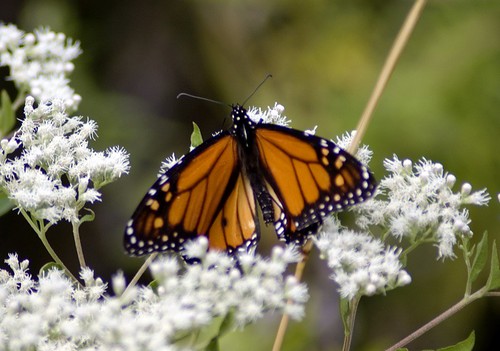
Where have all the monarchs gone?

monarch.jpg

They arrive in California each winter, an undulating ribbon of orange and black. [...] This year, though, the monarchs’ flight seems more perilous than ever. The Xerces Society for Invertebrate Conservation, a nonprofit group that conducts a yearly census of the western monarch, said the population reached historic lows in 2018, an estimated 86 percent decline from the previous year.

That in itself would be troubling news. But, combined with a 97 percent decline in the total population since the 1980s, this year’s count is “potentially catastrophic,” according to the biologist Emma Pelton.
Why should we care?
Butterflies are important because they quickly respond to ecological changes and serve as a warning about an ecosystem’s health, Ms. Pelton said. They pollinate flowers, too.

Monarchs require milkweed, a herbaceous plant that grows throughout the United States and Mexico, for breeding and migration. Acreage of milkweed, though, has been declining in recent years because of pesticide use and urban development, Ms. Pelton said.
Therefore, planting milkweed will help support the surviving monarchs.

Wednesday, November 21, 2018

"Pattern" as a Term of Art [niche | TALENT SEARCH]

I'd originally posted this in July 2014. I'm bumping it to the top of the queue as it is directly relevant to my current interrogation of Tyler Cowen's Emergent Ventures

* * * * *

In continuing to think about pattern I remembered some old notes I’d made about the concept of a biological niche. I’d decided that a niche was a pattern that some organism “traced” or “inscribed” in an environment.

Back THEN I was using the concept of pattern to explicate the concept of niche. In this current context, the focus, of course, is on pattern.

That is, I am developing “pattern” as a term of art and so I want to recast the ordinary notion just a bit. The ordinary notion of patterns is that, well, they’re everywhere. The ordinary notion is indifferent to how patterns are identified. The means of identification is off stage; it’s not even implicit; it’s simply not there.

I’ve decided that that won’t do for my purposes. As a term of art the concept of pattern is inherently relational. As a tentative formulation, a PATTERN can be said to be inscribed in a matrix by a vehicle. In the case of a biological niche, the organism is the vehicle, the environment is the matrix, and adaptation (or perhaps merely living) is the means of inscription.

What I like about the niche discussion is that it isn’t about humans. The niche is not a pattern conceived by humans. That’s one thing.

The other is that patterns emerge as the result of a process. Niches emerge as organisms live and become adapted to their environment. The patterns I’m interested in are the result of human perception and cognition.

Here are my old notes, from 1988, somewhat edited.

* * * * *

Niche as Pattern

The last time I looked (in the 1970s) I was unable to find a clean definition of the niche, and of correlative terms such as environment and habitat. Environments are complex and so are organisms. The niche seems to be a pattern which exists only in the relationship between an organism and its environment.

There are biologists who talk about a niche as existing independently of any organism. The niche exists and the organism moves into it. This really isn't satisfactory. For there is a sense in which organisms create niches. And I’m not thinking of the concept of niche construction, where an animal actively modifies its environment by building nests and trails and so forth, though that is obviously as aspect of the process.

One can think of an organism as a set of capacities. Given some pre-existing organism, it creates a niche when placed into the appropriate environment, namely, an environment whose structure corresponds to the organism's capacities.

But, in fact, there is no such thing as a pre-existing organism. Organisms always exist in environments, to which they are always (more or less) adapted.

In the abstract we can imagine talking about the material, energetic, and informatic patterns which are such that organisms, perhaps of a specific chemistry (such as one based on carbon and oxygen), are evolved to exploit them. Consider the following definition (which presupposes the arguments in A Note on Why Natural Selection Leads to Complexity, or here as well):
A niche is a collection environmental phenomena in which low energy utilization of information allows an organism economically to obtain the energy and materials it needs to maintain its life.
As far as I can tell they only way to identify such a collection of environmental phenomena is to design and an organism which can successfully exploit them. And the best way to “design” such an organism is to evolve it.

I take it then that there is no way to identify a pattern of environmental affordances (to borrow a term from J. J. Gibson) independently of identifying an organism that utilizes them. To be sure, you may read a biologist talking about such things as “a niche for two kilogram night foraging herbivore,” but that’s only because they know that such creatures exist and have one in mind when writing those words. Such formulations sound like the biologist is simply looking at an environment and spelling out a niche pattern based on general theoretical notions. But those theoretical notions are based the examination of real organisms in real environments.

It’s irreducible: Niches are patterns, and those patterns are “identified” by the organisms that occupy the niches. That’s the simplest way. And it’s not very simple. The universe is irreducibly complex.

* * * * *

Pattern: Some Cases

We have this tentative definition from above:
A PATTERN can be said to be inscribed in a matrix by a vehicle.
Now we have something to think about more generally. But not now. For now I offer these lists:
Biological niche:
matrix: environment
vehicle: organism
inscription: adaptation
Perceptual pattern:
matrix: environment
vehicle: nervous system (animal or human)
inscription: learning
Cultural pattern:
matrix: the world
vehicle: the human group
inscription: cultural evolution

Thursday, August 23, 2018

Gaia Redux, WTF!

Bruno Latour talks with James Lovecock and writes an essay, Bruno Latour Tracks Down Gaia, Los Angeles Review of Books.
We cannot hide from the fact that there is a fundamental misunderstanding about Gaia. We think we are using the name of this mythological figure to designate the quite common time-honored idea that the Earth is a living organism. Lovelock is renowned, they say, simply because he recast in cybernetic language the ancient idea that the Earth is finely tuned. The words “regulation” and “feedback” replace the antique idea of “natural balance” or even providence.
Except, Latour is about to inform us, that's not what he did, no, not at all. The idea arose as the result of a thought experiment:
The first Gaia idea came about with the following line of reasoning: “If today’s humans, via their industries, can spread chemical products over the Earth that I can detect with my instruments, then it is certainly possible that all terrestrial biochemistry could also be the product of living beings. If humans can so radically modify their environment in so little time, then other beings could have done it as well over hundreds of millions of years.” Earth is well and truly an artificially conceived kind of technosphere for which living things are engineers as blind as termites. You have to be an engineer and inventor like Lovelock to understand this entanglement.

So Gaia has nothing to do with any New Age idea of the Earth in a millennial balance, but rather emerges, as Lenton emphasizes over dinner, from a very specific industrial and technological situation: a violent technological rupture, blending the conquest of space, plus the nuclear and cold wars, that we were later to summarize under the label of the “Anthropocene” and that is accompanied by a cultural rupture symbolized by California in the 1960s. Drugs, sex, cybernetics, the conquest of space, the Vietnam War, computers, and the nuclear threat: this is the matrix from which Gaia was born, in violence, artifice, and war.
Whoops!
Before Gaia, the inhabitants of modern industrial societies saw nature as a domain of necessity, and when they looked toward their own society they saw it as the domain of freedom, as philosophers might say. But after Gaia these two distinct domains literally don’t exist anymore. There is no living or animated thing that obeys an order superior to itself, and that dominates it, or that it just has to adapt itself to, and this is true for bacteria as much as lions or human societies. This doesn’t mean that all living things are free in the rather simple sense of being individuals, since they are interlinked, folded, and entangled in each other. This means that the issue of freedom and dependence is equally valid for humans as it is for the partners of the above natural world.

Friday, August 3, 2018

Tyler Cowen interviews Charles C. Mann on Shaping Tomorrow’s World and the Limits to Growth

I think it’s impossible to overrate him. Jackie Chan’s amazing.
From Conversations with Tyler, HERE.

Air pollution:
COWEN: And in your book [The Wizard and the Prophet], environmental optimism versus environmental pessimism is a recurring theme. On this issue of the millions of deaths from air pollution, are you an optimist or a pessimist?

MANN: Oh, I think I’m an optimist on this. This one is a problem that we have a clear idea how to resolve. There are obvious substitutes that would be much better than the kind of kerosene that you see in Indian villages. So I think this is a totally lickable problem. There are other ones that I’m much more worried about.
Carbon issues:
COWEN: And on carbon issues overall, are you an optimist or a pessimist? And why?

MANN: Well, I’d say, if you think about it, in 1800, look at the situation of the world: We’re vastly poorer; a huge portion of the earth’s population is enslaved in one way or another. There’s actually estimates from people like Adam Hochschild that it’s three-quarters of the earth’s population. I think that seems high, but you get the general idea. Women aren’t allowed to own property, I think, anywhere. They aren’t allowed to go to college, you name it.

Our world has totally transformed in the last 200 years. Slavery was one of the foundational institutions of civilization. So to me, it would just be incredibly disappointing. Carbon in the air seems, by comparison to slavery, a much easier challenge, although it’s not to say a small one.

COWEN: And what do you think the solution will look like?

MANN: I think there’s multiple possible solutions, and that’s, in fact, what the argument of the book is. There’s different ways to go about it, and it really depends on what kind of future you want to have.

If you’re what I call a wizard — maybe I should call them, to be more exact, what would it be? A Schumpeterian meliorist or something like technophiliac meliorist or something.

COWEN: Okay.

MANN: So I call them wizards. You want to have big, centralized, super efficient facilities, and that typically translates into nuclear power.

If you’re a prophet — typical environment movement — you don’t like these giant, centralized facilities in and of themselves, and you want smaller and much more networked systems. And that looks like a complete reconstruction of the grid to use solar and wind, as well as lots and lots and lots of planting.

Both of them — from the point of view of today’s technology — are equally impossible. It’s a leap in the dark no matter what we do, but then that’s the human condition, isn’t it?
Water:
MANN: And it is absolutely true that people waste staggering amounts of water, and this is the kind of thing that people who study water, like Peter Gleick and the Pacific Institute, they tear their hairs out about all the different ways that we waste water.

Seventy percent of the world’s water, or something like that, goes to agriculture. Most of that is for irrigation, and estimates in the amount of water that’s lost and just totally wasted in irrigation range up to 70 percent of that. So 70 percent of 70 percent, you’re getting close to half the world’s water just wasted. So they say all the things you should do, which you were just talking about, which is charge people, act intelligent about this.

Opposing this is the fact that people are not rational [laughs] about water and have never been, as far as I can tell. When people feel water is threatened, they want more. So then their view is to do these giant mega projects. Like Israel, for example, has just built these huge desalination plants all over the Mediterranean coast. They have five big ones and they plan to build three more.

There’s another one that’s going to be in Aqaba in Jordan — it’s even larger. California has 20 of these planned. And then these mega projects, which I think from a strictly economic cost-benefit or benefit-cost point of view, are kind of crazy, given the wastage. But there’s a real pull toward doing that, and I just don’t know how it’s going to come out.
[Privatizing water companies] is a solution that should be on the table in many more places than it is, because the fact is that governments at every level have failed with water systems, and almost anything would be better than that.
The earth is finite, no?
MANN: ...So clearly, there is some limit somewhere. But where it is, we just don’t really have a clue.

One of the arguments I actually point out in this book is that there’s this idea, right at the beginning of the environmental movement, which is making this argument that we can’t do everything we want, that there’s carrying capacity. It has a whole bunch of different names — ecological limits, planetary boundaries — gets dressed up in different guises.

But the whole idea is that there’s these fixed points that we cannot surpass. Yet, when you look at it, the argument, however intuitively appealing — and it’s enormously intuitively appealing because the earth is round and it’s finite — is very, very difficult to substantiate. And you could, because it depends on what you consider those limiting factors to be.

In fact, one of the earliest calculations of this was done by the great physicist and mathematician Warren Weaver, and he said, “Well, the usable energy is what we need.” And there’s just an inordinate amount of energy coming in from the sun.

Wednesday, August 1, 2018

Our consumption has now overshot the earth's capacity for regeneration in 2018