Showing posts with label emergent-ventures. Show all posts

Tuesday, June 23, 2026

Inside ChatGPT, keeping the lights on while bailing out the hold

Back in 2018 Lenny Bogdonoff was in the first cohort of Emergent Ventures recipients, it was for a project after my own heart, using machine learning to create a genealogy of street art. He’s just published an interesting document, Thoughts before my next ten years. He was working at OpenAI when ChatGPT launched in 2022. Here’s what he says about that:

The most influential effort I touched was WebGPT. Its “chat” interface, which guided the model through an instruction-following paradigm, would later become the basis of ChatGPT, though at the time most of us didn’t register its significance against the alternatives: the code-completion interface, the Jupyter-like code blocks, and the other modality surfaces. It also shaped a unifying data structure the rest of us converged on, which mattered for training a single model with many capabilities rather than many small ones.

The WebGPT research effort had been in progress for over a year and a half, so most didn’t realize the significance of the interface, given the alternatives: the code-completion interface, the Jupyter-like code blocks interface, and the other modality surfaces.

When ChatGPT launched that November in 2022, the rest of the company needed to adjust. Consumer usage was beyond any expectations, and the burden on the entire research organization was material as GPU capacity got reallocated. Everyone assumed the initial surge would settle. Instead it compounded week over week, and the whole organization bent around the GPU constraint that couldn’t be planned for at that scale.

I recognized that the ChatGPT user base at the time was far greater than any contractor force we could manage. If we could properly incentivize that user base to help with data collection, we could produce a much higher-quality “flywheel” for improving the models. In reality, there are numerous challenges to producing a clean data flywheel from end-users, but this gave me conviction that it was an important thread worth exploring. Since keeping ChatGPT online was an all-hands-on-deck effort across infrastructure, research, product, and customer support, my focus on finding the right way to gather meaningful data from users felt even more important. Through this, I formally joined the ChatGPT team and began contributing to the codebase and product roadmap.

As soon as 2023 began and the holiday code freeze concluded, my priorities shifted from data collection to executing on whatever needed to be done to make sure ChatGPT would be usable. Each day ChatGPT would suffer hours of downtime as a wave of traffic followed the busy working hours around the world. Traffic peaked when Asia, Europe, and the US East and West Coasts were all online simultaneously, and the hours leading up to and following these surges were committed to doing anything possible to reduce the pain. Databases were migrated, telemetry was improved, caching and traffic rules were established, and heroic efforts were made by a surprisingly small number of people to make the next day’s surge less painful.

My first major product contributions were around ChatGPT launching a paid subscription. While the previous consumer-facing OpenAI paid product had required weeks of planning and development, the goal this time was to ship a paid product with zero downtime in single-digit days. This was an effort I eagerly jumped into. We started in February and launched in March with ChatGPT Plus, publicly reaching $100M in ARR within days and continuing to grow far faster than anyone could have anticipated. By April, GPT-4 launched, speeding up demand and challenges even more.

The subsequent year is a blur. ChatGPT had unquestionable product market fit, constrained by a single variable: GPUs. Database IDs started wrapping, nearly every early infrastructure decision eventually broke and needed attention, and systems needed refactors. Even with careful planning, we were constantly making changes to improve stability and security. Surprisingly, for a product growing this fast, the biggest unexpected drains were the abuse and misuse we hadn’t designed for.

The ChatGPT team, which began as fewer than 10 people, grew to over 200 dedicated contributors, not to mention the numerous behind-the-scenes infrastructure engineers and adjacent researchers. The company I’d joined at 250 employees a year before was on track to hit 2,000. It was an insane period of continually finding the most important bottleneck, finding any means to relieve it, and moving on to the next.

He left OpenAI in 2024 and joined a venture capital firm. He’s left that and is now thinking about his next step.

When I think about the role of AI in the economy, I keep coming back to an idea borrowed from economics. Economists use “velocity of money” to describe how quickly a dollar moves through an economy and turns over into new value. I’ve started thinking in terms of a “velocity of intelligence,” or how quickly the distance between knowing something and acting on it collapses. AI compresses that distance, and as it does, the velocity of intelligence rises.

At OpenAI, I saw the friction collapse in real time as hundreds of millions of people discovered AI’s utility in the post-ChatGPT wave, and the physics of software businesses shifted. Then, from the startup and venture side, I saw both halves of the unevenness. AI and infrastructure companies were compounding at a rate that was previously impossible, while a far larger set of existing enterprises and industries, where that same acceleration would matter even more, wouldn’t see it arrive for years, held back by organizational constraints rather than any limit of the technology. The places where intelligence is cheap and fast today aren’t the places where the gains would matter most.

That gap is where I want to spend the next decade: getting AI adopted where the velocity of intelligence would be genuinely consequential but won’t happen without a push. I’m still working out the specifics, but having seen the acceleration from inside the labs and where it stalls from the investor’s seat, I think I’m positioned to push on this in a way few others could. For now, I’m getting back to building.

Sunday, May 1, 2022

What I've been up to in the last two weeks, across the Continental Divide and on to the Pacific [how the mind works]

Here's the most recent two entries from my intellectual diary, which is mostly just short notations. The second entry is unusually long.

* * * * *

Emergent Ventures Grant
4.28.22

Applied in April to work over my attractor-net stuff, run it through the brain paper, on to “Kubla Khan” and out into a differentiation between natural and artificial minds. It was turned down on April 25, 2022. By that time I’d started thinking my way back into the old work on Attractor Nets.

3rd Version of “The Theory”
4.30.22

By which I mean the theory I’d been working on with Dave Hays. The first version was based on Mechanisms of Language. That was in place when first met Hays in Spring of 1974. Hays wrote Cognitive Structures in the Spring of 1975. That marks the second version of the theory, where Hays grounded cognition in the servomechanical model developed by William Powers (Behavior: The Control of Perception). My 1978 dissertation, “Cognitive Science and Literary Theory,” advanced that a notch, mainly with the addition of what I call The TV Tube model. Then Hays and I wrote and published “Principles and Development of Natural Intelligence” (1988).

That marks the beginning of the third phase of the theory – though we’d published on metaphor the year before. We’d completed the “brain paper” in ’85, I believe, the review process took three years. The brain paper retained by four degrees from the stage 2 theory – sensorimotor, systemic, episodic, gnomonic – and added a fifth at the bottom, modal. That was based on McCulloch’s model of the reticular activating system (RAS). We stuck Pribram’s holographic ‘model’ in at the second degree, sensorimotor, and the Powers stack at three, systemic. But we didn’t actually know how to construct cognitive models (comparable to those of stage 1 & 2) in those terms.

I began that work in 2003 when I had the idea of taking Sydney Lamb’s relational notation and using it to make logical relations between the basins of attraction in patches of cortical tissue, such as Walter Freeman found in his work. That went well for two or three months until I decided that things were beginning to seem arbitrary and unmotivated. So I stopped working. But by that time I had a pile of very interesting diagrams and some provocative prose. I created two documents, a text document (MSWord), and a diagrams document (PowerPoint), and sent those around to various people. I also came up with the idea of an open-ended natural language front-end for end-user software. I sent that around as well. Sydney Lamb thought it was a good idea. A decade later I put those three documents on the web at on my Academia page.

And that was that, until a week or so ago. That’s when I decided it was time to get back into the fray. By then I’d been thinking seriously about work in machine learning, mostly in cognitive criticism. But I’d also been thinking about NLP, especially the machine translation work. Along came GPT-3 and I got serious. I wrote a working paper, “GPT-3: Waterloo or Rubicon? Here be Dragons”, in 2020. I made real progress on that, began to get a sense that what’s going on in those engines is intelligible. The work of Peter Gärdenfors was important.

The upshot: By the time I’d submitted the proposal to Emergent Ventures I’d begun to think my way back into it. When I got turned down, I couldn’t stop. Yesterday I figured it out:


physical substrate

data reduction

concepts

Hays

Powers stack

(analog servos)

parameters of perception

cognition

Gärdenfors

subsymbolic

neural net

conceptual spaces, dimensions

symbolic

What does that mean, figured it out? It means I finally made it across the continent and am viewing the Pacific Ocean. I’ve put a boundary around the territory. Most of the territory has yet to be explored, much less become settled and domesticated.

These diagrams are nice as well. This diagram relates to the work of Gärdenfors. Each rectangle is a domain in his terminology. Conceptual spaces (again, his terminology) exist in different domains.

This diagram relates to both Hays-Benzon and Gärdenfors. The rectangles are Gärdenfors. The network structure in Benzon-Hays.

Sunday, April 24, 2022

On the Differences between Artificial and Natural Minds: Another version of my intellectual biography

A couple weeks ago Tyler Cowen’s Emergent Ventures announced an interest in funding work in artificial intelligence (AI). I decided to apply. The application was relatively short and straightforward: Tell us about yourself and tell us what you want to do. So that’s what I did. I ended up recounting my intellectual career from “Kubla Khan” to attractor nets.

So, I’ve reproduced that narrative below, except for the final paragraph where I ask for money. It joins the many pieces I’ve written about my intellectual life. I list most of them, with links, after the narrative.

* * * * *

In a recent interview with Karen Hao, Geoffrey Hinton proclaimed, “I do believe deep learning is going to be able to do everything” (MIT Technology Review, 11.3.2020). His faith is rooted in the remarkable success of deep learning in the past decade. This notion of AI omnipotence has deep cultural roots (e.g. Prospero and his magic) and is the source of both wild techno-optimism and apocalyptic fears about future relations between AI and humanity. Momentum seems to be on Hinton’s side. I believe, however, that by establishing a robust and realistic view of the actual difference between artificial and natural intelligence, we can speed progress by tamping down both the hyperbolic claims and the fears.

In the 2010s I employed a network notation developed by Sydney Lamb (computational linguistics) to sketch out how salient features in the high-dimensional geometry of complex neurodynamics could map into a classical symbolic system. (Gary Marcus argues that Old School symbolic computing is necessary to handle common sense reasoning and complex thought processes.) My hypothesis is that the highest-level processes of human intelligence are best conceived in symbolic terms and that Lamb’s notation provides a coherent way of showing how symbols can impose high-level organization on those “big vectors of neural activity” that Hinton talks about.

Here is a quick account of how I arrived at that hypothesis.

For my Master’s Thesis at Johns Hopkins in 1972 I demonstrated that Coleridge’s “Kubla Khan” was a poetic map of the mind, structured like a pair of matryoshka dolls, each nested three deep. It “smelled” of an underlying computational process, nested loops perhaps. Over a decade later I published that analysis in Language and Style (1985) – at the time perhaps the premier journal about language and literature.

In 1973 I started studying for a PhD in English at SUNY Buffalo. The department was in the forefront of postmodern theory and known for its encouragement of interdisciplinary boldness, with Rene Girard, Leslie Fiedler, Norman Holland and several prominent postmodern writers on the faculty. There I met David Hays in the linguistics department. He had led the RAND Corporation’s team on machine translation in the 1950s and 1960s and later coined the term “computational linguistics.” I joined his research group and used computational semantics to analyze a Shakespeare sonnet, “The Expense of Spirit.” I published that analysis in 1976 in the special 100th anniversary issue of MLN (Modern Language Notes) – an intellectual first. Much of my 1978 dissertation, “Cognitive Science and Literary Theory,” consisted of semi-technical work in knowledge representation, including the first iteration of an account of cultural evolution that Hays and I would publish in a series of essays in the 1990s.

Prior to meeting Hays I had been attracted by a 1969 Scientific American article in which Karl Pribram, a Stanford neuroscientist, argued that vision and the brain more generally operated on mathematical principles similar to those underlying optical holography, principles also used in current convolutional neural networks. Neural holography played a central role in a pair of papers Hays and I published in the 1980s, “Metaphor, Recognition, and Neural Process” (American Journal of Semiotics, 1987), and “The Principles and Development of Natural Intelligence” (Journal of Social and Biological Structures, 1988). Drawing on a mathematical formulation by Miriam Yevick, both papers developed a distinction between holographic semantics and compositional semantics (symbols) and argued that language and higher cognitive processes required interaction between the two.

I spent the summer of 1981 working on a NASA project, Computer Science: Key to a Space Program Renaissance, leading the information systems group. I left the academic world in 1985 – I’d been on the faculty of the Rensselaer Polytechnic Institute – and collaborated with Richard Friedhoff on a coffee-table book about computer graphics and image processing, Visualization: The Second Computer Revolution (Abrams 1989). During this period Hays and I began publishing our articles on cultural evolution, beginning with “The Evolution of Cognition” (Journal of Social and Biological Structures, 1990). We argued that the development of a major new conceptual instrument, such as writing across the ancient world, enabled a new cognitive architecture, and that new architecture in turn supported new modes of thought and invention. When Europe had fully absorbed positional decimal arithmetic from the Arabs, the result was a new conceptual architecture which enabled the scientific and industrial revolutions and indirectly, the novel. The twentieth century saw the development of the computer, first conceptually, and then implemented in electronic technology at mid-century. Another new cognitive architecture emerged, but also modernism in the arts.

At the end of the 1990s I entered into extensive correspondence with Stanford’s Walter Freeman about complex neurodynamics. That work became central to the account of music I developed in Beethoven’s Anvil: Music in Mind and Culture (Basic Books, 2001). Meanwhile literary scholars were finally discovering cognitive science. I jumped back into the fray and published several articles, including a general theoretical and methodological piece, “Literary Morphology: Nine Propositions in a Naturalist Theory of Form” (PsyArt: An Online Journal for the Psychological Study of the Arts, 2006). I argued, among other things, that literary form could be expressed computationally in the way that, say, parentheses give form to LISP expressions. My early work on “Kubla Khan” and “The Expense of Spirit” exemplifies that notion of computational form, which I also discussed in “The Evolution of Narrative and the Self” (Journal of Social and Evolutionary Systems, 1993). Over the last two decades I have described and analyzed over 30 texts and films from this perspective, though most of that work is in informal working papers posted to Academia.edu where I rank in the 99.9 percentile of publications viewed.

I am now who knows how many miles into my 1000-mile journey. The full range of the work I’ve done over a half century, all of it with computation in mind – language, literature, music, cultural evolution ¬– remains open for further exploration. I am now ready to make significant progress on the problem that started my journey: the form and semantic structure of “Kubla Khan.” In so doing I intend to clarify the difference between natural and artificial intelligence.

“Kubla Khan” is one of the greatest English-language poems and has left its mark deep in popular culture. It has a rich formal structure and through that draws on the full range of human mental capacities. By explicating them I will propose a minimal, but explicit, set of capabilities for a truly general intelligence and show how they work together to produce a coherent object, a poem. I expect to show – though I can’t be sure of this – that some of those capacities are beyond the range of silicon.

I undertake to do so, not to save the human from the artificial, but to liberate the artificial from our narcissistic investment in it - the tendency to project our fears of the unknown and anxieties about the future onto our digital machines. Only when we have clarified the difference between natural and artificial intelligence will we be able to assess the potential dangers posed by powerful artificial mentalities. Artificial intelligence can blossom and flourish only if it follows a logic intrinsic and appropriate to it.

As futurist Roy Amara noted: We tend to overestimate the effect of a technology in the short run and underestimate the effect in the long run. So it is with AI. Fear of human-level AI is short-term while the transformative effects of other-than-human AI will be long term.

I don’t intend to craft code. I’m looking to define boundaries and mark trails. I have spent a career examining qualitative phenomena and characterizing them in terms making them more accessible to investigators with technical skills I lack. I seek to provide AI with ambitious and well-articulated goals that are richer rather than simply “bigger and still bigger.”

* * * * *

The break – How I ended up on Mars

Here’s one way I’ve come to think about my career: I set out to hitch rides from New York City to Los Angeles. I don’t get there. My hitch-hike adventure failed. But if I ended up on Mars, what kind of failure is that? Lost on Mars! Of course, it might not actually be Mars. It might be an abandoned set on a studio back lot. Ever since then I’ve been working my way back to earth.

This material is about how I ended up on Mars while on the way to LA. That is, it is about I set out to analyze “Kubla Khan” within existing frameworks but ended up outside those frameworks.

Touchstones • Strange Encounters • Strange Poems • the beginning of an intellectual life https://www.academia.edu/9814276/Touchstones_Strange_Encounters_Strange_Poems_the_beginning_of_an_intellectual_life

This is about my undergraduate years at Johns Hopkins and my years as a master’s student in the Humanities Center, where I wrote my thesis on “Kubla Khan.” This is how I became an independent thinker with my own intellectual agenda. Among other things, I talks about the role that some altered mental states – two having nothing to do with drugs, one about and LSD trip (that wasn't trippy in the standard sense) – in my early intellectual development. If you read only one of these pieces, this is the one.

Into Lévi-Strauss and Out Through “Kubla Khan”
https://new-savanna.blogspot.com/2013/08/into-levi-strauss-and-out-through-kubla.html

This is a story told in diagrams, about how I went from Lévi-Strauss style structuralism to the computationally inspired semantic networks of cognitive science. Read this second.

Tuesday, April 12, 2022

Meet the Pioneers [TALENT SEARCH] & a home run on neural nets over neural nets

Bumping this to the top just to remind myself of Bhav Ashok's work.

From the Pioneer blog (H/t Tyler Cowen):

We’re excited to announce the winners of the first Pioneer Tournament.

In the short 3 months since its launch, Pioneer has garnered a global reach. Our first tournament featured applicants from 100 countries, ranging from 12 to 87 years old. Almost half of our players hailed from countries like India, UK, Canada, Nigeria, Germany, South Africa, Singapore, France, Turkey, and Kenya. Projects were spread across almost every industry -- AI research, physics, chemistry, cryptocurrency and more.

We started this company to find the curious outsiders of the world. We think we’re off to a good start.
They've announced 17 winners for this round, including Leonard Bogdonoff, who got an Emergent Ventures grant (New Savanna post here) from Tyler Cowen (who is an advisor to the program). The winners of this round are mostly tech-oriented and range in age from 16 to 29).

My favorite, which simply reflects my interests:
Bhav Ashok (25, Singapore & USA, @bhavashok)

Bhav came up with a way to train a neural network to compress other neural networks. The compression process produces a faster and smaller network without sacrificing accuracy. This has the potential to vastly improve response time in self-driving cars, satellite imaging, and mobile apps.

Noteworthy: By age 12, Bhav was programming and making money selling graphics add-ons for games. At 16, he started doing research in machine learning for bioinformatics. He left Singapore for Austin, where he created TexteDB and founded a company. Bhav later enrolled in the Masters program at CMU, earned the highest GPA in his program, founded a computer vision club, and worked on various research projects.
Here's an arXiv preprint for the compression scheme (arXiv:1709.06030v2 [cs.LG]):
N2N Learning: Network to Network Compression via Policy Gradient Reinforcement Learning
Anubhav Ashok, Nicholas Rhinehart, Fares Beainy, Kris M. Kitani
(Submitted on 18 Sep 2017 (v1), last revised 17 Dec 2017 (this version, v2))

While bigger and deeper neural network architectures continue to advance the state-of-the-art for many computer vision tasks, real-world adoption of these networks is impeded by hardware and speed constraints. Conventional model compression methods attempt to address this problem by modifying the architecture manually or using pre-defined heuristics. Since the space of all reduced architectures is very large, modifying the architecture of a deep neural network in this way is a difficult task. In this paper, we tackle this issue by introducing a principled method for learning reduced network architectures in a data-driven way using reinforcement learning. Our approach takes a larger `teacher' network as input and outputs a compressed `student' network derived from the `teacher' network. In the first stage of our method, a recurrent policy network aggressively removes layers from the large `teacher' model. In the second stage, another recurrent policy network carefully reduces the size of each remaining layer. The resulting network is then evaluated to obtain a reward -- a score based on the accuracy and compression of the network. Our approach uses this reward signal with policy gradients to train the policies to find a locally optimal student network. Our experiments show that we can achieve compression rates of more than 10x for models such as ResNet-34 while maintaining similar performance to the input `teacher' network. We also present a valuable transfer learning result which shows that policies which are pre-trained on smaller `teacher' networks can be used to rapidly speed up training on larger `teacher' networks.

For some comments on the idea, though not this version, see this page.

Why do I like this work? Because, to quote James Brown, it feels good. Why does it feel good? Because I think the neocortex does something like that, and does it perhaps two or three levels deep. And why do I think that?

Well, that would take a bit of explaining and a really good explanation would likely range into areas beyond my technical competence, both in neuroscience and computation. Still, take a look at a paper Dave Hays and I published .some years ago [1].  Here's the abstract:
The phenomena of natural intelligence can be grouped into five classes, and a specific principle of information processing, implemented in neural tissue, produces each class of phenomena. (1) The modal principle subserves feeling and is implemented in the reticular formation. (2) The diagonalization principle subserves coherence and is the basic principle, implemented in neocortex. (3) Action is subserved by the decision principle, which involves interlinked positive and negative feedback loops, and resides in modally differentiated cortex. (4) The problem of finitization resolves into a figural principle, implemented in secondary cortical areas; figurality resolves the conflict between pro-positional and Gestalt accounts of mental representations. (5) Finally, the phenomena of analysis reflect the action of the indexing principle, which is implemented through the neural mechanisms of language.

These principles have an intrinsic ordering (as given above) such that implementation of each principle presupposes the prior implementation of its predecessor. This ordering is preserved in phylogeny: (1) mode, vertebrates; (2) diagonalization, reptiles; (3) decision, mammals; (4) figural, primates; (5) indexing. Homo sapiens sapiens. The same ordering appears in human ontogeny and corresponds to Piaget's stages of intellectual development, and to stages of language acquisition.

Principles 2 through 5 are implemented in cortical tissue and its afferent and efferent linkages to subcortical tissue. Think of coherence (2) as being implemented in something like a conventional neural net. Action (3), finitization (4), and analysis (5) would then be implemented through compression over downstream networks.

So, Tyler Cowen's first class had at least one member in one of my sweet zones (graffiti) and Pioneer's first class has a member in another sweet zone (neural computation). When and where will the third turn up?

* * * * *

[1] William Benzon and David Hays, Principles and Development of Natural Intelligence, Journal of Social and Biological Structures, Vol. 11, No. 8, July 1988, 293-322. Academia.edu: https://www.academia.edu/235116/Principles_and_Development_of_Natural_Intelligence. SSRN: https://ssrn.com/abstract=1504212.

Friday, May 21, 2021

A World’s Fair for a world that’s permanently fair @3QD [Hey, kids! Let's create a NEW World's Fair!]

I'm bumping this to the top of the queue because Tyler Cowen's Emergent Ventures has made Cameron Wiese a Progress Studies fellow so that he can re-animate and re-conceptualize an old idea and create a new World's Fair. From Weise's call to action:

Today, World's Fairs have been rebranded as "International Expositions" that occur every 5 years, and are a hollow shell of their former glory. They no longer showcase the promise of the future or celebrate achievement. Instead, they serve as national branding exercises, infrastructure development projects masquerading as innovation, architecture competitions, and an opportunity to promote tourism. If anything, they're the perfect representation of our current vision for the future: unfocused and uninspiring.

But it doesn't have to be this way; we can't afford for it to be this way.

The world has changed dramatically since 1984. We now live in the most incredible time in human history. The internet has brought billions of people together and tech companies have given us supercomputers in our pockets. We're starting to build hyperloops and supersonic jets. We're on the cusp of incredible breakthroughs in genetics, biology, medicine, food science, energy, transportation, manufacturing, computing, and robotics. We're finally going back to the moon and then on to Mars. We've once again seen the power of a collective vision with the record-breaking development of the COVID-19 vaccine.

* * * * *
 
I’ve got a new piece up at 3 Quarks Daily: World Island: Zeal Means Hope [The World’s Got Talent]. It’s about my friend, Jerry Greenberg, who now goes by “Zeal”, and his project to create a World Island, as he calls it, “a world’s fair for a world that’s permanently fair.” It was a wonderful quixotic idea, a $25 billion dollar city-within-a-city dedicated to peace and human flourishing. It was to be located on Governors Island, 172 acres in New York Harbor a quarter of a mill off the tip of Manhattan and only 100s of yards from Red Hook, Brooklyn.

The article tells the story of what happened between the time we meet in 2003 or 2004 and the time we had to deliver a proposal to locate World Island on Governors Island. The agency in charge of the island, GIPEC (Governors Island Preservation and Education Corporation) was holding a competition for proposals. The proposals were due May 10, 2010. We made the deadline, with 5 minutes to spare.

Our proposal wasn’t accepted. No proposals were. I continued to work with Jerry on other locations for the project, Sierra Leone, and Athens, Greece were looking good at various times, and with other projects, such as WISE, World Investment Summit/Exposition. But this isn’t about that.

It’s about something else, about Jerry’s influence on others. He’s worked with a handful of people quite closely on these various projects, a very large handful. But he’s met 1000s of others and worked with some of them for a bit. How’d he change their lives?

database
Zeal's database system
In my own case, in November of 2007, a year and a half after the Governors Island proposal, I wrote a document, Jersey City: From a Skate Park to the World, and posted it to the web. I told that story in a post, How I Found a Home in Jersey City and Got Steve Fulop Elected Mayor, Part 3. That part about electing the mayor, that’s a bit tongue in cheek; but I did give a copy of that report to Fulop. It was about a park project, a two-and-a-half mile cultural corridor, through the middle of Jersey City. I figured it would cost a quarter to half a billion dollars, much cheaper than World Island, and would transform the city. Here’s the executive summary.
Jersey City has an unparalleled opportunity for developing park space and cultural amenities in a two-mile corridor running from the Powerhouse Arts District in the East, along the Sixth Street Embankment to the Palisades, then up the River Line to the Bergen Tunnel, and west through the Erie Cut-Bergen Arches to JFK Boulevard. What is unique about this strategy is that is builds on both abandoned railroad properties and on Jersey City’s status as a center for graffiti art of the highest caliber. By capitalizing on its graffiti heritage, Jersey City can attract tourists from around the world and establish itself as an international center of cutting-edge art.

This development strategy includes three park-garden areas: 1) Sixth Street Embankment, 2) River Line Walk, and 3) Erie Cut. A skate park is already being planned for the River Line Walk area. At full development the Erie Cut would have a series of small gardens in various national styles – Indian, Chinese, Spanish, etc. – and a conservatory linking the bottom of the cut to the street-level surface(Route 139). There would also be two modest museum complexes: 1) a graffiti museum at 12th and Monmouth, and 2) a railroad museum nearby at the Bergen Tunnel. These complexes would include restaurants and shops.

A thumbnail calculation indicates that these developments could bring new tourist revenue to the city in the amount $36 to $90 million (or more) annually. Other benefits include increased property values along the corridor and new businesses.
Crazy a way – where’s the quarter to half billion construction costs going to come from? – but not so crazy. It was a vision for the future, not a concrete plan. Visions work indirectly.

A couple years later I gave a copy of that report to Greg Edgell. Since then he and I, along with dozens of others, have been working on it in one way or another. We worked with June Jones (Morris Canal CDC) and skateboarders to get the city to agree to build a skate park, albeit in a different place from the one proposed in that report. More recently we started The Bergen Arches Project, which aims to complete another aspect of that proposal, and at a much lower cost.

The vision I projected in that report is thus coming to life. I wouldn’t have written it if I hadn’t spent two or three years working on the World Island project with Zeal.

Ideas have influences. Visions have consequences. Such is the way of the world.
 
Addendum:  You can download some World Island documents at Scribd.

Tuesday, September 17, 2019

Emergent Ventures has an Unconference [random, concentrated breakthroughs]

Tyler Cowen's Emergent Ventures recently had an Unconference to celebrate its one-year anni versary. Craig Palsson attended and then went immediately to a standard academic conference. He compares the two.

Making connections:
The Unconference was designed to forge new connections. Conferences are advertised as a way to create connections, but they usually don’t create a good environment for it. Sessions are organized by a series of papers, and you typically attend the session related to your work. If I work on financial panics, I go to the session with related papers, and so do all of the people in my field. Over the three days, I discover that I’m usually with the same people, because we have similar interests, and I never interact with most people at the conference. [...]

Contrast this with the Unconference. It started with a reception, which is typical of such events. But then at dinner we sat at tables by birthday, inserting some randomness into our conversation partners. Then halfway through dinner, Tyler shuffled the seating arrangements so we would have new conversation partners. Then during the Unconference sessions, participants were randomly assigned to groups for 45 minute discussions. Generally there was an understanding that people were welcome to walk into a conversation and join. [...]
Hierarchy (vs. anarchy?):
The Unconference did not have a hierarchy of achievement. Anyone who has been to a Conference understands there are hierarchies. On the final day of the Conference, I’m eating breakfast, and two others are at the same table with me. I don’t know them, so I start a conversation. But then one of the most prominent people at the Conference sits at the table. Unashamed, I abandon the first conversation and focus solely on the important person. If this person knows and likes me, that could benefit my career, so I’m not going to waste an opportunity.

I’m writing these observations the day after the breakfast, and I’ve already forgotten the names of the two people I started the conversation with.

But at the Unconference, I did not see a hierarchy. There was an implicit assumption that everyone was working on something interesting, and therefore everyone had something to contribute. Indeed, one of the notes I made in my journal was a comment made by an 18 year old participant. This is the aspect of the Unconference that I think will be hardest to transfer to a Conference.
H/t Tyler Cowen.

Addendum: This random connection thing, I wonder, does that come from the nascent world view Cowen has been trying out:  Toward a theory of random, concentrated breakthroughs (2.28.2019):
I don’t (yet?) agree with what is to follow, but it is a model of the world I have been trying to flesh out, if only for the sake of curiosity. Here are the main premises:

1. For a big breakthrough in some area to come, many different favorable inputs had to come together. So the Florentine Renaissance required the discovery of the right artistic materials at the right time (e.g., good tempera, then oil paint), prosperity in Florence, guilds and nobles interested in competing for status with artistic commissions, relative freedom of expression, and so on.

2. To some extent, but not completely, the arrival of those varied inputs is random. Big breakthroughs are thus hard to predict and also hard to control.

Monday, November 26, 2018

Here's to your personal moonshot


This image embodies rather nicely the argument I made in MOONSHOT: Does Project Apollo bring us to redefine humanity? [TALENT SEARCH]

More and more I'm thinking that the 1969 Apollo landings (there were two that year, in July and November) will be seen as the Singularity marking the beginning of a new era in human history, through we're still clawing our way into even now almost 50 years later.

Saturday, November 24, 2018

MOONSHOT: Does Project Apollo bring us to redefine humanity? [TALENT SEARCH]

A couple days ago I ran up a post, What’s a (metaphorical) moonshot? [TALENT SEARCH], where I looked at a couple of articles where Mercatus Center fellows talked of moonshots. I was looking for the metaphorical work done by the idea of ‘moonshots’, and I missed it. ‘Moonshots’, whatever they are, are obviously awesome. But why?

Why? The idea seems to carry the connotation that these are very risky ventures where success is not certain. That’s certainly what Tyler Cowen seems to think. After all he’s asserted that if most of his picks for Emergent Ventures aren’t failures, then he’s not doing it right (you’ll find the link in the previous post). But as Graboyes and Stossel pointed out (again, link in previous post), Project Apollo was not a particularly risky venture, not from an engineering point of view. We knew all the relevant physical principles. It was just a matter of getting the engineering right. The time table may have been a bit tricky, but as long as we’re willing to commit the resources success seemed certain. And it was.

So what’s the big deal?

THAT was the big deal, that success was all but certain. What does it imply about who and what we are that, when a nation set out to land a man on the moon within a decade, it did so? What does it mean that that (kind of) feat is within our capabilities

Mars too. Elon Musk says we could have a base on Mars by 2028. Do I believe him? Yes/no/I don’t know. But it’s the timing I’m iffy about, not the technical capability. If we’re willing to commit the resources, then YES, we can do it. Well, I’m also iffy about the psychological capacities of humans in a venture like that. But what kind of doubt it that?

On the other hand, while I think that computers will be doing some pretty interesting things in 2028, some of them not anticipated at the moment, I don’t think we’ll have common sense knowledge under control, nor do I think we’ll be anywhere near ‘artificial general intelligence’, whatever that is. In this domain we lack knowledge of the fundamental principles governing mental phenomena and so we’re just grope around trying this or that. Some things succeed spectacularly, others fail, but we don’t quite know why in either case. We’re accomplishing something, learning something, but just what, who the hell knows? We don’t. Not yet.

Back to moonshots. It seems to me that what underlies the metaphor’s power is the simple fact that, YES, we set out to land a man on the moon and we did it, on time and on budget (I think). What’s awesome about Project Apollo isn’t that it was a crapshoot that came through. Rather, what’s awesome is that it WASN’T a crapshoot and there was little substantial doubt that we would succeed (at least not among the engineers and scientists who planned and designed the mission). That such a thing is now within human capacity, THAT’S WHAT’S AWESOME.

Addendum, 11.25.18: Posted to my Facebook page:

Dictionary, language, word friends, I'm interested in when and how the idea of a "moonshot" became a metaphor meaning roughly, "a highly improbable undertaking but of possibly high value if successful". The reason that interests me is that the vehicle, in one terminology, of the metaphor is obviously Project Apollo. But success was not highly improbable. There were no unknown laws of physics etc. involved. It was a highly focused engineering venture, one that, given time and resources, was all but certain to succeed. As for its value, well, how do we determine that? But it was funded as a propaganda effort in the Cold War (though I doubt that's how the people involved in the project thought of it). That is to say, Project Apollo was NOT a moonshot in the metaphorical sense.

So, how and when did that come about? The OED might tell you something, but I don't have access. I checked the BYU corpus of contemporary American English. It's earliest example (and it only goes back to 1990) is from 1995, and that was clearly metaphorical.

Google Ngram is sparse and enigmatic. Thus from 1979, New York Holstein-Friesian News: "ALSO: A Redwood Ramona Moonshot with 1st calf from a dam with 17,767 3.5% 619 in 288d at 3-0." Further googling reveals "Redwood Ramona Moonshot" to be a bull in Livingston County NY, just how prolific I can't say. And then there's Glenmore Moonshot, a horse of some distinction back in 1982. And "the town of Moonshot, Oregon, is experiencing a rapid growth of population because of the recent relocation of an assembly plant for hand calculators near the town." From 1976, "But the real news is that short days, at least in the case of the Galores and Moonshot types result in substantially earlier flowering — and substantially dwarfer plants." So, we've got moonshot animals, moonshot flowers, and a town. All of which is really quite interesting. But I don't know what to do about it.

Thoughts?

Wednesday, November 21, 2018

"Pattern" as a Term of Art [niche | TALENT SEARCH]

I'd originally posted this in July 2014. I'm bumping it to the top of the queue as it is directly relevant to my current interrogation of Tyler Cowen's Emergent Ventures

* * * * *

In continuing to think about pattern I remembered some old notes I’d made about the concept of a biological niche. I’d decided that a niche was a pattern that some organism “traced” or “inscribed” in an environment.

Back THEN I was using the concept of pattern to explicate the concept of niche. In this current context, the focus, of course, is on pattern.

That is, I am developing “pattern” as a term of art and so I want to recast the ordinary notion just a bit. The ordinary notion of patterns is that, well, they’re everywhere. The ordinary notion is indifferent to how patterns are identified. The means of identification is off stage; it’s not even implicit; it’s simply not there.

I’ve decided that that won’t do for my purposes. As a term of art the concept of pattern is inherently relational. As a tentative formulation, a PATTERN can be said to be inscribed in a matrix by a vehicle. In the case of a biological niche, the organism is the vehicle, the environment is the matrix, and adaptation (or perhaps merely living) is the means of inscription.

What I like about the niche discussion is that it isn’t about humans. The niche is not a pattern conceived by humans. That’s one thing.

The other is that patterns emerge as the result of a process. Niches emerge as organisms live and become adapted to their environment. The patterns I’m interested in are the result of human perception and cognition.

Here are my old notes, from 1988, somewhat edited.

* * * * *

Niche as Pattern

The last time I looked (in the 1970s) I was unable to find a clean definition of the niche, and of correlative terms such as environment and habitat. Environments are complex and so are organisms. The niche seems to be a pattern which exists only in the relationship between an organism and its environment.

There are biologists who talk about a niche as existing independently of any organism. The niche exists and the organism moves into it. This really isn't satisfactory. For there is a sense in which organisms create niches. And I’m not thinking of the concept of niche construction, where an animal actively modifies its environment by building nests and trails and so forth, though that is obviously as aspect of the process.

One can think of an organism as a set of capacities. Given some pre-existing organism, it creates a niche when placed into the appropriate environment, namely, an environment whose structure corresponds to the organism's capacities.

But, in fact, there is no such thing as a pre-existing organism. Organisms always exist in environments, to which they are always (more or less) adapted.

In the abstract we can imagine talking about the material, energetic, and informatic patterns which are such that organisms, perhaps of a specific chemistry (such as one based on carbon and oxygen), are evolved to exploit them. Consider the following definition (which presupposes the arguments in A Note on Why Natural Selection Leads to Complexity, or here as well):
A niche is a collection environmental phenomena in which low energy utilization of information allows an organism economically to obtain the energy and materials it needs to maintain its life.
As far as I can tell they only way to identify such a collection of environmental phenomena is to design and an organism which can successfully exploit them. And the best way to “design” such an organism is to evolve it.

I take it then that there is no way to identify a pattern of environmental affordances (to borrow a term from J. J. Gibson) independently of identifying an organism that utilizes them. To be sure, you may read a biologist talking about such things as “a niche for two kilogram night foraging herbivore,” but that’s only because they know that such creatures exist and have one in mind when writing those words. Such formulations sound like the biologist is simply looking at an environment and spelling out a niche pattern based on general theoretical notions. But those theoretical notions are based the examination of real organisms in real environments.

It’s irreducible: Niches are patterns, and those patterns are “identified” by the organisms that occupy the niches. That’s the simplest way. And it’s not very simple. The universe is irreducibly complex.

* * * * *

Pattern: Some Cases

We have this tentative definition from above:
A PATTERN can be said to be inscribed in a matrix by a vehicle.
Now we have something to think about more generally. But not now. For now I offer these lists:
Biological niche:
matrix: environment
vehicle: organism
inscription: adaptation
Perceptual pattern:
matrix: environment
vehicle: nervous system (animal or human)
inscription: learning
Cultural pattern:
matrix: the world
vehicle: the human group
inscription: cultural evolution

What’s a (metaphorical) moonshot? [TALENT SEARCH]

“Throughout the past year, Mercatus scholars have explored their personal and policy moonshots; Emergent Ventures is a step to making those moonshots a reality,” said Tyler Cowen, faculty director of the Mercatus Center. “By finding and taking chances on risk-taking, talented people with bold ideas, I believe we can reinvent the capacity for an intellectually-oriented philanthropy to improve the world.”
Why this talk of moonshots? It seems to be a popular term at Mercatus. A search of their site for “moonshot” turned up 77 hits (today, November 21, 2018 at 11:39 AM; it produced 92 hits when I searched it last night).

The term is being used metaphorically, of course, where America’s Project Apollo is the vehicle, to use a term of art, that conveys the intended meaning about some tenor, another term of art, some other project or venture. What meaning is supposed to be conveyed?

Let's list some moonshots

In an article, Deep Technologies & Moonshots: Should We Dare to Dream?, posted on September 18, 2018, Senior Research Fellow Adam Thierer, observes:
Don Boudreaux defines moonshots as, “radical but feasible solutions to important problems” and Mike Cushing has referred to them as “innovation that achieves the previously unthinkable.” “Deep technology” is another buzzword being used to describe such revolutionary and important innovations. Swati Chaturvedi of investment firm Propel[x] says deep technologies are innovations that are “built on tangible scientific discoveries or engineering innovations” and “are trying to solve big issues that really affect the world around them.”
A bit later:
More concretely, when people use these terms in reference to existing technologies, or ones currently on the drawing board, they often mention innovations like:
  • Artificial intelligence / machine learning / robotics
  • 3D printing / additive manufacturing
  • Self-repairing / self-building objects
  • Driverless cars / flying cars (VTOL), supersonic transport
  • Private space travel / lunar mining
  • Clean power / alternative energy production
  • Genetic editing & life extension technologies
  • Implantable tech / human augmentation
  • Hyper-connected devices / wearable fitness / sensor tech / IoT
  • Precision medicine
  • Neural networks
  • Quantum computing
  • Nanotechnology / synthetic biology
  • Immersive technology (AT & VR)
This is just a partial list of the type of technologies that experts mention when discussing “moonshots,” deep tech,” and other “disruptive” or “transformative innovations.” What unifies them more than anything else is the potential for major improvements in human well-being. Significant advancements in these areas could lead to substantial jumps in human welfare, health, and longevity.
The question I’m thinking about is whether or not Project Apollo was a moonshot in this sense.

In what sense did it “lead to substantial jumps in human welfare, health, and longevity”? Oh, yes, there were side effects aplenty, from Tang to computers to propulsion systems and who knows what else, but what benefits have accrued from actually landing human beings on the moon?

So far the only benefits that I can see have been largely symbolic: We did it! We actually set foot on the moon. But how has that lead to benefits in human welfare?

Or, going back to his earlier paragraph, in what sense was landing on the moon a solution to an important problem? The problem it solved, if that’s how you want to put it, was boosting national morale in a technological race with the Soviet Union. And even at that Congressional funding was a bit iffy.

Crapshoots and sure things

Over two years ago Robert Graboyes and Thomas Stossel argued Curing Cancer Is Not a Moonshot (January 15, 2016). They set things up with this observation:
When President John F. Kennedy articulated his moonshot project in May 1961, it was a narrowly focused, clearly defined engineering problem. While costs and timelines were somewhat uncertain, tried-and-true principles of physics informed the engineers and made a successful lunar landing highly likely.
That is to say, landing humans on the moon was a difficult, but not particularly uncertain technological problem. It was expensive and so required substantial commitment, but it was not a long shot. The major risk was born by the astronauts themselves. Three died in a prelaunch test prior to Apollo 1 and Apollo 13 suffered an accident on route that made a lunar landing impossible, but the crew returned safely to Earth.

Graboyes and Stossel go on to observe:
Cancer, in contrast, is many different diseases demanding diverse treatments. Compared with the high-precision physical sciences that reliably guided NASA to the moon, the principles of biology are obscure and agonizingly unpredictable.
They then go on to argue curing cancer is not the sort of thing to be tackled by a large centrally controlled government organization. Rather, the private sector, with its entrepreneurial skills and drive is better suited to this mission. They may well be correct in that, but that’s secondary to my argument. Their contrast between the two projects, landing a man on the moon, curing cancer, is not. The second is still pretty much of a crapshoot, but the first was not.

Monday, November 19, 2018

TALENT SEARCH: Tyler Cowen on the value of sole proprietor pop-up philanthropic shops [plus a widely shared blind spot in his thinking and a plug for a NASA administrator]

A week or so ago Tyler Cowen ran up a post on his philanthropic method, The philosophy and practicality of Emergent Ventures. He notes that traditional philanthropies have large staffs “which means relatively conservative, consensus-oriented proposals emerge at the end of the process.” Moreover “the high fixed costs of processing any request discriminate against very small proposals” and such foundations tend to become “captured by their staffs”, who tend to be treated as valued proxies for the foundation’s audience and thus further increase the conservative insularity of the decision process.

A sole proprietor pop-up philanthropic shop

All of which makes sense to me. In contrast, his approach in Emergent Ventures is quite different. He has no staff. Though he may seek advice from others, he makes all the decisions. The process is quick and cheap and the “arrangement also can promise donors 100% transmission of their money to recipients, or close to that.”

And so:
The solo evaluator — if he or she has the right skills of temperament and judgment — can take risks with the proposals, unencumbered by the need to cover fixed costs and keep “the foundation” up and running. Think of it as a “pop-up foundation,” akin to a pop-up restaurant, and you know who is the chef in the kitchen. It is analogous to a Singaporean food stall, namely with low fixed costs, small staff, and the chef’s ability to impose his or her own vision on the food.
Once a fixed sum of money is given away, and the mission of the project (beneficial social change) has been furthered, “the foundation” goes away. No one is laid off. Rather than crying over a vanquished institutional empire and laid off friends/co-workers, the solo evaluator in fact has a chance to get back to personally profitable work. It was “lean and mean” all along, except it wasn’t mean.
What’s not to like?

He goes on to suggest: “In my view, at least two percent of philanthropy should be run this way, and right now in the foundation world it is about zero percent.” He goes on to suggest: “The ideal scaling is that other, competing ‘chefs’ set up their own pop-up foundations.” YES to all of this.

In particular, what I like about this last suggestion is that it speaks to a blind spot in Cowen’s perception of what he’s up to, a perception that seems almost universally shared by people in the philanthropy business. What is that blind spot? Simple, that what they’re looking for is an attribute of individuals.

Talent, whatever that is, may well be an attribute of individuals. But, to the extent that Cowen is trying to increase innovation by identifying individuals whose work will be widely valued and used, he is in fact looking for a GOOD FIT between individual talent and social need and capacity. Let me repeat that in slightly different terms. Cowen is looking for individuals with a talent that has the capacity to fill a socio-cultural need. What’s missing from his formulation is explicit recognition of that fit, of the importance of socio-cultural context in determining whether or not individual talent will flourish.

Many sowers, many seeds

I’ll say a bit more about that later, but first I want to explain why his suggestion of limited-term sole-proprietor pop-up philanthropic shops speaks to that blindness. It’s simple, really. We are in an era of tremendous social cultural change. It’s pretty clear, at least to many of us, that the future cannot be extrapolated from the past. Something new and different is required. But just what that is, just what will work, no one really knows, though many have opinions. In particular, we don’t know what potentials are latent in the world today.

In that situation it makes sense to sow many seeds widely and quickly. Who should do the sowing? Talented people who are in touch with other talented people. Each of these people will have their own sense of the needs and potentials of the current cultural moment, each will have their own vision about the proper fit between talent and cultural opportunity. But don’t give any one of them too much philanthropic capacity. By endowing many talented people with limited philanthropic capacity you guarantee the placement of many bets over a wide range of future possibilities and potentialities.

Thursday, November 8, 2018

The World-Wide Wall, evolving over time


Using the hundreds of thousands of images I was able to crawl from Instagram before the geographical data was made inaccessible, I analyzed how the presence of street art around the world, over time. [...] This data, which was no longer associated to the actual images that were originally indexed — due to Instagram’s change in policy — provided insight into the presence of street art and graffiti around the world.

Interestingly, the image frequency also provided a visual which eludes to an obvious relationship between urban centers and street art. If this was analyzed further there may be clear correlations between street art and real estate value, community social ties, political engagement, and other social phenomena.

In the past few days, I have focused on synthesizing the various means with which I expect to use machine learning for analyzing street art. Because of the media’s misrepresentation of artificial intelligence and the broad meaning of machine learning in the technical/marketing field, I was struggling with what I meant myself.

Prior to this project’s incarnation, I had thought it would be possible to build out object detection models to recognize different types of graffiti in images. For example, an expression of vandalism is different than a community sanctioned mural. I also imagined it would be possible to build out ways of identifying specific letters in larger letter-form graffiti pieces. I believe it would be interesting to combine the well defined labels and data set with a variational auto-encoder to generate machine learning based letter-form pieces.

Going further, I thought it would be possible to use machine learning to detect when an image in a place was “new”, based on it not having been detected in previous images from a specific place. I thought it would also be interesting to find camera feeds to railway cars traveling across the US and build out a pipeline for capturing the graffiti on train cars, identifying the train cars serial number, and tracking how train cars and their respective art traveled the country.
And so it goes.

Saturday, November 3, 2018

Update on the Bogdonoff graffiti study


Tuesday, October 30, 2018

Getting a boost from Marginal Revolution, or into the weeds with stats [#EmergentVentures #WorldWideWall]

Last Thursday, October 25, 2018, I ran up a post entitled, Is this the beginning of the #WorldWideWall ?. The post consisted of five tweets from Leonard Bogdonoff, who had gotten a grant from Tyler Cowen’s Emergent Ventures “to create a genealogy of street art, using machine learning.” That got my attention for two reasons: 1) I’m interested in Emergent Ventures, and 2) I’m interested in both graffiti and machine learning.

When I looked Bogdonoff’s tweets that morning I realized that, for all practical purposes, he’d begun work assembling what I have been calling the World-Wide Wall, all of the world’s outward facing graffiti and street art assembled into one gigantic and searchable object in cyberspace via photographs on the web. So I assembled that post and then emailed a link to Tyler Cowen in which I congratulated him on a shrewd first pick. I came this > < close to saying “the eagle has landed.” Tyler emailed me back, indicating that he’d post a link on Saturday. Saturday roles around and there it is, the link:

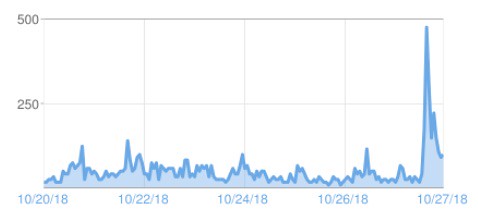
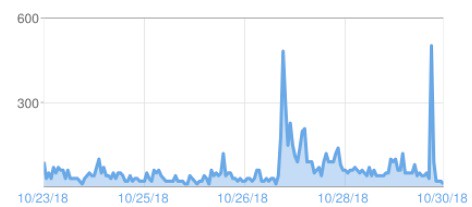
 10-27-18 week
That shows web traffic to New Savanna for the previous week. That spike is the effect of Cowen’s link on my web traffic.

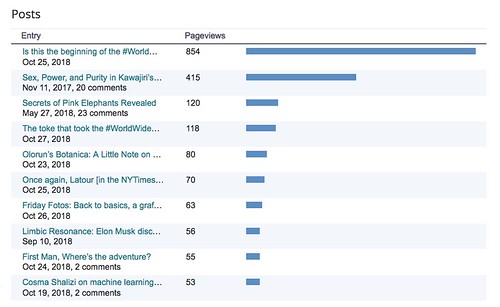
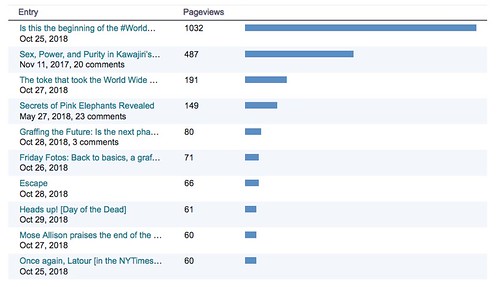
This chart shows the top 10 posts for the preceding week, measured starting the 27th:

10-27-18 top10 week

At 854, the #WorldWideWall post is first. Most, though not all, of those hits are traffic from Cowen’s blog, Marginal Revolution, which he runs with Alex Tabarrok. The next two posts, Sex, Power, and Purity in Kawajiri’s Ninja Scroll, and “Secrets of Pink Elephants Revealed”, are the most popular posts here, and have been up for several years.

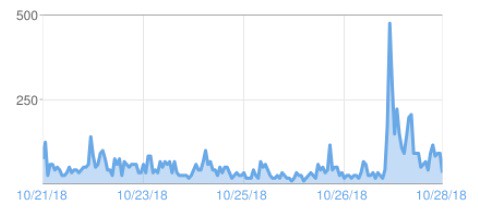
Here’s shot of the previous week’s posts that I took on Sunday, the 28th:

10-28-18 week graph

The effects of Cowen’s link are still quite visible.

And again, earlier this morning:

10-30-18 826 week

Cowen’s spike is still prominent, but another spike has appeared. I haven’t got the foggiest idea what’s driving it. The increase in traffic is probably distributed across many posts.

This post shows the top 10 posts for the immediate week, measured backward from this morning:

10-30-18 902AM week

Again, “WorldWideWall is tops, Ninja Scroll is second, but Pink Elephants has slipped into fourth behind “The toke that took World Wide Web and smoked the #MSM”, about Elon Musk. That post is related to graffiti and Bogdonoff and so may have benefited indirectly from Cowen’s link, but not, I feel, enough to account for that new spike. If I had more information I might be able to figure this out. But I don’t.

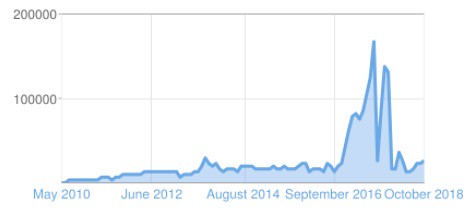
Finally, this chart shows New Savanna’s traffic over the span of its life from April 2010 to present:

10-28-18 year

Notice that there’s a huge increase in traffic for roughly 2016. I have no idea why that happened. At one time or another I thought it might be centered on my photographs, but I really don’t know.

More later.

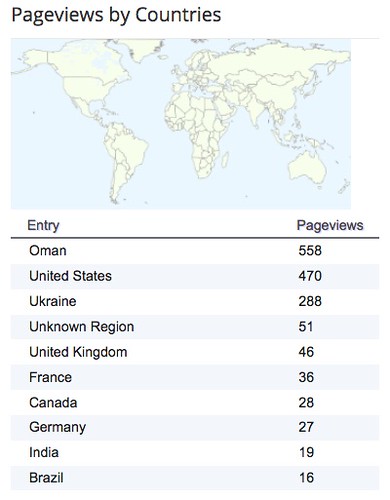
Addendum: I found the source of today’s spike: Oman. Here’s a chart of today’s traffic grouped by country of origin:

views by country DAY

Oman is at the top with 558 hits, followed by the United States, which generates by far the largest fraction of my traffic, and then Ukraine, which also provides a fair but of traffic. I have no idea about the source of that traffic from Oman; it could be just one or a half-dozen curious people. Who knows? The fact that no single post shows an unusual uptick in traffic suggests a small number of people each browsing a bunch of posts.