Showing posts with label KK encounter. Show all posts

Wednesday, June 23, 2021

The failure of structuralism and linguistics: Why did academic literary criticism turn its back on intellectual opportunity in the mid-1970s? [and why did I ignore the profession?]

6.25.21: Revised and updated with new material.

I’ve been through this before, I know, but I keep coming back to it. Maybe this time I can get it right, or at least inch beyond were I got the last time. However, I’m not going to take the time to link to specific posts or working papers that are relevant. I’m just going to talk this one straight through.

However, I did update a post where I’ve been keeping track of my thinking on this issue. Here it is:

The profession of literary criticism as I have observed it over the course of 50 years [& related matters], https://new-savanna.blogspot.com/2017/01/the-profession-of-literary-criticism-as.html

I will say this, after having drafted this essay, I think I’ve got it right, more or less. This satisfies my curiosity about this matter, though no doubt there are details to be nailed down, etc.

Two Perspectives

We have two perspectives, two aspects to examine: 1) the profession in general, and 2) my history in particular. Let us assume that by my senior year in college, 1968-69 at Johns Hopkins, I had internalized some version of a standard academic approach to literary criticism. The object of criticism was to interpret the text. There was some question as to whether or not interpretations were unique, whether or not they could be objective, at least in principle. This was quite problematic and extensively debated. But there was no doubt that interpretation was the name of the game.

That’s the period when structuralism, not post-structuralism or deconstruction, was getting attention, what with its codes, little diagrams, and formulae. Perhaps, some thought, structuralism will clear up some of the debates about the nature of the text, meaning, and interpretation and, at the same time, open avenues of collaboration with neighboring disciplines. I grabbed ahold of that and had worked my way to computational semantics by early 1974. But the profession tossed structuralism over in favor of Derrida and friends. Why the divergence? And why did it take me so long – roughly two decades, into the mid-1990s – to realize that it had been form that had my attention all along that, in effect?

Lévi-Strauss and the logic of myths

I suppose it was in my sophomore year that I first encountered the work of Claude Lévi-Strauss. It would have been in a class I took with Richard Macksey. He’d assigned the following text as optional reading:

Claude Lévi-Strauss, The Structural Study of Myth, The Journal of American Folklore, Vol. 68 No. 270, Oct-Dec 1955, pp. 428-444.

I read it and was fascinated. I did a paper on Oedipus at Colonus – so it must have been his Idea of the Theatre course – in which I drew a table modeled more or less after something I’d seen in that article. It’s important that I’d internalized the article to the point where I did draw a table.

I forget what kind of table it was. I may still have the paper – I’ve kept some of my undergraduate work (just as Jerry Seinfeld has all his notes back to the first bit he ever performed) – but it would be in storage along with the rest of my library. It might have looked something like this, from the article:

That’s about the logic underlying the Oedipus stories. I sometimes talk of ‘myth logic.’

Then there’s this intriguing diagram:

It looks a bit like a slice through some kind of machine, a myth machine, no? Notice that we’ve got “life” at the upper left and “death” at the lower right. In between we’ve got some linkage between “animal food” and “life destroyed.” What’s going on?

Lévi-Strauss was working out a theory/model whatchamacallit that myths work by resolving binary oppositions. The big one, of course, is life-death. You then substitute mediating terms for each side of the opposition until you reach a point where you’ve got a common term, or something like that. That’s what that horizontal slot is about.

He argued that in myth after myth after myth for several years, until he adopted a somewhat different and more elaborate whatchamacallit in Mythologies, the first volume of which was The Raw and the Cooked, which are mediating terms for nature and culture, respectively.

That’s what caught the attention of the folks who organized and attended the (in)famous structuralism conference at Hopkins in the fall of 1966. Though I was on campus at the time, I didn’t attend any of the sessions, nor would it have done me any good as they we all in French, one of many languages of which I know little to nothing. But I was in Dick Macksey’s orbit, and that was enough. I read that essay, wrote that paper, and was hooked on Lévi-Strauss for the next few years.

But why?

The word illusion and the problem of meaning

When I talk of the word illusion I’m alluding to the fact that when we see words on the page – or for that matter, hear them, but mostly we see them on the page in our work – we think we’re seeing the whole word in the way that we see the whole cat when we look at it. In the case of the cat, of course, we may be looking at it from, say, its left side, but it has a right side that is invisible to us, not to mention the belly and back, as well as its interior organs. But that’s not quite what I have in mind.

We see a word on the page and we know how to spell it, how to pronounce it, how to conjugate it (if it is a verb) and so on. And we know its meaning, or perhaps meanings. We feel that we grasp of that when we see it there on the page. The word.

But the word, the whole word in full, isn’t on the page at all. All that’s on the page is the word form. We hold all the rest of that in our heads. That all the rest of it is somehow inherent in those marks on the page, that’s a perceptual-cognitive illusion. The word illusion. If meaning inhered in the marks, then you could look at a text in a foreign language and grasp the meaning immediately, from the marks. Obviously language doesn’t work like that.

Well, linguists have quite a bit to say about word forms, and about phonology, morphology, and syntax. And the structuralist movement latched on to this domain primarily through the structuralist linguistics Ferdinand de Saussure. He talked of the sign as consisting of a signifier (the word form) and signified (meaning), where the signified was explicitly understood as being different from the referent, the thing (out there) in the world to which the word referred.

It’s easy enough to say all that, and even to believe it. But how do we work with, think about, those signifiers? We can’t get at them directly. They’re not physically present in the speech stream or inscribed on the page with written symbols. They’re in the mind, or brain, but we can’t observe them directly.

We have to get at them indirectly. Obviously they form some kind of system. Perhaps it’s a differential system, like the phonemes, which have binary features. We can work with phonemes directly. Perhaps we can detect the workings of a differential system of meanings in texts. That’s what Lévi-Strauss was doing in his work on myth. He was examining myths, how they unfold through some system of categories, how those categories reflect off one another, and deducing the likely terms in the underlying system of meaning. Those diagrams, those little formulas, they’re all representations of a system of signifiers in the mind, your mind, my mind, every mind. Those representations make the hidden and invisible world of signifiers real and tractable.

That’s what made structuralism so appealing to a generation of scholars who, having entered into the business of interpreting texts, were beginning to fear it to be a somewhat dodgy business.

Well, members of the profession gave it a try from the mid-1960s and into the 1970s. Robert Scholes produced a little book on structuralism. Jonathan Culler produced a somewhat bigger book, Structuralist Poetics, and lectured it across the country in ‘75 or ‘76. But, in a review of Mythologiques in Diacritics at that time, Eugenio Donato said we can set aside the analyst of ethnographic materials; it’s Lévi-Strauss the enigmatic philosopher who interests us, the Lévi-Strauss who believes his analysis of a myth is but another variant of the myth, and so forth. [I had little interest Lévi-Strauss the philosopher.] In the title essay of The Fate of Reading (1975), Geoffrey Hartman pronounced an interdiction on semiotics, linguistics and “technical structuralism” in literary criticism. And behind it all was Derrida’s deconstruction of Lévi-Strauss in “Structure, Sign, and Play in the Discourse of the Human Sciences,” the paper he delivered at the 1966 structuralism symposium at Hopkins.

Derrida had won. Structuralism and linguistics lost. But I went with losers. I went beyond them. It was clear to me from my careful study of The Raw and the Cooked, that if there was that much structure there, there must be more. I was going to look for it.

Trees in “Kubla Khan”

But it wasn’t at all obvious in 1968-69 that structuralism and linguistics had lost. What’s when I took a two-semester course in Romantic Literature, taught by Earl Wasserman. He praised my Wordsworth paper as exhibiting a “mature approach” to whatever poem I’d analyzed, I forget which. I’d also done a paper on “Kubla Khan,” and that poem would come to dominate the earliest phase of my career. I was told that that paper prompted Wasserman to ask a question in my name (they did that back in those days, do they still do it?) at some presentation where I wasn’t present. I believe that I’d proposed that the poem achieves completeness by asserting its own completeness and he asked about that.
Friday, October 25, 2019

Into Lévi-Strauss and Out Through “Kubla Khan”

Prefatory Note

I first published this in The Valve on December 7, 2009. This piece tells the story of how, in the early 1970s, I came to abandon "traditional" literary criticism and set sail for cognitive science. I'm reposting it here and now because it is also about description, for the core of my work on "Kubla Khan" WAS descriptive, not theoretical as I'd set out to do. I've also published this post as part of a working paper, Beyond Lévi-Strauss on Myth: Objectification, Computation, and Cognition (PDF).

* * * * *
Other posts in the series:
* * * * *

My recent posts about Claude Lévi-Strauss are about his ideas on myth, but they are also about the influence of those ideas on me. They are stories in my intellectual autobiography. I would like to continue with that autobiography and say more about how, for better or worse, I moved through Lévi-Strauss to cognitive science.

That could not have happened unless I had become interested in the cognitive sciences even as I was investigating Lévi-Strauss. For Lévi-Strauss & Co. was not all that caught my undergraduate interest when I was at Johns Hopkins in the 60s. I studied psycholinguistics under James Deese and thereby discovered Noam Chomsky’s transformational generative grammar (& how it wiped behaviorism off the map). I learned about Jean Piaget under Mary Ainsworth, who also introduced me to John Bowlby and to primate ethology. Other thinkers were important as well, including Nietzsche, Merleau-Ponty, the early Wittgenstein, and, in a way, Philippe Ariès, though that influence is not so germane to this particular story.

What brought it all together, or, in a way, forced me to tear it apart, was a poem, Coleridge’s “Kubla Khan” (text available here). I became interested in “Kubla Khan” during my senior year at Johns Hopkins in a course taught by the late Earl Wasserman. As you know, Coleridge had declared “Kubla Khan” incomplete: It came to him in an opium-induced reverie (opium was the aspirin of the time); he was interrupted by a man from Porlock; the reverie was dissipated and, with it, most of the poem vanished. The text was oh! so incomplete. I sensed that the two sections of the poem—the first, about Kubla and his pleasure-dome, the second, about a poet and his vision of the damsel with a dulcimer—had the same structure. I also believed that “Kubla Khan” became complete by asserting its own incompleteness: “Could I revive within me . . .” But he couldn’t, and so this incomplete poem asserted its own fragmentary nature, from within itself, thereby recursively attaining closure. It was a trick of the times.

I wrote that paper and, while I thought it was a good one, it didn't come close to exhausting my interest in the poem. I decided to continue that work into a Master's Thesis at the Humanities Center, with Dick Macksey as my director. (Of course I addressed him as “Dr. Macksey” at the time.) This was a few years after Macksey and Eugenio Donato had organized the 1966 structuralism conference that is generally given as the starting point of the intellectual shake-up that has since devolved into Theory. Though I was on campus at the that time I didn’t attend any of the sessions. But I took several courses with Macksey and an independent study as well.

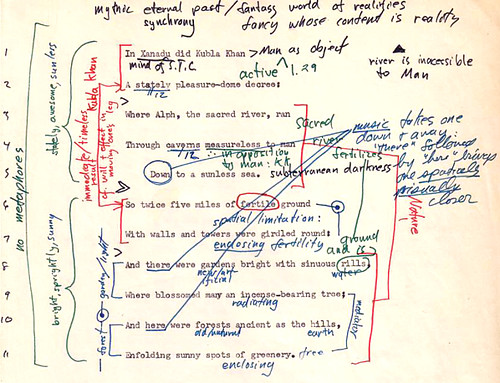
And so, in due course, I undertook a binary inquiry into “Kubla Khan.” Getting started was easy, too easy, for the poem bristled with oppositions—dome vs. caves, light vs. sound, sight vs. breath, Kubla vs. the woman wailing, the woman wailing vs. the damsel with a dulcimer, order vs. chaos, time vs. space, impotence vs. creativity, and others. But I could see no way of making sense out of the plethora of such oppositions; they refused to order themselves into a continuum—from maximum opposition through intermediary steps to minimal opposition—such as Levi-Strauss had shown in his famous discussion of Oedipus or his later treatment of the story of Asdiwal. Nor was any other pattern discernible. “Kubla Khan” appeared to be a chaos of binary order (see Figure 1).

KK-working-text-old-2cr72.jpg

Figure 1: A fragment one of the worksheets I used in exploring “Kubla Khan.”

I decided that I would have to create a theory suited to this poem. Levi-Strauss, yes, and Roman Jakobson, but also Merleau-Ponty, Wittgenstein, Piaget, Nietzsche and others. After seven or eight months of work in which I reviewed the extant literature on the poem and slogged away on that theory I began to feel I was embarked on an endless task. Yes, I was making progress, things would fall into place here and there. But I was well over a hundred double-spaced pages into a draft with no sense of closure in sight.

It wasn't the sort of experience where you get through your basic argument, crudely, with loose ends sticking out all over, and then go back to tie them off and find out it takes more thought than you had anticipated. Rather, I simply had no sense of an exposition and argument that was going anywhere but in circles. I would find myself making a certain argument, call it Shangri-La, conclude it, and move on to another line of thought and, ten or fifteen pages later, I was back at Shangri-La, working through it, moving on . . . and right back to Shangri-La. It was like getting lost in the forest and circling back to the same point, except this circling was abstract, not concrete.

I concluded that it was time to call a halt and to retool. I dug out Chomsky, and then stratificational linguistics (Sidney Lamb's elaboration of Hjelmslev). And psycholinguistics. And cognitive psychology. Physical anthropology and also the evolution of language—why not? The neurosciences. I read more and ran it all up against “Kubla Khan.” It was all fascinating. But nothing clicked.

Somewhere in there, early in 1972, I destroyed my aborted manuscript and signed up for trumpet lessons in the at the Peabody Conservatory; I studied with Harold Rehrig, who’d spent his career with the Philadelphia Symphony. This wasn’t a complete break from reality. I’d played the trumpet since childhood and was fairly good. I’d been working on Louis Armstrong trumpet solos since my early teens, Armstrong had just died, July 1971, what better time to walk another path? After a month or two of that I came to my senses and decided to finish out my Master’s degree — though I kept up the trumpet lessons. I would just have to say whatever I could say and drop the elaborate theorizing.

Thursday, December 17, 2015

Literary Studies from a Martian Point of View: An Open Letter to Charlie Altieri

I of course, am the Martian, a conceit I’ll explain in due course.

I took a course in modern poetry with Charlie Altieri in the fall of 1974, my second year at SUNY Buffalo. I don’t know why I signed up for Charlie’s course, probably for the exposure. I’d come to Buffalo for a very specific purpose and with only a weak background in English and American literature. I picked my courses in part to remedy that.

That same semester I was also studying with David Hays in linguistics. On the one hand I was enrolled in a course, Linguistics as a Focus of Intellectual Integration, in which we read books by William Powers (control theory and psychology), Talcott Parsons (sociology), Northrup Frye (literary criticism), Ernst Gombrich (art history), Gregory Bateson (systems, mind, ecology), and most likely someone else. But Hays, a computational linguist, was also tutoring me in his semantic model.

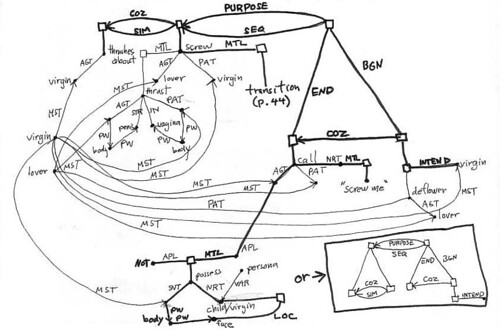
I used that semantic model to examine some passages from William Carlos Williams, Patterson, Book V, and submitted that (rather long) paper to both Altieri and Hays. That’s the kind of place Buffalo was in those days. Here’s one of the many diagrams from that paper:

deflower-virgin-crop

Looking at it now I’m appalled at how sloppy it is. But I’m sure I was proud of it at the time, and even thought it a bit stylish. I’d bought a set of technical fountain pens (Rapidograph) just so I could draw such diagrams. These days I’d use the computer, probably Omnigraffle, to draw something that complex.

I remember Charlie making two verbal comments to me about it (above and beyond what he wrote in the margins): 1) that I was using literature as a vehicle for elaborating other interests, and 2) like I. A. Richards I had moved beyond literature to a more general interest in language and the mind. The second was flattering, but I bridled at the first, though it was true. However, it is by no means clear, then or now, in just what the proper study of literature consists.

Anyhow, here’s an open letter to Charlie. Why Charlie? That I studied with him at a critical point in my career is sufficient reason. But there is one other thing: Charlie takes a philosophical approach and is conversant in both Continental and Anglo-American idioms. Despite a spate of dumb remarks from prominent physicists, philosophy remains intellectually necessary.

I start by recounting, for the 4th time I believe [1], my early intellectual history. After that I talk about my analytic work on ring-composition and then on to other things.

* * * * *

Hi Charlie,

I’ve been looking at some of the stuff on your website and notice that you’ve taken to posing as an old scholar reflecting on the profession. That’s a pose I know well, and have explored it myself in this and that, except that here and now I’m pretending to be a Martian. It’s a metaphor of course, but not, as I’ll explain, a mere metaphor. And like you I’m suspicious about the “materialist” allegories that have come to dominate the field, though I’m not so bothered by the erasure of authors – but that particular issue would take me a bit far afield.

From Johns Hopkins to Buffalo

I’ve spent a great deal of time thinking about the profession, by which I mean academic literary criticism, and wondering about its future. On the one hand I’m amazed at the variety of work done in the name of (academic) literary criticism. I certainly can’t get a grip on the full range. Can anyone? Someone who’s chaired a large and diverse department, or served as editor for a generalist journal, they’d have seen a wide range of work parade before them over the years. But really grasp it all?

Moreover I look at the discipline as an outsider. I’m an outsider in the sense that I don’t hold an academic appointment and haven’t had one since I failed to make tenure at RPI back in 1985. But I’m hardly the only capable scholar – or whatever it is that I am – to operate outside the academy. I’m an outsider in a deeper and more fundamental sense and have been, I realize in retrospect, ever since I completed my MA degree at Hopkins in 1972, ever since I wrote that MA thesis on “Kubla Khan”.

That is to say, I was an intellectual outsider when I arrived at Buffalo in the fall of 1973 for the purpose of getting the credential, the PhD, that is the all but necessary requirement for an academic post. At that time it was obvious that my MA thesis was a very unusual piece of work. I had a sense that, though it was my work – I’d written the thing, hadn't I? – I didn’t really know what I’d done. For knowledge is ineluctably social – there are no private languages – and it wasn’t at all clear just which intellectual community could accommodate that work.

It was quite unlike anything that had been written about “Kubla Khan”. And while it had obvious antecedents in structuralism and in linguistics, in various respects it was quite different from what Jakobson, Lévi-Strauss, and others had done with poetry. What was it, a duck or a swan? Who knew how to answer the question?

When I arrived at Buffalo I was apprehensive about whether I’d be able to do the work I wanted to do, not that I had any clear idea of what that was. All I knew is that I wanted to somehow make sense of the structure I’d found in that poem. So I showed the thesis around, to Mac Hammond, my advisor, to Al Cook who was, well, Al Cook, and in my second year, to you. Everyone accepted it as well, I don’t know what, but it was in some way accepted. And, with the help of another graduate student, Ralph Henry Reese, who’d worked with David Hays, I managed to find my way to the Linguistics Department where I joined Hays’s research group in computational linguistics.

Back then, the world seemed wide open – “it was the age of wisdom, it was the age of foolishness, it was the epoch of belief, it was the epoch of incredulity, it was the season of Light, it was the season of Darkness, it was the spring of hope, it was the winter of despair, we had everything before us” – and who knew how the discipline would develop. It was worth a shot.

Monday, November 2, 2015

How Failure Led Me to Appreciate the Importance of Description in Literary Study

That one learns from failure is a well-worn cliché in the business world, but that shouldn’t blind us to the fact that it is true. Or can be. For learning isn’t automatic. You have to work for it.

And sometimes you have to work for a long time. That’s certainly been the case with the string of failures or quasi-failures that have bounded my intellectual life.

Structuralism Can’t Explain “Kubla Khan”

It starts with the spring semester of my senior year at Johns Hopkins. I was in a course on Romantic literature taught by Earl Wasserman and I became interested in Coleridge’s “Kubla Khan” [1]. I wrote a course paper on the poem and then, over the next two-and-a-half years, a Master’s Thesis.

My basic intention was to do a structuralist analysis of the poem, most in the mode of Lévi-Strauss on myth, but also with a bit of Roman Jakobson. It didn’t work out that way. In fact things went so badly that at one point I considered scrapping the thesis, bailing on the Master’s degree, and becoming a musician. It was in the wake of that crisis that I came back to the work, reconceptualized it and wrote a thesis, but one that was very different from I’d imagined I would be doing.

I knew going in that I couldn’t take structuralism off the shelf, apply it to them poem, and the analysis would pop out. I’d have to do a bit of preliminary work of a theoretical kind. The idea was to create the theory that would allow structuralist analysis to yield up the secrets of “Kubla Khan”.

It was the theoretical effort that fell apart. The thesis I ended up writing was mostly descriptive in character: the poem has two parts, each of them has three parts, and so on, mostly the rhyme scheme matches up, but sometimes it doesn’t, and so on. It went on like that for over 70 pages. I liked what I had done. But it wasn’t what I’d set out to do.

It didn’t explain anything, much less the poem’s meaning. It just described a very complicated linguistic object. And the description just lay there.

But, at the same time, that description seemed inescapable. At the time literary texts seemed to be very ‘fuzzy’ objects, their meanings highly variable, mostly as a function of what critics wanted of them. The patterns I described weren’t like that. They were pretty much there, in the text, and didn’t require any interpretive theory. Just look at the language and describe what you see.

Where’d those patterns come from?

Cognitive Networks Can’t Explain “Kubla Khan”

So, thesis in hand, I want off to get a doctorate in English at SUNY Buffalo. I arrived there in the fall of 1973 and showed my thesis around. People were impressed, but couldn’t help me.

In the spring of ’74 Ralph Henry Reese, a fellow graduate student, introduced me to Prof. David Hays in the Linguistics Department. He was a social scientists and a computational linguist and was familiar with that cognitive science stuff I’d been reading just before I left Hopkins.

He too was impressed with the thesis, but didn’t have anything to offer me immediately. However, we liked each other and I became his student and joined his work group. The idea, at least from my side, was that I would learn his semantic theory and then use it to explain that pattern I’d found in “Kubla Khan.”

After about a year or so of work I used Hays’s semantic theory to explain (critical aspects of) the structure of Shakespeare’s Sonnet 129, “The Expense of Spirit”. I chose that sonnet because Roman Jakobson has worked on, figuring my semantic work would thus complement his syntactic, morphological, and phonological work. That resulted in an essay I published in the special Centennial issue of MLN (Modern Language Notes) in 1976 [2].

I figured that analysis would be preliminary to the analysis of “Kubla Khan”. It turns out that that’s all there was. I just couldn’t produce a plausible account of the semantic underpinning of that poem. Instead I aimed my dissertation at a more sophisticated treatment of the Shakespeare sonnet.