Showing posts with label urban. Show all posts

Sunday, September 17, 2023

Cities are not start-ups

 Jersey City's Urban Design Laboratory

Molly Turner, They’re Ultrarich Techies, and They Want to Build a City From Scratch. What Could Go Wrong? NYTimes, Sept. 17, 2023.

From the article:

Cities and their problems have long bedeviled people in power. The Technotopians are just the latest in a grand tradition of American business magnates aspiring to build their dreams — from Pullman, Ill., to Epcot Center in Disney World. They tend to approach building cities the same way they’ve approached building tech start-ups. And that is unfortunate.

To state the obvious: Cities are not start-ups. They can’t keep up with the tech industry’s rate of innovation. That frustrates many Technotopians, like the Thumbtack co-founder Jonathan Swanson, who once complained that “humans currently live in cities that are the equivalent of flip phones” — the worst possible insult in Silicon Valley at the time.

Cities aren’t like phones. They’re not like computers either, a distinction that the University of Pennsylvania professor Shannon Mattern wrote an entire book to explain. Urban problems are too complex and politically fraught to be programmed into an app. Constructing a building takes much longer than constructing a website. And undoing the racist legacy of urban policies is more complicated than pushing through a software update.

Later:

It’s challenging to transform our existing cities and to pilot new tech solutions on our streets. Just look at the rocky rollout of e-scooters around the world. Wouldn’t it be easier to test new technologies, business models and government structures in cities free of pesky people? That’s certainly the aim of many Technotopian plans, which call for new cities to be built, new rules to be written and new residents to opt in to being guinea pigs. Mr. Lonsdale, of Palantir, explains: “The idea is simple: found new cities, free from old bureaucratic and legal structures, and explore bold new visions of how government should work. Market them to people who choose to join and see what the world learns.”

But, these new cities are never really built from scratch. They usually encroach on someone else’s land or run contrary to local plans. The Technotopians rarely acknowledge that, which often leads to their downfall, as with Alphabet in Toronto and the Seasteaders in French Polynesia. The Solano project appears to be on a similar trajectory. They’ve snapped up land under a veil of secrecy, which has undermined needed political support. “If these investors plan to convince Solano residents and their elected representatives that building a new city on productive agricultural land is a wise scheme, they are off to a terrible start at earning the community’s trust,” John Garamendi, a Democrat who represents part of Solano County, testified at a recent State Senate committee hearing.

There's more at the link.

Sunday, June 27, 2021

Ancient cities – "Instead of a small focal point, cities spread over 100 sq km."


From the linked article:

Amazingly, however, far from being compact, we now know that even in the most well-known of Maya centres, like Copán and Tikal, the population was relatively dispersed. Instead of having fields outside and politics inside, fields were located throughout the urban infrastructure and residences. And instead of a small focal point, cities spread over 100 sq km. Recent studies of Tikal have shown a network of moats, dwellings, reservoirs and pyramid clusters that extend out from a single hill for up to 200 sq km into the surrounding landscape.

Innovative aerial surveys have now made similar findings across the Maya world. In almost all instances, instead of isolated urban buds, scientists have found vast landscapes of small and large centres connected by dispersed agrarian landscapes, residential areas, causeways and a complex, interlinking system of dams, reservoirs, sinkholes, channels and swamps that supported growing populations through even the driest of seasons. As leading Mayanist Prof Lisa Lucero, of the University of Illinois, puts it, “the Classic Maya knew the importance of water and of fertile agricultural soils, the latter dispersed in variously sized pockets, mirrored by a dispersed agricultural settlement. This low-density approach to cities was a logical, innovative solution.”

The Classic Maya also had far more diverse and sophisticated economies than has often been appreciated. Alongside the key crops, archaeobotanists have shown that the planting of avocados, pineapples, sunflowers, tomatoes and manioc added to a dispersed settlement and lifestyle. The Classic Maya are also known to have penned, fed and fattened wild turkeys and deer for their key protein sources.

Scientists have found evidence that diverse “forest gardens” sustained these cities. Based on ethnographic study of, and testaments from, Maya communities today, this type of cultivation, called milpa (or kol in the local Yukatek language), involves the use of multiple crops, and the movement of fields, allowing different parts of the forest to grow back and patches of soil to rest and restock before planting begins in a locality again. We also know that instead of indiscriminately planting in soils of all types, the Classic Maya actually followed rich veins of particularly productive soils, giving their field systems a winding appearance that snaked along rivers and up slopes. They even added special plants, like water lilies, to reservoirs. These plants are incredibly sensitive to water quality, only growing under clean conditions, and allowed people to monitor the buildup of stagnant water and thus guard against disease.

As a comparison you might want to check out:

Saturday, July 25, 2020

Walt Disney, Stephen Miller and the Future of Jersey City

I'm bumping this 2013 post to the top of the queue on general principle. But also, BECAUSE. Who'd believe an expert with a laser cutter was living in the ghetto and included international starchitect Norman Foster among his clients? Not that I think of it as a ghetto. It's where I lived for 2 and a half years and felt very comfortable, at home, thank you very much

* * * * *

Buildings ... are not discrete objects. They are building blocks of a democratic society. W. H. Auden once proposed that a civilization could be judged by "the degree of diversity attained and the degree of unity attained." In the spirit of service, architecture can contribute to both. Without the spirit of service, architecture can be a highly destructive force.

– Herbert Muschamp, Visions of Utopia
No doubt you are familiar with Walt Disney, the guy who made cartoons and nature documentaries, created the world’s first theme park, and gave his name to what is now the world’s largest entertainment company. But it’s been years since Disney himself appeared in the media – he died in 1966 – and his life story isn’t well-known, though there must be at least a dozen biographies of him (I’ve read four of them).

But what does Uncle Walt have to do with Stephen Miller and what do either of them have to do with the future of Jersey City?

And, by the way, WHO is Stephen Miller?

I don’t know how many laser cutters there are in Jersey City – 10, 20, 100, 763? I have no idea – but one of them is in his atelier off Harrison Street between Monticello and Bergen.

What’s a laser cutter?

It’s a high tech jigsaw used for cutting materials such as wood, plastic, leather, metal perhaps.

And what the h___ is an atelier?

It’s a workshop and design studio. A high-class term.

OK, gotcha, but what does that have to do with Walt Disney and what do they have to do with the future of Jersey City?

Let’s start with Walt Disney. Disney was an entertainer; he made movies and went on to build a theme park. Miller is an entertainer too, though of a different kind. He’s musician and a very good MC – he tells me he used to front a band. And he’s a slammin’ djembe player.

And I know a little about djembe players. When I lived in upstate New York I performed with Eddie “Ade” Knowles, a percussionist who toured as a percussionist with Gil Scott-Heron early in his career. I hear and feel the same power and nuance in Miller’s djembe playing that Ade has in his.

OK, so he’s an entertainer, there are lots of entertainers in the world...

Just cool your jets. Don’t go getting testy on me. I’m gettin’ there.

Take a look at this video (embedded below). It’s a promotional video that Disney prepared for Epcot (Experimental Prototype Community of Tomorrow) and it shows a small city that’s very different from and far more interesting than what the Disney Company eventually built in central Florida.


About 16 minutes in you’ll see an architectural model for the central building and transportation hub that Disney had planned (but that never got built). Well, those models don’t grow on trees – though such models often feature model trees. Someone has to build them. That’s how Miller makes his living; he makes architectural models.

An architect, say Norman Foster, has a client who’s about to sink $100,000,000 into a project. The client wants to see what he’s getting for all those spondulix, and the client wants to see more than plans and pretty 2D renderings. Plans don't really mean much to anyone but architects and engineers and pretty 2D renderings are, well, pretty, but they don't really give you a sense of the space. What the client really wants, of course, is to walk around and through the finished structure before it’s actually built and paid for. That’s not possible. But it is possible to build a scale model.

That’s Miller’s job. Foster shoots over the plans in Autocad format, Miller feeds them into the laser cutter, and the cutter spits out the parts. Miller assembles the parts into a model, sprinkles some artificial grass on the ground, plants artificial trees and shazayum! finished model, ready for client viewing.

Now, long before he even thought of Disneyland, much less Epcot, Walt Disney built models. As I put it in Walt Disney: A Career in Three Acts:
In the late 1940s Walt turned his attention to model railroads. Not only did he give them as gifts to himself, and his nieces and nephews, he also learned to construct them. He was already a respectable carpenter - skills he had learned from his father. Now he learned how to fabricate the metal parts necessary for a 1/8 scale railroad which was constructed in the yard at his new house. This railroad was his pride and joy; he loved operating the engine - which was a real steam engine, though not full-sized - and giving people rides on the train...

At the same time - the late 1940s - Disney began thinking about creating a “Mickey Mouse Park” on sixteen acres of land near the studio. The original purpose was to have a place where studio employees and visitors could park their children. But, as Disney thought about the park, and investigated amusement parks here and there, his aspirations became ever more elaborate, and ever different from standard amusement parks of the Coney Island type.
And thus Disneyland was born, a theme park that James Rouse – the real estate developer perhaps best-known for creating Columbia, Maryland – called “the greatest piece of urban design in the United States today” in a 1963 speech at Harvard University.

Wednesday, January 20, 2016

The curse of parking

Clive Thompson in Mother Jones:
The average automobile spends 95 percent of its time sitting in place. People buy cars because they need to move around, but the amount of time they actually do move around is tiny. So the cars are parked, and in multiple spaces: A car owner needs a spot near home, but also spots near other places he or she might go—the office, a shopping mall, Epcot.

A 2011 study at the University of California-Berkeley found that the United States has somewhere close to a billion parking spots. Since there are only 253 million passenger cars and light trucks in the country, that means we have roughly four times more parking spaces than vehicles. If you totaled up all the area devoted to parking, it'd be roughly 6,500 square miles, bigger than Connecticut.
And finding one of the parking spaces is a PITA:
And worst of all may be the emissions that parking causes. Studies have found that anywhere from about 30 to 60 percent of the cars you see driving around a downtown core are just circling, looking for an open space to claim. (An IBM survey found that worldwide, urban drivers spend an average of 20 minutes per trip looking for parking.)
But:
We are, [some experts] say, on the cusp of a new era, when cities can begin dramatically reducing the amount of parking spaces they offer. This shift is being driven by a one-two punch of social and technological change. On the social side, people are increasingly opting to live in urban centers, where they don't need—or want—to own a car. They're ride-sharing or using public transit instead.

And technologically, we're seeing the rapid emergence of self-driving cars. Google's models have traveled more than a million miles with almost no accidents, and experts expect that fully autonomous vehicles will hit the consumer market as early as a decade from now. [...]

One study suggests a single self-driving car could replace up to 12 regular vehicles. Indeed, many urbanists predict that fleets of robocars could become so reliable that many, many people would choose not to own automobiles, causing the amount of parking needed to drop through the floor.

"Parking has been this sacred cow that we couldn't touch—and now we can touch it," says Gabe Klein, who has headed the transportation departments in Chicago and Washington, DC. He sees enormous potential—all that paved-over space suddenly freed up for houses and schools, plazas and playgrounds, or just about anything. "All that parking could go away, and then what happens?" he asks. "You unlock a tremendous amount of value."

Wednesday, November 6, 2013

A City on the Move, Literally

Here's a real "blue sky" urban design. A small city mounted on huge caterpillar tracks allowing it to move around:
In a world where people live more mobile lifestyles than they have for centuries, cities are facing a problem they rarely planned for: their citizens move away. When jobs and resources start to decline, modern cities, such as Detroit, suffer difficult and often wasteful processes of urban contraction. In contrast to this, Manuel Dominguez’s “Very Large Structure,” the result of his thesis project at ETSA Madrid, proposes a nomadic city that can move on caterpillar tracks to locations where work and resources are abundant.
At ArchDaily, with lots of pictures. H't Tyler Cowen.

Saturday, July 30, 2011

The Site of Graffiti: Linked Poetry and Mu’en

Graffiti expresses the kami of the site where it is situated

I take it from my post, Living Graffiti, that the site of graffiti is the focus of our, or at least my, investigation. But the site is to be understood, not as a mere physical place. It IS that, but the physical place is to be understood, perhaps, provisionally, as a resource accessed by the graffiti, and thus by the graffiti writer. The site is a confluence of physical, social, and aesthetic energy.

In order further to understand this, a little comparative investigation is called for. And for that we turn to—where else?—but to Japan and Buddhism. Not directly, but as interpreted through Eiko Ikegami’s wonderful book, Bonds of Civility: Aesthetic Networks and the Political Origins of Japanese Culture (Cambridge 2005). We start with linked verse, a form of collective, public poetry practiced in the 13th century (and later):
The atmosphere of a Cherry Blossom session was intensely moving for its participants. The typical number of seats poets in a za session was not fixed but usually stood at around 10. Unlike the more formal linked-verse meetings of later periods, however, members of the audience that surrounded a circle of poets in a Cherry Blossom session were free to contribute poems of the own to the circle. After one sequence of chain poems was made by seated members in the circle, the floor was open to the public. All the participants in the meeting would avidly search for the best follow-up verse, one after the other, Sometimes, dozens of poems were thrown in from the audience to provide the next stanza in a particularly difficult chain. When an unexpectedly interesting succeeding stanza was presented, the perceptive participants would be captivated by feelings of surprised exhilaration.
In other words, we be jammin’.

Now check this out, it’s from Roger Gastman & Caleb Neelon, The History of American Graffiti (Harper 2010); they’re quoting TDEE, a Jersey City writer talking about the Jersey City Wall of Fame, as it’s sometimes known (p. 276):
All of sudden, already seasoned writers like TECK, SERO, SNOW, and the QMB CREW started rocking ‘our’ walls, to where soon you could go up there on any given Sunday during the summers of 1991 to 1993 and find at least ten people painting, and twenty more just hanging out. . . . The Newport Wall was the first time writers from different New Jersey cities got together on the regular and had a place to meet and paint as a collective.
Times have changed, but the Newport Wall’s still there, only three blocks from the Holland Tunnel and thus within earshot of thousands of cars a day, though it’s been neglected of late and part of the wall’s covered with dirt, dirt thrown there as part of preparations for erecting apartment buildings that have not yet happened.

Monday, June 20, 2011

Who Has Rights to Public Space?

Graffiti writers have long asserted their right to public space and, by implication, the rights of their respective communities. As this post from the New Economics Foundation makes clear, such assertions are every more important, and ever more threatened:
As news emerges that two London councils plan to charge children to play in public spaces, whilst another stridently attempts to drive out homeless people from some of London’s most visited places, has the time not come to assert our common right to the city?
The article goes on to point out that those particular cases:
... should not be dismissed as isolated cases; they are snapshots of a much larger issue. Or put differently pieces within a wider and more worrying jigsaw amounting to nothing less than the ideological, and if current trends are not arrested, material remaking of this city.
Cities the world over are re-making themselves in a ‘neoliberal’ way and thus commoditizing the city:
As a result many spaces that we could once call our own, where we could linger at our leisure and experience some of the joys of urban life, have been privatised and increasingly securitised. This in turn fragments our access to the city, limiting it to those who can pay for the privilege and those who conform to narrowly defined social norms.

This problem has been most acutely felt in the great cities of America: New York and Los Angeles being prime suspects. Here, as Sharon Zukin and Don Mitchell eloquently point out, the ability to access and enjoy once freely cherished spaces has come under the almost relentless pressure of market-driven forces, often in the guise of Business Improvement Districts (BIDs) which, in a predictable desire to secure their businesses and loyal consumers (and inevitably surrounding spaces), have driven out transgressive deviants – read those less likely to ‘consume’ the city, and whose presence may deter paying customers; the homeless, ‘winos’, skateboarders, and the like.

Friday, May 21, 2010

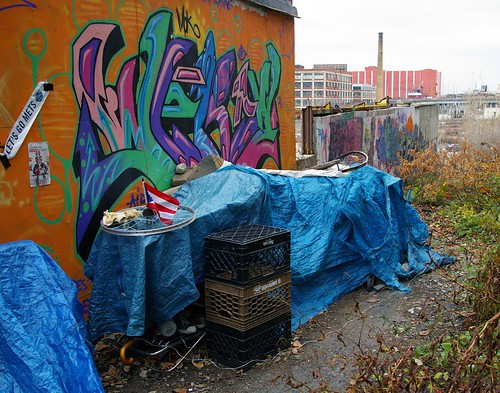
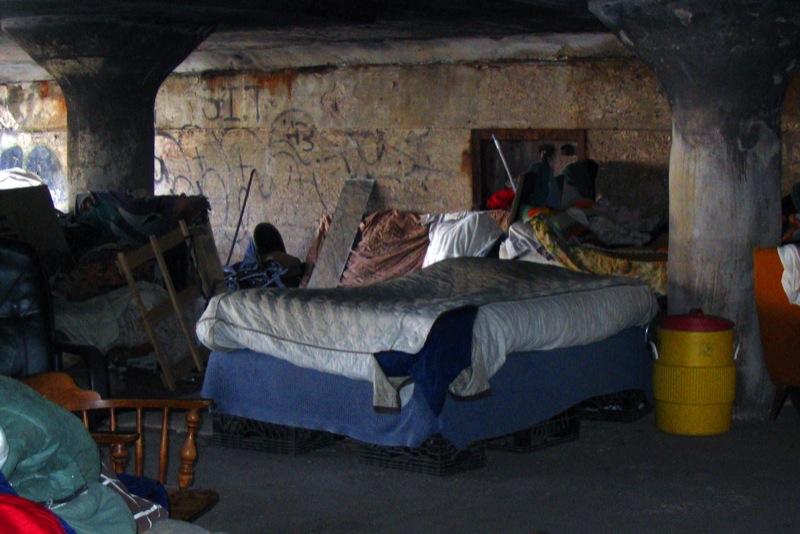
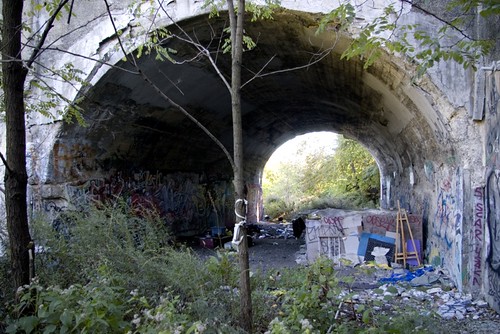
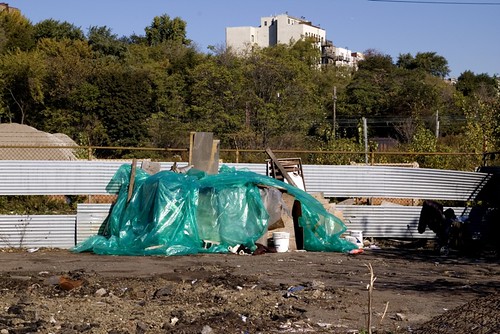
Gimme Shelter: Some Urban Homesteads

Taken at various times and places in Jersey City, NJ, across the Hudson River from Manhattan.


You can see more photos in this series in my Urban Homesteads set on Flickr.

Tuesday, May 4, 2010

Tools of Civilization

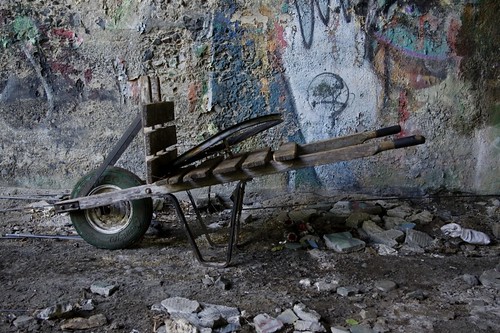
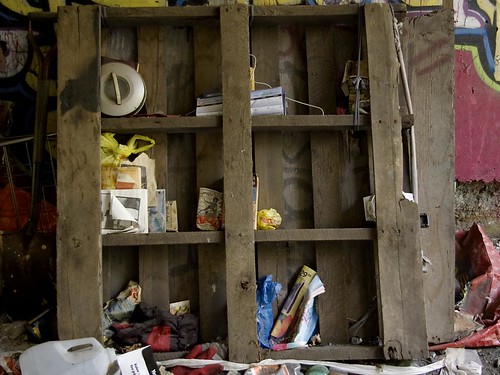
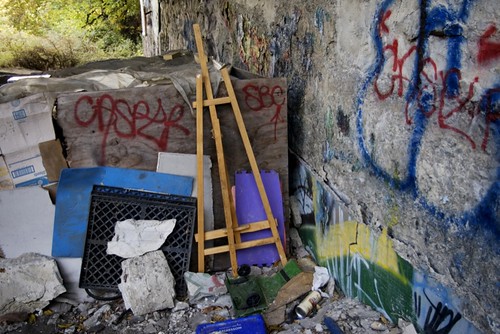
I took these photos in the same place, but at different times. Early in the 20th Century a trolley line went through this place, which is in Jersey City, in a place known locally as the Bergen Arches (this is under one of the arches). I don't know when the trolley line was abandoned, but this space is now given over to homeless people and graffiti writers. 


Tuesday, April 27, 2010