Showing posts with label Everett. Show all posts
Showing posts with label Everett. Show all posts
Friday, August 28, 2026
Friday, August 7, 2020
Why Did Interpretive Criticism Take Hold?
I'm bumping this post (from 2.24.17) to the top of the queue as it responds to a question implicit in my recent post, On the nature of academic literary criticism as an intellectual discipline: text, form, and meaning [where we are now]: How can we justify the interpretation of texts when there is something else, something that's been woefully neglected, that the discipline can do, namely, attend to form and develop models. Why do we need interpretation? See highlighted passages.
Now, interpreters do need to refine and justify their methods in view of the observation I made in the post I mentioned above: "I see no reason why academic literary criticism should give up the way of the critic. But it will whither and die if it does not attend more deeply to the way of the modeler."
Conversely, is interpretation of texts (literary, movies, more generally cultural) even useful, much less necessary, in a world that is culturally homogeneous? Is there any chance of arriving at such a world someday soon?
The question doesn’t exist for most academic literary critics because that’s just what we do. Some may know that it’s relatively recent, but that history is not something that’s “real”; it’s just something they know about from reading. While I can’t really remember a time before the hegemony of interpretation, it is nonetheless problematic for me because I have, for a long time, found another descriptive analysis just as congenial, if not more so, a theme I’ve explored often, most recently in my open letter to Dan Everett. Not too long after I’d posted it I had an after thought, as I sometimes do, and added this observation to the post: “And what I’m wondering is if the original impetus behind interpretive criticism wasn’t cultural anxiety: Just who are we and what are our values?” I then elaborated on that a bit later in the post.
Now, interpreters do need to refine and justify their methods in view of the observation I made in the post I mentioned above: "I see no reason why academic literary criticism should give up the way of the critic. But it will whither and die if it does not attend more deeply to the way of the modeler."
Conversely, is interpretation of texts (literary, movies, more generally cultural) even useful, much less necessary, in a world that is culturally homogeneous? Is there any chance of arriving at such a world someday soon?
The question doesn’t exist for most academic literary critics because that’s just what we do. Some may know that it’s relatively recent, but that history is not something that’s “real”; it’s just something they know about from reading. While I can’t really remember a time before the hegemony of interpretation, it is nonetheless problematic for me because I have, for a long time, found another descriptive analysis just as congenial, if not more so, a theme I’ve explored often, most recently in my open letter to Dan Everett. Not too long after I’d posted it I had an after thought, as I sometimes do, and added this observation to the post: “And what I’m wondering is if the original impetus behind interpretive criticism wasn’t cultural anxiety: Just who are we and what are our values?” I then elaborated on that a bit later in the post.
Now the thing is, when that idea occurred to me, it had the force of something new, at least new to me, and that despite the fact that I’d appended it to a paragraph in which I’d quoted J. Hillis Miller asserting: “English literature was taken for granted as the primary repository of the ethos and the values of United States citizens...” That is obviously a closely related idea but, for what it’s worth, in my mind there’s a world of difference between English literature as a repository of values and interpretive criticism as a response to cultural anxiety. English literature is a particular body of cultural materials while the interpretive criticism is a particular way of dealing with those materials.
In any event, having gotten that idea in my mind I decided that it was time I took a look at a book I’ve known about for years, but never read: Gerald Graff, Professing Literature: An Institutional History (The University of Chicago Press, 1987, 2007). So I picked up a copy and skimmed my way through it. As the early chapters are about the 19th century I skipped over them. Let’s go a bit over halfway into the book, Chapter 10, “General Education and the Pedagogy of Criticism: 1930-1950”, which opens like this:
No development had more influence in securing the fortunes of criticism in universities and secondary schools than the movement for general education revived and restated by Robert Maynard Hutchins of Chicago in the 1930s and institutionalized after World War II. The general education movement was a response to two kinds of fears: that because of increasingly disciplinary specialization and emphasis on vocational training, knowledge was becoming fragmented, and that because of deepening conflicts of ideology, the unity of Western culture was disintegrating into a chaotic relativism. General education expressed a desire to restore common beliefs and values, and the humanities were seen as central to this goal by endowing the student with the sense of a common cultural heritage. (p. 162)
That sure looks like what I had in mind in talking about cultural anxiety.
A bit later in that chapter we have:
The new pedagogical concentration on the literary “text itself” was designed to counteract the large problems of cultural fragmentation, historical discontinuity, and student alienation. But putting the emphasis on the literary text itself also had a more humble advantage: it seemed a tactic ideally suited to a new, mass student body that could be depended on to bring the university any common cultural background – and not just the student body but the new professors as well, who might often be only marginally ahead of the students. The explicative method made it possible for literature to be taught efficiently to students who took for granted little history by professors who took for granted little more history. (p. 173)
And gives us interpretive criticism as a solution to the problem. And that is by no means the earliest expression of that idea in the book, nor the last. By and large interpretive criticism is seen as a way of dealing with the problem cultural identity. Not only do we teach a certain body of texts to undergraduates, but we interpret those texts for them and give them instruction in how to do the same.
This idea that only a couple of days ago struck me as a new idea has been sitting in the literature in a 30-year old book (Professing Literature was first published in 1987), that I’ve known about for years. The sense of newness I had now feels a bit embarrassing. But only a bit.
For Grafton’s story ends in the late 1960s and early 1970s while that’s when mine begins. For that’s when the possibility of a description-based poetics became available – most visibly in Jonathan Culler’s Structuralist Poetics (1975) – and was rejected, as much though lack of interest as through explicit argumentation, though there was some of that. That possibility simply doesn’t come up in Grafton’s telling of the story, not even at the end.
Friday, September 22, 2017
I think like a Pirahã (What's REAL vs. real)
Something I'd recently posted to Facebook.
I just realized that in one interesting aspect, I think like a Pirahã. I’m thinking about their response to Daniel Everett’s attempts to teach the Christian Gospel:
Pirahã: “This Jesus fellow, did you ever meet him?”Everett: “No.”
Pirahã: “Do you know someone who did?”Everett: “Um, no.”Pirahã: “Then you don’t know that he’s real.”
As far as the Pirahã are concerned, if you haven't seen it yourself, or don't know someone who has, then it's not REAL (upper case).
This recognition of the REAL takes a somewhat different form for me, after all, I recognize the reality (lower case) of lots of things of which I have no direct experience and don't know anyone who has. Thus, to give but one example, I've not set foot on the moon and I don't know anyone who has. But I don't believe that the moon landings were faked. Yada yada.
But I’ve been thinking about the REAL for awhile. One example, the collapse of the Soviet Union in the last decade of the millennium. For someone born in 1990, say, that’s just something they read about in history books. They know it’s real, and they know it’s important. But it just doesn’t have the “bite” that it does for someone, like me, who grew up in the 1950s when the Cold War was raging. It’s not simply events that appeared in newspapers and on TV, it’s seeing Civil Defense markers on buildings designated as fall-out shelters, doing duck-and-cover drills in school, reading about home fall-out shelters in Popular Mechanics and picking a spot in the backyard where we should build one. I fully expected to live in the shadow of the Soviet Union until the day I died. Some when it finally collapsed – after considerable slacking off in the Cold War – that was a very big deal. It’s REAL for me in a way that it can’t be for someone born in 1990 or after (actually, that date’s probably a bit earlier than that).
This recognition of the REAL takes a somewhat different form for me, after all, I recognize the reality (lower case) of lots of things of which I have no direct experience and don't know anyone who has. Thus, to give but one example, I've not set foot on the moon and I don't know anyone who has. But I don't believe that the moon landings were faked. Yada yada.
But I’ve been thinking about the REAL for awhile. One example, the collapse of the Soviet Union in the last decade of the millennium. For someone born in 1990, say, that’s just something they read about in history books. They know it’s real, and they know it’s important. But it just doesn’t have the “bite” that it does for someone, like me, who grew up in the 1950s when the Cold War was raging. It’s not simply events that appeared in newspapers and on TV, it’s seeing Civil Defense markers on buildings designated as fall-out shelters, doing duck-and-cover drills in school, reading about home fall-out shelters in Popular Mechanics and picking a spot in the backyard where we should build one. I fully expected to live in the shadow of the Soviet Union until the day I died. Some when it finally collapsed – after considerable slacking off in the Cold War – that was a very big deal. It’s REAL for me in a way that it can’t be for someone born in 1990 or after (actually, that date’s probably a bit earlier than that).
[Yeah, I know, I didn't see it with my own eyes. But then is something like the Soviet Union something you can see? Sure, you can see the soil and the buildings, etc. But they're not the Soviet Union, nor are the people. The USSR is an abstract entity. And I can reasonably say that I witnessed the collapse of that abstract entity in a way that younger people have not. That makes it REAL. Or should that be REALreal? It's complicated.]
This sense of REALness is intuitive. And I’d think it is in fact quite widespread in the literate world, but mostly overwhelmed by “book learnin’”.
Another example. Just the other day I read a suite of articles in Critical Inquiry (an initial article, 5 comments in a later issue, and a reply to comments). It was about the concept of form in literary criticism, which is very important, but also very fuzzy and much contested. What struck me is that, as far as I can tell, only one of the people involved is old enough to have been thinking about literary criticism at the time when structuralism (a variety of thinkers including Lévi-Strauss and, of course, Roman Jakobson) and linguistics (Chomsky+) was something people read about and took seriously, as in: “Maybe we ought to use some of this stuff.” That phase ran from roughly the mid-1960s to the mid-1970s. Any scholar entering their 20s in, say, 1980 and after would think of structuralism as something in the historical past, as something the profession had considered and rejected. Over and done with.
For those thinkers structuralism and linguistics aren’t REAL in the sense I’m talking about. They know that work was done and that some of it was important; they’re educated in the history of criticism. They know that linguistics continues on, and they’ve probably heard about the recursion debates. But they’ve never even attempted to internalize any of that as a mode of thinking they could employ. It’s just not REAL to them.
Why is this important in the context of that Critical Inquiry debate? Because linguists have a very different sense of form than literary critics do. The spelling’s the same, but the idea is not. Yet literary critics are dealing with language.
Sunday, February 19, 2017
An Open Letter to Dan Everett about Literary Criticism
If you’ve heard of Dan Everett at all, most likely you’ve heard about his work among the Pirahã and his battle with Noam Chomsky and the generative grammarians. He went into the Amazon to live among the Pirahã in the mid-1970s with the intention of learning their language, translating the Bible into it, and converting them to Christianity. Things didn’t work out that way. Yes, he learned their language, and managed to translate a bit of the Bible into Pirahã. But, no, he didn’t convert them. They converted him, as it were, so he is now an atheist.
Not only did Everett learn Pirahã, but he compiled a grammar and reached the conclusion – a bit reluctantly at first – that it lacks recursion. Recursion is the property that Chomsky believes is irreducibly intrinsic to human language. And so Everett found himself in pitched battle with Chomsky, the man whose work revolutionized linguistics in the mid-1950s. If that interests you, well you can run a search on something like “Everett Chomsky recursion” (don’t type the quotes into the search box) and get more hits than you can shake a stick at.
I’ve never met Dan face-to-face, but I know him on Facebook where I’m one of 10 to 20 folks who chat with him on intellectual matters. Not so long ago I reviewed his most recent book, Dark Matter of the Mind, over at 3 Quarks Daily. I thus know him, after a fashion.
And so I thought I’d address an open letter to him on my current hobbyhorse: What’s up with literary criticism?
* * * * *
Dear Dan,
I’ve been trying to make sense of literary criticism for a long time. In particular, I’ve been trying to figure out why literary critics give so little descriptive attention to the formal properties of literary texts. I don’t expect you to answer the question for me but, who knows, as an outsider to the discipline and with an interest in language and culture, perhaps you might have an idea or two.
I figured I’d start by quoting a fellow linguist, one moreover with an affection for Brazil, Haj Ross. Then I look at Shakespeare as a window into the practice of literary criticism. I introduce the emic/etic distinction in that discussion. After that we’ll take a look at Joseph Conrad’s Heart of Darkness in the course of which I introduce the question, What would I teach in a first level undergraduate class? I find that to be a very useful way of thinking about the discipline; I figure that might also appeal to you as a Dean and Acting Provost. I conclude by returning to the abstractosphere by distinguishing between naturalist and ethical criticism. Alas, it’s a long way through, so you might want to pour yourself a scotch.
Haj’s Problem: Interpretation and Poetics
Let’s start with the opening paragraphs from a letter that Haj Ross has posted to Academia.edu. Of course you know who Haj is, but I think it’s useful to note that, back in the 1960s when he was getting a degree in linguistics under Chomsky at MIT, he was also studying poetics under Roman Jakobson at Harvard, and that, over the years, he has produced a significant body of descriptive work on poetry that, for the most part, exists ‘between the cracks’ in the world of academic publication. The letter is dated November 30, 1989 and it was written when Haj was in Brazil at Departamento de Lingüística, Universidade Federal de Minas Gerais, Belo Horizonte [1]. He’s not sure whom he wrote it to, but thinks it was one Bill Darden. He posted it with the title “Kinds of meanings for poetic architectures” and with a one-line abstract: “How number can become the fabric on which the light of the poem can be projected”. Here’s the opening two paragraphs:
You correctly point out that I don’t have any theory of how all these structures that I find connect to what/how the poem means. You say that one should start with a discussion of meaning first.That kind of discussion, which I have not heard much of, but already enough for me, I think, seems to be what people in literature departments are quite content to engage in for hours. What I want to know, however, is: what do we do when disputes arise as to what two people think something means? This is not a straw question - I have heard Freudians ram Freudian interpretations down poems’ throats, and I think also Marxists, etc., and somehow, just as most discussions among Western philosophers leave me between cold and impatient, so do these literary ones. So, for that matter, do purely theoretical, exampleless linguistic discussions. Armies may march on their stomachs; I march on examples. So I would much rather hear how the [p]’s in a poem are arrayed than about how the latent Oedipal etc., etc. In the former case, I know where to begin to make comments, in the latter, ich verstumme.
You’ll have to read the whole letter to find out what he meant by that one-line abstract, but I assure you that it’s both naïve and deep at one and the same time, mentioning, among other things, the “joy of babbling” and the role of the tamboura in Indian classical music. At the moment I’m interested in just those two opening paragraphs.
While I got my degree in literary criticism and understand the drive/will to meaning, I also understand Haj’s attraction to verifiable pattern/structures and his willingness to pursue that even though he cannot connect it to meaning. Yes, meaning is the primary objective of academic literary criticism and, yes, justifying proposed meanings is (deeply) problematic. I also know that the academic discipline of literary criticism was NOT founded on the activity of interpreting texts. It was founded in the late 19th century on philology, literary history, and editing – that is, editing the canonical literary works for study by students and scholars. Roughly speaking, the interest in interpretation dates back to the second quarter of the 20th century, but it didn’t become firmly institutionalized until the third quarter of the century. You can see that institutionalization in this Ngram search on the phrase “close reading”, which is a term of art for interpretive analysis:
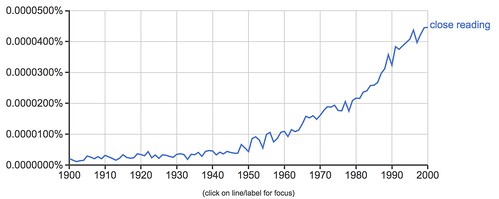
Figure 1: "Close reading"
And that’s when things became interesting. As more and more critics came to focus on interpretation, the profession became acutely aware of a problem: different critics produced different interpretations, which is the correct interpretation? Some critics even began to wonder whether or not there was such a thing as the correct interpretation. We are now well within the scope of the problem that bothered Haj: How do you justify one interpretation over another?
That’s the issue that was in play when I entered Johns Hopkins as a freshman in 1965. Though I had declared an interest in psychology, once I’d been accepted I gravitated toward literature. Which means that, even as I was working as hard as I could to figure out how to interpret a literary text, I was also party to conversations about the problematic nature of interpretation. As I have written elsewhere about those years at Hopkins [2] there’s no need to recount them here. The important point is simply that literary critics were acutely aware of the problematic nature of interpretation and devoted considerable effort to resolving the problem.
In the course of that problematic thrashing about, literary critics turned to philosophy, mostly Continental (though not entirely), and linguistics, mostly structuralist linguistics. In 1975 Jonathan Culler published Structuralist Poetics, which garnered him speaking invitations all over America and made his career. For Culler, and for American academia, structuralism was mostly French: Saussure, Jakobson (not French, obviously), Greimas, Barthes, and Lévi-Strauss, among others. But Culler also wrote of literary competence, clearly modeled on Chomsky’s notion of linguistic competence, and even deep structure. At this point literary critics, not just Culler, were interested in linguistics.
Here’s a paragraph from Culler’s preface (xiv-xv):
The type of literary study which structuralism helps one to envisage would not be primarily interpretive; it would not offer a method which, when applied to literary works, produced new and hitherto unexpected meanings. Rather than a criticism which discovers or assigns meanings, it would be a poetics which strives to define the conditions of meaning. Granting new attention to the activity of reading, it would attempt to specify how we go about making sense of texts, what are the interpretive operations on which literature itself, as an institution, is based. Just as the speaker of a language has assimilated a complex grammar which enables him to read a series of sounds or letters as a sentence with a meaning, so the reader of literature has acquired, through his encounters with literary works, implicit mastery of various semiotic conventions which enable him to read series of sentences as poems or novels endowed with shape and meaning. The study of literature, as opposed to the perusal and discussion of individual works, would become an attempt to understand the conventions which make literature possible. The major purpose of this book is to show how such a poetics emerges from structuralism, to indicate what it has already achieved, and to sketch what it might become.
However much critics may have been interested in this book, that interest did not produce a flourishing poetics. Even Culler himself abandoned poetics after this book. Interpretation had become firmly established as the profession’s focus.
As for the problem of justifying one interpretation over another, deconstructive critics argued that the meaning of texts was indeterminate and so, ultimately, there is no justification. Reader response critics produced a similar result by different means. The issue was debated into the 1990s and then more or less put on the shelf without having been resolved.
I have no quarrel with that. I think the basic problem is that literary texts of whatever kind – lyric or narrative poetry, drama, prose fiction – are different in kind from the discursive texts written to explicate them. There is no well-formed way of translating meaning from a literary to a discursive text. When you further consider that different critics may have different values, the problem becomes more intractable. Interpretation cannot, in principle, be strongly determined.
What, you might ask, what about the meaning that exists in a reader’s mind prior to any attempt at interpretation? Good question. But how do we get at THAT? It simply is not available for inspection.
What happens, though, when you give up the search for meaning? Or, if not give up, you at least bracket it and subordinate it to an interest in pattern and structure as intrinsic properties of texts? Is a poetics possible? Let’s set that aside for awhile and take a detour though the profession’s treatment of The Bard, William Shakespeare, son of a glover and London actor.
Friday, January 13, 2017
Is generative grammar moving to the “we knew it all along” phase?
As you may know, for the last few years the linguistics world has been transfixed by a cage match between Daniel “The Pirahã Whisperer” Everett and Noam “The World’s Greatest Intellectual” Chomsky over the nature of language. Chomsky claims, has claimed for years, that recursion is the central defining feature of human language, where syntax is the central ‘organ’ of language. Everett, on the other hand, claims that while recursion is central to human thought, it is not a necessary component of language. The argument centers on whether or not the language spoken by the Pirahã has recursive structures. Everett says “no” while Chomsky says “it has to.”
Everett has recently published an informal account of the controversy in Aeon, “Chomsky, Wolfe and me”. In his article he quotes Schopenhauer as saying “All truth passes through three stages. First, it is ridiculed. Second, it is violently opposed. Third, it is accepted as being self-evident.” I think the generativists are about to enter the third stage.
For the last few years I’ve been following, albeit at a distance, Faculty of Language, a blog devoted to generative grammar (GG). On January 6 Norbert Hornstein posted “Inchoate minimalism” and that post reads like the third stage is about to begin. As you may know minimalism is the latest version of Chomsky’s theory. He quotes a passage from Chomsky’s 1968 Language and Mind, arguing that it presages the minimalist program. Here’s the passage followed by Hornstein’s gloss:
Here’s the quote (L&M:182):I would, naturally, assume that there is some more general basis in human mental structure for the fact (if it is a fact) that languages have transformational grammars; one of the primary scientific reasons for studying language is that this study may provide some insight into general properties of mind. Given those specific properties, we may then be able to show that transformational grammars are “natural.” This would constitute real progress, since it would now enable us to raise the problem of innate conditions on acquisition of knowledge and belief in a more general framework....This quote is pedagogical in several ways. First, it does indicate that at least in Chomsky’s mind, GG from the get-go had what we could now identify as minimalist ambitions. The goal as stated in L&M is not only to describe the underlying capacities that make humans linguistically facile, but to also understand how these capacities reflect the “general properties of mind.” Furthermore, L&M moots the idea that understanding how language competence fits in with our mental architecture more generally might allow us to demonstrate that “transformational grammar is “natural”.” How so? Well in the obviously intended sense that a mind with the cognitive powers we have would have a faculty of language in which the particular Gs we have would embody a transformational component. As L&M rightly points out, being able to show this would “constitute real progress.” Yes it would.
Could those “general properties of mind” include recursion? Is that where this is going? Inquiring minds want to know.
Here’s Hornstein’s next paragraph:
It is worth noting that the contemporary conception of Merge as combining both structure building and movement in the “simplest” recursive rule is an attempt to make good on this somewhat foggy suggestion. If by ‘transformations’ we intend movement, then showing how a simple conception of recursion comes with a built in operation of displacement goes some distance in redeeming the idea that transformational Gs are “natural.”
Hey, Dan! Get ready. You’re about to be mugged!
Sunday, January 1, 2017
Polythetic Entitation & Cultural Coordinators
Timothy Taylor has an interesting entry in this year’s “Edqe Question” idea-fest. It has the ungainly title, Polythetic Entitation. He attributes the idea to the late David Clarke:
Clarke argued that the world of wine glasses was different to the world of biology, where a simple binary key could lead to the identification of a living creature (Does it have a backbone? If so, it is a vertebrate. Is it warm blooded? If so, it is a mammal or bird. Does it produce milk? ... and so on). A wine glass is a polythetic entity, which means that none of its attributes, without exception, is simultaneously sufficient and necessary for group membership. Most wine glasses are made of clear glass, with a stem and no handle, but there are flower vases with all these, so they are not definitionally-sufficient attributes; and a wine glass may have none of these attributes—they are not absolutely necessary. It is necessary that the wine glass be able to hold liquid and be of a shape and size suitable for drinking from, but this is also true of a teacup. If someone offered me a glass of wine, and then filled me a fine ceramic goblet, I would not complain.
Taylor is an archaeologist as was Clarke. They face the problem of how to identify cultural objects without knowing how they are used. An object’s physical characteristics generally do not speak unequivocally, hence the term polythetic (vs. monothetic). Thus:
Asking at the outset whether an object is made of glass takes us down a different avenue from first asking if it has a stem, or if it is designed to hold liquid. The first lumps the majority of wine glasses with window panes; the second groups most of them with vases and table lamps; and the third puts them all into a super-category that includes breast implants and Lake Mead, the Hoover dam reservoir. None of the distinctions provides a useful classificatory starting point. So grouping artefacts according to a kind of biological taxonomy will not do.As a prehistoric archaeologist David Clarke knew this, and he also knew that he was continually bundling classes of artefacts into groups and sub-groups without knowing whether his classification would have been recognized emically, that is, in terms understandable to the people who created and used the artefacts. Although the answer is that probably they did have different functions, how might one work back from the purely formal, etic, variance—the measurable features or attributes of an artefact—to securely assign it to its proper category?
What matters for proper classification are the attributes with “cultural salience” (Taylor’s term).
Now cultural salience is how I define the genetic elements of culture, which I have taken to calling coordinators. Coordinators are the culturally salient properties of objects or processes. In a terminology originally promulgated by Kenneth Pike, they are emics (notice that Taylor uses this terminology as well).
One thing that became clear to me in Dan Everett’s Dark Matter of the Mind (see my review in 3 Quarks Daily) is that a culture covers or paints (other terms of art I am considering) their natural environment with coordinators. Thus Everett talks about how, even after he’d been among the Pirahã for a couple years he simply could not see the jungle as well as they did. They were born and raised in it; he was not. Features of the jungle – creatures and events – that were obvious to the Pirahã because they had learned to identify them, that were culturally salient to the Pirahã, were invisible to Everett. They may have been right in front of his (lying) eyes, but he couldn’t discern them. They were not culturally salient to him, for his mind/brain had developed in a very different physical environment.
The polythetic nature of cultural artfacts is closely related to what I have called abundance elsewhere. The phenomena of the world have many properties; they are abundant. Only some of those properties will even be perceptually available; after all, our ears cannot hear all sounds, our eyes cannot see all electromagnetic radiation, etc. Of the perceptually available properties, only some will be culturally salient. This is as true for natural objects as for cultural artifacts and activities.
Saturday, December 24, 2016
My posts at 3 Quarks Daily
Listed in order started from the most recent.
To boldly go to the Edge....science in everyday life
Prelude and Exordium to the Ordination, Coronation, Inauguration, and Installation of the Grand High Singularity, Donald of Trump, Ruler of Universes Known, Unknown, Unimaginable and Phantasmagoric
Exposed! Daniel Everett Shines a Light on the Mind’s Dark Matter
We’re All in This Together: Life as Jamie Knows It
Martha Mills: Lawyer, Activist, Judge
Markos Vamvakaris: A Pilgrim on Ancient Byzantine Roads
Peace is Everybody’s Business, Nobody’s Job
A Brexit State of Mind: The Vision Thing
Grandpa, Proust, Ulysses and World War II
Ecstasy at Baltimore’s Left Bank Jazz Society
Break! How I Busted Three Trumpeters Out of a Maryland Prison
Jerry Seinfeld and Barack Obama Have a Meeting of the Minds
Three Moments in America’s Conversation on Race
Secrets of Pink Elephants Revealed
The United States Needs a Department of Peace
Why Miyazaki’s The Wind Rises is Not Morally Repugnant
Have the Internets Rotted My Brain and Wrecked My Mind?
Robert Frost, Time Traveler: The Road Not Taken
A White Blackman
Obama’s Pinckney Eulogy and the Place of Religious Discourse in Civic Life
Pontifex as Bridge Builder: the Encyclical Laudato Si (by Charles Cameron)
The Next 100 Years in the Human Sciences, a Reply to Frank Wilczek's Remarks about Physics
OK to Destroy: Jersey City's Graffiti Jam of April 2015
The Magic of the Bell and a Glimpse of Spirits
Cultural Styles in the 21st Century, or the High Tech Debt to Africa
Charlie Keil's Simple Appeal to the Pope on Behalf of the Future (by Charlie Keil)
Western Culture is an Ideological Fiction, and so are the Rest
Free-Floating Anxiety, Teens and Security Theatre
American Craziness: Where it Came from and Why it Won't Work Anymore
Evolving to the Future, the Web of Culture
Macroanalysis and the Directional Evolution of Nineteenth Century English-Language Novels
It's Time to Change the World, Again
Sing Me a Song of Hyperobjects: Starting Over with Humans and Other Creatures in the 21st Century CE
Graffiti is the Most Important Art Form of the Last Half-Century...
Graffiti and the Spirit of the Place
The Only Game in Town: Digital Criticism Comes of Age
Bundling, Dream Space, Love and the Farmer's Daughter
Some Varieties of Musical Experience
An Astonishing Tale about the Origins of Golf: A True Story
Charlie Keil: Groovologist
Two Problems for the Human Sciences, and Two Metaphors
To boldly go to the Edge....science in everyday life
Prelude and Exordium to the Ordination, Coronation, Inauguration, and Installation of the Grand High Singularity, Donald of Trump, Ruler of Universes Known, Unknown, Unimaginable and Phantasmagoric
Exposed! Daniel Everett Shines a Light on the Mind’s Dark Matter
We’re All in This Together: Life as Jamie Knows It
Martha Mills: Lawyer, Activist, Judge
Markos Vamvakaris: A Pilgrim on Ancient Byzantine Roads
Peace is Everybody’s Business, Nobody’s Job
A Brexit State of Mind: The Vision Thing
Grandpa, Proust, Ulysses and World War II
Ecstasy at Baltimore’s Left Bank Jazz Society
Break! How I Busted Three Trumpeters Out of a Maryland Prison
Jerry Seinfeld and Barack Obama Have a Meeting of the Minds
Three Moments in America’s Conversation on Race
Secrets of Pink Elephants Revealed
The United States Needs a Department of Peace
Why Miyazaki’s The Wind Rises is Not Morally Repugnant
Have the Internets Rotted My Brain and Wrecked My Mind?
Robert Frost, Time Traveler: The Road Not Taken
A White Blackman
Obama’s Pinckney Eulogy and the Place of Religious Discourse in Civic Life
Pontifex as Bridge Builder: the Encyclical Laudato Si (by Charles Cameron)
The Next 100 Years in the Human Sciences, a Reply to Frank Wilczek's Remarks about Physics
OK to Destroy: Jersey City's Graffiti Jam of April 2015
The Magic of the Bell and a Glimpse of Spirits
Cultural Styles in the 21st Century, or the High Tech Debt to Africa
Charlie Keil's Simple Appeal to the Pope on Behalf of the Future (by Charlie Keil)
Western Culture is an Ideological Fiction, and so are the Rest
Free-Floating Anxiety, Teens and Security Theatre
American Craziness: Where it Came from and Why it Won't Work Anymore
Evolving to the Future, the Web of Culture
Macroanalysis and the Directional Evolution of Nineteenth Century English-Language Novels
It's Time to Change the World, Again
Sing Me a Song of Hyperobjects: Starting Over with Humans and Other Creatures in the 21st Century CE
Graffiti is the Most Important Art Form of the Last Half-Century...
Graffiti and the Spirit of the Place
The Only Game in Town: Digital Criticism Comes of Age
Bundling, Dream Space, Love and the Farmer's Daughter
Some Varieties of Musical Experience
An Astonishing Tale about the Origins of Golf: A True Story
Charlie Keil: Groovologist
Two Problems for the Human Sciences, and Two Metaphors
Sunday, December 4, 2016
Neurolinguistics of Language
Here's links to a bunch of recent articles in Journal of Neurolinguistics (H/t Dan Everett). Note that all are behind a paywall, but you can at least link through to see some abstracts. I've listed two articles (plus abstracts) that caught my attention on a quick look:
* * * * *
A re-visit of three-stage humor processing with readers' surprise, comprehension, and funniness ratings: An ERP studyHighlights
- •
- The roles of surprise, comprehension, and amusement levels in humor processing were examined.
- •
- Participants were divided into high/low score groups based on their behavioral ratings to verbal jokes.
- •
- Highly surprised, comprehended, and amused group elicited larger N400, P600, and LPP effects, respectively.
- •
- These intergroup variances supported the three-stage model of humor processing.
Abstract
Humor processing can be divided into three sub-stages including incongruity detection, incongruity resolution, and elaboration (2, 3 and 10). However, few studies have investigated the three-stage model of humor processing with readers' surprise, comprehensibility and funniness levels, and little discussion has been devoted to its biological underpinning. To verify the credibility of the three-stage model, electroencephalography (EEG) was utilized in corroboration with two types of stimuli including jokes and non-jokes in the present research. Participants were categorized into high vs. low score groups based on their rating scores of surprise, comprehension, and funniness to joke stimuli. The between-group analyses showed that compared with the less surprised group, highly surprised people elicited a primarily larger N400, which may suggest more incongruity perceived in reading jokes. Additionally, good comprehenders mainly elicited a larger P600, probably indicating a more successful resolution of detected incongruity in comparison with poor comprehenders. Finally, the highly amused group elicited a larger late positive potential (LPP) compared with the less amused group, which could reflect more affective elaboration of jokes. Participants' surprise, comprehension, and funniness levels had smaller impacts on other chief electrophysiological components, with the effects varying with different group contrasts. These results provided the evidence that different degrees of surprise, comprehensibility, and amusement to jokes would influence the three sub-stages (incongruity detection, incongruity resolution, and elaboration) respectively in humor processing. The current study thus generally re-verified the stability of the three-stage model through participants' behavioral ratings which had seldom been touched upon.
* * * * *
Individual differences in the bilingual brain: The role of language background and DRD2 genotype in verbal and non-verbal cognitive controlHighlights
- •
- Bilingual language control is associated with activity in the inferior frontal gyrus.
- •
- Non-verbal control is associated with activity in the anterior cingulate cortex.
- •
- Specific genotypes predict fMRI activity during language control and task switching.
- •
- Bilingual experience predicts fMRI activity during language control and inhibition.
Abstract
Bilingual language control may involve cognitive control, including inhibition and switching. These types of control have been previously associated with neural activity in the inferior frontal gyrus (IFG) and the anterior cingulate cortex (ACC). In previous studies, the DRD2 gene, related to dopamine availability in the striatum, has been found to play a role in neural activity during cognitive control tasks, with carriers of the gene’s A1 allele showing different patterns of activity in inferior frontal regions during cognitive control tasks than non-carriers. The current study sought to extend these findings to the domain of bilingual language control. Forty-nine Spanish-English bilinguals participated in this study by providing DNA samples through saliva, completing background questionnaires, and performing a language production task (picture-naming), a non-verbal inhibition task (Simon task), and a non-verbal switching task (shape-color task) in the fMRI scanner. The fMRI data were analyzed to determine whether variation in the genetic background or bilingual language background predicts neural activity in the IFG and ACC during these three tasks. Results indicate that genetic and language background variables predicted neural activity in the IFG during English picture naming. Variation in only the genetic background predicted neural activity in the ACC during the shape-color switching task; variation in only the language background predicted neural activity in the ACC and IFG during the Simon task. These results suggest that variation in the DRD2 gene should not be ignored when drawing conclusions about bilingual verbal and non-verbal cognitive control.
Monday, November 14, 2016
Dan Everett’s Dark Matter @ 3QD
Consider these three words: gavagai, gabagaí, gabagool. If you’ve been binge watching episodes in the Star Trek franchise you might suspect them to be the equivalent of veni, vidi, vici, in the language of a space-faring race from the Gamma Quadrant. The truth, however, is even stranger.
The first is a made-up word that is well-known in certain philosophical circles. The second is not quite a word, but is from Pirahã, the Amazonian language brought to our attention by ex-missionary turned linguist, Daniel Everett, and can be translated as “frustrated initiation,” which is how Everett characterized his first field trip among the Pirahã. The third names an Italian cold cut that is likely spelled “capicola” or “capocolla” when written out and has various pronunciations depending on the local language. In New York and New Jersey, Tony Soprano country, it’s “gabagool”.
Everett discusses first two in his wide-ranging new book, Dark Matter of the Mind: The Culturally Articulated Unconscious (2016), which I review at 3 Quarks Daily. As for gabagool, good things come in threes, no?
Why gavagai? Willard van Orman Quine coined the word for a thought experiment that points up the problem of word meaning. He broaches the issue by considering the problem of radical translation, “translation of the language of a hitherto untouched people” (Word and Object 1960, 28). He asks us to consider a “linguist who, unaided by an interpreter, is out to penetrate and translate a language hitherto unknown. All the objective data he has to go on are the forces that he sees impinging on the native’s surfaces and the observable behavior, focal and otherwise, of the native.” That is to say, he has no direct access to what is going on inside the native’s head, but utterances are available to him. Quine then asks us to imagine that “a rabbit scurries by, the native says ‘Gavagai’, and the linguist notes down the sentence ‘Rabbit’ (or ‘Lo, a rabbit’) as tentative translation, subject to testing in further cases” (p. 29).
Quine goes on to argue that, in thus proposing that initial translation, the linguist is making illegitimate assumptions. He begins his argument by noting that the native might, in fact, mean “white” or “animal” and later on offers more exotic possibilities, the sort of things only a philosopher would think of. Quine also notes that whatever gestures and utterances the native offers as the linguist attempts to clarify and verify will be subject to the same problem.
As Everett notes, however, in his chapter on translation (266):
On the side of mistakes never made, however, Quine’s gavagai problem is one. In my field research on more than twenty languages—many of which involved monolingual situations ... whenever I pointed at an object or asked “What’s that?” I always got an answer for an entire object. Seeing me point at a bird, no one ever responded “feathers.” When asked about a manatee, no one ever answered “manatee soul.” On inquiring about a child, I always got “child,” “boy,” or “girl,” never “short hair.”
Later:
I believe that the absence of these Quinean answers results from the fact that when one person points toward a thing, all people (that I have worked with, at least) assume that what is being asked is the name of the entire object. In fact, over the years, as I have conducted many “monolingual demonstrations,” I have never encountered the gavagai problem. Objects have a relative salience… This is perhaps the result of evolved perception.
Frankly, I forget how I reacted to Quine’s thought experiment when I first read it as an undergraduate back in the 1960s. I probably found it a bit puzzling, and perhaps I even half-believed it. But that was a long time ago. When I read Everett’s comments on it I was not surprised to find that the gavagai problem doesn’t arise in the real world and find his suspected explanation, evolved perception, convincing.
Friday, November 11, 2016
We think with gestures and things
In Dark Matter of the Mind Dan Everett devotes a chapter to gesture and its relation to speech. Writing in The Conversation, Gaëlle Vallée-Tourangeau and Frédéric Vallée-Tourangeau argue that gestures are important in thinking:
...that people’s thoughts, choices and insights can be transformed by physical interaction with things. In other words, thinking with your brain alone – like a computer does – is not equivalent to thinking with your brain, your eyes, and your hands – as humans frequently do.The mind in the worldIn the course of problem solving, we naturally tend to recruit artefacts and manipulate them to augment and transform our ability to think and to explain ourselves. Consider a game of Scrabble: players naturally touch, move and re-arrange the tiles they receive. If thinking were simply done “in the head”, what’s the purpose of these moves?In fact, these moves are integral to the process of generating words. As players reconfigure the physical properties of their environment, they are not simply making it easier for them to think; they are thinking. Moves can be deliberate or serendipitous. This suggests that thinking is fundamentally relational: it unfolds along a series of physical changes in the environment that at times affects, and at times is affected by, a series of biological changes in the brain.
And so it goes with creativity and insight:
I would add, anecdotally, that I find that pacing helps me to think. And, as I've argued, drawing diagrams as well.While posing a problem presented using a classic pencil and paper format never led to a breakthrough, those who could use physical artefacts to build a model of the problem were much more likely to reach some insight, no matter the difference between the partipants’ cognitive abilities.We also applied this approach to the study of complex statistical reasoning. Previous research had found that, depending on the ease of mentally representing the statistical information presented, between 11% and 40% of people succeeded in solving these reasoning problems using just pen and paper.We presented the same information on a pack of cards which reasoners were free to spread out and rearrange in any way they like. Not all participants fully engaged with the cards – perhaps unwilling to be judged as poor thinkers for doing so. Yet the success rate for those who made the most of this opportunity to use the material world to boost their thinking leapt to a 75% success rate.
Wednesday, November 9, 2016
Evolution of Language – Will we crack it in 30 years?
When I was young, they was relatively little work on the evolution of human language. Back in the 19th century the Société Linguistique de Paris banned the topic and that ban seemed in effect. By the 1990s, however, things had changed. The evolution of language was now not only a respectable topic for research, but a popular one.
These days any number of people would like to be recognized as the one who discovered how language came about. But discovering the origin of language is rather different from, for example, discovering the tomb of an Egyptian pharaoh. Tombs are physical things with definite locations. To a first approximation, you either know it exists and where, or you don’t. If you start digging in a deserted area and find a tomb, then you discovered it. Simple enough.
But language, how does one discover its origins? The big problem, of course, is that we have no direct observations. If we had a time machine then we could gather such observations. We’d know when and where language originated, and perhaps even how.
Of would we? There is the problem of definition. These communication phenomena we’ve observed, language or not? But that’s likely a matter of mere semantics. It doesn’t really matter just which of them we’re going to certify as ‘real’ language. What needs to be explained, explained, is the entire evolutionary run from a point where there is no language to one where, yes, that’s definitely language. And, while having direct observations of that run would certainly help, it won’t tell us everything. It will tell us about the relationship between spoken language and associated behavior and that will be useful. But it won’t tell us what’s happening in the brain.
Still, I’m beginning to think that we may arrive at a consensus account within 20 or 30 years. I’ve given considerably thought to a related question, the origins of music, which I discussed in Beethoven’s Anvil a decade and a half ago. I extended those ideas at bit and had some remarks on language in Synch, Song, and Society, an essay-review of Steven Mithen’s The Singing Neanderthals. I have no intention of summarizing those arguments here, but I need to mention that I joined the ancient and venerable parade of those who believe that music, or something like it, not only preceded the emergence of language, but is a necessary precursor.
All of this is a prelude to Dan Everett’s new book, Dark Matter of the Mind: The Culturally Articulated Unconscious, which I’m currently reading. As the title indicates, it’s not about the origins of language, but the subject does come up, particularly in his discussion of work on the relationship between gesture and language. I find that discussion very encouraging. That, along with what I already know, is what has me thinking that we may arrive at a consensus account in 20 or 30 years.
If so, the account will stretch over many specific disciplines scattered across linguistics, psychology, anthropology, neuroscience, biology, and who knows what else. The trick is to pull all that together. That’s something our academic institutions are not suited for. If anything, they work against it.
We’ll see.
Thursday, September 15, 2016
McWhorter on Wolf on Chomsky and Everett: What color are the thoughts of a 12-tone squid sleeping furiously?
Dan Everett says that John McWhorter's review of Tom Wolf's The Kingdom of Speech is the best review of the book to date. I'll take Dan's word for it. The book, as you may know, pits Everett against Chomsky in the Intellectual Cage Match of the Century.
Here's McWhorter getting started on Chomskyian linguistic theory:
For example, in English we say, What do you want? But Chomskyan theory suggests that when our brains first assemble such a sentence, it structures it as You want what? This hardly seems implausible, since what is the object of want and objects usually come after their verb in English (I kick the ball). Besides, we can even actually say, "You want what?" depending on the tone we intend.Thus, Chomskyan syntax has it that — in English, although obviously not in all other languages — there is a special rule for a word like what, which moves it from after want to the beginning of the sentence.So far, fine. But from one academic generation to the next, this method of parsing language has mission-crept into a strangely complicated business, increasingly unrelated to what either laypeople or intellectuals outside of linguistics would think of as human language. It is truly one of the oddest schools of thought I am familiar with in any discipline; it intrigues me from afar, like giant squid and 12-tone classical music.
Yes! I like the slippage "from one academic generation to the next," which I've observed in literary theory. And McWhorter has a word on that as well:
And as to whether the density of the jargon (which I have spared the reader) is deliberately fashioned for an air of profundity, the charge is as unnecessary as it is against the lingo of literary criticism. The jargon accreted gradually and imperceptibly over decades, and is readily comprehensible to practitioners.
This McWhorter, he's a level-headed guy. On Dan Everett:
Everett agrees that there is some kind of genetic specification for language in a general sense — there’s a reason chimpanzees do not talk and do not even use sign language on a primitive level unless painstakingly taught to by humans. But he dismisses the idea that it calls for quietly shifting subjects, verbs bouncing around, or exercising the mental muscles that perform math and create computer programs. Language is just saying what you are: "Our identities and our cultural cloaks," as Everett has put it. For those dedicated to Chomsky’s syntactical tree diagrams, this could only sound simplistic, uninformed, and even dangerous — distracting the public from science with feel-good pablum.
FWIW McWhorter thinks the syntacticians may have a point:
Wolfe describes how three die-hard Chomskyans penned an almost obsessively detailed rebuttal to Everett’s claims about Pirahã in linguistics’ flagship journal Language, making them seem like hapless, sputtering refugees from The Revenge of the Nerds. The truth is that even someone more inclined to Everett's claims than the Chomskyans' – e.g., me — who slogged through that rebuttal plus the response from Everett and a riposte from the syntacticians, ends up unexpectedly finding the syntacticians largely convincing. It seems quite plausible that Pirahã is not as quirky a human language as Everett proposed.
The whole thing is worth reading.
Sunday, May 22, 2016
Chomsky, Hockett, Behaviorism and Statistics in Linguistics Theory
Here's an interesting (and recent) article that speaks to statistical thought in linguistics: The Unmaking of a Modern Synthesis: Noam Chomsky, Charles Hockett, and the Politics of Behaviorism, 1955–1965, by Gregory Radick (abstract below). Commenting on it at Dan Everett's Facebook page, Yorick Wilks observed: "It is a nice irony that statistical grammars, in the spirit of Hockett at least, have turned out to be the only ones that do effective parsing of sentences by computer."
Abstract: A familiar story about mid-twentieth-century American psychology tells of the abandonment of behaviorism for cognitive science. Between these two, however, lay a scientific borderland, muddy and much traveled. This essay relocates the origins of the Chomskyan program in linguistics there. Following his introduction of transformational generative grammar, Noam Chomsky (b. 1928) mounted a highly publicized attack on behaviorist psychology. Yet when he first developed that approach to grammar, he was a defender of behaviorism. His antibehaviorism emerged only in the course of what became a systematic repudiation of the work of the Cornell linguist C. F. Hockett (1916–2000). In the name of the positivist Unity of Science movement, Hockett had synthesized an approach to grammar based on statistical communication theory; a behaviorist view of language acquisition in children as a process of association and analogy; and an interest in uncovering the Darwinian origins of language. In criticizing Hockett on grammar, Chomsky came to engage gradually and critically with the whole Hockettian synthesis. Situating Chomsky thus within his own disciplinary matrix suggests lessons for students of disciplinary politics generally and—famously with Chomsky—the place of political discipline within a scientific life.
Saturday, October 25, 2014
John Lawler on the Current State of Generative Grammar
From a Facebook conversation with Dan Everett (about slide rules, aka slipsticks, no less) and others:
The constant revision and consequent redefining and renaming of concepts – some imaginary and some very obvious – has led to a multi-dimensional spectrum of heresy in generative grammar, so complex that one practically needs chromatography to distinguish variants. Babel comes to mind, and also Windows™ versions. Most of the literature is incomprehensible in consequence – or simply repetitive, except it's too much trouble to tell which.
–John Lawler
Subscribe to:
Posts (Atom)