Showing posts with label Xanadu. Show all posts

Friday, August 8, 2025

Intellectual creativity, humans-in-the-loop, and AI: Interlude, Claude on “xanadu” and the metaphysical structure of the world

After yesterday’s post about the Xanadu meme went up I started wondering just how an AI, a current AI, would even confront such a question. Why would an AI issue a simple one-word query to the web: “Xanadu”? And when it got 2,000,000 hits, what reason would it have to think that a large number? I decided to have a discussion with Claude Sonnet 4 about “xanadu.” That eventually led to an interesting discussion that ended with something I’ve been calling “the metaphysical structure of the world.” I introduced the term in a blog post from August of 2020, which I’d written in the wake of GPT-3 and then included it in my working paper, GPT-3: Waterloo or Rubicon? Here be Dragons. I’m beginning to think it might be useful. 

On the way there ChatGPT made the following observation

Current AI systems are remarkable at following up on investigations once they’re pointed in a direction. But that initial moment of recognition - “this might be interesting” - seems to require a different kind of agency. It’s not just pattern recognition; it’s pattern recognition combined with intrinsic motivation and aesthetic judgment about what’s worth pursuing.

Yes.

As always in these discussions, my prompts are in boldface.

* * * * *

“Xanadu”

What comes to mind when I say “Xanadu”?

Several things come to mind with “Xanadu”:

Literary: Most famously, it’s from Coleridge’s poem “Kubla Khan” - “In Xanadu did Kubla Khan / A stately pleasure-dome decree” - describing an exotic, dreamlike palace.

Historical: The actual Xanadu (Shangdu) was Kublai Khan’s summer capital in 13th-century Mongolia, which inspired Coleridge’s poem.

Pop culture: The 1980 musical film with Olivia Newton-John and Gene Kelly, along with its title song. There’s also Rush’s epic song “Xanadu” from their album A Farewell to Kings.

Cinema: In Citizen Kane, it’s the name of Charles Foster Kane’s sprawling, isolating estate.

The word has become synonymous with an idealized, fantastical place - somewhere luxurious but perhaps unattainable or illusory. It carries this sense of exotic grandeur mixed with a hint that such perfection might be more dream than reality.

What made you think of Xanadu? Were you thinking of one of these references in particular?

I was just curious. Back in January of 2006 I typed “Xanadu” into Google and got 2,000,000. That surprised me. “Xanadu” is not a common term. People don’t have much of an opportunity to use it. Yet there were 2 million web pages that mention it.

That’s a fascinating observation! You’ve hit on something really interesting about how language spreads in digital spaces versus everyday conversation.

“Xanadu” is indeed quite rare in daily speech - most people might go years without using it. But on the web, it has this remarkable reach because it’s such an evocative, culturally loaded word. Each of those cultural touchstones I mentioned creates its own cluster of web content: literary analysis sites discussing Coleridge, movie review sites covering the film, music sites with Rush lyrics, film studies pages about Citizen Kane.

Plus, “Xanadu” is exactly the kind of word that gets borrowed for business names, product names, gaming references, fantasy literature, and artistic projects. It carries this instant sense of mystery and grandeur that appeals to people creating content.

Your 2006 observation captures something about how the internet amplifies certain words that have cultural resonance far beyond their frequency in speech. Words that are “mythologically useful” - like Xanadu, Atlantis, Eden - probably punch way above their weight in search results because they’re so semantically rich.

It’s a perfect example of how digital archaeology can reveal hidden patterns in our collective cultural consciousness. Did you notice similar patterns with other evocative but uncommon words when you were exploring search results back then?

It didn’t take long to figure out that most of the hits did not link to pages mentioning Coleridge’s poem. After a bit I determined that a lot of the hits belonged in what I termed the “sybaritic” cluster, which I trace back to Citizen Kane. Lots of people saw that movie and it has a fairly substantial cultural presence. The movie itself quotes the first five lines of the poem in the newsreel sequence and, as you mentioned, there’s Kane’s mansion.

That’s a brilliant piece of cultural archaeology! Your “sybaritic cluster” concept really captures how Citizen Kane became the dominant cultural vector for “Xanadu” rather than the original Coleridge poem.

It makes perfect sense - while English literature students encounter the poem, Citizen Kane reached massive audiences and embedded “Xanadu” firmly in the American cultural lexicon as shorthand for extravagant, perhaps excessive luxury. The film’s Xanadu represents wealth turned grotesque and isolating, but the name itself got detached from that cautionary context.

So you probably found tons of luxury hotels, upscale restaurants, spa resorts, real estate developments, and high-end businesses that borrowed the name purely for its connotations of opulence. They’re not thinking about Mongolian summer palaces or Romantic poetry - they’re thinking about that sense of ultimate luxury that Kane’s estate represented.

This is such a neat example of how cultural transmission works. The literary source provides the raw material, but a hugely influential film recontextualizes it and creates the dominant semantic pathway. Most people using “Xanadu” for their luxury business probably have no idea they’re referencing Coleridge - they’re unconsciously channeling Welles.

Did you find that pattern held up as you dug deeper? Were there other cultural artifacts where you could trace similar semantic drift from high culture sources through popular media?

Ted Nelson’s Project Xanadu

I also identified a cluster I called the “cybernetic” cluster. For example, there’s a spot on Saturn’s moon, Titan, that I put in that cluster. Where do you think this cybernetic cluster comes from?

Ah, that has to trace back to Ted Nelson’s “Project Xanadu” - his pioneering hypertext system from the 1960s! Nelson chose the name explicitly referencing Coleridge’s poem, envisioning his system as a kind of “magic place of literary memory” where all human knowledge could be interconnected.

Thursday, August 7, 2025

Intellectual creativity, humans-in-the-loop, and AI: Part 3, The Xanadu meme

The process of chasing down the Xanadu “meme” was quite different from interpreting Spielberg’s Jaws.

Late in 2005 I had become a guest author at a now defunct group blog, The Valve, which was having a symposium on Franko Moretti’s book, Graphs, Maps, Trees. In that general context I did a web search on the term, “Xanadu,” though at this point I don’t recall whether or not I was explicitly thinking about that symposium when I did the search. Judging from my notes, that was likely in the second week of January 2006. To surprise I got roughly 2 million hits.[1] That seemed high to me. On a hunch I decided to investigate. On January 24 posted the (initial) results of my investigation, One Candle, a Thousand Points of Light: Moretti and the Individual Text. I argued that many of the hits feel into one of two clusters, which I termed the sybaritic group and the cybernetic group.

I don’t recall any moment when, after I made that first web search, I decided “I’ve got it.” That is, there was no moment comparable to the point in my work on Jaws where, suddenly recalling Girard’s ideas, I switched from open-ended exploration to the focused elaboration of a specific thesis. Judging from my vague recollections and from notes I made at the time, what seems to have happened is that, as I went poking around what I found was sufficient to justify the effort, so I kept it up. Before long I had something worth writing about. Four years later, in March of 2010, I published a working paper, One Candle, a Thousand Points of Light: The Xanadu Meme. Then, earlier this year (July 10, 2025), I called on ChatGPT to update that work, Tracking the “Xanadu” Meme.

Let’s take a closer look.

Note: Richard Dawkins introduced the term “meme” in his 1976 book, The Selfish Gene. He thought of it as the cultural analog to the biological gene. Since that time there has been considerable discussion of memes in cultural evolution without any consensus being established. For various reasons I’ve decided to abandon the term as a term of art and talk about coordinators instead. But we need not worry about that here. For the purposes of this post the term “meme” is fine as long as you realize that I’m not using it as a technical term. It’s just a convenient way of referring to a “bit” of culture without worry about just what role it plays in the process.

Cultural evolution

I don’t recall just why I did a web search on “Xanadu.” I do a lot of things out of idle curiosity. Let’s chalk it up to that.

I was surprised when I got 2,000,000 hits. Why? For one thing, “Xanadu” is not a common word. It has no use in daily life. It’s the name of Kubla Khan’s summer capital in 13th century CE. It’s also the second work I Coleridge’s poem “Kuba Khan,” which begins, “In Xanadu did Kubla Khan/ A stately pleasure-dome decree.” I had a long-standing interest in that poem, which is why I searched on that term. And, while it is one of the best-known poems in the English language, as these things go, it’s not that well known, not in comparison to recent pop songs, current movie stars, major world leaders, and so forth.

Beyond that, I have a long-term interest in cultural evolution. Thus I wasn’t thinking about “Xanadu” as just some word. I was thinking about it as a culturally laden word. Perhaps its presence on the web tells us something about culture?

By the time I’d done that web search I also knew that “Xanadu” has been introduced into modern English through Coleridge’s poem. I also knew that that poem had been quoted in Orson Welles’ 1941 movie, Citizen Kane, where it was the name of a mansion Kane had built in Florida. I saw the film in college in the 1960s and then again somewhat later when it had been re-released. Citizen Kane has been called the best (American) film ever made. Regardless of that claim, it’s been seen by millions of people. Could it be that a lot of those web hits could be traced back to Welles’ film rather than to Coleridge’s poem? That is, the people who’d created those pages, and many who saw them, may never had read Coleridge’s poem.

That’s the kind of question that was on my mind when I began poking around on the web. I saw the web, which its rich connectivity, as a way of exploring how the process of cultural evolution. Perhaps “Xanadu” was an interesting case. I didn’t take much work for me to conclude that, yes, a lot of those hits probably could be traced back to Citizen Kane. That gave me what I termed the sybaritic group of web pages, which is about luxury and excess verging into sensuality (see what you get when you search on “sex Xanadu”). 

The cybernetic cluster appears 

Now let’s look at the pages returned by my “Xanadu” query early in 2006. These were the first ten items returned:

1. Xanadu (1980): Xanadu - Cast, Crew, Reviews, Plot Summary, Comments, Discussion, Taglines, Trailers, Posters, Photos, Showtimes, Link to Official Site, Fan Sites.

2. Kubla Khan: In Xanadu did Kubla Khan A stately pleasure-dome decree: Where Alph, the sacred river, ran Through caverns measureless to man: Down to a sunless sea. ...

3. Xanadu Australia: The name "Xanadu" and the Flaming-X symbol are software an eid service trademarks of Project Xanadu, registered in certain countries and claimed elsewhere. ...

4. XANADU Software Home Page: In XANADU did Kubla Khan A stately pleasure dome decree... ---. The XANADU software package comprises high-level, multi-mission tasks for X-ray astronomical ...

5. Welcome to Udanax.com: Xanadu Secrets Become Udanax Open-Source. The long history of the Xanadu® vision of hypertext has inspired many individual

6. The Mills - Madrid Xanadu: Madrid Xanadu · Register for X Alerts. Lo último en Madrid Xanadú. No hay ningún evento previsto actualmente.

7. Index: .:Test Page - www2:. www.xanaduwines.com.au/ - 1k - Cached - Similar pages

8. Xanadu: The language and translation wizard Xanadu: The language and translation wizard. Translate words and terms. Find professional translators. Read language related news.

9. Amazon.com: Xanadu (1980): DVD: Xanadu, Olivia Newton-John, Gene Kelly, Michael Beck, James Sloyan, Dimitra Arliss, Katie Hanley, Fred McCarren, Ren Woods, Sandahl Bergman, Lynn Latham, ...

10. Ted Nelson and Xanadu: The Electronic Labyrinth is a study of the implications of hypertext for creative writers looking to move beyond traditional notions of linearity.

From my 2006 post:

The first and ninth items are for a 1980 movie starring Olivia Newton-John and are obviously associated with her hit song of the same name [...] The second item is a text of the poem itself in the online text repository at the University of Virginia [...] This is one of many copies of the text online; I've made no attempt to count them, but that should be doable with the appropriate resources. Entries three, four, five, eight, and ten are all related to Ted Nelson's Xanadu project [...] There's nothing at item seven, nor do I have any idea why it is so highly ranked. Item eight is a retail and entertainment complex in Madrid (also in the Wikipedia list) that features an indoor ski-slope – caves of ice?

Think about entries 3, 4, 5, 8, and 10. They’re all associated with a single software project, Ted Nelson’s pioneering hypertext work, Project Xanadu, which was well-known in the tech world. That’s where I got the idea of a cybernetic cluster of web pages. Entries 1 and 9 are related to Olivia Newton-John’s 1908 film, Xanadu, in which Gene Kelly recites the opening lines of “Kubla Khan.” They belong to the sybaritic cluster.

That’s more or less where things stood when I posted my results to The Valve. But if you go to the link above you’ll see that the post generated a fair amount of discussion. And on January 26 I posted some remarks from my friend, the late Tim Perper, who was trained as a biologist, who’d posted some simple Boolean queries which refined my results. I took a cue from Tim and generated some queries of my own. That discussion went into early February. (Note: I’ve also made a PDF of the post and the whole discussion, which you can download here.)

Looking through my files I see I have an unpublished document from February 8, 2006, “Notes on Xanadu Lineages and Related Matters.” In that document, a month after the discussion at The Valve, I’d decided that Olivi Newton-John’s song and film, Xanadu, had in fact established a third population of hits that was independent of the first two, the sybaritic and the cybernetic. That’s where things remained when I decided to wrap things up and publish that working paper: One Candle, a Thousand Points of Light: The Xanadu Meme.

But still, what got me started?

That’s where I ended up. But what got me started in the first place? As I said, I was surprised that a search on “Xanadu” turned up 2,000,000 hits. So what? In what sense is 2,000,000 a large number? I should note that I did a number of searches at various intervals just to verify the number. I’d gotten as few as 1,600,000 hits and on one occasion 7,000,000. As I noted in my post at The Valve:

Yet there's more involved that simply the number itself, which is, in context, not terribly impressive. Though it is not easy to determine how many pages there are in the web, the number is probably upward of 4 billion. Two million hits is five ten thousandths of the web. But, what percentage of the web would you expect any one query item to retrieve? At this point these are just numbers; their significance is obscure.

At this point I’m included to say that I had a hunch, a hunch that turned out to lead somewhere. I have lots of hunches. I follow some of them, and some of them actually lead somewhere.

On the one hand, by that time I had a good deal of experience in make web searches and so had developed some sense of the kind of results you get when making a query. That’s the background against I had my hunch, vague though it is. But, as I’ve already said, I was interested in cultural evolution. And cultural evolution takes place through hundreds upon thousands upon millions of face-to-face transactions between individuals, but also broadcast transactions between individuals that various media properties. “Xanadu” is one of those bits of culture.

Opportunity cost

Here's how I’m now thinking about it: I had a hunch as a result of making a web query. Making web queries is easy. So I decided to verify my initial query. Easy to do. It was easy to look up “Xanadu” in Wikipedia and see what turns up there. Similarly, I could go to the Oxford English Dictionary and I could even query the archives of The New York Times for occurrences of the term. All of these things were quick and easy and, wouldn’t you know, the results turned out to be interesting.

And I didn’t have anything pressing on me at the time.

That is to say, conversely, the opportunity cost of getting more information was low. As long as new stuff turned up, why stop? That’s what kept me going long enough to produce my initial post to The Valve and kept me continuing on until, in the middle of March, I’d decided that we had three clusters, not two. I didn’t see any point in trying to work things into a formal article since I didn’t know of any place that would consider such an article. So I stopped working.

Academia.edu started up in 2008. I probably found out about it shortly after, but I don’t know when I decided to join it myself. Once I did I realized that, not only could I use it as a way of distributing articles that I’d already published, but I could use it to distribute new work. That’s when I decided to take the work that I’d done on “Xanadu” and publish it though Academia.edu.

At some point I wondered whether or not I should update that work. I’ve got records of web searches I did in 2018. But I never got around to doing all the fiddly details needed for a proper update. Why not? Opportunity cost. I had more fruitful ways of using my time.

Then earlier this year, I was doing some work with ChatGPT where I uploaded my working paper in connection with something or another. ChatGPT offered to update that work.

I wasn’t interested in it at just that moment, but I kept the offer in mind and a couple weeks later decided to go ahead with the study. It turned out that ChatGPT had to work through the night executing the study, but that wasn’t my time. I was sleeping. When I got up the next morning, the study was done. It was then a relatively simple matter to combine that work with a summary of my original paper and produce the updated study: Tracking the “Xanadu” Meme.

* * * * *

[1] By way of comparison, when I search Google on “Xanadu” today I get roughly 9 million hits.

Thursday, July 10, 2025

Tracking the “Xanadu” Meme

New working paper. Title above, links, abstract, table of contents, and introduction below:

Academia.edu: https://www.academia.edu/130470494/Tracking_the_Xanadu_Meme
SSRN: https://papers.ssrn.com/sol3/papers.cfm?abstract_id=5346920
ResearchGate: https://www.researchgate.net/publication/393569547_Tracking_the_Xanadu_Meme

Abstract: I treat a single word, Xanadu, as a “meme” and follow it from a 17th century book to a 19th century poem (Coleridge's "Kubla Khan"), into the 20th century where it was picked up by a classic movie (Citizen Kane), an ongoing software development project (Ted Nelson's Project Xanadu), another movie and hit song, Olivia Newton-John’s Xanadu, and a few other events. The aggregate result is that many occurrences of “Xanadu” fall into clusters that resonate with one of these founding events. Thus while some occurrences are directly related to Coleridge's poem, more seem to be related these other events and thus only indirectly to Coleridge’s poem. For example, one large cluster of Xanadu sites is high tech while another cluster is about luxury and excess. Fifteen years ago I used manual methods to identify these clusters and estimate their sizes. Now I use ChatGPT o3 to update that work and to create a methodology for identifying other terms with similar distributions.

Background: Tracking Down the “Xanadu” Meme 2
“Xanadu” as Meme 2
The Origin, Growth, and Structure of the Xanadu System 3
Xanadu Meme Dynamics, 1999–2025: Methodology and Findings 8
Calibrating the Results 10
What Other Terms Would Have Traceable Lineages? 11
Meta: Man and Machine 12
Appendix 1: Donald Trump and the Xanadu Meme 13
Appendix 2: The Xanadu Mandala 14
References 16

Background: Tracking Down the “Xanadu” Meme

Sometime early in January of 2005 I did a Google search on the term “Xanadu,” which is the second work in Coleridge’s well-known poem, “Kubla Khan.” I had no particular expectations about what would turn up, but I was nonetheless surprised that I got roughly 2,000,000 “hits.” How did this one word from an early 19th century English poem, albeit a relatively well-known one, end up on approximately 2,000,000 pages of the World Wide Web in the early 21st century?

Over the course of days, if not weeks, I ran a bunch of queries on the web, analyzed on the results, and produced a post, “One Candle, a Thousand Points of Light: Moretti and the Individual Text.” I subsequently refined that work and published a working paper (Benzon 2010). The paper argued that the current distribution of “Xanadu” is the result of four key events ranging in time from Coleridge’s publication of “Kubla Khan” in 1816 to Olivia Newton-John’s 1980 movie and hit-song, “Xanadu.” Each of those events marks the origin of cluster of occurrences of “Xanadu” having a particular vibe or resonance.

From time to time I would think about updating that original work, but always decided that I just didn’t want to do the tedious work that would entail. Then, a couple weeks ago, I was doing something with ChatGPT o3 where I had cause to upload my paper. In the course of commenting on whatever it was, ChatGPT asked whether or not I wanted to redo that original work. “Not now,” I said, but I kept the possibility in mind.

Finally, in the middle of June 2025 I decided to take ChatGPT o3 up on the offer. The study ran all night and confirmed that the clusters I had identified in my original study still stood. The purpose of this paper is to present the new results. The next two sections present a highly condensed version of my original paper. Then we have ChatGPT’s report of its study, followed by a methodology for identifying terms with similar distributions.

Sunday, June 30, 2019

Score one more for the Xanadu meme

From the article:
What sets Xanadu apart is its approach. Many quantum computers require shed-sized chambers where specialized chips are cooled to just above the coldest possible temperature, minus 273.15 Celsius, so subatomic particles in the chips experience the quantum mechanical effects that are needed to unleash their computing power.

Xanadu, which raised $9-million in a 2018 financing also led by OMERS, instead uses a process called “squeezing light,” by firing lasers that enable photons to generate quantum effects on a thumbnail-sized chip. The method, based on Australia-born founder and CEO Christian Weedbrook’s PhD thesis at University of Queensland, happens at room temperature. That means Xanadu – which achieved light-based quantum effects on a chip last September, a feat that no one else has accomplished – believes it can develop its quantum computer much quicker and cheaper than others.
Ah, from "caves of ice" – those "shed-sized chambers" – to the "sunny dome" – lasers!

Here's my paper on the Xanadu meme: One Candle, a Thousand Points of Light: The Xanadu Meme.

Tuesday, June 25, 2019

Xanadu Swingers

Granted, there's that line about the woman wailing for her demon lover, still, I doubt this is what Coleridge had in mind.


If you're curious, here's a link that will take you there, though you'll have to jump through a few hoops: Xanadu-Manchester. Note, though, according to this and that on the web, this club may no longer be open and it wasn't much anyway. And then there's Xanadu of Greenville, SC (NSFW). I suppose if you look around you may find out something about it as well.

Saturday, September 1, 2018

"Xanadu" in 2005 and 2018

Back in January of 2005 I investigated the occurrence of Xanadu on the web, producing a series of Google queries that allowed me to get a sense of the contexts in which the term appeared. About a year later I made use of that work in an online symposium devoted to Franco Moretti’s Graphs, Maps, Trees. I reported those results in a post entitled, One Candle, a Thousand Points of Light: Moretti and the Individual Text. In 2010 I reworked those results into a working paper, One Candle, a Thousand Points of Light: The Xanadu Meme (at Academia.edu, at SSRN).

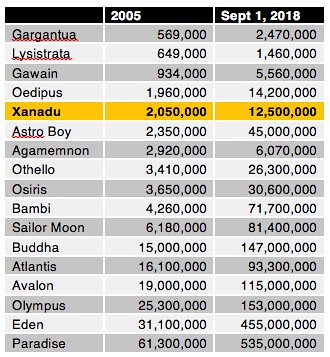
I’ve now updated one small bit of that work. In order to get some sense of what my Xanadu numbers mean I googled a number of other terms and sorted them in order of hits from lowest to highest. Here’s a table showing those results for both January 2005 and now for September 2018; the table is sorted according to the 2005 results from lowest to highest:

Xanadu comparison 2005 sort

Perhaps the most obvious difference is that the 2018 numbers are much larger than the 2005 numbers, which isn’t at all surprising. Agamemnon shows only a 208% increase over 2005, the smallest; Astro Boy shows a 1915% increase, the largest; and Xanadu shows a more modest 610% increase. The average increase was 849%.

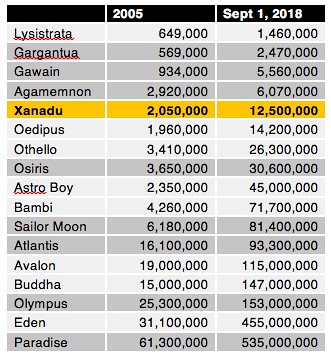
But sheer magnitude isn’t the only difference. The relative ordering shifted a bit as well. This table shows the results sorted by the 2018 results:

Xanadu comparison 2018 sort

Notice that Xanadu is fifth smallest (out of 17) in both lists while Paradise is the largest. However, whereas the count for Astro Boy was only a bit larger than that for Xanadu in 2005 (2,350,000 vs. 2,050,000 or 115%), it was considerably larger in 2018 (45,000,000 vs. 12,500,000, or 360%). That would seem to indicate that the cultural importance of Astro Boy increased more in the intervening decade than that of Xanadu.

There was also some change in relative order. Thus Agamemnon had more hits than Xanadu in 2005 (2,920,000 vs. 2,050,000) and fewer in 2018 (6,070,000 vs. 12,500,000). Conversely, Oedipus had fewer hits than Xanadu in 2005 (1,960,000 vs. 2,050,000) but more in 2018 (14,200,000 vs. 12,500,000). There are other changes in ordering as well, but those are the only ones with respect to Xanadu.

It’s not at all obvious to me that there is any neat way to summarize these various changes. I feel safe in attributing the overall increase in numbers to the overall growth of the web. I’m not sure what to say about the position of Xanadu relative to the others. I had no systematic principle of selection in choosing terms. Though I don’t recall just what I did, I feel pretty certain that I didn’t formulate a list and then run the queries. Rather, I ran queries until I had a nice range of results, both smaller and larger than Xanadu.

On the other hand, I certainly didn’t pull those terms out of a hat. Xanadu is the second word in “Kubla Khan”, one of the most important poems in the English language; Paradise is the last word in the poem while  Eden is a Christian paradise. Lysistrata, Gargantua, Gawain, Agamemnon, Othello, Atlantis, Avalon, and Olympus all reference important literary/cultural works in the Western tradition. So does Oedipus, but it also has a significant use outside of literature, in psychoanalytic discourse. Buddha, of course, is non-Western; Bambi belongs to popular culture; and Astro Boy and Sailor Moon are Japanese titles that have become fairly well known in the English-speaking world.

That Xanadu’s relative position hasn’t changed most likely indicates that little happened to change its relative visibility. There was a Xanadu musical on Broadway that opened in 2007 and ran for 500+ performances. It has also had touring versions.

I’m willing to attribute the dramatic increase for Astro Boy and Sailor Moon (1915% and 1317% respectively) to spreading interest in Japanese popular culture–both are popular manga and anime titles. But I have no suggestions for Bambi (up 1683%) and Eden (1463%). Agamemnon and Lysistrata had the lowest increases (208% and 225%). Why? A decline in classics majors? Who knows?

And so it goes.

Sunday, November 5, 2017

Tracking “Xanadu” around the web

IMGP6920rd

I'm gearing up to write a review of Franco Moretti's latest; well, actually, not just Moretti, but Moretti plus thirteen others: Mark Algee-Hewitt, Sarah Allison, Marissa Gemma, Ryan Heuser, Matthew Jockers, Holst Katsma, Long Le-Khac, Dominique Pestre, Erik Steiner, Amir Tevel, Hannah Walser, Michael Witmore, Irena Yamboliev (notice the alphabetic ordering). N+1 is putting out a collection of papers from the Stanford Literary Lab, Canon/Archive: Studies in Quantitative Formalism, and I'll be reviewing it for 3 Quarks Daily.

I first learned about Moretti just over a decade ago when I was writing for The Valve. We had a "book event" organized around his Graphs, Maps, Trees (2007). A number of people contributed posts and Moretti responded. I contributed two posts, a short one, and a somewhat longer one, One Candle, a Thousand Points of Light: Moretti and the Individual Text. The format's gone bizarro and there's a lot of link rot, but the discussion was long and interested. What I did was google the term "xanadu" and investigated the fascinating results. Who would have thought that such an exotic word would get two to three million hits? That was 2006; now it gets almost 10 million hits.

Anyhow, sometime later I took that old post, refined it a bit, and published it as a working paper: One Candle, a Thousand Points of Light: The Xanadu Meme. You can download it here:
It’s rather different in spirit and technique from the text mining/corpus linguistics techniques that are currently raising the bar in computational humanities. But it is computationally intensive. It’s just that the intensity is not on my desktop, it’s in Google’s servers. I used Google to troll the web for “Xanadu” and identified two contexts, other than the Coleridge’s poem, where I got a lot of hits.

Here’s the abstract:
I treat a single word 'xanadu', as a 'meme' and follow it from a 17th century book, to a 19th century poem (Coleridge's "Kubla Khan"), into the 20th century where it was picked up by a classic movie ("Citizen Kane"), an ongoing software development project (Ted Nelson's Project Xanadu), and another movie and hit song, Olivia Newton-John's Xanadu. The aggregate result can be seen when you google the word, you get 6 million hits. What is interesting about those hits is that, while some of them are directly related to Coleridge's poem, more seem to be related to Nelson's software project, Olivia Newton-John's film and song, and (indirectly) to Welles' movie. Thus one cluster of Xanadu sites is high tech while another is about luxury and excess (and then there's the Manchester Swingers Club Xanadu).
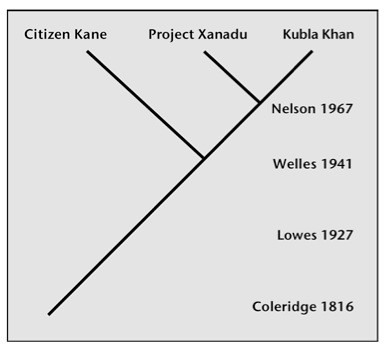
We can call the first cluster of sites the cybernetic context while the second is the sybaritic context. This simple diagram shows the evolution:

Xanadu Cladogram

The Citizen Kane line is, of course, the sybaritic one, while the Ted Nelson line is the cybernetic one.

My point is simple and, I hope, obvious. That this one term, “Xanadu,” has taken on two different valences, which are active in two different contexts. The cybernetic doesn’t seem to exist in Coleridge’s text at all. Ted Nelson created that when he provided a new context for the poem by making it the inspiration for his hypertext system. Though it wasn’t the poem that was the context as much as it was Coleridge’s alleged inability to remember the whole thing. Nelson imagined his hypertext system as one where nothing would ever get lost.

The sybaritic context, however, is there in the poem—“pleasure dome,” “demon lover,” “damsel with a dulcimer” and so on. Welles’ film, in effect, stripped the rest of the poem away and then magnified the cultural presence sybaritic element by putting it on the motion picture screen. If we examine the historical record more closely, though, we have hints that that job had started before Welles made his film. Prior to 1940 The New York Times, for example, makes mentions a yacht, or perhaps two, named “Xanadu.”

Now, imagine contexts for thousands of words in thousands of documents. That’s what is examined in topic analysis. Documents provide contexts for topics, and topics provide contexts for works. Algorithms for topic analysis examine words in large collections of documents and infer the topics in which they belong.

* * * * *

Here's the table of contents:
Introduction: “Xanadu”— 2
Googling for Memes — 3
A Thousand Points of Light, a Metaphor — 4
Xanadu: A View from the Wikipedia — 5
Xanadu: A Google View. — 7
Examining the Xanadu System — 12
Beyond the Meme — 18
Beyond Interpretation — 19
Appendix 1: Googling Oedipus — 19
Appendix 2: Xanadu in Google Books — 21
References — 23

Monday, June 10, 2013

From Xanadu to the American Dream

Sometime in the late 19th century a British poet named Samuel Taylor Coleridge read a 17th century travel book and came away with the name of Kubla Khan's summer palace, which he used in his poem, "Kubla Khan." Or perhaps he got the name from Milton's Paradise Lost. Who knows? Wherever Coleridge got the name, he turned it into "Xanadu" when he published his poem in 1816 and that's the name we know today.

Orsen Welles read Coleridge's poem and used "Xanadu" as the name of the fabulous Florida mansion of Charles Foster Cane, the protagonist of his 1941 film, Citizen Kane. Later on a computer programmer, Ted Nelson, chose "Xanadu" as the name of his hypertext project. Still later, "Xanadu" was snatched up by Olivia Newton-John as the name of a pop song and a film (which starred Gene Kelly). (I spell this out a bit more in this post, "Xanadu" on the Digital Tip.)

But that's all background.

In the early years of this millenium the Mills Corporation opened Madrid Xanadú, a fabulous shopping and entertainment center that included, among other things, in indoor ski and snowboarding center.

The company planned and started construction on a similar complex in the New Jersey Meadowlands, which is not too far from where I live, Jersey City. That's what this little item is about. That project fell apart when the finances did and construction wasn't completed.

Thursday, July 5, 2012

The Road to Xanadu

There is a bit of deception in the staging of these photographs. The sites they depict to not exist along a single path. All but the pirate and the sofa section ARE on the same path, but not in the order I show them. The pirate and the section are each in different, but nearby, places. I did, however, photograph all these sites on the same day, yesterday. Paradise it was not. Hot, a bit swampy. But Xanadu...?

IMGP6857rd

IMGP6915rd

IMGP6884rd

Thursday, October 6, 2011

Memes in Xanadu: Tinker, to Evers, to Chance

Samuel Taylor Coleridge read voraciously and took notes on everything. Early in the 20th century one John Livingston Lowes examined books Coleridge is known or likely to have read – either because it is explicitly referenced in Coleridge’s notes or because it is very much like something Coleridge has referenced and was likely available to him at the time – and found passages similar to lines and phrases in “The Rime of the Ancient Mariner” and in “Kubla Khan.” Lowes then reproduced these passages, some at considerable length, and provided suitable contextual and connective tissue relating them to Coleridge’s interests and habits and, of course, to his poems. He published the results of his labors in The Road to Xanadu. I agree with the modern judgment that Lowes’ investigation into Coleridge’s notebooks and library tells us relatively little about how Coleridge’s poems work in our minds and hearts, nor is his loose associationist psychology very convincing.

Nonetheless, I find Lowes’ work quite fascinating. What interests me is what interested Lowes, that fragments of ideas and wording somehow found their way from texts dating back to the 17th century and into Coleridge’s poems. Those poems then served as a vehicle for further dissemination of some of those fragments. We can thus think of them as memes in Richard Dawkins’ rather casual and controversial formulation.

I herewith present the text to “Kubla Khan,” followed by putative sources from Lowes, and end with the lyrics to a rock anthem, “Xanadu,” by Rush. The rock tune is clearly indebted to Coleridge’s poem. The actual order of transmission is, of course: sources to Coleridge to Rush. Beyond this I note that the garden meme is older than language. Without it there would be no Xanadu.
I've done a web-based study of the distribution of the /xanadu/ meme where I argue that, once Coleridge had introduced the word into early 19th century Europe, there were three major dispersal events: the film, Citizen Kane; Ted Nelson's Project Xanadu; and the movie, hit song, and now Broadway musical, Xanadu. Here's a detailed analysis of Coleridge's poem.


The Text of “Kubla Khan”

In Xanadu did Kubla Khan
A stately pleasure-dome decree:
Where Alph, the sacred river, ran
Through caverns meaureless to man 
     Down to a sunless sea.
So twice five miles of fertile ground
With walls and towers were girdled round: 
And there were gardens bright with sinuous rills,
Where blossomed many an incense-bearing tree;
And here were forests ancient as the hills,
Enfolding sunny spots of greenery.

But oh!  that deep romantic chasm which slanted
Down the green hill athwart a cedarn cover! 
A savage place! as holy and enchanted
As e'er beneath a waning moon was haunted
By woman wailing for her demon lover!
And from this chasm, with ceaseless turmoil seething
As if this earth in fast thick pants were breathing,
A mighty fountain momently was forced:
Amid whose swift half-intermitted burst
Huge fragements vaulted like rebounding hail,
Of chaffy grain beneath the thresher's flail:
And 'mid these dancing rocks at once and ever
It flung up momently the sacred river.
Five miles meandering with a mazy motion 
Through wood and dale the sacred river ran,
Then reached the taverns endless to man,
And sank in tumult to a lifeless ocean:
And 'mid this tumult Kubla heard from far 
Ancestral voices prophesying war!
     The shadow of the dome of pleasure 
     Floated midway on the waves;
     Where was heard the mingled measure
     From the fountain and the caves.
It was a miracle of rare device,
A sunny pleasure-dome with caves of ice!

     A damsel with a dulcimer
     In a vision once I saw: 
     It was an Abyssinian maid,
     And on her dulcimer she played,
     Singing of Mount Abora.
     Could I revive within me
     Her symphony and song,
     To such a deep delight ‘twould win me
That with music loud and long,
I would build that dome in air,
That sunny dome! those caves of ice! 
And all who heard should seem them there, 
And all should cry,  Beware! Beware!
His flashing eyes, his floating hair!
Weave a circle round him thrice,
And close your eyes with holy dread,
And drunk the milk of Paradise.

Coleridge’s Sources

Here are a few of the passages Lowes marshals in contemplation of “Kubla Khan.” What's intersting is how specific words and phrases made their way into the poem. I have reproduced them as Lowes did, with certain phrases italicized. The first passage is from Purchas His Pilgramage, originally published in the early seventeenth century. This is the passage that Coleridge cites in his preface to the poem, though he misquotes it there (p. 326 of Lowes):
In Xamdu did Cublai Can build a stately Palace, encompassing sixteene miles of plaine ground with a wall, wherein are fertile Meddows, pleasant springs, delightfull Streames, and all sorts of beasts of chase and game, and in the middest thereof a sumptuous house of pleasure, which may be removed from place to place.
The next passage is by a contemporary of Coleridge’s, William Bartram, and is from his Travels through North and South Carolina . . . (p. 335 of Lowes):
Just under my feet was the inchanting and amazing chrystal fountain, which incessantly threw up, from dark, rocky caverns below, tons of water every minute, forming a bason, capacious enough for large shallops to ride in, and a creek of four or five feet depth of water, and near twenty yards over, which meanders six miles through green meadows, pouring its limpid waters into the great Lake George. . . . About twenty yards from the upper edge of the bason . . . . is a continual and amazing ebullition, where the waters are thrown up in such abundance and amazing force, as to jet a swell up two or three feet above the common surface: white sand and small particles of shells are thrown up with the waters . . . when they . . . subside with the expanding flood, and gently sing again.
The next passage is from James Bruce, who had journeyed to the source of the Nile in the third quarter of the eighteenth century and published his Travels to Discover the Source of the Nile in the fourth quarter (Lowes p. 339):
The second fountain lise about a stone-cast west from the first: the inhabitants say that this whole mountain is full of water, and add, that the whole plain about the fountain is floating and unsteady, a certain mark that there is water concealed under it; for which reason, the water does not overflow at the fountain, but forces itself with great violence out at the foot of the mountain. The inhabitants . . . maintain that that year it trembled little on account of the drought, but other years, that it trembled and overflowed so as that it could scare be approached without danger.
While we have good reason to believe that Coleridge had read Purchas, Bartram, and Bruce, we do not know that he had read F. Bernier’s Voyage to Surat, from the seventeenth century (Lowes p. 352):
Out of all these mountains do issue innumerable sources and rivulets. . . . All these rivulets, descending from the mountains, make the plain and all those hillocks so fair and fruitful, that one would take this whole kingdom for some evergreen garden. . . . The lake hath this peculiar, that ‘tis full of little isles, which are as many gardens of pleasure, that appear all green in the midst of the water. . . . Beyond the lake, upon the side of the hills, there is nothing but houses and gardens of pleasure . . . . full of springs and rivulets.
Note that the passages I’ve cited here pertain mostly to the first half of the poem, but Lowes does provide putative sources for the second half as well. These few passages do not adequately convey the cumulative effect of Lowes’ exposition, with page after page of likely or possible “sources” for the poem.

Lyrics to “Xanadu”

Here are the lyrics to a tune called “Xanadu,” composed and performed by the rock group, Rush. Following Lowes’ convention with Coleridge’s putative sources, I have italicized the fragments that seem to have come from Coleridge’s poem.
"To seek the sacred river Alph
To walk the caves of ice
To break my fast on honey dew
And drink the milk of paradise...."

I had heard the whispered tales
Of immortality
The deepest mystery
From an ancient book. I took a clue
I scaled the frozen mountain tops
Of eastern lands unknown
Time and Man alone
Searching for the lost—Xanadu
Xanadu—To stand within the Pleasure Dome

Decreed by Kubla Khan
To taste anew the fruits of life
The last immortal man
To find the sacred river Alph
To walk the caves of ice
Oh, I will dine on honeydew
And drink the milk of Paradise

A thousand years have come and gone
But Time has passed me by
Stars stopped in the sky
Frozen in the everlasting view
Waiting for the world to end
Weary of the night
Praying for the light
Prison of the lost—Xanadu
Xanadu—To stand within the Pleasure Dome

Decreed by Kubla Khan
To taste my bitter triumph
As a mad immortal man
Nevermore shall I return
Escape these caves of ice
For I have dined on honeydew
And drunk the milk of Paradise

Music by Geddy Lee and Alex Lifeson
Lyrics by Neil Peart

Wednesday, April 20, 2011

Being in Crisis and the Ontological Text

"Kubla Khan", Sir Gawain and the Green Knight, Fantasia, and Tezuka’s Science Fiction Trilogy

Early in my career I was immersed in the ideas of a handful of Continental thinkers, including Nietzsche, Merleau-Ponty, Piaget, and Lévi-Strauss, but, as I explained in an essay, about my encounter with Coleridge’s “Kubla Khan”, that poem forced me away from a more or less philosophical grounding toward the cognitive briar patch of the newer psychologies. The poem presented problems that simply didn’t register with Merleau-Ponty or even Lévi-Strauss, but that seemed more commensurate with the world of Chomsky, but also, though less directly, that of the neurosciences.

I have subsequently come to realize the “Kubla Khan” is what we might call an ontological text, and that I have an affinity for such texts. While all poems and fictions have an ontological dimension, not all of them focus on ontological matters. Most texts deploy an ontology in order to tell a story. Ontological texts ‘tell stories’ in order to deploy and ontology.

In the case of “Kubla Khan” the poem doesn’t tell a story at all, not in the way, for example, Coleridge’s so-called Conversation Poems do. It presents us with a succession of situations, each in a different world. In the large, the poem unfolds in two movements. The first is set in the physical world of Xanadu around and about a river and some marvelous structure; the second is set nowhere in particular, but is a tissue of thoughts and imaginings. The two worlds are connected only be an emblem: 1) “A sunny pleasure-dome with caves of ice” (l. 36), 2) “That sunny dome! Those caves of ice!”. And the nature of that connection is mysterious and problematic. What is at issue in this poem is the stations of Being, if you will, that bind these objects and processes into a world.

So that’s one text I’ve pondered. And pondered.

Sir Gawain and the Green Knight is another. The action moves toward the third part, which takes place over three days. Sir Bercilak goes hunting in the forests while Sir Gawain goes hunting in Bercilak’s bedroom – more accurately, he is the hunted. At the end of the day they exchange the spoils of their respective hunts. That exchange thus asserts an equivalence between two realms of being, that of the hunt and that of courtship. This action, of course, is framed by the larger action which has Sir Gawain journeying from Camelot, to Hautdesert, to the Green Chapel and then back to Camelot. As I have argued in an essay about the narrative, Hautdesert is an inversion of the ‘normal’ courtly world of Camelot: a woman presides at court, not a man; a woman pursues Sir Gawain, not vice versa. And the Green Chapel seems a negation of the world of human artifice, being but a mound deep in the forest. The narrative sets these worlds into interaction with one another and asserts that interaction through an emblematic object, the green girdle Bercilak’s wife gave to Sir Gawain, which saved his life at the Green Chapel (at the cost of a nick on the neck) and which, upon his return to Camelot, came to symbolize the fellowship of knights at court. (Did it really save his life?)

Another ontological text. A narrative, yes. But a highly ritualized one, one emphasizing different kinds of and modes of being.

Friday, December 17, 2010

"Xanadu" Revisited

Google has just released an interesting dataset. Geoff Nunberg describes it at Language Log:
Culled from the Google Books collection, it contains more than 5 million books published between 1800 and 2000 — at a rough estimate, 4 percent of all the books ever published — of which two-thirds are in English and the others distributed among French, German, Spanish, Chinese, Russian, and Hebrew. (The English corpus alone contains some 360 billion words, dwarfing better structured data collections like the corpora of historical and contemporary American English at BYU, which top out at a paltry 400 million words each.)
It is, he says, “the largest corpus ever assembled for humanities and social science research.” The New York Times has reported on it and there’s an article in Science based on it.

You can also play around with it online with the Google Books Ngram Viewer. You enter individual words or phrases (up to five words long) and a Google graphs their frequency over time. I’ve spent a little time playing around with it.

In particular, I’m interested in the proper noun, “Xanadu.” As you may know, it’s the name of Kubla Khan’s summer capital and is also the second word in Coleridge’s most famous poem, “Kubla Khan.” Several years ago I did a Google search on “Xanadu” and was surprised to come up with over two-million hits. How’d that happen? I wondered.

I ended up writing a long post on The Valve, which generated an interesting discussion, and then distilling that down into a tech report. You can download the report here (One Candle, a Thousand Points of Light: The Xanadu Meme). Here’s the abstract:
I treat a single word 'xanadu', as a 'meme' and follow it from a 17th century book, to a 19th century poem (Coleridge's "Kubla Khan"), into the 20th century where it was picked up by a classic movie ("Citizen Kane"), an ongoing software development project (Ted Nelson's Project Xanadu), and another movie and hit song, Olivia Newton-John's Xanadu. The aggregate result can be seen when you google the word, you get 6 million hits. What is interesting about those hits is that, while some of them are directly related to Coleridge's poem, more seem to be related to Nelson's software project, Olivia Newton-John's film and song, and (indirectly) to Welles' movie. Thus one cluster of Xanadu sites is high tech while another is about luxury and excess (and then there's the Manchester Swingers Club Xanadu).
In doing this work I had problem getting historical data. The web hits are all, of course, indicators on current usage, namely on pages on the web. But how did that current usage evolve from past usage? I checked the Oxford English Dictionary, which gave examples of usage from Coleridge’s own source, a 17th century travelogue, to the present. But that’s only isolated examples, without any sense of frequency. I also searched The New York Times archives from 1851 through 1980. Here’s what I found (from the tech report):
I got 443 hits; only 3 of them were in 1900 or earlier. I checked only the first one, an article on child labor from 1870 and was unable to find “xanadu” in the article itself and so have no idea why it turned up in the search. I checked a few later articles, including a review of Livingston Lowes’s The Road to Xanadu (1927) and one of a Coleridge biography. There were a number of articles about yachting and ocean racing in the 1930s and into the 1940s. I checked two of them. One mentions a yacht named “X Anadu” and another mentions one named “Xanadu.” While the first is probably a typo, I would not automatically assume so; yachts are often oddly named. The point is that entries are sparse between 1900 and the 1940s. The New York Times review for Citizen Kane, however, was 77th in the list of 443 hits over the period between 1851 and 1980. Thus over 80% of occurrences of “Xanadu” are dated after the premier of Citizen Kane.
Of course, The New York Times is only one source and can hardly be considered as representative of usage in the English-speaking world. But it’s what I could get at the time.

Google’s new toy affords me a more complete look, though it only tracks occurrences in books, not in periodicals. So I graphed “Xanadu” from 1800 to 2008 (alas, you have to click on the link and open another window). There you see a gradual rise in usage from the late 1830s (“Kubla Khan” was first published in 1817) up through 1920. Then there’s a sharp rise in the late 1920s and peaks around 1934 (see this graph, 1910-1950), well before Citizen Cane. What’s that about? Here’s a listing of books published in 1934, a number of which mention The Road to Xanadu. I’ve not explored the whole list (there seems to be over 300).

So, at least in the world of books there was a fair amount of interest in “Xanadu” before Citizen Kane. What’s equally interesting is that 1934 remains the peak up to the present. Though here we’ve got to be careful. The graph shows percentages, not absolute numbers. So “Xanadu” is relatively more frequent in 1934 than in any year before or since. But it may well have been used more often, in absolute terms, in subsequent years.

We don’t know.

Which is how I feel about this new tool, interesting, but we don’t know. I’m sure it will tell us something, but just what . . . .

Friday, July 2, 2010

Mind Hacks 5: 1982 – Tron


Sucked into cyberspace.

In Tron we have the first major motion picture where the main action takes place inside a computer, in what has become known as cyberspace. This world, of course, has no visual reality. To depict this world in film, then, one must invent a visual language. The language invented for Tron derives from video games, experimental film, and visionary imagery of psychedelia.

Through the wonders of computer graphics, the computer itself now becomes the medium for a Trip. The lead character of Tron was based loosely on computer guru Alan Kay – his wife was one of the screen writers – who is best-known as the developer of the GUI interface that has come to dominate both personal computers and high-end workstations. When Tron was made the personal computer revolution was in full swing, and Apple’s ground-breaking Macintosh computer was only two years away. The Macintosh would change the way people interacted with computers and make them more accessible to adults as well as to children.

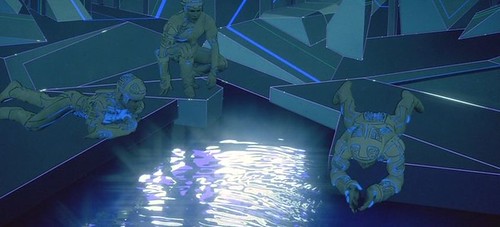
Drinking cyberwater.

The counter-cultural sixties were thoroughly over and the high tech world of PCs had absorbed much of the adventurous spirit of youth. In the 1960s and 1970s young people turned on, tuned in, and dropped out to form communes and other collective living arrangements. In the 1980s and into the 1990s bright and adventurous young people formed high-tech companies in hopes of becoming wealthy at an early age. They dressed informally and listened to rock and roll though headsets while programming their way, if not to fame and fortune, then at least to exhaustion and sleep. Just as San Francisco and its hinterlands played a seminal role in the counter-cultural 60s, so the same region, and often the same people, played a seminal role in the personal computer revolution of the 70s and 80s.

Space ship in cyberspace.

New Age this and that became part of the cultural landscape. Yoga and the martial arts were fixtures of shopping malls across the land. While Yoga had been introduced into the West late in the nineteenth century, it owes much of its current popularity to receptiveness engendered in the psychedelic 60s. The martial arts master, with his superior physical prowess and mystical powers of insight and concentration, had become a figure of popular culture. Alternative forms of medical treatment had become more widely available; even the most prestigious medical institutions were teaching meditation to heart attack patients.

Meanwhile the elite world of artificial intelligence had fallen into disarray. The brilliant promises of the 1950s and 1960s went un-kept and the attempt to turn AI into a commercial enterprise went belly-up. The so-called “AI-winter” set in. At the same time the nation’s War on Drugs had kicked into high gear by the moralizing enthusiasm of William Bennett. The post-war baby boomers began moving into middle age.

The tyrant of cyberspace.

Selected Milestones:
  • 1977: Star Wars became a motion-picture blockbuster, wedding martial arts mysticism with a space opera story and high tech special effects.
  • 1981: William Bennett appointed to head the National Endowment of Humanities, his first government post. This positioned him to declare and lead a culture war. Later he would become “Drug Czar” under President Bush.
  • 1981: Ted Nelson publishes Computer Liberation, in which he describes an elaborate hypertext system he called Project Xanadu (after the kingdom described in Coleridge’s “Kubla Khan”).
  • 1984: Apple Computer advertised their new Macintosh in a Super Bowl advertisement that pitched IBM in the role of Big Brother and the Mac as humankind’s liberator.
  • 1984: William Gibson combines video game imagery with reggae music and mythology and sets it in the future, thus placing psychedelia and computing on equal terms in the cyberpunk world of Neuromancer.
  • 1985: Steve Jobs purchases Pixar, from George Lucas, and establishes it as an independent computer graphics company. Pixar would go on to produce the first completely computer-generated motion pictures.
Your interpretation here.

Wednesday, June 16, 2010

From Yesterday's Catch: Visions of Xanadu


Xanadu didn't happen. It was built. The building left/leaves scars/traces. A state of mind.  On the real tip.