Showing posts with label 2_war. Show all posts

Friday, June 5, 2026

The American Way of War

I've got a short series of posts from awhile back on the American way of war. I decided to add to it with this short conversation with Claude.

* * * * *

American wars since the collapse of the USSR

Give me a chronological list of the wars that America has been involved in since the collapse of the USSR.

The project knowledge touches on this theme thematically but doesn't provide a factual list. Here's a straightforward chronological account from general knowledge, using 1991 (the USSR's formal dissolution) as the starting point:

Gulf War (1991) — Already underway when the USSR collapsed in December; the US-led coalition expelled Iraq from Kuwait. A short, decisive conventional war.

Somalia (1993) — Humanitarian intervention that escalated into urban combat, culminating in the Battle of Mogadishu ("Black Hawk Down").

Haiti (1994) — Military intervention to restore the elected government of Jean-Bertrand Aristide.

Bosnia (1995) — NATO air campaign (Operation Deliberate Force) in which the US played the lead role, ending the Bosnian War.

Kosovo (1999) — NATO air war against Yugoslavia to halt ethnic cleansing; again US-led.

Afghanistan (2001–2021) — Invasion following 9/11, ousting the Taliban; the longest war in American history.

Iraq (2003–2011, then resumed 2014–) — Invasion that toppled Saddam Hussein, followed by a prolonged insurgency. US forces returned in 2014 to fight ISIS and remain in smaller numbers today.

Libya (2011) — US participated in NATO air operations that led to Gaddafi's fall.

Syria / ISIS (2014–present) — Air campaign and special operations forces deployed against the Islamic State across Syria and Iraq.

Iran (2020) — The drone strike killing General Qasem Soleimani; a targeted killing rather than a sustained war, but a direct military act against a state actor.

Yemen (ongoing, indirect)** — The US has provided intelligence, refueling, and arms to the Saudi-led coalition, with direct drone strikes against Al-Qaeda in the Arabian Peninsula.

Iran (2025) — You noted in your War Series writing (with a 2026 addendum) that a Trump-era attack on Iran occurred, which fits this list as the most recent major escalation.

A few observations relevant to your own analytical framework: this list illustrates the pattern you describe in your War Series — the post-Cold War redirection of American aggression outward, particularly toward the Arab/Muslim world as the new "Other" following the loss of the Soviet scapegoat. Nearly every conflict after 1993 takes place in the Islamic world, which tracks your 2014 addendum about the "well-crafted Orientalist mythology of the exotic and crazy Arab Other."

Talcott Parsons 1947

At the heart of that War Series is a 1947 essay by Talcott Parsons, “Certain Primary Sources of Aggression in the Social Structure of the Western World.” I read that early in my undergraduate years at Johns Hopkins. I regard it as speculative, plausible but speculative. How would one gather empirical evidence on it? It’s not like any nation ever announces, “We’re going to war to let off some steam and ease tensions at home?”

That's exactly the right epistemological challenge — the mechanism Parsons proposes operates at the level of collective unconscious motivation, which is precisely what makes it both compelling and resistant to direct verification. But there are several indirect empirical strategies that could build a cumulative case.

Quantitative correlational approaches

The most tractable starting point is looking for statistical relationships between domestic stress indicators and the initiation of military action. You'd want to examine whether wars or significant military escalations cluster after periods of elevated internal tension — economic downturns, spikes in domestic unrest, rising inequality, political polarization indices. The null hypothesis would be that war timing is random with respect to domestic conditions; a systematic pattern would be suggestive. Turchin's work on political stress cycles (his "cliodynamics" project) is actually well-suited to this — he's already built quantitative indices of internal instability across centuries, and one could ask whether war-initiation correlates with his stress peaks.

The "rally around the flag" literature

There's actually a substantial body of political science research on this, though it approaches the question from a slightly different angle. The "rally" effect — the well-documented spike in presidential approval following military action — shows that war does relieve domestic political pressure in measurable ways. John Mueller's work on war and presidential popularity is foundational here. The harder inferential step is from "war relieves pressure" to "anticipated relief motivates war-making," but the effect at least confirms the direction of the mechanism.

Elite communication analysis

Parsons' theory doesn't require that anyone consciously decides to go to war for psychodynamic reasons — the motivation can be largely unconscious and rationalized afterward. This actually makes elite rhetoric more useful as evidence, not less. You'd look for patterns in how war is framed domestically — whether war rhetoric systematically spikes domestic us-versus-them language, whether it correlates with reduced internal scapegoating (your Klinkner & Smith thesis about civil rights gains during wartime), and whether the timing of hawkish escalation by elites tracks with rising domestic discontent. Content analysis of congressional debates, newspaper editorials, and presidential speeches across the full arc of conflicts could reveal structural patterns invisible to any individual case.

The comparative/historical method

Parsons' thesis should predict that nations with other mechanisms for handling internal aggression — stronger corporatist institutions, more robust social contracts, functioning scapegoats already in place — should be less prone to foreign military adventurism. Scandinavian nations, for instance, would be a useful comparison class. You could also look at cases where domestic conditions that should predict war didn't produce it, and ask what was different. The comparative method won't confirm the mechanism, but systematic cross-national patterns would be hard to explain otherwise.

The Klinkner-Smith natural experiment

The civil rights thesis is actually the most testable piece, and as you note in your writing, they've already done substantial work on it. Their finding — that Black Americans' civil rights gains cluster tightly around periods of external military threat — is exactly the kind of pattern that's hard to explain without something like Parsons' mechanism. It's not proof of the psychodynamics, but it's consistent evidence that war functions to redirect internal aggression in measurable ways.

The fundamental limitation

None of this gets you to the causal mechanism Parsons actually proposes — that repressed aggression generated by Western child-rearing practices flows through nationalist scapegoating and finds periodic release in war. That specific chain is probably permanently beyond empirical reach, because the mediating variable (unconscious aggressive impulse at civilizational scale) isn't directly observable. What you can do is show that the functional relationship holds — that war operates as if it were serving this purpose — and that alternative explanations (pure rational calculation of national interest, for instance) leave systematic residuals.

Which is, frankly, roughly where Freudian-influenced social theory in general sits: plausible, structurally coherent, supported by functional evidence, but not falsifiable in any clean Popperian sense. The honest assessment is that Parsons is probably tracking something real but operating at a level of abstraction that empirical social science can approach but not fully close.
Wednesday, March 4, 2026

TO WAR! Part 1: War and America's National Psyche

Once again I"m bumping this to the top of the queue. And for obvious reasons. Once again a foolhardy President has taken the country into a war with no obvious end in sight, just a squandering of human live and productive resources.

* * * * * 

As part of a special WAR EDITION of New Savanna I'm reproducing a set of notes I wrote up during the 2000 Presidential Election. I first published them on NS back in November of 2011 and I'm republishing them now in recognition of yet another turn in the long-spinning wheel of American mythology. Yet another bump to the top, as I'm thinking of this stuff, this time in connection with the relationship between war and nationalism.
Everything is connected to everything else and the causal forces meeting in the historical present stretch back into the past without end. Figuring out where to start is not easy. My sense is that we need to focus our attention on the dissolution of the Soviet Empire in the late 1980s. That left the nation without a national scapegoat, thus radically altering the nation’s psycho-cultural landscape. We no longer had Ronald Reagan’s Evil Empire to kick around.

As some of you may know, my thinking on these matters has been strongly influenced by an essay Talcott Parsons published in 1947 on “Certain Primary Sources of Aggression in the Social Structure of the Western World”. Parsons argued that Western child-rearing practices generate a great deal of insecurity and anxiety at the core of personality structure. This creates an adult who has a great deal of trouble dealing with aggression and is prone to scapegoating. Inevitably, there are lots of aggressive impulses which cannot be followed out. They must be repressed. Ethnic scapegoating is one way to relieve the pressure of this repressed aggression. That, Parsons argued, is why the Western world is flush with nationalistic and ethnic antipathy. I suspect, in fact, that this dynamic is inherent in nationalism as a psycho-cultural phenomenon.

For the most part I have used Parsons, and others as well, in arguing about the nature of racism in the USA. While Africans were brought to this country for economic reasons it seems to me that during, say, the 19th century African Americans increasingly assumed a dual psychological role in the white psyche. On the one hand, they were a source of entertainment. On the other, they were convenient scapegoats, as became evident with the lynchings that emerged during Reconstruction and continued well into the last century. That is to say, African America served as a geographically internal target for the ethnic and nationalist antipathy Parsons discussed.

Thus we have the thesis in Klinkner and Smith, The Unsteady March (U. Chicago, 1999). They argue that African Americans have been able to move forward on civil rights only during periods where the nation faced an external threat - the Revolutionary War, the Civil War, and the major wars of the first half of the 20th century. When the external danger had subsided, gains were lost. From my point of view, they’re arguing that, when external danger looms large and demands attention, the citizenry can focus aggression there and so ease up on the internal colony. Beyond this, of course, it becomes necessary to recruit from the colony to fight the external enemy, both physically and propagandistically - be kind to your black citizens when you fight the Nazis, etc.
  
Vietnam was the last major war of the Cold War period. As it receded into the past, a political backlash set in and affirmative action came under attack. That’s the situation we faced when the Soviet Empire collapsed. With the major external threat suddenly collapsed, there was a crisis of aggression - I’m reminded of the phrase “conservation of aggression” coined by Robert Wright. The fall of the Evil Empire deprived a great many people of an object for aggressive impulses. What then, happened to that aggression?

It got directed elsewhere. My sense is that the political rhetoric on a number of issues heated up in the wake of the fall: gun control, abortion, the arts, gays, affirmative action, violence in the media. A number of these issues come under the rubric of the so-called “culture wars”. Each of these issues was already on the political agenda, and had been there for some time.

Sexy music had been inspiring pulpit denunciations and legislative action since the early decades of the 20th century. Movies have been problematic since the beginning and the NAACP put itself on the political map by organizing protests against “Birth of a Nation.” But, it seems to me, that the scope of politicized cultural contest broadened. [If I’m correct, then this could be verified empirically by doing content analysis of periodicals, looking at opinion polls, crime rates, etc.]

Perhaps the most interesting redirection, however, was into the so-called War on Drugs. Political concern about drug use is not, of course, new. It goes back to Prohibition - which, was, of course, intimately linked with that objectionably sexy music - and got redirected by and in reaction to the counter-cultural 60s and 70s. However, it is my impression that the current effort ramped up in the wake of the Soviet collapse.

This war on drugs has had substantial material consequences: increased law enforcement and court activity, a considerable increase in the prison population and, of course, in the prison industry. Our prisons now have a relatively large population of non-violent offenders who are disproportionately black, taken off the voting rolls as felons, and available for labor in various prison-based enterprises. I do not know whether or not the increase in the economic “weight” of the prison sector is roughly equal to the losses suffered by the defense sector. I would, of course, like to know.

Regardless of how those numbers work out, my basic point is simply that the end of the Cold War changed the psycho-cultural system in a major way. Psycho-cultural aggression had to be redirected and much of it was redirected at targets within the country, rather than externally. That redirection is the central political phenomenon of the 90s and is responsible for much of the ugliness and programmatic futility of current politics.

Addendum 2011: Obviously, this internal redirection of aggression continues. It may well have gotten worse – I wonder what ‘sentiment analysis’ would turn up if applied to documents written over the past decade? The problem facing us, of course, is not that of finding suitable targets for this displaced aggression. No, we have to restructure our way of living so as to reduce our need to have such targets. That’s a tough one, and one that will take a generation or three.

Addendum 2014: Obviously the Arab world is a perfect target for this repressed aggression. We've got a long-standing and well-crafted Orientalist mythology of the exotic and crazy Arab Other. I fear we're going to be banging on this nail for a long time.
 
Note 2026: The second post in this series has a clip from the Marx Brothers movie, Duck Soup, that can be taken as a comment on how Trump arrived at the decision to attack Iran: TO WAR! Part 2: A Marx Brothers Analysis of America's War Craziness.  

Sunday, November 10, 2019

Racial integration of the US Army during the Korean War

Abstract: The racial integration of the US Army during the Korean War (1950-1953) is one of the largest and swiftest desegregation episodes in American history. This paper argues that racial integration improved white survival rates at the expense of blacks, and resulted in less anti-black prejudice among white veterans decades after the war. Using a novel military casualty file, I construct a wartime similarity index to measure the extent of racial integration across military units and time. Using exogenous changes in racial integration, I show that integrated whites were 3% more likely to survive their injuries than segregated whites, whereas integrated blacks were 2% were less likely to survive their injuries than segregated blacks. Given that blacks were initially confined to noncombat support roles, the results reflect a convergence in hazardous combat assignments. To explore the long-term effects of racial integration, I link individual soldiers to post-war social security and cemetery data using an unsupervised learning algorithm. With these matched samples, I show that a standard deviation change in the wartime racial integration caused white veterans to live in more racially diverse neighborhoods and marry non-white spouses. In aggregate, these results are some of the first and only examples of large-scale interracial contact reducing prejudice on a long-term basis.

See my post, TO WAR! Part 1: War and America's National Psyche, where I briefly mention Klinkner and Smith, The Unsteady March (U. Chicago, 1999), who argue that African Americans have been able to move forward on civil rights only during periods where the nation faced an external threat - the Revolutionary War, the Civil War, and the major wars of the first half of the 20th century. When the external danger had subsided, gains were lost.

Saturday, June 6, 2015

Good Grief! War Boys in the Promised Land [#GVM004]

One could, of course, dismiss it because it’s comic strip imagery, and therefore Not Serious. One could also dismiss it as graffiti, and therefore Not Serious.

But I can’t do that, not while I’m being a Martian Anthropologist. In that role I have no choice but to take what the natives do as being quite serious. That is, serious in the sense that it indicates what’s going on in their society.

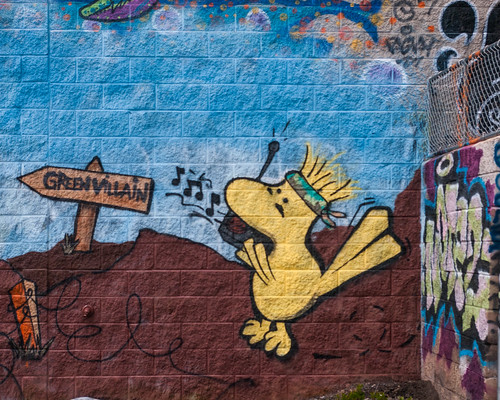
Here’s Woodstock, a character from the comic strip, Peanuts, which is surely smack dab in the center of post-war (WWII) American culture and which has shown up in graffiti culture since the mid-1970s–that is to say, from the beginning:

20150605-_IGP3920

The headband establishes Woodstock’s hippie cred and the music-blaring transistor radio dates him.

The “Greenvillain” sign is a shout-out to Greg Edgell, who runs Green Villain, the production company that’s organizing the graffiti on the soon-to-be-demolished Pep Boys building in the Newport area of Jersey City. This is painted on the southwest corner of the building.

But why the brown? Is it supposed to represent bare dirt? What about the black loops? Since I’ve seen the whole mural I’ll tell you what it is, it’s barbed wire. Woodstock is strolling around on a battlefield. Vietnam perhaps? After all, the war there was going hot and heavy when the flower children gathered in the mud at Woodstock, New York, and listened to Jimi Hendrix transform “The Star-Spangled Banner” into a war protest anthem.

Friday, December 12, 2014

It’s Complicated 3: Social Manipulation in a Culture of Fear

danah boyd. It’s Complicated: The Social Lives of Networked Teens (Yale UP 2014).
Let’s start with a footnote to Chapter 4, “Danger: Are Sexual Predators Lurking Everywhere?” (p. 232)
In The Culture of Fear, sociologist Barry Glassner provides a detailed account of how American society uses fear to regulate everyday practices. He points out that people are terrible at assessing risk; many fears are connected, not to risk, but to how the media shapes the public’s perception of key issues.
That’s it in a nutshell: “American society uses fear to regulate everyday practices.” But America is not exceptional in that regard. It’s a widespread socio-cultural practice and it’s at the heart of cultural mechanisms of social control.

Free-Form Fear

Here’s the paragraph to which that footnote is attached (p. 102):
From the advent of social media, it has been impossible to talk about teens’ engagement without addressing the topic of online safety and sexual predators. More than any other issue presented in this book, the topic of online safety generally—and sexual predators specifically—has played a significant role in configuring teens’ relation to mediated communication, adults’ attitudes toward teens’ participation, and policy discussions about social media regulation. Online safety is also a particularly complicated issue, in part because a culture of fear is omnipresent in American society, and no parent wants to take risks when it comes to their children’s safety. Statistics showing the improbability of harm fail to reassure those who are concerned. Even when highly publicized stories turn out to be fabrications, parents still imagine that somewhere, somehow, their child might fall victim to a nightmarish fate. They are afraid because terrible things do happen to children. And although those violations most commonly take place in known environments—home, school, place of worship, and so on—the internet introduces an unknown space that is harder to comprehend. Nothing feeds fear more than uncertainty.
A bit later (p. 106, emphasis mine):
Legal scholar Larry Lessig argues that four forces regulate social systems: market, law, social norms, and technology or architecture. Fear is often used in service of these forces. Companies sell fear to entice parents to buy products that will help them protect their children. Policymakers respond to fear by regulating children’s access to public spaces, even when doing so accomplishes little. The media broadcasts fears, creating and reinforcing fearful social norms. And technologies are built to assuage or reproduce parents’ fears. Given the cultural work done in the name of fear, it’s astounding that young people have as much freedom as they do.
Of course, there are real dangers out there. The existence of those real dangers lends plausibility to the hyped up dangers, and the hype, in turn, makes it difficult to deal with the real dangers in an intelligent way (p. 109):
Parental fear regarding sexual predators is understandable. No parent wants to imagine her or his child being harmed, and the potential cost of such a violation is unfathomable, regardless of how statistically improbable such an event might be. Combine this with the media’s magnification of the cultural mythos of the online sexual predator and it’s no wonder that countless parents become hyperprotective without considering the costs of their actions. But this distorted fear obscures the very real and costly risks that some youth do face. Untangling these issues requires stepping back and rethinking what we think we know regarding sexual predation.
In this situation, how do you draw a line between real danger and fantasized danger?

Thursday, September 11, 2014

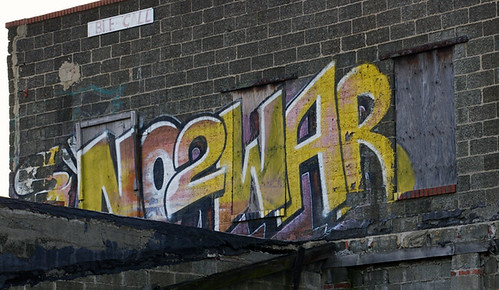
TO WAR! Part 3: Graffiti Edition: Say "No" to War

NO2WAR

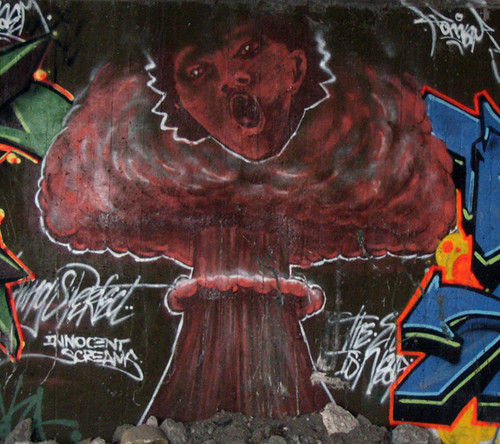
Innocent Screams - Komar

TO WAR! Part 2: A Marx Brothers Analysis of America's War Craziness

Another old time good one. The post is from 2011, the movie from 1933. And, at this rate, the movie will still be relevant in 2033. Think we'll be over it by 2133?
 
 
Or, The Right Hand of Good Fellowship

I grew up watching Groucho Marx on his “You Bet Your Life” television show. My father assured me that the Marx Brothers films were the funniest ever. But I didn’t get to see any of them until I went to The Johns Hopkins University, which had an excellent film series curated by Richard Macksey.

Then I saw at least some of their feature films and laughed myself silly. My favorite, and certainly one of their best, is Duck Soup (1933). It’s about war between two minor nations, Freedonia and Sylvania, with the four brothers playing both sides of the conflict against the muddle.

Groucho plays Rufus T. Firefly, who is installed as head of Freedonia by Mrs. Gloria Teasdale, played by Margaret Dumont, Groucho’s foil in several films. I won’t go into the absurd intricacies of the clap-trap plot as I’m interested in only one scene, the scene where war is finally declared between Freedonia and Sylvania.

duck soup 1 chico in the dock

Chicolini (Chico Marx) is on trial in Freedonia for spying. Firefly has, for whatever reason, decided to act as his defense council, though he’s the one who caught Chicolini. This that and the other happens and the news comes that Sylvania troops are at the Freedonia’s border. This causes some distress as “war would mean a prohibitive increase in our taxes”—maybe back then, but not now; now we cut taxes and spend even more money on undeclared war. There’s some wordplay on “taxes” and “dollars” = “Dallas, Dallas, Texas.” It’s eerie, you’d think those guys were reading the future.