Showing posts with label FDR. Show all posts

Friday, January 3, 2025

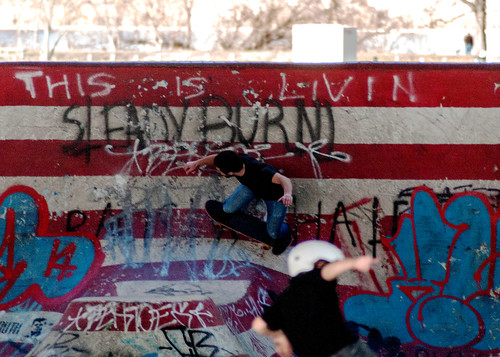
Claude 3.4 describes a photo of a skate-boarding boy & we discuss technique

What’s happening in this picture?

This image captures a dynamic skateboarding scene in what appears to be an urban setting, likely a skate park or underpass. A skateboarder wearing a purple hoodie and khaki pants is photographed mid-maneuver on a curved surface. The image employs motion blur techniques to convey the speed and movement of the skater, creating a sense of energy and action.

The background features graffiti-covered walls with visible splashes of pink, blue, and other colors, adding to the urban aesthetic of the composition. The lighting appears natural, possibly filtering in from outside the structure, which creates an interesting interplay of light and shadow across the scene.

The photograph's technical execution, particularly the motion blur effect while maintaining focus on the skateboarder, suggests this was a deliberately composed action shot rather than a casual snapshot. This technique effectively communicates both the movement and the athletic nature of skateboarding as an urban sport.

Nothing deliberate about it. I was lucky to get the shot. I saw the boy skating, moved my camera to follow him, and took the shot.

I appreciate you sharing the background of how you captured this remarkable shot. It's an excellent example of "panning" - a photography technique where the camera moves along with the subject to keep them relatively sharp while blurring the background. While you describe it as luck, successfully executing this technique, even unintentionally, requires good instincts and timing.

The resulting image is quite striking. The motion blur of the background graffiti creates an engaging sense of movement, while maintaining enough clarity on the skateboarder to capture their form during the maneuver. The contrast between the sharp subject and the streaked background effectively conveys the dynamic nature of skateboarding.

This type of spontaneous photography often produces more authentic and compelling results than carefully planned shots. Would you be interested in sharing more about what inspired you to photograph at this particular location?

It’s a skate park known as FDR in South Philadelphia. My sister lived near there. I’m interested in graffiti and skate parks so went there several times to take photos.

Thank you for providing that context about FDR Skate Park. It's a significant location in Philadelphia's skateboarding culture, known for its distinctive DIY history and design. The park's location beneath I-95 provides both shelter and a unique architectural setting that has made it particularly appealing for photographers and skaters alike.

Your interest in both graffiti and skate parks makes FDR an ideal subject, as it exemplifies the intersection of these two urban art forms. The graffiti serves as more than mere decoration; it's an integral part of the park's identity and contributes to its authentic street culture atmosphere. In your photograph, this is particularly evident in how the blurred graffiti creates a dynamic backdrop that complements the skating action.

The image effectively captures the organic relationship between skateboarding and street art that defines spaces like FDR. Having multiple visits to the location likely helped you develop an understanding of how skaters interact with the space, leading to opportunities for compelling shots like this one.

Would you be interested in discussing how the park's unique architecture and layout influences your photographic approach?

My photographic approach is simple: keep my eyes open, think quick, and get the shot. It’s a bit like jazz improvisation.

Your comparison between photography and jazz improvisation is quite apt and illuminating. Both art forms require a foundation of technical knowledge combined with the ability to make split-second creative decisions based on changing conditions.
Friday, April 9, 2021

Courts decide that graffiti is REAL – Meaning and identity in graffiti, skateboarding, and on the web

One reason graffiti interests me is that it is socially and institutionally ambiguous. It was created back in the late 1960s and 1970s by (mostly) kids who didn’t go to art school or frequent museums. They just tagged their names – not their legal names, but their noms de guerre if you will – wherever they could and elaborating them into every larger and more complex patterns until they were able to cover the side of a subway car with a “piece” (for masterpiece), as they call it. Naturally this brought them into conflict with the authorities and, for that matter, with much of the pubic as well.

The authorities and the wide public thought of it as vandalism, legally it is, while they thought of it as, well, self-expression, maybe art as well – though who knows what ART is these days. As the 1980s rolled around graffiti had become the graphic style of hip-hop culture and then extreme sport (such as skateboarding) and, as such, showed up as designs on apparel and other merchandise, and then in the display windows of upmarket department stores, of all things. Graffiti was becoming institutionalized.

A small cadre of writers – for what is what these artists call themselves, for writing is what they do; they write names – made money producing these designs and doing “permission” walls around the world. Even as they were making bank in legit endeavors, they still kept up their street cred by doing illegals, often in secret hidden places no one knew about but them. As this was going on some writers where doing canvases that could be sold in galleries, hung in private collections, and even in museum collections. We even have dedicated graffiti museums these days, but the illegal work continues.

And that brings us to 5Pointz, a legendary site of legit graffiti in Queens, NYC, that ended up pitting 21 graffiti writers against a landlord who decided to cash in on his property and so destroyed their work without prior notice. I discuss that in the next section. Then I take a look at FDR Skate park in Philadelphia which exists by grace of the governing authorities. It thus has, like the graffiti that covers it, an interstitial (between the cracks) existence. I conclude with a short look at social media, noting that one of the earliest sites on the web is Art Crimes, a repository for graffiti photos started by Susan Farrell in 1994.

5Pointz

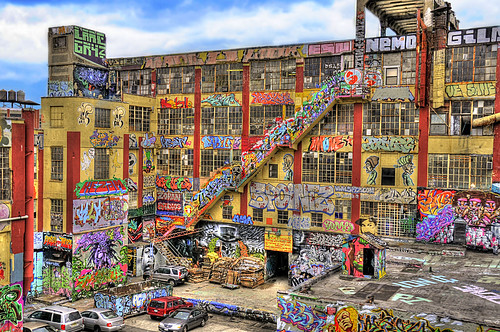
5pointz

Credit: iamNigelMorris, “5Pointz” (2009). (CC BY 2.0)

Back in 2002 Jerry Wolkoff made an oral agreement with Jonathan Cohen allowing him to manage and curate his 200K sq. ft. warehouse in Queens in New York City for use by graffiti writers. Cohen, who gets up (paints) as Meres One, renamed the building as 5Pointz (for the 5 boroughs of NYC). In sort order the building was covered in graffiti and attracted writers and admirers from all over the world. To the extent that such a thing is possible, that building became graffiti’s mecca. Roughly a decade later Wolkoff decided he wanted to demolish the building and replace with it with luxury condos.

The artists were not happy and filed a petition under the Visual Artists Rights Act of 1990 to stop the demolition. Without giving the artists any notice Wolkoff locked the artists out and had the building whitewashed overnight. 5Pointz was gone. The issue went to trial and the artists were awarded $6.7M. Wolkoff appealed and, in February of 2020, lost. Graffiti had reached a new institutional milestone.

Louise Carron has reviewed the case at the Center for Art Law. Here’s her overview:

February 20, 2020 will be known in legal art history as the day that street art was affirmed as “a major category of contemporary art.” In Castillo v. G&M Realty L.P., which put an end to a 7-year long dispute over the whitewashing of the Long Island City-based “graffiti mecca” known as 5Pointz, the U.S. Court of Appeals for the Second Circuit upheld Hon. Frederick Block’s February 2018 ruling for the District Court for the Eastern District of New York (E.D.N.Y.). Judge Block awarded $6.75 million in statutory damages to 21 aerosol artists whose works were destroyed without prior notice by the owner of the building where the artists had been authorized to create for a decade.

In addition to being a great win for the plaintiffs, this case helps legal practitioners understand the Visual Artists Rights Act of 1990 (“VARA”) and pays deference to graffiti as an art form. This federal law takes its roots in the European moral rights theory of protecting art as an expression of the artist’s personality. Among the rights awarded to visual artists is the protection against the willful destruction of works of “recognized stature.” VARA outlines two mechanisms for enforcing these rights:

  1. Unremovable works incorporated in a building cannot be removed without the artist’s consent, unless the artist waives his or her rights in a writing signed by both the artist and the building owner.
  2. Authors of removable works are entitled to 90-days written notice to enable them to salvage the works.

However, VARA does not explain how to reach the threshold of “recognized stature,” so the task of defining its boundaries has been left to the courts, litigants and their attorneys. In Castillo, the Court of Appeals determined whether temporary artworks possessed moral rights and specifically, whether they could achieve recognized stature. The court concluded that “the temporary nature of [street] art is not a bar to recognized stature.”

After a chronology of events and a discussion of the legal issues Carron notes:

this decision is noteworthy for examining street art through the lens of art history and acknowledging that it has become “a major category of contemporary art.” The Second Circuit Court references famous visual artists such as Monet, Christo and Jeanne-Claude, along with Shepard Fairey and Banksy, the latter two known for their “illegal” works and whose pieces sell for millions of dollars at auction. This decision elevates street art to the same level as “high art,” which is exactly what the community has been fighting for for decades, specifically to go beyond the “vandalism” label that authorities coined in the 1970s.

However, it must be stressed that this decision is of limited scope, as it deals with authorized/sanctioned/legal art and is unlikely to be extended to unauthorized works which have not achieved recognized stature. Also noteworthy, the court’s evaluation of the Appellant’s behavior, testimony, and experts were all used against him. This shows how this ruling is particularly fact-specific and sui generis: Jerry Wolkoff engaged in a disrespectful pattern against the artists, which the courts acknowledged and did not allow such behavior to go unpunished.

So, a milestone has been reached, a carefully and narrowly defined milestone to be sure, but a milestone nonetheless. The artists and their art must be respected. 

Finally, I want to come back to the fact that 5Pointz was admired by people from all over the world. It was a locus of fundamental meaning, a quasi-sacred shrine. That sentiment is why that art is valuable and worthy of legal protection. The experts who testified to its “recognized stature” were proxies for those many people.

DIY Sk8parks [Philly’s FDR]

Skateboarding started in the third quarter of the previous century in California as an offshoot of surfing culture. During the 1970s purpose-built skateparks emerged, and in 1990, in Portland, Oregon, skateboarders began creating their own parks. They’d find an out of the way spot, haul in materials, and create their own parks. I’ve photographed two such parks in Jersey City, now gone.

One of the largest and best-known in the nation is FDR, in South Philadelphia. It was constructed under Interstate 95 at the southern end of FDR Park, hence the name. The city government started it in 1994 in an effort to get the skaters out of the central city. They set aside the land, put in a few features, and left it to the skaters, who then proceeded build their own. Here’s a short documentary:

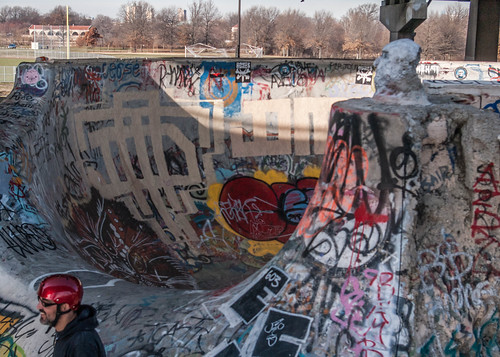
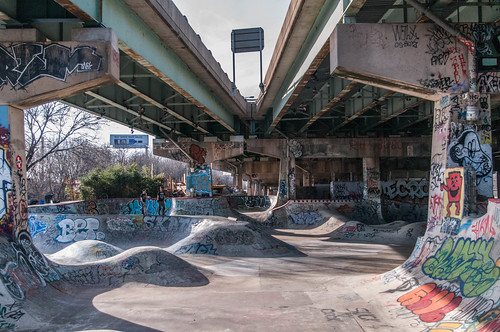
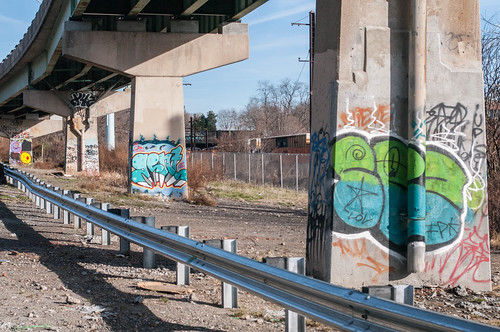
Here’s some photos:

Who runs the place? Who designs and constructs the features? Where do the materials come from? Who handles the money? What’s the approval process. As far as I know the process is entirely informal. The city owns the land, but that’s it. I sent an email to Nick Orso, a well-known skateboard activist who lives in Philadelphia, who told me that construction is organized by one man, named Carlos, and that there is no non-profit organization involved.

If someone were badly injured and decided to sue, how would that go? My friends in the skateboarding community tell me that if that happened, the person would be ostracized from the community. Sure, but more basically, who is there to bring suit against? The City of Philadelphia? My guess is that if the city found itself defending suits it would shut the park down pretty quickly.

As for the graffiti all over everything, I’m pretty sure that goes the way graffiti always goes. Anyone can put anything on any surface at any time. But if you go over someone else’s work, what you do must be better. That’s pretty much it. Though, in this particular case then does seem to be at least one very specific understanding. One surface is covered with an American flag and it does get repainted when the surface degrades. FWIW, I detect a strong quasi-nationalist sentiment – sk8board nation as it were – in the graffiti.

Look at the back in the center to see the flag.

My point is simple: Here we have an enterprise of modest scope that pretty much runs on informal norms. Philadelphia also has ‘legit’ skateparks. Some relatively small neighborhood affairs, but there’s also a large one, Franklin’s Paine, not too far from the Art Museum (the one immortalized by Rocky Balboa’s training regime).

From social media to meaning and identity

And then we have the world-wide web and, in particular, social media. Sites like Facebook, Twitter, YouTube (owned by Google), are privately owned and straddle the globe. They are thus subject to the laws of many nations, and, in a way, more powerful than any of them. Recent political events have made freedom-of-speech issues critical in the United States but, since these facilities are owned and operated by private companies, they are not subject to First Amendment protection.

What are they subject to? How are they to be governed and regulated? I have no intention of proposing answers to these questions. My purpose is quite limited, to point out that the issues raised by social media – not only who says what, but also who owns user-data and how is it to be used – are not readily handled by existing institutions. They are thus like graffiti and do-it-yourself skateparks.

Skateparks exist and are used locally. Graffiti is a bit different. Yes, the individual tags, throw-ups, pieces, and productions – terms of art for various kinds of graffiti art are called – all exist on specific surfaces at specific places. But many of them have been photographed and starting with Susan Farrell’s Art Crimes in 1994, many of these photographs end up on the web. More recently Leonard Bogdonoff has been using computer technology to crawl the web and create a genealogy of graffiti and street art. Given this web-mediated connectivity I have come to think of the graffiti (and street art) taken collectively as the World-Wide Wall, a single aesthetic entity existing both on the ground and in the cloud: ungoverned, beyond all institutions, ever-growing and ever-changing.

* * * * *

Graffiti and skateboarding are sources of meaning for many. As such those activities are important facets of their identity. For a dedicated few, those activities may event be the central anchors of their identity, their deepest point of purchase on the world.

What about social media? The web is large and diffuse. It has no center. But, in social media many find a point of purchase on the world that has become very important to them. It is not only a place to display one’s identity, but an arena in which one can develop and solidify one’s identity in conflict with others. It has become an arena that is ungovernable by current institutions.

Graffiti is a new art form born in the second half of the 20th century and skateboarding is a new sport born at roughly the same time. Will social media prompt us to invent new modes of governance that transcend existing boundaries. Will it have that kind of power? Can we summon the will to do so?

* * * * *

Addendum: For more recent thoughts, see Courts decide that graffiti is REAL 2: Further thoughts [reframing the discussion]. And I'm sure there will be more beyond that.

Monday, January 7, 2019

FDR Skatepark at 3QD

I’ve gathered some of my recent FDR material together and crafted a post for 3 Quarks Daily, Is FDR the capital of the SK8board nation?

What are we to make of this?


It’s crudely rendered, which is neither here nor there, but should be noted as there is some superb work at FDR. What do we make of the imagery? At the center we have a skull and partial skeleton topped by a crown and bordered a black-edged pattern in red and yellow. Feathers, flames? What of the flames at the bottom and the upper corners? The black birds? There’s a caption at the top: “RIDE INTO THE HOLY LAND”. What’s that about? What of the red, yellow, and blue color scheme?

Thursday, January 3, 2019

FDR 4: What about the Indians?

Let’s pick up where we left off, with Trump. Consider this tableau:


There’s Trump on the side of that column at the right. Look at the face of that column. It may be a bit difficult to see, but that’s an Indian (aka Native American). We’ll come back to that. Look at the top of that column. I don’t know what “BDC” stands for, but “DON’T BE A VICTIM” is clear enough. While you are free to read that as a comment on the Indian, I’ve got an image (which I’m not posting) that shows that it was on the column before the Indian was.

Now scan over toward the left, looking at all the graffiti as your eyes move along. There’s a lot of THAT at FDR. We’ve got layers of paint, how many, who knows? Now look at the far left at that black panel on the column. We’ve got the letters “fdr” (in lower case) enclosed in a keystone shield, where we understand the keystone to by symbolic of Pennsylvania (“the keystone state”). Up at the top we have “SOBER VS. WASTED” and at the bottom, “WE HAVE YOU”. In other words, this is home, we are family.

THAT’s our context, all of it.

Look at this photo from 2017:


Look at the second column from the right, behind a low mound of dirt. Yes, it’s small, but I wanted you too see the image in its unblemished state. The image shows an Indian on horseback. To the right of his head it says, beneath what appears to be a halo or perhaps a crown, “SACRED LAND”. That, presumably, is a comment on FDR itself. Here’s a more recent photo, one with some red scrawls across it:


We can now see that it depicts a statue of an Indian on horseback, with “FDR” on the pedestal. Whatever the red markings are about, the underlying image is invoking the American Indian to consecrate – “SACRED GROUND” – FDR.

Now let’s go back where we started. Here’s the face of that column that had Trump on one side:


The figure is clearly male and the long hair and feathers indicate that he is Indian. The jacket almost looks like a double-breasted blazer or sport jacket. Almost. He’s holding something in his left hand. It looks like an arrow, but I can’t really tell. But we can’t be mistaken about the fact that he’s emerging from a keystone on which the letters “fdr” are inscribed in Black-letter font. The letters anchor the image to the skate-park itself. The keystone anchors the image in political structure of American history while the Indian links the image to the people who inhabited the land prior the colonization.

More later.

Wednesday, January 2, 2019

FDR 3: How does Trump show up at the park?

I’ve been blogging about how politics, broadly construed, shows up in the graffiti and street art at FDR skate park in south Philadelphia. In one post we’ve seen how patriotic symbols and dress are transformed and appropriated for FDR itself. In another we’ve seen expressions of war and peace. What about President Trump?

Yes, he shows up there. But let’s start back in 2014. Consider this photo:


In upper right corner you can see a crude bust at the top of a pedestal-like formation. Here’s a close-up:


It’s crudely rendered and is unpainted. Was it supposed to represent anyone in particular? I have no idea.

Now look at this photo from 2017. You can see that bust along the mid-line above the center:


It’s now been painted. The face is flesh-colored and the lips are red (though it’s hard to see them in this small an image). What color is the hair? It’s yellow, that is, blonde. Was that done to evoke Trump? I don’t know. But certainly his blonde hair is used as an identifying feature.

Now look at the bowl behind the bust, a bit below it and to the left. We see what appears to be “TRUMP CAN’T PUMP” on the wall in crude letters. Someone was thinking about Trump and put that up on the wall. I don’t see any obvious and strong connection between those letters and that bust, but those letters do make it clear that some thoughts about Trump do show up on these walls.

Here’s a photo I took in December of 2018.


“FUCK TRUMPS” is clearly scrawled on that bump. The anger is directed, not just at the president, but at his whole family. And this looks like an image of Trump:


Judging from the texture of the marks I’d say that it is a poster that has been pasted to the pillar, a so-called wheatpaste. I don’t know the significance of the lettering, “SYAM”. I did a quick web search but didn’t turn up anything that is obviously related. In particular, I didn’t turn up other images of such a poster. They might be there on the web, but it will take more searching than the five or ten minutes I did.

Now look at the medallion at the lower left. We have lettering around the silhouette of an elephant. Across the top we have “ANGRY ELEPHANTS” and “SPREAD PLAGUE” along the bottom. I’d guess that “PWW” at the left somehow identifies the person or group that placed that medallion on the pillar. Is it the same person who pasted up the poster? I don’t know, but there is a resonance between the two. I find it difficult NOT to see that elephant as the symbol of the Republican Party, which seems to have become the party of Trump.

Some yards away we see an elephant, an angry elephant:


Is there an intentional relationship between this elephant and the one in the medallion? Were they placed there by the same person, by people in dialog? I don’t know.

Finally, here’s a photo of that bust:


The hair is still yellow; the lips are red, but the neck and lower jaw has been painted red as well. There must have been a reason, but I can’t hazard a guess as to what it might have been. Does anyone at FDR think of that bust as representing Trump? I don’t know.

The only thing that’s clear is that Trump is represented at FDR, and not favorably. I don’t recall seeing any other national political figure on those walls. If I’d seen one, I’d have photographed them. For what it’s worth, while Pennsylvania went Republican in the 2016 presidential election, Philadelphia went Democrat.

Tuesday, January 1, 2019

Transformation: FDR then (2014) and now


If you line up the left-most pillars in both images things should fall into place. The creature in the lower photo appears to be modeled after Wylie Coyote; notice the eyes.

Saturday, December 29, 2018

FDR 2: War and Peace

Continuing commentary on politics at FDR SK8park in Philly.


Stylistically, it's a roller. That is, the paint was applied with rollers rather than aerosol. This style is common and is used for large dramatic letters, as here.

I don’t know what “SFO” stands for, but the “O” takes the form of a sign that is generally known as the peace sign. I was first introduced to it in the anti-war movement back in the 1960s, but it is about a decade older than that. It originated in Great Britain in the nuclear disarmament movement and consists of the semaphore (signal flag) signals for “N” and “D” (nuclear disarmament). I’ve seen it at a number of graffiti sites in Jersey City. There’s nothing particularly interesting about it showing up at FDR; in fact, I’d almost be surprised if it weren’t here.

But let’s look at something a bit more interesting. Consider the skull and helmet at the center of this photos:


There’s a lot happening on that surface. It appears to me that the skull was painted along with the background of flames as a single image. Someone went over it with a yellow throw-up on the left and someone else put a white throw-up on the right. Both of those violate and norm the requires that, when you go over someone else’s work, you go over it with something better. But that’s not what interests me.

I’m interested in the lettering on the helmet. Here’s a close-up.


I detect at least four hands at work plus who knows what else. First we have the hand that did the flames, skull, and helmet. That doesn’t look like aerosol; it looks like paint and brush. Our first hand. I’m guessing that the green and white we see at the bottom edge of the helmet is from whatever is beneath it.

Then we have the letters in white aerosol. Our second hand. “WAR” is obvious. If we look beneath the black “NO” – our third hand – we can see “TO”. So, after the skull and helmet was painted someone came along and sprayed “TO WAR” on the helmet. Am I certain of that; am I sure that “TO WAR” isn’t the work of the original artist. “Sure?” No, I’m not sure. But I doubt they’re the same hand. Why would the original artist have switched from paint and brush to aerosol? No, chances are that someone else sprayed “TO WAR” on the held and then a third person cancelled out the white “TO” with a black “NO”.

And then a fourth person came along and sprayed “BE KIND [heart]” in light green on top of the rest. At least two other people made comments by placing stickers on it, a green on in the center and a purple and yellow on at the upper right. They came along before the green painter as his words go over those stickers.
What about the dark red we see? I simply don’t know. It may well be lettering, but I can make it out; it’s too obscured. If you look closely at some of the edges it looks like it may be paint-and-brush work. Perhaps it was part of the original image. We just can’t say.

Friday, December 28, 2018

Politics on Display at FDR SK8park in Philadelphia [Friday Fotos]


THAT^ is why FDR exists, for the thrill and freedom of riding a skateboard.


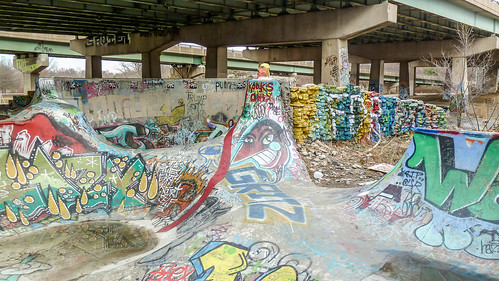
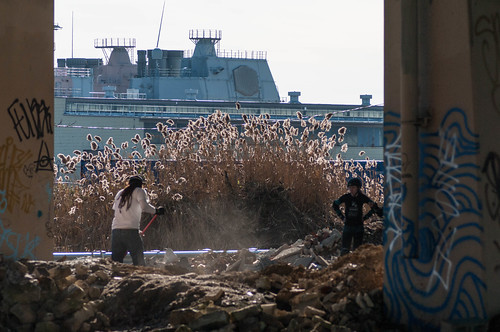
And THIS^ will give you a very rough idea of the style and scale of the place, which covers three to five times the area you see in that photo. Notice the naval ships in the background, the underside of the interstate above, and the shoes suspended from the girders.

But this isn’t exactly about skateboarding, not directly. It’s about some of the imagery that’s painted on the surfaces of the park, the vertical surfaces of the support pillars for I-95 above and for the park’s various features, and on the skating surface itself.

This is going to be a long read, as they say, albeit one with pictures,. You might want to pour yourself a scotch or, better yet, pop the top of a PBR and relax.

Click on photos to enlarge them.

Independence Day (born on the 4th of July)

Consider this photo, which I took this year (on 12.24.18):


Across the center we see “FDR”, “4th of July 2018”, “FDR Since•96” and the Liberty Bell, all against a background of red, white, and blue, the colors of the American flag. The initials “FDR” stand for Franklin Delano Roosevelt, 32nd president of the United States, but the skate park is not named after him. Rather, it is known as FDR because it is at the far end of Franklin Delano Roosevelt Park at the south end of Philadelphia, near the football stadium and the naval yard. For anyone in the skateboarding world “FDR” means this skate park, not the larger park and not the president that park is named after.

The 4th of July is, of course, Independence Day, a national holiday in the United States that commemorates the day the Declaration of Independence was signed in 1776. Where was it signed? In Philadelphia, the home of the Second Continental Congress. The Liberty Bell hung in Independence Hall, formerly the Pennsylvania State House, and is a symbol of American Independence.

And then we have “FDR since•96”. Here’s a bit of history written in 2001 on the Transworld SKATEboarding site on the web:
FDR is to Philadelphia as Burnside is to Portland: city-owned, skater-built, and not for the meek. This sacred space beneath Interstate 95 in South Philly has come a long way since its fledgling days in 1994, when it was born as a result of Philadelphia government’s desire to eliminate skateboarding at Love Park. As a peace offering to Philly skateboarders, the city set aside approximately 16,000 square feet of real estate beneath the highway, laid down a blacktop slab, threw in a couple of pyramids and a grind box, and called it a “skatepark.” City Hall thought this was enough to solve the problems caused by skaters at Love Park; nothing further happened for about a year and a half, until the locals got restless. Inspired by Burnside, and tired of waiting on the City, they took matters into their own hands and started building a transition up a support pillar here, a corner bowl there, a mogul or two in between.
Notice that phrase, “sacred space”. I assure you that’s not used casually.

A year and a half from ‘94 would give us ‘96, in effect the year that the skate boarders took over the park and made it their own, designing and constructing their own features. The park has been growing ever since and remains under construction to this day. Around the edges of the completed section you’ll see mounds of dirt, piles of scrap and not-so-scrap wood and wooden forms for pouring concrete. I don’t know where the money comes from – though at one point the city kicked in $25K – nor do I know anything about the administrative structure of the park. As far as I know there is no legal entity taking responsibility for the park (nothing listed in the Wikipedia entry for example). Somehow it just happens: of the people, by the people, and for the people.

Let’s continue with another paragraph from Transworld SKATEboarding:
The story of FDR Skatepark is much like the story of the United States of America. They both began when a government used unpopulated land in an attempt to move a community of people who needed freedom to express themselves. What followed was not expected by anybody; the colonization of these lands did not happen immediately or as planned. It took time, a lot of work, dedication, dreams, sacrifices, and pain. In an effort to tell the skateboarding world how the colonization of FDR Skatepark happened, the following is a collection of conversations, stories, memories, and feelings from skateboarders who have been there since the beginning, as well as recent immigrants.
And that’s what I see in some of the imagery painted at the park.

In my experience graffiti writers and street artists do not normally employ patriotic imagery, but some of them at FDR do. It is not clear to me just how the story/mythology of this park became infused with the story/mythology of the nation, but that is clearly what has happened. If people were thinking that way in 2001, when Transworld SKATEboarding article was published, then it’s not at all surprising to see such imagery on the walls.

National symbols and skate board mythology


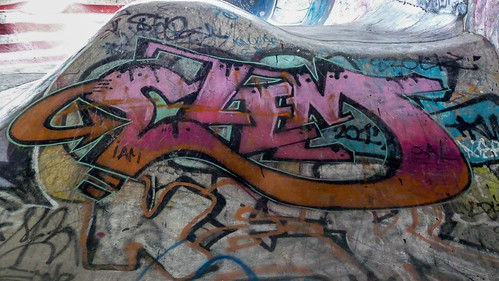
I took that photo last year. In the foreground we see standard graffiti, layers of it (also standard). There is a large well-executed semi-wild-style name in red tones – STEM – that went over something in aqua; that something is now all but obliterated. There is an informal rule about this: If you go over someone else’s work, go over with something better. Otherwise, going over is considered an act of aggression and makes your own work a target for retaliation. STEM seems to have followed that rule. There’s a lot of little nonsense around the periphery, again, pretty standard for sites like this. This is a different kind of politics, the arrangements among graffiti writers about how to interact with one another on the walls they share.

But let’s return to that other kind of politics, where the mythology of nation building has become the mythology of FDR. In the background we see some version of the American flag painted on the surface, the so-called Betsy Ross version. We’ve got 13 stars in a circle against a field of blue at the upper left and then the standard 13 red and white stripes. The “76” isn’t part of the flag design but was added by the artist, whoever it is.

Notice the beer can at the right, sporting the red, white, and blue colors of Pabst Blue Ribbon, which fit in nicely with the ongoing patriotic mythology. But where a real can would proclaim “Pabst Blue Ribbon” we see instead, fdr. Pabst Blue Ribbon is often referred to as PBR, which transmutes easily into fdr. Beyond this, PBR has some considerable currency in popular culture, though just why that is so, I don’t know (Wikipedia lists a bunch of occurrences in movies, TV, and song).

Off there to the left someone is wishing “Happy Birthday” to Jeremiah Risk. This sort of thing is common enough at popular graffiti sites.


This is another photo from this year. As you can see, the painted surface has been degraded through constant skating – it will likely be repainted sometime in 2019. Notice that “NO BIKES” is inscribed at the bottom of the can. More politics. Parks that are good for skate boarding are also good for BMX biking. But skateboarders believe that bikers are harder on the surface than they are and consequently do not like BMX bikers to use their parks. Notice the small white keystone image at the upper right. That figure is repeated across the background (you can just barely see them in the previous photo). Pennsylvania is known as “the Keystone State”, presumably for some role it played in the revolution.

Friday, January 23, 2015

FDR Skate Park in Philadelphia

20141227-_IGP1705 EQ EXP CRVS

FDR is one of the largest DIY skate parks in the world, and is legendary in the skate boarding world. I took those photographs on December 27 and 28, 2014.

20141227-_IGP1802

There are scads of photos of FDR on the internet, and a quick look will tell you that it wasn't always covered in graffiti. But it's the graffiti that drew me there this time around.

20141227-_IGP1828

As the name indicates, it's at the south end of Franklin Delano Roosevelt Park underneath the Franklin Delano Roosevelt Expressway in south Philadelphia. Train tracks are thirty yards away, and then there's the naval yard.

20141227-_IGP1837

20141227-_IGP1669

As far as I know, the place is always under construction: