Showing posts with label Hurricane Sandy. Show all posts

Monday, January 6, 2025

Claude 3.5 Sonnet describes the aftermath of hurricane Sandy

Notice how quickly Claude correctly identifies the general location of the photo and the time when it was taken. Notice, as well, that it has a reasonable grasp of the local geography. I wonder how it would do if I uploaded a map and asked it to read it for me? Hmmmmm.

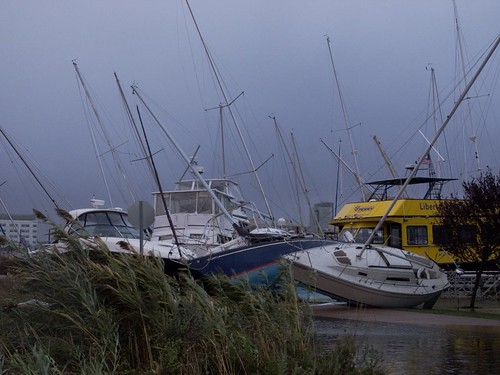
What happened here?

This image appears to show the aftermath of a major storm or hurricane in what looks like New York City. There are several boats and a yellow Liberty Landing Ferry that have been pushed onto land or damaged, surrounded by overgrown vegetation. The boats appear to be strewn about haphazardly, suggesting they were likely displaced by storm surge or powerful winds. The city skyline is visible in the background under overcast skies.

Given the location and the type of damage shown, this image might be from the aftermath of Hurricane Sandy which hit New York City in 2012. Sandy caused significant damage to marinas and boats along the coast, with many vessels being pushed inland by the storm surge. The presence of the Liberty Landing Ferry (which operates between New Jersey and New York City) and the NYC skyline in the background supports this context.

The scene depicts a mix of recreational boats, including what appear to be several yachts and fishing vessels, all showing signs of having been forcefully moved from their normal moorings. The overgrown vegetation around the boats suggests this might have been some time after the initial storm event.

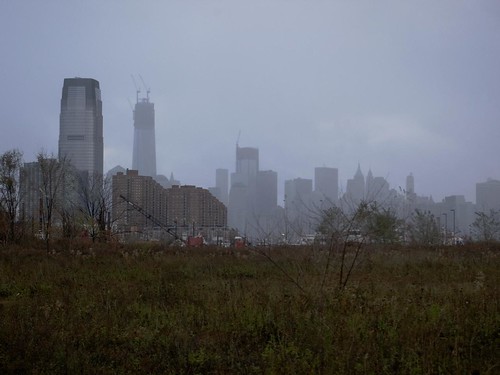
You’re right, it was the day of Hurricane Sandy. The boats were just plopped down in the vegetation. That’s in Liberty State Park near the Liberty Marina. A lot of boats were lifted right out of the water. Though most of the skyline you’re seeing in Jersey City. The New York skyline is obscured by the fog.

Thank you for confirming and providing those additional details. Hurricane Sandy was indeed a devastating event, and this image really captures one of its surreal impacts - the way it could just lift massive vessels and deposit them onto land as if they were toys. It's particularly striking to see the Liberty Landing Ferry among them, given how large and heavy those vessels are.

The fact that this is the Jersey City skyline makes perfect sense given the location in Liberty State Park. That area was hit particularly hard by Sandy's storm surge, being right on the Hudson River. Liberty State Park and the surrounding area have actually become an important case study in coastal resilience and storm preparation since Sandy.

The foggy, gloomy atmosphere in the photo really captures the ominous mood of that day. It's remarkable that this was taken during the actual storm. Were you there documenting the storm's impacts, or did you come across this photo from elsewhere? That must have been an incredibly intense day to witness firsthand if you were there.
Friday, October 2, 2015

Friday Fotos: What Bad Weather Can Be Like in Jersey City (Joaquin is coming)

With hurricane Joaquin coming up the coast, we're in for some bad weather. Just how bad, we don't know. Maybe just a lot of wind and rain, but maybe some flooding too. Probably not Sandy-bad, though. Here's what Sandy was like.

Wind and rain the afternoon before (Oct 29, 2012):

IMGP1487rd

Early morning after Sanday had blown through (Oct 30, 2012):

IMGP1544rd

A little later, a couple of hundred yards away:

IMGP1570rd

No lights:

IMGP1607rd

Wednesday, July 16, 2014

Inside Sandy Looking Out


IMGP1659

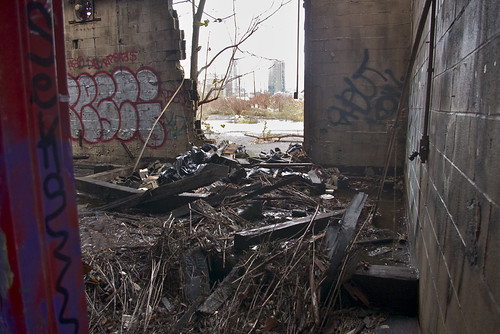
I took this photo the day after hurricane Sandy rolled through Jersey City. The power was out in my apartment and the City, of course, was pretty much shut down. So what else was there for me to do but to photograph the damage.

This particular building is a small abandoned industrial building of some kind; it's off Aetna Drive near the place where the old Morris Canal feeds into New York Bay. Since the building is covered with graffiti inside and out I call it the Urban Design Center. The hole in the wall was there before Sandy – I've taken several shots though it, looking in, and looking out – and the floor was trashed. But most of this debris seems have been washed through by Sandy.

What I particularly like about this photo is the electrical line and junction box that hangs down along the right side of the hole – the way it just hangs there, waiting? The branches reaching over from the left, and the City beyond in the mist. Notice the blue and red along the left edge of the photo. On a door I believe.

Wednesday, April 9, 2014

The Dutch on Water: Let It Flow

In the Netherlands, a man named Henk Ovink offered to be Donovan’s guide. Ovink was the director of the office of Spatial Planning and Water Management, meaning, essentially, that it was his job to keep the famously waterlogged country dry. As he learned about various Dutch innovations, Donovan was struck by the fact that Ovink looked at water as much in cultural as in engineering terms, which was a function of the centuries-old need of the Dutch to act together for protection.
Think like a community:
Beyond that, Ovink feared that politics might undermine any chance to encourage new thinking about water management. “When I mentioned climate change to one official,” he said, “she almost hit me.” He characterized some of the wishful thinking he believed he would be dealing with as: “Don’t hire a Dutchman — believe in angels.”

Dutch battles against water led his country to develop a communal society. To this day, Water Boards, which date to the Middle Ages, are a feature of every region, and they guide long-term infrastructural planning. American individualism, on the other hand, has yielded a system in which each municipality has a great deal of autonomy, making regional cooperation difficult.


Pacific Avenue in Jersey City, the day after Sandy

Friday, October 25, 2013

Jersey City Future: the Twilight Zone

I’ve been feeling that there’s something afoot in Jersey City, but I don’t know quite what. For example, here’s an empty block in Lafayette as it was two years ago (August 10, 2011):

IMGP2017rd

Here’s the same block earlier this year (September 14, 2013):

IMGP3591

Quite a difference.

Two years ago the block was deserted and derelict. This year it’s blooming with plants, art, and people.

What’s Going On?

In the small, that’s easy. Liz Perry and UMMI (Unified Mothers & Men Initiative) got the lot into Jersey City’s Adopt A Lot program in 2012. That summer a few people put plots into the lot and grew some stuff. The lot looked a bit better, but still rather thin.

This summer, UMMI’s Living Village Community Garden really took off. The City fenced it off, more people took plots, and the artists, poets, musicians, and other creatives moved in, the children, too. The garden won a prize for Seed Sowing, and the seeds are just plant seeds. We’re talking about life and friendship and getting along and getting up in the neighborhood.

IMGP4243

That’s one neighborhood, and I could name a lot more people here.

But I’ve got the impression that this sort of thing is jumping off all over the city. The most obvious indicator is all the street art. Some of that is City funded, but most is not. There seem to be a lot of Liz Perrys in Jersey City, a lot of UMMIs, and they’re building neighborhoods.

What’s driving that?

Tuesday, August 20, 2013

Liberty Marina, Fair Weather and Foul: A Photo Essay

IMGP1405rd

In the late 19th Century a canal was cut from the anthracite region in the Lehigh Valley of Pennsylvania across northern New Jersey to New York Bay: the Morris Canal. The canal has long since fallen into disuse and been filled-in. The place where its eastern terminus feeds into New York Bay has become the Liberty Marina.

IMGP1009rd

IMGP1385rd

The yellow boat in the center is a ferry boat:

Friday, August 2, 2013

Funky Friday: Titanic

Damn! I forgot this was here. I shoulda' pulled it out after Sandy. And if you're curious about the roots of hip-hop, here they are. Some of them.
During the Katrina fiasco I went cruising the web for a copy of "Titanic," thinking it an appropriate way of memorializing that occasion. Now that BP has elected to foul the Gulf of Mexico, "Titanic" is once again appropriate.

What is "Titanic"?

"Titanic" is a toast, a form of boasting narrative in the African-American oral tradition that is a precursor to rap and hip-hop. If you go to this YouTube video you can hear Rudy Ray Moore recite a version from Dolomite.

Toasts were discovered by scholars in the late 1960s, but they are undoubtedly much older. The "Titanic" toast is about, well, the sinking of the Titanic. As I say in the final chapter of Beethoven’s Anvil:
After the Titanic sank in 1912, blacks began reciting a narrative poem in which a mythic black boiler man, Shine, escapes from the sinking ship and swims safely ashore. The ship’s captain attempts to keep Shine on board, first offering him money and then offering the sexual favors of white women, including his own daughter. Shine rejects all offers and remains steadfast in his determination to swim ashore. The poem thus rejects white evaluation of black character by depicting a white authority figure as being so depraved as to offer his daughter up to a boiler man for no rational purpose. This obsession, it implies, is a white folks’ problem and it’s about time they dealt with it.
More obviously, "Titanic" is also about white arrogance, the arrogance that believed the Titanic to be unsinkable, the arrogance that believed an oil rig in the Gulf of Mexico couldn’t fail or, if it did, failure wouldn’t cause nasty problems.

The version of "Titanic" I present below is by Afthur Pfister (aka Professor Arturo) and was collected by Louisiana Voices. You can find a more elaborate version at ChickenBones: A Journal.

Shine and the Titanic

I'm a weaver of the word, not a maker of rhyme
But I'm going to tell you the story about my man, my main man Shine.
It was a helluva day in the merry month of May,
Shine was the stoker on the Titanic that day
When a big iceberg come a floatin' their way.

Shine said, "Cap'n Charley, Cap'n Charley, there's a big iceberg floatin' our way."
Cap'n said, "Shine, Shine, don't you be no clown,
I got ninety-nine pumps to pump the water down.
I got pumps made of pipes and chumps to pump.
I got a trillion dollar load I ain't going to dump."

Shine said, "Cap'n Charley, Cap'n Charley, if you look now,
There's a whole lot of ice comin' 'cross the bow.
I ain't never read a book, ain't never been to school,
But Louzeeanna Annie ain't never raised a fool."
Shine said that to himself.

Cap'n Charley said, "Shine, Shine don't you know my might?
Anything I say and do is right.
You work for Cap'n Charley when the sun comes up
You brings my favorite slippers and my coffee cup.
You work for Cap'n Charley, stokin' the coal.
You work for Cap'n Charley and I owns your soul.
You might be a Christian and pray to the Lord,
But on the Titanic, I outranks God."

Tuesday, November 20, 2012

Global Warming: Is it beginning to sink in?

The New York Times has recognized global warming for some time. So it's not surprising that, post-Sandy, it's been running a variety of articles on the theme: WTF do we do? Then thing is, the damage from Sandy has been so extensive that, one way or the other, billions upon billions of dollars will have to be spent. Even if the body politic decides to do nothing, that is, go back the way things were before Sandy, it's going to cost billions and billions of dollars.

And that's billions and billions of dollars in one of the most visible cities in the world, a city that has long prided itself on being the world's de facto financial and artistic capital and, in a sense, the world's premier city. After all, New York is where the United Nations in headquartered, no? New York is not some exotic quasi-tropical tourist destination like New Orleans. New York is, you know, the captial of the freakin' world.

And it's freakin' out because now it's GOT to spend billions and billions to do SOMETHING. But what? And, no matter what gets done, Occupy Wall Street will be watching and tweeting. The revolution may not be televised, but the reconstruction of NYC will be tweeted to infinity and beyond

In Vetoing Business as Usual After the Storm Michael Kimmelman puts it like this:
Cost-benefit analyses, long overdue, should answer tough questions like whether it’s actually worth saving some neighborhoods in flood zones. Communities like Breezy Point should be given knowledge, power and choice about their options, then the responsibility to live by that choice.

This means embracing a policy of compassion and honest talk. It’s no good merely to try to go back to the way things were, because they are not
.
This sort of conversation is a third rail of American politics, so it’s no wonder all presidents promise to rebuild and stick taxpayers with the tab. That billions of dollars may end up being spent to protect businesses in Lower Manhattan while old, working-class communities on the waterfronts of Queens, Brooklyn and Staten Island most likely won’t get the same protection flies in the face of ideas about social justice, and about New York City, with its open-armed self-image as a capital of diversity.

But the decisions ahead come down to nature and numbers, to density, economics and geology. Our relationship to the water can’t stay the same, and at the same time the city is not worth saving if it sacrifices its principles and humanity.

So the real test post-Sandy will be negotiating between the two.

Monday, November 12, 2012

Unity of Being: Conflict and the Self

In the process of formulating a pluralist approach to literary criticism I introduced the notion of unity of being (Unity of Being and Ethical Criticism) and said a few things about it with regard to literature. Now I want to generalize the idea.

The term itself is not at all new, though I have no idea when and where I first encountered it much less how old it is. Nor, of course, is the idea, though just what THAT idea is in THIS context, that’s not obvious. That’s what I want to explore.

In context of literary criticism I had two things in mind: the direct experience of literature and the world as constructed in a given text. The first concerns what it feels like to experience a given text, moment by moment, from beginning to end. The second is how one lives one’s life outside and beyond the text, but in its shadow. That is, the world view embodied in the text. In doing so I simply indicated that those things are what I meant by unity of being.

And that’s how I’m going to proceed, inductively rather than deductively. I could, abstractly considered, proceed by defining being and consequent to that defining unity and disunity of being. Maybe I’ll eventually end up there, but not now. In particular, I may figure out the relationship between “being” in this context and “being” in the general context of pluralist ontology: Are they the same thing or not?

Another Case: Music

So, unity of being and the literary text.

What about, not a verbal text, but instrumental music, or dance? There we have the moment by moment experience, but there is no reference to, construction of, the world? Here unity of being can exist only in the expressive act, for there is no expression of nor reference to a world outside the expressive act.

The case is an important one because I believe it to be fundamental to the evolutionary, psychological, social, and psychological transition from clever ape to proto-human. In making that argument, as I did at some length in Beethoven’s Anvil, I argued that rhythm, not melody much less harmony, is the foundation. And synchronization to a simple beat is the most basic form of rhythmic organization in a group. Fireflies have been observed to synchronize their blinking, certain audiences will synchronize their clapping. And almost all forms of music require that the players synchronize around a single repetitive beat.

The storm has passed, but Sandy is still with us

IMGP1681rd

Sunday, November 11, 2012

A Post-Sandy Header

I'm  trying out a new look: a new header photo and fonts and a new description, as it's called, the phrase below the blog name. The photo still has the urban savanna look, but it's a bit grittier. There's graffiti in there, which is dead-on, and it's on an abandoned freight container, which seems apropos as well. Finally, it's a post-Sandy photo, though there's really no way to tell that from the photo itself.

Comments?

Thursday, November 8, 2012

What Have I Learned from Sandy? Resilience Begins in Responsibility

I phrase it as a question because, though, considered as a weather event, hurricane Sandy is over and done with, as a psycho-cultural-historical event, it is only in the early phases of its life. In an earlier post (Thoughts on Sandy: We Must Change Our Ways, NOW) I talked about the need to restructure our world:
We have to rethink and restructure. We have to decouple and downsize. Otherwise we’re committing suicide by “civilization” and technology.
That idea isn’t new to me. It’s been with me in one form or another for a long time.

But, whatever lessons Sandy has for others—and I hope her lessons have been deep ones—I’m beginning to think that she does have a lesson for me, a lesson about self-reliance, community, and their interdependence. Still, I’m not sure. It’s too soon to tell. In any event, before I get around to a tentative account of THAT lesson, I want first to talk about some other lessons.

Sputnik, Martial Law, Berlin Wall

These lessons are personal lessons, though not entirely so. They are lessons about the intersection of my life with the larger currents of history. As such, I don’t expect that these historical events will have the same or similar significance for others, though they might. Briefly, these are the events:
  • 1957: The Russians launched Sputnik, the first man-made satellite to circle the earth
  • 1968 1969: Martin Luther King was assassinated, riots broke out, and martial law was declared in Baltimore
  • 1989: Berlin Wall came down and set the stage for the reunification of Germany
I was ten years old in 1957 and was fascinated by outer space, rockets, and such—a fascination stoked, no doubt, by various TV programs by Walt Disney and films such as Forbidden Planet (1956). The launching of Sputnik marks the first time my dreams and fantasies met-up with history.

The launching of Sputnik was certainly a world historical event. Shorn of politics, it was the first time that humans stepped off of the earth to function in outer space, if only indirectly. But of course, we can’t divorce Sputnik from Cold War politics, nor did I do so as a ten-year old. I knew, in my ten-year old way, that it was important for America to beat the Russians in the space race that Sputnik had catalyzed.

However, by the mid-1960s I had decided that, if the Cold War was in fact a real and pressing international conflict, it was a conflict dominated by a military-industrial complex that was more interested in preserving itself than in preserving the peace. The war in Vietnam had made me a pacifist and the counter-culture had almost made me a hippie.

Almost. I wore hippie clothing, listened to the Beatles, the Doors, and Jimi Hendrix, and smoked weed—yes, I inhaled. But I never made it to full-out hippiedom. I was too much of an intellectual for that.

And when Martin Luther King was assassinated in 1968, riots broke out in Baltimore, where I was attending The Johns Hopkins University. The riots took place in East Baltimore, far from the North Charles Street campus of university (though the medical school and hospital were in East Baltimore), but that made no difference when martial law was declared. The whole city was put on lock-down. Curfew was 4PM and National Guard vehicles and men patrolled the streets. Of course I had to break curfew, along with some of my hippie (and non-hippie) friends.

Could New York City Protect Itself with Barriers?

In the past few years proposals have been floated to protect the NYC area from flodding by putting large gates into New York Bay. The gates would lie in the seafloor most of the time but would be raised into place during a major storm, such as Sandy. The NYTimes writes:
[Brian A. Colle] said that if gates had been placed in strategic spots like the Arthur Kill, between Staten Island and New Jersey, they would have protected some of the areas that were swamped by floodwaters, including the edges of Lower Manhattan, low-lying areas of Brooklyn and Queens and the western part of Staten Island, as well as Jersey City and Hoboken, N.J.

“The idea is that you raise these barriers, and anywhere inside of that you’re basically protected,” Dr. Colle said, adding, “With a solid barrier, we basically can have business as usual in Lower Manhattan.”

But vexing questions remain. Would industries tolerate immense disruption from the construction of barriers in the city’s busy waterways? Would residents object to the marring of vistas? With climate change advancing, can scientists accurately predict the size of hurricanes that the sea gates would one day have to withstand?

And where would the $10 billion-plus in construction money come from? Even a study — taking into account the complexity of New York waterways, projections in the rise in sea levels and other factors — would take years and millions of dollars.

The scientists and engineers who have worked on conceptual designs for the city say a comprehensive study is needed on what would be the most effective locations and the most practical type of barriers — whether they swing close like a driveway gate or pivot up from the ocean floor, for example.
A feasibility study by the Army Corps of Engineers, which would have jurisdiction, would require authorization from Congress.

“A lot of things need to be taken into consideration before we throw up a giant wall,” said Chris Gardner, a spokesman for the corps.
What strikes me as that time to do the preliminary study and then the actual construction is on the order of significant climate change due to global warming. Thus one can imagine that the climate is changing fast enough that such gates would be obsolete by the time they're built. These gates make sense ONLY if we take major steps to stop pumping CO2 into the atmosphere. Otherwise it's just more wishful techno-dreaming.

Tuesday, November 6, 2012

Apocalypse Now: Sandy Dominates My Weltanschauung

Big word that: Weltanschauung. It means world view, a comprehensive top-to-bottom, right-to-left, inside-and-outside account of the world. Well, hurricane Sandy changed my world. She deserves a Big Word.

Now, physically, me and my stuff are now OK. But as I type this I hear noise created by the generator at the firehouse behind my building. The street it faces doesn't have electric power. That firehouse is my polling place today. I assume the generator will power the electronic voting machine.

Tomorrow we're supposed to get an ordinary winter storm, one of those storms that're variously delightful, if you like snow, or merely irritating if you don't. But this one is coming on top of Sandy, and Jersey City has not even remotely recovered from her. So the impact of this new storm could be harmful, especially for those still without power.

Given this, it is thus something of a shock when I go online to the various places I haunt and discuss and find that those discussions aren't dominated by Sandy. Why not? Because most folks don't live in an area that's been crushed by Sandy. She doesn't dominate their Weltanschuung.

For me and my neighbors, we got a taste of the apocalypse. For the rest of the world, life goes on.

Monday, November 5, 2012

Thoughts on Sandy: We Must Change Our Ways, NOW

IMGP1487rd

I didn’t really think much about hurricane Sandy until I went grocery shopping on Sunday afternoon, October 28. The fact that Irene hadn’t hit Jersey City as bad as had been predicted meant little about Sandy. And I knew that. But still, how bad could it be? So I didn’t stock up on batteries, candles, and non-perishable food. Thus it’s a matter of luck that I had enough to get through four-and-a-half days without power.

Of course, I also had friends, June Jones in particular. A number of people met at her place for meals. She was cooking up a storm. Without power the food in her freezer would spoil quickly. She decided to cook it up and had her friends and family over.

Thanks, June!

And then there’s my friends at the Villain. But I’m getting ahead of myself.

So I got home from shopping on Sunday afternoon and spent some more time on my Halloween costume: Trash Master. I was coming down the home stretch on it and figured it would be ready in plenty of time for the Halloween party we were throwing for the kids in the garden.

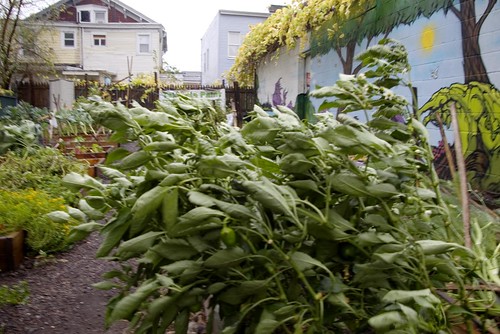
Did some more work on the costume on Monday and more this and that. Took some photos of wind whipping through the garden (see above) and planned my work for the rest of the week. Around 8:30 PM or so that evening the power flickered and then went out. But it came back in a minute or so. Every once in awhile I could feel the building shake. At 9:05 PM the power went out again, and didn’t come back.

Not to worry. I was ready for bed anyhow—I’m going to bed early these days, and getting up early, too, as always. I figured the power would be back when I woke up, or later that day.

I woke up Monday morning to darkness. I had some breakfast, grabbed my camera, and hit the streets by 6:45 AM. Very few lights were on anywhere. That was NOT a good sign, not good at all. Oh, some big buildings had lights on, buildings with generators no doubt. But mostly things were dark, in Jersey City AND in Manhattan.

IMGP1540rd