Showing posts with label globalization. Show all posts

Sunday, May 3, 2026

Presiding over a declining America, Trump hastens the descent

Two from today's (May 3, 2026) New York Times. First, China is on the rise and ready to move beyond America. Then we have the decline of the American empire.

China Rising

Jacob Dreyer, Trump Is Coming to a China That Has Moved On, NYTimes, May 3, 2023.

Deng Xiaoping, the former Chinese leader, once said: “If China wants to be rich and strong, it needs America.” But this isn’t the same country that once looked to a U.S. president’s visit as a moment of global validation. It is a country where the realization has dawned that it may have learned all it can from America and has begun to chart its own course.

This was bound to happen as China grew stronger and richer. But Mr. Trump has accelerated this shift. China’s people have watched with a mix of fascination and revulsion as the president — through his abortive tariff wars, the war with Iran and callow allegiance to financial markets — has completed America’s transformation from a model to emulate to a troublesome distraction to be managed. With sinking approval ratings and potential losses awaiting in the midterm elections, Mr. Trump will arrive in Beijing a more diminished figure in Chinese eyes than perhaps any visiting U.S. president. Sign up for the Opinion Today newsletter Get expert analysis of the news and a guide to the big ideas shaping the world every weekday morning. Get it sent to your inbox.

This matters, both for the visit itself and for the future of the relationship between the two countries. China’s leaders, aware of Mr. Trump’s weakness and perfidy, are unlikely to strike any meaningful bargains with him. His actions strengthen China’s Communist-ruled system at home by making it look superior by comparison.

Many Chinese people increasingly view the United States less as the lodestar it once was and more as a cautionary tale. Popular sentiment in China is of course state-managed, but it resonates because it mirrors what the Chinese see for themselves. I hear it in daily conversations: Chinese friends who return from America with tales of homelessness, dilapidation and political rancor, which contrast sharply with China’s clean and safe cities, gleaming infrastructure and political stability.

After a couple of paragraphs acknowledging that many Chinese “worry that China isn’t ready to fill [America’s] shoes” in the world and acknowledging that “China, after all, has its own problems,” Dreyer moves on:

Still, there is a clear sense about the need to move past America. Mr. Trump will be gone in two years, but Mr. Xi can rule for as long as he wants and has laid out ambitious plans that are likely to survive him. Those plans include a China that is at the center of new types of energy, the use of data and technologies like artificial intelligence for urban management, the delivery of public services, cheaper health care and better access to education. Chinese people also see that the world is increasingly open to adopting Chinese technology, products, investment and other solutions, maybe even its governance ideas.

There's more at the link.

An Empire in Decline

Christopher Caldwell, America Is Officially an Empire in Decline, NYTimes, May 3, 2023.

The American-Israeli attack on Iran was more than a bad idea; it has turned into a watershed in the decline of the American empire. Some might prefer the word “hegemony” to describe the world order the United States leads, since its flag does not generally fly over the lands it protects or exploits. But the rules are the same: Imperial systems, whatever you call them, last only as long as their means are adequate to their ends. And with the Iran war, President Trump has overextended the empire dangerously.

A Middle Eastern military misadventure is one of the last ways a casual observer would have expected Mr. Trump’s presidency to go wrong. The problems he alluded to in all three of his presidential campaigns had mostly resulted from our leaders’ governing beyond their means. At home, proponents of wokeness underestimated the costs and difficulties of micromanaging interactions between groups. Abroad, the mighty American armed forces proved to have no particular talent for democracy promotion, and there was the recent debacle in Iraq to prove it. Overextension was a danger that President Joe Biden contemptuously dismissed. “We’re the United States of America,” he used to say, “and there’s nothing we can’t do.”

Mr. Trump, people thought, would be different. For all the grandiosity of the expression “Make America great again,” Trump voters did not expect him to take on new problems. The greatness would be mostly atmospheric — braggadocio, not adventurism. The United States could become greater even if it withdrew to a less expansive sphere of influence. When he proclaimed an updated Monroe Doctrine, refocusing American attention on the Western Hemisphere, retrenchment was what most people thought they were getting. In last November’s National Security Strategy, he added, “The days in which the Middle East dominated American foreign policy in both long-term planning and day-to-day execution are thankfully over.”

And yet here we are, ankle-deep in a Middle Eastern quagmire, one that Trump himself laid the groundwork for when he withdrew from Obama’s Iran nuclear agreement (Joint Comprehensive Plan of Action, aka JCPOA) in his first term. After two paragraphs in which Caldwell sketches out how Netanyahu suckered Trump into this quagmire, Caldwell has a paragraph in which he sketches out a parallel “with Britain a century ago: deindustrializing, overcommitted, complacent.” He concludes:

Mr. Trump was the perfect candidate for Americans who suspected something had gone wrong with their elites. His argument, basically, was that American-led globalism was so beneficial to politicians that once in power, they would defend it even against their voters, no matter what they said while campaigning. Events, alas, have proved him right.

Suckered again.

Friday, April 3, 2026

The hegemon no longer, the USA as one nation among others

I've long thought that the situation of the post-Soviet collapse, with the USA as the dominant hegemon in the world, I've long thought that situation was unstable, a mistake. For one thing, it forces the USA to devote a huge chunk of its national resources to the military-industrial complex, which amounts to burying that wealth in the sand. There are better things to do with those resources, both here and abroad. And it forces other nations into perpetual obsequiousness, which is undignified.

But, how do we get out of that situation? The answer seems to be: Trump. In the process of attempting to enforce America's will on the world, that is, Trump's will, he's forcing other nations to abandon us and stand up for themselves.

Ana Swanson, Rival Nations Seize On Choke Points to Counter Trump, NYTimes, Apr. 2, 2026.

President Trump has unapologetically wielded the power of the United States on the global stage, taking a much more belligerent approach economically and militarily to try to dictate the actions of other countries.

From high tariffs to the war with Iran, Mr. Trump has claimed that this aggressive behavior internationally has only upsides, and that past leaders were fools for refusing to tap into America’s power.

But one clear drawback of the strategy is emerging. While many countries have acceded to the president’s demands, some have found a highly effective new way to fight back. Mr. Trump’s aggression has given them the opportunity to test their control over choke points, threatening the United States and the global economy.

One such choke point is the Strait of Hormuz. Iran, which accounts for less than 1 percent of global economic output, has control over the shipping lane that transports a fifth of the world’s oil and gas. Its closure since the United States and Israel began attacking Iran at the end of February has blocked shipments of fuel, fertilizer and other goods, sending gas prices sharply higher and spreading anxiety among U.S. farmers and manufacturers.

Another experiment in retaliatory coercion began one year ago on Thursday, when Mr. Trump walked into the Rose Garden and unveiled tariffs on what he called “Liberation Day.” While many governments — even powerful economies like the European Union — complied with U.S. demands, China was a notable exception. Beijing rolled out a licensing system for exports of rare-earth minerals and magnets that has given China unparalleled control over the global manufacturing system.

Whoops! Maybe the sheer complexity of the existing world system is making Trump's hegemonic dreams utterly impossible. It's like the mythical hydra, chop one head off and three more crop up. Are we actually moving toward a really new world order?

There's more at the link.

Thursday, September 24, 2020

TikTok and the problems of social media in a global information economy

John Herrman, What Happens When Americans Join the Global Internet, NYTimes, Sept. 22, 2020.
In contrast to mounting political criticisms of, say, Facebook and Twitter, platforms where the president is extremely active and invested, the government’s public case against TikTok has been largely speculative, citing theoretical dangers and hardly trying to appeal to the app’s users directly. It’s no surprise that the vague message from Ms. Pappas gave some users comfort, given how little this process has addressed them.

TikTok’s users are experiencing for the first time something long familiar to much of the world outside the United States: a flourishing online social space existentially threatened by diplomatic and political fights between states and corporations, with little input from those affected by their decisions. Likewise for WeChat, the Chinese messaging app used by millions in the U.S. to keep in touch with friends, families and colleagues abroad, which was set to be banned on Sunday until a federal court intervened.

To the limited extent that the plights of TikTok and WeChat have familiar precedents, they’re mostly overseas: China’s broad bans on foreign platforms including Facebook and Google; Russia’s “data localization” laws, which require foreign firms to store certain types of data locally; the occasional national shutdowns of Twitter, Facebook or YouTube during periods of political unrest in many countries around the world, including Egypt, Vietnam, Bangladesh, Sri Lanka, Turkey and others; or the Indian ban on TikTok and other Chinese internet services earlier this year. [...]

Worrying about a foreign government’s influence or access to data — or about whether imported competitors might hurt domestic firms — has been a burden for practically every country in the world except the United States, where many of the global internet’s most popular services were started. For a large majority of their users, Facebook, Twitter and Google are foreign firms.

Tuesday, December 17, 2019

What I'm thinking is that global high tech communication absolutely SHREDS a global order based on nation-states [Google and Turkey]

Matt Stoller, Google's Dangerous Monopoly-Based Foreign Policy, BIG, Dec 17, 2019:
There’s something of a parallel to what Google is doing to Turkey, and it’s in China. The U.S. government ordered Google to stop delivering apps to Huawei, and the result is a catastrophe for any attempt to build phones for use outside of China. Here’s one review of one of Huawei’s new phones that works without Google’s apps:
The Mate 30 Pro is an exceptional piece of hardware. Its quad-camera setup shoots outstanding photos, a dazzling 6.53-inch waterfall display is the centerpiece of an inspired design, and its 4,500-mAh battery goes and goes and goes. But the fiasco that is Android without full Google support makes it impossible to recommend.
This isn’t such a problem in China, which has a parallel tech ecosystem of apps like Weibo and WeChat. But it’s a huge problem everywhere else, including in Turkey. I don’t know what happens at this point, but it’s very obvious that if I’m a foreign official anywhere in the world I’m going to realize that Google wants to run my legal system and that I better get access to some sort of tech ecosystem that can support a modern economy.

Google is making a call to use leverage that should only be resolved for very serious foreign policy disputes by the U.S. government, and doing so to protect itself from having to obey an antitrust law in a foreign country. Pulling this kind of stunt is like using financial sanctions recklessly. It works if you’re the dominant network, but every time you use sanctions you create the incentive to build an alternative. To put it differently, it’s like overusing antibiotics. Turkey’s response will in the long-term mean leaning more on China, or Russia, or both. Or the EU and the U.S. could step in, and find ways of demanding that Google obey Turkish law.

Maybe the U.S. government is fine with this decision to prioritize Google’s monopoly and forgo leverage by the government it might need in a genuine national security crisis. But somehow I doubt anyone's really thinking this through, except the officials who used to work at the State Department and now work at Google, like Jared Cohen. And Cohen didn’t do a great job when he worked at State.

Is the nation-state an obsolete form of governance and social organization?

I’ve been blogging on the topic for awhile now – see posts collected under the label “nation-state”. It looks like my first post on the topic went up on October 4, 2014, Where's the World Headed & the Rise of Cities, a Quickie. My most recent one (except for this) went up yesterday, Reading The Human Swarm 8: What about the USA? After I’d posted that I read an article in the NYTimes, In Era of Hardening Identities, Trump Order on Jews Kindles Questions Old and New. The title didn’t say anything about the nation-state, but that’s where it went. Why? Because the nation-state is about identity. And so I appended some passages from that article to my post about The Human Swarm.

Now, that’s the first time I can remember reading something in the NYTimes that pointed out, quite explicitly and distinctly, both that the nation-state is a relatively recent socio-political invention, AND that somehow moving beyond the nation-state is the political problem of the day:
The world, unable to unwind a global order built on national identity, sought to manage its worst tendencies by promoting cultural pluralism, international integration and protections for minorities and migrants. These values did not so much replace national identity as sit uneasily alongside it, eventually leading to a backlash.
I have no particular reason to believe that that is the first time the idea has been broached in that paper – though there always is a first time – which is why I emphasized “remember”. But the topic certainly hasn’t been a regular feature in the opinion section. It should be.

Now, that article goes on to say:
Mr. Trump’s order [targeting anti-Semitic and anti-Israel speech on campuses] raises anew a question that has faced Jews throughout the 200-year era of national identity: whether such identities offer them security or only peril. It is an echo of late 19th-century debates, when some urged embracing national identity and forming a state, while others argued for casting it off and integrating into multicultural democracies instead.

The wider democratic world asked itself this same question in the wake of World War II. It declared old-style national identity a curse and pluralistic democracy the only path to peace, but the argument has raged off and on ever since — as it has, in parallel, for Jews.
That last paragraph suggests that the issue of national identity has been explicitly on the table since the end of the Second World War.

Just how explicit? I’m not at all sure. What I think is that, regardless of what has been said and done – the establishment of the United Nations, all the various treaties, trade agreements and so forth – that the nation-state state has in fact been tacitly assumed as the fundamental framework of political organization. 

It’s like the geocentric model of the solar system. You add new cycles and epicycles to make the whole thing work, but don’t really abandon your central conception. As a last desperate gesture to keep the whole thing tottering along Tycho Brahe suggests a drastic modification: keep the earth in the center as always, so the sun revolves around the earth, but then let all the other planets revolve around the sun. Geocentrism is saved while the mathematics is a bit simplified. It didn’t work.

So, I argue, it has been in our geopolitical thought and action. The United Nations, globalization, all of it, it’s all a Tychoesque Rube Goldberg attempt to keep the old nation-state pumping. It’s not working.

What’s next?

P.S. You might want to take a look at the collection of Thomas Naylor essays Charlie Keil and I have put together, Thomas Naylor's Paths to Peace: Small Is Necessary (Local Paths to Peace Today, Vol. 2). We offer no answers, only things to think about.

Monday, November 18, 2019

Why is Trinidad such fertile ground for the Islamic State?

Simon Cottee, Trinidad's Islamic State Problems, Lawfare, November 17, 2019.
In November 2013 Shane Crawford and two other men pulled off a double murder in a busy town in central Trinidad. Less than a month later all three were in Syria fighting for the Islamic State—the first Trinidadians, or Trinis (to use the local idiom), to do so. By the time the U.S. State Department added Crawford to its list of “Global Terrorists” in 2017, more than 240 Trini nationals had migrated to the so-called caliphate in Syria and Iraq. This makes Trinidad and Tobago (T&T), a small twin-island republic in the Caribbean, one of the world’s biggest recruiting grounds, per capita, of the Islamic State.
Who are these recruits?
In a recent article published in the journal International Affairs, I presented demographic data on 70 of them:
  • Thirty-four percent are adult men, 23 percent are adult women and 43 percent are minors.
  • Of the adults, the ratio of males to females is 60:40. This places T&T at the top of the list of Western countries for female Islamic State migrants.
  • The average age at time of departure across all 40 of the adults is 34. This is unusual compared to age averages found for all other Western Islamic State contingents; travelers from other countries are, on average, nearly a decade younger.
  • Nearly all the adult men were employed at the time they departed to join the Islamic State. The vast majority—90 percent—can be categorized as middle class, while 10 percent can be categorized as lower class.
  • Among the men, nearly 80 percent were married at the time of leaving, while among the women all were married, with the sole exception of an 18 year old who left with her family. So, among the Trini individuals for whom we have data, there were no “jihadi brides,” and while in the European and North American context the norm was “bunches of guys” leaving, in Trinidad it was “bunches of families,” of which there were at least 26.
  • Forty-three percent are converts, which, though high, doesn’t deviate from the pattern in other Western Islamic State mobilizations, where converts are also over-represented.
  • Thirty percent had a criminal record or had been involved in criminal activities prior to their departure, which is also broadly in line with research on European foreign fighters.
  • Finally, the vast majority of those who left come from three areas in Trinidad: Rio Claro in the southeast, Chaguanas in west-central Trinidad, and Diego Martin in the northwest. The majority—nearly 70 percent—lived in Rio Claro on or near the Boos Settlement Muslim community led by Imam Nazim Mohammed.
  • Many attended Salafi mosques (of which there are fewer than five out of a total of 85 mosques in T&T; Salafi-Muslims in T&T are a tiny minority within a minority).
Push, pull, and a network:
What seems to have pushed them, although “push” is far too deterministic a metaphor, was a profound spiritual disaffection from the very best that Trinidad had to offer, which was a decent life of tranquility and ease on a tropical island that they came to see as sexually permissive, corrupt and lacking in any real value—a sort of anti-paradise. What seems to have “pulled” them to the Islamic State was a conviction that it was the true paradise that Trinidad claimed to be but was not: a pristine society of faith free of corruption, deviance and worldly temptation.

Just as important a question as why they radicalized and joined the Islamic State is how they radicalized and joined. This is really a question about recruiters, facilitators and networks. One of the most striking features about the entire cohort of Trini Islamic State travelers is just how networked it was. Everyone in it was connected to everyone else. They all knew each other, either because they were friends or because they were related.

The node at the center of the network was Imam Nazim Mohammed, who remains in Trinidad and presides over his own religious settlement (a sizable area of land that includes the mosque he leads and around 30 houses he owns) in the rural town of Rio Claro. Mohammed’s network has its roots in the Jamaat al Muslimeen, a group of black Muslims led by Yasin Abu Bakr. In July 1990, 114 men from Bakr’s group, including Mohammed and one of his sons, attempted to overthrow the government of T&T, effectively holding the country for ransom for six bloody days. They didn’t succeed, but the dark legacy of the attempted coup, of which the pro-Islamic State network in Trinidad is a part, lives on. Bakr and his men were imprisoned for their involvement but were pardoned in 1992. After their release, Mohammed began to distance himself from the al Muslimeen leader and eventually established his own religious community in the south of the country, where he embarked on a project of Islamic proselytization and disengaged altogether from domestic politics.
Moreover:
If the authorities in Trinidad are to repatriate its Islamic State-affiliated women, as I am suggesting they should, the price of repatriation must be a serious moral reckoning with what these women have done and, for the vast majority who took their children to Syria, the harms they inflicted on their children by effectively pimping them out to a merciless terrorist group. They cannot return as victims deserving of sympathy but must be held to scrupulous moral account.

This raises some difficult questions. One relates to the custodianship of the children, and whom they live with once they are returned to Trinidad. This is made all the more difficult because many of the children’s extended family members in Trinidad are part of the pro-Islamic State network there.

Another question has to do with capacity and cost: It will not be cheap to repatriate 40 or more children to Trinidad, and their care and rehabilitation over many years will require a long-term investment of resources.
Repatriating the men poses different issues. There is more at the link.

Monday, October 21, 2019

Donald Trump, the tail [media master] who wags the dog [body politic] of democracy?

John Emerson has recently posed the question: “With all the things wrong with Trump, why is his dumbness the final zinger for so many people? He's brutal and malignant and his goals are all wrong, but what we talk about is his toupee and his IQ” (see this post, where I quote John extensively). I think it’s a very good question, but I don’t know quite what to do with it. That is, it points somewhere, but where?

I note as well, the Dan Drezner has been running a Twitter thread in which he quotes Trump associates talking about him as a young child. It recently reached 1000 tweets. Here’s a recent pair of tweets, but by no means the most recent:

The valence is different from that of anti-Trump people, these staffers, after all, have to work with the man and, presumably, they are more or less aligned with him politically. Stupid is one thing, childish another, but they share a core meaning: not a full adult like we are.

And in both cases “we” people who have succeeded by, in Emerson’s words, “testing well, filing applications, and credentialization” and “in the schooled, credentialed world, dumbness is the disqualifying sin.” It’s just that some of us want him out of there, while others are doing all they can to keep in him there and functioning. Trump lives and functions best outside the world of coherent procedures, of rules, regulations, and bureaucracy. In Emerson’s formulation, he’s at home in a world that includes
the managers of the huge slush funds of various kinds: intelligence and propaganda services of various nations, organized crime groups, offshore banking and money launderers. And the world of these slush funds is the lawless, untaxed deregulated world of globalization. Trump knows how to work in this world the way we do not.
It’s a world of pirates and improvisers shooting from the hip, trusting in their gut, and making it up as they go along. It’s a pre-modern social world with modern tools and implements.

That’s one thing. And in Emerson’s view that world is the result of short-sighted decisions by the Doyens of Credentialdom:
America's most wrongheaded moves during my lifetime were made by very smart people from Harvard, Yale, Princeton, Stanford, and the U of Chicago -- deregulation, privatization, the militarization of policing, the exemption of big money from taxation, the looting of Russia, the Vietnam and Iraq Wars, and so on.
And, in particular, they’re the ones who created the media world which Trump has been able to master and, in turn, parlay that mastery to the Presidency – even if, perhaps, he didn’t expect to succeed.

Emerson makes light of Trump’s bankruptcies, observing that “they’re normal in his biz.” Perhaps so. I wonder though, if in the end, his real estate business was just a vehicle to build and propagate his personal brand. As long as he hand enough wealth to put on a good front, little else mattered. And once he discovered that he could work the TV screen, everything became secondary to that. Then he discovered he could work the Twitterverse, 140 and then 280 characters at a time.

And that put him in position to use the media to leverage the company’s political system in favor of his personal brand. He’s thus made a wag the dog scenario – remember the movie? – into the current political reality.

What I’m fishing for is the proper way to conceptualize the relationship between his personality and the media-drenched political sphere. Is it that he was the first one to see the possibility? I can think of three movies off the top of my head that deal with this: All the King’s Men, A Face in the Crowd, and Network. The first was based on a book loosely based on a real politician, Huey Long of Louisiana. The demagogic abuse of the media is hardly a new possibility, or fear. It’s been with us since when, the invention of the printing press or not too long after?

Perhaps Trump is simply the first one to pull off this media reversal/takeover at the national level. Well, sure. But why him, why The Donald? That’s what I’m trying to conceptualize. The timing was right? OK. But he saw/smelled a possibility and went after it. It’s one thing to spot a way down field (I’m launching into a football metaphor) when you’re up in the stands with a pair of high-powered binoculars. But how do you spot the opening when you’re on the field as a quarterback or running back? That’s what Trump did, he spotted the opening from the field. Those movies, and by implication other more distant expressions and conceptions, they’re observing the field from the stands. They may see accurately, but you can run with the ball from up there.

OK, that’s enough. Perhaps more later. Check out my post from September 2018, Trumposaurus Rex @ 3QD – Toward a cybernetic interpretation.

Addendum, later in the day: I just took a look at that post. In there make the point that Trump’s post-election combination of daily tweeting and fairly frequent rallies (combined with keeping tabs on his TV profile) is something new and those two activities in tandem put him much closer in touch with this political base. Perhaps THAT’s what different and what gives him the power to wag the dog.

Addendum, 10.23.19: The NYTimes recently published an Op-Ed by an anonymous official within the Trump administration, I Am Part of the Resistance Inside the Trump Administration. This official is in favor of much of what Trump has done, but thinks this about the man himself:
The root of the problem is the president’s amorality. Anyone who works with him knows he is not moored to any discernible first principles that guide his decision making.

Although he was elected as a Republican, the president shows little affinity for ideals long espoused by conservatives: free minds, free markets and free people. At best, he has invoked these ideals in scripted settings. At worst, he has attacked them outright. [...]

From the White House to executive branch departments and agencies, senior officials will privately admit their daily disbelief at the commander in chief’s comments and actions. Most are working to insulate their operations from his whims.

Meetings with him veer off topic and off the rails, he engages in repetitive rants, and his impulsiveness results in half-baked, ill-informed and occasionally reckless decisions that have to be walked back.

“There is literally no telling whether he might change his mind from one minute to the next,” a top official complained to me recently, exasperated by an Oval Office meeting at which the president flip-flopped on a major policy decision he’d made only a week earlier.

Friday, October 18, 2019

John Emerson on Donald Trump's ability to surf the world of unregulated slush funds


Here's how it ends (to save you the trouble of clicking through to FB):
Not only did he have money, his world was made up of other people with money. Much of his success has come from convincing others to invest their own money in his projects. And "people with money" isn't just heirs and successful businessmen. It includes the managers of the huge slush funds of various kinds: intelligence and propaganda services of various nations, organized crime groups, offshore banking and money launderers. And the world of these slush funds is the lawless, untaxed deregulated world of globalization. Trump knows how to work in this world the way we do not.

* * * * *
With all the things wrong with Trump, why is his dumbness the final zinger for so many people? He's brutal and malignant and his goals are all wrong, but what we talk about is his toupee and his IQ.
* * * * *

Addendum 10.18.19: Emerson has now amplified and elaborated:
Trump has not gotten to where he is through testing well, filing applications, and credentialization. People who have been schooled that way are hard put to understand people who didn't, like Basquiat, Amazonian tribesmen, and Trump. Trump has succeeded in a difficult field and while he started on third base, he's objectively done far better than most heirs.

Tuesday, December 4, 2018

Could mainland China force itself on Taiwan through military power? Perhaps not.

Tanner Greer, Taiwan Can Win a War With China, Foreign Policy, September 25, 2018:
China has already ratcheted up economic and diplomatic pressure on the island since the 2016 election of Tsai Ing-wen and the independence-friendly Democratic Progressive Party. Saber-rattling around the Taiwan Strait has been common. But China might not be able to deliver on its repeated threats. Despite the vast discrepancy in size between the two countries, there’s a real possibility that Taiwan could fight off a Chinese attack—even without direct aid from the United States.

Two recent studies, one by Michael Beckley, a political scientist at Tufts University, and the other by Ian Easton, a fellow at the Project 2049 Institute, in his book The Chinese Invasion Threat: Taiwan’s Defense and American Strategy in Asia, provide us with a clearer picture of what a war between Taiwan and the mainland might look like. Grounded in statistics, training manuals, and planning documents from the PLA itself, and informed by simulations and studies conducted by both the U.S. Defense Department and the Taiwanese Ministry of National Defense, this research presents a very different picture of a cross-strait conflict than that hawked by the party’s official announcements.

Chinese commanders fear they may be forced into armed contest with an enemy that is better trained, better motivated, and better prepared for the rigors of warfare than troops the PLA could throw against them. A cross-strait war looks far less like an inevitable victory for China than it does a staggeringly risky gamble.

Friday, May 16, 2014

Over six decades ago - Gojira 1954

In honor of the latest Godzilla film, here's a blast from the past, a review of Gojira which I published in The Valve several years ago. This is the Japanese original of a film that appeared in America in 1956 as Godzilla, King of the Monsters, and scared the stuffing out of me when I was a kid. The Japanese original is richer. It came out less than 10 years after the end of WWII and about a century after Commodore Perry goaded the Japanese into investigating Western ways and refitting them into Japanese ways. Gojira has two interlinked storylines: the story about the monster from the sea and a story about love vs. arranged marriage. The second one was dropped from the American re-edit. In this essay I suggest — but no more than that, suggest — that the two storylines are, deep down, but one storyline. Here's a working paper on Gojira.

A review of Gojira, Ishiro Honda, dir. Toho Co, Ltd. 1954; reissued by Classic Media 2006.
On March 1, 1954, the United States detonated Castle Bravo at Bikini Atoll in the South Pacific. Castle Bravo was a hydrogen bomb with a yield of 15 megatons, roughly two or three times what had been expected. It was the largest radiological accident ever caused by the land of the free and the home of the brave and poisoned the crew of a Japanese tuna boat, the Daigo Fukuryu Maru (Lucky Dragon No. 5), with one crew member eventually dying of leukemia. This led to a tuna scare in Japan and a petition drive to ban the bomb.

Tomoyuki Tanaka was one of many Japanese who followed the story closely. He worked as a producer for Toho Company, Ltd., one of Japan's major film studios. When a deal fell through and created a hole in the studio's release schedule, Tanaka decided to fill it with a new kind of film, a sci-fi horror story filmed in noir style and featuring a prehistoric beast awakened by an atomic explosion. The beast was named Gojira and the film was released in Japan on November 3, 1954.

If you look closely, you'll see a reference to Lucky Dragon No. 5 early in Gojira. The movie opens on a freighter at sea off Odo Island, the Eiko-Maru. It's evening and some of the sailors are gathered together while one of them plays the guitar and another the harmonica. There's a sudden bright light and a loud noise. The sailors rush to the side of the ship to see what's happened:

0 no 5.jpg

Notice the number on the life preserver, “No. 5.” The freighter sinks and all hands are lost.

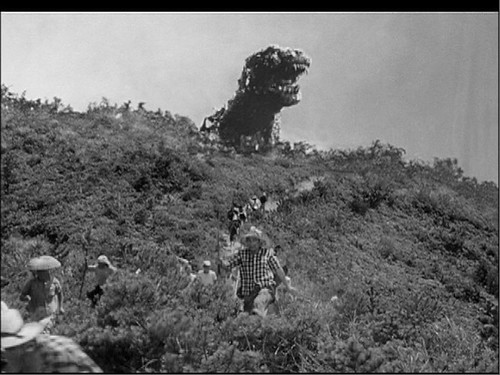
Thus begins Gojira. It builds slowly. Another ship is lost, meetings are held, decisions made, and eventually a scientific team is sent Odo Island to investigate. The team is headed by Dr. Kyouhei Yamane, a noted paleontologist, who is accompanied by his daughter Emiko and Hideto Ogata, who works for the steamship company that's lost two boats. At long last, 21 minutes into a 98 minute film, we catch our first glimpse of Gojira:

5 gojira roars.jpg

Gojira's footprints are saturated with Strontium 90, as is the Island's well water, evidence that Gojira as been tainted by radiation from some otherwise unidentified nuclear test. Beyond that, we know and learn little about why Gojira's on the rampage. It's simply an ugly fact, the monster's been awakened and is heading toward Tokyo, what do we do?

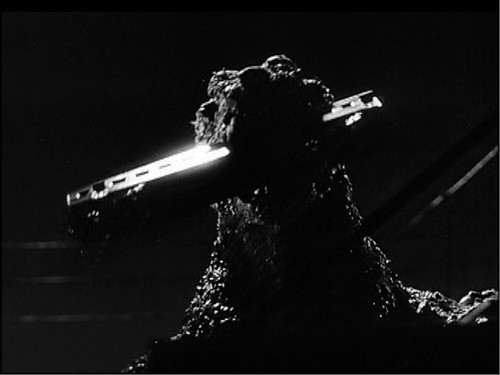
Not much that's effective. Gojira arrives at night and wastes Tokyo. Here's Gojira crushing a passenger car from a commuter train:

7 train in mouth.jpg

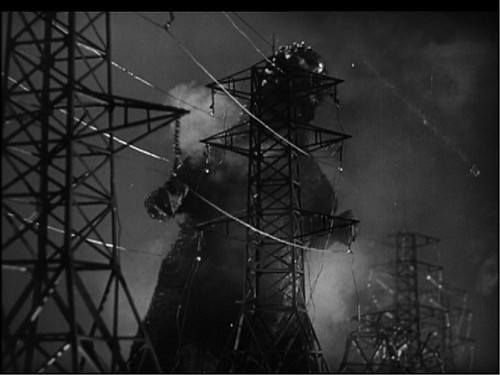
Gojira is unfazed by the high-voltage fence erected as a defense measure:

9 at the tower fence.jpg

Saturday, October 22, 2011

Saif al-Islam al-Gaddafi, a Tragic Figure?

Graham Harman has recently offered some reflections on Saif al-Islam al-Gaddafi, Muammar Gaddafi’s second son and often thought to have been his heir apparent.
I’ve mentioned before that I saw Seif lecture in Cairo maybe 18 months ago. He showed his true colors in the spring of 2011 with his violent television speech, but I’m afraid he had me pretty well fooled during his Cairo speech (which wouldn’t have happened if I’d bothered to research some of his previous public statements ahead of time). It was a smooth, likable, progressive-sounding talk about the future of Libya and of all Arab countries–and obviously complete bullshit, in retrospect.
I’m not so sure.

I have no direct knowledge of Saif, but a friend of mine did, Ned McClennen. Ned had admitted Saif to a Master’s level philosophy program he ran at the London School of Economics (LSE) and had worked with Saif in creating a new constitution for Libya, drafting both a bill of rights and a preamble. Critical Inquiry recently asked Ned about his experience with Saif. Here’s the long penultimate paragraph:

Sunday, October 31, 2010

The Great Writer: Graffiti and the Singularity

An Apocalyptic Fantasy in Some Acts, Maybe More, Maybe Less

IMGP0640rd.jpg

So, I was wondering, as I do from time to time: What’s this blog about? Sure, I write it, but that doesn’t mean that I know what I’m going. What do all these things have to do with one another other than me being interested in them: cultural evolution, graffiti, music, anime (Miyazaki, Kawajiri) and animation (Disney, Paley), flowers (flix), Shakespeare, sexuality, and a little of this and some of that.

As I said, I was thinking through that stuff and it hit me: Graffiti and the Singularity!

WTF? What in doG’s name do they have to do with one another?

IMGP2888rd

THE SINGULARITY, as you may know, is something that’s supposed to happen in the not too distant future, though not necessarily just around the corner, when computers get big enough and smart enough that they can light out for the territory on their own. Spontaneously, over night, they’ll out-think us and, from that point on, we won’t know what they’re up to. Heck, we won’t even know they’ve gone over to the THE OTHER SIDE because we won’t be smart enough to detect it and they won’t have any reason to tell us about it.

That’s one version, anyhow.

But what’s that have to do with graffiti? Well, it seems Vernor Vinge came up with the idea back in 1983, about a year before Subway Art came out. I suppose lots of notions were sent up in trial balloons within a year or two of Subway Art, one way or the other. But they don’t count. ‘Cause you see, Style Wars came out in 83 and you had Kase 2 talking about computer styles in graff.

Yeah, that’s it. Kase 2 read Vinge’s article and got the idea for computer styles from the singularity. Or did Vinge see Style Wars and cop the idea from Kase 2? Maybe neither. Maybe both were channeling the Great Writer.

IMGP9906rd.jpg

For you see, both computers and graffiti are about writing. The graffiti case is well-known. It started with the tag, the writer’s name. And became more developed and elaborate until wild styles came on the scene. With wild styles the name was all but obliterated in the elaboration, figuration, and transformation. But it was still there, in the deep core, in the instruction set of the design matrix.

Thursday, August 5, 2010

What's (a) Google wave?

1. A secret gesture Google employees use to identify one another when they’re on a spy mission in, say, China.

2. A unisex hairstyle available free of charge to Google employees in on-site styling salons.

3. Modeled on ‘the wave’ at sporting events, it’s gesture of solidarity among thousands upon thousands of people in a public place, such as Times Square in New York City, Piazza San Marco in Venice, or Tiananmen Square in Beijing.

4. Like microwaves, except very much higher in frequency. Used to carry the net traffic of ‘preferred’ users. Or perhaps it’s used in weapons designed to vaporize communications satellites.

5. A super tsunami created when an asteroid plunges into the ocean.

6. A special weave in the fabric of the jerseys required of all ‘inner circle’ Google employees.

7. The pattern of revisions to history books as a consequence of changes in the page-rank algorithm.

8. Earth tremors resulting from the explosion of a Goggle data center as a consequence of a massive viral attack.

9. The gesture Sergy and Larry make to the remaining inhabitants of earth when they set course for Mars in their solar sailer.

Sunday, July 11, 2010

Nina Paley on Fire


This is another excerpt from my interview with Nina Paley about the Agni Pariksha episode of her feature-length animated film, Sita Sings the Blues. I organized the interview around a series of frame grabs from the film. In this excerpt we're discussing how Paley animated fire.

[The first interview excerpt is here and it is about directing.]


Rotoscoping Fire


BB: Where’d Mr. Squiggles come from?

NP: Ah, that is one where I did make an automated rotoscope. What I did I was looking on line for real fire, real explosion.

I should say that making fire, animating fire, was such a challenge for me. I did not know how to do it, I could not find books about doing it. There had been a book that I’d seen in San Francisco, I didn’t remember the title of it.

BB: I, I, I’m sure it’s a pain.

NP: But I saw it beautifully done in Fantasia -

BB: Oh, sure. But they had someone who animated fire 24/7, he breathed, and another guy animated bubbles 24/7 –

NP: I know –

BB: And another one did sea foam –

NP: I know, but there are principles behind it that could be learned, but I could not get my hands of a book. I was looking everywhere . . .

BB: Well, Mike Barrier tells me those, they’re [The Walt Disney Company] never gonna’ release the archives, and it’s a world treasure, and no one’s ever gonna’ know what’s in them.

NP: Well, anyway, such books exist, I know they exist. But I could not find them. So I was just going nuts, and I actually went to great lengths to get a DVD of Fantasia, which of course was in the vault, out of print, couldn’t get that. So that was an adventure in and of itself. And then I studied it.

Studying that didn’t, I couldn’t figure it out anyway, even from studying it. It was like I didn’t get it.

So, I was having to learn how to animate fire. And one of the many things that I did, was I rotoscoped fire. But to do that I needed some footage of fire. So I scoured the web. And remember that I was basically broke, even though the film cost a lot of money, cost many 10s of thousands of dollars, I was broke. So I could have bought a videotape of fire, like somebody had shot various explosions against a black background, for compositing and special effects. And that was like $500 to buy the videotape. It was then royalty free, but I did not want to pay that. I mean, I didn’t really need the videotape, I just needed something to rotoscope. So fortunately I found the tiny little preview videos on the website that was selling the tape. Because who would want it at such low low resolution? And they put their  logo in it. So, and um, it might have been like $800 or something, it was more than I could afford. And I wasn’t going to use it for compositing.

So I managed to capture some of those videos, remove the logo, and I had to crop the thing. But I rotoscoped those with software called Synthetic Studio Artist. Which is not easy to use anyway. You have to create all the brushes, and create how it’s gonna be –

BB: So that’s rotoscoped fire –

NP: This is, yeah, this is rotoscoped with Synthetic Studio Artist, which is amazing. And I also use that for the explosion in the beginning.

BB: I mean, that’s three times in the film. In the very beginning and at the beginning and end of this sequence.


Monday, May 17, 2010

World Music Still Thriving After All Those Years of Rock and Roll Imperialism

Fernando Ferreira & Joel Waldfogel have published "Pop Internationalism: Has A Half Century of World Music Trade Displaced Local Culture?" through the National Bureau of Economic Research (NBER Working Paper No. 15964, Issued in May 2010):
Advances in communication technologies over the past half century have made the cultural goods of one country more readily available to consumers in another, raising concerns that cultural products from large economies – in particular the US – will displace the indigenous cultural products of smaller economies. In this paper we provide stylized facts about the global music consumption and trade since 1960, using a unique data on popular music charts from 22 countries, corresponding to over 98% of the global music market. We find that trade volumes are higher between countries that are geographically closer and between those that share a language. Contrary to growing fears about large- country dominance, trade shares are roughly proportional to country GDP shares; and relative to GDP, the US music share is substantially below the shares of other smaller countries. We find a substantial bias toward domestic music which has, perhaps surprisingly, increased sharply in the past decade. We find no evidence that new communications channels – such as the growth of country-specific MTV channels and Internet penetration – reduce the consumption of domestic music. National policies aimed at preventing the death of local culture, such as radio airplay quotas, may explain part of the increasing consumption of local music.