Showing posts with label #ccourses. Show all posts

Thursday, September 10, 2020

Vygotsky Tutorial (for Connected Courses)

Bumping to the top of the queue because it is relevant to my current interests (the impossibility of brain-to-brain thought transfer).
Howard Rheingold recently mentioned Vygotsky in a Connected Courses discussion:
And student-centric pedagogy in which learners attempt to make meaning of texts together isn't as new as social media. Dewey, Freire, Vygotsky and others pointed in that direction.
I’m not sure what he had in mind with that reference to Vygotsky, but Vygotsky is one of the seminal 20th century thinkers about language and mind and has had a strong influence on me.

Vygotsky argued, in effect, that thinking – considered as a quasi-verbal voice in the mind – is just internalized speech. The young child learns to speak to herself as others speak to her and thereby gains a mechanism affording some control over her mind. We can contrast Vygotsky’s view with the somewhat later view of Noam Chomsky, the linguist, who regarded language as primarily an instrument of thought and only incidentally an instrument of communication. On the contrary, Vygostkians argue, we can think (in the sense of talking to ourselves) because we can communicate.

I’ve already got a relatively brief post on this elsewhere on New Savanna: Thought as Inner Speech. In this post I excerpt a long article published in PSYART: A Hyperlink Journal for Psychological Study of the Arts: First Person: Neuro-Cognitive Notes on the Self in Life and in Fiction. When reading this excerpt keep two things in mind. First, there is no deliberate instruction going on. For the most part we acquire language without being deliberately taught; we just “breath it in.” The child is not, in this process, imitating the adult (or other speakers). She’s internalizing.

Think of the process Vygotsky describes in terms of the scaffolding metaphor that's currently all over the place. The adult's speech scaffold's the child's behavior, both in action and perception. Then the child learns to use her own speech to scaffold. Finally there's no need for external scaffolding, that is, no speech either from an adult or from the child herself.

Vygotsky on the Emergence of Thought as Inner Speech

Given this conception of self and language I now want to turn to Vygotsky's conception of thought as inner speech. The general idea is that as others direct the child's actions and perceptions through language, so the child learns to use language in controlling herself (Vygotsky, 1962; Luria, 1959). In effect, the child peoples her brain with an other and uses that other as a mechanism to control her own mind.
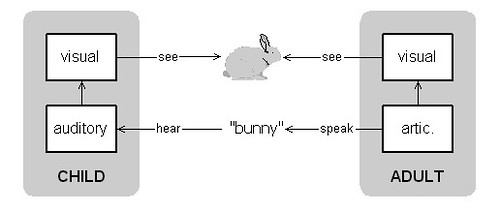
Vygotsky bunny 1
Figure 1: Adult directing child's attention to a bunny.

When a young child is requested to do something, the linguistic channel in the child's brain analyzes the acoustic input and activates the appropriate cognitive and perceptual schemas. The command "come here" will activate a plan for locomotion while the command "look at the bunny" (see Figure 1 for an informal representation) will activate a plan for seeing. The child knows that she is to execute the command because of the intonation pattern (Jakobson's conative function, 1960), which, presumably, is grounded in the various neural systems subserving social interaction. Upon receipt of that intonation pattern, the child's motor system is prepared to execute a pattern. As the content of the utterance is decoded the motor schema, whether for moving her body or looking in a certain direction, is executed. This sounds as though the infant is helpless in the face of intelligible commands from others, that she has no choice but to execute them. Initially, I believe, this is the case. The motor control center has no way of distinguishing between a command originating in the brain of another and a command originating within the child's own brain. Once the ability to make the distinction is learned, the word "no" enters the child's vocabulary as a means of marking autonomy (Church, 1966, p. 101).

Not only can the child listen, she can also speak – though there is a lag between the child's capacity to understand language and the child's ability to produce it such that the child can understand more than she can talk about (Lenneberg, 1967). If the child's utterance contains a command directed toward herself – and there is evidence on this (Vygotsky, 1962; Luria, 1959) – then she is using language to direct her activity in the way which others use language to direct her activity (see Figure 2). The route from acoustic analysis to the execution of the action is the same in both cases, only the utterance's point of origin is different. In one case the utterance originates with another, in the other case with the child herself.
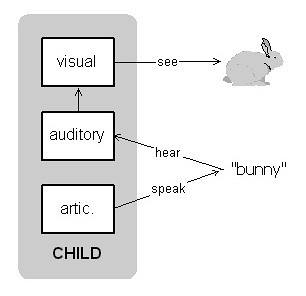

Vygotsky bunny  2
Figure 2: Child talking to herself about a bunny.

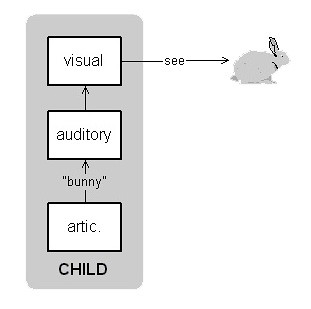
The next developmental step, so Vygotsky's account goes, is that the child's self-directed speech becomes silent and internal (see Figure 3). In a word, it becomes what is ordinarily known as thinking (Benzon, 1976a, cf. Lamb, 1998, pp. 181-182). Given that this process starts with language which others direct to the growing child and involves mental structures for coordinating language and social interaction, this would make thought, so understood, to be an inner dialog between virtual persons. It is thus not surprising that, in his investigation of the metaphor system governing folk conceptions of the self, George Lakoff (1996) found that we conceive the self to be a multiplicity of agents. And when we leave the world of folk psychology and enter the world of psychoanalytic thinking we find that the superego, the inner agent of social norms, develops as an internalization of parent figures (for example, see Freud, 1960, pp. 18-29; Erikson, 1963, pp. 256-57).
Vygotsky bunny  3
Figure 3: Child thinking about a bunny.

Let us then assume the existence of the mental machinery responsible for the process Vygotsky has outlined. This machinery operates on the self-structure as described in the account of personal pronouns. In the context of this more sophisticated machinery the ego and alter nodes are variables. Let us assume that this machinery creates what Gilles Fauconnier (1994) calls mental spaces; a mental space is an occasion for thinking, speaking, or writing [Note 9]. It is a temporary event; neurologically it would correspond to a particular pattern of brain activation.

[Note: the talk of ego and alter variables in the following paragraph refers back to an earlier section of the original article. Just read through it.]

A mental space can be real or hypothetical (Lakoff, 1996, pp. 95 ff.). A real space is one representing real events, whether immediately present or recalled from the past. When activated in a real space the ego variable is set to equal the self-image while alter is set to equal the person with whom one is talking. This means that all the knowledge one has of that other is brought into play, whatever that means, through the operations of the alter variable. And, of course, all the knowledge one has of oneself is brought to bear through the ego variable. One constructs a hypothetical space to consider hypothetical situations about real people or, possibly, imaginary events about completely imaginary folks. When activated in a hypothetical space ego can be set to equal any person, as can alter. In particular, it is possible to set both ego and alter to the same value. When one is just thinking, ego and alter may both be set to the self-image, thus making such thinking into a conversation with oneself. When one is watching a performance of Antony and Cleopatra, ego may be set to Antony while alter is set to Cleopatra, or Caesar, or Enobarbus, whomever Antony is interacting with at the time – a matter we'll take up in the next section.


Tuesday, August 16, 2016

Small schools punch above their weight on tech innovation

From Howard Rheingold's profile of digital educator Bryan Alexander:
My experience with large institutions such as Stanford and smaller, less brand-famous institutions such as the University of Mary Washington, led me to the same conclusion as Alexander: “Some of these private, undergraduate-focused, smaller institutions punch above their weight when it comes to technology innovation. We worked closely with these schools and experimented with variety of tools and pedagogies — GIS mapping, social media on mobile devices, digital story-telling. We used technologies to talk about how to use technologies — video conferencing to help explain video conferencing. Social media. I built and ran a prediction market game for a few years. Since 2014, Alexander has struck out on his own as a “consulting futurist” for educators.
Social equity:
“First is the social equity benefit. If you go to a library in the developing world, you’ll find them usually packed with people but lacking a lot of materials. And, one reason is because they can’t afford to ship in a lot of books and journals. They can’t afford a lot of the developed world prices. Open education resources for those libraries are a godsend. You think about the same as a learner. You’re working in Ghana, you’re 15 or maybe you’re in North Africa and you would really like to make more of your life. You have access to the world through your phone but how much of American higher education is not available that way, even when it’s in digital form? How much do we bury behind pay walls or lock in the tombs of closed, proprietary systems? So for equity reasons, for just decency reasons, we have to open our trove for the world.”

Wednesday, December 16, 2015

To Academia.edu or Not Academia.edu, that is the question

There's a debate going on about whether or not scholars should participate in Academia.edu. The case against it is: because, capitalism! That is, it is a profit making venture and so doesn't have 'our' best interests at heart. But then, do existing colleges and universities?

Gary Hall is one source of this discussion. His Should This Be the Last Thing You Read on Academia.edu? has, at this point, been seen almost 12,000 times. A paragraph:
Of course, the majority of academics who are part of Academia.edu’s social network are the product of the state-regulated, public higher education system, as is their research (a system, it should be said, from which public funding is steadily being withdrawn). But just as Airbnb and Uber are parasitic on the public ‘infrastructure and the investment’ that was ‘made by cities a generation ago’ (roads, buildings, street lighting, etc.), so Academia.edu has a parasitical relationship to the public education system, in that these academics are labouring for it for free to help build its privately-owned for-profit platform by providing the aggregated input, data and attention value. We can thus see that posting on Academia.edu is not ethically and politically equivalent to making research available using an institutional open access repository at all.
I am currently participating in two discussions of the matter at Academia.edu. One of them is hosted by Eileen Joy, publisher of Punctum Books: Open Letter to Rosemary Feal, Kathleen Fitzpatrick, and the Modern Language Association. The other is hosted by Tim Markey: On Staying With academia.edu.

I've expressed by own general views on the issue in the first two sections of my working paper, Personal Observations on Entering an Age of Computing Machines.

Tuesday, September 15, 2015

Wuthering Heights, Vampires, Handbooks, and Citizen Science

Heathcliff as vampire wannabe? Why didn't I think of that? Fortunately others have.

Over at The Literature Network, kev67 asked (in Nov 2012):
I was just wondering whether Wuthering Heights was some sort of proto-vampire book when in the last chapter Nelly herself wonders whether Heathcliff is a ghoul or a vampire. I was surprised as I did not think vampires had been discovered till later. I have not watched any of the Twilight films (and I don't intend to neither) but it struck me there were some similarities between Wuthering Heights, Twilight, Buffy the Vampire Slayer and other vampire films and television series. Heathcliff can stand bright sunlight; bibles, wooden crosses, garlic and holy water might annoy him but would not be sufficient to ward him off; and although driving a wooden stake through his heart would kill him, so would other methods of execution. However, there are some similarities: Heathcliff is evil (like most vampires). Heathcliff and Catherine continue to walk the Earth after death and do not find rest. Heathcliff has no hope of salvation, neither does he want it. Heathcliff's idea of heaven is close to torment. Heathcliff's love for Catherine is eternal (rather like some vampire love stories). Heathcliff's love for Catherine is rather chaste. Heathcliff is tall, strong, rather dark with long, black hair. Heathcliff forms one point of a love triangle with Catherine as the apex (a bit like Twilight I believe).
The good folks at Shmoop – "We speak student" – are on the case. Here's the lead to their Wuthering Heights material:
Edward and Bella, meet Heathcliff and Catherine.

That's right: before The Walking Dead, Twilight, Buffy the Vampire Slayer, and The Vampire Diaries, there was Wuthering Heights.

At first glance, Heathcliff may not resemble the vampires that you've grown to know and love (or hate), but he's got a lot more going for him than most of 'em. Just saying.

Wuthering Heights, published in 1847, revolves around the passionate and destructive love between its two central characters, Emily Brontë's headstrong and beautiful Catherine Earnshaw and her tall, dark, handsome, and brooding hero/devil, Heathcliff.

Forget the romantic candlelit dinners, the wine, and the roses. Catherine and Heathcliff's love exists on an entirely different plane: one that involves ghosts, corpses, the communion (or possession) of souls, and revenge. And, speaking of revenge, Heathcliff—who harbors more than one grudge against his adoptive family, the love of his life, and his neighbors—manages to make every revenge drama look like kid's play.
And to seal the deal, "Reading Wuthering Heights gives you bragging rights over all your friends who think that the whole vampire thing started with Buffy. Suckas."

* * * * *

I'm thinking a couple of things.

First, the connection is valid. I assume that proper scholarly work has been done on this connection, tracing themes and connections, that sort of thing. If not, get on it, someone!

Second, I'm guessing that these two sites, Shmoop, and The Literature Network, are aimed at high school students and lower level undergraduates and community college students (and their teachers). And we've got Cliff's Notes and Spark Notes and others serving the same market. They all have basic stuff about literary texts, mostly canonical ones.

How much of the material at these sites could be consolidated into consensus handbooks of materials about these texts? These sites are commercial enterprizes and so, I assume, would be reluctant to give up their stuff to an open-access resource. But, they're already giving their stuff away on the net. Why don't they all draw on the same body of standard material, material that furthermore has been vetted by scholars – assuming you can find first-rate scholars willing to do this. These sites would also be useful for the casebook industry.

I've been calling for handbooks for awhile. My point is that we've got the seeds of that already on the net.

Third, this leads us to citizen science. There's lots of 'fan'-created stuff on the web. Some of high quality. This Wuthering Heights site, by Paul Thompson, is excellent. I found it when looking for a timeline of events in the story. Thompson's done quite a bit of sleuthing on this. There's handbook quality material lurking here.

But how do we put it all together? And just who is "we"? Does literary academia want to commit proud suicide or does it want to enter the 21st century and engage the large population of people who are interested in literature (though they might not give a crap about high theory)?

Sunday, September 13, 2015

Lectures vs. Active Learning

poor and minority students are disproportionately likely to have attended low-performing schools and to have missed out on the rich academic and extracurricular offerings familiar to their wealthier white classmates, thus arriving on campus with less background knowledge. This is a problem, since research has demonstrated that we learn new material by anchoring it to knowledge we already possess. The same lecture, given by the same professor in the same lecture hall, is actually not the same for each student listening; students with more background knowledge will be better able to absorb and retain what they hear.

Active-learning courses deliberately structure in-class and out-of-class assignments to ensure that students repeatedly engage with the material. The instructors may pose questions about the week’s reading, for example, and require students to answer the questions online, for a grade, before coming to class. This was the case in an introductory biology course taught by Kelly A. Hogan at the University of North Carolina at Chapel Hill. In a study conducted with Sarah L. Eddy of the University of Washington, the researchers compared this “moderate structure” course (which included ungraded guided-reading questions and in-class active-learning exercises in addition to the graded online assignments) to the same course taught in a “low structure” lecture format.

Wednesday, October 22, 2014

Learning/Teaching Styles: Connected Courses Exemplars

When I signed up with the course I did so without much investigation or thought. To be sure, I’ve been online and active for two decades and know the web fairly well, and I’d even taught an online course way back in the pre-web era. But I figured I should get up to speed on this that and the other. So, I took a quick look at the description, saw that Howard Rheingold was on board, and I signed up.

How could I miss? I’d learn about some technology, learn what other folks are up to, and meet some interesting people. It was a no-brainer.

But, I didn’t realize something that I might have picked up if I’d read the “fine print” more carefully:
In 2013, the DML Hub, as part of the MacArthur Foundation supported Digital Media and Learning Initiative, launched Reclaim Open Learning, an effort to explore the intersections between higher education, open learning, and the connected learning model in the midst of MOOC mania. The effort focused on returning to core pedagogical and learning principles, the ethos of the open web, and end-to-end faculty and student innovation when attention was shifting to large institutionalized initiatives and old-school top-down pedagogical and learning models...
It’s the implications of “MOOC mania” and “returning to core pedagogical and learning principles” that I either didn’t notice or didn’t think about. And if I’d thought about them it’s not clear whether or not that would have gotten me to where I am now.

It’s not, mind you, that I’m particularly interested in MOOCs. I think “MOOC mania” is a reasonable characterization of the phenomenon that, for example, lead one University of Virginia board member to go nuts – though as I recall, they don’t call them “board members” at UVA. MOOCs are a certain kind of pedagogical system and they have a place, but you can’t base a whole college curriculum on MOOCs and MOOCs aren’t appropriate for the things I’ve got in mind for myself.

But it’s not at all clear to me that the creators of MOOCs had lost touch with “core pedagogical and learning principles.” Perhaps they’d just focused on one set of principles to the exclusion of others.

Let’s continue with the Connected Courses fine print:
One of the outcomes of this effort was a set of innovation prize winners – phonar, ds106, and FemTechNet – that exemplified core principles and approaches that shared a family resemblance both philosophically and in their implementation. These courses were anchored in a university course that stressed critical thinking in the context of creative production, and which had created infrastructures and modes of participation that lived on the open web. Over time, these projects have built a strong online community and brand that has a life outside of the university course. Together, they provide a set of models and learning that we felt could inform the development of more open courses that are highly participatory and aligned with the principles of connected learning.
OK. “Critical thinking in the context of creative production” – sounds good, but what does it mean in practice?

Three Exemplars

So I went to the web sites for the three courses that are mentioned and snatched a bit of prose from each.

Thursday, October 16, 2014

“I Have a Dream” – Remembrance of “Nuggets” Past

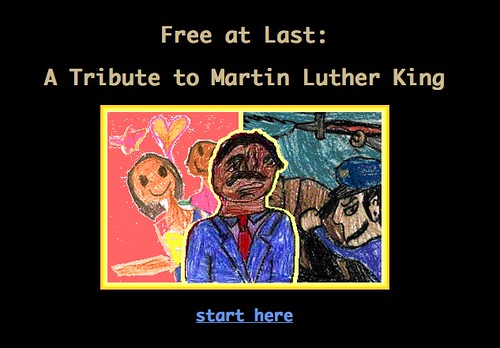
MLK splash

The phrase “I have a dream” is, of course, the refrain from Martin Luther King’s best known speech. “Nugget” is a term of art in the Connected Courses world that designates a bit of text that’s been tricked out and amplified by at least some of the wonders available on the web (scan down this page for a fuller explanation). Our assignment for this week is to create a nugget.

I’ve decided to substitute some old not-quite nuggets for making a new one. Back in the old days of the web, when you had to hand-code your html, I coupled up with Bill Berry to create a site that was first called “Meanderings” (after an email newsletter Bill had been circulating) but then became “Gravity” – a persistent black object to which everything was attracted, or at least that was the idea. One of the things we did was to create a tribute to Martin Luther King based on that famous speech. The idea was to pick words and phrases in the speech and use them as anchors for hyperlinks that would take you to some web page relevant to that topic, either directly or tangentially.
 
The execution, however, got a bit elaborate and took a crew two or three months of here-and-there now-and-then work.

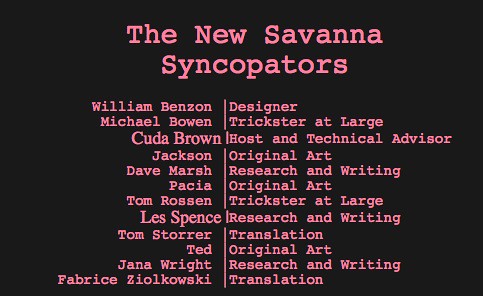
MLK credits

Notice the “original art” credits for Jackson, Pacia, and Ted. They were young primary school students on the West Coast (of the USA). In one of my many trips around the web I’d seen some charming illustrations they’d made of incidents in Martin Luther King’s life. I decided to use them in the tribute, though I worked the images over in some paint program I had at the time – Brush Strokes I believe. Of course I got informal permission to use them, though nothing in hard-copy.

Early days, early days.

As explaining the various presentations we offered is a bit tricky, I’ll skip it. But you can explore them if you wish, though I warn you that many of the links have rotted. After all, this first went up on the web almost 20 years ago.

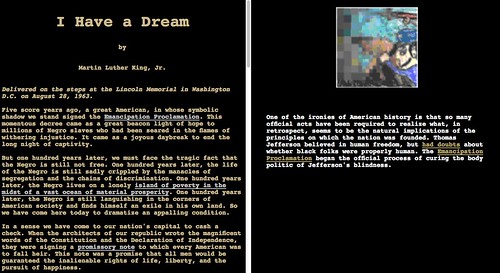
Here’s the main presentation:

MLK1

On the left you see the text of the speech. If you look carefully you can see hyperlinks in the text. We had 25 of them scattered throughout the speech, five by five (two presentations involved a 5 by 5 matrix). When you clicked on a hyperlink another display would show up on the right. At the top is a picture that is derived from one of the original images created by those children. Below it is a bit of text that is somehow related to the word or phrase linked in King’s speech. That bit of text in turn has hyperlinks, and they go out to the web at large.

Most of those links, alas, have rotted. One of my favorites went out to photographs of the Mississippi Delta. Another went to a small city in Japan that had performed Beethoven’s Ninth Symphony every year since, I believe, 1912. You got to that through a hyperlink anchored in the word “harmony.”

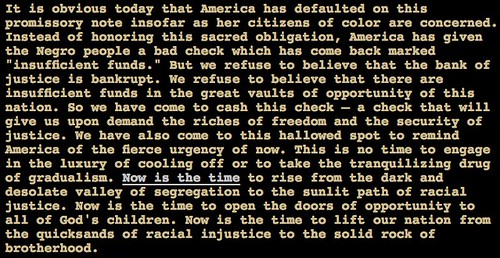
Here’s the fourth paragraph of the speech and it has a single hyperlink in it:

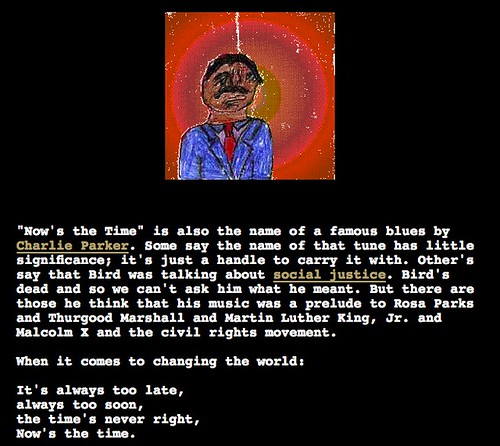
MLK2 now-time

The under-lined phrase has deep resonance for any jazz fan, for “Now’s the Time” is one of the best-known tunes by Charlie “Yardbird” Parker, an alto sax player who was one of the progenitors of bebop. Accordingly, the gloss on that link is a short paragraph on the relationship between jazz and the Civil Rights movement (and, yes, I’m aware of problems in that paragraph that should have been copy-edited out):

MLK3 C Parker

Both of the links in that paragraph are now rotten.

And so it goes.

I’ve not gone through the whole tribute to check all of the links. I wouldn’t be surprised if they’ve all rotted. Nor would I be surprised if one or two are still good. When I looked at the tribute a month or so ago I quickly found one good link. When I tried that link earlier today it had rotted.

No matter.

You get the idea.

I don’t know how many links went out to the web at large. Off hand I’d guess there were between 50 and 100. And we probably examined a dozen sites for every one that we actually used. Sorting through all that, creating the images, writing the html, testing it, and so forth, that took time. As I said up top, the tribute evolved over two or three months.

All of our interaction took place online through email. Though dial-up modems, too.

I’m still in touch with some of the New Savanna Syncopaters. Bill Berry (Cuda Brown in the credits) is a Facebook friend, as are Mike Bowen, Tom Rossen and Lester Spence. I’ve met both Bill and Mike face-to-face, but not Tom or Les, though I’ve come close. Back then Les was a graduate student in political science. He’s now a tenured professor at Johns Hopkins, where I did my undergraduate work back in the Civil Rights era.

Things change.

But the time’s still now.

As Shakespeare said, though Lear, ripeness is all.

Wednesday, September 24, 2014

Why Teach? Obvious: to Change the World

20061122-IMGP0233

Why do I teach?

Well, I haven’t done so for years, except casually and by the by, and I didn’t much enjoy it when I was doing it?

So, why do you want to teach now?

That’s a story, not a long one, but a story. What it comes down to is there are things I want to do, things I want to see happen, and teaching is necessary to get there.

20061122-IMGP0234

I went into academia because I wanted to do research. Not only wanted to, but had a passion for it. There was a certain line of investigation I just had to follow. I was able to do that in graduate school, but things got difficult when I took an academic post.

It was a good school, but there really wasn’t much chance of teaching my research, it was just too far from the various courses I taught. So teaching became something that took my time and attention away from my research. That’s not good, neither for teaching nor research.

I didn’t get tenure and after trying for two years, was unable to secure another academic post. So I alternated between making a living at things of relatively little interest, and doing interesting, buy nonremunerative writing and research.

I left the academy thirty years ago. I’ve written a lot since them, as much as a third of half of it online in the last ten years. The research is in good shape, so it’s time to do a Faust and turn my attention to the world.

Tuesday, September 16, 2014

Throw It All Away: American Heartache Sick of Society

20140915-IMGP0416 V4

It started with an email to Jon Naar: Let’s meet. Naar, as you may recall, did the first book on graffiti. He took the photos back in '72, found a publisher, and his publisher coupled him with a writer, Norman Mailer. Cay 161 gave Mailer a truth, “the name is the faith of graffiti,” and from that truth a book title was born: The Faith of Graffiti. The book went on to become the “bible” of graffiti.

In his reply, Naar copied graff writer EKG. In my reply to both, I told them about American Heartache, a nice sized roller in an abandoned building in Jersey City:

IMGP6464

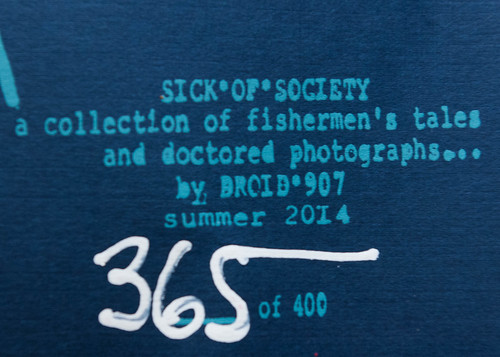
EKG says, that was by Droid907, I’ll let him know. Thus it was that I got an email from Droid907 asking for a mailing address so he could send me his latest book. A day or two ago the book arrived in the mail: Sick of Society, a collection of fisherman’s tales and doctored photographs. And with it, three stickers and a decal:

20140915-IMGP0379 V4

20140915-IMGP0428 V4

Zines have been around at least since Plato. That’s not what they called them in ancient days, but that’s what they were, artisanal books, hand crafted and NOT hot off the presses. There were no presses back then, just scribes, writing away, one at a time. Zines aren’t scribal, but you know a human hand touched each page.

Wednesday, November 30, 2011

Introduction: Fantasia and Me

You can download a PDF of my Fantasia commentary here. For all my posts on the Pastoral episode, go here.
I grew up watching Fantasia episodes on Disney’s TV program and I saw it in theatrical release in 1969. It fascinated me as a child but as a young adult, eh, it’s not all that. Then I picked up a DVD in August 2003 in connection with a now-abandoned book project: WHAM! I was stunned.

I saw the film itself, yes, but though it I also saw the cumulated techniques of 3000 years of art history, Western and Eastern, and a large swath of the cosmos and of life on Earth. So I wrote a longish email about it, and more generally about cartoons and animation, to my colleague, Tim Perper. Tim had become interested in manga and anime so I figured he’d have some observations even if Disney and Fantasia didn’t particularly interest him.

I was right, Tim had things to say. He also got me interested in manga and anime, which have been a major part of my intellectual life since then. It’s been mostly the Japanese stuff, but I’ve also looked into some classic America cartoons, Winsor McCay, Warner Brothers, Walter Lantz, and classic Disney, Fantasia above all.

In August of 2006 a made a post at The Valve in which I argued that Fantasia was one of the great works of the 20th century. Back then the claim struck me as rather outrageous. Now that I’ve gotten used to it, it still seems true, sorta’, but also beside the point—to which I’ll return in a moment.

When I made that post I didn’t intend to devote posts to each episodes. As a result of an email exchange with Michael Barrier I wrote a piece on Dance of the Hours in 2007 and that, I figured, was that. It wasn’t until the Spring of 2010 that I decided I might work my way through the entire film, starting with The Nutcracker Suite and The Sorcerer’s Apprentice. I’ve now written about every episode, including the intermission. I’ve also written a concluding piece in which I examine episode order, arguing that the episodes on an increasing range of mental faculties until, say, Dance of the Hours, at which point the episodes begin asking: Just what does it mean to be human?

As for Fantasia being one of the great works of the the 20th century, you can read my argument on that, and the rest of my commentaries as well. But I do wonder what the greatness game is about. In January of 2010 Frederick Turner argued that Hayao Miyazaki is the world’s best living filmmaker, a judgment I’m not prepared to contradict. Miyazaki, of course, is working in the same medium that Disney did, animation, though his work is quite different.

But the greatness game is not simply or even primarily a game played by individual critics offering up judgments. It’s an institutional game. While Disney had his successes and his fame, including honorary degrees, and certainly his fortune, we have no institution that endorses the greatness of his animation, nor, as far as I can tell, is Miyazaki’s greatness endorsed by any institution—John Lassiter’s enthusiasm not withstanding. The institutions that underwrite greatness are not interested in animation and I’m afraid that neither my enthusiasm, nor Fred Turner’s, is going to change that.

The question, it seems to me, is this: Is Disney’s finest work, and Miyazaki’s, along with much other work—is this work destined to sink into the past without leaving a trace or, on the contrary, will it turn out to be the foundations of new institutions in new worlds that are, at best, only now hinted at? Only time will tell.