Showing posts with label Bordwell. Show all posts

Sunday, March 10, 2024

David Bordwell, 1947 - 2024

I was privileged to have some correspondence with Bordwell over the years, including a helpful suggestion about King Kong that panned out.

Here is his Wikipedia entry. And here is an obituary prepared by his colleagues and friends:

David Bordwell, the Jacques Ledoux Professor Emeritus of Film Studies at the University of Wisconsin-Madison, died on February 29, 2024, at the age of 76 after a lengthy illness. A prolific researcher, dedicated teacher, and passionate cinephile, he guided countless colleagues, students, and film lovers to heightened awareness of the medium’s artistic possibilities. “One thing that I loved and greatly admired about Bordwell was how – with passion, analytic precision and boundless enthusiasm for the medium – he carved out an inviting, sui generis intellectual space that could be enjoyed by scholars and general readers alike,” wrote New York Times film critic Manohla Dargis upon learning of his passing. “He was a paragon of scholarly achievement, yes and of course, but he was also a lot of fun to read – which isn’t something you can say of most academics.”

Bordwell joined the faculty of UW-Madison’s Department of Communication Arts in 1973 immediately after completing his graduate coursework at the University of Iowa (PhD, 1974). He remained at Wisconsin throughout his illustrious career, retiring in 2004, and he continued contributing to the Department’s mission after retirement through emeritus teaching and other activities. He also held visiting faculty appointments at New York University (1979) and the University of Iowa (1980), and in spring 2017 he held the Kluge Chair in Modern Culture at the Library of Congress.

When Bordwell launched his career in the 1970s, film studies was just entering academia, and over the course of three decades at the UW-Madison, as well as a remarkably productive post-retirement, he helped the still-young discipline achieve new levels of respectability and intellectual rigor. Indeed, his scholarly productivity reset the bar for the discipline of film studies. He authored, coauthored, or edited some 22 books and monographs. These included two foundational film studies textbooks written with his spouse and intellectual partner, Dr. Kristin Thompson (Ph.D. UW-Madison, 1977), a multi-talented scholar who has made major contributions to film studies, literary studies, and Egyptology. Bordwell also authored more than 140 journal articles, book chapters, introductions to collections, and review essays.

Later in his career he produced equally valuable material for wider audiences including a lively, wide-ranging blog Observations on Film Art, also in partnership with Thompson, as well as video essays and informative DVD commentaries for The Criterion Collection. And he made himself available at numerous film festivals and public movie screenings as a commentator, sharing his knowledge and enthusiasm with fellow movie lovers. In fact, Bordwell remained a productive scholar until the very end of his life, just a year ago publishing Perplexing Plots: Popular Storytelling and the Poetics of Murder. This exhaustively researched and elegantly written book has been nominated for an Agatha Award and for the Edgar Award, given by the Mystery Writers of America, in the Best Critical/Biographical category.

An inspiring teacher, Bordwell’s classroom skills were acknowledged with the UW-Madison’s Chancellor’s Teaching Award (1984) and a Phi Beta Kappa Teaching Award (2004). He was known for his energized lectures and for his lively, probing graduate seminars. His pedagogical strategy was not so much to impart knowledge as to draw it out from students, yielding fresh insights on whatever film, director, or theoretical issue was on the agenda for that day. Professor Maria Belodubrovskaya (University of Chicago) speaks for generations of former Bordwell students in recalling the sense of participation available to all members of a Bordwell class. “What struck me about David’s teaching was that in the classroom he did not behave as a big-time scholar but as more of a leader,” she recalled. “Everyone was treated as no less curious and observant than the instructor himself.”

Bordwell also provided a professional model that benefitted many of the Communication Arts graduate students who eventually entered higher education. UW-Madison Professor Emeritus Vance Kepley’s memory of his very first experience in a Bordwell graduate course is indicative: “It was something of an epiphany. By the end of the first class, I thought, ‘This is exactly how film studies should be taught. It’s what I want to do, and I want to do it just as well.’ Of course, I never came close to duplicating David’s casual brilliance, but years of trying made me a better teacher.”

The impact of Bordwell’s graduate mentoring can be suggested by both the quantity and quality of the doctoral dissertations he supervised. At UW-Madison, he directed 33 dissertations, each of which helped launch a productive career, and 17 dissertations were published as career-enhancing monographs. Bordwell’s dissertators could count on him to provide exacting but encouraging guidance through the always-arduous process of bringing forth a polished manuscript. “David pounced on every chapter as soon as I submitted it for review,” remembers Professor Richard Neupert (University of Georgia). “Within days he returned the manuscript covered with detailed and often witty commentary, along with a thoughtful, typed summary with warnings, suggestions, and praise. More than a great mentor, he was a fellow traveler.”

Bordwell’s research program consisted of three principal strands. The first is composed of stylistic analyses of individual films or directors, most notably The Films of Carl-Theodor Dreyer (1980), the monumental Ozu and the Poetics of Cinema (1988), The Cinema of Eisenstein (1993), and detailed essays on Louis Feuillade, Kenji Mizoguchi, Theodoros Angelopoulos and Hou Hsiao-Hsien grouped in the volume Figures Traced in Light: On Cinematic Staging (2005). The introductory college textbook Film Art: An Introduction, written with Thompson, also contributes to this strand. First published in 1979, it is now in its thirteenth edition and will continue under the authorship of Professor Jeff Smith (UW-Madison). It has been translated into ten other languages, with additional translations forthcoming.

The analysis of national film styles and modes of film production constitutes the second strand of Bordwell’s research. These studies incorporate primary-level documentary research on the structure of film industries, film technology, and the conditions of production. The most important work in this category is The Classical Hollywood Cinema: Film Style and Mode of Production to 1960 (1985), written with Thompson and Janet Staiger (William P. Hobby Centennial Professor Emerita, University of Texas at Austin). A massive research undertaking, it incorporates stylistic analyses of a random sample of one hundred films, interviews with veteran cinematographers and other craft workers, and careful reading of film industry trade papers and industry technical reports. It seeks to define the group style of classical Hollywood in terms of a range of stylistic options which were delimited by the state of filmmaking technology at any given point, as well as by the craft practices and conventions internalized by filmmakers. The methodology was later used in another widely successful textbook, Film History: An Introduction, also coauthored with Thompson and designed to introduce students to a broad spectrum of national cinemas. The sole-authored Planet Hong Kong: Popular Cinema and the Art of Entertainment (2000) examined a small but hugely successful film industry from the 1970s through the 1990s, focusing on stylistic norms and narrative strategies that distinguished Hong Kong cinema from Hollywood.

The third strand of Bordwell’s research involved theorizing the role of the film spectator in the movie-viewing experience. Bordwell’s ground-breaking Narration in the Fiction Film (1985) proposed the idea that viewers integrated perceptual information with higher order cognition to construct the film’s story. For Bordwell, spectators were active makers of meaning who drew on their understanding of cinematic conventions, their knowledge of different types of stories, and their real-life experience to comprehend the various visual and audio cues given to them by the film. With this and several subsequent publications, Bordwell helped encourage a robust line of scholarship in cognitive film studies, an approach that brought together analytic philosophers and psychologists in developing a model of spectatorship that amalgamates aspects of art, culture, and even biology.

Bordwell’s many professional honors attest to the respect he earned in the international scholarly community. He was awarded honorary doctorates from the University of Copenhagen (1997) and from Lingnan University in Hong Kong (2023). Other major international awards include a University of Auckland Hood Fellowship (New Zealand), an Anthology Film Archives Award (United States), an Excellence in Asian Film Scholarship Award (Asian Film Society, Hong Kong), and the aforementioned Kluge Chair. At UW-Madison, Bordwell was selected for a prestigious Wisconsin Alumni Research Foundation Professorship (1990) and for a Hilldale Distinguished Professorship (2001), as well as a Hilldale Award in the Humanities (2001) and a senior fellowship at the Institute for Research in the Humanities (1993-98).

Bordwell’s love of cinema emerged when he was a child, living on a remote farm in upstate New York, far from any movie theater. In his rare moments away from school and chores, he nourished his cinephilia by watching films on TV and reading books about film starting at the age of 12. Bordwell made his way to the State University of New York at Albany, where he studied English literature. He then did his graduate studies in Speech and Dramatic Arts, with a concentration in Film at the University of Iowa.

Notice of his passing prompted glowing tributes for Bordwell from prominent filmmakers and intellectuals outside the academy who valued his myriad contributions to world film culture.

David Koepp, critically acclaimed screenwriter and director (Jurassic Park, Mission Impossible, Premium Rush)

“David’s genius for analyzing Hollywood narrative was an inspiration and a goal for me in my own work, and it reflected in the work of anyone who read him. He had a boundless generosity toward the medium and found value in everything he saw, at all levels of artistic accomplishment.”

Damien Chazelle, Oscar-winning writer and director (La La Land):

“I learned more about film from reading David Bordwell than from any other writer. To me he was America’s André Bazin, a thinker and historian who massively expanded the field and found a way to marry theory and criticism in a wholly new way. Narration in the Fiction Film changed how I think about storytelling in film. Figures Traced in Light changed how I think about framing. The Way Hollywood Tells It changed how I think about Hollywood. He was a giant, and multiple generations of filmmakers, critics and theorists (for ultimately we are all in this together) owe him a huge debt.”

Kim Hendrickson, Executive Producer, Criterion:

“David and I spent many hours together recording his analyses for the fifty episode Observations on Film Art series we created for the Criterion Channel. He was a champion for movies not because he was superb at analyzing form – he was the best – but because movies were his life force. I, and so many colleagues at Janus and Criterion, are indebted to him for his brilliance, generosity, and friendship.”

James Schamus, award-winning screenwriter, producer, director, and professor (Crouching Tiger, Hidden Dragon; Brokeback Mountain):

“As a filmmaker, I can describe David’s friendship as unnervingly generous. His astonishing critical intelligence never got in the way of his enthusiasms, and his enthusiasms never dampened his analytic regard; they were functions of each other. This meant that when talk came around to one’s own work, the effect was something akin to getting a loving bear hug from a nuclear-powered microscope. There will never be another like David again.”

To an international community of filmmakers, film students, and cinephiles, David Bordwell was the most respected film scholar of his generation. But to his very wide and ever-widening circle of friends, he also was a warm, witty, unaffected companion. To the thousands of students, colleagues, and movie-lovers who sought his counsel outside of the classroom, he was generous with his time and knowledge, and in social gatherings he graciously cultivated new friendships with individuals he was meeting for the first time while also reconfirming his appreciation for friends of long-standing. He could tailor his one-on-one conversations to whatever topics were of interest to the other party, and one usually came away from such chats with the feeling that, besides being a keen conversationalist, he was also a wonderfully attentive and appreciative listener. All who knew David Bordwell personally will miss his kindness, goodwill, and boundless congeniality, as well as his professional wisdom.

Survivors include his wife, Kristin Thompson; his sisters, Diane Bordwell Verma and Darlene Bordwell; his nephew, Sanjeev Verma, and his niece, Kamini Verma.
Tuesday, October 31, 2023

Kristin Thompson on Best Film Oscars in recent years

Kristen Thompson, “Best Picture” ≠ “Live Action,”Observations on film art, July 8, 2023.

Opening paragraphs:

Way back in 2006, I posted a long piece on the increasing prominence of animated features being released each year. This was in the infancy of the blog, and the entry shows it–few photos, inserted as thumbnails. We only gradually worked up to our format of posting plenty of illustrations. By contrast this current contribution offers plenty of visual pleasure.

Basically I argued three points. First, that by their nature animated films would tend to be among the highest-quality films in any given year, despite their relatively small number in those days.

My argument laid out some reasons for this high quality. First, the fact that animated films were perforce thoroughly planned in pre-production, meaning that every detail was carefully considered. This means that relatively few inadequate scenes are reworked in production. Live-action films these days tend to be heavily dependent on shooting lots of coverage and making many decisions in the editing stage. Not true of animated films. Similarly, the soundtrack is recorded in advance and the images animated to sync with it. Hence the sound is meticulously planned. The voice actors record their voices and leave, usually not hanging around to try and change their scenes during shooting or fluffing lines and thus requiring multiple retakes of scenes.

My second point addressed the opinion, widely circulating in the trade press, that the spread of animation, and particularly digital animation, was a mistake. I quoted a recent Screen International article: “Much has been made this year of the seeming over-saturation of studios’ computer-generated titles, with critics and analysts pointing to growing movie-goer apathy.” I pointed out that such a claim didn’t fit the facts: “As a proportion among the total number of films made, CGI’s box-office successes seem fairly high compared to live-action films.”

My third point was that American distributors did not know how to market films from abroad, so that Ghibli and Aardman titles did not get nearly the audiences they deserved. Since then the distributor GKIDS has shown that it’s possible, at least for a relatively small company, successfully to release such films. They currently offer films with eleven best-animated feature Oscar nominations (with one win, Spirited Away), having gained distribution rights to Ghibli films, previously controlled by Disney.

Since I wrote that entry, the number of animated films, mostly digital, released yearly has sharply increased. And the disproportionate number of those animated films that appear among the top hits of the year continues to demonstrate that people are not apathetic. The spread of streaming services, combined with the decline of theatrical attendance during the pandemic, make it difficult to judge the success of films. Going back to 2019, where it’s a bit easier to judge, the top ten films included two animated successes, Toy Story 4 and Frozen II. An additional two were in the top twenty, How to Train Your Dragon: The Hidden World and The Secret Life of Pets 2. Animated films did not make up 20% of all films released, but that’s the portion of the top twenty they occupied.

I followed up that entry with one that found additional evidence that animated features were doing well, including the fact that Ice Age: The Meltdown was, though not the top box-office film of 2006, the most profitable film of that year.

So many developments have occurred in the world of feature animation since that first post that I decided to write an update.

Thompson then goes on to make a head-to-head comparison of Oscar-nominated live-action and animated films between 2002 and 2022. Her conclusion:

Totting up the live-action vs. animation winners in this face-off, we find one recusal, one draw, five decisions in favor of the live-action winners and fourteen for the animated winner or one or more of the animated nominees. As I mentioned at the start, the figures would be quite different if I had compared all the Oscar-worthy animation awards with all the Oscar-worthy Best Picture nominees. Still, in general this comparison may suggest that animated films are unfairly treated as one of the minor categories that people don’t pay much attention to.

I’m not suggesting that the Academy change their categories or rules. There’s probably no way to boost the prestige of the Animated Feature nominees.

The point here has simply been to add some evidence to my claim that a higher percentage of animated films tend to be excellent in a way that compares favorably with the live-action films nominated in the more prestigious category. Despite this, animated films are simply not taken seriously by most people, inclined cinephiles. They are still viewed as children’s fare, despite the successful appeal to adults built into many of the titles I’ve singled out here. They are also mostly comic to some extent and often involve fantasy, while Oscar bait leans toward drama and, with rare exceptions, away from fantasy/science fiction.

The conclusion is that if you think, for whatever reason, that live-action Oscar winners and films in general have declined in the past few decades, check out some ‘toons.

Color me sympathetic. You should read the whole thing. 

 While you're absorbing this information, take a re-read on my post about Robert De Vany's Hollywood Economics,  quantitative studies developing models that show we don't know how to predict the eventually box-office success of films. Do makers of animated films know something the rest of Hollywood does not?

Sunday, May 30, 2021

“NATURALIST” criticism, NOT “cognitive” NOT “Darwinian” – A Quasi-Manifesto

Time to once again bump this to the top of the queue. 

* * * * *

Reposted from The Valve, 31 March 2010, this is an informal manifesto for whatever it is I'm up to, and why I'm come to think of it as naturalist criticism. I could link a lot more into this piece now, especially my recent work on ring composition and digital humanities, but I won't. It's a decent map to my work in literature, a place-holder until I have time to do something a bit more formal.


You mean a quasifesto?

Shoo, get out . . .


Fact is, if I’d known then what I know now, I’d never have thought of myself as being in the business of bringing cognitive science to literary criticism much less represented myself to the world in that way. But I didn’t (know) and I did (represent), so now I seem stuck with the moniker. I’d like to shake if off.

When I finally decided to publish a programmatic and methodological statement, “Literary Morphology: Nine Propositions in a Naturalist Theory of Form,” I adopted naturalism as a label. Fact is, I’d just as soon not think of it as anything but the study of literature. But we live in an age of intellectual brands, so I chose “naturalism” as mine.

Yes, I know that “the natural” is somewhat problematic, but you’ll just have to get past that. No label is perfect and I’m not about to coin a new term. Assuming you can struggle past the word, what does naturalism suggest to you? To me the term conjures up a slightly eccentric investigator wandering about the world examining flora and fauna, writing up notes, taking photos, making drawings, and perhaps even collecting specimens. That feels right to me, except that I’m nosing about poems, plays, novels, films, and other miscellaneous things. Beyond that I’d like the term to suggest some sense of literature as thoroughly in and a part of the world. There’s only one world and literature exists in it.

Beyond that, what does the term suggest? . . . Nothing, that’s what I’d like it to suggest, nothing. But whatever this naturalist criticism is or might become, that it has some kind of name suggests that it’s probably not myth criticism, New Criticism, Marxist criticism, psychoanalytic, deconstructive, archetypal, phenomenological, reader response, or any of the other existing critical brands.

What do the terms “cognitive criticism” or “cognitive rhetoric” suggest? Like many of those other labels, they suggest some body of supplementary knowledge and practice that one brings to the study of literature. Just exactly what the supplementary body is, that may not be terribly clear. But that doesn’t matter. The terms emphasize and draw your attention to the supplement. The same with “Darwinian literary criticism,” only vaguer. The only thing that’s clear about that label is a towering intellectual figure whose work had nothing to do with the study of literature.

None of this should be taken to imply that I’ve lost interest in the newer psychologies, as I like to call them. I haven’t. I believe that future literary studies must take them into account, and other theories, concepts and models as well. I just don’t want to stick those names in my brand label.

Anything else?

Yes, I put the study of form at the center of the enterprise.

So why not label yourself a formalist?

Because that’s already of term of art, and it’s too strongly identified with approaches that treat the text as an autonomous object more or less independent of reader, author, and the larger world. For that matter, many formalist critics are more interested in textual autonomy than in systematically analyzing and describing the manifold formal aspects of literary texts. In the end, they’re as greedy after meaning as most other critics are.

OK, so what do you have in mind with this naturalist criticism that emphasizes form?

Good question. And I’m afraid my best answer is a bit embarrassing. I figure the best way to scope out any literary program is to look at practical criticism. What does it do with an actual text, in some length and detail. And the best examples I know are, umm, err, from my own work. And that, as I said, is embarrassing. I’d rather point out someone else’s work.

Really? There’s nothing else? Your work is de novo, so to speak?

Well, everyone has precursors and models. I was certainly influenced by the structuralists, Roman Jakobson, Edmund Leach, Jean Piaget, and Lévi-Strauss above all. For that matter I should probably know narratology better than I do. And I’ve enjoyed the detailed analytic work that David Bordwell’s posted on his blog, though I’ve not gotten around to reading any of his books except Making Meaning, which is an analysis and critique poststructuralist film criticism. If more people analyzed literary texts like Bordwell analyzes film, that would be good.
[More specifically, check out, e.g. Bordwell’s post on “Tell, don’t show,” or this post on “Kurosawa’s early spring,” other posts tagged as “Film technique,” and this essay, “Anatomy of the Action Picture.”]
OK OK, I get the idea. I’m skeptical, but go on. What’s your best analytic work?

I suppose my recent essays on “Kubla Khan,” and “This Lime-Tree Bower My Prison,” but they’re a bit of a slog, long and detailed, and lots of diagrams. I like this old piece on Sir Gawin and the Green Knight too, and this Shakespeare piece, which looks at three plays, Much Ado About Nothing, Othello, and The Winter’s Tale and even uses evolutionary psychology.

Perhaps the best place to start would my recent post: Two Rings in Fantasia: Nutcracker and Apprentice. It focuses on form and it’s got some nice screen shots too. It’s relatively short and pretty much free of abstract critical apparatus, though there’s an addendum that heads off into the abstractosphere. Yeah, it’s about film, not literature, but that’s a secondary issue that has no bearing on my main point.

As the title suggests, I consider two episodes in Disney’s Fantasia, the Nutcracker Suite and the Sorcerer’s Apprentice. There are three things going on in that post: 1) the analysis and description of so-called ring forms in the two episodes, which is my main focus, 2) a brief characterization of the spatial worlds in the two episodes, and 3) some informal remarks on what those episodes might mean.

A ring form is a text in which episodes mirror one another around a central point or episode, thus: A, B, C . . . C’, B’, A’. One of these episodes has a conventional narrative (Sorcerer’s) while the other does not. But both are rings. Pending strong arguments to the contrary, I regard that as a fact about them. The ring structure really is there; it’s not something I’m reading into the episodes. The core work in the post is to report the relatively straight-forward analytical work needed to establish ring structure as a descriptive fact.

In the course of looking at the ring structure I also offer some remarks on the structure of the visual worlds in the two episodes and how the virtual camera moves through them. This plays no role in my argument about ring structure, but it is a formal feature of the episodes and is important in the larger scope of the hole film. Each of the eight episodes has a different theme and subject matter, and each has a different animation style. Somewhere “between” the style and the subject matter you have visual space and movement through it.

Finally, I offer some interpretive comments, some observations about what these episodes might mean. In the case of Nutcracker those suggestions lean toward the Freudian, though I suppose some might argue it has no meaning at all, that it’s just a bunch of pretty pictures set to music. Sorcerer’s is a different case, because here we have a actual story. I suppose I could’ve gone Freudian and worked on Father and Son, but I got stuck on all those industrious brooms parading across the screen and ended up giving a nod toward the Marxists.

Well, OK, OK. I’ve read the paper and it’s a nice piece of work.

Thank you.

But I don’t see anything new in kind.

Well, yes, I didn’t invent anything, but . . . .

Anyone could do it. It’s well within range of a good undergraduate . . .

And did you notice it’s not jam-packed with a lot of conceptual apparatus?

That’s what I mean, it’s almost as if anyone could do it.

Well, I rather doubt that. You do have to have a “feel” for the job, and that takes time and experience. You have to work with texts (or films) to learn how to work with them. You can’t get it by reading books and articles. But the absence of a lot of apparatus, that’s a feature, not a bug. In any event the thing to notice is that formal analysis and description is at the center of the piece.

But that’s not a central focus of practical criticism in the discipline as it is currently practiced. Nor does it seem to be on radar screen for the cognitivists and the Darwinians. They still treat meaning as the main event.

Tuesday, June 9, 2020

The Social Network [Media Notes 35]

I was certainly aware of this film when it came about in 2010 but, for whatever reason, didn’t go out to see it. It went on to win a slew of awards, including three Oscars. Now that I’ve streamed it I must say I don’t get it. Good? Yes. But not that good. Perhaps it got all that credit because it’s about a boy, our boy billionaire, the youngest ever.

Who knows?

The Social Network tells its tale by cutting back and forth between depositions in two law suits – one brought against Zuckerberg by the Winklevoss twins, the other by his business partner, Eduardo Saverin – and the actions that gave rise to them. I didn’t find it all that compelling – though perhaps it’s just me, as I’m still coming out of my annual melancholy phase. So we have something of a Rashomon redux, three versions of the same story. Which one is true?

To be honest I didn’t really register the fact that the movie offers us three versions of the tale until I read about it in the Wikipedia entry. Ah! that’s right, said I to myself. I’d noticed discrepancies, but had just chalked it up to ordinary everyday tricks of memory of now particular epistemological significance. Those disparities aren’t central to the film. They’re just a gloss on the story.

Do I care?

The fact that these people worked very hard doesn’t compensate for the fact they are rather obnoxious (self-important jerks chasing money), though the Wikipedia entry does suggest that, in reality, it wasn’t as bad as all that. Maybe the Zuck's really a decent person.

The ending struck a false Citizen Kane note, with the Zuck, his lawyers having settled the suits, attempting to send an email to the young woman who had dumped him (for being a jerk) at the beginning of the film. Are we are supposed to conclude that he did it all in compensation for that? I don’t buy it. The thing is, when Welles asked us to believe that Kane’s career was an attempt to compensate for a lost childhood, symbolized by that Rosewood sled burning in the flames, at least Kane had had a lifetime of striving and accomplishment. Not so with Zuckerberg, who got his billion at the beginning of his career. The young people I worked with at MapInfo worked as hard as the Zuck and may well have been as smart, but they didn’t happen to be situated such that the world has been willing to shower them with a billion bucks. Where’s their movie? I’m sorry, but racking up a million users, in that networked world (that is, our world), isn’t worth a billion bucks. And the film is utterly lacking in the kind of irony that could have redeemed it from that false valuation.

Charles Foster Kane, needy and driven though he may have been, wrestled with the world to achieve his wealth. Racking up a million users isn’t wrestling with the world; it’s just bringing in the harvest. Worthy, but not worth a two-hour film. What Zuckerberg and Facebook are now facing – the way Facebook is being abused at the expense of civic comity – that’s wrestling. And perhaps one day we’ll get a film about that.

Note: Um, err...Yes, I realize that Charles Foster Kane is fictional, albeit inspired by William Randolph Hearst, while Mark Zuckerberg is real.

* * * * *

David Bordwell looks at the treatment eyes in the film. Very interesting.

From the end of this analysis, which includes screen grabs that I've not snatched:
But in a climactic face-off, we come to see a different Eduardo.

Eduardo’s quiet testimony about whether anyone’s share but his was diluted (“It wasn’t”) affects Mark more deeply than the bluster of the Winklevoss brothers. The words are delivered without the usual sidelong glance, kinked eyebrows, or head ducking that has defined Eduardo earlier. His brow is smooth, his brows level. This is man to man, and it’s Mark who breaks off eye contact.

You could nuance this transformation by tracing it scene by scene, and contrasting it with the body language displayed by other characters. For today I simply wanted to sketch the broad development that I think is at work in this core relationship. The drama of domination and betrayal is played out in eyes, eyebrows, mouths, mutual gazes, and the like as much as it is in the dialogue and incidents.

There is no art, Shakespeare’s Duncan says, to read the mind’s construction in the face. He’s right about the reading part; we grasp expressions fast, intuitively, and often reliably. But there is art in the performer’s construction of the face, and of the director’s cinematic shaping of it.

Monday, September 24, 2018

Still, why do literary critics find it so difficult to focus on form?

A topic I’ve been thinking about off and on for some time, most recently: Once more, and thinking of ring composition: Why aren’t literary critics interested in describing literary form?

A meaning-focused discipline

It’s surely that literary criticism has focused on meaning. But why should that distract from an interest in form, especially since so-called formalism looms large in methodological discussions and in practical criticism? That is, why does formalism have so little to do with actual form? That’s the question.

Of course, form in the sense that I mean, isn’t completely invisible. It’s quite visible in formal verse, where patterns of rhyme, meter, and so forth have been extensively catalogued. This is, however, a relatively peripheral matter for literary critics, though it may be very important to some working poets.

Verse forms are visible because they are forms of sound, and sound is readily objectified. What of ring forms? Well, in the small, they’re known as chiasmus, and are well known and often remarked. But chiasmus often involves symmetrical arrangements of sound. Large-scale ring forms do not. They’re more difficult to identify, and certainly more problematic.

That they are large scale, encompassing the whole work, is one source of difficulty. You have compare features across the whole text, that’s much more difficult than comparing features within a line or a few lines of poetry. Moreover it’s not obvious what features you should be comparing. It’s not sound. And objectifying subject matter is trickier, no?

The road to form

In my own experience, it takes a fair amount of tedious work to identify ring-form structures. I can think of one case where I suspected a ring-form at the outset, Tezuka’s Metropolis, and another where I started with a clue, David Bordwell’s remark about symmetry in King Kong. In both of these cases it took me some hours of work over a day or three to conduct the analysis. And then there’s Gojira, where I’d worked on the film off and on over a couple of years before I suspected it might be a ring composition. And then, again, it was hours of work to verify my suspicion.

I note moreover that I did this work after, long after, I had adopted a computational view of literary texts. Indeed, I did most of this work after my 2006 paper on literary morphology [1]. By that time I had, of course, done the work on “Kubla Khan” and on Tezuka’s Metropolis. But it wasn’t until several years later I ran up a post about “The Nutcracker Suite” and “sorcerer’s Apprentice” episodes of Fantasia [2], though I must have worked on “The Nutcracker Suite” in 2006 or 2007 as I’d written a long email to Mary Douglas about it and she died in May of 2007.

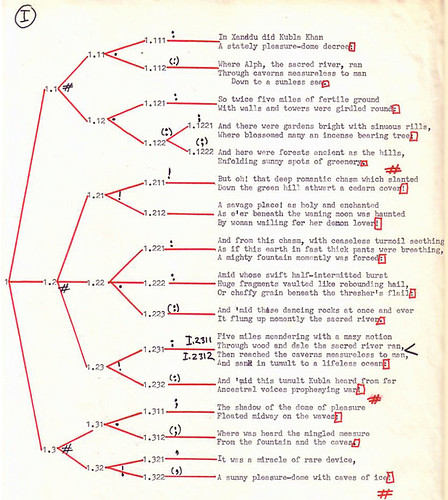
My point is simply that I hadn’t begun this work in a systematic way until I’d found a example or two by the by and until I had a theoretical reason – computational form – to look for them. I’d been driven to computation by “Kubla Khan” years ago, after I found those nested structures that must “smelled” like computation.

KK-triple-72.jpg
Nested structure in “Kubla Khan”, ll. 1-36.
And it was easy and natural enough to extend computation to Lévi-Strauss’s notion of the armature. And finally, having adopted a computational view of language, it followed that literature must have a computational aspect as well. The remaining issue is whether or not literary texts display large-scale computational structures rather than simply being a concatenation of sentence-level structures. The existence of ring-form texts suggests that they do.

Saturday, July 7, 2018

The Problematic of Description

From five years ago....

We can frame the problematic of description with a remark David Bordwell made while discussing the state of film criticism. Following Monroe Beardsley, he divides the critic’s activities into four categories, description, analysis, interpretation, and evaluation. He then characterizes reviews, critical essays, and academic articles with respect to those four categories of activity. All of them employ description. Beyond that, the sense of his usage is that description is the most primitive of elementary of these activities.

In Bordwell’s recasting:
Critics describe artworks. Film critics summarize plots, describe scenes, characterize performances or music or visual style. These descriptions are seldom simply neutral summaries. They’re usually perspective-driven, aiding a larger point that the critic wants to make. A description can be coldly objective or warmly partisan.
The question I want to pose is whether or not neutral, if you will, objective, description is possible. While the issue interests me in its full generality, I’ve been particularly concerned about the descriptive characterization of literary texts. In the extreme, of course, we have that sort of postmodernism that tends to insist the text itself is just a bunch of marks on a surface and it’s all interpretation from there.

For those interested in, say, machine vision, that in itself is a practical, and difficult problem. It is one thing to train a computer to recognize mechanically printed text; that is now routine business. But computer recognition of handwriting is still a difficult problem. That is to say, in that particular intellectual context, merely recognizing the words on the page (or, for that matter, speech sounds in the air) is a deep and challenging problem. It is by no means obvious, however, that such an attitude is reasonable for the general practice of literary criticism. Is it possible to characterize plot structures and semantic structures in a way that is neutral and objective?

Therein lies the problem. In the penultimate chapter of Is There a Text in This Class? Stanley Fish takes up Stephen Booth’s work on Shakespeare’s sonnets, noting that Booth disavows any interpretive aims but declares that he intends simply to describe the sonnets. Fish observes (p. 353):
The basic gesture, then, is to disavow interpretation in favor of simply presenting the text; but it is actually a gesture in which one set of interpretive principles is replaced by another that happens to claim for itself the virtue of not being an interpretation at all. The claim, however, is an impossible one since in order “simply to present” the text, one must at the very least describe it . . . and description can occur only within a stipulative understanding of what there is to be described, an understanding that will produce the object of its attention.
That is to say, Booth, among others Fish discusses, seems to be claiming that description is not a starting point, but the end point. And further, that it has unmediated access to the text, something we know, in fact, to be impossible. There is no description without (logically prior) interpretive activity of some sort. Literary texts, whatever they are, are exceedingly complex. Just what we describe, and how we describe it, these are not simple matters.
 
We must realize, however, that there is interpretation and there is interpretation. It is disingenuous of Fish to pretend that all interpretive acts are equally problematic. Michael Bérubé makes this point in “There is Nothing Inside the Text, or, Why No One’s Heard of Wolfgang Iser”, Postmodern Sophistry: Stanley Fish and the Critical Enterprise, edited by Gary A. Olson and Lynn Worsham (SUNY, 2004), pp. 11-26.
... It would have been possible, in other words, to contest Fish’s reading of Iser not by stubbornly insisting on the determinacy of the determinate, and not, good Lord, by insisting on two separate varieties of determinacy and assigning “interpretation” to one of them, but by acknowledging that all forms of reading are interpretive but that some involve the kind of low-level, relatively uncontestable cognitive acts we engage in whenever we interpret the letter “e” as the letter “e,” and some involve the kind of high level, exceptionally specific and complex textual manipulations, transformations and reconfigurations involved whenever someone publishes something like S/Z – or Surprised by Sin. (And, of course, that there are any number of “interpretations” that fall between these extremes, and that the status of each of them is – what else? – both open to and dependent on interpretation.)
That’s what I’m looking for, “uncontestable cognitive acts.” Whether or not they’re low level, that’s another matter. What’s important is that Bérubé bounds them by contrasting them (différance at work) with the “exceptionally specific and complex textual manipulations, transformations and reconfigurations involved whenever someone publishes” professional interpretive criticism.

That’s the problematic of description, to forge a methodology from those uncontestable cognitive acts even if we have to consult new sources of disciplinary inspiration to do so.

* * * * *

I have long since made peace with the idea the meaning is irreducibly subjective not so much in the sense that it is idiosyncratically variable among persons–that may be true, but it’s secondary–but in the primary sense that meaning exists only IN the minds of subjects. Hermeneutic procedures always transform and translate meaning into other terms, terms which are themselves subjective.

But it is far from obvious that hermeneutic translation of meaning is the only sophisticated analytical instrument we have. I believe, for example, that in his work on myth in Mythologies, Levi-Strauss pointed the way to non-translational analytic strategies (cf. Distant Reading in Lévi-Strauss and Moretti) and I believe that I’ve demonstrated such strategies in my work on “Kubla Khan” and “This Lime-Tree Bower My Prison” and in other work as well. What I have taken to calling naturalist criticism can only be built on a foundation of descriptive work.

Monday, April 30, 2018

Beauty and the Beast: King Kong as ring composition, plus myth logic

Since I've just republished an old Gojira post at 3 Quarks Daily I thought I'd bump this King Kong post to the top of the queue.
KING_KONG_1933-00.47.07

Almost four years ago I’d done a post about the possibility that King Kong (1933) has ring-from composition [1]. In that post I mentioned that David Bordwell had tipped me off to the possibility, following a presentation he’d seen by Thierry Kuntzel and I appended a passage from a 1976 article by Judith Mayne in which she remarked upon the symmetries in the film [2]:
And yet the structure of King Kong is a paragon of symmetry. The center of the film, occurring on Skull Island, is enclosed by two sequences occurring in New York, and these two sequences in their turn are enclosed by the references to Beauty and the Beast. (377)
I have now, at long last, taken a look myself and have tentatively concluded that, yes, King Kong is a ring form text. The symmetry is certainly very strong and my reservations are details, though worth thinking about.

First things first. As far as I know there’s only one DVD reissue, by Warner Home Video (2005) and that’s what I’m working from. All timings are from that DVD.

Preliminary ring-composition analysis

The original 1933 King Kong, directed and produced by Merian C. Cooper and Ernest B. Schoedsack, entered the National Film Registry in 1991 and has been remade twice, in 1976 and 2005 [3]. It received rave reviews at its original release. The review aggregator, Rotten Tomatoes, has ranked it the fifth greatest horror film of all time [4] and the 29th greatest film of all time [5]. I rather imagine that the Rotten Tomatoes rankings fluctuate quite a bit – the film was rated higher in both lists in the Wikipedia article, which accessed them on March 17, 2010 (horror, when Kong was 1st) and October 14, 2016 (all time greatest, when Kong was 20th) – so we should take those rankings with a grain of salt, but only a grain. The film certainly merits careful examination.

King Kong is something of a film-within-a-film. Carl Denham, a maker of adventure films, has the idea for the film of a lifetime. He recruits Ann Darrow, whom he’d found stealing a piece of fruit at a street side stall, to star in it. They travel to Skull Island, where the filming is to take place, and does. During the voyage Darrow falls in love with Jack Driscoll, the first mate on the ship. The natives on the island offer Darrow to Kong, who takes her into the interior of the island. She’s rescued, and Kong himself is brought back to New York where he’s exhibited on Broadway. He escapes, takes Darrow up the Empire State Building, where he’s killed. Darrow, presumably, lives happily ever after with Driscoll.

Here’s the basic form of the action:

1
Start in New York City where Carl Denham recruits Ann Darrow for his film.
2
We journey to Skull Island and land near a village where the inhabitants worship Kong.
X
Then we move through the village into Kong’s territory, where Kong takes Darrow.
2’
Darrow is rescued and we return to the village, followed by Kong who goes on a rampage and is finally subdued on the beach by gas.
1’
We return to New York City where Kong is put on display, escapes, takes Darrow up the Empire State Building, and is killed.

That seems symmetrical enough, which is the main requirement for ring-composition. However, in the first half we spend eight minutes on board the ship traveling from New York City to Skull Island. But in the second movement we cut directly from Skull Island to New York. Do we count that as a failure of symmetry, and is that failure bad enough that we cannot count King Kong as a ring-form text? I’m not sure, but for the moment I want to set that question aside. I’ll return to it at the end.

There’s a more pressing issue, one that takes us deeper into the film. The film runs roughly an hour and 43 minutes from the opening to the final display of credits, though the first four minutes is given over to an overture with nothing on the screen but a card that says “Overture”. The central section, when we’re in Kong’s territory, is a bit over 28 minutes long, which strikes me as being a bit long to be the turning point in a film that runs almost one and three quarter hours. Is there, within that section, a shorter segment that serves as the turning point?

I believe there is, and it’s a battle between King Kong and a T-Rex. It is almost four minutes long and is, I believe, the longest and most complex single fight sequence in the film. (I haven’t actually checked the timing on the others. I’m just guessing about this.) Given that, at this point in the film, the goal is to rescue Darrow from Kong, you’d think that the moment of rescue would be the center point. But I don’t think that’s right. The timing’s off.

The film is roughly 01:43 long and the T-Rex fight starts at c. 1:01:51, well over half-way through. The rescue sequence starts at roughly 1:14:03, which is over two-thirds of the way through the film, and it only lasts for about two-and-a-half minutes (1:14:03-1:16:38 or so), making it shorter. For those reasons, position in the film and relative length (and thus prominence) of the two sequences, I think the T-Rex fight is the center point.

That gives us:

1
Start in New York City where Carl Denham recruits Ann Darrow for his film.
2
We journey to Skull Island and land near a village where the inhabitants worship Kong.
3
Then we move through the village into Kong’s territory, where Kong takes Darrow.
X
Kong battles T-Rex.
3
Driscoll (ship’s mate) finally frees Darrow from Kong.
2’
Darrow is rescued and we return to the village, followed by Kong who goes on a rampage and is finally subdued on the beach by gas.
1’
We return to New York City where Kong is put on display, escapes, takes Darrow up the Empire State Building, and is killed.

What is Kong? Who is Kong?

And it also gives us much to think about. Darrow’s rescuer, Jack Driscoll, the ship's mate and husband-to-be, is nowhere to be seen in that central sequence. He’s in a shallow cave beneath the edge of a cliff where he’d gone to escape Kong, and where he’d wounded Kong in the hand with his knife.

Saturday, September 24, 2016

The end of cinema, NOT!

David Bordwell has a column about that film journalism favorite, the article proclaiming the end of cinema. He observes, quite rightly, that it's become a cliché unrelated to reality. The whole article is worth reading, but check this out:
In talking about “our” cinema, I’ve been too glib, though this angle fits with an assumption of the death-knoll critics (“Movies as We Know Them”). Of course, Jacobs, Raftery, and Burr all acknowledge that Hollywood isn’t making movies just for us; it’s a world industry. People elsewhere (many recently arrived in the local equivalent of the middle class) seem keen to participate in American popular culture, with fashion, music, TV, and websites. Hollywood entertainment, lame as it often is, is part of being cosmopolitan.

Still, maybe it’s time to admit that we don’t own Hollywood. Maybe we never did, but it seems clear that with globalization “our” popular cinema is becoming something else–not exactly “theirs,” but not wholly ours either. Now You See Me 2 may have attracted only mild interest here: little cultural chitchat, except maybe among magicians, and $65 million box office (less than Lt. Robin Crusoe, USN). But it garnered $266 million internationally. Nearly a hundred million of that came from China, perhaps partly owing to long stretches set in Macau and short stretches featuring Jay Chou Kit-lun. And the director was Asian-American Jon M. Chu. ...

This won’t stop. One of the most astonishing and puzzling facts of contemporary cinema gets almost no press, maybe because it contravenes the death-of-film narrative. Over the last ten years, there has been a huge rise in the number of feature films.

In 2001, the world produced about 3800 features annually. The number passed 4000 in 2002, passed 5000 in 2007, and passed 6000 in 2011. In 2014, IHS estimates, over 7300 feature films were made in the world. There are now fifteen countries that produce over 100 features a year. As a result, only 18% of the world’s features come from North America. The boom took place despite the rise of home video, cable, satellite, DVD, Blu-ray, VOD, and streaming. And it happened despite the fact that American blockbusters rule nearly every national market. This may be a bubble, or it may be genuine growth. In any case, we ought to investigate the reasons that a great many people around the world stubbornly persist in making two-hour films. They don’t appear to care if We sense a summer slump.

Thursday, July 21, 2016

Character change in the Hollywood film

Rory Kelly has an interesting guest post at David Bordwell's Observations on film art. It's called "Rethinking the character arc." The opening paragraphs:
Since the 1960s, the character arc has become all but obligatory in Hollywood movies. Genres like sci-fi and horror, once largely unconcerned with character change, now often include it. Compare, for example, the 1953 version of War of the Worlds with Steven Spielberg’s 2005 remake. In the latter the alien invaders are not only defeated, but in the process Tom Cruise’s character, Ray Ferrier, becomes a better father.

Why has character change become so prominent? In The Way Hollywood Tells It (2006), David offered some suggestions. The psychological probing in plays by Arthur Miller, Paddy Chayefsky, and Tennessee Williams became popular models of serious drama. Teachers and writers were persuaded by Lajos Egri’s book, The Art of Dramatic Writing (1946), in which the author advises that characters should grow over the course of a play. There was also the impact of self-actualization movements of the 1960s and 1970s that held out the promise of personal growth and transformation.

It’s also likely that star power has had considerable influence. When trying to raise financing for a low-budget indie script a few years back, my collaborator and I were advised by three different seasoned producers to give our protagonist a more pronounced arc or we would never be able to attract a name actress to the role. Whether they were right or not, I do not know, but their shared assumption about attracting talent is telling.

Given how common the character arc has become, we need to better understand how it is typically handled. I think we can identify and analyze six narrative strategies that create a particular character type: the protagonist who is flawed but is capable of positive psychological change. My primary example will be The Apartment (1960).

I’ll also consider aspects of character change in Casablanca (1942), Jaws (1975), and About a Boy (2002). This list will allow me to consider the character arc over six decades, from the studio era to contemporary Hollywood, and across several genres.

Saturday, October 24, 2015

The transition to digital cinema has cut down on the availability of classics

Granted, it is easier and cheaper to produce and manage a DCP [digital cinema package] than a 35mm print. And some classics did find their way to independent or repertoire theatres (the few who survived the digital switch, that is). Several archives, ours included, are enjoying these benefits of the digital switchover. And advertising an 8K or 20K or whatever-K restoration can bring in audiences. But many of us also have tons of perfectly fine 35mm of classics, and they cannot be shown any more. Why not?

*35mm projectors are basically gone

*Some catalogue owners permit screening only their “restored DCP” (and strictly with English or French subtitles – so much for cultural diversity!)

At the end of the day the number of available classic titles went down, not up.

We could talk about this situation a long time, but let’s home in on one effect of the digital transition. The story I want to tell today is one about those “technical details” that we seem never able to get right. Only the Gods of Cinema know why.

We could talk about screen ratios in this connection, but not today. Today we talk about frame rates.

Tuesday, February 10, 2015

Film Rhythm after Sound - Lea Jacobs - University of California Press


 From the essay/review by David Bordwell:
Early sound cartoons are sometimes characterized as “prisoners of the beat” because they create cycles of motion that are lined up with the musical meter. Lea traces how Disney animation became more fluid and flexible, syncing more around sound events than around rigid beats. She illustrates her case with analyses of Hell’s Bells (1929), The Three Little Pigs (1933), and Playful Pluto (1934). The last two are widely regarded as classic Silly Symphonies, and she sheds fresh light on them through the sort of micro-analysis brought to bear on Ivan
She shows how sections gain a fast or slow tempo through the interaction of many factors, of which shot length is only one. In particular, Disney directors could change pace through a tool that Eisenstein didn’t have: altering the frame rate of animation. Normal animation is “on twos”; each drawn frame is photographed twice, to last for two film frames. Many stretches of the Disney cartoons are on twos, but sometimes, to create vivid sync points, the filmmakers go “on ones,” allotting one frame for each drawing. This is more expensive and time-consuming, but it allows for the sort of fine control of pace that we find in The Three Little Pigs. There the Wolf launches into “a jazzy, up-tempo gallop” that accelerates the danger bearing down on the pigs. In a similar way, Playful Pluto creates variety by “matching movement to different fractions of the beat and establishing differential rates of movement within the shot.” Imagineering, for sure.
Bordwell's verdict?
Film Rhythm after Sound is a breakthrough in showing how narrative cinema masters time in its finest grain. We’re used to talking about scenes, shots, and lines of dialogue. Lea has taken us into the nano-worlds of a film: frames and parts of frames, fractions of seconds, phonemes. As Richard Feynman once said of atomic particles, “There’s plenty of room at the bottom.” Of course Lea doesn’t overlook characterization, plot dynamics, themes, and other familiar furniture of criticism. But she shows how our moment-by-moment experience depends on the sensuous particulars that escape our notice as the movie whisks past us. We can’t detect these micro-stylistics on the fly. Yet they are there, working on us, powerfully engaging our senses. Film criticism, informed by historical research, seldom attains this book’s level of delicacy. Analyzing a movie’s soundtrack will not be the same again.

Sunday, September 28, 2014

Ring Composition: Some Notes on a Particular Literary Morphology

Another working paper (title above). Links, abstract, etc., below.
 
Abstract: Ring-composition is an ancient way of ordering narratives, but it exists in a variety of modern texts as well. Mary Douglas has identified seven criteria for recognizing narrative rings: 1) exposition or prologue, 2) split into two halves, 3) parallel sections, 4) indicators to mark individual sections, 5) central loading. 6) rings within rings, and 7) closure at two levels. I analyze a variety of texts according to those criteria (“Kubla Khan,” Metropolis, Heart of Darkness, Apocalypse Now), introduce the notion of center point construction as a weakened, and therefor more general, form of ring composition, and discuss ring-composition in relation to a computational model of mental behavior.

Introduction: Rings and Narratives

I first learned about ring form composition in a 1976 article by R. G. Peterson, “Critical Calculations: Measure and Symmetry in Literature” (PMLA 91, 3: 367-375), which I probably read when it was originally published. By ring Peterson meant texts having this kind of form, often known as chiasmus:

A, B, … X … B’, A’
OR
A, B, … X, X’, … B’, A’
Peterson was reporting on a literature that was two decades old by that time, though it was mostly about classical and biblical texts. Beyond verifying the chiasmus in Dylan Thomas’ “Author’s Prologue”, however, I did nothing with the article. I simply filed the topic away in my mind.

I wasn’t until early in this millennium, after the publication of Beethoven’s Anvil, that I put ring composition on my own agenda. The late Mary Douglas had been kind enough to blurb the book and my editor put me in touch with her after it was published. In the course of our correspondence she asked me if I had any ideas about how the brain might do such a thing. She was interested in ring forms because she thought they were somehow fundamental to the human mind. Here’s an entry from my notes at the time:
The most interesting aspect of ring-composition is the inverse order requirement. Why do I think that? Because it places the most "stress" on the brain's equipment. Consider the alphabet. School children spend hours learning to recite the alphabet. But the fact that you've learned it doesn't mean that you can recite it in reverse order. That requires further practice. The brain's standard procedure for memorizing lists (whatever it is) is unidirectional. In contrast, once the alphabet has been written down, it is a trivial matter to read it in either direction. The eyes scan right to left as easily as left to right, bottom to top as easily as top to bottom.
So, just how is it that ring forms arise? It’s one thing to have a chiasmus that spans a short time period, such as that at the end of Shakespeare’s Sonnet 129 – “this the world well knows yet none knows well…” – but how do we do such a thing for a much longer span?

My initial thought, though, was that the navigation system might produce ring forms. Consider what happens when you leave home for some purpose at some other place and then return by the same route. For example, Mary goes to the grocer to buy a bottle of milk:
1) Mary leaves home.
2) She walks past the oak tree.
3) She walks past the post box.
4) She arrives at the grocery store.
5) She opens the door and enters.
6) She nods to the cashier.
7) She gets a bottle of milk from the cooler.
6’) She pays the cashier for the milk.
5’) She exits through the door.
4’) She walks away from the grocery store.
3’) She walks past the post box.
2’) She walks past the oak tree.
1’) Mary arrives home.
That’s a canonical ring form, with the departure from and arrival back home being the first and last elements in the ring and the purchase of the bottle of milk being the mid-point. The events in the tale are arrayed symmetrically about the mid-point.

Tuesday, December 10, 2013

Ring Form Opportunity: King Kong – and some notes on how to do it

David Bordwell just sent me the following note:
Long ago I remember the French critic Thierry Kuntzel giving a talk (which he never published, I think) on KING KONG arguing that it had such a construction, which he compared to an opened book, and the discovery of Kong as the 'gutter' (we'd say) between two pages, before and after. I've never checked to confirm this, but maybe it would fit too.
Are there any takers? I have seen the original, as well as the more recent remake, but this is not something you can do from memory. You need to watch the film and take notes. Judging from my experience, it should take at least half-a-day to do this.

And you start with a leg-up. In the first place, you have a reason to think the film might be a ring form, so you're looking for something specific–remember Mary Douglas's check list? Further, you've got a candidate for the central episode; that makes things much simpler.

Now you're trying to verify whether or not that episode is the center of a ring. Without that start you might have to test several episodes for centrality. And – obviously – when you're looking for ring form, the first thing to look for IS that central episode. In the cases of both Tezuka's Metropolis and Heart of Darkness, I started with a suspicion about what the central episode was.

Sunday, January 13, 2013

Bordwell on Early Cinema

David Bordwell has posted a Powerpoint presentation, with voice-over, about early cinema (1908-1920). It's mostly about the evolution of cinematic style. But his examples are from several national traditions (American, Danish, Russian, Italian, Japanese) and so indirectly contributes to my argument about the fundamentally transnational nature of cinema culture. Film-makers routinely learned from practices in various nations.

David

Monday, November 12, 2012

Movies in the Mind

David Bordwell has an interesting essay outlining various accounts of movies in the mind: The Viewer’s Share: Models of Mind in Explaining Film:
Throughout history, filmmakers have worked with seat-of-the-pants psychology. By trial and error they have learned how to shape our minds and feelings, but usually they aren’t interested in explaining why they succeed. They leave that task to film scholars, psychologists, and others.

What follows is a survey of some major ways in which people thinking about cinema have floated psychological explanations for filmmakers’ creative choices. Sometimes filmmakers reflected on their own craft; more often the task of employing psychology to illuminate the viewer’s experience fell to journalists, critics, and academics. But most of them did not conduct careful historical or empirical research. This doesn’t make their ideas worthless, but it should incline us to see them as working informally. Sometimes they connect ideas about films’ effects on viewer to wider theories of mind; sometimes they don’t. When Film Studies entered universities in the 1960s, writers became more conscious of how specific schools of psychological research accorded with the filmic phenomena they wanted to study. Explicit or implicit, vague or precise, models of mind were recruited to explain the power of cinema.
Bordwell surveys the models in historical order, from early 20th Century folk psychology to contemporary cognitive and neural theories.