Showing posts with label NCIS. Show all posts

Tuesday, February 1, 2022

NCIS New Orleans, a quick note on the configuration [Media Notes 66]

NCIS: New Orleans is a spinoff from NCIS. As its name indicates, it’s set in New Orleans whereas NCIS is set in Washington, N.C. This post is about the configuration of the show. Configuration? Read on.

Office: The team NCIS is housed in a standard office with desks separated by cubicles. Other people and terms are located in the same room. The walls are orange, which is a running joke. NCIS: New Orleans is housed in I don’t know what. The desks are in a large open room with a high ceiling; no dividers separate the space into cubicles. Each desk is placed on an Oriental carpet. There’s a courtyard with tropical plants. Pride lives upstairs in a loft-like space whereas Gibbs lived in a separate house, one that’s sparsely furnished and having a workshop in the basement. New Orleans is exotic while D.C. is just a city with no particular character, though we see an occasional monument or two.

Leader: Both leaders are strong-minded individuals who love to bend the rules and even break them on occasion. After almost four seasons of New Orleans it’s my impression that Dwayne Pride is, if anything, even more of a cowboy than Gibbs (NCIS). Whereas Gibbs has a murder deep in his past, Pride’s father is a convicted criminal who is in prison until some point in season four. Gibbs is a woodworker who builds boats. Pride is a musician who plays piano. Both are single men. Pride is recently divorced with an adult daughter; Gibbs his thrice divorced with once widowed (lost a daughter too). Gibbs interacts frequently with whomever is the director at the moment; the director’s office is upstairs. Pride has considerably less interaction with his boss.

Forensic technician: Both Abby Sciuto (NCIS) and Sebastian Lund (New Orleans) are jam-packed with technical information and like to prattle on about it until they’re cut off. Both have a weird side. Abby is a Goth and is into the paranormal. Sebastian is into conspiracy theories.

Computer Tech Wizard: In NCIS it’s Timothy McGee, an MIT graduate. He becomes a field agent early in the show, second season perhaps? In New Orleans it’s Patton Plame, a paraplegic Black man. McGee is presented as geeky; Plame, not so much, though his computer chops are formidable. He dresses better than McGee.

Medical Examiner: “Ducky” Mallard (NCIS) is British and likes to prattle on. He’s employed by NCIS. Loretta Wade (New Orleans) is employed by Jefferson Parish and is Black. She does not chatter on.

Family: In both shows the characters refer to the team as family. It seems to me that New Orleans does this much more than NCIS.

This is not the whole configuration – I’ve not included the other team members (the women in particular) – but it’s what strikes me as being the most salient comparison and contrast.

Tuesday, December 28, 2021

Leroy Jethro Gibbs – Beyond the edge (#NCIS) [Media Notes 64]

Leroy Jethro Gibbs is the central character of NCIS, one of the longest running and most popular shows on network TV. It premiered in 2003, has just completed its 19th season. Gibbs is a Supervisory Special Agent and a former Marine sniper. He’s highly respected by his superiors and subordinates and seems to be almost legendary, at least in certain circles. I’m interested in three aspects of his characterization, that “point beyond the edge.”

What do I mean by that? That will emerge as we examine them: the mysterious woman, the boats in the basement, and Gibbs’ rules.

The Mysterious Woman

At the end of the first episode, as Gibbs is standing around, a woman pulls up in a silver Mercedes convertible. Gibbs gets into the car and they drive off. No one remarks about it, then or later. This happens throughout the first and second seasons and into the third. We never learn who she is.

What’s up?

We assume, more or less by default, that they have a sexual relationship. But we don’t actually know that. That she’s a redhead is one thing; we learn in the course of things that Gibbs likes redheads. That’s it.

That she’s in a Mercedes indicates that she’s got money. The Mercedes convertible is also a bit exotic. It’s a bit of a James Bond touch, though admittedly Bond favored sportier vehicles. But Gibbs is not a Bond kind of guy. Yes, they’re in the similar businesses, but Bond is a cosmopolitan urban sophisticate who favors bespoke suits while Gibbs is more mundane. We’ll eventually learn that he from a small coal-mining town in Pennsylvania. Bond jets all over the world while Gibbs stays mostly in the Washington, D.C. metropolitan region, though he does travel to Mexico, Arizona, the Middle East, North Africa, and Afghanistan as required. He does not don a Tuxedo to gamble in clubs peopled by wealthy folks and Eurotrash. It's almost as though that woman-in-the-Mercedes serves to tells that the Bond world exists, but this is not that. It is something else.

A blogger writing as hessd as an interesting take on this motif. That Gibbs is pursued by a wealthy woman establishes his sexual attractiveness without encumbering him with a relationship that might interfere with his job. As the show moves on he has affairs with other woman, an army colonel, a psychiatrist, a lawyer, and others, but nothing that becomes permanent.

Gibbs is offered as some kind of prototype of ideal masculinity, as is the somewhat different James Bond. As such, he has to be sexually attractive and active. This motif is a way of achieving that. But it only lasted into the third season. On the one hand it’s not the sort of they could have gone on forever. One the other hand, things did change in the third season. NCIS got a new director, an attractive redhead names Jenny Shepard. We learn that in the past Gibbs and Shepard we agents together and had had a torrid affair. Every so often we’d get flashbacks to that affair, but, in the present, their relationship we professional and free of sexual complication. After two or three seasons – I forget exactly – Shepard is killed and the show comes up with other women to keep us aware of Gibbs’ sexual heat.

The boat in the basement

I don’t know when we first went down into Gibbs’ basement, but I assume it was relatively early in the first season. There we see an upturned hull of a sailing vessel supported on sawhorses. At first it’s just the keel and ribs, but in time planking is added. How is he ever going to get it out of the basement? It’s much too large to go up the steps.

Every so often someone will ask Gibbs about that. He just smiles and shrugs it off. It’s a mystery.

Gibbs goes down there to think while he works on the boat, generally sanding or planning. He pours some bourbon into a mug, offering his visitor the same. And they talk, about the case, or perhaps about life. Whatever.

Though Gibbs is working for the navy, albeit in a civilian capacity, he shows no particular interest in the sea or sailing. Sometime a case will take him aboard a ship, but we never see in sailing about in the kind of boat he’s building.

At some point the first hull disappears, without comment, to be replaced by another somewhat different hull, one for a small motor launch. Then the boats disappear entirely and Gibbs builds other stuff.

What’s up?

Whatever else is going on, this is a device for displaying Gibbs’ love of craftsmanship and carpentry. He does it for the activity itself, not to achieve some practical end, though occasionally he will build something for a specific purpose, such as the ornamented coffin he built for his friend, colleague, and mentor Mike Franks. Some people meditate; Gibbs crafts boats, coffins, and other things.

I suppose woodworking also contrasts with the high-tech world of crime fighting, from the cell phones (which Gibbs hates), to the computers, to the lab equipment. Agent McGee is an MIT graduate with excellent computer skills and Abby Sciuto handles all the laboratory instrumentation. But Gibbs is an old-fashioned guy who likes woodworking with hand tools.

Gibbs’ rules

And then we have Gibbs’ rules, a running motif in the show. If you do a search on “Gibb’s rules” you’ll get multiple hits, like this one. Some of them seem specific to the job – Never Let Suspects Stay Together, Never Get Personally Involved on a Case – others are more general – You Don't Waste Good, Never accept an apology from someone who has just sucker punched you. There doesn’t seem to be any particularly logical order to them. It’s a more or less arbitrary list.

Apparently #91 is the highest number mentioned so far: When you decide to walk away, don't look back. But there are many numbers without rules attached to them, e.g., 17, 19, 21, 24, 25, etc. Only 35 rules have been mentioned so far. (I’ve only watched the 15 seasons available on Netflix, so I’ve not encountered all that have been revealed.)

Gibbs’s agents are supposed to learn the rules. Every once in a while you’ll see one of them write one down. Occasionally someone, not necessarily Gibbs, will mention a rule by number only.

I suppose the central point is that these are Gibbs’s rules. No one else gets to have them. They establish the world as his world. The fact that they don’t exist in any logical order or structure, yet they are numbered, suggest they radically open-ended nature of this world. It is not logical and orderly – it is, after all, a world structured by crime, terrorism, and war.

* * * * *

Addendum, 1.8.22: In S16, E13, “She,” near the end, Gibbs opens a small file box where he apparently keeps slips of paper with his rules on. He takes out the slip for rule 10, Never Get Personally Involved on a Case, and tosses it in the fire (in his fireplace). This is in response reading Ziva David’s old personal notes about a case that then team had just solved. It seems that Ziva had kept a private office which she rented in a small building and kept personal notes on every case she’d worked on.

What have we got?

Any fictional world is going to imply things that we do not see actually happening. But these three motifs – the mysterious woman, the boat in the basement, Gibbs’ rules – serve explicitly to point beyond what we see on screen. Though I’ve not thought this through, nothing else in NCIS works like this, nor have I seen anything quite like it in any other show I’ve watched. Of course, there any many shows I haven’t watched. Any or several of them do this sort of thing, I wouldn’t be surprised. But I’d be curious.

I wonder what role, if any, these motifs play in the show’s popularity. More likely, they tell us something about the show that is central to its appeal. What?


Wednesday, November 1, 2017

Traffic's up at New Savanna

Five weeks ago I reported, Too good to last, the New Savanna hit streak is over. As you may recall, New Savanna had been getting 4000 or more hits a day for awhile, but then that stopped. At first I thought it might be an end-of-season lull, but the numbers keep low. But now, they started coming up a couple of weeks ago, back to 3000 or so a day. You can see that in this chart, from noon today:

11-1 posts 12PM month grph

It shows daily traffic for the last month. Over there at the far left you can see the drop to "normal" of 500 or so hits per day. Then the rise back up. But look there at the far right. What is that? Here we see the hourly traffic for the last week:

11-1 posts 12PM week

There's that recent action, that big spike. But what's it about?

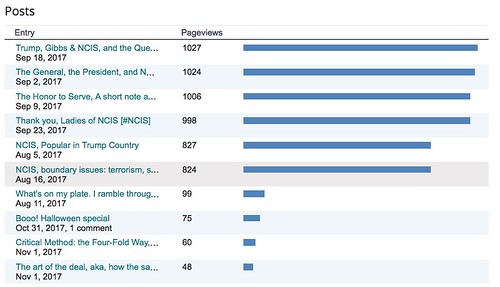
It's about NCIS, that's what. Look at this chart, which shows the most popular posts for the day:

11-1 posts 12PM

The top six posts are about about NCIS, and they've gotten considerably more action than any of the next four. Obviously a bunch of NCIS fans discovered those posts. I expect that this action will die down. I also expect, however, that it will drop down only to 3000-4000 hits a day, not all the way back to 400-700.

Today's total was 8,702 at noon when I took those flix. It's now 9,377 at 3PM as I post them.

We'll see. 

Monday, September 18, 2017

Trump, Gibbs & NCIS, and the Queen @3QD

I’ve got another post up at 3 Quarks Daily, Donald Trump is no Leroy Jethro Gibbs: http://www.3quarksdaily.com/3quarksdaily/2017/09/donald-trump-is-no-leroy-jethro-gibbs.html

The title tells it all, I measure Trump against the central character of one of the most popular scripted shows on network television, ever. Trump comes up short.

After establishing a sense of NCIS I focus on the distinction between one’s interests as a private person and one’s interests and duties in an organization. In Trump’s case that organization is, of course, not merely the Federal Government, but the nation. That distinction is real for Gibbs, but doesn’t exist for Trump.

But how do you dramatize that distinction? It’s easy enough to assert it, and one can write about it at considerable length. But making it REAL in a dramatic medium is different. You can’t have characters giving lectures on political and legal theory. Well you can, but it would be very boring.

For the most part NCIS leaves the distinction unstated. It’s there in Gibbs’s actions, and the actions of other characters, but they don’t philosophize about it.

I then give an example from the Netflix series about Queen Elizabeth II, The Crown. The distinction between private interests and public duty is central to that show, and there is considerable talk about it. I present one such example, but without comment. In this post I want to comment on that example. Before that, however, I want to present a speech from Shakespeare.

The Rejection of Falstaff

Sir John Falstaff is one of the most beloved characters in Shakespeare. He’s a down-and-out knight who spends his time drinking with his pals and trading in petty crime. Prince Hal, heir apparent to the throne of England, is one of those pals. When Hal ascends to the throne, becoming Henry V, Falstaff approaches him at the coronation, gleefully anticipating good times to come now that his boon companion, good old Hal, rules the land. He addresses the King as “Hal” and is severely, unexpectedly, and very publically reprimanded (Henry IV, Part II, Act 5, scene 5)
I know thee not, old man: fall to thy prayers;
How ill white hairs become a fool and jester!
I have long dream'd of such a kind of man,
So surfeit-swell'd, so old and so profane;
But, being awaked, I do despise my dream.
Make less thy body hence, and more thy grace;
Leave gormandizing; know the grave doth gape
For thee thrice wider than for other men.
Reply not to me with a fool-born jest:
Presume not that I am the thing I was;
For God doth know, so shall the world perceive,
That I have turn'd away my former self;
So will I those that kept me company.
When thou dost hear I am as I have been,
Approach me, and thou shalt be as thou wast,
The tutor and the feeder of my riots:
Till then, I banish thee, on pain of death,
As I have done the rest of my misleaders,
Not to come near our person by ten mile.
For competence of life I will allow you,
That lack of means enforce you not to evil:
And, as we hear you do reform yourselves,
We will, according to your strengths and qualities,
Give you advancement. Be it your charge, my lord,
To see perform'd the tenor of our word. Set on.
Notice how Hal explicitly distinguishes his two selves, the private person (“the thing I was”, “my former self”) and his new status as king (“our person”, “we hear you”). As a consequence of this distinction the King must necessarily have a different relationship with Sir John than Hal did.

Such a speech is natural to the occasion, the coronation of the King. For it is in that ceremony that a person leaves one social status (a term of art in the social sciences) and assumes another, that of monarch. This is a type of ceremony that anthropologists call a rite of passage. Christenings, baptisms, bar/bat Mitzvahs, weddings, funerals, and graduations are other examples of rites of passages. In each case a person leaves one station in society and assumes another. Depending on various factors, such ceremonies may be simple, with few present, or complex and staged before a large audience.

A complex ceremony before a large audience is a kind of theater. As such, it is a natural way for a dramatist to explore and present, at some length, the distinction between private and public person. That is what Shakespeare did in Henry IV, Part II.

Saturday, September 9, 2017

The Honor to Serve, A short note about NCIS

Episode 13 in the first season of NCIS is called “One Shot, One Kill”. It opens in a video game arcade where some teen-aged boys are blown away by the skill of Marine Corps sergeant. We cut to recruiting office where the sergeant is giving the boys the hard sell about hitching up. He’s talking about Iraq: “Been in the corps 16 years. Closest I’ve ever come to a bullet is...” Shatter! Wham! Splatt! He’s shot. Slumps over on the desk.

Gibbs and his team are called in to investigate. In the course of their investigation the recruiter who replaces that first one is shot as well. In both cases, sitting at the desk, shot from long distance, through the window. Sniper.

Gibbs decides he’s got to go under cover on this one. He’s going to pretend to be the recruiter. The idea seems to be that they’ll place bullet-proof glass in the window and Gibbs’ll wear a bullet-proof vest. They place three microphones outside so that, when the shooter fires, Abby can pick up the sound and use it to triangulate the shooter’s location. They can then scoot over there and make the arrest.

Very clever, no?

But that’s not what I’m interested in, though obviously that kind of cleverness is part of the show’s appeal.

So, we’re in the recruiting office, Gibbs looking sharp in his old gunnery sergeant’s uniform, though it’s a bit tight on him. Kate’s in uniform as a captain. She’s there to profile potential recruits as they visit the office. The major who heads the recruiting unit wants to stay; after all, he’s lost two men to this sniper. Gibbs says no, he’ll just be in the way. The major insists.

Here’s what they say (c. 34:39):
Gibbs: Major, your job is to protect our country. Our mission right now is to protect you, and your marines. Allow us the honor of doing our job.

Major: Good luck Gunnery Sergeant.
That phrase – “the honor of doing our job” – may be the ideological heart of this show. It resonates with me. I can see why it resonates with Trump voters.

And, you know, I can imagine that it would resonate with Trump himself. It kinda’ makes you feel good, doesn’t it, the thought of a job such that doing it is an honor? What kind of job is it that ennobles the person who does it? I fear, though, that when the aspirational moment passes, Trump will revert to himself, the deeply insecure man who feels entitled to the Presidency and diminishes those who would serve the country by serving him.

Saturday, September 2, 2017

The General, the President, and NCIS

I have already noted that NCIS is popular among Trump supporters. Trump is strong on authority, his in particular, and NCIS, after all, centers around the military, the Navy and the Marines, which is strong on authority as well. Moreover he has turned to generals in staffing up, Mattis as Defense Secretary, McMaster as National Security Adviser, and now Kelly as his chief-of-staff (he’d previously headed Homeland Security). This makes sense, Trump & the generals, NCIS & Trump’s supporters, and yet...

The New York Times has reported that some of Trump’s staff “gently suggested he refrain from injecting politics into day-to-day issues” to which 45 responded by unloading on his new chief of staff:
Mr. Kelly, the former Marine general brought in five weeks ago as the successor to Reince Priebus, reacted calmly, but he later told other White House staff members that he had never been spoken to like that during 35 years of serving his country. In the future, he said, he would not abide such treatment, according to three people familiar with the exchange.
Makes sense, all around. Trump can’t abide having anyone try to reign him in and a general can’t abide being treated like dirt – I assume that’s what Trump did in one way or another.

It’s a tricky situation:
“It is inevitable that a guy who will not be contained and does not want to be handled or managed was going to rebel against the latest manager who wanted to control him,” said Roger Stone, the longtime Trump adviser, who believes Mr. Kelly represents a kind of management coup by “the triumvirate” of two powerful retired generals — Mr. Kelly and Jim Mattis, the defense secretary — and one general who is still in the Army, the national security adviser, Lt. Gen. H. R. McMaster.
Back to NCIS. The central character is Leroy Jethro Gibbs, played by Mark Harmon. Gibbs is a former Marine sniper and gunnery sergeant. He runs a tight ship, authority and discipline – like the generals, but is also a bit of a cowboy – like Trump. I can’t imagine Gibbs putting up with a Trump-like person under his command, nor, for that matter, can I imagine him serving under one or being anyone’s chief of staff. He’s an interesting character, like Trump in some ways, utterly unlike him in other ways.

And then we have the matter of boundaries, which, as I’ve indicated in a previous post, is at issue in NCIS. Gibbs maintains the boundaries that his subordinates find troublesome, but will bend the rules when necessary. Trump has made America’s boundaries a major issue, acting to curtail immigration and promising to build a wall along the Mexican border. This clearly appeals to his base, and I suspect to others as well. But otherwise Trump disrespects boundaries, his attitudes toward women is the most obvious example (something Gibbs would have no truck with), along with his conduct in office, in particular, his refusal to respect the boundary separating the Justice Department and the FBI from the executive (that is, the Presidency).

What would Gibbs think of 45?

Wednesday, August 16, 2017

NCIS, boundary issues: terrorism, sexual harassment, and rambling on

As I mentioned in this post, I’ve been watching a lot of NCIS and wondering why it’s perhaps the most popular show on network TV. It’s a crime show, and crime shows have a long and deep history on television, in the movies, and in fiction. What are such shows about? Abstractly considered, they’re about a boundary, the boundary between actions that legitimate and those that are not. Criminals are those who transgress that boundary in some way and police are those who restore the boundary by catching criminals.

Moreover, NCIS came on the air in September of 2003, two years after 9/11. And 9/11, of course, put terrorism at the top of America’s attention vector. What is terrorism but a specific class of boundary violations. While ordinary criminal activity is mostly undertaken for the private benefit of the criminals, terrorism is done to damage the body politic, to make citizens feel that they are not safe. Moreover, the bombing of the World Trade Center was done by foreign nationals and so violates the nation’s territorial integrity.

A good many NCIS episodes are about terrorists. I don’t have a count, but let’s say it’s a third of them. When the NCIS agents apprehend a terrorist they not only restore the body politic in the way the capture of any criminal does, but they restore the integrity of the nation as well. Surely this part of the show’s appeal.

But there’s something much more subtle and interesting in NCIS, for boundary issues are written into the texture of the show in the way people interact with one another.

Consider one of the central characters, Senior Special Agent Anthony DiNozzo. He is a bit of a bully, wise guy, and sexual harasser. He’s real prick, but good at heart (of course). I don’t know how many times I’ve winced at his intrusive and harassing remarks. And I’m certainly not the only one. The Wikipedia article on DiNozzo remarks that “Tony was often criticized by the female audience at the beginning of the show's run for his chauvinism.” What is sexual harassment if not violating someone’s personal boundaries?

But that’s not the only kind of boundary violation in the show. The three characters who are more or less intellectual – the medical examiner, the forensic specialist, and another Special Agent – tend to ramble on about technical matters. Gibbs, head of the team and the show’s central character, will ask one of them what’s going and they’ll start rambling on about this that and the other, mostly technical matters leading up to an eventual conclusion, until Gibbs cuts them off and demands, What’s the point? He’s clearly annoyed and so, I strongly suspect, is the audience. I know I am.

This is a kind of boundary violation. Gibb’s wants know this or that so he can push the investigation further. He trusts their technical competence (very important) and doesn’t care about the detail. It’s his sense of the whole investigation sets the boundaries on these conversation. Technical details violate those boundaries.

Consider Ducky, Dr. Donald Mallard, the Medical Examiner. He’s very good – they all are (this, after all, is TV) – but easily lost in details. Not only that, but he often starts meandering through old cases or even wanders into his army days. He’s British and resembles Higgins, from Magnum P.I., in this respect. His assistant ME (for most of the show’s run), Jimmy Palmer, is also a rambler.

And so it goes with Abby Sciuto, the Forensic Specialist and Timothy McGee, another Special Agent. McGee’s MIT graduate, and expert in computers. This contrasts with DiNozzo, who is an athlete from Ohio State. DiNozzo has his own form of rambling, not on technical matters, but movie references. He’s forever comparing current events to movies he’s seen, to the annoyance of just about everyone.

In contrast, the two female agents, Caitlin Todd (first two seasons) and Ziva David (seasons 3-11), never ramble on. But they are the primary objects of DiNozzo’s sexist remarks.

And of course Gibbs doesn’t ramble, and neither do the two long term NCIS directors, Jenny Shepard (season 3-5) and Leon Vance (season 6 to the present). These are authority figures. It is thus their job to keep things on track. Gibbs, though, doesn’t always do things by the book, which the directors know. Gibbs has a freedom to maneuver that the directors, by virtue of their position, do not.

The analytic trick, it seems to me, is to make sense of collection of characters and their characteristics. While rambling is generally associated to intellectuality and maleness, Abby rambles and is female, while DiNozzo rambles and is male. But DiNozzo’s rambling is about films, not about technical issues pertaining to evidence; that differentiates him from Ducky, McGee, and Abby. Abby has a goth persona, with tattoos (which are mostly just talked about) and funky taste in clothing while Caitlin and Ziva are more, well, standard/mainstream. She is also effusive while the other two women are not.

There is a logic here, myth logic I call it, but it’s not yet clear to me what’s going on.

I think it calls for some more rambling.

More later.

Friday, August 11, 2017

What’s on my plate. I ramble through NCIS, cultural evolution, description, #DH, and plot another article. [Ramble 5]

I’ve got a number of posts planned for the near future, perhaps even the very near future. But I’m not sure in just what order I’ll be writing them. Here’s (some of) what I’m currently thinking about.

NCIS, boundary issues: terrorism, sexual harassment, and rambling on: As I mentioned in this post, I’ve been watching a lot of NCIS and wondering why it’s perhaps the most popular show on network TV. It came on the air not too long after 9/11 and a good many shows are about terrorists; I don’t have a count, but let’s say it’s a third of them. That’s part of the appeal. One of the central characters, Sennior Special Agent Anthony DiNozzo, is a bit of a bully, wise guy, and sexual harasser. He’s real prick, but good at heart (of course). And the three characters who are more or less intellectual – the medical examiner, the forensic specialist, and another Special Agent – tend to ramble on about technical matters. I’m thinking these are all about more or less the same thing, boundary violations, and that’s part of the show’s appeal. How do we restore those boundaries?

Cumulative culture in the reticulum: This is a follow up to my post, Gestalt Switch in the Emergence of Human Culture. I’m not quite sure just where I’m going with this, but I do want to link up with some of my other thinking on cultural evolution. In particular, I want to connect with my concept of the cultural reticular, which I currently define as:
Reticulum or cultural reticulum: A network of persons and other cultural actors, whether animate or inanimate, that are linked together in a social group at the neural level. A reticulum in this sense is a Latourian actor-network. It is the environment in which cultural beings evolve and to which they must adapt. The actors in a reticulum are covered or painted with coordinators. Formerly mesh, which I may still use informally.
 It is the emergence of the cultural reticulum that affords the emergence of cumulative culture.

And here's a more considered remark on cumulative culture, including some comments on Dawkins.

The rhetoric of interpretation and explanation in literary criticism: This is a follow-up to my post, Description, Interpretation, Explanation, and Evaluation as Rhetorical Roles in Literary Criticism [#DH]. I want to take another crack at characterizing the roles of interpretation and explanation in literary criticism. I think that the purpose of interpretation is to translate one’s engagement with the text into discursive prose. “Engagement” is perhaps an odd word to use, but I don’t want to use “read” (which is over-used in literary criticism) or “experience”, which doesn’t seem quite right. Encounter? Perhaps it would be better to say interpretation is about translating from aesthetic mode (the text) to discursive mode.

But now I’m starting to write the post. Whatever the formulation, this is to be contrasted with explanation, which is about mechanisms (broadly and loosely understood) operating in and through the text.

How do humanists understand computational criticism (aka ‘distant reading’)? Computational criticism is quite technical, involving statistics and high-dimensional spaces, among other things, to make ‘observations’ about texts. And one needs to think like a social scientist to relate these observations to literary history. Literary critics are not ordinarily trained in these things. I’m particularly concerned about the technical issues.

Saturday, August 5, 2017

NCIS, Popular in Trump Country

For some reason I’m rather fond of NCIS, the wildly popular TV series. I watched it on and off back in the days when I had a television, and before there was much if any streaming video online, and I’ve been watching it again, the whole run, on Netflix. Here’s some basic info from the Wikipedia entry:
NCIS is an American action police procedural television series, revolving around a fictional team of special agents from the Naval Criminal Investigative Service, which investigates crimes involving the U.S. Navy and Marine Corps.

The concept and characters were initially introduced in two episodes of the CBS series JAG [...]. The show, a spin-off from JAG, premiered on September 23, 2003, on CBS. To date it has aired fourteen full seasons and has gone into broadcast syndication on the USA Network. Donald P. Bellisario and Don McGill are co-creators and executive producers of the premiere member of the NCIS franchise. It is the second longest-running scripted, non-animated U.S. primetime TV series currently airing, surpassed only by Law & Order: Special Victims Unit (1999–present), and is the 7th longest-running scripted U.S. primetime TV series overall. [...]

While initially slow in the ratings, barely cracking the Top 30 in the first four seasons, by its sixth season, it became a top five hit, and has remained there since. In 2011, NCIS was voted America's favorite television show in an online Harris Poll. The series finished its tenth season as the most-watched television series in the U.S. during the 2012–13 TV season.
Season 15 will start airing in September, 2017. How many more seasons after that?

So, it’s been an enormously popular series. It started off slow, but according to TV Tropes it’s now the most popular show in the world. Why? That’s something I want to think about, but not right now. I want to save that for another post.

While thinking about the show’s popularity I wondered just who it appealed to. It seemed to me, for example, that it was more likely to appeal to a Trump voter than a Clinton or a Sanders voter. While thinking about this I turned up a NYTimes article from late last year, ‘Duck Dynasty’ vs. ‘Modern Family’: 50 Maps of the U.S. Cultural Divide, which reported that NCIS is most popular in rural areas. That’s Trump country.

In particular:
A Forbes article about Jared Kushner, Mr. Trump’s son-in-law, said that the Trump campaign may have specifically targeted “NCIS” viewers. It said data analysis “drove the scaled-back TV ad spending by identifying shows popular with specific voter blocs in specific regions — say, ‘NCIS’ for anti-Obamacare voters or ‘The Walking Dead’ for people worried about immigration.”
Bingo! Of course, that doesn’t necessarily imply that Clinton or Sanders voters don’t like the show, but it surely casts doubt. In any case, it bears out my intuition that the show appeals to Trump’s people.

And that’s reason enough to examine it closely.

Now, let me be clear, I am NOT a Trump person. I think he’s been a disaster so far and I have little hope that he will get better. And yet I genuinely like NCIS. If I didn’t, I wouldn’t have spent so much time watching it.

More later.

P.S. I wonder what anti-ObamaCare NCIS fans think about ObamaCare now?