I'm bumping this to the top of the queue with the addition of a tweet linking to a study of hemispheric timing (see last two sections below, Two Hemispheres, Splitting the Mind? You can download a slightly different version of the original post at THIS LINK).
Abstract from the article: Anja Pflug, Florian Gompf, et al., Differential contributions of the two human cerebral hemispheres to action timing, eLife 2019;8:e48404 DOI: 10.7554/eLife.48404:
Three against two is one of the most important rhythm ‘cells’ in all of music. What do I mean, three against two? You play three evenly spaced beats in one ‘stream’ in the same period of time you play two evenly spaced beats in another ‘stream.’ It sounds simple enough but, the problem is that three and two do not have a common divisor, making the ‘evenly spaced’ part of the formula a bit tricky. The two patterns coincide on the first beat, but the second and third beats of the three-beat stream happen at different times from the second beat of the two-beat stream. And if you think that’s a lot of verbiage for something that ought to be simple, when then you’re beginning to get the idea.
* * * * *
Interesting new paper about the perennial question of lateralization and timing, from Chris Kell's lab in Frankfurt https://t.co/AeoVe5x9Zo Differential contributions of the two human cerebral hemispheres to action timing— David Poeppel (@davidpoeppel) November 21, 2019
Abstract from the article: Anja Pflug, Florian Gompf, et al., Differential contributions of the two human cerebral hemispheres to action timing, eLife 2019;8:e48404 DOI: 10.7554/eLife.48404:
Abstract: Rhythmic actions benefit from synchronization with external events. Auditory-paced finger tapping studies indicate the two cerebral hemispheres preferentially control different rhythms. It is unclear whether left-lateralized processing of faster rhythms and right-lateralized processing of slower rhythms bases upon hemispheric timing differences that arise in the motor or sensory system or whether asymmetry results from lateralized sensorimotor interactions. We measured fMRI and MEG during symmetric finger tapping, in which fast tapping was defined as auditory-motor synchronization at 2.5 Hz. Slow tapping corresponded to tapping to every fourth auditory beat (0.625 Hz). We demonstrate that the left auditory cortex preferentially represents the relative fast rhythm in an amplitude modulation of low beta oscillations while the right auditory cortex additionally represents the internally generated slower rhythm. We show coupling of auditory-motor beta oscillations supports building a metric structure. Our findings reveal a strong contribution of sensory cortices to hemispheric specialization in action control.
* * * * *
Three against two is one of the most important rhythm ‘cells’ in all of music. What do I mean, three against two? You play three evenly spaced beats in one ‘stream’ in the same period of time you play two evenly spaced beats in another ‘stream.’ It sounds simple enough but, the problem is that three and two do not have a common divisor, making the ‘evenly spaced’ part of the formula a bit tricky. The two patterns coincide on the first beat, but the second and third beats of the three-beat stream happen at different times from the second beat of the two-beat stream. And if you think that’s a lot of verbiage for something that ought to be simple, when then you’re beginning to get the idea.
In some cultures, including many in Africa, young children are taught 3 against 2 at a very young age. For them it IS easy. That’s not the case, however, in European derived musical traditions. Three against two is not part of basic toddler pedagogy and, as a consequence, learning to do it is a bit more difficult when, and if, the time comes – for some, it never comes. Thus, within the context of the Western classical tradition, three against two is considered moderately difficult rather than being fundamental. Such rhythms are exceptional in classical music, but they are common enough that any moderately skilled keyboard player must know how to execute them.
Go Slow, Count it in Six
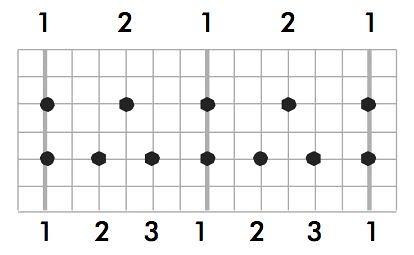
In playing percussion or a keyboard instrument it is easy to alternate notes from one hand to the other and it is easy to play notes simultaneously with both hands. It is also easy to play two or four or eight notes with one hand against one note with the other hand or, for that matter, three or six notes with one hand against one note with the other. And, of course, it is easy to repeat such figures time after time after time. It is, however, distinctly more difficult to play three notes with one hand against two with the other. The problem is that, once the first note is struck by both hands, none of the successive notes in the pattern line up nor are they equidistant from one another. The patterns are incommensurate, as we see in the following diagram:
 |
| Three Against Two |
Let’s consider the advice Joseph Hoffman offered on this problem. Hoffman was a piano virtuoso whose career spanned the late nineteenth and early twentieth centuries. In 1909 he published a book of Piano Questions, which consisted of “direct answers to two hundred fifty questions asked by piano students” which he had originally published in the Ladies’ Home Journal over a period of two years. One of the questions he answered was “How must I execute triplets played against two-eighths?” — a typical 2-against-3 pattern. Here is the first part of Hoffman’s answer:
In a slow tempo it may serve you to think of the second eighth-note of the triplet as being subdivided into two sixteenths. After both hands have played the first note of their respective groups simultaneously, the place of the aforsaid sixteenth note is to be filled by the second note of the couplet.