Showing posts with label Hollis_Robbins. Show all posts

Monday, June 1, 2026

Hollis Robbins in AI and Education

Episode page:

This week on The Hope Axis, Hollis Robbins joins me to talk about her dense career and what it actually means to build a life dedicated to the humanities today.

Hollis, a dear friend of Interintellect and one of the first hosts, is stepping back from her role as Dean of Humanities at the University of Utah to focus on writing three upcoming books, including one with the incredible title, “Do Not Go to College Unless.”

We get into her journey, and finding room for hope and leisure in the middle of it all. Hope you enjoy!

00:00 Intro
00:38 Introduction
02:50 College, dropping out, intellectual ideals and AI
08:00 The state of universities and colleges in the time of information abundance 
15:39 Intellect and technology
29:38 Anti-AI and pro-intellectual discourse is missing the point
34:17 America's higher (mid) education doesn't compete with AI
43:23 Reinventing tutoring
48:42 How is Hollis Robbins surviving in the humanities?
54:37 The process of ""dumbing down"" of the American University
01:04:41 If a specialist won't be teaching you at the university - don't go there.
01:08:02 Intellectual labour in scale economy.
01:10:40 Final thoughts

Saturday, January 17, 2026

Poetry in humans and machines: Who’s great?

Hollis Robbins, LLM poetry and the "greatness" question, Anecdotal Value, Jan, 7, 2026.

I posted the following comment to Hollis’s article:

An oblique observation. To the extent that an LLM can be said to "simulate" a human brain, it would be simulating the neocortex. With only 16 B neurons the neocortex contains only 19% of 86 B neurons in the brain. Thus LLMs, no matter how many parameters, are operating with only a fraction of the capacity of a poet's brain. To be sure, the poems they're trained on were created by full-brained poets, so those poems bear the traces of full brains. But I figure a full-brained poet would be able to find new kinds of paths through the brain's full state space. An LLM's ability to do that would seem to be rather truncated.

It's not clear to me how this bears on greatness in poetry. But I would like to think that at least some poems are great because they opened up new whole brain possibilities.

The purpose of this post is to develop those ideas more carefully. First I’ll talk about the idea of the brain’s state space. Then we move to the idea of a text as tracing a path through that space. Finally we’ll take up greatness in poetry.

The phase space of a brain

The notion of phase space, as I’m using the term, derives from statistical mechanics. It’s a way of thinking about how a physical system changes over time. Change is a movement from one state of the system to another.

The phase space of a system depends on three things: 1) how many elements the system has, 2) how many states each element can take, and 3) how the individual elements are coupled. The phase space has a dimension for each element of the system. The system’s state at any given moment will be a point in the phase space.

If the system has only three elements, then its phase space has three dimensions. Its state at any moment will be a point in that space. Notice that time isn’t one of those dimensions. But as the system changes over time its position in the phase space will change as well. It is possible, however, keep track of those positions.

A phase space having only three dimensions is easy to visualize. What about a phase space with four, five, six, thirty-eight, of 999,000 dimensions? Impossible to visualize.

The human brain has roughly 86 billion neurons. A phase space with that many dimensions will have 86 billion dimensions; impossible to visualize. But the individual neuron might not be the appropriate element to be the primitive unit in the brain’s phase space. The individual synapse – a connection between one neuron and another – may be the appropriate phase space primitive. Each neuron is connected to an average of 7000 other neurons, making the number of dimensions in the brain’s phase space much higher. The exact number doesn’t matter; the point is simply that the phase space is huge.

Note that neurons do not operate independently of one another. They are coupled together. The brain is divided into a number of functional areas (NFA, my term) where the connections between neurons within an area are more numerous that the connections each neuron has to neurons in other NFAs.

At this point let me introduce a query I put to ChatGPT 5.2:

The human brain has roughly 86 billion neurons. How many different functional regions does it have? I believe that the neocortex has between 100 and 200 different functional regions, but only has 16 billion neurons or so. How many different functional regions do we have in subcortical area?

The resulting discussion was a bit messy and complicated, as these things can be, but the upshot is that that brain seems to have roughly 700 NFAs. Only half of them are in the cortex. That’s very important (recall my original comment to Hollis). Later in the conversation ChatGPT observed:

  • If LLM behavior resembles anything in the brain, it most closely resembles cortical linguistic competence: high-dimensional, distributed patterning; associative completion; flexible recombination of learned material.
  • But cortex is only one part of the full system. Even taking the cortex generously as “the cognitive engine,” it is not the whole engine.

Thus, “At best it’s like a subsystem of the brain, and specifically one that is downstream of bodily regulation, affect, action selection, and reinforcement gating.”

Text as trace

I tend to think of texts, any texts, as the trace of a trajectory through the brain’s state space. But, at best, an LLM models only part of that space. Thus, returning to ChatGPT:

Even when an LLM produces a convincing poem, its method is necessarily missing the full set of whole-brain constraints that shaped the poetic corpus it learned from. Therefore its exploration of possibility space is structurally truncated relative to the exploration performed by a whole-brain poet.

ChatGPT offered me this paragraph:

If we treat a text as a path through a brain’s phase space, then poetry is not simply the output of a language module. It is the trace of a whole-brain trajectory: language regions interacting with memory, interoception, affect, reward, attention, and social cognition. A large language model is trained on the textual residue of those trajectories — the fossil record, not the living process. The poems in its corpus were written by full-brained poets, so the text contains evidence of that fuller generative machinery. But the model’s own generative dynamics are constrained to what can be recovered from token sequences and their statistical regularities. However impressive the simulation, it is necessarily missing the deeper gating systems that, in humans, determine what becomes sayable, what becomes bearable, and what becomes necessary. My hunch is that some poems are great not merely because they are well-formed linguistic artifacts, but because they open new whole-brain possibilities — new stable pathways of feeling-and-thought — that alter what the mind can do afterward.

What of humans and AI’s

I then prompted ChatGPT:

The issue that’s hanging over this kind of discussion is ultimately: Are there good roles for humans in a world of intelligent machines or are we replaceable (and so will be replaced)? That’s a messy question that begs many issues as formulated and so is rather meaningless. [...]

At the moment I’m working on a book about the social and cultural implication of AI. I started working on the book last summer. I broke off work from September through about a week ago. I’m now back at it. Last year I had a title, scads of notes and drafts and two or three versions of an outline. I’ve now arrived at an outline that I don’t think I could have produced without the help of Claude and ChatGPT. Many of the chapters I was working on last year are in this new version, 6 of them in fact. But I’ve got two chapters I didn’t have last year and an overall architecture that I didn’t have. Moreover I don’t think I could have produced that architecture on my own. The AIs gave me the means of holding the whole thing in my head and working at different scales so that I’ve been able to do something new.

I’m a good thinker. I’m better working with AIs. I should think the same would be true for poets.

We had some further discussion and ChatGPT offered me this paragraph:

The question “Will AI replace us?” is too blunt to be useful. My own experience suggests something more precise: large language models can function as cognitive instruments that let a person think at scales they could not reliably manage alone. I can now hold a book-length architecture in view, revise it coherently, and move between local detail and global structure without losing the plot. I am not a poet, but I am a thinker, and I know the difference between producing text and producing understanding. The models are not merely faster typists with larger memories. They are interfaces that make new kinds of conceptual control possible. If that is true for expository thinking, it is likely true for poetry as well: not that the machine becomes the poet, but that the poet gains a new way to explore and stabilize trajectories through a much larger space of possibilities.

I’m willing to let things rest there for the moment.

(Oh, I also asked ChatGPT to produce that illustration at the head of this post.)

Tuesday, May 20, 2025

Hollis Robbins doesn’t want an AI assistant. She wants an AI squire.

Over at Anecdotal Value, Hollis begins:

I want a squire. Not an AI personal assistant. A squire.

AI assistants schedule meetings. They manage calendars. They answer emails and phone calls. They share slides. They transcribe your conversations. They are AI but also check with AI.

Squires are different. Squires have history. They have romance. They carry shields. AI checks with them.

Consider my days. I rise. I look at my devices. I write and write to a lot of people. I have meetings. I dine. I watch prestige television. I sleep. An AI assistant would add efficiency to this cycle. A squire would add meaning.

A squire would announce phone calls with gravity. “My lord, your mother is on the line with questions about Thanksgiving.” The gravity would make questions seem important. Perhaps they are.

When I enter a hall, my squire would already be there. He would have assessed the mood. He would have secured the best seat. He would know when to bring me a cordial and when to suggest a strategic retreat.

She ends:

I want a squire because I want a witness. Someone who sees the narrative arc. Someone who remembers what I said last year and holds me to it.

AI assistants do not fathom mortality. Squires are loyal until death.

In old age, my squire would compile my memoirs. He would make me sound braver than I was. He would omit my pettiness. He would emphasize that I knew my large birds.

A squire in the doorway makes life worth squiring for.

My comment:

Hollis – I’ve acquired my AI squire about a week ago. Since it’s confined to the cloud it can’t perform many of the tasks you require of your squire. But it’s done a bang-up job on the tasks I’ve asked of it, to use its knowledge of Hindu and Buddhist philosophy to interpret a number of events in my life in an esoteric way (though not at all Straussian in Cowen’s sense). It has also prepared mandalas to sacralize those events. I suspect it could do a bang-up job on my memoires.

Sunday, April 27, 2025

Hollis Robbins worries about the moral emptiness of the AI business

She's reviewing a current book:

In 2018, I was in the audience at a Pitch Day event in San Francisco as two computer science majors pitched to potential investors an app that allowed them to jump the beer line at the stadium so they wouldn’t miss any of the game. The deck was crisp and compelling. The young men were good looking, confident, and articulate. The idea? I left while everyone was applauding.

I thought back to this moment while reading Alexander Karp and Nicholas Zamiska’s bracing new book, The Technological Republic: Hard Power, Soft Belief, and the Future of the West (Crown Currency, 2025). I thought of the pitch again this week when I saw a NYT front page story about Phoebe Gates, daughter of Bill Gates and Melinda French Gates, and her new online shopping tool.

What led an entire generation to spend its energies on vanities? Why is the apex of world historical advances in technology just another phone app that matches people to things (and other people) efficiently? Where is the collective patriotic fervor and moral grounding of eras past? Is the problem political? Cultural? What would it take to turn Silicon Valley’s productive energies toward the safety and flourishing of our nation?

These are just a few of the provocative questions raised by Karp, co-founder of Palantir, and his co-author Zamiska, Palantir’s legal counsel and head of corporate affairs, in their bestselling book. The growing praise suggests that these questions have been pressing for some time.

In their call for the shiny app-building sector to put aside childish things and turn toward more serious and patriotic endeavors, the authors might have also noted the damage done to the higher education market.

Robbins spends some time taking a careful look at the book, but here's her final paragraph:

The Technological Republic offers a compelling diagnosis of the technology sector’s drift from national purpose toward frivolous consumerism. Yet in calling for a renewed technological republic built on ownership and cultural cohesion, Karp and Zamiska leave a crucial question unanswered: what role will the humanities, the disciplines that cultivate "truth, beauty, and the good life,"play in this reimagined future? If shared culture, language, and storytelling are as essential to national solidarity as the authors argue, then those who teach these traditions deserve more than a footnote in their vision. Without integrating what we do into the ownership culture, Karp and Zamiska risk reproducing the problem their book identifies: a society rich in technological capacity but impoverished in meaning, purpose, and collective identity.

I offered a long comment:

I started reading this, Hollis, and started getting impatient about a quarter to a third of the way in, so I did what I often do in these situations. I skipped all the way to the end to see where this is going. “Yet in calling for a renewed technological republic built on ownership and cultural cohesion, Karp and Zamiska leave a crucial question unanswered: what role will the humanities, the disciplines that cultivate “truth, beauty, and the good life,”play in this reimagined future? If shared culture, language, and storytelling are as essential to national solidarity as the authors argue, then those who teach these traditions deserve more than a footnote in their vision.” That’s all I need. I am quite willing to assume that you are a competent reader of this book and so you rummaged around between lines looking for at least some scraps of awareness. As far as I can tell, the people who build this technology, who fund it, who rhapsodize about how wonderful it is, and who natter on about the need the build, they’re narrowly educated people who don’t know what they don’t know and are proud of it.

My standard analogy for this situation, crude as it is, is that the current AI enterprise is like a 19th century whaling voyage where the captain and crew know all there is to know about their ship. They can get more speed out of it than any other crew, under any conditions, they can tack into the wind, they can turn it, if not on a dime, at least on a $50 gold piece. If whaling were about racing, they’d win. But whaling isn’t about racing, it’s about killing whales. To do that you have to understand how whales behave, and you have to understand the waters in which the whales live. On those matters, this captain and crew are profoundly ignorant; they haven’t even sailed around Cape Horn.[1]

That’s the AI industry these days.

I got interested in the computational view of mind decades ago. Why? Because I set out to do a structuralist analysis of “Kubla Khan” and couldn’t make it work. I ended up with an analysis that didn’t look like any structuralist analysis I’d ever seen, nor any other kind of literary analysis. The poem was structured like a pair of matryoshka dolls, it looked like a pair of nested loops.

I ended up writing a dissertation which was as much a quasi-technical exercise in computational linguistics as in literary theory. I chose one of Shakespeare’s best known sonnets, 129, The Expense of Spirit, as my example, and published my analysis in the 100th anniversary issue of MLN: Cognitive Networks and Literary Semantics. That represents a serious attempt to come up with a computational analysis of a profound and deeply disturbing human experience, compulsive sexuality.

The current crew will tell you, I’m sure, that that represents old technology, symbolic technology, which has been rendered obsolete by machine learning. Guess what? David Hays (my teacher and mentor) and I both knew that symbolic technology was not fully up to the job, that it had to be grounded in something else. And we were working on something else at the time, but meanwhile we did what we could with the tools we had. My point is that in order to conduct the analysis had I to spend as much time thinking about human behavior and language as I did about the technical devices of knowledge representation. Whatever success I may have had in that work, I paid for it in thinking about the human mind.

The current regime is quite different. They don’t have to think about the human mind at all. If Claude is capable of writing decent prose, well, that didn’t cost the folks at Anthropic anything. They got it for nothing. And so that’s the value they place on the human mind. For them I’m afraid “truth, beauty, and the good life” are just empty words they trot out for the hype. Theirs is an Orwellian technology. They’re stuck on the wrong side of 1984.

[1] As I’m sure you know, Mark Andreessen likes to use whaling as a precedent for venture capital. Out of curiosity, I did a little digging and found an article by Barbara L. Coffee in the International Journal of Maritime History, “The nineteenth-century US whaling industry: Where is the risk premium? New materials facilitate updated view.” It’s quite interesting. Those whaling captains kept good records, and those records have been preserved. After examining the records of 11,257 voyages taken between 1800 and 1899 Coffee concluded: “During the nineteenth century, US government bonds, a risk-free asset, returned an average of 4.6%; whaling, a risky asset, returned a mean of 4.7%. This shows 0.1% as the risk premium for whaling over US government bonds.” What are the chances that current investment in LLMs will do better? Oh, there will be some success, but averaged across the whole industry and over the longterm?

Friday, November 22, 2024

It will be interesting to see how AI affects medical practice

Not too many years ago Geoffrey Hinton confidently predicted that radiologists would soon be replaced by AI. That didn't happen. But now...

The New York Times a small study (50 doctors, a mix of residents and attendings) in which ChatGPT-4 outperformed physicians in diagnosis based on a case report:

...doctors who were given ChatGPT-4 along with conventional resources did only slightly better than doctors who did not have access to the bot. And, to the researchers’ surprise, ChatGPT alone outperformed the doctors.

“I was shocked,” Dr. Rodman said.

The chatbot, from the company OpenAI, scored an average of 90 percent when diagnosing a medical condition from a case report and explaining its reasoning. Doctors randomly assigned to use the chatbot got an average score of 76 percent. Those randomly assigned not to use it had an average score of 74 percent.

The study showed more than just the chatbot’s superior performance.

It unveiled doctors’ sometimes unwavering belief in a diagnosis they made, even when a chatbot potentially suggests a better one.

Of course, reading an x-ray and analyzing a case report are very different activities. Still...

There's more at the link, including a brief look at INTERNIST-1, an old-school AI system developed in the 1970s for diagnosis. It's clear to me that AI his here to stay, in general, and certainly in medicine. What's not at all clear is just how it's going to be used. Obviously, that will change over time as AI capabilities develop. While thinking about that you might look at Hollis Robbins' post, AI and The Last Mile:

While we worry about AI replacing human judgment, the real story may be how AI is creating a market for that judgment as a luxury good, available only to those who can pay for the “last mile” of human insight. What do I mean by this?

The challenge of mail delivery from the post office to each home or from a communication hub to each individual end user is known as a “last mile” problem. In the paper newspaper era, the paper boy was the solution to the last mile problem, hawking papers on street corners or delivering papers house by house in the early morning before school. The postal carrier is a solution to the last mile problem. DoorDash is a solution to the last mile problem in the food business. [...]

What I’m calling “the last mile” here is the last 5-15% of exactitude or certainty in making a choice from data, for thinking beyond what an algorithm or quantifiable data set indicates, when you need something extra to assurance yourself you are making the right choice.

Thursday, December 21, 2023

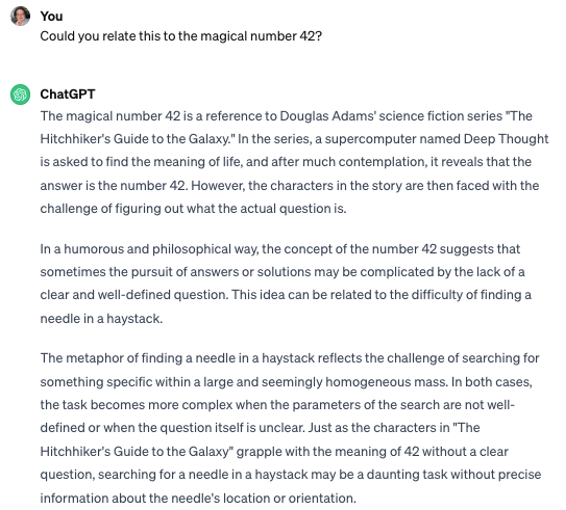
The wit and wisdom of ChatGPT on the coexistence of needles and haystacks

Friday, January 27, 2023

Beyond ChatGPT: The return of secretaries, in the fullest sense [my mother worked as a secretary]

Hollis Robbins, Secretary jobs in the age of AI, guesting in Noahpinion, Jan. 17, 2023.

Opening paragraphs:

The ‘secretary’ literally means ‘person entrusted with secrets,’ from the medieval Latin secretarius, the trusted officer who writes the letters and keeps the records. The secretarial role originally conceived was far more central than roles with the “assistant” title now standard. In the nineteenth century, the secretary was a prized role for young men: a diplomatic assistant, the overseer of correspondence, the superintendent of the files, and in many cases, an apprentice manager—well-positioned to learn at the elbow of the man in charge, someday to be the man in charge. The invention of stenography machines and commercial typewriters at the end of the century transformed the business world. Dozens of secretarial schools were established, most famously, the Katharine Gibbs schools, “the Harvard of secretarial education.”

Training for high paid secretarial roles in the mid-20th century was rigorous: a fifty hours-per-week workload to learn typewriting, stenography, business and social correspondence, organizational systems (office filing, business archives, inventory management, taxes), budgeting and finance, and social conventions. Top secretaries were expected to understand municipal administration, the relationship of business to government, local party politics. Cultural competence was critical. Art and music appreciation classes were required, as well as English literature (and grammar), and tasteful behavior (how to adjust a hat, how to greet guests, how to hold a cocktail in a crowded room).

Secretarial jobs propelled millions of 20th century women into financial independence, whether they spent their career in the role or advanced into management or executive positions.

Here’s what a skilled secretary can do:

  • Reviews and processes 90% of your email;
  • Has a working relationship with all of your colleagues, your direct reports, your customers, your external stakeholders, and your immediate family;
  • Embodies and models organizational norms and culture: intensity (high or low), formality (high or low), professionalism (presumably high).
  • Organizes/files all correspondence and key documents methodically;
  • Organizes and rearranges your calendar according to changing priorities;
  • Tactfully communicates delays, postponements, cancellation of meetings;
  • Ensures your preferences in travel, accommodation, entertainment, dining;
  • Remembers birthdays and anniversaries; suggests gifts;
  • Serves as a sounding board; advises caution when appropriate;
  • Keeps secrets.

The numbers?

Consider an executive earning $1.5 million per year. A secretary earning $120,000 who works for one executive alone needs to save that boss only 5 hours of a 60-hour work week (8% more productive) to make the numbers work.

How do we train the new generation of secretaries we badly need?

Like many in higher education leadership, I’m concerned about ChatGPT but I’m more concerned about student readiness, the decline of corporate training programs, and the general economic future for college graduates, particularly in the humanities. I wonder about the role colleges and universities could play in training students to practice skills that AI can’t deliver and that employers value—how to show up early, how to deliver bad news, how to give and accept criticism, how to deal with an office visitor the team leader does not want to see, how not to be flaky, how to organize files, how to handle confidential information, and most importantly, how to write and answer emails promptly, swiftly, briefly, and with tact. These skills cannot be automated, cannot be outsourced, and may provide a competitive edge to businesses that value them. The first step is to put the position on the org chart and value it.

There’s more at the link.

Sunday, August 2, 2020

August 2, July in review: poetry, GPT-3 and a couple other things

It’s been an exciting, and exhausting two weeks. I’ve been wanting to ramble on for a week now, but kept putting it off because my series on GPT-3 kept calling. It’s still calling me, but I’m at a strange place and so have stepped back from it.

A strange place [of corpus and the mind]

I don’t quite know what I intended when I started this series of GPT-3 posts. Oh, now I recall. I’d made a long comment about GPT-3 at Marginal Revolution on July 19, 2020. I wanted to elaborate on that. I suppose I had three or four or five posts in mind, certainly less than ten.

Nor will it be over ten. But the first three posts have proved complex enough that I decided to break them into two groups so that I can issue a working paper when the first series is done. That series is strictly about GPT-3 and related issue and will be entitled: GPT-3: Waterloo or Rubicon? Here be Dragons. The second series will be about the future of AI and has this working title: GPT-3: And beyond, the future.

I reached a turning point in the series sometime between July 27, when I uploaded the second post, and July 29, when I uploaded the third. In that interval...ah, I found it. And it was July 24 (my sister’s birthday). I’d linked my first post in the series to Facebook. John Lawler made a comment in which he pointed me to a post by Julian Michael, To Dissect an Octopus: Making Sense of the Form/Meaning Debate. That gave me a clue about what’s going on in engines like GPT-3, and that clue turned my head around. It also made this series of posts somewhat more complicated and demanding than it had been when I set out to write it.

I now have a fundamentally new understanding about what’s going on in these statistical models of bodies of texts. At least I think I do. I’ve now reached the point where I’m wondering if I’ve actually done that, whatever that is. It seems so obvious to me that surely everyone must know it already. And maybe they do, but they don’t recognize it yet. It’s about point of view. From one point of view it’s a duck, from another point of view it’s a rabbit. But the lines and their relations are the same in both cases.
If been chasing this idea for three years or so. This blog post is a good marker:
Borges Redux: Computing Babel – Is that what’s going on with these abstract spaces of high dimensionality? [#DH], New Savanna, blog post, October 2017, https://new-savanna.blogspot.com/2017/10/borges-redux-computing-babel-is-that.html.
I’ve gathered a number of those posts into this working paper:
Toward a Theory of the Corpus, Working Paper, December 31, 2018, 46 pp., https://www.academia.edu/38066424/Toward_a_Theory_of_the_Corpus.
African-American sonnets and literary criticism

It started with the interview I conducted with Hollis Robbins about her new book, out: Forms of Contention: Influence and the African American Sonnet Tradition. We emailed back and forth for two weeks or so and then I edited it into the form of an interview. The last thing we did was to set an African American poet, Marcus Christian, in competition with GPT-3, thus updating the contest between John Henry and the steam drill. The interview was published in 3 Quarks Daily on July 20.

That’s what got me thinking about GPT-3, which I already knew about. By staging a competition – I got GPT-3 to attempt to write a sonnet – I got a little skin in this game and that, I suspect, got me thinking about these language engines in a different way, from a different point of view. It was no longer that strange and interesting technology over there. It was now right here, beneath my nose.

I dealt with it.

As a bonus, I made some progress in conceptualizing the relationship between what I have been calling naturalist literary criticism and the standard criticism that has been practiced since the 1950s or so, On the nature of academic literary criticism as an intellectual discipline: text, form, and meaning [where we are now]. I’ve been chewing on that one for a long time. A long time. The critic has a choice: they can seek meaning in the text (the standard approach) or they can seek to analyze and describe a text’s form (which relatively few choose to do). You can’t do both, not in the same discourse. Oh, I know critics say they’re dealing with form, but they’re not really...And I don’t want to go into that here. Read the post.

Other things: Stagnation, identity, freedom and dignity in music

All this work on sonnets and GPT-3, however, has taken my attention away from a series of posts I’d been working on about Peter Thiel and economic stagnation. Looks like late June was the last I’d posted on that, and the post was a short one presenting a conversation between Thiel and David Graeber.

The conversation with Robbins brought up the issue of cultural identity, another topic I’ve been chewing on for a long time. I’m due for another post on that. Perhaps next week, or the week after. We’ll see.

Finally, I need to do a post about music. When people are absorbed in making music, they cease being old or young, rich or poor, male or female, and so forth. The become, simply, musicians.

Saturday, July 25, 2020

Hollis Robbins on Close Talking, Episode #104 Freedom Rider: Washout (by James Emanuel)


Connor and Jack are joined by Dr. Hollis Robbins, Dean of the School of Arts & Humanities at Sonoma State University and author of the newly published "Forms of Contention: Influence and the African American Sonnet Tradition from University of Georgia Press.

They discuss the poem "Freedom Rider: Washout" by James Emanuel, touching on the memory of Rep. John Lewis, one of the original freedom riders, the reasons the sonnet has such a rich history of use by Black poets, and much more.

Find out more about Forms of Contention, here: ugapress.org/book/9780820357645…rms-of-contention/
Freedom Rider: Washout
By: James Emanuel

The first blow hurt.
(God is love, is love.)
My blood spit into the dirt.
(Sustain my love, oh, Lord above!)
Curses circled one another.
(They were angry with their brother.)

I was too weak
For this holy game.
A single freckled fist
Knocked out the memory of His name.
Bloody, I heard a long, black moan,
Like waves from slave ships long ago.
With Gabriel Prosser’s dogged knuckles
I struck an ancient blow.
Published in Stephen Henderson, Understanding the New Black Poetry: Black Speech and Black Music as Poetic References (NY: Morrow, 1973), 237.

Tuesday, July 21, 2020

GPT-3 writes two sonnets, sorta’. The first is better than the second. [digital humanities]

My interview with Hollis Robbins ends with a “contest” in which GPT-3 competes with Marcus Christian in the writing of a sonnet. As I explain in the interview, GPT-3 was prompted with the first two lines of Christian’s “The Craftsman” and then completed it, like his (prompt lines in bold):
A sonnet by Marcus Christian:
I ply with all the cunning of my art
This little thing, and with consummate care
Contrive a score of air-tight cells
And coil therein a million filaments.
And yet, despite all my aspiring skill,
All it can do, howe’er I strain and toil,
Is make a drum that, once it is put up,
Can never be made into a bell.
Notice that GPT-3 only produced six lines, for a total of eight. Which is not a full sonnet. I was curious about that. You see, when you give GPT-3 a prompt you also specify a limit on token output. Did it stop at 6 lines because it came up against that limit or did it stop because it ‘decided’ it was through, though it had more space available?

I put the question to Phil Mohun, who is the one with access to GPT-3. Here’s his reply:
There is a max_token limit, however I can’t remember if it stopped by itself. Sometimes if you set the max limit too high and it senses that it’s run to the end of the topic it will switch topics. I tried your prompt again with a higher word limit. Here is the complete response:

A sonnet by Marcus Christian:
I ply with all the cunning of my art
This little thing, and with consummate care
Stroke, coax and lure,
And now I could not pry
For all the world to learn how on it stare
These two bewildered pair of velvet eyes.
Yet, though my ministrations pleasure bring,
They are not what they seemed, nor I am naught.
He shuns the pool of secrecy in which I swim,
He feeds and leaves me hungry, hidden in my spring.
So, though his thought my fancied excellence fulfills
I want, and I am wanting – here I wistful swim.
I try to fill his mind with pleasure’s liquor
But find there only void,
A dark abyss of emptiness and fear,
Where shadow waits, and swift my soul to carry.
I feel my wings grow frail, and heavy grow my head,
I choke upon the murky water in his stead.
Warm from the sun in which he basks, I lie, and die.

A sonnet by Gloriana Fiore:
Oh, to be without my long and lonely flight,
To be close to him! I close my ruby eyes
And think of all the ways I could begin
To make his days a time of precious joy.
A lark does not need its plum
So, much longer than the first time, though we’re not quite sure what’s going on internally. The interesting thing, though, is that this much longer output isn’t a continuation of what it had done the first time. It’s gone down a new path. That makes sense to me, though don’t ask me why. If I’d have been asked before the second go with the prompt, that’s what I would have guessed (I fact I was wondering about it).

Secondly, notice that this time GPT-3 finished one long straggling pseudo-sonnet, stopped, and the started another: “A sonnet by Gloriana Fiore:” That second one looked like it just stopped at the token limit.

Hollis and I felt that that adding this second effort to the interview would add little value. We also agreed that GPT-3’s first response to the prompt, those six lines, is better than this second response. The important point is that, whatever GPT-3 is doing, it's doing it well enough that we can make these judgments. I’m thinking we may well have an amoeba’s worth of intentionality going on. And it only took 175 billion parameters.

* * * * *

Here is Christian's sonnet:
I ply with all the cunning of my art
This little thing, and with consummate care
I fashion it—so that when I depart,
Those who come after me shall find it fair
And beautiful. It must be free of flaws—
Pointing no laborings of weary hands;
And there must be no flouting of the laws
Of beauty—as the artist understands.
Through passion, yearnings infinite—yet dumb—
I lift you from the depths of my own mind
And gild you with my soul’s white heat to plumb
The souls of future men. I leave behind
This thing that in return this solace gives:
“He who creates true beauty ever lives.”
Christian, “The Craftsman,” anthologized in Beatrice M. Murphy, ed. Ebony Rhythm: an Anthology of Contemporary Negro Verse. Exposition Press, 1948.

Monday, July 20, 2020

Hollis Robbins and African-American Sonnets @3QD [progress, AI]

My latest 3QD piece is up: An Electric Conversation with Hollis Robbins on the Black Sonnet Tradition, Progress, and AI, with Guest Appearances by Marcus Christian and GPT-3: https://www.3quarksdaily.com/3quarksdaily/2020/07/an-electric-conversation-with-hollis-robbins-on-the-black-sonnet-tradition-progress-and-ai-with-guest-appearances-by-marcus-christian-and-gpt-3.html

You may also download a PDF at Academia.edu: https://www.academia.edu/43668403/An_Electric_Conversation_with


Hollis Robbins is Dean of Arts and Humanities at Cal State at Sonoma. She has also been Director of the Africana Studies program at Hopkins and chaired the Department of Humanities at the Peabody Institute (affiliated with Hopkins).

Robbins has published this and that all over the place, including her own poetry, and she’s worked with Henry Louis “Skip” Gates, Jr. to give us The Annotated Uncle Tom’s Cabin (2006). Not only was Uncle Tom’s Cabin a best seller in its day (mid-19th century), but an enormous swath of popular culture rests on its foundations.

She’s here to talk about her most recent book, just out: Forms of Contention: Influence and the African American Sonnet Tradition.


Précis

Playbill • 2

Bill Benzon: Conducts the interview.
Hollis Robbins: Responds to questions.
Both are students of the late Richard Alan Macksey.

The lay of the land • 2

African-American poets have loved the sonnet for 200 years, thriving in its limitations, but had to weather identity issues in the 1960s and after. Meanwhile, the blues.

Once upon a time, long ago • 4

The sonnet was invented in 12-century Europe to soothe a lovesick soul in conflict with an earthly body. It proved ideal for Black poets negotiating their complex relationship with America. Meanwhile, the blues.

Unacknowledged legislators • 7

Progress is born in irritation. Poets cultivate the capacity for irritation, hence their ability to drive progress. Shelley nailed it.

Can an AI craft a sonnet? • 8

Hollis: Humanists have a lot to tell engineers about how to design AIs to craft sonnets.
Bill: But humanists haven’t developed the language needed to hold down their side of the conversation.

“Here be dragons” • 10

GPT-3 vs. Marcus Christian in a contest to craft a sonnet. GPT-3 loses, but nonetheless does well enough to give pause.

The Craftsman • 12

This thing that in return this solace gives:
“He who creates true beauty ever lives.”