Showing posts with label awesome. Show all posts

Thursday, April 24, 2025

Howard’s Jam II: Go with the flow nation

I’m bumping this to the top of the queue on general principle and because the next edition of Howard’s jam is coming up this May 17th. You might want to check out this earlier post: Knockin’ on Heaven’s Door (at Howard’s Party).
Jamming has come up over at Morton’s joint, so I thought I’d say a little more about how things work at Howard’s Annual Birthday Bash and All-Hoboken Jam Session.

First let me reiterate that Howard’s been living in Hoboken for some time, 25 or more years I believe. He’s been active in the Hoboken music scene for at least that long. He knows a lot of people and, wouldn’t you know, many of them are musicians. Thus the people who attend this bash know one another, some better than others, naturally.

IMGP3670rd

For the past three or four years Howard and a few others have had a jam session that would met every two or three weeks, usually at Howard’s place. That group has been fairly stable. Howard plays guitar and sings. So does Pete. Doug – who’s played with Howard longer than anyone else in the current group – plays bass; he sings as well. Pavel plays drums and is a Russian working in the USA and living here with his family. Vinnie plays harp (that is, harmonica), though he wasn’t able to make it to the party. I play trumpet and bells (cowbell, agogo).

We perform every once in awhile, but mostly we just jam. Over the years we’ve developed a repertoire of most rock and folk tunes, including a few turns written by members of the jam (Howard, Pete, me). While we do have routines on tunes we play regularly, they aren’t particularly rigid. And there are tunes were the idea is take the jam wherever the moment leads us. These tend to be Grateful Dead tunes; Fire on the Mountain is a favorite. And sometimes stuff just happens.

That’s how things began last Saturday, the night of the party. The front room on the first floor had been designated and set up as the music room. There was a drum set, microphones and speakers, amplifiers, and a keyboard. Sometime between 8:30 and 9:00 PM us core jammers were all there, as were other people, milling about. Howard started playing a simple two-chord riff on his guitar. Pete and Doug joined in – I forget in which order. Nor do I remember when Pavel started in on drums.
 
But there they were, noodling away. People were entering through the front door, walking through the room to the kitchen (& the food and the liquor). Talking, munching, milling. And I was sitting on the couch in the front room, oiling the valves on my trumpet, setting out my bells.

Are they just messing around? Is that a tune they’re playing? Sounds like SOMETHING but I don’t recognize it. What should I do?

I joined in. Just made up something that seemed to fit. And we played whatever it was for awhile and then stopped. Then, I believe, we played one of the tunes we’d been working on. But I forget which one.

And then another. More people came in. Some of them had their instruments. Which they got out, one by one. Got ‘em out, set ‘em up. Joined in. Pretty soon we were playing this or that song that wasn’t part of the regular repertoire. But someone knew it, otherwise we wouldn’t have been playing it, right?

The crucial thing is that WE was no longer the core jam group, the five guys I mentioned up there in the third paragraph. Other people were playing – guitar, keyboard, electric fiddle, and various shakers and rattlers – and singing. Oh yes, the singing.

Somewhere in there three women sitting on a wide bench started doing routines – synchronized hand gestures, leaning this way and that, just like Motown groups did. Who planned that? No one.

That’s how these things go. Here and there around the room other people were playing bells and rattles. Lots of things happen. No one plans anything. Well, not much.

Pretty soon the women started doing simple kicks, while remaining seated. Of course. Before you knew it, Guitar Dave (that’s how I think of him) was wailing away on his acoustic and joined them in their kicks. About this time I was into some kind of trumpet solo, and I – from my seat on the couch – also join up with the kick brigade. Which was ‘kinda awkward, and must have looked ridiculous. But who cares?

It was fun.

Somewhere each and everyone of us from the core group put down our instruments, went into the kitchen, and got some food, and some liquor. And other people filled in on the music. We weren’t actually necessary since there were many musicians in the crowd. They really didn’t need us. The real point, I suppose, is that there is no firm distinction between “they” and “us.”

Somewhere during the evening, this happened (I’m copying a note that Doug had posted to Facebook):
Group mind can be used for good. For ex: late Sat. @ Howard’s. The trumpet player (you) were playing repeating sixteenths on A. I picked it up on bass. Then - then we got on the same page and walked it up the progression, driving the previously listless vamp up a notch. The jam took off. All of us listening and hearing and doing: group mind - used for good. Another reason to adore making music.
You listen, you follow along, you play, someone follows you, and so it went. All night long. It worked because we were comfortable with one another. And because we shared a wide repertoire of songs and riffs. Whatever happened, you could somehow fit in and go with that particular flow.

As for that opening piece that we did, it turns out it wasn’t a tune that anyone knew. When Howard started playing that riff, he was just playing that riff. Getting the fingers loosened up. Checking the feel of the guitar, the sound of the room. We jammed it into, well, a tune.

Now, can we reconstruct what we did, and do it again? Who knows? Maybe, yes. Maybe, no. Something from nothing.

* * * * *

That guy in that picture up there. That’s Howard, though not on this occasion. That was last summer and an outdoor concert by a group he plays in, The Gordy’s. This guy here, that’s Guitar Dave:

IMGP3659rd

And the people in the next photo, they’re members of The Gordys too. And they’re doing something silly. I bet they didn’t plan that routine:

IMGP3748rd

As the concert moved along, people got up and started dancing. Like this:


The blonde in front is Howard’s mother. The woman behind her is Howard’s wife. Howard’s somewhere off to the left, playing his guitar.

For the next photo I think I was standing more or less behind the band and looking into the audience. But how do you draw a line between the band and the audience?

IMGP3795rd

See that red-haired woman to the left of center? She was at the party Saturday night. She was one of the women doing the Motown routines.

These guys are Howard’s sons:

IMGP3760rd

And that’s the moon over Manhattan:

IMGP3809rd

Monday, November 13, 2023

Disney's Fantasia as Masterpiece

This is currently the fifth most popular post at New Savanna.  I originally published it in The Valve in August, 2006; I then republished it here in November, 2010. It's about why Fantasia is one of the great works of 20th Century art. The first time I formulated that thought to myself — that Fantasia is one of the great works of 20th Century art — it took my breath away. But in time I got used to the idea. Almost.

The argument in the post, however, is at most only half the argument. It's about what happens in Fantasia, what phenomena Disney chose to represent. The other half of the argument is, it seems to me, rather more difficult to state, for it is about how things look on the screen. If the film doesn't look good, well, the representational content is not in itself enough to make compelling art. I believe, of course, that it does look good. This post on The Nutcracker Suite is part of that argument, as is this post on Dance of the Hours.
April 27, 2014: It's now the 4th most popular post. Another Fantasia post, Two Rings in Fantasia, is 3rd.
June 14, 2021: It's now the 6th most popular post. Two Rings in Fantasia is now 4th.

November 13, 2023: My sister, Sally, has just informed me that Fantasia premiered on this day back in 1940. So I'm bumping this post to the top of the queue. I've published a working paper on the film: Walt Disney’s Fantasia: The Cosmos and the Mind in Two Hours.

dandilion

In 1938 Walt Disney decided to bet the farm on an extravaganza originally entitled The Concert Feature. Disney's intention was twofold. On the one hand he would use the power of animation to present Classical Music to the Masses. Get it out of the concert hall, into the movie palace, and dress it up to make it more approachable. But also, showcase the powers of this new medium - one in which Disney had a considerable investment, both in time and imaginative effort and in money - in a way that had never been done before.

Disney secured the collaboration of Leopold Stokowski, the best-known conductor of the day (who had already been parodied in a cartoon or two) and devoted the full resources of his studio to the effort. The film premiered in late 1940 under a new name, Fantasia, and received mixed critical notices. Music critics were offended, film critics didn't quite know what to think, though some liked it. The public, for the most part, did not. The film was a financial failure, though it finally managed to break-even in the late 1960s, after Disney had died.

Fantasia is highly regarded among students of animation and has sold well in videotape and DVD. I have little sense of where it stands among more general arbiters of culture. I'm convinced it is a masterpiece. But a masterpiece of what?

Encyclopedic Forms

In 1976 Edward Mendelson published an article on “Encyclopedic Narrative: From Dante to Pynchon” (MLN 91, 1267-1275). It was an attempt to define a genre whose members include Dante's Divine Comedy, Rablais', Gargantua and Pantagruel, Cervantes' Don Quixote, Goethe's Faust, Melville's Moby Dick, Joyce's Ulysses, and Pynchon's Gravity's Rainbow. Somewhat later Franco Moretti was thinking about “monuments,” “sacred texts,” “world texts,” texts he wrote about in Modern Epic (Verso 1996). He came upon Mendelson's article, saw a kinship with his project, and so added Wagner's Ring of the Nibelung's (note, a musical as well as a narrative work), Marquez's One Hundred Years of Solitude, and a few others to the list. It is in this company that I propose to place Fantasia.

On the face of it, the idea is absurd. For one thing, the works Mendelson and Moretti discuss are securely ensconced in the Western Canon of High Art, Fantasia is a cartoon. Perhaps it occupies a significant place in popular art of the 20th century, but how could it possibly be anything more?

I'm not sure what kind of consideration this is. But I'm just going to ignore it.

The fact that Fantasia is not even a narrative - it tells no connected story from beginning to end - is a more serious matter. If genres are to be defined by intrinsic characteristics, then Fantasia fails. In a footnote Mendelson indicates that Frye discusses various encyclopedic forms in his Anatomy of Criticism, namely Menippean satire and anatomy. But Fantasia doesn't fit there either. Perhaps it is sui generis.

What is important to me is simply the encyclopedic scope of these various works. All of them seek to encompass the entire world as it was known at the time.

So does Fantasia. In the brief compass of two hours Fantasia traverses an astonishing range of . . . of what? “Human experience” would be a good phrase here, but one major segment, The Rite of Spring, concerns things which no human being could possibly have experienced. Human experience, yes. But more generally, the world.

10 hot sun.jpg


Wednesday, July 14, 2021

Baby Shark Gets Around [Kawaii alert!] {#BoycottZukerman}

The original "Baby Shark":

Henry Lau's version (one of them):

And here we have BTS as Sharks:

In light of the Pinchas Zukerman scandal (HERE and HERE at New Savanna), I propose a somewhat revised version of the original video where the word "baby" is replaced with "Pinchas", to give us "Pinchas Shark." We'll make some other changes as well. Instead of cute kids we have East Asian violinists brandishing their bows like rapiers. Better yet, how about Star Wars light sabers? And Pinchas Shark can have a Darth Vader helmet.

Revised lyrics:

Pinchas shark, doo doo doo doo doo doo
Pinchas shark!

Vader shark, doo doo doo doo doo doo
Vader shark!

He's a grouch, doo doo doo doo doo doo
He's a grouch!

Silly man, doo doo doo doo doo doo
Silly man!

Yeah, I know, it's a bit repetitive.
And now we're off to wǔxiá-land where we fly over the trees.

Fly away, doo doo doo doo doo doo
Fly away!

O're the trees, doo doo doo doo doo doo
What a blast!

Vader shark, doo doo doo doo doo doo
Silly man, doo doo doo doo doo doo
Sing this song, doo doo doo doo doo doo
Now we're free!

It would be so so CUTE!

Friday, May 14, 2021

Give Nina money ($$$$) so she can create more MysticSymbolic AWESOMENESS! {pretty, pretty please, pretty pretty please please}

Here's the fundraiser: MysticSymbolic Development. About:

MysticSymbolic currently lets you randomly generate “creatures ” - really compositions - using a vocabulary of over 100 visual symbols I’ve been designing and testing over the last several weeks.

The same symbols appear in randomly-generated mandalas , with some limited animation functions. Atul also made these controllable animated waves , based on the way I animate waves in my films . Thanks to the contributions of Maneesh Yadav, we have the beginnings of procedurally-generated colors; thanks to contributor Dave Weaver, we have experiments running on a separate web site .

But these represent the mere embryo of what MysticSymbolic will be, if we can get some quality dedicated coder time. Then it will be able to generate complete compositions with animated backgrounds and harmonious colors. [...]

What do you get for contributing? MysticSymbolic is a Free Culture, Open Source Software project. We’re giving it to everyone as we create it, and you can use the assets or fork the software already. But there will be more and better assets to use and code to fork, if we can afford more work-time.

Thursday, August 6, 2020

How I Found a Home in Jersey City and Got Steve Fulop Elected Mayor, Part 3

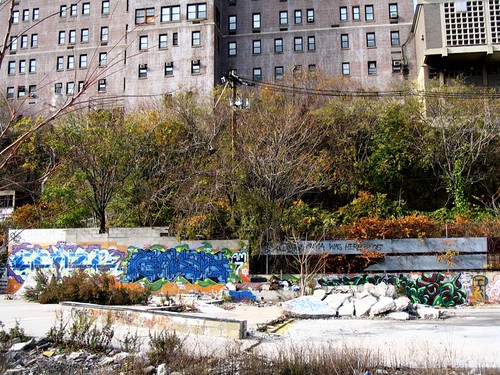
I'm bumping this to the top of the blog in honor of the fact that today, August 6, 2020, almost thirteen years after we started working for it in November, 2013, Jersey City opens it first legitimate, purpose built SK8 park.
When the second installment ended I was photographing graffiti and had started volunteering in the Hamilton Park Neighborhood Association. There I found out that Janice Monson, who taught in the Jersey City schools and was a hardcore activist, used to take her students up on the Newport Wall and take their pictures upon graduation.

Back in November of 2006, before I’d shown up at an HPNA meeting, I was walking around, or perhaps I was in the car on the way back from my Sunday AM grocery run. One or the other, it doesn’t much matter. Anyhow, I spotted some color:

sk8 park.jpg

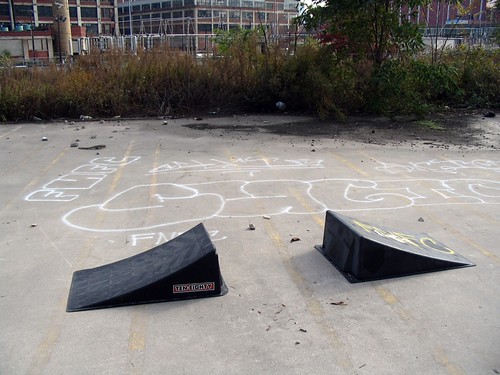
That’s the stuff, says I, that’s the stuff. When I got closer, I noticed a ramp against a wall:

one old ramp now gone.jpg

And then this:

10 80.jpg

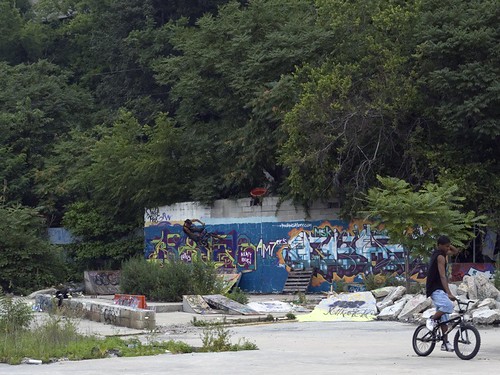
Someone was obviously using this site—the floor slab of an abandoned industrial building of some sort—as a park for skateboarding and BMX bike riding. See:

bikez3

I took that one in July of 2007. Notice that the art on the walls has changed. It seems that some local, and not so local, graffiti writers used this site as something of an experimental gallery even as the skateboarders and BMXers used it to hone their athletic skills.

All off the books, so to speak. They were trespassing on this land. But no one cared. The cops certainly knew what was going on. Sure, it was a little off the beaten path, but only a little. The site’s not particularly remote or hidden. Oh, they knew, the cops. But why hassle the kids? They weren’t hurting anyone; the land wasn’t being used for anything. Let ‘em use it; keeps ‘em outa’ trouble.

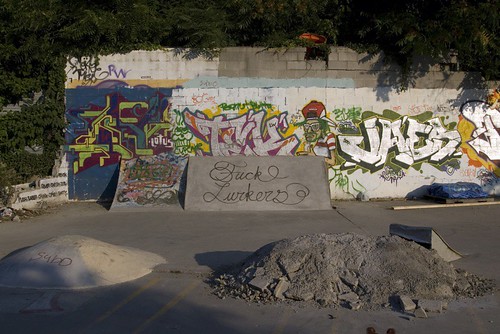
Then this appeared:

hump, no fag.jpg

new facilities, are we having fun yet?

Someone was hauling concrete back there and building mounds and ramps. Someone knew about construction. Someone was investing in improvements in this property that they didn’t own. Call it crazy; call it initiative; call it real.

Sunday, July 12, 2020

The Great Show Trial of Two-Ought-Ought-Six

I'm feeling nostalgic, so I've bumped this 2011 post to the top of the queue.


In honor of all interweb traditions

The interwebs are hardly old enough for there to be any old geezers reminiscing about how things were in the old days. So this post will only be but a pale imitation of the real ‘back in the day’ thing. Alas. Here we go.

It was back in two ought ought six at Bérubé’s joint on Wednesday the fourth of October. Michael decided that it was high time he and his beloved Janet prepared a living will [this post seems to have disappeared from the web, hence no link, 7.12.20]:
There were a few comic moments in the attorney’s office when it sounded as if we were ordering from a sushi menu: we’ll have the maguro in the event of severe and permanent incapacitation, please, and two ebi with extra wasabi if terminally ill. Hold the intubation, and no blood products, thanks—we’re trying to cut down.
Michael continues on a similar vein until a Great Revelation comes to him, which he then passed on to us, the readers of his humble blog:
So it occurs to me that one of the more pleasant aspects of a giant nuclear fireball that consumes all life on earth is that it would render all these difficult decisions moot. I have therefore decided to abandon my commitments to procedural liberalism and political left-progressivism, and to begin working for the We Are All Giant Nuclear Fireball Now party. What’s in it for me, you ask? Peace of mind, mainly.

Just as long as we all perish by being vaporized in the bombs’ total destruction radius, and are not left to wheel shopping carts around the ashen, blasted post-apocalyptic landscape like something out of Cormac McCarthy’s latest. Because that would suck.
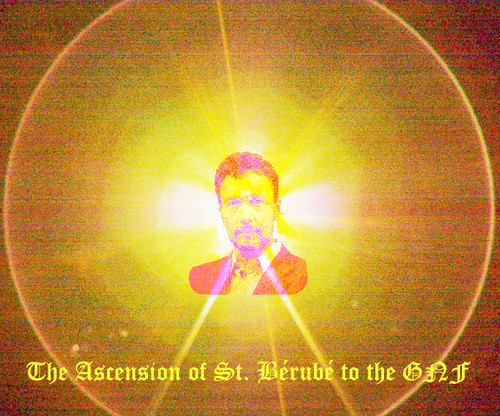
Thus was the WAAGNFN Party born in the sixth year of the reign of King “Bring’Em On” Bush.

st-berube3-872-labeled
Michael Bérubé, Founder of the We Are All Now Giant Nuclear Fireball Party
That left us with a problem: Just what exactly was the WAAGNFN Party (hereafter WAAGNFNP) to do? The party’s major objective – total annihilation of the world though nuclear conflagration – while spectacular, wasn’t exactly the sort of thing that got out the voters. And, in any event, it was a bit late in the season to run candidates for office, whether dogcatcher, assembly-person or governor.

Fortunately, Michael had a jivometric mind jolt. When Friday rolled around, as it always did, he announced yet another of his Arbitrary, but Fun (ABF), contests. These contests were known far and wide throughout the interwebs for their convivial good fun and just plain silliness. Michael dug deep into his well of pop cultural gambits and gambols and came up with one of the old-time good ones: complete the sentence. Here’s how it went:
To join the We Are All Giant Nuclear Fireball Now party, and achieve the serenity and peace of mind promised by our name and elaborated in our platform (which includes a plank of yummy irradiated Copper River salmon), simply follow the lovely and talented Oaktown Girl’s suggestion in comment 48 of this thread, and finish the sentence,
One of the more pleasant aspects of a giant nuclear fireball that consumes all life on earth is…
There’s only one proviso: you must use your captcha word in the completed sentence.
And so people began merrily completing the sentence. The completions kept rolling along and went into Saturday. And then Chris Clarke, environmentalist, poet, photographer, and blogger, admitted to some obscure sin against the WAAGNFNP. Seems that he had the keys to the skunkworks and “deleted a couple troll messages from that same guy without checking with [Michael] first” (see comment 88). To make amends for this violation of as yet unformulated, and thus all the more binding, Party policy, he offered himself “for a showtrial at your convenience.” The redoubtable and resourceful Oaktown Girl, who was about to appoint herself Ministress of Truth, Justice, and the WAAGNFNP Way, accepted on behalf of the Party, noting (comment 104):
A nice long showtrial could be just what is needed to boost the profile of our fledgling WAAGNFN Party. We need to prove we are perfectly capable of:

1. Bringing a “dangerous criminal” to justice through charges based on intelligence that is faulty, non-existant, deliberately misleading and cheery-picked, or just some shit we made up,

2. having “secret” evidence (by making more shit up or pretending we have some shit we made up),

3. rendering folks. (Let’s not render him too far, and let’s also skip the torture on this one. We still may need him around for skunk removal).

Mr. Clark, your sacrifice on behalf of the WAAGNFN Party will be long remembered.
So it was said, and so it was done.

Sunday, June 21, 2020

Wolfram says it's computation all the way down

One of the questions that comes about when you imagine that you might hold in your hand a rule that will generate our whole universe, how do you then think about that? What's the way of understanding what's going on? One of the most obvious questions is why did we get this universe and not another? In particular, if the rule that we find is a comparatively simple rule, how did we get this simple-rule universe?

The lesson since the time of Copernicus has been that our Earth isn't the center of the universe. We're not special in this or that way. If it turns out that the rule that we find for our universe is this rule that, at least to us, seems simple, we get to ask ourselves why we lucked out and got this universe with a simple rule. I have to say, I wasn't expecting that there would be a good scientific answer to that question. One of the surprises from this project to try to find the fundamental theory of physics has been that we have an understanding of how that works.

There are three levels of understanding of how the universe works in this model of ours. It starts from what one can think of as atoms of space, these elements that are knitted together by connectivity to form what ends up behaving like the physical space in which we move. The first level of what's going on involves these elements and rules that describe how elements connected in a particular way should be transformed to elements connected in some other way. This connectivity of the elements is what makes up when we look at, say, 10^100, 10^400 of these elements. That's what behaves like space as we're familiar with it, and not only space but also all of the things that are in space—all the matter and particles—are all just features of this underlying structure and its detailed way of connecting these elements together.

We've got this set of transformation rules that apply to those underlying elements. In this set up, space is a very different thing from time. One of the wrong turns of 20th-century physics was this idea that space and time should always be packaged together into this four-dimensional spacetime continuum. That's wrong. Time is different from space. Time is the inexorable operation of computation in figuring out what the next state will be from previous states, where our space to something that is a more specific extent of, in this particular case, the hypergraph that knits together these different elements.
One rule:
The main point is that at every event, you can have an update event that corresponds to every possible rule you might apply. You, as an observer of the universe, could choose a frame in which you're only considering the path through this ultra-multiway system of all possible applications of rules. You're only considering the path that corresponds to the application of one particular rule. It's like saying, I've got my way of describing the universe and I'm only going to consider that one; the fact that all these other possible paths are being followed, well, yes, but I'm not interested in those aspects of the universe—I'm just interested in the aspects of the universe that correspond to the particular rule that I've identified as being my reference frame for thinking about the universe. You might say, but there are all these other universes, and they're all doing different things. Because of this property of causal invariance, in the end it doesn't matter because they're all in some sense doing the same thing.
Universal computation:
This idea of universal computation already tells one that once you say the universe is something that can be generated by a universal computer, that fact is telling you that there's some sort of singleness to the way of describing the universe. In this rulial space of all possible rules, everything that's there is representable by a universal computer. You can translate between reference frames by essentially having what amounts to one universal computer description emulate another universal computer description by giving it the appropriate programming to emulate that other thing.

The one ultimate fact would be that the universe is computational, that the universe can be represented by a universal computer. That fact is not self-evident. It might not be true. It might be that there are hypercomputers that go beyond the computers we can build with Turing machines, that our universe might be a hypercomputer. Though, I don't think it is. What we're learning from this adventure in studying fundamental physics is that there is a description of the universe in terms of ordinary universal computation, and we're finding the details of how that works.

Saturday, June 20, 2020

Man on the Moon: Three Takes [Media Notes 38]

What’s it like to have landed on the moon? I’ve not done it. Only a few have.

The Crown

There's an episode in The Crown where Prince Philip is feeling spiritually depleted as a middle ages man who gave up the life of an Air Force pilot zipping about the world in high speed jets in favor of life as consort to a monarch presiding over ceremonies and gestures. The Apollo 11 astronauts were touring Britain at the time and he arranges a private meeting with them. He's clearly seeking something from them, some revelation, some hint of adventure, but all he gets is ordinary chit chat. Maybe they HAD gotten what he was seeking when they were out there 240,000 miles from earth, but they had no way of conveying it to him nor even a sense that that's what he wanted of them.

2001: A Space Odyssey

I'm wondering that, earthbound though he was, if that isn't what Stanley Kubrick was after in 2001: A Space Odyssey. Roger Ebert asserted that the film was “transcendent, and work upon our minds and imaginations like music or prayer or a vast belittling landscape.” I took up the argument in Media Notes 34. The slow pace, the surpassing strangeness, that was about evoking an experience. Kubrick may not have been on the moon, but he knew awe, and how to evoke it through film. Did the Apollo 11 astronauts feel, but could not way, what Kubrick evoked in 2001?

First Man

I made a similar argument in two posts about Damien Chazell’s First Man: First Man and our capacity for experience, and First Man, a remark or two on how it achieves its effects. Chazell contrasts Armstrong’s life as an astronaut and his suburban life as a husband and father. They are two different worlds. In one world, suburban domesticity, Armstrong’s young daughter dies of cancer. In the other world, adventuring on the moon, Armstrong’s drops his daughter’s baby bracelet into a crack in the moon’s surface. The distance between the two worlds is now bridged by a heartfelt absence.

Is this awe, like Kubrick evoked? Not necessarily like Kubrick, but awe. Or is it something else?

Friday, November 22, 2019

Fascinating, and sad – A story of partition, loss, of invention and fabulation, of attempted restoration

Ellen Barry, The Jungle Prince of Delhi, The New York Times, November 22, 2019.

Late in the narrative, but early in the story, at its root:
Wilayat followed her husband, Shahid told me, but she never accepted his decision to leave India. She was obsessed with what she had left behind. In her mind, the grudge sprouted and germinated, and her behavior became volatile. Then her husband suddenly died. Now with all restraining influence on her gone, furious over the expropriation of her property, she accosted Pakistan’s prime minister at a public appearance, Shahid said, and slapped him.

This changed things for Wilayat. She was no longer a well-connected widow, but something shadier.
An ordinary grievance, unaddressed, had metastasized to become an epic one.
She was confined to a mental hospital in Lahore for six months after that — the only way, Shahid said, to avoid a long prison sentence. Shahid remembers visiting her there, among the wails and curses of the patients. “It was horrible,” he said. “Women tied up with chains. One poor girl was chained up to a wall. It was four chains. And she was swinging. And spitting at everybody who went past.”

Salma said that Wilayat was given electroshock therapy. “They said she was mental,” she said. “They gave her all these injections.”

When she was free, Wilayat gathered up her youngest children without warning, packed trunks with carpets and jewelry, and smuggled it all back into India, with the goal of reclaiming her property. Shahid set out with them but eventually walked away. He could not put into words why he left. His story flickers out here.

Friday, November 8, 2019

Friday Fotos: A Safari into Midtown Psychedelia [the hallucinating city?]

Wednesday morning I headed into Manhattan for a meeting on W44th St., just off Times Square in the theater district. I took my camera with me so I could catch some flix on the way in and back out.

Here’s we’re just below 41st. Right there in the middle, see that? It’s a bicycle behind a chain-link fence.(Click on photos to embiggen.)


Not really. It’s just a photograph, or perhaps a frame from a video. It’s on a LED screen, changing. That’s what I’m here for.

There we are, 41st Street, Times Square ahead.


There’s Coca Cola – the Real Thing, No? – it’s all over the place. The guy at the bottom, left of center, probably reading something on his sMart pHone, or just zipping through whatever, oblivious to the rest of the world.

I LOVE this one, positively love it. We’re looking into a subway station, the turnstiles.


Except we’re not. It’s just a photo.

Remember Howl’s Moving Castle? The castle had a magic door with four settings, each taking you out into a different part of the world, but castle itself doesn’t move. That’s how this is, each LED display is a different door opening out on a different world. Some of them, of course, open into multiple worlds, one after the other, while others keep cycling through the same world. Another metaphor: the Tardis from Dr. Who. It can take you anywhere in time and space, but itself remains the same (on the inside). Where do you want to go?

And this! The marque dominates the image. The Loft, is that what the building/theater/whatever is called?


NYPD is here – they’re everywhere, this, after all, IS New York. The Lion King. Aladdin.

Same place, different angle. SAVE FOR EDUCATION.


Looks like a Walgreens advertisement at center right; notice the “W” at the upper left.

TIMES CHANGE • DUTY ENDURES • THE CROWN • NOV 17 | NETFLIX.


I’m there! And I will be. I liked the first two seasons.

And look at all the people. Some lonely, some not, some betwixt and between. Time goes on.

Change of scale. Into the red: 18 MILES OF BOOKS • STRAND • NEW YORK CITY • EST. 1927.


See, books are not dead, nor, apparently, has Instagram replaced the postcard.

I don’t know what’s going on above His Dark Materials but I like it.


The lower right, notice the man with the Captain America shield on his back. Of course that’s not the real Captain America; it’s a man in a costume. And it looks like Minnie Mouse to this right. As I walked by I noticed the clown (you can only see the red hair) peeling bills from a roll. Paying street performers for their shift in Never-Never Land?

Let’s look up:


THE END

Sunday, October 27, 2019

Lakota America – Beyond Little Bighorn and beyond Wounded Knee, still vital

Writing in the NYTimes Parul Sehgal reviews Pekka Hamalainen, Lakota America, A New History of Indigenous Power, (Yale 2019):
All nations deserve to have their stories told with this degree of attentiveness, but the Lakotas might have a special claim. Their political philosophy and social organizations were distinguished by a flexibility that allowed them to maneuver among rival colonial powers and hostile neighboring tribes. One of their mythical heroes is the shape-shifting spider-trickster figure Iktomi. The Lakotas’ malleability aided their countless transformations — from foragers to farmers to nomads to hunters on horseback, from an isolated society to the most dominant indigenous nation in the Americas, controlling territory across the Great Plains, and into the Rocky Mountains and Canada. “Lakota America” takes us from the 16th century to the present, with painstaking, carefully marshaled detail, but its real feat is in threading how the Lakota philosophy and vision of the world guided their reinventions and their dealings with colonial powers.

“Lakotas were fighting for survival,” Hamalainen writes, “but they were also fighting to keep alive a broader vision of America where coexistence through right thoughts and acts might be possible.” Theirs was a capacious notion of kinship, in which competitors and even enemies could be brought into the fold. (Lewis and Clark make a spectacularly bumbling appearance in the book as the perfect foils for the Lakotas, marked by an utter inability “to see, learn and adapt.” They were bewildered that Native Americans welcomed American trade but not their “paternal embrace.”)

Hamalainen has the novelist’s relish for the strange, pungent detail, and he conjures early America in swift strokes: fur-trading posts reeking with the scent of entrails; the 17th-century world of cross-cultural diplomacy that relied on semaphore, kisses and tears. In one dreamlike scene, he describes a frozen lake full of the preserved bodies of a thousand bison, “halted in mid-motion.” They had been trapped under a layer of ice and became “a huge natural refrigerator of meat” that sustained the Lakotas for a year.
Note quite the end:
The challenge of writing this history, Hamalainen notes, was making iconic events and figures unfamiliar again, which is never more necessary than at the twilight of the Lakota empire. At the Battle of the Little Bighorn, the Lakotas dealt the Americans a humiliating defeat, and the American Army responded with a campaign of terror, beginning with the Wounded Knee massacre, in which soldiers slaughtered hundreds of Indians. Missionaries and social reformers began their work in zeal; children were taken from families and sent to boarding schools whose explicit mission was to annihilate the Lakotas’ language, religion and culture. Nearly every aspect of Lakota life became subject to surveillance and control. The winter counts are few from these years, reflecting the trauma, the ravages of dispossession and suicide — “colonialism working exactly as intended.”
And yet the Lakota persist and, recently, have protested the drilling of a oil pipeline through their land. And there is poetry:
In Layli Long Soldier’s spellbinding “Whereas,” a finalist for the National Book Award in 2017, she investigates the wording of treaties and other government communications with Native Americans, noting the violence coiled in official language. In the midst of this muck of doublespeak and prevarication, her own words rise, anthemic. “I am a citizen of the United States and an enrolled member of the Oglala Sioux Tribe, meaning I am a citizen of the Oglala Lakota Nation,” she writes in the book’s introduction. “In this dual citizenship, I must work, I must eat, I must art, I must mother” — notice the double meaning of “must,” which describes both what she is forced to endure but also how she goads herself forward. “I must friend, I must listen, I must observe, constantly I must live.”
* * * * *

A quick thought, I hazard to give it utterance, and yet...so many people's have suffered as the Lakota have suffered, and yet they persist, strive, and even thrive. And no we all face the effects of global climate change. The effects will not be born equitably by the world's peoples, and they will be so bad that no nation will come through unscathed. And yet we will survive. As with the Lakota, so with us all.

Friday, October 18, 2019

BAPC camping trip 5: After much trial and tribulation the Feather of Destiny is Found [you knew it would be]

So there we were, we’d searched and searched for the Feather of Destiny and still it was not found. And then the Pentagonian Battle Cruiser appeared. What to do?

We redoubled our search. Greg and Rahid got in the canoe and began exploring the coastal waters while Eke manned the nebula class kayak and started scanning the bottom for anomalies in the Force. Yes, the Force, that Force, it’s everywhere, you know. And we entered a galaxy long ago and far away when we went through the portal in the Arches, and that’s where the Force is strongest, long ago and far away.


I started look wherever I hadn’t looked already. I looked in the embers of last night’s camp fire, in a knot hole in an old log, under a weird rock, even in a bramble patch. Ouch!


This one looks better if you enlarge it by clicking on it – well they all do, but this one especially.

No luck. Maybe tucked away amid the moss, rocks, and driftwood? No luck there.


Not even hidden way up in the trees.


Then Gunnar spotted something out on the water:


Oh no!, cried Adam.

Thursday, October 17, 2019

BAPC camping trip 4: The majesty of the forest reveals itself to us and a Pentagonian battle cruiser is spotted screaming across the lake

As we left the story yesterday we were making plans to find The Feather of Destiny. But how can you make plans to find something when you don’t even know what it looks like? It’s a feather, sure, but what kind of feather? How big, what color, and above all else, where?

We got up the next day and decided we’d just have to scour the forest, hoping that we’d know the feather when we saw it.

Some of us headed into the forest and up the hill:


Others walked the tree line along the edge of the lake:


Adam put on his climbing gear and went up into the canopy. Look at this photo he flicked:


But it’s not as though there wasn’t plenty to see close to the ground.