Showing posts with label bardolatry. Show all posts

Thursday, June 6, 2024

That Shakespeare Thing

I'm bumping this to the top of the queue for several reasons, general principle among them. The opinion I offer in the last half or so requires a proper argument and, while I've written various things in that direction, I haven't gotten around to such an argument. Nor can I see putting it high on the agenda now. Consider it a stake in the ground, or a promissory note.
 
* * * * *
 
It is a truth fervently believed, at least among those who have beliefs about such things, that Shakespeare is the greatest writer the world has ever seen. Without question. Period. End of story. So help me god. Cross my heart and hope to die.

Bollocks!

It’s not that I doubt Shakespeare’s excellence. Of course he’s good. But not that good. No mortal human is, or could possibly be, that good. For THAT good is not about history, it’s about mythology.

And that mythology has got to stop. We can’t treat our literary culture as though it were but an appendage to Shakespeare’s large, various, and excellent output. Debts are owed, certainly. But appendages to, certainly not.

It’s simple: We can’t enter into the 21st century as long as we keep swearing fealty to The Bard, even if we cross our fingers behind our backs while so swearing. The world’s changing, it’s been changing since Shakespeare’s time. The old guy can no longer keep up. It’s time to put him on a raft, and cut the raft free. Let him float out to sea.

Who’s this WE you’re talking about?

Good question. Tricky question. I suppose I could say Harold Bloom and the Bloomistas and be done with it. In fact, that’s what I will say: Bloom and the Bloomistas!

Call it a figure.

Though Harold Bloom is real enough. His admiration for Shakespeare is well known – didn’t he write a fat book explaining how we’re all Shakespeare’s children? And he’s set himself up as the Defender of the Western Literary Canon, the Finger in the Dike that Protects Western Civ from the Sea.

Give the finger a rest. Let the water flow. Life goes on.

What brought this on, you ask?

It’s been a long time coming. At least since late 1989 when The New Republic published a special 75th anniversary issue in which their long-term film critic, Stanley Kauffmann, reflected on film’s history and accomplishments. Toward the middle he had a Big Paragraph:
After we have at the beginnings [of film], what can we say today about the results? What has film accomplished since then? Once, after a meeting in which films were glowingly discussed, a well-known poet challenged me to name one film that was the equal of the greatest work in other arts, the work of Sophocles or Dante or Michelangelo or Bach or Tolstoy. The answer was, is, double. First, there is no such film. There may never be such a film. Second, who is the Sophocles or Bach of the 20th century? Great artists there have certainly been in our time, and I would not blithely equate even the best films I know with the work of Joyce or Picasso. But few would rank Joyce or Picasso or the other masters of our time with the greatest artists in history; and the overwhelming fact is that, arriving in this century that has been stormy even for the oldest arts, film has created hundreds of works that are now part of the cultural legacy of every civilized human being.
He’s got that last clause right: Film HAS created hundreds of works that are now part of the cultural legacy of every civilized human being. The rest of it is pious nonsense, spun from the same thread as Bloomistavision.

That’s what set me on this line of thought. What set me off is Apocalypse Now. I didn’t see it when it first came out. Don’t know exactly why. Perhaps because it was a Hollywood film, so how could it be Really Good? Saw the Redux version; don’t remember what I thought. But then the DVD set came out, Apocalypse Now: The Complete Dossier.

I was stunned. Watching it on my small computer monitor with the add-on speakers – decent sound, but not as good as my stereo system, and certainly not theatrical – I was stunned. Thought I to myself: Shakespeare couldn’t do this.

Shakespeare couldn’t do this.

It’s not simply that he didn’t have the technology, though he didn’t, and that’s not irrelevant. Whatever Coppola was saying, Shakespeare couldn’t say it, because he didn’t know it. He didn’t know it.

Shakespeare didn’t know it. It’s not his fault. Our world isn’t his world. Our world makes its own demands, and Shakespeare’s knowledge cannot be equal to them, no more.

Let him rest.
Tuesday, June 4, 2024

What does evolution have to teach us about Shakespeare’s reputation? [founder effect, Bloom]

I'm bumping this to the top while I think about how to wrap up my discussion of Bloom in my series on great literary critics, which is actually a series on the nature of literary criticism as an academic discipline. 

* * * * *
 
For some decades now I’ve been a bit puzzled by Shakespeare’s status. I don’t doubt that he’s good, but THAT good? Really? I mean, apparently he’s so good that the Klingons claim him for their own, and they’re not even real. No, Shakespeare IS good, but there’s more to his reputation than mere technical or aesthetic excellence–or is it that there’s more to aesthetic excellence than craft, skill, and grace? [1]

When someone asserts that Ussain Bolt is the greatest sprinter of all time, I know what they mean. He’s won many internal competitions and he’s the world record holder in the 100, 200, meter sprints, and the 4 by 100 meter relay. Excellence in running is easily measured. When someone says Bolt is a faster sprinter than, say, Karl Lewis I know what they mean. Bolt ran the 100 meters in 9.58 seconds, Lewis in 9.86. Bolt is 0.30 seconds faster than Lewis. Simple, clear, objective.

To assert that Shakespeare is the world’s best writer is to assert, not only that he’s merely better than, but that he is far and away better than, say, Rabindranath Tagore, George Eliot, Alexander Pushkin, Honoré de Balzac, Miguel de Cervantes, Dante Alighieri, Murasaki Shikibu, Sophocles, and so forth through a long list – and we haven’t even gotten to the Klingon masters. By what measure is Shakespeare head and shoulders above those many others? Oh, I’m sure learned reasons can be given; Harold Bloom has likely given three-quarters of them at one time or another. But none of them includes a simple objective measure like time to sprint 100 meters.

It’s not that simple, not at all. For one thing, it’s a subjective matter. The fact that this judgment is subjective does not, of course, mean we cannot talk and reason about it. Intersubjectivity is real, after all. We’ve been talking and reasoning about it for centuries and the upshot is that Shakespeare is the best.

But something else is going on, something other than mere subjectivity.

The founder effect

What do I mean by founder effect? It’s a term from evolutionary biology. Oleg Sobchuk [2] explains it this way [pp. 93-94]:
Imagine a group of monkeys living in an imaginary Unhappy valley. The valley is called Unhappy, because there are too many monkeys and too little food. In the search for more bananas and oranges, a group of four monkeys (who happen to be shorter than the rest of their group – just by chance) takes a risky trip to an unknown land, possibly full of predators. However, they get lucky: they find another valley with lots of bananas and no monkey competitors. So, these four settle in the Happy valley. They give birth to many children, all of which share the genes of this initial small group. As a result, most of the monkeys in the new colony are short – like their four ancestors. And – it is important to stress – they are short not because this trait is adaptive (i.e., it was not selected for), but simply due to chance. It just happened that the founders were short – by chance.
But what does that have to do with Shakespeare?

Sobchuk goes on to point out [p. 96]:
The contemporary literary field – Modern European literature – began to take shape in the late eighteenth and early nineteenth centuries. The main reason for this was the invention of the modern nation state: a radically new way to organize societies (Hobsbawm 1992). And at the avant-garde of nationalism were Germans. They did not have a united state, and they felt the need to obtain it more than anyone else. A state united by a single nation, a single language, and... a single literature. German intellectuals started thinking about their literary canon earlier than the intellectuals in other countries. They started inventing the canon.
And they decided to center it on Shakespeare. Why? Sobchuk continues:
An appeal to the senses, feelings, and imagination – this is what Shakespeare’s plays could provide for readers tired of the over-formalized and rational classicist drama. [...] However, it also happened that this was a decisive place and time in the history of European literature. It was the moment when, along with the formation of the modern nation state, modern national literature was formed, having a canon of “geniuses” at its center. Shakespeare was not the founder of modern literature, but he was chosen by the founders.
To repeat Sobchuk, we have the emergence of a new form of political organization, the nation state, accompanied by the institutionalization of a literary canon to support that political form. Shakespeare was chosen to anchor that canon.

But there is more to Shakespeare’s suitability for this role than “an appeal to the senses, feelings, and imagination”.

Shakespeare and the invention of the modern

Let us turn for a moment to Harold Bloom [3]:
Western psychology is much more a Shakespearean invention than a Biblical invention, let alone, obviously, a Homeric, or Sophoclean, or even Platonic, never mind a Cartesian or Jungian invention. It’s not just that Shakespeare gives us most of our representations of cognition as such; I’m not so sure he doesn’t largely invent what we think of as cognition. I remember saying something like this to a seminar consisting of professional teachers of Shakespeare and one of them got very indignant and said, You are confusing Shakespeare with God. I don’t see why one shouldn’t, as it were. Most of what we know about how to represent cognition and personality in language was permanently altered by Shakespeare.
Frankly, I think that’s a bit overwrought – “I’m not so sure he doesn’t largely invent what we think of as cognition.” But I do think Bloom is looking in the right place.
 
Some years ago I published a pair of papers that make a similar point in more sophisticated and contemporary language. The first, “The Evolution of Narrative and the Self” [4] argues that over the long term story-telling has provided ever more sophisticated “templates” for organizing of the psyche; Shakespeare laid imaginative foundations that came to fruition with the emergence of the novel over a century later. We can see this in the interiority that Hamlet has but which is utterly lacking in, Amleth, his twelfth century literary predecessor [p. 142]:
Something had happened which made Amleth's madness ploy less effective. An individual can escape contradictory social demands by opting out of society. But if the contradictory demands are within the individual, if they are intrapsychic, then stepping outside of society won't help. If anything, it makes matters worse by leaving the individual completely at the mercy of his/her inner contradictions, with no contravening forces from others. That, crude as it is, seems to me the difference between Amleth and Hamlet. For Amleth, the problem was how to negotiate contradictory demands on him made by external social forces. For Hamlet, the contradictory demands were largely internal, making the pretense of madness but a step toward becoming, in reality, mad.

The difference between the story of Amleth and Shakespeare's Hamlet parallels the difference between the Oedipus story as it was in Homer's time and as it came to be in Sophocles’s. Just as the superego evolved between thirteenth century Greece and fifth century Greece, so it had to be recreated between twelfth century Denmark and seventeenth century England. The Elizabethan audience demanded defense against their dark impulses while the Medieval audience settled for some slight of hand which let the impulses work toward a happy ending.
In “At the Edge of the Modern, or Why is Prospero Shakespeare’s Greatest Creation?” [5] I consider four plays – Much Ado About Nothing, Othello, The Winter’s Tale, and The Tempest – and argue that laid the psychological foundations for the modern nuclear family [p. 274-275]:
According to [Lawrence] Stone the English family was, during the sixteenth, seventeenth, and eighteenth centuries, reconstructed to accommodate affective individualism, which stressed autonomy, privacy, and long-term emotional commitment. Stone sees a three part movement, from the Open Lineage Family (1450 - 1700), to the Restricted Patriarchal Nuclear Family (1550 - 1700), and finally to the closed Domesticated Nuclear Family (1640 - 1800) - note the overlap in the dates, the evolution is gradual and affects different strata of society in different ways. My argument is that while the marital and familial conventions in Shakespeare's plays are those of the earlier family types, he is using them to work out the inner dynamics of the domesticated nuclear family, which is restricted to a couples and their children. The male integration of masculine and feminine characteristics which Shakespeare finally achieved in the late romances is suited to the domesticated nuclear family, but irrelevant for the earlier types. If we think of literary works as equipment for living (Burke 1973), providing us with ways of organizing our experience, then Shakespeare's plays provided people with ways of organizing experience which were consonant with the demands of the nuclear family, which didn't appear in any very strong way until after Shakespeare's career was over.

The play in which this affective shift is most explicitly thematized is Romeo and Juliet - that the story existed in many versions in Europe makes it quite clear that the conflict it captures was an important one. Romeo and Juliet are caught between their private desires for one another and the public feud between their families. Those private desires became the ideological foundation of the domesticated nuclear family, a family contracted out of the mutual affection and desire of the couple and extending only to their children. The public feud between the Montagues and the Capulets reflects the dynamics of open lineage. Mere marriage centers on the lineage; it is an alliance, political, economic, and social, between two families. In this alliance the bride is assimilated to the groom's lineage. The personal, and private, affection between Romeo and Juliet was at variance with the public conflict between their lineages. With the claims of both person and lineage being deemed valid, there was no outcome possible but stasis. A new couple is constituted, but only in a death which ends their lineages.
Social space is becoming differentiated into a private and public realm and family life is becoming reconstituted around the private relationships among family members.

Saturday, March 30, 2024

I was right, Shakespeare isn’t real (Lit Lab 17) [#DH]

I'm currently thinking about Harold Bloom and his Bardolatry. Thus I'm bumping this post to the top of the queue as it is directly relevant. The following post is relevant as well: What does evolution have to teach us about Shakespeare’s reputation? [founder effect].
 
* * * * *
 
Yes, I know, all those plays were written by a real person, not by an alien from another world. And no, I’m not alluding to that inane controversy over whether or not those plays were in fact written by Christopher Marlow, Edward de Vere, or Rocket J. Squirrel. I’ve got something else in mind.

I’m thinking of his place in our cultural imagination. There he’s an almost mythic figure, beyond any mere human being. He’s the best, no one else is even close. That’s the legendary creative genius whom Harold Bloom credits with creating well, hear him out [1]:
Western psychology is much more a Shakespearean invention than a Biblical invention, let alone, obviously, a Homeric, or Sophoclean, or even Platonic, never mind a Cartesian or Jungian invention. It’s not just that Shakespeare gives us most of our representations of cognition as such; I’m not so sure he doesn’t largely invent what we think of as cognition. I remember saying something like this to a seminar consisting of professional teachers of Shakespeare and one of them got very indignant and said, You are confusing Shakespeare with God. I don’t see why one shouldn’t, as it were. Most of what we know about how to represent cognition and personality in language was permanently altered by Shakespeare.
Is The Bard great? Of course. But is he THAT good, that original, all by his own self? I think not. Actually it’s not so much that but that I don’t know what all those superlatives mean. Still, it’s useful to have him around, as many legends are.

Popularity/Prestige

And that brings me to J.D. Porter, Popularity/Prestige, from Stanford’s Literary Lab [2]. It’s about the so-called canon and it’s relation to non-canonical texts. As the title suggests, it’s about the roles of popularity and prestige in determining canonicity.

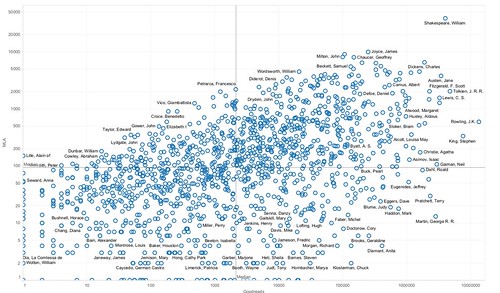
The study uses a convenience sample of 1406 authors. It is not nor is it intended to be comprehensive. It is biased toward the English language. Porter measured popularity by counting the number of times an author was rated on the Goodreads website and prestige by the counting number of articles in the MLA International Bibliography where the author is listed as “Primary Subject Author”.

Consider this graph:

LitLab 17 F1

Popularity is indicated along the X axis (Goodreads) while prestige is indicated along the Y axis (MLA). That figure way up there at the Northeast corner, that’s Shakespeare, all alone.

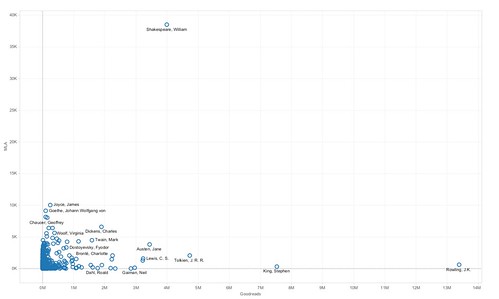
The thing to realize is that the chart scales are logarithmic. When you plot the same data without logarithmic scaling Shakespeare’s uniqueness pops out even more dramatically:

LitLab 17 F5

Almost all the other authors are bunched together down there at the Southwest corner. Only about 40 authors escape the “blob”, as Porter calls it. That’s Shakespeare up there at the top, with almost four times as many articles (38,000) as the next-most prestigious author, James Joyce with 10,000 articles. This chart also makes it obvious that there are three authors who make more appearances in Goodreads: J.R.R. Tolkien, Stephen King, and J.K. Rowling. King and especially Rowling have vastly more readers than Shakespeare, but none of those three have anything like Shakespeare’s prestige.

Why the enormous difference in prestige? Well, I suppose one could say that Shakespeare’s THE BEST, and hence better than Tolkien, King, and Rowling. But that doesn’t quite get at it. I’m willing to concede that he’s better than those three, and better than most other writers as well. As to whether or not he’s the BEST EVER, I’m not sure that’s even a meaningful designation.

But why does Shakespeare have overwhelmingly more articles about him than any writer? I don’t really know, but I have a few remarks. Obviously any academic who’s a Shakespeare specialist is going to write articles about him. And so it is with specialists in the Early Modern period, particularly specialists in British literature. The same goes for specialists in drama, in the sonnet, and so forth. But how is it the he came to be an exemplary author, one you’re likely to write about if you want to make a general theoretical or methodological point independently of any specific area of specialization? It helps, of course, that he wrote several centuries ago. It’s not only that age tends to confer prestige, but that it affords more time for sprouting influence. Beyond that, how is it that he came to be included in general survey courses such as world literature or British literature? Has Shakespeare's presence in all those survey courses in turn driven his popularity?

But all those articles are relatively recent, within a century or so. What got Shakespeare the level of visibility such that, when scholars started publishing articles, they published them about Shakespeare? Whatever it is, once it got started, it snowballed, and Shakespeare took over the academic field. And now he’s untouchable.

For awhile.

How will things look 100 years from now?

The canon system

Put in an extreme way, which I don’t necessarily believe but I’m putting it this way so we can see the internal logic, let’s assume that a canon system, if you will, requires a centerpiece, one significant author (or text), to anchor the whole thing. This is a structural requirement. Think of it like the solar system: one sun, a bunch of planets, planetoids and asteroids, and some of those planets can have their own satellites. The system functions to keep everything in its place.

Yes, I know, there are double star systems. That’s a complication. Set it aside.

Where does that centerpiece come from? First answer: It doesn’t matter; perhaps it’s an accident. Once a text is fixed in the center, the system will function to keep it there. Second answer: It’s motivated. The centerpiece is noticeably different from its competitors.

If Shakespeare’s position is in fact motivated, I think the motivation would be some combination of the quality of his poetry and the variety of his dramatic materials. Once he got fixed in the center role, the system kept him there, where he still is.

What are the institutions of this system? Well, no doubt it varies. The Early Modern world is institutionally different from the Modern world. For example, the aristocracy was much more important in the early modern world than it is in the modern world. Different levels of literacy are a factor as well; Porter wonders whether or not “prestige and popularity [are] even distinct in, say, 1650, when most people could not read” (p. 19). In the modern world we have the emergence of mass literacy, which confers power on those who control print media. It also confers power on the school system, libraries, and colleges and universities.

What institutions are responsible for the current canon system, when did they emerge, and what was Shakespeare’s standing when that happened?

Note: This was suggested by the rocket/airplane metaphor Porter invokes on page 21.

There's more

Literary Lab Pamphlet 17 isn’t primarily about Shakespeare’s oddball status. While Porter acknowledges that status (pp. 14 and 15) they don’t dwell on it. Rather, they discuss how complex the literary field is and how canonicity changes over time. The whole thing is well worth reading.

References

[1] Antonio Weiss, interviewer, “Harold Bloom, The Art of Criticism No. 1”, The Paris Review, No. 118, Spring 1991, https://www.theparisreview.org/interviews/2225/harold-bloom-the-art-of-criticism-no-1-harold-bloom.

[2] J.D. Porter, Popularity/Prestige, Pamphlet No. 17, Stanford Literary Lab, September 2018, https://litlab.stanford.edu/LiteraryLabPamphlet17.pdf.

Monday, October 16, 2023

Once more unto the breech! Shakespeare and Bankman-Fried

Over at 3 Quarks Daily, Joseph Shieber has a nice piece on the Bankman-Fried Shakespeare controversy that seems to have gotten so many folks riled up: "Oh, he’s wrong. So are many of the people coming at him." Later on Shieber argues:

The appearance of a Shakespeare or a Newton is like winning the PowerBall – an almost miraculous event. Given the analogy to miraculous events, I can sympathize a bit with Bankman-Fried’s contrarian impulse. Many millions of people believe that Jesus performed miracles, but that doesn’t incline me to accept the divinity of Jesus. Bankman-Fried seems to think that the near-universal acclaim enjoyed by Shakespeare is more like the belief in religious miracles; the various testimonies on behalf of Shakespeare’s genius are not independent, and therefore cannot serve as strong evidence of that genius.

That's worth thinking about, especially that those last two clauses, about testimonies not being independent. No, they are not. They are coordinated. That's a theme I get around in the comment [below the asterisks] I made on Shieber's piece.

* * * * *

Thanks for this, including the link to Bankman-Fried's old blog post. The question of Shakespeare's greatness has interested me for some time, and I've written a number of (somewhat) different blog posts on it. The most recent is in response to the contretemps over Bankman-Fried and the oldest in response to something Stanley Kaufman published in The New Republic back in 1989, where, in so many words, he observed that we don't make 'em like we used to.

Bah! Humbug!

You are correct about "genius." It doesn't follow the laws of probability. They are outliers, these geniuses. Nassim Nicholas Taleb, would call them black swans. Their occurrence is not predictable. But then much in culture is not predictable. When films are released, no one knows whether or not they'll break even much less make a profit or even become blockbusters, something Arthur De Vany has studied with some care in Hollywood Economics.

And I fear you're correct that Bankman-Fried hasn't attended to Shakespeare well enough to be entitled to a serious opinion about his greatness. He simply doesn't know what he's talking about. Still, I find it hard to believe that Shakespeare really is the greatest writer of all time, or even the greatest writer in Western literature. He's certainly very good, as good as any I warrant, but I just don't find the idea of "the best" very meaningful. There really is a lot of inertia in the system, and Shakespeare is hardly the only beneficiary of it.

Our esteem for Shakespeare reflects two things: 1) his inherent quality, which is difficult to measure and judge, but is real enough, and 2) the dynamics of a cultural system. On the latter, let me offer an observation as someone trained in literary criticism.

For professional purposes it's convenient to have a writer everyone agrees is the best. As professionals, our purview is necessarily narrow. Romanticists look at texts written between, say, 1780 and 1850 and will generally specialize on a handful of those. But what if one of us specialists wants to argue some general point? If the Romanticist hangs the argument on Keats, no one will read it except other Romanticists. But if you rest your argument on Shakespeare's mighty shoulders, then everyone will see it and be interested in it. And so we agree, tacitly of course, no vote is ever taken, that, yes, Shakespeare is the best. I suspect that Shakespeare has a similar value for the public even if, truth be told, they'd rather read Tolkien, or, I shudder to think of it (the horror! the horror!), J.K. Rowling – for empirical evidence on this point see J.D. Porter, Popularity/Prestige, Stanford Literary Lab 2018. Societies need common reference points and so cultures provide them. Shakespeare seems to have won that particular lottery. I mean, even the Klingons claim him as their own.

Sunday, October 8, 2023

In partial defense of Sam Bankman-Fried on Shakespeare [there IS a serious issue here]

This passage, which, I gather, is from Michael Lewis’s biography of Sam Bankman-Fried, has been burning up the Twittersphere (Xosphere?) in past couple of days:

It is offered as an example and evidence of his, well, of some sort of deep deficiency.

I’m willing to believe that SBF is deeply flawed, but at the core of that passage is a serious issue.

Setting aside SBF's Bayesian framing, just what is going on that we – whoever WE are – have declared this 16th-17th century playwright to be the world’s greatest writer? Is it really possible that, with so many people having been born (and died) since Shakespeare, that none is as good a writer? Well, sure, in the spirit of anydamnthing is possible, it’s possible. But how likely? Is Shakespeare really better than, say, Rabindranath Tagore, George Eliot, Alexander Pushkin, Honoré de Balzac, Miguel de Cervantes, Dante Alighieri, Murasaki Shikibu, Sophocles, and so forth through a long list – and we haven’t even gotten to the Klingon masters? What’s the standard of judgment?

Anyone who approaches Shakespeare does so knowing that he is the best. Anyone who reads about his work, who studies it, can rattle off reason after reason why he is so good. In all this we are just replaying judgements and assertions that have been set in place by others over past centuries. We do not bring naïve sensibilities to Shakespeare. We do not and cannot approach him, or any other canonical writer, innocently. Our judgements are borrowed from others as much if not more than they are our own.

That’s how culture works and Bankman-Fried is right to question it, if however clumsily.

Having said all that, let’s continue on by considering Harold Bloom on Shakespeare's greatness. In a post with that title I quote Bloom as saying:

The principal insight that I’ve had in teaching and writing about Shakespeare is that there isn’t anyone before Shakespeare who actually gives you a representation of characters or human figures speaking out loud, whether to themselves or to others or both, and then brooding out loud, whether to themselves or to others or both, on what they themselves have said. And then, in the course of pondering, undergoing a serious or vital change, they become a different kind of character or personality and even a different kind of mind. We take that utterly for granted in representation. But it doesn’t exist before Shakespeare.

I’m in no position to contradict Bloom’s judgment on that. It seems credible to me. That’s sufficient to ensure Shakespeare a place in the canon. Shakespeare is a great writer, irreducibly a genius.

A genius, a place in the canon? That’s one thing. But the best ever? I know what the words mean, but I don’t believe that conjunction of them means much of anything. Or, rather, what it means is some expression of cultural faith, some display of cultural affinity. It’s not a matter of objective judgment. Literary achievement is too complex, too multidimensional, to admit of the kind of one-dimensional scalar ranking that puts one individual at the top.

Here's a post in which I explore that issue: The Hunt for Genius, Part 2: Crackpots, athletes, 4 kinds of judgment, training, and Cultural Context. I begin by observing that it is easy to determine just who is the fastest sprinter in the world. That’s something we know how to measure. What about the best gymnast? That’s more complicated. The best athlete? Still more complicated. Judging artistic accomplishment is, if anything, even more complex. I’m inclined to think we can rank artists in levels, where the artists in a given level are said to produce work of the same quality, but that it makes no sense to declare any particular artist to be the unique best.

Then we have to consider the fact that Shakespeare was writing at time when the world was changing. That puts him in a position to benefit from what evolutionary biologists call the founder effect. Oleg Sobchuk explains it [pp. 93-94]:

Imagine a group of monkeys living in an imaginary Unhappy valley. The valley is called Unhappy, because there are too many monkeys and too little food. In the search for more bananas and oranges, a group of four monkeys (who happen to be shorter than the rest of their group – just by chance) takes a risky trip to an unknown land, possibly full of predators. However, they get lucky: they find another valley with lots of bananas and no monkey competitors. So, these four settle in the Happy valley. They give birth to many children, all of which share the genes of this initial small group. As a result, most of the monkeys in the new colony are short – like their four ancestors. And – it is important to stress – they are short not because this trait is adaptive (i.e., it was not selected for), but simply due to chance. It just happened that the founders were short – by chance.

He then points out [p. 96]:

The contemporary literary field – Modern European literature – began to take shape in the late eighteenth and early nineteenth centuries. The main reason for this was the invention of the modern nation state: a radically new way to organize societies (Hobsbawm 1992). And at the avant-garde of nationalism were Germans. They did not have a united state, and they felt the need to obtain it more than anyone else. A state united by a single nation, a single language, and... a single literature. German intellectuals started thinking about their literary canon earlier than the intellectuals in other countries. They started inventing the canon.

And they centered this canon on Shakespeare because he suited their Romantic sensibilities. They constructed his greatness, not from nothing, but from the conjunction of his texts and their needs – I say a bit more about this here, where I originally quoted Sobchuk.

If we really wish to understand Shakespeare’s greatness, then, we must consider two things: 1) his texts, and 2) what we have made of his texts, and why? We now have the intellectual tools to state the issue. As for actually dealing with it, I believe that’s a long-term project.

Two other posts that are relevant:

The 2011 post is the first time I looked at the issue. The 2018 post looks at data on literary prestige gathered at the Stanford Literary Lab. 

Friday, April 23, 2021

Harold Bloom on Shakespeare's greatness

The late Harold Bloom was a bardolator without peer, so some have claimed. Whether he was the best I do not know, but bardolator he surely was. He devoted two books to Shakespeare, one about all his work, Shakespeare: The Invention of the Human, and one on Hamlet: Poem Unlimited. I’ve not read them, though I once leafed through the Shakespeare book in a bookstore. But here is a passage from an interview that he gave to the Paris Review (“The Art of Criticism, No. 1”,  Spring 1991, interviewed by Antonio Weiss) where he talks of Shakespeare:

Western psychology is much more a Shakespearean invention than a Biblical invention, let alone, obviously, a Homeric, or Sophoclean, or even Platonic, never mind a Cartesian or Jungian invention. It’s not just that Shakespeare gives us most of our representations of cognition as such; I’m not so sure he doesn’t largely invent what we think of as cognition. I remember saying something like this to a seminar consisting of professional teachers of Shakespeare and one of them got very indignant and said, You are confusing Shakespeare with God. I don’t see why one shouldn’t, as it were. Most of what we know about how to represent cognition and personality in language was permanently altered by Shakespeare.

That seems to me rather overstated: Shakespeare inventing “what we think of as cognition.” Really.

Bloom goes on:

The principal insight that I’ve had in teaching and writing about Shakespeare is that there isn’t anyone before Shakespeare who actually gives you a representation of characters or human figures speaking out loud, whether to themselves or to others or both, and then brooding out loud, whether to themselves or to others or both, on what they themselves have said. And then, in the course of pondering, undergoing a serious or vital change, they become a different kind of character or personality and even a different kind of mind. We take that utterly for granted in representation. But it doesn’t exist before Shakespeare.

That’s more interesting, that Shakespeare as (perhaps) the first to show us how a person changes themselves. Bloom credits Chaucer as a predecessor, “But Chaucer does it only in fits and starts, and in small degree. Shakespeare does it all the time. It’s his common stock. The ability to do that and to persuade one that this is a natural mode of representation is purely Shakespearean and we are now so contained by it that we can’t see its originality anymore.”

Bloom goes on to tell how he came about this insight into Shakespeare’s originality:

I was teaching King Lear, and I’d reached a moment in the play that has always fascinated me. I suddenly saw what was going on. Edmund is the most remarkable villain in all Shakespeare, a manipulator so strong that he makes Iago seem minor in comparison. Edmund is a sophisticated and sardonic consciousness who can run rings around anyone else on the stage in King Lear. He is so foul that it takes Goneril and Regan, really, to match up to him . . . He’s received his death wound from his brother; he’s lying there on the battlefield. They bring in word that Goneril and Regan are dead—one slew the other and then committed suicide for his sake. Edmund broods out loud and says, quite extraordinarily (it’s all in four words), “Yet Edmund was belov’d.” One looks at those four words totally startled. As soon as he says it, he starts to ponder out loud. What are the implications that, though two monsters of the deep, the two loved me so much that one of them killed the other and then murdered herself. He reasons it out. He says, “The one the other poison’d for my sake / And after slew herself.” And then he suddenly says, “I pant for life,” and then amazingly he says, “Some good I mean to do / despite of mine own nature,” and he suddenly gasps out, having given the order for Lear and Cordelia to be killed, “Send in time,” to stop it. They don’t get there in time. Cordelia’s been murdered. And then Edmund dies. But that’s an astonishing change. It comes about as he hears himself say in real astonishment, “Yet Edmund was belov’d,” and on that basis, he starts to ponder. Had he not said that, he would not have changed. There’s nothing like that in literature before Shakespeare. It makes Freud unnecessary. The representation of inwardness is so absolute and large that we have no parallel to it before then.

I’m not sure in what sense it makes Freud unnecessary. To be sure, there are many who think that Freud was an unscientific fraud, but don’t think Bloom’s thought runs along those lines. He’s got something else in mind, something that seems to collapse the distinction between a theory about the mind and literary presentation of the mind in action. Literary criticism seems to do that sort of thing. Alas.

Wednesday, July 3, 2019

Just how good is Shakespeare anyhow?

This is a question I think about from time to time [1]. Among those who think about such things there is the belief that Shakespeare is the greatest. The greatest what? It depends: English poet, English writer, maybe even the greatest writer ever.

Really?

Consider these assertions:
  1. Sugar Ray Robinson is the greatest welterweight boxer ever.
  2. Pound for pound Sugar Ray Robinson is the greatest boxer ever.
  3. Muhammad Ali is the greatest ever.
  4. Shakespeare is the greatest imaginative writer ever.
I don’t care whether or not it is true, but the first statement seems straight forward to me. Robinson was a boxer and he fought as a welterweight. The assertion rests on his record. The second statement opens with a qualifying phrase, “pound for pound”. The second statement is asserting that Robinson had more skill than any other boxer, including those of other weight classes, but it leaves open the real possibility that, had he fought larger fighters, he might have lost to them because of their superior strength. So, it’s a tricky call. Still the ultimate grounds for judgment are the same as in the first case, athletic prowess.

The third statement is different. Ali was one of the best heavyweight boxers ever; the grounds for that judgment are of the same kind as for (1) and (2). That’s why we care about him. But assertions of his greatness transcend his physical skill and include his politics; he refused to enter the military during the war in Vietnam. That’s a different kind of judgment; it’s a judgement of general social and cultural significance of a kind few athletes attain.

What about that last statement, which seems much like the first statement except that it operates in a different arena. While judgments about artistic skill are not impossible, it seems to me that they’re trickier and more problematic than judgments about athletic skill [2]. And Shakespeare, he’s long since been larger than life, a semi-mythic figure. He belongs to the furniture of Anglophone literary culture [3]. And so I believe that assertions of his greatness are not in fact parallel to (1) and (2). They’re more like (3), but with even more mythic resonance.

Given such an appraisal, of course it is easy to justify it. Shakespeare did excellent work on four dramatic genres, comedy, tragedy, history, and romance. His characters, maybe even especially his women. And the language! – which is a bit of a stretch for most of us these days, it’s so old (perhaps we’re awarding it points for exotic distance, Shakespeare as Other).

Was Shakespeare an excellent poet and playwright, a great one? Sure. And his position in cultural firmament stands on that. But not only that. It also stands on the need to have visible touchstone that we – whoever “we” are – can agree on.

References

[1] See “Bardolatry, Tyler Cowen edition: Is Shakespeare a real person or a mostly mythic being?” New Savanna, April 30, 2017, https://new-savanna.blogspot.com/2017/04/bardolatry-tyler-cowen-edition-is.html. I quote Cowen as asserting, “Shakespeare is very likely the deepest thinker the human race has produced, so these are worth careful study!”

Also: “That Shakespeare Thing”, New Savanna, July 6, 2011,
https://new-savanna.blogspot.com/2011/07/that-shakespeare-thing.html.

[2] I discussed this at some length in “The Hunt for Genius, Part 2: Crackpots, athletes, 4 kinds of judgment, training, and Cultural Context”, New Savanna, October 19, 2017, https://new-savanna.blogspot.com/2013/10/the-hunt-for-genius-part-2.html.

[3] This post touches on that, “I was right, Shakespeare isn’t real (Lit Lab 17) [#DH]”, New Savanna, Sept. 30, 2019,
https://new-savanna.blogspot.com/2018/09/i-was-right-shakespeare-isnt-real-lit.html.

Sunday, April 30, 2017

Bardolatry, Tyler Cowen edition: Is Shakespeare a real person or a mostly mythic being?

Economist and uberblogger Tyler Cowen of Marginal Revolution is featured in a podcast at Financial Times, Cardiff Garcia’s Alphachat. The podcast mostly about Cowen’s recent manifesto, Stubborn Attachments: A Vision for a Society of Free, Prosperous, and Responsible Individuals, but the final moments take the form of a desert island ‘quiz’ for Cowen. At about 1:09:56 Garcia asks Cowen “Shakespeare or your fifteen favorite novels published in your lifetime?” Cowen’s reply:
Shakespeare beats anything you can come up with, unless it’s Shakespeare or everything else. Shakespeare’s gonna’ win. Anything you’re even tempted [...] Not many [novels] do I need to read five times, but there are easily 20, 25 Shakespeare plays I could just read the rest of my life N number of times and not get sick of them.
Really? Is this a real judgment or is it Cowen’s way of affirming the deeply enshrined and utterly conventional view that Shakespeare is beyond a shadow of a doubt the best writer ever?

Addendum 6.15.2017, TC: "Shakespeare is very likely the deepest thinker the human race has produced, so these are worth careful study!"

It’s not that I don’t think Shakespeare is good. He is surely in the first rank. But that he is so very good that he occupies a pinnacle by himself, that’s different.

I don’t believe that. Nor do I disbelieve it. I simply don’t know how to evaluate it as a judgment about quality. That assertion has more to do with mythology than identifiable excellence.

I mean, think about it for a minute: Has the world never seen other writer’s of Shakespeare’s excellence? Are there no other texts as good as his 20 or 25 best plays? How do you make such a judgment?

Now, we can talk about Shakespeare’s cultural influence, and that discussion will be about what he was doing in the context of his times. But that’s a different kind of discussion from one about his excellence.

Finally, in Shakespeare’s case, we’ve got to consider the fact that Shakespeare is just old enough that his work is a bit foreign to us. He uses words that we no longer use and he uses familiar words in obsolete ways. He’s thus difficult, not because he’s deep (though, yes, he IS deep) but because he’s a bit foreign. Maybe one reason Cowen could read and reread him time and again is because he has to do so to become accustomed to the language. But that’s not about excellence. That’s something else. That’s strangeness.

* * * * *

See also a post from a few years ago, That Shakespeare Thing.