Showing posts with label man-in-space. Show all posts

Thursday, December 19, 2024

Mars or Bust (?)

As well all know, Elon Musk is getting ready to go to Mars and establish a colony there. Why? Because we need to become a cosmic civilization if we are to survive and that’s a step in that direction.

We all know that Neil deGrasse Tyson is skeptical. Terraform Mars so we’ve got a place to go when Earth becomes uninhabitable as a result of our activities? Are YOU kidding me? If we’ve got the power to terraform Mars, which is far away and unhospitable, then surely we’ve got the power to Make Earth Great Again! Putting that aside, colonizing Mars would be enormously expensive. It’s not going to be funded as a commercial venture because chance of a profit are nil. That leaves the government. Governments will undertake big projects when they feel threated, that’s why we went to the moon, to beat the Russkies. When the Chinese announce that they’re going to Mars, we’ll race them. Until then, no way Jose!

OK, OK! Let’s set all that aside. Would you like to go to Mars? Would I like to go to Mars?

That depends. If the probability of dying is over, say, 1% or 2%, I’m not doing it. If the probability of dying us under 1%, we can talk.

How long is it going to take? Given current propulsion systems it would take 7 to 9 months to get there. Would you do during that time? You can read, play chess with your cabin mates, look out the window – for nine whole months? At some point you’re going to be too far from earth to cruise the internet conveniently, so that’s out. Once you get there you’re going to be there awhile. Why? Because you have to wait until Earth and Mars are in proper alignment for the shortest possible trip back. What are you going to do when you get there? How much red desert do you want to see? And how much is it going to cost?

No, that all seems very doubtful to me.

Now, if $10,000 gets me there and back in a month, hmmmm. Even if I’m only on the surface for a few hours or maybe a day, it would be worth it. But a week would be better. I could spend a week contemplating the red desert, especially if I could get out and walk around and maybe even drive around a bit.

Yep, that’s it, ten-thousand bucks for around trip. Sign me up.

Thursday, June 13, 2024

Being in space changes bodies and minds

Kenneth Chang, 3 Days in Space Were Enough to Change 4 Astronauts’ Bodies and Minds, NYTimes, June 12, 2024.

Space changes you, even during short trips off the planet.

Four people who spent three days off Earth in September 2021 experienced physical and mental changes that included modest declines in cognitive tests, stressed immune systems and genetic changes within their cells, scientists report in a package of papers published on Tuesday in the journal Nature and several other related journals.

Almost all of what changed in the astronauts returned to normal after they splashed down on Earth. None of the alterations appeared to pose a showstopping caution for future space travelers. But the results also highlighted how little medical researchers know. [...]

The four astronauts traveled on a mission, known as the Inspiration4, which was the first trip to orbit where not one of the crew members was a professional astronaut. Jared Isaacman, a billionaire entrepreneur, led the mission. Instead of bringing friends along, he recruited three travelers who represented a wider swath of society: Hayley Arceneaux, a physician assistant who survived cancer during her childhood; Sian Proctor, a community college professor who teaches geoscience; and Christopher Sembroski, an engineer.

The Inspiration4 crew members consented to participating in medical experiments — collecting samples of blood, urine, feces and saliva during their flight — and to allowing the data to be cataloged in an online archive known as the Space Omics and Medical Atlas, or SOMA, which is publicly available.

There's more at the link.

Thursday, May 30, 2024

We'll know we've reached the mythical "AGI" when we can create autonomous industrial facilities on the Moon, Mars, and asteroids

Tyler Cowen recently had a conversation with Michael Nielson, which ranged all over the place, as Cowen's conversations tend to do. Here's snippet:

COWEN: You have reason to think we’re going to last a thousand years in a civilized state. Not every person dead —

NIELSEN: I think getting off planet Earth and establishing a civilization elsewhere is very, very important. Yes. Very hard for economic reasons but utterly crucial.

COWEN: Robots, in a sense, make it harder because you could send robots to Mars to do whatever might be economically useful there, means you never work hard on having humans do it.

NIELSEN: Yes, that’s true. We’re pretty curious.

COWEN: The robot will take perfect footage. Whatever is there, the robot will send back to us. You’ll have your whatever is the current version of Apple Vision Pro on. It will seem very realistic.

NIELSEN: You’re an economist. I’m a romantic, I think.

[laughter]

NIELSEN: Might be the difference.

COWEN: We’d have to settle them at scale, so 20 people on Mars limping along.

NIELSEN: Oh, we’re talking about a million people, not 20 people.

COWEN: If we can do a million, we can do a billion, I would think.

Perhaps we'll colonize Mars, perhaps we won't. That's not what interests me at the moment. What interests me is the possibility of creating and maintaining infrastructure, robots, and manufacturing infrastructure on Mars. Will that one day be possible? I don't know & I don't have a strong opinion either way. I note, however, that at the present we're a long way from having robots that could do all the physical tasks necessary to assemble and maintain manufacturing infrastructure. I'm thinking in particular of bottom-level locomotion and physical manipulation.

Beyond that, there's the business of managing the activity. It's all well and good that we now have LLMs that can craft fluid prose on a wide variety of subjects and are useful in writing computer code. But it will take a lot more than that to run a factory. Among other things, that will require sophisticated planning capabilities, which are currently beyond the capacities of LLMs. But I don't see any reason why we could develop that technology. LLMs are NOT the end of the technology pipeline. There's more to come.

Finally, I note that what Mars is too far away for real-time monitoring and control from earth, it's certainly possible for human operators on earth to perform various high-level analytic and planning tasks if that proves necessary. If we can create and maintain autonomous facilities on Mars, the Moon, and asteroids, that operate a decade or more without on-site human intervention, I'd say that, yes, we've achieve AGI, whatever that is. As for superintelligence, at that point, who cares?

There's been a fair amount of conceptual work on self-replicating factories. In particular, I recommend study undertaken by NASA in the summer of 1980: Replicating systems concepts: Self-replicating lunar factory and demonstration. From the Introduction:

As the cost of fossil-fuel energy continues to escalate and supplies of readily accessible high-grade ores and minerals gradually become depleted, the utilization of non- terrestrial sources of energy and materials and the develop- ment of a nonterrestrial industrial capacity become increasingly desirable. The Moon offers plentiful supplies of important minerals and has a number of advantages for manufacturing which make it an attractive candidate factory site compared to Earth. Given the expense and danger associated with the use of human workers in such a remote location, the production environment of a lunar manufac turing facility should be automated to the highest degree feasible. The facility ought also to be flexible, so that its product stream is easily modified by remote control and requires a minimum of human tending. However, sooner or later the factory must exhaust local mineral resources and fall into disrepair or become obsolete or unsuitable for changing human requirements. This will necessitate either replacement or overhaul, again requiring the presence of human construction workers with the associated high costs and physical hazards of such work.

The Replicating Systems Concepts Team proposes that this cycle of repeated construction may possibly be largely eliminated by designing the factory as an automated, multi- product, remotely controlled, reprogrammable Lunar Manufacturing Facility (LMF) capable of constructing duplicates of itself which would themselves be capable of further replication. Successive new systems need not be exact copies of the original, but could, by remote design and control, be improved, reorganized, or enlarged so as to reflect changing human requirements. Afew of the benefits of a replicative growing lunar manufacturing facility (discussed at greater length in secs. 5.4 and 5.5) include:

(1) The process of LMF design will lead to the develop- ment of highly sophisticated automated processing and assembly technologies. These could be used on Earth to further enhance human productivity and could lead to the emergence of novel forms of large-scale industrial organization and control.

(2) The self-replicating LMF can augment global industrial production without adding to the burden on Earth's limited energy and natural resources.

(3) An autonomous, growing LMF could, unaided, construct additional production machinery, thus increasing its own output capacity. By replicating, it enlarges these capabilities at an increasing rate since new production machinery as well as machines to make new machines can be constructed.

(4) The initial LMF may be viewed as the first step in a demonstration-development scenario leading to an indefinite process of automated exploration and utilization of nonterrestrial resources. (See fig. 5.1.) Replicating factories should be able to achieve a very general manufacturing capability including such products as space probes, plane- tary landers, and transportable "seed" factories for siting on the surfaces of other worlds. A major benefit of replicating systems is that they will permit extensive exploration and utilization of space without straining Earth's resources.

Read the whole thing. It'll give you a decent overview of what's required. While you're at it, read this post from 2017: Summer 1981, When I advised NASA on their computing infrastructure. That's when I learned about that NASA study and made my own contribution to the effort: An Executive Guide to the Computer Age.

Sunday, February 25, 2024

The human challenge of a mission to Mars

Nathaniel Rich, Can Humans Endure the Psychological Torment of Mars?, The New York Times Magazine, Feb. 25, 2024. From the article:

That people will travel to Mars, and soon, is a widely accepted conviction within NASA. The target date for the initial human mission has drifted slightly — in a 2018 report commissioned by Congress, NASA estimated that the first human beings would land on Mars “no later than the late 2020s” — but the certainty has not wavered, even if technical hurdles remain. Rachel McCauley, until recently the acting deputy director of NASA’s Mars campaign, had, as of July, a punch list of 800 problems that must be solved before the first human mission launches. Many of these concern the mechanical difficulties of transporting people to a planet that is never closer than 33.9 million miles away; keeping them alive on poisonous soil in unbreathable air, bombarded by solar radiation and galactic cosmic rays, without access to immediate communication; and returning them safely to Earth, more than a year and half later. Many other problems involve technical details so arcane that McCauley wouldn’t even know how to begin explaining them to a well-intentioned journalist lacking an advanced engineering degree. But McCauley does not doubt that NASA will overcome these challenges. What NASA does not yet know — what nobody can know — is whether humanity can overcome the psychological torment of Martian life.

Enter CHAPEA. Instead of asking questions about aeroshell sensor design and terrain-relative navigation, it promised to ask questions about people. For 378 days, four ordinary people would enact, as closely as possible, the lives of Martian colonists, receiving directives, feedback and near-total surveillance from mission control. They would eat astronaut food, conduct basic experiments, perform maintenance duties, respond to endless surveys and enjoy highly structured down time. This level of extreme verisimilitude is necessary to ensure that the experiment accurately determines whether human beings can thrive while living millions of miles from everybody they’ve ever known.

There's much more at the link.

Monday, January 2, 2023

Does a manned mission to Mars make sense?

Michael Ceglowski, Why Not Mars, Idle Words, 1.1.23.

Like watching paint peel:

The buildup to Mars would not look like Apollo, but a long series of ISS-like flights to nowhere. If your main complaint about the International Space Station is that it’s too exciting and has a distracting view of Earth out the window, then you’ll love watching ISS Jr. drift around doing bone studies in deep space. But if you think rockets, adventure, exploration, and discovery are more fun than counting tumors in mice, then the slow and timorous Mars program will only break your heart.

Sticking a flag in the Martian dust would cost something north of half a trillion dollars, with no realistic prospect of landing before 2050. To borrow a quote from John Young, keeping such a program funded through fifteen consecutive Congresses would require a series “of continuous miracles, interspersed with acts of God”.

Let the robots do it:

But fifty years of progress in miniaturization and software changed the balance between robots and humans in space. Between 1960 and 2020, space probes improved by something like six orders of magnitude, while the technologies of long-duration spaceflight did not. Boiling the water out of urine still looks the same in 2023 as it did in 1960, or for that matter 1060. Today’s automated spacecraft are not only strictly more capable than human astronauts, but cost about a hundred times less to send (though it’s hard to be exact, since astronauts have not gone anywhere since 1972).

The imbalance between human and robot is so overwhelming that, despite the presence of a $250 billion International Space Station National Laboratory, every major discovery made in space this century has come from robotic spacecraft. In 2023, we simply take it for granted that if a rocket goes up carrying passengers, it’s not going to get any work done.

Hmmm, and the way AI is unfolding the case it looking better and better to send the robots up.

What about microbial life, on earth and Mars?

The fact that we failed to notice 99.999% of life on Earth until a few years ago is unsettling and has implications for Mars. The existence of a deep biosphere in particular narrows the habitability gap between our planets to the point where it probably doesn’t exist—there is likely at least one corner of Mars that an Earth organism could call home. It also adds support to the theory that life may have started as an interplanetary infection, a literal Venereal disease that spread across the early solar system by meteorite. If that is the case, and if our distant relatives are still alive in some deep Martian cave, then just about the worst way to go looking for them would be to land in a septic spacecraft.

What’s the point?

Somehow we’ve embarked on the biggest project in history even though it has no articulable purpose, offers no benefits, and will cost taxpayers more than a good-sized war. Even the builders of the Great Pyramid at Giza could at least explain what it was for. And yet this project has sailed through an otherwise gridlocked system with the effortlessness of a Pentagon budget. Presidents of both parties now make landing on Mars an official goal of US space policy. Even billionaires who made their fortune automating labor on Earth agree that Mars must be artisanally explored by hand.

The cargo cult to Mars:

When you hold on to a belief so strongly that neither facts nor reason can change it, what you are doing is no longer science, but religion. So I’ve come to believe the best way to look at our Mars program is as a faith-based initiative. There is a small cohort of people who really believe in going to Mars, the way some people believe in ghosts or cryptocurrency, and this group has an outsize effect on our space program. At NASA, the faith takes the form of a cargo cult. The agency has persuaded itself that re-enacting the Moon landings with enough fidelity will reward them with a trip to Mars, bringing back the limitless budgets, uncomplicated patriotism, and rapt public attention of the early sixties. They send up their rockets with the same touching faith that keeps Amtrak hauling empty dining cars across the prairie, dreaming of the golden age of rail.

Let's hear it for robots:

We’re at a rare moment when the United States is in between white elephant space projects. The ISS is nearing the end of its life, and tensions between NASA and Roscosmos have filled all hearts with hope that we can soon drop the thing into the ocean. For the first time since Nixon, Americans have a chance to choose a bolder future for their space program.

One path forward would be to build on the technological revolution of the past fifty years and go explore the hell out of space with robots. This future is available to us right now. Simply redirecting the $11.6 billion budget for human space flight would be enough to staff up the Jet Propulsion Laboratory and go from launching one major project per decade to multiple planetary probes and telescopes a year[63]. It would be the start of the greatest era of discovery in history.

There’s much more at the link.

H/t Tyler Cowen.

Tuesday, May 17, 2022

Being in space for a long time brings about changes in the brain

Peter Rogers, How long-term space missions change the brain, Big Think, May 15, 2022.

According to the 2015 NASA report, astronauts who spent long periods in space described motor-control problems and vision impairment, neither of which are ideal for individuals operating billion-dollar pieces of equipment in outer space.

One particularly common visual impairment, spaceflight-associated neuro-ocular syndrome (SANS), affects up to 70% of NASA astronauts who undergo long-duration missions aboard the International Space Station (ISS). These symptom indicated neurological changes, so it became more common for astronauts to undergo MRIs before and after missions.

These brain scans revealed significant structural changes. The group of international researchers sought to determine whether these changes in the brain are associated with SANS. Donna Roberts, M.D., a neuroradiologist at the Medical University of South Carolina who helped lead the study, explained in a press release:

“By putting all our data together, we have a larger subject number. That’s important when you do this type of study. When you’re looking for statistical significance, you need to have larger numbers of subjects.” [...]

After being in space, all the space travelers exhibited similar brain changes: cerebrospinal fluid buildup and reduced space between the brain and the surrounding membrane at the top of the head. The Americans, however, also had more enlargement in the regions of the brain that serve as a cleaning system during sleep, e.g. the perivascular space (PVS).

H/t Tyler Cowen.

Thursday, April 7, 2022

Star Trek: The Motion Picture [Media Notes 70] – I’ll take romance

I’ve been re-watching Star Trek: The Original Series – I’ve almost finished the first season – and thinking, how clunky! Shatner the ham, how plain everything is, how obvious and intrusive the moralizing, and how primitive the special effects! But in its day … Can’t say I was ever a fan, but I’ve watched most of the Trek franchise (except for the animated series).

Fortunately Tyler Cowen posted a link to a new review of the first Star Trek movie: Tim Greiving, ‘Star Trek: The Motion Picture’ Is the Best ‘Star Trek’ Film for Non-Trekkies, The Ringer, April 5, 2022. I watched it when it came out in 1997. My dominant memory is that it was slow, though I sense an undercurrent of something else. I’m thinking Greiving’s review-essay is about that something else. Anyhow, I’ve watched it and, yes, it’s slow, but there is something there.

The concept, a stately ontological fable, with touches of grace:

Star Wars may have inspired the suits to make a Star Trek movie, but screenwriter Harold Livingston—working from a story conceived by Roddenberry and sci-fi author Alan Dean Foster (who ghostwrote the novelization of Star Wars)—ignored the mysticism and kid-friendly adventure of George Lucas’s universe and instead plunged into mankind’s quest for meaning. For all the flak the film has taken for being too heady, it actually employs an admirably lean, focused concept for a sci-fi blockbuster: a mysterious object in space, the clash and competition between an old-school captain and a whiz kid, forbidden love between old flames, and a contemplation on the dynamic tension between emotion and logic, between carbon units (humans) and machines.

It's not a space opera, nor is it jammed end-to-end with battles – though, for what it’s worth, Gene Roddenberry pitched the original series as “Wagon Train to the stars” – Wagon Train was a major TV Western of the 1950s and 1960s. It is a romance and, it turns out in a final twist that I’d completely forgotten, a cosmic one at that. If you want to know what motivated those NASA kids to fly to the moon, this movie has a sense of that.

At least I think it does, though I’ve not been there myself, so what do I know? I’d imagine that actually spending an extended period of time in space could get to be something of a slog, punctuated, perhaps, by moments of terror. But I’d imagine that someone of an appropriate sensibility, who’d cultivated their imagination – for that’s what it would take, no? cultivation, would be able to sense the majesty and wonder of it all. I’d like to think so, otherwise, why go there at all? Anyhow, I felt a bit of that when I visited Kennedy Space Flight Center in, I believe it was, 1997. Sacred ground.

But I digress. Back to Greiving’s essay. The movie’s style:

Director Robert Wise was more of an Old Hollywood craftsman than an auteur with his own remarkable style, but he brought some serious pedigree: He edited Citizen Kane before directing a sci-fi staple, The Day the Earth Stood Still, and two mid-century musical classics, West Side Story and The Sound of Music. In fact, he treated this film like a roadshow musical spectacular—complete with an overture and several lengthy set pieces where Jerry Goldsmith’s music takes the wheel, only instead of song and dance routines, they’re choreographed numbers for animated energy fields and ship models. One of the chief complaints people have about this movie is epitomized by the roughly five-minute, wordless sequence where Scotty (James Doohan) slowly flies Kirk around the parked Enterprise. […]

In this way, The Motion Picture is much more a cousin to 2001 or Close Encounters of the Third Kind—with their shared effects wizard Douglas Trumbull, who died in February, at ship’s helm—than the whiz-bang dogfights in Star Wars. The visuals in The Motion Picture, which include everything from vintage matte paintings to animated light streaks for a wormhole scene to elaborate models, are absolutely of their time—no matter how much Wise was able to gussy them up with 2000-era CGI in his director’s cut. But it’s part of the movie’s vintage 1979 charm that it sits smack between Close Encounters and Blade Runner in a heyday of tactile, handmade illusions before computers ruled the earth. And it’s the mood of these hypnotic, psychedelic space sequences that’s timeless—mostly thanks to the symphonic majesty of Goldsmith’s cosmic French impressionism, in one of the greatest film scores (and main themes) ever composed.

So not everyone wants a mood-altering mind trip through the heavens—fine. But Stanley Kubrick defined a very specific and very powerful template with his 1968 space movie that many others wanted to follow and revise in their own image, from Spielberg to Denis Villeneuve. Villeneuve’s epic Dune may have more jaw-droppingly realistic visuals, but it’s every bit as much a glacially patient and somber slow movement for spaceships and (electronic) orchestra.

That said, The Motion Picture is as much a character story as it is spectacle; it’s fundamentally about the necessity of “foolish human emotions,” to quote Bones. Wise managed to get far more naturalistic, grounded performances from Shatner, the Hamlet of hams, and his cohort of TV actors than they ever gave on the small screen or in later movies. This feels like a 1970s movie, and not just because it introduces Bones in a chest-hair-and-bling-bearing tracksuit and a shaggy Bee Gees beard.

There’s much more at the link.

Jerry Goldsmith, Chinatown theme

Greiving praises Jerry Goldsmith’s music, justly so. He’s scored many films, but I associate him with the main theme from Chinatown (1974), perhaps because I’m a trumpet player. It was performed by Uan Rasey, a legend of the Hollywood studios.


Man in Space, imagination needed

I’ve done a number of posts on the theme, man in space, which I’ve gathered under that link. Many of them are about movies or TV programs, for that’s how most of us experience outer space, isn’t it? We’ve never been there, have we? You might contrast this movie with the way The Crown depicted Prince Philip’s disappointment over the conversation he had with the Apollo 11 astronauts (Armstrong, Aldrin, and Collins). Their banal banter didn’t touch his soul. Who knows what they actually felt? They didn’t know how to express (it), and Philip didn’t know how to elicit (it).

Wednesday, March 30, 2022

Mind Hacks 3: 1956 – The Forbidden Planet Within [Media Notes 59]

I’m bumping this post from 2010 to the top of the queue as it is relevant to my current thinking about current fears of rogue AI. Those fears are projective fantasy. Just as the Monster from Id in Forbidden Planet is a projection from the mind of a central character, Dr. Morbius. The mechanism is obvious in the movie. Morbius has been hooking himself up to advanced mind technology and it has, in turn, created the monster that stalks the planet.

Skynet in the Terminator films is thus a cultural descendant of that Monster from the Id. The same is true for all that crazy advanced technology that threatens the human race in so many science fiction films. But the same is true about those fears of out-of-control AI that real people have, real people who should know better. I’m thinking of people like Bill Gates, Elon Musk, Bill Joy, Eliezer Yudkowsky, Nick Bostrom, and others. It’s a bit scary to realize that these businessmen and ‘thought leaders’ indulge, are allowed to and even encouraged to, indulge in projective fantasy so openly and transparently.

We are seeing that the development of ‘mind technology,’ that is, artificial intelligence, has this side effect, that the ‘dark side of the mind’ is being projected into policy discussions in the civic sphere.

This thought needs to be refined and developed – as I have done in a post at 3 Quarks Daily, From “Forbidden Planet” to “The Terminator”: 1950s techno-utopia and the dystopian future. I note only, as I indicate in the post below, that Forbidden Planet is based on Shakespeare’s The Tempest and the Monster from the Id is the cultural descendent of Caliban. What is the mechanism through which these creatures of fantasy have been transmuted into real social mechanisms and forces?

* * * * *

 Forbidden Planet, Robbie the Robot on the right.

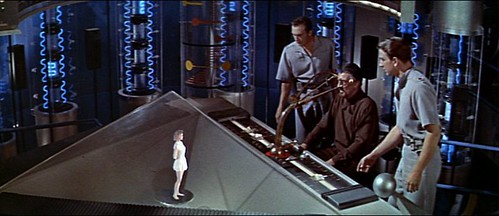
Based loosely on Shakespeare’s The Tempest, Forbidden Planet takes us on a Freudian trip to another world where we meet Robbie the Robot, the progenitor of Steven Spielberg’s R2D2 and C3PO, and the Monster from the Id, the progenitor of those irrational computers that crop up in science fiction. This use of Shakespeare underscores the point that the imaginative devices used publicly to comprehend and present computers often have old cultural roots. Part of the world that Disney had carved out for an indeterminate audience is now being crafted to fit the needs of young adults through the guise of science fiction and the fantasy fiction of J. R. R. Tolkein. Disney’s abstract imagery becomes the stuff of special effects. Similar imagery would be reported by subjects of the LSD experiments that were conducted by the CIA – in search of truth drugs and agents for psychological warfare – and by various clinicians in the United States and Canada.

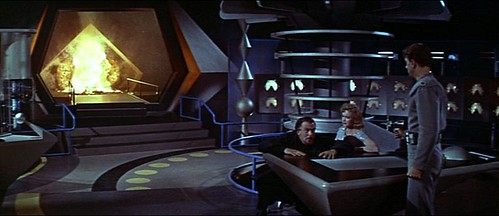
Forbidden Planet, the super-hot Monster from the Id melting the door at the left.

The term “artificial intelligence” was coined at a 1956 conference held at Dartmouth; the Russians launched Sputnik a year later. Noam Chomsky vanquished behaviorism and revolutionized linguistics by making the study of syntax into a technical discipline modeled on the notion of abstract computation. The human mind was declared to be fundamentally computational in nature.

In the literary world Aldous Huxley initiates modern writing on drug experiences with The Doors of Perception while Jack Kerouac, Allen Ginsberg, and William Burroughs all published major drug-influenced works. At the same time banker R. Gordon Wasson reaches the general public with an ecstatic article in Life magazine about having discovered that the hallucinogenic mushroom, Amanita muscaria, was the root of much religious experience throughout the world. Psychiatric experts were predicting great things of LSD-aided psychotherapy.

Forbidden Planet, Morbius (seated at the table) in using the mind-amplification technology of an advanced, but dead, civilization.

The Josiah Macy Foundation was funding conferences in both arenas, cybernetics and psychedelics. It seemed as though, at last, we were on the verge of discovering the material basis of the human mind and harnessing it to our will. Yet, however this played out in the press, the “real goods” were restricted to relatively small and elite groups of people. Computers were very large and expensive devices that had to be kept in environmentally controlled rooms; very few people saw or worked directly with them. Similarly, these wonderful psychedelic drugs were not readily available; one had to travel to Mexico, or one had to live in a big city and know the right psychiatrist.

People were wishing upon a distant star, imagining a future world over which they, in fact, had no control and for which they had little responsibility. That safe remoteness was about to change. In the 1960s psychedelics became freely available on many college campuses and in their surrounding neighborhoods while the 1970s would see the emergence of personal computers, computers small enough and cheap enough that individuals could own them.

Selected Milestones:
  • 1953: Watson and Crick publish the double helix structure of DNA and thus initiate the age of microbiology, initiating biology into the information paradigm.
  • 1954: J. R. R. Tolkein publishes The Fellowship of the Ring, The Two Towers.
  • 1954: Thorazine, the first major tranquilizer, is marketed.
  • 1956: Dartmouth hosts the first conference on artificial intelligence. The Bathroom of Tomorrow attraction opens at Disneyland.
  • 1959: John McCarthy proposes time-sharing to MIT’s director of computing; time-sharing would make computers much more accessible.
  • 1960: Robert Heinlein publishes Stranger in a Strange Land, which would become a major point of literary reference in the drug and mystical counter-culture of the 1960s.

Tuesday, August 24, 2021

Reading Spacecraft 6: The child is father to the man

Morton begins Spacecraft by talking about his childhood as an eleven year old boy coming from a family of limited means and walking to school in the morning, going “toward the ... alienating land of a very posh private school” (p. 1). In that context he took comfort in “making up spacecraft. I would inhabit them in the cockpit of my mind, describing their specifications to myself, under my breath.” When I first read those words I merely read them on the way to what came next, which was about seeing Star Wars and, a bit later, Close Encounters of the Third Kind – both came out in 1977, when he was nine – about his collections of models, and books.

Yet, as I read Morton’s account of his childhood engagement with space flight, I thought of my own, which was a bit different as I am a generation older. For me the movie was Forbidden Planet, which came out in the same year as Godzilla King of the Monsters, 1956. I spent hours drawing pictures of flying saucers and robots. But the definitive event came early in October of 1957 when the Soviet Union launched Sputnik into space, thereby launching the so-called “space race” into overdrive. That’s when my personal imaginary met world history. I didn’t think in those terms at the time, that formulation came to me only in retrospect.

I’m wondering whether or not Morton’s childhood encounter with space-themed science fiction had a similar valence for him. And not only for him, but for many other children as well. Thus, after recounting that aspect of his childhood, Morton observes (p. 2):

I was using space craft as protection and escape vehicle in my head. And so, to this day, I’ve wanted to explore what that was all about. In particular that’s because I’m sure I’m not the only one.

No, he’s not. How many of us are there? Morton continues in the next paragraph:

This doesn’t mean that I’m not interested in Apollo or the Space Shuttle, or Soyuz, or Sputnik. Far from it. The whole point about those vehicles is that they also originated in some dream of a human being. The Space Shuttle bears a vivid resemblance to the shuttle as imagined by Stanley Kubrick in the film 2001: A Space Odyssey (1968). And to design real spacecraft you need a big imagination.

When I was young science fiction was a relatively minor genre, both in film and on television (not to mention prose fiction). The Western was much more important. I’d guess that the Western wouldn’t have been so important in Britain, especially on TV, but I have no idea what the British equivalent would have been. My point, though, is that however much I loved Westerns, and I did love them, and how much time me and my friends played at “cowboys and Indians” – not to mention that I wanted to be an Indian when I grew up – they were set in the past. There was almost no way I could forge an adulthood around one of the typical characters from a Western. I wasn’t going to be a cowboy, much less an Indian.

But an astronaut, that’s different. That had possibilities. I thought about that. But gave it up in favor of being a scientist or an engineer. But for whatever reason, I declared a psychology major when I went off to college; graduated with a degree in philosophy; and then went off to get a doctorate in English Literature. Still, about a decade after getting the degree I did manage to spend a summer working with NASA on a project involving artificial intelligence.

I digress. In pursuing Morton’s childhood (and mine), I’m not attempting to shoehorn Spacecraft into old-fashioned biographical criticism whereby one seeks to explain a text by finding its secrets in the author’s autobiography. There’s nothing secret of hidden about Morton’s childhood introduction to spacecraft. He tells us about it the very first thing. It’s part of the story he’s telling. And that, he later tells us, is a story common to many children whose imagination has been fired with visions of space travel. It’s a story born of a specific cultural imaginary common among children of the last decades of the previous century.

Such children couldn’t have existed prior to the second half of the twentieth century. Why not? Because the culture didn’t provide the materials on which such an imagination could feed itself. Sure, science fiction novels existed before then, as did magazines build on science fiction stories, and some science fiction stories did show up in the movies, But they weren’t so pervasive and readily available to children as they became in the 1950s. Nor did they exist in the context of an international competition, the Cold War, that made the conquest (a word I chose deliberately) of space a matter of national and international importance.

That competition reached an inflection point in the late 1960s, at about the time Morton was born (in 1968). Stanley Kubrick redefined science fiction when he released 2001: A Space Odyssey in 1968. The special effects were a quantum level superior to those in any prior science fiction films and, by starting the film in the ancient past, when there were no humans on earth, Kubrick situated the mythos of spaceflight in the history of life on earth. Thus, with the help of Arthur C. Clarke, who collaborated on the script, Kubrick situated space flight in the mythos and imaginary of the human, thereby freeing it from the trapping of the late industrial revolution.

A year after that NASA landed Apollo 11 on the moon. What Kubrick had depicted in fiction, in imagination, in one of the most important science fiction films ever made, NASA had made real. Space travel was no longer something that happened only in the cultural imaginary. It had entered the realm of the Real, of what Morton called the “future future. Futurality is the possibility that things could be different” (p. 73). Space travel is more than rockets and phasers, super-smart computers, aliens, and the possibility of faster-than-light travel. It is the possibility of radical transformation. As Morton says at the beginning of his last paragraph (pp. 110): “The millennium (as in falcon) is hyperspace, that post-apocalyptic moment at which a more just world is established.” NASA may have been funded out of a desire to score points against the nation Ronald Reagan would come to call an evil empire (1983), but it was never captive to, subsumed by, that intention. It played on a much larger stage.

But I want to go back to childhood. The late-60s conjunction of Kublick and NASA also saw the original Star Trek on television (1965-1969). A decade later The Muppet Show ran on British and American television between 1976 and 1981. It had a running segment entitled “Pigs in Space,” which was a parody on 1960s and 1970s space operas. That is to say, by that time space travel was established well enough that it could evoke and support parodies in a television show aimed at children (the kind of children’s show that appealed to adults as well). Morton watched it “all the time” he tells me (I asked him in the Twitterverse). And though I didn’t ask him whether or not he watched Doctor Who, I assume that he did so, because 1) it started in 1963 (and has been on television ever since), 2) he mentions it fairly often in the book.

That brings us to our Wordsworthian subtitle: “The child is father to the man.” Just what we’re supposed to do with it, I’m not sure. Contemplate it? Re-read the post?

I know what I want. Hegel had a word for it: Aufhebung. Uttering the word is easy enough. Performing the act, allowing it to perform you. That is not so easy.

‘Till next time.

* * * * *
 

120 years of faking space travel for the movies

Starting at about 2:42: "Take this shot of a flying saucer in Plan 9 from Outer Space (1959). It's clearly just a toy on a string. But that would all change drastically in 1968 with 2001: A Space Odyssey. Now that humans had actually gone to space, Stanley Kubrick needed to redefine what futuristic life in space would look like, and he did so by pushing the limits of visual effects."

Monday, August 16, 2021

Ramble – Spacecraft, social nature of truth, Green Villain, the architecture of mind

Once again, I’m feeling a need to ramble around in my mind, see what’s going on.

Spacecraft

I’m still thinking about Tim Morton’s Spacecraft. I figure I’ve got two, perhaps three, more posts on it and then perhaps a formal review. One post will look at how he talks of spacecraft, and his basic distinction between spacecraft and spaceship. Even before that, though, I think I need to talk about the distinction between real spacecraft and fictional ones. By real spacecraft I mean the 100s if not 1000s of satellites we’ve launched since Sputnik back in 1957, the various probes and landers, manned orbital craft and, of course, the Apollo missions, etc. There’s been a lot of them.

But while Morton mentions one or three of them here and there, they aren’t of much interest to him. He’s only interested in fictional space craft, with the Millennium Falcon being his primary example. And I pretty much assumed that’s what he’d be talking about when I asked him to have a copy of the book sent to me. It’s a bit as though someone had chosen two write a book about unicorns or dragons and did so in much the same way as one would write a book about sheep or crows. Of course Morton knows these various spacecraft are fictional, as is hyperspace, which I’ve already written about. But he sees no need to remark on that fact, much less to examine it.

That in itself is interesting.

Then I want to write one about the future. For that’s what was on my mind when I asked Tim for a copy: I wonder if he’ll say something about the future? And he does, page 73. Not sure whether I can get a whole post out of that, we’ll see. But the future sort of goes along with science fiction, no? Nor, come to think of it, does he talk much, if any, about science fiction as a kind of fiction, but that’s what he’s writing about, no? That too is interesting, especially since he’s trained as a literary critic.

That is to say, what’s most interesting about Spacecraft is the framing that’s not there.

The social construction of truth

I was going to write a 3QD column about the social construction of truth, but bailed on it. It would have been an expansion and refinement of a recent blog post, What’s the difference between a conspiracy theory and a far-out, but reasonable, idea? When does signaling go haywire? (July 21). I’m not quite sure why I bailed on it. Though I will note that, for one thing, it’s been shifting beneath my feet.

Perhaps I’m still figuring out an approach to truth. One thing that’s clear in a general sort of way, lots of people in what I will call my society believe lots of different things and this collectivity of beliefs is by no means coherent, mutually consistent, and stable. Do I need an approach to that multiplicity, a way to move it into the foreground instead of keeping it in the background? I’m inclined to think of that as the nature of belief in society and truth is something we carve out of it.

OK, this is going somewhere. The deep problem with asserting the social nature of truth is the implied split between nature and culture (and this goes back to Morton and his OOO). Given that split, society (that is to say, us) is viewed as a source of distortion and error. Truth is something outside us, it’s stable. What is in fact going on, however, is that, once we reach substantial agreement, we project that agreement into nature and fool ourselves into thinking it has nothing to do with us.

And in a sense it doesn’t, because it is about the world. But that agreement is something we’ve created. Science, in this view, is a collection of techniques for framing propositions about the world such that observations can be made that compel agreement from a given scientific community. Which brings us to the case of fundamental physics, where we’ve had half a century of theorizing without observational confirmation. Where’s that going?

What if scientists in other fields decided that they didn’t need to worry about observational confirmation either. That would surely make things easier for psychologists with their replication crisis. Just toss out observation all together. The crisis disappears.

Do these physicists know that their recalcitrance is threatening the very nature of science?

So, what’s at state in my other examples: 1) GOP Trumpism and conspiracy theories (e.g. QAnon), 2) memetics, and 3) the tech singularity? The first is mostly about socio-political reality where current truth is determined by journalistic means. The second was a proposal about science that just fizzled out. And the third is about things that will happen in the future.

I’m thinking that doing all that much stretch the limits of a 3QD column. It’s the framework implied in the previous paragraph that’s tricky. That is, almost all thinking about epistemology takes place within a Cartesian framework, where mind and body are split and truth is a problematic negotiation between a mind and the world. Drop that framework and truth becomes something different, a matter of reading agreement.

Green Villain

Instead of writing about the social construction of truth I choose to do a photo essay about the Green Villain loft space 51 Pacific. That was fun, and didn’t require much thought, just arranging the photos and providing a bit of introductory prose. The trick was to choose the photos, as I’ve got 100s to choose from. The idea was to sample the space.

Here’s another one, of Serringe in process:

In going through the photos, it occurred to me that if this space existed today (the building was demolished in 2015) it would be possible to charge people, say, $5 to enter and tour the building. That wouldn’t have been possible when the space was alive and kicking, back in the early 2010s. Things have changed.

The architecture of mind

And then there’s this recent post: Attractor nets, from basic vertebrates to humans, August 13. That belongs to my general attractor nets project, where the goal is to produce a primer on attractor nets. Does it make sense to think in terms of an explicit construction for each of the five principles listed in the brain paper (Principles and Development of Natural Intelligence)? The basic goal of the attractor net project is to work out constructions for the fifth principle (indexing). That earlier post mentioned the first principle (feeling, on-blocks). What about the other three? I’m thinking I need to leave them alone for awhile.

Seinfeld working paper

Yes, I need to get one of those done, one based on my explication of various bits.

Thursday, August 12, 2021

Reading Spacecraft 2: Hyperspace, a lounge at the center of the world [& the Disney version]

“Hyperspace” is the third chapter in Tim Morton’s Spacecraft, a book with four chapters plus an introduction. Let’s start with a passage near the end of the chapter. I’ve not chosen it at random, say by tossing divination sticks in the manner of John Cage I-Chinging his way toward a composition. Nor have I spent a great deal of time choosing just the right passage for this (illustrative) purpose. Because, really, any of various passages would serve.

Here we go (p. 85-86):

To the outside world you disappear when you enter hyperspace. But for you, it’s as if you’ve stepped out of the street into the lounge. Star Wars sensualizes hyperspace in this way too – hyperspace is not a place of cosmic speed and massive realizations, but rather a quiet lounge. There’s an achieved privacy. It’s soft and comfy. You can play chess. You can flirt. You can talk about boyfriends. Suddenly you arrive at your destination and your spacecraft floats a little. It’s as if you’ve been in a traveling lounge that can relocate anywhere. Then you have to get to work and do stuff like fighting or landing.

What do you think as you read that? After all, you’ve not read Spacecraft so you’re not accustomed to Morton’s way of talking. Stepped out of the street into the lounge? What street, and what lounge? What’s this have to do with Star Wars?

Morton opens the chapter in the lounge area at the center of the Millennium Falcon where Chewbacca’s paying holographic chess (p. 53). So the chapter starts in a lounge. A bit later Morton will offer a brief disquisition on lounges in which he informs you, trickster that he is, that the Falcon is itself a lounge that contains a lounge much larger than it is – in the same way that the Tardis, from another science fiction franchise, contains within it much more than could possibly be fit inside a phone booth – and that this much larger lounge is hyperspace (p. 55). How do you get to hyperspace? By hitching a ride on the Falcon. Or you can watch the Tardis tumble thought hyperspace at the beginning of a each episode of Doctor Who.

Honestly, it’s as though all those roads that lead to Rome? When you turn around and look at them all squinty-eyed, it turns out they can to hyperspace as well. Though you might have to click the heels of your red shoes to get the full effect.

Later (p. 56-57): “...hyperspace is definitely not an empty box. [...] hyperspace has a feel. Hyperspace is ‘space-feel’ just like potato chips have ‘mouthfeel’ in the PR business. [...] Hyperspace is a place.

You are perhaps confused? From hyperspace to mouthfeel to place, that’s just how it goes. How about Claude Monet’s water lilies, Einstein’s spacetime, stream of consciousness (Woolf and Joyce), “Space...has contours...is creamy...a kind of roaring blue and white curdled ocean” – I’m not making this up. I’m just collecting things as I leaf through the book. Then: Hyperspace is the ecological niche of spacecraft – their habitat.” Finally we land, with Morton telling us that the term hyperspace was coined in 1967 (p. 61). Then right back out, we’re off into Gauss and non-Euclidean geometry and “reference mollusks” (Einstein) and then Wham! Han Solo tells us: “Traveling in hyperspace ain’t like dusting crops boy” (p. 62). It sure didn’t feel that way, zipping all over the map in Morton’s OOO-charged prose.

* * * * *

It’s time to slow down and get serious. What strikes me about this chapter ¬– and it’s why I want to get to Walt Disney – is Morton’s discussion of the way hyperspace is visually presented in Doctor Who (the Tardis tumbling though a tunnel), Kubrick’s 2001: A Space Odyssey (a psychedelic light show), the Star Wars saga, more psychedelia, and the relationship between those tunnels and the ones in near death experiences, the Tibetan Book of the Dead, and DMT trips. In some cases the hyperspace tunnel is a way of getting from here to there while in other cases it’s a place where you are (for awhile). Morton discusses the kinesthetic and haptic feel of these tunnels, whether one is penetrating into the tunnel or enveloped by the tunnel (those are gender typed), and so forth. He manages to bring Plato’s cave into play, for it is a tunnel too, no? and therefor implies light, which blinds one upon leaving the tunnel.

And so (pp. 83-4, just three pages short of the passage where we began):

When we enter or “make” hyperspace, it’s also like having an orgasm. The fourth wall collapse I discussed a moment ago is a kind of orgasm of the film stock, a sudden shudder or “petit mort” as the French say about coming: la mort, l’amour. There is a sudden spring or ripple that demonstrates how not in control of our bodies we really are. We move from extreme pleasure into bliss. In the esoteric “tantric” parts of Hinduism and Buddhism bliss is a pathway beyond the ego – into the hyperspace of enlightenment.

Like Han said, it ain’t like dusting crops.

* * * * *

But it might be like the closing sequence of the “Toccata and Fugue in D Minor” episode of Disney’s Fantasia (1941). It is the first episode, of eight (plus in interlude in the middle), in the film.

During the opening toccata we see the orchestra in images like this:

We recognize the images, but we never see them fully rounded. There’s always an element of flattening.

When we move into the fugue we see quasi abstract imagery:

Tuesday, August 10, 2021

Reading Spacecraft 1: In what way is Morton’s prose like Shakespeare’s verse? [and why?]

Timothy Morton, Spacecraft, Bloomsbury Academic, 2021.

I posted a tweet about Morton’s new book, Spacecraft (not yet out), earlier today. Here’s the tweet along with Morton’s response:

Let’s begin at the end. In what way is Morton’s writing like Shakespeare’s? As you might imagine, I hesitated for a few seconds before actually releasing that tweet into the Twitterverse. Morton & Shakespeare? You’ve got to be kidding. No, I’m not. But you might not realize quite what I’ve got in mind. It’s not obvious, though I said it plain: “just beyond the edge.”

The thing is, Shakespeare is not a real person. No, I don’t mean that old “who is Shakespeare” nonsense. I mean that Shakespeare has long since ceased to be a mortal human being. He’s become a mythological creature.

The Bard. The Greatest Poet of the English language. The Greatest Writer that ever lived.

Are you kidding me? Those are titles, honorifics, laudatory epithets. They indicate, not the individual, who(m)ever they are, who wrote those plays. They designate a certain position in the cultural firmament of a large and miscellaneous group of mostly, but not entirely, Europeans and other Westerners. The North Star, that’s what this symbolic Shakespeare is.The North Star isn’t any better than any other star, nor any worse. But it happens to be in a convenient location for certain beings (us) to use it for certain purposes (getting around). So it is with Shakespeare.

Of course, getting back on track, that symbolic Shakespeare is a perfectly fine object, just like that real individual, and just like Tim Morton. Proper objects all. It’s their language that interests me.

Is Morton’s language as good is Shakespeare’s (pick whichever Shakespeare you will)? Likely not, though that’s beside the point – speaking of which, Morton has some interesting remarks on how he uses the ideas of prose and poetry in teaching (pp. 58-59). The point is that Shakespeare’s English is not quite our English. It’s just beyond the edge of our English. It’s a little strange, strange words whose meanings we cannot readily ken, so we read the footnotes (if we’re diligent, if not...).

And so Morton’s language is a little strange as well. Not so obviously strange as Shakespeare’s, none of those odd Shakespeare words you don’t recognize. But really, if you attend to it, strange. He talks OOO, object-oriented ontology. OOO is a kind of philosophy with which Morton is associated. I’ve blogged about it a bit, mostly several years ago (2012-2015, but referencing it here and there up to the present). In OOO everything is an object, that apple you just ate, the sun, the tsunami that wrecked Fukushima, the idea of the future, of atoms, of Mohammed, any and all ideas, Der Hölle Rache kocht in meinem Herzen, the odor of myhrr, Denali (the mountain), and so on. You get the idea. So Morton spells that out with examples. Names some implications, e.g. withdrawal, with examples, and so on. That’s all quasi-technical philosopher’s speak. There are other books where he does more of that. But, in my experience, his writing is never so dense with philosopherspeak as that of, for example, Graham Harman. Which is not to criticize Harman, nor to praise Morton either. They are different. That’s all.

Just different.

Just.

Different.

Morton’s written a lot, and I’ve not read much of it, though I did read Hyperobjects quite carefully back in 2014. I don’t know how he’s been writing since then, but I have the impression in Spacecraft that he wants to minimize philosophyspeak, even eliminate it – not so he can address himself to a general audience, though he wishes to do that (and why not?), in favor of simply seeing and talking about the world in that OOO way.

That’s the sense in which Spacecraft is an operator’s manual for spaceship earth. I know, “operator’s manual” conjures up a book of instructions, perhaps several books, a thin one to get your started, and a thick one to bore you out of your mind once you’ve gotten going. Given that Morton has a long-standing interest in global climate catastrophe, you might think an operator’s manual for earth would say something about how to avoid it. Nope, nothing like that, at least not so far (I’m on page 68 of 112). He mentions global warming and the Anthropocene – how could he not? – but his focus is firmly on spacecraft.

And the Millennium Falcon is his primary example. There are various reasons for that, including the fact that he first saw it in a theater when he was nine (when I was nine I saw a light in the sky I interpreted as Sputnik). The thing about the Millennium Falcon is that it has no operator’s manual. Maybe it did when it first rolled out of the assembly building in that galaxy long ago and far away. But that event is not part of Star Wars canon, at least not yet. As far as we know, as far as we have seen, anyone who has managed to sit their ass down in the pilot’s seat of the Millennium Falcon also knows how to fly it, intuitively, either that or they can figure it out in real time.

That’s what Morton is up to in his style. A real-time reconfiguration of how we see and talk. A new language in which to pilot spaceship earth. Which is also and one and the same time a craft. And a craft is not a ship.

But that will have to wait for next time.

Friday, July 23, 2021

Billionaires in Space, Part 5: Is nothing sacred? [What is an engineer mage?]

In my experience that question – Is nothing sacred? – is usually asked in a tone of exasperated irony by someone who, more likely than not, is a thoroughly secular person. I’m a secular person, but I ask the question without irony, which implies that I am also asking whether the category of “the sacred” is a meaningful one in a secular world. Nor am I exasperated, much. More curious, and pondering.

My friend the late Charles Cameron was a deeply religious man, a mystic, and a poet. He feared that, if travel to the moon became routine, that would rob the moon of its value as an attractor for contemplation of the sacred. In my recent article at 3 Quarks Daily I made a remark that points in that direction:

The fact that at long last America had landed on the moon, that changed the valence of the whole man-in-space project. As long as it was out there in the future we could treat it as a blank slate and write anything on it we wished. Now we had been there, three of us at least; it became real in a way it had not been before.

I then went on to mention an episode in The Crown, season 3, episode 7, “Moondust.”

Prince Philip had been feeling a bit depressed over the fact that he’d given up a career as an air force pilot to be, in effect, a jewel in his wife’s crown. The Apollo astronauts, however, were on a tour of Britain and he arranged to have a private meeting with them. It did not go as he’d hoped. They had not somehow become magical larger-than-life beings. They were mere men, like himself, and not particularly articulate about the experience of having landed on the moon.

What I didn’t say is that that episode began with Philip speaking to a cohort of priests who had come to a retreat at an otherwise unoccupied house on one of the royal estates. As they tell him why they’d come to the retreat he gets restless and tells them that they need action, not contemplation. He leaves. Then we have the incident with the astronauts. As the episode closes Philip has returned to the retreat, apologized to the priests, and asked for their help in working though is mid-life issues.

Charles saw the short blog post I did about that episode and remarked in comments:

Okay. If “religion” fails to offer the sense of mystery and wonder, and “science” in the form of going to the moon (dust, mainly, as if a reminder of “ashes to ashes and dust to dust” unfortunately) doesn’t assuage the quest to “meaning” either, something we might term “imagination” or "spirituality" – perhaps falling somewhere between the two, or in triangulation with a meditative “peace”, might still do the trick. Anyway, that's the direction my own “quest” / “questioning” is leading me in...

Notice all the scare quotes and the trailing ellipses. THAT, I believe, is where we are, though just who “we” refers to is an open question, one perhaps best answered by each individual. But in the end we – some very substantial collective – are going to have to agree on some kind of answer and that answer will help guide us through the climate issues facing us and will guide us perhaps into outer space. To what end? That has yet to be determined.

...we need to be involved in and committed to something greater than ourselves.

I don’t think Richard Branson has anything useful to say in this conversation. He’s just a charismatic joy-riding billionaire. Bezos is less charismatic – the cowboy hat did not do the trick – and I doubt that he has much to say either, though he has a lot more money to spend.

And there is the peculiar shape of his rocket, which has been getting a fair amount of attention. I’ve already linked to Joe Rogan’s Instagram comment, which is rather crude, as one can expect from Rogan. But Rogan has the most watched pod-cast on the planet. Then there’s this video on YouTube:

It’s approaching a million views. That’s not Joe Rogan territory, but it’s worth thinking about. How many more views will it get? How many others are or will be satirizing the shape of that rocket.

When I first saw the shape I thought nothing of it. And when people started either hinting at or outright saying it’s a giant dick, I dismissed those remarks. Why? Because the shape of the rocket is largely dictated by physical considerations. It has to have the shape of a cylinder and the top needs to taper. Now I’m beginning to wonder. Does the capsule really need to be wider than the rocket itself in a way that resembles the glans of a human penis? Was that aerodynamically necessary? Didn’t any one in Blue Origin’s PR department point out that that shape could be embarrassing?

Aren’t these questions just a little silly? Maybe yes maybe no. The fact that they arise speaks to the lack of a shared cultural framework through which we can understand this current space race as anything more than billionaires showing off and living out childhood fantasies. Yes, there’s the tech and the possibilities of spin-offs. That’s what NASA said back in the 1960s. It was a thin truth then and it’s thin now. Technology isn’t what’s driving this race now – except, perhaps, in the case of Musk. But let’s finish up with Bezos first.

I don’t know what goes on in the mind of a billionaire who may think he’s some kind of god. I hear Bezos thinks we are or should be an interstellar species. So what? That’s been in science fiction for decades. He gets no credit for thinking such thoughts. Whatever he is, he is no philosopher king. Nor perhaps should he be. I could say more about Bezos – his predatory attitude toward his employees for example, but let’s just leave it there.

And then there’s Elon Musk. I’ve written so much about him I’ve made him a named topic here. As I remarked yesterday, “He’s built an actual [space] business, though one that depends on getting government contracts. He wants to go to Mars. I don’t know what I think about that.” He may well go down in history as the Henry Ford of the electric automobile. He has some strange ideas about direct brain-to-brain communication and apparently he’s not a very nice person. So what? He’s not a philosopher king either.

But he may be something else. A real life Tony Stark? To be honest, I’m not invested enough in the Marvel Universe to know whether or not that judgment is worth spit. But I rather doubt that the Marvel Universe can support what I have in mind, what I’m searching for, what Charles Cameron was searching for. Can Musk support that? 

He is an engineer. A designer. He may even be a profound engineer. A builder. Maybe he is an engineer mage.

We’ll see.

There is this idea, at one and the same time a cliché and a profound truth, that we need to be involved in and committed to something greater than ourselves. Does Richard Branson think there is anything greater than Richard Branson? Jeff Bezos? Does cheering them on lift us out of ourselves to something greater?

No.

I’m not sure about Musk.

* * * * *

Why engineers? you ask. Because engineering is about designing and constructing. I have quite a bit to say about engineers and engineering here at New Savanna. In the preface to my book on music, Beethoven’s Anvil, I characterized my method as speculative engineering. One of the important things about Grace Lindsay’s new book, Models of the Mind: How Physics, Engineering, and Mathematics Have Shaped Our Understanding of the Brain, is that she recognizes the importance of engineering. More personally, my father was an engineer, a very good one. It’s in my blood, as they say. 

Compared to science and scientists, engineers don't get no respect, as Rodney Dangerfield might say. Engineering is not as deeply implanted in our philosophical superstructure as science is. Philosophy of science is a thriving subject. Philosophy of engineering? Doesn't exist. I suspect there is a class issue here, the gentleman scientist vs. the blue collar engineer, but also calculation vs. manipulation. There's an intellectual issue as well. This bears looking into.

Thursday, July 22, 2021

Billionaires in Space, Part 3: What do I think? [What's the WHOLE picture?]

It’s complicated. I’ve written a fair amount on man-in-space. Somewhere in their I’ve told how, when Sputnik was launched in October of 1957, my father took me outside to observer the night sky. He pointed Sputnik out to me? Did I actually see what he was pointing at? Could you actually observe Sputnik from earth? I don’t know, but I believed we saw Sputnik that night. That is when my personal life met world-historical time in my memory.

Even before then I’d been drawing pictures of space ships, flying saucers, robots (remember, Forbidden Planet had come out a year before Sputnik). I watched Walt Disney extol the virtues of space travel. I assembled plastic models of rockets and space ships. I even designed some. I was into it. I wanted to become an astronaut.

But when I came time to enter college, I declared a psychology major, then changed to philosophy, and ended up doing a de facto degree in literature. When Apollo 11 landed on the moon in 1969 I didn’t watch it on TV. It was too ‘establishment.’ And I wasn’t into establishment.

Years later, in the mid-1990s, I was in Orlando, Florida at a trade show. I took the last day off to drive to Kennedy Space Flight Center and see the land from which those moon rockets were launched. They had a Saturn V hanging from the roof in one long shed. I was awed. I felt that I was on sacred ground.

Billionaires in space? Right around the corner Michael Liss asked me a question:

Bill, Disney's insistent focus on the future was part business, but it was also part mission. Are there futurists now who you think have the resources (or access to them) and desire to do the same? I'm knocking out the vanity space-flights because they seem purposeless, but you can disagree.

Here’s my reply:

That’s a very interesting question, Michael. And context matters. You’re right about Disney, part business AND part mission. Moreover, back in Disney’s time science fiction wasn’t all over the screen and, of course, humans had not yet landed on the moon. Things are very different now.

Bezos was born in 1964. He would have been five when Apollo 11 landed on the moon. What could that possibly have meant to him? Star Trek came on the air in 1968; Star Wars came out in 1977. He’s grown up in a world with space-oriented science fiction, one where humans have been to the moon and back, and were now flying missions to low earth orbit. In that world, does thinking Disney-like thoughts count as vision any more? Just WHAT DOES count as vision?

When all these ideas are out there as science fiction, what counts as vision? Has Bezos done anything more that flip the switch on some science fiction tale and say, “I want one of those, I’m a billionaire?” Is he doing anything more than re-enacting childhood fantasy? Is his vision just slip-streaming off of good old Uncle Walt?

And what was he doing wearing the cowboy hat? You know what I think of when I think of cowboy hats in space? That’s right, Slim Pickens riding the bomb in Dr. Strange Love. In a way I’d like to see Bezos earn that hat by bull riding on the rodeo circuit for a year, or actually working on a cattle ranch. If he wants to prance around in the bedroom with his current squeeze while wearing a cowboy hat, that's fine. That's play. But when he's in public with millions of people watching, no, he doesn't get to do that. He doesn't get to play while millions are hurting from Covid, some of whom work for his company. He doesn’t get to mess with American myth simply because he’s a billionaire.

Musk, I think, is in a different class. He’s built an actual business, though one that depends on getting government contracts. He wants to go to Mars. I don’t know what I think about that. But he wants to do it for real. If he actually does it, that changes the game, big time. Even if it’s only a one-time shot and he leaves some dead astronauts on Mars.

But vision?

Like I said, it’s complicated.

I’m not at all sure that I like the idea that, at the moment, the billionaires dominate media coverage of humans-in-space. Space should not be the preserve of rich men. It belongs to us all, no?

Not, mind you, that the race to the moon was for the good of humanity. It was America vs. the Russians, one nation-state against another. Don’t like that either.

Which is better, dueling billionaires or dueling nation? Of course China is getting to the act as well. How does that change things?

I do note, however, that Bezos is being lambasted, at least on Twitter, for that cowboy hat and for the phallic shape of his rocket. That’s fair game; it’s all to the good. He’s also been criticized for his remarks about how he couldn’t have done it without all his wonderful Amazon employees. In making those remarks he was playing the benevolent paterfamilias; but he was being criticized as an exploitive boss. That too is fair.

These guys don’t get exclusive control over the spin. How much traction will the resistance get? I don’t know. It remains to be seen just how these events get interpreted. That’s just beginning.

What I’m getting at is that we have to think of the whole picture, what these billionaires do AND how those actions play out in the public sphere. What are we as a culture and a society making of all this right now? Where are we, and our billionaires, going?

This is going to take awhile.

Billionaires in Space, Part 2: Neil deGrasse Tyson (explaining science) and Chuck Nice (cracking wise)

It's going to be interesting to see how this plays out in the media. This clip is an interesting combination of scientific explanation and comic relief. The billionaires can't control how they play out in the media. 

If billionaires want to feed their egos, act like fools, while also advancing technology, why not? That is to say, as long as there is a commentariat calling them on it, let them go. But we need the commentariat, we need the comedic takes like Chuck Nice is supplying, we need the court jesters. 

Billionaires in Space, Part 1: Joe Rogan's take on Jeff Bezos (or is it Bozos?)

What was he thinking wearing that cowboy hat? Yeah, I know, I wore a cowboy hat when I was a kid, but I was just a kid and I was playing at being a cowboy. Is that what Bezos was doing? If he wants to prance around in the bedroom with his current squeeze while wearing a cowboy hat, that's fine. That's play. But when he's in public with millions of people watching, no, he doesn't get to do that. He doesn't get to play while millions are hurting from Covid, some of whom work for his company.

When I think of cowboy hats in space I think of Slim Pickens riding the bomb down at the end of Dr. Strange Love. Maybe Bezos should give it a try. Not a live bomb, of course, a dud. He can ride that dud to anywhere he pleases. If not that, he should at least earn the hat by going on the rodeo circuit for a year and breaking broncos or riding bulls. 

What was he thinking? He was thinking "I'm Jeff Bezos, I can do anything I want to." But cowboys are American mythology. You don't get to fuck with American mythology. Not Jeff Bezos, not Donald Trump, no one, not even John Wayne (and he's dead).