Giving it another boost, because: Why not! And it was so much FUN!
Bumping this to the top (from 2014) because why not? Some of us need a break from weary weather.
Giving it another boost, because: Why not! And it was so much FUN!
Bumping this to the top (from 2014) because why not? Some of us need a break from weary weather.
Abstract: This is an informal evaluation of the MacArthur Fellowship Program, the so-called "genius grants." I argue that the program functions basically as a PR vehicle for the MacArthur Foundation and for the foundation world in general. I also suggest that it could achieve better results by not awarding grants to people who already have jobs at elite institutions. There are discussions of how talent is evaluated, the cultural factors in genius, accounts of three elite institutions (Johns Hopkins, RPI, and SUNY Buffalo), and discussions of Louis Armstrong, John von Neumann, and Richard Feynman.
Journalists and others sometimes use “genius grant” as a shorthand reference for the MacArthur Fellowship. We avoid using the term “genius” to describe MacArthur Fellows because it connotes a singular characteristic of intellectual prowess. The people we seek to support express many other important qualities: ability to transcend traditional boundaries, willingness to take risks, persistence in the face of personal and conceptual obstacles, capacity to synthesize disparate ideas and approaches.
Bumping to the top of the queue because it is relevant to my current interests (the impossibility of brain-to-brain thought transfer).
And student-centric pedagogy in which learners attempt to make meaning of texts together isn't as new as social media. Dewey, Freire, Vygotsky and others pointed in that direction.
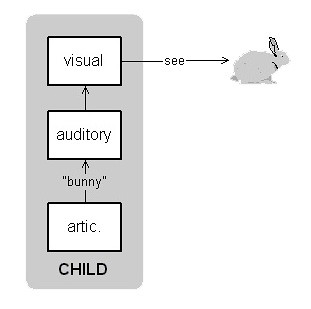
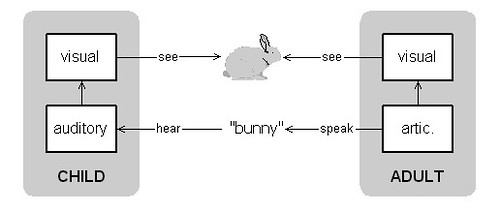
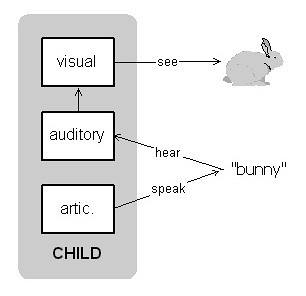
Not only can the child listen, she can also speak – though there is a lag between the child's capacity to understand language and the child's ability to produce it such that the child can understand more than she can talk about (Lenneberg, 1967). If the child's utterance contains a command directed toward herself – and there is evidence on this (Vygotsky, 1962; Luria, 1959) – then she is using language to direct her activity in the way which others use language to direct her activity (see Figure 2). The route from acoustic analysis to the execution of the action is the same in both cases, only the utterance's point of origin is different. In one case the utterance originates with another, in the other case with the child herself.
When I decided that this week would be Talent Search Week I was hoping to have a new article for today. But I've gotten broadsided by other matters and have spent most of the day putting out fires. So I've decided to bump this up to the top of the queue. Walter Murch has won three Oscars, one for sound on Apocalypse Now and two for The English Patient, sound and editing.Two summers ago I was working on a series of posts about Apocalypse Now. One day I got an email from one Walter Murch, a man I did not know. But I knew the name.
Reading Penrose - the fact that billiards, which is the game usually given as an example of mechanical physics in deterministic practice, is not immune to vanishingly small initial conditions for the outcome of complex sequences • A line of 20 balls may be arranged in a zigzag such that each will hit the next in sequence when tapped by the cue ball. But exactly where the last ball will wind up after it is hit is subject to something as small as an intake of breath in the neighboring town. If there are 26 balls, a molecular disturbance in some neighboring galaxy will influence the outcome • Reminds me of my 'magic light' hypothesis of film: that film is the sensitive receptacle of everything that happens during the filming - what the assistant electrician had for breakfast, etc. - caught somehow, invisibly, in the amber of celluloid. In the future, people will be able to see this complex of interactions directly by shining a special ‘light’ through the film. It will look like some 5-dimensional moiré pattern, endlessly shifting, endlessly fascinating.
What I meant by "Magic Light" is the discovery of some new force (Force 5) of nature, which has been with us all along but of which we are presently as ignorant as Newton was of electromagnetism. Using this new “force” as a beam, these hypothetical people of the future will transect our films and see - not the images which we see - but some fascinating interaction of all the people who worked on the film, in all its unexpected contingency, and this will be much more satisfying (to them) than the film itself. And it will be a wonder, to those future people, that we could accomplish this filmmaking without any knowledge of “Force 5”, which will be as crucial to them in their society as electromagnetism is to us today. As wondrous as is the construction of Gothic cathedrals to us today: we can hardly believe that our ancestors achieved these miracles with only human and (literal) horse power, and with no engineering textbooks.
And you could add: Duke Ellington and Shakespeare and the Egyptian Pyramids and many other things to this list.
I think part of the mystery is that occasionally there is a balance of forces - what Koestler called the autonomy of the part and the wisdom of the whole - where the “part” (whatever it is) makes autonomous decisions that would be impossible for the theoretically guiding force (whatever that may be) to make. And that these decisions miraculously further the higher goal of the “organism” (Duke Ellington's sound, for instance: Duke did not have to tell each of his musicians exactly what to do at every moment) Similarly, if everything that is done on a film had to be expressed in “machine code” (e.g. “turn thirty degrees to the left and cock your right eyebrow”) the film would never get off the ground. People talk about this happening in sports, in battle, in every communal undertaking in fact. It is the human equivalent of the miraculous (to us) ability of fishes and birds to swim/fly in formation and all turn, repeatedly, at exactly the same moment, as if the school/flock were a single organism.
Cross posted at The Valve
Of course, the majority of academics who are part of Academia.edu’s social network are the product of the state-regulated, public higher education system, as is their research (a system, it should be said, from which public funding is steadily being withdrawn). But just as Airbnb and Uber are parasitic on the public ‘infrastructure and the investment’ that was ‘made by cities a generation ago’ (roads, buildings, street lighting, etc.), so Academia.edu has a parasitical relationship to the public education system, in that these academics are labouring for it for free to help build its privately-owned for-profit platform by providing the aggregated input, data and attention value. We can thus see that posting on Academia.edu is not ethically and politically equivalent to making research available using an institutional open access repository at all.
I was just wondering whether Wuthering Heights was some sort of proto-vampire book when in the last chapter Nelly herself wonders whether Heathcliff is a ghoul or a vampire. I was surprised as I did not think vampires had been discovered till later. I have not watched any of the Twilight films (and I don't intend to neither) but it struck me there were some similarities between Wuthering Heights, Twilight, Buffy the Vampire Slayer and other vampire films and television series. Heathcliff can stand bright sunlight; bibles, wooden crosses, garlic and holy water might annoy him but would not be sufficient to ward him off; and although driving a wooden stake through his heart would kill him, so would other methods of execution. However, there are some similarities: Heathcliff is evil (like most vampires). Heathcliff and Catherine continue to walk the Earth after death and do not find rest. Heathcliff has no hope of salvation, neither does he want it. Heathcliff's idea of heaven is close to torment. Heathcliff's love for Catherine is eternal (rather like some vampire love stories). Heathcliff's love for Catherine is rather chaste. Heathcliff is tall, strong, rather dark with long, black hair. Heathcliff forms one point of a love triangle with Catherine as the apex (a bit like Twilight I believe).
Edward and Bella, meet Heathcliff and Catherine.That's right: before The Walking Dead, Twilight, Buffy the Vampire Slayer, and The Vampire Diaries, there was Wuthering Heights.At first glance, Heathcliff may not resemble the vampires that you've grown to know and love (or hate), but he's got a lot more going for him than most of 'em. Just saying.Wuthering Heights, published in 1847, revolves around the passionate and destructive love between its two central characters, Emily Brontë's headstrong and beautiful Catherine Earnshaw and her tall, dark, handsome, and brooding hero/devil, Heathcliff.Forget the romantic candlelit dinners, the wine, and the roses. Catherine and Heathcliff's love exists on an entirely different plane: one that involves ghosts, corpses, the communion (or possession) of souls, and revenge. And, speaking of revenge, Heathcliff—who harbors more than one grudge against his adoptive family, the love of his life, and his neighbors—manages to make every revenge drama look like kid's play.
Over the years, I have noticed that the increasing complexity of the molecular and cellular signaling pathways and the technologies we employ makes it easy to forget the "big picture" of why we are even conducting the experiments. [...] When asked to explain the purpose or goals of our research, we have become so used to directing a laser pointer onto a slide of a cellular model that it becomes challenging to explain the nature of our work without visual aids.
This fall, I introduced a new component into our weekly lab meetings. After our usual round-up of new experimental data and progress, I suggested that each week one lab member should give a brief 15 minute overview about a book they had recently finished or were still reading. The overview was meant to be a "teaser" without spoilers, explaining why they had started reading the book, what they liked about it, and whether they would recommend it to others. One major condition was to speak about the book without any Powerpoint slides! But there weren't any major restrictions when it came to the book; it could be fiction or non-fiction and published in any language of the world (but ideally also available in an English translation). If lab members were interested and wanted to talk more about the book, then we would continue to discuss it, otherwise we would disband and return to our usual work. If nobody in my lab wanted to talk about a book then I would give an impromptu mini-talk (without Powerpoint) about a topic relating to the philosophy or culture of science.
Venture and equity financing for ed tech companies soared to nearly $1.87 billion last year, up 55 percent from the year before, according to a new report from CB Insights, a venture capital database. The figures are the highest since CB Insights began covering the industry in 2009.
While rising sharply, the values of ed tech financing deals are chump change compared with the money flowing into consumer software. Uber, the ride-hailing app, for instance, raised $2.7 billion last year.The smaller sums going into ed tech illustrate the challenges facing start-ups as they try to persuade public school systems to adopt their novel products. Companies often must navigate local school districts with limited budgets and slow procurement processes. To bypass the bureaucracy, many start-ups are marketing free learning apps and websites directly to teachers in the hopes that their schools might eventually buy enhanced services.
In 2012, Seung started EyeWire, an online game that challenges the public to trace neuronal wiring — now using computers, not pens — in the retina of a mouse’s eye. Seung’s artificial-intelligence algorithms process the raw images, then players earn points as they mark, paint-by-numbers style, the branches of a neuron through a three-dimensional cube. The game has attracted 165,000 players in 164 countries. In effect, Seung is employing artificial intelligence as a force multiplier for a global, all-volunteer army that has included Lorinda, a Missouri grandmother who also paints watercolors, and Iliyan (a.k.a. @crazyman4865), a high-school student in Bulgaria who once played for nearly 24 hours straight. Computers do what they can and then leave the rest to what remains the most potent pattern-recognition technology ever discovered: the human brain.Ultimately, Seung still hopes that artificial intelligence will be able to handle the entire job. But in the meantime, he is working to recruit more help. In August, South Korea’s largest telecom company announced a partnership with EyeWire, running nationwide ads to bring in more players. In the next few years, Seung hopes to go bigger by enticing a company to turn EyeWire into a game with characters and a story line that people play purely for fun. “Think of what we could do,” Seung said, “if we could capture even a small fraction of the mental effort that goes into Angry Birds.”
Eve Marder, a prominent neuroscientist at Brandeis University, cautions against expecting too much from the connectome. She studies neurons that control the stomachs of crabs and lobsters. In these relatively simple systems of 30 or so neurons, she has shown that neuromodulators — signaling chemicals that wash across regions of the brain, omitted from Seung’s static map — can fundamentally change how a circuit functions. If this is true for the stomach of a crustacean, the mind reels to consider what may be happening in the brain of a mouse, not to mention a human.
Children love to experiment with encoding messages. From pig latin to invisible ink pens, children explore hidden messages when they’re imagining themselves as spies and messengers. As children grow up, they look for more sophisticated means of passing messages that elude the watchful eyes of adults. In watching teens navigate networked publics, I became enamored of how they were regularly encoding hidden meaning in publicly available messages. They were engaged in a practice that Alice Marwick and I called “social steganography,” or hiding messages in plain sight by leveraging shared knowledge and cues embedded in particular social contexts.
The social media tools that teens use are direct descendants of the hangouts and other public places in which teens have been congregating for decades. What the drive-in was to teens in the 1950s and the mall in the 1980s, Facebook, texting, Twitter, instant messaging, and other social media are to teens now. Teens flock to them knowing they can socialize with friends and become better acquainted with classmates and peers they don’t know as well. They embrace social media for roughly the same reasons earlier generations of teens attended sock hops, congregated in parking lots, colonized people’s front stoops, or tied up the phone lines for hours on end. Teens want to gossip, flirt, complain, compare notes, share passions, emote, and joke around. They want to be able to talk among themselves—even if that means going online.
My interview with Myra, a middle-class white fifteen-year-old from Iowa, turned funny and sad when “lack of time” became a verbal tick in response to every question I asked her about connecting with friends. From learning Czech to track, from orchestra to work in a nursery, she told me that her mother organized “98%” of her daily routine. Myra did not like all of these activities, but her mother thought they were important. She was resigned to them. Lack of freedom and control over her schedule was a sore topic for Myra. At one point, she noted with an exasperated tone that weekends were no freer than weekdays: “Usually my mom will have things scheduled for me to do. So I really don’t have much choice in what I’m doing Friday nights. . . . I haven’t had a free weekend in so long. I cannot even remember the last time I got to choose what I wanted to do over the weekend.” Myra noted that her mother meant well, but she was exhausted and felt socially disconnected because she did not have time to connect with friends outside of classes.