Showing posts with label fun. Show all posts

Thursday, April 3, 2025

A short note on the importance of fun [Homo ludens]

Tyler Cowen has just interviewed economic historian Sheilagh Ogilvie on a variety of topics:

...the economic impacts of historical pandemics, the “happy story” of the Black Death and why it doesn’t stand up to scrutiny, the history of variolation and how entrepreneurs created vaccination franchises in 18th-century England, why local communities typically managed epidemics better than central authorities, the dastardly nature of medieval guilds, the European marriage pattern and its disputed contribution to economic growth, when sustained economic growth truly began in England, why the Dutch Republic stagnated despite its early success, whether she agrees with Greg Clark’s social mobility hypothesis, her experience and conducting “anthropological fieldwork” on English social customs, the communitarian norms she encountered while living in Germany...

It's all interesting. But, given my current interests, this passage caught my eye:

COWEN: Let’s say an 18-year-old, highly intelligent young woman comes to you. She’s moving to England; she might want to be a professor. What advice do you give to her? From America, let’s say.

OGILVIE: [...] I would say, and this is actually not just England-specific, but changing cultures. When I was 20, I went to live in Germany. I lived there, actually, for quite a long time while I was doing research for my doctorate.

When you initially go to a foreign place, whether it’s Germany — or later, I lived in the Czech Republic for a year — you won’t figure out right away what people in this culture do to feel comfortable and have fun. But you have to have the faith that they do have things that they do, and you need to learn what those things are that they do in this culture to be comfortable with one another and to have a great time.

The sooner you learn that, the happier you’ll be fitting into a new culture. I think that would be my general life advice to anyone who is moving to a new country. Find out what people do for fun, and then start doing it.

I suspect that there is more to that advice than the fact that fun is, well, fun. There's something deeper going on. It is not just that fun is a better way to pass the time than boredom or even work, but that it puts you more fundamentally touch with the people.

Sunday, November 24, 2024

Using a 300-ton hydraulic press to crush a block of 10,000 Lego bricks


The really fun stuff starts at about 8 minutes in, but, really, if you're going to watch that, why not watch the whole thing? 

AND: What kind of person laboriously assembles 10,000 Lego bricks into a single block for the purpose of seeing how it will respond to pressure from a 300-ton hydraulic press? 

They're having so much FUN doing this.

Saturday, September 23, 2023

There's a better way to teach music to kids [who are born to groove]

Sammy Miller, We’re Teaching Music to Kids All Wrong, NYTimes, Sept. 23, 2023.

Opening paragraph:

Each fall, as school starts up again, music educators witness a familiar ritual: Eager first-time students squeak on a clarinet, suppress giggles at the noises coming from the tubas and zealously hit a bass drum a little too hard. It’s a moment characterized by excitement, enthusiasm and the anticipation of new beginnings — which is why it’s so disheartening to know that many of those kids will eventually quit their instruments.

And on about this and that, and then:

Rather than fixating on funding, let’s look at taking a whole new approach. Educators lament that, as with other courses, band can frequently fall prey to “teaching to the test” — in this case, teaching to the holiday concert. A class that by definition is meant to be a creative endeavor winds up emphasizing rigid reading and rote memorization, in service of a single performance. We need to abandon that approach and bring play back into the classroom by instructing students how to hear a melody on the radio and learn to play it back by ear, and encouraging students to write their own simple songs using a few chords. (The dirty secret of pop music, as Ed Sheeran has explained, is that most chart-topping songs can be played by using only four chords: G, C, D and E minor.) So start with just one chord, a funky beat and let it rip — and, voilà, you’re making music.

It’s often been repeated that “music is a language,” yet we’re reluctant to teach it that way. When we learn a language, we don’t simply memorize phrases or spend all day reading — we practice the language together, sharing, speaking, stumbling but ultimately finding ways to connect. This should happen in music class, too. Music should be a common pursuit: Ask any dad rock weekend band or church ensemble how it experiences music, and the performers are likely to tell you it’s not a chore but a way of building community.

Most important, we need to let kids be terrible. In fact, we should encourage it. They’ll be plenty terrible on their own — at first. But too often kids associate music in school with a difficult undertaking they can’t hope to master, which leads them to give up. Music does not have to be, and in fact, shouldn’t be, about the pursuit of perfection. And the great musicians have plenty of lessons to teach students about the usefulness of failure.

All together now:

We also teach language through immersion, so let’s focus on creating an immersive experience in the language of music. Kids learn best when they’re part of communities filled with people of all skill levels for them to play along with, listen to music with, mess up with and just be silly with. Parents, this means you. Don’t let instrument instruction simply be something you nag your kids to endure. Music was never meant to be a lonely vigil. Play together. Make noise together. Find joy together. Take out an instrument and learn a song that you and your child both love.

While you're at it, check out: 

 
Available at: 

Amazon: https://tinyurl.com/4p67bahh
Barnes & Noble: https://tinyurl.com/5vjf3kjt
Google Play: https://tinyurl.com/39rz43vp
Kobo eReader: https://tinyurl.com/5bmkjsme

And there's my handy-dandy five step program for improvisation.

Saturday, March 4, 2023

Kimono Mom Cavorts like a child [No, really!]

The family prepares for a trip to Hong Kong and Dubai, where they’re going to a trade show to drum up business for Moe’s new Japanese Cooking Sauce. In the second shot we see Moto (only his hand) wrapping a bottle of it to go with them. Moe flashes passports in the third shot, and then Sutan does a quick turn into a bouncy crouch in the forth and fifth shots.

We’re off! Well, not quite yet. We have to finish packing.

Cavorting at 2:08 through to 2:50 or so, then to serious packing. Then we have a run in something of a cavorting style run at 4:35 (exaggerated movements, like a cartoon character). The house is a mess while they’re packing. And why not? Things to do. NOW! Sutan tries out her Totoro hat (6:44). Kawaii! BTW, their voices sound silly when you play the video at double speed. There’s some nonsense about pineapples at 10:06 ff. And then Sutan cavorts a bit on the run (10:34), just nudging into cavort territory, but not going deep into it. Now Sutan’s into it, serious cavorting (11:08). Crouch and wave your hands to the camera (11:24). “Keep it up, daddy.” A bit later Moe and Sutan deliver a commercial announcement (the video was sponsored by Sakuraco, a maker of snacks, and we all need snacks, no?).

Now we’re at the airport. No more cavorting. Off to Hong Kong! They’re staying in a private house. With friends? “I want to see the dog.” “Here’s such a beautiful toilet.” Sutan climbs onto the bed, standing up. No jumping on the bed? Or wasn’t the camera there for the fun?

We’re off to film a video with some YouTuber in Hong Kong.

Sunday, June 28, 2020

David Graeber on Fun at the Heart of Being [common glad impulse]

Except for the addendum, which is new, this post is from 2014. I'm bumping it to the top on general principle.
David Graeber, most widely known as the author of Debt: The First 5000 Years and a theorist of the Occupy movement, has an article in The Baffler arguing that freedom and play inherent in the nature of things. After a certain amount of opening throat clearing about play among inchworms and lobsters he gets around to the modern economic view of things, according to which all animal behavior (including that of us featherless bipeds) is to be accounted for by appeals to rational self-interest, a view that embraces (if only metaphorically) genes, which are just (odd) components of certain molecules.

For various reasons, which he explains, Graeber's not buying it. This is what he ends up proposing, via self-organization:
Let us imagine a principle. Call it a principle of freedom—or, since Latinate constructions tend to carry more weight in such matters, call it a principle of ludic freedom. Let us imagine it to hold that the free exercise of an entity’s most complex powers or capacities will, under certain circumstances at least, tend to become an end in itself. It would obviously not be the only principle active in nature. Others pull other ways. But if nothing else, it would help explain what we actually observe, such as why, despite the second law of thermodynamics, the universe seems to be getting more, rather than less, complex. Evolutionary psychologists claim they can explain—as the title of one recent book has it—“why sex is fun.” What they can’t explain is why fun is fun. This could.
I'm sympathetic, both with his reservations about economic rationalism, and with his advocacy of ludic freedom.

Common Glad Impulse

Charlie Keil reminds me of: W.H. Hudson, The Naturalist in La Plata, D. Appleton and Company, 1895. Here's a passage:
Birds are more subject to this universal joyous instinct than mammals, and there are times when some species are constantly overflowing with it; and as they are so much freer than mammals, more buoyant and graceful in action, more loquacious, and have voices so much finer, their gladness shows itself in a greater variety of ways, with more regular and beautiful motions, and with melody. But every species, or group of species, has its own inherited form or style of performance; and, however rude and irregular this may be, as in the case of the pretended stampedes and fights of wild cattle, that is the form in which the feeling will always be expressed. If all men, at some exceedingly remote period in their history, had agreed to express the common glad impulse, which they now express in such an infinite variety of ways or do not express at all, by dancing a minuet, and minuet-dancing had at last come to be instinctive, and taken to spontaneously by children at an early period, just as they take to walking "on their hind legs," man's case would be like that of the inferior animals.

I was one day watching a flock of plovers, quietly feeding on the ground, when, in a moment, all the birds were seized by a joyous madness, and each one, after making a vigorous peck at his nearest neighbour, began running wildly about, each trying in passing to peck other birds, while seeking by means of quick doublings to escape being pecked in turn. This species always expresses its glad impulse in the same way; but how different in form is this simple game of touch-who-touch-can from the triplet dances of the spur-winged lapwings, with their drumming music, pompous gestures, and military precision of movement! How different also from the aerial performance of another bird of the same family--the Brazilian stilt--in which one is pursued by the others, mounting upwards in a wild, eccentric flight until they are all but lost to view; and back to earth again, and then, skywards once more; the pursued bird when overtaken giving place to another individual, and the pursuing pack making the air ring with their melodious barking cries! How different again are all these from the aerial pastimes of the snipe, in which the bird, in its violent descent, is able to produce such wonderful, far-reaching sounds with its tail-feathers! The snipe, as a rule, is a solitary bird, and, like the oscillating finch mentioned early in this paper, is content to practise its pastimes without a witness. In the gregarious kinds all perform together: for this feeling, like fear, is eminently contagious, and the sight of one bird mad with joy will quickly make the whole flock mad. There are also species that always live in pairs, like the scissors-tails already mentioned, that periodically assemble in numbers for the purpose of display. The crested screamer, a very large bird, may also be mentioned: male and female sing somewhat harmoniously together, with voices of almost unparalleled power: but these birds also congregate in large numbers, and a thousand couples, or even several thousands, may be assembled together: and, at intervals, both by day and night, all sing in concert, their combined voices producing a thunderous melody which seems to shake the earth. As a rule, however, birds that live always in pairs do not assemble for the purpose of display, but the joyous instinct is expressed by duet-like performances between male and female. Thus, in the three South American Passerine families, the tyrant-birds, wood-hewers, and ant-thrushes, numbering together between eight and nine hundred species, a very large majority appear to have displays of this description.

Saturday, January 20, 2018

Pop goes the peek-a-boo, Japanese style

Be sure to play the film clip.

Friday, August 29, 2014

Friday Fotos: Sparkychan and Gojochan Retrospective!

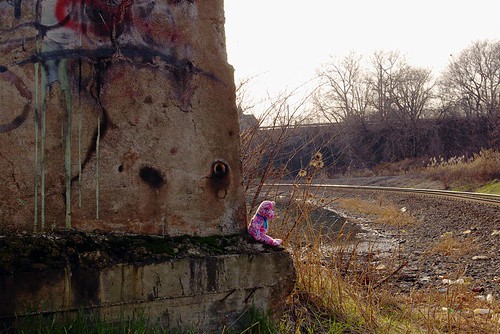
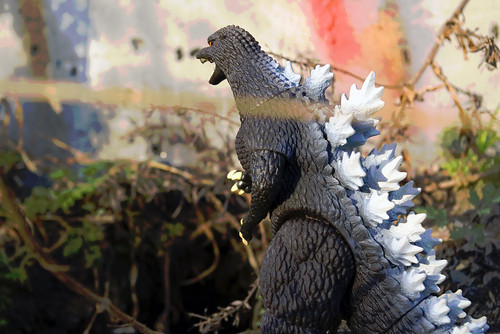
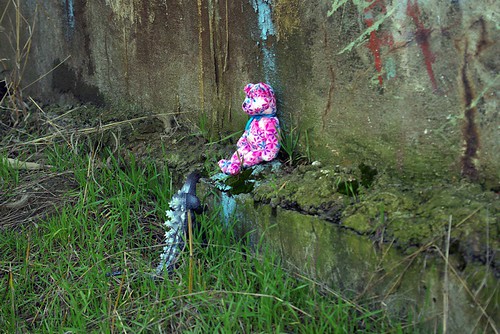
Back in 2006, when I first started photographing graffiti, I thought it would be interesting to get some kid's toys and photograph them amid the gritty territory I was exploring. So I bought two, a plastic model of Gojira (Godzilla in America), which promptly became Gojochan, and a hot-pink plush bear, Sparkychan. Here's some stories about their life: The Collected Adventures of Sparkychan & Gojochan (Thus Far). I've posted some photos of them below.

* * * * *

Oh me oh my
Sparkychan meditating on the awesomeness of existence.

sparky in the hole.jpg
Gojochan raging against the dying of the night.

Ah yes
Gogochan is attracted to Sparkychan's inner peace.

Tuesday, April 26, 2011

What's Popular, and Why

Maybe

One aspect of posting to the web is that you can get statistics on what stuff people like. Here's some light analysis of what's popular here at New Savanna and what photos are popular at my Flickr site.

Posts on New Savanna

[Counts as of 7 AM Tuesday 26 April 2011.]

The most popular post on this blog – by far – is "Sex, Power, and Purity in Kawajiri's Ninja Scroll". It was posted on 18 September 2010 and has 3,476 pageviews.. I wouldn't rate it as one of my best posts, much less THE best one. So why's it have more that twice as many views as the second most popular post? That seems obvious enough. Ninja Scroll is a very popular anime title and — the post is about sex in the film. "Naked Flickr Sex Erotic Bodies" is second, with 1,464 pageviews; it was posted on 16 November 2010. Again, not in my list of top 50 favorites, but it has its points. I assume its popularity is a function of its subject, sexy photos. Alas, no photos in the post itself.

The third most popular post is something of a surprise: "Secrets of Pink Elephant Revealed", posted on 25 October 2010 and having 1419 pageviews. It mostly analyzes and describes what happens in the "Pink Elephants on Parade" segment of Dumbo. I like that post a lot, though I don't know whether I'd put it among my very best. However much I'd like to think that the post's popularity is a function of how well I did the analysis, I suspect that much of the popularity is a function of the popularity of the segment itself. I wasn't aware of its popularity, but that popularity pleases me a great deal. It's a fine piece of film-making.

In fourth place we have "Sakaki Rides a Dolphin", another post about animation, this one being from a Japanese anime title of fairly recent vintage: Azumanga Daioh. It was posted on 19 April 2010 and has 733 hits to date. I like this post as well; I think there's a bit of analysis in there that's just splendid. But, again, I can't claim the all the hits for myself; Azumanga Daioh is quite popular.

The fifth-place post has nothing to do either with sex or with cartoons: "Higher Ed and the Rise of the Citizen Researcher", with 603 hits. It was posted on 16 August 2010. That post is about how the web is making it easier for ordinary folks to engage in research projects of various kinds, so it's about the social and cultural impact of digital tech, always a popular subject on the web.

Let's skip over 6th place, about two episodes in Fantasia, and 7th place, about sex in two novels, to number 8, which was posted on 26 March 2011, the only one in the top 10 to have been published this year. That post is "The Hottest Man in Siam", again, an analytic and descriptive effort I'm quite fond of. But I'm just a little surprised that it's gotten so much action, 534 pageviews, so quickly. I suspect I was helped by a recent story in The New York Times about a Woody Woodpecker cartoon, which also mentioned The Greatest Man in Siam, the cartoon I discussed in the post. The 9th and 10th posts are both about Fantasia; one asserts it's a masterpiece, the other explains why I like The Nutcracker Suite episode.

Now, a quick look back over the numbers: 1) 3476, 2) 1464, 3) 1419, 4) 733, and 5) 603. The most popular has more than twice as many views as the second, which is very close to the third. The third is roughly double the fourth, which is a sixth greater than the fifth. While the 10th trails the 5th by over 100 views (488 to 603) the gaps do seem to be closing up once we get out of the top four.

Sunday, March 20, 2011

Adventures in Cartoons

winter

A little over a week ago I had the notion that I should write a piece talking about what I’d learned about cartoons in the past few years. No sooner had the thought occurred to me than I realized that writing such a piece would be difficult. It’s not that I haven’t learned anything, but that what I’ve learned is difficult to summarize.


For the most part I’ve been concerned to analyze and describe cartoons. I’ve learned lots of specific things about specific cartoons, some of which I’ve written about, here and elsewhere, and some of which exists only in notes, or just ideas flitting about in my mind. But general conclusions? Well, cartoons are rich and complex.

AP 12 Sita + arm wavers

Duh!

That’s hardly a conclusion. In fact, that’s why I started describing them in the first place. I already knew they were rich and complex, so much so that it’s hard to remember, accurately what happens, and how. But when you look, you see things, patterns. And they’re interesting.

Thursday, February 24, 2011

Transition Mission

I’ve been working with Charlie Keil to start The Transition Party USA. As Charlie put it, “it’s a way to give a whole spectrum of NGOs/non-profits, peace orgs, environmental orgs, AND a precious slice of Teapartiers who genuinely want to restore the Constitution, repeal the Patriot Act, no bailouts for Wall St., reduce the debts and size of Fed gov’t and it's taxation of middle class to feed the rich, etc.” Our modest aim is to become a "decisive" or log-jam breaking party in the House. If, for example, there were 214 Republicans elected and 209 Democrats, our 12 Transition Party Representatives could exert great leverage for Truth, Traditions, Transition legislation – and against the tremendous waste encouraged by big corporations feeding at the trough of big government.

You can find out more at our blog, Transition Party USA. Here’s Charlie’s local perspective from Lakeville, Connecticut:
The Great Transition is being made as we speak. In Lakeville, Connecticut the Great Transition to sustainability, permacultures, resilience in everything that matters (highest standards of humor, musicality, plenty of mighty trees to admire, excess energy in the local grid, etc,) has been ongoing for over a century!

150 years ago all the trees had been turned to charcoal for local iron making furnaces (and then the first Bessemer steel?), smoke, soot, grey skies everywhere, desolation, fires burning 24-7 in the hills making the last piles of charcoal. Then it went to Pittsburgh and Lakevillians began to make a long, slow, recovery that has culminated in recent decades with the reappearance of all the animals, pileated woodpeckers, too many geese, too many turkeys, too many deer, bear, a moose came through our yard a few weeks after my father died and took a swim in Lakeville's lake. We have a sawmill in Falls Village, for local timber. My wife Angie calls them Potempkin forests but they are real enough, old growth enough, for those giant pileated woodpeckers.