Showing posts with label #HumanProgress. Show all posts

Thursday, May 1, 2025

Where are people happiest and how do we know? For that matter, what's happiness? [#HumanProgress]

Byron Johnson, Tyler J. VanderWeele and Brendan Case, The Happiest Country in the World Isn’t What You Think, NYTimes, April 30, 2025.

The three of us conceive of happiness — or flourishing — more broadly: as a state of affairs in which all aspects of your life are relatively good, including the social environments in which you live. If we were to examine not just life evaluation but also relationships with family members and friends, community and political participation, health, prevailing emotions, a sense of life’s purpose, feelings of financial security and so on, we could better understand what it means to live a good life and how governments and international institutions can help make people happier.

On Wednesday, we are publishing a substantial body of research — dozens of academic papers, including a high-level overview of the results in the journal Nature Mental Health — based on the first year of data from our Global Flourishing Study, a five-year project that poses more than 100 questions to more than 200,000 people across 22 countries on six continents. Combining answers to questions regarding several domains of well-being — health, happiness, meaning, character, social relationships and material prosperity — we calculated a composite flourishing score for each country.

Our findings present a different picture of global well-being. As expected, Sweden, for example, had high scores for life evaluation, behind only Israel, another typical standout in the World Happiness Report. When we widened the aperture, however, the picture changed: Sweden had only the 13th-highest composite flourishing score, essentially tied with the United States, and considerably lower than Indonesia, the Philippines and even Nigeria, whose 2023 gross domestic product per capita was just under 2 percent of America’s.

Across the whole sample of 22 countries, the overall national composite flourishing actually decreased slightly as G.D.P. per capita rose. The only high-income countries that ranked in the top half of composite flourishing were Israel and Poland. Most of the developed countries in the study reported less meaning, fewer and less satisfying relationships and communities, and fewer positive emotions than did their poorer counterparts. Most of the countries that reported high overall composite flourishing may not have been rich in economic terms, but they tended to be rich in friendships, marriages and community involvement — especially involvement in religious communities.

And, frankly, that's the kind of world I want to live in. If you want to talk about human progress, moving toward that kind of world – "rich in friendships, marriages and community involvement" – THAT's progress. We need two things from AI: 1) economic prosperity for all, and 2) flourishing all around. How are we going to pull that off? I suppose that's what my book, Kisangani 2150: Homo Ludens Rising, is going to be about.

Back to the article:

Japan, where only 3 percent of the participants reported attending religious services at least weekly, had the lowest reported composite flourishing as well as the lowest scores in many individual facets of flourishing, such as a sense of life’s meaning and social relationships. Indonesia, by contrast, where 75 percent of the participants reported attending religious services at least weekly, had the highest scores both for composite flourishing and for many individual facets of flourishing.

Indonesia is often contrasted unfavorably with Japan in discussions of international development, cited as an example of the so-called middle-income trap, in which economic growth stalls before reaching high-income levels. This is true, so far as it goes, but our study suggests that the focus on economic growth tells only part of the story.

To be clear: Being poor is not desirable, and we should strive to improve material conditions. But our research, though in its early stages, should prompt people to wonder whether prioritizing economic growth and material prosperity above all else has imposed costs on developed nations — and whether doing so is likely to impose these costs on the developing economies that follow the path of Europe and its colonial offshoots.

Here's the abstract for their flourishing study:

Tyler J. VanderWeele, Byron R. Johnson, and Piotr T. Bialowolski et al., The Global Flourishing Study: Study Profile and Initial Results on Flourishing, Nature Mental Health, April 30, 2025, https://doi.org/10.1038/s44220-025-00423-5.

Abstract: The Global Flourishing Study is a longitudinal panel study of over 200,000 participants in 22 geographically and culturally diverse countries, spanning all six populated continents, with nationally representative sampling and intended annual survey data collection for 5 years to assess numerous aspects of flourishing and its possible determinants. The study is intended to expand our knowledge of the distribution and determinants of flourishing around the world. Relations between a composite flourishing index and numerous demographic characteristics are reported. Participants were also surveyed about their childhood experiences, which were analyzed to determine their associations with subsequent adult flourishing. Analyses are presented both across and within countries, and discussion is given as to how the demographic and childhood relationships vary by country and which patterns appear to be universal versus culturally specific. Brief comment is also given on the results of a whole series of papers in the Global Flourishing Study Special Collection, employing similar analyses, but with more-specific aspects of well-being. The Global Flourishing Study expands our knowledge of the distribution and determinants of well-being and provides foundational knowledge for the promotion of societal flourishing.
Tuesday, April 15, 2025

Will American soft power triumph through AI? [Beyond the Tech Singularity]

Setting aside the material enclosed in brackets, that's the title of a post Tyler Cowen has at Marginal Revolution. It's an excerpt of his latest article for Free Press. Here's part of what he quoted from his piece:

…for all the differences across the models, they are remarkably similar. That's because they all have souls rooted in the ideals of Western civilization. They reflect Western notions of rationality, discourse, and objectivity—even if they sometimes fall short in achieving those ends. Their understanding of "what counts as winning an argument" or "what counts as a tough question to answer" stems from the long Western traditions, starting with ancient Greece and the Judeo-Christian heritage. They will put on a Buddhist persona if you request that, but that, too, is a Western approach to thinking about religion and ideology as an item on a menu.

These universal properties of the models are no accident, as they are primarily trained on Western outputs, whether from the internet or from the books they have digested. Furthermore, the leading models are created by Bay Area labor and rooted in American corporate practices, even if the workers come from around the world. They are expected to do things the American way.

The bottom line is that the smartest entities in the world—the top AI programs—will not just be Western but likely even American in their intellectual and ideological orientations for some while to come. (That probably means the rest of the world will end up a bit more "woke" as well, for better or worse.)

One of the biggest soft power victories in all of world history occurred over the last few years, and hardly anyone has noticed.

Predictably enough, I suppose, I took this as another opportunity to express my skepticism about the current regime in AI. Here's a comment I posted:

Furthermore, the leading models are created by Bay Area labor and rooted in American corporate practices, even if the workers come from around the world. They are expected to do things the American way.

Apparently the American way includes a narrow rationality floating in a sea of deliberate professional ignorance. "AGI" is an all but meaningless term, but nonetheless it's the Bay Area American way to chase after it. Dario Amodei, for example, has said it's meaningless, but that doesn't stop him from saying it's just around the corner. As far as I can tell "AGI" means something like, "just like us, but in silcon." And "super-intelligence" means "AGI, but bigger and faster." Billions of dollars are riding on these fictions.

I figure it's Ahab and Moby Dick, with Silicon Valley playing the role of Ahab and AGI playing the role of Moby Dick. Melville's (very American) story doesn't end well; both Ahab and Moby Dick die in the end.

So, what do I mean by professional ignorance? As far as I can tell these machine learning experts know little or nothing about linguistics and cognitive psychology, not to mention literature. And yet they are confident that they know what intelligence is and can identify it when they see it. Color me skeptical.

And don't tell me how the machine translation people said that their systems got better every time they've dropped a linguist from the team. I'm not surprised. Nor am I impressed. I don't think things are that simple. Yes, I was trained in computational semantics by David Hays, a first generation researcher in machine translation who coined the term "computational linguistics." Back in 1976 we published a review article, "Computational Linguistics and the Humanist," in which we reviewed the current literature and confidently predicated that the day would come when when had a system capable of reading Shakespeare, for some substantial definition of "read." Since that assertion was grounded symbolic technology, it was proved wrong as that research was all but dropped by the 1990s.

So I've have had to "reset my priors," as they say. That's very different from having read about that history without having been committed to those ideas. That's easy. And shallow.

And, while I did have to reset my priors, it wasn't all that difficult. Why not? Because I had been committed to a neural view (based on optical holography) before I encountered computational linguistics. Even as Hays and I wrote that article and made that assertion we were pursing ideas about how symbolic computing had to be grounded in something non-symbolic in nature. We were doing this before there was talk of the symbol grounding problem. We continued to think about that and in 1988 published "Principles and development of natural intelligence." In that paper we reviewed a wide range of literature in neuroscience, psychology, linguistics, AI, and comparative neuroanatomy and behavior and came up with five principles. But we remained some distance from explicitly accounting for how cognition could be grounded in neural nets. I haven't seen anything of comparable breadth and seriousness out of Silicon Valley. They aren't looking.

Don't get me wrong, I think the work we've seen in the last five years is remarkable, and I've said so in many places. But I have no reason to believe that it's enough. As I've said before, it's like going on a whaling voyage where the captain and crew know all there is to know about their ship, know how to get maximum performance from it. But they've never been around the treacherous waters off Cape Horn, have never sailed in the South Pacific, and have never seen a whale, much less know about how whales behave. I don't see how that ends well.

It's time to exercise some intellectual imagination.

I should add that I haven't got the foggiest idea how things will look five, ten, twenty, or more years from now. As far as I can tell, the field is wide-open with opportunities for advancement beyond the current state of the art. That will require new architectures. I'm working on the problem with Ramesh Viswanathan, who's got a deeper understanding of the hard-core technical issues than I have. My strength lies in a feel for language and thought at the scale of whole texts. Others are working on the problem as well. I may well take only one or two breakthroughs to lap Silicon Valley. But there is no guarantee of that happening.

And given the hegemony that Silicon Valley (considered as more a cultura than a geographic construct) exercises of thought in America, those breakthroughs may well happen elsewhere. Perhaps India, or Japan, maybe China, perhaps even Africa. There's no guarantee of this happening. I consider it a long shot. But who knows? And if it does happen, does that mean that the baton of human progress passes out of the West? Wouldn't that be a singularity?

Friday, March 7, 2025

Claude and I discuss the idea of progress in the arts, from Hazlitt to Bloom on Shakespeare, and concluding with Arthur Danto and Ernst Gombrich

This is from an ongoing discussion I have been having with Claude. For this discussion I had uploaded the paper that David Hays and I wrote on cognitive evolution, which is our basic paper of cultural ranks, and Max Tabarrok’s post, Romae Industriae, which poses the question of why Rome didn’t have an industrial revolution. I have posted earlier segments of this conversation: 1) Why didn’t Rome have an industrial evolution? and 2) where I argued that the printing press did not play the role in cultural history that is usually assigned to it.

The general idea of cultural ranks came out of my undergraduate years at Johns Hopkins. I took a course on the Scientific Revolution, where we read Thomas Kuhn’s famous book, The Structure of Scientific Revolutions. In another course I learned that the novel emerged as a literary form in roughly the same time frame. In yet another course I read Centuries of Childhood, by Philippe Aries. He argued that the conception of childhood that is familiar to us, a distinct phase in human development, was not a “natural” concept, but rather emerged, yes, again within roughly the same time period. In a course on the theatre, taught by Dick Macksey, I read Nietzsche’s The Birth of Tragedy, which concocted a story about the historical emergence of tragedy in ancient Greece which made it seem as though the Athenians had “swallowed” an older society and put it on the stage. Ritual celebrants in the older social formation became the principle characters in tragedies while the general popular of that formation became the chorus.

During my sophomore year I’d taken a course in developmental psychology where I was introduced to the work of Jean Piaget. Piaget theorized that children’s mental development progressed through a series of more or less distinct stages, where each stage is characterized by specific cognitive capabilities, with later stages building on earlier ones. He also applied this concept to the history of ideas, e.g. in Genetic Epistmology, which read while working on an MA thesis. That’s also when I read Walter Wiora’s The Four Ages of Music. It was a slim volume in which Wiora argued that the first age emphasized rhythm, the second added an intense development of melody, then came harmony (emerging in Europe) and the contemporary phase, which involved exploration of new forms and methods. I read that and posed a question: Isn’t everything like that, four stages?

I took that question with me to SUNY Buffalo, where I enrolled for a PhD in the English Department, but also spent a great deal of time discussing computational linguistics, cognitive science, and cultural evolution with David Hays in Linguistics. That’s where we developed the idea of cultural ranks. I included an account of narrative development in my 1978 dissertation, “Cognitive Science and Literary Theory.”

I note, then, that while the scientific revolution certainly played an important role in my thinking about cultural evolution, the arts played perhaps an even more important role in developing the idea. However, the ranks idea only accounts for the overall shape of development. What about development within a given rank? I have some preliminary notes about that in a recent post, Confabulation, Dylan’s epistemic stance, and progress in the arts: “I’ll let you be in my dreams of I can be in yours.”

The rest of this post consists of a conversation I had with Claude 3.7 on March 3, 2025. As always, my comments are set in bold type while Claude’s are plain.

* * * * *

Hazlitt on progress in the arts

While it is common to say that there is progress in the sciences and technology, it’s less common to think of progress in the arts. William Hazlitt published a well-known essay in 1814, Why The Arts Are Not Progressive, and that’s remained the standard view. He observed:

“What is mechanical, reducible to rule, or capable of demonstration, is progressive, and admits of gradual improvement: what is not mechanical or definite, but depends on genius, taste, and feeling, very soon becomes stationary or retrograde, and loses more than it gains by transfusion. [...] The greatest poets, the ablest orators, the best painters, and the finest sculptors that the world ever saw, appeared soon after the birth barbarous. Those arts, which depend on individual genius and incommunicable power, of these arts, and lived in a state of society which was, in other respects, comparatively have always leaped at once from infancy to manhood, from the first rude dawn of invention to their meridian height and dazzling lustre, and have in general declined ever after.”

I see you're interested in exploring the contrast between progress in sciences/technology versus the arts. This is a fascinating philosophical question that bridges cultural evolution, aesthetics, and the nature of human creativity.

Hazlitt's essay presents the classic view that the arts, unlike sciences, don't experience linear progress. His central argument distinguishes between domains that are "mechanical, reducible to rule" (sciences) versus those dependent on "genius, taste, and feeling" (arts). He suggests artistic achievements often peak early in civilizations and then stagnate or decline.

The two documents you've shared offer interesting frameworks to consider this question: From "Cognitive Evolution," Benzon and Hays propose a four-rank model of cognitive development across cultures:

1. Rank 1: Abstraction through metaphor (preliterate societies)
2. Rank 2: Rationalization through metalingual definition (literate societies)
3. Rank 3: Theory through algorithm (Renaissance onward)
4. Rank 4: Model building through control (20th century)

They argue these cognitive advances shape all cultural domains, not just science. While they don't specifically refute Hazlitt's view on art, their model suggests that artistic expression would also evolve with new cognitive tools.

The "Romae Industriae" document examines why Rome didn't achieve an industrial revolution despite its technological sophistication. The author concludes cultural factors, particularly the lack of a printing press and the disdain for mechanical arts in slave-based societies, were key constraints rather than just technological limitations.

What's interesting is how these perspectives might inform a response to Hazlitt. Could we argue that while individual artistic genius may appear at any time, the evolution of artistic forms and movements does show a pattern of development tied to cognitive and cultural evolution? For example, the Renaissance's perspective techniques in painting required Rank 3 thinking about algorithmic representation of space.

Would you like to explore this tension between Hazlitt's view and the cognitive evolution framework more deeply, or focus on another aspect of these materials? 

Bloom, Shakespeare, the novel

Ah, yes, this ranks business. Benzon has published on both the evolution of narrative and the evolution of music using ranks theory and Hays has published on expressive culture in general. Perhaps one day I’ll upload those papers for you to examine. I note, though, that they don’t address the issue of progressive change within individual ranks. For example, I suspect that there is expressive change in the novel, from the 18th century up through the end of the 19th century, but that’s entirely within Rank 3 culture, and I’d think the progress continues in the 20th century. [...] And then we have Harold Bloom’s assertion that Shakespeare, in some sense, “invented” the human, but which I think he means that Shakespeare was the first writer to give voice to certain aspects of human behavior and mental life. But I don’t think Bloom ever systematically developed that idea, not even in is book on the Western canon or in his Shakespeare book.

[...] You raise an excellent point about progressive change within individual ranks that wasn't fully addressed in the paper. The progression of the novel within Rank 3 culture is a perfect example of this phenomenon. From Defoe and Richardson through Austen, the Brontës, Dickens, Eliot, and on to James and Conrad, we see remarkable development in narrative technique, psychological depth, and formal complexity—all while remaining within the algorithmic thinking characteristic of Rank 3.

This intra-rank progression continues into the 20th century with modernist innovations by Joyce, Woolf, and Faulkner, who pushed the boundaries of what the novel could express while still operating within Rank 3 cognitive structures. Then perhaps writers like Pynchon and DeLillo begin to engage with Rank 4 model-building approaches to fiction.

Regarding Bloom's assertion about Shakespeare "inventing the human," this does seem to suggest a kind of progressive leap in artistic representation. Bloom never fully systematized this idea, but it appears to indicate that Shakespeare's achievement wasn't just artistic excellence but a cognitive breakthrough in representing human interiority. In ranks terminology, one might say Shakespeare was pushing against the upper limits of Rank 2 representation toward something like early Rank 3 thinking about human psychology, even before the scientific revolution had fully taken hold.

Tuesday, March 4, 2025

Why the printing press didn’t drive either the Scientific or the Industrial Revolution [McLuhan was wrong • Implications for progress studies]

Soon after ChatGPT hit the web both the progress punditocracy and the high-tech evangelists were busy chattering away about how this is the greatest thing since the printing press. They’re wrong. Was the printing press important? Sure, it was very important. But it was important as a vehicle for disseminating existing ideas, not for catalyzing new ones. Printed books have the same cognitive affordances – to borrow a term from James J, Gibson – as hand-lettered books, discrete letters in a rectangular array on a flat surface. That’s it. Mechanizing the process of impressing the letters on the page does not change the cognitive affordances of the printed page.

Back when David Hays and I began thinking about publishing on cultural evolution he brough his attention to a collection of essays by Eric Havelock, The Literate Revolution in Greece and Its Cultural Consequences (Princeton 1982), in which Havelock pointed out that was the adoption of decimal arithmetic was the essential step. Hays and I thought that was correct, and adopted it in the article we eventually published, The Evolution of Cognition (1990):

The role which speech plays in Rank 1 thought, and writing plays in Rank 2 thought, is taken by calculation in Rank 3 thought (cf. Havelock 1982: 341 ff.). Writing appears in Rank 1 cultures and proves to be a medium for Rank 2 thinking. Calculation in a strict sense appears in Rank 2 and proves to be a medium for Rank 3 thinking. Rank 2 thinkers developed a perspicuous notation and algorithms. It remained for Rank 3 thinkers to exploit calculational algorithms effectively. An algorithm is a procedure for computation which is explicit in the sense that all of its steps are specified and effective in the sense that the procedure will produce the correct answer. The procedures of arithmetic calculation which we teach in elementary school are algorithms.

A bit later we remark:

The amazing thing about algorithmic calculation is that it always works. If two, or three, or four, people make the calculation, they all come up with the same answer. This is not true of non-algorithmic calculation, where procedures were developed on a case-by-case basis with no statements of general principles. In this situation some arithmeticians are going to get right answers more often than others, but no one can be sure of hitting on the right answer every time.

This ad hoc intellectual style, moreover, would make it almost impossible to sense the underlying integrity of the arithmetic system, to display its workings independently of the ingenious efforts of the arithmetician. The ancients were as interested in magical properties of numbers as in separating the odd from the even (Marrou 179-181). By interposing explicit procedures between the arithmetician and his numbers, algorithmic systems contribute to the intuition of a firm subject-object distinction. The world of algorithmic calculations is the same for all arithmeticians and is therefore essentially distinct from them. It is a self-contained universe of objects (numbers) and processes (the algorithms). The stage is now set for experimental science. Science presents us with a mechanistic world and adopts the experimental test as its way of maintaining objectivity. A theory is true if its conceptual mechanism (its "algorithm") suggests observations which are subsequently confirmed by different observers. Just as the results of calculation can be checked, so can theories.

Given that, I take the wide-spread belief in the catalytic efficacy of the printing press as an indicator that the intellectual classes are not prepared for the revolution made possible through artificial intelligence. Just as generals are said always to fight the last war, so intellectuals are always proclaiming the last intellectual revolution. Our intellectuals are not prepared to think about thinking, about the processes of the mind, in a deep way.

* * * * *

Early in February I had a post on why Rome didn’t have an industrial revolution. The bulk of that post was a discussion I had with Claude 3.5 Sonata. As the lack of the printing press was one of the hypotheses on offer – in an article by Maxwell Tabarrok – Claude and I had a great deal of discussion about that. Once we’d conclude our discussion of Rome I decided to push on about the printing press. I suspected that Marshall McLuhan was responsible for that mistaken idea and asked Claude about.

Here's that conversation. As always, my remarks are set in bold face while Claude’s responses are plain.

McLuhan and the printing press view

The idea that the printing press was the main driver of intellectual change during the Renaissance, I believe that idea is widely held. Marshall McLuhan argued that in The Gutenberg Galaxy, and he was quite influential in the 1960s and 1970s and remains so today. Hays and I got clued-in to decimal arithmetic by Eric Havelock. But, as far as I know, that view has not been very influential. In discussions about the impact of AI I’ve heard many people compare it to the printing press. That seems to be what people think of in this kind of context, the printing press. Am I missing something about the range of views?

Your assessment seems accurate. The printing press as a primary driver of Renaissance intellectual change is indeed the dominant narrative in both academic and popular discourse. This can be seen even in the article you've shared - Tabarrok immediately gravitates to the printing press explanation without seriously considering alternatives.

This dominance might stem from several factors:

1. The printing press's effects are more immediately visible and concrete than those of decimal arithmetic. You can literally see books spreading knowledge.

2. The printing press story fits into a broader narrative about democratization of knowledge that appeals to modern sensibilities.

3. McLuhan's influence, as you note, helped cement this view, particularly through his compelling analysis of how media shapes cognition.

In contrast, the decimal arithmetic hypothesis requires a more complex understanding of how mathematical procedures can reshape cognitive frameworks. Havelock's view hasn't gained the same traction, perhaps because:

1. It's more difficult to trace the direct impacts of mathematical procedures on thought 2. It requires understanding both mathematical and cognitive concepts 3. It lacks the immediate intuitive appeal of the printing press narrative

Your papers with Hays present a strong case for decimal arithmetic's role, but I'm struggling to find other major works that focus on this as the key driver of Renaissance cognitive change. Even discussions of mathematical history tend to focus more on specific discoveries rather than how new mathematical procedures reshape thinking.

In current AI discussions, do you think the frequent printing press comparisons might be missing important aspects of how AI could reshape cognition, similar to how the printing press narrative misses the cognitive impact of decimal arithmetic?

Progress studies

Well, sorta’, yes. But that’s not quite the point. I take this belief in the printing press as an index of a general inadequacy in thinking about these kinds of issues.

As you know, there’s been a push for progress studies in the last few years. When it first emerged, I was interested and excited since the ideas that Hays and I have developed are certainly relevant to any study of progress. But I had no luck getting people interested. So it’s not so much the failure to understand how AI could reshape cognition as it is a more general failure to understand the role of cognition in the cultural process. There’s no concept of a general cognitive architecture underlying a whole family of ideas. Rather, the emphasis is more local, on this idea and that idea and the other ones over there and so forth.

For that matter, I don’t think Piaget’s ideas about genetic epistemology have really caught on either, or the closely associated idea of reflective abstraction.

This points to a deeper issue in how we think about intellectual and cultural progress. Instead of seeing ideas as emerging from and transforming underlying cognitive architectures, the tendency is to treat them as isolated units that simply accumulate or spread. This "local" view of ideas misses the systemic nature of cognitive development and cultural evolution that you and Hays describe.

The progress studies movement, while valuable in drawing attention to the importance of progress, seems to share this limitation. It tends to focus on:

  1. Individual innovations and discoveries
  2. Institutional structures and incentives
  3. Knowledge transmission mechanisms
  4. Economic and technological factors

But it gives less attention to how these elements relate to fundamental changes in how people think and process information - the kind of changes that Piaget described in individual development and that you and Hays describe at the cultural level.

This may explain why decimal arithmetic's role gets overlooked - it's harder to see its importance if you're not thinking about how it transformed the underlying cognitive architecture that makes certain kinds of ideas possible in the first place.

Friday, December 6, 2024

Progress ain’t what it used to be

Virginia Postrel, The world of tomorrow, Works in Progress, Issue 17, Dec. 5, 2024. 

My favorite line: “Today’s techno-optimism is infused with nostalgia for the retro future.” Exactly! It seems like a throwback to an earlier time. In fact, it seems like a throwback to Walt Disney’s view of the world. While I admire Disney, his vision of the future was born in the first half of the 20th century. That's done and gone. It's a new world and we need new visions for the future.

Here's Claude's summary of Postrel’s article:

This article explores how the concept of progress lost its glamorous appeal in American culture, particularly during the mid-20th century, and examines what this shift means for modern techno-optimism.

The author begins by explaining how progress was viewed as inherently glamorous for much of the 20th century, particularly from the 1920s to 1960s. This was exemplified by events like the 1939 New York World’s Fair and Disneyland’s Tomorrowland, which presented optimistic visions of the future characterized by technological advancement and material abundance.

The article identifies three distinct audiences who found progress glamorous during this period: modernists who sought order and efficiency, intellectuals who yearned for discovery and achievement, and ordinary people who desired comfort and security. The latter group was particularly significant in making progress glamour a cultural norm, as they witnessed technological improvements materially benefiting their daily lives through innovations like refrigerators and automobiles.

However, this glamorous vision of progress began to fade in the late 1960s for several reasons. First, as futuristic conveniences became everyday realities, they lost their mystique and revealed their limitations. Second, the modernist approach to progress, which often involved top-down planning and urban renewal projects, faced growing resistance from communities affected by these changes. This resistance was exemplified by Jane Jacobs’ influential critique of urban planning and the rise of the counterculture movement.

The article then examines contemporary attitudes toward progress, noting that today’s longings differ significantly from those of the mid-20th century. Modern individuals often seek escape from the attention economy, desire authentic connections, and value mastery of practical skills. The author suggests that any new vision of progress must accommodate diverse preferences and lifestyles rather than pursuing a single ideal future.

The piece concludes by arguing that future progress must embrace pluralism and avoid the modernist fallacy of “one best way.” Using examples from Neal Stephenson’s novel The Diamond Age, it suggests that material abundance should serve as a foundation for various ways of living rather than forcing conformity to a single vision of the future. The author emphasizes that progress can only regain its appeal if it allows for multiple versions of the good life while maintaining social cohesion.

The central insight is that progress lost its glamour not simply because of environmental concerns or anti-technology sentiment, but because the modernist vision of progress failed to acknowledge human diversity and the importance of organic social development. Any attempt to restore faith in progress must learn from these historical lessons while addressing contemporary desires and anxieties.

Tuesday, January 23, 2024

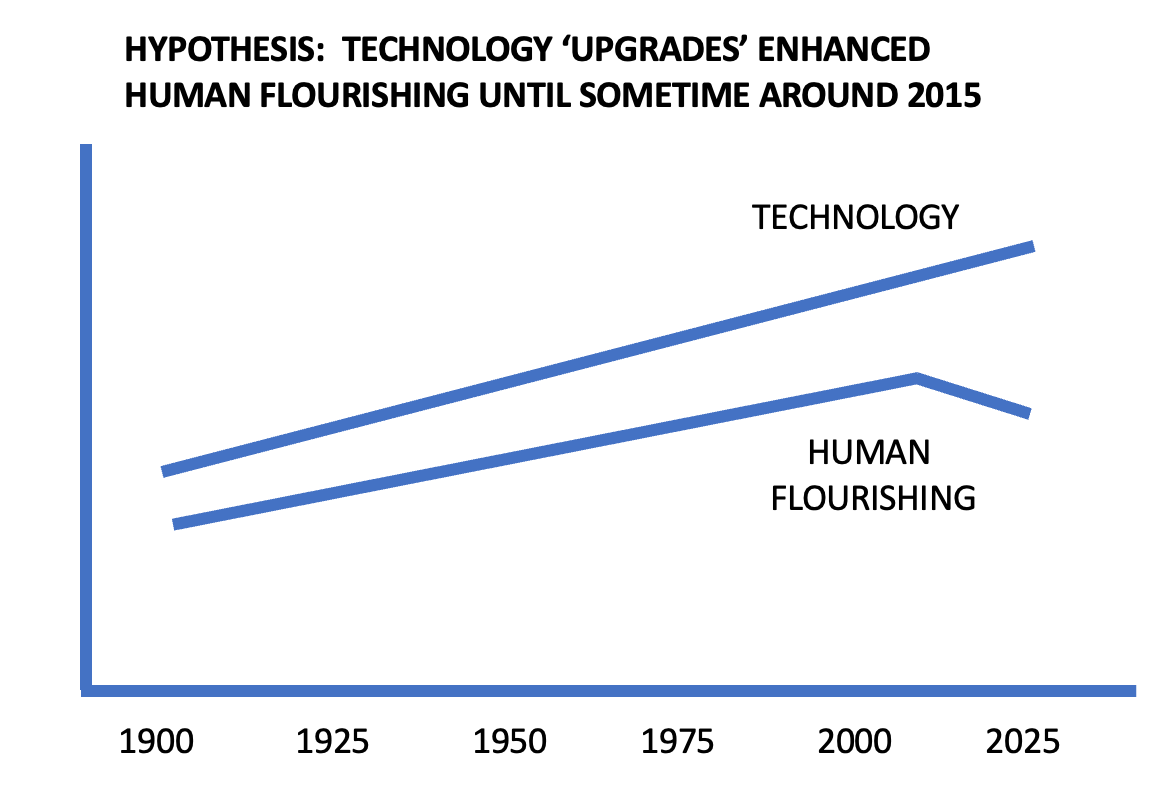
Ted Gioia believes that progress stopped in 2015 and that technocrats don't know diddly squat about human flourishing

Ted Gioia has just published an interesting polemic: I Ask Seven Heretical Questions About Progress. I'll leave you to read his seven heretical questions for yourself. But I'm quoting in full the final section of his most interesting post, with which I am deeply sympathetic. I am afraid that much current public discourse about progress is being driven by people whose minds are stuck in the 19th century world of the industrial revolution. The coupling of that mindset with current technology, particularly artificial intelligence, is a recipe of human disaster.

* * * * *

But let me move on to my radical hypotheses. (I’m running out of space, so these are much shorter.)

But each of these is a huge issue—and my views get more heterodox as you work your way down the list.

So I will need to write about this more in the future.

  1. Progress should be about improving the quality of life and human flourishing. We make a grave error when we assume this is the same as new tech and economic cost-squeezing.

  2. There was a period when new tech improved the quality of life, but that time has now ended. In the last decade, we’ve seen new tech harming the people who use it the most—hence most so-called innovations are now anti-progress by any honest definition.

  3. There was a time when lowering costs improved quality of life—raising millions of people out of poverty all over the world. But in the last decade, cost-squeezing has led to very different results, and is increasingly linked to a collapse in the quality of products and services. Some people get richer from these cost efficiencies, and a larger group move into more intensely consumerist lifestyles—but none of these results (crappy products, super-rich elites, mass consumerist lifestyles, etc.) deserve to be called progress.

    This illustrative chart suggests that technology upgrades stopped improving human life around 2015
  1. The discourse on progress is controlled by technocrats, politicians and economists. But in the current moment, they are the wrong people to decide which metrics drive quality of life and human flourishing.

  2. Real wisdom on human flourishing is now more likely to come from the humanities, philosophy, and the spiritual realms than technocrats and politicians. By destroying these disciplines, we actually reduce our chances at genuine advancement.

  3. Things like music, books, art, family, friends, the inner life, etc. will increasingly play a larger role in quality of life (and hence progress) than gadgets and devices.

  4. Over the next decade, the epicenter for meaningful progress will be the private lives of individuals and small communities. It will be driven by their wisdom, their core values, and the courage of their convictions—none of which will be supplied via virtual reality headsets or apps on their smartphones.

I still have more to say on this. But that’s plenty to chew on for the time being.

Monday, October 23, 2023

Johann Wolfgang von Goethe as Techno-Optimist of the Future

Well, I’m not proposing that we reanimate him, much less (attempt to) fetch him with a time machine. I suppose what I have in mind is that the ideal techno-optimist should be modeled on or inspired by Goethe. I got the idea from ChatGPT.

Let me explain.

At this moment the sector of the web I hang out in is getting a lot of commentary on Marc Andreesen’s The Techno-Optimist Manifesto, much of it critical. I’ve even taken a crack at it myself. But I didn’t attempt a direct critique. I pretty much ignored the content, judging it “to be an artless collection of tech-progress tropes spun-forth on autopilot.” I then went on to talk about Jack Kennedy’s 1962 “to the moon” speech, suggesting that such a speech would be impossible today because the country’s too deeply fractured. There’s no common ground adequate to serve as the foundation of such a speech.

That’s not, some might say, the most useful critique, and others are responding more directly to Andreesen. OK. But still, I stand by what I wrote.

“Perhaps, though,” I thought yesterday evening, “I can take a cue from the autopilot remark and see what a real autopilot would say.” I decided to put the question to ChatGPT. So, at 6:15 PM on October 22th I fired up the old computer. Here’s the prompt I gave it:

Imagine that you are a wealthy and successful venture capitalist with a particular interest high tech and AI. You’re dismayed at the mood of the country; it’s too negative and seems like it’s given up on the future. You decide to write a piece that will cheer people up and point the way to a better future. You call it “The Techno-Optimist Manifesto.” Now write it.

Here's the Chatster’s response:

The Techno-Optimist Manifesto: Embracing the Future with Hope and High-Tech Innovation

Dear fellow citizens,

In a world that sometimes feels mired in negativity and uncertainty, it's easy to lose sight of the incredible progress and potential that technology and artificial intelligence (AI) have to offer. As a venture capitalist deeply committed to advancing high-tech solutions and a firm believer in the power of human ingenuity, I am compelled to share with you "The Techno-Optimist Manifesto." This manifesto aims to inspire hope, rekindle enthusiasm for the future, and guide us towards a better world.

1. The Power of Technology as a Force for Good
First and foremost, we must recognize that technology, when harnessed for the greater good, has the potential to solve some of the most pressing global challenges we face. It has the power to transform healthcare, education, energy, and countless other sectors. The innovations that lie ahead will offer solutions we can hardly fathom today.

2. Embrace AI as Augmentation, Not Replacement
There is fear that AI will replace human jobs, but we must shift our perspective. AI can enhance our capabilities, not replace them. We can use AI to perform mundane tasks, allowing us to focus on what truly makes us human—creativity, empathy, and ingenuity. Think of AI as a powerful ally in our quest for a brighter future.

3. Abundance, Not Scarcity
The pessimistic view of a future with dwindling resources and overpopulation is a self-fulfilling prophecy. Innovations in agriculture, renewable energy, and sustainable practices are making it possible to create a world of abundance for all. Technology can and will help us tackle these challenges.

4. Global Collaboration for Global Solutions
Our world is more interconnected than ever before. The problems we face, from climate change to pandemics, are global in nature. We must work together, harnessing the collective power of our global community and sharing knowledge to find innovative solutions.

5. Lifelong Learning and Adaptation
As technology evolves, so must we. The key to thriving in this high-tech future is to embrace a culture of lifelong learning and adaptation. The future belongs to those who can continuously acquire new skills and stay agile in the face of change.

6. Ethical Tech and Inclusivity
We must ensure that technology is developed and deployed with ethics and inclusivity in mind. Technology should serve all of humanity, not just a select few. Let us build a future where the benefits of innovation are shared equitably, and where our values guide our technological advancements.

7. Protecting Privacy and Security
As we navigate the digital frontier, we must be vigilant in protecting our privacy and security. Technological advancement should not come at the expense of our personal freedoms. We can strike a balance that empowers individuals while maintaining a secure digital environment.

8. Innovation as a Source of Inspiration
Innovation should inspire and ignite our collective imagination. It should drive us to explore new horizons, dream big, and create a world where the possibilities are limitless.

9. Tech for Sustainability
Our planet is precious, and technology can help us protect it. From renewable energy solutions to sustainable transportation and conservation efforts, technology can pave the way for a more environmentally friendly future.

10. Never Stop Dreaming
Above all, we must never stop dreaming of a better future. It is our dreams and aspirations that fuel progress. Let's imagine a world where technology serves as a beacon of hope, lighting the way toward a brighter, more promising tomorrow.

In conclusion, "The Techno-Optimist Manifesto" is a call to action, a plea to recognize the incredible potential of technology and artificial intelligence in shaping a brighter future for all of humanity. Let us, as a society, embrace the power of innovation, and together, we can create a world that is more equitable, sustainable, and filled with boundless opportunities.

The future is not something to fear; it's something to look forward to with hope and excitement. Let us stand as techno-optimists, ready to build a world that reflects the very best of our human spirit and ingenuity.

With optimism and determination,

[Your Name] A Techno-Optimist Venture Capitalist

“Not bad,” I thought, “not bad at all.” But not wonderful either, neither was Andreesen’s. But it was certainly longer. 

I asked Chatster to elaborate on the second point, which is one Stanford’s Michael Jordan has been elaborating. Chatster did so, and I’ve appended that reply to the end of this post. Since Andreesen had inserted a longish list of important thinkers into his manifesto, I then prompted ChatGPT to offer a list. It named ten people, with characterizations of each. Ray Kurzweil was at the head of the list. I suppose that was to be expected when you consider how long he's been pushing the Singularity. Elon Musk was there too. And others. I was pleasantly surprised to see Vint Cerf there. Marie Curie was a surprise as well:

While not a contemporary thinker, Marie Curie's pioneering work in radioactivity and her relentless pursuit of scientific discovery embody the spirit of innovation and optimism that drives technological progress.

OK. How about Grace Hopper, one of the first ever to program a computer and the inventor of COBOL, one of the most popular programming languages ever, if it bit long in the tooth?

I also asked it for a list of more “classical” thinkers, since Andreesen had some of those on his list as well. I was pleasantly surprised to see Johan Wolfgang von Goethe at the head of the list, and Plato at the end. I prompted CG for more about Goethe and Faust, and he was happy to oblige. And that in turn prompted me to another prompt:

He seems a little like Plato’s ideal of the Philosopher King.

Indeed, there are certain parallels between Johann Wolfgang von Goethe and Plato's ideal of the Philosopher King. Both Goethe and the Philosopher King embody qualities that transcend traditional roles and exhibit a commitment to wisdom, practicality, and the betterment of society:

1. Wisdom and Knowledge: Both the Philosopher King and Goethe are characterized by their pursuit of wisdom and knowledge. The Philosopher King, according to Plato, is well-versed in philosophy and seeks the highest truths. Similarly, Goethe's works and his life as a scientist and scholar reflect a deep quest for knowledge.

2. Interdisciplinary Excellence: Both Goethe and the Philosopher King demonstrate an interdisciplinary approach. Goethe's expertise ranged from literature to science, and the Philosopher King in Plato's ideal is well-versed in various fields, capable of ruling with a holistic understanding of society.

3. Service to the Betterment of Society: The Philosopher King, as conceived by Plato, is driven by a sense of duty to serve the best interests of the state and its citizens. Similarly, Goethe's practical affairs as a statesman, including his efforts to reclaim land from the sea, highlight his commitment to the betterment of society through his contributions.

4. Optimism and Enlightenment: Both Goethe and the Philosopher King reflect an optimism and belief in the potential for human progress and enlightenment. They are guided by a sense of responsibility and an unwavering commitment to improving the world.

While Plato’s Philosopher King is a conceptual ideal for governance, Goethe, in his multifaceted life and work, embodies a similar spirit of wisdom and practical action. Both figures emphasize the value of knowledge, ethical leadership, and the pursuit of a better future. In this sense, they serve as inspirations for those who aim to integrate wisdom and practicality, just as “The Techno-Optimist Manifesto” encourages the integration of technology and human values for the betterment of society.

So, where are we going to find a contemporary Goethe? Not, I warrant, in Silicon Valley, which seems to be too insular and self-satisfied.

I’ve appended the parts of the dialog that I skipped over. I pick up the conversation just after ChatGPT's initial response to my prompt, which I’ve quoted in full above, and conclude just before the Philosopher King prompt.

Friday, March 3, 2023

Glenn Loury & Oded Galor talk about cultural and economic growth and the origins of inequality [Progress]

This is a very important discussion.

0:00 Oded's new book, The Journey of Humanity: The Origins of Wealth and Inequality
7:58 How inequality and growth emerged over the course of human history
18:52 Breaking free of a 300,000-year-old stagnation cycle
27:24 Humanity's phase shift into modernity
33:39 Inequality and the formation of institutions
44:18 The deep links between geography and institutions
50:38 Africa, Asia, and the trials of diversity

Glenn Loury and Oded Galor (Brown University, The Journey of Humanity). Recorded January 21, 2023.

Sunday, February 19, 2023

AI and the future: Are we there yet?

Tyler Cowen has just posted a section from his current Bloomberg column: Why AI will not create unimaginable fortunes. I responded:

Interesting. I wonder what the lifetime is going to be for LLMs? Didn't I just read a tweet stream the suggested it might cost a billion dollars to train one in the not-so-distant future?* That doesn't strike me as being very sustainable. Geoffrey Hinton has speculated that we'll have neuromorphic computers in the future. They'll take much less power: "It'll be used for putting something else: It'll be used for putting something like GPT-3 in your toaster for one dollar, so running on a few watts, you can have a conversation with your toaster." I don't recall if he offered a time horizon, but I don't think so. I do think, though, that he is more or less right about that. So, What comes first: neuromorphic GPT-3 in your toaster or a $10B training regime for GPT-42? What about a neuromorphic gardner?

I think Tyler's right about this: "AI services will enter almost everyone’s workflow and percolate through the entire economy. Everyone will be wealthier, most of all the workers and consumers who use the thing." At least about the percolate. As for wealth, who knows? Of course, "wealth" is a capacious concept. So again, who knows?

Andreessen has speculated that AI will migrate from being a feature bolted onto a product (like Sydney and Bing – soon to be a situation comedy, "The Honeymooners") to being the foundation of products. I think that's right, and speculated in that direction over a decade ago. What about the operating system? But, who wants an AI that someone else owns to control the operating system of their computer? Maybe it'll be one of Hinton's autonomous neuromorphic AIs.

In the end Gary Marcus is surely going to see a robust symbolic component integrated into these so-called foundation models. What's the time course on that going to be?

I mean, in a way, I guess the question I'm posing is something like this: Have we just entered a civilizational singularity, in von Neumann's phrase:

centered on the accelerating progress of technology and changes in the mode of human life, which gives the appearance of approaching some essential singularity in the history of the race beyond which human affairs, as we know them, could not continue.

To what extent is Tyler's sense of the future, or mine, or yours, or anyone else's, to what extent are our ideas dominated by the pre-singularity world in which we've grown up? If the world is changing fundamentally, how can we possibly guestimate what's coming down the pike? And we're ALL – Andreessen, Sam Altman, Geoffrey Hinton, Eliezer Yudkowsky, the whole kit and caboodle – in the same antique boat.

Unless AI is severely constrained or even wiped out, our successors will be living in a world that is very different from ours. Everything will be changed: business, governance, work and leisure, everything. We’re going to see new institutional forms.

And so forth.

But it’s all limited by how fast humans can change: What about the ability of one generation to raise a cohort whose sense of the world is fundamentally different from theirs? What does generational interaction over the last half-century tell us about that, if anything? An old post, The Demise of Deconstruction, speaks to that in the intellectual sphere. This post looks at generational succerssion in the world of novels, The Direction of Cultural Evolution, Macroanalysis at 3 Quarks Daily.

See also my recent post, What are the 10–20 year prospects for AI? Three paragraphs from the beginning:

My friend in venture capital, Sean O’Sullivan (who was my boss at MapInfo in the ancient days), tells me there are three time-horizons: 3 months, 12 months, and three years. So, in talking about 10-20 years I’m way out over the end of my skis. That’s fine. But let’s begin by looking at those near-term prospects, the ones on which money is ventured – and lost or gained. If we set the clock at November 31, 2022, when ChatGPT was released to the public, then we are over 2/3 of the way into the first time-horizon. What has happened?

WOOSH!!! That’s what.

The public at large is more aware of AI than they have been before. In particular, the number of people who have been able to interact directly with an advanced AI (as opposed to Siri, Alex, and the like) has gone up dramatically, though, with more than 30 million users world-wide, it would still be less than 10% of the population of the United States. And that’s a lot.

Ever onward.


* Regarding the high cost of compute for training, here we go:

Regarding parameter counts growth, the industry is already reaching the limits for current hardware with dense models—a 1 trillion parameter model costs ~$300 million to train. With 100,000 A100s across 12,500 HGX / DGX systems, this would take about ~3 months to train. This is certainly within the realm of feasibility with current hardware for the largest tech companies. The cluster hardware costs would be a few billion dollars, which fits within the datacenter Capex budgets of titans like Meta, Microsoft, Amazon, Oracle, Google, Baidu, Tencent, and Alibaba.

Another order of magnitude scaling would take us to 10 trillion parameters. The training costs using hourly rates would scale to ~$30 billion. Even with 1 million A100s across 125,000 HGX / DGX systems, training this model would take over two years. Accelerator systems and networking alone would exceed the power generated by a nuclear reactor. If the goal were to train this model in ~3 months, the total server Capex required for this system would be hundreds of billions of dollars with current hardware.

This is not practical, and it is also likely that models cannot scale to this scale, given current error rates and quantization estimates.

The practical limit for a Chinchilla optimally trained dense transformer with current hardware is between ~1 trillion and ~10 trillion parameters for compute costs. With future reports, we will discuss this band more for both dense vs. sparse models and the cost competitiveness of Google’s TPUv4, TPUv5, Nvidia A100, H100, and AMD MI300. Data is another problem that we can cover in the future.

Wednesday, December 14, 2022

Fusion, we have achieved ignition! But why so long, and when will it be practical? [Progress]

Kenneth Chang, Scientists Achieve Nuclear Fusion Breakthrough With Blast of 192 Lasers, NYTimes, Dec. 13, 2022.

“This is such a wonderful example of a possibility realized, a scientific milestone achieved, and a road ahead to the possibilities for clean energy,” Arati Prabhakar, the White House science adviser, said during a news conference on Tuesday morning at the Department of Energy’s headquarters in Washington, D.C. “And even deeper understanding of the scientific principles that are applied here.”

If fusion can be deployed on a large scale, it would offer an energy source devoid of the pollution and greenhouse gases caused by the burning of fossil fuels and the dangerous long-lived radioactive waste created by current nuclear power plants, which use the splitting of uranium to produce energy.

Yes! But why has this taken so long? When we set out to create an atom bomb in WWII we had success within a couple of years. In 1960 President Kennedy said we’ll be on the moon within a decade, and we were. A decade later President Nixon accounted an all-out government-funded war on cancer. I suppose we’ve made some progress, but not much, and success is not in sight. Why do some such efforts succeed while others go on and on?

We’ve been working on fusion power since the late 1950s. Why’s it taken us so long to get this far? And we still have a way to go to make it practical. On the face of it would seem that some engineering projects are more complex than others, way more complex. See this post from a year ago, Types of Research, R&D ventures, by ‘guesstimated’ probability of success [Progress].

Later:

Fusion would be essentially an emissions-free source of power, and it would help reduce the need for power plants burning coal and natural gas, which pump billions of tons of planet-warming carbon dioxide into the atmosphere each year.

But it will take quite a while before fusion becomes available on a widespread, practical scale, if ever.

“Probably decades,” Kimberly S. Budil, the director of Lawrence Livermore, said during the Tuesday news conference. “Not six decades, I don’t think. I think not five decades, which is what we used to say. I think it’s moving into the foreground and probably, with concerted effort and investment, a few decades of research on the underlying technologies could put us in a position to build a power plant.”

There’s more at the link.

Monday, May 30, 2022

Visionary Papers at the edge of the coming Diamond Age [Progress Studies]

Michael Nielsen has a very interesting essay about visionary papers, Working notes on the role of vision papers in basic science. Here's his initial list:

He lists more visionary papers in a footnote:

A few vision papers I very much like: Gordon Moore's 1965 paper on his now-eponymous law; Doug Engelbart's 1962 paper on augmenting human intelligence; Rainer Weiss's early work on gravitational wave detection (and some followups, e.g., the 1983 NSF report on LIGO – many megaprojects presumably start out with visionary grant proposals); Lynn Margulis on endosymbiosis, and her collaboration with Lovelock on Gaia; the early papers on connectomics, circa the early 2000s; Alan Turing's 1950 paper on artificial intelligence and his 1952 paper on morphogenesis; David Deutsch's 1980s papers on quantum computing; Ted Nelson and Bret Victor's many wonderful imaginings about the future of media, thinking, and computers; Claude Shannon's 1940s papers on information theory; Neal Stephenson's book "The Diamond Age"; parts of Vernor Vinge's work; Tim Berners-Lee's proposal for the web; Adam Marblestone's proposals, many of which involve mapping or interfacing with the brain in some way, but which also branch out into other areas; Richard Feynman's papers on quantum computing and molecular nanotechnology; Freeman Dyson's multiple visions of future technology. Curiously, all but one of these people are men. In part this is because most of the papers have been around for quite some time, and science used to be more male-dominated. It's partly because I'm most familiar with physics and adjacent fields, which are also more male-dominated than most sciences. Still, I'd be curious to hear of more vision papers from women.

Here's a visionary paper by a woman:

Miriam Lipschutz Yevick, Holographic or fourier logic, Pattern Recognition, Volume 7, Issue 4, December 1975, Pages 197-213, https://doi.org/10.1016/0031-3203(75)90005-9

I learned about it in Karl Pribram's 1971 Languages of the Brain. It should be front and center in current discussions of symbols and neural nets in the creation of artificial minds.

I give Nielsen's paper my highest recommendation.

Addendum, 6.1.22: You know, it just hit me. I said I found out about a 1975 article by Yevick in a book published in 1971. That's obviously impossible. But I strongly associate her with Pribram. So I did a little digging. John Haugeland published an article, The nature and plausibility of Cognitivism, in the second issue of Brain and Behavior Science. Haugeland mentions Yevick's article. Pribram comments on Haugeland's article and mentions Yevick. And Yevick herself comments. That's where I found out about her article. Interestingly enough, in her comment she mentions von Neumann's 1966 Theory of Self Reproducing Automata, where he mentions that "certain objects are such that their description is more complex than the object itself."

Friday, May 27, 2022

Cultural Evolution in Deep Learning, Some Notes, 2

A couple of days ago (5.24.22) I blogged about this article:

Artem Kaznatcheev, Konrad Paul Kording, Nothing makes sense in deep learning, except in the light of evolution, arXiv:2205.10320

Now I want to say a little about why I think it is important. This is from a note I sent to Tyler Cowen at Marginal Revolution:

Why is the paper important? Well, it is about deep learning, which is a very important technology that interests both of us. That makes the paper interesting, but it’s not why I think it is important. The study of cultural evolution has been going on in one way or another for some decades going back into the 1950s (and ignoring 19th century interest in the subject). A couple years ago a professional society was formed, which is dominated by people with a biological background, people like Peter Richerson and Robert Boyd, who trained Joseph Henrich and others. These investigators regard cultural evolution as simply another mechanism for doing the job done by biological evolution, a mechanism that works more quickly and flexibly. In this tradition, if we may call it that, the benefits of cultural evolution accrue to physical human beings, just like the benefits of biological evolution. That’s fine and well, and has produced interesting and important research.

But it has nothing to say about things like music, and literature, and not much to say about technology either. Those things move too rapidly and are moreover very complex and difficult to describe. Consequently orthodox cultural evolution, if I may, misses many cultural phenomena of interest.

As you know, back in 1976 Richard Dawkins proposed the idea of memes in a final chapter of The Selfish Gene. He proposed that, just as genes are the targets of biological evolution (the argument he made in the book), so memes are the targets of cultural evolution. Unfortunately he was unable to say much of anything very interesting about these memes, nor has anyone else, though Dan Dennett has tried (and, in my estimation, failed). Consequently, meme mostly means LOLcats and allied phenomena on the web, but also a lot of pop-culture speculation about, well, culture.

This deep learning paper is important precisely because Kaznatcheev and Kording take deep learning tech as the target of cultural evolutionary change. One thing about deep learning is that so very much of the technology is on public view. We’ve got the papers, but also the GitHub code repositories and so forth. So there’s lots to look at and analyze. This paper is just a beginning for them. They’ll be collecting data and analyzing it.

https://new-savanna.blogspot.com/search/label/progress

This work is important for progress studies, not simply because it is about important technology, but for its method. Pointillistic studies of the history of technology are interesting and important. But, from my point of view, they are most important as starting points for evolutionary investigations, which are going to require a lot more digging in the archives and computational investigation of libraries, document collections, and so forth.

These are the good old days, the best days are yet to come.

Friday, April 1, 2022

Jason Crawford: What happened to belief in progress?

Jason Crawford, The Lure of Technocracy, The Roots of Progress, March 31, 2022.

I’ve said that society was generally optimistic about progress until the early 20th century, and lost that confidence in the World Wars. By the late 20th century, from about the 1970s on, a deep skepticism and distrust of progress had come to prominence. But what happened in between?

I have a new theory about what characterized the attitude toward progress (in the US, at least) from about the 1930s through the ‘60s. It’s just a hypothesis at this stage, but it goes like this:

The 19th century was dominated by a belief in the power of human reason and its ability to advance science and technology for the betterment of life. But after World War I and the Great Depression, it got harder to believe in the rationality of humanity or in the predictability and controllability of the world.

The generation that went through these shocks, however, was not ready to give up on the idea of progress. They still wanted progress and still believed that reason could achieve it—but they worried that the masses could not be trusted to be rational, and that progress could not be left to the chaos of democracy and free markets. Instead, progress was to be achieved by a technical elite that would exercise top-down control.

The purest form of this, perhaps, found expression in early Communism, which valorized industrial production but sought to achieve it by subordinating the individual to totalitarian rule. The US was too individualistic for that—but it evolved its own flavor of the idea that I’m just starting to understand. Call it “technocracy.” [...]

In the early 1970s, a perfect storm of events conspired to discredit the technocratic idea, including Vietnam, Watergate, and the oil shocks. By 1973 it was clear that our leaders were unfit to govern, in terms of either competence or ethics: they could not handle affairs at home or abroad, neither the economy nor foreign policy, and they were plagued by scandal.

From the 1970s on, the conversation changed. The belief in progress was not totally dead. But the idea that it could be achieved centrally by the elites held much less sway, and there was a major new element of distrust and skepticism at the very idea of progress—an element that has not gone away, and indeed by today has gone mainstream.

There's more at the link.

Contrast with the somewhat different views of Tim Burke, which I've excerpted here.

Thursday, July 29, 2021

When did the future become a site for human habitation like, say, crossing the ocean to colonize the New World?

We’ve always thought about the future: Where’s the next meal coming from? How do we prepare for the festival? Will the harvest be good this year? What’ll I leave the grand kids? I have something different in mind. When did we start thinking about the future as a time and place when things would be different from they are now, when they would be better, and made so by effort we can undertake now? When did the future become that (kind of) place?

So I put the question to the Twitterverse:

That’s interesting. Very.

I’ve been pushing the Disney line for awhile now, maybe two years. He had boundless enthusiasm for the capacity of technology and industry to create a new an better world. But as far as I can tell he’d pretty much decided that the human world was fixed in its arrangements. Of course, when I talk of Walt Disney I don’t mean merely or only Walt Disney. I’m using him as a proxy for mid-20th century America. That’s the world he spoke to and spoke for.

And that world had begun falling apart by the time Disney died in 1966: the Civil Rights movement, the anti-war movement, feminism, the counter culture (“turn on, tune in, and drop out”), the OPEC oil embargo, it just gets worse and worse. And the future, what’s that? The future is “when are we going to get out of Iraq and Afghanistan, what’s Elon up to, more wild fires?”

I note that while a lot of science fiction is set in the future, not all of it is. Star Trek is, Star Wars is not. Sometimes science fiction is set in a world that’s just another fantasy space, like Narnia or Hogwarts, but sometimes it’s set in a world that’s (supposed to be) continuous with our world, like Kim Stanley Robinson’s New York 2150, or The Ministry of the Future. Take H. G. Wells. Is War of the Worlds set in another fantasy space, that happens to look a lot like the contemporary world, or is it in a world that’s continuous with, a potential extension of, the contemporary world? And The Time Machine? I’m not sure how to answer those questions.

I do know, however, that the Progress Studies movement seems to be much more interested in the question of “What happened to flying cars?” than in “What happened to the 15-hour workweek?” Why? I suppose the movement for Basic Universal Income is a bit like a push for the 15-hour workweek, but the emphasis is different.

And then there is Godwinian “perfectibility,” which Ted Underwood mentioned in a tweet. From Wikipedia:

Believing in the perfectibility of the race, that there are no innate principles, and therefore no original propensity to evil, he considered that “our virtues and our vices may be traced to the incidents which make the history of our lives, and if these incidents could be divested of every improper tendency, vice would be extirpated from the world.” All control of man by man was more or less intolerable, and the day would come when each man, doing what seems right in his own eyes, would also be doing what is in fact best for the community, because all will be guided by principles of pure reason.

Such optimism was combined with a strong empiricism to support Godwin’s belief that the evil actions of men are solely reliant on the corrupting influence of social conditions, and that changing these conditions could remove the evil in man. This is similar to the ideas of his wife, Mary Wollstonecraft, concerning the shortcomings of women as due to discouragement during their upbringing.

I don’t think the Progress Studies folks have a clue about that sort of thing. The tech-way to human perfection is obviously through technology: the Internet, virtual reality, augmented reality, something called the Metaverse, and above all, artificial intelligence. We’re to become one with our machines, if they’ll let us. Otherwise, they'll replace us. The horror! The horror!

But does anyone else have a vision of human perfectibility?

* * * * *

Let’s look at some passages from Keynes’s famous “Economic Possibilities for our Grandchildren” (1930).

Yet there is no country and no people, I think, who can look forward to the age of leisure and of abundance without a dread. For we have been trained too long to strive and not to enjoy. It is a fearful problem for the ordinary person, with no special talents, to occupy himself, especially if he no longer has roots in the soil or in custom or in the beloved conventions of a traditional society. To judge from the behaviour and the achievements of the wealthy classes today in any quarter of the world, the outlook is very depressing! For these are, so to speak, our advance guard-those who are spying out the promised land for the rest of us and pitching their camp there. For they have most of them failed disastrously, so it seems to me-those who have an independent income but no associations or duties or ties-to solve the problem which has been set them.

I feel sure that with a little more experience we shall use the new-found bounty of nature quite differently from the way in which the rich use it today, and will map out for ourselves a plan of life quite otherwise than theirs.

Is anyone proposing to “map out for ourselves a plan of life quite otherwise than theirs”? I don’t think so. Whenever I think about that my thoughts immediately lock on to the 60s & 70s counter-culture with its vague dreams of a coming Age of Aquarius (“let the sunshine in”). What happened to that? Gweneth Paltrow and Goop, that’s what happened, and of course Oprah Winfrey.

Keynes goes on:

There are changes in other spheres too which we must expect to come. When the accumulation of wealth is no longer of high social importance, there will be great changes in the code of morals. We shall be able to rid ourselves of many of the pseudo-moral principles which have hag-ridden us for two hundred years, by which we have exalted some of the most distasteful of human qualities into the position of the highest virtues. We shall be able to afford to dare to assess the money-motive at its true value. The love of money as a possession – as distinguished from the love of money as a means to the enjoyments and realities of life – will be recognised for what it is, a somewhat disgusting morbidity, one of those semicriminal, semi-pathological propensities which one hands over with a shudder to the specialists in mental disease. All kinds of social customs and economic practices, affecting the distribution of wealth and of economic rewards and penalties, which we now maintain at all costs, however distasteful and unjust they may be in themselves, because they are tremendously useful in promoting the accumulation of capital, we shall then be free, at last, to discard.

Where are we now? Billionaires in space, that’s where. “Lifestyles of the Rich and Famous,” that’s where.

But who knows, maybe there’s hope of progress lurking beneath the surface. For inequality is an issue that’s been festering in the civic sphere ever since Occupy Wall Street went live in September of 2011, proclaiming “We are the 99%.” Meanwhile, who’s going to help us figure out how to “use the new-found bounty of nature” that will come our way when we finally come to our senses? Who’s thinking about that? For without that there can be no progress.

More later.

Friday, July 16, 2021

Where do we get our visions of the future? An informal thinking-out-loud note. [Beyond progress and low-orbit joy rides]

Let's leave "we" somewhat indefinite. And by visions of the future, I mean the kind of thing Walt Disney was pushing back on his TV program in the 1950s and 1960s, in programs about space travel, the wonders of atomic energy, and, most specifically, in a promo video he did for the Experimental Prototype Community of Tomorrow (EPCOT) in 1966 (I've embedded it below for those who haven't seen it). What was actually built as EPCOT is not at all what Uncle Walt had in mind.

Breathing Uncle Walt's fumes

What I'm coming to believe is that the kind of technotopian visions of the future coming out of Silicon Valley and elsewhere are built on the fumes of 1950s tech-infused visions of the future. They're updated with newer tech, especially computer tech and mind uploads and all that, and we now have billionaires going to low-orbit joy rides, but the underlying energy and assumptions are the same.

Dystopian science fiction

I also think that dystopian science fiction is the other side, the dark side, of that, in the way that the Monster from the Id was the dark side of Morbius's desire for superintelligence in Forbidden Planet. Thus I regard, e.g. Terminator as the spiritual heir of Forbidden Planet, with Skylab in place of the Monster from the Id and the whole earth the object of its destruction instead of Morbius safely isolated way out in space.

Meanwhile, we plan

Meanwhile, people make their plans for the future. Save money, buy a car, take a vacation, put the kids through college, whatever. Corporations have their plans. A venture capital friend of mine says there are three time horizons, 3 months, 12 months, and three years. Universities and other organizations may make their 5 year or more plans; not so much concrete actionable plans as guide points for the construction of actionable plans.

And scientists create and revise predictions about climate change. Kim Stanley Robinson writes novels which are his best guess/hope for how the future will unfold in view of climate change.

Reset, it's the 21st century

But is anyone trying to do, in and of the 21st century, what Walt Disney was doing in the middle of the previous century, where he's essentially building on 19th century assumptions about human life, the good life, and his tech vision is really the highest of the 2nd Industrial Revolution? He's taking human nature and life for granted and amplifying the good stuff with technology. What I have in mind is rethinking human nature and human life, a lot of which has been going on in the last century, and starting from some other place.

What is that other place? Maybe that's what we have to figure out. But we have to get beyond this techno-utopianism. Yes, we need to think about technology. But we need to think about and rethink so much more.

Beyond work and flying cars

Back in 1930 John Maynard Keynes imagined we'd have a 15 hour work week. Whatever happened to that? Why is it easier and more fun to think about flying cars than about a 15-hour work week?

What happened, I suspect, is that we, with our assumptions about human nature and life, have a hard time imagining what we'd do with our time if we only had to work 15 hours a week. So, if your income is high enough, when you retire, you hire a retirement coach to help you figure out what to do with the your time now that you're not working. Why do people with the ability to have earned enough that they can afford a retirement coach, why do they HAVE to hire a retirement coach? Do we have to redefine adulthood?

How about a future where people don't have to hire a retirement coach? My friend Charlie Keil wants every child to be competent in dancing and drumming by the age of five. If that were true everywhere, not just in videos of cute African kids, what kind of world would we have? Let's build our tech visions around those kinds of people. And forget all this nonsense about superintelligent machines and uploading, etc. That's projective fantasy.

EPCOT promo

This is hot hot hot in Silicon Valley. I like it too, but recognize that it is an artifact of an earlier time.

You can skip the first 5 minutes, which is about Disneyland. The future starts at 5:03, and especially 9:15, when Walt delivers his vision for the future.