Showing posts with label jivometric. Show all posts

Tuesday, July 28, 2026

The Vera Rubin Observatory in Chile has been discovering objects we hadn't even imagined existed

On the YouTube page:

Vera Rubin’s First Images JUST STOPPED THE WORLD! The Vera Rubin Observatory has already discovered objects that scientists never expected to find.

What if the most revolutionary telescope in history isn't looking deeper into space—but watching the universe change in real time? In this video, we explore the astonishing first discoveries from the Vera C. Rubin Observatory, including a 163,000-light-year stellar stream, an impossibly fast-spinning asteroid (2025 MN45), millions of newly detected celestial objects, and why astronomers believe Rubin is about to transform astronomy forever.

Unlike Hubble or the James Webb Space Telescope, Vera Rubin repeatedly scans the entire southern sky every few nights, creating a living timeline of the cosmos. That unique capability has already revealed hidden galactic structures, strange asteroid behavior, and a flood of discoveries that previous generations of telescopes completely missed.

You'll learn how Rubin's Legacy Survey of Space and Time (LSST) works, why it generates millions of alerts every night, what makes asteroid 2025 MN45 seemingly impossible according to current physics, and how the observatory is expected to map nearly 20 billion galaxies during its decade-long mission. Every image is adding new pieces to one of the biggest scientific puzzles of our time.

Could these discoveries change our understanding of dark matter, galaxy formation, planetary evolution, and even the future of our Solar System? The first images suggest we may only be witnessing the beginning.

Friday, July 3, 2026

Friday Fotos: The Last Frontier of AI

No photographs this Friday. Instead, images created by ChatGPT.

I used quite a long prompt for the first image, but the prompt came in two parts. The first part was the longest. I won’t put that up. Though I used it to ensure a rich conceptual context for ChatGPT, you don’t really need it to get a feel for what’s going on. Nor will I give you ChatGPT’s short verbal response, which I’d asked for. Why? I suppose I wanted to verify that it had “understood” the material. Anyone, I then gave it one last paragraph and asked it to base it’s image on that. I will give you that paragraph, followed by the rest of that session. After that, and “below the fold,” I give you some of the recent images that got me thinking along these lines. Click on an image to enlarge it.

* * * * *

If that's right, then the last frontier isn't more capability in the pattern-matching sense — bigger weight spaces, richer latent connections, better approximations of the associative regime. It's the specific, non-scalable, non-parallelizable fact of an individual mind's biography, which generates paths through possibility space that are real, productive, and genuinely inaccessible to any system that hasn't lived a life. That would be consistent with everything the day's argument has built toward: embodiment, developmental history, tacit knowledge distributed across time in a single nervous system rather than across space in a community or a corpus. The doppelganger, if it's ever built, would need a biography, not just a bigger dataset. And a biography, by definition, can only be lived once, by one entity, in one order. That may be the thing that doesn't scale, and it may be exactly why it counts as the last frontier rather than a soon-to-be-automated intermediate stage.

I like that, I like it a lot. Let me tell you what I’m thinking. Over the last year or so I’ve had you create a lot of images, various types for various purposes. One of the things I’ve been thinking about is creating fine-art images. Some of the images I’ve had you do are near fine art; in fact, some are parodies of existing fine art images. I’m particularly interested in the combination of concrete identifiable imagery and abstract imagery, especially abstract imagery suggesting biology (cells, DNA) and information systems. You’ve got that in this image. So let’s play around with it a little. Give me a distinctly different take on the subject. Perhaps an aerial view of some landscape where the viewing is flying over in a biomorphic vessel and the territory below flows toward natural realistic imagery in one direction and abstract informatic imagery in the opposite direction.

When I was young I was deeply impressed by a book called Pagoo, illustrated by Holling Clancy Holling. There must be copies of that on the web. I know there are since I’ve seen them. That’s tidepool imagery. Take the concept we’re evolving and apply it to that.

I’ve had you design various kinds of imaginary currency. Take the imagery we’ve been working with and base the design of imaginary currency on it. But don’t use real numbers or alphabetic characters anywhere. Yes made-up squiggles and designs that have the texture of print, but aren’t.

Now I want to go Hegelian. Think of the first image we generated as the Thesis. The next three are variations on the Antithesis. I want you to combine Thesis and Antithesis to produce a Synthesis. Render it in a square aspect ratio.

This is promising. I’ve got to eat. But I’ll be back to do some more exploration along these lines.

* * * * *

ChatGPT gave me a somewhat odd response to that, as follows:

Sounds good. This line is worth continuing: biography + tidepool ecology + information space + currency/ornament as a synthetic fine-art language.

What's odd about that? It’s just a little too specific for what I’ve been thinking. But that’s OK. I’ve collected some recent images below. These are what set me to thinking along these lines. FWIW, I’m not quite sure what I think of these images. But I do think I’ll continue experimenting. 

ADDENDUM & BTW, a couple of hours later: On the whole I find the images below the fold more compelling than those above the fold. Hmmm.....

Sunday, June 28, 2026

People made famous in paintings sing and dance mambo

Outline – Play: How to Stay Human in the AI Revolution

I've been working on this book project for some time now. An earlier title was Homo Ludens Rising: A Manifesto for the Fourth Arena and I posted an outline for the project under that title a year ago. I have since revised the project considerably, and given it a new title as well (suggested by my friend, David Porush): Play: How to Stay Human in the AI Revolution. While I have posted the new title here and there, I've not posted the new outline. Here it is, below the image which was created by ChatGPT.

The prose is entirely AI generated, the overview by ChatGPT and the rest of it by Claude. The process behind that outline, however, was long and complicated, involving both chatbots and me.

About the Book

This book explores how artificial intelligence is forcing a rethinking of what we know, how things act in the world, and what forms of life we value. Rather than treating AI primarily as a labor-displacing technology or an existential threat, it approaches large language models and related systems as cultural technologies—on a par with markets, corporations, and media—that demand new forms of epistemic trust, institutional design, and self-understanding.

The book first diagnoses how modern societies became trapped in work mode, organized around Homo economicus and equilibrium machines privileging efficiency, stability, and monetized value. The book then recovers Homo ludens—the human capacity for play, exploration, and generativity—which has always persisted in the margins, especially in art, music, and science fiction.

Midway through, the analysis shifts into speculative fiction set in the year 2150, using narrative rather than argument to make a different world feel real. In this future, a society centered in Kisangani has developed low-energy, generative forms of artificial intelligence and human–AI partnership that support play, creativity, and care rather than substitution and control. The final chapter returns to the present with a long-term orientation for building institutions, technologies, and cultural norms capable of sustaining such a transition.

Chapter 1: The Grammar of Truth, Revised

The opening chapter frames the challenge posed by contemporary AI as primarily epistemological. Large language models generate fluent and persuasive outputs without transparent grounding, unsettling long-standing assumptions about truth, authorship, and evidence. To understand why this feels so unsettling, the chapter steps back to examine how language has historically functioned as an epistemic regulator — how truth claims were once tightly bound to direct experience and communal accountability, and how modern institutions transferred that work to credentialing, citation, and peer review.

The chapter introduces a key distinction between equilibrium machines — designed to settle into stable, repetitive behavior, the engines of the Industrial Revolution — and generative machines, capable of producing structured novelty. Language itself is a generative machine; LLMs are its latest and largest instantiation. Just as the steam locomotive forced an ontological displacement by performing autonomous motion once considered uniquely animal, LLMs force one by performing linguistic performance once considered uniquely human. The unease is real, but it arises from a mismatch between new mechanisms and inherited categories, not from anything supernatural.

This reframing opens a fork that will shape the rest of the book: AI can be developed either as a substitute for human labor, reinforcing the competitive logic of Homo economicus, or as an augmentation of human generative capacity, aligned with play, exploration, and creativity. The choice is cultural and institutional, not technical. The chapter closes with a reflexive account of how it was itself produced through human-AI collaboration, using that process as a concrete case study of what institutionalization of generative machines might look like in practice.

Chapter 2: Trapped in Work Mode

This chapter shifts from machines to lived experience. It opens with a concrete and familiar phenomenon: the disorientation many men face upon retirement, evidence of a deeper cultural condition in which identity and worth have been tightly bound to work. From this starting point, the chapter generalizes: work mode is a pervasive orientation in which time is structured by schedules, worth measured by output, and personal identity tied to labor markets.

Within this framework, AI registers automatically as threat — a competitor or replacement. Contemporary fears of displacement arise less from AI's intrinsic properties than from the evaluative lens imposed by Homo economicus. The chapter is diagnostic rather than prescriptive: its task is to make the contingency of work mode visible, and to loosen the reader's identification with it.

Chapter 3: The Rise and Collapse of Homo Economicus

This chapter provides the historical backbone. Homo economicus is not a natural form of human existence but the product of specific technological and institutional developments centered on equilibrium machines. The chapter opens with hunting-and-foraging societies — presented not as romantic precursors but as sophisticated systems featuring flexible coordination and distributed intelligence — before tracing the gradual subordination of generative human capacities to equilibrium-oriented systems through agriculture, the division of labor, and finally the Industrial Revolution.

The apparent "collapse" of Homo economicus is not the failure of rationality as such, but the exhaustion of a form of life overextended beyond its proper domain. Conrad's Heart of Darkness enters here as a moral counterpoint, marking the moment when economic rationality becomes global and self-undermining.

Chapter 4: Homo Ludens — Exploration, Play, and Freedom

Homo ludens has never disappeared. It has persisted in marginal, protected, or undervalued forms: play, art, music, language, ritual, and exploration. This chapter's central claim is that human freedom and creativity are not opposed to mechanism but are grounded in a special class of mechanisms — decoupled, autonomous generative systems maintained far from equilibrium.

Play is treated not as leisure or escape, but as a mode of engagement in which generative mechanisms are allowed to operate openly — disciplined exploration of possibility rather than chaotic freedom. By the chapter's end, Homo ludens is no longer a romantic ideal but a viable and already-existing mode of life, newly salient as generative machines re-enter the center of social and cultural life.

Chapter 5: Science Fiction Imagines the Future

Science fiction has long functioned as a collective ludic laboratory — a cultural space in which societies explore alternative forms of life unconstrained by existing economic arrangements. Moving through Forbidden Planet, 2001: A Space Odyssey, The Matrix, and Spielberg's A.I., the chapter arrives at its central case: the Star Trek universe, which is fundamentally post-scarcity. In that world, exploration, learning, diplomacy, and self-cultivation replace work mode as the primary orientation. Deep Space Nine complicates this without abandoning the baseline, reintroducing moral ambiguity and political conflict. The chapter pays particular attention to the Trill and the Changelings as early narrative explorations of distributed identity and non-unitary selfhood — anticipating the doppelganger concept developed in later chapters.

Science fiction emerges not as speculative appendix to theory but as a parallel cognitive technology, preparing readers to inhabit rather than merely analyze an alternative world.

Chapter 6: The Transformation — Kisangani 2150

This chapter marks a deliberate shift in mode. Having established ludic principles conceptually, the book moves fully into speculative narrative to explore what happens when those principles become the organizing basis of a society. The setting is Kisangani in the year 2150, developed in dialogue with Kim Stanley Robinson's New York 2140.

The narrative centers on the Mystic Jewels — a loosely coordinated transnational network of dissidents, creatives, and technologists who converge on Kisangani over the late 21st and early 22nd centuries, experimenting with alternative institutional forms and generative technologies. Their relative invisibility is described using Wakanda-style stealth as a metaphorical shorthand. The chapter culminates when the Jewels reveal themselves publicly — not as revolution, but as the exposure of an already-functioning alternative. Ludic mode, long practiced in protected spaces, is shown to be capable of scaling into a viable social order.

Chapter 7: At Play in a World of Doppelgangers

This chapter allows the reader to inhabit a mature ludic society from the inside, through extended dialogue among young Kisanganians and their Mirrors — computational doppelgangers that function not as tools or replacements but as long-term cognitive partners. The chapter centers on ritual moments that articulate the ethical settlement Kisangani has reached with artificial intelligence, including an adolescent initiation ritual and a later rite confronting the asymmetry between human mortality and the potential non-mortality of doppelgangers.

Kisangani's doppelgangers are inseparable from its energy regime: highly efficient, continuously learning cognitive systems aligned more closely with biological nervous systems than with conventional AI infrastructure. Over time, some persist beyond the lives of their human partners, blending into the city's ecological fabric as distributed attentional processes. Intelligence in Kisangani is quiet, local, and low-legibility to the outside world. The chapter ends with a gentle destabilization of the boundary between vision and reality: the future is not argued for, but visited.

Chapter 8: A Thirty-Year Plan

The final chapter returns from Kisangani to the present, translating the book's conceptual insights into a long-horizon program of action. Using the paired figures of chess and language to represent two distinctly different computational regimes, the chapter argues that the future of AI cannot be secured by scaling existing architectures alone. Sustaining generative, continuously learning systems — capable of supporting augmentation rather than substitution — requires coordinated progress across conceptual, cognitive, technical, and institutional dimensions.

The plan presented is deliberately programmatic rather than granular. It identifies the kinds of research, institutional experimentation, and cultural reframing required if AI is to support a transition from Homo economicus to Homo ludens, without locking the future into specific technical implementations. The chapter closes by reframing "work" itself — not as labor to be optimized away, but as stewardship: the collective task of building and maintaining conditions under which generative intelligence, human and artificial, can coexist productively over time.

Welcome to the Fourth Arena.

Friday, June 19, 2026

Conversations with Tyler: A Special Conversation with Nicholas Copernicus, Adam Smith, and William Stanley Jevons

I was feeling impish this morning, so I gave Claude 4.6 Sonnet (Medium) the following prompt:

Back in the 20th century Steve Allen did a series of TV shows called “Meeting of Minds,” where people from different time periods were brought together to have a discussion. I want you to imagine a special episode of “Conversations with Tyler” in which Tyler Cowen moderates a discussion between Copernicus, Adam Smith, and Stanley Jevons on economics. For reference I have placed three documents in the project folder. Two books by Tyler Cowen, one on marginalism and the other on the Great Economists (GOAT), which has material on Adam Smith.. There’s a shorter document by Copernicus (in Latin), filename, “Copernicus on economics.”

I’ve appended its response below the entirely imaginary Five TC Bucks note. Click on the image to see the detail. Note that ChatGPT did the image, not Claude.

Conversations with Tyler: A Special Episode
Tyler Cowen in Conversation with Nicholas Copernicus, Adam Smith, and William Stanley Jevons

[Recorded live at the Mercatus Center, George Mason University. The set is the standard one — a small round table, minimal lighting, no audience. Tyler Cowen sits across from three guests who have, for the purposes of this episode, been freed from the constraints of mortality and non-overlapping centuries. Copernicus speaks through a translator when needed, though he proves surprisingly comfortable in English, given how many languages he actually commanded. Smith retains his Edinburgh-via-Kirkcaldy cadence. Jevons is precise, energetic, and fidgets with what appears to be a small logometer.]

* * * * *

TYLER: So let me start with something that might seem unfair to Nicholas, but I think actually redounds to his credit. Tyler Cowen — the other Tyler Cowen, me — has written that astronomers of the sixteenth century were sometimes better economists than the economists of the same period, because there essentially were no economists. And that you, Nicholas, were one of the first people to state the quantity theory of money. Now here's my question: did you think of yourself as doing economics, or did you think of yourself as solving a political crisis?

COPERNICUS: The distinction you draw would not have occurred to me. I was asked by the Diet of Prussia — by the princes, by the king's administrators — to address a practical emergency. The currency of this land had been debased so many times, by so many hands, in so many mints, that commerce had ceased to function in any stable way. The goldsmiths prospered — they were the only ones who could extract the silver from the degraded coin before the next debasement arrived. Everyone else suffered. So yes, I was solving a political crisis. But a crisis requires a theory, or you are merely thrashing. You cannot prescribe a remedy for a disease you have not diagnosed.

TYLER: And your diagnosis was what exactly?

COPERNICUS: That money is a mensura — a measure. It is like a unit of length or weight. If your ulna varies from day to day, you cannot do carpentry. If your currency varies in its silver content from month to month, you cannot do trade. The injury to commerce is the same in both cases, but the monetary injury is more insidious because it proceeds occulta quadam ratione — by a kind of hidden logic. People notice a bad harvest immediately. They do not immediately notice that the coin has been shaved, but they feel its effects: prices rise, foreign merchants refuse your money, the best craftsmen leave for regions with sounder currency.

SMITH: If I may — this is exactly the confusion I spent considerable effort untangling in Wealth of Nations when I took on the mercantilists. They believed that the accumulation of specie was wealth. What Canon Copernicus is describing from his Prussian experience is that even that modest goal — hoarding silver — is self-defeating. The moment you debase the coinage, you have, in a sense, exported your silver to every foreign merchant clever enough to melt the coins.

COPERNICUS: Precisely. The goldsmiths and those who know the quality of metals — they are the only beneficiaries. They collect the old coin, extract the silver, sell it at a premium, and leave behind a pile of copper. My recommendation was blunt: stop minting until the existing coin has restored its value, establish at most two mints for all of Prussia, and make the coin of one mint and one standard.

TYLER: Gresham's Law, essentially, before Gresham.

COPERNICUS: Before whom?

TYLER: Thomas Gresham. He gets credit for the principle that bad money drives out good. Roughly a generation after you stated it.

COPERNICUS: (pause) This is the way of things. Copernicus waits for Copernicus. In astronomy as in monetary theory.

JEVONS: I want to press on the word "measure," if I may. Canon Copernicus treats money as a standard — a fixed reference against which goods are priced. But what I discovered, or rather what I was forced to discover when trying to establish whether the value of gold had actually fallen after the Australian and Californian gold rushes of the 1850s, is that money itself has no fixed value. It is itself a commodity whose degree of utility — whose marginal utility, to use the language I was then working out — varies with its quantity. The quantity theory you describe is already implicit in this: flood the market with debased coin, and each unit of coin buys less, not merely because there is more of it, but because its intrinsic silver content is lower and everyone knows it. 

[Note: I did an Ngram search on “marginal utility” and found that it didn’t have an appreciable presence in books until a bit after 1880. Jevons did not use the phrase. He talked of “final degree of utility.”]  

COPERNICUS: I will not quarrel with the analysis, though your language differs from mine. What I found is that the regions of Prussia which had maintained good currency were also the regions with flourishing workshops, skilled artisans, and abundant goods. The regions with debased currency had become idle. You say this is because the marginal utility of a sound currency is higher. I say it is because craftsmen and merchants are not fools: they will go where their labor and their goods are honestly compensated. 

[I wonder what Copernicus could have understood by the phrase, "marginal utility"?] 

TYLER: Adam, let me come to you here. Smith, you spent a great deal of Wealth of Nations attacking mercantilism — the view that national wealth consists in the accumulation of precious metals. But you also granted mercantilists more credit than many of your defenders are comfortable with. You said their arguments were "partly solid and partly sophistical." What did you actually concede to them?

SMITH: What I conceded is that commerce and defense are entangled in ways that pure theory does not capture cleanly. The Navigation Acts — requiring that trade to Britain's colonies be carried in British ships — were bad economics by almost any reckoning. They raised prices, restricted trade, enriched a narrow set of interests at the expense of the broader public. But I wrote, and I meant it, that defense is of more importance than opulence, and that the Navigation Acts, whatever their economic defects, had served to maintain British naval power. One cannot always afford the luxury of consistent principle. (small smile) Though I tried to be consistent as often as possible.

TYLER: Jevons, here is a question directed at you specifically: why did it take from roughly 1776, the publication of Wealth of Nations, until 1871, the publication of your Theory of Political Economy, for economics to absorb the idea that value is determined at the margin — by the last unit, not the total quantity? Smith understood the diamonds-water paradox but did not resolve it. You resolved it. What took so long?

JEVONS: I have thought about this a great deal, and I believe the answer is that the resolution required mathematics, and economics had declined to use mathematics, or rather had not yet learned that it could use mathematics. The idea that utility diminishes with quantity is not — once stated — particularly obscure. Galileo came close to it. My precursors in the British literature, Jennings and MacLeod, came close to it. But close is not enough. You need to be able to state the law precisely, apply it to a schedule, differentiate, and find the first-order conditions. You need calculus, or at least the habit of mind that calculus cultivates. Once I had that tool in hand, the whole of exchange theory reorganized itself very quickly. I felt it opening up.

Sunday, June 14, 2026

Masterful control of all ten digits

Sunday, June 7, 2026

On Steven Spielberg, three vignettes

Wesley Morris, Why We Still Need Steven Spielberg, NYTimes, June 7, 2026.

The cultural importance of movies:

Lately, the idea of a Steven Spielberg has felt endangered. For more than 50 years, his imagery has epitomized American movies, maybe even epitomized America. He has been at the center of an industry that, if it’s not dying, is certainly diminished. The sort of original movies that made Spielberg Spielberg are virtually nonexistent, even though the two major flavors that now define the industry — global box-office smash and best picture nominee — are, with Spielberg, indistinguishable (start with “Jaws,” “Raiders of the Lost Ark,” “E.T. the Extra-Terrestrial”). More than once, he inhabited both modes within one calendar year: “Jurassic Park” in the summer of 1993, for instance, then “Schindler’s List” at the end of Hanukkah, perhaps the most triumphant single-year change-up any Hollywood director has had. (He’s still the most commercially successful director ever, and he’s tied, at 13, with William Wyler for directing the most best picture Oscar nominees.)

Popular art has always bonded us to one another, no matter what might have been cleaving us apart, no matter how different our lives or how our responses to that art diverged. And Spielberg’s films have been a premium adhesive. Not only the ones he directed but the dozens of swooshing, indelibly kooky hits unleashed by Amblin Entertainment, his production company: “Poltergeist,” “Gremlins,” “The Goonies,” the “Back to the Future” trilogy, “Who Framed Roger Rabbit,” “Arachnophobia.”

Spielberg’s stardom arose from the collision of capitalism, audacity and creative vision. His movies emerged alongside the arrival of cable television and proliferating advances in personal computing and home entertainment. I watched “E.T.” at the movies, devoured it on cable, played it on my Atari and let Michael Jackson sing me a lullaby the movie inspired him to write. (Spielberg: so titanic that the other king of pop worshiped his thrillers.)

But a kind of cultural malnourishment has set in. While you once needed a pair of hands to count the major studios, we’re on the verge of barely needing one. And the best, most lucrative ideas entail microwaved nostalgia that we all know by its legal nickname: I.P. The takeovers and reheating, the obscure metrics that ensure we never quite know exactly how popular anything is, it’s dispiriting: Pac-Man eating ghosts, algorithms keeping secrets.

Working through his parent's divorce:

“For years, I was working out my mom and dad’s divorce through my stories,” he told me. The split happened when Spielberg was about 15, but the marriage had begun to fade years before. The family dissolved, too. He went off to live with his father, Arnold, a computer engineer, in Los Angeles, while his three sisters remained in Phoenix with their mother, Leah, a classical pianist who used to operate a kosher deli. But it seems that living under the same roof didn’t significantly change how remote Arnold could feel to his son.

Over dinner one night, Spielberg told me about working on “Indiana Jones and the Last Crusade” with George Lucas. The movie reunites Harrison Ford’s Indiana with his father, a Holy Grail expert played by Sean Connery. “My contribution was: ‘OK, but I want to meet Indy’s dad, and I want them to have had years of estrangement and father neglecting son because the father was a workaholic. And this story will bring them back together again.’” When Spielberg said this, he still sounded wishful and a touch sad. Watched through the lens of his childhood, his movies can seem newly forlorn, someone blowing on a birthday cake gated with stubborn candles.

For centuries, we’ve lived with a myth that genius — male genius — expresses itself as wild eccentricity or madness, that the personality warrants a cult or a harem. Spielberg disorients in that regard. I, at least, needed a moment to absorb how familiar he felt, how familial. The man who made “E.T.” was eerily reminiscent of the woman who took me to see “E.T.” Both of them have in common a special intuition to anticipate needs we don’t know we have. My mother did it for a household. For more than half a century, Spielberg has been doing the same for a planet. [...]

Spielberg hasn’t been to see a therapist since he was in college. Instead, the movies are the arena in which he has worked on some of the mysteries he couldn’t solve on his own. What we experience as sorcery is, for him, a process of exorcism. “I can’t express enough how therapeutic and healthy it is for me to keep doing this job over and over and over again,” he said deliberatively, almost as if he was feeling this out. “I work so much out through this process. So much out. I get to bleed off some of the darkness instead of letting it fester inside me. You get to let it fester inside you.”

A six year old:

As we were getting ready to head over to “Oh, Mary!” Spielberg told me a story about the time his mother’s brother, Bernard, took him and his cousin, Paul, to visit the Lincoln Memorial. It was 1952 or ’53. He would’ve been 6. The three of them climbed the steps. “Suddenly I was standing at the foot of a scary giant,” he recalled. “I remember glancing up and being so terrified I could only look at the hands.” He fixated on how they “were overhanging the armrests” and felt the urge to flee. But something held him back. “When I turned around, I looked up at his face. At this statue. Of Lincoln. A calm washed over me. An instant connection washed over me.” His fear ceased. What arrived in its place was unabated curiosity. He began to read all about Lincoln and started making silhouette cutouts of him, an obsession you can see re-enacted in the opening scene of “Minority Report,” when a child makes a paper mask of Lincoln.

There's much more at the link.

Wednesday, May 13, 2026

Mary Magdelene: ChatGPT offers some revisionist depictions

Here's how the Wikipedia entry for Mary Magdelene opens:

Mary Magdalene (sometimes called Mary of Magdala, or simply the Magdalene or the Madeleine) was a woman who, according to the four canonical gospels, travelled with Jesus as one of his followers and was a witness to his crucifixion and resurrection. In the heavily disputed Gnostic writings, Mary Magdalene is depicted as Jesus’s closest disciple who uniquely understood his teachings, causing tension with Peter, and is honoured as the “apostle to the apostles”.

Mary Magdalene is regarded by believers as a historical figure, possibly from Magdala. She is seen as a prominent follower of Jesus who was believed to have been healed by him, supported his ministry financially, and was present at his crucifixion and burial. She played a key role among his female disciples. Overall, there is limited information about her life.

The entry continues:

Apocryphal early Christian writings often portray Mary Magdalene as a prominent, spiritually insightful figure favoured by Jesus, challenging traditional patriarchal norms. These texts have inspired modern reinterpretations of her role. During the Patristic era, Mary Magdalene was mentioned only briefly by early Church Fathers, with her image evolving from a minor gospel figure to being conflated with other women in the Bible. Eventually she became viewed in Western Christianity, largely due to Pope Gregory I's influential 591 sermon, as a repentant prostitute, despite there being no biblical basis for this portrayal.

Somewhat later:

According to the Gospel of Luke,[19] Jesus exorcised "seven demons" from Mary Magdalene. That seven demons had possessed Mary is repeated in Mark 16:9, part of the "longer ending" of that gospel – this is not found in the earliest manuscripts and is possibly a second-century addition to the original text, possibly based on the Gospel of Luke. In the first century, demons were believed widely to cause physical and psychological illness. Bruce Chilton, a scholar of early Christianity, states that the reference to the number of demons being "seven" may mean that Mary had to undergo seven exorcisms, probably over a long period of time, due to the first six being partially or wholly unsuccessful. [...]

Because Mary is listed as one of the women who supported Jesus' ministry financially, she must have been relatively wealthy. The places where she and the other women are mentioned throughout the gospels indicate strongly that they were vital to Jesus' ministry and that Mary Magdalene always appears first, whenever she is listed in the Synoptic Gospels as a member of a group of women, indicates that she was seen as the most important out of all of them.[...] That women played such an active and important role in Jesus' ministry was not entirely radical or even unique;[32][34] inscriptions from a synagogue in Aphrodisias in Asia Minor from around the same time period reveal that many of the major donors to the synagogue were women.

As witnesses:

All four canonical gospels agree that several women watched Jesus's crucifixion from a distance, with three explicitly naming Mary Magdalene as present. Mark 15:40 lists the names of these women as Mary Magdalene; Mary, mother of James; and Salome.[40] Matthew 27:55–56 lists Mary Magdalene, Mary mother of James and Joseph, and the unnamed mother of the sons of Zebedee (who may be the same person Mark calls Salome). Luke 23:49 mentioned a group of women watching the crucifixion, but did not give any of their names. John 19:25 lists Mary, mother of Jesus, her sister, Mary, wife of Clopas, and Mary Magdalene as witnesses to the crucifixion.

The Gospels make no mention of her skill at riding a motorcycle. 

A note about the images. All of them are by ChatGPT. In the first one ChatGPT uses its default photorealistic style. I asked for a Jack Kirby style image for the second. The third is a generic graffiti style, though if you look closely you'll see Ben-Day dot patterns in the skin tones that were probably inherited from Roy Lichtenstein version that I haven't uploaded (boring). The fourth one is in the style of Salvador Dali while the last is Picasso, where I specifically mentioned Guernica

Notice that in the Picasso version the woman is straddling the bike while she's standing next to it in the other versions. Also, she looks more directly at Christ than she does in the others and her jacket is unzipped. I didn't ask for those changes.

Monday, May 11, 2026

I’d forgotten how hilarious Tootsie is [Media Notes 180]

I’d seen the movie when it originally played in theaters [1982] and I’d watched it several years ago on some streaming platform (probably Netflix). I watched it again last night [May 10, 2026] and laughed myself silly two or three times, including the ending, which surprised me, and I’d seen the movie at least twice before. Nor did I remember that Bill Murray was in it, nor Dabney Coleman and Charles Durning. Did I remember Jessica Lange or Teri Garr? Maybe a little. What I mostly remember is Dustin Hoffman as Michael Dorsey, a talented actor whose intrusive perfectionism (he actually went full-tilt “method” on a 30-second gig he had as a tomato in a TV commercial) has kept directors from hiring him. So, what does he do? Out of sheer orneriness he goes up for a part an actress friend of his (Terri Garr) failed to get in a soap opera, Southwest General. And wouldn’t you know, he gets it!

And now he’s stuck as Dorothy Michaels playing Emily Kimberly, hospital administrator. Yes, he’s got a gig, an income, but now he’s got to play Dorothy Michaels to the cast and staff of the TV program. His first test as Dorothy comes the first day on set when he plays a scene with the hospital’s Chief Surgeon, known as “the tongue” among the other actresses. When Kimberly sees him going in for the kiss Dorothy bashes him on the head with her clipboard and improvises her way through the rest of the scene. It works! Other things work as well. Before you know it Dorothy’s a hit and the show picks up her option for another year. Now Michael’s stuck. Another year? Thats more than hed planned on. Way, more. No!

At one point Dorothy is talking with another cast member, Julie Nichols (played by Jessica Lange) who’s complaining about men. She tells Dorothy what she would like to hear from a man some time:

“Hey, listen. You know I'm confused about this too. I could lay a big line on you, we could do a lot of role-playing, but the simple truth is I find you very interesting and I'd really like to make love to you.”

That WOULD be refreshing now, wouldnt it?

At this point we know of course that that line is going to come back a bit later in the film, this time headed in the other direction. And it does. Michael Dorsey is at a party talking with Julie and says, “Hey, listen. You know I'm confused about this too....” As soon as he opens his mouth we know what will happen. Sure enough, he gets a glass of wine tossed in his face.

THAT’s what I remember from the movie. Not the fact that Julie’s father (played by Charles Durning) decided to court Dorothy and asks her to marry him, nor that Julie was having an affair with the director, Ron Carlisle (played by Dabney Coleman); and I’d completely forgotten that Sidney Pollack played Dorsey’s agent. So much forgetting, such a funny movie. And the movie’s title, Tootsie? That’s what Carlisle, an unrepentant sexist, called Dorothy, who didn’t like it, at all. But it stuck.

Here’s what Roger Ebert said (taken from the Wikipedia entry):

Tootsie is the kind of Movie with a capital M that they used to make in the 1940s, when they weren't afraid to mix up absurdity with seriousness, social comment with farce, and a little heartfelt tenderness right in there with the laughs. This movie gets you coming and going...The movie also manages to make some lighthearted but well-aimed observations about sexism. It also pokes satirical fun at soap operas, New York show business agents and the Manhattan social pecking order.”

Tootsie was nominated for nine academy awards and got one, Jessica Lange for Best Supporting Actress.

Friday, May 1, 2026

Why Do I Like Veronica Mars? [Media Notes 178]

I watched the series when it first aired back in 2004-2005 and liked. It seemed a bit like Buffy the Vampire Slayer, not with the mythology and such, but in underlying sensibility. We have a teenaged girl undertaking an adult role in the world. Buffy had to save it, Veronica merely solved mysteries, first of all the mystery of her best friend’s murder & her mother’s disappearance, which, I suppose, are cosmic enough.

Here’s how Wikipedia describes the show:

Veronica Mars is an American teen neo-noir mystery drama television series created by screenwriter Rob Thomas. The series is set in the fictional town of Neptune, California, and stars Kristen Bell as the eponymous character. The series premiered on September 22, 2004, during television network UPN's final two years, and ended on May 22, 2007, after a season on UPN's successor, The CW, airing for three seasons total. [...]

The character Veronica Mars is a student who progresses from high school to college while moonlighting as a private investigator under the tutelage of her detective father. In each episode, Veronica solves a different stand-alone case while working to solve a more complex mystery. The first two seasons of the series each had a season-long mystery arc, introduced in the first episode of the season and solved in the season finale. The third season took a different format, focusing on smaller mystery arcs that would last several episodes.

That’s a start.

Neptune is a small town not far from the Mexican border. It’s got a rich side and a middle class to poor side. Both sides meet in high school, where they clash. Veronica’s middle class; her murdered best friend was rich. So that’s part of the tension and the vibe, Veronica shuttling between the two. Her boy friends are from the rich side. Her running buddies, not so much. One of them is a Hispanic head of a biker gang. It’s an interesting mix.

I supposed I could say that Kristen Bell sparkles as Veronica, but I’m sure Veronica would cringe at the word “sparkles,” probably Kristen too. Heck, I cringe at it as well, but there it is. Enrico Colantoni plays her father with deadpan cool. You may have seen him as Mathesar in Galaxy Quest. Come to think of it, Veronica Mars has Galaxy Quest undertones. Overtones?

You get the idea.

Friday Fotos: Messages written in shells

Mum’s the word.

I see you.

One if by land, two if by sea.

Does not compute.

Just talking trash.

Sunday, April 19, 2026

Angine de Poitrine - Full Performance (Live on KEXP)

I first heard about these guys from (a somewhat exasperated) Rick Beato. Wings of Pegasus says (perceptively): “I’ve Been Waiting 10 YEARS FOR THIS!!!” It seems like everyone who's anybody in YouTube music commentary is commenting about them. I find them oddly endearing, and, yes, I might even go hear them live.

YouTube:

11,284,915 views Feb 5, 2026 ✪ Members first on February 4, 2026
http://KEXP.ORG presents Angine de Poitrine performing live at ESMA in Rennes, France, during Trans Musicales 2025. Recorded December 04, 2025.

Songs:
Sarniezz 00:32
Mata Zyklek 06:10
Fabienk 13:09
Sherpa 20:33

Khn de Poitrine - Microtonal Guitars
Klek de Poitrine - Drums

Host: Morgan
Audio Engineer: Matt Ogaz
Guest Audio Engineer, Mixer & Mastering: Dany Lemay

Cameras: Jim Beckmann, Carlos Cruz, Scott Holpainen & Luke Knecht
Editor: Carlos Cruz

From their Wikipedia entry:

Angine de Poitrine (Canadian French: [ãʒɪn də pwatʁɪn][1][a]) is a Québécois[b] rock[discuss] duo formed in the Chicoutimi borough of Saguenay, Quebec, in 2019. It is composed of anonymous musicians performing under pseudonyms as guitarist Khn de Poitrine and drummer Klek de Poitrine. They are known for complex, microtonal compositions in the style of math rock and experimental rock, and an absurdist public image, featuring oversized papier-mâché masks and black-and-white polka-dotted costumes.

Conceived initially as a disguise to retain audiences across back-to-back sets at a local venue, the project became the duo's primary focus. Following their debut album, Vol. 1 (2024), the band gained traction on the Quebec festival circuit, culminating in an Artist of the Year win at the 2025 GAMIQ awards. They achieved viral recognition in February 2026 when a live session recorded for KEXP accumulated millions of views. This preceded the release of their second album, Vol. II (2026), and supporting international tours.

Wednesday, April 1, 2026

Whale ropes to the sky [Adam Roberts]

So, after doing a bit of work this morning, I checked Facebook and saw that my buddy Adam Roberts had posted this:

Off dream: I had an unfamiliar laptop, and couldn't get the power cord to fit into its socket. I knew the device was almost out of power, and fumbled around with this wire. Eventually I gave up, opened the laptop and saw what I'd been writing: a poem. The only line of the poem I can remember from the dream is:

"The bombed city threw whale-ropes to the sky"

Then the screen went blank, and I knew I had lost whatever it was I had been writing. Particular type of anxiety dream.

I thought a bit and posted this reply:

Sounds like you're channeling STC. How's your laudanum supply holding out?

In Xanadu did Adam R
A sacred city rebuild.
Where mad cetaceans swam
Beneath the bombed walls
Tossing whale-ropes to the sky.

I thought some more, Shazaam! ChatGPT! I added this to my reply, courtesy of the good old Chatster:

When I asked Adam whether or not I could post his note along with my reply, he said:

Please do! I could say that, in the dream (so far as I remember it: the memory is already fading away) my understanding of "whale" was less cetecean and more an index of thickness: bombs resulting in fat, ascending pillars of smoke. But I accept that's not necessarily what the line itself suggests.

Saturday, March 21, 2026

Philosopher-Cat, contemplating the world

Saturday, January 10, 2026

Classical improvisation by a Danish American Jewish comedian, Victor Borge

I'm bumping this one to the top of the queue because 1) I want to, 2) it's my blog, and 3) Borge is wonderful.
Victor Borge never got the memo saying that classical musicians stopped improvising sometime during the middle of the 19th century. So, when a fiddle player wanted to perform a tune that Borge had heard, but never played, Borge simply improvised an accompaniment. It's a bit over the top at points, but then Borge is a comedian. Watch how the two men interact act with one another. There are points where one or the other doesn't quite know what's coming up, so they have to look and listen.
 
 
Pay attention at about 3:13, in a slow section (stuck in the middle of all the fast stuff). At about 3:43 Borge starts a nice counter melody; from 3:54 to the end it's nuts, with a nice counter melody in octaves at about 4:02. Notice the nice hesitation for the very last note, a skillful touch.

Friday, August 29, 2025

Talking Chimps and UFOs: A thought experiment

I'm bumping this to the top of the queue because I intend to put some version of it in my book in progress: PLAY: How to Stay Human in the AI Revolution.  
* * * * * 
 
This is an out-take from Beethoven’s Anvilmy book on music. It’s about a thought experiment that first occurred to me while in graduate school in the mid-1970s. Consider the often astounding and sometimes absurd things that trainers can get animals to do, things the don’t do naturally. Those acts are, in some sense, inherent in their neuro-muscular endowment, but not evoked by their natural habitat. But place them in an environment ruled by humans who take pleasure in watching dancing horses, and . . . Except that I’m not talking about horses.


It seems to me that what is so very remarkable about the evolution of our own species is that the behavioral differences between us and our nearest biological relatives are disproportionate to the physical and physiological differences. The physical and physiological differences are relatively small, but the behavioral differences are large.

In thinking about this problem I have found it useful to think about how at least some chimpanzees came to acquire a modicum of language. All of them ended in failure. In the most intense of these efforts, Keith and Cathy Hayes raised a baby chimp in their household from 1947 to 1954. But that close and sustained interaction with Vicki, the young chimp in question, was not sufficient. Then in the late 1960s Allen and Beatrice Gardner began training a chimp, Washoe, in Ameslan, a sign language used among the deaf. This effort was far more successful. Within three years Washoe had a vocabulary of Ameslan 85 signs and she sometimes created signs of her own.

The results startled the scientific community and precipitated both more research along similar lines—as well as work where chimps communicated by pressing ironically identified buttons on a computerized panel—and considerable controversy over whether or not ape language was REAL language. That controversy is of little direct interest to me, though I certainly favor the view that this interesting behavior is not really language. What is interesting is the fact that these various chimps managed even the modest language that they did.


The string of earlier failures had led to a cessation of attempts. It seemed impossible to teach language to apes. It would seem that they just didn’t have the capacity. Upon reflection, however, the research community came to suspect that the problem might have more to do with vocal control than with central cognitive capacity. And so the Gardners acted on that supposition and succeeded where others had failed. It turns out that whatever chimpanzee cognitive capacity was, it was capable of surprising things.

Note that nothing had changed about the chimpanzees. Those that learned some Ameslan signs, and those that learned to press buttons on a panel, were of the same species as those that had earlier failed to learn to speak. What had changed was the environment. The (researchers in the) environment no longer asked for vocalizations; the environment asked for gestures, or button presses. These the chimps could provide, thereby allowing them to communicate with the (researchers in the) environment in a new way.

It seemed to me that this provided a way to attack the problem of language origins from a slightly different angle. So I imagined that a long time ago groups of very clever apes – more so than any extant species – were living on the African savannas. One day some flying saucers appeared in the sky and landed. The extra-terrestrials who emerged were extraordinarily adept at interacting with those apes and were entirely benevolent in their actions. These creatures taught the apes how to sing and dance and talk and tell stories, and so forth. Then, after thirty years or so, the ETs left without a trace. The apes had absorbed the ETs’ lessons so well that they were able to pass them on to their progeny generation after generation. Thus human culture and history were born.


Now, unless you actually believe in UFOs, and in the benevolence of their crews, this little fantasy does not seem very promising, for it is a fantasy about things that certainly never happened. Further, even if this had happened, it does seem to remove the mystery from language’s origins. Instead of something from nothing we have language handed to us on a platter. We learned it from some other folks, perhaps they were little short fellows with green skin, or perhaps they were the modern style aliens with pale complexions, catlike pupils in almond eyes and elongated heads.

But, and here is where we get to the heart of the matter, what would have to have been true in order for this to have worked? Just as the chimps before Ameslan were genetically the same as those after, so the clever before alien-instruction were the same as the proto-humans after. The species has not changed, the genome is the same – at least for the initial generation. The capacity for language would have to have been inherent in the brains of those clever apes. All the aliens did was activate that capacity. Once that happened the newly emergent proto-humans were able to sustain and further develop language on their own. Thus the critical event is something the precipitates a reconfiguration of existing capabilities.

However, language origins is not our problem. We are searching for the origins of music. So, instead of alien instruction in Hebrew or Sanskrit we can imagine alien instruction in samba or polka. The basic configuration and dynamics of the story remains the same. However, to make it real we have to get rid of those aliens and their instruction. Instead of the aliens we have only our group of clever apes. They are going to have to instruct one another. What we are looking for is a a way to get a gestalt switch in group dynamics that supports new modes of neural dynamics in the brains of individuals who are interacting with one another in a group.


Let us call this the Gestalt Origins Hypothesis:
Gestalt Origins: The precursor to music arose when groups of hominids interacted in a way that triggered a new configuration of operation in their existing nervous system.
Notice that I talk of a precursor to music. I don’t think we can get from ape to music in a single bound. We need at least one precursor, something that is rhythmic, like music, but not yet fully formed. In order to get even that far, so my argument goes, our proto-humans need better control over their vocal cords than apes have, they need more rhythmic sophistication, and greater mimetic capacity.

Notice that this story says nothing about the adaptive value of music. I do intend to get around to that toward the end of the chapter, but that’s not my primary concern. My primary concern is getting our ancestors to the point where a gestalt switch can happen that will bring about a precursor to music, something we can call musicking. In order for that to happen we need to solve an adaptive problem or two. But those adaptations are not about music; they are about its precursors. Once music-making is going along smoothly we need another gestalt switch to differentiate it into language and music proper.

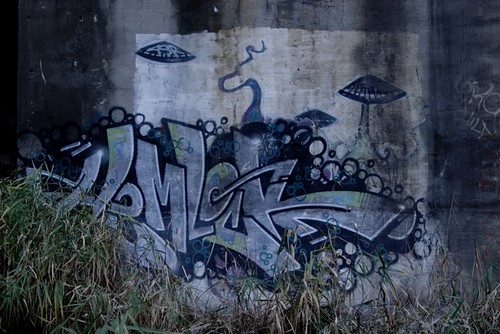
The photos show graffiti that’s at the western end of the Erie Cut (aka the Bergen Arches) in Jersey City. There are at least two layers of graffiti. The back layer contains what appear to be UFOs, though perhaps the two at the right are mushrooms. The top layer has a name, Hemlock, which is obscured by the grass to one degree or another.