Showing posts with label Baltimore_Years. Show all posts

Monday, May 19, 2025

My first band @3QD [I’m a musician]

I’ve got a new article up at 3 Quarks Daily: White Light and Basement Joy: Into The Saint Matthew Passion and Beyond.

I think of the The Saint Matthew Passion is the first I played in. Strictly speaking, no, it’s not the first. I played in marching band, concert band, and “stage” band in middle school and high school – which I discuss briefly in the article. But they weren’t MY bands in the sense that I was a founding member of the band, which was thus the creation and “property” of us founders. No, those were institutional bands, established by the school. They were good bands. I enjoyed playing in them. I learned a lot.

But they weren’t mine. The Saint Matthew Passion was. To be sure, I didn’t start the band. I was recruited to it by Jon Siskind, who started it along with some of his friends. They recruited others as well. There were seven us, four in the rhythm section and three horns. I was one of the horns.

The band was modeled after Blood, Sweat, and Tears, and Chicago (then Chicago Transit Authority). The idea was to blend jazz with rock by adding a small horn section to a standard rock rhythm section. Just what I was looking for.

* * * * *

This was back in 1969-71, when I was at Johns Hopkins. I’ve written quite a number of articles about that period in my life, which you can find by clicking this link: Baltimore_Years. One of these days I’ll write a post where I say a bit about each one of those articles and perhaps add a thing or two to place them in context among one another.

But I would like to say one more thing. Though I’d been playing music since I was ten, and had been serious about it since I was 13, I didn’t think about myself as a musician. Rather, I was a guy who played music, a lot. “Musician” wasn’t an identity I assumed.

That changed during my Baltimore period. One evening I was talking with Gren Whitman, a friend maybe 10 years older. He’s Mr. Alpha in my recent post, Breaking down monogamy in Baltimore in the early 1970s. I don’t know quite how it came about, but he told me, “No, William” – didn’t normally call me that, no one did or does, but in that situation, he did, I can even hear the faint echo of his voice in my mind’s ear – “no, William, you ARE a musician.” Just like that: “You are a musician.” I don’t think he explained – though he may have said something, nor did I ask him to, the declaration was enough. Ever since then I’ve thought of myself as a musician.

It was a simple gift, but powerful: Thanks, Gren.

Monday, April 14, 2025

I became a conscientious objector during the War in Vietnam

I don’t remember just when I became aware of the war in Vietnam, but 1964 seems like a good year. That’s when the U.S. Congress passed the Gulf of Tonkin Resolution which, in effect, authorized the country to provide military aid to South Vietnam (in its war against North Vietnam) without Congress having to pass a formal declaration of war. The war in Vietnam had begun.

I have a vague memory of being in the basement recreation room, where the TV was. I forget just what I was watching, perhaps a news report on the war, perhaps something else. My father was there. I think he’d just come down the stairs and was looking into the rec room, but wasn’t actually in the room. As I said, things were vague. I recall saying, “Don’t worry, if I have to, I’ll go.” While there had been some anti-draft protest before passage of the Gulf of Tonkin Resolution, protest activity increased after the resolution and in a year or two became large-scale protest against the war.

I would certainly have been aware of that activity – perhaps that’s what prompted my remark to Father. But I would also have been skeptical. I’d been reading Bertrand Russell by that time. I’m pretty sure I’d read his 1963 Playboy interview, in which he discussed nuclear disarmament and civil disobedience. Thus, regardless of what I actually said, that remark was surely an expression of my skepticism and uncertainty. I entered Johns Hopkins in the fall of 1965. My skepticism would grow, but it wasn’t until 1969 that I was forced to choose.

Johns Hopkins and the antiwar movement

I don’t remember just how I came to join the Students for a Democratic Society (SDS). There were a number of political clubs. I assume there was some organization based on the Democratic party and another on the Republican. I know there was a chapter of Young Americans for Freedom (YAF). Wikipedia says it was founded in 1960 at a meeting in the home of William F. Buckley. I thought of it as the right-wing near-crazies. None of those appealed to me, but I liked the sound of “participatory democracy,” so SDS it was.

I don’t remember much about SDS. We had meetings. A guy named Pete Davidovich was a sort-of leader. He had some kind of relationship – friend, girlfriend, I don’t recall – with a cool fair-haired blue-eyed blonde who went to Goucher College, an elite women’s school in Towson that functioned as a “sister” school to Johns Hopkins. There was another guy, tall, sandy-haired, dark glasses, whose politics led him to drop out in his junior year and take a job in the steel mill at Sparrows Point. And I remember that I somehow was asked to lead a meeting. So, I sat on a table at the front of the room and led the meeting. Davidovich remarked that I was the first hippie to lead an SDS meeting. I guess I was something of a hippie. I certainly had the long hair.

We went on anti-war demonstrations in Baltimore. I don’t recall how many or how often. I do know that I didn’t go to the big demonstration in Washington, the October 1967 march on the Pentagon that Norman Mailer wrote about in The Armies of the Night. It’s during this anti-war activity that I hooked up with the people I mentioned in my post, Breaking Down Monogamy in Baltimore in the early 1970s.

I also hung out in the Chaplain’s Office. Well, it wasn’t the Chaplain’s Office at first. It was just the Johns Hopkins branch of the YMCA, directed by Dr. Chester Wickwire, one of the most remarkable men I’d ever met, and who had a tremendous influence on me. He was from Denver and had toured as the tenor with an evangelist early in his life. He’d had polio and walked with a pair of arm crutches, you know, the ones that had cuffs that went around forearms and handles you gripped in each hand.

During the 1950s he led student trips to the Soviet Union in the summers. One summer his group was arrested for subversive activity of some kind and put on trial. They were acquitted, of course. It was just a sham, for propaganda. It radicalized Dr. Wickwire, who we knew affectionately as Chet the Jet. He became determined to see that that never happened in the America.

When he returned to America, he threw himself heart and soul into the civil rights movement, which is another story. When the antiwar movement emerged on campus, he championed it. When SDS held meetings, we met in Levering Hall, which was owned by the YMCA. That’s probably how I fell into Chet’s orbit.

He also ran a coffee house on Friday and Saturday nights, The Room at the Top. It was open on Friday and Saturday evenings and featured mostly local musicians, many of whom were quite good. The walls were covered with graffiti and line art, including an elaborate five-foot caricature of a 17th century aristocrat with an elaborate coat and a wig two feet high. In 1968-69 a local artist, Robert Hironimus, covered the walls with an elaborate psychedelic mural:

The Apocalypse Mural, Egypt Wall - Dr. Bob Hieronimus 

The Apocalypse Mural, Eagle Wall - Dr. Bob Hieronimus

But I digress.

The point is simple, Chet the Jet had his fingers in a lot of pies, including the anti-war movement. When the Selective Service system instituted a lottery in December of 1969. Since I had graduated in the spring, I no longer had my student deferment, a status granted to full-time college students making them exempt from conscription. As I had drawn the number 12 in the lottery, I was certain to be drafted. What could I do?

I’m drafted

I weighed my options. The easiest thing to do was simply to enter the military. But I objected to that, not simply because it was convenient, but because I objected to this particular war and to war in general. I was a pacifist. As a practical matter, with my education, I would not have been drafted into a combat unit. But I didn’t want to enter the military at all.

I could pay a psychiatrist to write a letter that would likely exempt me from service. I knew people who knew people and I was attached to one of the greatest universities in the world. If I’d wanted to, I could have done this. But it was undignified and dishonest. I could also have gotten messed up on drugs the day before my pre-induction physical in hopes of failing the drug test. This was iffy at best, but rumor had it that it sometimes worked. This was too was dishonest and distasteful.

There was another possibility. I could become a conscientious objector. That was a status established by the Selective Service System for people who were pacifists through religious belief. However, I had no conventional religious belief. I was a member of no church and didn’t attend religious services.

Wednesday, April 9, 2025

Rambling into April: 4th Arena, Patriotism, Mystery Box + stuff

Lot’s going on. Time to sort things out.

The Fourth Arena

I’m committed to writing a book with the tentative title: Welcome to the Fourth Arena: Homo Ludens Rising. Here’s my current elevator pitch:

"Welcome to the Fourth Arena: Homo Ludens Rising" charts humanity's next great leap - not toward obsolescence, but toward unprecedented forms of existence. Just as life emerged from matter and culture from life, we're witnessing the birth of entities that transcend traditional boundaries between human and artificial. Drawing on complexity science and cultural evolution, this book offers an optimistic vision of how human-AI partnerships could create genuinely new forms of consciousness, relationship, and being. For readers seeking a fresh perspective on our technological future that goes beyond both utopian and dystopian clichés.

I contacted my agent from Beethoven’s Anvil, but he’s getting out of the business so he can’t take me on. But he’s agreed to help me with the proposal. I’ve got a chapter outline (17 chapters) and a decent idea of what goes in each chapter. I’m in the process of putting finishing touches on a draft of the introduction, “The Four Arenas,” which is based on an article I’d published in 3 Quarks Daily. I’ve started work on drafting Chapter 14: “Science Fiction Imagines the Future.” That will use some material from an old 3QD piece plus some new material. This working paper contains early pre-draft material for the final chapter and background material for the two preceding chapters: Kisangani 2150: Homo Ludens Rising.

My New-Found Patriotism

I’m sure you’ve heard a saying that goes something like this: You don’t understand the value of something until it’s gone. Well, sometime during the last week, as I was thinking about the damage that Trump, with the help of Musk and a bunch of others, is doing to the country, and the world, I felt patriotic in a way I’d never felt before.

It’s MY country these people are destroying! NO.

I’ve decided that’s the topic for my next article for 3 Quarks Daily. Tentative title: “My New-Found Patriotism: Vietnam, the Draft, Mennonites, and Apollo.”  From a note I sent to friends:

Patriotism is an abstract thing, like justice, gravity, charity, evolution, and dozens and hundreds of other phenomena. All of these things have definitions, which are easily enough learned, and stories associated with them. But at some point, these things must resolved into often complex patterns of concrete events. So this article is about some of the (more or less) concrete events which give meaning to my patriotism. For someone like Trump, “patriotism” is just a word, a powerful word, he uses to get what he wants. It’s detached from any meaningful committee to and participation in the large collective effort and experiment that has been America to date.

So, the piece will be largely autobiographical, with a concentration on my years in Baltimore, when I got bachelor’s and master’s degrees at Johns Hopkins, protested against the war in Vietnam, got drafted, and performed alternative service in the Chaplain’s Office at Johns Hopkins.

I’ll also be talking about my trip to Goshen College to talk about my book on music. Why? First, because I was invited. Beyond that, Goshen College is a Mennonite school and Mennonite men are pacifists. During WWII many Mennonite men went to prison rather than serve in the army. Consequently, in order to avoid the expense and bother of criminal proceedings and imprisonment, the government decided to allow pacifists the option of performing some kind of civilian service as an alternative to going into the military. That’s what I did. I owed a debt to the older male relatives to the students I would be speaking to.

The Mystery Box Show

I’ve discovered a very interesting YouTube channel: The Mystery Box Show. Here’s how the channel describes itself;

Take a bit of The Moth, a bit of TED and throw a lot of sex into the mix and you've got The Mystery Box Show, a storytelling podcast where people tell their true stories all about sex. From the vanilla to the kinky, from hilarious mis-adventures to inspiring sexual revelations, our storytellers bare their souls and deliver their sexy secrets directly to your ears.

I’ve watched a bunch of them and have enjoyed most of them, some more than others. I’ve included one of the videos in a recent post: Can there be (sexual) pleasure and freedom in bondage?

Other things I’m working on

I’ve still got to finish my commentary on Harold Bloom and then gather that whole series together into a single document with the (tentative) title, A Quixotic Essay about Literary Criticism: Thinkers, Methods, Authority.

I’ve got to prepare some working papers. There’s that literary critics one. I also want to do something with my series on melancholy and at least one more Claude conversation: Dialog with Claude 3.5 on the Intellectual Potential of Man-Machine Interaction.

Finally, I’ve decided to write some more about my years in Baltimore, which was a very important period in my life. Between a number of posts here – most recently, Breaking down monogamy in Baltimore in the early 1970s – and at 3 Quarks Daily, I’ve already written quite a bit about that period. I’ll be writing more in the course of my patriotism essay. Then, I suppose, I could gather them all together into a single document.

And so it goes.

Sunday, March 30, 2025

Breaking down monogamy in Baltimore in the early 1970s

Was it the best of times? It certainly wasn’t the worst of times. They were for damned sure interesting times.

But no, “breaking down monogamy” probably didn’t mean whatever you think it means. Not in context. I should know. I was there, in the middle of it.

North Baltimore, near Johns Hopkins

I was living at 2935 N. Calvert St. in Baltimore, two blocks away from the campus of The Johns Hopkins University. I’d finished my undergraduate work there and was now working on a master’s degree while performing alternative service in the Chaplain’s Office at Hopkins. It was during the Vietnam War era, and I’d drawn a 12 in the draft lottery. I’d actually had my preinduction physical exam – the best hearing, off the charts, you wouldn’t believe how good – but didn’t serve in the army. Rather, I’d declared myself to be a conscientious objector to military service and was allowed to perform two years of civilian service, which I did in the Chaplain’s Office.

During that period I often went to Sunday afternoon jazz concerts in the Famous Ballroom. Those concerts, which were sponsored by the Left Bank Jazz Society, were the first time I regularly found myself in a majority black setting. It was during that period that I had my first (and only) LSD trip, which played a crucial, but obscure, role in my work on Coleridge’s “Kubla Khan.” However important those things were, this is not about them.

This is about a community I belonged to. That community was not large – most real communities aren’t – and it was about various things. One of them was something called “breaking down monogamy.” Lots of discussions about that. I listened in on some of them, and maybe I even made a remark or three. But, well, rather than try to explain further, perhaps I should just get on with the story.

Burned Out

As I said, I was living at 2935 N. Calvert St. It was a three-floor brownstone that had been divided into six apartments, two on each floor. I lived in the third-floor rear. One evening there was a fire in the building. I forget whether it was on the first or second floor, or perhaps both, but, while fire didn’t make it the third floor, smoke certainly did. And so did firemen. At least one came in through a rear window and stomped in the middle of my turntable. My apartment was a wreck.

I forget just what happened next. But for the sake of getting on with the story, let’s say that a number of people gathered in front of the building and some of my friends were among them. They invited me to sleep at their place for the night. An invitation I gratefully accepted.

The next day me and my friends, the ones I’d stayed with, but others as well, trooped over to my wreck of an apartment and started moving my stuff into their basement, by which I mean the basement of the place where I’d spent the night. For one thing, my stuff had to go someplace, and so did I. Somehow fate had decided that I would live with my friends for a while. Just how fate channeled that decision through us humans, I don’t remember.

So there we were. We got boxes from some place, carried them to my apartment, and filled them with my books, I had more than a few, and records, ditto. That took a lot of heavy boxes, each carried by one person, down two flights of stairs, out the door, around the corner and over a block to Guilford Ave., and then North two blocks. Since my apartment had been furnished, after a rather cheap fashion (student apartment), I didn’t have any furniture. Just my books, records, clothes, dishes, some paintings, and a bit of this that and the other. Not a whole lot of stuff. But it took us awhile, a half day, a day, I don’t remember. How many of us? A half dozen, maybe one or two more. It was drizzling at least part of the day. Beyond that, I can’t recall.

By the end of the day, I was living on Guildford Ave. in Baltimore, MD. I was now breaking down monogamy. Or at any rate, I was right next to the process.

Monogamy, according to the dictionary on my computer, is “the practice or state of having a sexual relationship with only one partner at a time.” That is a minimal definition. More loosely, it is about child-rearing and living arrangements. A monogamous couple lives with their children in a single dwelling unit, an apartment or a single-family home, that’s monogamy. In this sense, monogamy has been the foundation of Western society since forever. From that you may infer that breaking down monogamy has something to do with questioning the foundations of Western society. Breaking down monogamy as it was understood in this particular community was thus a political act.

The Personal is Political

I was part of a community for whom “the personal is political,” as the phrase goes. Here’s what Wikipedia says about that phrase:

In the feminist movement of the 1960s and 1970s, it was seen as a challenge to the patriarchy, nuclear family and family values. The phrase was popularized by the publication of feminist activist Carol Hanisch's 1969 essay, “The Personal Is Political.” The phrase and idea have been repeatedly described as a defining characterization of second-wave feminism, radical feminism, women's studies, or feminism in general.

I was part of a political community.

You’d probably guessed that, or something like it, when I told you that I was a conscientious objector to military service. This was the Vietnam era. But it was also the counterculture of the 1960s and 1970s. That counterculture had two strands, broadly considered. There was the anti-war movement, which protested the war in various ways, and there were the hippies, who were in favor of tuning in, which I did (I played in a rock and roll band), turning on (which I did as well), and dropping out, which I never quite managed.

I joined this community through anti-war activity on the Johns Hopkins campus (I had been a member of SDS, Students for a Democratic Society). Those guys had wives and girlfriends. Those women were central to the feminist movement in Baltimore. Among other things, they produced one of the first feminist journals, Women: A Journal of Liberation.

That’s the community I hung out with. Oh, I hung out other places as well, but yes, and looking back, those people were, for lack of a better term, they were my homies. I visited two homes quite frequently, the place where I moved, and another place, I believe it was on the same street, but a couple blocks away. We’d listen to music, get stoned, sometimes we’d dance, but always, always we talked. One thing we talked about was how the women’s movement was a mediating force between the political movement, anti-war but also civil rights (especially in Baltimore), and the cultural, sex, drugs and rock and roll movement.

Breaking down monogamy was about both culture and politics. Why? Because that’s where the family sits. It is both a cultural and a political institution. To question the family, to breakdown monogamy, is to question the whole damn edifice of Western so-called culture. Wham! What was it that Gandhi said when asked what he thought about Western Civilization? “I think it would be a good idea.” That’s what we thought as well. We were trying to make it work.

And thus it came to pass that two families decided to live in one house. I suppose I could give these families fake names, but for some reason I rather like calling them Family Alpha and Family Beta. By living together in one house, Family Alpha and Family Beta became engaged in breaking down monogamy. They took meals together, hung out together in the living room and front parlor, discussed a lot of things together, and... How were household chores distributed between men and women? I don’t remember exactly. But I assume they were more equitably distributed than was conventionally the case. What else did they do together? I suppose that to some limited extent they participated in raising one another kids together. Family Alpha had a boy of about 10 or so while Family Beta had a boy of six months or so. One thing they did NOT do, is swap wives, or swap husbands, depending on your point of view. There was no sexual or romantic adventuring going on.[1] At least not that I was aware of. Who knows what was going on two or three links away from the people I hung out with.

I don’t know what names went on the mortgage and in what roles. It wasn’t any of my business. But it’s my understanding that the Alphas and Betas owned the house jointly.

By entering that home, if only temporarily, I too became engaged in dismantling monogamy. I forget just how I participated in household chores, though I’m not sure how much that should be attributed to breaking down monogamy and how much to simply being a guest. I do remember that I went into a minor panic when I was asked to prepare a salad for an evening meal. Me? A salad? I mean, I’d been cooking for myself for years, but I never made a salad. Anyhow, I managed to rip apart a head of lettuce, do something else as well, slap some dressing on it, and call it a salad. No one complained.

Tommy

While I’m reluctant to name the adults, I can see no harm in calling Family Beta’s son by his name, Tommy. I remember that one day shortly after I’d moved in Mr. Alpha and I were in the front parlor with young Tommy. We’d set up my stereo speakers on the floor, each was about two feet high, and young Tommy was between them in his little rocker. We got a buzz on, started listening to some music, and watched young Tommy rock out.

Monday, December 5, 2022

Rahsaan Works the Crowd – August 7, 1935 to December 5, 1977

Rahsaan Roland Kirk is one of my favorite musicians. I first heard him on his album, Rip, Rig, and Panic, probably in the summer of 1966 or perhaps that fall. I heard him live three times, once in Baltimore in 1969, once a couple years later (but before I went to Buffalo in 1973) and then finally in 1977, in Buffalo. This is about the first time I saw/heard him live. It's from my book, Beethoven's Anvil: Music in Mind and Culture (Basic 2001, pp 4-6).

* * * * *

rahsaan broadcast

* * * * *

Sadness and tenderness are certainly not the only emotions elicited by musical performance. Joy and exaltation demand our attention as well. Rahsaan Roland Kirk was the most reliably joyful performer I have ever seen. I first saw him at the Morgan State Jazz Festival in 1969. It was outdoors, and at night. Bright searchlights beamed onto the stage. As Rahsaan walked onto the stage the light splintered from his black vinyl jump suit and from the complex textures created by the mantle of musical instruments Rahsaan wore like liturgical vestments. He began by rapping to the audience as he walked onto the stage, “They can keep us off the radio, but they can’t keep us outa’ the air!” He then took his band into the first number, “Volunteered Slavery,” a raunchy blues proclaiming that “If you want to know what it is to be free/ you gotta’ spend all day in bed with me.” Rahsaan did not have much of a singing voice, but he delivered the lyrics with force and vigor. He then took up his tenor saxophone and began to conjure a solo up out of the ground.

Rahsaan was a skilled and muscular saxophonist able to perform in a variety of styles from 30’s swing to 60’s freak-out. On this occasion he played straight-ahead all-out blues that achived lift-off. Rahsaan was playing a multiphonic riff on three horns at once and then simplified it to playing just the tenor sax, while his side men were riffing away. Rahsaan settled on one note and held it as the riffing grew louder. The drum figures became more complex, the piano riffing more insistant and, above all, Vernon Martin let loose a mighty thunder on the bass. As the thunder crested Rashaan began playing the concluding riff from the Beatles’ tune “Hey Jude” on his tenor sax. The musical thickness cleared away, Dick Griffen switched his trombone riff, and the audience let out a gasp. We rose to our feet with some standing on their seats. People were clapping in time to the music and swaying back and forth, together. Rahsaan had us and we were pleased to have him.

Who orchestrated this activity? In one sense the question has an easy answer: Whoever organized the 1969 Morgan State Jazz Festival. But that isn’t quite the question I’m asking. In a different sense, Rahsaan and his musicians orchestrated their performance. How did they do it? Part of the answer is traditional and banal: they practiced. Through that practice they’ve developed routines, signals, and an intuitive sense among each of them of how each of the others shapes, moves and reacts to musical flow. For all its rhetoric of spontaneity,jazz is a highly rehearsed music. The sequence of events in “Volunteered Slavery” might have been fully scripted before Rahsaan first played it with the group, though I doubt it. On the other hand, it may simply have happened that way in performance or rehearsal and worked so well that they made it their standard performance. The routine may reflect a self-organizing process typical of such musical collaboration. In either case, the performance rests on hours upon hours of rehearsal and practice by these musicians, individually and as a group.

Whatever happened among the musicians accounts for only part of the event’s orchestration, the part that happened on stage. Who organized the audience so that they knew when to gasp and rise to their feet? No one. That’s the most interesting component of this orchestration.

Of course there are conventions one follows as a member of a concert audience. You sit in your seat; you don’t talk during the performance; you applaud after a solo—this was a jazz concert, and applause after solos has been the convention for decades. And you applaud at the end of a number.

There were no conventions regarding gasping. As for clapping to the music, and standing, there certainly were people in the audience for whom those were conventional responses, as this behavior is common in churches that favor enthusiastic song from the choir and parishioners. But this was not such a church; it was a jazz festival. Beyond that, there are no conventions governing standing on one’s seat. That just happened in the enthusiasm of the moment. What I find so interesting is that so many people got enthusiastic at the same time, a time that made musical sense. People rose to their feet and then to their chairs at a point in the music where there was a major shift in the energy.

Such behavior needs to be explained—something we’ll think about later in this book. For now I would like simply to note that the distinguished historian William H. McNeill has argued in his book, Keeping Together in Time, that coordinated rhythmical activity is fundamental to life in society. By dancing together to music, by marching together in military drill, we bond with one another and become a group. In McNeill’s view human society would not be possible without such activity. Music and dance are not mere luxuries consuming resources. They are every bit as fundamental to our life as hunting or childrearing, but fundamental in a different way.

Tuesday, July 30, 2019

“It got adults off your back” – Richard Macksey remembered

The black page in Tristram Shandy

On the evening of July 22 I learned that Dick Macksey had died earlier that day. He was a Hopkins legend – a prodigious polymath who speaks who knows how many languages, a tireless teacher, a genial host, and an indefatigable conversationalist who owns more books than the Library of Alexandria, though only a few of them are quite so old. Everyone had said so for decades, and Everyone is now saying it again. The thing about legends is that they are based in fact, but are also used to distance the facts they’re based on.

I worked with Macksey for seven years between 1966, the spring of my freshman year at Johns Hopkins, and the fall 1973, when I went to SUNY Buffalo to get a doctorate in English lit. I have had occasional contact with him since then. I knew the legend. I would also like to think I glimpsed something of the man.

Progression through digression

I don’t know why I took Prof. Macksey’s course, The Autobiographical Novel, in the spring of 1966. Sure, I liked to read. But there must have been other literature courses I could have taken – for all I know, maybe I took one of them. That was a long time ago, over half a century. If I told you what I remembered of Macksey at that time would I be reporting my memories, shaky as they are, or simply giving you the legend as it has been passed down and embroidered?

Truth is, I probably took the course in part because I HAD heard the legend, about this cool professor who spoke a zillion languages, had read everything and owned half of it, could talk his way from Baltimore to Towson (just north of Baltimore for those who don’t know the area) by way of Lubbock, Timbuktu, Paris, Moscow, and Dublin, and who smoked a pipe. What’s to tell, strictly from memory?

I more or less forget what we read, but I’ve been reconstructing the list. Gradually. Likely St. Augustine’s Confessions, definitely Remembrance of Things Past (I’d never heard of Proust), A Portrait of the Artist as a Young Man (nor Joyce either), Slaughterhouse Five, Tristes Tropiques, an abridged translation – my introduction to Lévi-Strauss, The End of the Road – I believe that Barth had left Hopkins for Buffalo by that time. And for sure Tristram Shandy. Now there’s a Macksey novel, progression by digression, Laurence Stern’s method and Macksey’s too. I remember he brought a first edition to class – a little stack of smallish books.

And he would hand out a chronology for each author. Each one. All the time.

The Idea of the Theater – took that in the fall of ‘66. Did a paper on Oedipus at Colonus; used a chart in that paper. I got the idea from Lévi-Strauss’s 1955 essay, “The Structural Study of Myth”. When did I learn about Roman Jakobson’s poetic function? The Idea of the Picaro (Lazarillo, Simplicius, Moll Flanders, Felix Krull, Gully Jimson, Gnossus Pappadopoulis, who else?) – forget just when I took that one. Which course had Naked Lunch? Northrup Frye’s Anatomy? I may have taken another course with Macksey, in fact I did, a history of literary criticism – is that where we read Longinus? For sure I did an independent study, but I don’t remember the rationale, as if it mattered. It was with Macksey.

Somewhere during that time there was a visit to his house where I saw Whitehead and Russell’s three-volume Principia Mathematica stacked on a chair. My audiophile friends were impressed with the Macintosh tube amplifier. I was impressed by the oriental carpets.

To be honest – dare I admit this? – every once in awhile the intellectual virtuosity was more annoying than dazzling. For one thing after a few years I’d heard some of the riffs before. And sometimes you just wanted a drink of water, not the whole damn reservoir sluiced at you through a fire hose – to invoke the Milton Eisenhower line that’s one of the keys to the legend. I mean, come on Prof. Macksey, just get to the point.

By that time, though, I was hooked. One summer I was writing long letters, often very long letters. And I decided to insert digressions within digressions and to mark the embedding with parentheses (like this). I must have rambled some of those sentences out for half a page or more and five levels deep. It was fun. It has only just occurred to me that I must have absorbed that from Tristram Shandy via Macksey (or vice versa). But at the time I certainly did not think that’s what I was doing – at least I don’t think so. Remember, that was a loooong time ago. I was just playing around. Progression through digression.

Anyhow, I got my undergraduate degree (in philosophy) on time, the spring of 1969, and stuck around for a couple of years to get a master’s degree in the Humanities Center. This was during the Vietnam era and I’d drawn a 12 in the draft lottery. It was pretty clear that I was going to be called up. I applied for conscientious objector status and got it. I did my alternative service in the Chaplain’s Office at Johns Hopkins while writing a long and somewhat shocking thesis on “Kubla Khan”, shocking in that it was a rather inventive structuralist analysis at a time when structuralism was on its deathbed. Macksey directed the thesis and sent me off to Buffalo for a doctorate. I visited Macksey two or three times after that when I was visiting Hopkins and have had some phone calls with Dick now and then.

Mary Douglas on Tristram Shandy

One of them was late in 2003. Most likely I’d called him to talk about anime, which I’d just discovered. I don’t have any explicit record of the call, no notes, no phone bill. But I know I talked with him about anime and judging from some emails I’d sent, that must have been when I made the call.

While Dick may have seen Hayao Miyazaki’s Spirited Away, which had played in theaters in the States, he was not acquainted with anime. For that matter, I don’t really know how much I knew at the time, but certainly Spirited Away, a couple other Miyazaki films, My Neighbor Totoro, probably Princess Mononoke, and anime by others as well, Ninja Scroll, Akira, Ghost in the Shell, perhaps Card Captor Sakura. I was excited. He was interested.

He suggested I read The Electric Animal, by Akira Lippit – a friend, former student? I forget. It was indeed useful, about just why animals-as-people seemed to dominate cartoons early in the 20th century (flight from the country to the city left us hungry for contact with animals), and about one particularly gruesome episode in early cinema, the electrocution of the elephant Topsy in 1903 – Google it to see a clip – which proved suggestive in thinking about those electric elephants in the “Pink Elephants on Parade” sequence of Dumbo.

Somehow we got to talking about Mary Douglas, the anthropologist who was, in some ways, the British counterpart to Lévi-Strauss. Perhaps I’d mentioned her simply because I’d been corresponding with her subsequent to the publication of my book on music, Beethoven’s Anvil, which she had been kind enough to blurb. Or perhaps because she and I had talked about anime and manga when I visited her at Yale, where she was in residence to deliver the Tanner Lectures. One of those lectures was to be about Tristram Shandy, and she’d sent me a draft.

It turned out that Dick needed to fill a slot in the issue of MLN which had been due at the press yesterday, if not before. Perhaps she’d be interested in publishing her Tristram Shandy paper with MLN? I asked her. A bunch of emails, a few late night phone calls. Yes-no maybe sorta’. It was just a little complicated and a little frantic, by my standards if not by Dick’s. It didn’t take all that much time, it was just the pace and odd hours. The issue needed to go to press and it would be really nice to have an essay by Mary Douglas. Alas no.

I came away with the impression that the Macksey-behind-the-curtain worked really hard. Of course, anyone who knows him knew that he worked hard. How else could he get it all done, teaching four, five, six courses – and on two campuses (Arts and Sciences at Homewood, the Medical School in East Baltimore), advising the Chaplain’s Office on films (not to mention hosting discussions of them in his library screening room), the editing, the correspondence, the guests, and who knows what else? His family, Catherine and Alan! But here I’d been in the middle of the maelstrom. I’m tempted to say that I felt just a bit like Mickey Mouse drowning in that whirlpool of freely associating brooms in “The Sorcerer’s Apprentice”. But it was Macksey himself who was riding the waves and there was no sorcerer to calm the waves. He just had to ride it out.

Tuesday, July 23, 2019

The Hunt for Genius, Part 5: Three Elite Schools [RIP #RichardAMacksey]

Once more I'm bumping this to the top of the queue, this time in remembrance of Dick Macksey, who has just died, three days shy of his 88th birthday.  In 1999 he sat down with Mame Warren and talked about the history of Johns Hopkins. The material is online, voice recordings and a transcript.

* * * * *
[From Sept. 2018] 
Over the last two weeks or so I've read more than I can stand about the sad case of Avital Ronell, Nimrod Reitman, and NYU. It doesn't have to be like that, and at many places it isn't. I'm reposting this from five years ago. Note my account of graduate school at SUNY Buffalo. These accounts are of times past, over three decades ago. Adjunctification hadn't set in yet.


* * * * *
[From Oct. 2013]
The Three: The Johns Hopkins University, the English Department at SUNY Buffalo back in the 70s (hottest department in the country), and Renssalaer Polytechnic Institute.

I grew up in western Pennsylvania in a suburb of Johnstown, a small steel-making city. My father was from Baltimore and he worked with Bethlehem Mines, the mining subsidiary of the now-defunct Bethlehem Steel Corporation. My mother was a native of Johnstown, had been there for the 1937 flood, and was a full-time housewife and mother. That was typical for the time, the 1950s and into the 60s.

Mother loved gardening and she was an excellent cook and seamstress. Father was more intellectual than most engineers. In addition to playing golf, collecting stamps, and woodworking, he liked to read, both fiction and nonfiction. Both parents played the piano a bit and enjoyed playing contract bridge.

I spent many hours happily immersed in books from my father’s library (which contained many books from his father’s library): Arthur Conan Doyle, Rafael Sabatini, Rider Haggard, Charles Dickens, and Mark Twain among them. I went to school in Richland Township. The schools were above average, but not special. They did not regularly send students to elite schools.

I’d applied to three Ivies, Harvard and Yale, which turned me down, and Princeton, which wait-listed me. I’d also applied to The Johns Hopkins University, my father’s alma mater. They accepted me. That my father had gone there no doubt weighed in the decision.

A classmate of mine, quarterback of the football team, was accepted to Princeton. I believe he was the first student from the school to go to an Ivy League school. I don’t think he was very happy there.

I can’t say that I was happy at Hopkins either. But then I didn’t go there for happiness. I went there to get an education, which I did.

The Johns Hopkins University

Hopkins is probably the most distinguished of the elite schools I’ve been associated with. I did my undergraduate work there between 1965 and ’69 and then completed a Master’s degree in Humanities between 1969 and ’72 while at the same time working in the Chaplain’s Office as an assistant. This was at the tail end of the Vietnam War era and I was a Conscientious Objector to military service. I thus had to perform civilian service instead of being drafted into the military. That’s why I worked in the Chaplain’s Office.

After a so-so high school outside a small city in western Pennsylvania the intellectual life at Hopkins came as a welcome revelation to me. Ideas seemed important. Well, sorta’.

At the same time it was clear that coursework had its limitations. If a course clicked, then I tended to lose interest in assigned coursework for the last half or third of the semester. Instead, I’d immerse myself in whatever had attracted my interest. If a course didn’t click, well, I managed to stick it out.

What made Hopkins work was finding Dr. Richard A. Macksey, a polymath who taught comparative literature (in English translation for those who couldn’t read French, German, Italian, or Russian) through the interdisciplinary Humanities Center. I took several courses with him, an independent study, and subsequently did my Master’s under him. Other individual faculty were important as well, particularly Mary Ainsworth, Arthur Stinchcombe, Neville Dyson-Hudson, and Earl Wasserman.

But Macksey was the guy. Without him I’d have had a more difficult time graduating from Hopkins. He provided relief from the “system” and he knew that. Other students were attracted to him and studied with him for the same reason. He was particularly important to students interested in film since he taught a film workshop thereby enabling them to get academic credit for their passion. At least two students slightly older than me went on to distinguished careers in Hollywood (Caleb Deschenel and Walter Murch) and there may well have been others as well.

In terms of sheer brilliance I’ve never worked with anyone superior to Macksey and very few his equal. For whatever reason, he chose to work with and develop others rather than develop a large body of his own research. He taught many courses, more than required of him, and always had a group of students whom he worked with independently.

It would be interesting to compare his record as a talent scout with the record of the MacArthur Fellows Program. There would, of course, be a calibration problem. Macksey went at it for six decades or so (he only retired a couple of years ago) whereas the MFP has only been around for just over three decades. On the other hand the MFP has had more resources at its disposal.

Macksey is most-widely known, however, as the long-term editor of the comparative literature issue of MLN (Modern Language Notes) and as one of the organizers of the in/famous structuralism symposium of 1966: The Languages of Criticism and the Sciences of Man. While Jacques Derrida is perhaps the best-known figure that spoke at the symposium, he was a relative unknown at the time. In fact, he wasn’t even supposed to be there. He was invited as a last-minute replacement for Luc de Heusch. The paper Derrida delivered, “Structure, Sign, and Play in the Discourse of the Human Sciences,” undercut structuralism as a movement and made him a star.

Though I was on campus at the time I didn’t attend the symposium – it wouldn’t have done me any good as it was delivered in French. But Macksey distributed an English translation of Derrida’s paper in one of his classes and I devoured it. It became one of my central texts for a while, though it didn’t diminish my enthusiasm for Lévi-Strauss.

At the time, of course, no one foresaw the consequences of the intellectual currents that organized themselves through that conference. For one thing, the conference was organized as a new beginning, a beginning in the New World, for structuralism as an interdisciplinary mode of investigation. Instead, it functioned as the beginning of the end.
 
* * * * *

And then there is Chester Wickwire. When I entered Hopkins he was the Executive Secretary of the Levering Hall YMCA. The YMCA subsequently decided to withdraw from the campus, at which time the University took over the building and Wickwire became University Chaplain.

Wickwire was an activist. He was central to both the civil rights and anti-war movements in Baltimore. In the spring of 1966 he brought Bayard Rustin to campus, which inspired the Ku Klux Klan to burn a cross next to Levering Hall. He also ran a tutorial program in which inner city (aka ghetto) kids were brought to campus on Saturday mornings where Hopkins undergraduates helped them with schoolwork. These activities made him suspect among the more conservative folks at Hopkins.

I volunteered at the coffee shop Wickwire ran in Levering Hall, The Room at the Top, and in two film series he ran, one for classic American films and the other for foreign films. Dick Macksey advised Wickwire on films for both series and often held late-night discussions of the films at his house after the evening showing.

One summer Wickwire decided to book some films into the main campus auditorium, Shriver Hall, to raise some money. Chet was forever raising money, because, well, his programs needed it. We picked films that we thought would fill a 1000+ seat auditorium for two shows.

One of those films was John Waters’ Pink Flamingos. This was in the early 1970s before Waters had developed much of a national reputation, but he was well-known in the Baltimore area. As Pink Flamingos had never before been shown in Maryland it had to go before the Maryland Board of Censors for approval – the only such state-level board in the nation. One scene in particular was in notorious bad taste, even by Waters’s standards: a small dog defecates in front of Divine, the film’s transvestite star, and she scoops the feces up so as to deliver a ****-eating grin.

In order to provide a bit of intellectual cover for this cheapest of cheap tricks, we – I forget just who – decided that Macksey should sign a brief but edifying essay about the film. Without ever having seen the film, I drafted the essay, Macksey OKed it, and we included it in the package that went before the censors. They approved the showing and the film played to a packed house. Chet made his money and we all had some fun.

* * * * *

Finally, I should mention Lincoln Gordon. A former United States Ambassador to Brazil, he succeeded Milton Eisenhower (Ike’s brother) as university president in 1967. He introduced coeducation to the undergraduate program in 1970 and was forced out of office by the faculty in 1971. The Wikipedia says that financial problems forced him to cut budgets and that displeased the faculty. No doubt. What I remember is that for some reason the faculty thought him arrogant. Whatever.

The point is simply that faculty displeasure did force him to resign. Universities are like that, at least some of them.

Faculties are by and large intellectually conservative. Academic research and scholarship are not “boldly go where no man has gone before” kinds of business. Library stacks are finite in length and someone has always been over every inch of them at one time or another. Thus I’m pretty sure that intellectual life at Johns Hopkins is still dominated by the walls between departments that Macksey found so troublesome.

At the same time faculty members tend to be prickly and independent minded. The faculty at Hopkins forced Lincoln Gordon out; years later the faculty at Harvard would force Lawrence Summers out.

There is a certain looseness about such institutions that allows interesting people to survive here and there in little nooks and crannies. Some of them may well be geniuses, but that’s not by institutional design. It’s merely accidental.

The English Department at SUNY Buffalo

Not so long before I’d arrived there in the fall of 1973 the State University of New York at Buffalo had been a private university, the University of Buffalo, and it was still known by those initials, “UB”. The State University of New York (SUNY) system had acquired it with the intention of transforming it into a Berkeley of the East. Student riots in the early 1970s, however, scared the local gentry and they put the breaks on any massive upgrading.

But not before the Department of English had been turned into the finest experimental program in the nation and not before David Hays was able to establish an eclectic Department of Linguistics. I did most of my coursework in English, as that was the department in which I was enrolled. However, as I’ve explained elsewhere (e.g. in this essay on computational linguistics and literary study), I got my real education with David Hays. The English Department was fully aware of that and had no problems with it.

It was an extraordinary intellectual environment, as Bruce Jackson has explained in this essay:
For at least a decade, the UB English department was the most interesting English department in the country. Other universities had the best English departments for history or criticism or philology or whatever. But UB was the only place where it all went on at once: hot-center and cutting-edge scholarship and creative writing, literary and film criticism, poem and play and novel writing, deep history and magazine journalism. There was a constant flow of fabulous visitors, some here for a day or week, some for a semester or year. The department was like a small college: 75 full-time faculty teaching literature and philosophy and film and art and folklore, writing about stuff and making stuff. Looking back on it from the end of the century, knowing what I now know about other English departments in other universities in those years, I can say there was not a better place to be.
I have no reason to contradict that judgment.

Thursday, September 27, 2018

Earl Wasserman, a lifelong student, a scholar’s scholar

I’m told that he was sometimes known as “Earl the Pearl” among the English Department grad students. Why, I don’t know. Well sure, there’s the sound of the thing, but there’s got to be more than that, no? Pearl of great price? I don’t know.

To me he was Dr. Wasserman.

A couple of years ago another Johns Hopkins graduate, Shale D. Stiller, published an article about him in the alumni magazine, “Remembering a Giant: Earl Wasserman”. Among other things Stiller talked of the discrimination Wasserman had faced as a Jew:
His first choice when he entered Johns Hop­kins was to study mathematics. But he was advised that Jewish students were not welcome in the Math Department, so he migrated to English. After two years, he was accepted into the graduate program and received his doctorate four years later in 1937.
After the war Wasserman, who had served in the Pacific, decided he wanted to return, this time to the faculty. The English Department was enthusiastic, but had to overcome the anti-Semitism of the university's president, Isaiah Bowman. He joined the faculty in 1948 and stayed until his untimely death  in 1973 at the age of 59. By the time I arrived at Hopkins in the mid-1960s things had changed considerably. There were many Jews on the faculty and in the student body.

Here’s a rather different passage from Stiller's article, one that speaks to Wasserman's character:
Wasserman was tough but fair. He was intim­idating to many people. Legendary Johns Hop­kins humanities professor Richard Macksey could not say enough about Wasserman’s “passion and fervor” while teaching. “If you really wanted your battery charged, you would go in and listen to Earl for a while.” Jerry Schnydman, former director of admissions and secretary of the board of trustees at Hopkins, took Wasserman’s course on Keats and Shelley in the mid-1960s because Wasserman was “the most revered teacher at Hopkins.” Schnydman did not receive a great mark for the course, but because Wasserman happened to be his adviser, he was constrained to meet with him to approve his schedule for the next term. Schnydman approached the meeting with great trepidation because of his low mark. Wasserman immediately put him at ease by commenting that Schnydman was an A student in lacrosse (being an All-American) and that when one averaged the marks in lacrosse and Keats-Shelley, he would do well in life. He has never forgotten Wasserman's generosity.
There was a brief note at the end of the article indicating that one could get a longer version of the article by writing directly to Stiller. While I was waiting for Hurricane Sandy to blow through, I did so, and sent my own observations about Wasserman.

* * * * *

Dear Shale, if I may,

I’ve now read your longer piece about Wasserman and enjoyed it a great deal. It was good to hear those voices. I know many, perhaps most, of the people you quoted, some better than others. And I’ve had a chance to think about my own debt to Wasserman. At the same time I was struck by the thought that the world in which Wasserman was great is, if not all but gone, fading fast. And it is by no means clear what will replace it.

So, with your indulgence, I’d like to take a little time and reflect upon matters (as I await the storm that’s coming up the coast; I live in Hoboken).

I was at Hopkins from the fall of ’65 through the spring of ’73 and got a bachelors in philosophy and a masters in humanities, with literature as the area that pulled all the others together. Dick Macksey was my main professor. I took a number of courses from him, was a TA in one of his courses, and he ultimately supervised my masters thesis, which was on “Kubla Khan.” Other professors were important as well, including Mary Ainsworth in psychology, Arthur Stinchcombe in sociology, and of course Wasserman.

As I indicated in my previous note, I took his two-semester course in Romantic Literature in 68-69, my senior year. We studied Keats, Shelley, and Austen the first semester and Wordsworth, Coleridge, and Scott the second. As I vaguely recall enrollment dropped from the first to the second semester, which prompted Wasserman to lead one of the second-semester discussion sessions himself, presumably to get a better handle on his students. I was in his discussion section.

I have no specific memories from that semester, but I did become interested in Coleridge’s “Kubla Khan” and settled on that as the topic of a master’s thesis in humanities. While it was my intention to get a doctorate, this was during the Vietnam war and I had drawn a low number in the draft, making my immediate future uncertain. I’d become a conscientious objector and decided to perform my alternative service in the Chaplain’s Office at Hopkins and, while doing that, to get my masters in the Humanities Center under Macksey.

But, because “Kubla Khan” was my text, I worked fairly closely with Wasserman for a semester or two, meeting with him on a regular basis, perhaps as often as once a week. Some of our conversations were quite animated and at times it seems as through we might manage to levitate his desk. At one point I got so comfortable as to lean back in my chair and put my feet on his desk. The look he gave me, however, prompted me to remove them and to once again sit up.

There was one point where we agreed that perhaps the most important job of a scholar was to ask the right questions. Answers could always be found, but the quest must go on. At some time during this period some visiting scholar gave a lecture on Coleridge which I was unable to attend. I am told that Wasserman asked a question in my name. Or perhaps I was at the lecture, but simply kept respectfully to the rear of the room, and quiet. I don’t really recall.

All I know is that he asked a question in my name. That impressed me, not merely for the implied compliment, but more importantly, I think, for the courtesy. You quoted a passage from a letter where he talked of his intellectual life being intertwined with those of colleagues. That requires courtesy; it’s not simply that everyone’s contributions to the conversation should be acknowledged, but that keeping track of who said what is important to managing the intellectual drift of the matter. The ‘valence’ of an idea is linked to the person who thought it. To keep an intellectual community going you need to keep track of those things.

So, when Wasserman made a query in my name, I learned something about how to conduct myself in an intellectual community. And perhaps that is what I got from Wasserman. The thesis I ended up writing about “Kubla Khan” was quite different in style from Wasserman’s work. But the fact that I would devote some 70 pages to one 54-line poem, that concern about detail, that intensity, I picked up from Wasserman. That it was worth the effort; I got that from Wasserman.

In the course of working on that thesis I read everything I could find in the Hopkins library on “Kubla Khan.” That sense of thoroughness came through Wasserman. It was a matter of duty to the intellectual community.

That’s what I got from Wasserman, the feel for an intellectual community. The work itself is important, and it is work you do in a community.

I hope this is of some use to you.

Regards,

Bill Benzon

Saturday, August 4, 2018

Old School: Torpor and Stupor at Johns Hopkins

Also known as Tottle and Stutter. But the real name was Tudor and Stuart: The Tudor and Stuart Club.

The Tudor and Stuart Club was a literary society at The Johns Hopkins University in Baltimore – yes, they insist upon that “the” before “Johns” (things have changed since I wrote this) – and I was the club secretary for several years back in the late 1960s and 1970s. I don’t know just how that honor came to me. But I’d taken many literature courses as an undergraduate, half of them or so with (the now legendary deceased) Richard Macksey and the others with members of the English Department: Earl Wasserman, Donald Howard, D. C. Allen, and J. Hillis Miller. They must have decided that I had a future as a literary critic and so deserved this honor. I certainly felt honored. And pleased. I’m pretty sure it was Dick Macksey who told me.

T&S was organized to straddle the boundary between those pesky Two Cultures academic reformers are wont to natter on about [1]. The club room was located on the Arts and Sciences campus (where I was), but the Medical School (across town in East Baltimore) had an equal partnership in the club’s affairs. Sir William Osler, FRS, FRCP [2], one of the four founders of The Johns Hopkins Hospital – yes, you read right, “Sir” in the New World no less – endowed the club in 1918 as a memorial to his son, Edward Revere Osler, who was killed in World War I. Osler was a legendary character, the Father of Modern Medicine, but also a bibliophile and historian. Part of his son’s book collection went to the club, along with some of his fishing tackle – at least I think it was his Revere’s. But it might have been Sir William’s. I don’t rightly recall what I was told at the back then. Anyhow, I assure you, there was fishing tackle in the club’s oak-paneled room in Gilman Hall and that it had a distinguished provenance. Had to, it belonged to T&S!

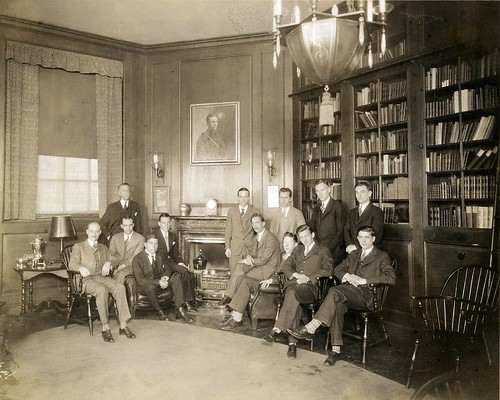
T&S club room
The Tudor and Stuart Club Room, c. 1929
Meetings were organized around an academic presentation, which was followed by cold cuts, tobacco, beer, conversation and, on a good evening, conviviality. As Sir William had been a physician, not a literary scholar or critic, the Medical School contingent and the Arts and Sciences contingent alternated in picking topics and choosing speakers for the monthly meetings.

As secretary it was my duty to go down to the Lexington Market and buy the cold cuts [3]. I forget which vendor we bought the cold cuts from, but the club had an account. I would be offered samples each time I made the monthly purchase. Pastrami, corned beef, roast beef, ham – I guess. I’d sample each, nod my approval, and the requisite poundage would be sliced, wrapped, and placed in shopping bags, one for each hand. I must have bought some cheese somewhere – not that I actually remember doing so, but I’m just saying so out of the principle of the thing, along with the bread and condiments. These things are all necessary, no? And, as they couldn’t materialize out of thin air, I must have purchased them and transported them back to the club room on meeting day.

But not before I’d been to Fader’s tobacco shop to buy the tobacco, boxes of Sher Bidis, cigars, and loose pipe tobacco of various kinds. A couple deep draughts [4] on a Bidi was good for a bright-edged buzz, and perhaps an exchange of knowing winks about inhalants used in more private settings. And sometimes those winks were exchanged between a faculty member and a student.

Oh my!

We had a standing order with Fader’s that included the club’s special mix, which was a good thing, as I surely didn’t know anything about purchasing tobacco. I can still smell the shop, well, almost, after five decades. Have you ever been in a tobacco shop? The aroma is crisp in the air, and creates the illusion that you can grasp the air. It is a delicious illusion.

I’d deliver the food and the smokes to the club room and then go over to the Faculty Club where I was one of the group that had dinner with the evening's guest speaker. The others would be faculty from both the Medical School and the Arts and Sciences School, as appropriate to meeting, guests, and club officers. The only other officer I remember is the curator, Michael Hancher, who was a young assistant professor in the English Department. The club must have had a president, a vice president, and a treasurer, but I don’t remember who they were or how they were distributed between the two schools [5]. As far as my memory is concerned, it was just me and Mike.

The worthy who had endowed the Faculty Club back, I believe, in the 1930s, also decreed that each meal should be finished with a cup of sherbet. For some reason I cannot fathom, that worthy believed that culinary elegance required sherbet, and so it was sherbet at the Faculty Club. That was fine with me. I liked sherbet (still do).

We would meet at the bar first. That’s where I learned to drink scotch. I’d never had scotch before, not at home, not otherwise at Hopkins. It started with Torpor and Stupor – I jest – at the club. Don’t ask me just how that came about, because I’d then have to fabricate an answer, which is something I’d rather not do. No doubt I followed someone’s example.

Thursday, May 5, 2016

Ecstatic Jazz @3QD

On Monday I posted a piece at 3 Quarks Daily, Ecstasy at Baltimore’s Left Bank Jazz Society. As I remark in the piece:
Best jazz venue I’ve ever been in. Of course I’ve got my quirks. I’m not a night person, so I don’t go to jazz clubs that often. By the time the music starts cookin’ at a regular club I’m ready for bed. But those sets at the Famous started at 5 PM on Sunday afternoon. Well, they were scheduled for 5 which, allowing for local quirks and prerogatives, generally translated into 5:30 PM or thereabouts.

And that was fine. Gave us time to chat, check out the used records for sale, maybe go to the Kentucky Fried Chicken around the corner and get a bucket of the Colonel’s Original. You could order something from the kitchen on the days it was open – fried chicken, collard greens, sweet potato, biscuits and gravy, grits, aka soul food. Or maybe get some set-ups, bring out your own liquor, and get loosened up. By the time the music started up we were mellowed out and ready to luxuriate in delicious sounds.

I heard a lot of great music in those days, but I don’t remember most of it. When the music goes through you, that’s it. It’s gone. Nothing to remember, though the aura lingers and one aura blends with another until all that’s left is a numinous presence in your mind: the Famous!
Here’s Rahsaan Roland Kirk – one of the musicians I heard at the Left Bank – performing with McCoy Tyner, Stanley Clarke, and Chick Corea:


Wednesday, November 5, 2014

How I Freaked the Secret Service and Lived to Tell About It

This story, like many stories, is at the confluence of many streams. The story itself is a simple one, but to appreciate the simplicity you need to know something about the contributing streams. So that’s where I’ll start. Forgive me if it takes awhile for even the hint of drama to show up.

* * * * *

The story takes place in Baltimore, Maryland, during the Summer or Fall of 1972 during the run-up to the Presidential election that year. I was working as an assistant in the Chaplain’s Office at The Johns Hopkins University. One stream is about the chaplain, Chester Wickwire, and his role in the Civil Rights movement. This stream explains how the chaplain happened to be at the event in question.

The event in question was a stop on the campaign trail – another stream. That explains the existence of the freaked out Secret Servicemen: they were accompanying Sargent Shriver, Democratic candidate for Vice President, who had a reputation as fine speaker. He was speaking before Baltimore’s Interdenominational Ministerial Alliance, an organization of black ministers who had been central to the Civil Rights movement in Baltimore. That made them central to getting out the black vote, which is why Shriver was speaking to them.

Wickwire had been deeply involved in the Civil Rights movement as well. In consequence, he was a member of the Interdenominational Ministerial Alliance. That gets him to the meeting.

* * * * *

Now we’ve got to get me hooked up with Wickwire and give me something that would freak out a handful of Secret Serviceman. That’ll take some ‘splainin’.

Oh, the freak-out is easy enough. I stood up and blew a fanfare on my trumpet. It was loud, they weren’t expecting it, and they jerked to full tactical alert. As they should. That’s what you do when you’re a Secret Serviceman on detail, you get ready for action when you hear an unexpected loud noise.

The fact that it was only a fanfare also explains why I’ve lived to tell the story despite the fact that those Secret Servicemen experienced a moment of, shall we say, heightened awareness. As soon as they saw what was going on, they relaxed. Things were cool. The ministers smiled, laughed. Shriver shook my hand, as did Parren Mitchell, one of the founders of the Congressional Black Caucus.

Things were cool. We ate lunch. And then Shriver had his head handed to him by Homer Favor. Metaphorically speaking, of course. 

* * * * *

But, I forgot. I was going to tell you how I got hooked up with Wickwire and what the bleep I was doing with a trumpet at a luncheon where Baltimore’s Interdenominational Ministerial Alliance was being wooed by the man who would later become Arnold Schwarzenegger’s brother-in-law.

OK, me and Wickwire – another stream. He was chaplain at Johns Hopkins. I was a student there, first undergraduate, then graduate. When I drew number 12 in the Selective Service draft lottery it was obvious I was going to be drafted. So I became a conscientious objector. Wickwire helped me with that, first hooking me up with counseling, then calling in favors to get Congressman to write on my behalf (Parren Mitchell and Paul Sarbanes), and then offering a me a job I could perform as my alternative service.

So, I was doing this and that in the Chaplain’s Office. What about that trumpet? Sure, I was a trumpet player, had been one for years, but what was I doing with a trumpet at a meeting where the black ministers were being serenaded along with the founder of the Peace Corps?

And it wasn’t even my trumpet. It belonged to the Chaplain’s Office. But Wickwire bought it on my suggestion. He liked stagecraft as much as the next fellow, and that’s what the trumpet was about.

* * * * *

You need to understand that, while he was Chaplain at Johns Hopkins, he was also somewhat at odds with Hopkins – yet another stream. Hopkins was a top-shelf University and for many on staff that meant that it was had to be above the political fray, and certainly above the Civil Rights movement, which had inspired the Ku Klux Klan to burn a cross on the campus in the Spring of 1966. The KKK burned that cross because Wickwire had invited Bayard Rustin to speak on campus. He also ran a tutoring program that brought black students on campus where Hopkins students helped them with their studies.

This was not consistent with a certain vision of the University as a bastion of the search for truth. Mind you, though, at one time Milton Eisenhower, brother to Ike, had been President of the University. That’s hardly above it all.

One day the clock in the Gilman Hall tower went silent. Gilman Hall was the University’s oldest building and was symbolic of the university as a whole. The clock in the tower atop Gilman Hall rang the hours, and perhaps the quarter hours too. I don’t rightly remember. In particular it rang the noon hour.

When the Gilman Hall clock sounded noon, everyone on campus knew about it. When the clock went silent, well, how the bleep did you know where you were in the day when noon wasn’t being sounded?

I took that as an opportunity for a little fun and merriment, a little showmanship, and Wickwire agreed. I went down to Ted’s Music – a wonderful little hole in a basement off Calvert Street that sold use instruments – and purchased a post-horn for the Chaplain’s Office. Post-horns are those long slender trumpets used for trumpeting the start of a horse race.

The idea is that each noon I would go out on a small balcony on the second story of Levering Hall – where the Chaplain’s Office was located and next to Gilman Hall – and sound the noon hour. Thus the Chaplain’s Office was now picking up where the official university had failed. It got us story in the campus newspaper and was, of course, lots of fun.
 

Now that the Chaplain’s Office had this post-horn we used it on other occasions as well. One of my colleagues in the office made a nice felt banner which we hung from the horn. It was a red peace symbol on a white background with yellow tassels. When Wickwire gave a speech, I’d precede him with the post horn. I blew the post horn at the beginning of Sunday morning services.

And I decided that it would be fun to blow a fanfare to welcome Sargent Shriver to Baltimore. Wickwire loved the idea.

* * * * *

Now the streams are coming together – the one about Wickwire and the Civil Right movement, the one about the 1972 Presidential campaign, the one about me and Johns Hopkins and the chaplain, and I suppose we really ought to have a separate stream about me and trumpets, but we won’t, because this story is getting too damn long.

There we are sitting in the basement of the church – just which one I don’t recall – me in my hippie clothes and long electrostatic hair and with the post horn. Oh, those ministers loved that post horn. They knew what I was going to do.

We got the word that Shriver had entered the building. I stood up, put the post horn to my mouth, and blew a mighty Joshua blast on the trumpet as Shriver’s party entered the room. Those Secret Servicemen jumped a foot into the air and a good time was had by all.

We finished lunch and it was time for the speaking. Shriver, of course, was the headliner. But Homer Favor preceded him on the bill.

Favor taught political science at Morgan State (“Teacher’s College” it was back then, now it’s “University”), a Baltimore HBCU known for its ferocious gospel choir. No more than 10 seconds or a half-minute in and I knew I was in the presence of a master orator. Favor may not have been a preacher, but he spoke like one. His speech had the cadence, the rhythm, the music, and the fire of a speech by Martin Luther King. He was that good.

I forget just what phrase he used as a refrain, but the burden was simple: When you’re in office, what’re you going to do for black people? I haven’t got the foggiest idea what Shriver was thinking during that speech. But I wouldn’t be surprised if sweat was rolling down his legs and pooling in his shoes. He had a reputation as a fine speaker, but as he soon showed, he wasn’t in Favor’s class.

When Favor was done speaking the show was, for all practical purposes, over. I remember nothing of Shriver’s speech. And George McGovern, who headed the Democratic ticker, lost the election.

Tricky Dick won.

Those were the days.