Showing posts with label graffiti essay. Show all posts

Thursday, June 10, 2021

OOO! – So That’s What You Mean [Morton and graffiti]

I'm bumping this post from April 2011 to the top of the queue in joint recognition (conjunction) of Jersey City's mural festival and the recent New Yorker article about Tim Morton.
 
* * * * *

Objects withhold themselves

This is about connections. It started – well, who knows just when it really started, but, in the immediate past, it started yesterday when I listened to a talk Tim Morton just gave at Temple. In the subsequent Q & A Tim made a remark about how he loves to return to London, his hometown, because he’s always discovering “strange pathways” affording him uncanny glimpses into his home turf. That reminded me of my early experiences photographing graffiti, and that, in turn, reminded me of a passage from J. J. Gibson, the ecological psychologist.

So I made a comment to that effect at Tim’s blog, and that was that. Except that it wasn’t. It never is, is it? I realized that Tim’s comments & the Gibson connection have given me a clue about what OOOists (object oriented ontologists) mean when they say that objects are ‘withdrawn,’ or they ‘withhold themselves.”

I slept on it, and more connections formed themselves in the meshwork that is my mind. And From Gibson I connected with one of my current hobbyhorses, and then to another, and ended up at graffiti, via ecology.

So that’s what this post is about. First I recap the comment I made at Ecology without Nature. And I jump to graffiti.

Strange Ways

On Thursday 7 April Tim Morton keynoted a symposium held at Temple University: GRID + Flow: Philadelphia and Beyond, Mapping and Reimagining Urban Ecologies through the Arts and Humanities. His topic: Ecology and Philosophy in the Time of Hyperobjects. In the subsequent question and answer session someone posed a question about non-locality. After acknowledging that Philadelphia was real, yes, really real, Tim’s answer moved to the Airporter, an airport shuttle service. What he said was that the trip from his (familiar) home to the (by now familiar) airport inevitably went by way of unfamiliar routes, giving him a strange and uncanny view of his home turf. The capacity for reliable navigation is deeply embedded within animal nervous systems and that, in particular, this entails the capacity to move to and from one’s home base (nest, den, hive, as the species may be). The shuttle picked up Tim from his home base and then immediately set out on a strange route, thus causing some discomfort to millions of years of evolutionary work enmeshed deep in his brain.

From there Tim talked about coming back to London (1:03:40) and finding all sorts of strange little places that he hadn't seen before, “strange ways of going from A to B.” That’s when it hit me: Wham!

For I’d felt that very strongly when I first began photographing graffiti in my neighborhood. The graffiti itself aside – marks of paths taken by others through my 'hood – I walk obscure and hidden pathways through my familiar neighborhood. I'd walk for, say, a mile or so behind abandoned buildings and along a railroad track and take and turn and then another and suddenly, Bingo! There I am in this place I've been through time and again. But never by the route I just took. That place had become, all of a sudden, strange and a bit uncanny. 

Here's a passage from the ecological psychologist J. J. Gibson that's relevant (The Ecological Approach to Visual Perception. Boston: Houghton Mifflin, 1979, pp. 256-257). He was addressing the question of how you tell a veridical perception from an illusion (say, projected into your mind by a malignant being;):
A surface is seen with more or less definition as the accommodation of the lens changes; an image is not. A surface becomes clearer when fixated; an image does not. A surface can be scanned; an image cannot. When the eyes converge on an object in the world, the sensation of crossed diplopia disappears, and when the eyes diverge, the “double image” reappears; this does not happen for an image in the space of the mind. . . . No image can be scrutinized -- not an afterimage, not a so-called eidetic image, not the image in a dream, and not even a hallucination. An imaginary object can undergo an imaginary scrutiny, no doubt, but you are not going to discover a new and surprising feature of the object this way.
David Hays and I have glossed Gibson's passage:
Gibson presupposes an organism which is actively examining its environment for useful information. It can lift, touch, turn, taste, tear and otherwise manipulate the object so that its parts and qualities are exposed to many sensory channels. Under such treatment reality continually shows new faces. Dream, on the other hand, simply collapses. Dream objects are not indefinitely rich. They may change bafflingly into other objects, but in themselves they are finite.
The real, then, is that which holds open the potential for the new. We can never fully know what’s real. The more we look, the more we see. Endlessly. It’s turtles all the way down, but not quite the same turtles. They keep morphing. And become doves.

All the way down.

And, that, I believe, is what object oriented ontologists are driving at when they make these strange assertions about how objects are withdrawn, how they withhold themselves – not merely from us (for it’s not about us at all, this is not us-oriented ontology, after all) – but from one another. There’s always more object there. Our nervous system can never fully assimilate an object, a real object, to its familiar patterns – which is, incidentally, what nervous systems are ‘designed’ to do, more or less, but not always, not in emergencies.

Objects are withdrawn. They withhold themselves. There’s always something more.

And so the uncanny, the disequilibrium of the new and strange, that becomes the mark of the real. There is this modernist notion – still in this post-modern age, post-post-modern? – that the purpose of art is to ‘make it new,’ to ‘defamiliarize’ the world – though do give a thought to traditional societies where they sing the same songs and weave the same patterns and paint the same pots generation after generation.

Graffiti as Environmental Art

I don’t mean graffiti in the general sense of the term, as writing and markings on walls. I mean it in the specific sense that it acquired in the early 1970s, where it came to designate the markings – initially ‘tags,’ then ‘throw-ups‘ or ‘throwies,’ then ‘pieces,’ ‘burners,’ and ‘productions’ – that appeared in urban environments starting in Philadelphia and New York City and, in relatively short order (a decade or two) around the world. The term “graffiti” was not used by the artists themselves. Their markings were names, based on letter-forms and elaborations on them, and they called themselves writers. What they did was write on walls.

I don’t know just when or how the term ‘graffiti’ was first applied to these markings. But a book by Norman Mailer and Jon Naar, The Faith of Graffiti, fixed the term in people’s minds. It stuck. That’s what it’s now called, graffiti.

To the non-graffiti world it said, unmistakably, that other people exist and live in the same space they lived in, people who didn’t figure in their life ways in any significant way. To the non-graffiti world, graffiti was vandalism. And that’s still very much, though not exclusively so, the case. The non-graffiti world found it distancing, uncanny, estranging. But, one might argue that even as graffiti took their world away, it also returned that world to them by forcing them to think about that world they otherwise took for granted.

Whatever.

What I really want to get to is the way in this graffiti stuff now exists. It’s ephemeral; it’s transitory. And the writers know that and even cherish it. They will spend hours upon hours putting pieces on walls knowing that they will be written over by others. Knowing that the only people who see their work are other graffiti writers. They are more outside the art world than the most avant of the avant-garde.

What I want to suggest is that graffiti’s basic mode of existence makes it, in this the start of a new millennium, a new kind of artistic expression. We could talk about the marks themselves, the tags and throwies and pieces, but that’s not what I have in mind. For this work is being done in the wake of and under the nose of an aesthetic culture that thinks of art as something that’s ‘over there’ and that’s ‘eternal.’ Graffiti is not over there, it’s right here and in your face (except when it’s hidden around a corner where you may never go). And it’s not created for eternity. It’s created with the certain knowledge that it will perish.

It is of and in the environment where it is created. It is environmental art in the deepest and most profound sense. At one and the same time it pervades the web. Writers post photos of their graffiti on the web, as do followers (of which I am one). The electronic web is simply part of the environment that connects the world-wide meshwork of graffiti, that slowly changing and reforming connection of consciousness around the world. Graffiti is the markings on the stone cave walls of 21st century cyberspace.

It is us.

Note: If you google ‘graffiti’ you’ll get tons of stuff. I’ve written a great deal about it. Here’s an annotated list of posts I made at The Valve and here’s a link to my graffiti posts and photos at New Savanna.
Thursday, August 6, 2020

How I Found a Home in Jersey City and Got Steve Fulop Elected Mayor, Part 3

I'm bumping this to the top of the blog in honor of the fact that today, August 6, 2020, almost thirteen years after we started working for it in November, 2013, Jersey City opens it first legitimate, purpose built SK8 park.
When the second installment ended I was photographing graffiti and had started volunteering in the Hamilton Park Neighborhood Association. There I found out that Janice Monson, who taught in the Jersey City schools and was a hardcore activist, used to take her students up on the Newport Wall and take their pictures upon graduation.

Back in November of 2006, before I’d shown up at an HPNA meeting, I was walking around, or perhaps I was in the car on the way back from my Sunday AM grocery run. One or the other, it doesn’t much matter. Anyhow, I spotted some color:

sk8 park.jpg

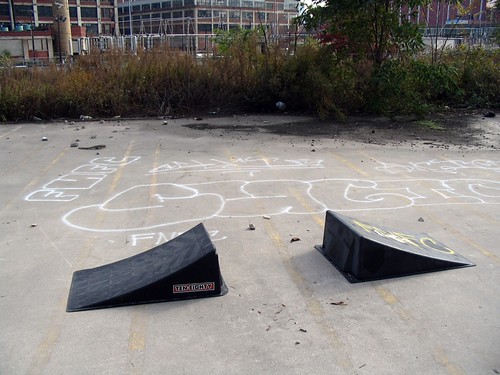
That’s the stuff, says I, that’s the stuff. When I got closer, I noticed a ramp against a wall:

one old ramp now gone.jpg

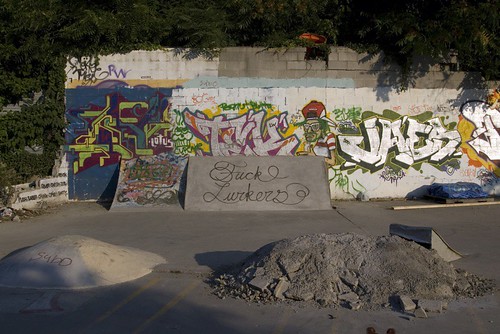
And then this:

10 80.jpg

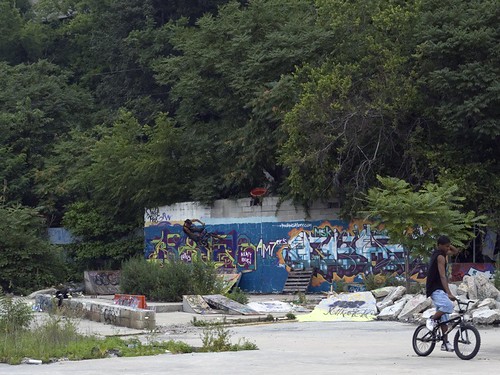
Someone was obviously using this site—the floor slab of an abandoned industrial building of some sort—as a park for skateboarding and BMX bike riding. See:

bikez3

I took that one in July of 2007. Notice that the art on the walls has changed. It seems that some local, and not so local, graffiti writers used this site as something of an experimental gallery even as the skateboarders and BMXers used it to hone their athletic skills.

All off the books, so to speak. They were trespassing on this land. But no one cared. The cops certainly knew what was going on. Sure, it was a little off the beaten path, but only a little. The site’s not particularly remote or hidden. Oh, they knew, the cops. But why hassle the kids? They weren’t hurting anyone; the land wasn’t being used for anything. Let ‘em use it; keeps ‘em outa’ trouble.

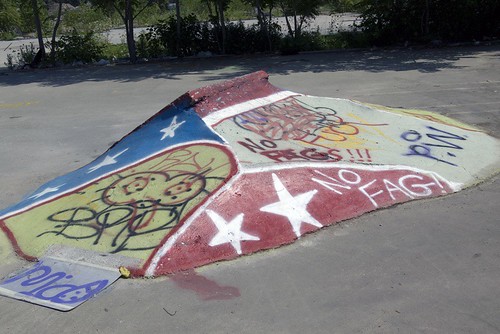
Then this appeared:

hump, no fag.jpg

new facilities, are we having fun yet?

Someone was hauling concrete back there and building mounds and ramps. Someone knew about construction. Someone was investing in improvements in this property that they didn’t own. Call it crazy; call it initiative; call it real.

Friday, January 18, 2019

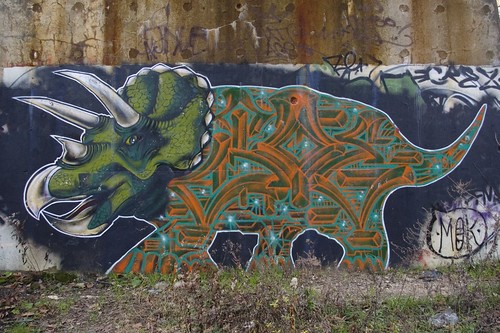
Shrine of the Triceratops: A Graffiti Primer

Or: Indiana Jones and the Green Dinosaur, a Tale of Exploration, Deduction, and Interpretation in the Wilds of Jersey City


This is the first post I made about graffiti. It went up on The Valve on November 1, 2006, over 12 years ago. When I posted this I really didn't know what I was looking at. I didn't even know that this was a name...

IMGP1338rd.jpg

...much less that the name was Joe. In time I figured out that it was by Japan Joe, not Jersey Joe, and I found someone who was present when Joe did it. All I knew was that, like Alice, I'd tumbled to something wonderful, something I had to investigate. Note also that I framed the piece by a quote from Sir Gawain and the Green Knight, a great medieval poem. That still seems right.

* * * * *

“Now, indeed,” said Gawain, “here is a wizardy waste,

And this an ugly oratory, still overgrown with weeds;

Well it befits that wight, warped and wraped in green,
To hold his dark devotions here in the Devil's service!
Now, sure in my five wits I fear it is the foul fiend
Who here has led me far astray, the better to destroy me.

–Sir Gawain and the Green Knight

Though ignorance is not, as the saying implies, a stop on the highway to bliss, it has its uses. In my case, all-but-ignorance of the world of graffiti and hip-hop has allowed me to explore my immediate surroundings as though I were a child discovering neat things in the woods, like the abandoned electrical substation where Steve and I found the raccoon skeleton in one corner of a room, or the strange markings on Timmy's lawn that looked like landing tracks from a flying saucer.

If I had been well-informed about the current state of graffiti I would not have regarded the images I recently blundered into as objects of wonder. I would have known what and perhaps even why they were and thought nothing more of them. Thus I would have been unable to see that I had found a shrine to the spirit of the triceratops. To me it would have just been a large and interesting painting (actually, a “piece”) in a strange location, strange because it is out-doors and thus unprotected, and hidden from public view as well. What sort of artist deliberately does good work in a place where no one will see it?

Tags, Throw-ups, and Pieces

The adventure started about a week ago [remember, I wrote this in November of 2006] when I decided to take some pictures of my neighborhood, Hamilton Park, roughly a third of mile (as measured on Google Earth) from the Holland Tunnel in downtown Jersey City. It's mostly a residential neighborhood consisting of one, two, and three-family attached housing and small apartment buildings. But there are large warehouses nearby, a small abandoned rail yard, a small office building for the Port Authority of New York and New Jersey, and various signs and remnants of more substantial industrial use not so long ago. It's a gentrifying neighborhood where homeless people push their grocery carts on streets where Mazdas and Range Rovers are parked.

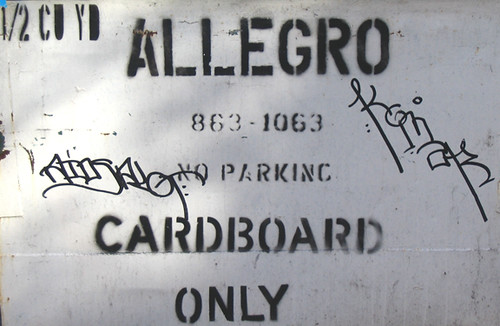
While walking the streets taking pictures of this and that I noticed “tags” (see Figure 1) on signs, sidewalks, walls, fire hydrants, dumpsters and other surfaces.

dumpster_872
Figure 1: Two tags on the dumpster behind my apartment building.

Rime Hael
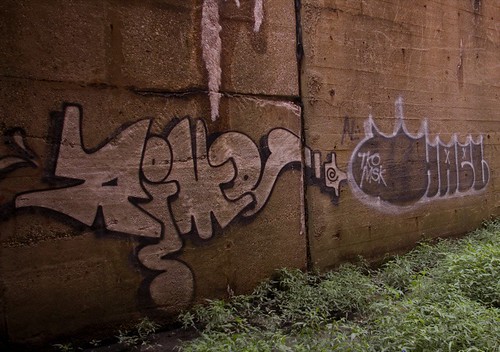
Figure 2: Two “throw-ups” on the side of a building, Rime and Hael

I also saw some more elaborate graffiti of the kind known as “throw-ups” (see Figure 2) - though I didn't know the term when I started this adventure. They're generally, though not necessarily, larger than tags and have filled letters, with the outline and body in contrasting colors. They take more time to make than tags, but can still be thrown up rather quickly, necessary to avoid detection by the authorities.

I uploaded the first batch of photos into my computer and began examining and editing them in Photoshop. The more I looked at them, the more fascinated I became. I decided to roam the neighborhood looking for tags and other graffiti. I didn't know what I would find, but I had every reason to think there might be something interesting out there.

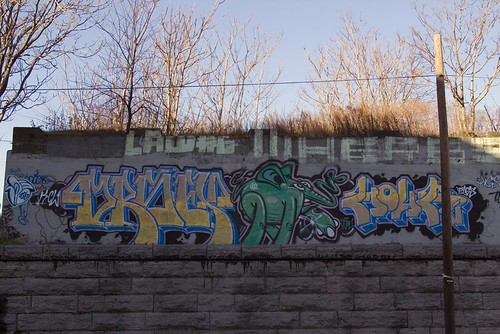
After all, this “piece” (Figure 3) - as they are called, from “masterpiece” - is on an embankment about 100 yards from my apartment building. Notice the lettering to the left and right and the strange long-nosed green creature in the center. Perhaps I would find one or two other pieces like it. I now know that such pieces are common enough, and have been so for years.

jj-elephunt.jpg
Figure 3: A piece on Jersey Avenue between 10th and 11th streets. It faces east toward the Holland Tunnel, the Hudson River, and Manhattan.

For that matter I had seen elaborately painted subway cars back in the 1970s. But I was only a visitor to New York at the time, such graffiti were not a part of my world. I had read about elaborate graffiti, about competitions between “writers” (the term of art for those who make graffiti) and their “crews,” about graffiti in the high art world of Andy Warhol, about Keith Haring and Jean-Michel Basquiat. But I did not live with the work. I only visited it.

Sunday, October 28, 2018

Graffing the Future: Is the next phase of human cultural evolution being inscribed on walls by graffiti writers and street artists?

This post is from January 6, 2015. I'm bumping it to the top of the queue in honor of the Emergent Ventures grant to Leonard Bodgonoff.

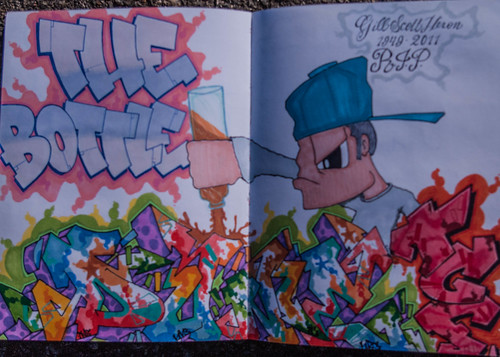
20141213-_IGP1443

The Bottle, by DUNE UNO, Gil Scott-Heron 1949-2011, in ZAR's Blackbook [1]

I have a bias about the future, the deep future. We can’t predict it, for it’s too strange. It’s not simply a continuation of current trends into the future. Oh, sure, there is that.

But there is also radical change, captured in the concept of a singularity, a “moment” in human history that so changes the dynamics of human society and culture than those living on the past side of it cannot imagine much less predict the nature of life on the far side.

We are now living in such a singularity. It is breaking over and around us like a 12-foot wave breaking over surfers in the Banzai Pipe. We don’t know what the world will be like when the last energies of the wave have dissipated. All we can do is be prepared to create a new way of life on those shores.

Images Images (Photos) Everywhere

I am an intellectual. My main mode of acting is through thinking. And what I am thinking is that those distant shores began appearing before us in Philadelphia and New York City in the late 1960s and early 1970s. I am of course talking about graffiti, not just any writing on walls, but the particular kind of writing that appeared on those walls at that time, writing using aerosol paint as its instrument.

At the time most good citizens thought of it as vandalism; from a legal standpoint, that’s what it is. In his essay to the first “bible” of graffiti, The Faith of Graffiti, Normal Mailer called it art. I’m calling it messages from the future.

I note first of all that we are living in a renaissance of images. Everyone has a cell phone and uses them to take photos. As a recent Google report observed:
Since the dawn of time we’ve been captivated by images. But the web has turbocharged our ability to view, share and create more imagery than ever before, to the extent that visual imagery has become the dominant form of communication in the 21st century. No wonder smartphones and tablets sans keyboards are increasingly popular – they prioritize imagery above all else.

This bias towards imagery is creating a new sensorium – how we perceive and sense the environment around us. It has not only influenced how we engage in the digital space, but outside of it too.
In 2011 380 billion photos were taken, that’s 10% of all the photos ever taken. Most of those photos, of course, are quick and dirty. But as people take more and more photos they will inevitably be come more discriminating. The quality will go up.

It’s in that context that we have to think about the impact of graffiti. In an increasingly visual culture, visual imagery is ever more important. Graffiti is everywhere, and spreading. Photos of it are all over the web. Last year Google’s Cultural Institute launched the Street Art Project to showcase graffiti and street art from around the world.

From Human Origins to the Renaissance

With this in mind, let’s go back in time. While we’ve found cave paintings roughly 40,000 years old, we’ve got stone tools going back almost 2 million years. That’s important, as I noted in a review of Steven Mithen’s book on music (“Synch, Song, and Society”, Human Nature Review 5, 2005, pp. 66-85):
Obviously we have no record of these utterances, but the archeological record does have indications of cultural conservatism. The repertoire of stone tools was both limited and unchanged between 1.8 and 0.25 million years ago; Mithen gives particular emphasis to the constant form of hand-axes (164). Mithen suggests that, because their finely wrought form exceeds the practical demands of butchery, wood-working, and cutting plants, these hand-axes may have been fitness indicators in the sort of sexual selection regime Geoffrey Miller has advocated.

Beyond this, I note that Ralph Holloway (1969, 1981) long ago suggested that strongly conserved hand-axe form was an indicator of social norms. Those forms could not be conserved from one generation to the next unless there was a deliberate intention to do so. One has to note the significant features of an existing axe and discipline one’s knapping motions to produce that result. That is considerably more exacting than simply producing an axe with a sharp edge and appropriate heft. The motivation behind such exacting form, then, is not practical. Nor can it be merely aesthetic, which would allow for considerable individual variation. That leaves us with a desire to conform to social norms. Given the importance of such norms, that may in itself be a sufficient motivation for their form, to serve as a visible token of social solidarity. In any event, Holloway’s observation does not contradict Miller’s, and now Mithen’s hypothesis. Norms are norms, regardless of their specific purpose and norms that serve multiple ends are likely to be particularly strong.
My point is a simple one: the oldest evidence we have of specifically human cultural norms is of something that can be seen and therefor copied. Cave art, so far as we’ve discovered, is considerably newer. Other than those stone tools, cave art provides our oldest evidence of human craftsmanship.

Now let’s turn our attention to more recent events, the European Renaissance:

Filippo Brunelleschi Invented one-point linear perspective 1377-1446
Nicholas Copernicus Championed the heliocentric view of the solar system 1473-1543
William Shakespeare Playwright often credited with inventing the modern sensibility 1564-1616
Isaac Newton Synthesized the conceptual foundations of classical physics 1642-1746

It was the visual arts that kicked off the change, not literature and not science; they followed. Filippo Brunelleschi was one of the foremost architects and engineers of the Italian Renaissance:
Besides accomplishments in architecture, Brunelleschi is also credited with inventing one-point linear perspective which revolutionized painting and allowed for naturalistic styles to develop as the Renaissance digressed from the stylized figures of medieval art.
There is, of course, no assurance that the future will unfold according to patterns followed in the past. But if that happens, then our future is now being written on walls around the world.

The Case for Graffiti

Assuming that the visual arts are leading the way, why choose graffiti?

On the one hand, the “legit” art world is in turmoil. You can’t tell the hucksters from the genuine artists and, in any case, there is no definitive sense of direction. Artists, dealers, collectors, and museums are thrashing about.

Meanwhile, in the course of two decades from the late 1960s to the late 1980s graffiti made its way around the world and did so pretty much outside the art world. Graffiti represents a new starting point, a new conception of image space, and it’s the only form of abstract art to attract a mass audience.

Further, as it’s spread, graffiti has attracted other styles of art and imaging making and given birth to street art. Think of them together as an aesthetic laboratory in which all styles of art will be tested and tried. It’s through that experimentation that the enduring forms of 21st century art will first emerge, for that is where they will receive their sternest test and widest exposure.

On the walls of the world, the World-Wide Wall.

* * * * *

[1] All graffiti writers have a blackbook, more than likely they have several to piles of them. They're artist's notebook filled with blank sketch paper. They're called blackbooks because their covers are typically/classically black. Writers use them to sketch ideas, but also share ideas. So writers will sketch in one another's blackbooks. In this case DUNE UNO did a sketch in ZAR's blackbook.

ZAR is a writer in Northern New Jersey, Patterson I believe. I mention him in other posts here at NEW SAVANNA and have a bunch of photos of his work, including action in-progress photos, over at my Flickr page.

Friday, May 5, 2017

Sacred Things

From six years ago....
IMGP0005rd

… that still roaring dell, of which I told;
The roaring dell, o'erwooded, narrow, deep,
And only speckled by the mid-day sun;
Where its slim trunk the ash from rock to rock
Flings arching like a bridge;--that branchless ash,
Unsunn'd and damp, whose few poor yellow leaves
Ne'er tremble in the gale, yet tremble still,
Fann'd by the water-fall! and there my friends
Behold the dark green file of long lank weeds,
That all at once (a most fantastic sight!)
Still nod and drip beneath the dripping edge
Of the blue clay-stone.

-- Coleridge, This Lime-Tree Bower My Prison
This post began, I suppose, when, upon reading Charles Cameron’s post, Sacred space and the imagination, the “graffiti!” light went off in my brain. Not just any graffiti light, but this one:

westward ho.jpg

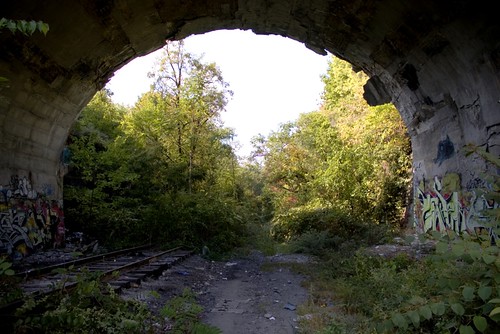
Well, not that exact one, but it was a photograph of that same arch, a different photograph. This one shows the graffiti a little more clearly, but it’s not the same graffiti, as graffiti often changes over time, in some places more rapidly than others.

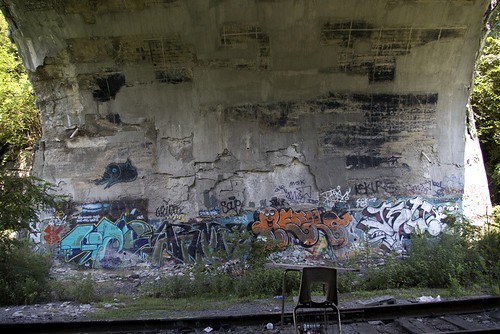
If you look back over Cameron’s images, you’ll see that it’s of a piece with them. And I’ve got dozens of photos of that arch: different times of the day, different seasons, different years, different graffiti, different angles. And that’s not all.

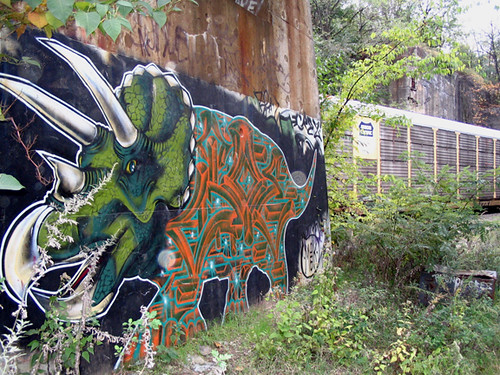
Graffiti and the sacred is a natural, one that hadn’t quite hit me full-on until I’d read Cameron’s post. You see, my first post about graffiti (the images, alas, are gone) was about this piece, which I called the Shrine of the Triceratops:

dino_train_872

It’s not that I believe, mind you, that there’s a triceratops cult in Jersey City and that this is where they meet. Nothing like that. Rather, that that image seemed to embody of the spirit of the place, the Japanese word is kami. (That triceratops is now gone. First, eroded by the weather, then other writers went over it.)

I could go on and on about graffiti, but I won’t, because this post isn’t just about graffiti. But I’ll leave you with one last graffiti thought. Graffiti is often likened to cave art. Well, cave art, some of it, perhaps all of it, is sacred art. Not mere pictures, but spirits bodied forth on walls.

Monday, March 13, 2017

Journey to 3Tops: Indiana SLuGS and the Land that Time Forgot

Here's a piece from several years ago. Now that I'm involved in The Bergen Arches Project I've decided to bump it to the top of the queue. The graffiti 'landscape" has changed since then, and I've made some notations about that. "WAAGNFNP" is, of course, the We Are All Nuclear Fireball Now Party, which I've written about a bit earlier, and 3Tops is the Party's enforcer.
About two weeks ago (I'm writing this on 23 July 2007) I was checking my Flickr account to see if anyone had commented on any of my photos. I hit pay dirt. One PLASMA SLuGS (red ribbon for WAR} had made the following comment on one of my graffiti photographs: “please if u dont mind tell me where n how to get here.” Bingo!

As some of you party loyalists may know, I've been photographing local graffiti since last fall. The visage of our fine and noble 3Tops is, in fact, one of the pieces I'd found, not to mention other WAAGNFNP notables, such as Toothy. Graffiti, however, is generally illegal, and the people who do it don't leave contact information on the walls. Thus, while I now have hundreds, thousands even, of photographs of graffiti within a mile or so of my apartment, I don't know who painted them. And, since I have no roots in the area, I've got no social network through which I can track them down.

That's one of the reason I'd started posting my photos to Flickr. I figured that some of the writers (a term of art) would see them and perhaps, one day, one of them would contact me about them. SLuGS is the first.

Of course, I told him where the picture was taken - in Jersey City, about a mile in from the Holland Tunnel near the old Long Dock Tunnel. I also offered to take him on a tour of the local graffiti. He took me up on my offer and showed up that Sunday afternoon with a woman he introduced as his wife, a backpack full of spray paint, and a Canon single-lens reflex camera. I revved up Google Earth and showed them where we were, where the graffiti is, and off we went, with the intention of going into the Erie Cut.

On the way there SLuGS did a little painting, with both his wife and I snapping pictures:

laylabill07.jpg
Still there, though faded a bit.
That's the SLuG, his identifying mark that he uses instead of the name that most writers use. It's painted on the base of one of the columns supporting I78 as it comes down off the Jersey Heights (or the Jersey Palisades) and feeds into the Holland Tunnel. He's done thousands of these here and there, mostly I'd guess in the New York City area, but other places as well. He's been to Amsterdam and he's made cooperative arrangements to get the PLASMA SLuG up all over.

Thursday, January 12, 2017

Metaphor Deeper than Mere Metaphor

Came across this old post when I went looking for the Thoreau quote, which is about steam engines, and thought I'd bump it to the top of the queue. It's about how we use metaphor to lay claim to the world.
I’m interested in figurative language in this post, but not the sort of figurative language that excites the cognitive metaphor people. Those figures, those metaphors, have become so naturalized that their figurative nature is no longer apparent. Their meanings have become so settled that they’re regarded as literal, not figurative.

No, I’m interested in figures that have new work to do. Actually, I’m interested in one particular figure, one that I’ve been using. It interests me both in itself, for the work that it has to do, but also as an example of the more general phenomenon.

That figure is one I’ve been using to talk about graffiti sites. While I know that the graffiti is put on the walls by particular writers at particular times for whatever purposes they may have, I find it useful, perhaps in a sense indispensable, to talk of the graffiti as an expression of the spirit of the place, for which I also use the Japanese word kami. No, I don’t think there is actually a ghostly creature at the site who’s somehow directing graffiti writers, but . . . .

Let’s set that aside and consider one of my touchstone passages, which I’ve used in a post about ontology. This is a passage from Henry David Thoreau’s “Sound” chapter in Walden (1854):
When I meet the engine with its train of cars moving off with planetary motion . . . with its steam cloud like a banner streaming behind in gold and silver wreaths . . . as if this traveling demigod, this cloud-compeller, would ere long take the sunset sky for the livery of his train; when I hear the iron horse make the hills echo with his snort like thunder, shaking the earth with his feet, and breathing fire and smoke from his nostrils, (what kind of winged horse or fiery dragon they will put into the new Mythology I don’t know), it seems as if the earth had got a race now worthy to inhabit it.
There’s quite a bit of figurative language in that paragraph, but I’m interested in two metaphors, iron horse and fiery dragon. The iron horse is a well-known metaphor for a steam locomotive, perhaps from all those old Westerns where Indians use the term. Fiery dragon is not so common, but it’s use in that context is perfectly intelligible.

What was Thoreau doing when he used those figures? He certainly recognized them as figures. He knew that the thing about which he was talking was some glorified mechanical contraption. He knew it was neither horse nor dragon, nor was it living.

Or was it? Did he really know that it wasn’t alive? Or did he think slash fear that it might be a new kind of life? We live in a world where everyone is familiar with cars and trains and airplanes from an early age, not to mention all sort of smaller self-propelling devices. We find nothing strange about such things. They’ve always been part of our world. And so, as we learned to talk, as we learned to think, we made places for these things in our worldview, along with rocks, a dandelions, raccoons, the wind, and other humans.

Thursday, December 29, 2016

The Faith of Graffiti, Redux

I originally posted this review in 2010. But the book is an important one,  so I'm bumping the review to the top of the queue.
* * * * * 
Norman Mailer and Jon Naar. The Faith of Graffiti, New Edition. It Books, 2009.
Conceived by designer Mervyn Kurlansky, executed by Jon Naar (photographer) and Norman Mailer (writer), and named by CAY 161 (writer), The Faith of Graffiti hit like a bomb when it was first published in the Spring of 1974. Graffiti was still young, hip-hop didn’t exist, and the war in Vietnam was still taking lives. Faith got a full page in the New York Times Book Review, helped, no doubt, by Mailer’s name on the jacket. But Mailer’s remarkable essay wouldn’t have meant jack if its hopes and claims weren’t supported and amplified by Jon Naar’s powerful photographs.

One can’t have an art book without photographs of the art, but Naar’s photographs are more than that. For he’s not photographing self-contained works framed to be hung on walls. The names he’s photographing – for that’s what graffiti is, names, variously written, embellished, tricked out, disguised, and transformed – do not imply natural boundaries. They’re written directly on walls, then in New York City — though Philly's Cornbread was up first. Wherever arms could reach, names followed. (You can see some of these photos at Naar’s website.)

Here’s the wall of a paddleball court: COMET, BABY 183, Bingo, STiTch I, KEY II, FAST ED, PiE, Barbara 62 — 10s and 100s of names, a community of names, on this one wall. Naar has framed this shot by two paddleball players, backs to us. Then there’s FRANK 136 in large white letters on the surface of a playground, a girl skipping across at the upper right, two boys and a basketball, upper middle, and a name-laden wall across the top edge, those names showing the beginnings of the elaborations that would become pieces, aka masterpieces. Elsewhere: MARiA I, FRANNY, and CHETTA in bright red, TooTs and Sissy in blue and red, and others, all on a deep green background, flecked here and there with yellow. What about three TUROK 161’s, two FRANK 207’s (plus three stars and a crown), all on the red side of a subway car. Or: “Rube” in bright red followed by an “N” just scratched on a metal surface – RubeN – with four tic-tac-toe games to the lower left.

In many photos the city and the people take up more space than the graffiti, thus placing the graffiti in the life of the city. Where it is / was / belongs. Yes, the subway cars (inside as well as out) and platforms and stations, but also the steps and stoops, apartment houses, trees, statues, parks, fences, bridges, underpasses, shacks and sheds – the fixed and mobile infrastructure of the city. Some of the writers posed for Naar, he got some action shots too, and there’s a blurred photo of some police cornering some writers. In many shots we see people just going about their business on the streets, on buses, and in the subways.

And light playing about all of this.

Naar had to figure out how to SEE this, what to see, how to frame it, what’s there, what’s only implied. If you’ve done much photography with serious intent you know that, no matter how deliberate you may be about a given shot, you don’t know what you’ve got until you’ve taken your work out of the camera. And when Naar took these photos, he was often challenged in the deliberation department — 3000 shots in two weeks, and some of that time running from police. There is thus a sense in which Naar didn’t know what he was doing when he took these photos, and he did it very well indeed.

A lesser photographer would have blown the assignment, and Mailer would have had nothing to justify what he wrote, though the graffiti would still have been there, in the streets.

Friday, August 26, 2016

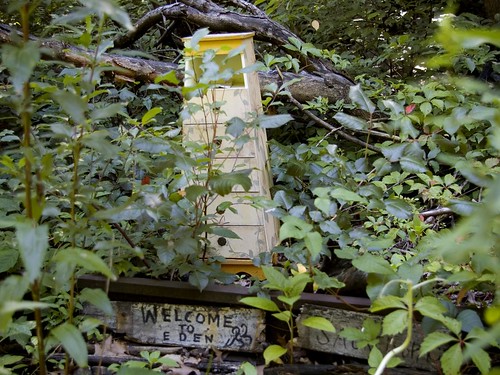
Friday Fotos: Welcome to Eden: The Bergen Arches

Since it's Bergen Arches week in Jersey City I thought I'd bump one of my many Bergen Arches posts to the top of the queue.
IMGP6920rd

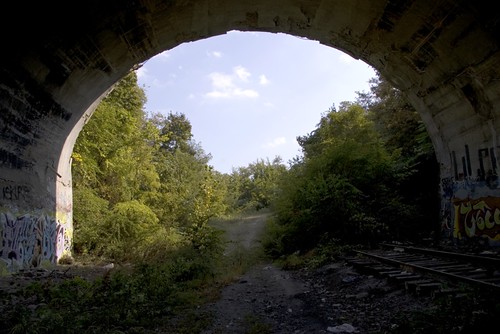
The local name for the phenomenon, the Bergen Arches, is a bit well, odd. Yes, there are arches, five of them; two are bridges and three are short tunnels. You see them when you are there, but what you really see is the Erie Cut, a trench cut through Bergen Hill, which is the southern tip of the Jersey Palisades.

IMGP7399rd.jpg

palisades arch looking east.jpg

The Cut is 85 feet deep and almost a mile long. It was cut into solid rock in the early 20th century to bring four railroad tracks to the port at Jersey City. Jersey City - like Hoboken to its immediate North (where “On the Waterfront” was set) - is no longer a port city; those tracks have been abandoned and only one of them remains. No one goes into the Cut except graffiti writers, historic preservationists, and other assorted miscreants and adventurers.

that decorator touch.jpg

IMGP1969rd

Once you're in the Cut you're in another world. Yes, New York City is two or three miles to the east across the Hudson and Jersey City is all over the place 85 feet up. But down in the Cut, those places aren't real. The Cut is its own world, lush vegetation, crumbling masonry, rusting rails, trash strewn about here and there, mud and muck, and mosquitoes, those damn mosquitoes! Nope, it's not Machu Pichu and it's not Victoria Falls, but it's pretty damn good for being in the middle of one of the densest urban areas in the freakin' world.

Sunday, June 7, 2015

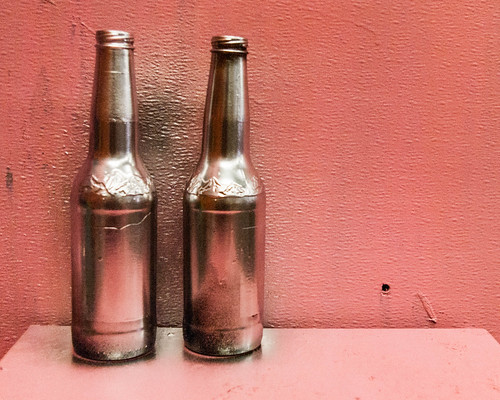
Study in Pink and Silver: Why Not Call It an Installation? [#GVM004]

What, pray tell, is this?

20150605-_IGP3982

It’s two bottles on a shelf or something.

Well, yeah, that’s obvious. But what kind of bottles...

look like beer bottles, maybe

but beer bottles aren’t silver

neither are they. that’s paint

not applied very carefully either, looks like it was sprayed

and the spray caught the wall too.

Saturday, June 6, 2015

Good Grief! War Boys in the Promised Land [#GVM004]

One could, of course, dismiss it because it’s comic strip imagery, and therefore Not Serious. One could also dismiss it as graffiti, and therefore Not Serious.

But I can’t do that, not while I’m being a Martian Anthropologist. In that role I have no choice but to take what the natives do as being quite serious. That is, serious in the sense that it indicates what’s going on in their society.

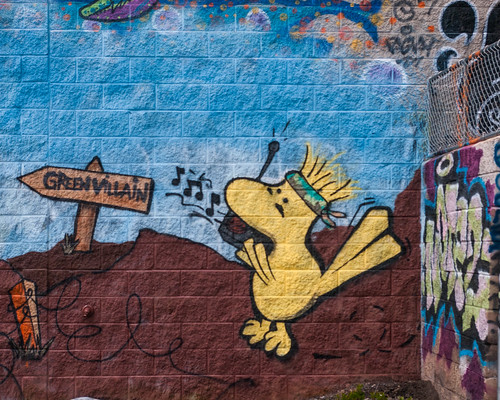
Here’s Woodstock, a character from the comic strip, Peanuts, which is surely smack dab in the center of post-war (WWII) American culture and which has shown up in graffiti culture since the mid-1970s–that is to say, from the beginning:

20150605-_IGP3920

The headband establishes Woodstock’s hippie cred and the music-blaring transistor radio dates him.

The “Greenvillain” sign is a shout-out to Greg Edgell, who runs Green Villain, the production company that’s organizing the graffiti on the soon-to-be-demolished Pep Boys building in the Newport area of Jersey City. This is painted on the southwest corner of the building.

But why the brown? Is it supposed to represent bare dirt? What about the black loops? Since I’ve seen the whole mural I’ll tell you what it is, it’s barbed wire. Woodstock is strolling around on a battlefield. Vietnam perhaps? After all, the war there was going hot and heavy when the flower children gathered in the mud at Woodstock, New York, and listened to Jimi Hendrix transform “The Star-Spangled Banner” into a war protest anthem.

Friday, June 5, 2015

War Boys in Tomorrowland 2: The Graffiti Connection

Ad astra per aspera.

IMGP0853rd

In a previous post I argued that the War Boys of George Miller’s Mad Max: Fury Road would be among the first to be recruited to the build-the-future-crusade that ends Brad Bird’s Tomorrowland. That effort, of course, is to dig humankind out of the hole it’s been sinking into over the past century or so, to imagine, craft, and build a new world. I want to explore that notion a bit by arguing that graffiti writers are a ‘bridge’ between the sensibilities of these two films.

War Boys and Creatives

Why do I think George Miller’s War Boys would be interested in Brad Bird’s crusade for the future? Fundamentally, it’s the exuberant energy common to the two. Of course, the War Boys are (seem to be) driven by a desire for glory after death (in Valhalla) and that seems rather different from Casey Newton’s desire to keep NASA living true to its visionary mission. One rushes to death while the other seeks the stars. But are those aspirations so very different?

We are dealing with fictions, not with life. And, of the two films, Fury Road seems more consistent with the laws of physics, biology, and even history (if history can be said to have laws) than does Tomorrowland. As George Miller said in an interview:
It’s not a fantasy film. It doesn’t have dragons and spaceships. It’s a film very rooted to Earth. A kind of crazy demented quality to everyone’s behavior arises out of this extreme, elemental, post­apocalyptic world.
The plot of Tomorrowland depends on the existence of a mysterious other ‘dimension’ where a Tomorrowland has in fact been constructed. Without that other dimension, what happens to the story? What we actually see in the film itself is, of course, a mad dash to stave off an apocalypse that is, in fact, emanating from this other dimension. The chase is somewhat more elaborate than that in Fury Road, and not so action-intense, but it’s still a chase.
 
That other dimension where Tomorrowland exists is not so very different from the Valhalla that the War Boys seek through battle. It’s not really real, it’s not here and now, it’s somewhere else in the ether. The War Boys seek to enter this other dimension through battle whereas, in Tomorrowland, Governor Nix is waging war on earth through this other dimension. Furthermore, the fact of the matter is that extreme and fundamental creativity is also violent, destroying old ideas and practices. It is dangerous.

In a sense, the worlds of the two films re mirror images of or inversions of one another. All that’s really different is the set dressing and costumes. The positive creativity of Tomorrowland is extra-legal while the action of Fury Road is set in s world where legality as we know it is irrelevant. Don’t let the futuristic architecture and the Disney imprimatur fool you; the world of Tommorowland is as out-of-control as that of Fury Road. The underlying energy and intention is the same.

Graffiti Writers and War Boys and Artists

The spiritual connection, if you want to call it that, between graffiti writers and War Boys is obvious to anyone who knows much about the art. “Bombing” is a term of art in graffiti culture, but it has nothing to do with explosives. It’s about “getting up” (another term of art, meaning to write or paint) in something of a rampage. Susan Farrell, founder of Art Crimes, the oldest graffiti site on the web, once characterized graffiti as a cross between extreme sport and art.

One aspect of getting up is simply to get up in places that seem all but impossible to reach: How’d they do that?

IMGP3588

But there’s also visual virtuosity, which takes time and skill.

IMGP9554rd

Writers compete over access to walls. I’ve documented a battle that was spread over several blocks in Jersey City. And, of course, as most graffiti is done illegally, the activity is something of a low-scale battle against ‘legitimate’ society.

But then, the Plus Ultras of Brad Bird’s Tomorrowland operated entirely outside the authority of existing nations and international authorities. And our plucky protagonist, Casey Newton, works at sabotaging a NASA launch pad, which is hardly the act of a well-behaved law-abiding citizen. She has her reasons for doing that, and graffiti writers have their reasons for bombing walls. Destructiveness is not the point of either activity.

Both are about making room for a future. Graffiti writers are in effect claiming turf for a new civilization. Now I rather doubt that such thoughts are much on their minds (nor, alas, are they on anyone else’s minds either). They’re more concerned with mere psychic survival. Without that, there isn’t even a viable present. With it, there’s the possibility of a future.

It’s up to us to accept their offer and to create that new civilization.

Indiana SLuGS on the Bridge of Doom

Wednesday, April 29, 2015

Graffiti: From Art Crimes to Family Day #GVM004

20150425-_IGP3164

Back in the day, when graffiti was just getting started in the late 1960s and early 1970s, it was a criminal act. A minor crime, to be sure, but still criminal. And it still is, for the most part, vandalism.

But things have changed as well. By the 1990s graffiti had been picked up by hip-hop, extreme sports, and had gone international. It was a crime all over the world.

20150425-_IGP3154

And now, what happened in downtown Jersey City this past Saturday, April 25, 2015? The Green Villain, aka Greg Edgell, organized a graffiti jam at the Newport Pep Boys store.

In the Spring of 2014 Greg Edgell started his plan to take over walls in Jersey City, where he lives, and New York City, across the river. Find a good wall, contact the owner, get permission to put graff or street art on it. The Newport Pep Boys in Jersey City was the fourth hit: #GVM004.

20150425-_IGP3148

Why this building? Because the rear wall is big and visible. It faces the Hudson-Bergen Light Rail, where it is seen by 1000s of commuters a day. All systems were Go. By November 2014 the AIDS crew had that huge rear wall covered. Five months later word came down that the building had been sold and would be demolished to make way for new construction.

Wednesday, December 31, 2014

Lee Quiñones interview in Vulture

Matthew Giles interviews Lee Quiñones in Vulture:
Of your work that you’ve created, which did you feel was the most important?
The "Howard the Duck" handball wall mural, which I created in 1978 and was the first of its kind. Basically that mural broke open the conversation of what this art movement was capable of and the trajectory it was pointed in. I felt that I had arrived as an artist at that point. "The Lion’s Den" mural was behind it. I loved the "Lion" mural more than Howard, because it was when I felt I brought the technique of spray-painting to the next level. Instead of outlining things in a cartoonish way, I was working with stories of light and depth and feel. Both were a neighborhood prescription.

When you say "neighborhood prescription," what does that mean?

The Lower East Side is an unsung hero itself. A lot of talents came out of there, but it is always at the back of the bus compared to the rest of the city. I felt the neighborhood was hurting and wanted something refreshing to look forward to.
An influence I wouldn't have expected:
As you were developing your talent, what other NYC pieces were you looking to for inspiration?
Jenny Holzer. Her writings on the wall were instrumental. In the 1980s, in NYC, there was an abundance of abandoned buildings and walls. The presence of all those empty buildings became almost normal to some people, but when you saw something painted on a wall as crude as the phrase "Broken Promises" or "Sense of Power Is Domination," it gave a whole new purpose to the climate and the actual buildings. That was riveting to me. Jenny Holzer makes me feel so illiterate and stupid when I read her stuff. I am a visual person, and when I am down and out in my work, I always look forward to her work. Her work is like she is throwing a huge party on the street that no one is ever late to.
On Banksey, Street Art, and Greed:
For the past decade, there has been so much attention focused on street art. What did you think of Banksy's NYC residency?
I love a lot of Banksy’s work. I was really busy when it was going on and I wasn't trying to get on that herd drive, but I saw some pieces later on and thought they were genius. They were hilarious and brought up some real issues. Giving away drawings for $6, he is having a laugh at the hypocrisy of how people are in a crazy rush to buy and own something. Me, me, me. Art is a powerful tool, and right now street art is more than ever economic and a tool for planting a flag when talking about displacement and replacement. When you see street art coming up in a neighborhood, you know that will be the next neighborhood.

It’s interesting about the owning of street art. In that HBO Banksy documentary, people were taking the pieces almost immediately as they were being "discovered." It’s the start of a nasty fire. It’s all about personal greed.

Tuesday, December 30, 2014

42 Quarks: Getting from here to there

I've written 14 essays for 3 Quarks Daily over the past year. Now I've bundled them into a PDF, which you can download here:

Here's the introduction:

0. Introduction: here & there

Fourteen essays in a bit over a year. The first one appeared on Monday 16 December 2013 and the most recent one on Monday 15 December 2094. My basic routine is simple. During the week before publication I’d get an email from the editor, S. Abbas Raza, reminding me that I had an essay due on coming Monday. I’d start thinking about it and by Friday or so I would begin writing. I’d finish up mid-day on Sunday, upload the essay, and tell Abbas I was good to go.

That was the basic routine, a skeleton. One time Abbas forgot to email us, but I was working on a piece anyhow. Another time I started writing a week ahead of time and sent through six drafts. Just variations on the basic procedure, which went like clockwork, albeit the clock was not quite mechanically perfect.

Not so what went on inside my head. That was irregular. Despite the fact that I’ve been blogging for a while now, and am used to producing frequent long-form posts, writing for 3 Quarks Daily is different. The audience is different.

My blog, New Savanna, is just that, MY blog. I write whatever I want to & post whatever photos. To some extent it’s an extension of my notebooks – in fact my note keeping has all but disappeared into my blogging. While New Savanna is fully public in the sense that anyone on the web can read it, I don’t treat it as a public activity. It’s more like a private salon. I assume I am writing for people who have been following me for a while.

3 Quarks Daily IS public, though public in a distinctly intellectual way. Since I appear there only once every four weeks I do not assume I am writing for an audience that follows me. I am writing for an audience that follows 3QD.

Of the things I know, what would, or should – a different slant, no? interest the 3QD audience? Pondering that question makes writing for 3QD a bit different, a bit more strenuous than writing for New Savanna.
Wednesday, December 10, 2014

Reading Latour: Assembling the Society of Graffiti

No scholar should find humiliating the task of description. This is, on the contrary, the highest and rarest achievement.
—Bruno Latour


20141207-_IGP1143
Bruno Latour. Reassembling the Social: An Introduction to Actor-Network Theory. Oxford UP, 2005.
During the late summer and early fall of 2011 I blogged my way through Latour’s Reassembling the Social (RS) and then, at the end, Latour’s manifesto on compositionism. I would read a chunk of the book, generally a chapter, and the write a blog post based on passages from that chapter. I then assembled those posts into a working paper, which I issued in October of that year.

One of the things that attracted me to RS is that it was concerned with social life before a network had coalesced into an institution. And that, as far as I can tell, is the status that graffiti culture has in the contemporary world. It’s been around for going on five decades, but it has never quite become institutionalized. For that reason I used graffiti culture as a running example in my notes. In some notes talk of graffiti was prominent, but other notes had little or nothing about graffiti in them.

As there are people whose interest in graffiti exceeds their interest in Latour, it seemed like a good idea to release a second abridged edition of the original working paper. That’s what this is. With the exception of the very first segment, which sets up the whole series, I’ve simply dropped the segments that said nothing about graffiti. But I’ve not changed the numbering, so you can see where the “holes” are, if that concerns you. As I did not attempt to build a cumulative argument in this series of posts, the missing posts shouldn’t cause any problems. If you’re curious, however, I’ve retained the complete list of all the original posts at the end of the introduction.

Tuesday, December 9, 2014

It’s Complicated 2: Graffiti and Public Space

20141207-_IGP1027

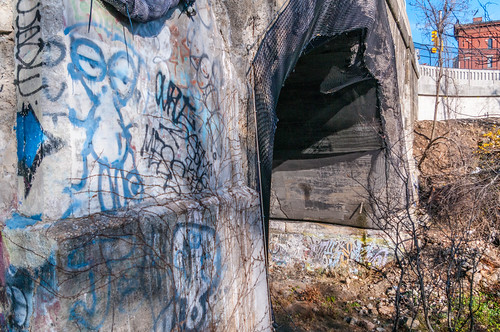
You are looking at two of the handful of arches known in Jersey City collectively as the Bergen Arches. In my experience, while many people have heard of “the Arches”, few people have a clear idea of what and where they are and even fewer have been there, though many pass beside them as they drive on Rt. 139. The arch to the left is over the remaining roadbed of a trolley line, which is where we’re standing. The one on the right goes over the Erie Cut, a man-made geological formation geographical feature that used to accommodate four railroad tracks. Three of them have been ripped out; the  fourth is broken and busted. The Erie Cut is almost a mile long and goes under four or five more arches, though three of them are better characterized as short tunnels.

Unless otherwise indicated, all the photographs in this post are of the Bergen Arches and were taken on December 7, 2014.

I’ve written about the Arches before, extensively. I’m going through the exercise again because, 1) they fascinate me, and 2) I want to discuss them in the terms that danah boyd has established for teen cyberspace hangouts in It’s Complicated: The Social Lives of Networked Teens (Yale UP 2014).

There are major differences, of course. The Bergen Arches is a real location in physical space whereas the spaces boyd has investigated are virtual. Functionally, network spaces exist online; physically, though, the servers that support them have real locations around the globe. However, copies of my photographs of the Arches exist on my Flickr page and so can be accessed by anyone who has Internet access to Flickr. And I am by no means the only one who photographs the graffiti down there. Just how many of us do that, I don’t know. I’d say 10s to 100s.

20141207-_IGP1030

We’re standing right in front of the upper arch, looking down at the lower arch. Notice the somewhat scuffed and faded graffiti at the base of the arch. I’ve got photos of that wall going back to 2007 and those show four or five paint layers below the one currently visible. The strange big-eyed character at the left, however, is unchanged, perhaps because the location is not particularly desirable; it’s small and peripheral. I’ve got photos of that character in at least two other locations. The dark black lettering in the middle, however, is relatively new. You can make out the letters “MESS.” MESS or MES writes with the PFE crew. He gets up all over the place, though I’ve only got photos from three other locations that I can think of off hand. Finally, notice the black netting in the lower arch. That was installed a year or two ago to catch the crumbling masonry.

One of the themes boyd develops is that of privacy in public. The Internet functions as a public utility and most of the places teens hang out are public spaces; anyone can go there. Some have privacy settings, like Facebook, but using them is somewhere between tricky and a pain in the ass, so most teens simply ignore them. The fact that they don’t mess with those privacy settings doesn’t mean that they’re addressing their remarks to the public large. They’re not; they’re only addressing their friends. And, for the most part, the public at large could care less about what they say – the various snooping agencies and advertisers are not the public at large, nor is it obvious that they have any very clear idea of what they’re doing; they just do a lot of it.

However, steps are taken (p. 65):
Children love to experiment with encoding messages. From pig latin to invisible ink pens, children explore hidden messages when they’re imagining themselves as spies and messengers. As children grow up, they look for more sophisticated means of passing messages that elude the watchful eyes of adults. In watching teens navigate networked publics, I became enamored of how they were regularly encoding hidden meaning in publicly available messages. They were engaged in a practice that Alice Marwick and I called “social steganography,” or hiding messages in plain sight by leveraging shared knowledge and cues embedded in particular social contexts.
front row seat in the Theater of the New Reality.jpg

That photo dates from July 6 of 2007 and is the oldest photo I have of that wall, which is the wall whose lower edge we saw in the previous photo. There’s a lot of stuff on that wall, and things seem to have been piled atop one another chaotically. There is, however, an informal ethics to that. Unless the existing imagery has been badly degraded by the weather, or by “toys” (novice writers who have more chutzpah than skill), you have to do something better than what you’re going over.

Sunday, November 23, 2014

Street Aesthetics: Why Jerkface is Killin’ It

20141118-_IGP0048

IMGP8462rd

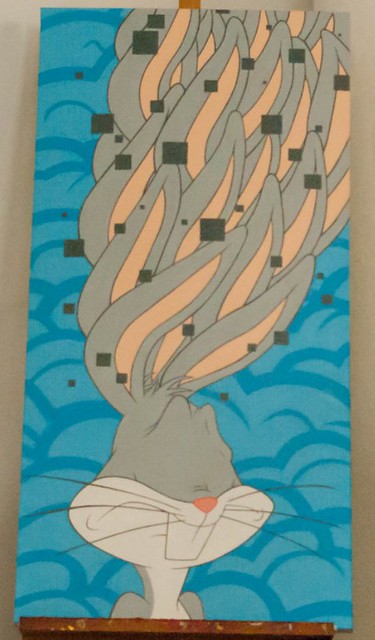
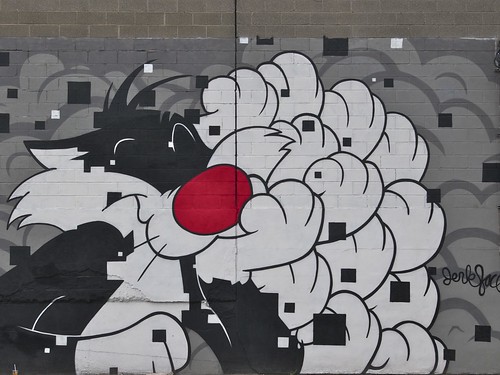
Three things are distinctly odd about these images, both by Jerkface – as you see, Bugs Bunny is on canvas; Sylvester is on a wall. Neither face has eyes, and both pictures appear to be “pierced” by a pattern of squares, and Bugs has multiple ears and Sylvester has multiple paws. Note that the pattern of squares doesn’t respect the distinction between foreground and background – well, in the Bugs Bunny it almost does, but it definitely doesn’t in the Sylvester.

Let’s start with the squares. As a comparison, let’s look at this graffiti piece:

IMGP0820rd.jpg

In typical fashion the name dominates the image. What interests me are those rectilinear forms walking over the surface. The name-form is bordered in orange and we orange rectilinears merging into that outline, with a few free of it. The blue and green rectilinears within the name-form work a bit differently. Some of them respect the letter-form boundaries, but some extend beneath those boundaries while others go over it.

The overall effect is similar to that of the square’s in the Jerkface images. In all three cases we’ve got to quasi-independent image “logics” that intersect one another in the image plane. One is figural – cartoon characters for Jerkface, a name for the graffiti piece – and the other is a relatively simple geometric pattern.