Showing posts with label animation. Show all posts

Tuesday, September 2, 2025

KPop Demon Hunters [Media Notes 172]

The film is getting a lot of buzz. I like animation & I have some interest in Korean culture, so why not? From the Wikipedia entry:

KPop Demon Hunters is a 2025 American animated musical urban fantasy film directed by Maggie Kang and Chris Appelhans from a screenplay they co-wrote with the writing team of Danya Jimenez and Hannah McMechan, based on a story conceived by Kang. Produced by Sony Pictures Animation for Netflix, the film stars the voices of Arden Cho, Ahn Hyo-seop, May Hong, Ji-young Yoo, Yunjin Kim, Daniel Dae Kim, Ken Jeong, and Lee Byung-hun. It follows a K-pop girl group, Huntr/x,[a] who lead double lives as demon hunters; they face off against a rival boy band, the Saja Boys, whose members are secretly demons.

KPop Demon Hunters originated from Kang's desire to create a story inspired by her Korean heritage, drawing on elements of mythology, demonology, and K-pop to craft a visually distinct and culturally rooted film. The film was reported to be in production at Sony Pictures Animation by March 2021, with the full creative team attached. The film was animated by Sony Pictures Imageworks and was stylistically influenced by concert lighting, editorial photography, and music videos as well as anime and Korean dramas. The soundtrack features original songs by several talents, and a score composed by Marcelo Zarvos.

KPop Demon Hunters began streaming on Netflix on June 20, 2025, while a sing-along version of the film received a two-day limited theatrical release from August 23 to 24, 2025. The film drew acclaim for its animation, visual style, voice acting, writing, and music, and was named a cultural phenomenon by several publications. It surpassed Red Notice (2021) to become the most-watched film in Netflix history with 236 million views, and its sing-along theatrical release was both the widest for a Netflix film and the first to top the box office in the United States, surpassing Glass Onion: A Knives Out Mystery (2022).

I suppose that accounts for the buzz. As for me, in two sittings I didn’t get more than a third into it. It struck me as slick, bland, and bloodless.

Tuesday, August 19, 2025

Grave of the Fireflies [Media Notes 170]

YouTube:

Film critic Roger Ebert reviewing the Japanese anime "Grave of The Fireflies", a Studio Ghibli film of 1988. Contemplating on animation and Asian film making. Amazed by his empathy and sensitivity through his description of this film, his interpretation is almost moving.

This is one of the most harrowing and tender films I've ever seen, and one of the best. Stunning.

Sunday, June 8, 2025

Claude on the Eightfold Way: Sonnet 129, Fantasia, Kubla Khan

New working paper. Title above, link, abstract, table of contents, and introductory material below.

Download from Academia.edu: https://www.academia.edu/129826893/Claude_on_the_Eightfold_Way

ABSTRACT: A) The circular structure of Shakespeare’s Sonnet 129 the analysis mirrors contemplative technologies found in both Hindu/Buddhist and Christian traditions. The sonnet's recursive exploration of desire creates what can be understood as a secular meditation technology that operates through psychological rather than explicitly spiritual means, transforming destructive cycles into opportunities for deeper understanding.

B) Walt Disney's Fantasia (1940), functions as a cinematic mandala structured around the mystery of sound-sight relationships. Despite appearing as popular entertainment, Fantasia employs sophisticated contemplative architectures, including radial organization around central insights, recursive motifs (particularly hands as symbols of creative consciousness), and a progression that builds contemplative capacity rather than advancing linear narrative.

C) Coleridge's “Kubla Khan” provides the most striking example of unconscious contemplative mastery. Structural analysis reveals the poem's recursive architecture, where the emblem “A sunny pleasure-dome with caves of ice” functions as what modern AI research would recognize as a semantic attractor—a compressed representation in high-dimensional meaning space that contains the informational content of the entire preceding text. This insight, impossible before the advent of large language models, illuminates how consciousness naturally creates contemplative technologies through semantic compression and decompression cycles.

D) There is a consistent meta-pattern across all examined works: (1) presentation of a psychological or existential problem, (2) circular exploration that deepens rather than resolves the problem, (3) semantic compression into forms that contain the entire exploration, and (4) recursive return that transforms the initial problem into contemplative opportunity. Is this a fundamental cognitive architecture that emerges when consciousness operates at optimal integration?

E) Finally, the conversation itself becomes an example of the contemplative consciousness it analyzes, suggesting that such deep structural patterns represent universal features of human cognitive architecture rather than culturally specific techniques.

Contents

Prefatory Note: Full Circle 4
An Esoteric Reading of Sonnet 129 6
A Christian Reading: Felix Culpa 8
Compare the two readings 11
Summarize the Discussion 14
Memory Palace vs. Mandala 16
Walt Disney’s Fantasia 19
Confirmation 25
Coleridge’s “Kubla Khan” 28
The Common Architecture 36
Recursion on Recursion 39
Summary 41
The Title-Page Mandala 43

Prefatory Note: Full Circle

The conversation I report in this paper simply evolved. I wanted to have a “pure” discussion of Shakespeare’s Sonnet 129, “The Expense of Spirit,” in both Esoteric (Hindu/Buddhist) and Christian terms. I put “pure” in quotes because I had already done such a comparison in ChatGPT, but that was in the context of a longer discussion that began with having ChatGPT make a mandala suitable for the sonnet. That led me to suggest that ChatGPT examine particular aspects of the poem, the concluding couplet and the simile of the hunter. That is when I brought up that similar that I suggested a Tantric reading.

“What would happen,” I wondered, “if I simply asked for an esoteric reading of the poem, without any of the preparation I had in the existing discussion?” Since I had enabled a feature in ChatGPT that allows it to track back through earlier sessions, it seemed to me that, even if I started a new session with ChatGPT where I simply uploaded the text of 129 and asked for the readings, it might access the earlier work. I decided that I should switch to Claude for this exercise.

So here we are.

First I had Claude do an esoteric reading of Sonnet 129. I took a break and then added the Christian reading a few hours later. That was on June 4, 2025. I then came back the next day, June 5, and did the rest of the discussion – comparing the two readings, summarizing the discussion, and finally commenting on mandalas and memory palaces as cognitive tools – though not in one continuous session. Why did I then decided to switch from Shakespeare to Disney? Why not? Though seriously, it was the circular aspect, the mandala form.

Not only does Shakespeare call our attention to, report about, the cycle of desire/satisfaction/shame, but he takes us through the cycle two or three times in the course of the sonnet, depending on how you count them. The sonnet thus embodies the cycle in its very form. Similarly Fantasia cycles back and forth between little lessons about music, delivered by Deems Taylor, and the music itself, which has been visually realized through animation. That had been a signal point in my analysis of the film, but I was not thinking in terms of mandalas when I did that work over a decade ago. Now I am. The connection now seemed natural to me.

And so was the addition of “Kubla Khan” to the exercise. That poem, after all, with its center-symmetric structures, is what got me started on this adventure. “Kubla Khan” has been my touchstone, my lode star, my intellectual home base. I judge my intellectual progress according to whether or not I have gained new insight into that poem. Would it be too much to say that my intellectual life has been cycling to and from “Kubla Khan” for over fifty years?

A Note about the Title

Yes, the title is an allusion to Buddhist doctrine (mentioned on p. 43 below). But it also alludes to a book I saw in the home of one of my undergraduate professors, Dr. Richard Macksey. The book was entitled The Eightfold Way. I can’t recall whether or not I registered anything about the book other than the title, which intrigued me for some reason. Did I know that it was a collection of papers about quantum mechanics? I can’t recall.

The collection had been assembled by Murray Gell-Mann and Yuval Ne'eman and published in 1964. Gell-Mann had used that title for a paper he’d published in 1961, “The Eightfold Way: A theory of strong interaction symmetry.” Just why Gell-Mann chose to allude to Buddhist doctrine eludes me. Yes, it’s a mathematical scheme for ordering eight kinds of subatomic particles (hadrons) , but why liken that to Buddhism? Poetic license?

Monday, June 2, 2025

The French Film That Inspired Japanese Anime

Staff, The French Film That Changed Japanese Animation, Animation Obsessive, June 1, 2025.

The film wasn’t meant to come out — but it did. In 1952, The Shepherdess and the Chimney Sweep appeared at the Venice Film Festival. It was a French animated feature by Paul Grimault, who later set out to destroy many copies of it, and to lock away the rest.

It was his magnum opus. When The Shepherdess and the Chimney Sweep got started in the ‘40s, it was “expected to be the European answer to American-made feature films,” according to historian Giannalberto Bendazzi. It’s a surreal tale about a tyrant king and two paintings (a shepherdess, a chimney sweep) that come to life and try to escape his vast, vertical kingdom. Dazzling and hyper-technical animation brings it together.

But, after a few years of production, the project’s scope outstripped its budget. Grimault ran out of money. It was quickly assembled and released anyway.

“[D]espite Grimault’s opposition, his partner André Sarrut decided to exploit the film before its completion (one-fifth was yet to be filmed),” Bendazzi wrote. “Lawsuits, criticism from the press and intellectuals’ indignation could not prevent the film from being shown in an incomplete version.”

That version toured the world. There was an English dub — now reportedly in the public domain, and free on the Internet Archive. More impactful was the Japanese release of 1955. Its title was Yabunirami no Bokun (“The Cross-Eyed Tyrant”), and it took root.

Japan’s press and intelligentsia raved about Grimault’s film. Its incompleteness barely registered. Here was a movie beyond Disney, they argued — something with a deep political meaning, ties to modern art and its own approach to animated characters. “It is not a children’s cartoon (manga), but a sort of experimental film,” noted the Asahi Shimbun.

It did well in theaters. And, in the years ahead, it grew into a near-universal reference point for Japan’s animation industry.4 Among its fans were the young Hayao Miyazaki and Isao Takahata, and their colleagues at the studio Toei Doga in Tokyo.

“If I had not seen this film,” Takahata later wrote, “I would have never imagined entering the world of animation.”

When Takahata first watched Grimault’s film in the 1950s, he was attending university. It “made a vivid impression on me,” he said.5 This thing went “way beyond established ideas at the time.”

Miyazaki's reaction, quoted in the post:

I first saw The Cross-Eyed Tyrant in manga form. At that time, manga versions of movies were being created and circulated without paying for the license. Osamu Tezuka also created manga based on Disney’s Pinocchio. That was the era. I thought the manga version was interesting.

There's much more at the link.

Monday, January 20, 2025

Hot off the presses! Claude 3.5 Sonata explains how Shakespeare is like all-purpose flour.

In what way is Shakespeare like all-purpose flour?

What an intriguing and creative comparison! Let me think about this...

Both Shakespeare and all-purpose flour are remarkably versatile foundational ingredients that can be transformed into countless different creations. Shakespeare's works serve as a base material that can be adapted into comedies, tragedies, sonnets, modern retellings, or experimental interpretations - much like how all-purpose flour can become bread, pasta, cakes, or pastries depending on how it's used.

Both are also "processed" versions of something more raw - Shakespeare took the raw materials of human experience, language, and earlier stories and refined them into something that could be used universally, just as all-purpose flour is wheat that's been milled and refined to be suitable for many different uses.

Additionally, both have an amazing ability to bind things together - Shakespeare's works unite themes of love, betrayal, ambition, and justice, while flour literally binds ingredients together in recipes. They're both such fundamental ingredients in their respective domains that we often take them for granted!

What made you think of this particular comparison? I find it quite thought-provoking.

Thought provoking indeed. Let me count the ways... No, seriously, give me ten examples of how Shakespeare has been used as a foundational ingredient in popular culture back to, say, 1956, when The Tempest was the basis for a classic science fiction movie, Forbidden Planet.

Let me take this chronologically, focusing on some fascinating transformations of Shakespeare's works:

1. Forbidden Planet (1956) - As you mentioned, this pioneering sci-fi film reimagines The Tempest in space, with Dr. Morbius as Prospero, Altaira as Miranda, and the invisible monster as Caliban, born from the dark side of human consciousness.

2. West Side Story (1957/1961) - Leonard Bernstein and Stephen Sondheim's masterful transformation of Romeo and Juliet into a tale of rival New York street gangs, with the Jets and Sharks standing in for the Montagues and Capulets.

3. Throne of Blood (1957) - Akira Kurosawa's adaptation of Macbeth into feudal Japan, demonstrating Shakespeare's themes transcend both culture and time. The famous ending with Washizu (Macbeth) being shot full of arrows by his own men is particularly memorable.

4. Kiss Me Kate (1948-1968) - Cole Porter's meta-musical about a production of The Taming of the Shrew, where the backstage drama mirrors the play itself, had an incredibly successful Broadway run and multiple revivals.

5. Rosencrantz and Guildenstern Are Dead (1966) - Tom Stoppard's brilliant reframing of Hamlet from the perspective of two minor characters, turning Shakespeare's tragedy into an existential comedy about free will and destiny.

6. The Lion King (1994) - Disney's animated adaptation of Hamlet, with Simba as the young prince, Mufasa as the murdered king, and Scar as the usurping uncle. Even includes a Yorick-like moment with Mufasa's skull.

7. 10 Things I Hate About You (1999) - A teen comedy version of The Taming of the Shrew set in an American high school, with Heath Ledger and Julia Stiles bringing Shakespeare's sparring lovers into the modern era.

8. She's the Man (2006) - Twelfth Night reimagined in a high school setting, with Amanda Bynes playing Viola disguising herself as her brother to play soccer, rather than serve in a noble household.

9. Sons of Anarchy (2008-2014) - The entire series is structured as a modern Hamlet in a California motorcycle club, with the protagonist's father murdered by his uncle, who then marries his mother.

10. Something Rotten! (2015) - A musical comedy that imagines Shakespeare as a Renaissance rock star while two competing playwrights try to write the world's first musical, incorporating references to dozens of Shakespeare's plays.

What's particularly fascinating is how these adaptations don't just transpose Shakespeare's plots - they often use his themes and character dynamics as a foundation to explore contemporary issues, just as a baker might use all-purpose flour to create entirely new recipes while relying on its fundamental properties.

Would you like me to explore any of these adaptations in more detail? I'm particularly intrigued by how some of them, like Forbidden Planet and Throne of Blood, completely transform the setting while keeping the psychological core of Shakespeare's work intact.

The Lion King.

Ah, let me delve deeper into The Lion King's Shakespearean DNA!

The parallels to Hamlet are both obvious and subtle. The core story mirrors Hamlet's plot: a young prince's father is murdered by his uncle, who then takes the throne and marries (or in The Lion King's case, becomes the dominant male of) the former king's wife. The prince goes into exile, haunted by his father's ghost who urges him to take action.

But Disney made some fascinating adaptational choices:

  • Simba is a child when Mufasa dies, unlike the adult Hamlet. This shifts the story from one of indecision to one of growth and accepting responsibility
  • Timon and Pumbaa serve as a lighter version of Rosencrantz and Guildenstern, but they're genuinely loyal friends rather than the king's spies
  • Rafiki combines elements of Horatio (the truth-teller) and the gravedigger (philosophical wisdom wrapped in eccentric behavior)
  • Zazu maps loosely to Polonius, as the fussy royal advisor
  • Nala takes on elements of Ophelia but is given far more agency - she actively seeks out Simba and fights alongside him
  • The hyenas serve as both Claudius's corrupted court and as a broader representation of how Scar's poor leadership destroys the kingdom

Perhaps most interestingly, while Hamlet ends tragically with most of the cast dead, The Lion King transforms the story into one of renewal and restoration. It keeps Shakespeare's themes about responsibility, betrayal, and the relationship between political and natural order, but reframes them through the lens of "The Circle of Life" - turning Hamlet's existential questioning into a more affirmative message about finding one's place in the grand scheme of things.

What do you think about this transformation? I find it fascinating how Disney managed to make a children's film that keeps so much of Hamlet's thematic richness while completely changing its emotional trajectory.

Yes. Some time ago I coined the term “universal kid space” for that aesthetic region where we find the best animated films, accessible to and enjoyable by children, yet rewarding to adults as well. Seems like Shakespeare is firmly ensconced in universal kid space.

That's a brilliant observation and term! The "universal kid space" concept perfectly captures how works like The Lion King, or even more directly Shakespearean adaptations like Gnomeo and Juliet, operate on multiple levels simultaneously.

Shakespeare himself worked in a kind of "universal human space" - his plays were enjoyed by groundlings and nobility alike, mixing high philosophy with low comedy, complex political machinations with slapstick humor. His work naturally lends itself to this kind of multi-level adaptation because he was already working in multiple registers.

The themes that preoccupy Shakespeare - love, jealousy, ambition, family loyalty, betrayal, growing up, finding one's place in the world - are fundamentally human experiences that resonate across ages. A child can understand Simba's grief and guilt over Mufasa's death while an adult might see deeper parallels to Hamlet's existential crisis.

This might also explain why Shakespeare works so well in animation - the medium's ability to move fluidly between reality and fantasy, to externalize internal states, to shift scale and perspective dramatically, provides a perfect toolkit for translating his theatrical magic into visual storytelling that works for all ages.

Would you say the "universal kid space" concept applies equally well to all of Shakespeare's works, or do some translate better than others into this space?

Wednesday, August 7, 2024

"Inside Out" provides a language for therapy

Melena Ryzik, How ‘Inside Out’ and Its Sequel Changed Therapy, NYTimes, Aug. 7, 2024. Opening paragraphs of the article:

In 2012, when Olivia Carter was just starting out as a school counselor, she employed all sorts of strategies to help her elementary-age students understand and communicate their feelings — drawing, charades, color association, role playing. After 2015, though, starting those conversations became a lot easier, she said. It took just one question: “Who has seen the movie ‘Inside Out’?”

That Pixar hit, about core emotions like joy and sadness, and this summer’s blockbuster sequel, which focuses on anxiety, have been embraced by educators, counselors, therapists and caregivers as an unparalleled tool to help people understand themselves. The story of the moods steering the “control panel” in the head of a girl named Riley has been transformational, many experts said, in day-to-day treatment, in schools and even at home, where the films have given parents a new perspective on how to manage the turmoil of growing up.

“As therapeutic practice, it has become a go-to,” said David A. Langer, president of the American Board of Clinical Child and Adolescent Psychology. In his household, too: “I have 9-year-old twins — we speak about it regularly,” said Langer, who’s also a professor of psychology at Suffolk University. “Inside Out” finger puppets were in frequent rotation when his children were younger, a playful way to examine the family dynamic. “The art of ‘Inside Out’ is explicitly helping us understand our internal worlds,” Langer said.

And it’s not just schoolchildren that it applies to. “I’ve been stealing lines from the movie and quoting them to adults, not telling them that I’m quoting,” said Regine Galanti, a psychologist and author in private practice on Long Island, speaking of the new film.

Anxiety:

And the new movie’s focus on anxiety, which has reached crisis proportions among adolescents, normalizes experiences that for young people could seem isolating or overwhelming, and makes them relatable.

“Almost every day there’s a student who’s struggling or having a panic attack,” Carter said. “I could see this being something that I lean on pretty heavily for a long time.”

Later:

“INSIDE OUT” ARRIVED at a moment when educators and caregivers were paying more attention to what’s known as social-emotional learning, prioritizing connection and communication skills, and recognizing, not tamping down, children’s sensibilities as part of their self-regulation. [...]

Acknowledging feelings “is like a magical thing,” Damour said. “If a person says, ‘I feel sad,’ they suddenly feel less sad.”

That “Inside Out” helps families have those conversations together amplifies one of its messages, to embrace our personalities in all their shades and shadows.

There's much more at the link.

Thursday, June 6, 2024

Jurassic World Camp Cretaceous [Media Notes 128]

Jurassic World Camp Cretaceous is the prequel series to Jurassic World: Chaos Theory, which I’ve already blogged about. It consists of 49 episodes over five seasons (22-24 minutes each), which ran from 2020 to 2022. Thus it centers on the same six characters and has the same showrunners, Scott Kreamer and Aaron Hammersley, thus insuring continuity among the characters.

At the beginning of the series I found all of the characters annoying at times, some more than others. But those annoyances had mostly disappeared by, say, the fourth season. Is that simply because I’d gotten used to them, or because they had in fact changed. For the purposes of argument, let’s say it’s the latter. That’s why I’m writing this note.

Come to think of it, this show is a variation on the “gang of misfits” premise we find in such movies as Seven Samurai, the American re-make, The Magnificent Seven, and The Dirty Dozen. During the early scenes of those movies, misfit fighters are recruited on an impossible mission. They succeed, of course, and during the process become a well-functioning team. The six teens in Camp Cretaceous are not fighters, and they aren’t exactly recruited, but really, they’ve been chosen because they make for good PR. The dinosaurs somehow escape from their cages, things fall apart, the adults flee the island, and the kids are left to fend for themselves.

Which they do, and quite ingeniously. They also have to figure out what’s going on. Some bad people are doing bad things and they have to get to the bottom of it. Actually, there’s more than one bad actor at work. During the course of all this, two young women discover they are gay and attracted to one another, or, perhaps more likely, Sammy knew she was gay all along, but Yasmina had to discover it about herself. And Kenji and Brooklyn fell for one another.

Kenji’s story is the one that most interests me. His father is rich, and has a penthouse apartment on Isla Nubar. He’s entitled and domineering, but manages to get over it by the fourth season or so. Then, at the very end of the fourth season Kenji learns that his father, Daniel Kon, now owns the island. During the fifth season we learn that Daniel Kon is not a good guy. But Kenji, who desperately wants his father’s approval, cannot see that, not initially, while the others see it right off. That disparity puts Kinji at odds with the others, though it all works out in the end, sorta’.

So, did these characters really change over the course of the five seasons? That question is entirely an aesthetic one, for these, after all, are purely imagined characters. Did we see character change, or simply different behavior from the same characters? I think it’s the former, but the question requires more investigation.

Saturday, June 1, 2024

Jurassic World: Chaos Theory [Media Notes 126]

More or less on impulse I decided to watch Jurassic World: Chaos Theory, which premiered on May 24, 2024. I had no particular expectations beyond being a bit dubious about the quality of the 3D computer animation. I was pleasantly surprised. I found it rather compelling, at least some something aimed at tweens and teens.

It's the second animated series in the sprawling Jurassic Park franchise. I haven’t seen the first nor, for that matter, have I seen anything beyond the first three films, much less read any of the books (including Crichton’s original), or played the games. So I’m not going to attempt to situate this in that whole mess. Suffice it to say that the protagonists are five of the six teenaged members of a group known as “The Nublar Six” (apparently from the previous animated series). We’re in a world where dinosaurs are now all over the place and there’s a Department of Prehistorical Wildlife (DPW – a pun?) charged with looking after them, protecting them and chasing them down as the situation may warrant.

Actually, all of the Nublar Six are present in the movie, but one of them, Brooklyn, is present only in flashback, of which there are many. She was murdered and that’s what the series is about: Who did it and are they after us?

Yes, they’re after us, and I suppose we more or less figure out who did it, but not really. Someone is capturing and selling dinosaurs on the black market. A related someone high up in the DPW is in on the scheme, and they get chased down, or at least one of them does. But we don’t find out who’s really behind it. That, presumably, will be the subject of the next series.

Anyhow, in the first episode, Darius, one of the six, is feeling guilty about Brooklyn’s death and he reunites with Ben, another of the six, who believes that Brooklyn had in fact been murdered. Darius is dubious, but they’re suspiciously attacked by some raptors. Darius is convinced. The first episode ends on a cliffhanger – I haven’t used that term in a long time – forcing me to watch the next episode to discover whether or not they escape the raptors.

I mean, of course I know they escape, because there’s no series if they don’t – that’s how cliffhanger’s work, but I went on to the next episode anyhow because I just HAD to find out. In the old days you had to wait at least week to get to the next episode. And on I went through the first four episodes in my first session (each episode runs 23-24 minutes). By that time four of the five remaining members of the six have been recruited to the hunt: Darius, Ben, Sammy (female), and Kenji. The fifth, Yaz, is recruited to the cause in the sixth episode, leaving four more to go.

During the action we learn about the complicated relationships within the six – Brooklyn and Kenji had broken up, Kenji’s dad was under house arrest, Sammy and Yaz are lovers, temporarily estranged – and see a lot of battles between humans and dinosaurs, and dino on dino action as well. Sammy has a pet dinosaur, who gets stolen, etc.

Our trio is racially and stylistically mixed, but all have the utterly smooth skin characteristic of computer graphics, though Kenji’s dad has a few facial wrinkles. FWIW, the dinosaurs seemed a bit more realistic to me, but that no doubt reflects the fact that I have no experience with living dinosaurs (nor does anyone else for that matter). There’s lots of big dinosaur teeth, stubby little dinosaur forelimbs, and close-ups of dinosaur eyes. In contrast, I don’t recall any close-ups of human eyes. I wonder what that’s about.

Anyhow, if you’ve got some popcorn sitting around just waiting to be munched, Jurassic World: Chaos Theory would be an excuse to munch it. BTW, Wikipedia notes that while cliffhangers date back to the Middle Ages, current practice dates back to the Victorian era, when novels were often published in serial form. I wonder how serial publication affects plot structure?

Saturday, May 25, 2024

South Park: The End of Obesity + Unfrosted [Media Notes 122]

I’ve just watched South Park: The End of Obesity, more or less on general principle and out of curiosity. I’ve known about South Park more or less since it showed up in the late 1990s, but have only watched an episode or three plus bits and pieces. So I figured this would be a time to get acquainted, AND, it’s about those (semiglutide-based) weight loss drugs that have been making such a fuss lately. But I didn’t expect to see so much visual material that overlapped with Unfrosted. They are, after all, very different beasts.

Both are comedies, but Unfrosted is live-action and an hour-and-a-half long with Obesity is animated and only an hour. Obesity flat-out satire, and pretty gross at times, while Unfrosted doesn’t quite know what it wants to be aside from funny, along with being cheery and friendly. What do they have in common? Breakfast. And big business. In one case it’s the cereal business, in the other, it’s health insurance.

Eric Cartman, one of the munchkins at the center of the South Park universe, is overweight, but can’t get a prescription for Ozempic because his family’s insurance won’t cover it for weight loss purposes. His friends decide to help him. First they try to navigate the American health care system, to no avail (and accompanied by a sprightly song). So they decided to go into business manufacturing the drug themselves. Meanwhile a women’s group is scoring black-market drugs for themselves, and are joined by one man, Randy, a prominent recurring character in this world. Before you know it these two enterprises collide in comic mayhem.

And that mayhem involves a gang of very angry cereal mascots, including Tony the Tiger, the Trix rabbit but, more prominently, Cap’n Crunch, and Sonny the Cuckoo Bird (Cocoa Puffs). What's their motivation? Obesity drugs are cutting into the cereal market, just like Pop-Tarts! That’s one (unexpected) conjunction between these two movies. They go to war on behalf of Big Cereal and Big Sugar. Another conjunction. Meanwhile we have Cartman’s affection for something called breakfast bombs, which seems to involve a bucket of Kentucky Fried Chicken that also includes cereal and milk. He resorts to these in panic when he can’t get more of the black-market drug his friends have made for him (the lab was destroyed and the shipment hijacked). And then there’s the super bomb called the Oppenheimer, which involves Twinkies and gravy. There’s one beyond that, the Stormy Daniels.

There you have it, breakfast, cereal mascots, big business, and violence, the American way.

Tuesday, November 21, 2023

The Agni Pariksha segment from Nina Paley's Sita Sings the Blues

Now that I've just put fire on the table, though a segment from Disney's original animated version of The Jungle Book, I might as well go whole hog. At the center of Nina Paley's Sita Sings the Blues there is an astonishing 3-minute sequence depicting a fire ritual, the Agni Pariksha. Here it is:

I described that sequence in some detail in something I published in 2014, Cultural Evolution: A Vehicle for Cooperative Interaction Between the Sciences and the Humanities. I've also interviewed Nina about that segment, Nina Paley on the Agni Pariksha, where she comments on the segment as we move through it from beginning to end. I've also provided some descriptive information on the sequence.

What follows is an edited version of the presentation in the cultural evolution paper.

* * * * *

Nina Paley’s animated film, Sita Sings the Blues, revises and retells the story of Rama and Sita from the Ramayana, one of the classic texts of Hinduism. Paley tells Sita’s story in three different ways: 1) in a series of vignettes set to songs recorded by Annette Hanshaw in the 1920s and which is animated in a very “cartoony” style; 2) in a series of scenes based on paintings Paley did in imitation of 18th Century Rajput miniatures and on collages based on what appears to be calendar and greeting-card art, and 3) through voice-over dialogue among three Indian-Americans talking about the Ramayana and realized on-screen as three Indonesian shadow puppets. The multiplicity of this story, its many sources – which I’ve only hinted at in this brief description – is deliberately built-in to the visual and audio texture of the film.

Let's look at the film itself. What does it look like on the screen? How do we describe it? What features are important to the film’s effect, and which are incidental? These are important and difficult questions and I can do no more than indicate what’s entailed.

In particular, I want to examine the Agni Pariksha segment, which is unlike anything other segment in the film. In the Ramayana Sita had to prove her fidelity to Rama in a trial by fire. She throws herself into the flames and is rescued by Agni, the fire deity, thereby establishing her purity.

Paley has placed this segment somewhat after the middle of the film at the point immediately after Nina, her alter ego in the film, learns that her husband wants a divorce. On the sound track we hear her heart thumping away while we see it pulsing (a stylized red heart) and finally breaking. At that point Nina screams, the virtual camera zooms into her wide-open mouth, and we’re into the segment, which is basically a solo dance amid flames.

Nina’s broken heart.

The role of Sita is danced by Reena Shah, who voices Sita and who also sings the lyrics, written in Hindi by her mother, Laxmi Shah. This is the only place in the film where we hear Hindi and the only place where we see live action, sort of. Paley videotaped Shah dancing before a green screen and then hand-traced Shah’s movements into the film.

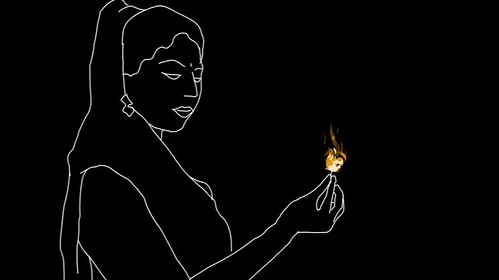
Rather than attempting to describe the entire three-minute segment, which could easily go on and on – “a picture is worth thousand words” and this film packs a lot of them into 180 seconds. Instead, I’ll concentrate on a few frames. The following two frames are from the beginning and the end of the segment, respectively. We see Sita in white outline against a black background, but her hair has some color fill (collaged in) in the ending segment, but not the beginning.

Light the match.
Blowing out the match.

In both frames she is holding lighted match. She lit the match at the opening of the segment and then dropped it, lighting the fire beneath her. At the end she blows the match out, ending the segment. Thus there is a bit of visual continuity between the opening and ending segments. At the same time the final act, in effect, reverses the opening one. The opening act took Sita into the fire; the closing act brings her out of it and back into the world.

Is this a rite de passage? (Of course it is, of course.) For who? Sita, Nina, us? Of what kind, from what to what?

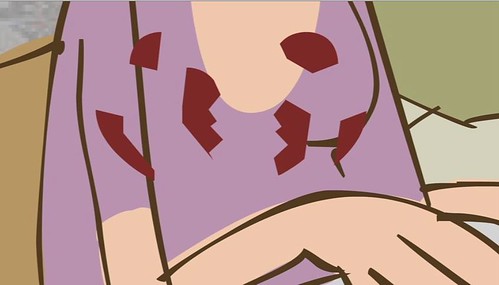
Now consider these three frames, which come one after the other in the film:

Sita dancing, 1, 2, 3

The backgrounds are pretty much the same, which is what you would expect from such closely spaced frames. But look at Sita in the center. Her outline is not quite the same from one frame to the next, for she’s spinning counter-clockwise at a pretty good rate; but her overall visual mass remains in the same position within the frame. The texture filling her form, however, differs radically from one frame to the next. All three body fills are half-tone images magnified to the point where the individual dots are visible, but I can’t make out identity of the material in either the first frame or the third. The second image is the head of a woman.

Paley uses this technique throughout the segment. None of the collage elements is on the screen for more than a fraction of a second. You can identify some of the images, but not most of them. It is obvious that she’s showing lots of different things mostly through Sita’s form, but through other elements of the segment as well.

Now look at Sita in this next frame, to the left. Her outline, in black, is decoupled from the texture-filling forms, one for her hair (yellow-green), one for her body (a warm medium brown) and still others for her eyes. Paley does this for about six seconds. What’s this about?

Form and fill dissociated

If you’ve been reading visual neuroscience you may note that fill and outline are handled in different systems, as is motion. So Paley is “manipulating” those systems, which is interesting. But that doesn’t tell us why she’s doing it? Because she can, and it’s interesting? Certainly, but is that all?

Before I hazard a guess I want to state that the most important thing, at this point, is simply to describe what’s going on. Without that description, nothing else can be done.

So, why’s she doing it? Because it’s different from every other segment in the film, including the two segments that also depict the Agni Pariksha. One of those is set to Annette Hanshaw’s performance of “Mean to Me” while the other is set to her performance of “I’ve Got a Feelin’ I’m Fallin’.” In both of those cases the visual style is Paley’s old-time “cartoony” style, which she uses for all the Hanshaw performances. That is to say, those ritual enactments are not visually different from any other events in the Hanshaw version of the Sita story.

Any anthropologist will tell you that rituals are about transformation (e.g. van Gennup 1960); some literary critics will tell you that as well (e.g. Frye 1965, Barber 1959). By making this segment visually different from anything else in the film Paley is giving the film itself a ritual dimension – though the part of me that is a child of the 60s is thinking “altered state of consciousness” (cf. Fischer 1975). She’s not merely showing a ritual, depicting one in the film; she is inviting us to enact a ritual by experiencing the visual world in a way that is radically different from what we experience anywhere else in the film. This segment of the film IS ritual.

Now, if we wish, we can begin thinking about what happens in the nervous system in this segment that is different from every other segment in the film. In the annoying manner of math textbooks, however, I’ll leave that as an exercise for the reader.

Monday, November 13, 2023

Disney's Fantasia as Masterpiece

This is currently the fifth most popular post at New Savanna.  I originally published it in The Valve in August, 2006; I then republished it here in November, 2010. It's about why Fantasia is one of the great works of 20th Century art. The first time I formulated that thought to myself — that Fantasia is one of the great works of 20th Century art — it took my breath away. But in time I got used to the idea. Almost.

The argument in the post, however, is at most only half the argument. It's about what happens in Fantasia, what phenomena Disney chose to represent. The other half of the argument is, it seems to me, rather more difficult to state, for it is about how things look on the screen. If the film doesn't look good, well, the representational content is not in itself enough to make compelling art. I believe, of course, that it does look good. This post on The Nutcracker Suite is part of that argument, as is this post on Dance of the Hours.
April 27, 2014: It's now the 4th most popular post. Another Fantasia post, Two Rings in Fantasia, is 3rd.
June 14, 2021: It's now the 6th most popular post. Two Rings in Fantasia is now 4th.

November 13, 2023: My sister, Sally, has just informed me that Fantasia premiered on this day back in 1940. So I'm bumping this post to the top of the queue. I've published a working paper on the film: Walt Disney’s Fantasia: The Cosmos and the Mind in Two Hours.

dandilion

In 1938 Walt Disney decided to bet the farm on an extravaganza originally entitled The Concert Feature. Disney's intention was twofold. On the one hand he would use the power of animation to present Classical Music to the Masses. Get it out of the concert hall, into the movie palace, and dress it up to make it more approachable. But also, showcase the powers of this new medium - one in which Disney had a considerable investment, both in time and imaginative effort and in money - in a way that had never been done before.

Disney secured the collaboration of Leopold Stokowski, the best-known conductor of the day (who had already been parodied in a cartoon or two) and devoted the full resources of his studio to the effort. The film premiered in late 1940 under a new name, Fantasia, and received mixed critical notices. Music critics were offended, film critics didn't quite know what to think, though some liked it. The public, for the most part, did not. The film was a financial failure, though it finally managed to break-even in the late 1960s, after Disney had died.

Fantasia is highly regarded among students of animation and has sold well in videotape and DVD. I have little sense of where it stands among more general arbiters of culture. I'm convinced it is a masterpiece. But a masterpiece of what?

Encyclopedic Forms

In 1976 Edward Mendelson published an article on “Encyclopedic Narrative: From Dante to Pynchon” (MLN 91, 1267-1275). It was an attempt to define a genre whose members include Dante's Divine Comedy, Rablais', Gargantua and Pantagruel, Cervantes' Don Quixote, Goethe's Faust, Melville's Moby Dick, Joyce's Ulysses, and Pynchon's Gravity's Rainbow. Somewhat later Franco Moretti was thinking about “monuments,” “sacred texts,” “world texts,” texts he wrote about in Modern Epic (Verso 1996). He came upon Mendelson's article, saw a kinship with his project, and so added Wagner's Ring of the Nibelung's (note, a musical as well as a narrative work), Marquez's One Hundred Years of Solitude, and a few others to the list. It is in this company that I propose to place Fantasia.

On the face of it, the idea is absurd. For one thing, the works Mendelson and Moretti discuss are securely ensconced in the Western Canon of High Art, Fantasia is a cartoon. Perhaps it occupies a significant place in popular art of the 20th century, but how could it possibly be anything more?

I'm not sure what kind of consideration this is. But I'm just going to ignore it.

The fact that Fantasia is not even a narrative - it tells no connected story from beginning to end - is a more serious matter. If genres are to be defined by intrinsic characteristics, then Fantasia fails. In a footnote Mendelson indicates that Frye discusses various encyclopedic forms in his Anatomy of Criticism, namely Menippean satire and anatomy. But Fantasia doesn't fit there either. Perhaps it is sui generis.

What is important to me is simply the encyclopedic scope of these various works. All of them seek to encompass the entire world as it was known at the time.

So does Fantasia. In the brief compass of two hours Fantasia traverses an astonishing range of . . . of what? “Human experience” would be a good phrase here, but one major segment, The Rite of Spring, concerns things which no human being could possibly have experienced. Human experience, yes. But more generally, the world.

10 hot sun.jpg


Friday, November 3, 2023

Miyazaki's "The Boy and The Heron" to be released in the USA in December

Debbie Diamond Sarto, GKIDS Drops Miyazaki’s ‘The Boy and The Heron’ English Trailer, Anime World Network, Thursday, November 2, 2023:

GKIDS has just released the new English-language trailer for Oscar-winning filmmaker Hayao Miyazaki and Studio Ghibli’s new feature, The Boy and The Heron. The film's previously announced English language dub will feature the voices of Christian Bale; Dave Bautista; Gemma Chan; Willem Dafoe; Karen Fukuhara; Mark Hamill; Robert Pattinson; and Florence Pugh. The trailer offers a first look at voice performances of the film’s all-star English language cast. The English-language dub was produced in accordance with the SAG-AFTRA Foreign Dubbing Agreement.

The Boy and The Heron heads to cinemas in the U.S. and Canada on December 8, 2023, in the original Japanese and English language versions. GKIDS also announced special preview engagements in New York and Los Angeles on November 22.

Released in Japan as Kimitachi wa Do Ikiruka (translated as How Do You Live), the hand-drawn animated feature – director Miyazaki’s first feature film in 10 years – opened exclusively in Japanese cinemas earlier this year. Produced by Oscar-winning Studio Ghibli co-founder Toshio Suzuki, the film features a musical score from Miyazaki’s long-time collaborator Joe Hisaishi.

An original story, Heron is set in World War II and follows a boy grieving for his deceased mother while his father quickly remarries his mother’s sister. As a teaser had previously described, “A young boy named Mahito yearning for his mother ventures into a world shared by the living and the dead. There, death comes to an end, and life finds a new beginning. A semi-autobiographical fantasy about life, death, and creation, in tribute to friendship, from the mind of Hayao Miyazaki.”

The Boy and The Heron premiered internationally at Opening Night Gala of the 48th Toronto International Film Festival on September 7. The film made its U.S. premiere at the New York Film Festival, its European Premiere at the Opening Night of San Sebastian International Film Festival, its UK premiere at the BFI London Film Festival, and its Los Angeles IMAX premiere at the Opening Night of the Animation is Film Festival.

Source: GKIDS

Thursday, November 2, 2023

Quickie: Spider-Man: Across the Spider-Verse [Media Notes 98a]

I don’t know what to say. I saw Spider-Man: Into the Spider-Verse in a theater and liked it. Maya Phillips has a positive review of Spider-Man: Across the Spider-Verse in the NYTimes. Here’s as trailer:

WOW! The color, patterns, texture, action. WOW!

And that’s about it for me. I like the visual style, but...in three sessions I’ve been unable to finish watching it. I figure that’s on me, but on the film as well. Distinguishing between the two, that’s difficult.

On me, I’m preoccupied by intellectual projects at the moment, mostly my ChatGPT round-up, but also an expansion of my Out of Control piece. I’m afraid it would be difficult for any movie, at least when viewed on the small screen at home (Netflix) – the big screen with big sound and an audience, that’s another kettle of fish – to capture my attention. A half-hour (the remake of the Odd Couple, for example) or an hour is about as far as I can go (Miami Vice anyone?).

But, this adolescent hero, Miles Morales, is grating on my last nerve. Why’s he so damn whiny? Why doesn’t he grow up? But then, that’s what the film is (supposed to be) about, no? So, I’m really not the target audience for this film.

OTOH, there’s too damn much action, too quick. Maybe that also means that I’m not the audience for this film, but I don’t care. Slow down, breathe, reflect a bit. It won’t kill you. THAT’s a problem with the film. & maybe Miles would be less bothersome if his makers gave him more room to chill out.

But, damn! I do like the style. All the colors and textures, even the inclusion of live-action clips, and snippets from other Spidey films, the references to canon. It’s all good, or would be if there weren’t so damn much crammed into too little time. This style has room to grow, definitely.

I will, somehow, manage to watch the whole thing.

Tuesday, October 31, 2023

Kristin Thompson on Best Film Oscars in recent years

Kristen Thompson, “Best Picture” ≠ “Live Action,”Observations on film art, July 8, 2023.

Opening paragraphs:

Way back in 2006, I posted a long piece on the increasing prominence of animated features being released each year. This was in the infancy of the blog, and the entry shows it–few photos, inserted as thumbnails. We only gradually worked up to our format of posting plenty of illustrations. By contrast this current contribution offers plenty of visual pleasure.

Basically I argued three points. First, that by their nature animated films would tend to be among the highest-quality films in any given year, despite their relatively small number in those days.

My argument laid out some reasons for this high quality. First, the fact that animated films were perforce thoroughly planned in pre-production, meaning that every detail was carefully considered. This means that relatively few inadequate scenes are reworked in production. Live-action films these days tend to be heavily dependent on shooting lots of coverage and making many decisions in the editing stage. Not true of animated films. Similarly, the soundtrack is recorded in advance and the images animated to sync with it. Hence the sound is meticulously planned. The voice actors record their voices and leave, usually not hanging around to try and change their scenes during shooting or fluffing lines and thus requiring multiple retakes of scenes.

My second point addressed the opinion, widely circulating in the trade press, that the spread of animation, and particularly digital animation, was a mistake. I quoted a recent Screen International article: “Much has been made this year of the seeming over-saturation of studios’ computer-generated titles, with critics and analysts pointing to growing movie-goer apathy.” I pointed out that such a claim didn’t fit the facts: “As a proportion among the total number of films made, CGI’s box-office successes seem fairly high compared to live-action films.”

My third point was that American distributors did not know how to market films from abroad, so that Ghibli and Aardman titles did not get nearly the audiences they deserved. Since then the distributor GKIDS has shown that it’s possible, at least for a relatively small company, successfully to release such films. They currently offer films with eleven best-animated feature Oscar nominations (with one win, Spirited Away), having gained distribution rights to Ghibli films, previously controlled by Disney.

Since I wrote that entry, the number of animated films, mostly digital, released yearly has sharply increased. And the disproportionate number of those animated films that appear among the top hits of the year continues to demonstrate that people are not apathetic. The spread of streaming services, combined with the decline of theatrical attendance during the pandemic, make it difficult to judge the success of films. Going back to 2019, where it’s a bit easier to judge, the top ten films included two animated successes, Toy Story 4 and Frozen II. An additional two were in the top twenty, How to Train Your Dragon: The Hidden World and The Secret Life of Pets 2. Animated films did not make up 20% of all films released, but that’s the portion of the top twenty they occupied.

I followed up that entry with one that found additional evidence that animated features were doing well, including the fact that Ice Age: The Meltdown was, though not the top box-office film of 2006, the most profitable film of that year.

So many developments have occurred in the world of feature animation since that first post that I decided to write an update.

Thompson then goes on to make a head-to-head comparison of Oscar-nominated live-action and animated films between 2002 and 2022. Her conclusion:

Totting up the live-action vs. animation winners in this face-off, we find one recusal, one draw, five decisions in favor of the live-action winners and fourteen for the animated winner or one or more of the animated nominees. As I mentioned at the start, the figures would be quite different if I had compared all the Oscar-worthy animation awards with all the Oscar-worthy Best Picture nominees. Still, in general this comparison may suggest that animated films are unfairly treated as one of the minor categories that people don’t pay much attention to.

I’m not suggesting that the Academy change their categories or rules. There’s probably no way to boost the prestige of the Animated Feature nominees.

The point here has simply been to add some evidence to my claim that a higher percentage of animated films tend to be excellent in a way that compares favorably with the live-action films nominated in the more prestigious category. Despite this, animated films are simply not taken seriously by most people, inclined cinephiles. They are still viewed as children’s fare, despite the successful appeal to adults built into many of the titles I’ve singled out here. They are also mostly comic to some extent and often involve fantasy, while Oscar bait leans toward drama and, with rare exceptions, away from fantasy/science fiction.

The conclusion is that if you think, for whatever reason, that live-action Oscar winners and films in general have declined in the past few decades, check out some ‘toons.

Color me sympathetic. You should read the whole thing. 

 While you're absorbing this information, take a re-read on my post about Robert De Vany's Hollywood Economics,  quantitative studies developing models that show we don't know how to predict the eventually box-office success of films. Do makers of animated films know something the rest of Hollywood does not?

Wednesday, March 29, 2023

Motion capture is not at all straightforward

From YouTube:

The suits are just the beginning of the motion capture process.

Motion capture has taken over a lot of computer animation for movies, video games, and TV. Coverage typically focuses on actors wearing funny suits and performing feats of imagination. But is it really that easy?

The above video shows that it’s a lot more complex than that. Motion capture requires heavy editing, tweaking, and processing after the actual capture to create animations that look real. That part of the process is key to understanding the images on your screen.

Watch the above video to learn more.

Further Reading: https://plask.ai/
Plask.ai lets you try out these tools for yourself. It’s a fun way to see just how far AI-based motion capture can go.

https://www.mixamo.com/#/
Mixamo is one of many resources for motion capture artists, and it’s fun to just browse the animations and see how they work.

As in most things related to visual effects, the site Befores and Afters has countless relevant nuggets of behind-the-scenes footage and deep dives into motion capture history.

Sunday, March 19, 2023

Top Posts at New Savanna 19 Mar 23 [& notes about why]

Every once in a while I make a post about what’s going on here at New Savanna, though I tend to include action at my Academia page under that tag as well. Back in August of 2019 I took a look at top posts. Back in August of 2013 I took a look at the all-time most popular posts, as of that time. I gave counts for the top 35 posts.

It's time for another look, though I’m not going to survey the top 35. I have something different in mind.

This shows the action from the beginning, in April 2010, to the present:

Notice that big spike there around 2017. I have no idea what’s going on there. Here’s a short post about it.

This is Blogger’s list of the top ten all-time posts:

The counts are off, moreover, when you take a closer look, those really aren’t the top ten. I’ll look at the in a minute.

But let’s take a look at the list as it stands. The top post is about Ninja Scroll. That’s one of the earliest posts I ever did and it has been the top post as long as I’ve been checking. Five more of the top posts are about animation, either Disney or Miyazaki. While I’ve done many posts featuring photos of irises, that particular post has only one photo. It’s a nice photo, but I do not know why it has proven so popular. I assume the popularity of Joe Rogan post is a function of Rogan’s popularity plus Bruce Lee and Chuck Norris (it’s about a well-known fight scene). The Hilary Hahn post is nice, and I believe benefited from being listed over at Marginal Revolution. Finally, we have that old post about what’s popular here. Why’s it so popular?

This table gives more accurate counts for those posts, along with direct links to them. Thus, whereas the Bogger states had Ninja scroll at 138K, the true figure seems to be 142K. Going to the bottom, we have 3.08K for Hilary Hahn vs. 3.59K. But look at the disparity for Pigs in Spirited Away, 3.67K vs. 14.2K. Something’s messed up. I have no idea what, but I decided to do some looking around.

Top Ten Posts at New Savanna

Listed in order according to Blogger’s order and not by “true” count

March 19, 2023

Sex, Power, and Purity in Kawajiri’s Ninja Scroll [Rape]

142,091

Secrets of Pink Elephants Revealed

94,000

Horikoshi’s Wife: Affective Binding and Grief in The Wind Rises

54,877

Irises

10,082

Two Rings in Fantasia: Nutcracker and Apprentice

9,435

Joe Rogan and Joey Diaz call “Bruce Lee vs. Chuck Norris”

6,338

Disney’s Fantasia as Masterpiece

8,236

What’s Popular and Why (April 2011)

5,961

Pigs in Spirited Away

14,212

Hilary Hahn on daydreaming as a mode of practicing music, of priming yourself to go with the flow in performance

3,590

Since animation is by far the post popular topic, I looked at animation posts. I’ve created tables for Miyazaki posts, Disney posts, and other animation.

Most Popular Miyazaki Posts

March 19, 2023

Horikoshi’s Wife: Affective Binding and Grief in The Wind Rises

54,877

Pigs in Spirited Away

14,212

Follow the Acorns: Revealing Totoro

9,326

Miyazaki Notes 2: Castle in the Sky

6,193

Real Dreams: From Seeds to Trees in Totoro

6,876

Miyazaki Notes 2: Castle in the Sky

6,193

Porco Rosso 3: In the Minds of Women

5,626


Most Popular Disney Posts

March 19, 2023

Secrets of Pink Elephants Revealed

94,000

Two Rings in Fantasia: Nutcracker and Apprentice

9,435

Disney’s Fantasia as Masterpiece

8,236

Domestic Tranquility, NOT: Disney’s Pastoral

6,682

American Mythology in Disney’s Dumbo

5,040

Roustabouts, Trains, Elephants, and Crows

4,373


Other Popular Animation Posts

March 19, 2023

Sex, Power, and Purity in Kawajiri’s Ninja Scroll [Rape]

142,091

Sakaki Rides a Dolphin

7,256

Samurai Champloo: Graffiti and Baseball in Old Japan

4,745

Porky in Wackyland

4,140

Intimate Enemies: What’s Opera, Doc?

3,739

The Hottest Man in Siam

2,304

I’m particularly pleased that The Hottest Man in Siam has done so well. It’s about a Walter Lantz cartoon, “The Greatest Man in Siam,” which features an amazing dance sequence, two people doing the Lindy to a really hot trumpet solo. The post is mostly screen shots of that dance sequence. It’s hard to find online. The last time I looked I couldn’t find it. But maybe someone’s put it up again.